Classes in Principle-based Parsing
Paola Merlo*
Universit6 de Gen6veIn recent years models of parsing that are isomorphic to a principle-based theory of grammar (most notably Government and Binding (GB) Theory) have been proposed (Berwick et al. 1991). These models are natural and direct implementations of the grammar, but they are not efficient, because GB is not a computationally modular theory. This paper investigates one problem related to the tension between building linguistically based parsers and building efficient ones. In particular, the issue of what is a linguistically motivated way of deriving a parser from principle-based theories of grammar is explored. It is argued that an efficient and faithful parser can be built by taking advantage of the way in which principles are stated. To support this claim, two features of an implemented parser are discussed. First, configurations and lexical information are precompiled separately into two tables (an X table and a table of lexical co-occurrence) which gives rise to more compact data structures. Secondly, precomputation of syntactic features (O-roles, case, etc.) results in efficient computation of chains, because it reduces several problems of chain formation to a local computation, thus avoiding extensive search of the tree for an antecedent or extensive backtracking. It is also shown that this method of building long-distance dependencies can be computed incrementally.
1. Introduction
In the development of parsers for syntactic analysis, it is standard practice to posit two working levels: the grammar, on the one hand, and the algorithms, which produce the analysis of the sentence by using the grammar as the source of syntactic knowl- edge, on the other hand. Usually the grammar is derived directly from the work of theoretical linguists. The interest in building a parser that is grounded in a linguistic theory as closely as possible rests on two sets of reasons: first, theories are developed to account for empirical facts about language in a concise w a y - - t h e y seek general, abstract, language-independent explanations for linguistic phenomena; second, cur- rent linguistic theories are supposed to be models of humans' knowledge of language. Parsers that can use grammars directly are more likely to have wide coverage, and to be valid for many languages; they also constitute the most economical model of the human ability to put knowledge of language to use. Therefore, postulating a direct correspondence between the parser and theories of grammar is, methodologically, the strongest position, and is usually assumed as a starting point of investigation. How- ever, experiments with parsers that are tightly related to linguistic principles have often been a disappointment, largely because these parsers are inefficient.
Inefficiency is a problem that cannot simply be cast aside. Computationally, it renders the use of linguistic theories impractical, and, empirically, it clashes with the
Computational Linguistics Volume 21, Number 4
observation that humans make use of their knowledge of language very effectively. In this paper, I investigate the computational problem related to the tension between building linguistically based parsers and building efficient ones, which, I argue, derives from the particular forms linguistic theories have taken recently. In particular, I explore the issue of what is a good parsing technique to apply to principle-based theories of grammar. I take Government-Binding (GB) theory (Chomsky 1986a,b; Rizzi 1990) to be a suitable illustration of such theories, and also to show in all clarity the problems that might arise. I differ from other investigations on the import of principle-based parsing in not drawing on cognitive issues or psycholinguistic results to justify m y assumptions. Indeed, part of the spirit of this work is to explore how far one can go in advocating principle-based parsing, in the absence of motivations given by cognitive modelling.
1.1 The Problem
When generative grammatical theory in the '70s talked about "dative shift," "topi- calization," "passive," it meant that each of these constructions was captured in the grammar by a specific rule. Consequently, rules were not only construction-specific, but also language-specific (French, Italian and Spanish, for instance, have no "dative shift"). The conceptual development of the '80s, in many frameworks, consists in hav- ing identified the unifying principles of many of these construction-specific rules. For example, according to GB theory, the same set of principles are at work in the "raising" construction, (la) and in passive, (lb). The principles are X theory, the Theta Criterion, and the Case Filter. In both cases, the relation between the underlying position and the surface string is expressed by
chains.
Chains consist of the word that undergoes movement and all the positions this word occupies in the course of a derivation. In (1) the chains are(John, t)
and(The children, t).
(1) a. John seems [ip t to like Bill ]
b. The children are loved t by John.
The advantage of this treatment is that common properties of language, here certain classes of verbs, are expressed by common principles.
This search for generality is not unique to GB theory. Feature-structure formalisms also use rule schemata to capture similarities among grammar rules. Moreover, reen- trancy as a notational device to express common features seeks the same type of representational economy that is expressed by the use of "traces" in GB theory.
is desirable for the parser to maintain the level of explanatory power of the theory, it must maintain its modularity.
It has also been argued (Berwick 1991) that the current shift from rules to a modu- lar system of principles has computational advantages. Principle-based grammars en- gender compactness: Given a set of principles, P1, P 2 , . . . , Pn, the principles are stored separately and their interaction is computed on-line; the multiplicative interaction of the principles, P1 x P2 x ... × Pn does not need to be stored. Hence, the size of the grammar is the sum of the sizes of its components: IGI = P~ + P2 + "'" 4- Pn. Con- sequently, a parser based on such a grammar is compact, and, theoretically, easier to debug, maintain and update. 1 In practice, however, designing and implementing faithful and efficient parsers is not a simple matter.
Defining "faithfulness" to a linguistic theory is not a trivial task, as a direct relation between the grammar and the parser is not the only option (see Bresnan 1978; Berwick and Weinberg 1984; van de Koot 1990, and references therein). In general, it is not necessary for a parser to implement the principles of the grammar directly. Rather, a covering grammar could be used, more suited to the purpose of parsing. However, it is important that such covering be done in such a w a y that accidental properties of a particular grammar, which would not hold under counterfactual changes, are not used. Otherwise, the covering grammar would not be sufficiently general.
A faithful implementation is particularly difficult in the GB framework, as GB principles are informally expressed as English statements, and can take a variety of forms. For example, X theory (a condition on graphs), the Case Filter (an output filter on strings), and the 0 criterion (a bijection relation on predicates and arguments) all fall under the label of principles. Attempts have been made to formalize GB principles to a set of axioms (Stabler 1992).
One possible, extreme interpretation of the direct use of principles is an approach where no grammar compilation is allowed (Abney 1989; Frank 1992; Crocker 1992). 2 This approach is appealing because it reflects, intuitively, the idea of using the grammar as a set of axioms and reduces parsing to a deduction process. This is very much in the spirit of the current shift in linguistic theories from construction-dependent rules to general principles, and it separates quite clearly the grammar from the parsing algorithm.
However, it is not obvious that this approach is efficient. Partial evaluation and variable substitution can increase performance, but, as usual, a space/time trade-off will ensue. Excess of partial evaluation off-line increases the size of the grammar, which might, in turn, slow down the parse. Experimentation with different kinds of algorithms suggests that some amount of compilation of the principles might be necessary to alleviate the problem of inefficiency, but that too much compilation slows d o w n the parser again.
1 Berwick (1982, 403ff.) shows that the size of a cascade of distinct principles (viewed as machines) is the size of its subparts, while if these same principles are collapsed, the size of the entire system grows mulfiplicatively. Modularity corresponds to maximal succinctness w h e n all independent principles are stated separately. Independent principles are, intuitively, principles that can be computed
independently of each other, and therefore whose interactions are all possible. Barton et al. (1987) and Berwick (1990) attempt to formalize the concept of independence as separability, assuming that the topology of a principle-based theory like GB can be m a p p e d onto a planar graph. In fact, if independent modules are separable modules, there is little reason to think that GB is modular, as it corresponds to a highly connected graph.
Computational Linguistics Volume 21, Number 4
1.2 On-line Computation is Inefficient
Several researchers note that principle-based parsers allowing no grammar precom- pilation are inefficient. Firstly, Johnson (1989), Stabler (1990), and van de Koot (1991) note that the computation of a multi-level theory without any precompilation might not even terminate. Secondly, experimental results show that an entirely deductive approach is inefficient. Kashket (1991) discusses a principle-based parser, where no grammar precompilation is performed, and which parses English and Warlpiri us- ing a parameterized theory of grammar. The parsing algorithm is a generate-and-test, backtracking regime. Kashket (1991) reports, for instance, that a 5-word sentence in Warlpiri (which can have 5! analyses, given the free word order of the language) can take up to 40 minutes to parse. He concludes that, although no mathematical analysis for the algorithm is available, the complexity appears to increase exponentially with the input size.
Fong (1991, 123) discusses a parsing algorithm. He shows that an initial version of the parser, where the phrase structure rules were expressed as a DCG and interpreted on-line, spent 80% of the total parsing time building structure. In a later version, where rules were compiled into an LR(1) table, structure-building constituted 20% of the total parsing time. This same parser includes a module for the computation of long distance dependencies, which works by generate-and-test. Fong finds that this parsing approach is also inefficient.
Dorr (1987) notices similar effects in a parser that uses an algorithm more parallel in spirit (Earley 1970). Dorr notes that a limited amount of precompilation of the prin- ciples speeds up the parse, otherwise too many incorrect alternatives are carried along before being eliminated. For example, in her design, X theory and the other principles are coroutined. She finds that precompiling the principles that license empty categories with the phrase structure rules reduces considerably the number of structures that are submitted to the filtering action of the other principles, and thus speeds up the parse. In all these cases, the source of inefficiency stems from the principle-based design. Because each principle is formulated to be as general as possible, the "logical" abstrac- tion of each principle from the others causes a lot of overgeneration of structure and, consequently, a very large search space.
1.3 Too Much Precompilation is Inefficient
Simple precompilation is not a solution to the inefficiency of principle-based parsing, however. Experimentation with different amounts of precompilation shows that off- line precompilation speeds up parsing only up to a certain point, and that too much precompilation slows d o w n the parser again.
The logic of w h y this happens is clear. The complexity of a parsing algorithm is a composite function of the length of the input and the size of the grammar. For the kind of input lengths that are relevant for natural language, the size of the grammar easily becomes the predominant factor. If principles are precompiled in the form of grammar rules, the size of the grammar increases.
a uniform format. Therefore, GPSG is, in principle, more amenable to being processed by known parsing techniques. Thompson (1982) finds that expanding metarules, rather than computing them on-line, is advantageous, but that instantiating the variables in the expanded rules is not. Phillips and Thompson (1985) also remark that compiling out a grammar of twenty-nine phrase-structure rules and four metarules is equivalent to "several tens of millions of context-free rules." Phillips (1992) proposes a modifica- tion to GPSG that makes it easier to parse, by using propagation rules, but still notes that variables should not be expanded.
In conclusion, the lesson from experimentation is that parsing done totally on-line is inefficient, but that compilation is not always a solution. A parser that uses linguistic principles directly must fulfill apparently contradictory demands: for the parser to be linguistically valid it must use the grammar directly, while a limited amount of off-line precompilation might make the parser more efficient. 3 In the next section, I propose and discuss a solution to this problem that builds on other approaches and relates the parser to the grammar in a principled way.
2. The Proposal
Two avenues have generally been pursued to build efficient GB parsers. In one case, a "covering grammar" is compiled, which overgenerates and is then filtered by con- straints. The compilation is done in such a way that the overgeneration is well- behaved. For instance, the correct distribution of empty categories is calculated off-line (Dorr 1993). In the other case, all the principles are applied on line, but they apply only to a portion of the tree, and are therefore restricted to a local computation (Frank 1992). 4 My proposal combines these two approaches: it adopts the idea of compiling the grammar, at least partially, off-line but it attempts to find a principled way of doing so. In this, I differ from Dorr, where the amount of compilation is heuristic and based on practical experimentation. The approach shares Frank's intuition that linguistic principles have a form, which can be exploited in structuring the parser.
This proposal is based on two observations. First, each principle of linguistic theory has a
canonical form,
and second, primitives of linguistic theories can be partitioned into classes, based on their content.As an illustration of the first observation, we can look at the principle that regulates the distribution of the empty categories in the phrase marker, the Empty Category Principle (ECP), as stated below (adapted from Rizzi 1990, 25).
(2)
.
The Empty Category Principle
An empty category x is licensed if the 3 following conditions are satisfied:
x is in the domain of a head H
3 For CF parsers, just how much compilation speeds up the parser is defined precisely by the analysis of the algorithm. No such precise analysis is available for principle-based algorithms.
4 Frank (1992) presents a parsing model that is claimed not to allow any compilation of the linguistic theory, and to operate in linear time. Two objections can be raised to these claims: first, the use of TAG elementary trees to restrict the working space of the parser amounts to a precompilation of
Computational Linguistics Volume 21, Number 4
.
3.
the category of H E {A, Agr, N, P, T, V}
there is no barrier or head H r that intervenes between H and x
It can be observed that this principle has an internal structure and can be decom- posed into separate pieces of information: (2.1) imposes a condition on configurations, namely, a condition on the shape of the tree; (2.2) imposes a condition on the labelling of the nodes in the tree; and (2.3) imposes a locality condition, as it defines the subtree available for the computation of the principle. These three conditions are independent. For instance, the configuration does not depend on the categorial labelling of the head node. The precompilation of these conditions would require computing all the possible combinations, without any reduction of the space of analysis.
The second observation is based on a detailed inspection of the form of the prin- ciples of the grammar. What is presented in (2) as an illustrative example is, in fact, a consistent form of organization of the principles. If one looks at several of the princi- ples of the grammar that are involved in building structure and annotating the phrase marker, one finds the same internal organization.
Theta-assignment occurs in the configuration of sisterhood, it requires a 0-assigning head, and it must occur between a node and its most local assigner. Assignment of Case occurs in a given configuration (according to Chomsky (1988, 1992) it is always a specifier-head configuration), given a certain lexical property of the head ([-N]), and locally, within the same maximal projection). The same restriction occurs again for what is called the wh-criterion (Rizzi 1991), which regulates wh-movement, where the head must have a +wh feature and occur within a specifier-head configuration. Cat- egorial selection and functional selection also occur under the same restrictions, in the complement configuration (i.e., between a head and a maximal projection). The licensing of subjects in the phrase marker, done by predication, must occur in the specifier-head configuration. The licensing of the empty category pro also requires the inflectional head of the sentence to bear the feature Strong Agr, and it occurs in the specifier-head configuration. The assignment of the feature [+ barrier] depends on L-marking, which in turn requires that the head is lexical, and that marking occurs in the complement configuration.
Thus, each different "factor" that composes a principle can be considered a sepa- rate primitive, and such primitives can be grouped into classes defined according to their content. Linguistic information can be classified into five different classes:
(3) a. Configurations: sisterhood, c-command, m-command, + maximal b. Lexical features: i N , +V, +Funct, +c-selected
c. Syntactic features: +Case, +0, +% +barrier, +Strong Agr d. Locality information: minimality, antecedent government e. Referential information: q-anaphor, q-pronominal, indices
This qualitative classification forms a partitioning into natural classes based on
information content. I call these IC ClassesP
It can then be h y p o t h e s i z e d that the a m o u n t of compilation (or, conversely, the m o d u l a r i t y of the parser) is c a p t u r e d b y the notion of IC classes as follows:
IC Modularity Hypothesis (ICMH)
Precompilation within IC Classes i m p r o v e s efficiency. Precompilation across IC Classes does not.
In other words, a parser that takes a d v a n t a g e of the structure of linguistic principles will maintain a m o d u l a r design based o n the five classes in (3).
A l t h o u g h the I C M H is not so stringent as to m a k e predictions that c o n v e r g e on a single parsing architecture, it does p r o v i d e some predictive p o w e r a b o u t the orga- nization of the parser. First, structural information is e n c o d e d separately from lexical information. Standard context-free rules, specified with category, such as VP --*V NP, are not compatible with the ICMH, n o r are proposals in the spirit of licensing g r a m - mars (Abney 1989, Frank 1992), w h e r e information is e n c o d e d in each lexical item. Second, the I C M H predicts that long-distance dependencies, represented as chains, are c o m p u t e d in steps. E m p t y categories are licensed in t w o c o m p u t a t i o n a l steps: structural licensing b y an a p p r o p r i a t e head, a n d feature instantiation. With respect to feature instantiation in particular, it is predicted that p r e c o m p i l i n g syntactic features speeds u p the parsing process. This is different from functional a p p r o a c h e s such as Fong (1991), a n d Fong a n d Berwick (1992), in w h i c h there is no precompilation. 6
These predictions seem to be s u p p o r t e d (and, consequently, so is the ICMH) b y t w o m a i n results, w h i c h are illustrated below:
.
m
separating X from lexical information yields m o r e c o m p a c t data structures; I p r o p o s e a parser that uses t w o c o m p i l e d tables: one that encodes structural information, a n d the other that encodes lexical information.
. using syntactic features to c o m p u t e e m p t y categories reduces the search space, complex chains can be c o m p u t e d efficiently.
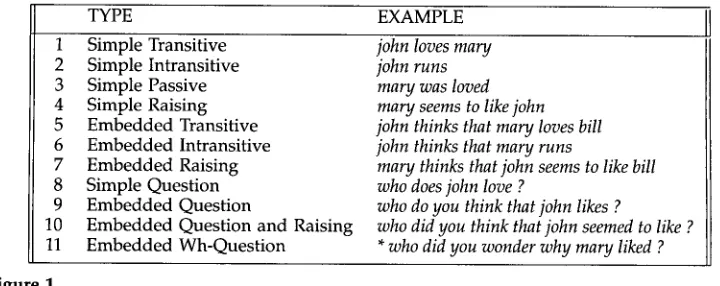
These claims are s u p p o r t e d in the next section, w h e r e I discuss the properties of an i m p l e m e n t e d parser, w h i c h c o m p u t e s simple, complex, a n d multiple chain formation, as exemplified in Figure 1. This subset of constructions has been chosen because it con- stitutes the crucial test set for principle-based parsers: it involves c o m p l e x interactions of principles over large portions of the tree. 7
perspective is not in opposition to the current proposal, as the specialization of the parser in different tasks is likely to be an adaptive reaction to the different types of inputs.
At first sight it might appear that the notion of types proposed by Fong (1991) is similar to IC classes. In fact, the similarity is superficial. Clearly, both notions constitute an attempt to partition the set of principles into smaller subsets. However, Fong's types are a mechanism to interleave constraints and phrase structure rules automatically. They are a method to schedule the on-line computation of principles that are the direct translation of the theory, and not a way of defining the design of the parser. In Fong's view, all computations are done on-line and the parser reflects the theory as directly as possible.
6 It is difficult to separate precisely "lexical" from "syntactic" features. One can consider "syntactic" those features that are used to determine the well-formedness of syntactic trees. In the spirit of more recent developments in syntactic theory, I consider syntactic those features that are involved in some particular incarnation of the "Generalized Licensing Condition" (Sportiche 1992.) These include 0-roles, case, (possibly all ~6 features), and, following Rizzi (1991), Haegemann and Zanuttini (1991), and Laenzlinger (1993), also wh, neg, adverb.
Computational Linguistics Volume 21, N u m b e r 4
TYPE EXAMPLE
1 Simple Transitive 2 Simple Intransitive 3 Simple Passive 4 Simple Raising 5 Embedded Transitive 6 Embedded Intransitive 7 Embedded Raising 8 Simple Question 9 Embedded Question
10 Embedded Question and Raising 11 Embedded Wh-Question
john loves mary john runs mary was loved mary seems to like john john thinks that mary loves bill john thinks that mary runs
mary thinks that john seems to like bill who does john love ?
who do you think that john likes ?
who did you think that john seemed to like ? * who did you wonder why mary liked ?
Figure 1
Types of Sentences.
I n the rest of the p a p e r , I first d i s c u s s the a d v a n t a g e s of s t o r i n g X i n f o r m a t i o n s e p a r a t e l y f r o m lexical i n f o r m a t i o n (section 3). I t h e n t u r n to t h e c o m p u t a t i o n o f l o n g - d i s t a n c e d e p e n d e n c i e s . I illustrate t w o a l g o r i t h m s to c o m p u t e chains: I s h o w t h a t a p a r t i c u l a r u s e of s y n t a c t i c f e a t u r e i n f o r m a t i o n s p e e d s u p the p a r s e , a n d I d i s c u s s the p l a u s i b i l i t y o f u s i n g a l g o r i t h m s t h a t r e q u i r e strict left-to-right a n n o t a t i o n o f t h e n o d e s (section 4). In fact, the a l g o r i t h m I p r o p o s e a p p e a r s to b e i n t e r e s t i n g l y c o r r e l a t e d to a g a p in t h e t y p o l o g y of n a t u r a l l a n g u a g e s .
3. The Computation of Phrase Structure
In o r d e r to e x p l o r e the v a l i d i t y of the p r o p o s e d h y p o t h e s i s a b o u t t h e m o d u l a r i t y o f t h e parser, a n a n a l y z e r for E n g l i s h w a s d e v e l o p e d . E a c h of t h e d a t a s t r u c t u r e s is the direct i m p l e m e n t a t i o n of linguistic objects w i t h d i f f e r e n t i n f o r m a t i o n c o n t e n t s . T h e i n p u t to the a l g o r i t h m is a n u n a n n o t a t e d sentence. T h e o u t p u t consists of a tree a n d a list of t w o chains: the list of A c h a i n s a n d the list o f A chains, t h a t is, c h a i n s f o r m e d b y w h - m o v e m e n t a n d N P m o v e m e n t , respectively. T h e m a i n p a r s i n g a l g o r i t h m is a m o d i f i e d LR p a r s i n g a l g o r i t h m a u g m e n t e d b y m u l t i - a c t i o n entries a n d c o n s t r a i n t s o n r e d u c t i o n . 8
T h e s t r u c t u r e - b u i l d i n g c o m p o n e n t of the p a r s e r is d r i v e n b y a n LR(k) p a r s e r ( K n u t h 1965) w h i c h c o n s u l t s t w o tables. O n e table e n c o d e s X i n f o r m a t i o n ( f o l l o w i n g K o r n a i a n d P u l l u m 1990). T h e o t h e r table e n c o d e s lexical i n f o r m a t i o n . Lexical infor- m a t i o n is c o n s u l t e d o n l y if it is n e e d e d to d i s a m b i g u a t e a state c o n t a i n i n g m u l t i p l e a c t i o n s in the LR parser. A n o v e r v i e w of this d e s i g n is s h o w n in F i g u r e 2.
instance) or they require extensive backtracking (Fong 1991; Fong and Berwick 1992). In formalism other than GB theory, gaps are encoded directly into the rules. Both GPSG and HPSG use slash features to percolate features to gaps. The use of slash features probably simplifies the computation. There has been a debate on the explanatory adequacy of grammars that employ slash features (see van de Koot 1990, and Stabler 1994). For my purposes, note that, if anything, I am dealing with the worst case for the parser.
[image:8.468.56.416.61.204.2]Input [
\
Stack
LR Parsing Program
I
\
I,
I'
LR Table
I
Figure 2
I Chains I
/ ~constr )
o-occurrence Table
I !q/I I I I I I
li I II II~'NI I I
il I 1/1'1 I il I I I I I I
II I'i I I [ ]~- I i I Ill I
,," 'iLi,
iI i R
I'1-1 IP ii I I I I I
, 1 1 1 1 I,I
k l l I I I L I
,,,.
-
j
I
I
Organization of the Parser: The data structures (tables, stack and chains) are represented as rectangles. Operations on feature annotation are performed by constraints, represented as ovals.
Figure 3
Category-Neutral Grammar.
X" --* Y" X' specification X" --* X' Y"
X' --* X Y" complementation X' ~ Y" X
X' --* Y" X' modification X' --* X' Y"
X' ~ X unary head
X" ~ X' unary Xmax
X ~ empty empty heads
X" --~ empty empty Xmaxn
The context-free g r a m m a r compiled in the LR table is s h o w n in Fi__gure 3. The crucial feature of this g r a m m a r is that n o n t e r m i n a l s specify only the X projection level, a n d not the category. Because the LR table is underspecified with respect to the categorial labels of the input, m a n y instances of LR conflicts arise, w h i c h can be teased apart b y looking at the co-occurrence restrictions o n categories. This i n f o r m a t i o n w o u l d be stored in the rules themselves in o r d i n a r y context-free rules. H o w e v e r , o r d i n a r y context-free rules do not e n c o d e m a n y other types of lexical i n f o r m a t i o n also u s e d in parsing. Thus, they lose generality, w i t h o u t exploiting all the available information. As an illustration, consider the following set of context-free rules.
[image:9.468.82.400.58.282.2] [image:9.468.150.310.342.448.2]Computational Linguistics Volume 21, Number 4
(4) 1. C' -+ Co IP
2. I' --* I0 VP
3. V' ~ V0 NP
4. V' ~ V0 e
5. V ~ ~ V0
m
Rules 1-4 have the same X structure, but they differ in the labels of the nodes. In rules I and 2 the heads, Co and I0 respectively, are followed by IP and VP obligatorily. Rules 4 and 5 cover the same string. Clearly, by writing 1-4 as different rules, the fact that they are instances of the same structure is not captured. Similarly, the obligatori- ness of IP and VP as complements of Co and I0 is lost. Finally, the choice of rule 4 or rule 5 depends on the actual verb in the string. If the verb is intransitive, rule 4 cannot apply.
In the parser, structural information is separate from information about co-occur- rence (rules 1-4), functional selection (rules 1, 2) and subcategorization (rules 4, 5). This information is stored in a table, called a co-occurrence table. The table stores information about obligatory complementation, such as the fact that I0 must be fol- lowed by a VP. It also stores compatible continuations based on subcategorization. For instance, consider the case in which the current token is an intransitive verb. The LR table contains two actions that match the input: one action generates a projection of the input node (V'), without branching, while the other action creates an empty object NP. By consulting the subcategorization information, the parser can eliminate the second option as incorrect.
Using an LR table together with a co-occurrence table is equivalent in coverage to a fully instantiated LR table, but it is more advantageous in other respects. Conceptually, the latter organization encodes X theory directly, and it maintains a general design, which makes it applicable to several languages. Practically, there is reason to think that it is more efficient.
3.1 Testing the ICMH for phrase structure
The prediction made by the ICMH is that compiling together X theory and categorial information will increase the size of the grammar without reducing the nondetermin- ism contained in the grammar, because category/subcategory information belongs to a different IC Class than structural (i.e., X) information.
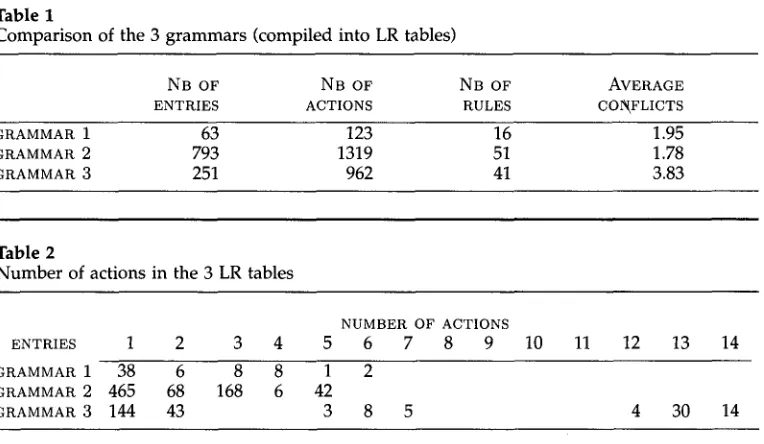
Method and Materials. The size of the grammar is measured as the number of rules or number of states in the LR table. The amount of nondeterminism is measured as the average number of conflicts (the ratio between the number of actions and the number of entries in a table.) 9
Three grammars were constructed, constituting (pairwise) as close an approxima- tion as possible to minimal pairs (with respect to IC Classes). They are shown in the Appendix. Grammar 1 differs minimally from Grammar 2, because each head is in- stantiated by category. The symbol YP stands for any maximal projection admitted by linguistic theory. Grammar 3 differs minimally from Grammar 2, because it also
Table 1
Comparison of the 3 grammars (compiled into LR tables)
N B OF N B OF N B OF AVERAGE
ENTRIES ACTIONS RULES COI~FLICTS
GRAMMAR 1 63 123 16 1.95
GRAMMAR 2 793 1319 51 1.78
GRAMMAR 3 251 962 41 3.83
Table 2
Number of actions in the 3 LR tables
NUMBER OF ACTIONS
ENTRIES 1 2 3 4 5 6 7 8 9 10 11 12 13 14
GRAMMAR 1 38 6 8 8 1 2
GRAMMAR 2 465 68 168 6 42
GRAMMAR 3 144 43 3 8 5 4 30 14
includes some subcategorization i n f o r m a t i o n (such as transitive, intransitive, raising), a n d some co-occurrence restrictions a n d functional selection. Moreover, e m p t y cate- gories are " m o v e d up," so that they are e n c o u n t e r e d as high in the tree as possible. These three g r a m m a r s are then compiled b y the same p r o g r a m (BISON) into three (LA)LR tables. The results are s h o w n in Table 1, w h i c h c o m p a r e s some of the indices of the n o n d e t e r m i n i s m in a given g r a m m a r to its size, a n d Table 2, w h i c h shows the distribution of actions in each of the grammars.
Discussion. Consider G r a m m a r I a n d G r a m m a r 2 in Table 1. G r a m m a r 2 has a slightly smaller a v e r a g e of conflicts, while it has three times the n u m b e r of rules a n d twelve times the n u m b e r of entries, c o m p a r e d to G r a m m a r 1. The fact that G r a m m a r 2 is larger than G r a m m a r 1, with o n l y a slightly smaller a v e r a g e of conflicts, confirms the prediction m a d e b y the ICMH that compiling X t h e o r y with categorical i n f o r m a t i o n will increase the size of the g r a m m a r w i t h o u t decreasing n o n d e t e r m i n i s m . Since the n u m b e r of rules is e x p a n d e d , b u t no "filtering" constraint is i n c o r p o r a t e d in G r a m m a r 2 with respect to G r a m m a r 1, this result m i g h t not seem surprising.
H o w e v e r , the I C M H is also confirmed b y the other pairwise c o m p a r i s o n s a n d b y the global results. G r a m m a r 3 has a higher n u m b e r of average conflicts than G r a m m a r 2, b u t it is smaller, both b y rules a n d LR entries, so it is m o r e compact. Notice that a d d i n g i n f o r m a t i o n (subcategory, selection, etc.) has a filtering effect, a n d the resulting g r a m m a r is smaller. H o w e v e r , a d d i n g i n f o r m a t i o n does not r e d u c e n o n d e t e r m i n i s m . C o m p a r e d to G r a m m a r 1, G r a m m a r 3 does not s h o w a n y i m p r o v e m e n t o n either dimension: G r a m m a r 3 is both larger (four times as m a n y LR entries) a n d m o r e non- deterministic than G r a m m a r 1. Globally, one can observe that an increase in g r a m m a r size, either as a n u m b e r of rules or n u m b e r of LR entries, does not c o r r e s p o n d to a parallel decrease in n o n d e t e r m i n i s m .
Computational Linguistics Volume 21, Number 4
Table 3
Comparison of the 3 grammars (compiled into LL tables)
NB OF NB OF NB OF AVERAGE
ENTRIES ACTIONS RULES CONFLICTS
GRAMMAR 1 19 62 16 3.26
GRAMMAR 1' 19 46 13 2.42
GRAMMAR 2 112 255 51 2.28
GRAMMAR 3 144 368 41 2.62
of conflicts, only some rules can apply, namely, those that have a certain X projection level, and that cover the e m p t y string (e.g., all XP's, independent of category, that cover the empty string). This observation confirms that categorial information does not reduce nondeterminism. On the contrary, adding categorical information multi- plies nondeterminism by adding structural configurations. Even introducing "filter- ing" lexical information (co-occurrence restrictions and functional complementation) does not appear to help. In fact, ambiguities caused by e m p t y categories occur accord- ing to structural partitions. The qualitative observation supports the numerical results: Introducing categorial information is not advantageous, because it increases the size of the grammar without decreasing significantly the average number of conflicts.
3.2 Extending the test to other compilation techniques
The effects discussed above could be an artifact of the compilation technique. In order to check that this is not the case, the same three grammars (reported in the appendix) were compiled into LL and Left Corner (LC) tables.
LL compilation: Discussion. The LL compilation method yields results similar to those of the LR compilation, although less clear cut. This confirms the intuition that the results reflect some structural property of the grammar, and are not an artifact of the LR compilation.
The results of the compilation of the same grammars into LL tables are shown in Table 3. Grammar 1' is a modified version of Grammar 1, without adjunction rules. These figures show that there is no relation between the increased specialization of the grammar and the decrease of nondeterminism. Note that the LL compilation does not maintain the paired rankings of actions and rules. So, for the LL table, the co- occurrence of lexical categories does not play a filtering role.
Globally, there appears to be an inverse relation between the size of the grammar, measured by the number of rules, and the average number of conflicts: the larger the grammar the smaller the number of conflicts. This might make one think that there is some sort of relation between grammar size and nondeterminism after all. However, this is not true if we use the n u m b e r of entries as the relevant measure of size. Moreover, if one looks at Grammar 1', which is smaller than Grammar 1, one can see that the average number of conflicts decreases quite a bit. This confirms a weaker hypothesis, which is nonetheless related to the initial one, namely that nondeterminism does not vary in an inverse function to "content of information."
[image:12.468.52.431.88.172.2]Table 4
Comparison of the 3 grammars (compiled into LC tables)
NB OF NB OF NB OF AVERAGE
ENTRIES ACTIONS RULES CONFLICTS
GRAMMAR 1 49 136 16 2.77
GRAMMAR 2 1456 4030 51 2.76
GRAMMAR 3 398 610 41 1.53
Table 5
Number of actions in the 3 compiled LC tables
NUMBER OF ACTIONS
ENTRIES 1 2 3 4 5 6 7 18 19
GRAMMAR I 4 18 15 9 3
GRAMMAR 2 602 702 48 96 8
GRAMMAR 3 282 92 4 4 4 12
of cell [X0, w p ] in G r a m m a r 1.) This suggests that lexical tokens do n o t p r o v i d e a n y selective information. Moreover, as w e s a w in th.e LR tables, projections to the s a m e level h a v e the s a m e p a t t e r n of conflicts. (In G r a m m a r 2, the n u m b e r of conflicts is m u l t i p l i e d b y the n u m b e r of categories.) 1°
LC-compilation: Discussion.
The s a m e three g r a m m a r s w e r e c o m p i l e d in left corner (LC) tables. The result of the c o m p i l a t i o n are s h o w n in Table 4, a n d the distribution of the conflicts is s h o w n in Table 5. As can be seen f r o m Table 4, G r a m m a r 2 is three times larger t h a n G r a m m a r 1 a n d is c o m p i l e d in a table that has t w e n t y - n i n e times as m a n y entries, b u t the a v e r a g e n u m b e r of conflicts is not significantly smaller.T h e i n t e r p r e t a t i o n of the LC table d e r i v e d f r o m G r a m m a r 3 p o s e s a p r o b l e m for the I C M H . G r a m m a r 3 is larger t h a n G r a m m a r 1, as it contains c a t e g o r y a n d s o m e co-occurrence i n f o r m a t i o n , b u t its a v e r a g e of conflicts is smaller. In this case, it s e e m s that a d d i n g i n f o r m a t i o n r e d u c e s n o n d e t e r m i n i s m . O n the other h a n d , c o m p a r e d to G r a m m a r 2, b o t h the table a n d the a v e r a g e n u m b e r of conflicts are smaller. I take this to m e a n that the I C M H is c o n f i r m e d o n l y b y a global a s s e s s m e n t of the relation b e t w e e n the content of i n f o r m a t i o n a n d the a v e r a g e conflicts, b u t not b y p a i r w i s e c o m p a r i s o n s of the g r a m m a r s . Notice h o w e v e r , that the difference in the t w o p a i r w i s e c o m p a r i s o n s confirms that s i m p l e categorial i n f o r m a t i o n d o e s n o t p e r f o r m a filtering action on the structure, while lexical co-occurrence does. This is precisely w h a t I p r o p o s e to c o m p i l e in the lexical co-occurrence table.
The qualitative inspection of the tables confirms the clustering of conflicts sug- gested b y Table 5. G r a m m a r 1 a n d G r a m m a r 2 s h o w the s a m e p a t t e r n s of conflicts as the LR a n d LL tables: conflicting actions cluster w i t h the b a r level of the category. So, for e x a m p l e , in G r a m m a r 2, o n e finds that w h e n the left corner is a m a x i m a l projection
Computational Linguistics Volume 21, Number 4
the action is unique, while when the corner is a bar level projection there are multiple actions and they are the same, independently of the input token. In Grammar 3, the same patterns of actions are repeated for each left corner, independently of the goal or of the input token.
The qualitative inspection of the compiled tables is coherent across compilation methods and appears, in general, to support the ICMH, as the interaction of structural and lexical information is the cause of repeated patterns of conflicts. Quantitatively, the results, which are very suggestive in the LR compilation, are less clear in the other two methods. However, in no case do they clearly disconfirm the hypothesis. I conclude that categorial information should be factored out of the compiled table and separate data structures should be used. u
4. The Computation of Chains
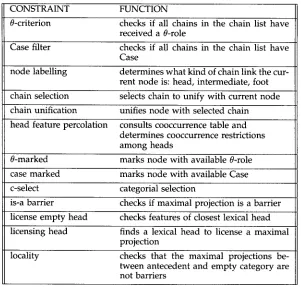
As a result of using a category-neutral context-free backbone to parse, most of the feature annotation is performed by conditions on rule reduction associated with each context-free rule, which are shown in Figure 4.
The most interesting issues arise in the treatment of tiller-gap dependencies, which are represented as chains. Informally, a chain is a syntactic object that defines an equivalence class of positions for the purpose of feature assignment and interpretation.
(5)
a. Maryi was loved ti b. Whoi did John love ti ?c. Maryi seemed t I to have been loved ti . d. Whoi did John think t I that Mary loved ti ?
The sentence in (5a), for example, contains the chain (Maryi, ti), which encodes the fact that Mary is the object of love, represented by the empty category t.
In this parser, empty categories are postulated by the LR parser, when building structure, and their licensing is immediately checked by the appropriate condition on rule reductions, shown in Figure 4.
Many principles regulate the distribution of chains. For the purpose of the follow- ing discussion, it is only necessary to recall that a chain can only contain one thematic position and one position that receives case. Moreover, chains divide into two types:
CONSTRAINT FUNCTION
0-criterion checks if all chains in the chain list have received a 0-role
Case filter checks if all chains in the chain list have Case
node labelling determines w h a t kind of chain link the cur- rent node is: head, intermediate, foot
chain selection selects chain to unify with current node
chain unification unifies node with selected chain
head feature percolation consults cooccurrence table and determines cooccurrence restrictions a m o n g heads
0-marked marks node with available 0-role
case m a r k e d marks node with available Case
c-select categorial selection
is-a barrier checks if maximal projection is a barrier
license e m p t y head checks features of closest lexical head
licensing head finds a lexical head to license a maximal projection
[image:15.468.79.380.63.350.2]locality checks that the maximal projections be- tween antecedent and e m p t y category are not barriers
Figure 4
The Constraints.
m
w h - c h a i n s , a l s o c a l l e d A - c h a i n s , a n d N P - m o v e m e n t c h a i n s , a l s o c a l l e d A - c h a i n s ; t h e e m p t y c a t e g o r i e s t h a t o c c u r i n t h e s e c h a i n s h a v e d i f f e r e n t p r o p e r t i e s . M o r e t h a n o n e c h a i n c a n o c c u r i n a s e n t e n c e . M u l t i p l e c h a i n s o c c u r r i n g in t h e s a m e s e n t e n c e c a n e i t h e r b e d i s j o i n t o r i n t e r s e c t e d . 12 D i s j o i n t c h a i n s a r e n e s t e d , a s in (6a). If c h a i n s in- t e r s e c t , t h e y s h a r e t h e s a m e i n d e x a n d t h e y h a v e e x a c t l y o n e e l e m e n t i n c o m m o n , a s i n (6b).
(6) a. W h o i d i d M a r y i s e e m tj to l i k e ti?
b . W h o i d i d y o u t h i n k ti s e e m e d t i to l i k e M a r y ?
4.1 The Algorithms
W h e n b u i l d i n g c h a i n s , s e v e r a l p r o b l e m s m u s t b e s o l v e d . F i r s t o f all, t h e p a r s e r m u s t d e c i d e w h e t h e r to s t a r t a n e w c h a i n o r not. It m u s t a l s o d e c i d e w h e t h e r to s t a r t a c h a i n h e a d e d b y a n e l e m e n t i n a n a r g u m e n t p o s i t i o n ( A - c h a i n ) , s u c h a s t h e h e a d o f a p a s s i v e c h a i n , o r a c h a i n h e a d e d b y a n e l e m e n t in a n o n - a r g u m e n t p o s i t i o n ( A - c h a i n ) ,
12 Actually, chains can also compose. If chains compose they do not have intersecting elements, but they create a new link. This type of chain is exemplified in (i). We will only discuss chains of the types of (6).
Computational Linguistics Volume 21, Number 4
such as the head of a wh-chain. Second, on positing an e m p t y element, the parser m u s t decide to w h i c h chain it b e l o n g s ) 3
The t w o decisions can be seen as instances of the same problem, w h i c h consists in identifying the
type
of link in the chain that a given i n p u t n o d e can f o r m ( w h e t h e r head, intermediate or foot, abbreviated as H,I,F in w h a t follows.) One can describe this sequence of decisions as two p r o b l e m s that m u s t be solved in o r d e r to form chains: the N o d e Labelling Problem (NLAB), and the Chain Selection Problem (CSEL), f o r m u l a t e d below.The Node Labelling Problem (NLAB).
G i v e n a n o d e N to be inserted in a chain, d e t e r m i n e its label L, w h e r e L ¢ {AH, A H , AI, AI, AF, AF}.
This p r o b l e m defines a relation R: N x L, w h e r e N belongs to the set of nodes, a n d L belongs to the set of labels for the elements of chains. The labels of possible chain links reflect the theoretical distinctions b e t w e e n A - m o v e m e n t a n d A - m o v e m e n t , a n d the fact that links of a chain can be either the first e l e m e n t of the chain, the h e a d (H), or an i n t e r m e d i a t e e l e m e n t (I) in the case of chains f o r m e d b y several links, or the last element, the foot (F). 14
Algorithm 1
Input: N o d e , Local Configuration Output: List of Labels
If N o d e is not e m p t y t h e n
If N o d e is [+wh] t h e n Label +-- A H else Label *-- A H
else
If N o d e has 0-role then
If N o d e has Case then Label +-- AF else Label ~ AF
else
If Local Configuration = Spec of C then Label +-- AI else Label +-- AI
There are six possible o u t p u t s for this algorithm. The first case arises w h e n the n o d e N is a lexical wh-word, w h i c h starts a wh-chain. The second possibility is if the head is lexical, b u t not a question word. In this case, an a r g u m e n t chain (A-chain) is started, as in passives. The last four cases deal with e m p t y categories. The feature
13 Strictly speaking, it must also provide a rescuing procedure. This can be done by checking whether all the chains satisfy the well-formedness.conditions. If not all the chains satisfy the well-formedness constraints, the parser can attempt to intersect or compose two or more chains in order to satisfy the well-formedness conditions. These two problems are not treated here. For an illustration, under the name of Chain Intersection Problem and Chain Composition Problem, see Merlo 1992.
a n n o t a t i o n of the category is inspected: case distinguishes the foot of an A-chain from the foot of an A-chain, while intermediate traces are characterized b y a lack of 0-role and b y their configurations (i.e., intermediate A e m p t y categories occur in A positions (spec of I), while intermediate A e m p t y categories occur in A positions (spec of C)).
Once the potential chain links have been labelled, a second algorithm looks for a chain that can "accept" a n o d e with that label.
The Chain Selection Problem (CSEL)
Given a n o d e N of label L, a n d an o r d e r e d list of chains C, r e t u r n the chain Ci, possibly none, to w h i c h N has unified.
Algorithm 2
Input: N o d e , Label(s), O r d e r e d List of Chains Output: Chain or e m p t y set
m
If Label E {AH, AH} then start n e w chain else
else
If Label E {AF, AF, AI} then choose (nearest) u n s a t u r a t e d chain
m
If Label = AI then
choose nearest u n s a t u r a t e d chain,
unless it is the i m m e d i a t e l y preceding element in the stack.
The list of chains given as i n p u t is o r d e r e d b y the structure-building algorithm: w h e n n e w chains are started, they are a d d e d at the e n d of the list. The first clause;of Algorithm 2 starts a n e w chain w h e n e v e r a lexical e l e m e n t is seen. N o other t y p e of chain link can start a chain. The second clause selects a chain w h e n the foot is seen. By choosing the nearest chain (i.e., the last one in the list), only nested d e p e n d e n c i e s are built. The third clause assigns AI in a condition that is m o r e c o m p l e x than the others, to deal with subject-oriented parasitic-gaps. 15
In Figure 5, I s h o w schematically h o w these algorithms build chains. A p s e u d o - Prolog notation is used, w h i c h is similar to the o u t p u t of the parser, w h e r e chains are represented as lists enclosed in square brackets. I s h o w the I / O of each algorithm, given the sentence Who did you think that John seemed to like?, w h e r e a multiple A-chain a n d an A-chain m u s t be recovered. NLAB takes an i n p u t w o r d a n d o u t p u t s a label, while CSEL takes a triple (Node, Label, Chains) as input, a n d returns a n e w chain list. N o t e that, in Algorithms I and 2, features such as Case a n d 0-role m u s t be available as i n p u t for the correct labelling and chain assignment of the e m p t y category. This is a crucial feature of the algorithms for chain f o r m a t i o n p r o p o s e d here.
In GB theory, e m p t y categories can be freely coindexed with an antecedent, from which they inherit their features. Features that are incompatible with a given context are automatically excluded, since the sentence will be u n g r a m m a t i c a l (Brody 1984). This t h e o r y is called functional determination of e m p t y categories. In GB parsing, there have b e e n two a p p r o a c h e s to the i m p l e m e n t a t i o n of chains: one that mirrors directly
features such as case and thematic roles when building chains leads to an exponential growth of the space of hypotheses; second, I argue that using these features does not restrict the validity of the algorithm to specific constructions or languages.
4.2 Restricting the Search Space
As the previous section on phrase structure has shown, computing features is not always profitable, as some features reduce the search space while others do not. To see that checking features does indeed pay off, the cost of checking these features must be compared to the benefit of reducing the search space.
This analysis mostly concerns the first algorithm, NLAB, which is constituted of a series of binary choices. More precisely, recall that the relevant information is: a) whether a node is lexical or not; b) whether it has a 0-role or not; c) whether it has Case or not; d) whether it is a sister of C (hence, in an A-position) or not (if not, it counts as an A-position). For the chain selection algorithm (CSEL) there are four main constraints: first, A-nodes can only be inserted in A-chains and A-nodes can only be inserted in A-chains. Second, empty nodes never start a new chain. Third, the closest head is always chosen as a potential chain to which to unify. Finally, only unsaturated chains are chosen.
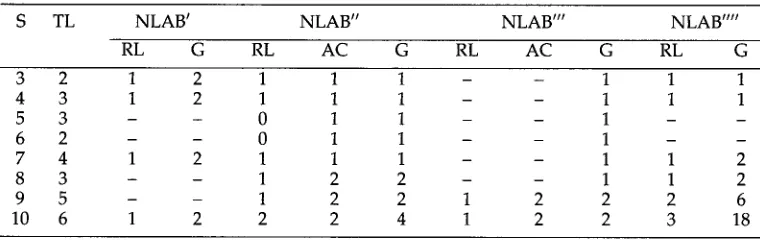
Consider what would result if NLAB did not check for all of these factors. If (b) were not checked, NLAB ~ would not distinguish between feet and intermediate traces, even in the same type of chain, thus it would output four sets of labels: AH, AH, {AF, AI}, {__AF, AI}. If (c) were not checked, NLAB" would not distinguish between A-feet and A-feet, thus it would output AH, AH, AI, AI, {AF, AF}. If (d) were not checked, NLAB'" would output AH, AH, {AI, AI}, AF, AF. If (b), (c) and (d) together were not checked, NLAB"" would output AH, AH, {AI, AI, AF, AF}.
In accounting for the growth rate in the space of hypothesis of these modified algorithms, two factors must be taken into consideration. One factor is the number of active chain types, namely, whether a sentence presents only A-chains, only A-chains, or both. This factor encodes the second and third restriction of the CSEL algorithm, with the consequence that not all combinations are attempted. The second factor ac- counts for the growth rate proper, which is reducible to counting the set of k-strings over an n-sized alphabet, hence n k. Here, k is the number of relevant links in the sen- tence (for instance, feet in NLAB'), and n is given by the size of the set of features collapsed by lifting some of these checks, hence, 2, 2, 2 and 4, respectively.
The hypothesis space in the three algorithms grows in slightly different ways. In NLAB ~, where there is no restriction on the number of active chains, the growth rate is n k. For NLAB" and NLAB m, the formula is NA k, where NA is the number of active chains. Practically, this amounts to 2 k at most, as the number of active chains is not more than 2, because of the restriction requiring that the nearest unsaturated chain be selected. For N L A B " , the restriction for active chains no longer holds. In this algorithm, no features are checked, so it is impossible to establish if a chain is saturated or not until structure building ends. Thus, the growth factor is a function of the number of heads seen up to a certain point in the parse, the number of empty categories, and their respective order in the input. Notice that the different size of the collapsed feature set, which is larger for N L A B " , is implicitly taken into account by k, as the number of relevant links varies with the size of the collapsed feature sets. For the same sentence, there are more relevant links if the collapsed feature set is larger.
Computational Linguistics Volume 21, Number 4
Table 6
Growth of Hypothesis Space: S = sentence; TL = Total number of links; RL= Relevant Links; AC = Number of Active Chains; G = Growth rate
S TL NLAB' NLAB" NLAB"' NLAB""
RL G RL AC G RL AC G RL G
3 2 1 2 1 1 1 - - 1 1 1
4 3 1 2 1 1 1 - - 1 1 1
5 3 - - 0 1 1 - - 1 - -
6 2 - - 0 1 1 - - 1 - -
7 4 1 2 1 1 1 - - 1 1 2
8 3 - - 1 2 2 - - 1 1 2
9 5 - - 1 2 2 1 2 2 2 6
10 6 1 2 2 2 4 1 2 2 3 18
feature checks b e c o m e s beneficial o n l y if kf > n k. N o w notice that 2 _< n _< 2d. For n = 2 a n d f = 3, the inequality is satisfied for k < 4. This m e a n s that for a l g o r i t h m s N L A B " a n d N L A B "p, all sentences with m o r e than three relevant links are c o m p u t e d faster if features are checked. For n = 4, i.e. a l g o r i t h m N L A B " , the inequality is n e v e r satisfied. 17
The results of s o m e calculations are r e p o r t e d in Table 6. The n u m b e r s in the "sen- tence" c o l u m n refer to the t y p e of construction, as exemplified in Figure 1 (sentence types 1 a n d 2 are not considered because t h e y contain o n l y trivial chains). If o n e con- siders a sentence such as Who did you say that John thought that Mary seemed to like?, with four g a p s a n d four heads, there are 96 h y p o t h e s e s a b o u t chain f o r m a t i o n to explore using N L A B " . Clearly, checking features a n d using t h e m for b u i l d i n g chains, a n d k e e p i n g the h y p o t h e s i s search space small, is beneficial in m o s t cases.
Extensibility. These algorithms deal in detail w i t h the s o m e w h a t neglected p r o b l e m of w h a t to d o w h e n m o r e than o n e chain has to be constructed. T h e y d o n o t discuss specifically the issues of adjunction or r i g h t w a r d m o v e m e n t . H o w e v e r , they could be extended.
In the u n e x t e n d e d algorithm, the postulation a n d structural licensing of e m p t y categories is a l w a y s p e r f o r m e d b y the same m e c h a n i s m . A c c o r d i n g to the ECP (as f o r m u l a t e d in Rizzi 1990, 25; Cinque 1990; C h o m s k y 1986b, a m o n g others), for an e m p t y c a t e g o r y to be licensed, t w o conditions m u s t be satisfied: the e m p t y c a t e g o r y m u s t be within the m a x i m a l projection of a lexical h e a d to be licensed structurally, a n d it m u s t be identified b y an antecedent. The structural licenser a n d the a n t e c e d e n t need not be the same element. In fact, t h e y h a r d l y ever are. W h e t h e r m o v e m e n t is to the left or to the right does not affect structural licensing (which is here p e r f o r m e d b y the conditions that a p p l y to the reduction of an ~-rule).
R i g h t w a r d m o v e m e n t requires an extension of the a l g o r i t h m to incorporate the e m p t y c a t e g o r y in a chain. A n e m p t y c a t e g o r y that is the foot of r i g h t w a r d m o v e - m e n t m u s t be licensed structurally, before its a n t e c e d e n t is seen. W h e n the N P that is the antecedent (head of chain) is found, it starts a n e w chain, according to CSEL. Therefore, an extension is n e e d e d to check if there are a n y e m p t y categories wait-
17 Note that here I a m a s s u m i n g that checking a feature and checking a chain have the s a m e
[image:20.468.49.429.110.233.2]Computational Linguistics Volume 21, Number 4
L-attributed rule into an S-attributed rule (Aho, Sethi and Ullman 1977, 282ff discuss the marker nonterminals technique). Such a transformation is possible if the attributes of the tokens on the left of the current token are at a fixed position in the stack.
We can use this S-attribution transformation for Case assignment to the subject (nominative Case or structural case). In English, structural case is assigned to the subject position, if the subject is a sibling of (the projection of) a finite inflectional node. This position can occur both in main and e m b e d d e d clauses. English is head- initial, and the Specifier precedes the head. These properties interact, so that when the subject NP is reduced, INFL is always the next token in the parsing configuration. Thus, rule (8) can be u s e d . 21
(8) IP --+ NP {Case assign, if I +fin} I'
This rule assigns case correctly only if the attribution is not a function of the subconstituents of I. This is precisely what distinguishes case assigned to the subject (structural case assignment) from other types of case assignments (e.g., case assigned to the object by either a verb or a preposition): it is assigned independently of the properties of the main verb.
The S-attribution transformation is not restricted to languages with the properties of English; it can also be extended to head-final languages. In verb-final languages (German, for example) the subject of the sentence in embedded clauses is not string adjacent to the head of the sentence, as it is in English. However, structural case can be assigned from left to right, since the complementizer, which necessarily marks the left edge of an IP, is obligatory, and the finite complementizer is always different from the infinitival complementizer.
S-attribution could not be performed, however, in parsing a language with all the characteristics given in (9).
(9) a. no overt case marking
b. no distinct finite complementizer c. verb final
d. right branching in the projections other than the verb
21 At first sight, this might appear as a wild overidealization. In fact, there are both theoretical and empirical reasons to think that this is the right way to idealize the data. A corpus analysis on 111 occurrences of the verb a n n o u n c e in the Penn Treebank shows that the subject is followed by an aspectual adverb 11 times, twice by incidental phrases, and 4 times by an apposition. In all other cases the subject and the verb are indeed adjacent. I do not consider appositions and incidentals as
challenging for the general claim: incidentals are clearly outside of an X structure assigned to the sentence; while appositions are "internal" to the NP, thus w h e n the verb is reached, the phrase sitting on the stack is indeed the NP subject, which can therefore receive Case. The treatment of aspectual adverbs is more complex. There are at least two possible tacks. First, one can notice that adverbs, although they are analysed as maximal projections because they can be modified, never take a complement, thus they are usually limited to a very short sequence of words, and they do not have a recursive structure. A minimum amount of lookahead, even limited to these particular instances of aspectual adverbs, would solve the problem. Clearly, this is an inelegant solution. A more principled treatment comes from recent developments in the theory, that have changed somewhat the
Because of property (9a), case could not be inferred from explicit information contained in the input (unlike Japanese or German); because of property (9b) the subject position of an embedded clause would not be unmistakably signalled (unlike German but like Japanese); because of property (9c), the inflectional head would occur after the NP that needs to be assigned case; finally, because of property (9d), an LR parser could give worst-case results (which is not the case for verb-final, but left-branching, languages, like Japanese): it could require the entire sentence to be stacked before starting to assemble it.
Although a problem in principle, this limitation disappears in practice. Inspec- tion of some of the sources on language typology shows that such languages are very difficult to find (Steele 1978; Shopen 1985; Comrie 1981). According to Downing (1978), verb-final languages usually have prenominal relative clauses, which is a sign that they are left branching. Only two verb-final languages have postnominal relative clauses, Persian and Turkish. In Persian, the clause boundary is overtly marked by the suffix -i on the antecedent. Moreover, both languages have overt case marking of the subject. Although this is by no means definitive evidence, it suggests that the algorithm for chain formation and feature assignment that I have presented is not obviously inadequate, and that it is applicable to a variety of languages with different properties.
5. Conclusion
The parser described in this paper has been implemented for English. It parses a homogeneous, though small, set of sentences. As a matter of fact, one of the interesting features of this implementation is that it offers a unified treatment of all of the chain types presented above.
The parser has clear limitations due to the fact that it was developed mainly for exploratory purposes. For instance, it deals only with very simple nominal phrases and it does not treat adjunction. In other respects, however, this design lends itself readily to extensions: The structure building and chain formation routines do not rely on characteristics that are found only in English or in a head initial language, as was discussed in the previous section.
In the course of pondering the relation between the grammar and the parser, and mostly how the conceptual
modularity
of current linguistic theories can be imple- mented, one learns that, in fact, the notion of modular theory is both true and false, at least in its present incarnation. All linguists strive to develop theories that rest on general, abstract principles, which interact in complex ways, so that many empirical facts "fall out" from a few principles. Such a theory is clearly not modular, although highly general and abstract. On the other hand, linguistic concepts operate on different primitives: intuitively, X-theory, and principles of argument structure or coreference are different objects. Future research must lead in a direction that enables us to de- fine more precisely this basic intuition. Modularity, if it exists, is to be found in the linguistic content, and not in the organization of the theory.Acknowledgments
I would like to thank those who have helped me in this work: Michael Brent, Bonnie Dorr, Uli Frauenfelder, Paul Gorrell, Luigi Rizzi, Graham Russell, Eric Wehrli, Amy Weinberg, and two anonymous reviewers. All remaining errors are my own.
References
Abney, Steven (1989). "A Computational Model of Human Parsing."