http://wrap.warwick.ac.uk/
Original citation:Parberry, I. D. and Goldschlager, L. M. (1983) On the construction of parallel computers from various bases of Boolean functions. University of Warwick. Department of
Computer Science. (Department of Computer Science Research Report). (Unpublished) CS-RR-048
Permanent WRAP url:
http://wrap.warwick.ac.uk/60755
Copyright and reuse:
The Warwick Research Archive Portal (WRAP) makes this work by researchers of the University of Warwick available open access under the following conditions. Copyright © and all moral rights to the version of the paper presented here belong to the individual author(s) and/or other copyright owners. To the extent reasonable and practicable the material made available in WRAP has been checked for eligibility before being made available.
Copies of full items can be used for personal research or study, educational, or not-for-profit purposes without prior permission or charge. Provided that the authors, title and full bibliographic details are credited, a hyperlink and/or URL is given for the original metadata page and the content is not changed in any way.
A note on versions:
The
University
of
Warwick
THEORY
OF
COMPUTATION
REPORT
NO.4B
SI
THE CONSTRUCTION OF PAMLLEL COMPUTERSFROM VARIOUS BASES OF BOOLEAN FUNCTIONS
Les'lie M. Goldschlager
Ian
ParberryIs:ued
jointly
as Technjcal Report No. 206by
:Basser Department
of
Computer ScienceUniversity
of
Sydney N.S.r{.
2006Austra]ia
Department
of
Computer ScienceUni versi
ty
of
l,lanvi ckCoventry CV4 7AL Engl and
FRCI'I VARIOUS BASTS OF BOOLEAN FUNCTIONS
Les'l i
e H.
Goi ds chl agerIan
ParberYSasser Department
of
Computer ScienceUniversity
of
Sydneyl{.S.}1. 2006
Australia
Department
of
Computer ScienceUni versi
ty
of
l,Jami ckCoventry CV4 7AL England
Noveniber 1982
Abs
tract
The
effects
of
basesof
two-input
bcoleanfunctions are
characterisedln
termsof
their
impact on some questionsln
parallel
computation.
It
is
foundthat
a
certain
set
of
bases(called
the
P-completeset)
whichare
notnecessarily
completein
the
classical
sense, apparently makesthe
circuit
value
prob'lemdifficult,
and renders extended Turing machines andconglorn-erates equal
to
general
parallel
computers.
Aclass
of
prob'lemscalled
EParises
naturally
fromthis
study, re'lating
to
the
parity
of
the
numberof
solutlons
to
a
pr^oblem,in
contrast
to
previously
defined c'lasses concerningthe
count
of
the
nunberof
solutions
(#P)
or
the
existenceof
so'lutions
to
aproblem
(Hp).
Tournanrent isomorphismis
a
rBnSerof
EP.I,
Introduction
Complexity
theory
seeksto
formalize
our
intuitive
notions
of
computa-tiona'l
difficulty.
|Jhilst
weare
intuitively
surethat
certain
functionsaFe
npre
difficult
to
compute thanothers,
veryrarely
can weactually
proveIt
(the
classica'l
examp'leis
that
of
NP-complete problems,see
lCook 711,lKarp
721l.
Horever,
it
is.
possibie
to
classify
srnall classesof
functionsaccording
to
their
relative
complexity.
Thisre
shall
dofor
tlre
two-inputbooJean
functions.
The
motivation
for
our
classiflcatlon
schem comesfrrm
examinfngtlm-boundeo
parallel
(space bounded sequential)
computations 'involvingtlre tr*o-input
booleanfunctions.
Tne main bodyof
tiis
paperls
cornprised
of
tliree
sections.
Thefirst
is
onthe
space complexityof
the
circuit
va1ue problemover
tJrehro-input
bases,the
second the computingp${er
of
tim-bounded extended Turing machines overtno-fnput
bases,
and tJret}rird
tlre
ability
of
bro-input
basesto
realise
parallel
oachines.The
circuit
value
problemover
basis
B (CVp,or mr?
precisely
CVpB)is
tfe
prob'lemof
determining,
f9r
I
given conbinational
circuit
(a
ci"cuii
rlthout
feedbacklgop!)
overbasis
B andits
iTputs,.the
yqlueof
its
output. Qra
gircuit
over
basis
B r*e FEana
circuit buiit
uiing-gai;J-rhich
reallze
functlons
drawn froma
booleanbasis
B.[Lad
75Jand-tdf-iii-have
shomthat
the
ci rcuit
val ue probl en-over
cornp'!eti -basesind
thd
rrcniiine
ci rcuit
val uecirsutf-yalue
problemsover
these basesare
in
a,sense amongthe
mostdifficult
in
P.
For
if
they
can be computedin
0('logKn) space then so can every nemberof
P.The
parallel
cornputationthesis
ICKS81J,
IGo'l82]
states
that
time
onany
"reasonable"
modelof
parallel
cornputationis
polynomia'llyrelated
tospace
on
a deterministic
Turing
machine.
Thusthe
circuit
value problemsover
comPlete and monotone basesare unl'ikely
to
have an exponential speed-up ona
para'llel
computer.
blec'lassify the
twoinput
boo'lean functionsaccording
to
the
effect
whichtheir
presencein
a
basis
has uponthe
conpplexity
of
the
circuit
va'lue problemover
that
basis.
trlefind
that
for
thebro
input
basesB,
either
cvPois
log
space completefor
Por
it
can becomputed
in
0(log2n)
,0....
o
Among
the
"reasonabJe" modelsof
parallel
machinearchitecture
is
theaJternating
Turing
machineof
ICKS8il.
This
differs
fromthe
standardnondeterministic
Turing
mach'ineonly in'uhe
mannerof
defining
acceptance.The
states
of
ana'lternating
Turing
machine may belabelled
ttl{D(universa'l),
0R
(existential),
NOT(negating),
acceptor
reject.
This
labelling is
extended
to
configurations
in
the
obviousway.
Aconfiguration
is
deenpdto
beaccepting
if it
has an acceptstate,
or
if it
ls
universal
andall
successor
configurations are
accepting,
or'lf lt
is
ex{stential
and sonresuccessor
configuraticn
is
accepting,
or
if it
is
negating andits
successor
is
not
anaccepting
configuration.
b{egeneralize
this
by allowingthe states
to
be'labe'lled
with a larger
rangeof
functions,
in
particular
the
two
input
booleanfunctions.
l.Je provethat
these extended Turing machines.over trxo
input
boolean bases Bare
aspcwerful as
para'l'le'l machinesiff
thecircuit
value
problemover
basis
Bis
log
space comp'letefor
P.-F
Furthermore,
there are
four
language classes recognised by po'lynomialtlnre
bounded extendedTuring
machinesover
the
bases whose CVP can becomputed
in
logz
space.
Thefirst
three are the
familiar
classesP,
NPand C0 -NP. The
fourth
is
a previously
undiscovered c'lass whlch we shalleall EP.
Problemsin
the
latter
canbe
thoughtof
(at
the
abstractFrtblem
level)
as the
parity
of
the
nunberof
solutions
to
problemsin
NP,ln
the
saneliay
that
problemsin
C0 -NP can be thoughtof
asthe
complenrentsof
problemsin
NP.Another
previously
studied
modelof
parallel
machinearchitectures
arethe
conglorcrates
of
[Go]821.
Theseare
essentially
conrnunication nebtorksof
synchronousfinite
state machines. lle
restrict
these rnachinesto
basesof
two
input
boo'leanfunctions.
Theserestricted
machines over basis Bare
aspowerful
as
parallel
machinesiff
the
circuit
va'lue problem overbasis
Bis
log
space comp'letefor
P.2.
TheCircuit
Value Problenrt{e
shall
usethe
standarddefinitions
of
space andtira
ona
Turingnachine (see
for
example [A]lU741, tJL
75U.
Let
P bethe
class
of
languagesrccognizable
in
tine
polynomia'lin
the
lengtlr
of
the input
bya
determinis-tfc
Turing
nachine.Definitions
A
languageA
is
log
spacetransfomab'le
to
B(written
Alloq
B)1T t[ert
exists
a function
t
suchtjrat
for
aTi-;,
Lernna
1 (i) If
B!s
1og space comp'leteTslog
spaceconplete
for
P, tii) If
Brecognizable
in
space0(logKn)
for
somebe
recognizedin
space 0(logKn).Definition
B.,=
{f:{0,1}n*{0,tiJis
thetl
for
P,
B<too
A
and Ae
P then Ais
'log spEce tomp'letefor
P andjs
constant
k
.
1
then every Ae
P canset
of
n-input
boolean functions.is
a
sequence C=
.91r...,9n)
Defini
tions
Acircuit
over
basis
B$
Btrhere
eachg,
is
either
a
variab'le
xl,xz,
...
(ln
which caseit
is
cal'ledan
input)
or
f(j,k)
for
somefunction feB
(in
which caseit
is
called
aF.t"
'. j.-[: '
The va]ueof
a
circuit
Cat
gate9i,
v[C'9i]
is
givenDy
v(C,xr)
=
xj
v(c,tti,k))
=
f(v(c,gi),
v(c,9k)).
The va'lue
of
a
circuit
Cis
defined
to
be v(C) = v(c,91).
probTEm
ctJPg=
ic
1v(c) =1i
.Lenmg
2
(ilad
15)) If
B
is
a
completebasis
then CVP,is
conFlEe
for
P.Lenrna
3
ttGol
771)
If
Bcontains t&,V]
then CVPtis
logTEF-F.
+e*1j If
Bcontains
{*t,tf,},{*i
or
{l}
then CVP,ls
log'space conplete TOrr.
The ci rcui
t
va'luelog
spacespace complete
Lenma
5 If
Bcontains
i&'
**1,
tv,**},
{a'61
or
tv$i
ttren cvPtis
los
EpaEe-coorpl
ete
for
P,Froof:
{*,-t}
is
complete, and hence by'lenma?'
completefor
P.
Furthermore CV-tt*r-]
16-g LUrB{y'}
stnce-tx
can be replacedby
x *
0'^1
f
x,
0and
x
+y
cdr
be repiacedby
X*J, I I
tx
/
y),
respecti ve'ly. El
Proof:
cvPt&,v]
i
log
CvPe where B=
{&,*},
aVb
=
(a.*
b)
**
(a&b)a&b
=
(a+-rb)
++
(a\tb)aVb=(41b)
@ta&b)and
a&b=
tath)
@ taVb)respecti
vely-E
Definltion
Let
C =(gt,...,9n)
be
a
clrcuit.
trcn
gi
to gj
as
follors.
Therels
a
path
of
there
erlsts
k
S
n
suci
that
9j
=
f(9i,9p)
or
Iength
u
>
I
fromgt to
9j ls
a
path
of
lengtJtFtth
of
length
1
fromgt
to
9j
CVPl*-tis
log
sPacewhere B
=
{*},
{f},
{*}
or+xorxflrespectivelY
.y+xor(yfxlft
tv,.*],
t&S}}
or
{v,O}
sincehfire
a
PatJrof
length
ulengtlr
I
frosr9i
b
9j
lf
9j
=
f(9p,9i).
A Patltof
.*-- - .. .-
--..-- .., .'^..-.t-'i,:).-...,..,\+"+-&-. -'r-,-.;--.l:.:i.-ts-,1
,'--
-4-Definitions
Let
C=
.91r..,,9n>
be
a
circuit.
Definethe
function
oddu(9irg3)
to
betrue
iff
there are
an odd nurberof
pathsof
length
u oln
C frorng,
to
gj.
Further
define odd(9i,9;)
=
O.
oddu(gi,9j)
to
berrrU=l
etrue
iff
there are
an odd nunberof
paths
(of
anylength)
fromg*
to
g*.
rJ
Lenma6LetC-<91,.",9n)beacircuitoverthebasis{@}'For
J =
11...1h the
value
of
the
circuit
at
gate 95is
given byvts5)
=
,R,,
Iodd(s.'sr)&v(st
)I
--
9iProof
Byinduction
onj,
noting
that
&distrlbutes over
@
(i.e.
a&(b@c)
;TFb)
@ (aac))tl
Lenma
7
Let
C=.g1r...rgn>be
a
clrcult
over{@}. If
u
>dil
thenn
oddu(9i,95) =
@
toddo(9i,91)
& oddu_o(gi,gj)I
Proof
Bylnduction
on
u.
O
Con-slder
the
fo'lloi+ing
procedure: boolean procedurepath
(ili,k)
ffis
true
iff
there
exists
an odd nun&erof
pathsffir ,i
to 9j of
length
k.lf
k =
I
-
_then 3_oddno.
of
connectlons fromgi
b
gj
nel
se
O
ipatntl
,l
,lk//l
)
s
path(l
,i
,tk/d
)l
-
xFlLenna
8
path(l
,j,u)
=
odd,,( 9.i ,95 )Lenma
9
CVP;611 canbe
so1vedby
a
determlnistic
---T
t\l/
r0(1og'n)
space.Proof
Let
C=
.glr...
r9n> bea
circuit
over
{O}.
which computes
e
6.
lpath(i,n,u)&v(gr)]
.lnputs
u=19i2
This
uses space0(log'n)
and. @.
O-
Ipat}r(t,n,u)&v(gr)J
=.O
ItO-oddu(sg,sn)&v(sr)J
lenrna 8lnputs u=l
I
lnputs
u=l9i
9i=
vln)
lenma6
B
CVPtCIi'
CVP1.-*i'CVP{O,*}
dndCYPI9-<-+*
are
all
log
spaceas
in
the
proof
of
lerma3, wlth
the*+b
n
be solved bya deterministlc
Turingf(x,y) is
monotoneif
for
all
x., < x.,f(x,y)
is
Tinear
if it
can be^-
LTuring machine
in
Conslder
the
programLerma 10
equl va1
ent.
Proof
Uses doublerail
loqic
illenEity a@b
=-(a**b)
=
(-a)
Lenma
11
CVP,.., dnd CVP,.,.' catAJ
T Y.|machine
in
01logzn)
space.lroof
Asimplified version
of
the proof
of
1enma 9will
sufflce,
since
acircuit
built
from
0Rgates
is
true
pr;cisely
whenthere eixists
a
path to
'the
output
froma true input,
anda
circuit
built
from AND gatesis
false
precise'ly
nhenthere
exlsts
a
path
to
the output
froma
false
input"[l
Qetjnitions
[t'lcc811
A function
and
y,
<
yZ
f(xyy1't
.
f
UZ,!2),
expressed
in
the
form.o@(at&x)@trz&y)
rhere a0,
al,
a,
e
{0,
1}.
The
bro-input
booleanfunctions
fall
into
four
classes inducedby
theProperties
of llnearity
andmonotonicity
(see tabJe1).
The functionswhich
are both
linear
and nronotone breshall
call 'triyial'I,
those which areJfnear
only
"easy",
those whichare
monotoneonly'rnderate"
and thosertich
are
neither'linear
nor
npnotone'hard".
If
t}re gatesln
basls
B areall
easyor
trivial,
then cvP,
is
easy(i.e.,
can besitved
ln
logz
space).If
Bcontains
at
most onernderate gate
(andthe
rest
trivial)
then
CVF,is
easy.
If
Bcontains
b*o nroderategates,
or
a moderate and an easygate,
ora
hardgdt€,
then
CVPgis
hard.
This
is
sunnpd up bythe following
theorem,xftich follows
from thE
earlier
lerrnas.Theorem
12
cvP,
is
log
space completefor
p
lf
either:
tf)
Bcontalns
a
gate
vhlch
ls
not
llnear
anda
gatertrich
is
not
mnotone;or
(fi
)
{&,y}g
B-6-Table
I
Complexity
classes
of
gate
g 'indicates that
functions
ln
BZ.
An entryg
hasproperty
p
(wherr pof
1
underproperty p
of
ls
rpnotonlclty
or linearity).
functi on I I near cJ ass
0
I
x
v
fal
setrue
left
identlty
right
i dentity
I
1
I
1
tri
vi al-x
-y
e
+
left
negat.|onright
negatlonequl va1 ence excJ usi ve
or
0
0-0 0 andor
0 0 0 0 0 o 0 0\
t
.+\
\
nand norlmpl I es
not
inrpl iesls
lmplled
byls
not
lmplled
by3.
Extende{_Turing MachinesThe
definition
of
alternating
Turing
machine ICKS81]
can be generalizedto
al'low
the
labelling
of
nonfina'l
states with
any reasonablefunction.
Definition
An extendeoTurinq
*a
(ETl,t)is
anine-tuple
FIT;E;
k,
QD
ls
a
problem domain[0,
I
e
D;
I /
D).B
=
{fr,...,fn}
is
a
finite
set
(Uasis)
of
flxed-arlty
functions
f,
of
ar{ly ai
f0, fi : D' *D
1 <
i
5n.
k
ls
the
numberof
work tapes. Qis
a
finite
set
of
states.
E
is
a
finite
input
a'lphabet(//L is
an endmarker).I is
a
finite
work-tapealphabet
(#ef
is
the
blank synrbol).d
g
tQr
rk
r
tru
{4ii'
tq'
ii-
i*rk
'
{tJ,-JnJrlr*tt
is
tbe
next--nove
reJat{on.
gn
e
Qis
the
initial
state.
g":
Q*
Bu
DDeflnitions
A
configuration
of
an ETlt l-l= tD, B,
k,
Q,X,
I,6,
Qg, 91)ls
an elenrentof
Cn=
Qx
E*x((f
- t#])r)k
, ttk*lj If
o
and Bare
configura-tlons
of
l'l wesay
that
Bis
a
successorof
c
(written
fB) if
g
follows froma
in
onestep
accordingto-tEe
transition
functlon-6.
Theinitial
confisuration
of
t'lon
input
x
is
or(xi
=
(Qg,*,
\-y',
Upt
k
k+lrhere
I
denotesthe
emptystring.
The sernant'lcs
of
an extended Turing machineare
analogousto
thoseof
analternating
Turing
machine.
lle
insist
tlrat
the
transition
function 6 is
such
that,
for
all
states q e
Q,every configuration containing
q
has-8-For
f:Do*D where OeDJ\D we define ?:(Du[i;a*outli of
f
as
fol'lows:the
monotone extensionand
all
aF
8.,
I ( i
<
a.
T-d e
D thenY
has a-least
=
the
=
0,
rluE, tnk )
grfini
tions
AP NP-
co-NPIf
leDa
then?(I)
=
f(.U
andfor
I
<
m5 a, it.5.O*1
andye(Duilif-m
ft1,,-J,
=tlo;:;ii]l.ro,
.,,
oeDf(x,0,r)
=t(r,o,r)
For example,
the
rnonotone extensjonsof
sonefunctions
in
B^ areshown
in
table
2.
zA
labelling
of
configurations
is
a
mapI :
C,
*
DU{J-i.Let
T
be
the
operator
mappinglabe)lings
to
labellings
definedas follows.
Let
M=
(0,
B,
Q,
E,
fr
6,
Q0,9)
andq
bea
configuration
of
Ht+ith state
g.
Assumea
total
ordering
onthe
e'lementsof 6,
so
that
we canorder
tJroseB such
that
aF
B.
Then1g(q)
if
e(qieDr(l)(a)
-
=
?o.
\f(l(8t),...,1(Ba))
if
g(q) =
f
If
wedefine the
re'lation
".u
bJI
<
d
for
fixed point
lr
with
respect-to
<.gefinitions
An EiH H gcceptsx
iff
t*tfn.'(x))
il1
1,
l{
reiecis
x
iff
l*tdr(x))
I anguage accepted
by
ltl,l.l
halts
onx
iff
l'l
acceptsor
rejects
x,
andL(n
=-{x
e
E* [M acceptsx].
Theorem
13
The extendedTuring
machlneswith
computable bases acceptpreeisely the
r.e.
sets.
Note
that
extendedTuring
machineswith
domainthe
natural
nurrbers andbasis
t+]
are the
counting Turing
nrachinesof
[Val 79J;
andif
we choose the domainto
be
the
boo'leanset
t0,1i,
ETll'swith basis
{&,v''-}
are alternating
Turing
machines, thosewith
basis
tV]
are
nondeterrninistic Turing machines,and tjrose
with
basis {&} are
co-nondeterministic
Turingmachines.
Since ourinterest'lies
with
the
twoinput
boo'leanfunctions,
wewill
henceforthrestrict
ourselves
to
extendedTuring
machineiwith
D=
t0,lj
andBg
BZ.Definition
PTIf'tE=
UB
k>oPTII'IE
{&,V
r-r}
PTIl,lE
iv]
v rI0
iffi
Taule 2
Extenslons
of
sor,efunctions
in
B.
to
domain{0,I,
1}.I
&
I
t
0
+
1
I
0
r.L0
ffi
o
I
-
10-Detlqtjg!
Abasis
Bis
calJed
P-completeiff
CVPBis
log
space completeT6T
T.
Theorem 14
For
ail
P-complete basesB,
B' c B,TIt'lErtT(n))
g
TImrt,(or(n)
)SPACEB(S(n)) c SPACET,
(S(n))
for
someconstant
d.Proof:
Theorem2.5
of
[CKS 811 Provesthe resu'lt
for
B=
t&,V,-]
and.tr
=
{&,V}.
The technfqueused'ls
similar to
the
one usedto
showthat
Urc monotonecircuit
value
problemis
log
space cornpletefor
P (lermra 3). De Morgans1awsare
usedto
pushthe
neEations downto
the
final
states
in
the
sane mannerthat
they
are
usedto
pushthe
negatlons backto
the
inputsln
the
monotone-circuit
value
prob'lem.
Asimilar
nrod'ificationto
the
proofsdi
ifr.
i-completenessof
all
suchB
gives the
required
resu'lts'E
Thus extended
Turing
machinescver the
P-complete twoinput
booleanbases
are
just
as
pcwerful,
within
a
constant
factor,
asalternating
Turingmachines.
ICKS 811 have shownthat
alternating
Turing machinesare
aspoi+erful
,
to within
a
po'lynomial,
as
anyparallel
machine.
Theorern 14imp]ies
ijrat
the conplbxily
results
onaliernating
Turing-machines (notablythlorems
3.1-3.4
andcorollarjes
3.5-3.6
of
ICKS81ll
app'lyequally
well
toextended Tur
ing
riachinesover
P-conplete
bases..Jheorem
15
TIttE,ei(T(n))
= TIME,.*n(T(n))
=TIHErr,.-*1(rtn))
=Tii',lECI,*r.)(T(n))
Proof
A
sinple modification
to
the prcof
of
lenma 10suffices
to
give
tlris
ffiuTt.
E
Def f ni
tion
ETIME(T(n))
=
TIHEr*, (T(n) )EP
=
PTIME,3]At
this
stage we havefour
interesting
c'lassesof
languages accepFd bypolyranial
time-Sounded extendedTuring ma-hines.
The raost por,rerfu'l classis inat
recognized by machinesover
a
P-complete basis,_exemplified byalternating
Turing
mlchines"
In
the
light
of
theorem 15, i*e seethat
itre-remaining lanluages
fali
into
the t6ree
classes accepted.by po'lynomialtinre
bounded-exteideiTuring
machinesover the
bases{&},
tV}
and {@1.t'tachines
over the
first
two bases aFenondeterministic
and co-nondeterministicTuring
machinesr€spectively.
Languagesin
the
correspondingpolyngryLll:--ttm
Soundedclassei
NP and-co-NPaie
wel'l-studied
(seefor
example IAIIU 741The'last class
is
EP,the class
of
languages acceptedin
polynomialtine
by
extendedTuring
machinesover
basis
@]
[E
for
Equivalence orExclusive-or).
Theclassjcal
open prob'lenrs regardingthe
relationships
between
P,
NP and co-NP can be extended_to inc'ludeEP.
For erample, onemlght wonier whether
or
not NPfi
co-NPnEP=
P?'
(Seefigure
l.)
Aswith
the
question
PI
NP?there are
complete problemsfor
the
questlon Pf
EP?Definitions
A 'languageA
is
(many-one) reducibJetoB(writtenA<B)lf
F
there
exists a
function
f
computablein
polynomialtim
suchthat
for
a1l
w,w
e
A
iff
f(w)
e
B.
A'lanEuageB
is
said
to
be EP-completeif
BeEP andfor
all
AeEP,
A
<8.
tr
Defini
tions
LetasaiTnr,effor
x
-r-a v-r-arl-r-able
x
orasslgnnent
t
is
f,
=
{x'
,..
.rx-}
bgis
a
fdnction"'t
:its
complementf.
given
by-[t(x) if I
.,
=
xbt(x)
lf I
=f
a set
of
boo'leanvariables.
Atruth
X
*
{0,1}.
Alitera]
overx
is
EJTEETThe value
of a-fiteral
I
undertruth
v( I
,t)
A
clauseover
x
is
a
set
of
litera'ls
overx,
tr[th
assignnentt
is
v(c,t)
= V v(l,c).
Alec
set
of
c'lauses-over
x.
Thevalue
of
a fornula
f
undertruth
asslgnnentt
ls
v(f
,t)
=
/l v(c,t).
The-satJsfiabll'ity
problemsAT
=
tbooleifi'formulae
flv
vm
t
The value
of
a
clause C underboolffiisa
narity-SAT
=
{boolean formulaev(f
,t)].
Theorem 16
parity-SAT
is
EP-complete.Proof
Clearly
parity-SAT
e
EP.
tie
fo1lowthe proof
of
Cook's theorem (see T6FTxanp'le tAflu741).
G'iven an extended Turing machine l'lwith
L(MleEP, wecan encode
it
as
a
booleanformula,
as
if it
Herea
nondetenninisticTuring
rnachine.
tlit}rout
loss
of
generallty,
assumthat
lil hasonly
exclusive-or
states.
Then t'l acceptsinput
x
iff
there are
an odd numberof
accepting computation pathsof x
lff
there are
an odd nurberof
satisfying:ssignnents.
to
the
boo'lean formu]aof
M. ElSimi'larly,
determining
the
parity
of
the
nurserof
solutions
to
t{P-complete problems
is
EP-complete providedthe
reduction from SATis
solution-preserving.
Thegeneralized
Ladner's theorem IKS 80Jtells
us
that
(provided
PI
EP)there
are
problemsin
EP whichare
nelther
In
Pnor
EP-complete. A candidate
ls
tournanEnt isonqrphism, wfrichis
not knoynto
be
in
P
[tJrebest
kno*nalgorithm
is
the
nc.lo$n1i*
algorithrn
of
{Luk
80J),
Tournarent isomorphismis
in
EPsince
the autonnrphism groupof
a
tournanent has oddorder
(hencethe nunter
of
isornorphism bebreen brotournarpnts
ts
either
zero
or
odd).fle
-12-Ficure I
The
Class
EPFL
ff-JI-Fiqure
2
fi*o-phase
lion-overla
4.
Conq'lomratesConglomrates
consisting
of
synchronousfinite
state
macbinesco,*uniciting
via
aninterconnectiiln
networkare
anothermdel
of
para'|1el^
machines.
If
th;
pitt.rn
of
the
interconnections
is
computable_in
polynomialsp.l.
ioi
porynoriii
parallel
tim)
then
the resulting
class.of
'cglg]onreratesIF"-it'powlrtirt,
to
*ithin
a
polyn6mial, as
anyparallel
machine [Gol 82].Definitions
Conglomerates, andthe notion
of
computation' accePtance andEx€cuTion-fine
aie
defined
as
in
[Gol
82J.Definition
Aconglomrate over
basis
Bconsists
of
gatesof
B conmunicatingffi..con
t
the
networl
may_becyclic,
unlike
the
combinationalcircuits
in
ivn".
Thereis
also available a regular
"tt{ophase non-overlapping
c1ock"
tMC 811 (seefigure 2)
whoseperiod
is
no greaterthan
a
finite
nunberof
gate
Oelays.
Thusthe
computationsof
the
gates-canbe made
synch.onorr,
andexe.uiiJi,-li*
is
definedto
bethe
numberof
clockprfl.i.
-in.
i.;;i-ionvention
is
that
the input
bits
bt'b2,...,bn
arerepresented
at
time
zero by having
the inputs
to
gate
i
equalto
bt
and thelnputs
to
gate
It
equal
to
-bi.
Acceptance andthe
complexityof
theinterconnection
networkare
defined
analogouslyto
conglorerates.Definition
coNG-TIHtr(Ttn))
(coNclOMEMTE-TIME(Ttn))) denotesthe
class
of
languages accepted
by
conglomeratesover basis
B (conglomerates) in_timef(nl
wittr
the interconneclion
network computablein
po'lynomialparallel
time.Stnce conglonrerates
over
a
finite
basis ar€
a
soeclal
caseof
qeneralsonglornrit"s,
it
is
obvioustnai
iolro-rimi*[r(nt)scorueromEMTE-TInrtT(n)).
l{e
shalI
nowinvesti gate
the
converseof
this
resu'lt.
Theorem 17: For
all
complete bases B,cONGLoHEMII-TIME (T(n )
)
cC0NG-Tlrcr(dT( n) )for
soneconstant
d.Proof
Eachfinite
state
machinein
the
conglorerate can be replacedby
anEffiaient
conbinational
circuit
over
basls B,
anda
finite
nurberof
mmoryelements.
These merrpry elements canbe
clockedby
the
regular_clock pulsesand
theii
outputs fed
Lackinto
the inputs
of
the
conbinational
circuit
in
order
to
simulate
tlre
flnite
state
machinesin
the
standardway.
If
Bis-iomplete, the
nErpryelenrnts
rnaybe
constructed usinga
9{c]ic
netr*or*of
gatis
of
Bas
in
the
normal"fli-p-f]op"
circuits.
E.4.,
if
B=
t&ryJ
thefllp-flop
could
beas
shownin
figure
3.i"7"|
Fi
eur€
3_-
Stan dard
F'l i P-fl oP-
14-Note
that
consecutiveflip-flops
will
needto
be clockedwith
opposite phases(0.,
and6r)
of
the clock
in
order
to
prevent
raceconditions.
Because tbe coAglomerEteconsists
of
finite
state
machines,only
a
finite
nunfer
of
gatesfrom B
are required
to
simu'late each one and sothe
executiontirp
will
belncreased
by
at
rpst
a
constant
factor
d.
Simil4rlJ,
the
comp'lexityof
theinterconnection pattern wi1'l not
be increased by nore thana
constantfactor.
Theorem
18:
For
a'lI
P-complete
bases B,C0NGLOMERATE-TIl'tE
(T(n))
c
CoHe -TIMEB(dT(n) )for
soneconstant
d.Proof:
Considerthe
case when B=
{&,V}.
Again usingthe
"doubJerail
logic"
l-dea
in
lenrna3,
it is
straightforrtard
to
replace the
combinationalcircuits
in
the proof
of
theorem 17wjth
gates from Bby
pushingthe
negations backto
the
inputs.
Thus each edgeof
the
interconnection
networkwil'l
beslmu'lated
by
two edgesof
the
{&,VJnetwork,
one carry'ingthe
negationof
the
other.
Nowthe
memoryelenents
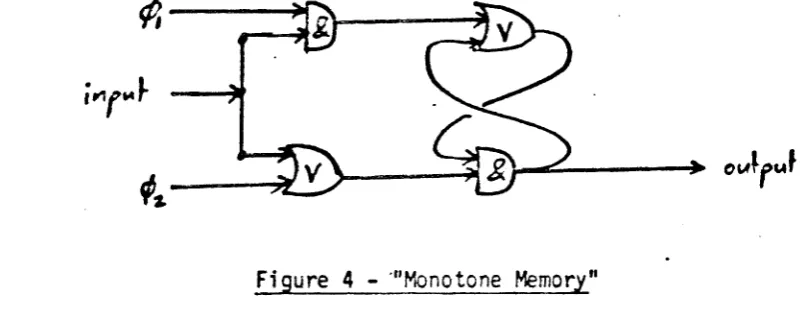
can be simulated asin
figure
4. [image:16.595.72.474.294.451.2]in7"l
oul7"|
Figure
4
-_'"Monot
"Thus
the
theorem ho'lds when B= t&,V),
neither
the
executiontinp
nor
theconrplexity
of
the interconnection
neiworkincreasing
by more thana
constantfactor.
l{owthe
theoremfoJlows
for
all
other
P-complete Busing
thetechnlques
of
lenmas4
and 5.D
Theorem
19:
If
scnpbasis
Bis
not
P-complete, then congloroerates overSasiTTEnnot
in
general simulate
conglonerates(or
anyother
generalpurpose paral
lel.
cornputer).Proof:
Assuneto
the contrary
that
somebasis
B whichis
not
P-complete can 5G- usedto
simulate
anarbitrary
conglomerate.
Thenin particular,
it
cansimulate ttre
conglomerate which computesthe
IIANDfunction
NAND(bl'OZ)
=f(bl,-bl,
bZ,-'bZ).
Thusa
(possibly
cyclicJ
networkof
gates from B cansimulate
t}e
I{AHDfunction
in
someparticu'lar
tim
t.
ilow sucha netrork
can
be
'unrolledn
into
a conbinational
circuit
with
deptlrat
mostdt
for
sorp constant
d
ISav721.
Notealso
that
anyclock signals
cominginto
agate
in
the unrolled
circuit
can beset to
a
constant value representlngfhe
value
of
that
clock
signal
at
the particu'lar
tinrein
the
computationrhich
the
depttrof
tfrat
gale
represents.
Thusthere
is
a
fixed
conbinationalcircuittver
basis
Bwhiitr
compirtesthe
NANDfunction
frornthe
valuesof
bn
lnputs
andtJreir
negations.
llenceCVP.$
:
CVP',contradiction.[l
Loosely speaking, we can sunmarise
this
section
by sayingthat
aparticular
basis
B 9_BZ canbe
usedto build
general purPoseparallel
foachines
iff
B
is
P--cofiplete.5.
Conc'lusionsUe have exanined bases
of
twoinput
boo'leanfunctions,
anddefined
thenotion
of
a basis
being P-comp'lete. i.Jith
referenceto
table
1,
a
basis
is
F-comp'lete
if it
contains
at
ieast
one"hard" function,
or
two "moderate",Or
a
i'mOderate" andan
"easyt'.
The remaining baseS Of twoinput
bOO'leanfunctions are not believed
to
be
F-completelun]ess
P=
SpACEllbSkn)for
some
constant
k).
If
a basis
is
P-complete,then
the
circuit
value problemover
that
basisls
probablyinherently
sbquentia'1,-and extended Turing machines and conglom-era'tesovei
that
basil
are
powerful
para'l'le'l machines. The remaining basesare not suitab'le
for
building
general
purposepala]lel
machines',andthe-iircult
value
problemover
t[et
canbe'so]ved
quickly
ona
parallel
machine.However
the
bases which donot
appearto
be P-complete can befurther
classified
into
four
groupsaccording
to their
apparent e_ffect on thecomputational power
oi
extendedTuring rnachines.
Thesefour
groups areexeinplified
by'{V}, {&},
the one-inpui functions, ald
p'
qotrespondingto
nbn-deterministic, co-nondeterministic, deterministic
andthe
new cJassof
"parity"
computations.6.
Further
workHow do PTanar
circuits
appearsthat
{&,V}
is
not
aiGol
80J.behave
over
different
bases?powerful
computationa'l basisFor examp'le, i
t
for
planar
circuits
'
It
wou'ldalso
benice
to
know more aboutthe class
EP.
Is
this
ldentj
cal
to
a previously studied
class?
l.lhatis
the
relationship
between-Ep and
p,
NP anb co-NP?-Is
there
a "natural"
problemnhich
ls
EP-complete?Ack now'l eCgeme nts
bte wou'ld
like
to
thank
Michae'l Hickeyfor
his
contributlon
to
t}te"rpnotone
n€nnry" elerients
of
section
4.References
[Lad 75J
tGo'l 771
R.E. Ladner,
"Thecircuit
va'lue problemis
log
space completefor
P",
SIG,ACT News7(1) (tgzs)
18-20.L.l'1. Gol dschl
ager,
"The monotone andplanar
circuit
value
prob'lemsa"e tog
spaceio*ptete
for
P",
SIGACT News1(2)
(tglll
25-29.t6ol
801
L.l,l.
Goldschlager,
nA spaceefficient
algorithm
f91.t}te
Imn0toner---
piina.
ctrcuit-vaiue
problemn,Inf.
Proc.Letters 10t1)
U980).IFfcC
811
l{.F.
l,'lcCo'|1,
"P'! anar crossoversn,
IEEE Trans. Computers'
C-30 (3)(1981).
IcKs 811
A.C.
Chandra,D.C.
Kozen andL.J.
Stockmyer,nAlternationu,
JACI'I28 11)
t1981).tvat
7gl
L.G.
Valiant,
'The
complexity
of
enunrration andrellability
-16_
ILuk
801
E.M.Luks,
"lsomorphisnof
graphsof
bounded yajence can be testedin
polynomialtime",
Proc.
21st
Annual IEEE Symp. 0n Foundationsof
Comp.Sci.,
(1980).ICook 7LJ
S.A.
Cook, "The Comp'lexityof
theorem proving proceduresn, Proc.3rd
ACH Symp. on Theoryof
Computing(f97t)
1S1-t58.IKarp 72J R.M.
Karp,
"Reducibility
arnong combinatoria'l prob'lerns",in
R.E.ili'l'ler
andJ.l.l.
Thatcher, Eds,
"Complexityof
Computer Computations",Plenum
Press,
NewYork,
(1972).IAHU
741
A.V.
Aho,J.E.
Hopcroft
andJ.D.
U'llman, "The design and analys'isof
computer algorithms",
Addison-l.les'ley, Reading, l'1A, (1974).tCJ
791
M.R. Garey andD.S.
Johnson, "Computers andintractability:
aguide
to
the
theory
of
fiP-completeness", l^1.H. Freeman, SanFran-cisco
(I979).
tKS
801
T.
Kamimura andG.
Slutzki,
"Sorr€resu'lts
on pseudopolynomialalgorithms",
Tech.
Report TR-80-6, Comp.Sci.
Dept,University
of
Kansas(Nov.
1980).tcol
821 L.il.
Goldsch'lager,"A
univensaJinterconnection
pattern
for
parallel
computers", JACM,Vol.
29,
No.4,
L98?.tSav
721
J.E.
Savage, "Coniputational work andtime
onfinite
rtdchinesr',JACI'!,