Testability Estimation of Framework Based Applications
Noopur Goel, Manjari Gupta
Department of Computer Science, Banaras Hindu University, Varanasi, India. Email: [email protected], [email protected]
Received August 29th, 2012; revised September 28th, 2012; accepted October 7th, 2012
ABSTRACT
Quality of software systems is highly demanded in today’s scenario. Highly testable system enhances the reliability also. More than 50% of test effort-time and cost are used to produce a highly testable system. Thus, design-for-testability is needed to reduce the test effort. In order to enhance the quality, productivity and reduced cost of the software organiza-tions are promoting to produce the reuse-oriented products. Incorporating reuse technology in both aspects-software development process and test process may payoff many folds. Keeping this view, our study focus the testability of the object-oriented framework based software systems and identify that flexibility at the variable points of the object-ori- ented framework, chosen for framework instantiation, greatly affects the testability of object-oriented framework based software at each level of testing. In the current paper, we propose a testability model considering the flexible aspect of the variable point to estimate testability in the early phase, requirement analysis phase, of development process of the framework based software. The proposed model helps to improve the testability of the software before the implementa-tion starts thus reducing the overall development cost.
Keywords: Reuse-Technology; Variation-Points; Object-Oriented Framework Based Software; Basic Test Cases; Framework Interface Classes; Other Application Classes
1. Introduction
Quality assurance is highly demanded in any software industry. Researchers and practitioners are aspiring to achieve the goal with many techniques. Software reuse and software testing are the two promising techniques to enhance the quality of the software applications.
[image:1.595.311.536.576.707.2]Framework is one of the promising technologies fos-tering reuse. A framework is the reusable design (the context) of a system or a subsystem stated by means of a set of abstract classes and the ways the objects of (sub-classes of) those (sub-classes collaborates [1]. Being a reus-able pre-implemented architecture, a framework is de-signed “abstract” and “incomplete” and is dede-signed with predefined points of variability, known as hotspots, to be customized later at the time of framework reuse [2]. A hotspot contains default and empty interfaces, known as hook methods, to be implemented during customization. While preserving the original design, parts of the frame-work are extended or customized to build applications using frameworks. A hook is a point in the framework that is meant to be adapted in some way such as by fill-ing in parameters or by creatfill-ing subclasses [3]. Hook description [3] is used for many possible implementa-tions of the Framework Interface Classes (FIC), shown in
Figure 1, for developing applications in the application engineering stage [4].
Software testing is effective if it detects faults in the early life cycle of the project development. Software testing is performed with the intent of finding faults and is a vital and indispensable part of the software develop-ment process which itself is a highly time consuming and costly affair. Testing of framework based applications is not a trivial task as the frameworks are inherently com-plex in structure. The resources for testing are limited [6], hence to achieve effective testing, the applications are considered to be designed for testability. The testability of software is an important quality attribute, since it determines the effectiveness of testing, and hence the
probable correctness of the software. Testability is the external quality of the software [7] used to estimate the complexity and test effort. Bach et al. [8] define testabi- lity as effort needed for testing. Effort is the vital quality characteristic of the software and claims that the most important software characteristic contributing to testabi- lity is the number of test cases needed for satisfying a given test strategy.
Researchers have opined about software testability from many different aspects. In IEEE glossary [9], test- ability is defined as: 1) the degree to which the system or component facilitates the establishment of test criteria and performance of tests to determine whether those cri- teria have been met; 2) the degree to which a requirement is stated in terms that permit establishment of test criteria and performance of tests to determine whether those cri- teria have been met. ISO defines testability as the attrib- utes of software that bear on the effort needed to validate the software product [10].
Flexibility provided at the hotspots of the framework promotes the reusability of framework. Flexibility is one of the internal quality attribute [6] associated to frame-works in addition to other software quality attributes: correctness, ease of use, efficiency, and portability. In-creasing the flexibility of the framework not only in-creases the reuse opportunities of the framework, at the same time it increases the complexity also [11]. In this paper, we are investigating about “how flexibility affects the testability of the framework based application?”
In spite of the increasing practice of development of applications based on OO frameworks, as per our knowl-edge, no study is found in literature on the testability of applications based on OO frameworks. This paper identi-fies flexibility, the internal quality factor, affecting the testability of framework based application at all level of testing and proposes the testability model that considers the level of flexibility of hooks and test effort to reuse the basic test cases as-is, customize and/or generate new test cases to test the applications at application engineering stage.
The paper is organized in five sections. Although, as per our literature survey, no study is found on testability of OO frameworks based applications, related work on testability of OO software and OO frameworks, and test-ing of framework based application is discussed in Sec-tion 2. SecSec-tion 3 describes motivaSec-tions and objectives of testability study of OO frameworks based applications and contributions of the current paper. Background of our work is explained in Section 4. In Section 5, our pro-posed work is detailed. A case study to support the level of testing needed for various level of support of hook is performed in Section 6. Conclusion and future work is specified in Section 7.
2. Related Work
2.1. Software Testability Paradigm
Software testability has been defined and analyzed from different point of views by many researchers. Fenton [7] defines testability as an external attribute of the software. Binder [6] defines testability as the relative ease and ex-pense of revealing software faults. According to him, a more testable system promotes high reliability of the software for a limited testing resource. Resources can be cost and time. He identifies six factors contributing to the design for testability: Characteristics of the representa-tion, characteristics of the implementarepresenta-tion, built-in-test capabilities, the test-suite, the test support environment and the software process in which testing is conducted. Design for testability and planning for test reduces the cost and difficulty of testing OO systems. Freedman [12] defines domain testability as the ease of modifying a program so that it is observable and controllable. It does not exhibit any test input-output inconsistencies. He identifies that a software component that is easily test-able has the desirtest-able attributes: test sets are small, test sets are non-redundant, test outputs are easily interpreted and software faults are easily locatable. [12,13] addressed testability using the concept of observability (ease of determining if specified inputs affect the outputs) and controllability (ease of producing a specified output from the specified input). Voas [13] defines testability as a probability that a test case will fail if a program has a fault. Testability metric based on input and output, and PIE (propagation, investigation and execution) approach to analyze software testability was proposed by Voas et al. [14,15]. Different from Voas et al.’s view [13-15], Bertolino et al. [16] proposed the program testability as the probability that a test of a program on an input drawn from a specified probability distribution of the given in-puts is rejected, given a specified oracle and given that the program is faulty. Using testability they estimate, from test results: 1) the probability of program correct-ness; and 2) the probability of failures, and derives the probability of program correctness using the Bayesian inference procedure. Bruntnik et al. [17] estimated the testability of the class by distinguishing two categories of the source code: factors affecting the number of test cases needed to test it and factors affecting the effort required to develop each test case. Opposite to Bruntnik
logy to improve the design testability by the UML class diagram of the system. They provide a model to capture the class interactions and identify classes that causes the interactions. Similar to concept of Baudry et al. [19], Mouchawrab et al. [20] also address the issues of ob-ject-oriented software testability at the design level i.e.
before the implementation phase. Design attributes that affect testability for each testing activities are defined to provide the guidance for the testability analysis in the different testing phases.
2.2. Framework Testability Paradigm
Wang et al. [21] propose an approach of built-in-test (BIT) in object oriented framework which besides ex-tending the reusability of frameworks from architecture to design to code to test improves the testability and maintainability of the frameworks. Similar to Wang et al. [21] approach, Jeon et al. [2] describes an approach to observe and control the process of framework testing, without making any changes to the framework design and code, whenever faults are incurred during the cus-tomization of the framework. A test support code is en-capsulated as BIT component and embedded into the hook classes of the framework, increases the observabi- lity and controllability and hence testability of the frame- work. Jeon et al. [2] identifies four factors that have di-rect influence upon framework testability are: controlla-bility, sensitivity, observability and oracle availability. Ranjan et al. propose various testability models based on abstractness/variability and design related aspects of the framework [22,23]. Ranjan et al. also carried an experi-mental analysis and found that study of testability of framework decreases with the increase in variability of the framework [24].
2.3. Framework Based Application Testing Paradigm
Framework testing at the framework engineering stage is important because the errors left in the framework during testing the framework during the domain engineering is propagated in the framework instantiation developed during application engineering stage. Several techniques have been proposed to test frameworks during the frame- work development stage (e.g., [25-33]). In [25,26] testing techniques, different possible framework use cases and input data are exercised. Tevanlinna et al. [33] observed that framework testing is hard during domain engineering stage. Some of the input data and use cases which are not covered at the time of framework testing in domain en-gineering stage and used in the framework instantiation, causes the instantiation to function improperly, must be located and tested during the application engineering stage. Dallal et al. [34] resolves the problems discussed
in [33] by identifying the input data and use case not co- vered during the framework testing stage and proposing a test case reusing technique to test the uncovered input data and use cases thus reducing the testing effort. Kaup-pinen et al. [35] proposes hook and template based co- verage criteria to test framework based applications.
2.4. Framework Based Application Testability Paradigm
As per our literature survey, no work on testability of framework based applications has been done. Although, there is much talk about increasing the quality and pro-ductivity while reducing the time-to-market of the soft-ware and softsoft-ware reuse practice is also prevalent but no study is found on the testability of framework based ap-plications.
3. Motivations, Objectives and Contributions
Few obvious reasons for the need of testability study of applications based on OO frameworks which motivated us are discussed as follows:
1) Applications developed using reuse technology must be more testable in comparison to the development of application from the scratch. It must ensure low test-ing cost and hence low development cost of the OO frameworks based applications.
2) Reliability of the application increases with the in-crease in testability of the application.
3) Testability is important for maintainability of the application [ISO 9126].
The objective of the current paper is to deal with the issues mentioned above by identifying how flexibility affects the testability of the framework based application at each level of testing. Reuse of basic test cases to use as-is, customize and/or generate new test cases by the hook method specifications at the application engineer-ing stage are considered as the effort takengineer-ing test activi-ties.
Our contributions to the current paper are:
1) Identification of flexibility as the important internal quality factor of the software affecting the testability of framework based application at each level of test.
2) Flexibility based testability model for the estimation of testability of framework based software before the implementation of software.
4. Background
4.1. Test Techniques
Test techniques used to generate test cases from the specification of the software are known as specification based testing techniques. FIC specification in the hook description is used to derive test cases to test the OO frameworks. The test cases generated during the frame-work development stage are basic test cases. The basic test cases are reused to test the application developed using the OO framework during the application deve- lopment stage rather than deriving test cases each time from the scratch. Thus, during the implementation of the
FICs, application developers deal with the specifications of FICs described by the hooks in three ways [4]:
1) By using them as defined.
2) By ignoring the specifications for the behaviors that are not needed in implementing application requirements.
3) By adding new specifications for the added behaviors to meet application requirements.
Similarly, test cases generated using the hook method specifications are reused for developing the correspond-ing hook implementation in the followcorrespond-ing ways respec-tively:
1) By reusing them as-is.
2) By ignoring or modifying some of the reusable test cases.
3) By adding some more test cases or building new test cases from the scratch.
4.2. Levels of Testing
Object-oriented applications have three levels of testing: class testing, cluster testing and system testing. Class testing is almost same as unit testing and cluster testing is somewhat different but comparable to the level of inte-gration testing of procedural approach. System testing is comparable in both approaches.
1) Class testing: Class testing is the first level of inte-gration testing. The intra-class method interactions and super class/subclass interactions are carefully examined during the class testing level.
2) Cluster testing: The interclass collaborations and interactions between the system classes are performed at the cluster testing level. Interclass method interactions are taken into account. A cluster corresponds to a se- cond level of integration. Cluster testing in framework based application is described in three ways—interaction of FICs with framework classes, interaction between the
FICs and interaction of FICs with other application classes.
3) System testing: Generally, the complete integrated system is tested based on acceptance testing requirements at the system testing level. All use cases defined at the analysis phase of the application engineering stage de- cides for the system testing of the application.
The object oriented application testing at method and system testing level is the same as traditional application software testing.
The specification based test cases for a class are pro-duced by stating the specifications of each method and a class invariant. Verification of fulfillment to stated pre- conditions and post-conditions is performed by executing each method at least once. Other test cases may be de-rived based on the class invariants, if needed. Test cases for the intra and inter-class method interaction levels are derived for each pair of methods interacting with each other to detect which pair is responsible for producing faults. Functional test cases for system testing can be derived from the use cases and other system require-ments.
4.3. Effort Related Test Activities
Test effort in case of framework based applications in-curs due do the following activities:
1) Test units identification in framework based appli-cations.
2) Organization and implementation of stubs and dri- vers for various units.
3) Identification of order of integration of units. 4) Finding and implementing test oracles.
5) Identification of reusable test cases and customiza-tion and generacustomiza-tion of new test cases for the framework based applications for unit, integration and system testing at the application engineering stage.
6) Test case execution, analysis and debugging. Test activities which needs intensive effort in context of our proposed approach is the identification of reusable test cases and customization and generation of new test cases for the framework based applications at the appli-cation engineering stage. Test cases for the framework based systems are constructed in two ways—either by reusing and customizing the baseline test cases or creat-ing new test cases from the scratch by studycreat-ing the re-quired product.
4.4. Test Case Generation Techniques
1) Functional test cases are constructed by considering the specifications provided for implementing hook methods of the hotspots (abstract classes). State-based models are used to validate the post-conditions of the methods de- fined in the class.
2) Structural test cases are constructed by considering the implementation of each method.
5. Proposed Work
Frameworks are complex architectural skeleton and hence they also affect the testability of framework based systems. Because of the reusable nature of a framework, it must be made flexible to conform to its objective. Flexibility brings with itself complexity also. We identify that the variability existing at the hotspot of the frame-work are also of different level of flexibility. The differ-ent levels of flexibility are named as option, supported pattern and open hooks by Froehlich et al. [37]. Test ef-fort to reuse basic test cases as, customize and/or gener-ate new test cases from scratch at all levels of test at ap-plication engineering stage is studied and analyzed.
5.1. Level of Test to Be Conducted with Respect to Various Level of Support of Hooks for Framework Based Applications
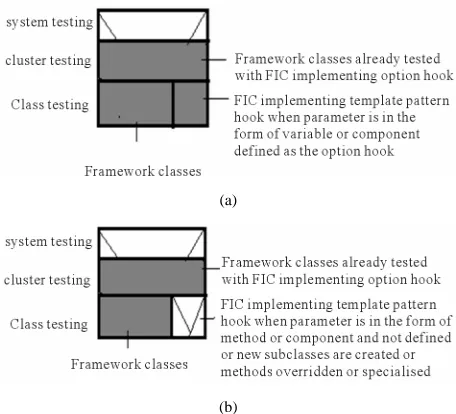
There are various approaches of testing—testing product by product, incremental testing of product families and division of responsibilities [33]. For a hook documented framework, we have identified different levels of test already conducted during the framework engineering stage and required at the application engineering stage based on the level of support of hook. For each level of support depicted in the Figures 2-4, the gray area shows that the respective level of testing of the artifact is al- ready conducted during the framework engineering stage and need no repetitions during the application engineer- ing stage. If there exist other application classes, unit testing of them is needed and if there exist any interac- tion between the FIC and other application classes then integration testing is also needed. Only the trivial case of
FIC consisting of hook with only one level of support i.e.
either option or supported pattern or open hook is con- sidered and depicted here.
Option Hook: Since the options are available within the framework, option hooks are already unit tested. However, when implementing option hooks, its imple-mentations need unit testing during the application engi-neering stage. Further, interactions between option hooks as well as interaction between option hook and frame-work classes, if any, are also tested during frameframe-work engineering stage. Thus, integration testing is also not required in this case [37]. System testing of the applica-tion is required be conducted during the applicaapplica-tion en-gineering stage to test whether all functional require-ments are fulfilled.
[image:5.595.310.540.86.171.2]Supported Pattern Hook: Test cases can be gener-ated which cover the range of parameters that the framework developers supply, are then adapted to test the applications. The templates should not be able to violate invariants on the framework, so no verification is needed [37]. Since the template pattern hooks should not violate
Figure 2. Various levels of test for FIC implementing option hook.
(a)
(b)
Figure 3. (a) Various levels of test for FIC implementing supported pattern hook when parameter is in the form of variable or component and stated as option hook; (b) Various levels of test for FIC implementing supported pattern hook when parameter is in the form of variable or component are not stated as option hook or new subclasses are created or methods are overridden or specialized.
Figure 4. Various levels of test for FIC implementing open hook.
[image:5.595.309.537.210.417.2] [image:5.595.310.536.509.589.2]application testing, as depicted in Figure 3(a). Another case 3(b) is when FIC implementing pattern hook whose parameters are not defined as the option hooks and/or creation of new subclasses, or methods to be overridden or specialized, then the unit testing of the respective FIC
and system testing is need to be conducted. The integra-tion testing of the respective FIC with framework classes need not to be tested as depicted in Figure 3(b).
Open Hook: Automated testing is not possible, and verification is considered necessary, maybe using model checking, to guarantee that the developers do not break conditions placed upon the framework or try to avoid or break the architecture of the framework [37]. New classes which are not subclasses, the new operations to classes and often the removal or replacement of code are made besides what is performed in the pattern hook.
The framework classes are already unit tested before the deployment of the framework. The framework inter-face class, FIC, having open ended hook are required to be unit tested, cluster testing is desired to be performed among the framework classes and FIC having open hooks, and system testing is also desired to be performed against the specified requirements of the application during the application testing.
Note: The gray area in the Figures 2-4 how’s the level of test already accomplished at the framework engineer- ing stage and the white area shows the level of test re- quired at the application engineering stage.
5.2. Comparison of Effort Needed for Various Levels of Test with Respect to Each Level of Support of Hooks
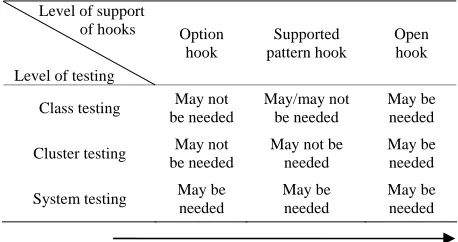
The flexibility to reuse as-is or customize basic test cases or generate new test cases from scratch during the appli- cation engineering stage increases from option hook to supported pattern hook to open hook [38]. It is obvious from the Figures 2-4 that the effort needed for unit, inte- gration and system testing is minimum with option hooks while it is maximum for open hooks. Thus, with the in- crease in flexibility of hooks test effort increases while the testability reduces as shown in Table 1.
5.3. Testability Model Considering the Flexibility of Hooks
[image:6.595.308.537.122.243.2]The application developer chooses those hooks which satisfies the requirements of the specific application. The various levels of support of hooks are categorized on the basis of level of flexibility provided to the framework re- user to customize the framework. Requirements specified at the hook methods form the basis for the construction of test cases which can be reused during application test-ing. Thus test effort will depend on different level of support of hooks of a framework and hence on flexibility
Table 1. Comparative study of effort needed for various levels of testing with respect to each level of support of hooks.
Level of support of hooks Level of testing
Option hook
Supported pattern hook
Open hook
Class testing May not be needed
May/may not be needed
May be needed Cluster testing May not
be needed
May not be needed
May be needed System testing May be
needed
May be needed
May be needed
Effort in test activity at each level of testing increases with the increase in flexibility of hooks.
provided by hooks.
A
TEFLA (1)
Equation (1) is further refined below.
In case of option hooks, since all requirements are met, least or no flexibility is provided to the application de-veloper to customize the requirements. Thus, flexibility provided by option hooks, FLOH, at the variation point is least and proportional to the total number of option hook,
NOH, chosen by the application developer, i.e.
OH OH
FL N (2a)
Further, the components are developed, tested and de-livered with the framework, so least or negligible amount of test effort is desired to be performed. Hence, test effort for the option hooks, TEOH, depends on the flexibility provided by option hooks, FLOH. Thus,
1
FIC
N
OH OH i
TE FL
(2b)In case of supported pattern hook, application deve- lopers are given the flexibility, FLSPH, to reuse the speci-fications of the supported hook as-is or customize them. Flexibility provided by supported pattern hooks, FLSPH, at the variation point is greater than FLOH and is propor-tional to the total number of supported pattern hook, NSPH, chosen by the application developer, i.e.,
SPH SPH
FL N (3a)
Further, the test effort depends on the number of basic test cases are reused as-is or customized as per the re-quirements specified at hook method are met or custo- mized. Test effort for the supported pattern hooks, TESPH, depends on the flexibility, FLSPH, of supported hook in a
FIC. Thus,
1
FIC
N
SPH S
i
P
TE FL
In case of open hooks, application developers are given the highest flexibility to reuse the specifications of the open hook as-is or customize or generate new speci-fications from scratch. Flexibility provided by open hooks, FLOPH, at the variation point/hotspot is highest and is proportional to the total number of open hooks,
NOPH, chosen by the application developer, i.e.,
OPH OPH
FL N (4a)
Further, test effort depends on the number of basic test cases reused as-is, customized or new test cases are con-structed from scratch as per the requirement specified at hook are met, customized or specified by the application developer. Test effort for the open hooks depends on the flexibility of open hooks, FLOPH, in a FIC. Thus,
1 FIC H OP N OP i
TE FL H
(4b)Thus, total flexibility, FLA, chosen by the application developer provided at the variation point/hotspot of the framework is represented as
A OH SPH OP
FL FL FL FL H (5a)
Since a FIC consists of option, supported pattern and open hooks, test effort for a FIC, TEFIC, is proportional to the summation of the test effort of option, supported pat-tern and open hooks in a FIC, i.e.TEOH, TESPH and TEOPH respectively, or test effort for all FICs is represented as
1 1 1 1
FIC FIC FIC FIC
N N N N
FIC OH SPH OPH
i i i i
TE TE TE TE
(5b)Using Equations (2b), (3b) and (4b), Equation (5b) becomes
1
FIC
N
F OH SPH O
i
PH
IC FL
TE FL FL
(5c)Using Equuation (5a), Equation (5c) becomes
1 FIC N C A FI i
TE
FL
(5d)Test effort required to test the framework based appli-cation, TEA, is dependent on the total test effort for total number of FICs, NFIC, containing hook(s) with various level of support and total test effort the total number of other application classes (NOAC). Thus,
1 0 FIC OAC N N FIC OAC i A i
TE TE TE
(6)So, replacing by the constant c, we have 0 OAC N OAC i TE
1 FIC A N FIC iTE TE
(7)Using Equation (5d), Equuation (7) becomes
A
TE FLA (8)
And using Equation (5b), Equation (7) is equivalent to
1 1 1
FIC FIC FIC
N N N
OH SPH OPH
i A
i i
TE TE T
TE E
(9)Factually, the testability of application, TbA is in-versely proportional to test effort, TEA. Thus,
1 1 1
1
FIC FIC FIC
N N N
OH SPH OPH
i i
A
i
N N N
Tb
(10)The Equation (1) shows that test effort of a framework based application is directly proportional to the flexibility provided by the framework developer and chosen and implemented by the framework reuser as the specific needs. Equation (10) is the testability model of the framework based application dependent on the number of various level of support of hooks implemented in the total FICs.
6. Case Study
open hook and the changes section describes that Anim-Drawing and AnimFigure are subclasses of Anim-Drawing and Figure. AnimDrawing overrides the existing step method of Drawing. These subclasses must be unit tested during the application engineering stage. The interaction of these subclasses AnimDrawing and AnimFigure must be tested with the framework classes Drawing and Figure. System testing is needed to be performed in this case during the application engineering stage to verify that all functional requirements are met as desired.
7. Conclusions
Our work, in the current paper, focus on identifying the internal software quality factor—flexibility affecting the testability of framework based software at all levels of testing. The level of flexibility provided at the variation point of the framework and chosen by the reuser of the framework as per the requirements affects the testability of the framework based systems. Moreover, we also propose a testability model considering the flexible as-pect of the variable point to estimate testability in the early phase, requirement analysis phase, of development process of the framework based software. The proposed model helps to improve the testability of the software before the implementation starts thus reducing the overall development cost. The limitation of our study is that the observations are based on the hook documented frame-work.
In future, a number of extensions to our work is plan- ned to be done:
1) An empirical study is needed to be conducted for the proposed model.
2) Modifying and proposing a new UML profile for the framework and framework instantiation to model the level of support of hooks, so that testability can be esti-mated directly from it.
3) Identifying and modeling many more factors af-fecting the testability of frameworks and framework based systems.
REFERENCES
[1] K. Beck and R. Johnson, “Patterns Generate Architec- tures,” Proceedings of 8th European Conference on Ob-ject Oriented Programming, Bologna, 1994, pp. 139-149.
[2] T. Jeon, S. Lee and H. Seung, “Increasing the Testability of Object-Oriented Frameworks with Built-In Test,” Lec- ture Notes in Computer Science, Vol. 2402, 2002, pp. 873-881.
[3] G. Froehlich, H. J. Hoover, L. Liu and P. Sorenson, “Hooking into Object-Oriented Application Frame- works,” Proceedings of the 19th International Conference on Software Engineering, Boston, May 1997, pp. 491- 501.
[4] J. Al Dallal, “Class-Based Testing of Object-Oriented
Framework Interface Classes,” Ph.D. Thesis, Department of Computing Science, University of Alberta, 2003.
[5] J. Al Dallal and P. Sorenson, “Estimating the Coverage of the Framework Application Reusable Cluster-Based Test Cases,” Information and Software Technology, Vol. 50, No. 6, 2008, pp. 595-604.
doi:10.1016/j.infsof.2007.07.006
[6] R. V. Binder, “Design for Testability in Object-Oriented Systems,” Communications of the ACM, Vol. 37, No. 9, 1994, pp. 87-101. doi:10.1145/182987.184077
[7] N. Fenton and S. L. Pfleeger, “Software Metrics: A Ri- gorous and Practical Approach,” PWS Publishing Com- pany, Boston, 1997.
[8] R. Bache and M. Mullerburg, “Measure of Testability as a Basis for Quality Assurance,” Software Engineering Jour- nal, Vol. 5, No. 2, 1990, pp. 86-92.
doi:10.1049/sej.1990.0011
[9] IEEE, “IEEE Standard Glossary of Software Engineering Terminology,” IEEE CSP, New York, 1990.
[10] ISO/IEC 9126, “Software Engineering Product Quality,” 1991.
[11] W. Pree and H. Sikora, “Design Patterns for Object Ori-ented Software Development,” ICSE’97, Proceedings of the 19th International Conference on Software Engineer-ing, Boston, 1997, pp. 663-664.
[12] R. S. Freedman, “Testability of Software Components,”
IEEE Transactions on Software Engineering, Vol. 17, No. 6, 1991, pp. 553-564.
[13] J. M. Voas, “Pie: A Dynamic Failure-Based Technique,”
IEEE Transactions on Software Engineering, Vol. 18, No. 8, 1992, pp. 717-727. doi:10.1109/32.153381
[14] J. Voas and K. W. Miller, “Semantic Metrics for Software Testability,” Journal of Systems and Software, Vol. 20, No. 3, 1993, pp. 207-216.
doi:10.1016/0164-1212(93)90064-5
[15] J. M. Voas and K. W. Miller, “Software Testability: The New Verification,” IEEE Software, Vol. 12, No. 3, 1995, pp. 17-28. doi:10.1109/52.382180
[16] A. Bertolino and L. Strigini, “On the Use of Testability Measures for Dependability Assessment,” IEEE Transac- tions on Software Engineering, Vol. 22, No. 2, 1996, pp. 97-108. doi:10.1109/32.485220
[17] M. Bruntink and A. V. Deursen, “Predicting Class Test- ability Using Object-Oriented Metrics,” Proceedings of IEEE International Workshop on Source Code Analysis and Manipulation, Chicago, 15-16 September 2004, pp. 136-145. doi:10.1109/SCAM.2004.15
[18] S. Jungmayr, “Identifying Test-Critical Dependencies,”
Proceedings of IEEE International Conference on Soft- ware Maintenance, Montreal, 3-6 October 2002, pp. 404- 413.
[19] B. Baudry, Y. L. Tran and G. Sunye, “Measuring Design Testability of a UML Class Diagram,” Information and Software Technology, Vol. 47, No. 1, 2005, pp. 859-879. doi:10.1016/j.infsof.2005.01.006
Test-ability,” Information and Software Technology, Vol. 47, No. 1, 2005, pp. 979-997.
doi:10.1016/j.infsof.2005.09.003
[21] Y. Wang, D. Patel, G. King, I. Court, G. Staples, M. Ross and M. Fayad, “On Built-In Test Reuse in Object-Orien- ted Framework Design,” ACM Computing Surveys, Vol. 32, No. 1, 2000, pp. 7-12. doi:10.1145/351936.351943
[22] D. Ranjan and A. K. Tripathi, “Variability-Based Models for Testability Analysis of Frameworks,” Journal of Soft- ware Engineering and Applications, Vol. 3, No. 5, 2010, pp. 455-459. doi:10.4236/jsea.2010.35051
[23] D. Ranjan and A. K. Tripathi, “Testability Models for Object-Oriented Frameworks,” Journal of Software En- gineering and Applications, Vol. 3, No. 6, 2010, pp. 536- 540. doi:10.4236/jsea.2010.36061
[24] D. Ranjan and A. K. Tripathi, “Effect of Variability of a Framework upon Its Testing Effort: An Empirical Eva- luation,” 5th International Conference on Computer Sci- ences and Convergence Information Technology, Seoul, 30 November-2 December 2010, pp. 146-151.
doi:10.1109/ICCIT.2010.5711046
[25] R. V. Binder, “Testing Object-Oriented Systems: Models, Patterns, and Tools,” Addison-Wesley Professional, Bos- ton, 1999.
[26] J. Al Dallal and P. Sorenson, “System Testing for Ob- ject-Oriented Frameworks Using Hook Technology,” Pro- ceedings of the 17th IEEE International Conference on Automated Software Engineering, Edinburgh, September 2002, pp. 231-236.
[27] M. E. Fayad and D. C. Schmidt, “Object-Oriented Appli- cation Frameworks,” Communications of the ACM, Vol. 40, No. 10, 1997, pp. 32-38. doi:10.1145/262793.262798
[28] T. Jeon, H. W. Seung and S. Lee, “Embedding Built-In Tests in Hot Spots of an Object-Oriented Framework,”
ACM Sigplan Notices, Vol. 37, No. 8, 2002, pp. 25-34. doi:10.1145/596992.597001
[29] J. Al Dallal and P. Sorenson, “Reusing Class-Based Test Cases for Testing Object-Oriented Framework Interface Classes,” Journal of Software Maintenance and Evolution:
Research and Practice, Vol. 17, No. 3, 2005, pp. 169-
196. doi:10.1002/smr.308
[30] W. Tsai, Y. Tu, W. Shao and E. Ebner, “Testing Extensi- ble Design Patterns in Object-Oriented Frameworks through Scenario Templates,” Proceeding of 23rd Annual International Computer Software and Applications Con- ference, Phoenix, October 1999, pp. 166-171.
[31] M. E. Fayad, Y. Wang and G. King, “Built-In Test Re- use,” In: M. E. Fayad, Ed., The Building Application Frame- works, John Wiley and Sons, Chichester, 1999, pp. 488- 491.
[32] E. Gamma, R. Helm, R. Johnson and J. M. Vlissides, “Design Patterns: Elements of Reusable Object-Oriented Software,” Addison-Wesley Professional Computing Se- ries, Boston, 1994.
[33] A. Tevanlinna, J. Taina and R. Kauppinen, “Product Fa- mily Testing: A Survey,” ACM Sigsoft Software Enginee- ring Notes, Vol. 29, No. 2, 2004, pp. 12-18.
doi:10.1145/979743.979766
[34] J. Al Dallal and P. Sorenson, “Testing Software Assets of Framework-Based Product Families during Application Engineering Stage,” Journal of Software, Vol. 3, No. 5, 2008, pp. 11-25.
[35] R. Kauppinen, J. Taina and A. Tevanlinna, “Hook and Template Coverage Criteria for Testing Framework- Based Software Product Families,” Proceedings of the International Workshop on Software Product Line Test- ing, Boston, 2004, pp. 7-12.
[36] B. Meyer, “Applying Design by Contract,” IEEE Com- puter, Vol. 25, No. 10, 1992, pp. 40-51.
doi:10.1109/2.161279
[37] G. Froehlich, “Hooks: An Aid to the Reuse of Object- Oriented Frameworks,” Ph.D. Thesis, University of Al- berta, Department of Computing Science, Edmonton 2002.
![Figure 1, for developing applications in the application engineering stage [4].](https://thumb-us.123doks.com/thumbv2/123dok_us/38352.503685/1.595.311.536.576.707/figure-developing-applications-application-engineering-stage.webp)