211
©IJRASET: All Rights are Reserved
UID based Payment Interface
Reetik Mathankar1, Vipul Karande2, Rahul Hipparkar3, Prof. Shikha Pachouly3
1, 2, 3
Department of Computer Engineering, AISSMS COE, Savitri Bai Phule University, Pune
4
Assistant Professor, Department of Computer Engineering, AISSMS COE, Savitri Bai Phule University, Pune
Abstract: The 3 modes of payment that people use to carry out any transaction are: cash, cards, e wallets. But there might be some circumstances when the buyer cannot use any of the above mentioned modes of payment. To deal with such case a payment interface can be developed which won’t require the customer to have a phone or a card or cash. Only the shopkeeper needs to have a smartphone having a camera. The customer needs to verify through iris scan to proceed with the transaction process. Aadhar cards are linked with bank accounts, which already contains the bio-metrics i.e. iris and the fingerprint, the input bio-metrics will be matched and verified. There is no need to collect information from the user, since Aadhar cards which contains the bio-metrics are already linked with the bank accounts can be used.
Keywords: Transaction Processing, Iris Recognition, Database Handling, Security, E-Commerce, Payment Gateway
I. INTRODUCTION
Every now and then in our day to day lives, we are always visiting a shop to buy some things according to our needs. In order to buy a product from a shop we need to pay the of that product in from money. This payment can be done either by cash, or card or an e-wallet. Nowadays e-wallets has become a trend, since mobile phones are widely used by the people. E-wallets are intended to replace the existing physical wallet, with its notes, coins, plastic cards etc. E-wallets makes it easier for the customers as well as the shopkeepers it requires no cash physically to carry out any transaction. Also e-wallets provide not only secure transactions but also they keep the records of each and every transactions that has been carried out successfully.
There might be some circumstances where the customer can neither pay through cash, card or any e-wallet. This is where our proposed system can be used. The proposed payment interface makes use of the Aadhar Card that is linked with the user’s bank account for verification purpose. The main advantage of our system is that there is no need to collect any data from the customer and make use of what is existing already. Iris recognition is the most crucial part of this project. People often get confused with iris and retinal scans. The retina is the portion made up of neural-cells that is located at the back portion of the eye. Whereas the iris is the circular structure in the eye that holds the responsibility of controlling the size and diameter of pupil. Iris Recognition is carried out by using the John Dougman Algorithm. By using this algorithm the camera of the mobile can be used, and there is no need of an external iris scanner.
II. RELATEDWORK
Research has proposed systems that use iris patterns to identify individuals by relying on near infrared images. A few use visible light images. In this section, some of the previous studies are reviewed based on the algorithms used in the iris recognition system phases for iris and pupil segmentation, normalization, feature extraction, and iris template matching.
TABLEI.LITERATURE SURVEY
Sr. No Name of the Reference
Paper
Publish Year
Author Description
[1] Developing Iris
Recognition System for Smartphone Security
2017
Lamiaa A Elrefaei, H. Hamid. Mobile devices can be used for high
performance iris recognition. Main issues related to iris recognition in mobile device consist of uncontrollable capturing conditions and limitations in computation
power. This approach consists of
212
©IJRASET: All Rights are Reserved
[2] Methodology for Iris
Scanning through
Smartphones
2018
Rosales-Bandares Jose de
Jesus.
The iris scan is an automatic biometric identification method that uses image
processing techniques and pattern
recognition. This paper describes an application for scanning the iris through mobile devices without the need to use special cameras.
[3] Security Risk Analysis
and Management in
mobile wallet transaction: A Case study of Pagatech Nigeria Limited
2018
Musbau D. Abdulrahaman,
John K. Alhassan
This research work focuses on the
assessment of the vulnerabilities
associated with mobile wallet transactions
and performs an empirical risk
management in order to derive the security priority level needed to ensure the security and privacy of the users of mobile wallet platforms.
[4] Comparison of Iris
Biometric Algorithms 2016
Priyanka Hende, Vinaya
Pranab, Gauri Kakade, Nikita Kamble
This paper, shows various biometric authentication technique based on human
iris and compared Iris biometric
algorithms that includes Avila, Li ma, Tisse and Daughman based on their
accuracy rate. We concluded that
Daughman has the highest accuracy rate.
[5] Iris Authentication
through Gabor Filter using DSP Processor
2013
V. Saravanan, R.Sindhuja. This method analyses the Iris Biometric
Authentication as it as low error rates
compared to other Biometric
Authentication methods and its
robustness of the algorithm is provided. Gabor Filter algorithm is used for feature extraction.
[6] Comparison of iris
recognition Algorithms 2004
Mayank Vatsa, Richa Singh, P.Gupta
This paper shows various known
algorithms for iris recognition. Four algorithms due to Avila, Li Ma, Tisse and Daugman are implemented and compared on the CASIA iris image database. The
results show that the Daugman’s
algorithm gave the highest accuracy of 99.9%.
[7] Iris Recognition with a
Database of Iris Images Obtained in Visible Light using Smartphone Camera
2017
Mateusz Trokielewicz This paper introduces a completely new
213
©IJRASET: All Rights are Reserved
[8] Iris Recognition System in
Smartphones Using Light Version (LV) Recognition Algorithm
2017
Syed Arslan Ali, Munam Ali Shah, Taimoor Ahmed Javed, Syed Muhammad Abdullah, Maham Zafar
This paper introduces a light version (LV) algorithm that can recognize iris images
in smartphones. Light version(LV)
algorithm is used for iris recognition using smartphone cameras by modifying and extending iris recognition algorithm in such a way that the best optimized solution can be found for authentication using smartphone cameras.
[9]
Iris Recognition using
Machine Learning from
Smartphone Captured
Images in Visible Light
2017 Md. Fahim Faysal Khan, Ahnaf
Akif, M. A. Haque
This paper shows the applicability and feasibility of different machine learning techniques on iris recognition from smartphone captured eye images. First, the iris is localized using the popular Daugman’s method and the eyelids are suppressed with canny edge detection technique.
[10] High Performance Iris
Recognition for Mobile Platforms
2018
G.A. Odinokikh, A.M.
Fartukov, V.M. Eremeev.
Mobile devices can be used for high performance iris recognition. Main issues related to iris recognition in mobile device consist of uncontrollable capturing conditions and limitations in computation
power. This approach consists of
following key components- multi-stage algorithm structure, novel iris image quality estimation approach for mobile applications.
III.DIFFERENTIRISRECOGNITIONALGORITHMS
Any iris algorithm is basically divided into four steps, Localization, Normalization, Feature Extraction, Matching.
A. Daugman Algorithm
Daugman was the first to give an algorithm for iris recognition. Both inner and outer boundaries of iris are found preprocessing step. A rectangular representation of required area is created for the conversion from Cartesian to Polar coordinates. For feature extraction algorithm makes use of 2-D wavelets. For matching, the hamming distance is calculated.
B. Avila
In Avila, iris feature are extracted in fine or course approximations. The result obtained is in the form of model which uses different distances.
C. Tisse
Tisse algorithm is done in two steps-
1) It implements gradient decomposition technique for iris localization.
2) It then analyses the image to verify iris from iris structure.
This algorithm is another alternative for Daugmann algorithm but has very less accuracy.
D. Li Ma Algorithm
214
©IJRASET: All Rights are Reserved
TABLEII
COMPARISON OF DIFFERENT IRIS RECOGNITION ALGORTIHMS
Iris Algorithms
Avila Tisse Li Ma Daugmann
Process Iris
representation is in the form of fine
or coarse
approximations.
Implements half transformed technique for iris
localization. It
then analyses the image to get the structure of iris.
Li Ma
decomposes into four layers using 2-D Haar wavelet transform
technique.
Divides the iris into inner and outer regions. Segmentation is done for iris verification.
Advantages Works for
more than one distance
measuring techniques.
Provides high
confidence iris
verification.
Provides high accuracy.
Provides high accuracy and resistance to noisy images.
Disadvantages Tedious work. Less accuracy
compared to
others.
Does not work on noisy images.
FAR/FRR 0.03/2.08 0.02/1.98 1.84/8.79 0.01/0.09
Accuracy 97.89 98.00 89.37 99.90
IV.EXISTINGSYSTEM
Currently there are many e-wallets that are being used by customers and the shopkeepers. Some remarkable examples are PayTM, Google Pay, PhonePe. Each of these application needs to be installed on both the shopkeeper’s and the customer’s smartphone in order to work. If customer’s phone is dead due to some reason, there is no way he/she can proceed with the transaction.
TABLEIIII
EXISTING SYSTEMS
Sr No. Parameters PayTm Google Pay PhonePe Proposed System
1. Secure Yes Yes Yes Yes
2. Additional Collection of Data Yes Yes Yes No
3. Need of a Smartphone at
Customer’s Side
Yes Yes Yes No
4. Linking Application to Bank
Account after Installation
Yes Yes Yes No (Shopkeepers
Only)
V. PROPOSEDSYSTEM
The payment interface is supposed to be an application that must be installed and run on shopkeeper’s smartphone. After installing the application, the shopkeeper needs to register, and enter the details of his bank account and the aadhar card number linked with that account.
Whenever the customer has to pay an amount in order to buy a product, the shopkeeper will have to enter the amount in the interface and give the smartphone to the customer for verification. The customer will feed his iris as an input and it will be matched with the iris that is stored in the Aadhar Card of the customer that is linked with his bank account.
215
[image:5.612.132.443.74.250.2]©IJRASET: All Rights are Reserved
Fig. 1 Architecture of Payment Interface
As compared to the existing systems, the customer does not need to install the application on his smartphone. Also there is no need for the customer to link any bank account to the application.
VI.IRISRECOGNITIONALGORITHMUSEDINTHEPROPOSEDSYSTEM
There are four main phases:
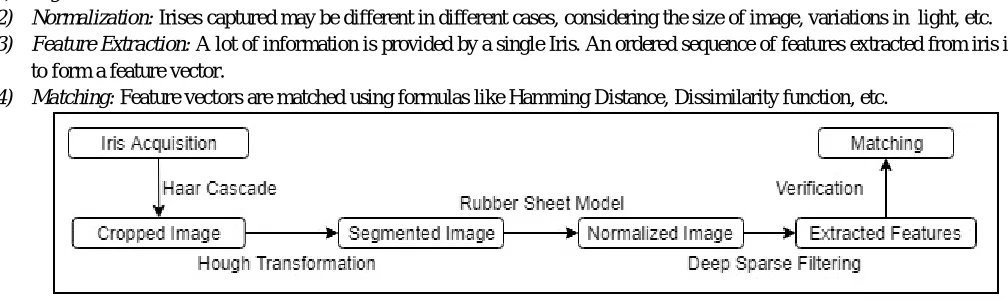
1) Segmentation: The inner and outer boundaries of Iris are calculated.
2) Normalization: Irises captured may be different in different cases, considering the size of image, variations in light, etc.
3) Feature Extraction: A lot of information is provided by a single Iris. An ordered sequence of features extracted from iris is used to form a feature vector.
4) Matching: Feature vectors are matched using formulas like Hamming Distance, Dissimilarity function, etc.
Fig. 2 Iris Recognition Module
John Daugman Algorithm is preferred for Iris Recognition in our proposed system. The proposed system captures an image by using the mobile built-in camera
5) Segmentation: This step is further divided into three steps: detection of iris, localization of pupil, localization of iris.
a) Detection of Iris: Iris must be detected from the eye region in the image captured. Here the Haar Cascade Classifier is used.
b) Localization of Pupil: It is used for locating the annular region surrounded by two circles: i.e. Sclera and boundary of Pupil. To identify the lines and circles, Hough Transformation is used. It determines the radius and the centre of the pupil.
c) Localization of Iris: This is the most important step, here both the inner and outer boundaries of the iris are to be located.
6) Normalization: This step is performed to obtain the fixed dimensions in variable conditions for iris comparisons. Mapping of iris done from Cartesian coordinates to the polar coordinates that represent a fixed pattern. The Rubber Sheet Model is used for this step.
7) Iris Feature Extraction: The Deep Sparse Filter algorithm is implemented and used for feature extraction. The only parameter required is the number of features present in Iris. A Deep Sparse Filter is used to collect a bank of filters, which will be used for extracting the features from the iris image.
[image:5.612.43.547.342.492.2]216
©IJRASET: All Rights are Reserved
VII.CONCLUSIONS
In future people will tend to go hands free, and this proposed system has the such potential. The UID based Payment Interface is very secure as it makes use of the Iris of the customer for verification, which can never be the same. Since data is already collected, the system is easy to implement as it has no need to collect the data again. This would revolutionize the whole payment system.
VIII. ACKNOWLEDGMENT
We would like to thank Prof. Shikha Pachouly Ma’am, under whose guidance we were able to come up with this idea of creating a payment interface. We would also like to thank our family members and friends who helped us throughout thi s project.
REFERENCES
[1] Lamiaa A, Ekrefaei, Doaa H. Hamid, Afnan A. Bayazed, Sara S. Bushnak and Shaikhah Y. Maasher, “Developing Iris Recognition System for Smartphone Security.” Multimedia Tools and Applications, vol. 77, no. 12, 22 Aug. 2017, pp. 14579-14603, Springer Science+Business Media, LLC 2017
[2] Mayank Vatsa, Richa Singh, and P.Gupta, “Comparison of Iris Recognition Algorithms”, ICISIP 2004, pp 354-358, IEEE
[3] Musbau D. Abdulrahaman, John K. Alhassan, Joseph A. Ojeniyi and Shafii M. Abdulhamid, “Security Risk Analysis and Management in mobile wallet transaction: A Case study of Pagatech Nigeria Limited”, I. J. Computer Network and Information Security, 2018, 12, 21-33, MECS
[4] Syed Arslan Ali, Munam Ali Shah, Taimoor Ahmed Javed, Syed Muhammad Abdullah, Maham Zafar, “Iris Recognition System in Smartphones Using Light Version (LV) Recognition Algorithm” , Proceedings of the 23rd International Conference on Automation & Computing, University of Huddersfield,Huddersfield, UK, 7-8 September 2017, IEEE
[5] Priyanka Hendre, Vinaya Parab, Gauri Kakade, Nikita Kamble, “Comparison of Iris Biometric Algorithms”, International Journal of Innovative Studies in Sciences and Engineering Technology, ISSN 2455-4863, March 2016
[6] Iris Recognition, Retrieved on October 2019, https://en.wikipedia.org/wiki/Iris_recognition
[7] Iris Recognition System, Retrieved on December 24, 2019, https://www.mathworks.com/matlabcentral/fileexchange/69484-iris-recognition-system
[8] Iris Recognition Vs. Retina Scanning: What are the Differences, Retrieved on December 22, 2019, http://www.m2sys.com/blog/biometric-hardware/iris-recognition-vs-retina-scanning-what-are-the-differences/
[9] List of all Eye Scanner(Iris, Retina Recognition) Smartphones, Retrieved on October 20, 2019, https://webcusp.com/list-of-all-eye-scanner-iris-retina-recognition-smartphones/