Variation of Vacuum Energy if Scale Factor Becomes
Infinitely Small, with Fixed Entropy Due to a Non
Pathological Big Bang Singularity Accessible to
Modified Einstein Equations
Andrew Beckwith
Department of Physics, Chongqing University, Chongqing, China Email: [email protected]
Received June 28, 2012; revised July 30, 2012; accepted August 8,2012
ABSTRACT
When initial radius if Stoica actually derived Einstein equations in a formalism which remove the big bang singularity pathology, then the reason for Planck length no longer holds. The implications of are the first part of this manuscript. Then the resolution is alluded to by work from Muller and Lousto, as to implications of entan- glement entropy. We present entanglement entropy in the early universe with a steadily shrinking scale factor, due to work from Muller and Lousto, and show that there are consequences due to initial entanged
0 initial
R
0 initial
R
2 2 0.3H
Sentropy r a for a
time dependent horizon radius rH in cosmology, with for flat space conditions rH for conformal time. In the case
of a curved, but not flat space version of entropy, we look at vacuum energy as proportional to the inverse of scale fac- tor squared times the inverse of initial entropy, effectively when there is no initial time in line with ~H2 G
1 H a
. The consequences for this initial entropy being entangled are elaborated in this manuscript. No matter how small the length gets, if it is entanglement entropy, will not go to zero. The requirement is that the smallest length of time, t, re scaled does not go to zero. Even if the length goes to zero. This preserves a minimum non zero
entropy
S
vacuum energy, and in doing so keep the bits, for computational bits cosmological evolution even if Rinitial 0.
Keywords: Fjortoft Theorem; Thermodynamic Potential; Matter Creation; Vacuum Energy Non Pathological Singularity Affecting Einstein Equations; Planck Length; Braneworlds
1. Introduction
This article is to investigate what happens physically if there is a non pathological singularity at the start of space-time, i.e. no reason to have a minimium nonzero
length. The reasons for such a proposal come from [1] by Stoica who may have removed the reason for the deve- lopment of Planck’s length as a minimum safety net to remove what appears to be unadvoidable pathologies at the start of applying the Einstein equations at a space- time singularity, and are commented upon in this article.
2 1
~H GH a
in particular is remarked upon. This is a counter part to Fjortoft theorem in Appendix I
below.
Note a change in entropy formula given by Lee [3] about the inter relationship between energy, entropy and temperature as given by
2
2π
U
B
a
m c E T S S
c k
38 ~ 10
S
(1)
Lee’s formula is crucial for what we will bring up in the latter part of this document. Namely that changes in initial energy could effectively vanish if [1] is right, i.e.
Stoica removing the non pathological nature of a big bang singularity.
If the mass m, i.e. for gravitons is set by acceleration
(of the net universe) and a change in enthropy
between the electroweak regime and the final entropy value of, if
2
c
a for acceleration is used, so then we x
obtain
88 ~ 10 Today
S (2)
between gravitons (today) and gravitinos (electro weak) in the sense of preservation of information.
3 4
3 4 2
#bits~ E l Mc l
c c
Having said this note by extention
2 1
~H GH a
. As changes due to
2
~H G
and ~1
#
initial Ng lanck
E
R 0
0 E
E
S P
R l , then a is also
altered i.e. goes to zero.
What will determine the answer to this question is if
initial goes to zero if initial which happens if
there is no minimum distance mandated to avoid the pa- thology of singularity behavior at the heart of the Ein- stein equations. In doing this, we avoid using the
situation, and instead refer to a nonzero energy, with initial instead vanishing. In particular, the
En-tanglement entropy concept as presented by Muller and Lousto [4] is presented toward the end of this manuscript as a partial resolution of some of the pathologies brought up in this article before the entanglement entropy section. No matter how small the length gets, entropy if it is
entanglement entropy, will not go to zero. The require- ment is that the smallest length of time, t, re scaled goes
to zero. This preserves a minimum non zero. va- cuum energy, and in doing so keep the bits, for compu- tational bits cosmological evolution even if R 0.
0 initial
R
initial
Before doing that, we review Ng [5-7] and his quan-tum foam hypothesis to give conceptual underpinnings as to why we later even review the implications of entangle- ment. Entropy, i.e. the concept of bits and computations
is brought up because of applying energy uncertainty, as given by [3] and the Margolis theorem appears to indi-cate that the universe could not possibly evolve if [1] is applied, in a 4 dimensional closed universe. This bottle neck as indicated by Ng’s [4] formalism is even more striking in its proof of the necessity of using entangle- ment entropy in lieu of the conclusion involving entan- glement entropy, which can be non zero, even if
.
2. Review of Ng [5-7] with Comments
First of all, Ng refers to the Margolus-Levitin theorem with the rate of operations
2
# time Mc l
c
E operations E
. Ng wishes
to avoid black-hole formation
2
lc M
G
. This last step is not important to our view point, but we refer to it to keep fidelity to what Ng brought up in his presentation. Later on, Ng refers to the
2~ 10123l
#operations RH P with RH
the Hubble
radius. Next Ng refers to the #bits #operations 3 4.
Each bit energy is 1/RH with RH ~lP10123 2
The key point as seen by Ng [4] and the author is in
(3)
Assuming that E of the universe is not set equal to zero,
which the author views as impossible, the above equation says that the number of available bits goes down dra- matically if one sets ~1
#
initial Ng Planck
R l ? Also Ng
writesentropy S as proportional to a particle count via N.
2~ H P
S N R l (4)
We rescale RH to be
123 2
~ 10 #
Ng H rescale
l
R
#
(5)
The upshot is that the entropy, in terms of the number of available particles drops dramatically if becomes larger.
So, as ~ 1 #
initial Ng Planck
R l #
#
0
R
0 initial
R
grows smaller, as becomes larger.
a) The initial entropy drops;
b) The nunber of bits initially available also drops. The limiting case of (4) and (5) in a closed universe, with no higher dimensional embedding is that both would vanish, i.e. appear to go to zero if becomes
very much larger.
3. Does It Make Sense to Talk of Vacuum
Energy if
R
initial≠
0 Is Changed to
R
initial→
0? Only Answerable
Straightforwardly if an Embedding
Superstructure Is Assigned. Otherwise
Difficult. Unless One Is Using
Entanglement Entropy which Is Non Zero
Even if
R
initial→
0
We summarize what may be the high lights of this in- quiry leading to the present paper as follows.
a) One could have the situation if initial of an
b) The most problematic scenario. initial and no
initial cosmological energy, i.e. this in a 4 dimensional
closed universe. Then there would be no vacuum energy at all.initially. A literal completely empty initial state, which is not held to be viable by Volovik [9].
0
R
c) Finding that additional dimensions are involved, than just 4 dimensions may give credence to the authors speculation as to initial degrees of freedom reaching up to 1000, and the nature of a phase transition from essen-tially very low degrees of freedom, to over 1000 maybe in fact a chaotic mapping as speculated by the author in 2010 [10].
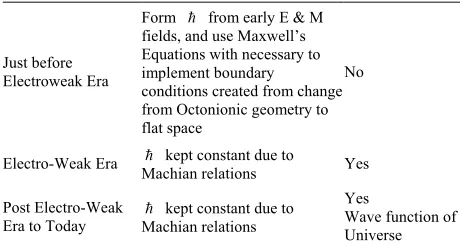
d) What the author would be particularly interested in knowing would be if actual semiclassical reasoning could be used to get to an initial prequantum cosmological state. This would be akin to using [11], but even more to the point, using [12] and [13], with both these last references relevant to forming Planck’s constant from electromag-netic wave equations. The author points to the enormous Electromagnetic fields in the electroweak era as perhaps being part of the background necessary for such a semi-classical derivation, plus a possible Octonionic space- time regime, as before inflation flattens space-time, as forming a boundary condition for such constructions to occur [14].
The relevant template for examinging such questions is given in the following Table 1.
e) The meaning of Octonionic geometry prior to the introduction of quantum physics presupposes a form of embedding geometry and in many ways is similar to Pen- rose’s cyclic conformal cosmology speculation. Note the following argument, as:
f) We are stuck with how a semiclassical argument can be used to construct Table 1 below. In particular, we look at how Planck’s constant is derived, as in the elec- troweak regime of space-time, for a total derivative [12, 13]
y
A t x
y
y A E
t
(6)
Similarly [12,13]
y
A t x
y z
A B
x
(7)
The A field so given would be part of the Maxwell’s
equations given by [11] as, when
represents a D’Al- bertain operator, that in a vacuum, one would have for an A field [12,13]
A0 (8)And for a scalar field
[image:3.595.307.537.111.234.2]
0 (9) Following this line of thought we then would have anTable 1. Time interval dynamical consequences does qm/wdw apply?
Just before Electroweak Era
Form from early E & M fields, and use Maxwell’s Equations with necessary to implement boundary conditions created from change from Octonionic geometry to flat space
No
Electro-Weak Era
kept constant due to
Machian relations Yes
Post Electro-Weak
Era to Today Machian relations kept constant due to
Yes
Wave function of Universe
energy density given by, if 0 is the early universe per-
meability [12]
2 2
2 2
0
0
2 Ey Bz Ay t x
(10)
We integrate (10) over a specified E and M boundary, so that, then we can write the following condition namely [12,13].
2 0
d d d
d d d
y
t x y z
A t x t x y z
gravitational energy
E
(11)
(11) would be integrated over the boundary regime from the transition from the Octonionic regime of space time, to the non Octonionic regime, assuming an abrupt transi-tion occurs, and we can write, the volume integral as representing [12,13]
(12)
Our contention for the rest of this paper, is that Mach’s principle will be necessary as an information storage container so as to keep the following, i.e. having no
variation in the Planck’s parameter after its formation from electrodynamics considerations as in (11) and (12). Then by applying [12,13] we get formed by semi-classical reasons and need to have Machs principle (1) to have the same value up to the present era. In semi classi-cal reasoning similar to [11]
t Apply Machs Relations
(Constant value) (13)
The question we can ask, is that can we have a pre- quantum regime commencing for (11) and (12) for if
1 ~
#
initial Ng Planck
R l
In so many words, the formation period for is our pre-quantum regime. This Table 1 could even hold if
initial but that the 4 dimensional space-time exhibi-
ting such behavior is embedded in a higher dimensional template. That due to initial not removing entan-
glement entropy as is discussed near the end of this article.
0
R
R
R
24π
initial initial initial
E R R
R R
0
4
.
If
R
initial→
0,
Then if There Is an Isolated,
Closed Universe, There Is a Disaster
Unless One Uses Entanglement Entropy
One does not have initial entropy, and the number of bits initially disappears.
Abandoning the idea of a completely empty universe, this unperturbed point of matter-energy appears to be a recipede for a static point with no perturbation, as may be the end result of applying Fjortoft theorem [15] to the thermodynamic potential as given in [16], i.e. the non
definitive anwer for fufillment of criteria of instability by applying Fjortoft’s theorem [15] to the potential [16] leading to no instability as given by the potential given in [16] may lead to a point of space-time with no change, i.e.
a singular point with “infinite” mass which does not change at all.
5. Can an Alternative to a Minimum Length
Be Put in? Consider the Example of
Planck Time as the Minimal Component,
Not Planck Length
From J. Dickau, the following was given to the author, as a counter part as to how to view threshholds as to how a Mandelbrot set may pre select for critical behavior dif-ferent from what is being pre supposed in this manuscript. [17].
Dickau writes:
“If we examine the Mandelbrot Set along the Real axis, it informs us about behaviors that also pertain in the Quaternion and Octonic case-because the real axis is invariant over the number types. If numbers larger than
0.25 are squared and summed recursively ( i.e. –z = z^2
+ c ) the result will blow up, but numbers below this threshold never get to infinity, no matter how many times they are iterated. But once space-like dimensions are added, i.e. an imaginary compoent—the equation blows up exponentially, faser than when iterated”.
Dickau concludes:
“Anyhow there may be a minimum (space-time length) involved but it is probably in the time direction”.
This is a counter pose to the idea of minimum length,
i.e. the idea being a replacement for what the author put
in here: looking at a beginning situation with a crucial parameter initial even if the initial time step is “put in
by hand”. First of all, look at [4], if E is M, due to setting
c = 1, then
(14)
Everything depends upon the parameter initial which
can go to zero. The choice as to initial going to zero, or
not going to zero will be conclusion of our article. We have to look at what (14) tells us, even if we have an initial time step for which time is initially indetermi- nate, as given by a redoing of Mitra’s g00 formula [8]
which we put in to establish the indeterminacy of the initial time step if quantum processes hold.
00 0
2
exp 0
1 p
g
t p t
(15)
What Dickau is promoting is, that the Mandelbrot set, if applicable to early universe geometry, that what the author wrote, with
#
1 ~
#
initial Ng Planck
R l smallvalue potentially
going to zero, is less important than a minimum time length. To which the author states, if Dickau is correct as to applicability of the Mandelbrot set, that he, the author is happily corrected, but he also thinks that the Mandel-brot set is a beautiful example of the fungability of space- time metrics used, i.e. how one sets the initial space-time
potential is to determine the correctness of the Mandel-brot set, i.e. the [16] reference, as given, by Thanu
Pad-manabhan appears not to have a Mandelbrot set, in its thermodynamic potential. The instability issue is review- ed in Appendix II. For those who are interested in the author’s views as to lack proof of instability. It uses [16] which the author views as THE reference as far as ther-modynamic potentials and the early universe.
6. Muller and Lousto Early Universe
Entanglement Entropy, and Its
Implications. Solving the Spatial Length
Issue, Provided a Minimum Time Step Is
Preserved in the Cosmos, in Line with
Dickau’s Suggestion
We look at [4]
2 2
0.3
entropy H
S r a for a time dependent
horizon radius rH in cosmology (16)
Equation (16) above was shown by the author to be fully equivalent to
2 2 2
0.3 0.3 ~ exp
3
entropy H
S r a t
a
(17)
i.e.
2
~ ln
3 e 0.3 entropy
a
t S
So, then one has
2 2
0.3 Sentropy
S
2
3 lne
a t
(19)
No matter how small the length gets, entropy if it is
entanglement entropy, will not go to zero. The require-ment is that the smallest length of time, t, re scaled does
not go to zero. This preserves a minimum non zero vacuum energy, and in doing so keep the bits, for com-putational bits even if Rinitial0.
0
R
0
R
0
R
7. Conclusions
a) The universe if initial [1] and if it is an iso-
lated system, i.e. not as embedded in higher dimensions as referred to in [18] may have no bits, or computations as thought of by Ng [5-7]. This would be in tandem with the authors conclusion that one would have an initial infinite point mass and no evolution. And no generation of entropy. The only way about this, as indicated in sec- tion 6 would be to use entanglement entropy, [4] and to keep the minimum time step from going to zero.
b) If initial [1] but the universe is embedded in a
higher dimensional system, as given by [19], then there is no reason to say there are no bits, or computations, and the universe will continue to evolve with entropy as a by product of that evolution.
The future endeavor to investigate, is if entanglement entropy can be set up so as to have Vacuum energy no matter what in terms of (19). Satisfying this will make
initial a tractable cosmological problem, and [1]
very useful [4].
8. Acknowledgements
This work is supported in part by National Nature Sci- ence Foundation of China grant No. 110752. The author particularly appreciates the Mandelbrot example given to him by J. Dickau as a legitimate research inquiry ques- tion which he will pursue in future work.
REFERENCES
[1] C. Stoica,“Beyond the FRWL Big Bang Singularity.” http://arxiv.org/pdf/1203.1819.pdf
[2] A. W. Beckwith, “Is Quantum Mechanics Involved at the Start of Cosmological Evolution? Does a Machian Rela- tionship between Gravitons and Gravitinos Answer This Question?” http://vixra.org/abs/1206.0023
[3] J.-W. Lee,“On the Origin of Entropic Gravity and Iner- tia,” 2012.
http://arxiv.org/abs/1003.4464; Foundations of physics, [4] R. Muller and A. C. Lousto, “Entanglement Entropy in
Curved Space-Times with Event Horizons,” Vol. 1, 28 April, 1995. arXIV gr-qc/9504049
[5] Y. J. Ng, “Spacetime Foam: From Entropy and Holo- graphy to Infinite Statistics and Nonlocality,” Entropy,
Vol. 10, No.4, 2008, pp. 441-461.
doi:10.3390/e10040441
[6] Y. J. Ng and H. van Dam, “Measuring the Foaminess of Space-Time with Gravity-Wave Interferometers,” Foun- dations of Physics, Vol. 30, No. 5, 2000, pp. 795-805. [7] Y. J. Ng, “Quantum Foam and Dark Energy,” Conference
International Work Shop on the Dark Side of the Universe.
doi:10.1023/A:1003745212871
[8] A. Mitra, “Why the Big Bang Model Cannot Describe the Observed Universe having Pressure and Radiation”, Jour- nal of Modern Physics, Vol. 2, 2011, pp. 1436-1442.
[9] G. E. Volovik, “Vacuum Energy: Myths and Realities,” arXIV: gr-qc/0604062 v2, April 16, 2006.
[10] A. Beckwith, “How to Use the Cosmological Schwinger Principle for Energy Flux, Entropy, and ‘Atoms of Space- Time’ to Create a Thermodynamic Space-Time and Mul-tiverse”, 5th International Workshop DICE2010: Space- Time-Matter—Current Issues in Quantum Mechanics and Beyond, Tuscany, 13-17 September 2010.
http://iopscience.iop.org/1742-6596/306/1;jsessionid=A0 5372A78C18D970BF35F40A9A863B51.c2
[11] M. Gryzinski, “Classical Theory of Electronic and Ionic Inelastic Collisions,” Physical Review, Vol. 115, No. 2,
1959, pp. 374-383
[12] U. Bruchholz, “Derivation of Planck’s Constant from Maxwell’s Electrodynamics,” Progress in Physics, Vol. 4,
2009, p. 67.
http://www.ptep-online.com/index_files/2009/PP-19-07.P DF
[13] U. Bruzchholz, “Key Notes on a Geometric Theory of Fields,” Progress in Physics, Vol. 2, 2009, pp. 107-113. [14] A. Beckwith, “Octonionic Gravity Formation, Its Con-
nections to Micro Physics,” Open Journal of Microphys- ics, Vol. 1 No. 1, 2011, pp. 13-18.
doi:10.4236/ojm.2011.11002
[15] J. Pringle and A. King, “Astrophysical Flows,” Cambridge University Press, New York, 2007.
doi:10.1017/CBO9780511802201
[16] T. Padmanabhan, “Lessons from Classical Gravity about the Quantum Structure of Space-Time,” Journal of Phys- ics: Conference Series, Vol. 306, No. 1, Article ID: 012001.
http://iopscience.iop.org/1742-6596/306/1/012001 [17] J. Dickau, “Private Communication to the Author as to
Minimum Space-Time ‘Length’,” 7 August 2012. [18] A. K. Avessian, “Plancks Constant Evolution as a Cos-
mological Evolution Test for the Early Universe”, Gravi- tation and Cosmology, Vol. 15, No. 1, 2009, pp. 10-12
[19] R. Durrer, et al., “Dynamical Casmir Effect for Gravitons
in Bouncing Braneworlds,” 2009.
http://theory.physics.unige.ch/~durrer/papers/casimir.pdf; Earlier version
Physical Review D, Vol. 76, 2007, Article ID: 104014.
doi:10.1103/PhysRevD.76.104014
[21] A. W. Beckwith, “Identifying a Kaluza Klein Treatment of a Graviton Permitting a Deceleration Parameter Q (Z) as an Alternative to Standard DE,” Journal of Cosmology,
Vol. 13, 2011.
http://journalofcosmology.com/BeckwithGraviton.pdf [20] S. Surya, “In Search of a Covariant Quantum Measure,”
2010. http://iopscience.iop.org/1742-6596/306/1/012018
Appendix I. Fjortoft Theorem
A necessary condition for instability is that if z is a
point in spacetime for which
2
2
d 0
d
U z
U z0
1 0 2
z z z
for any given potential , then there must be some value in the range such that
2
0
d
0 U
U z
z
U U
ab P ab T
4
;
a cd a b a b
ab c d ab
a b ab
a a a b
gravity matter ab
a a b a
matter ab gravity
U P T
x g
U U x g
U T U
0
2
d z U z (1)
For the proof, see [13] and also consider that the main discussion is to find instability in a physical system which will be described by a given potential . Next, we will construct in the boundary of the EW era, a way to come up with an optimal description for .
Appendix II. Constructing an Appropriate
Potential for Using Fjortoft Theorem in
Cosmology for the Early Universe Cannot
Be Done. We Show Why
To do this, we will look at Padamanabhan [16] and his construction of (in Dice 2010) of thermodynamic poten- tials he used to have another construction of the Einstein GR equations. To start, Padamanabhan [16] wrote
If cd is a so called Lovelock entropy tensor, and
a stress energy tensor
4 cd a b ab c d
P
a a bmatter ab
U T
(1)
(2)
a 4 cd a bgravity ab c d
U P
So happens that in terms of looking at the partial de- rivative of the top (1) equation, we are looking at
We now will look at
22 aa aa
a
U
T x g
a
(3)
Thus, we then will be looking at if there is a specified
for which the following holds.
02
2
0 0
0 0 0 0
4
0
a
aa aa
a
cd a b a b
ab c d c d
a b a b a b a b
ab ab
U
T x g
P
T x g
(4)
a
What this is saying is that there is no unique point, us- ing this for which (4) holds. Therefore, we say there
is no official point of instability of a
due to (3). The
Lagrangian structure of what can be built up by the po- tentials given in (3) with respect to a
mean that we
cannot expect an inflection point with respect to a 2nd derivative of a potential system. Such an inflection point designating a speed up of acceleration due to DE exists a billion years ago [21]. Also note that the reason for the failure for (4) to be congruent to Fjoroft’s theorem is due to
2
2 0,for choices
a
aa aa
a U
T x g