A thesis
submitted in partial ~ul~ilment
o~ the requirements ~or the Degree
o~
Master o~ Arts in Education
in the
University o~ Canterbury
by
B.N. BROOKER
University o~ Canterbury
CRAPrER
I.
CONTENTS
PAGE
ABSTRACT
.
.
.
.
. . .
.
.
. .
.
. . .
. .
. . . .
.
. . .
.
. .
.
. .
. .
xINTRODUCTION
.
. . .
.
.
.
. . .
.
.
.
. .
.
.
. . .
. . .
.
.
1 1Context of the Problem
. . .
.
. .
. . .
.
.
. .
. . . .
Purpose of the Study •••.•.••....•.•...••• 2Learning and Memory ••.••.••....••...•• 2
The nature of memory ••••..•••••.•••• 2
Model of memory •.••••.•••••••••..•••
4
Encoding processes and memory
strategies ••••••••••••••••••••••• 7
The intent to learn and meaningful
processing •••••••••••••••..•••••• 8
Learning / Retention •••••••••••••••• 10
Recognition / Recall
. . .
.
.
.
.
.
.
.
. .
.
.
. .
10Memory strategies and metamemory •••• 12
Hypotheses •••••••••.••••••••••••••••••••• 16
Major Study Variables •••••••.•••••••••••• 17
Operational Restatement of Hypotheses •••• 18
Significance of study •••••••••...•••••••• 19
II. FORMULATION OF INTERVIEW SCHEDUIJi:
. . .
.
. . .
.
.
21 Initial Exploratory study •••••••••••••••• 21Piloting the Draft Schedule •••••••••••••• 22
III.
IV.
METHOD
. .
.
. .
.
. . .
.
. .
. . .
.
. .
. . .
.
. .
.
. .
.
. . . .
.
. .
. . . .
.
Subjects.
.
.
. .
. .
. .
.
. .
. . .
.
.
. . .
. . .
. .
.
.
.
. .
.
Procedure. .
.
. .
.
. . . .
. . .
. . .
.
.
.
.
.
.
.
.
.
. .
.
.
.
.
.
. .
. .
.
. . .
.
. . .
.
. .
.
. .
.
Data Gathering
The Passage
.
. . .
.
.
.
.
. . . .
. .
. . .
.
. . .
.
.
.
.
.
.
Presentation of passage.
.
. . .
.
.
.
. . . .
.
The Interview.
. . .
. . .
.
.
.
. . .
.
. . .
.
.
. . .
.
.
Scoring of interviews. . . .
. . . .
. . .
Post-Tests.
. .
.
. . .
.
. . .
. .
. .
.
. . .
.
.
. .
. . .
. .
Predicted retention. .
.
. . .
.
.
31 31 31 32 36 36 38 38
43
43
Open ended (O.E.) post-test •••••••••
43
Multiple choice (M.C.) post-test •••• 45
RESULTS
.
.
. .
.
. . .
. .
.
.
.
. . .
.
. . .
.
.
. . . .
. . .
.
. .
. .
Descriptive Data.
. .
.
. . .
.
.
. .
.
.
.
.
. . .
.
. . .
.
47 47 47 49 49 49 49
Interest
.
.
. . . .
. .
.
.
.
. .
. . .
. . .
.
.
. . .
.
.
.
.
Previous reading. . .
.
. . .
.
. .
.
.
.
.
.
.
.
. .
.
.
.
. . .
.
.
. . .
. . . .
.
.
Number of times read
Selective reading
.
.
. . .
. . .
.
. .
.
. . .
.
Understanding.
. .
. . .
.
. . . .
. . .
. . .
.
Notes •••••••.•••••••••••••••••••.••• 50
Selective learning and forgetting •••
Test effect
. .
.
.
. . .
.
.
.
. . .
.
. .
.
.
.
.
Ideas on test.
. . .
.
.
.
. .
.
.
.
.
. . .
.
.
.
50
51 51
Self testing ••••••••••••••••••••••••
52
General recall
. .
. .
. . . .
. .
.
. .
. . .
.
.
. .
. .
52
Repetition ••..•...•...• 53
Association with experience
.
. . . .
.
. .
.
Pictorial imagery.
.
.
.
.
.
. .
. . .
. .
. . . .
. .
Verbal thought •••••••••••••••••••••• 56
Replies to general question o~
strategies used •••••••••••••••••• 56
Recall o~ stand-out ~acts ••••••••••• 57
Retention Statistics •••••••.•••••••••••••
59
Correlational Results •.••.•••••••••..•.•• 59
Facts recalled / M.C. correct ••••••• 59
I.Q., canprehension / Post-test,
predicted recall • • . . . . • . . . • • . • 62
Correlation o~ comprehension and
I.Q. with strategy use ••••••••••• 63
MOVA Results •••••••••••••••••••••••••••• 65
Predicted compared with actual recall 65
Breakdown o~ strategy use
-Cri terion: raw scores ••••••••••• 66
Breakdown o~ strategy use
-Cri teria: general b~owledge,
reversal and ~alse statements Breakdown o~ strategy use
-• -• • • 68
Criterion: residual test scores. 70
strategies as Dependent Variable ••••••••• 70
Analysis o~ Multiple Choice Test ••••••••• 72
V. DI SCUSSION •••••••••••••••••••••••••••••••••••• 76
Research design ••••••••••••••••••••• 76
I.Q., reading comprehension and
retention . . . 77
Previous reading and association with
VI.
PAGE
Reading, interest and understanding • 79 Selectivity - Reading, learning, and
note taking •••••••••••••••••••••• 81
Self questioning •••••••••••••••••••• 83
Repeti tion • . . . • 85
Pictorial imagery •••.•••...• 86
Stand-out facts
.
. . .
. .
.
.
. . .
.
. .
. .
.
87 Predicted retention ••••••••••••••••• 87Strategy use as dependent variable • • strategy use - General
. .
.
.
.
. . .
.
. . .
. .
Residual scores.
.
.
.
.
. . .
.
. .
.
.
. .
.
.
.
.
General knowledge, reversal and false
facts
.
.
. .
.
. . .
. .
.
.
. .
. .
. .
. .
.
.
.
. .
~~~etarnemory •••••••••••••••••••••••••••••••
Conclusions
. .
.
.
.
.
.
. . .
. .
.
.
.
.
. . .
.
.
. .
. .
. .
.
.
.
SUBSIDL~Y STUDY: INTRODUCTION~ND METHOD • • • INTRODUCTION
.
. .
.
.
. . .
. . . .
. . .
. . . .
. .
.
. . .
HrYJ? otl1e s e s •••••.•...•...•.•.••••.•..••
study Variables •••••••••.•••••••••••••••
Strategy use (independent) •••••••••
Reading level (modera tor) ••••••••••
Retention (dependent) ••••••••••••••
Operational Restatement of Hypotheses
.
.
.
8889
90
91 9396
101 101 102 103 103 104 104 104Significrulce of the study ••••••••••••••• 105
METHOD
. . . .
.
. .
. . . .
.
. . .
.
. .
.
. . .
.
. .
.
. .
. .
.
106Subjects • • . . . • • 106
Task •••••••••••••••..•.•••...••••••••••• 106
CHA.PTER
VII.
Incidental
. .
. . .
.
. . .
. .
. . .
.
.
.
.
.
. .
.
Logical comparisons.
. . .
. .
.
. .
.
.
.
Pictorial imageryKnowledge of test
. . .
.
. .
.
.
.
. . .
. .
.
.
.
. . . .
.
. . .
. .
.
. . . .
.
Reading Comprehension - Vocabulary • • • • • • Retention Measures
.
. .
. .
.
. . .
.
.
. .
.
. .
.
.
.
. . .
Open ended test
. . .
.
.
. . .
.
.
. . .
.
. . . .
Multiple choice test.
. . .
. .
.
.
. .
.
. .
. .
Procedure.
. .
. . .
. .
. .
.
.
.
. .
. .
.
. .
.
Data Analysis.
. . .
. .
.
. . . .
.
.
. . . .
.
.
. .
. . .
. .
.
RESULTS AND DISCUSSION
· .
.
. .
.
. .
.
. .
. . .
. . . .
.
.
Resul ts.
. .
.
. .
.
.
. . .
.
. . .
.
.
.
. . .
. . .
.
Main and interaction effects
.
.
. . .
Hypothesis 1·
. .
. .
. . .
. . . .
. . .
. . .
.
.
.
. .
Hypothesis 2· .
.
. . .
.
.
. . .
. . . .
.
.
.
. . .
.
.
Hypothesis 3·
.
.
. .
. . .
.
.
.
. .
. .
. . .
. .
.
. .
Hypothesis 4
· . . .
.
.
. . .
.
.
.
.
. .
.
. . .
. . .
.
Hypothesis 5·
.
.
.
. . .
.
. .
. .
.
. . .
.
. .
.
.
.
.
Hypothesis 6·
.
. .
.
.
.
.
.
. . .
. .
. . .
.
.
.
.
.
.
Hypothesis 7·
. . .
.
.
.
.
.
.
. . .
. .
. .
. . .
Discussion. . . .
.
.
.
. . .
. . . .
.
. . .
. .
.
.
. .
. . . .
Meaningful processing and the intentto remember • • • • • • • • • • • • • • • • • • • • •
PAGE 107 107 107 107 108 110 110 110 111 114 115 115 115 115 115 116 120 121 121 121 124 124 Metanlemory ••••••••••••••••••••••••• 126 Reading ability and strategy use
Pictorial items and pictorial
.
. .
imagery
.
. . .
. .
. .
. .
. .
. .
.
.
. . . .
.
. .
.
.
Ensuring meaningful processing inthe classroom
. .
. . . .
. .
.
. .
.
.
.
. .
.
.
.
126128
VIII. CONCLUSIONS. • • • • • • • • • • • • • • • • • • • • • • • • • • • • • • • •• 132
Pupils' Knowledge of' Learning--MemoI'Y
Processes . . . • . . . 132
Learning, Memory, and Teaching Retention 133
Retrieval Processes and Other Factors
Requiring Further Study ••••••••••••••
Learning~1emory Processes •••••.•••.••••• Measuring Retention •••••••.•••••••••••••
Research Design
.
.
.
.
.
.
. . . .
.
. .
.
. . .
.
.
. . .
ACKNOWLEDGEMENTS
. .
.
.
. .
. .
. .
. .
. . .
.
.
.
.
. .
. . . .
.
.
REFERENCES
.
.
.
. . . .
.
.
. .
. .
. .
. .
. .
.
. .
. . .
. .
.
.
.
. .
.
.
.
APPENDICES
A. PASSAGE USED IN INITIAL EXPLORATORY
STUDY
.
.
.
. . . .
.
. . .
.
. .
. . .
. .
. .
.
.
.
.
.
. .
B. MAJOR STUDY -- RETENTION PASSAGE AND137
138
139
143
146
147
153
BREAKDOVifN OF FACTS ••••••••••••••••• 155
C. INTERVIEV1f SCHEDULES •••••••••••••••• 163
D. POST--TESTS FOR 1VWOR STUDy ••.••••.• 167
E. REGRESSION ANALYSIS SUMMARY TABLES • 175
F. PJiJOVA SmaMARY TABLES FOR NJAJOR STUDY 177
G. SUBSIDIARY STUDY -- RETENTION PASSAGE
AND INSTRUCTIONS ••••••••••••••••••• 182
H. SUBSIDIARY STUDY -- TEACHERS' AND
LIST OF TABLES
TABLE PAGE
MAJOR STUDY
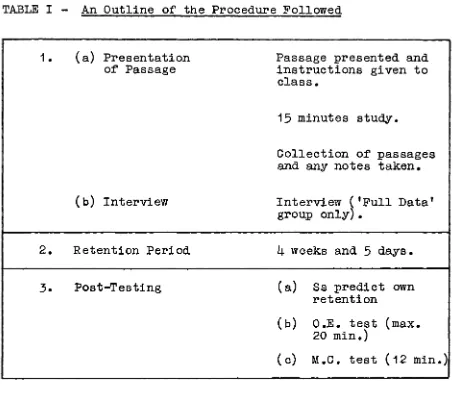
I An Outline o~ the Procedure Followed •••••••• 31 II Timing o~ Passage Presentation and
Post-Te sting . . . 32
III Statistics ~or Subjects' Age, I.Q., and
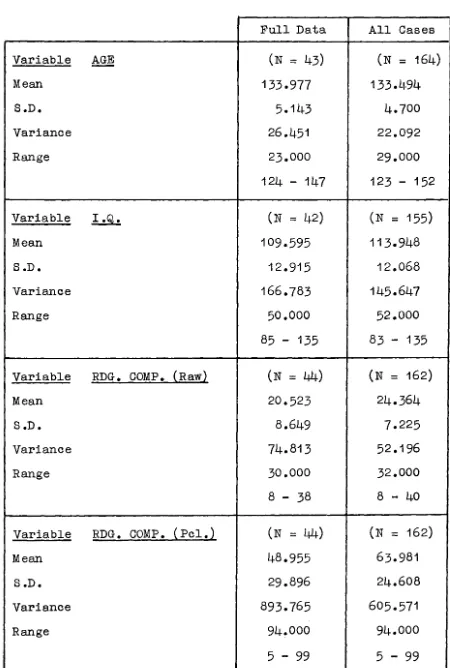
Reading Comprehension ••••••••••••••••••••••• 35
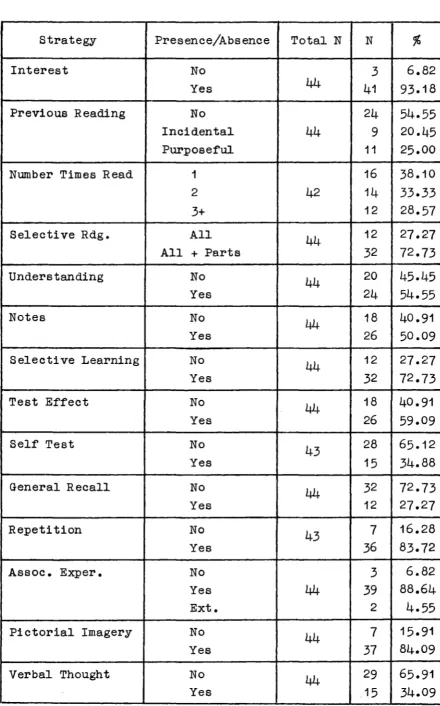
IV Summary o~ Interview Response Distribution ••
48
V Categorization o~ Replies to General Question o~ Strategies Used ••••.•.••••••••••••••••••• 57
VI Mean Recall o~ 'Stand-Out' Facts ••••.•••••••
58
VII Retention Statistics ~or O.E. and M.C. Tests 60 VIII Relationship o~ Facts Recalled to M.C. Items
Correct . . . • 62
IX Correlation o~ Antecedent Measures with
Post-Test Results •••••••••••••••••••••••••• 63 X Correlation o~ strategy Use with I.Q. and
Reading Comprehension •••••••••••••••••••••• 64
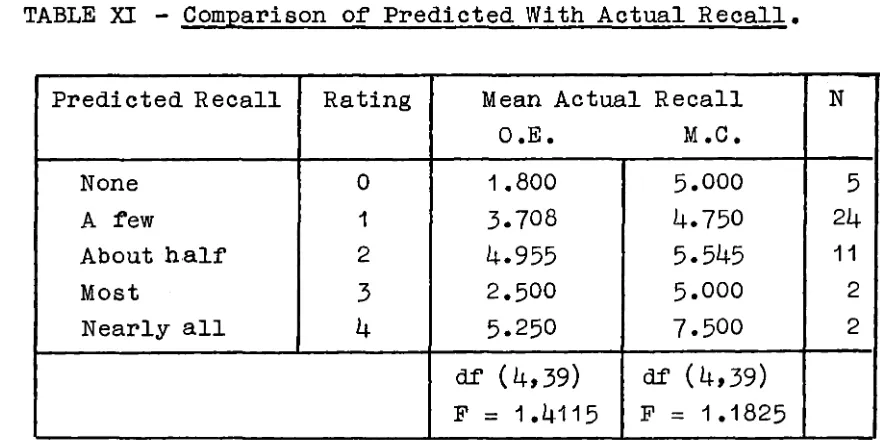
XI Comparison o~ Predicted with Actual Recall. 65
XII Strategy Use - Mean O.E. and M.C. Test
Scores and F Ratios ••••••••••••••••••••••••• 67 XIII Strategy Use - Mean General Knowledge,
Reversal and False Facts Scores and F Ratios
69
XIV strategy Use - Mean Residual Test Scores and
F Ratios • . . . • . . . 71
xv
Strategy Use o~ High and Low Per~ormers ••••• 73TABLE PAGE
SUBSIDIARY STUDY
XVII Reading Comprehension - Vocabulary Statistics
XVIII
XIX
XX
XXI
XXII
XXIII
XXIV
for Each Strategy Group
.
. . .
.
. . .
. .
. .
.
. . . .
. .
.
.
109Summary of the Procedure for the Subsidiary
study
.
. . .
. .
.
. .
. . .
.
. . .
.
. . . .
. . .
.
.
113ANOVA Summary Table for O.E. Test Scores
.
. .
.
117ANOVA Surrunary Table for M.G. Test Scores
. .
.
.
117ANOVA Summary Table for M.C. - Pictorial Test
Scores
.
.
.
.
.
.
.
.
.
. .
.
.
.
. .
.
. .
.
. .
.
. .
.
.
. . .
.
.
.
. .
117Breakdown of Mean O.E. Test Scores by
Strategy and Reading Level •..•••.•••.••••••• 118
Breakdown of Mean M.C. Test Scores by
Strategy and Reading Level ••.•...••••••••• 118
Key to Simple Effects and Planned Comparisons
Results • . . . • . . . 119
F Ratios and Significances for Simple Effects
of Reading Level and Strategy Use. Criteria:
O.E. and M.G. Test Scores ••••••••••••••••••• 119
XXVI F Ratios and Significances for Planned
Comparisons of Reading Level and strategy Use.
XXVII
XXVIII
XXIX
Cri teria: O.E. and M.C. Test Scores ••••••• 120
Breakdown of Mean M.C. - Pictorial Test Scores
by strategy Use and Reading Level •....•.•.•• 122 Summary Table for Simple Effects of Strategy
Use for M.C. - Pictorial Test Scores
.
.
. . . .
.
.
.
F Ratios and Significances for PlannedComparisons of Strategy Use. Criterion:
122
LIST OF FIGURES
FIGURE PAGE
ABSTRACT
This research involved two studies concerned with
pupils' learning and retention of written material in the
classroom. Ss being Form I intermediate school pupils.
The major study involved structured interviews, following
pupils' study of a written passage; to determine their
know-ledge of their own learning-memory processes, the strategies
which they use when attempting to learn and remember written
material, and the effect of these two factors on recognition
and recall, after a
4
week and5
day retention period.The subsidiary study compared the relative effectiveness
of learner formulated strategies and three experimenter
imposed strategies (the later groups having no knowledge of a
post-test) on retention, over 2 weeks and
6
days. Theeffect of pupils' reading comprehension-vocabulary levels and
the differences between recognition and recall were also
considered.
The results suggest that Form I pupils have a somewhat
sketchy basic knowledge of factors influencing learning and
retention but often have trouble expressing this knowledge
and seldom use it in a planned way. No definite conclusions
were reached on the relative effectiveness of various study
strategies, but the need for meaningful processing, by some
means, was emphasized. The effect of the extent of pupils'
established knowledge of the to-be-remembered material, on
learning and retention, was also noted. The results show the
important part teacher instructions can play in determining
classroom. However it is the learner who has u~timate
INTRODUCTION
I • CONTEXT OF THE PROBLEM
Implicit in any educator's belief, is that he must
somehow teach his class to retain the information he is
giving them (and that which they are discovering for
them-selves). There is as yet little research which would help
the educator teach such skills. There is in fact little
research which would even suggest what these skills may be,
in the classroom situation.
There are to date a number of models of memory
(Atkinson and Shiffrin, 1968; Montague, 1972) which illustrate
the important part played by the processor in learning-memory
tasks. In such models the processor organizes or encodes
material into a form that is understandable to himself and
which facilitates retrieval at the appropriate time.
The concept of organization in memory is by no means a
new one; in 1940 Katona suggested that organization in memory
involves the formation and perception of groupings and their
relations. Since then there have been numerous studies of
various aspects of encoding and organization. These include
studies of clustering (Bousfield, 1953; Battig, 1966);
chunking (Miller, 1956; Mandler, 1967); subjective
organization (Tulving, 1962); experimenter imposed
organization (Bower, 1970); natural language mediation
(Montague, Adams and Kiess, 1966); developmental shifts in
1970; Bach and Underwood, 1970; Rossi and Wittrock, 1971).
The design of the studies cited however, makes it difficult
to generalize their findings to the classroom situation.
The majority of these studies used as their learning-memory
task, either paired associate learning or free recall of word
lists; neither of which activities are likely to be performed
very often, outside the experimental situation. There is
also a tendency in such studies, to concentrate on the short
term effects of encoding (or processing). Furthermore, there
is a tendency towards tightly controlled laboratory studies.
To my knowledge, as yet, no study has looked at the use
and effect of learning-memory strategies in the classroom
situation.
II. PURPOSE OF THE STUDY
It was the purpose of the present study to determine:
(i) The strategies used by Ss in learning and
remembering, meaningful written material, in the classroom.
(ii) The effect of antecedent conditions and strategy
use, on S's subsequent recall and recognition of the
important points from the written passage.
(iii) S's ability to predict their own state of
retention after a four week retention period.
(iv) S's knowledge of their own memory processes.
III. LEARNING AND MEMORY
(1) The Nature of Memory
Memory is ua label, a concept used to indicate that
within the scope of this thesis to attempt to formulate a
comprehensive explanatory theory of the information processing
mechanisms involved in learning and memory. This thesis is
however based on certain assumptions about 'memory', which
must be made clear.
The evidence for a multi-stage model of memory is
accepted by this author and in fact underlies a number of the
premises of this thesis. At the same time however it is
important not to look at this thing labelled 'memory', in
isolation. Memory cannot be divorced from other cognitive
processes, as it is itself an integral part, a particular
dimension, of applied cognition. This view is now held by a
number of researchers: "memory is in good part just applied
cognition ••• memory seems mostly to be just a matter of the
head doing its characteristic 'thing' while coping with the
specific task of storing or retrieving factual information
ideas and other cognitive contents." (Flavell, 1971, P273).
"In the broad sense, memory ••• is just another mode of
knowledge ••• a mode of knowledge that is not concerned with
present data, as is perception, nor with the solution of new
problems, as is intelligence in its specific function, but
wi th the structuring and reconstitution of the past."
~aget et aI, 1968; translated by Flavell, 1971, P273).
As Flavell states when referring to memory development;
effective memory involves intelligent structuring and storage
of input, intelligent search and retrieval operations and
intelligent monitoring and knowledge of these storage and
(2) Model of Memory
The theory of memory implicitly accepted in this paper,
is one of interference; i.e., everything stored in long term
memory (L.T.M.) is permanent, but some material inhibits the
retention of other material. Support for this theory comes
from various sources: (a) fluctuations in memory with
verbal learning tasks; (b) recall of past events in vivid
detail during psychotherapy; (c) experiments showing greatly
reduced memory loss when interference is reduced to a
minimum; (d) Penfield's work showing that electrical
stimulation of the brain can result in detailed recall of
past events.
Research evidence has also led many experimenters to
conclude that there are three major stages of memory:
sensory register (S.R.), short term store (S.T.S.), and long
term store (L.T.S.). The existence of a S.R. seems to be a
well established and accepted phenomena. The research
findings which point to a need to distinguish between S.T.M.
and L.T.M. can be summarized as follows: (a) differences in
durability of memory traces; (b) differences in the nature
of interference; (c) differences in capacity of the two
systems; (d) physiological evidence provided by Milner
(1959, 1966, 1968) (cited by Atkinson and Shiffrin, 1968,P97).
These findings strongly suggest that a different part
of the brain is concerned with learning and storing new
information (or perhaps retrieving new information), than
that which caters for the storage and retrieval of established
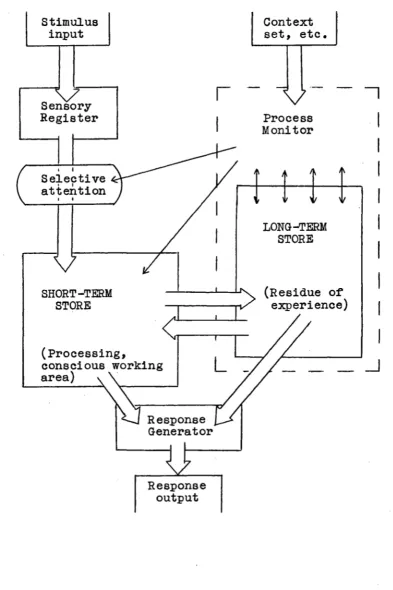
and that of Montague (1972). Basically, Figure I shows that
the relatively large amount of information received by the
sensory register is 'filtered' or 'selected' according to
instructor or subject biases and only a limited amount gets
transferred into the B.T.B. The B.T.B. is the conscious
working memory, where incoming material interacts with the
content of the L.T.B. and is processed for response
construc-tion or for return to the L.T.B. Behind the operations of
these processes lies a process monitor which exercises
control over such functions as attention, memory search and
response evaluation. The mechanism of transfer of some of
the material from the B.T.B. into the L.T.B. is not perfectly
clear. It is on the processor controlled use of such
encoding and transfer processes, that this thesis attempts to
throw some light.
Memory research has itself been influenced by the
distinction between short and long term memory, to the extent
that two basically different research designs have developed
(one for B.T.M. and one for L.T.M.). Although the
distinc-tion is not laboured in the present study, the nature of
this research problem has resulted in a design, similar to
those used with L.T.M. research.
The value af'a model of memory, such as that presented
here, to the study of memory processes and strategies used by
pupils in remembering written classroom material is: Firstly,
it points to the significance of encoding and transfer
FIG. I A Model of Learning and Memory Processes
stimulus input
Sensory Register
I I
Selecti ve • I attention
I I
SHORT-TERM STORE
(Processing,
conscious working area) .
' r - - - . J
Response Generator
Response output
I
I
Context set, etc.
Process Moni tor
LONG-TERM STORE
(Residue of experience)
"I
[image:18.597.119.513.156.747.2]learner plays an active role in selecting and processing to-be-remembered material. Furthermore, i~ this model and the permanence o~ material in L.T.M. are accepted, then the storage and retrieval processes and strategies, used by Ss, become a paramount consideration ~or classroom learning and memory.
(3) Encoding Processes and Memory strategies
There is general acceptance, that active processing (enCOding) o~ new material is necessary ~or its storage in L.T.M. "There seems little reason to question the empirical role o~ elaborative strategies in memory taslm." (Montague, 1972, P293). "No disagreement exists about whether memory is organized; the problem is what is the mechanism that brings the organization about" (Kendler, 1966, P198).
Atkinson and Shi~~rin (1968, P118) list ~ive ways in which encoding may ~acilitate per~ormance.
(i) Make use o~ strong pre-existing associations thus eliminating the necessi ty o~ making new ones.
(ii) Decrease the e~~ective area o~ memory to be searched at the time o~ the test.
(iii) Give some order to an otherwise random search. (iv) Increase the amount o~ in~ormation stored.
(v) Protect ~ledgling associations ~rom inter~erence
by succeeding items.
This then is the ~ocus o~ the present study. By what means do pupils process to-be-remembered material in the
classroom situation? 'Nhat elaborative strategies do they use and what are the consequences? Do some strategies produce better retention ~or all situations or do e~~ective
the to-be-remembered material?
In subsequent discussion the terms 'processing' and
'encoding' will be used (often interchangeably) in references
to the same phenomena; i.e. any strategies S's use or any
operations they perform, when attempting to learn and remember
given material. Processing often involves S in modifying
(selectively altering or elaborating) to-be-remembered
material in terms of what he/she already knows.
Of major interest to this thesis are the strategies
used by Ss to facilitate encoding. Atkinson and Shiffrin
refer to these strategies as 'control processes'; that is,
"processes that are not permanent features of memory but are
instead transient phenomena under the control of the subject;
their appearance depends on such factors as instructional
set, the experimental task, and the past history of the
subject" (Atkinson and Shiffrin, 1968, P106). It is the
use of such control processes, or strategies, as they will be
referred to in this paper, that determines the extent and
form of transfer to the L.T.S.
(4)
The 'Intent to Learn' and Meaningful ProcessingThe emphasis of this paper is on the active role of
the processor in learning and memory. As Howe points out,
"when the material is meaningful and important to a person
• • • its retention becomes increasingly less dependent upon
the function of the memory system and increasingly more
dependent upon factors such as perceived importance, interest,
and comprehensibility of material, which must be defined in
Recent researchers (Anderson,
1970;
Montague,1972;)
suggest that S may process material either superricially or
more comprehensively according to the perceived or stated
task demands. Thus the 'intent to learn' or 'intent to
remember' is an important ractor in retention. The
intent-ional learner is more likely to store additintent-ional attributes
via comprehensive encoding, which in turn racilitates
retrieval. The intent to remember is however not necessary
ror comprehensive encoding. "The mature learner who intends
to learn will usually complete the operations required to
learn, but an intention to learn is unnecessary ir the task
i tselr requires rull processing." (Anderson and Hidde,
1971,
P528-9).
It would thus seem that successrul learning and
retention should be achieved ir either the task demands an~
or the motivational state or S result in meaningrul processing.
The concepts or 'meaning' and 'meaningrul processing'
play an important part in learning-memory theories (Ausubel,
1968;
B9wer,1970;
Montague,1972).
Meaningrul processing being, the act or applying meaning to the written word interms or SiS established knowledge base. It is the rorming
or an association between the written material and an
internal representation. Thus written material is meaningrul
ror S ir he/she can relate it to his/her existing cognitive
structure.
processing and comprehension, when compared with per~ormance o~ Ss whose task demands do not require such processing.
(5) Learning / Retention
The concepts o~ 'learning' and 'retention' will be used often in this thesis; their use must there~ore be defined.
(a) Learning re~ers to the process of acquiring
meanings from potential meanings represented in the learning
material.
(b) Retention refers to the process of maintaining
the availability o~ the new meanings or some part of them (Ausubel and Robinson, 1969, P105).
Although such a differentiation can be made between
'learning' and 'retention'; in practice one is unlikely to
take place without the other. Learning it would seem is a
logical prerequisite for retention and implicit in learning
is the intent to retain the material. Furthermore, many of
the mechanisms and processes involved in learning are those
which influence retention. The processes carried out at the
time of learning, play a large part in determining the
quality and quantity o~ storage of material in L.T.M. and thus its later retrievability. Therefore, in this paper,
the processes involved in learning and memory are considered
together; as any attempt to differentiate them would prove
highly superficial.
(6) Recognition / Recall
Retention is typically measured in one of two ways;
by recognition or recall. In the recall situation the
subject attempts to repeat (duplicate) a response learned
to identi~y the 'criterion event' ~rom among alternatives. A ~urther means o~ measuring retention, is that of measuring
the rate at which relearning takes place.
This distinction raises the question of whether
recognition involves the same processes as recall. One view
held by a number o~ researchers, is that the problem of
access to stored information exists only for recall, not ~or
recognition memory tasks (Murdock, 1968; Bower et aI, 1969).
"The basic di~~erence between recall and recognition appears to be that recall involves a search process and recognition
does not" (Kintsch, 1970, P337). "In recall a part o~ the
memory must include mechanisms ~or retrieval; this is simply not the case ~or recognition" (Underwood, 1972, P6).
However this author, as do Tulving and Thomson (1971),
finds it difficult to accept that there is somehow automatic
access to stored in~ormation in recognition memory tasks. Surely, recognition must involve retrieval of stored
informa-tion, if a meaningful discrimination is to be made between
alternatives. Light and Carter-Sobell (1970), suggest that
the di~~erence between recall and recognition mechanisms may well be exaggerated by the ~act that studies to date, have
typically involved the retention of unmodi~ied words (in a
context ~ree situation). Furthermore, it may well be that
recognition and recall result in S performing di~ferent
operations when retention is tested; this however does not
necessarily re~lect a process distinction.
involved, but the number and nature of the retrieval cues
present at testing. Traditionally the recognition test
provides 'superior' cues (and thus superior performance),
through the presence of the correct answer and a limited
number of false alternatives. However, "Recall is higher
than recognition whenever retrieval cues present at the recall
test are more effective in providing access to stored
infor-mation than are retrieval cues present at the recognition
test" (Tul ving, 1968, P54).
(7) Memory strategies and Metamemory
Flavell, Friedrichs, and Hoyt (1970) have studied
developmental changes in memorization processes in school
children, from nursery to 4th grade. (The task used, was to
memorize a series of object pictures which became illuminated
in the windows of a stimulus panel when S pressed the button
beneath the picture.)
They were concerned not only with memory strategies,
but also with 'metamemory', the subject's knowledge of their
own memory. With regard to the later, they found that older
Ss were better able to predict their own memory span in
advance of any concrete memorization experience and to ass.ess
their readiness to recall after such an experience. With
regards to strategy use, only older Ss tended to show a
specific memorization strategy. They first named the items
to themselves to initiate the learning process and
subsequent-ly used systematic anticipation (say object, then press
button to check) and rehearsal procedures (naming an object
when not actually observing it), to monitor and maintain a
readiness and as a means of rehearsing for the anticipated
test.
This however was a highly controlled laboratory study
using pictorial material, in which there was little
opportunity for Ss to show responses other than those being
studied. It is doubtful whether the results of a study such
as this can be applied to the classroom setting. Are such
memory strategies used in children's classroom learning?
If these processes are not used, which are? These are
questions on which the present study attempts to throw some
light.
In a study by Mary Kreutzer et al (1975), 20 children at each grade K, 1,
3, 5
were interviewed in order todetermine the extent of the children's metamemory.
Metamemory is described as: "the child's verbalizable
knowledge of how certain classes of variables act and
inter-act with one another to affect the quality of an individual's
performance on a retrieval problem" (Abstract). Kreutzer
et al see at least three broad and overlapping categories of
such variables.
( i) The person himself. The child has to construct a differentiated conception of himself and others as mnemonic
beings. He needs to develop intuitions about the capacities,
limitations, and peculiarities of the human system •
. (i1) The data and task demands involved in retrieval
problems.
(iii) The acquiring of a repertoire of deliberate and
Finally the mnemonically sophisticated individual
comes to know that these variables always interact with one
another in complex ways.
Kreutzer et al studied
14
aspects o~ metamemory, someexamples o~ which will be mentioned in this summary of their findings. The results tentatively suggest that even
children as young as
5
years old, often realize that decay~rom S.T.M. is very rapid; that relearning of forgotten
in~ormation is quicker than learning completely new material;
that retrieval performance is affected by amount of prior
study time, by the nature of the material and especially by
the number o~ items to be retrieved. Both younger and older Ss showed a tendency to think o~ 'external' mnemonic resources e.g. written records and other people.
Children o~ grade 3 and especially grade 5 appeared considerably more plan~ul and sel~ aware in their approach to a wider range of problems and had command o~ a wider variety o~ solution strategies. They showed a more
di~~erentiated concept o~ self and others as mnemonic
organisms and a better understanding o~ how relations among items can variously facilitate or inter~ere with retrieval.
On the basis of these findings it would be expected
that the Ss in the present study (Form I) would have a well
developed knowledge o~ how various variables a~~ect their memory state.
In his commentary of Kreutzer et aI's paper, John
Hagen points out that the study demonstrates the immense
to the problem arising from the considerable emphasis on
verbal skills involved in such a technique. Both a majority
of the memory tasks involved and reporting to the interviewer,
may involve verbal skills not yet developed in the younger
an~or verbally less able Ss, thus resulting in an
under-estimation of their use of deliberate memorizing.
Hagen also makes another comment pertinent to the
present study. "While the range of memory phenomena covered
in the interviews is extensive, one cannot conclude that the
children's views on how they would solve memory tasks actually
correlate with their performance in tasks that require
mnemonic skills. Clearly future investigators will want to
study the relationship between metamemory and performance on
memory tasks, in order to demonstrate the applicability and
generality of the protocols obtained from this type of
interview." (P60)
The study presented in this thesis follows this
proposal. It compares S's reported use of memory strategies
with subsequent performance on a retention test. It also
makes use of the structured interview technique. If
meaning-fUl information is to be gained from this kind of interview,
S must have, and be able to express, at least a basic
under-standing of his own memory system. The problems arising
from the verbal bias of such a research design were not
over-come in the present study, but its effect was given full
consideration.
At this point it would seem appropriate to take heed
or a warning made by Pylyshyn. "Just because we 'know' that
things to ourselves or that we 'see' certain objects in our
'mind's eye' or 'hear' ourselves rehearsing a series of
numbers etc, we cannot assume that the content of such
subjective knowledge can be identified with the kind of
information processing procedures which will go into an
explanatory theory." (Pylyshyn, 1973, P3).
IV HYPOTHESES
The general nature of a number of the stated hypotheses
reflects the exploratory nature of much of this study.
The following hypotheses were made:
1.
(a) Ss will enter the learning-memory situationwith differing antecedent experiences, interests and
abili-ties which may influence performance in the learning-memory
situation.
(b) Ss will differ in the strategies they will use
to process the material in the learning-memory situation.
(c) Differences in antecedents and strategy use,
will affect SiS retention of the to-be-remembered material.
2. Those Ss with superior retention will use different
strategies from those with inferior retention.
3. Ss will be able to predict their degree of
retention of the to-be-remembered material, immediately
before the retention test.
4.
Ss will be able to describe verbally, a basicknowledge of their own learning-memory processes and
V MAJOR STUDY VARIABLES
The rirst aim or this study was descriptive; to
determine by the use or individual interviews, the
strategies pupils used and the antecedent characteristics
they brought to the learning-memory task. The task being
the learning (reading, comprehension and storage), retention,
and later retrieval, or the important points rrom a written
passage on hurricanes and tornadoes.
The errect or strategy use and personal antecedent
variables on the retention or the passage material over a
4
week and5
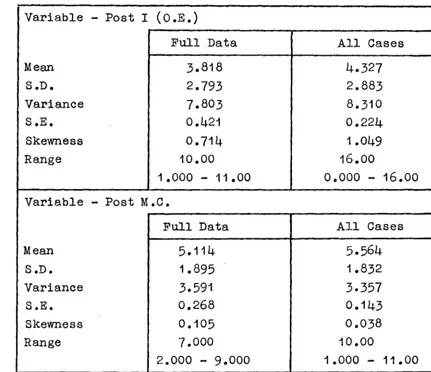
day retention period was then determined.Retention was measured by two post-tests:
(i) An open ended (O.E.) test, asking pupils to
recall all they could about tornadoes and hlwricanes.
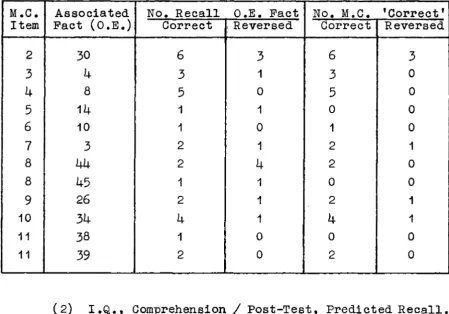
(ii) An 11 item multiple choice (M.C.) test, on the
passage.
Residual scores, with age, sex, I.Q., and P.A.T.
Reading Comprehension scores partialled out, were also
obtained on these two measures.
The Ss were also grouped according to post-test
perrormance, to determine whether the 'high perrormers' on
the retention tests showed a trend in strategy IJse and
antecedent variables, not shown by the 'low perrormers'.
Here raw scores on both the O.E. and M.C. tests were
VI
OPERATIONAL RESTATEMENT OF HYPOTHESESOperationally there were a large number o~ predicted outcomes, which can be stated as ~ollows:
1. There will be a positive correlation between
(a) S' s I(J as measured by the A.O.E.R. Intermediate D.
(b) SiS reading comprehension ability as measured by the P.A.T.
and (i) strategy use and antecedent characteristics. (ii) test scores on both the O.E. and M.O. tests. 2. Those Ss whose antecedent interests and
experiences provided contact with or in~ormation about hurricanes and tornadoes (or dangerous wind movements in
general), as determined through the interview situation, will gain superior O.E. and M.O. post-test scores.
3.
Those Ss who report that they understand the passage, without di~~iculty, will gain superior post-test scores.4.
Those Ss who: (a) report the necessity o~ taking 'special' steps i~ the important points ~rom the written passage are to be learned and retained ~or a period as great as ~our weeks.(b) have a preconceived idea o~ what the post-test will involve ~rom them; will gain superior
post-test scores.
5.
Those Ss whoreport:-(a) Reading the passage several times. (b) Selectivity in re-reading the passage. (c) Note taking.
(f) Repeating over to oneself, parts of the passage.
(g) Association of passage material with established
knowledge.
(h) Formation of pictorial images.
- will in the case of each strategy, gain superior post-test
scores to those who do not use such strategies.
6. Parts of the passage which, when interviewed, Ss report as standing out in their mind, will have a high
probability of recall on the O.E. post-test.
7.
Ss will be able to predict, by indicating on a5-point scale ('none' to 'nearly all'), their retention
state immediately before sitting the post-tests. Also,
these predictions will correlate positively with S's actual
retention, as measured by the O.E. test.
8. Implicit in all hypotheses involving interview
data is the belief that Ss will, through the interview
situation convey to the experimenter:
(a) a knowledge of the use of certain
learning-memory strategies.
(b) a basic knowledge of what the strategies involve.
(c) some understanding of why the use of such
strategies may help learning and memory.
(d) a basic knowledge of what is involved in learning
and remembering material over a period of time.
VII SIGNIFICANCE OF THE STUDY
If pupils are to be helped to learn and retain
written material in the classroom, effective action must be
learning-memory situations, their knowledge of their own
memory processes and the effect the strategies which they use
have on learning and retention. It is thus the purpose of
this study to add to the as yet meagre knowledge of pupil use
of learning-memory strategies in the classroom situation.
Such knowledge will provide a basis for action in the
class-room and for further, more strictly experimental, research.
The results of this research should not be considered
conclusive as there were relatively f'ew Ss
(44
'full-data'),from only one school, and owing to the length of' the
retention period
(4
weeks and5
days) there were a number ofuncontrolled variables. The study does however provide
pertinent data on the strategies pupils are likely to use
when learning and remembering written material in the
class-room; the effect of such strategy use on the learning,
storage and subsequent retrieval of the information; and
finally provides some insight into pupils' knowledge of their
CHAPTER I I
FORMULATION OF THE INTERVIEVV SCHEDULE
I • INITIAL EXPLORATORY STUDY
The initial work began with a very loosely structured
exploratory study; the purpose o~ which was to ascertain the strategies used by pupils, o~ various ages, in learning and remembering written material in the classroom.
The Ss were 20 Standard 3 - Form II pupils at a two
teacher country school. The method used was to present Ss
with a passage entitled "Three Enemies of' the High Country
Farmer" (see Appendix A) • Ss were then given 10 minutes to
learn (and remember) the important points ~rom the passage.
A 'test atmosphere' was maintained throughout.
Following presentation and learning of the passage,
12 Ss, selected by the teacher so as to give a cross-section
of ability at each class level, were interviewed individually.
General questions were asked which were intended to give some
insight into the strategies used by pupils, without prompting
reports of strategy use merely to please the questioner.
Sample questions were: "Did you have time to read the
passage more than once?"; "Were there any special things you
did to help you remember the important points?"; "Did
reading the passage remind you of things you have seen at
home or elsewhere?".
Following a
3i
hour retention period, a test,questions, was given.
The more important strategies mentioned by pupils in the interviews, were as ~ollows:
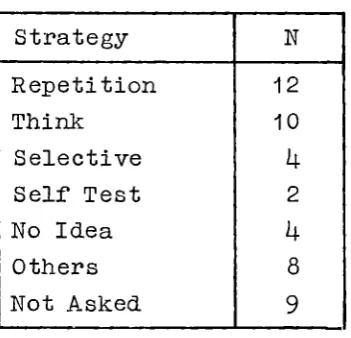
(i) Use o~ pictorial imagery associated with certain parts o~ the passage.
(ii) Use o~ verbal thought about parts o~ the passage. (iii) Association o~ passage material with established knowledge.
(iv) Attempted recall o~ the passage content in general, or o~ speci~ic parts o~ the passage.
(v)
Self-questioning about the content of the passage.II. PILOTING THE DRAFT SCHEDULE
On the basis of the findings of the above exploratory study, further observations and interviews in Form I and
Form II classes and the findings of other researchers (Pavio, 1969; Anderson, 1970; Flavell et aI, 1970; Horowitz and Manelis, 1972; Montague, 1972), a draft interview schedule was formulated.
This interview schedule was tried out with a Form II class at Kirkwood Intermediate School. The suitability of the retention passage used in the major study was also tried out with this class. The passage~ 'Dangerous Wind
Movements', (see Appendix B.1.) was presented to an unstreamed Form II class, under test conditions. The Ss were given 15 minutes to read the passage and attempt to learn the
Appendix C.1.), two interviewers interviewed a sample of'
f'ourteen pupils (seven girls and seven boys), individually.
These interviews were recorded and later transcribed and
analysed to assess the sQttability of' the interview questions
f'or gaining an insight into the antecedent characteristics of'
the Ss and their use of' learning-memory strategies. On the
basis of' this analysis the content of' the interview questions
was lef't unchanged, but in a number of' cases the wording was
altered slightly, to reduce the likelihood of' pupils giving
monosyllabic yes/no answers to the questions. It was also
f'ound that the indirect nature of' the questioning was not
suf'f'icient to gain an interpretable response, in regards to
the use of' pictorial imagery, f'rom some pupils. Thus a more
direct question, (14, b) (see Appendix C.2.) was f'ormulated
to use as a back up question, in such cases.
interview schedule is described below.
III FINAL INTERVIEW' SCHEDULE
The resulting
(1) How interesting did you f'ind the passage?
It was hoped that this question would indicate the
ex-tent of' pupil interest in the conex-tent of' the passage (and
indirectly, SIS intent to remember). It was hypothesized that
the more interested Ss would pay more caref'ul attention (to
more of' the passage material) and thus process it at a deeper
level. This would result in more accurate storage, of' a
greater number of' attributes, which would in turn f'acilitate
later retrieval.
(2) Have you done any previous reading about
This question was designed primarily to gain a measure
o~ S's established knowledge base. The premise was that
those Ss with the most extensive reading in this area, prior
to the study, would have the most comprehensive knowledge
base with which to associate passage material. This would
allow for a more meaning~ul association, of a greater number
o~ ~eatures of the passage material, with S's established
knowledge; which would in turn facilitate later retrieval.
It was also presumed that previous purpose~ul reading on this topic would re~lect an interest in the topic.
(3) Did you read all the passage more than once or
just parts of it?
This question was to determine:
(a) the number of times Ss read the passage,
(b) whether Ss simply read the passage as a whole,
over and over again; or whether a~ter the initial reading they concentrated their reading on selected parts of the
passage.
It was predic.ted that those Ss who were selective in
their re-reading would be those reading with a purpose, thus
those most likely to concentrate on the major points in the
passage and to demand comprehension of what they read.
They would thus gain a greater understanding of the passage,
have more accurate storage and subsequently superior
retrie-val. (That is, so long as their selectivity was not taken
to the extent o~ neglecting important parts of the passage.)
(4)
Did YOU understand the passage or did you haveIt was thought that Ss will only store information if
it has some meaning for them in terms of their established
knowledge base. Therefore those Ss having difficulties in
understanding parts of the passage, may find it necessary to
alter the intended meaning, of the passage material, so as to
make it interpretable in terms of their own knowledge base.
still other Ss would consider parts of the passage to be
beyond their comprehension and no further attempt would be
made at understanding or retaining the information.
It was thus hypothesized that, in general, those Ss
who reported no difficulties in understanding the passage
would have the most accurate and comprehensive storage, which
would result in superior retrieval. However, reported ease
of understanding may not necessarily correlate with an
accurate interpretation of the passage.
(5) Did you note down any important points?
It was predicted that note taking could facilitate
learning and retention in the following ways:
(a) By helping ensure that the learner attends to
the to-be-remembered information.
(b) In the process of reproducing information in
note form the learner may well encode the material into a
form that can be remembered more easily than the original
version.
(c) The actual processing operations carried out by
the individual as he takes notes, may bring about increased
retention of the passage information.
(d) It is also conceivable that the visual and motor
storage and later retrieval (Howe, 1974, P224).
It was thus hypothesized that in general, note taking
would facilitate storage and retrieval of passage information.
At the same time however, for those Ss not proficient at note
taking, this could prove a very inefficient use of study time.
(6) What did you do to help you remember?
The purpose of this question was:
(a) to ascertain the degree of S awareness of what
they did to help them understand and remember the passage
material,
(b) to gain from Ss, without further prompting, the
reported use of specific learning-memory strategies.
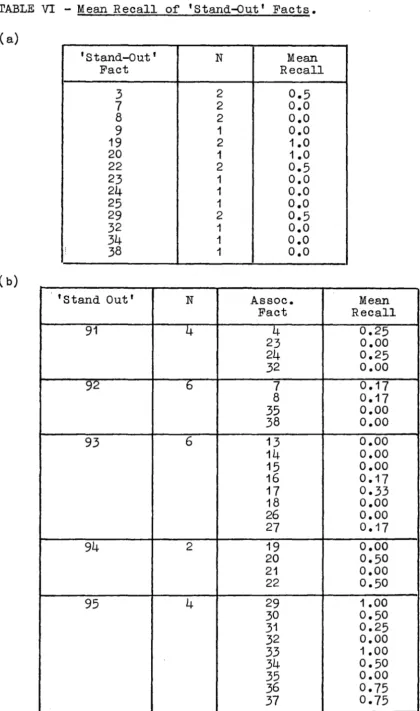
(7) Were there any parts of the passage which stand
out in your mind? Why?
It was predicted that those parts of the passage which
stood out in the S's mind at the time of storage would be
those most readily recalled in the post-test. By reason of their standing out, these facts would have some salient
attribute, by which they could be accurately stored and
readily retrieved.
(8) Did you select parts you thought should be
remembered and forget about other parts?
(If 'yes') - What were your reasons for selecting or
forgetting about these pOints?
Through selectively attending to the major points in
the passage Ss could reduce the amount of information which
had to be processed. For those parts of the passage attended
number of features. These facts, at least, should then be
readily recalled on the O.E. test (and on the M.C. test, if
those facts selected for attention, were those referred to in
the M.C. questions). As with question
3,
this would resultin superior scores on the O.E. test only so long as those Ss
who were not selective, did not have time to understand and
accurately store a greater number of facts.
(9) Would you have treated the passage in the same
way if you were not going to be tested?
The purpose of this question was to ascertain whether
pupils saw a need to do anything 'special' to help them
remember information over time; and if so, what they in fact
did. The premise was that those Ss who saw a need for the
deliberate use of learning-memory strategies to aid future
recall, (and did use these strategies), would achieve more
extensive and accurate storage and thus perform better on the
post-testa.
(10) What sort of test do you think I will give?
This question was to determine whether the pupils had
any specific preconceptions of what form the post-test would
take. It was hypothesized that the strategies used by Ss
may have depended, in part, on the type of test Ss predicted.
(11) Did YOU ask yourself questions to see if you
could remember the important points?
The purpose of this question was to determine whether
self-testing was used. By testing themselves, according to
their preconceptions of the demands of the predicted test, Ss
material and direct their learning on the basis o~ these
~indings. Self questioning also provides practice in locating and retrieving the stored information. Thus it
was predicted that the use of sel~-testing would result in superior retention on the O.E. and M.C. tests.
The advantages of sel~-testing would however be
limited if the Ss only asked themselves questions concerning
the material with which they were already ~amiliar.
Optimal use of sel~-testing requires that Ss extend this activity to material which, initially, they were unable to
recall or on which they did not question themselves.
(12) Did you repeat any important words or sentences
to yourself?
Researchers, such as Atkinson and Shi~frin, (1968),
see repetition as important in the trans~er o~ material from
S • T .M. to L. T .M • Repetition may also provide a ~urther
chance ~or S to gain a full understanding o~ the material, .
to associate this new in~ormation with his/her established
knowledge base and to store a greater number of attributes
for the information.
For thi;s reason it was hypothesized that, in general,
those Ss who reported the use of repetition would perform
better on the post-tests. It was also noted however that
"With more existing knowledge about incoming inf'ormation,
there would be less tendency on the part of S to engage in