AT A TEACHERS' COLLEgE
A thesis presented for the
degree of Master ot Arts in Education
in the University of Canterbury, Christohurch, New Zealand.
by
CHAPTER
I
II
III
TABLE OF CONTENTS
INTRODUCTION
Statement of the Problem Rationale
Defence of the Need for the study Outline ot the study
REVIEW OF THE LITERATURE Lectures and Discussion
Leotures and Independent study Lectures and Retention
Lectures and Programs Lectures and Note-taking
THE RESEARCH DESIGN : THE SAMPLE, SELECTION OF STUDENT VARIABLES, AND PROCEDURES
PAGE 1 1 2 2 3
7
9 13 14 16 17 21The Sample 21
The Selection ot the Student Variables 26
Procedure 28
Information giVen to students 28 The colleotion ot the notes 28 Selection ot lectures tor study 29
CHAPTER
IV
v
THE RESEARCH DESIGN: ANALYSIS OF THE NOTE-SCRIPTS, THE SELECTION OF
NOTE-TAKING
VARIABLES. DEFINITION OF TERMS,AND STATISTICAL PROCEDURES
The Selection of the Note-taking Variable. and Definition of Terms
Quantit7 Variables
The Structure Variables Methods of Emphasis Statistioal Prooedures ANALYSIS OF RESULTS
Relationships Between Academic Ability and Student Note-taking
PAGB 31 32 34 35 38
Behaviours 41
Relationships Between Sex and
Note-taking Behaviours 43
Relationships Between Student Age
and Note-taklng Behaviours 48 Relationships Between Measures ot
Intelligenoe and Note-taking
Behaviour Variables 48
Relationships Between Success at Teachers' College and
Note-taking Behaviours 51
Relationships Between University
Sucoess and Note-taking Behaviours 53
Relationships Between Note-taking BehaviQur Variables and Student
Variables 56
An Alternative Method of De8crib1ng the Relationship Between the Student Variables and the Note-taking
iv
CHAPTER PAGE
VI
Results of the Questionnaire 78
Relationships Between Questionnaire
Responses and Student Variables 78
Relationships Between Questionnaire
Responses and Note-Taking Variables 84
DISCUSSION AND CONCLUSIONS a LIMITATIONS OF THE STUDY : SOD IMPLICATIONS AND
SUGGISTIONS FOR FURTHER RESEARCH 87
The student Categories 88
Academic Ability 88
Sex Difterencea 89
student Age 92
Intelligence
93
College Performance 94
University Sucoess 95
The Note-taking Behaviour Variables 95
Numbe r ot' Words 95
Number of Lines 96
Number of Spaces 96
Number of Sentences 97
Number of Unit. 97
Abbreviations (i) (Trunoated Words) 98 Abbreviations (ii) (standard Forme) 98
Ratio ot' Lines to Spaces
99
Ratio of Words to Line. 99
Ratio ot Abbreviations (i) per
Ratio of Complete sentences to
Units 100
Ratio or Worda to Spaces 100
Ratio of Units to Lines 100
Instances of Underlining 101
Changes in Script St~l. 101
Ua. or Signs and Symbols 102 Use of Initial Capitals 102
Instances of Indenting 102
Use ot Enumeration and Us. ot
Tabulation 103
Ratio Of Methode of Emphasis to
Linea 103
Ratio ot Methods or Emphasis
~r100W~~ 1~
Ratio of Methods ot Emphasis
to Units 104
Responees to the Questionnaire 10;
Conclusions 107
Limitationa 109
Size of the Sample 109
Number ot Lectures 110
Attitudinal Factors 110
Implioations and Indications for
Future Researoh 111
vi
PAGE
APPENDICES 117
APPENDIX A: statement made to Student. within
the Init1al Leoture Sample 118
APPENDIX B. The Student Variable. 120 APPENDIX 0: The Note~takina Behaviour Variable. 122 APPENDIX D: Samples
or
Student.' Noteacriptatrom the First Leoture 124
APPENDIX I: Table
or
Means and Standard Deviations of Student Soores onthe Note-taking Beha.iour Variable. 130
APPENDIX F: The Questionnaire 136
[image:6.597.121.542.94.334.2]TABLE PAGE
I Not.~taking Behaviou~ Variables which
Correlate Signi~icantly with Student
Variables Indicating Academic Ability 42
I I Female Student Variables which Oorrelate 9igniricantly with Note-taking
Behaviour Variables ~
III Male Student Variables which Correlate Significantly with Note-taking
Behaviour Variables 45
~ Note~taking B.haviou~ Variables which
Correlate Signiricantlr with Student
Age over Total Sample n=89) 49
V Note-taking Behaviour Va~iable. which Correlate Signirioantly with Student Variables Indicating Measures or
Intelligenoe over Total Sample (n.89) 50 VI Note-taking Behaviour Variables which
Oor~elate Sign1rioantly with Student Variables Indicating Sucoess at
Teachers' College over Total Sample
52
VII Note-taking Behaviour Variables or thoseStudents with University SUQCess which Correlate Signi~icantly with Student
Variables 54
VIII Note-taking Behaviour Variables which Cor~elate Signiricantly with
Student Variables ~or Students
without University units 55
IX Significant Co~~elationB Between Student
Variablel and Note-taking Variable No.11
57
X Significant Correlations Between StudentVariables and Note-taking Variable No.12
57
XI Significant Correlations Between Studentviii
TABLE PAGE
XII Significant Correlations Between Student
Variables and Note-taking Variable No.14 59
XIII Significant Correlations Between Student
Variables and Note-taking Variable No.15 60
XIV Significant Correlations Between Student
Variables and Note-taking Variable No.16 60
XV Significant Correlations Between Student
Variables and Note-taking Variable No.17 61
XVI Significant Correlations Between Student
Variables and Note-taking Variable No.18 61
XVII Significant Correlations Between Student
Variables and Note-taking Variable No.20 62
XVIII Significant Correlations Between Student
Variables and Note-taking Variable No.21 62
XIX Significant Correlations Between Student
Variables and Note-taking Variable No.22 63
XX Significant Correlations Between Student
Variables and Note-taking Variable No.23 63
XXI Significant Correlations Between Student
Variables and Note-taking Variable No.24 64
XXII Significant Correlations Between Student
Variables and Note-taking Variable No.25 64 XXIII Significant Correlations Between Student
Variables and Note-taking Variable No.26 65
XXIV Significant Correlations Between Student
Variables and Note-taking Variable No.28 65
XXV Significant Correlations Between Student
Variables and Note-Taking Variable No.29 66
XXVI Significant Correlations Between Student
Variables and Note-Taking Variable No.30 67
XXVII Signif'icant Correlations Between Student
Variables and Note-taking Variable No.31 67
XXVIII Significant Correlations Between Student
[image:8.597.110.538.61.719.2]TABLE PAGE XXIX Significant Correlations Between Student
Variables and Note-taking Variable No.33 69 XXX Significant Correlations Between Student
Variables and Note-taking Variable No.34 70 XXXI Significant Correlations Between Student
Variables and Note-taking Variable No.35 71
XXXII Questionnaire Responses 79
to 82 XXXIII Responses to Questionnaire which Correlate
Significantly with Student Variables 83 XXXIV Note-taking Behaviour Variables which
Correlate Significantly in First
Lecture with Items on Questionnaire 85 XXXV Note-taking Behaviour Variables which
Correlate Significantly in Second
Leoture with Items on Questionnaire 86 XXXVI Means and Standard Deviations of Student
Scores on the Note-taking Behaviour
Variables 131
to 135 XXXVII Correlations Between Ten Student
Variables and Twenty-five Note-taking
Variables 140
and 141 XXXVIII Correlations Between Ten Female Student
Variables and Twenty-five Note-taking
Variables 142
and 143 XXXIX Correlations Between Ten Male Student
Variables and Twenty-five Note-taking
Variables 144
and 145 XL Correlatione Between Ten Student Variables
and Twenty-fiVe Note-taking Variables for Those Students with University
Sucoess 146
UB~
XLI
XLII
XLIII
Correlations Between Ten Student
Variables and Twenty-five Note-taking Variables tor Those Students Without
University Success
Correlations Between Twenty-tive Note-taking Variables in First Lecture and Twenty-tour Responses to Questionnaire
Correlations Between Twenty-tive Note-taking Variables in Seoond Lecture and Twenty-four Responses to Questionnaire
x
PAGE
148 and 149
150
LIST OF FIGURES
FIGURE PAGE
1 Performance of Students in the Intake from which the Lecture Sample was
Drawn on Seoond-year Eduoation Courses
24
2 Performance on Second-year Education Courses of Students in the Lecture Sample as an Indioator of College
Achievement 25
3 Comparison Between Student Scores on Advanced AL and Mean Number of Words
Noted in Two Lectures
73
4
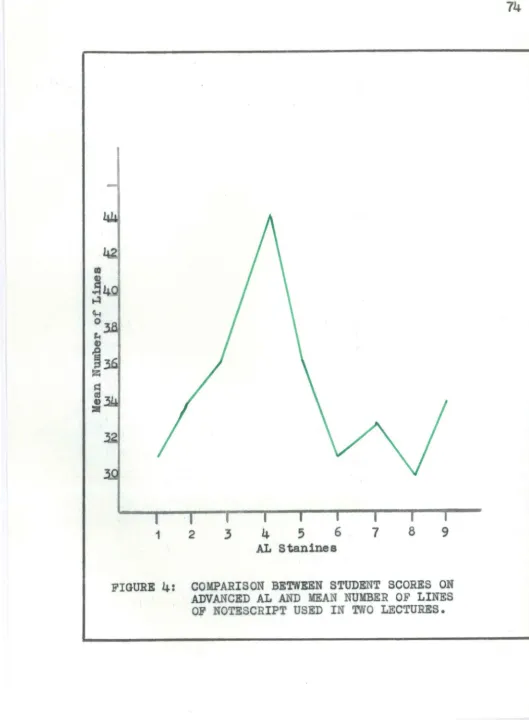
Comparison Between Student Scores on Advanced AL and Mean Number of Linesof Notescript used in Two Lectures
74
5 Comparison Between Student Scores onA.C.E.R. Reading Comprehension Test and Mean Number of Words Noted in
Two Lectures
75
6 Comparison Between Student Scores on A.C.E.R. Reading Comprehension Test and Mean Number of Instanoes of Underlining used as a Method of
Emphasis in Two Lectures
76
7
Comparison Between Student Performance on Second-year Eduoation Couraes and Mean Number of Words Noted in TwoCHAPTER I INTRODUCTION
I STATEMENT OF THE PROBLEM
This study was designed to provide a description of the actual note·taking practices ot students within a represen-tative tertiary education institution. Despi te the fact that such establishments rely heavily upon the lecture as a teaching method, relatively little is known of the efficiency, or otherwiae. of the student note-taking which almost
invariably accompanies the lecture method. EVen les8 is known about the structure ot such notes, and ita eftect upon subsequent learning trom the notes. A possible reason for thi. gap in our knowledge is auggested by Lawrenc.1 when he notes that educational researohers have tended to tollow the research models of the physical sciences rather than the more appropriate model of the biological scienoes. Thea.
latter sciences require. especially in the early phases ot research, Uextensive, systematic (even although tedious) data gathering and claSSification, and the search for predictable relationships and interactions between major features of the environment and the plant or organism".
Lawrence, P.J. Directions". of Canterbury.
UEduca tional Research : Problems and A public address given at the University
RATIOl-lALE
This study developed from an interest on the part of tne investigator &8 to whether or not the sheer .volwne ot
note.s taken in lectures by some students actuall,y hindered, rather than nelped, their learning, It was considered that there might be a point at whioh the balance between the
volume of notes taken and the manner in whioh they were structured affeoted the student'. ability to learn trom hi. notes, It was turther considered that this faotor could be retlected in a student'. overall academic performance,
especially as measured by examina tion. It was thought
possible, however, that beoause note-taking practices refleot individual learning style8,they might vary to such a degree that no generalisations could be made.
In the investigator'. present position at a Teacher.' Colleg., it was a180 thought that a atudent'. note-taking performanoe could be intlu.nced by factors pertaining to hi.
experienoe outside the College. Thero could, for example, be differencea between the note-taking styles of students who had attended univeraity and those who had not, or betwe$n
students who had had experience in commercial life as 'against those who had come to the College direotly from secondary education.
DEFENOE OF THE NEED FOR THE STUDY
3
teaohing at higher levels of education is concentrated almost entirely upon the effectiveness of the teaching, rather than the nature of the learning involved.
Typically, varioue t.chniques of teaching are compared with the lecture method. and their respective etficiencie. measured by tests in which etudents reoall the material
presented, Only in recent years has the tendency to meaaure the etfectiveness of teaching methods by means of t.ata ot recall been brought into question,
It is evident that the central mediating re.ponse betwe.n teaching by the lecture method and the learning that ensues
1.,
in tact, the type of note-taking that OCCur8 in the lecture room. Whilst ItHow to Study" texts found in the l1bral'"ies of' all higher learning centre. include sections on "How to take lecture note.", it could· scarcely be assumed that students typically follow these ideal patterns of note-taking.Should it be shown that students do not follow these suggested technique., questions ariae as to the efficiency of their note-taking, and of the learning which ia baaed upon such notes.
Only an objective study of' a representative sample of stUdents' not.s could suggeat anawers to aome ot thea.
questions. It was hoped that this study might be seen a8 a step toward me.ting thia need.
OUTLINE OF THE STUPY
to retain absolute normality, invited .econd-year .tudent. at the Christchurch Teachers' College to hand in their lecture notes at the conclusion of a twelve week introductory cours.
in Educational Psychology, oonducted by the investigator. From the twelve lectures given, two were aelected tor detailed analysis. It was originally intended that the study should include, as with studies conduoted overseaa,2 a
oomparison of the content oftered by the lecturer with that included in the students' notes, and to this end the leotures were recorded on audiO tape.
As the study progressed, however, the investigator felt that the note-taking praotices ot the students were of prime importanoe and OQuld well influence the results of any
comparative study. The.e practices, moreover, could be studied objeotively, whereas the a •• e.sment of leoturer "output" involved a .eries ot subjective judgement a which could not be Bustained. This opinion was supported by Rosenah1ne,3 who, when writing about an abortive attempt at a similar measure of organisation, atated "what was a main
1dea to one teacher, waa a subeidiary idea to another teacher". Th1s study was therefore focus.ed on an objective ass.ssment of the style and structure of the studenta' not •••
The major problem waa to desoribe the actual note-taking practices of students who were being taught by the lecture
2. These stUdies are reviewed in Chapter II.
method, with particular reterenoe to the q~ntity and atructure ot such note ••
To achieve this aim, oertain categoriea had to be devi.ed to enable ob~ective measurement ot tbe student.' scripta. ~he use of the.e categorie. enab1.d the in •• ati-gator to analya. the stUdent.' note. and iaolate certain behaviours which, it was thought, might correlate signifi-cantly with other tactors on which data was available.
5
Amongst these tactor. were included thoae within the students' backgrounds, their performanoe in oollege courses, and the nature ot their work e~erienc. or academic experience outside the college.
With the use of theBe object1ve measures, it waB then possible to tormu1ate a Bet of research hypothese.:
1. That the measured academic ability of student. w11l b, significantly related to certain note-taking behaviours. 2. That students of ditterent aex, age, and intelligence
will be tound to have significantly ditterent note-taking behaviours.
3. That with regard to the quantity and atructure of lecture noteB, aignificant ditterences w111 be shown to .xi.' between those students who are more suoce •• rul at college and those who are 1e88 succea.tul.
In the following chapters, a review of the literature will be found in Chapter II, while Chapter. III and IV will deal with the ree.arch design. Ohapter III will oover the sample, the selection of student variable. and procedure •• Chapter IV will be ooncerned with the selection ot the note-taking variables and with the description ot terms. An
CHAPTER I I
REVIEW OF THE LITERATURE
The efficiency ot the lecture aa a method of instruction in higher education has been widely argued. From its
inception in the Pre-Christian Academy, to the formalised ayatem of the medieval univeraity, the lecture survived
beoause knowledge waa regarded as a olo •• d system embodied in works not available to the student body.
McLeish1 claims that, d.spite the advent of the printIng preas, the taot that the leoture syatem was uneconomic and
inefficient waa not apparent, "since the aystem of protesaional training had developed ita own inertia and ita own set ot
vested interesta".
ae
cites Paul •• n,2 however, who describes the main purposes ot the lecture in higher education a.followaa
To provide a survey of the whole field of knowledge through the medium of a living personality;
to reIa te this body of knowledge to the primary aima of human life,
to arouse an active interest, leading to an independent comprehension of the subject on the part of the listener.
McLeiah3 atates that the main defect of the lecture system i. that there i8 no guarantee that thoa. purposes are
McLeiah, J. "The Lecture Method", Cambridge Mono,raph8
on
Teaching Methqd., No.1. Cambridge Inatitute 0 EdUcation,1968,
p.2.~.
achieved even by the generality of performers, He comments;
"Ir
we can take the •• declared objectives seriou.ly .a a justifioation for the lecture it can be •• serted with oonfidence that the number of teachers capableof getting even 80me way toward achieving them at the establiShed leoture hour every day tor a oonsiderable period of time must be 4eoide41y amall."
McLei8h
4
then remarks upon the state of current research into the efficiency of the lecture method. He not •• that a number of experimental inVestigations have been carried out, from the results of which we can attempt to disoover the merit. of the lecture methods oompared to other methods of teaching, Most of these experiments, he claims, are open to critioism tor a variety of reasons.McLei.h notes that, in most .xperiments, interest has been ooncentrated on the etfeot ot transmitting the aame
content by two or three different methods and comparing the outcomes in terms ot the amount retained by students. Re claims that the experimenter. have unfortunately seldom paid regard to the need to eliminate the erteets of reading,
revision, and other priVate atudy by the atudent in the interval between the teaching •••• ion and the examination which
1,
used aa the oriterion of gain. Consequently, heclaims. it i8 seldom possible to draw any oonclusion at all from these atudies a8 there are a great number of unoontrolled and confounding variable., In a recent study, Hartley and Cameron5 take up the criticism ot current methods of meaauring
4.
I
b14 ••
p,3.5.
Hartley,J.
and Cameron,.A.
nSome observations on the etficiency of lecturing', EduCe Rey, , Vol. 20.lecture efficienoy. Desoribing many of theee. as tf inappro"
priate techn1ques". they question the assumption that different teaching methods employed in moat studies
or
lecturing efriciency have the 8ame objective. and Can be measured by the aame teat.They susge.t, for example, that immediate recall of lecture materia.l i. the Objective ntither
ot
the stUdentsattend1ng the lecture nor of the lectUl"e.r delivering it.
Con.equently, if the objective of the lecturer 1s
to
promotefurther reading, a test of immediate recall 1s not relevant a8 a teet ot the efficiency ot the lecture. D •• pi te the.e critioisms, however, most,tudie.
or
leQture etticiency doemploy a comparison
of
the re.ultaor
teaching by the lecture method with those obtained by 80m. other method.It is theretore relevant to the purpo.e. of thIs study to briefly review theae r.8earches~
LICTURES AND DISCUSSION
Wallen and
TraVe1"a.
6 in their comprehen.lve summary ot the reaearch in thi. tield, not. that evaluation of the leoture Jlethgd has conslsted almost entirelY of comparisonwith the discussion
method.
YON ~.max-kabl., however, 1s thoU- .tatement thai theY'
could find no con.latent 'et1nltlon of th1. metl'io4 either by 6. Wallen, N. and Travers, R. uAnalyais and Inv •• tigat101l
the proponents of the method or 1n the reaearch related to it. They comment that !tone man'. 'lecture' uy be another man's discussion", Thi. situat10n may expla1n the fact that, with reapect to the maatery of tactual 1nt"ormation, moat .tudi.a find no 8ignificant d1fterenc •• between lecture and d1souss1on methods.
Ae examples
or
this type of study, Wallen and Travers oiteAach (1951), Bane
(1931),
Bills(19S2).
Carl.en(1953),
C.sey and Weaver(1956),
Deignen(1956),
Bllaeh (1954), Gerberieh and Warner(1936),
Ha1ah and SChmidt (1956), Husband(1951).
John.on and Smith (1953), Litson, Rempel, and Johnson (1956),Malone,
(1956),
Slomowitz(19").
Wisp.(19,1), and
Zelen.7( 1940).
The7 also cite. few studi •• whlch d1d report d1fterenc.a, uaually in
tavour
of thelecture.
The.e inolude Burke (1956),auetzow,
Kelly, and MoXe.ohie (1954). Remmers (1933), Ru~a(1954). and
Spence(1928).
Jaw(1949),
however, tound d1fferenoaa in tavour ot the discu8sion method.11
,tudent. o~ g~eater academ1~ abili~y under 41acua.ion prooedures. but found sre.,ter ret.nt~on of luoh material, under the lecture method with stUdents Of lower ability. J'urther, students of le8s ability showed greater immediate recall of information under the lecture method, whereas the -method* made little difterence in suoh porformance on the part of the more able stUdent ••
Tiataert (1965),8
how.v.~,
in a compariaon Of leoture discussion methods in the teaohing ot g.ograpbJ, found the discus. ion method to be .up_rior in developing 'retleotive-thinking' and retention of subject matter. The improvement in knowledge and in attitude to the subject associated with the dlsoussion me"thod persisted over a perlod of at least tour month •• The .uper1or1ty ot the d1.cussion over the leoture method was demonstrable with both the very bright and the average students.On the other hand,
lIly ••
tone(1966}9
discovered that there WaB nothing to ohoose between the methoda of a leoture (with,
and without discusaion). a bulletin, or a film. in conveyilig
tactual inrormation about research findings, except that the
subjects did better where thore was no discussion. Neither was there an adVantage in any of the thr.e methode in terma
8. Tistaert,
G".
cited in McLeish,J.,
op.q"",p.43.
9. EJ8atone, JA.L. tJA compa.rison of the ett'ect1vene •• otbulletin, til. and leoture, with and without disQusaion, in presenting research information".
of de8i~able changes in a~t1tude in the 513 experimental subjects employed in hi. experiments.
Joyce and Weatherall (1951)10 have concluded on the baai8
of cant~olled expe~lment. in teaeh1ng medical students, that
in terms ot ~e8ulta obtained from equal amount. of wo~k, the lecture method 18 mo~e etficient and more economical than di8cussion.
Although the di8cussion method could, in theory, be more ettective than the lecture method in developing concepts and problem-solving skills, tew studies have used independent meaaurea Of this type of lea~ning outoome. In general, the
conflicting nature of research findings in this field appear
to validate the criticisms of McLeish, Hartley and Cameron, and Wallen and Travers.
MoKeaeni.,i1 however, comment. that despite the many
ftnding. of no Significant ditterence. in etrectiTeneas between lectures and discus.iona, thoae studie. which have tound
ditterenc.a make surpriaingly good ••
nae.
In only two studie.was one method superior to another on a meaaure of knowledge of subject matter; both studies favouring the lecture method.
ot
8ix eXperiments finding significantdirterene..
ravouring discussion over lecture, the meaaure. in each oaee were other than tinal examination. t.,ting knowledge.10. Cited in McLeish,
J.,
S[Q.c!t.,p.44.
11. McKeaohie, W"J. uReaearch on Teaching at the College
and Univera1ty Level" in N.L. Gage,
e41tor,
0R.c1t"13
MoKeaChie concludes his oomments by suggesting that when
one is asked whether leoture i8 better than discusaion, the
apPX'opriate oounteX' would 8.em to be, "For what goal.?".
LECTURES AND INDEPENDENT STUDY
MeLeish states that several stUdies have report.d the
supeX'iority of independent study over the lecture method.
He o1te.12 McOullough and Atta (1960) who found that flexible studente benefit more trom independent study than do those with
rIgid personality atructures. He a180 cit.s Weit.man and Gruber (1960) who found that students .tUdying independ.ntly ahow them.elves better in making diffioult applications ot the
materials learned. and in learning new materials. They also show more curio'ity about the aUb~ect.
Jlarr (1960)13 ••••••• d the value ot a lecture by oomparing it to a condition in which students received no lecture ••
From the statistioal analyses performed, he made the interenoe that, tor introductory cours ••
tn
psychology and similar.ub~ects, stUdents w111 manit.st greater learning, as measured
by tormal teats, if they receive a .eries of lectures on the
material in addition to reading ~e textbook.
12. 13.
14.
Caro (1962),14 uains an end of course achievement test .a
McLeiah,
J.,
Cpteit., p.45.Marl', .;T.N., et.al. . "The contxo1bution ()t the l.ct~. to CO.11e,. teaching" t
JO.*
ot 14ugational;' P'19hol;9iY.Vol.
,1,
1960, p».2"-2 •Caro, P.W. ,"The Eftect of Clal. Attendance and 'Tim.-structured' Content on Achievement in Gelleral f.ycholoi1".
·a criterion, concluded that students performed .s well through independent study a8 in the conventional olass situation.
The conventional clas •• 8 were generally oonducted a8 lecture.
with students tree to raise quest1ons.
Corey (1934)15 compared the performance of lecture groups
with others who read the 8ame
material.
Hia x-osults, however, were based on ditterences in recall.Beaoh (1960)16 included a lectur. group and an independent etudy group in a tour group stu~ ot difterant teaching
, treatments' • Us1ng an achievement test •• a criterion, Beach
:round that the lecture group performed signitioantly better
than the other three groups. He further disoovered that introvert. per:t'ol'med better than extx-overt. in the lecture
, ,
group, whi18t there was no dif'terence at all between introvert. and extroverta in the independent atudy groUpt
Koenig and MoKeaohi. (1959~17 in a •• udJ comparing three teaching methode, found that women atUdenta high in ne.d tor
aChievemont pl"e:t'ex-red independent etud7 and 8mall group
d18culsion to the lecture method.
LECTURIS AND RETENTION
Ma~ studi •• of lecture ettioiency employ teats of' 15. Corey, S.M. "Learning
troDl
lecture. vex-aua loarninsfrom readings",
Jg'9£Wl. 9t
Idugat10nalP"ch010SI,
Vol. 25, 1934" pp. 4'9"'470. . .16 • • each, L.R. tfSociab111tyand acadelUic ach1ovemen1;.in
various types of' learning situations". 199nal
It
Edggationa1 fBYCA21QiY, Vol. ,1, 1960, pP. 208~ 12.17.
Itoenig, X.E. and McXtaohie. W.J. "Personality andindependent atud¥'·. ~g~ 9:(
idu9li&swa
lf
syqhol
ogy •15
retention, whether .ho~t~te~m or long-term • • a c~iter1a for measuring the Bucce's ot tIle method.
McLeish18 cite. Jon •• (1923) as being one of the r1rst to carry out .ystematic atudiea ot the lecture method. Using 5,000 questiona to teat retent1Qn, he concluded that the
individual difterences in retention indicated that the lecture system suited only the upper
ten
pereent of the group,McLeish himself, in what 18 known
a.
the Norwic4 experiment, tound19 that studente listening to an uninterrupted discourse within the range ot their underatanding,and taking notes inthe1~ normal fashion, carry away 80mething of thet order ot
forty-percent ot the tactual data, the theoretical principles atated, and the general applications referred to by the lecturer. A
week late~, however, they have forgotten at leaat half of this mater1al, although considerable individual ditterence. w.~
reported.
Corey,20 using a design which comllared the e:t't'ecti veness ot one or two lectures with a eimilar number of reading periods, came to tour basic conclusion ••
1. ~t tests of lamediat. recall are better for ma teriala students have read than tor the lIa_ materials heard in a lecture,
2. That neither Of the two type.
or
presentation18. McLeish., J. ,0Rtet!;., p.38.
19. Ibi4., p.9.
had any signifioant ett.ct on delayed (14 day)
recall.
3. That 8cor8a on t.et. of ~etentlon of material. read were more closely related to Boor •• on standardi.ed t.ets ot reading, vocabulary, and intelligence, than were t •• ta ot lecture
retention.
4.
That there 1'Ia8 a tendency tor .tudenis in the,
high_.t paycholog1cal teet quartile to perform relatively better on testa of reading retention rather than t.ata of lecture material retention.
LEOTURES AND PROGRAMS
Price (1966)21 haa adequately 8ummarised the reaearch
in this area. He notes that, in many ca ••• , the 'conventional methods' of teachtng used with control groups have been poorly defined. He Cites, however, a study by Roe WhO made us. ot
the lecture method for a control group whoa. achievement. wore significantly lower than tho.. ot the programmed
tn.truction group.
Pric. a180 cit •• a study by Wendt and Rust in which the lecture method Was more clearly detined, the lecture. being
b •• ed on the program used by the exPerimental group, They tound non-significant diffe~enoes between program-taught and 21. Price, G.J. "An Experimental study of tho Etfectivenes.
17
lecture-taught oollege treahm$n in learning to uae a library. They reported, however, large time eavings by the group using
the programmed method and they viewed this as a ma~or advantage over the lecture approach,
Price conclUded22
tnat
hie reaearch had been ot value in clarifying aome ot the many oomplex variables whioh influence retent10n or factual information in Teachers' College courses. Price antioipated that the signifioance of the results of his .tudy, in which the effectivene •• of two alternative methods were compared with the lecture approach, might convinceteachera ot the value ot attempting alternative method. in the presentation Of their course contont.
He implies that the more earetully structured the material
i_.
the gte.ter ia the desree of retentiQn. and the more valuable for study purposes the material becom •• in the eye. of' the .tudents.LECTURES AND NOTI-TAKING
The re.earch on note-taking is remarkable for ita
paucity, One of the earli •• t 8tudi •• was that of Thompaon,23 whoa. re8ea~ch de.ign was later used by Corey, and who Was primarily intere.ted in determining whether or not
note-taking ability coUld be used aa a mean. of predioting scholar-ship. Subjeot.mad. notes for 8imilar periods from either
22"
.I2!4.,
p-96.dictated or read mate~ia18, and were then permitted to u •• their notea to aid them to answer test questiona.
li.ne~
and Rhode(1959),24
atter commenting on the factthat
most "how to study" books advocate note-takins during a lecture, •• t up an experiment in whioh studenil were tnatrue-t.d to writ_ notes immediately after the lectur~. The¥ Qould report no evidence to support the belief that not.~taking itself during a lecture 15 an, more etrective in
producing efficient reoall than note-taking immediately atter the leoture.
This tinding i$ supported b¥ the work in New Zealand ot Freyberg
(1965),25
who, uatng316
Auckland Teachers· College students in matched groups, experimented with tour methods ot note-takina -- no notea, tull not •• , outline note., and duplicated summaries. Objective recall t.ats were adminia-tered immediately after the lecture, two weeks later, and eight weeks later.Aa a result ot this work, Freyb$rg suggests that, if no examinations are to be held, no notes need be taken. It examinations are nec •• sary, then duplicated summaries of the leoture material are most ueetul.
A moat inter •• ting deVelopment in this tield is the work of Hartley and ca.eron,26 who, in an attempt to
ve~1f1
I
Eisner, S. and Rhode,
K.
"Not.
taking
during or atter the lecture", JOJll!J1!l of' Idu9,t!oM1P,ycholOSI, Vol. 50, pp.301-304.
Freybers. P.S. "The etfect1veneaa ot note-taking"',
19
~e t~nd1ngs Of MeL.iab with regard to student retention ot
leoture Platerials, have evolved what they describe aa a measurement teohnique more appropr1ato
to
lecturing. In an effort to a •• ess the amount ot information storod in atudtint,'notebQoks. compared to the total amount ot intor-mation communicated to them. the researohers div1ded the transoripts of the lecture into 'information unit.', then ch.c~d the students' notea tor the number reoorded.They t'ound the. t approxima tely one third ot wha, was sa1d would be a generous estimate ot tne amount ot material tranamitted to notebooks.
The work ot Hartley and Cameron appeared to tni.
investigator to be a atep towal'd a olearer evaluation ot the lecture method, bearing in mind particularly their atatementa on the need to consider the ob~ectiv •• Of the lecturer betore assessing the degree of success ot the lecture.
Their atudy appeared limited in it. us.tuln •••• however, in that it was restricted to the notes
or
twenty-two atudent. at a univeraity college. It was thoUiht that their ideascould be taken turther with a more comprehensive study
ot
thenote .. taking practices in loeturea of a muoh larger and more diverae bQ~ of .tudents.
Whilst Hal'tle1' and Cameron were primarily concerned with
CHAPTER III
THE RESEARCH DESIGN • THE SAMPLI,
SELECTION OF STUDENT VARIABLES, AND PROCBDURES
The description of the rea.aroh de.ign i. divided into two paris. In this chapter i. included a deaoription of the lample of the etudent population upon whoae not •• the re.earch was undertaken. Also inoluded are specificationa
of tne available supporting data tor each student involved in the reaearch, and of the procedures used in the atudy. In Chapter IV, the .election of not.·taking variablea, the definition ot terms, the analysis of the not •• scripts and the atatistical procedures w111 be described.
A. THE SAMPLE
The eample was drawn trom .econd~year students at the Christchurch Teaehers· Colleae. At the time of their entry
into the College. students in this intake were allocated to eight groups of approximately equal size. lettered trom A
to H. Groupe B, D, F and H were compo.ed of student. who were already attending University course. or who had
indicated their intention to dO 80 concurrently with their
student. were allocated to ·Univeraity' groupe on the basis ot the a~bjeeta they were taking or intended to take
at the University. Thus, Gro~ B consisted largely of
students enrolled tor English
X,
Groupe D and F containedthose enrolled ~or Eduoation
I.
and Group H inoluded those enrolled ~or other sUbjeots.Students were allocated to the 'non-university' groups in alphabetioal order.
Tog.ther with other College cour •• s in English and Education, the oourse involVed 1n thia atudJ waa ottered
twice annually, with tour group. attending in each seme.ter. During the period ot' this researoh, Groups B, 0, F and
G were attending the lectures, thU8 inoluding
two
'university' groupa and two 'non-univeraity' groupe.Students who have pas.ad Education I at the Univeraity are normally exempted trom certain •• ctions o~ the Eduoation
courses at
the
Teacherat College, and this cour •• was one 01'those aections. The total numQer 01' students attending
the
oourse, theretore, was 136, repre.enting app~oximately half
an intake, leas thoae exempted from the course and thoae who did not complete the course tor other reasona.
Of the •• 138 stUdents. 60 were inoluded in the two
23
Because it was thought that any compulsion to hand in lecture notes would create an artiticial situation and consequently destroy the normality whioh was be1ng sought, students were invited to co-operate in the research by
voluntar1ly handing in their note. atter the examination which conoluded the •• mester·. work.
A total Qf 105 students, comprising 52 8tudents from the -un1versity' sro~s and
53
students from the 'nan-univeraity' groups responded to the invitation. This represented16
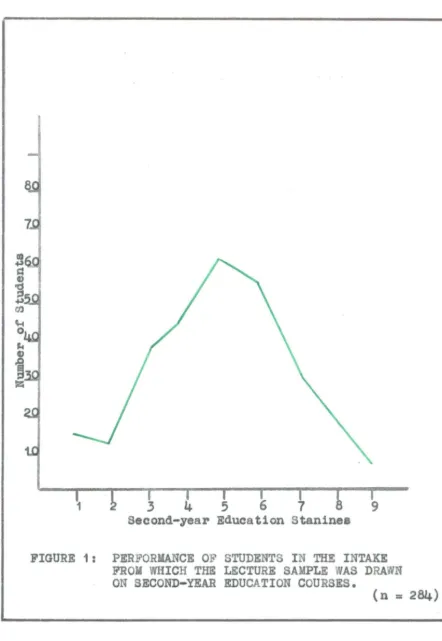
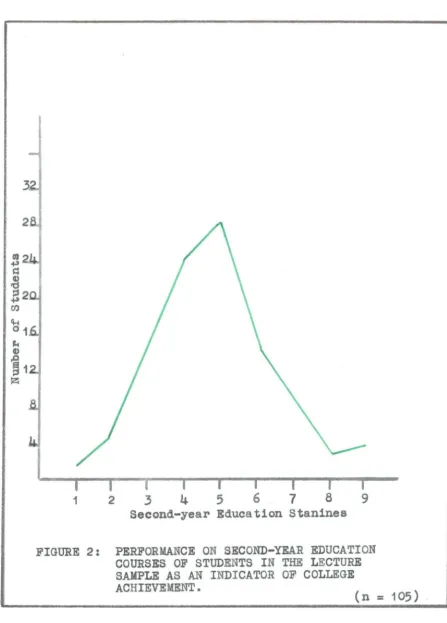
per-cent of the initial lecture sample.Using Teachera' College performance as a criterion, it can be shown (Figure. 1 and 2) that the •• 105 etudenta were representative of the whole second-year intake at this
particular Teschers' College.
It would be unwise, however, to generali •• from this population sample to students in other Teachers' College., as course requirementa and intake characteristic. vary in the Teacher.' Colleses throughout New Zealand. It is no~
possible, therefore, to predict behaviour from the result.
o~ this atudy, nor was it the intention of the investigation to dO anything other than to d •• c~ib. the actual behaviour
of a particular intake of student. in one Teachere' College. Finally, because
t:n.e
aecumulat.d data was llroc •• sed by oomputer. the Booree of those student. who had attended only one of the two lectures trom which note. were studied were3 4
Second-year Education Stanine
FIGURE 1: PERFORIIANCE OF STUDENTS IN THE INTAKE FROM WHICH THE LECTURE SAMPLE AS DRAWN ON SECOND-YEAR EDUCATION COURSES.
[image:35.617.78.520.55.696.2]1 2
FIGURE 2:
3 4 5 6 7 8 9
Second-year Education Stanines
PERFORMANCE ON SECOND-YEAR EDUCATION COURSES OF STUDENTS IN THE LECTURE SAMPLE AS AN INDICATOR OF COLLEGE ACHIEVEMENT •
(n
=
105) [image:36.600.81.528.54.677.2]B. THE SBLEC'tION OF THE STUDENT VARIABLES
Upon entry into the College, eaoh student had oompleted a testing program whioh included the following.
1. A.C.E.R. Advanced AL 2. A.e.E.H. Advanoed AQ
,3. A.C.E.H. Reading Oomprehena1ont Form y1
4.
A.C.E.R. TO Yathematics Te.t2The results of these te.t. were available, together wi tb
a personal history which inoluded seoondary .chool background, Ichool certificate and univeraity entranoe pe~formanoe. and university or employment hietory. In addition to the •• , the investigator had aoc ••• to the cumUlative College record ot each, student.
or
particular interest in thes. latter reoord8 was therelative performance ot each student in the eight syllabus study areas which were compUlsory tor all studente
in
thefirst two years ot their three year courae,
The
mean ofthese eight soore8 was taken for eaoh student as an indication of College performance.
In the tinal analysis, ten variables were .elected trom the available student data tor oorrelation with the note-taking variable ••
In
.U$mar~ to~m, theaewer ••
1 , Co-operative Bngliah Teat C2 Reading Comprehension (H1gh.~ Level).
FOrm
Y. PUbl1ahedin
Auatra11a b7the Australian Council tor Bducational Research. Univeraity Building, Melbourne.
Designed speoifically tor use in Australian
27
1. School Certificate ma~k. 2. Age in yeara.
3. Per~ormance on A.a.E.R. AdVanced AL.
4.
Performance on A.O.E.R. Advanced AQ.5.
PerformanCe on A.C.E.R, Rea41ng Comprehension (Form Y).6. Performance on A.C.E.R. Mathematic ••
7.
Performance in First Year College English course. 8. Performance in Firat Year Education courses.9. Performance in Seoond Year Eduoation courses, 10. Mean perfo~mance over eight Syllabus Studies. Sines all aSsessments at the Christohurch Teaohers' College are based on the atanine distribution, the variables numbered from 2 through 10 are reRorted in this form,
Performance on College English and first-year Iduoation oourses were included beoause these were the only two courses in the College where students regularly exper1enced leoture methode of teaching in groups ot forty or mo~e.
The aeoond yea~ Education performanoe included an aaa ••• ment of the student.' work not only on the course in which the reeearch was undertaken, but a1ao on the two other cour.e.which made up the year's work.
Performanoe in the examination whioh oonoluded the course itaelf was not considered aa a variable becaus8
C. PROCEDURE
Information given to etudents! . At the oommencement of the twelve lecture course, the investigator read a prepared statement to each of the four groups, expressing a desire to collect_ after the final examination, the notes of those students who were willing to lend them tor the purposes ot this study. A copy of this statement appears in AppendixA.
The desirability or otherwise of informing the student groups of the study was considered_ and it was finally
decided that there was a greater likelihood of a favourable response if a prior request had been made. There was a risk that note~taking behaviour might have been altered because of this prior announcement. but great e~hasis was laid on the fact that the study in no way affected the course assessment of student performance. No turther mention was made of the study until the end of the course.
The collection ot the notes: At the conclusion of the final lecture, the groups were again reminded of the investi-gator's desire to collect their notes, and were invited to hand them in when they met together after the examinations.
29
Selection of leqture. tor stUdY' In the tirst instance, three lecture., the firat, fourth and last in the series ot twelve, were chosen tor study by the investigator. This ohoice Was based on the intention of providing a description ot the consistency of student note-taking over a period of three months.
The note. taken by the 105 students trom the three
lectures were analysed, and the individual acor •• on eaCh ot the twenty-five va~iable8 recorded tor eaoh lecture which the atudent had attended. Such was the volume of the ensuing data, however, that it was considered unmanageabl,. A decision was therefore made to reduce the study to two lectures only.
The choice of the first and fourth lectur •• was made because they appear.d to the inv.stisator to be ot similar length and volume, and as nearly similar in structure as is
possible in lecture. which contain diftering aubject matter. The time interval was thus reduced to three w.eka between lectures.
The aij!.t19nQ1irt* In order to provide turther
information related to the development ot each student·s not.-taking style, a tourteen-item questionnaire was deVised, and administered at the conclusion ot the tinal lecture.
CHAPTER IV
T.HI RESEAROH DESIGN : ANALYSIS OF THI NOTE-SCRIPTS, THE SILECTION OF NOTE-!AKING
VARIABLES, :DUINI'tION OF '!'ERMS, AND
STATISTIOAL PROCIDURBS
The rational. for the selection of certain note-taking behaviour. haa been outlined in ChaPter I. In the ab.ence
of previous re.aarch in the tield, however, the 1nv.atigato~ was compelled to make somewhat arbitrary decisions as to the variable. wnioh might prove relevant.
Prior to the .tu~, .a~le. of lecture not •• were
collected from second-year students known to the inve.tigator. The selection ot variablea was influenoed by obaervatiansmade trom these samples.
Bearing in mind tha t tha study was' fooussed upon the
quantity and structure ot lecture notes, twenty-five variable. were isolated tor study. It was hoped that, through an
analysis of the.e variable., a comprehensive picture of each student's note-taking behaViour could be built up, and
comparison made, in turn, between individUal students and between groups of stUdents. Aa the study evolved, it became obvious that oomparison between groups would receive graatest em»ha.ia. Individual comparisona were, neverthele.s, atill available from the .aurce material.
tho •• concerned with quantity, those concerned with structure, and ~ethods of empha.is.
This chapter will provide a list ot the note-taking variables sel.ot.d, furnish a detinition ot each of the variable. as they were used in this study, and describe the
statistical procedures tollow.d.
A. THE BILEOTION' OF THE NOTE-TAKING VARIABLES AND DEFINITION OF TERMS
1. QUANTITY VARIABLB:S
The following .even variables Were thoUght to represent
the basic aspects of note-taking with regard to the volume ot mat.rial not.d,
<a> lumber of wo£dt. A 8impl' count waa made ot .very word uaed by each student. All abbreviation.
were inoluded .a worda, aa were .y$bola commonly us.d in place of worda.
• ther.tor. t • )
(For example -- ••• tor
(b> Number of 11nea u.'4: In an attempt to meaBure the amount of apace used by .ach student to writ. note. in a lecture, any line between the heading, it any, and the last line ot note-script was deemed to have been 'used.'. This included lines in the body ot
33
(0) Number ot spae •• within
tho
not.-scripta A spae. was d.fined as an area ot at leaat one line, butin practioe ott.n more than one. which was devoid ot note-script tor the complete width of the page. The eftect of a spac., therefore, wae to break an otherwiae continuoua note-8cript into cl.arly defined 'blocks'.
(d) lumber ot a.nt,nc.! ul,4: Many atudents used complete aentenc.s within their note-acript., .e oPP08.d to the use ot ahort, pertin.nt phraeea. A .entenee was derined as a group ot words which
met the grammatical requirements ot a .ent.no., but not necessarily the reqUirements of torm. Capital letters, tor example, w.re not consider.d necessary to begin a sentence.
(e) Number ot discrete unite of ngt.-script: For want of a better term, the investigator used thi'
d.scription to cover the visual unit. which appear in all note-scripts. (Examples are shown in
Appendix
n.)
It waa consid.red that l.arningmight be intluenced by the number of separate units ot script with which the stUdent was contronted when attempting to study trom the not.a.
ot bracket, parentlleaea or dashes, by underlining, or by otller methods of emphasis.
Diagrams were included aa one unit only, but information added outside the diagram by tlle student was treated a8 part ot the note·script.
(t)
Aibr,v1at1on'l Two broad Class.a of abbreviations were noted, and it was thought desirable to•• parate these in the analyaia.
(i) ~rupcat'd w9Fd@: Man1 students llad developed ,tyli.ed methods ot note-tak1ni lnvolvina the reduction ot recurring words to much shortened torma (tor example, ahn for children, lrng tor learning).
(ii) QommoQly aCQlpt!a abbreviation': For example, e.g_, ~B.
A,
etc.Scores on these seven note-taking variables wero then used to formulate what the investigator detined al structure variables, and a desoription of these is now presented.
2. THI STRUCTURE VARIABLES
Whilet the raw 8cor •• ot the actual incidence ot certain note-taking bellaVloura were important in tll.mselv •• , it wa. thought tllat they did not oonvey an impression ot any aapect ot the studenta' note-taking .tyl. other than volume.
'5
certain ratioB as instruments whioh might indicate the manner in which differing groups ot students structured their noteB. Th. ten variables .elected tor study were a8 tollows:
(a) Ratio ot words to lines (b) Ratio of words to spaces
(0) Ratio of lines to spaces
(d) Ratio ot abbreviations to words. For the purposes ot this variable, only the first category ot
abbreviations (that ia, truncated worda) was considered,
(e> Ratio ot words to discrete units (f> Ratio ot sentencos to disorete units (g) Ratio ot disorete units to linea
(h) Ratio ot methoda of emphasis to lines
(i) Batio
or
methods ot emphasis to discrete units (j) Ratio ot mothods of empbasis per 100 words. 3. METHODS OF EMPHASISIt waa thought that a crucial tactor in the student'. ability to learn trom lecture note. could be the manner in which attention was drawn to those points in the note. considered by the student to be most important.
(a> Instances
or
und,rlinins: Each .egment or line was regarded as one inatance. This was thoughtto be justitied on the grounds that the student was likely to respond to the visual impact ot the line whon studying trom the notes. A line
ot
note-script where each word was individually under-lined would require more 're-focussing' of attention than would, perhaps, a line ot not.script with
continuous underlining.
(b) Chans.a in 'arlpt ,tyl.: Some students,. it was observed, changed from cursive writing to print
script, or vic. versa, in order to emphasise a point. The use of italica or similar styles as a method
or
emphaais was alBo included, to the extent that it repre.ented a change rrom the stud.nt'. natural script 8tyl ••A 'chanae' was taken to include a complete unit
or
note-script where emphasis was given. Thus, touror tive words would b. counted as on. change in style. Worda writt.n entirely in oapitals were not included.
37
obVIously used capitallsat10n to denote a greater degree o~ 1mportance than was 1ndioated by most other methods or em»ha.Is.
(d) Instwo". ot the us. ot sims and .pbo;,: In order to focue attent10n on a particular aect10n ot the note"scl'lpt. many studenta used words .eparated rrODl
the text by margins, apaoea, or enolosures. Theae verbal reminders were claBs1tied.a taign.'. Most
otten used were the worda '1mportant' and 'not.t •
Other student. employed a non-verbal system to denote 1mportance. Most oommonly used symbols were
question mark. ("'), arrowa, and aater1sks.
As both eigns and symbols appeared to be employed to the same end, they were added together ror scor1na purposes in the analysis or the note-scripts,
(e) instances or ine use or
an
initial cap~tal. One ot the moet str1k1ng reatures or the note-scripts waa the frequency w1th wh1ch some students used capital letters to begin words.In
many inatances, theae words were in the body ot the note-scr1pt, ratherthan in headings or at the beginning ot a Bentence. It was thought possible that this method ot emphali. could actually hinder the clear •• lection or ma1n points rrorn the note-soript. A count
wsa
the~.tor. made of every instance where a word, othe~ise(t)
In.tanc!s of' ind.nt.Ai* Indenting waa deemed to have occurred whenever a atatement beginning nearthe lett margin was followed by suba1diary atat.-ments wh10h were begun not1ceably turther to the
right or a point vertically below the first word of the opening statement.
Each set of subsidiary statemente, whether it consisted of one or more items, was classed as a single instance of indenting.
Similar rules weI" applied
it
the subsidiary state-menta were themselv.s used as sub-headings and further indentation occurred.(g) Enwgratiop, and (h)
tapula£icm=
Both th •••method, ot .mpha.is were employed to give system and order to oonsecutive points in the note-scripta. It was thought that the us. of' numerala (.rtum.rat1on) or letters (tabulation) might be representative of' dittering note-taking styl •• , and the distinction was accordingly made for the purposes ot the
analysis,
I.
STATISTICAL PROCEDURES39
presented in Table XXXVII (pp. 140-141).
Similar product-moment calculations were computed tor each ot the ma~or sub-group ••
are reported ae followas
Matrices of interaorrelatione
All temale students All male students
All with university unit.
-- Table XXXVIII
.... - 'l'able XXXIX
-- Table XL
All without university unit. -- Table XLI
Additional correlations were computed tor each aex within the universit~/non-univer.ity dimension. These
results were later disregarded, however, because of the small number ot students involved in the university SUcceS8
calcu-lations.
the acceptable level of significance was set at the traditional .05 (two-tailed). It was considered that a lower level, tor example .10, might have given an indication of broad tendencies 8uited to the purposes ot this descriptive study. The amount ot data obtained a8 a result, however, would have proved unmanageable. By using the
.05
level, it was considered that there was lese risk that significantcorrelatione had occurred by chanee, and that variable. worthy ot further study would be more clearly isolated.
Produot-lI,oment correlations were a180 oomput.d tor the student Tariab1 •• and the questionnaire re8pon •••• and tor the note-taking behaviour variable. in each leoture and the questionnaire responeea. Matrices
ot
intercorrelationa tor these sets ot variable. are pre.ented in Table. XXXIII. XLII,ANALYSIS OF RlSULTS
In Chapter I ~ a number ot re.earch hypoth •••• were presented, Thes, were:
1. That the measured academic ability ot student. will be significantly related to certain
note-taking behaviour ••
2. That studente ot ditferent .ex, age, and
intelligence will be tound to have significantly d1fterent not.~takins behaviours.
3. 'that with regard to the quantity and structur. ot lecture note., s1gnifioant d1tterences will be shown to exist between tho.e student. who are more successtul at Teaohera' Oollege and those who are 1 ••• successtul.
4.
That signiticant 41tterenees in note-taking behaviours will be shown to ex1st between those Teachers- Collog. student.who have
beensuccesa-tul at University and tho$. who have either not attended or who have attended but not been
succeas:f'u,l.
41
this instruction and
ot
their existing note-takina abilitie ••In this chapter, results relevant to each hypothe.is will be presented. These will be followed by an analysis O~
the significance of each Of the note-taking behav10ur variables, and the chapter ooncludes with a summary of respon.es to the questionnaire.
RELATIONSHIPS BETWEEN ACADBMIC ABILITY AND STUDENT NOrm-TAKING BEHAVIOURS.
academic ability. They werec
Variable Ho. 1 -- Scho~l Certificate mark
Variable No. , -- Performance on
A.e.E.R.
Re.dina Comprehtn.1onVariable
No. 6 --
Pertormanoeon
A.e.E.R.
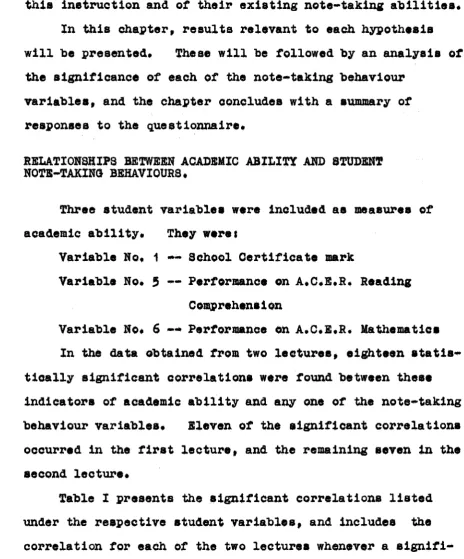
Mathematics In the data obtained t~om two lecture.; eight.en atatia. t1cally sign1ficant correlationa were found between thea. indicatora of academic abtlity and any one of the note-tak1ng behaviour variables. Eleven ot the signif1cant correlations occurred in the first lecture. and the remaining .even 1n the second lecture.Table X presents the significant correlations listed under the reapective student variables, and includes the
[image:52.595.67.532.64.624.2]1 1
11 12
1
1
DO
II
11 ~
,
tive corre tions. :fourteen
Six s correlat were concerned
volume notes taken, reaa the remaining
related to the structure •
With all but one of the thirty correlations presented in the table the same direction, clear indications were given that academic ability as mea by these three variables was significantly related to note-taking behaviour.
influence reading comprehension appeared to be of especial significance, and this factor will be discussed in the next chapter.
RELATIONSHIPS BETWEEN SEX AND NOTE-TAKING BEHAVIOURS
Significant correlations found between the variables relating to female stUdents and their note-taking behaviour are presented in Table II. Here also, the correlations
occurring in both lectures have been presented in order to determine whether or not directional tendencies were confirmed in the lecture other than that in which the significant
correlation occurred.
In Table III, the data for male students is similarly
presented.
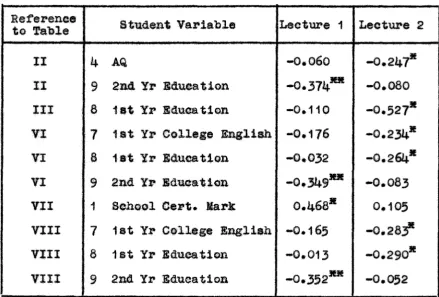
Of the thirty statistically significant correlations presented in Table II, twenty-one occurred in lecture one,
th,,;& ... 'ft Variable 1. 2. J
4
,
78
,
10
..
--
...
-Loet'UPe 1 2 1 2 1 I 1
2
1 21
2. 1 2. 1 2. 1 2.-24-
-10
-2S- -3~ !-os
1
-13
-26·
..Q5is
24-17
-0730R
14
·13.24-28-
OS-~~
2'-~
-28- -18
26·
26-
,38-£:
13-14
.28-
·34-
.. ,34-.... 13
36-
03
31
-23-
1723·
12
33
-2'-
-2tt
'"
-2~-24-
-28-
-24·
-2'-
-06 -218 .ePe
I I I
1 2
,
4
5
,
7
8,
101 2 1
2
1 2 1 2 12
1 2 1 2 12
1 2 12
l'
-11-5'-14
-68--"
-5411
-60·
5S-
0,
5'-".
21
-'4·
-24
24
5'- 51·
-38
-5,11
-64-
-6'-
-".
-73-5'·
-6,.
-54·
-6a-
-37
-56·
-5211
.... .32
....,'--54
11
-72-
,6·
-27
55·
-70- -73-
-5,.-5,11
-6'-
-74-
-8oD
-58- -5~
-32
-'7--71-
-,,-
-6,.
-59
11-7rJf1i
-5,11-74
8-78-
.... 33
-55·Decl_1
- P II1II
<.
8 p II1II <.01taking. In only two instances, however, were significant correlations found for the same pair of variables in both lectures.
Of the twenty-eight pairs of correlations presented, twenty-five showed consistent trends in direction, sixteen pairs consisting of nesative correlations, and nine showing positive correlations.
Two areas of Table II appeared to be of particular significance. In the first place, the concentration of
significant negative correlations between Methods of EmphaSis variables and School Certificate marks was not found in the scores of male students. Secondly, the strong positive relationships between some of the structure variables and college performance were quite the reverse of tendencies found in the scores of male stUdents in this general area. ConVersely, however, very similar scores were found for both male and female students between .ethods of Emphasis variables and scores on A.C.E.R. Reading ComprehenSion 'orm Y.
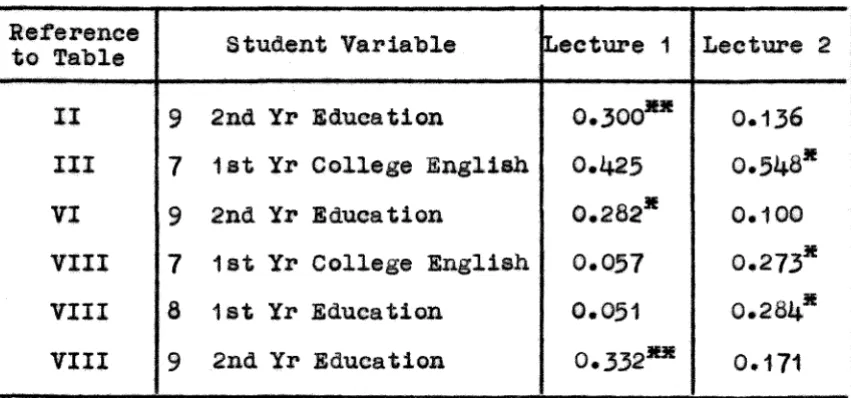
Of the forty-eight statistically significant correlations reported in Table III, twenty-two occurred in the first
lecture, and tlultnt),"-six in the second. Seven of the forty-eight related to the volume of notes taken, whilst the