
Towards a
Methodology-Growing
Framework
Master’s Thesis
Author
Richard Cornelissen
University of Twente
[email protected]
Supervisors (University of Twente)
Lodewijk Bergmans
Christoph Bockisch
Supervisors (Topicus)
Tom Palsma
Wouter Pollmann
Abstract
Software development methodologies instruct teams how to collaborate on de-veloping software for their project. Methodologies include, among others, pro-cedures, tasks, techniques, guidelines, and tools. As each software project is
unique, each requires its own, tailored methodology, or way of working. With
an inadequate methodology, or one that remains unadopted by the team, the project could end in failure.
The methodology-growing technique defined by Cockburn allows to create a suitable methodology for a software project. This technique does not support existing projects, though. Furthermore, it does not provide suggestions and guidance what to change to the methodology.
This thesis proposes to extend the methodology-growing technique into a frame-work that is able to support organizations in attaining suitable and adopted methodologies for software projects. Properties of the software project are col-lected that influence decisions on its methodology. These are used to prepare and hold incremental reflection workshops. During these workshops, team members collaboratively improve the methodology, making decisions on their previous experiences and on the properties of the project.
We propose to define methodologies as a composition of software development practices. Practices can be documented, reused and incorporated into method-ologies when they are applicable. We propose to extend documented practices with their usage criteria. These descriptions indicate when a practice is suitable and how it can be adjusted to the project.
Acknowledgements
The following people have supervised the research and the writing of this thesis. This research took place in a project called Findesk at Topicus, an organization located mainly in Deventer, The Netherlands.
dr.ir. Lodewijk M.J. Bergmans
The first supervisor from the University of Twente, with whom I have discussed in length about methodologies, relevant literature, changing the methodology in practice, the design of the framework and the writing of this thesis.
dr.ing. Christoph M. Bockisch
The second supervisor as well as my mentor from the University of Twente, who has helped in structuring and improving this thesis.
Tom Palsma, MSc
Supervisor and project manager at Findesk, who has helped apply the designed framework together with his team. He has also provided guidance, feedback and support in writing this thesis.
Ir. Wouter Pollmann
Supervisor and director at Findesk, who has guided me in designing the frame-work as a whole and motivated me to use it in practice at Findesk. He has also introduced me to the idea of discussing the framework with the interviewees listed below.
Interviewees
The following people are employees at Topicus who are experienced in different aspects of software development. They have helped me in designing the frame-work through extended discussions. Furthermore, they have filled in surveys for evaluation and have provided detailed comments.
• Marco Scholten – Senior software developer. • Daan Verbree – Product manager and team leader.
Contents
1 Introduction & Motivation 1
1.1 Background . . . 1
1.2 Research objectives . . . 3
1.2.1 Main objective . . . 3
1.2.2 Research questions . . . 3
1.2.3 Definitions . . . 4
1.3 Approach . . . 5
1.4 Evaluation approach . . . 6
2 Methodology Design 7 2.1 Conceptual terms . . . 7
2.2 Methodology design principles . . . 9
1. Interactive, face-to-face communication is the cheapest and fastest channel for exchanging information . . . 9
2. Excess methodology weight is costly . . . 9
3. Larger teams need heavier methodologies . . . 10
4. Greater ceremony is appropriate for projects with greater crit-icality . . . 10
5. Increasing feedback and communication reduces the need for intermediate deliverables . . . 11
6. Discipline, skills and understanding counter process, formality and documentation . . . 11
7. Efficiency is expendable in non-bottleneck activities . . . 12
3 Methodology Composition 15 3.1 SEMAT Kernel . . . 16
3.1.1 Alphas . . . 17
3.1.2 Activity spaces . . . 18
3.2 Practice library . . . 19
3.2.2 Prerequisites . . . 21
3.2.3 Necessary commitment . . . 22
3.2.4 Tailoring . . . 22
3.3 Documenting software development practices . . . 23
4 Project Inventory 27 4.1 Project properties . . . 28
4.2 Team member properties . . . 32
4.3 Solution properties . . . 33
4.4 Methodology properties . . . 34
4.5 Project inventory interview . . . 36
5 Methodology-Growing Framework 39 5.1 Composing the methodology . . . 39
5.2 Applying the framework . . . 44
Step 1. Project inventory . . . 44
Step 2. First practice attempt . . . 45
Step 3. Preparing reflection workshops . . . 45
Step 4. Holding reflection workshops . . . 48
Step 5. Changing the methodology . . . 50
Step 6. Middle of the increment . . . 51
5.3 Start of a new project . . . 51
5.3.1 First proposal . . . 52
5.3.2 First reflection workshop . . . 52
5.3.3 First practice attempt . . . 52
5.4 Summary . . . 53
6 Case Description 55 6.1 Project inventory . . . 55
6.1.1 Project properties . . . 56
6.1.2 Team member properties . . . 58
6.1.3 Solution properties . . . 59
6.1.4 Methodology properties . . . 60
6.1.5 Summary . . . 62
6.2 First iteration . . . 63
6.2.1 First practice attempt . . . 63
6.2.2 Preparation of the reflection workshop . . . 63
Contents
6.2.4 Changing the methodology . . . 67
6.3 Second iteration . . . 69
6.3.1 Preparation of the reflection workshop . . . 69
6.3.2 Second reflection workshop . . . 71
6.3.3 Changing the methodology . . . 73
6.4 Reflection on the methodology . . . 75
7 Evaluation 77 7.1 Employee survey . . . 77
7.1.1 Survey results . . . 78
7.1.2 Summary . . . 80
7.2 Team member & experienced employee survey . . . 81
7.2.1 Survey results . . . 81
7.2.2 Additional survey results . . . 86
7.2.3 Summary . . . 87
8 Conclusion 89 8.1 Conclusions . . . 89
8.2 Contribution . . . 93
8.3 Business recommendations . . . 94
8.4 Limitations and future work . . . 95
8.5 Concluding remarks . . . 97
Bibliography 99 A Experienced employee interviews 104 A.1 First interview . . . 105
A.2 Second interview . . . 107
B Practice Library 109 B.1 Weekly Cycle . . . 111
B.1.1 Usage criteria . . . 112
B.1.2 Alphas (things to work with) . . . 113
B.1.3 Work products (artifacts to maintain) . . . 114
B.1.4 Activities (things to do) . . . 115
B.2 Daily Standup . . . 117
B.2.1 Usage criteria . . . 118
B.2.3 Activities (things to do) . . . 120
B.3 MoSCoW Prioritization . . . 121
B.3.1 Usage criteria . . . 122
B.3.2 Alphas (things to work with) . . . 123
B.3.3 Work products (artifacts to maintain) . . . 124
B.3.4 Activities (things to do) . . . 125
B.4 Pair Programming . . . 127
B.4.1 Usage criteria . . . 128
B.4.2 Alphas (things to work with) . . . 129
B.4.3 Activities (things to do) . . . 130
B.5 Seasons of the Day . . . 131
B.5.1 Usage criteria . . . 132
B.5.2 Alphas (things to work with) . . . 133
B.6 Visualize Workflow . . . 135
B.6.1 Usage criteria . . . 136
B.6.2 Alphas (things to work with) . . . 137
B.6.3 Work products (artifacts to maintain) . . . 138
B.6.4 Activities (things to do) . . . 139
C Project inventory interview 143 D Social adoption measurement form 147 E Questionnaires 149 E.1 Evaluation by employees . . . 150
E.2 Evaluation at Findesk . . . 153
E.3 Evaluation with experienced employees . . . 155
F Survey results 157 F.1 Employee survey results . . . 157
F.2 Findesk team member survey results . . . 158
Chapter 1
Introduction & Motivation
This chapter introduces software development methodologies and states the goal of this thesis. The problem statement is defined and research questions are stated that have specified the focus of the performed research.
§
This thesis will propose a framework for attaining and improving methodolo-gies within a project. It has been applied within a single case to improve the methodology of a two year old project in the financial domain.
1.1 Background
Definition of methodology
A software development methodology can be defined as a means to achieve the development of systems, based on an underlying philosophy. Methodologies can include, among others, phases, procedures, tasks, rules, techniques, guidelines and tools [4, 30].
Benefits
Methodologies are useful for a number of reasons [4, 12, 25, 30]:
• Methodologies can increase transparency of the development process, which facilitates management and control of the project and thereby reduces risks and uncertainty.
• They can increase productivity and quality as necessary resources can be predicted beforehand.
Furthermore, according to Cockburn [8], methodologies can • Introduce new people to their jobs.
• Delineate responsibilities. • Show progress.
• Provide a curriculum for education.
Agile methodologies
The Agile Manifesto provides a guideline for a new class of methodologies that emerged in the mid-nineties: the agile methodologies [6]. The Manifesto in-cludes twelve principles for agile methodologies, focusing on customer satisfac-tion, changing requirements, frequent delivery, and other aspects to software development. Agile methodologies have gained increasing acceptance in the IT industry, as a number of surveys show [1, 26, 28, 29, 32], with up to 80% of the respondents indicating they use some agile methodology.
Surveys show agile methodologies are adopted for the following reasons [26, 32]: • They shorten time to market.
• They manage changing requirements. • They increase productivity and quality.
• They increase predictability and better align business and IT. • They reduce waste.
Adoption
Usage of methodologies is hard to measure because of bias and focus on specific methodologies [10]. Surveys and research indicate, though, that many organiza-tions are not using any methodology [12, 13, 14]. Among other reasons, this is caused by the selection of methodologies by management, who see more benefits to their use than developers, resulting in an unadopted methodology [14]. Furthermore, using an inappropriate or inadequate methodology can result in development failures [33]. Every project calls for a different methodology that fits both the project and the problem [8]. Attaining a methodology that is appropriate and adequate for the project, as well as accepted and adopted by developers is therefore important.
Tailoring
1.2. RESEARCH OBJECTIVES
or described in a broader sense. Instead of describing the exact way develop-ment should take place, the tailored methodology often specifies activities and objectives in less detail.
In order to tailor a methodology, Cockburn has designed a methodology-growing
technique [8]. With it, teams can construct and tune their own methodology
“on-the-fly”, beginning with a selected base methodology and iteratively tuning it to
better fit the project and the team members. Tuning is achieved by holding reflection workshops. In these workshops, teams discuss what they have learned during an increment and decide what they will improve.
Problem statement
The methodology-growing technique provides a guideline for iteratively tailoring
methodologies. In doing so, teams look into“things to try” for their methodology.
The technique does not, however, include a manner of composing methodologies. It also does not provide suggestions of practices that can be applied within the project. If teams want to look into new or alternative practices, they are required to do their own research.
Cockburn’s technique also does not provide instructions for modifying the method-ology of an existing project. Applying the technique to an existing project would require it to replace its entire methodology. According to Anderson, this would result in an unadopted methodology, as team members are likely to resist the change [3].
1.2 Research objectives
1.2.1 Main objective
This thesis will extend the methodology-growing technique to both support ex-isting projects and to suggest new practices that can be applied within projects. The main objective of this thesis is:
Designing a framework able to support organizations in attaining adequate agile software development methodologies for new and ex-isting software projects.
1.2.2 Research questions
1. For a given software project, how can suitable software devel-opment practices be identified and incorporated into a coherent
methodology?
To improve a methodology, Cockburn indicates teams look into possible im-provements, but does not include guidelines toward identifying these [8]. The following subquestions aid in the answer of the main research question:
a) How can software development practices be documented? b) How can usage criteria of documented practices be described?
c) How can software development practices be incorporated into a coherent methodology?
2. How can software development practices be selected and adopted
in both new and existing software projects?
Previous work in this area has not addressed how both new and existing projects can attain a suitable methodology. Many techniques only support newly starting projects or replacing the current methodology entirely, such as the methodology-growing technique by Cockburn and the decision model introduced by Vavpotič and Vasilecas [8, 31]. As explained earlier in this chapter, replacing the entire methodology is likely to result in an unadopted methodology.
The goal of this thesis is not to help projects achieve a theoretically perfectly suitable methodology, but rather to help them attain a methodology team members will truly adopt. The following subquestions aid in the answer of the main research question:
a) Which properties of software projects are important for making decisions on a methodology?
b) How do identified properties of software projects apply to new or existing software projects?
c) How do identified properties of software projects affect decisions regard-ing a methodology?
d) By what method can software development practices be adopted in a methodology?
1.2.3 Definitions
1.3. APPROACH
Software development practice A repeatable approach to doing something
with a specific purpose in mind [16]. For software engineering, practices provide guidance to deal with some dimension of software development.
Software development methodology A means to achieve the development of
systems, based on an underlying philosophy. Methodologies can include, amongst others, phases, procedures, tasks, rules, techniques, guidelines and tools [4, 30].
Software project A software project can be defined as an endeavor in which
people collaborate on developing software towards a solution.
1.3 Approach
To answer the research questions and accomplish the stated goal, the following approach has been used:
• Existing design principles for creating and adjusting methodologies are de-scribed in Chapter 2.
• A meta-model for methodologies to decompose them in smaller, reusable parts has been selected and discussed in Section 3.1.
• A library of reusable practices, appended with a description of their pur-pose, prerequisites, necessary commitment, and how they can be tailored, is described in Section 3.2.
• A ways of documenting reusable practices has been defined in Section 3.3. • Properties of software projects that are important for making decisions on a
methodology have been identified and discussed in Chapter 4.
• Checklists for composing methodologies out of reusable practices are pro-vided in Section 5.1.
• A framework extending the methodology-growing technique is discussed in Section 5.2.
• This framework has been applied in practice at a small-scale, two year old project, as discussed in Chapter 6.
• Surveys are held amongst employees at Topicus, with the team members of the project at which the framework was applied, and with a number of employees experienced with software development and methodologies. The surveys and the results are discussed in Chapter 7.
1.4 Evaluation approach
This thesis has led to the design of a framework for improving software develop-ment methodologies. It has been evaluated within Topicus, where the research took place.
Firstly, the framework has been applied in practice at a small-scale project in a growing organization. This case study is described in Chapter 6. Team members of the project were asked to complete a survey on their opinion of the framework. Secondly, six experienced employees within the organization have aided in the design of the framework by discussing it in detail. The discussions were held as two semi-structured interviews. The used forms are included in Appendix A. During the discussions, the framework was explained in detail. Their comments and feedback have aided in the design of the framework. They have also been asked to complete a survey on their opinion of the framework. This survey was an extended version of the one completed by the team members.
Chapter 2
Methodology Design
This chapter discusses concepts and design principles for software development methodologies. These are used to discuss and make de-cisions on methodologies.
§
Conceptual terms that are used for describing methodologies, as defined by Cock-burn [8], are first introduced in Section 2.1. These are also used in Section 2.2, where methodology design principles are discussed.
2.1 Conceptual terms
Cockburn discusses the design of methodologies using the conceptual terms de-scribed in this section [8]. These definitions are used in the methodology design principles described in Section 2.2. Some of the terms described by Cockburn have not been included in this section as they remain unused within the rest of this thesis.
Methodology size
The size of a methodology is defined as the number of control elements included in it. These include deliverables, standards, conventions, activities, quality mea-sures and technique descriptions.
A larger methodology, with more control elements, is said to be more prescrip-tive, while a lighter methodology is more adaptive [21].
Ceremony
ceremony of a methodology depends on the system criticality which is explained below.
The past experience of the author of the methodology also affects its included ceremony. Authors tend to include additional ceremony on everything they have seen gone wrong.
Methodology weight
The weight of a methodology is the product of its size and ceremony. This is a conceptual product, as it cannot be expressed as a number. The term methodology weight is used to indicate and compare the size and ceremony of methodologies.
Problem size
The problem size is defined as the number of elements in the problem and their cross-complexity. This indicates how hard it is to solve a problem. The problem size cannot be shown as an absolute measure, but the difficulty of different problems can often be compared.
Project size
The project size is the number of people whose efforts need to be coordinated. Depending on the project, the methodology might only need to coordinate devel-opment efforts, or might need to coordinate an entire department with different roles.
System criticality
The criticality of a system is the potential damage an undetected defect in the system can bring. Cockburn recognized four main classes [7].
• Loss of comfort
With a system failure, only comfort is lost, such as having to do what the system automatically does by hand. Purchase support systems fall in this category.
• Loss of discretionary moneys
System failure results in loss of money, but only in the range of discomfort, such as the failure of an invoicing system. The loss of money can be recovered.
• Loss of irreplaceable moneys
2.2. METHODOLOGY DESIGN PRINCIPLES
• Loss of life
System failure will put human life will be at stake. A well-known example would be system failures at nuclear power plants.
Stability
Stability is defined as the likelihood that something will change. Cockburn identifies three stability states:
• Wildly fluctuating, in which there is great likelihood something will change. This is often the case when development has just started.
• Varying, in which the details are likely to change. The stability of develop-ment is often in this state in the middle of an incredevelop-ment.
• Relatively stable, where there is a limited amount of things that can still change. This is the case at the end of a successful increment.
2.2 Methodology design principles
Cockburn has documented seven principles for designing and evaluating method-ologies [8].
1. Interactive, face-to-face communication is the cheapest and fastest channel for exchanging information
Creating software is easier and less expensive if the entire team is sitting together and has frequent and easy direct contact.
As the problem size increases, direct communication will become more difficult to arrange, as more people are needed to solve the problem (also see the third principle). This results in increased cost of communication, as well as decreased quality of communication and more difficulty in developing the software. This principle does not entail all software can nor should be developed by a small group of people in a single room. Principle 3 describes that as the problem size increases, the project size needs to increase to cope.
2. Excess methodology weight is costly
Figure 2.1: Problem size and methodology weight for a given project size [8].
decreases productivity. Adding a seemingly small amount of this methodology weight will add a large cost. Figure 2.1 shows the effect of adding methodology weight and shows that a fixed team size can often work on a larger problem with a lighter methodology.
Removing methodology elements can increase productivity of the team. But eventually, this approach can affect the elements that address (code) quality, in
which case the removal of elements can backfire. Therefore, only excess weight
should be removed, though what is excess is hard to determine. Cockburn sug-gests starting with a lighter methodology and adding elements where necessary.
3. Larger teams need heavier methodologies
As the project size increases, it becomes less clear what each team member is doing within the project. More coordination is required to ensure their work does not overlap or interfere with each other. In this case, heavier methodologies are necessary to offer this coordination. The relation between methodology weight and problem size, with a large number of people, is shown in Figure 2.2.
Principle 2 also applies to heavy methodologies, as shown in the right-most part of Figure 2.2.
4. Greater ceremony is appropriate for projects with greater criticality
2.2. METHODOLOGY DESIGN PRINCIPLES
Figure 2.2: Problem size and methodology weight for a high project size [8].
of precision and the tightness of tolerance included in it. As the criticality in-creases, there is less tolerance for error. Additional costs to prevent defects in the system become justified and tighter control mechanisms within the methodology are necessary.
According to the second principle, additional methodology weight is costly. In projects with high criticality, however, this weight is not excess, it is added to prevent potential costs.
5. Increasing feedback and communication reduces the need for intermediate deliverables
Intermediate deliverables, such as refined requirements documents, are used
in-ternally (within the team) to facilitate decisions. There are two ways to reduce
the need of these deliverables:
• Deliver a working increment of the system quickly enough for rapid feedback that will indicate whether the system is developing in the right direction. • Reduce the team size so that everyone is close enough for direct
communi-cation. This way, no internal documents are necessary.
6. Discipline, skills and understanding counter process, formality and documentation
• Documentation is not the same as understanding. Most knowledge
Figure 2.3: Discipline, skills and understanding counter process, formality and documentation [8].
• Process is not the same as discipline. In case of a process, people follow
instructions that have been defined for them. Discipline means people have
chosen to work in a consistent way. Therefore, process does not necessarily
impart discipline.
• Formality is not the same as skill. Filling in forms cannot replace the
skills of people. System architecture designers, for example, will apply use cases to create designs of the system and will rework this over time to improve it. No formality will be able to replace this skill.
Heavy methodologies often rely on process, formality and documentation, which
optimize activities. These methodologies work better when the problem domain
is well known and there is no need to adapt to changes. This gives the project the chance to optimize its costs. Lighter methodologies cling to discipline, skills and
understanding, which can be labeled as adapting. This difference is displayed
in Figure 2.3. Lighter methodologies are better when circumstances change and when the problem domain is not well known.
7. Efficiency is expendable in non-bottleneck activities
2.2. METHODOLOGY DESIGN PRINCIPLES
database administrator (DBA). All developers generate work for the DBA, but the DBA is unable to keep up with the generated workload.
Chapter 3
Methodology Composition
This chapter proposes a way to decompose software development method-ologies into smaller practices. In doing so, practices can be docu-mented and extended with their usage criteria for reusability.
§
Methodologies are often seen as a composition of smaller parts into a whole. For instance, Cockburn describes methodologies as a structure of 13 types of related elements [8]. Another example is the Software & Systems Process Engi-neering Metamodel (SPEM), a meta-model for defining processes, such as entire methodologies [23]. Elements of a methodology can be added, replaced, dis-carded, altered, and adjusted to the project where they are applied.
In this thesis, we define methodologies as a composition of software devel-opment practices, as proposed by the SEMAT initiative [18]. Software En-gineering Method and Theory (SEMAT) is an initiative started in 2009 by
Jacobson, Meyer, and Soley “with the aim of refounding software
engineer-ing as a rigorous discipline” [17]. In contribution to this goal, a kernel in
which to describe methodologies and practices has been defined so they can be composed, simulated, applied, compared, evaluated, measured, taught, and researched [16, 19, 24].
practice
extends
Activity space alpha
*
competency
*
*
Methodology
composed of
*
SEMAT Kernel
defined in
Figure 3.1: Methodology composition using the SEMAT kernel.
Definition of software development practice
SEMAT defines a practice as a repeatable approach that provides guidance to deal with some dimension of software development [16].
3.1 SEMAT Kernel
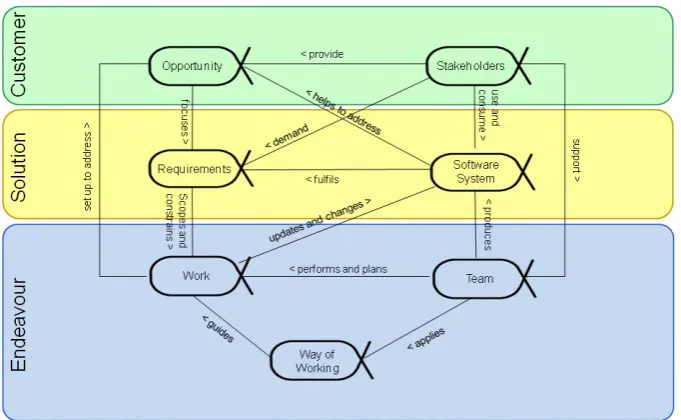
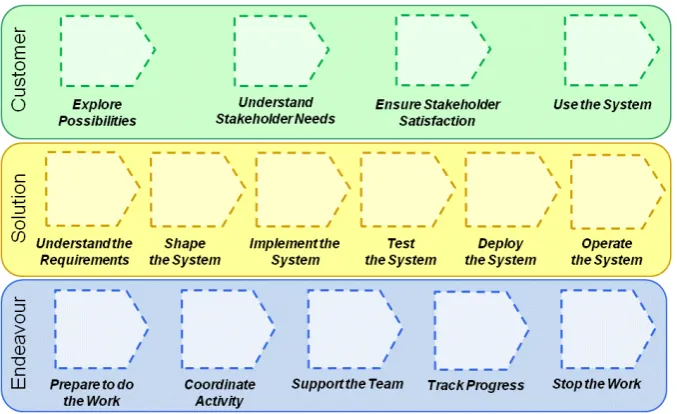
The SEMAT Kernel is divided into three areas of concerns: the Customer, the
Solution, and theEndeavor [16]. Each area of concern contains alphas, activity
spaces, and competencies, explained below.
Figure 3.1 depicts how methodologies are composed of practices, which can be documented using the Kernel. The symbols defined by SEMAT is used in com-bination with UML class diagram notation to show relationships. Practices, alphas, activity spaces, activities, and competencies all have their own symbols, which have been annotated with their name for clarification.
3.1. SEMAT KERNEL
[image:27.595.130.471.83.293.2]Essence 1.0 Beta 1 14
Figure 3 – The Kernel Alphas
In the customer area of concern the team needs to understand the stakeholders and the opportunity to be
addressed:
1. Opportunity: The set of circumstances that makes it appropriate to develop or change a software system. The opportunity articulates the reason for the creation of the new, or changed, software system. It represents the team’s shared understanding of the stakeholders’ needs, and helps shape the requirements for the new software system by providing justification for its development.
2. Stakeholders: The people, groups, or organizations who affect or are affected by a software system. The stakeholders provide the opportunity and are the source of the requirements and funding for the software system. The team members are also stakeholders. All stakeholders must be involved throughout the software engineering endeavor to support the team and ensure that an acceptable software system is produced.
In the solution area of concern the team needs to establish a shared understanding of the requirements, and
implement, build, test, deploy and support a software system that fulfills them:
3. Requirements: What the software system must do to address the opportunity and satisfy the stakeholders. It is important to discover what is needed from the software system, share this understanding among the stakeholders and the team members, and use it to drive the development and testing of the new system. 4. Software System: A system made up of software, hardware, and data that provides its primary value by the
execution of the software.
The primary product of any software engineering endeavor, a software system can be part of a larger software, hardware or business solution.
In the endeavor area of concern the team and its way-of-working have to be formed, and the work has to be
done:
5. Work: Activity involving mental or physical effort done in order to achieve a result.
Figure 3.2: Alphas in the SEMAT Kernel [24].
3.1.1 Alphas
Alphas are representations of essential things to work with when developing soft-ware [16]. Figure 3.2 shows all alphas included in the Kernel and their relations.
For instance, the Endeavor area of concern includes the Team that applies its
Way of Working, which in turn guides theWork that the team performs. Alphas
have states that reflect the current status of the development endeavor. The
Software System, for instance, can be in states Architecture Selected through Retired.
Figure 3.3 shows the structure of alphas and sub-alphas that extend their parent alpha. States are defined which alphas can be in. An alpha enters a state when
its defined checkpoints are achieved. TheRequirements alpha, for instance, is in
theAddressed state when the following checkpoints are achieved:
• Enough of the requirements are addressed for the resulting system to be acceptable to the stakeholders.
• The stakeholders accept the requirements as accurately reflecting what the system does and does not do.
• The set of requirement items implemented provide clear value to the stake-holders.
alpha SEMAT Kernel
defined in
Work Product
State
has can be in
* *
Level of detail
can be in
*
Section contains
*
sub-alpha
Figure 3.3: Structure of (sub-)alphas.
Adding a sub-alpha beneath an extended alpha implies the sub-alpha contributes to its parent alpha in some way. A multiplicity is added to this relation, for instance to show that the Week sub-alpha of the Weekly Cycle occurs multiple
times underWork, as further explained in Section 3.3.
Alphas and sub-alphas can contain work products. A multiplicity is added to show the possible number of each work product type, for example “1..*”. The work products can be in defined levels of detail and can contain multiple sections describing its contents.
Practices can also add additional details to alphas they extend from the Kernel.
For instance, the Requirements alpha has an additional state Prioritized with
the MoSCoW Prioritization practice, described in Appendix B.3.
3.1.2 Activity spaces
Activity spaces contain essential things to do while developing software [16].
Ex-amples of activity spaces are Implement the System, and Explore Possibilities.
Note that these are not activities but that practices add activities to their cor-responding activity space. See Figure 3.4 for all activity spaces included in the Kernel, grouped by area of concern.
3.2. PRACTICE LIBRARY
Essence 1.0 Beta 1 15
In the context of software engineering, work is everything that the team does to meet the goals of producing a software system matching the requirements, and addressing the opportunity, presented by the
stakeholders. The work is guided by the practices that make up the team’s way-of-working. 6. Team: A group of people actively engaged in the development, maintenance, delivery or support of a
specific software system.
One, or more, teams plan and perform the work needed to create, update and/or change the software system. 7. Way-of-Working: The tailored set of practices and tools used by a team to guide and support their work.
The team evolves their way of working alongside their understanding of their mission and their working environment. As their work proceeds they continually reflect on their way of working and adapt it as necessary to their current context.
8.1.5 Activity Spaces: The Things to Do
The kernel also provides a set of activity spaces that complement the Alphas to provide an activity based view of software engineering. The kernel activity spaces are shown in Figure 4.
In the customer area of concern the team has to understand the opportunity, and involve the stakeholders: 1. Explore Possibilities: Explore the possibilities presented by the creation of a new or improved software
system. This includes the analysis of the opportunity to be addressed and the identification of the stakeholders.
2. Understand Stakeholder Needs: Engage with the stakeholders to understand their needs and ensure that the right results are produced. This includes identifying and working with the stakeholder representatives to progress the opportunity.
[image:29.595.131.470.83.290.2]3. Ensure Stakeholder Satisfaction: Share the results of the development work with the stakeholders to gain their acceptance of the system produced and verify that the opportunity has been successfully addressed. 4. Use the System: Observe the use of the system in a live environment and how it benefits the stakeholders.
Figure 4 – The Kernel Activity Spaces
Figure 3.4: Activity spaces in the SEMAT Kernel [24].
performed.
Completion criteria are added to activities, which point to levels of detail (of work products) and states (of alphas). When an activity is performed, these levels and states are achieved for the corresponding work products and alphas. For instance, performing the Weekly Planning Meeting of the Weekly Cycle practice, used as an example in Section 3.3, means the Week Backlog work product reaches the Filled state.
Activities can also indicate the competency that is accountable for performing it, though not shown in the figure. Competencies are defined in the Kernel to represent the key competencies required to perform software engineering. Figure 3.6 lists all predefined competencies. Competencies are still a work in progress at the time of writing and therefore remain largely unused within this thesis [16].
3.2 Practice library
activity space alpha SEMAT Kernel
defined in
activity
contains
*
input *
Alpha completion criteria
Work product completion criteria
achieves
achieves
*
*
Work Product
State
has
can be in
* *
Level of detail
can be in
*
reaches
reaches
1
1
3.2. PRACTICE LIBRARY
[image:31.595.151.447.83.305.2]Essence 1.0 Beta 1 17
Figure 5 – The Kernel Competencies
In the customer area of concern the team has to be able to demonstrate a clear understanding of the business and technical aspects of their domain and have the ability to accurately communicate the views of their stakeholders. This requires the following competencies to be available to the team:
Stakeholder Representation: This competency encapsulates the ability to gather, communicate, and balance the needs of other stakeholders, and accurately represent their views.
In the solution area of concern the team has to be able to capture and analyze the requirements, and build and operate a software system that fulfills them. This requires the following competencies to be available to the team:
Analysis: This competency encapsulates the ability to understand opportunities and their related stakeholder needs, and transform them into an agreed and consistent set of requirements.
Development: This competency encapsulates the ability to design and program effective software systems following the standards and norms agreed by the team.
Testing: This competency encapsulates the ability to test a system, verifying that it is usable and that it meets the requirements.
In the endeavor area of concern the team has to be able to organize itself and manage its work load. This requires the following competencies to be available to the team:
Leadership: This competency enables a person to inspire and motivate a group of people to achieve a successful conclusion to their work and to meet their objectives.
Management: This competency encapsulates the ability to coordinate, plan and track the work done by a team.
Each competency has five levels of achievement. These are standard across all of the kernel competencies and summarized in Table 1. The table reads from top to bottom with the lowest level of competency shown in the first row and the highest in the last row.
Figure 3.6: Competencies in the SEMAT Kernel [24].
3.2.1 Purpose
We propose to add a description of the purpose of each practice to its documen-tation. This description explains why a practice should be incorporated within the methodology of a project. When considering a practice, its purpose helps identify if it would be of use to the project and the team.
The purpose of a practice can touch many aspects of software development. For example, the User Stories practice would have the following purposes:
• Tasks are written as customer-visible functionality.
• Tasks are displayed on index cards on a card wall, making it possible to track their progress.
3.2.2 Prerequisites
Each practice has prerequisites before they can be applied within a project. Three types are recognized:
• Other prerequisites, such as the necessity of a certain expertise. Visualize Workflow, for example, needs an outline of the workflow within the project before a card wall can be prepared and tasks can be tracked along this workflow.
We propose to add the prerequisites so they can be used as guidelines when considering if and how to incorporate a practice into a methodology. Using the description of how a practice can be tailored of Section 3.2.4, the practice can be adjusted to fulfill its prerequisites as well.
As an example, Scrum requires the availability of a domain expert to fill the role of Product Owner. This role can also be filled by a representative to which customers can relay requirements of the system under development.
Aside from tailoring a practice, the project can be changed to accommodate for the prerequisites of a practice as well. For example, a team that has been spread across two floors can be moved to a single floor, fulfilling the prerequisite of the Daily Standup.
3.2.3 Necessary commitment
Practices require certain work and activities to be carried out to apply it cor-rectly. This is documented as the necessary commitment of a practice. Among others, include regular activities, meetings, and maintained work products. This description gives an idea of the additional methodology weight and of the work-load demanded of the team. It helps in considering whether to incorporate a practice in the methodology of a project.
For example, Scrum requires two regular meetings: a planning meeting for scheduling the next increment, and a review meeting for demonstrating what has been achieved.
3.2.4 Tailoring
In many cases, practices will need to be tailored to a project before they can be applied. We propose to add a description of how practices can be tailored to the project, without damaging its purpose. Practices described in literature often already contain instructions for adjusting it to a project.
3.3. DOCUMENTING SOFTWARE DEVELOPMENT PRACTICES
For instance, Scrum can be used with different increment lengths [27].
3.3 Documenting software development practices
This section describes how software development practices can be documented
with the SEMAT Kernel. The EssWork Practice Workbench has been used,
which supports documenting practices with the Kernel [15].
The Weekly Cycle has been used as an example throughout this section [5]. Extreme Programming has combined this practice with User Stories and Test-First Programming, which are filtered out of the practice description. The entire documentation of the Weekly Cycle is available in Appendix B.1.
The following steps explain how practices can be documented.
1. Identify and extend alphas
The SEMAT Kernel predefines seven alphas, or “things to work with”. Go over
each of these and decide whether the practice extends the alpha.
For instance, the Weekly Cycle extends theWork alpha, as it instructs the team
that work is performed in weekly increments.
2. Add sub-alphas to alphas where appropriate
Adding a sub-alpha to an alpha implies the practice contributes to this alpha in some way.
For the Weekly Cycle, a sub-alpha Week is added under the Work alpha to
denote work is divided in weeks. TheWeeksub-alpha is given the states Planned,
In Progress, Concluded, and Closed, showing how a workweek progresses. As
multiple weeks are held, the multiplicity betweenWork andWeek is set to “1..*”.
Extend any additional alphas if new sub-alphas are discovered.
3. Add work products to alphas and sub-alphas
Add work products defined in the practice to their corresponding alphas or sub-alphas. Add levels of detail and sections that match the description in the practice.
For the Weekly Cycle, when workweeks are scheduled, a backlog is created con-taining the work items the team will complete the upcoming week.
Correspond-ingly, the Week Backlog work product is added to the Week sub-alpha with
described. As a single Week Backlog is created every week, the multiplicity from
Week to the Weekly Backlog work product is set to “1”.
If additional work products are discovered, extend the corresponding alphas if the practice does not do so yet.
The Weekly Cycle includes a Weekly Increment work product corresponding
to the Software System alpha, which the practice will need to extend. The
work product is added under the Software System alpha. The work product
has Planned and Complete as levels of detail, which show that an increment to the system will first be scheduled and finally be completed. No sections are
described. As the Software System is built by implementing multiple Weekly
Increments, the multiplicity between these two is set to “1..*”.
4. Identify activities and extend corresponding activity spaces
The Kernel predefines fifteen activity spaces, or “things to do”. Look into the
activities present in the practice and extend the activity spaces under which these belong.
The Weekly Cycle specifies two activities: a meeting held at the beginning of every week and deploying a new version of the system at the end of the week.
The practice therefore extends the Deploy the System and Prepare to do the
Work activity spaces.
5. Add activities to identified activity spaces
Describe the activities within the practice under the corresponding activity spaces.
For the Weekly Cycle, theWeekly Planning Meeting activity is added under
Pre-pare to do the Work. The meeting takes theRequirements alpha from the Kernel
as alpha input directly, as the backlog will be planned using these requirements.
It has three completion criteria: theWeek and Weekly Increment are Planned
and the Weekly Backlog is Filled. The activity Deploy Increment is added
un-derDeploy the System with three completion criteria: the Weekly Increment is
Complete, theWeek is Concluded, and theSoftware System is Operational.
Although competencies in the Kernel are still a work in progress, specifying an accountable competency makes it clear what role is necessary for completing
the activity. For the Weekly Planning Meeting, this is the Stakeholder
Repre-sentative present in the Kernel. For Deploy Increment, this is theDevelopment
3.3. DOCUMENTING SOFTWARE DEVELOPMENT PRACTICES
Note that additional alphas or sub-alphas can be discovered at this point, as activities take alphas as input.
6. Specify usage criteria of the practice
Lastly, specify the usage criteria of the practice, as defined in Section 3.2. These can already be described in the literature where the practice is explained, but can become more apparent when the team gains experience with applying the practice.
For the Weekly Cycle, the following are identified from literature. Purpose
• Focus to finish a deployable system every Friday.
• Have short iterations and thus receive feedback from customers often. • Letting teams reflect on their progress often.
• Perform and reflect on experiments within their workplace, such as changing details to the methodology, weekly.
Prerequisites
• Availability of customers for selecting tasks.
• The User Stories practice or a similar practice that has task breakdown and estimation.
Necessary commitment
• Weekly meetings on Monday to schedule work. • Reaching deployable software weekly.
Tailoring
• The Weekly Cycle can be combined with Test-First Programming, in which tests are written before work items are implemented.
• Some people start their week on Tuesdays or Wednesday. The weekly meeting can be moved as long as it will not pressure the team to work over the weekend.
Chapter 4
Project Inventory
Properties of software projects that influence decisions on a method-ology are identified in this chapter. Furthermore, a way to identify the important properties of a project is proposed.
§
As each software project is unique, each requires its own methodology with which to perform the software development effort [3, 8]. Projects can differ, among others, in team size, team members, budget, culture, schedule, and risks. These properties of projects can influence how their methodologies are composed. This chapter proposes a project inventory which enables gaining insight in a software project by collecting these properties.
The identified project properties are summarized in Table 4.1. They are divided into four groups:
• Properties about the project itself, described in Section 4.1.
• Properties of the team members of the project, described in Section 4.2. • Properties about the developed solution, described in Section 4.3.
• Properties of the current methodology of the project, described in Section 4.4.
The project properties are described as questions to ask interviewees. They include a description of their possible influence on the methodology and how they apply to newly starting projects and existing projects.
The project properties have been selected from existing literature [8, 31]. The following properties have been added to better support existing projects:
• The current backlog of the project.
Project
properties System and project history, team culture, criticality,priorities, budget, requirement stability, customer availability, planned milestones, environment, problem domain complexity, current backlog
Team member
properties People involved, problem domain experience, softwaredevelopment experience, methodology experience, willingness to change the methodology
Solution
properties Solution complexity, maintainability
Methodology
properties Current methodology, things to keep, things to discardor change, stakeholder requirements, standards and conventions, increment length, length of tasks, new requirements
Table 4.1: Identified project properties.
• The preferences of interviewed team members on their current methodology. • The current length of increments, or time between releases if increments are
not fixed.
• The length of lower-level tasks.
• The way new requirements become known within the project.
Section 4.5 describes how the properties of a software project are identified by interviewing key figures within the project. The project inventory is part of the methodology-growing framework further described in Chapter 5.
4.1 Project properties
This section lists the properties associated with software projects directly.
History
4.1. PROJECT PROPERTIES
Team culture
Ask interviewees whether they experience the culture within the team as being autocratic or participative. In a participative culture, team members are more likely to contribute in improving their methodology. In most autocratic cultures, on the other hand, management makes all decisions for the team.
The team culture is yet to be determined for newly starting projects. The team can initially discuss how they plan to shape the team culture, for example by determining who will carry responsibility for what decisions.
Criticality
Ask interviewees about the criticality of the system under development, defined in Chapter 2. The criticality indicates the amount of damage a failure would cause. More critical systems will need more control elements in the methodology. This applies to both existing and newly starting projects.
Practices that enable code reviewing and extensive testing, for example, can be included in the methodology for such cases. Even with low criticality, correctness can be a priority, for instance when stakeholders require it.
Priorities
Ask interviewees what the priorities of the project are. Priorities can range between productivity and prevention of legal liability [31]. The former focuses on a shorter time to market, often to get feedback quickly. The latter entails that artifacts are traceable and work is documented and tracked. Additional possible priorities are low costs and correctness, but also ask whether there are other priorities within the project.
The priorities heavily influence the methodology. For example:
• For a short time to market, the methodology needs short increments, each of which resulting in a workable product.
• To keep costs low, the project might need to have as few as possible team members, with a correspondingly designed methodology.
• When correctness is important, practices that enable regression testing, for example, need to be included.
• For traceability, the methodology needs more control elements as well as clear guidelines on what needs to be documented.
Budget
Ask the interviewee to indicate the cost limitations within the project. A tight budget can influence decisions on the methodology. For instance, it means there is less room for excess methodology weight in the form of artifacts and docu-mentation.
A budget too tight can have negative influence on the project’s success. From the methodology’s point of view, with a tight budget, less time should be spend creating artifacts and deliverables. Furthermore, letting the entire team sit in a single room will cost less than arranging for necessary communication.
For newly starting projects with a tight budget, the methodology should be composed light and later on extended if necessary. This will prevent excess weight. For existing projects, the team should look into which parts of the methodology are excess.
Requirement stability
Ask interviewees, especially those with a developer role, how stable and pre-dictable requirements are. The stability and predictability of requirements can decide the length of increments and how soon feedback is necessary. If require-ments are unstable, faster feedback is necessary and increrequire-ments need to be short to allow this. Alternatively, include practices such as prototyping that allow for fast feedback.
This project property is of less influence to newly starting projects, as the overall stability of requirements is still unknown. Still, ask interviewees how stable they expect requirements to become.
Customer availability
Ask each interviewee how communication with customers or their representatives is arranged. In the best case, they are always available to answer questions and give feedback. Practices that enable quick feedback should be included in the methodology otherwise.
4.1. PROJECT PROPERTIES
methodology, if such a team member is available.
Planned milestones
Ask interviewees what they know of upcoming milestones within the project, such as minor or major features and version updates. It is possible that no milestones are scheduled, for instance when the system is in maintenance. Asking this helps to predict arrival of new requirements and workload. It is therefore related to the way new requirements become known, included in Section 4.4. The planned milestones and workload influence the required efficiency of the project, especially when a large backlog of tasks is still in progress. For instance, when many milestones are defined, the methodology should focus on high pro-ductivity. This property applies the same to both new and existing projects.
Environment
Ask each interviewee about external projects, organizations, and other parties that are involved. Projects that develop a system integrating with the devel-oped solution are an example of such a party. Also ask for the stability and predictability of each party in the external environment and whether there are any risks for the project.
For both new and existing projects, the way to deal with the environment needs to be included in the methodology. For instance, other parties might require some form of reporting, which is also included in Section 4.4. Furthermore, the way communication with external projects is arranged should be included in the methodology as well.
Problem domain complexity
Ask each interviewee their estimation of the problem domain complexity. This is also called the problem size by Cockburn [8]. No absolute metric can indicate this complexity, but it can be discussed in terms as how difficult it is to learn and to implement a system in the domain.
The problem size affects the necessary methodology weight and project size. A lower project size, with a low methodology weight, can often solve the same problem size as a greater number of people with a greater methodology weight. When the problem size becomes larger, though, the number of people needed to succeed will greatly increase.
the problem, team members can start making decisions based on this property.
Current backlog
Ask for the size of the current task backlog. If there is no backlog available, ask for an estimation of the number of work items and the time it would take to complete all of them. A large backlog can indicate the project is not running on schedule or if there are any unrealistic expectations towards the speed of development.
This property is not applicable to newly starting projects, which do not have a backlog of older tasks.
4.2 Team member properties
This section lists properties associated with the team members of software projects.
People involved and project size
Ask which people are involved with the project, including the interviewee. De-termine how they are distributed amongst locations and what their roles and responsibilities are.
The number of people that are to be coordinated is an important factor for selecting and improving the methodology. As the number of people grows and their distribution becomes more spread, more communication elements must be included in the methodology for the project to succeed [8].
Problem domain experience
Ask interviewees how much experience they have with the problem domain of the project. If overall experience with the problem domain of the team is low, measures to prevent defects are necessary. For example, incorporating test-first programming in the methodology. Team members should also receive training to gain better understanding of the problem domain. This is especially impor-tant when the problem domain complexity is high, which is a project property described in Section 4.1.
4.3. SOLUTION PROPERTIES
Software development experience
Ask how much experience the interviewee has with software development. If overall experience with developing software is low, try to improve the team, not enlarge it. Enlarging it will make it necessary to increase the methodology weight, which comes with a cost, as explained in Section 2.2. Also ask team members that are not in a developer role about their experience with software development to see if they require further training.
For existing projects, project-specific questions can be asked as well, such as experience with used programming languages or frameworks.
Methodology experience
Ask interviewees about their experience in using software development method-ologies. Also ask which roles they have played within the methodologies of other projects. Employees with much experience are more likely to contribute in im-proving the used methodology. However, employees that do not have experience with methodologies are likely to need more guidance in changing their way of working.
Willingness to change the methodology
Ask interviewees to indicate how willing they are to change their current way of working. When interviewees are generally rigid, it is less likely major changes to their methodology will be adopted by the team.
4.3 Solution properties
Two properties of the developed system are identified to be important for making decisions on the methodology of a project: the complexity and the maintainabil-ity of the solution. There can be many other properties of the solution that can affect the methodology, such as its architecture, whether it uses a database and whether it includes support for legacy systems [31].
Solution complexity
If no metrics are available, ask for an indication of the complexity of the system, for instance by asking how difficult it would be to add an entire new component. Especially weigh in the opinion of interviewed developers. If complexity is high, ask if there is excess complexity which can be resolved.
With high complexity, the methodology should include practices that prevent defects and faults, such as regression testing.
For newly starting projects that do not inherit an existing system, this property does not influence decisions on the methodology yet.
Maintainability
Discuss the maintainability of the existing system and whether and why fixing defects or adding functionality is difficult. Also discuss whether this has had any effect on the planning of new features or increments and if the effort for adding features has been estimated wrong.
For newly starting projects that do not inherit an existing system, this property is not applicable.
4.4 Methodology properties
This section describes properties of the project about the currently used method-ology. These properties can still be useful to inventory for newly starting projects to find whether team members have preferences towards their methodology.
Current methodology
Ask for a description of the currently used methodology, for instance as a basic workflow. When discussing this, note any possible things to keep or discard. These are associated with the two properties below.
If interviewees do not know the entire methodology, they will probably only describe the elements they have experience with. These descriptions can be pieced together to get a full picture of the methodology. Also see if there are any differences in the given descriptions of the methodology. Differences can indicate a lack of cohesion of the methodology.
4.4. METHODOLOGY PROPERTIES
Things to keep
Ask for things of the methodology to keep. The description given of the current methodology can already give some answers. Also ask which rituals, customs and other matters, such as monthly company drinks, are important to keep within the project.
For newly starting projects, the things to keep of the methodology are not ap-plicable, but the rituals, customs, and other matters can already be part of the organization culture.
Things to discard or change
Similar to the things to keep, ask what not to keep or what to change within the methodology and project. Again, the description of the current methodology can give some answers.
For new projects, ask interviewees whether there are things to change within the culture of the organization, such as rituals and customs.
Stakeholder requirements
Ask for the requirements stakeholders have towards the project. Specifically ask for required work products, documentation, and other artifacts or deliverables. These are included in the methodology. Also ask whether there is a way to reduce the need of these deliverables, as they increase methodology weight. This property applies to both new and existing projects, though for new projects, these requirements might not all be known yet.
Standards and conventions
Ask interviewees whether any standards or conventions, such as coding styles, use of certain languages, patterns, or frameworks, are set within the project. Also let them indicate how tight the standards and conventions are used and if they need to be improved or used more strictly. If there are none, ask interviewees whether they feel standards and conventions are desired. Any of these cases can indicate a possible improvement or refinement for the methodology.
Increment length
Ask for the length of increments, defined as the duration of an iteration. For example, Scrum uses 30-day Sprints in which a next version of the product is developed [27]. In the absence of increments or iterations, there might exist a default release interval, for instance every other week. The length of increments, if available, indicates how long it takes to develop new features for the system under development.
This property does not apply to newly starting projects, although interviewees can give indications as to what they expect the increment length will be.
Length of tasks
Discuss with interviewees what the length of the lower-level tasks is. Especially let them give an indication of the maximal length of these tasks. This gives insight in how larger features are split into smaller items of work. The task length has influence on the length of increments. If tasks are relatively large and cannot be split into smaller items of work, longer increments might be more appropriate.
This property does not apply to newly starting projects.
New requirements
Ask interviewees how and when requirements become known to the project, who announces them and where they come from. For instance, a higher number of requirements might arrive in a specific season. This is called the demand profile and can have influence on the workflow within the project [2].
The way new requirements enter the project and how they are prioritized and scheduled are part of the methodology. Therefore, it is useful for team members to realize how this takes place, as well as to discuss if it can be improved.
4.5 Project inventory interview
The project properties are identified by interviewing key figures within the project, such as stakeholders, project managers, business roles, experienced de-velopers and graphical or interaction designers. For small projects all team members might be interviewed.
in-4.5. PROJECT INVENTORY INTERVIEW
terviewer to explore and look for surprises. As each project is different, each project can also have unique, additional properties, therefore, structured inter-views, which do not allow for improvisation, would not have been appropriate. The project inventory has been used in the case described in Chapter 6. Ap-pendix C contains the interview that has been used for identifying all properties and additional topics within the case. Many of these properties and topics are closed, but during the interviews, additional notes have been taken where inter-esting opinions and facts were found.
For the experience with software development and methodologies, interviewees were asked to indicate their time on the current project, the number of years of experience with software development and methodologies, and an indication of how they evaluate their own competence on both. The perceived team culture, willingness to change their methodology, budget, maintainability, requirement stability, customer cooperativeness, and stability of the environment are all asked using a five-point likert-scale.
Chapter 5
Methodology-Growing Framework
This chapter proposes a framework that uses identified properties of a software project to incrementally improve a methodology. Reflection workshops are held with the entire team, during which decisions on how to improve the methodology are made collaboratively.
§
The methodology-growing technique is described as a set of five activities, start-ing with the adjuststart-ing of an existstart-ing methodology and improvstart-ing it repeatedly [8]. The methodology-growing framework extends this technique by including the following:
• Support for existing projects that already have a methodology. • Identifying project properties to make decisions on the methodology. • A library of practices can be used to select possible improvements on the
methodology.
Section 5.1 provides checklists for making decisions on the methodology to keep it coherent. Section 5.2 introduces the methodology-growing framework, written from the point of view of an existing project. Section 5.3 gives additional instruc-tions for newly starting projects. Section 5.4 gives a summary of the framework and provides a high-level overview.
5.1 Composing the methodology
methodology-growing framework, as described in Section 5.2, these checklists are used when-ever decisions on the methodology are made.
The following set of questions can be used as a checklist when considering to incorporate a practice within the methodology.
1. Does the purpose of the chosen practice match with the goals of
the team and the project?
Assess whether the purpose of the practice matches with the goals of the team. If there is uncertainty, briefly discuss with team members whether they feel the practice would be of value to them.
Also check whether the purpose of the practice matches with the goals and priorities of the project. In some cases, it is possible to adjust the practice. For instance, using a practice with two month increment lengths does not match a short time to market priority. This practice can possibly be tailored for shorter increments, though.
2. Does the purpose of the chosen practice not overlap with that of
another selected practice?
See if there are no other practices selected that overlap in their purpose. If so, see if either or both of the practices can be adjusted or if they can be combined.
3. Are the prerequisites of the chosen practice met?
If the prerequisites are not met within the project, see if either the project or practice can be adjusted to accommodate for the them. The description of how the practice can be tailored can be used to make it fit the project.
4. Is the necessary commitment of the chosen practice worth its
ben-efits to the project?
Each documented practice contains a description of its necessary commit-ment. This indicates its added methodology weight when incorporated. Consider whether this commitment is worth the benefits of incorporating the practice.
It can be possible to adjust the practice to add less weight to the methodol-ogy. If this is not enough, other practices probably better fit the project.
5. Will team members be willing to adopt the chosen practice?
Consider whether team members will be willing to perform the necessary commitment of the practice. If they would not be willing, trying to incorpo-rate the practice can lead to it remaining unadopted.
![Figure 5 F i g u r e 3 . 6 : C o m– The Kernel Competencies p e t e n c i e s i nt h e S E MA TK e r n e l [ 2 4 ] .](https://thumb-us.123doks.com/thumbv2/123dok_us/9906368.492154/31.595.151.447.83.305/figure-c-kernel-competencies-s-e-ma-tk.webp)
