e-mails: [email protected]; [email protected]
(Received 7 November 2015; accepted 22 May 2017)
In this paper, we compute the M¨obius function of pointed integer partition and pointed ordered set partition using topological and analytic methods. We show that the associated order complex is a wedge of spheres and compute the associated reduced homology group for each subposet. In addition, we compute the M¨obius function of pointed graded lattice and use our method to compute the M¨obius function of pointed direct sum decomposition of vector spaces.
Key words : Partition; pointed partition; M¨obius function; poset map; simplicial complex; cone; contractible; homology group; simplicial map.
1. DEFINITIONS ANDPRELIMINARIES
Letnbe a non-negative integer. A multisetu={u1, u2,· · · , ur}of integers is an integer partition of
nprovided that eithern= 0 andu={0}orn≥1and
(a)
r X
i=1
ui =n
(b)ui ≥ 1, for alli= 1,2, . . . r.
We use multiplicities and write {ui11 . . . uie
e} where u1 > . . . > ue and i1. . . ie ≥ 1 as a
superscript of each ui in their decreasing order to give the multiset u [12]. Thus, for instance, {6,4,4,3,2,2,1,1}={6,42,3,22,12}.
Definition 1.1 — A pair{u, m}={u1, u2, . . . , ur, m}is called a pointed integer partition of
The integermis called the pointed part and we writeu1u2. . . urmto denote a pointed integer
partition{u, m}.
LetIn• denote the set of all pointed integer partitions of the non-negative integern. On this set
define an order relation by the two cover relations:
(1) {u1, · · ·, ui,· · · , uj,· · · , ur, m} ≤ {u1, . . . , uˆi,· · ·,uˆj, · · ·, ur,
ui+uj, m},and
(2) {u1, u2, · · · , ui,· · · , ur, m} ≤ {u1, u2, · · ·, ubi, . . . , ur, ui+ m}.
Hereuˆianduˆj means that the corresponding elements are omitted.
In [12] the poset of pointed integer partitionIn•ofnwas introduced and used for studying pointed
set partition lattices. Even thoughIn• appears as an interval inIn,the global structure of the posetIn•
was not clarified. In this paper we will be able to clarify this.
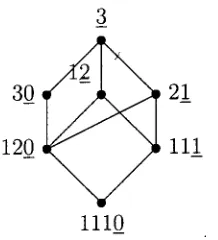
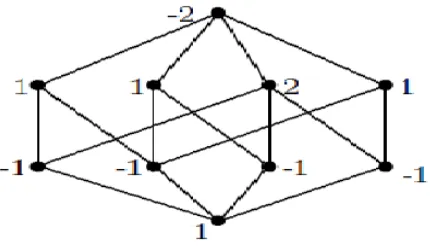
For instance ifn = 3, I3• = {1110, 120, 111, 21, 12, 30, 3}. It can be easily shown that
(I•
n, ≤)is a poset whose Hasse diagram is given in Figure 1, and this poset is graded, has unique minimal and maximal elementsˆ0 = 1110andˆ1 = 3,respectively, and is not lattice forn≥3.
The M¨obius functionµis a function that assigns to each interval in a posetP an integer and its
recursive formulation [13] is given by:
µ(x, y) =
(
1 for allx=y, −P
z:x≤z<yµ(x, z) for allx < y.
Example 1.2 : Let us considerI3• ={1110,120,111,30,21,12,3}and its Hasse diagram shown
[image:2.612.282.391.586.706.2]in Figure 1; we compute the M¨obius function forI3•recursively as follow.
Similarly,
µ(30) = −(µ(ˆ0,ˆ0) +µ(ˆ
Therefore,
µ(I3•) = µ(ˆ1)
µ(ˆ1) = −(µ(ˆ0,ˆ0) +µ(12) +µ(21) +µ(30) +µ(ˆ0,120) +µ(ˆ
Hence,µ(I3•) = (−1)3
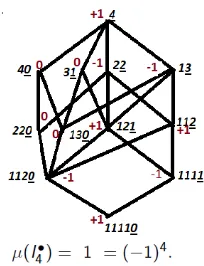
µ(I4•) = µ(ˆ1)
µ(ˆ1) = −(µ(ˆ0) +µ(1120) +µ(1111) +µ(121) +µ(112) +µ(22) +µ(13))
= −(1−1−1 + 1 + 1−1−1)
= 1 = (−1)4
Hence,µ(I4•) = (−1)4.
Our main result is:
Theorem 1.3 — Forn≥1we have,µ(In•) = (−1)n.
In the next section, we review some known poset constructions and use these constructions to
prove our claim thatµ(In•) = (−1)nfor alln.
= −(1 + (−1) + (−1)) = 1
= µ(21).
3
0,111))
= −(1 + 1 + 1 + 0−1−1) =−1 = (−1) 0,120))
= −(1 + (−1)) = 0.
.
Figure 2 : Hasse diagram ofI¯4•
2. NEWPOSETS FROMOLD
IfP andQare posets on disjoint sets, then the ordinal sum ofP andQis the posetP ⊕Qon the
unionP∪Qsuch that
s≤tin P⊕Qif
(a) s, t∈P ands≤tinP, or
(b) s, t∈Qands≤tinQ, or
(c) s∈P andt∈Q.
Now we define some simple examples of posets.
I We denote the trivial poset consisting of a single element by 1=•.
I The disjoint union ofncopies ofP is denoted bynP. Ann-element antichain (a subsetAof
a posetP such that any two distinct elements ofAare incomparable) is isomorphic ton1 and then-element chain is the ordinal sum 1|⊕1⊕{z. . .⊕1}
ntimes
ofntrivial posets.
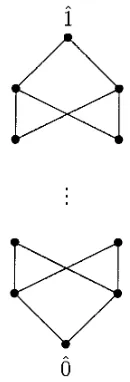
I We denote the adjoin of a posetP and{ˆ0,ˆ1}byP ,ˆ and similarlyP\⊕Q=P⊕Q∪ {ˆ0,ˆ1}.
Example 2.1 : ConsiderP =Q=11 ,P⊕Q=11⊕11. The Hasse diagram ofP\⊕Qis shown in Figure5.
Proposition 2.2 — LetP and Qbe finite posets. Then
Figure 5 : Hasse diagram of \ Figure 3 : Hasse diagram of ˆ
Figure 4 : Hasse diagram ofnˆ
P forP =11
P forP =11
[image:5.612.260.330.512.641.2]PROOF: We use induction on the cardinality ofQ.
IfQ=∅thenQˆ ={ˆ0,ˆ1}andµQˆ(ˆ0,ˆ1) =−1. It also holds thatP ⊕Q=P. Hence,
µ\P⊕Q(ˆ0,ˆ1) =µPˆ(ˆ0,ˆ1) =−µPˆ(ˆ0,ˆ1)·µQˆ(ˆ0,ˆ1).
Letq ∈Qthus we can have that,(P⊕Q)≤q=P⊕Q≤q, whereQ≤qdenotes the set{x∈Q|x≤
q}.(P ⊕Q)≤qis defined the same way.
Now assume|Q| ≥1and that the hypothesis has been verified for all posets of smaller cardinality.
µ\P⊕Q(ˆ0,ˆ1) = − X ˆ 0≤x<ˆ1
µ\P⊕Q(ˆ0, x)
= −µ\P⊕Q(ˆ0,ˆ0)−X p∈P
µ\P⊕Q(ˆ0, p)−X q∈Q
µ\P⊕Q(ˆ0, q)
= −X
p∈P
µ\P⊕Q(ˆ0, p)−X q∈Q
µP\⊕Q
<q(ˆ0, q)−1
= −X
p∈P
µ\P⊕Q(ˆ0, p) +X
q∈Q
µP(ˆ0,ˆ1)·µQˆ(ˆ0, q)−1
= −( X
p∈P∪{ˆ0}
µ\P⊕Q(ˆ0, p)) +µP(ˆ0,ˆ1)· X
q∈Q
µQˆ(ˆ0, q)
= µP(ˆ0,ˆ1)(1 + X
q∈Q
µQˆ(ˆ0, q))
= −µPˆ(ˆ0,ˆ1)·µQˆ(ˆ0,ˆ
Corollary 2.3 — LetP =11.ThenµP⊕···⊕\P(ˆ0,ˆ1) = (−1)n.
PROOF: Use induction onn(the number of times we take the ordinal sum). 2
A mappingt→¯ton a posetP is called a closure operator (or closure) if for alls, t∈P,
• t≤¯t
• s≤t⇔s¯≤¯t
• t¯¯= ¯t=t
An elementtofPis closed ift= ¯t. The set of closed elements ofP is denotedP¯, called the quotient
ofP relative to the closure. Ifs≤t in P, then defines¯≤¯t in P¯. Thus it is easy to see thatP¯is a
poset.
Proposition 2.4 (Stanley [13]) — LetP be poset with closuret→¯tand quotientP¯. Then for all
s, t∈P,
X
u∈P,u¯=¯t¯
µ(s, u) =
(
µP(¯s,¯t) ifs= ¯s,
0 ifs <¯s.
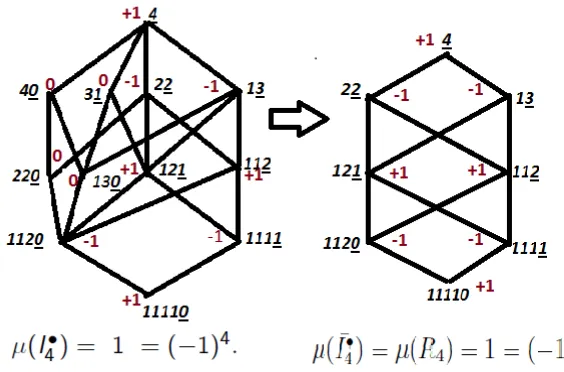
[image:7.612.168.450.122.308.2]Example 2.5 : For example, you can consider µ(I4•) = 1 = (−1)4 andµ(R4) = 1 = (−1)4, whereR4 = {1· · ·12i : 0 ≤ i ≤ 3} ∪ {1· · ·1i : 0 ≤ i ≤ 3},whose Hasse diagram is shown in
Figure 6.
Proposition 2.6 — LetP be a poset withˆ0andˆ1andx ∈P \ˆ1such thatµP(ˆ0, x) = 0. Then
µP(ˆ0,ˆ1) =µP\{x}(ˆ0,ˆ1).
PROOF: We use induction on the cardinalitylof the longest chain betweenxandˆ1.
Assumel= 0, that is,xis coatom (an element thatˆ1covers)
µ(ˆ0,ˆ1) = − X ˆ 0≤y<ˆ1
µP(ˆ0, y)
= − X
ˆ
0≤y<ˆ1,y6=x
µP(ˆ0, y)−µP(ˆ0, x)
= − X
ˆ
0≤y<ˆ1,y6=x
µP\{x}(ˆ0, y) =µP\{x}(ˆ0,ˆ1).
Now assume l >0,then
µP(ˆ0,ˆ1) = − X
ˆ 0≤y<ˆ1
µP(ˆ0, y)
= − X
ˆ
0≤y<ˆ1,xy
µP(ˆ0, y)− X
x<y<ˆ1
µP(ˆ0, y)
= − X
ˆ
0≤y<ˆ1,xy
µP(ˆ0, y)− X
x<y<ˆ1
µP\{x}(ˆ0, y)
= − X
ˆ
0≤y<ˆ1,xy
µP\{x}(ˆ0, y)
= µP\{x}(ˆ0,ˆ1).
Therefore,µP(ˆ0,ˆ1) =µP\{x}(ˆ0,ˆ
3. PROOF OFTHEOREM1.3
Theorem 3.1 — Let Rn = {1· · ·12i : 0 ≤ i ≤ n−1} ∪ {1· · ·1i : 0 ≤ i ≤ n−1} ⊆ In•.
ThenµRn(ˆ0,ˆ1) = (−1)n.
Theorem 3.2 — Letλ∈In•={µ∈In• :µ /∈Rn}. ThenµI•
n(ˆ0, λ) = 0.
For the proof of Theorem 3.1, observe thatRnis isomorphic to the ordinal sum ofn−1copies of
P =11. Thus by applying Proposition 2.2 we get the result.
Proposition 3.3 — Ifλ∈I¯•
n, then{η∈Rn:η ≤λ}has a unique maximal element.
For instance, consider
I•
4 ={11110,1120,130,40,220,1111,121,112,31,22,13,4}.
It is easy to check that,
¯ I•
4 = {220,130,40,31}.
R4 = {11110,1120,1111,121,112,22,13,4}.
Now, for130∈I4•,
{η∈R4 :η≤130}={11110,1120}={η ∈R4 :η≤220}={η ∈R4:η ≤40}
1). 2
of whichη= 11· · ·120is the maximal element.
Case 2 : The pointed part ofλ∈I¯n•is nonzero.
To determine the unique maximal element of{η∈Rn:η≤λ}, note that
Rn = {1· · ·12i: 0≤i≤n−1} ∪ {1· · ·1i: 0≤i≤n}
= {1· · ·10,· · ·1n−1, n,1· · ·120,· · · ,2n−2}.
Letλ=λ1. . . λnm /∈Rn, where1≤m≤n−3 andn≥4. Then, there existsisuch that
λi≥3 or there exists, 1≤i < j ≤n and λi, λj ≥2. (3.1)
If 11· · ·1i < λ1. . . λnm and 11· · ·2i < λ1. . . λnm,theni≤m.
Now, {11· · ·1i,11· · ·12i : 0 < i ≤ m} ⊆ Rn has11· · ·2mas its unique maximal element.
Using equation (3.1) above,11· · ·12m < λ1. . . λnm, and this shows that11· · ·12mis the unique
maximal element.
Therefore, ifλ∈I¯•
n, then{η ∈Rn:η≤λ}has a unique maximal element. This completes the
proof of the proposition.
Thus, we can use induction on the rank ofλto prove thatµI¯•
n(ˆ0, λ) = 0.
Ifλis of minimal rank, then the set{η ∈ In• : η ≤ λ} = {η ∈ Rn : η ≤ λ} ∪ {λ}, and so
µI¯•
n(ˆ0, λ) = 0.
Assumeλis not of minimal rank. By induction hypothesis for allη ∈ I¯•
n andη < λwe have
µI•
n(ˆ0, η) = 0. ThenµIn•(ˆ0, λ) =µRn∪{λ}(ˆ0, λ), but{η≤λ:η ∈Rn}has unique maximal element
ηT op(the pointed partition at the top). 2
We now use topological methods to prove Theorem 1.2. For the notation of poset topology and
background concept we follow papers by Wachs [11], Jonsson [7], Jung [8], Bj¨orner [1] and Bj¨orner
Definition 3.4 — An abstract simplicial complex4on finite vertex setV is a nonempty collection of subsets ofV satisfying:
(i) Ifv ∈V, then{v} ∈ 4, and
(ii) IfG∈ 4andF ⊆G, thenF ∈ 4.
The elements of4are called faces (or simplices) of4and the maximal faces are called facets.
We say that a faceF has dimensiondand writedimF =d, whend=|F| −1. Faces of dimension
dare referred to asd−f aces. The dimension of4, denoted bydim 4is defined to be
dim4= max
F∈4(dimF). (3.2)
We also allow the (−1)−dimensional complex{∅}, which we refer to as the empty simplicial
complex. We say4is pure if all facets have the same dimension.
A d−dimensional geometric simplex inRn is defined to be the convex hull of d+ 1 affinely
independent points or vertices inRn. The convex hull of any subset of the vertices is called a face of
the geometric simplex. A geometric simplicial complexΓinRnis a nonempty collection of geometric
simplices inRnsuch that
(i) Every face of a simplex in Γ is in Γ,
(ii) The intersection of any two simplices of Γ is a face of both of them.
From a geometric simplicial complexΓ, one gets an abstract simplicial complex4(Γ)by letting
the faces of4(Γ)be the vertex sets of the simplices ofΓ. Every abstract simplicial complex4can
be obtained in this way, i.e., given a geometric simplicial complexΓwe can have that4(Γ) = 4.
Although Γ is not unique, the underlying topological space, obtained by taking the union of the
simplices ofΓ under the usual topology onRn, is unique up to homeomorphism [4]. We refer to
this space as the geometric realization of 4(methods for turning abstract simplical complex into
topological space) and denote it byk4k. We will usually drop thek kand let4denote an abstract
simplicial complex as well as its geometric realization.
LetP = (P,≤) be a poset. A chain (or totally ordered set or linearly ordered set) is a poset in
which any two elements are comparable. A subsetC ofP is called a chain ifC is a chain when
regarded as a subposet ofP. The length`(C)of a finite chain is defined by
`(C) =|C| −1, where|C|is the cardinality ofC.
The length (or rank) of a finite poset P is defined by
totally ordered subsets) ofP. Note that the order complex of the empty poset is the empty simplicial
complex{∅}. Thus, for this simplicial complex we can always have a topological space called
geo-metric realization. Conversely to every simplicial complex4, one can associate a posetP(4)called
the face poset of4, which is defined to be the poset of nonempty faces ordered by inclusion. The
face latticeL(4)isP(4)with a smallest elementˆ0and a largest elementˆ1attached.
If∆is finite, then let fi denote the number ofi−dimensional faces of∆. Define the reduced
Euler characteristicχe(∆)by
e
χ(∆) =−f−1+f0−f1+· · ·
Note thatf−1 = 1unless∆ = ∅. The simplicial complexes∆1 =∅and∆2 ={∅}are not the
same; in particular,χe(∆1) = 0 and χe(∆2) = −1.Recall that the ordinary Euler characteristic χ(∆)is defined asf0−f1+f2− · · ·. Hence
e
χ(∆) =χ(∆)−1.
Recall that the M¨obius functionµis a function which assigns to each interval in a posetP an
integer and its recursive formulation is given by:
µ(x, y) =
(
1 for allx=y, −P
z:x≤z<yµ(x, z) for allx < y.
In Figure 7 the values ofµ(ˆ0, x)are shown for each elementxof a given poset.
Philip Hall’s formula to calculate the M¨obius functionµon a posetP is given by
µ(x, y) = X
x=z0<z1<···<zi=y
(−1)i
for allx < yinP[13] and its connection to the reduced Euler characteristicχe(∆)is given in Theorem
Figure 7 : The values ofµ(ˆ
Proposition 3.5 —[Philip Hall Theorem]For any posetP,
µ( ˆP) =χe(∆(P)).
As stated in [9], there is a standard result of algebraic topology [5] that the Euler characteristic of
a complex can be computed from its homology groups. Thus
µ(P) =X
n
(−1)nrankHfn(∆(P)),
whereHfn(∆(P))represents reduced simplicial homology with integer coefficients. This
relation-ship between M¨obius numbers and homology is one of the main reasons for studying the geometric
realizations of posets.
Let∆0be a simplicial complex, and let0a0be a vertex not in∆0. The cone,
Cone(∆0) = Conea(∆0)
over∆0is the simplicial complex obtained from∆0by addingσ∪{a}for eachσ ∈∆0. Equivalently,
∆is a cone with apexaifσ∪ {a}is a face of∆wheneverσis a face of∆. In particular, if a posetP
has some element which is comparable to every other element, then∆(P)is a cone. It is well known
that any realization of a cone is contractible (complex which is homotopy equivalent to a point). Since
a homotopy equivalence induces homology isomorphism, any contractible space is acyclic (has trivial
homology groups). It follows that ifP is acyclic,µ(P) = 0.
If we start with a simplicial complex4, take its face posetP(4), and then take the order complex 4(P(4)), we get a simplicial complex known as the (first) barycentric subdivision of 4. The
geometric realizations are always homeomorphic, i.e.,4 ∼=4(P(4)).Therefore, from a topological
deletion of∆with respect toσ is the subcomplexdel4(σ) = {τ ∈ ∆ : τ ∩σ = ∅}. The link of ∆with respect toσis the subcomplexlk4(σ) = {τ ∈ ∆ : τ ∩σ = ∅, andτ ∪σ ∈ ∆}, and star st4(σ) ={τ ∈∆ :τ ∪σ∈∆}. Clearly,del4(σ)∩st4(σ) =lk4(σ)andσ∗lk4(σ) =st4(σ).
An (order-preserving) poset map between two posetsP = (A,≤)andQ= (B,≤)is a function
f : A −→ B such thatf(x) ≤Q f(y)wheneverx ≤P y. We will often write f : P −→ Q. We
obtain a poset structure on a simplicial complex4of sets by definingσ≤τ wheneverσ⊆τ.
A simplicial mapf from a simplicial complex4to a posetPsends vertices of4to elements of
P and faces of the simplicial complex4to chains ofP.
The spacesXandY are of the same homotopy type (or are called homotopy equivalent) if there
exist mappingsf :X −→ Y andg : Y −→ Xsuch that the map f ◦g : X −→ X is homotopic
to the identity map of the space X and the map g ◦f : Y −→ Y is homotopic to the identity
map of the spaceY. Each of the maps f andgis called a homotopy equivalence. If there exists a
homotopy equivalence between two spacesXandY then we say the spacesXandY are homotopy
equivalent, and two spacesX and Y are said to have the same homotopy type. A space with the
homotopy type of a point is contractible.Equivalently,X is contractible if and only if identity map
of the spaceX is homotopic to a constant map. A homotopy from identity map of the spaceX to
a constant is called a contraction ofX. If two spacesX andY have the same homotopy type then
they have the same homology groups. Hence the Euler characteristicχ, which is defined as the sum
χ(4) = f0−f1 +f2−. . ., wherefi is the number ofi−faces of the complex4, is an invariant
under homotopy.
Theorem 3.6 —[Order Homotopy Theorem, Quillen 1978]. Letf, g: ∆−→P be simplicial
For two continuous mapsf andg of the spaceX into the spaceY, if there exists a continuous
mapF : X×[0,1]−→ Y such thatF(x,0) = f(x)andF(x,1) = g(x)for eachx,then we call
the mapF a homotopy between two mapsf andg. When a homotopyF betweenf andgexists, we
maps from a simplicial complex∆to a posetP. If f(x) ≤ g(x)for everyxin ground set of ∆, thenf andgare homotopic.
Corollary 3.7 — Letf :P −→P be an order-preserving map such thatf(x)≥xfor allx∈P. Thenf induces homotopy equivalence betweenPandf(P).
Theorem 3.8 —[Quillen’s Fiber Lemma]. Letf be a simplicial map from the simplicial
com-plexΓto the posetP such that for all elements xin the posetP, the subcomplex∆(f−1(P≥x))is
contractible. Then the order complex∆(P)and the simplicial complexΓare homotopy equivalent.
4. POINTEDINTEGERPARTITION ANDPOINTEDSETPARTITION
In this section we determineHfi(∆(In•))and show that∆(O•n)is contractible andµO•
n(ˆ0,ˆ1) = 0.
Theorem 4.1 — LetIn• denote the set of all pointed integer partitions of a non-negative integer n. Then the order complex ofIn•,(∆(In•)), has the homotopy type of sphere of dimensionn−1. In
particular theMobius¨ function of the posetIn•is given by(−1)n.
PROOF: Letf :In• −→In• be an order-preserving map such thatf(λ) = max{τ ∈Rn:τ ≤λ}
andRn = {1· · ·12i : 0 ≤ i ≤ n−1} ∪ {1· · ·1i : 0 ≤ i ≤ n−1} ⊆ In•. By Proposition 3.3
max{τ ∈Rn:τ ≤λ}has a unique maximal element, and hencefis well defined.
Thus,f(λ) ≤ λfor allλ ∈ In• andf(In•) = Rn. Therefore, by Corollary 3.7In• ' Rn. Now
it follows that∆(In•) ' ∆(Rn). Using the fact that∆(••)∗∆(••) = S0∗S0 =S1 and proof of
Theorem 3.1∆(In•)has homotopy type of a wedge of spheres consisting ofncopies of the0−sphere.
Thus,∆(In•) =Sn−1.
Let χe(∆(In•))be the reduced Euler characteristic of the order complex of In•. Thus by Hall’s
theorem we have thatµI•
n(ˆ0,ˆ1) =χe(∆(I
•
n)). Recall that, given two simplical complex∆andΓ, we
have that|∆| ' |Γ|=⇒χe(∆) =χe(Γ).
Hence,µI•
n(ˆ0,ˆ1) =χe(∆(I
•
n)) = (−1)(n−1)−1 = (−1)n. 2
Theorem 4.2 — LetIn• denote the set of all pointed integer partitions of non-negative integern. ThenHfi(∆(In•)) =Z,ifi=n−1,and0otherwise.
PROOF: Recall that, given two simplical complex∆ and Γ, we have that|∆|'|Γ|=⇒χe(∆) =
e
χ(Γ) =⇒Hfi(∆,Z) =Hfi(Γ,Z). Thus,Hfi(Sn−1,Z) =Z, if i=n−1,and0otherwise. 2
A pointed ordered set partitionπof set[n]is a list of blocks(B1, . . . , Bm)where the blocks are
pointed ordered set partitions of[n]. Partially order the elements ofOn• by the cover relations:
(1).(B1, . . . , Bj−1, Bj, . . . , Bm−1, Bm)<(B1, . . . , Bj−1, Bj∪Bj+1, Bj+2, . . . , Bm−1, Bm),and
(2).(B1, . . . , Bm−2, Bm−1, Bm)<(B1, . . . , Bm−2, Bm−1∪Bm).
Clearly,(On•,≤)is a poset.
Theorem 4.3 — LetO•
nbe the collection of the all pointed ordered set partitions of[n]. Then
∆(O•
n)is contractible(complex which is homotopy equivalent to a point).
PROOF: LetO•nconsists of the pointed ordered partition whose pointed part is∅.O•nis a subposet
ofO•n. Then the simplicial complex∆(O•n)is a cone with apex[n]/∅. Hence contractible.
Note : Let40 be a simplicial complex, and let0a0 be a vertex not in40. The cone,Cone(40)= Conea(40)over40with apex0a0is the simplicial complex obtained from40by addingσ∪ {a}for
eachσ∈ 40. Equivalently,4is a cone with apexaifσ∪ {a}is a face of4wheneverσis a face of 4.
Letf :O•n−→On• be an order-preserving map such that
f(π) = max
π∈O• n
{B1|. . . Br| ∅:B1 |. . . Br | ∅ ≤π}.
Since for anyB =B1 |. . . Br | ∅there isπ =π1 |. . . πr |τ , which is obtained when the last
block ofBis merged with the pointed block we getτ and it becomes the new pointed block ofπ,f
is well defined.
Forπ ≤σ=⇒ max{B :B ≤π} ≤max{B0 :B0 ≤σ}=⇒f(π)≤f(σ). Thus,f is a poset
map. By definition off, we have thatf(π)≤πfor allπ∈On• andf(On•) =O•
n.
Therefore, by Corollary 3.7 On• ' O•n. Hence, O•n is contractible. From which we get that f
Hn(∆(O•n)) = 0for alln. It follows that it isZ−acyclic. Thus, χe(∆(On•)) = 0. Therefore, by
Philip Hall’s theoremµO•
5. M ¨OBIUS FUNCTION FORPOINTEDGRADEDLATTICES ANDVECTORSPACE
DECOMPOSITIONS
A graded latticeLis a lattice with the minimal elementb0, maximal elementb1, and a rank function
rk : L −→ {0,1,2, . . . , n} satisfying rk(x) = 0 if x is a minimal element of L, and rk(y) =
rk(x) + 1 ifycovers xinL. The rank of a graded latticeLis defined as the rank of the maximal
elementb1, that is,rk(b1).
LetLbe graded lattice with rank functionrk, minimal elementb0and maximal elementb1.
Con-sider the setD(L•)with minimal element denoted byb0D(L•), maximal element denoted byb1 and
rk(b1) =rk(A1) +· · ·+rk(A1).
D(L•) =
n
A1|A2| · · · |Ar |Ar+1 :A1∨ · · · ∨Ar+1=b1, o
∪ n
b
0D(L•)
o ,
with the order relation≤defined by:
(1).A1 | · · · |Ar |Ar+1 ≤A1 |A2 |. . .|Aˆj |Ajˆ+1 | · · · |Ar|Aj∨Aj+1 |Ar+1, and
(2).A1 |A2 | · · · |Ar |Ar+1 ≤A1 |A2 | · · · |Ar−1 |Ar∨Ar+1.
ˆ
Ai and ˆAj in(1) above means that the corresponding elements are omitted and the bar|as in
partitions stands for the defined order relation with respect to a given ground set. Clearly,(D(L•),≤)
is a graded lattice. However, it is not a lattice in general. For instance, if we take a partitionL=Qrn
of all partitions onnelements where the cardinality of each block is divisible byr. Clearly this lattice
does not have a minimal element ifr > 1. However, it is join-semi lattice. ThusQrn joined by an
artificial new minimal elementb0, is a lattice. Hence, althoughQrnlacks a minimal element, it is still
called a lattice.
Example 5.1 : L=Bn ={A⊆[n]}, rkA=|A|. Clearly,b1 = [n],b0 =∅andD(B•n) ={A1 p · · ·pArpAr+1: A1∪ · · · ∪Ar+1 = [n] andn=|A1|+· · ·+|Ar+1|} ∪ ∅. ThenD(Bn•)is pointed
ordered graded lattice.
Example 5.2 :Ln={u: uis a subspace ofFnq, andrk(u) =dim(u)}.
D(L•n) =
n
A1 | · · · |Ar|Ar+1 :A1⊕ · · · ⊕Ar+1=Fnq, o
∪ n
b
0D(L• n)
o .
ThenD(L•n)is the poset of pointed vector space decompositions ofFnq.
Theorem 5.3 — LetLbe a graded lattice. ThenD(L•)is contractible, that is, it is a simplicial complex which is homotopy equivalent to a point. In particular,Hfn(∆(D(L•)) = 0for allnand
and hence∆ b0D(L•), τ is contractible.
Now assumeτ = A1 | A2 | · · · | Ar |Ar+1withAr+1 6=b0is not minimal with this property.
But for allτ0 < τ withτ0 =A01 |A02 | · · · |A0s |As+10forA0s+16=b0we have that∆ ³h
b
0D(L•), τ0
i´
is contractible. Set h
b0D(L•), τ
i
=
h
b0D(L•), τ
i \
n
τ0 =A01 |A02 | · · · |A0s|As+10 :A0s+1 6=b0 andτ0
Consider f : h
b
0D(L•), τ
i −→
h b
0D(L•), τ
i
which sends A1 | A2 | · · · | As | As+1
1 | A2 | · · · | As | As+1 | ∅, A1 | A2 | · · · | As | As+1 6= τ with As+1 6= b0 to A1 | A2 | · · · | As | As+1 | ∅, τ toτ andb0D(L•) tob0D(L•). Thenf is a poset map that sends
the open interval(b0D(L•), τ)to(b0D(L•), τ) := [b0D(L•), τ]\
n b0D(L•)
Forτ0 = A01 | A02 | · · · | A0s | ∅ ∈ ³
b
0D(L•), τ
´
we havef−1 µ³
b
0D(L•), τ
´
≥τ0

hasτ0 as its
unique minimal element and hence contractible.
Therefore, by Quillen’s Fiber lemma (Theorem 3.8), we see that
∆
³h b
0D(L•), τ
i´ ∼
= ∆
µh b
0D(L•), τ
i¶ .
But,f(τ) = A1 |A2 | · · · | Ar | Ar+1 | ∅is the unique maximal element of h
b
0D(L•), τ
i and
hence∆ µh
b
0D(L•), τ
i
By Corollary 3.7∆ ³h
b0D(L•), τ
i´
is contractible, and this proves our claim. From contractibility
of∆ ³h
b
0D(L•), τ
i´
, we get that Hfn(∆(D(L•)) = 0 for all n. Thus, χe(∆(D(L•)) = 0.
Conse-quently, by Philip Hall’s theoremµD(L•)(ˆ0D(L•),ˆ1D(L•)) =µ(D(L•)) = 0. 2
As stated in [14] we can also order the setD(Vn)of direct sum decomposition ofVnby
refine-ment. This means that for two direct sumV =V1⊕ · · · ⊕Vkand;
| ∅
to A
, τ}.
o
6
=τ

U =U1⊕ · · · ⊕UlofVnthe inequalityV ≤Uholds if and only if for all,1≤j≤k,there exists
ani,1≤i≤lsuch thatVj ≤Ui. Since in general there does not exist a direct sum decomposition
which refines all the others, we always need to add a least elementb0toD(Vn)in order to makeD(Vn)
into a bounded poset with top elementb1 = Vn.
LetVn•be the set of all pointed direct sum decompositions ofVn.
(1) U1⊕U2⊕ · · · ⊕Uj ⊕Uj+1⊕ · · · ⊕Ur⊕Ur+1 ≤U1⊕U2⊕. . .⊕Uˆj ⊕Ujˆ+1⊕ · · · ⊕Ur⊕
< Uj, Uj+1 >⊕Ur+1.
(2) U1 ⊕U2 ⊕ · · · ⊕Ui⊕ · · · ⊕Uj ⊕ · · · ⊕Ur⊕Ur+1 ≤ U1 ⊕U2 ⊕ · · · ⊕Ui ⊕. . .⊕Ur−1⊕ < Ur+Ur+1 >.
HereUˆi and ˆUj means that the corresponding elements are omitted and< Uj, Uj+1 >denotes
the vector space generated byUj andUj+1.
Corollary 5.4 — The M¨obius numberµ(Vn•)of the posetD(Vn•)is zero.
PROOF: This follows from Theorem 5.3 sinceVn•is a graded lattice. 2
ACKNOWLEDGEMENT
The first author would like to thank Professor Volkmar Welker(Germany) for hosting him twice at his
institution and providing him guidance while he worked on this project. He also acknowledges the
support he received from Addis Ababa University, ISP (International Science Program) and DAAD
(German Academic Exchange Service) to conduct this research. The second author acknowledges
assigned release time for research provided by William Paterson University of New Jersey to work on
this project.
REFERENCES
1. Anders Bjorner, Topological methods, Department of Mathematics, Royal Institute of Technology, S-10044 Stockholm, Sweden.
2. Anders Bjorner and Michelle L. Wachs, Shellable nonpure complexes and posets. I, Transaction of the American Mathematical Society, 348(4) (1996), 1299-1327.
3. A. Bj¨orner and V. Welker, The homology ofk-equal manifolds and related partition lattices, Adv. Math., 110 (1995), 277-313.
thesis, 1981.
10. M. L. Wachs, A basis for the homology of the d-divisible partition lattice, Adv. Math., 117 (1996), 294-318.
11. Michelle L. Wachs, Poset topology: Tools and applications, IAS/Park City Mathematics Series, Volume 00, 2004.
12. R. Ehrenborg and M. A. Readdy, The M¨obius function of partitions with restricted block sizes, Adv. Appl. Math., 39 (2007), 283-292.
13. R. P. Stanley, Enumerative combinatorics I, Second Edition, Cambridge University Press, Cambridge, 2011.