Computing Power Indices for Large Voting Games
Dennis Leech
No 579
WARWICK ECONOMIC RESEARCH PAPERS
COMPUTING POWER INDICES FOR LARGE VOTING GAMES*
by
Dennis Leech
Revised February 2002
Resubmitted to Management Science
Dr. D Leech
Department of Economics University of Warwick Coventry
CV4 7AL United
Tel: (+44)(0)24 76523047 Fax: (+44)(0)24 76523032
Email: [email protected]
http://www.warwick.ac.uk/fac/soc/Economics/leech/
Warwick Economic Research Papers, Number 579
COMPUTING POWER INDICES FOR LARGE VOTING GAMES
by Dennis Leech, University of Warwick
ABSTRACT
Voting Power Indices enable the analysis of the distribution of power in a legislature or voting body in
which different members have different numbers of votes. Although this approach to the measurement
of power, based on co-operative game theory, has been known for a long time its empirical application
has been to some extent limited, in part by the difficulty of computing the indices when there are many
players. This paper presents new algorithms for computing the power indices of Shapley and Shubik
and of Banzhaf, that are essentially modifications of approximation methods due to Owen, and have
been shown to work well in real applications. They are of most utility in situations where both the
number of players is large and their voting weights are very concentrated, some members having
considerably larger numbers of votes than others, where Owen's approximation methods are least
accurate.
JEL Classification numbers: C63, C71, D71, D72
Key words: Voting; Weighted Voting; Power Index; Weighted Majority Game; Empirical Game
COMPUTING POWER INDICES FOR LARGE VOTING GAMES
Many organizations have systems of governance by voting that are designed to give different
amounts of influence over decision making to different members. For example the joint stock company
gives each shareholder a number of votes in proportion to his ownership of ordinary stock; the
shareholder body is designed to be a democratic decision-making group with each share having equal
influence but with individual shareholders having different numbers of shares to reflect their relative
capital contributions. Many international economic organizations have been designed on a similar
principle, each country being entitled to a number of votes based on its financial contribution, the most
prominent examples being the Bretton Woods institutions: the International Monetary Fund and World
Bank. Federal political bodies which use the principle of weighted voting where the weights reflect
populations rather than contributions include the European Union Council of Ministers and the US
Presidential Electoral College, where the individual states' votes are cast as blocs of different sizes.
As general voting systems, considered in the abstract without reference to their different contexts,
these are all formally similar and can be classed as weighted voting games. They contain considerable
analytical interest because, when we consider their practical implications, by studying all theoretically
possible voting outcomes, and how individual members' votes relate to them, then it turns out that the
resulting distribution of power is often different from what the designers intended. On the other hand, it is
almost always assumed, by writers analysing the distribution of votes, that the power of a member is the
same as his share of the votes. For example, it is often the case in discussions of the IMF, that a member
with five percent of the votes is described as possessing five percent of the voting power, or that the
United States with almost 18 percent of the votes, thereby has 18 percent of the voting power. Yet the
proportion of decisions that may - at least theoretically - be taken by vote in which the member who has
of the United States may in fact be capable of being decisive in more or less than 18 percent of cases.
Therefore it is untrue to claim that their respective shares of the total voting power are 5% and 18%1
.
A simple example that illustrates the point clearly is that of a company with three shareholders, two
having 49 percent of the shares each and the third with 2 percent. It is not useful to describe these figures
as shares of the power each has in running the company because if the decision rule requires a simple
majority of more than 50 percent of the votes, then any two shareholders are required to support a motion
for it to pass. Any shareholder can win by combining with one other and therefore the one with 2 percent
has exactly the same power as one with 49 percent. Therefore by considering all possible voting outcomes
it becomes clear that each shareholder has equal power despite the disparity in their votes. Many such
examples can be constructed or found in the real world, in which the distribution of power among
members of a weighted voting body - a member's power being his ability to join coalitions of others which
do not have the required majority and make them winning - is not at all the same as the distribution of
votes.
Another, well known, example is the original Council of the European Economic Community.
Between 1958 and 1972 it had six member countries and used a system of qualified majority voting that
allocated 4 votes each to France, West Germany and Italy, 2 votes each to Belgium and the Netherlands
and one vote to Luxembourg. From these figures one might assume that the smaller countries would have
a disproportionately large amount of power. For example, Luxembourg, with 5.88 percent of the votes and
less than 0.2 percent of the population, had 25 percent as many votes as West Germany with only 0.57%
of its population; Luxembourg had one vote for 310,000 people while West Germany had one vote for
every 13,572,500, suggesting that Luxemburgers were 43.78 times more powerful than Germans. In fact,
however, since the number of votes required for a decision was fixed at 12, Luxembourg's one vote could
never make any difference: it was impossible for it to add its vote to those of any losing group of other
countries with precisely 11 votes and therefore its formal voting power was precisely zero. This is an
extreme case, but a real one, which illustrates the analytical importance of looking at the possible outcomes
of a weighted majority vote, as well as the nominal voting strengths, in considering voting power. The
same point arises also in the context of the corporation when we study the power of large stockholders.
Obviously if there is a majority shareholder he has all the voting power and none of the other shareholders
has any voting power at all. However, it is well known that if the largest shareholder has a very substantial
minority holding his vote will often be decisive in a proxy ballot or fully attended company meeting, even
to the extent that he could be said to have working control of the corporation, if his voting power were
sufficiently large. For example, it is almost universally accepted by writers who have studied corporate
ownership and control that a single 20 percent shareholder faced with many small shareholders is very
powerful indeed2
. This power is certainly not reflected in the number of its shares and may in fact be very
close to that of a majority shareholder. Although necessarily strictly less than 100 percent, it may be
extremely close to it.
The question has been studied by the use of power indices as measures of the ability of members
to influence voting outcomes. As a branch of co-operative game theory the field of power indices may be
thought to date from the publication of the seminal paper by Shapley and Shubik in 1954. However it has
failed to achieve wide acceptance due to ambiguity because different power indices have been defined on
the basis of different voting models. Different indices yield different results in practical applications and
research has so far provided little insight into the comparative merits of each. This has meant that the field
has remained at the frontier for almost fifty years. Good surveys are provided by Straffin (1994),
Felsenthal and Machover (1998) and Lucas (1983)3
.
2
For example La Porta, et al. (1999).
3
This paper is concerned only with the computation of the so called classical power indices,
proposed by Shapley and Shubik (1954) and by Banzhaf (1965)4
, both of which have been widely
applied. Both indices are based on a common idea that a member's power rests on how often he can add
his votes to those of a losing coalition so that it wins, but they differ in the way that such coalitions are
counted. In consequence, where both indices have been used to analyse the same voting body, they have
been found to give different results. This has meant that in the absence of any objective evidence on the
actual distribution of power against which to test the indices, it has not been possible either to test the
power indices approach or to establish the respective utility of the indices. This question is not addressed
in the present paper; however, see Leech (2002).
The difficulty of computing power indices when the number of members is large has been a major
factor limiting the use of the technique as a means of studying real institutions. The International
Monetary Fund5
for example has not far short of 200 members and a typical large company has many
thousands of shareholders, and for such large games the direct application of the definitions of power
indices is computationally impossible. The only methods previously available for such large finite games
are approximation methods due to Owen (1972, 1975a, or 1995) but in some cases these have been found
to have relatively large approximation errors (see Section. V below; also Widgren (2000)). This paper
proposes new algorithms, modifications of those of Owen, whose approximation errors are negligible.
These algorithms have been applied empirically to compute power indices for large voting bodies in Leech
(2001, 2002, forthcoming b).
The notation used and the power indices are defined formally in Section I. Section II describes the
direct enumeration method of computation, its limitations and those of other exact methods. Section III
describes the approximate methods for large games due Owen, before the proposed new algorithms, which
4
Actually originally proposed by Penrose (1946). See Felsenthal and Machover (1998) for the history of the measurement of voting power.
5
combine elements of both, are described in Section IV. Two numerical examples of their application are
described in Section V and Section VI concludes.
I. Power Indices: Notation and Definitions
I consider a weighted majority game of voting in a legislature with n members or players
represented by a set N = {1, 2, . . ., n} whose voting weights are w1,w2, . . . , wn . The players are ordered
by their weight representing their respective number of votes, so that wi≥ wi+1 for all i. The combined
voting weight of all members of a coalition represented by a subset T, T ⊆ N, is denoted by the function
w(T), where w(T) =
i
∑
∈ Twi. A sum of squares function will also be needed: let this be h(T) =
i
∑
∈ Twi2
.
The decision rule is defined in terms of a quota, q, by which a coalition of players represented by
subset T is winning if w(T) ≥ q and losing if w(T) < q. It is customary to impose the restriction
q > w(N)/2 to ensure a unique decision and that the voting game is a proper game.
A power index is an n-vector whose elements denote the respective ability of each player to
determine the outcome of a general vote. The index for each player is defined in terms of the relative
number of times that player can influence the decision by transferring his voting weight to a coalition
which is losing without him but wins with him. This is referred to as a swing. Formally a swing for player
i is defined as a pair of subsets, (Ti, Ti + {i}) such that Ti is losing, but Ti + {i} is winning. In terms of
voting weight,.Ti is a swing if q - wi≤ w(Ti) < q.
The power index for player i is defined as the relative frequency or probability of swings for i
with respect to a coalition model where, in some sense, each possible coalition is treated equally; if
coalitions are regarded as being formed randomly then the index is a probability. The two indices however,
employ different probability models and are mathematically distinct.
The Shapley-Shubik index is the probability that i swings (or is "pivotal" in the terminology of
member, the index is the number of orderings of both the members of the coalition Ti and the players not
in Ti relative to the number of orderings of the set of all players N: every reordering is counted separately.
The index is the probability of a swing for the player within this probability model.
For a given swing for player i, the number of orderings of the members of the subset Ti and its
complement (apart from player i ), N-Ti-{i}, is t!(n-t-1)! where t is the number of members of Ti and n is
the total number of players, members of N. The total number of swings for i defined in this way for this
coalition model is t!(n−t−1)!
Ti
∑
. The index, φi , is this number as a proportion of the number oforderings of all players in N,
φi =
t!(n−t−1)! n!
Ti
∑
. (1)If all orderings are equiprobable, it is the probability of a swing.
The Banzhaf index, on the other hand, treats all coalitions Ti as equiprobable, players being
arranged in no particular order. A member's power index is then the number of swings expressed as a
fraction of either the total number of coalitions (measuring the probability of a swing), or of the total
number of swings for all players (measuring the player’s relative capacity to swing).
The number of swings is then 1
Ti
∑
. The two versions of the index are defined by expressing thisnumber over different denominators. The Non-Normalized Banzhaf index (or Banzhaf Swing
Probability), βi', uses the number of coalitions which do not include i , 2n-1
, the number of subsets of
N–{i}, as denominator, and therefore it can be written as:
βi' = 1 Ti
∑
/2n-1. (2)
The Normalized Banzhaf Index, βi, uses the total number of swings for all players as the
βi = 1 Ti
∑
/ 1Ti
∑
i
∑
. (3)The normalized indices sum to unity over players: βi
i
∑
=1. See Shapley and Shubik (1954), Banzhaf(1965), Dubey and Shapley (1979), Lucas (1983), Straffin (1994), Owen (1995), Felsenthal and
Machover (1998).
In the discussion of computation of the Banzhaf index below it is only necessary to consider the
details of computing the swing probability version, (2), since βi = βi'/ βi'
i
∑
.II. Computing the Indices by Exact Methods
Several methods are available to compute the Shapley-Shubik indices, with simple modifications
for the Banzhaf indices: Direct Enumeration; Monte Carlo simulation (Mann and Shapley (1960));
Generating Functions (Mann and Shapley (1962)); Multilinear Extensions (Owen (1972, 1975a)); MLE
Approximation (Owen (1972, 1975a)).
The simplest approach is Direct Enumeration, which consists of searching over all possible
coalitions and applying the fundamental definitions of the indices directly. This method is straightforward
but only feasible for small and medium sized games. Experience with it suggests it is practical for values
of n up to about 30, beyond which computing times become very large.6 The method of generating
functions of Mann and Shapley (1962) and Owen's (1972) multilinear extensions method are alternative
exact methods which are usually regarded as more suitable for small (or at most medium sized) games
than for large games.Lucas (1983) discusses the applicability of the method of generating functions.
Widgren (1994) presents a case where the use of the exact multilinear extensions approach did not prove
6
computationally feasible for a game with 19 members and Owen’s MLE approximation method had to be
used instead.
The Direct Enumeration method is very inefficient and has exponential complexity. It requires the
use of an algorithm to find each subset of players exactly once (via a search which finds each corner of a
hypercube just once, known as a “Hamilton walk”). The number of subsets of N is 2n
. For each (proper)
subset it finds all swings and updates expressions (1) and (2) repeatedly.That is, for each S ⊂ N, it
evaluates w(S) =
j ∈ S
∑
wj, which requires n operations, summing over all n players taking account ofwhether each is a member of S or not. Then for each i = 1, n it tests for a swing and updates as follows: if
i∈N-S and q – wi≤ w(S)<q then (for the Shapley-Shubik index) set φi = φi + s!(n-s-1)!/n! (which
requires s function multiplications), and (for the Banzhaf index) add one swing, ηi = ηi + 1 and also η =
η + 1, where ηi is the number of swings for player i and η is the total number of swings for all players.
Then move to the next subset S and repeat. When all subsets have been searched the Shapley-Shubik
indices (1) are found and the Banzhaf indices can be obtained by, for each i =1, n, setting βi’= ηi/2n-1
and
βi = ηi/η. Therefore evaluating the indices for each player has complexity at least of order 2
n
. The
Non-Normalised Banzhaf indices βi’ have complexity of the order of 2n
,. while the Normalised indices βi
require the normalizing constant and therefore cannot be obtained separately; therefore their complexity is
of order n2n. The Shapley-Shubik indices require additional calculations because of the need to evaluate
s!(n-s-1)!/n! . This is found by the recursion: set x=1/n, then for j=1,s, set x=x.j/(n-s+j-1); since s ≤ n-1
the complexity is of order n. Therefore the Shapley-Shubik index for each player has complexity of the
order of n2n.
This paper proposes to overcome this by a mixed approach combining direct enumeration with the
approximation methods due to Owen (1972, 1975a) which uses variations of the central limit theorem to
get approximations to expressions (1) and (2). In order to describe the algorithms proposed in this paper,
III. Owen's MLE Approximation Algorithms
Expression (1) for the Shapley-Shubik index can be rewritten by noting that the term inside the
summation is a beta function:
B(t+1, n-t) = t!(n−t−1)!
n! = x
t
(1−x)n−t−1dx
0 1
∫
(4)The integrand on the RHS of (4), xt
(1-x)n-t-1
, can be regarded as the probability that the (random)
subset Ti appears, when x is the probability that any member joins Ti , assumed constant and independent
for all players j, j
∈
N - {i}. Summing this expression over all swings gives the probability of a swing fori. Let us call this probability ƒi(x):
ƒi(x) = Ti
∑
xt(1-x)n-t-1. (5)Integrating x out of (5) gives the Shapley-Shubik index, because, substituting (4) into (1) gives:
φi = Ti
∑
xt(1−x)n−t−1dx0 1
∫
= 0 1∫
[ Ti∑
xt(1-x)n-t-1
] dx
=
0 1
∫
ƒi(x) dx . (6)We can evaluate φi approximately using a suitable approximation for ƒi(x). In large games with many
small weights, and no very large weights, this can be done with reasonable accuracy using suitable
probabilistic voting assumptions and the normal distribution.
The probability of a swing ƒi(x) can be approximated using the following probabilistic-voting
model. Assuming each player j ≠ i votes the same way as i with probability x, independently of the others,
defines a random variable, vj with the following dichotomous distribution:
Pr(vj=wj) = x, Pr(vj=0) = 1 -x, Pr(vj≠wj and vj≠ 0) = 0.
The random variable vj can be interpreted as the number of votes cast by player j, at random, on the same
side as those of player i. Its first two moments are:
E(vj) = xwj , Var(vj) = x(1-x)wj 2
, all j.
vi(x) = vj j∈
∑
N−{ i}. Then vi(x) has an approximate normal distribution with moments:
E(vi(x)) = xw(N-{i}) = µi(x), say, and
Var(vi(x)) = x(1-x) h(N-{i}) = σi(x)2
.
Then the required probability,
ƒi(x) = Pr[q - wi≤ vi(x) < q], (7)
can be obtained approximately using the normal distribution function, Φ(.) by evaluating the expression:
ƒi(x) = Φ(q− µi(x)
σi(x)
) - Φ(q− µi(x)−wi
σi(x)
). (8)
The Shapley-Shubik index in (6) is approximated by numerically integrating out x in (8). The
Banzhaf index is obtained by setting x = 0.5 in (8), since then (5), for which (8) is an approximation,
reduces to (2), the definition of the Banzhaf Swing probability.
These methods have linear complexity. The calculations for the Shapley-Shubik index and the
Non-Normalised Banzhaf index for a player depend on the number of players n only in the data input and
calculation of the statistics w(N) and h(N) (which need only be done once since they are common to all
players) because neither (8) nor its numerical integral (6) depend on n. The Normalised Banzhaf indices
require the normalizing constant which necessitates that all n indices are found simultaneously.
These methods for both indices have been used in a number of studies7. but their accuracy
depends on the validity of the normal approximation. In some real world weighted voting bodies the
approximation is not good and consequent computation errors are large because of a failure of the central
limit theorem due to concentration of the voting weights wi. in the hands of a few. An example of this has
recently been reported by Widgren (2000).
7
IV. Modified Owen Algorithms for Large Finite Games
For games where n is too large for exact methods to be feasible, and where the distribution of
weights is highly skewed, we can combine the essential features of both approaches. The general
procedure is as follows.
The players are divided into two subsets: major players with the largest weight, M = {1, 2, . . , m}
and minor players N - M. The value of m is chosen for computational convenience, along a tradeoff
between accuracy and efficiency. A general rule would be to choose m as large as possible while
computing time is not too great.
The algorithm searches all subsets of M. Given a particular subset, S ⊆ M, it then evaluates the
approximate conditional swing probability for each player making Owen’s standard assumptions about
random voting by minor players only, conditional on S. The probability of the swing is then obtained as
the product of the probability of the formation of S, by random voting by major players, and that of the
conditional swing. The index is obtained by summing these joint probabilities over all the subsets. There
are two cases to consider: (1) player i is a major player, i
∈
M; (2) i is a minor player, i∈
N - M.(1) Major Players
It is necessary to search over all subsets of M which do not include player i; any subset of which i
is a member cannnot define a swing and the swing probability associated with it is definitionally zero. For
each such subset consider the probability of its forming and the probability of its being a swing for i.
Suppose S is a subset of M - {i}. We let the swing probability be ƒi(x) as before. This can be
written as:
ƒi(x) = Pr(swing for i) =
S
∑
Pr(S)Pr(swing for i|S)Defining the conditional probability of a swing given S as the function gi(S, x), and the probability of
12
ƒi(x) = S
∑
p(s, m-1, x)gi(S, x).The first factor inside the summation is:
p(s, m-1, x) = xs(1-x)m-s-1.
To find the second factor, define the random variable:
vi(x) =
j∈
∑
N−Mvj ,
where vj is as before, to represent the random number of votes cast by the minor players.
So, E(vi(x)) = xw(N-M) = µi(x),
and Var(vi(x)) = x(1-x)h(N-M) = σi(x)
2
.
Using these moments and the normal approximation to the distribution of vi(x), we can obtain the required
probability as:
gi(S, x) = Pr[q - w(S) -wi≤ vi(x) < q - w(S)]
= Φ(q−w(S)−µi(x)
σi(x)
) - Φ(q−w(S)−wi−µi(x)
σi(x)
). (9)
Therefore, we can write
ƒi(x) = S⊆
∑
M−{i}xs(1-x)m-s-1 gi(S, x). (10)
The required index is then:
φi = 0 1
∫
ƒi(x) dx = 01
∫
[S⊆
∑
M−{i}xs(1-x)m-s-1 gi(S, x)]dx
=
S⊆
∑
M−{i} 0 1∫
xs(1-x)m-s-1gi(S, x)dx (11)which can be found by searching over all subsets of M-{i}, integrating out x by numerical quadrature at
each subset then summing. The Banzhaf index β'i is obtained from (10) on setting x=0.5 instead of
integrating it out, then summing to give β'i = ƒi(0.5).
The summation in expression (10) above is over all subsets of M-{i}, but it is clear that
swing for i. Writing gi(S,x) = 0 for all S where i
∈
S, and as expression (9) where i∉ S then we canrewrite (10) and (11) as:
ƒi(x) = S
∑
⊆Mxs(1-x)m-s-1 gi(S, x), (12)
φi = S
∑
⊆M 01
∫
xs(1-x)m-s-1gi(S, x)dx, (13)and the Banzhaf index
βi' = S
∑
⊆M0.5m-1gi(S,0.5) = ƒi(0.5). (14)
It is therefore possible to compute the indices for both major and minor players in a single search over the
subsets of M.
(2) Minor Players
Now the computation of the indices for the smaller players, i
∈
N-M, is described. The subset Scan now be considered to be any subset of M. Since we are now treating the votes of all m major players
as random (not just m-1 of them), the probability of the subset S is:
Pr(S) = p(s, m, x) = xs
(1-x)m-s
.
The behavior of the minor players other than i is described by a random variable
yi(x) =
j∈N
∑
−M−{i}vj which has an approximate normal distribution with moments:
µi(x) = xw(N-M-{i})
and σi(x)2
= x(1-x)h(N-M-{i}).
Hence we can evaluate the conditional swing probability gi(S, x) which now can be written as
gi(S, x) = Pr[q - w(S) - wi≤ yi(x) < q - w(S)],
approximately by the normal probability in expression (9) after making the required notational
substitutions.
Writing
ƒi(x) =
S
∑
⊆Mthe Shapley-Shubik index is found again by quadrature, then summing,
φi = S
∑
⊆M 01
∫
p(s, m, x) gi(S, x) dx (16)and the Banzhaf index by setting x=0.5, then summing,
βi' = S
∑
⊆M0.5m gi(S,0.5) = ƒi(0.5). (17)
within the same subset search as before, S ⊆ M.
These algorithms require a search over all subsets S of M, in order to find (10), therefore the
calculations have to be repeated 2m times. Expression (9) does not depend on either m or n once the
statistics w(N-M) and h(N-M) have been evaluated, requiring O(n) operations, and these are common to
all players. Therefore the indices have complexity exponential in m and linear in n.
These algorithms have proved to be efficient and accurate8 in large games. Leech (forthcoming b)
has n=178 and in Leech (2001, 2002) there are numerous cases of company voting games with n>400.
These applications have required only a moderate choice of m. The obvious rule for choosing the value of
m is that it should be large enough to ensure accuracy without being too large to prevent all subsets of M
to be enumerated in a reasonable computing time.
V. Two Examples
This section presents the results of using the algorithms in practical computations. The
implementation uses a subroutine that finds every subset of a set exactly once, given in Nijenhuis and Wilf
(1983), a quadrature subroutine due to Patterson (1968) for the Shapley-Shubik index, and double
precision arithmetic. Two examples are presented, a real one from the International Monetary Fund in
which there is one member with a very large weight, and an artificial one in which the distribution of
Example 1: The IMF Board of Governors
The algorithms have been used to calculate the measures of voting power for the governing body
of the International Monetary Fund. The United States has weight much greater than the other countries
and we might expect some error in the normal approximation in consequence; the Shapley-Shubik indices
and the Non-Normalised Banzhaf indices for the other members, and the Normalised Banzahf indices for
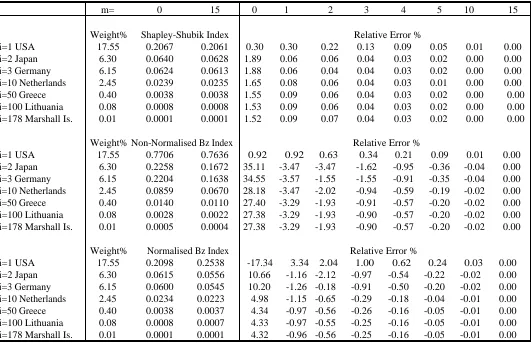
all members, are likely to be affected by this. The results are presented in Table 1 for m=0 (corresponding
to Owen’s methods) and various values of m up to 15 for certain representative members, including the
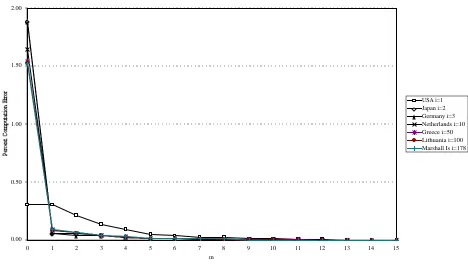
largest three and the smallest. The relative approximation errors are graphed in Figure 1 for all m. The
error in calculating the Shapley-Shubik indices is never greater than 2 percent and becomes much less
than 0.1percent for m=1, the case where the very large weight for the United States is removed from the
approximation part of the algorithm.
There is a much greater approximation error in the Banzhaf calculations, for both the
non-normalised and non-normalised versions of the index for m=0. For the former the error in the index for the
USA is less than 1 percent as would be expected but there are very large errors in the others, over 35
percent in the case of the second member, Japan, and well over 25 percent for all other members.
Increasing m reduces the error until it becomes negligible by the time m has been increased to 10. The
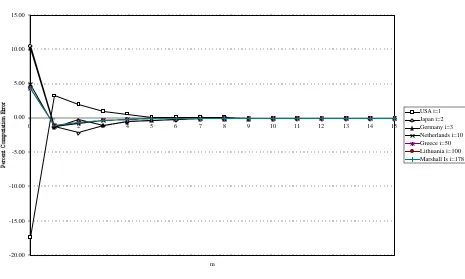
figures for the normalised Banzhaf index calculated by the Owen algorithm are also subject to error,
including the index for the USA, because the failure of the normal approximation leads to overestimation
of the normalising constant. Again the algorithm reduces the error and it is well under 1 percent for all
members when m≥5 and negligible when m=10.
The general conclusion from this example is that the algorithms perform well in combining
accuracy with speed and that there is very little to be gained in improved accuracy by increasing m much
8
beyond 5 when the relative accuracy for all the indices is around one tenth of one percent. The problem of
Figure 1. Voting Power in the IMF
m= 0 15 0 1 2 3 4 5 10 15
Weight% Shapley-Shubik Index Relative Error %
i=1 USA 17.55 0.2067 0.2061 0.30 0.30 0.22 0.13 0.09 0.05 0.01 0.00 i=2 Japan 6.30 0.0640 0.0628 1.89 0.06 0.06 0.04 0.03 0.02 0.00 0.00 i=3 Germany 6.15 0.0624 0.0613 1.88 0.06 0.04 0.04 0.03 0.02 0.00 0.00 i=10 Netherlands 2.45 0.0239 0.0235 1.65 0.08 0.06 0.04 0.03 0.01 0.00 0.00 i=50 Greece 0.40 0.0038 0.0038 1.55 0.09 0.06 0.04 0.03 0.02 0.00 0.00 i=100 Lithuania 0.08 0.0008 0.0008 1.53 0.09 0.06 0.04 0.03 0.02 0.00 0.00 i=178 Marshall Is. 0.01 0.0001 0.0001 1.52 0.09 0.07 0.04 0.03 0.02 0.00 0.00
Weight% Non-Normalised Bz Index Relative Error %
i=1 USA 17.55 0.7706 0.7636 0.92 0.92 0.63 0.34 0.21 0.09 0.01 0.00 i=2 Japan 6.30 0.2258 0.1672 35.11 -3.47 -3.47 -1.62 -0.95 -0.36 -0.04 0.00 i=3 Germany 6.15 0.2204 0.1638 34.55 -3.57 -1.55 -1.55 -0.91 -0.35 -0.04 0.00 i=10 Netherlands 2.45 0.0859 0.0670 28.18 -3.47 -2.02 -0.94 -0.59 -0.19 -0.02 0.00 i=50 Greece 0.40 0.0140 0.0110 27.40 -3.29 -1.93 -0.91 -0.57 -0.20 -0.02 0.00 i=100 Lithuania 0.08 0.0028 0.0022 27.38 -3.29 -1.93 -0.90 -0.57 -0.20 -0.02 0.00 i=178 Marshall Is. 0.01 0.0005 0.0004 27.38 -3.29 -1.93 -0.90 -0.57 -0.20 -0.02 0.00
Weight% Normalised Bz Index Relative Error %
Figure 1(a): Relative Approximation Errors, Shapley-Shubik Index
0.00 0.50 1.00 1.50 2.00
0 1 2 3 4 5 6 7 8 9 10 11 12 13 14 15
m
[image:21.595.78.546.124.401.2]Figure 1(b): Relative Approximation Errors, Non-Normalised Banzhaf Index
-5.00 0.00 5.00 10.00 15.00 20.00 25.00 30.00 35.00
0 1 2 3 4 5 6 7 8 9 10 11 12 13 14 15
m
USA i=1 Japan i=2 Germany i=3 Netherlands i=10 Greece i=50 Lithuania i=100 Marshall Is i=178
Figure 1(c): Relative Approximation Errors, Normalised Banzhaf Index
-20.00 -15.00 -10.00 -5.00 0.00 5.00 10.00 15.00
0 1 2 3 4 5 6 7 8 9 10 11 12 13 14 15
m
[image:22.595.81.536.116.380.2] [image:22.595.80.545.439.718.2]Example 2: An Artificial Example
The second example is a game with artificially generated weights constructed to capture the
characteristic pattern encountered in real voting bodies with a large number of members, in which there are
a few members with large weights and many with small weights. The concentration of weight among these
large players, could make the normal approximation somewhat inaccurate. Very good results are obtained
using the new algorithms, however.
The game was chosen with n=100, q=55% and the weights have been generated at random (before
being expressed as percentages) from a suitable distribution: w1, w2, . . . , w100 are a sample from the
Lognormal Distribution Λ(4.3, 3). The resulting distribution of votes is very concentrated: one player has
29%, two further players have over 10% and a further 2 more than 5% of the total votes. The smallest
player has 0.00001 percent of the votes. Although this concentration makes it necessary to choose a value
of m greater than zero to get good accuracy, for the same reason it is not necessary to use a large value of
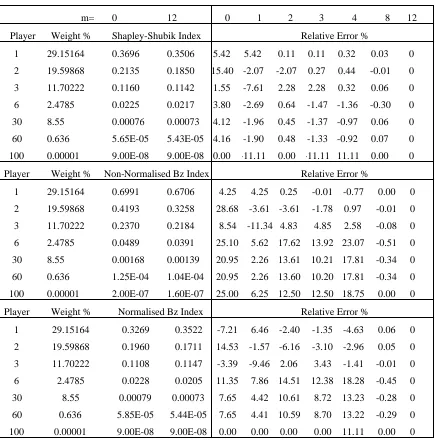
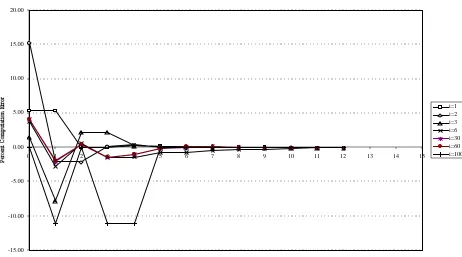
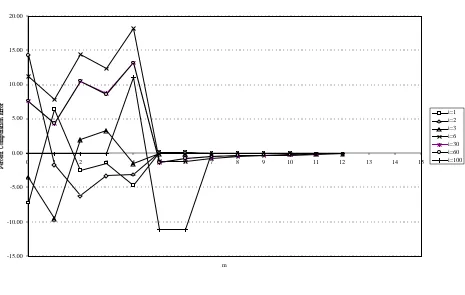
m. Table 2 shows the power indices for certain selected players, i=1,2,3,6,30,60 and 100, calculated for
m=0 and m=12. It also shows the relative approximation errors for m=0,1,2,3,4, 8 and 12 (identically zero
since the values calculated with m=12 are taken as fully accurate.) The graphs in Figure 2 show the relative
approximation errors for these players and all values of m≤12.
In this example, the MLE approximation methods are very inaccurate (the case m=0), the index for
i=2 being overestimated by 15% and that for i=1 by 5%. However for the large players the errors in all
indices become negligible for m≥5. For the small players the errors in the Shapley-Shubik indices and the
Non-normalized Banzhaf indices become negligible for m≥5 and those in the Normalized Banzhaf indices
for m ≥ 7 in the case of the smallest player, i=100. (This result may be affected by rounding error and the
Table 2: Artificial Example: Power Indices and Relative Approximation Errors for Selected Players
m= 0 12 0 1 2 3 4 8 12 Player Weight % Shapley-Shubik Index Relative Error %
1 29.15164 0.3696 0.3506 5.42 5.42 0.11 0.11 0.32 0.03 0 2 19.59868 0.2135 0.1850 15.40 -2.07 -2.07 0.27 0.44 -0.01 0 3 11.70222 0.1160 0.1142 1.55 -7.61 2.28 2.28 0.32 0.06 0 6 2.4785 0.0225 0.0217 3.80 -2.69 0.64 -1.47 -1.36 -0.30 0 30 8.55 0.00076 0.00073 4.12 -1.96 0.45 -1.37 -0.97 0.06 0 60 0.636 5.65E-05 5.43E-05 4.16 -1.90 0.48 -1.33 -0.92 0.07 0 100 0.00001 9.00E-08 9.00E-08 0.00 -11.11 0.00 -11.11 11.11 0.00 0 Player Weight % Non-Normalised Bz Index Relative Error %
1 29.15164 0.6991 0.6706 4.25 4.25 0.25 -0.01 -0.77 0.00 0 2 19.59868 0.4193 0.3258 28.68 -3.61 -3.61 -1.78 0.97 -0.01 0 3 11.70222 0.2370 0.2184 8.54 -11.34 4.83 4.85 2.58 -0.08 0 6 2.4785 0.0489 0.0391 25.10 5.62 17.62 13.92 23.07 -0.51 0 30 8.55 0.00168 0.00139 20.95 2.26 13.61 10.21 17.81 -0.34 0 60 0.636 1.25E-04 1.04E-04 20.95 2.26 13.60 10.20 17.81 -0.34 0 100 0.00001 2.00E-07 1.60E-07 25.00 6.25 12.50 12.50 18.75 0.00 0 Player Weight % Normalised Bz Index Relative Error %
Figure 2(a): Relative Approximation Errors: Shapley-Shubik Index
-15.00 -10.00 -5.00 0.00 5.00 10.00 15.00 20.00
0 1 2 3 4 5 6 7 8 9 10 11 12 13 14 15
m
[image:25.595.81.543.228.485.2]Figure 2(b): Relative Approximation Errors: Non-Normalised Banzhaf Index
-15.00 -10.00 -5.00 0.00 5.00 10.00 15.00 20.00 25.00 30.00
0 1 2 3 4 5 6 7 8 9 10 11 12 13 14 15
m
i=1 i=2 i=3 i=6 i=30 i=60 i=100
Figure 2(c): Relative Approximation Errors: Normalised Banzhaf Index
-15.00 -10.00 -5.00 0.00 5.00 10.00 15.00 20.00
0 1 2 3 4 5 6 7 8 9 10 11 12 13 14 15
m
[image:26.595.66.533.113.372.2] [image:26.595.82.547.438.733.2]VI. Conclusion
This paper has described two algorithms for computing power indices for voting games, enabling
the easier analysis of power in the kind of large weighted voting bodies that often occur in reality. They
are capable of achieving a high degree of accuracy without excessive cost in terms of computing time in
real applications and can be applied to voting bodies of any size. The algorithms are a hybrid between the
direct application of the definitions of the indices, whose feasibility for all but small games is severely
limited by computing time because of their exponential complexity, and approximation methods due to
Owen, where the accuracy of the approximation may be limited when voting weights are very concentrated.
By treating a small number of members with large weights differently from the minor members, the
methods achieve a significant reduction in approximation error at little cost in terms of computer time.
References
Banzhaf, John F (1965), “Weighted Voting Doesn’t Work: A Mathematical Analysis”, Rutgers Law Review, 19, 317-343
Coleman, James S (1971)., "Control of Collectivities and the Power of a Collectivity to Act," in B.Lieberman (ed), Social Choice, New York, Gordon and Breach, reprinted in J.S. Coleman, 1986, Individual Interests and Collective Action, Cambridge University Press.
Dubey, P. and L.S. Shapley (1979), "Mathematical Properties of the Banzhaf Value," Mathematics of Operational Research, 4, 99-131.
Felsenthal, Dan S. and Moshé Machover (1995), "Postulates and Paradoxes of Relative Voting Power: a Critical Re-Appraisal," Theory and Decision, 38,195-229.
---, (1998),The Measurement of Voting Power, Cheltenham, Edward Elgar.
---, and William.Zwicker( 1998), "The Bicameral Postulates and Indices of a Priori Voting Power," Theory and Decision, 44, 83-116.
---, (2001), “The Treaty of Nice and Qualified Majority Voting,” Social Choice and Welfare, 19(3), 465-83.
Holler, Manfred (1981), (Ed.), Power, Voting and Voting Power, Physica-Verlag, Wurtzburg.
Lane, Jan-Erik and Sven Berg (1999), "Relevance of Voting Power", Journal of Theoretical Politics, 11(3), 309-19.
La Porta, R., Florencio Lopez-de-Silanes, Andrei Shleifer and R.W. Vishny (1999), "Corporate Ownership around the World," Journal of Finance, 32(3), July, 1131-50.
Leech, Dennis (1988) "The Relationship between Shareholding Concentration and Shareholder Voting Power in British Companies: a Study of the Application of Power Indices for Simple Games,"
Management Science, 34, 509-527.
--- (1992) "Empirical Analysis of the Distribution of a priori Voting Power: Some Results for the British Labour Party Conference and Electoral College", European Journal of Political Research, 21, 245-65.
--- (2001), "Shareholder Voting Power and Corporate Governance: a Study of Large British Companies," Nordic Journal of Political Economy, Vol. 27(1), 33-54.
--- (2002) "An Empirical Comparison of the Performance of Classical Power Indices," Political Studies, vol. 50(1) March 2002,1-22.
--- (forthcoming, a), “Designing the Voting System for the Council of the European Union,” Public Choice, forthcoming. [Also Center for the Study of Globalization and Regionalisation Working Papers, 75/01, University of Warwick.]
--- (forthcoming, b), "Voting Power in the Governance of the International Monetary Fund", Annals of Operations Research, Special Issue on Game Practice (Guest-Editors: I. Garcia-Jurado, F. Patrone and S. Tijs), forthcoming. [Also Center for the Study of Globalization and Regionalisation Working Papers, 68/01, University of Warwick.]
Lucas, William F. (1983), “Measuring Power in Weighted Voting Systems,” in S. Brams, W. Lucas and P. Straffin (eds.), Political and Related Models, Springer.
Mann, Irving and Lloyd .S Shapley (1960), Values of Large Games IV: Evaluating the Electoral College by Montecarlo Techniques, RM-2651, The Rand Corporation, Santa Monica.
--- (1962), Values of Large Games VI: Evaluating the Electoral College Exactly, RM-3158, The Rand Corporation , Santa Monica.
Nijenhuis, A. and H.S.Wilf (1983), Combinatorial Algorithms, Academic Press.
Owen, Guillermo (1972), “Multilinear Extensions of Games,” Management Science, vol. 18(5), Part 2, P-64 to P-79.
--- (1975a), "Multilinear Extensions and the Banzhaf Value," Naval Research Logistics Quarterly, 22, 741-50.
--- (1975b), “Evaluation of a Presidential Election Game”, American Political Science Review, 69, 947-53.
--- (1995), Game Theory,(3rd Edition) , Academic Press.
Penrose, L.S. (1946), "The Elementary Statistics of Majority Voting," Journal of the Royal Statistical Society, 109, 53-57.
Shapley, Lloyd S. and Martin Shubik (1954), “A Method for Evaluating the Distribution of Power in a Committee System,” American Political Science Review, 48, 787-92.
Straffin, Philip D. (1994), "Power and Stability in Politics," chapter 32 of Aumann, Robert J and Sergiu Hart (eds.), Handbook of Game Theory, Volume 2, North-Holland.
Widgren, Mika (1994), "Voting Power in the EC Decision Making and the Consequences of Two Different Enlargements," European Economic Review, 38, 1153-1170.