FACULTY OF BEHAVIOURAL, MANAGEMENT AND SOCIAL SCIENCES
MASTER COMMUNICATION STUDIES
EXAMINATION COMMITTEE Dr. H.A. van Vuuren
Dr. S. Janssen
University of Twente
Master thesis
STIMULATING AND FACILITATING
INDIVIDUAL LEARNING AND
DEVELOPMENT IN SELF-MANAGING
TEAMS
An exploratory case study in the context of software
development
Laura van ’t Hul
S1233203
SUMMARY
INTRODUCTION. A growing number of organisations has implemented self-managing teams to cope with their complex and rapidly changing environment. Especially in the context of software development, employees are confronted with short development and learning times and continuous changes in customer needs and technologies. In self-managing teams, employees are expected to take on greater responsibility for their own learning and development. At the same time, HR(D) professionals are challenged to build environments in which the learning potential of self-managing teams can be fully utilised. While self-managing teams are becoming increasingly implemented in organisations, the implications of self-management for individual learning and development have only received little attention in current research.
OBJECTIVES. Therefore, this study addressed the research gap by investigating the learning activities employees of self-managing teams engage in, and the factors that enable and hinder learning in the context of software development.
METHOD. An exploratory case study was performed in which semi-structured interviews were conducted with 20 members of five multidisciplinary self-managing teams in an IT company. Participants differed in their craftsmanship: backend developers, frontend developers, user experience designers, graphic designers, and product owners participated in this study.
RESULTS. In addition to many studies describing (inter-)team learning, the results of this study show that individuals also engage in different learning activities to develop themselves. First, individuals regularly took on new roles or tasks, implemented new technologies, helped others in their learning and learned further at home through hobby projects. Less often individuals participated in formal training or conferences, organised feedback sessions, consulted colleagues from other teams, or worked temporarily at or together with another team. Furthermore, this study reveals that multiple factors were found to enable or hinder learning in self-managing teams, each in its own way. This study shows that a self-managing team may be a stimulating work environment for employees that can self-direct their learning, but may be a pitfall for employees that find doing so more difficult. Moreover, employees of self-managing teams experience some lack of clarity about the distribution of responsibilities when it comes to learning and development.
CONCLUSION. This study complements previous research by aligning research and practice through revealing the everyday challenges that self-managing teams face regarding learning and development. Furthermore, practical implications are discussed on how to further benefit the stimulating conditions, or adjust the hindering conditions for learning. Through for example providing time for experimenting, supporting and coaching teams in feedback giving and receiving, or starting the conversation about responsibility, learning and development can be further stimulated and facilitated in the case study company. While this study attempted to understand the implications of self-management for learning, future research should study teams for what they are as in practice teams cannot be compared. Future research would benefit from a ‘complexity’ or ‘systems theory’ approach to create more understanding of individual learning and development in contemporary organisations.
CONTENTS
SUMMARY 2
CHAPTER 1 PROBLEM STATEMENT 4 CHAPTER 2 THEORETICAL FRAMEWORK 6
2.1 Self-managing teams: defining the concept 6 2.2 Employee learning and development in self-managing teams 7
2.2.1. Implications of self-management for employees 7
2.2.2. Implications of self-management for HR(D) professionals 7 2.3 Learning opportunities in the workplace: learning activities 8 2.4 The workplace as learning environment: conditions for learning 9
CHAPTER 3 METHOD 11
3.1 Research design 11
3.2 Research context 11
3.2.1. The way of working at the case study company 11
3.3 Role of the researcher 12
3.4 Participants 13
3.5 Procedure and research instrument 14
3.6 Data analysis procedure 15
3.6.1. Coding the learning activities 15
3.6.2. Coding the conditions 16
3.6.3. Validation 16
CHAPTER 4 RESULTS 17
4.1 Learning activities 17
4.1.1. Learning by doing one’s regular job 17
4.1.2. Learning by applying something new in the job 17
4.1.3. Learning by social interaction with colleagues 19
4.1.4. Learning by reflection 21
4.1.5. Learning off-the-job 22
4.2 Learning conditions 23
4.2.1. Nature of work 23
4.2.2. Way of working 26
4.2.3. Workload 27
4.2.4. Latitude 27
4.2.5. Team composition 29
4.2.6. Social culture 29
4.2.7. Communication about the training budget 30
4.2.8. Questions about responsibility 31
CHAPTER 5 DISCUSSION 33
5.1 Goal 1 – understanding what activities employees in self-managing teams undertake to learn 33 5.2 Goal 2 – understanding the factors that enable or hinder learning in self-managing teams 34 5.3 Theoretical implications and directions for future research 36
5.4 Practical implications 37
5.5 Methodological strengths and weaknesses 40
CHAPTER 6 CONCLUSION 41
REFERENCES 42
CHAPTER 1
PROBLEM STATEMENT
An organisation’s ability to serve customer needs, respond to market dynamics, and come up with technological innovations determines both its survival and success (Grant & Parker, 2009; Pikkarainen, Haikara, Salo, Abrahamsson, & Still, 2008). This is especially true for organisations in software development as they “are often confronted with short development and learning times as well as unpredictable and continuous changes in both technologies and customer needs” (Chau & Maurer, 2004, p. 98). To meet these demands, organisations increasingly implement agile work philosophies and rely upon work teams to tackle the challenges in the rapidly changing and complex environment in which they operate (Hiller, Day, & Vance, 2006; Pikkarainen et al., 2008). Teams have always been an important aspect of organisational life as they have great abilities to fulfil an organisation’s most urging and difficult needs (Tannenbaum, Mathieu, & Cohen, 2012). However, the nature of teams has been changing; as teams take on more self-management they also take greater responsibility for the development of the team and its members (Tannenbaum et al., 2012). As learning is an important source of competitive advantage for individuals and organisations, it is of significant importance that learners develop a sense of self-directedness in their learning, and organisations create environments that stimulate learning and development of employees (Ellinger, 2005).
A growing number of organisations has implemented self-managing teams with the notion to increase organisational and individual learning (Tjepkema, 2003). For organisations, it is important to stimulate individual learning because it will not only be beneficial for the team performance, but also results in an attractive environment for talented employees (Tjepkema, 2011). It is a way to attract potential employees and at the same time remain an attractive employer where employees can exploit the available learning opportunities and thereby fully develop themselves (Tjepkema, 2011). Kengen and Jagtman (2010) explain that implementing self-management has consequences for learning and development of employees as the teams and its members take an active role in recognising their own learning needs. As a consequence, the Human Resource (HR) and HR Development (HRD) professional take on another rather facilitating role as HR(D) tasks are increasingly distributed to teams itself.
Currently, little research has investigated the implications of self-management for individual learning and development (e.g. Tjepkema, 2003) or attempted to capture the experiences and challenges that come along with it in practice (e.g. Kengen & Jagtman, 2010). Especially for new organisational structures, such as self-managing teams, research is needed that adequately captures what teams and its members are really experiencing and challenged with today as research and practice are not evolving fast enough (Tannenbaum et al., 2012). Furthermore, current research in the context of software development is not adequate enough as the majority focused either on team learning (e.g., Moe, 2013) or inter-team learning (e.g., Chau & Maurer, 2004; Santos, Goldman, & De Souza, 2015), instead of individual learning.
both formal and informal learning (Ellinger, 2005; Tjepkema, 2011). To understand what teams need to fully use their learning potential, it is important to explore these conditions affecting learning. The organisational context is commonly acknowledged as important facilitator or inhibitor of learning. However, little research has been conducted that explores how and which factors impact learning in the workplace (Ellinger, 2005), especially not in the new organisational context of self-managing teams (e.g., Tjepkema, 2003) or software development (e.g., Babb, Hoda, & Nørbjerg, 2013). This study therefore aims to increase understanding of how learning takes place in self-managing software development teams and which conditions influence employees’ learning. By doing so this study will provide insight into the everyday experiences and challenges that employees of self-managing teams encounter when it comes to their own learning and development, and that of their and team members.
CHAPTER 2
THEORETICAL FRAMEWORK
2.1 Self-managing teams: defining the concept
Self-managing teams have been increasingly implemented in all types of organisations (Kengen & Jagtman, 2010). Because the term self-managing (‘zelfsturend’ in Dutch) is so widespread, it makes it difficult to define. What one understands as self-managing, another might not (Tjepkema, 2011). A thorough literature review of Tjepkema (2003) resulted in the following definition (Tjepkema, 2003):
A self-managing team is a permanent group of employees who work together on a daily basis, who, as a team, share the responsibility for all interdependent activities necessary to deliver a well-defined product or service to an internal or external customer. The team is, to a certain degree, responsible for managing itself and the tasks it performs, on the basis of a clear common purpose. In order to do so, the team has access to relevant information, possesses relevant competences and other resources, and has the authority to independently make decisions with regard to the work process (e.g., solving problems). (p. 6–7)
This does not mean that self-managing teams are leaderless teams, they are able to meet the challenges they face by organising themselves over and over in various ways (Cockburn & Highsmith, 2001). Leadership is shared within these teams, members are regarded at an equal level, and a team hierarchy is absent (Hoda, Noble, & Marshall, 2011). However, from practice we know that is almost impossible to have a team in which there is no hierarchy at all (De Sitter, 1994, as cited in Tjepkema, 2003). Self-managing teams have a team leader or coordinator, who is not a manager or a boss, but who is a ‘primus inter pares’ (Tjepkema, 2003). This person is equal to others in the team but has a representative function and usually has more influence than others (ANW, n.d.). As responsibilities for team leadership are shared within the team, people who have an affinity for certain topics such as team members well-being or team atmosphere can engage in those tasks (Emans et al., 1996, as cited in Tjepkema, 2003). Overall, in this study the definition of Tjepkema (2003) is used because it accurately distinguishes self-managing teams from more traditional teams.
2.2 Employee learning and development in self-managing teams
The implementation of working with self-managing teams has consequences for learning and development (Kengen & Jagtman, 2010). In contrast to departments or teams in more bureaucratic organisations, self-managing teams are regarded as upcoming organisational structures in which learning and working are closely intertwined. Such teams are not only responsible for fulfilling operational tasks, but also for improving the qualities of the product and work processes (Tjepkema, 2003). As self-managing teams are responsible for their own learning, it is of great importance that its members become skilled in learning from their experiences, through for example retrospectives (Tannenbaum et al., 2012). Furthermore, due to this high level of autonomy in self-managing teams, member performance is not evaluated by the leader or management as in a traditional or more hierarchical team. As a consequence, teams with shared leadership have to establish their own process through which members can gather input and feedback from colleagues (Tannenbaum et al., 2012).
2.2.1. Implications of self-management for employees
Multiple researchers highlight that individuals are increasingly assuming greater responsibility for their own learning and development, which is especially true for members of self-managing teams (Ellinger, 2004; Tannenbaum et al., 2012). Organisations find themselves in an increasingly rapidly changing environment, meaning that employees will have to change along and continuously learn in order to make and keep organisations effective (Vos, Corporaal, Dartel, Peters, & Morssink, 2017). This requires quite a bit of competencies of employees, as they are expected to become proactive and self-directed learners (Tjepkema, 2003; Vos et al., 2017). Being self-directed in your learning means that you “take the initiative, with or without the help of others, in diagnosing [your] learning needs, formulating learning goals, identifying human and material resources for learning, choosing and implementing appropriate learning strategies, and evaluating learning outcomes” (Knowles, 1975, p. 18). However, learners differ in the degree to which they are willing and capable of taking on this responsibility and be self-directed in their learning (Brockett & Hiemstra, 1991, in Ellinger, 2004).
2.2.2. Implications of self-management for HR(D) professionals
individual learning and self-directedness in the workplace (Ellinger, 2004). From the organisation’s perspective, it is important that individuals continuously develop themselves as professional since skilled and talented employees are a company’s major competitive advantage (Govaerts, Kyndt, Dochy, & Baert, 2011). Also for individuals it is important to continuously invest in their own personal development, since individuals no longer are employed a life-time but increasingly make transitions in and between organisations (Arthur & Rousseau, 1996).
2.3 Learning opportunities in the workplace: learning activities
Multiple researchers have tried to conceptualise workplace learning through using a variety of labels (Bolhuis & Simons, 2011; Tynjälä, 2008). For instance, Tynjälä (2008) explains that learning can take different forms depending on the place of the employee at work and the influence of the workplace environment. In her article she describes three models of workplace learning: first, learning can be incidental and informal, whereby learning is a by-product of work (Marsick & Watkins, 1990); second, learning can be intentional and non-formal such as practicing a certain skill or mentorship; third, formal learning which can be on or off-the-job training. By means of grounded research, other researchers have come to a more specific classification of the ways in which individuals learn. For example, following a qualitative research amongst Dutch nurses we can distinguish the following learning activities (Berings & Doornbos, 2011; Berings, Poell, & Gelissen, 2008):
1. Learning by doing one’s regular job: carrying out daily (technical) tasks, learning from success and mistakes, through contact with customers, through observing colleagues or helping others learn, people learn how to perform their work increasingly better.
2. Learning by applying something new in the job: new situations at work, taking on new tasks, or taking over work from colleagues.
3. Learning by social interaction with colleagues: asking for and obtaining feedback from colleagues and exchanging knowledge and experience with each other. Bolhuis and Simons (2011) explain that this type of learning happens through working together and getting responses from your social environment.
4. Learning by reflection: reflection can happen before, during, or after the action, can be together or alone, unconscious and conscious. Reflecting is a way through which you process experiences and information into a personal competence.
5. Learning by theory and supervision: this type of learning mostly takes place intentionally and includes consulting media, being coached or guided by a colleague, visiting meetings and conferences and following trainings.
Bolhuis and Simons (2011) justly denote that in an organisation, these ways of learning coincide and complement each other. Though an important difference between these categories is that learning through experience and social interaction occurs naturally, it happens whether you want it or not. In contrast, learning by theory or reflection happens when the goal is explicitly to learn and only happens when you make conscious effort to learn from it (Bolhuis & Simons, 2011).
themselves through learning activities in the context of the team. As the learning on the team level includes the construction of new knowledge and having the capacity for collaborative action as a team, (Marsick & Watkins, 2001), individuals also make meaning of these learning experiences for themselves. Therefore, we define learning activities as “the concrete activities
that individuals (or in the context of the team) undertake to acquire and develop knowledge and skills, happening either incidentally or intentionally” (Based on Berings & Doornbos, 2011; Marsick & Watkins, 2001; Tjepkema, 2003).
2.4 The workplace as learning environment: conditions for learning
Implementing self-managing teams is a way for companies to stimulate individual and organisational learning (Tjepkema, 2003). However, implementing such teams does not necessarily mean that it automatically becomes a success (Moe, Dingsoyr, & Tore, 2009).Hoda et al. (2011, p. 73) have studied self-managing teams in the context of software development and underline the team’s need for a “supportive environment to emerge and flourish”. What is required for a team, and the individuals within it, to successfully manage questions regarding learning and personal development? To understand what a team needs, it is important to understand the conditions affecting the team.
This was also highlighted by Ellinger (2004) who stresses the need for research into the contextual factors that influence or impede individual learning and self-directedness (Ellinger, 2004). Multiple researchers have tried to capture influencing conditions for learning (Confessore & Kops, 1998; Ellinger, 2005), however little research has investigated these conditions in the context of self-managing teams (e.g., Tjepkema, 2003) or software development (e.g., Babb, Hoda, & Nørbjerg, 2013). Therefore, this study will provide insight into the enabling and hindering conditions for individual learning and development in self-managing software development teams. In this study, a condition is defined as a “characteristic
of the individual, team, or organisation, that enables or hinders learning from each other”
individual’s learning (Tjepkema, 2003). Also informally or formally rewarding employees by their performance and competence, rather than hierarchy or years of experience can stimulate employees to learn (Tjepkema, 2003). Lastly, the team must be small enough to feel like a group and be large enough to do the work and allow for flexibility and room for learning (Tjepkema, 2003).
Third, certain characteristics of the job such as nature of work, autonomy, cooperation with team members, work pressure, and growth potential (Tjepkema, 2003; Verscheijden, 2017) can stimulate or inhibit individual learning. To begin with, high job variety implies that there are various work activities that create learning opportunities, which will likely increase individuals’ self-directedness to learn (Raemdonck, van der Leeden, Valcke, Segers, & Thijssen, 2012). However, in the specific context of software development employees have to balance between working on a variety of projects or systems to diversify their experience and between specialising their experience in one system (Fong Boh, Slaughter, & Espinosa, 2007). Furthermore, autonomy in one’s job will likely stimulate individuals’ motivation to engage in learning behaviour as people feel they can control their own work and their learning (Straka, 2000). Also, opportunities for collaboration will positively impact individual learning behaviour (Rana, Ardichvili, & Polesello, 2016). Besides, workload is another important condition for learning, since high work pressure can cause it to be more difficult for employees to find the time for learning during work (Tjepkema, 2003). Lastly, if the employee perceives the job to provide opportunities for learning and mobility (growth potential) he or she will be more likely to undertake learning activities (Confessore & Bonner, 1997, as cited in Raemdonck, van der Leeden, Valcke, Segers, & Thijssen, 2012).
Lastly, on an organisational level factors such as management vision and behaviour and the culture are important for learning (Tjepkema, 2003). First, according to Tjepkema (2003) when management clearly communicates their view on self-management and learning and why it is important for the organisation, and set an example by acting in accordance with it, this will likely enhance employee motivation to engage in learning. Lastly, the organisational culture or learning environment has also been shown to be connected to individual learning (Confessore & Kops, 1998). A culture in which 1) an emphasis is placed on creativity and innovation and in which errors are tolerated; 2) responsibility is delegated to organisational members; 3) learning initiatives are supported; 4) open communication is encouraged; 5) and individual learning opportunities are provided, will likely stimulate individual self-directedness to learn (Confessore & Kops, 1998).
CHAPTER 3
METHOD
3.1 Research design
This study aims to gain better understanding into the underexposed topic of individual learning and development in an upcoming organisational structure: self-managing teams. Therefore, an exploratory case study design was used in which data was gathered through semi-structured interviews. The request to conduct this study came from the case study company. A case study design fits the exploratory nature of this study as it enables the researcher to examine data within a specific context and to learn about contemporary challenges that exist in companies working with self-managing teams (Zainal, 2007). As such, the aim of a case study is to generate theory, or add to and compare findings with current theory on the topic, rather than to arrive at statistical generalisation (Rowley, 2002). Semi-structured interviews are a common method in case study research and are suitable because of its flexible nature (Runeson & Höst, 2009). Often, participants have information that was not thought of by the researcher beforehand. When a participant brings up such information, the researcher using a semi-structured interview approach can allow the interview conversation to develop and thus explore new and relevant topics (Hesse-Biber & Leavy, 2011).
3.2 Research context
Data gathering took place at an internet agency in the Netherlands, referred to as the pseudonym ‘Company X’ or ‘the case study company’ throughout this thesis. Around 80 employees and 30 students work at the company. There are five innovation teams and four supportive teams. In the innovation teams, team members work together to realise new digital solutions and products for the specific customers the team serves. The ‘supportive’ teams, are in support of Company X (e.g., Human Resources or administration) or customers (e.g., application maintenance or customer service). Since three years all teams are self-managing of nature and the innovation teams are also multidisciplinary. In the past, the innovation teams were formed based on a speciality (e.g., software development or project management) but now teams consist of around 12 employees that vary in their specialisation, also referred to as ‘craftsmanship’ at Company X. In the teams there is no place anymore for managers but rather team leads represent the teams. Within the team there are no official functions, but employees rather have a certain speciality or take on a certain role, such as financial or HR responsible. Also, performance appraisals have been abolished. The innovation teams at Company X have the autonomy to decide how they work on their projects. The following section is a more detailed description of how teams structure their work (according to agile methodologies or not).
3.2.1. The way of working at the case study company
methodology. When a team works according to the Scrum methodology all work is done in sprints, which are 30-day periods in which a working part of the system is delivered. Each sprint starts with a planning session in which the team decides what work will be done in the next sprint. Teams engage in the daily stand-up, a 15-minute meeting with the purpose to synchronise the work for all team members. At the end of a sprint, results are delivered and reflected upon in a retrospective (Schwaber, 2004). Sutherland (2014), co-creator of Scrum explains that there are only three roles in a Scrum team:
1. Scrum master: some teams at Company X have a Scrum master, who is responsible for
how work is done and how work can be done better. The Scrum master is guiding the team in their continuous improvement and makes sure that the process is effective. His or her role is to ask the critical questions to figure out what is getting a team in their way and to coach the team through the Scrum framework.
2. Product owner (PO): at Company X, each team has one (or two) PO’s who is responsible for what work should be done. The PO represents the interests of all stakeholders in the project (Schwaber, 2004), has the vision of what the team should make for the customer, and is responsible for the outcomes. Half of their time PO’s are busy communicating with the customer and understanding its needs, the other half is spent showing the team what the customer valued and what work must be done in the following sprint.
3. Development team: these are theother members of the team that are “doing the work”. The team needs to have the skills to produce what the PO envisions for the customer. At Company X, the development teams consist of backend developers, frontend developers, user experience designers, and graphic designers.
Working Scrum has been proven to be a successful method. However in practice, and thus also at Company X, it depends upon the type and size of the project which agile practices and methods are chosen (e.g., Kanban, Scrum, Waterfall, etc.) (Eijgelshoven, 2017; Moe, 2013). Therefore, several agile methods and practices are often combined in a project or in a team, or when the team works on several projects simultaneously (Moe, 2013). As a result, the five innovation teams differ in the way they work and work according to different (agile) methodologies. Some teams always aim to work Scrum, also if they have multiple smaller projects, others only work Scrum when the project is big enough to work on with the entire team and when the customer also supports this method. It is through adapting methodologies to customer needs, that teams can be as effective as possible (Hoda, Kruchten, Noble, & Marshall, 2010). You could wonder: are such teams still agile or not? Hoda et al. (2010, p. 86) pose the following answer to this question: “To what extent should a team that does not adapt its practices appropriately […] really be regarded as an agile team?”
3.3 Role of the researcher
I understood the culture being studied because I experienced it myself. Furthermore, I already had established a connection with the employees which allowed the participants to tell the truth when it comes to their opinions and experiences (Bonner & Tolhurst, 2002, as cited in Unluer, 2012). However, being an insider also has disadvantages. For instance, to some degree, I experienced that participants might have assumed that I already know what they know (Unluer, 2012) (e.g., the informal culture at Company X). Furthermore, it might be that some participants did not feel entirely comfortable to share their true experiences as I was a ‘pupil’ of de HR manager. To conduct credible research from within, it was important for me to be aware of being biased as a researcher during data collection and analysis, as well as well as issues related to the anonymity of the participants (Smyth & Holian, 2008). Therefore, at the start of the interview, I told participants that they would remain anonymous and emphasised that they could talk freely about their own experiences. Furthermore, I kept a research diary in which I shortly reflected on the interviews (e.g., “Person was very honest about his or her own personal development” or“conversation was somewhat difficult, I had to try hard to keep it going”).
3.4 Participants
Twenty employees working at Company X participated in this study. Participants were purposively selected based on four criteria. First, participants had to be from one of the innovation teams of the company as the initial focus of this study was on self-managing teams working via agile software development methodology. Therefore, employees from the service teams (e.g., marketing, application maintenance, and HR) were excluded from this study. However, this focus changed after four interviews (see also 3.5) but for practical reasons it was decided to maintain the selected sample. Second, participants had to have at least six months of work experience at the company. This was assumed to be a sufficient period in order for employees to establish meaningful work experience to talk about learning in their company. Also, student employees were excluded from participation. Third, in terms of diversity (craftsmanship and seniority), participants were selected to form a realistic reflection of the company’s project teams. Fourth, participants were selected from two different career age groups: early (25–35 years of age) and middle (36–45 years of age) (Kram & Isabella, 1985). In the project teams, members aging 46 years or older (late career age) were absent. Career age and seniority are different concepts because seniority is not necessarily a derivative of work experience; at the case study company you can also be a senior in your craftsmanship at the age of 28. Lastly, I did not strive for a balance in men and female participants as this would not be realistic in the context of software development in which the majority of employees is male. However, all three female project team members were asked to participate in this study. In collaboration with the HR manager, a final list was put together that reflected the demographics of Company X. The selected participants were asked to participate in person or via mail, all agreed to participate.
organisational tenure was 6.2 years which ranged from 1 to 20 years. Lastly, the average work experience was 9 years, ranging from 1 to 22 years.
3.5 Procedure and research instrument
Semi-structured interviews were conducted in separate meeting rooms at the company to minimise the possibility of being disturbed. At the start of the interview, the goal of the research was explained to the participant. Then the participant was informed that he or she always had the possibility to quit the interview and that the participant remained anonymous. After the participant had given permission to audio record the interview the interview started. Interviews lasted from 44 minutes to 1 hour and 13 minutes, with an average length of 58 minutes.
The topic list used for the interviews was based upon the topic list of Tjepkema (2003). The interview started by asking the participant to describe his or her job and role in the team. Then the participant was asked for how long he or she has been working at the company. The following topics were then discussed:
- Individual learning activities
The participant was asked in which ways he or she kept learning and developing him- or herself. Also, the participant was asked when he or she looked back over the period he or she had been working at the company, what the important things were someone had learned.
- Learning at the team level
Secondly, the participant was asked how the team was important for his or her personal development. The participant was also asked if and how the team reflected upon projects that were done, and if feedback was directed on work content or also at a personal level. Next, the participant was asked if and how he or she was important in the professional and/or personal development of team members.
- Learning at the inter-team level
Regarding inter-team communication and learning the participant was asked if he or she had contact outside of their team with colleagues from their own craftsmanship. Follow-up questions were asked to reveal what the contact what about and if it was mostly formal or informal.
- Learning by social interaction
- Additions
Lastly, the participant was asked to what extent he or she had thought of opportunities or things that go rather well at the team level regarding the attention for learning and personal development, and at the organisational level. Then the participant was asked if there were any other issues he or she liked to be discussed. Closing off, the participant was thanked for participating.
The described topic list was the version that was used to interview the majority of the participants (also see Appendix A). After four interviews some changes were made in the topic list. Initially an open question was also posed to uncover what aspects in the way of working at Company X facilitated or inhibited learning. However, for participants this questions seemed rather difficult and ambiguous to answer. Also, to get participants talking about their experiences they were first asked how they worked as a team (agile or not) and then follow-up questions were asked to address their personal learning experiences. However, it was difficult for me to ask adequate follow-up questions to shift the conversation from a factual discussion about ways of working (e.g., agile methodology, self-management, multidisciplinary, etc.) to a conversation about actual individual experiences and opinions on learning. For this reason, it was decided after four interviews that I would not initiate the topic of the way of working (and facilitators and inhibitors) anymore but when the participant raised this topic, I would ask follow-up questions. By deviating from the topic list and allowing the research design to emerge naturally it allowed me to find interesting things I did not expect or had not thought of beforehand to ask questions about (Jacob & Furgerson, 2012).
3.6 Data analysis procedure
Interviews were transcribed and analysed by means of ATLAS.ti software. A multistep content analysis procedure was followed to analyse the data. As a beginning I read all the interview transcripts and added comments to fragments of text which reflected the way in which individuals learned (e.g., “observing colleagues” or “guiding new colleagues”) or which factors enabled or hindered their learning (e.g., “colleagues are approachable for questions” or “little information about training budget”). The coding procedure and validation will be discussed in the following paragraphs.
3.6.1. Coding the learning activities
experience yourself, which is not in relation to others in contrast to the definition of Berings et al. (2008). Secondly, this study showed that learning by taking over something new is also concerned with acting creatively and producing something new for which someone must acquire new information to develop these fresh ideas (Collin, 2002). In the context of this study, taking over something new is not just about taking a different role or task, it is much more concerned with being innovative and exploring new ideas. Third, to arrive at a clear understanding of learning by social interaction, categories of Eraut, Alderton, Cole, and Senker (2002) (as cited in, Koopmans et al., 2006) were used in this study: learning support, collaboration, and consulting someone within the team and from outside the team. While Berings et al. (2008) see observing and helping others in their learning as learning by doing one’s regular job, in this study it is inextricably linked with social interaction and therefore included in this category. Fourth, the category learning by reflection was similar. Lastly, in this study off-the-job learning refers to learning from training (both off- and online) and hobbies. This interest in technical matters or even enjoying designing or developing as a hobby at home can be seen as typical for the context of study (e.g., Collin, 2002). Berings et al. (2008) category of learning from theory and supervision was inadequate as itshowed overlap with learning by taking over something new as you will need theory to implement new ideas, and overlap with social interaction as supervision is inevitably a social activity. All in all, this categorisation was believed to be the best fit for the context and has the best possible distinctness.
3.6.2. Coding the conditions
Furthermore, axial coding was used to arrive at a categorisation for the learning conditions enabling or hindering the occurrence of the learning activities. Firstly, fragments of texts were labelled as hindering, enabling, or neutral after which they were merged into themes. In contrast to the coding process of the learning activities, no literature framework was used for the coding of the learning conditions. Several iterations were done in which data was coded inductively meaning that themes emerged from the data (van Staa & Evers, 2010). After this coding round, another discussion was held with a colleague researcher about the categorisation of the conditions. Next, the two or three most important conditions per learning activity were selected. Furthermore, conditions regarding organisational learning (e.g., knowledge sharing between teams) were left out of account, since this study focused on individual learning and development. Once the final codebook was established, all interviews were coded once more.
3.6.3. Validation
CHAPTER 4
RESULTS
The aim of this study was to identify learning activities in self-managing teams and the factors enabling and hindering learning. In section 4.1 we will elaborate on the occurrence of the five types of learning activities that were found in this study. In section 4.2 the conditions that enabled or hindered the occurrence of these learning activities will be discussed.
4.1 Learning activities
Five learning activities that members of the self-managing teams at the case study company engaged in were distinguished from the data, namely learning by: doing one’s regular job; by applying something new in the job; social interaction; reflection; and off-the-job learning. We will discuss the occurrence of these types of learning activities in the following sections.
4.1.1. Learning by doing one’s regular job
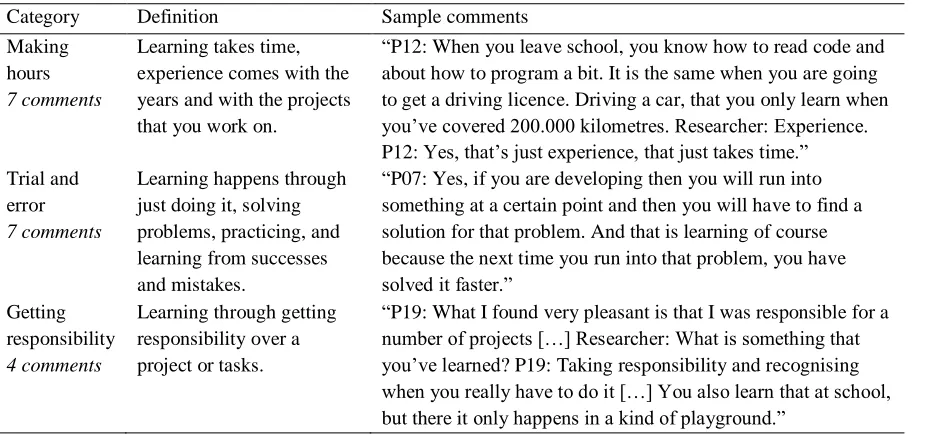
The first way through which participants learned was by doing their regular job. First, five participants explained that learning is making hours and that through practice you will gain experience. Experience was regarded as something which will come with time. Second, five participants described to learn by just doing it, solving problems, and learning from successes and mistakes encountered along the way: “P06: But programming is also really doing it, and
[image:17.595.73.543.460.677.2]really just trying and just making mistakes and then you see why and how something works. Just trying actually.” Lastly, three more junior participants mentioned that you also learn from getting responsibility over a project.
Table 1
Results of the content analysis for learning by doing one’s regular job
Category Definition Sample comments Making
hours
7 comments
Learning takes time, experience comes with the years and with the projects that you work on.
“P12: When you leave school, you know how to read code and about how to program a bit. It is the same when you are going to get a driving licence. Driving a car, that you only learn when you’ve covered 200.000 kilometres. Researcher: Experience. P12: Yes, that’s just experience, that just takes time.” Trial and
error
7 comments
Learning happens through just doing it, solving problems, practicing, and learning from successes and mistakes.
“P07: Yes, if you are developing then you will run into something at a certain point and then you will have to find a solution for that problem. And that is learning of course because the next time you run into that problem, you have solved it faster.”
Getting responsibility
4 comments
Learning through getting responsibility over a project or tasks.
“P19: What I found very pleasant is that I was responsible for a number of projects […] Researcher: What is something that you’ve learned? P19: Taking responsibility and recognising when you really have to do it […] You also learn that at school, but there it only happens in a kind of playground.”
4.1.2. Learning by applying something new in the job
Table 2
Results of the content analysis for learning by applying something new in the job
Category Definition Sample comments Job
enlargement
21 comments
Taking on a new task outside the scope of your job or (official) role such as SCRUM master, team lead, PO, etc.
“P08: Well for me it mainly is a new challenge. [...] I do see it as a kind of next step. Yes, I really like developing now, but I certainly don’t have to keep developing full-time my entire life. So, it is also just a bit of exploring another role how that suits me.”
New cooperation
4 comments
The person has done projects in or together with another team.
“P14: Well I have worked at [another team] every Wednesday for three weeks to help with a project. And that was the first time I found out that another team than our team also does something with [programming language].”
Implementing new
technologies
15 comments
Bringing new technologies into the team and/or applying these in projects.
“P04: I have just researched a bit of new technology and I have demonstrated that already. And we must make sure that everyone will master that a bit. I’ll take that on me.”
Keep up with trends via media
14 comments
Reading books, blogs, watching YouTube movies, searching on Internet, etc.
“P20: By trying out new things. For example, for me that is reading, and talking with [colleagues from same craftsmanship]. If there is the possibility. And see what fellow professionals in the world are doing and to nose about a bit. I look at
frankwatching and smashing magazine. See what’s going on a bit. Try to do that every week. Oh yeah, that's something new, this is fun, oh we can try this one time."
Team day for innovation
7 comments
Having team days for research & development (or not).
“P09: But we have had a work on the team day a long time ago. In itself, I think that is positive in terms of improving your knowledge. Just get started with something, pick something yourself and invent something for that.”
First, job enlargement was a topic that was most discussed by participants with regard to learning by applying something new to the job. Ten participants mentioned to have taken on a new role or taken on tasks outside the scope of their own job. As teams are self-managing, several tasks or responsibilities are assigned to the team itself. Participants had taken on roles such as team lead, SCRUM master, or tasks related to HR or finance to make a next step in their own development: "P06: And I always thought it was a nice thing [a new role], or interesting at least. And I wanted to take on a slightly more leading role, also for my own personal development. Because the leader's role is not really a role that perhaps is not really meant for me, but that is something I would like to grow in. And I think when I have the commitment of the team, they stand behind it and they also know that I am still learning. So then I think well that it something that can flourish right here." Besides taking on a new role, new project cooperation’s was also a way to learn. Two participants mentioned to have been recently working at another team temporarily or that their team joined forces with another team to work together on a project.
Second, the categories implementing new technologies and keeping up with trends are linked to another. Ten participants mentioned to keep up with trends by reading blogs, watching YouTube movies, and reading books with the goal to use the knowledge or implement the technologies in their job: “P16: I think the main thing now is that I keep reading about the
some new experiments are and new web standards are being announced. Then you will find out what it is about, is it interesting for us or not. That is actually something […] you constantly do, and occasionally you take the time to engage in an experiment and to see if this could be something for our team.”
Lastly, five participants also mentioned as a team they (had) organised a day on which time is exclusively spent on developing new ideas. These team days were seen as rich source of learning, from which some ideas also had been used in later projects. However, participants also mentioned that they had not organised such a day for a long time which could be an idea for the near future.
4.1.3. Learning by social interaction with colleagues
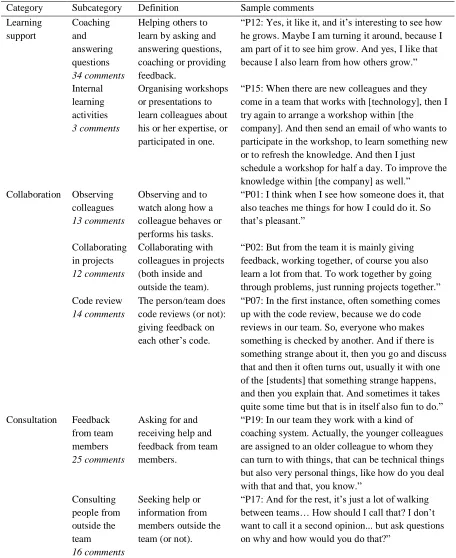
We distinguished three ways of learning by social interaction with colleagues: learning support, collaboration and consultation.
Learning support. This category can be understood as supporting others in their learning which was commonly discussed by participants. Answering questions and coaching others is in this category seen from the perspective of the one providing the support. In one team, they worked with formally assigned coaches to the junior members of the team. Coaching was arranged according to the preference of the junior and was meant to support him or her in all kind of job-related questions. In other teams, support was provided more incidental during the day or when a colleague asked for help. Secondly, two of participants mentioned to have organised a workshop for their colleagues to stimulate learning from each other and practise with a new technology: “P16: We have now started giving workshops instead of giving
presentations. And the last [workshop] we did was about creating a mobile app from scratch, in a front-end technology. And that has been received very well. And all [attendees] managed to write their own app in one evening and get it working on their own phone, from scratch. That is quite nice so they can take that knowledge back to their teams.”
Collaboration. First, observing colleagues doing their job with whom you collaborate is a useful learning activity. Learning can take place on the level of knowledge and skills acquisition, for instance watching a colleague designing something, or on a behavioural level, seeing how a colleague acts and taking your own lesson from that (e.g., how to communicate with the customer). Second, learning also naturally occurs as you work together with colleagues on projects in which you have shared responsibilities and interdependent tasks. Lastly, code reviews were seen as a useful way to learn which was mentioned to be done by six participants. By discussing the mistakes found in the code both more junior and more senior members of the team can learn from each other: “P03: Yes, I mainly look at the code of a teammate, a bit of code review. More in the form of, he is not as experienced as me yet, so then it is more about is what I have made correct according to the standards and how would you do that? Is it right like this? Can it get even better? In that way teammates also continue to learn, and I for sure also learn something from that.”
hand, eight participants explained that they seldom consulted members outside the team. Some of these participants gave examples of contact with colleagues outside the team, but in most cases it was the other colleague that came to them for a question.
Table 3
Results of the content analysis for learning by social interaction with colleagues
Category Subcategory Definition Sample comments Learning support Coaching and answering questions 34 comments
Helping others to learn by asking and answering questions, coaching or providing feedback.
“P12: Yes, it like it, and it’s interesting to see how he grows. Maybe I am turning it around, because I am part of it to see him grow. And yes, I like that because I also learn from how others grow.”
Internal learning activities
3 comments
Organising workshops or presentations to learn colleagues about his or her expertise, or participated in one.
“P15: When there are new colleagues and they come in a team that works with [technology], then I try again to arrange a workshop within [the
company]. And then send an email of who wants to participate in the workshop, to learn something new or to refresh the knowledge. And then I just schedule a workshop for half a day. To improve the knowledge within [the company] as well.”
Collaboration Observing colleagues
13 comments
Observing and to watch along how a colleague behaves or performs his tasks.
“P01: I think when I see how someone does it, that also teaches me things for how I could do it. So that’s pleasant.”
Collaborating in projects
12 comments
Collaborating with colleagues in projects (both inside and outside the team).
“P02: But from the team it is mainly giving feedback, working together, of course you also learn a lot from that. To work together by going through problems, just running projects together.” Code review
14 comments
The person/team does code reviews (or not): giving feedback on each other’s code.
“P07: In the first instance, often something comes up with the code review, because we do code reviews in our team. So, everyone who makes something is checked by another. And if there is something strange about it, then you go and discuss that and then it often turns out, usually it with one of the [students] that something strange happens, and then you explain that. And sometimes it takes quite some time but that is in itself also fun to do.” Consultation Feedback
from team members
25 comments
Asking for and receiving help and feedback from team members.
“P19: In our team they work with a kind of coaching system. Actually, the younger colleagues are assigned to an older colleague to whom they can turn to with things, that can be technical things but also very personal things, like how do you deal with that and that, you know.”
Consulting people from outside the team
16 comments
Seeking help or information from members outside the team (or not).
4.1.4. Learning by reflection
The fourth way through which participants explained to be learning was through learning by reflection. In contrast to learning by social interaction, which is more informal, learning in this theme was seen as more structured and intentional (the aim is to learn). Firstly, participants learned from reflection through meetings with colleagues from the same craftsmanship. At Company X, some craftsmanships (had) organised meetings to share experiences of current and previous projects and to share new developments relevant for their discipline. However, not all craftsmanships did this anymore or not very frequently. Some participants mentioned that they would like to have such meetings again with colleagues from the same craftsmanship.
Within the team, participants mentioned to have team meetings in which the previous year was evaluated, plans for the coming year were made, and also personal ambitions could be talked about. Furthermore, in two teams there recently had been an initiative to organise feedback sessions within the team. Also, some participants mentioned that they had, or could, organise themselves an individual feedback round by asking their colleagues (via mail or in person) for personal feedback instead of an organised session. Other participants mentioned that they had not organised such a session in a time but that it was a good idea to do so: “P03:
The personal and stuff, we have to look at that with the team of how we want to give shape to that. Because in other teams, I think they are already busy with those 360-degree feedback sessions […] that we haven’t got on track yet.” Overall, participant differed in their attitude towards feedback meetings with the team. Commonly discussed problems were that people did not feel the need to and that it is sometimes difficult to come up with concrete actions and as a result, the feedback sessions and team meetings loose part of their value. This can be because for instance employees continue to get the same feedback, or it is forgotten as people are swayed by the issues of the day.
A third way of learning by reflection was through the evaluation of projects. Participants explained that after a sprint period, or when the project was finished, they held a retrospective which is a meeting for project evaluation and reflection. This was an important way for teams to make sure to learn from mistakes and become increasingly better. Sometimes a retrospective was held together with the client to evaluate the project with both parties. However, it differed per team if they took part in retrospectives. Participants from one team mentioned that they had retrospectives as team, while participants from two other teams mentioned to plan it occasionally or that it had happened in the past. Participants from the other two teams did not mention it or told that it did not happen anymore. In addition, the same was true for the daily team meetings (stand-ups). One team had decided to stop doing stand-ups, two teams did team stand-ups, and the other teams decided alternate between project and team stand-ups.
While not all teams had organised moments for reflection (or feedback) during projects, six participants mentioned that evaluation and thus giving feedback also happened during the day. One participant explains: “P02: At the moment when something does not go well, usually
Table 4
Results of the content analysis for learning by reflection
Category Definition Sample comments Craftsmanship
meeting
12 comments
Taking part in craftsmanship meetings (or not).
"P05: And we happened to do it for the second time two months ago. So that needs to be picked up more efficiently, but then you just sit together and discuss, what did you do in the past six months, what are you doing now, where do you want to go, what are developments that you follow? [...] Are there things we can merge [Company X] broadly, can we share knowledge about what we have made, so you don’t have to reinvent the wheel every time."
Team meetings
6 comments
The person/team takes part in team meetings (or not).
"P17: Then you also have the personal ambitions of people that we ask about every year ‘what are your learning goals, and how are we going to help you as a team in that?’. Is on the agenda and is discussed. I do notice that in the issues of the day it sometimes fades away." Team
feedback meetings
15 comments
The person/team takes part in feedback meetings (or not).
"P13: We do a kind of feedback meeting once a year with everyone, yes, we did that in the past two years. Everyone then has to say something about someone else, also because that has to be done from HR. Not that the team is in so much need for that, but it is a bit obligatory because we no longer have any functioning and assessment interviews."
Project evaluation
21 comments
Taking part in retrospectives or reflection (or not) during and after projects.
"P06: So basically, we look back every two weeks what went well, what didn’t go well, and then we try to do what we didn’t do well, want to improve what we want to improve next time, then we take it into account. That actually means that you have an iteration, so that you get better every time."
Stand-up
12 comments
Taking part in daily team meeting to start the day (or not).
"P11: Yes, we have stand-ups every morning. There we reflect on what happened the day before and you still have the opportunity to make some remarks about certain work of someone."
Unorganised reflection (and feedback) 7 comments Reflection and giving feedback happens during work.
"P19: In our team it is very much possible at any time. Yes, everyone knows each other so well that you can say ‘well [teammate] what you did then just sucked or something. You can safely say that if you have a good reason. [...] But no, there are no fixed moments, you can actually always do that."
4.1.5. Learning off-the-job
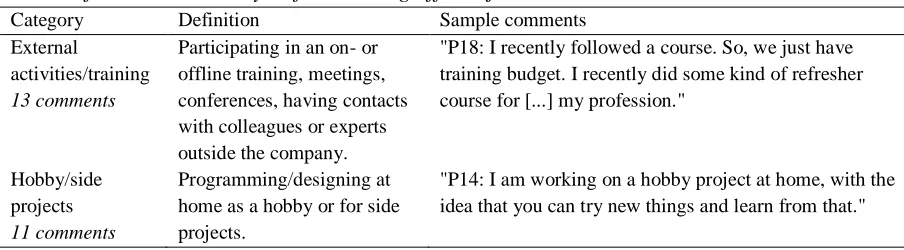
The last way through which participants learned was by learning off-the-job. This category covers learning situations that are located outside the actual workplace which are considered also necessary and complementary to on-the-job learning (Tjepkema, 2003). Firstly, four participants (explicitly) mentioned to have made use, or planned to make use, of the personal budget available at Company X to do a training. Three participants reported to go to conferences, meetups, or other relevant activities outside of the company.
developer who works here, has once made his own side project or whatever. And then you are busy with all aspects, and from that you also learn a lot."
Table 5
Results of the content analysis for learning off-the-job
Category Definition Sample comments External
activities/training
13 comments
Participating in an on- or offline training, meetings, conferences, having contacts with colleagues or experts outside the company.
"P18: I recently followed a course. So, we just have training budget. I recently did some kind of refresher course for [...] my profession."
Hobby/side projects
11 comments
Programming/designing at home as a hobby or for side projects.
"P14: I am working on a hobby project at home, with the idea that you can try new things and learn from that."
4.2 Learning conditions
In this study the following conditions were found to either enable or hinder learning: nature of work; way of working; workload; latitude; team composition; social culture; communication about the training budget; and questions about responsibility. Table 6 depicts how these conditions affected the occurrence of the five types of learning activities or learning in general.
4.2.1. Nature of work
The nature of workwas an important factor with regard to learning by doing one’s regular job. Nature of work can be understood as the type of the tasks or projects people work on. Participants explained that the nature of work generated opportunities to learn from. At Company X, teams work for different customers and thus experience a high variation in the projects, causing employees to come up with new solutions to meet the various customer demands. A participant explains how he or she appreciates the variety of work: "P18: Because you just see that people are also developing because of the projects they do. [...] I have already done a lot of projects of some quite big names, so in that way you are also developing yourself. Much more than that you would do at another company. [...] It is not the same project every day, the moment you do the same project every day, you don’t learn anything anymore.”
In addition, participants mentioned that it is less challenging to work on an existing project than new ones: "P03: If there are existing projects that need to be tinkered with, then the challenge is gone pretty quickly. Because there is already something, then I already dived in that, that is already there, it has been running for a while, it is building extra, not really building something new. Yes, sometimes, but you build on existing stuff that is already there. So, for me it's more challenging to have a new project with yet another very different view of how I'm going to tackle it this time.”
Table 6
Conditions for learning at the case study company
Condition Affecting learning by...
Enabling aspects of the condition (+) Hindering aspects of the condition (–)
(* not exclusively enabling or hindering)
Nature of work doing your regular job
+ You learn from variation in projects.
+ You learn to do something faster when working with the same technology/solution more often.
– Working on and maintaining existing projects is less challenging.
Way of working social interaction
+ When tasks are interdependent/a team is working on a big project with a shared goal this automatically generates opportunities for learning and feedback. + Working on a common goal and giving feedback enhances a sense of ownership and responsibility for learning.
+ When the project is done by the whole team it enables you to work with new technologies and you will arrive at results you could not have imagined.
– When team members are divided over smaller projects it is more difficult to share knowledge and learning experiences with the entire team.
– Working on separate projects makes it more difficult to give each other feedback on your work.
reflection + Despite of working on several projects, stand-ups are still useful because you can still help team members by asking critical questions and giving suggestions to tackle and also prevent problems.
+ Project stand-ups (with sub teams) increases the quality of interaction.
– When a team has multiple projects with less task interdependency then stand-ups and other reflective practices are not relevant enough or cost too much money to do with the entire team. This could affect learning if no alternatives are thought off.
Workload applying something new in the job
+ Low workload means there is time for working with new technologies.
– High workload means that persons do not have (or take) enough time to get round to investigating new technologies themselves/or with the team.
– Focus on being profitable enhances the feeling that doing new things should be a success otherwise it is a waste of money and time. reflection – Culture is somewhat action oriented, focus is on delivering and
working, rather than reflection.
Latitude applying something new in the job
+ The constantly changing landscape forces you to gain knowledge about technical developments because you need it to perform your job well/otherwise you fall behind.
+ Having the autonomy to decide yourself in what technologies you invest your time.
+ Directly applying a new technology in a project enhances learning.
+ Giving workshops on new technologies helps people to also implement new ideas into projects as they have learned the basics.
– No clear vision on the path that Company X choses when it comes to new technologies.
– Implementing new technologies is not always possible for practical reasons, such as support from the browser or implications for maintenance.
– Implementing new technologies to a project that you do not master yet is not always possible as it costs Company X and the customer time and money to do so.
* Sometimes it is also beneficial for learning not to engage in a new technology, but to take time to master what you have learned in a previous project in order to become more efficient.
Team composition social interaction
+ Having a more experienced other or colleague from the same craftsmanship to learn from in the team.
+ In a multidisciplinary team you learn to do your own job better through learning about the craftsmanship of your team mates.
– Absence of a more experienced other or colleague from the same craftsmanship to learn from or debate with during projects.
Social culture reflection & social interaction
+ A team atmosphere in which you can say what you think and still like each other equally the same.
+ A team atmosphere which has a good fit with yourself and with personalities you like will enable you to ask questions and feedback.
+ Colleagues that dare to give feedback help you in your own development.
– Fun and friendshipis what characterised Company X, however this sometimes makes it more difficult to dare to say what you really think/give honest feedback/address someone on his/her functioning. – Talking about own functioning, realising own shortcomings, is sometimes experienced as difficult.
– At Company X everyone is really kind to each other, which is good but makes that not everyone is that open to feedback, are sensitive for it, or show resistance to feedback.
Communication about training budget
off-the-job learning
+ The availability of a personal budget for training and education.
– Lack of clarity in the communication about the use of the training budget.
Questions about responsibility
learning in general
+ Employees that have developed self-directedness in their learning are able to manage their own development. * Employees differ in their motivation to learn.
– For employees that have less sense of self-directedness it is more difficult to manage their own learning when you have responsibility yourself.