University of Warwick institutional repository: http://go.warwick.ac.uk/wrap
A Thesis Submitted for the Degree of PhD at the University of Warwick
http://go.warwick.ac.uk/wrap/36098
This thesis is made available online and is protected by original copyright. Please scroll down to view the document itself.
STATE-LABOUR RELATIONS IN BOTSWANA
1966-1990
Industrial Relations in an Emergent "Liberal" Capitalist Democracy.
By
MONAGENG MOGALAKWE.
DEDICATION.
ACKNOWLEDGEMENTS
During the course of writing up this thesis I have incurred debts of gratitude to many people who gave me encouragement, advice, and assistance. These people are too numerous to mention them by name, but my special thanks go to Dr Robert Fine, my supervisor. His insight into the mind of a research student, his patience and his ability to see beyond the darkness that clouded rrr mind have several times pulled me from the brink of "throwing in the towel". Thank you, Bobt Professor Peter Gutkind, a world reknown scholar of labour studies, commented on and criticized this thesis at various stages of its preparation. Lawrence Tshuma and Tetteh H.orineku-Ajei,the "unreconstructed Marxists", gave me the moral support that only friends can give. The memories of those many Friday evenings we spent together drinking Guiness or discussing Marxist state theory, or doing both, and the comments they threw at me during the write-up of this theis, will forever be cherished. Janet and Macharia Mama provided me with "home" enviroment whenever I needed it.
I should also like to thank my sponsor, the University of Botswana, for the financial support they gave. Professor John Melamu, the Deputy Vice Chancellor gave me fatherly
encouragement to persist after my nasty experience at another university which led to my transfer to the Unversity of Warwick.
Last but not least, I know that my daughter, Bothepha Setlhabi-Mogalakwe, and her mother, Koketso, endured with fortitude, many, many "moons" of my absence as the head of the household. If you two are now contemplating a charge of mental cruelty and malicious desertion against me, the successful completion of this thesis provides extenuating circumstances. Can I therefore plead guilty to the lesser charge of involuntary negligence due to "diminished" responsibility?
ABSTRACT.
Botswana is a formally liberal democratic country that is known for its impressive economic growth and political stability. The country has sometimes been referred to as Africa's economic miracle and a shining example of democracy in a continent notorious for economic mismanagement, military dictatorships and one-party government. However, this picture of Botswana is too superficial and generous.
This study seeks to delve beneath the surface of this much acclaimed liberal democracy in order to explore the system of labour repression that is the dark side of Botswana's constitutional framework of individual rights and democratic freedoms. In Botswana, the collective rights and freedoms of trade unions, though formally recognized, are in fact severely restricted. The state prevents workers in the public sector from forming or belonging to trade unions at all. In the private sector there are manifold constraints on industrial bargaining, organisation and activity. These forms of control over the trade union movement derive from the Botswana state's position as a peripheral capitalist state.
These structures of social domination, however, have not gone unchallenged by the labour movement. The growth and development of the trade union movement and the challenges posed by the labour movement to both the state and capital have shifted the state towards limited labour reforms. This shows that, while the Botswana state remains the guarantor of private capital accumulation, its form is nevertheless determined by the constellation of class forces in which it is located. If the state is to maintain legitimacy and hegemony in society, and not rely on coercion alone, it must accede to some of the demands of the working class. Botswan&s liberal democracy gives the working class space to fight for the reduction of exploitation and to push the state toward more social reforms.
TABLE OF CONTENTS.
page Acknowl edgernent s
Glossary
List of Tables Abstract
PART ONE.
GENERAL INTRODUCTION. 1
CHAPTER ONE. 2
INTRODUCTION TO BOTSWANA.
1.1 The Purpose of the Study 2
1.2 The Thesis 3
1.3 Theoretical Overview 4
1.4 Colonial Economic Legacy 9
1.5 Post-independence Developments 16 1.6 State-Society Relations 19
1.7 Summary 23
PART TWO 32
STATE-LABOUR RELATION: LITERATURE REVIEW
AND THEORETICAL FRAMEWORK. 33
CHAPTER TWO. 33
Theorising the State-Labour Relation.
2.0 Introduction - 33
2.1 Marxist Theories of the State 36 2.2 The State-Labour Relation 43 2.3 Challenges of the Labour Movement 47
2.4 Conclusion 53
CHAPTER THREE. 56
The State Regulation of Labour: the African context.
3.0 Introduction 56
3.1 Marxist Theories of Peripheral
Capitalist State 59
3.2 State-Labour Relation in Peripheral
Capitalism 67
PART THREE. 89 THE BOTSWANA STATE: ITS RELATION TO ORGANIZED LABOUR
CHAPTER FOUR. 90
The Post-Colonial State: The Case of Botswana. 90
4.0 Introduction 90
4.1 The Class Character of the Botswana State 92 4.2 Post-Colonial Economic Growth Strategy 106 4.3 Economic Growth and Structural
Trans format ions 108
4.4 Institutions of Intervention 113 4.5 The State and Development: Some Observations 118 4.6 The Emergent National Bourgeoisie 122
4.7 Conclusion 130
CHAPTER FIVE. 134
The Post-Colonial Wages Policy 134
5.0 Introduction 134
5.1 The Post-Colonial Wages Policy (1972-1990) 135 5.2 Framework for Implementation 140 5.3 Salaries Review Commissions 146 5.4 Income Distribution and Social Inequality 148
5.5 Conclusion 160
CHAPTER SIX. 164
The Capitalist State and the Trade Unions. 164
6.0 Introduction 164
6.1 Restructuring and Control:
The Early Phase 167
6.2 Restructuring and Control:
The Later Phase 173
6.3 Ideological Habituation 178
6.4. Trade Unionism in Botswana 184
6.5 Conclusion 189
CHAPTER SEVEN. 195
Industrial Relations in Botswana
(1966-1990). 195
7.0 Introduction 197
7.1 An Historical Background 199
7.2 Botswana's Constitution and Labour
Legislation 199
7.3 The Employment Act 205
7.4 Trade Unions and Employers Organisation Act 207
7.5 The Trades Dispute Act 218
7.6 The National Security Act 222 7.7 Labour Organisation in the Public Service 223 7.8 Botswana and ILO Conventions 228
PART FOUR. 237 ORAGANISED LABOUR IN BOTSWANA: ITS RELATION TO THE STATE
CHAPTER EIGHT. 238
Trade Union Growth and Development. Post-Colonial Era.
8.0 Introduction 238 8.1 Trade Unions in Botswana. The Colonial Period 239 8.2 Organised Labour In the Post-Colonial Period 247
8.3 Collective Bargaining 255
8.4 Settlement Procedures and Arbitration 264 8.5 Sectionalism and class consciousness 269
8.6 Conclusion 274
CHAPTER NINE. 280
Class Organisation and Class Struggles in Botswana
9.0 Introduction 280
9.1 Trade Unions and the Class Struggle 281 9.2 Industrial Conflict in the Private Sector 285 9.3 Industrial Conflict In the Public Sector 291
9.4 Conclusion 307
CHAPTER TEN. 314
CONCLUSION.
Prospects for Organised Labour in the Third Phase.
314 318 323 325 336 338 338 340 347 349 351 354 357 361 362. 10.1 State-labour Relation before the 1990s
10.2 Labour Legislation in the 1990s 10.3 The Future of Collective Bargaining 10.4 Conclusion: Social Movement Unionism
APPENDICES APPENDIX A.
APPENDIX B.
1.1 METHODOLOGY 1.2 Research Design
1.3 Research Techniques. 1.4 Research Process
1.5 Problems encountered. 1.6 Limitations of the Study. LIST OF PRIMARY SOURCE DOCUMENTS. LIST OF KEY INFORMANTS
LIST of REFERENCES
LIST OF ABBREVIATIONS/ACRONYMS. AALC. ACAS. ANC. BCSA. BOCCIM. BDP BFL. BFTU. BPP. BPWU. BTtJC BTUEC BOFE STE. BOPRITA. COTU. DPSM. FEF. FEUA. KFL. LAB MFDP. NEMIC. MFDP. MUZ. NJICC. NLC. PWD. SACTU ZCTU. ZRAWU.
American-African Labour Centre.
Advisory, Conciliation and Arbitration Service. African National Congress.
Botswana Civil Servants Association.
Botswana Chamber of Commerce, Industry, and Manpower.
Botswana Democratic Party.
Bechuanaland Federation of Labour. Botswana Federation of Trade Unions Eotswana Peoples Party.
Bechuanaland Protectorate Workers Union. Bechuanaland Trade Union Congress
Botswana Trade Union Education Centre. Botswana Federation of Secondary School Teachers.
Botswana Primary School Teachers Association. Central Organisation of Trade Unions.
Directorate of Personnel Management. Fredrich Ebert Foundation
Franscistown African Employees Association. Kenya Federation of Labour.
Labour Advisory Board.
Ministry of Finance and Development Planning. National Economic, Manpower and Incomes Council. Ministry of Finance and Development Planning. Mineworkers Union of Zambia.
National Joint Industrial Consultative Council. National Liberation Council.
Public Works Department.
South African Congress of Trade Unions. Zambia Congress of Trade Unions.
Zambia Railway Amalgamated Workers Union.
LIST OF TABLES.
Table.
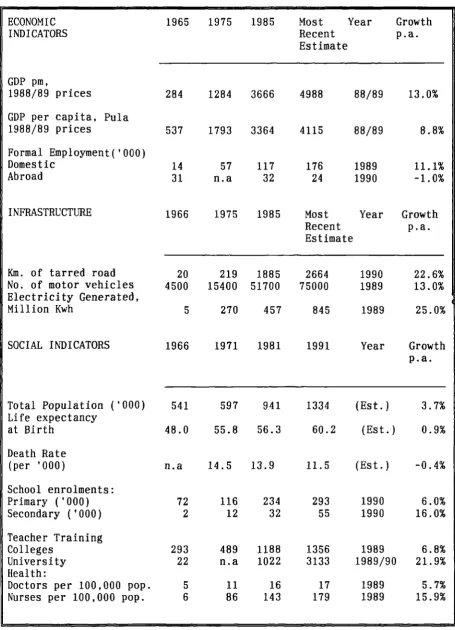
4.1 Development Indicators (1966-1991) . 109 4.2 Gross Domestic Product. 1966-1988/89
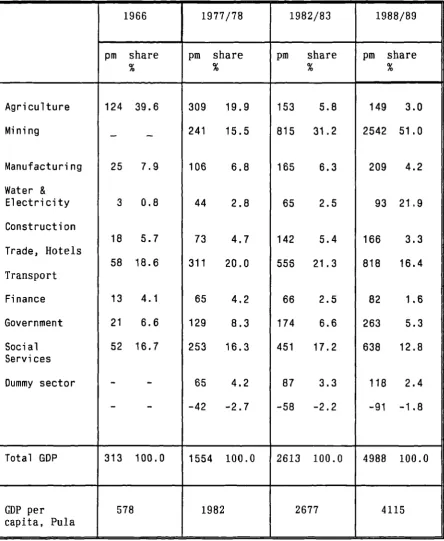
(selected years) . 110
4.3 Ownership of Manufacturing firms by Citizenship
(Selected years) 127
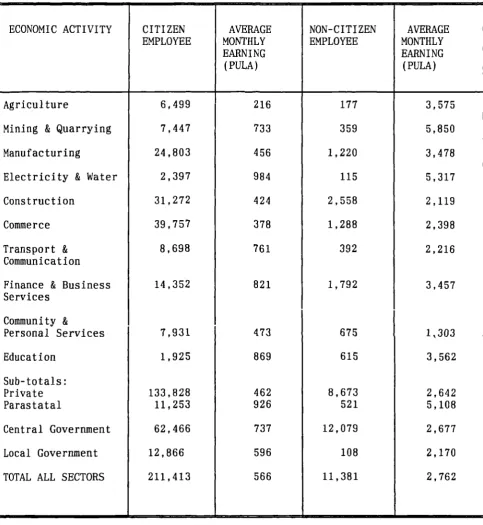
5.1 Estimated Average Earnings by Economic Activity
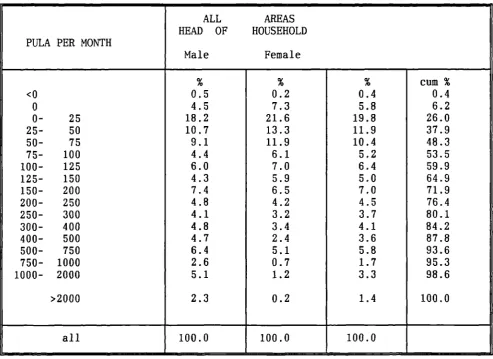
and Citizenship of Employee. 150 5.2 Cash Income Distribution. 153 5.3 Average Monthly Real Earnings of Citizens by
Occupation (all Sectors) Excluding Central
Government. 157
8.1 Estimated Number of Paid Employees by Economic
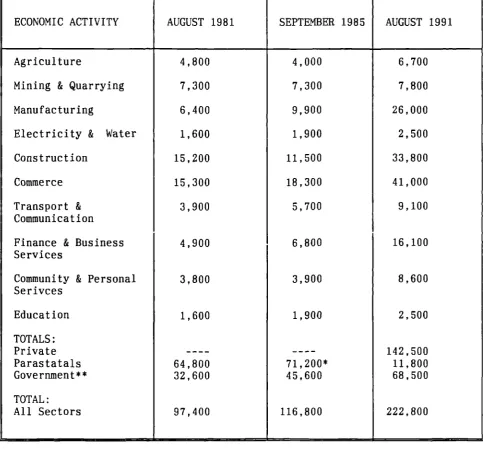
Activity (Selected Years) . 249 8.2 Estimated Number of Employees By Economic
Activity, Sex and Citizenship (March, 1991) . 250 8.3 Registered Trade Unions and Estimated
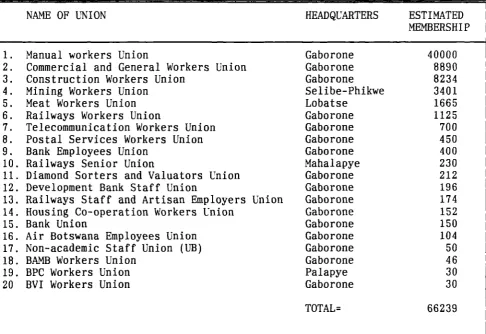
Membership, October, 1991. 251
CURRENCY EQUIVALENTS.
Value of the Rand. to the Pound.
Year value
1968 1.7
1969 1.7
1970 1.7
1971 1.7
1972 1.95
1973 1.85
1974 1.85
1975 1.85
1976 1.78
Value of the Pula to the Pound.
1977 0.68
1978 1.53
1979 1.72
1980 1.74
1981 1.70
1982 1.65
1983 1.7
1984 1.7
1985 1.9
1986 2.45
1986 2.71
PART ONE.
CHAPTER ONE.
INTRODUCTION TO BOTSWANA 1.1 Purpose Of The Study.
The purpose of this study is to examine the system of state repression and domination of organised labour in Botswana, a formally liberal democratic country. I argue that state repression and domination of labour were necessitated by the imperatives of economic development under a capitalist mode of production. Invariably, post-colonial state policies in developing countries, designed to meet the requirements of economic growth, necessitate various forms of state intervention in the economy and in industrial relations. My concern is to explore the specific form of this intervention in Botswana, which until the beginning of the 1990s was one of the few formally liberal democratic countries in Africa.
intervened through creating a physical and social infrastructure and establishing public enterprises in various sectors of the economy. At the level of industrial relations, the state intervened through a restrictive wages policy and labour legislation. The first wages policy was in place for close to twenty years from 1972 to 1990.
The third phase of Eotswana's peripheral capitalist development is the one that is emerging in the 1990s and was initiated by the adoption of the 1990 ReDort of the Presidenti p l Commission on the Review of the Incomes Policy, (hereinafter, the Presidential Commission). The third phase of Botswana's capitalist development is being characterised by changes which appear to indicate a transition from state interventionism to a more neo-liberal form of state involvement in the economy. Although this period lies outside the main focus of my analysis, I comment on it in my concluding chapter because of the implications it has for the future of the labour movement.
1.2 The Thesis
constitutes a repressive structure of social relations that is maintained by the state through the exercise of political power and legitimated through an ideology of nationalism. The corollary of the thesis, however, is that these structures of repression only set limitations to class actions; they do not prevent them.
1.3 Theoretical Overview
The theory that informs this study is that of historical materialism. My starting point is that the motive force of history is constituted by changes in the modes of production, the consequent division of society into distinct classes, and the struggles of these classes against one another. On the basis of this starting point, I argue that the repressive structures of social relations are historically specific and contingent upon the balance of class forces. It is the case, therefore, that in the course of on-going struggles, the subaltern classes will generate counter-ideologies to engage their class opponents. As Marx
(1968a:97) pointed out:
Men make their own history, but they do not make it just as they please; they do not make it under circumstances chosen by themselves, but under circumstances directly encountered, given and transmitted by the past.
19
can occur only within definite limits. These limits tend to relax as the level of technical and economic development rises and the working class increases its social weight (Fine, 1991)
The repressive structures of social relations constitute forms of labour control by the state on behalf of capital, whilst industrial action in various forms constitutes resistance to the capitalist control of the labour process. Labour control refers to those activities of representatives of capital to assert the authority of capital over wage labour and thereby incorporate labour into the capitalist mode of production. Labour resistance refers to those activities of wage labour through its representative organisations to defy the authority of capital and assert the autonomy of workers, thereby obstructing the incorporation of labour into the capitalist mode of production (Crisp 1984:1).
state-labour relation is interactive: the state influences the labour movement by imposing political limits upon it, but the labour movement in turn influences the state by its struggles from below.
On the basis of this argument, the study also focuses on the actions of the working class as autonomous actors within the limits of these repressive structure of control. I argue that in order to maintain social cohesion in an inherently unstable system of economic and political relations, the state has to concede to some of the demands of the working class, in order to gain legitimacy and support for the attainment of state-defined national goals, even though these goals are in the long term interest of the economically dominant class. That is to say, these concessions are made within the parameters of capitalist relations of production.
relationship, the state tries to sustain this social order by declaring universal legitimacy of the narrow interests of this class. As Marx (1970:65) pointed out:
Each new class which puts itself in the place of the ruling class before it, is compelled merely in order to carry through its aim, to represent its interests as the common interests of all members of society, that is, expressed in ideal form: it has to give its ideas the form of rationality, and represent them as the only rational universally valid ones.
The form in which particular class interests are presented as the general interests of society is through the ideology of nationalism. The prevalent ideological forms are those of "national interest" and "national development". Ideology is used in this context to refer to a particular form of human thinking that conceals class contradictions of society in metaphysical abstractions, and tends to present the society as a harmonious entity (Billig 1982:32). However, in a class divided society, national interest can not be taken for granted. It is important that such ideologies be put in their social context in order to reveal their class content.
The sense in which this thesis breaks new ground, that is, how it is an original contribution to knowledge about Botswana, is that it is a departure from the conventional analysis on Botswana's political economy, which have been limited to the descriptive analyses of
and dominant conceptual frames to reveal the character of a system of labour repression. I view the process of economic development and the relations of production which characterise this process as constituting a terrain of class struggle in which the interests of capital accumulation are in conflict with the interest of the working class. I also move beyond the current analyses of the political economy of Botswana by showing how the economic growth and structural changes that have occurred in Botswana in the last 25 years were accompanied by the process of class formation and class conflict. The process of economic growth and structural changes also shapes classes, which becomes as much an outcome as a starting point of the process of accumulation (Richard and Waterbury 1990:10).
bourgeoisie which now has structural links with the political elite. This is one other issue that the current analyses on Botswana has not taken on board.
BOTSWANA: BACKGROUND AND LITERATURE REVIEW. 1.4 Colonial Economic Legacy
Botswana lies at the heart of the Southern African sub-continent. The country is completely landlocked, being surrounded by South Africa in the south, Zimbabwe in the east, and Namibia in the west and north west. Physically, Botswana is a very large country. Its total land area is 582,000 square kilometres, about the size of France, or the state of Texas in the United States of America. However, Botswana's huge physical size is out of proportion to its population. The 1991 population census put Botswana's population at 1,326,796. Of this, 1,010,154 people were living in the rural areas, and only 316,642 lived in Botswana's four major urban areas. Gaborone, the capital city, had some
133,468 people, or more than a third of Botswana's urban population [1]. Although Botswana can boast about the Okavango Delta, the biggest inland drainage system in the world, which also has the most varied species of flora and fauna, most of the country is flat and dry. More than two thirds of the land area is covered with the thick sand layers of the Kgalagadi Desert. Most Batswana live in the eastern region of the
Botswana was colonised by Britain in 1876. However, for the ninety years of colonial rule, the country remained underdeveloped, and was used mainly as a labour reserve colony for South Africa. At the time of her Independence from Britain in 1966, Botswana was listed amongst the world's poorest countries. It was uncharitably labelled a "hopeless basket case" (Coclough and MacArthy 1980). Botswana was so lowly rated by the Colonial Office, so much that the country was even ruled from outside its borders, from Mafeking,
in the Cape Colony: the only case in the annals of the history of British imperialism. Harvey and Lewis (1990:15) argue that the country suffered social and economic neglect, even by African standards. They argue:
Despite more than eighty years of British rule, Botswana inherited very little in 1966: very little infrastructure, and very few people with education, training, or experience except that provided by traditional activities and low level work in South African mines and farms.. .until before Independence, . . .the country had no capital city, nor even the benefits of the small spending power of colonial administration. Another symbol of neglect was that Bechuanaland Protectorate never had its own governor like other colonies; the governor was the British High Commissioner to the Cape Colony, and later to the Union of South Africa.
Botswana must rank as one of the few countries in the world that never benefited even indirectly from the industrial revolution that changed the world, especially Europe and North America. Botswana inherited very little in terms of social and or economic
The developments that were bequeathed from the colonial period included a single track rail line built by the British South Africa Company (BSAC) to link Cape Province with Southern Rhodesia. There were very few economic activities outside of pastoral and arable farming. Manufacturing industry was almost non-existent, and there was no viable indigenous capitalist sector. Commercial activities consisted of a creamery, and a bonemeal and animal fodder plant in Francistown and an abattoir, Botswana Meat Commission (BMC), a maize and malt mill in Lobatse, and small shops
scattered around the country. Other commercial activities like wholesale and retail business activities were few and far between and were controlled by foreigners (Harvey and Lewis 1990).
The situation was even more hopeless in relation to human resources. In a population of about 549,000 at independence, there were only 71,546 children in primary schools, and 1,531 in secondary schools. There were only nine secondary schools with only two offering
km long, was just dirt tracks. The budget at Independence in 1966 was P13m, but revenues were only P6m, and Britain had to provide grants in aid to balance the budget and pay civil servants salaries. Compared to the other British colonies of Lesotho and Swaziland, Botswana was worse off, in the sense that these countries could at least boast of some modicum of commercial activities that were taking place in and around their administrative headquarters. But Botswana was administered from outside her borders (Harvey and Lewis 1990)
challenge and feared that the Germans in South West Africa (Namibia) and the Portuguese in the eastern part, Mozambique, and the land hungry Boers who had already annexed the southern part of Botswana, might between them annex the central part of Southern Africa, where Botswana is, and close the British route from its base in the Cape Colony to Central Africa. As a result of this, Britain instructed its representative in the Cape, Sir Charles Warren to inform Botswana Kings that their country had now become a British protectorate. This was the area up to latitude 22 degree south
(Coiclough and McArthy 1980).
Because of its economic unattractiveness, Botswana remained just a buffer zone between tthe Germans and the Portuguese, and no economic development took place. Colciough and MacArthy argue that the British attitude was to keep the financial cost of their involvement in Botswana to a minimum. The governor of Cape Colony is reported as having said that the British government would do "as little in the way of administration or settlement as possible" (Coiclough and McArthy 1980:12). In order to balance the cost of administering the country from local sources, the colonial administration introduced a Poll Tax in the territory.
political structures did not differ from actions of a colonialist state in a classical colony. For example in 1890 Britain extended its jurisdiction beyond 22 degree latitude up to the Zambezi River and in 1893 annexed Tati Concession, a part of Matebeleland and made it part of Botswana. Inside the country Britain was busy carving up the country and redesignating the fertile parts of Botswana like the Tuli Block, Molopo Farms, Gaborone and Lobatse into the so-called "Crown Lands", and demarcating "tribal reserves" for the indigenous people (Coiclough and McArthy 1980).
Other colonial state actions included the Credit to Natives Proclamation which restricted the borrowing capacity of Batswana to €35 a year, restricted Batswana's economic activity to agriculture, and reserved modern commercial activities to Europeans and Indians only [3]. The absence of any industrial or manufacturing base resulted in the establishment of a nationwide migrant labour recruitment network after the
introduction of the Poll Tax by the colonial state. As a result of this, many able bodied young men, especially from poor families who could not produce surplus to meet their tax obligations, were forced to go and make a living from South African mines. The migrant labour system became a traditional source of wage employment in colonial Botswana in particular and Southern Africa in general.
unions. This remained the situation until 1965 when Botswana was granted self-government. Independence came on 30th September, 1966.
1.5 Post-Colonial Developments
Since independence the country has undergone rapid economic transformation. There have been significant changes in the country's social, economic and physical landscape. Important indicators of these structural changes include the growth of formal sector employment, urbanisation, the building of good roads and telecommunications network, the creation of an educational and health infrastructure, and an improved standard of living for most people, especially those in urban areas (Harvey and Lewis 1990; NDP 7). In 1990, Eotswana's per capita income was P3000 and foreign reserves stood at P5 billion.
This economic performance has triggered numerous positive commentaries about Botswana: some economists have characterised Eotswana as an African, and sometimes even as a Third World economic success story, alongside Taiwan, Korea, Singapore (National Development Plans NIJP's 4-6; World Bank Annual Reports; Colcough and MacArthy 1980; Lewis and Sharpley 1988; Harvey and Lewis 1990). The most recent of these glowing commentaries on Botswana has come from Stedman
At a time when Africa's dismal economic performance and political corruption and mismanagement have given rise to a new intellectual movement called Afropessimisrrt, when analysts create generic models of African governments that include "lame leviathans",
"swollen states", "kieptocracies", and "vampire states", Botswana stands out as an example of economic development, functioning governance, multiparty, liberal democracy. It is... a
country akin to Switzerland, an exception that confounds generalizations, but whose very exceptionality prompts analysts to see it as a hopeful model for other societies [41
Stedman, like most commentators on Botswana, then goes on to give a description of Botswana's economic growth, increase in per capita income and growth in the gross domestic product. Some political scientists (Good 1992) have described Botswana as a shining example of liberal democracy in a continent notorious for one party states and or military dictatorship.
development in areas such as health and education, rural water supply, and even drought relief and drought recovery programmes as examples of how the benefits of rapid economic growth were distributed through out the society. They also point out that between 1974 and 1986 formal sector employment increased by 150 per cent while the population only increased by 65 per cent, and that this was a major gain in welfare because even rural households could benefit from the growth of employment through remittances from household members with urban jobs. They also cite as an example of the benefits of rapid economic growth the fact that only a small number of Batswana are still going to South Africa from employment. They argue:
So rural household gained not just from the absolute increase in the opportunity to get employment, but from a shift in the composition of job opportunities to working in Botswana rather than under the conditions of apartheid
[ p 277]
The new dimension that I raise in this study is to draw attention to class contradictions that have emerged. My argument is that in a class divided society, where private capital accumulation is seen as the best way of securing social production and reproduction, class contradictions inevitably arise because of the relations of productions embedded in this process are conflictual. The development path adopted by the post colonial state, and the state's reliance on private capital accumulation, necessitate the political control of the working class. To this end the state create structures of repression in order to trammel organised labour. However, as both the economy and organised labour grow quantitatively and qualitatively, these structures will be challenged by the working class.
1.6 State-Society Relations in Botswana.
are six registered political parties, but only two major ones, the ruling Botswana Democratic Party (BDP),
and the main opposition, the Botswana National Front (BNF) [5) . If all goes well, Botswana will go to the polls again in 1994 for the seventh time since
Independence.
The state-society relation in Botswana is, however, a complex mixture of repression, corporatism and paternalism. This itself is the result of a combination of several factors: a liberal democratic constitution that guarantees fundamental human rights and freedoms; and the populist nationalism of the BDP, which, although a strong advocate of capitalism, has been able to maintain its hegemony on Botswana's body politic. But as some commentators on Botswana like Molutsi and Hoim (1990:327) have pointed out:
[Botswana] Government is assuming some corporatist characteristics: policy initiation takes place within government ministries; persuasion is presented as consultation; limits are placed on participation in politics; government dominates communication processes, and ministries create and control most organised groups.
the ruling party. The idea that organs of civil society should lobby political parties and form alliances is officially discouraged, even though not prohibited by law, and the term "politics" refers only to the activities of political parties, while pressure groups, such as trade unions, are expected to take their problems to civil servants, rather than lobby politicians and seek to influence government action
directly (Molutsi and Hoim 1990)
Some of the researchers who have so fulsomely praised Botswana's liberal democracy and successful capitalist development have to a large extent ignored some of these issues. To me this is a serious omission and a gap in knowledge that has to be rectified. The post-colonial state's relationship with the labour movement forms a part of the picture that has not yet been critically analysed. What is often ignored in most analyses about Botswana is that the attainment of independence left the post-colonial state with an urgent need for accelerated economic development. Like most third world countries, Botswana could only achieve this by creating repressive structures, at both political and ideological levels, to control the trade union movement and make it acquiescent or supportive.
to develop as fast as possible and the post-independence political authorities felt that the only way to do this was to mobilise international capital and create conditions for the growth of domestic capital. The political elites called on the trade unions to join the government in the quest for national development, and dictated that the interests of the trade union movement in advancing the interests of their members should be subservient to the "national interest". Trade unions were treated as junior partners in the development process, and their role was seen as "cooperating" with government. This inevitably created tension between the unions and the state. As Damachi (1974) argues, the tendency in Africa is for governments to develop firm control over trade unions as part of a broad political effort to establish state supervision and management of conventionally autonomous structures. The control and supervision of trade unions is supposed to be done in the national interest for the sake of attracting investment.
and Dear (1984:4) point out though the state maintains the capitalist system, the state is not the exclusive domain of the capitalists, but interacts with society in a continuous spiral of responses and counter responses which in turn move the society toward some further development, generating new difficulties and leading yet to a further round of state intervention.
1.7 Summary.
I begin this study by critically exploring some of the Marxist debates on the state. My intention is to develop a theoretical framework for the analysis of the state-labour relation that is based on historical experiences, rather than logically derived from the capitalist mode of production. In so doing I hope to shift the focus from the top-down state-centered theory of the state onto a society-centred theory which views the state-labour relation interactive terms.
take place within the parameters defined for them by the state, as the guarantor of the process of private capital accumulation
political economy, the local state, and the organisational strength of organised labour.
In Chapter Four, I give an analysis of the class character of the Botswana state, and show that the roots of the present political elite go back to the pre-independence period. I also give an empirical overview of economic growth and structural transformation that have taken place in Botswana from Independence to 1990. In this chapter I show how the post-independence state has been in the forefront of the economic development through direct investment in infrastructural development and in the establishment of public enterprises. It is argued that these are
functions of the state to create the necessary conditions for production and reproduction of the society. The class character of the state and its functions lead us to the examination of the form of the Botswana state.
In Chapter Five I examine the capitalist form of the Botswana state. The form of this state is revealed in the state's relationship to labour. The organising principle of capitalism is the exploitation of wage
which has led to higher per capita income, but very unequal income distribution and poverty wages for the workers. This reveals the capitalist form of the Botswana state.
In Chapter Six, I examine the state's restructuring of the trade union movement, and the ideological habituation of the working class. These actions by the state against the working class derive from the state as the disciplinarian of labour on behalf of capital. It is argued that like in other parts of Africa, even in Botswana the primary role of state intervention in industrial relations is to restructure and remodel the trade union movement to make organised labour more amenable to state control. The working class has to be habituated to accept the existing exploitative relation of production through the ideology of national interest etc. It is hoped that in this way, the working class will become supportive or at least acquiescent.
it politically. As it will be shown in the analysis, the state gave with one hand and took away with the other. Whilst the state has created a floor of rights for the workers, and a trade union does not have to negotiate for recognition with an employer once it is registered, trade unions have not been allowed to organise in full freedom, and workers in the public sector, who comprise a large percentage of the working class in Botswana, are denied the right to form and belong to trade unions. Although collective bargaining is accepted in principle, the employers are not under any legal obligation to disclose information to the workers side for the purpose of collective bargaining.
In Chapter Eight I examine trade union growth and development in post-colonial Botswana. It is pointed out that one of the characteristics of the development of capitalist relation of production is the growth in formal sector employment as labour released form the previously non waged economic activities are absorbed in formal sector employment as wage labourers. I examine the numerical growth of the working class, disputes settlement and collective bargaining. It is argued that are integral part of the growth of trade union consciousness.
working class is by no means hapless and helpless victim of this repressive structure. I show how the working class in Botswana has grown restive, assertive and increasingly militant in its demands and had resorted to illegal strike actions and deliberately disregarded laws outlawing strikes. It is argued that these are indicative of the fact that workers are becoming more and more aware of their class position. These issues are germane to class struggle.
NOTES and REFERENCES.
1. See Central Statistics Office (CSO) Report on Population and Housing Census, Ministry of Finance and Development Planning, Gaborone
2. A citizen of Botswana is Motswana. Batswana is the plural form. Setswana is the national language. Botswana is largely homogeneous and Setswana is the langauge of about 85 percent of the people.
3. See The Bechuanaland Protectorate Credit Sales to Natives Proclamation, No 38 of 1923, Her Majesty Stationery Office, London.
4. In 1992, some ministers were implicated in corruption by the Kgabo Commission on Land Allocations in Pen-Urban Areas and by the Christie Report on the Operations of the Botswana Housing Corporation. Peter Mmusi, the National Chairman of the ruling Botswana Democratic Party (BDP), and the country;s Vice President, and Daniel Kwelagobe, the Secretary General of the party and the Minister of Agriculture, and Ronald Sebego, Assistant Minister of Local Government were forced to resign. Michael Tshipinare, another Assistant Minister in Local Government and Lands was fired from cabinet, and served a term of imprisonment for receiving a bribe of P500,000. Joe Letsholo, the late manager of Botswana Housing Corporation, as saiô to have kept close to P250,000 in a safe in his office. The Christie Comrnision also alleged that the deceased had in a very short time built an estate of over P3 million.
PART
CHAPTER 2
THEORISING THE STATE-LABOUR RELATION.
Introduction
The analysis that follows is primarily concerned with the relationship of the state to organised labour in a eveloping country. This relationship between state and labour cannot be understood without analysis of the state itself. In most Marxist theories of the state, the state has been viewed in terms of its relation to capital rather than labour. The state is often conceived as an instrument that can be wielded by the capitalist class, or more specifically in the case of Third World countries by the capitalist class in the 'centre' together with its allies in the 'comprador' or 'national' bourgeoisie.
My starting point is to look at the functions and forms as analytically distinct, though closely related aspects, of the state. My argument is that the function of the state in every society is to secure the conditions of production and reproduction. How the state organises this process is largely determined by factors such as the development of productive forces, class formation, class struggles, and the need to balance conflicting interests while at the same time guaranteeing the long term interests of capital accumulation. It is the constellation of these factors which I argue determines the form of the state. Whereas the state intervenes in the social and economic life of the society in which it resides, its form is determined by factors which are independent of its functions.
ideology, are real enough, there is always a space for struggle within the limits of those structures. In other words, organised labour is not an impotent plaything of the "capitalist state".
I shall start in this chapter by briefly examining some of Marx and Engels' theories of the state, developed in the context of Europe, which may be regarded as the precursors of the modern Marxist theories of the state.
I then move on to an examination of the state-labour relation in developed capitalism and show how the labour movement has been able to struggle within the structures imposed by capitalist relations of production to influence the state, thus making an impact on the form of the state. Whilst I agree that the state in a capitalist society always acts in a manner that will secure or attempt to secure the long term interests of capital accumulation, this action by the state is circumscribed by the balance of class forces, that is, by the strength of other classes, not just the interests of the "bourgeoisie" alone (Fine 1984; Kelly 1987) . Therefore the state cannot be seen as a mere instrument of class rule.
between labour and capital. My contention is that the form of the state is determined by the relations between classes and not by the ruling class alone. The
form of the state is not predetermined by is decided on the conjunctural terrain, which is a field of objectively possible outcomes of class and political relations in the course of the on going struggles [1]
2.1 Marxist Theories of the State.
I have chosen the above sub-heading, Marxist theories of the state, quite deliberately for the following reason. Classical Marxism contains a very incomplete analysis of the state. In fact Marx and Engels did not provide any systematic or coherent theory of the state and politics, but offered a variety of theoretical perspectives which coexist in an uneasy and unstable union (Jessop 1982). Their analyses of the state and politics are subsumed under their general critique of political economy of capitalism, and most importantly, their unit of analysis was the capitalist mode of production. However, the historical materialist method provides very useful guide-lines to be followed in the analysis of the state and its relation to civil society. [2]
appears in a celebrated passage in the Preface to a Contribution to the Criti que of Political Econom y , in which Marx argued that people enter into social relations that are independent of their will and that these relations are only appropriate to a given stage in the development of material forces of production:
The totality of these relations of production constitutes the economic structure of society, the real foundation, on which arises a legal and political superstructure and to which correspond definite forms of social consciousness.
This statement has attracted a charge of "economic reductionism" because it ultimately reduces the actions of the state, the legal and political aspects to the requirements of the economy. In fact in a well known statement in the Communist Manifesto, Marx and Engels (1968b) put it bluntly that the executive of the modern state is but a committee for managing the common affairs of the whole bourgeoisie. The implication here is that at least the executive of the state can be wielded by the capitalist class in pursuit of its own interests. The actions of the state executive are seen to flow directly from the requirements of capital.
that the transformation in the superstructure follows changes in the economic foundations is to imply that political action cannot alter the economic base or even the nature of class relations until economic factors themselves permit or require such alteration.
Engels' key statement on the state has not been spared the charge of instruxnentalism. In this statement, which appears in the The Oriain of the Family , Private Pr p ertv and the State, Engels links the emergence of the state to the inception of private property and the resulting breakdown of a previously "harmonious" communal society. According to Engels (1968a:586-587), the state is a product of society at a certain stage of development of society and has arisen to moderate the conflict engendered by conflicting economic interests in a class divided society. According to Engels, the emergence of the state
is the admission that this society has become entangled in an insoluble contradiction with itself, that it has spilt into irreconcilable antagonisms which it is powerless to dispel. But in order that these antagonisms and classes with conflicting economic interests might not consume themselves and society in fruitless struggle, it became necessary to have a power seemingly standing above society, that would alleviate the conflict, and keep it within the bounds of "order"; this power, arisen out of society, placing itself above it, and alienating itself more and more from it, is the state.
the state of the most powerful, economically dominant class, which through the medium of the state becomes also the politically dominant class and thus acquires new means of holding down and exploiting the oppressed class.., and the modern representative state is an
instrument of exploitation of wage labour by
capital (emphasis added).
These approaches have been under sustained attack especially because of their apparent determinism or reductionism. It is difficult to sustain the view that the state always acts in accordance with the interests of the capitalist class, especially in developed capitalist countries which have strong organs of civil society, like trade unions and other pressure groups. I shall return to this issue later, suffice to note here that the charge of reductionism or instrumentalism is not sustainable. The formulation that the state actions are always in the interests of the economically dominant class is not so much false as it is incomplete. It seems to me to ignore Engels's later clarifications of their position on the state. Engels' 'key statements' on the state must be read critically and in conjunction with other statements made by Engels to counter the charge of economic reductionism that had been made against him and Marx.
that the antagonists, the bourgeoisie and the proletariat, do not "consume" themselves and society in an endless struggle. Put in other words, although the state may be an "instrument" of class rule, how this instrument is actually used, that is, its form, is not something that inheres in the nature of the state, but is determined in the course of the class struggles.
In a letter to J. Eloch, Engels (1968b:692-693) argued that the charge of reductionism or determinism is an accusation unfairly levelled against him and Marx. In this letter he argues that, though the determining element in his materialist conception is production and reproduction in real life, that is, in the economic
"base" of society, various elements of the superstructure in turn exercise their influence upon the course of the class struggle; he includes here the
poliiical forms of the class struggle, constitutions established by the victorious class, and political, legal, philosophical and religious theories. He argued in this vein that, although economic conditions are ultimately decisive, political conditions and traditions also play a part in historical materialism. Engels further pointed out that people have sometimes laid more stress on the economic side than is due to it. But, he argued
the opportunity to give their due to the other elements involved in the interaction. (ibid.)
It is also worth noting what Marx said about the state in some parts of Europe and North America; this is important because it further underlines the uneasiness and instability of "Marxist" theoretical perspectives on the state. In this regard, Badie and Birnbaum (1983) and Jessop (1982) argue that all the states Marx referred to, like the Prusso-German Empire, Switzerland, England, and the United States, had capitalist economic systems but different state forms. According to Marx (cited in Badie and Birnham 1983:7), in the United States the state was weak and subordinate to civil society; the Prussian state was "nothing but a police-guarded military despotism, embellished with parliamentary forms, alloyed with a feudal admixture"; and the French state was dominated by
the executive power with its enormous bureaucratic and military organisation, with its ingenious state machinery.., a host of officials numbering half a million, besides an army of another half a million, [an] appalling parasitic body [thatl enmeshes the body of French society like a net and chokes all its pores.
Ziernann and Lanzendorfer (1977:150) have interpreted these remarks to mean that there is no Marxist theory of the state. They argue that:
I disagree with these authors when they argue that these apparently contradictory remarks are "only indications going beyond the level of political analysis and they are not put in the economic and social context" (ibid.). It is due to the different economic and social contexts within which these apparently conflicting theories of the state were articulated that Marx and Engels rightly took cognizance of the concrete situation. Their "contradictoriness" is derived from the fact that Marx and Engels were trying to explain a phenomenon that was spatio-temporal in its materiality. They were well aware that state forms differ.
I agree with Jessop (1982:9-12) when he argues that there are present in both Marx and Engels a wide variety of themes and approaches which are capable of
cohesion or an institutional ensemble, all are present in the classical works [3]
The question that arises is, what do these apparently "contradictory" statements tell us about the Marxist theory of the state? More specifically, what are the implications of these theories for state-labour relations. This is the point to which I now turn.
2.2 State-Labour Relation.
Industrial relations systems of developed capitalist countries differ; for instance the British industrial relations system is characterised by 'voluntarism', whilst in the United States and Germany there is said to be extensive state intervention through legislation. Nonetheless, there remain major common characteristics
In many countries incomes policies have been used in an attempt to modify or neutralise the results of collective agreements, and public sector workers, whose wage increases are highly visible, are recuired to conform to the government pay guide-lines in order to influence private sector wage settlements
(emphasis mine) (p.101).
Some Marxists (notably, Aithusser 1971; Altvater 1978) have argued that in developed capitalist countries, it is the state that maintains wage labour as an object of exploitation, reproduces general conditions of production, including labour power, and maintains legal relations. According to Althusser:
The reproduction of labour power requires not only a reproduction of its skills, but also, at the same time, a reproduction of its submission to the rules of the established order, i.e. a reproduction of submission to the ruling ideology for the workers, and a reproduction of the ability to manipulate the ruling ideology correctly for the agents of exploitation and repression, so that they, too, will provide for the domination of the ruling class "in words"
(p127-128)
Altvater (1978) argues that there are other conditions that private capital can not meet, because their production implies non-capitalist forms of production which are nonetheless crucial for capitalism as a mode of production. In order to secure the overall preconditions of capitalism, the state intervenes in the provision of physical infrastructure development, invests in the fields of education and health, and establishes the legal relations through which relations of legal subjects in capitalist society are mediated. The state also regulates the conflict between wage labour and capital and if necessary, uses repression against the working class through the law as well as the police and the army. The state also safeguards the existence and the expansion of total national capital on the capitalist world market through its military forces.
The strength of Aithusser lies in the fact that his approach to state-labour relations goes beyond simple reductionism and! or instrumentalism. In particular, he shows that state control of labour is not just repressive but also ideological. His weakness is that his account is too structuralist. He assumes that whatever the state does, functions perfectly for capital and does not give space to organised labour or class struggle. For example, Aithusser (1971:127-128) argues that the reproduction of labour power consists of learning rules of good behaviour, that is
the attitude that should be observed by every agent in the division of labour, according to the job he is "destined" for: rules of morality, civic and professional conscience, which actually means rules of respect for the socio-technical division of labour and ultimately the rules of the order established by class domination.
2.3 challenge of the Labour Movement.
The role the state plays in industrial relations in developed capitalist societies can be properly grasped in the context of concrete historical phases in the development of capitalism. Indeed, the history of capitalism is replete with examples of how industrial relations have changed over time as a result of class struggles. Let me refer to some important antecedents.
According to Gregory (1979), labour repression in England goes as far back as 1349 when an Ordinance of Labourers was enacted specifically to hold down wages in the face of an acute shortage of labour that was brought about as a result of the Black Death. The Act decreed that all men and women under the age of sixty must work for any master who wanted their services, and made it an offence to offer higher wages as this would entice workers to leave one master for another. The Act remained in place for many centuries and was used to fix wages and ensure that the law of supply and demand did not apply to the labour market.
conditions acceptable to them. At the same time, production requirements ushered in by the factory system made it possible for workers to form trade unions.
Though the state initially curtailed this right by the promulgations of the Combinations Act, the Act was repealed in 1875 and in 1906 the British Parliament adopted the Trades Disputes Act. This was not an act of goodwill on the part of the state. Kelly (1988:21) argues that this change was brought about by trade union pressure channelled through the Trade Union Congress, which was by then the largest and most powerful in Europe.
This legalisation was not a final victory. Gregory (1979:19) argue that even with the repeal of the Combinations Act, the English courts still felt
impelled by tradition to rest their disapproval of strikes on some formal legal grounds, they decided to dress it up for public consumption in what they called the doctrine of criminal conspiracy
In the United States, a change in labour law only occurred in 1935 with the adoption of the National Labour Relations Act, commonly known as the Wagner Act. According to Klare (1982), the Wagner Act initially aroused fierce opposition from the capitalist class which saw it as a concession to the labour movement by the state. The Act was even labelled by one newspaper as the most objectionable as well as a "revolutionary" piece of legislation ever presented to Congress that would "out-soviet the Russian soviets". Kiare argues that the American capitalists feared that legalising collective bargaining would mean their loss of control over the production process, and that by promoting unionism the Act would encourage radicalism and class conflict.
Overtly repressive forms of labour control have gradually been replaced by less repressive forms. The reason is largely due to the growing strength of the working class itself, not the benevolence of the
are the distorted reflection of the struggle between labour and capital for the realisation of their contradictory interests through the state, that is, they are a response to both popular struggles of the subordinate classes and contradictory demands of capital.
Kelly (1988:247) points out that in the decade after 1968, the advanced capitalist countries were shaken by strike waves which saw two British governments go down in electoral defeat, and in other European countries government enacted major concessions to restore social order. In 1968, France introduced the Grenelle agreement which gave the trade unions the rights to organise at the work place, collect dues and attend training courses without loss of pay. In Italy, the 1970 Labour Statutes established trade union right to organise and hold meetings at the work place. In 1972 Federal Republic of Germany introduced Works Councils and granted legal recognition of trade unions at. the work place. In 1973 and 1974, the British government enacted the Work Safety Act and the Security of Employment Act, respectively and Sweden enacted the law on Joint Determination.
manner in which particular interests are represented in the state institutions of intervention is based on the balance of class forces on the ground. The representation of some interests does not preclude or exclude others, but rather it is a question of preponderance, that is, there is an asymmetrical representation of interests.
Clarke (1991:6-9) argues the state has "selective mechanisms" through which to filter the demands placed upon it by various competing interests. What this means is that the state has to carefully balance the interests of capital, namely securing the conditions of sustained accumulation, and avoid compromising its legitimacy by identifying overtly with the interests of any particular class. Within the limits of the need to sustain the accumulation of capital as a whole, the particular policies pursued by the state and the particular interests served by those policies will be contingent on its own political priorities.
more apparent than real. Historically, economic processes have been dependent upon specific modes of state intervention, such that these apparently autonomous economic processes have been shaped by conditions of existence that the state actually provides. This does not mean that the state can be regarded as a mere instrument of class rule. Strinati
(1979:193) argues that the state is capitalist only in so far as it has structural connections with the capitalist economy and its own internal structures and modes of operations serve to secure the conditions of existence of capital accumulation. He argues:
The capitalist state is such a state not because it is determined by the capitalist economy but because it objectively organises structures indispensable for the functioning of the capitalist economy: the circuit of capital, the production, realisation and appropriation of the surplus value, generalise commodity production and exchange, the reproduction and restructuring of capital and labour power, the conditions that allow the circuit of capital to exist.
2.4 CONCLUSION
In capitalist countries, there is a fundamental structural connection between the state and the capitalist economy. The state creates conditions that are indispensable to the process of capitalist accumulation. How the state does this, however, is decided on the conjunctural terrain. Both the capitalist class and the working class make demands on the state. These demands are by no means evenly represented, but since the state cannot use coercion all the time, it is forced to make concessions to the working class.
These concession point to two issues: (a) the state, is institutionally separate from the economy, and has its own identity. But because of the structural connections between the state and the capitalist economy, the state is not neutral; (b there is a need to balance the conflicting interests in society. This "balancing act" is carried out within the parameters of securing or attempts to secure the long term interests of private capital accumulation, that is, in order to perpetuate the capitalist mode of production.
of time, reflecting the need for the state to continually readjust its position in order to maintain its hegemony and the cohesion of the social formation.
Hegemony is maintained not by coercion alone but also by securing the consent of the dominated class by means of political and ideological dominations, to the extent that particular interests of the capitalist classes are successfully presented as the general interests of all. This involves taking systematic account of popular interests and demands, shifting position and making compromises on secondary issues to maintain support and alliances in an inherently unstable and fragile system of political relations, and organising support for the attainment of national goals which serve the fundamental long term interests of the dominant class
NOTES AND REFERENCES.
1. Imperialism and cold war rivalry have been very crucial factors in peripheral capitalism. Imperialism has always intervened militarily, politically and at an ideological level, on the side of the peripheral capitalist state to defeat working class struggles. However, these defeats do not always end in surrender. The working classes of peripheral capitalist societies continue to engage their class opponent in the on-going struggles for better conditions of service and a more equitable distribution of social wealth, even if these struggles are carried within the framework of the existing exploitative social relations.
2. For an extended discussion of these guide-lines, it is useful to refer Jessop (1982), Chapter 5.
CHAPTER 3.
THE STATE REGULATION OF LABOUR: THE AFRICAN CONTEXT. Introduction.
The state in peripheral capitalist societies has not received the same kind of rigorous analysis as it has in developed capitalist countries [1] . There are several points that can be raised in connection with this. The first is that the state has always been analysed against the backdrop of the existence of an economically dominant class, "the bourgeois class", that is, that class that was characterised as the
"conquering bourgeoisie", which has captured for itself in the modern representative state, "exclusive political sway" (Marx and Engels 1968b:35-38)
In peripheral capitalist societies, however, this class exists only in a formative or inchoate form. As a result, it has often been the state, rather than the capitalist class, that has been spearheading the process of economic development in the post-colonial period. Some have argued that the state has actually
replaced the bourgeoisie (Evans 1982).
non-existent social services (housing, health and education) and backward productive forces. The majority of the people still live in rural areas in subsistence agriculture (Bean 1985; Chazan et al 1988; Todaro 1992)
The third point is that most peripheral capitalist countries are under either a one-party system or a military administration, or sometimes even a bit of both. Generally organisations of civil society such as trade unions, the media and various types of pressure groups are weak as compared to state organs like the army, police and civil bureaucracy.
The fourth point is that most analyses of peripheral capitalist societies, especially neo-marxist dependency theory variants, have been conducted on a gzireL' economic terrain, the major preoccupation being to show the effect of international capitalism on peripheral capitalist economies.
All these factors add to the difficulties in theorising at a general level the nature and structure of the state and politics in peripheral capitalist societies. Pinkney (1993:2) argues in this vein that:
It is these social economic circumstances, together with an unequal relationship with the
The contributions in the last two decades by several scholars, (notably Alavi 1972; Ziemann and Lanzendorfer 1977; Leys 1976; Beckman 1981) have made valuable attempts to analyse the state in peripheral capitalist formations. In my view, these debates have not broken out of the instrumentalist problematic of the state theory. The common thrust of these approaches is twofold: first, they reduce the form of the peripheral capitalist state to the requirements of the economic interests of imperialism and its local allies, defined variously as the national bourgeoisie or national comprador class; second, these theories are state-centred and ignore impact of class struggles on the state.
issues in order to control labour, not only because of international pressures but also because of the under-development of labour struggles.
3.1 The Theories of the Peripheral Capitalist State.
Flamza Alavi (1972) led the debate in his article on the state in Pakistan and Bangladesh. He argued that the original base of the state in peripheral capitalist countries lay in metropolitan countries and did not rest on the support of any of the indigenous classes; instead it subordinated all indigenous classes to the requirements of metropolitan capitalism. For this reason, he argued, the state jn perIpheraL capitalist societies was "overdeveloped". Alavi advanced two theses: first, that the peripheral capitalist countries have inherited an "overdeveloped" state in the form of a huge military-bureaucratic machinery; second, and flowing directly from the first, that this overdeveloped state has often pursued its own particular agenda and appropriated a large part of the economic surplus for itself. He argues:
The most sophisticated critique of the peripheral capitalist state theory in general and Alavi's thesis in particular has come from Ziemann and Lazendorfer
(1977). The key point which they make concerns the potentiality of the peripheral capitalist state to promote national economic development. They doubt whether this can be achieved under conditions of peripheral capitalism. In their attempt to go beyond Alavi, Ziemann and Lanzendorfer (1977:155) posit that:
With the expansion of trade into world trade and the rise of the world market, there has developed, since the days of European colonial expansion, an international economic s y stem in which the production and reproduction of all
societies in the world are integrated... With the spread of the dominant reproduction dynamic to world level, the pre-colonial self-centred development of the peripheral societies was blocked, being transformed, in regionally differentiated scope and form depending on the previous historical and natural conditions, into a complementary and subsidiary system attached to the metropolitan system (emphasis added).
their inner structure is adapted to the reproductive needs of the metropolis.
Ziemann and Lanzendorfer's argument (p.160-2) is that the peripheral state must be seen as an institution which serves the international economic system. At the
economic level the peripheral capitalist state aims at linking the world market with the national economy by breaking down the political frontiers between the world market and the national economy; for example, through its policies on imports and exports, foreign investment and exchange rates.
In a similar mode to that of Ziemann and Lanzendorfer, Amin (1987) has argued that the decisive quality that distinguishes the state in the capitalist centre from
the state in peripheral capitalism is that in the centre the bourgeois nation state has crystalised and its essential function is to fulfil the conditions that make possible autocentric accumulation; the state can
subordinate external relations to the logic of that accumulation. On the other hand, the peripheral state cannot control local accumulation but is subject to the demands of "globilised accumulation"; the direction it takes is determined by the direction taken by the central powers, especially through their instruments of intervention, the World Bank and the International Monetary Fund.
Muthunga (1980) also argues along these lines when he makes the point that Kenya is an exploited society dominated by American, British, French, German and Japanese imperialism. Muthunga (1980:3) gives an extreme and somewhat eccentric view when he states:
That is our economic base. Our neo-colonial state is in fact part and parcel of the international states of the bourgeoisie. The ruling comprador bourgeoisie are an agent of the international bourgeoisie. Our laws express the will of the international boure p isie first and foremost. the interests of the comprador bourgeoisie being championed because they primarily serve those of the former. Any interests derived by the Kenyan petty-bourgeoisie under this set of affairs are