Abstract
The goal of the current research is to investigate the relationship between perspective taking, empathy, prosocial behavior and acceptance of antisocial behavior. Perspective taking
facilitates the intention to feel empathy of others. A feeling of empathy leads to an increased intention to help. Reading plays an important role in the creation of perspective taking and
empathy. The following experiment was constructed to investigate if perspective taking through reading influences our thinking and behavior. Participants were divided into two
different groups, a perspective condition group and an information condition group. A survey was created whereby participants are asked to read a text. After reading; perspective taking,
empathy, prosocial behavior and acceptance of antisocial behavior were measured. The two conditions differ in the instruction, how to read the text. The perspective condition group was
asked to try to take the perspective of the people in the text. The information condition group
was asked to remember information of the text. It was hypothesized, that people in the perspective condition show more empathy, perspective taking and prosocial behavior
compared group the information group. The manipulation check showed that the manipulation was not successful, but the results showed nevertheless a nearly significant difference
between the groups in connection with blood donation. The mean value of blood donation in the perspective group was higher than in the information group. Although most of the
hypotheses were not confirmed, the experiment pointed out the importance of perspective through reading and its influences and it created a basis for further research.
Keywords: Perspective Taking, Reading, Empathy, Prosocial Behavior, Anti social Behavior
Abstract (Dutch)
Het doel van deze studie is te onderzoeken of er een relatie tussen perspectief innemen, empathie, prosociaal gedrag en antisociaal gedrag bestaat. Het perspectief innemen vergroot
de kans , dat iemand empathie voelt. Empathie voert wederom naar prosociaal gedrag. Het volgende experiment wil onderzoeken of perspectief innemen door lezen ons denken en
gedrag beinvloed. Lezen speelt een grote rol bij het perspectief innemen en het voelen van
empathie. De participanten worden daarvoor in twee groepen opgesplitst. Ene groep is de Perspectief conditie en de andere groep is de Informatie conditie. Er was een vragenlijst
construeert, waar de participanten een tekst moeten lezen. Daarna worden de constructen perspectief innemen, empathie, prosociaal gedrag en acceptatie van antisociaal gedrag
gemeten. De twee condities verschillen door de instructie, hoe ze de tekst meoten lezen. De participanten in de perspectief conditie kregen de instructie te verzoeken de perspectief van de
inwoners van het eiland Kiribati intenemen. De Informatie conditie groep kreeg de opgave zo veel mogelijk informatie te onthouden. Het wordt verondersteld, dat mensen in de Perspectief
conditie meer perspectief innemen en empathie en prosociaal gedrag vertonen, dan de mensen in de Informatie conditie. De manipulatie check toont aan, dat de manipulatie niet
heel succesvol was, maar het is een licht effect op prosociaal gedrag te zien. Het is te
verklarren door de manipulatie. Hoewel de meeste resultaten niet significant waren, laat het onderzoek wel zien, dat perspective innemen door lezen groot invloed heeft op empathie.
Verder is het een basis voor verder onderzoek.
Trefwoorden: Perspectief innemen, Lezen, Empathie, Prosociaal gedrag, Anti sociaal
gedrag.
Introduction
“Reading is a technology for perspective taking. When someone else`s thoughts are in your head, you are observing the world from that person`s vantage point.” – Steven Pinker, 2011
Reading is a prominent way for people to get information about the world. Nowadays people read a lot about war, assassination and refugees who want to start a new life, in a new country.
Most of the time, stories do not have a direct effect, because they happened thousands of miles away. Nevertheless people talk about the things they read. In the newspaper people read
about others, who try to flee from their own country because they have no chance to survive, such information influences people; it facilitates the intention feel empathy with this people
(Biswas, Riffe, & Zillmann, 1994).
If Johannes Gutenberg were still living today, he would be very surprised how his
invention, the printer in the 15Th century, has developed. There are millions of books available and there are also millions of different newspapers. People are able to get information about
others, which are living all over the world. Furthermore people are able to read books, such as fantasy books. They have nothing to do with their reality, but nevertheless people identify
with characters and their situations. Nowadays, a well read person is seen as intelligent and smart, because reading is seen as an enlargement of the horizon.
The question now is why is it important to be able to take the perspective of others. Van de Pieterman (2015) examined this topic and came to the conclusion, that perspective
empathy and a feeling of empathy can lead to the intention to help others, or to act in a pro
social way. (Vescio, Gretchen & Paolucci, 2003).
According to Stephan and Finlay (1999) empathy consists of two parts: the cognitive
and the emotional. The cognitive part refers to the ability to take the perspective of another person. The second, the emotional part, is divided into parallel empathy. This refers to the
emotional responses which are similar to the experienced emotions of the other. Furthermore there is reactive empathy, which is described as a reaction to the emotional experiences of
another person. What is well described here is how closely perspective taking and empathy are correlated to each other. Empathy has a lot of influence of the attitude towards others.
Empathy helps to positively affect the attitude, whereby a lack of empathy has negative effects in the attitude towards others.
Arousal seems to be another important topic in the area of reading. The word arousal can be described as the creation of emotions and feelings. Arousal can occur for some people
when certain literature is read. There are some possibilities to “manipulate words” and create a specific atmosphere. Sensitivity is one possibility to get people aroused. It is one of the most
important topics to create a specific atmosphere and leads the reader to a specific feeling. On the one hand an emotional text facilitates the intention to help others. On the other hand it is
also possible to inhibit the intention to help others by creating a lack of empathy (Silva, Montant, Ponz & Ziegler, 2012).
The personal factor is necessary to reach perspective taking, creating feelings such as empathy and in a final step increase the intention to help others. People are more able to keep
information in their heads if they read stories with personal influences and not only general information or “methodological created data”. Recognizing one’s own experience in a story
facilitates the intention to take perspective. It is also easier to feel empathy, because they nearly know how other people feel. Empathy increases the intention of prosocial behavior
(Steffen, 1997).
described in the method. After indicating the results, there will be a discussion of the findings
and its interpretation.
Theoretical framework
The importance of helping behavior is also indicated by Darwin (1859). He observed that it is necessary to support and help members of one’s group. Humans live in groups and living in
harmony predicts the ability to take the perspective to other persons and feel empathy with them (Pinker, 2011). Another important factor to survive is fitness. According to Kruger
(2003) the intention to help enhances the fitness and fitness enhances the life possibilities. Furthermore altruism and empathy facilitates the kin selection. The study also showed, that
empathy correlates with helping behavior. The studies showed that empathy and perspective taking are important and necessary for prosocial behavior. Long before people starts to read
is was important to look at each other. If reading facilitates empathy it is possible to promote prosocial behavior through reading. Nowadays, helping behavior, such as donating blood,
bone marrow or organs safe other people’s life. It could be possible to encourage people through reading to behave prosocial, such as donating blood.
Helping behavior is something people have in their genes, but it can also be learned, manipulated or developed. Visualizing the target is for example one method to increase the
intention to take perspective. Trzebiński (2005) emphasizes the importance of emotions and motivation. He indicates that the helping behavior increases if people feel empathy. If people
read a text and they find personal experiences which match with the story, the intention to help increases, because they see themselves in the story. They are more able to see the
negative emotions and consequences of not helping. One method to visualize a target is to
present a personal illness narrative (Charon, 2016). She indicates the importance of the personal factor when people should behave prosocial. With a personal illness narrative
Seeing consequences is an important factor of the intention to act prosocial as well.
This information is necessary for the manipulation in this study. People are more likely to act
prosocial if they see consequences. The normactivation model by Schwarz (1977), describes the theoretical background of helping behavior in more detail. According to De Groot and
Steg (2009) pro social behavior consists of three types of variables. The first variable is personal norms (PN). Personal norms are seen as personality differences. Not everybody has
the same amount of empathy intentions and it is not easy for everybody to take the
perspective of others. Furthermore each individual has different experiences and memories.
An example is somebody, with a fear of pins is not able to donate blood, although they want to help. The second variable is described as awareness of consequences (AC). The awareness
of consequences is described as knowing the consequences and the awareness what can happen in the case of notacting. The third variable is the ascription of responsibility (AR).
The ascription of responsibility shows how someone feels responsible for example a person, who needs help A manipulative text should therefore include personal stories, because the
personal norm is seen as important. Furthermore people feel empathy when they see
consequences, such as living or existing problems
The degree of consequences is another factor which seems to be important. The intention to help is influenced by the fact if helping is urgent or nonurgent (Shotland &
Stebbins, 1983).The findings confirm the idea of the normactivation model. The more urgent the situation seems to be, the more someone is willing to help. If the consequences are high,
people are more able to behave prosocial. The findings are in line with the Awareness of
consequences (AC) from De Groot and Steg (2009).
Arousal and personal experiences also play a role in understanding how empathy works. During reading people get aroused. In the context of reading arousal means, that
people are affected. Imagination of personal experiences predicts this arousal. If people are emotionally touched by a story it creates empathy (Stotland, 1969). Similar feelings or
situations are reasons why people have the ability to take perspective of others. Personal
Batson, Early and Salvarani (1997) designed an experiment, where people are divided
into two conditions. In both conditions the same story from a girl was shown. One of the
groups was asked the people to think how she would feel in this situation. The other group was asked how they would feel if they were in this situation. The first group showed self
oriented empathy. The second group showed not only empathy, but also selforiented distress. The second group felt more empathy in comparison to the other group. A high amount of
empathy influences the intention to prosocial behavior. Combined with the theory of Stephan and Finlay (1999) the first group feels parallel empathy with the girl and the second group
feels reactive empathy.
There was a lot of literature, which examine the relationship between empathy and
prosocial behavior. It is also interesting to look on the other side. Mackenzie et al (2010) identify, that a lack of empathy is responsible for antisocial behavior. In their study, they
concluded, that antisocial behavior, such as bullying could be decreased with creating empathy for the victim. Furthermore is the ability to take the perspective of others an
important step towards prosocial behavior. In an experiment from Chandler (1973), striking adolescents were playful forced to take the perspective of others. The people in the
experimental group showed long a significant longterm decrease of antisocial behavior.
Current study
In further progress an experiment presented, where perspective taking, empathy, prosocial behavior and acceptance of anti social behavior are measured and manipulated in order to
understand that relationship more in detail. Inspired from the example of Batson et al (1797), it is chosen for a manipulation with two conditions. The first condition is the Perspective
condition where people are asked to take the perspective. In the Information condition the focus is on information in the text, this condition is more factual.
On the basis of the presented literature the following hypothesizes were examined:
● People in the Perspective condition show more empathy than people in the
● People in the Perspective condition show more perspective taking than in the
Information condition.
● People in the Perspective condition show more prosocial behavior than in the
Information condition.
● People in the Information condition show more acceptance of antisocial behavior than in the Perspective condition.
● There is a positive correlation between perspective taking and empathy.
● There is a positive correlation between empathy and prosocial behavior.
● There is a positive correlation between perspective taking and prosocial behavior
→ + +
Method
Design and Participants
70 participants started with the survey whereof three of them did not finish. Therefore 67
two were of other nationalities. The average age was 26 years. 28 of the respondents were
male and 39 were female. There was a variance in highest education from secondary modern
school to PHD. Most of the respondent graduated from High School.
The sample consisted not only of students of the University of Twente recruited via Sona Systems, but also of people within the social environment, as well as unknown people
through the snowball sampling. Respondents recruited via sona system got points for participation. The other participants did not get a reward. When the participants started the
survey they were asked if they prefer the German or the English language. Because the manipulation text was an article presented in English, as well as in German, there were no
language issues. The items, which were originally in English and Dutch language, were translated into German and English.
The respondents are randomly assigned to a Perspective condition group and an Information condition group. The groups got different instruction how to read the given text.
The perspective condition group got a ‘Perspective Taking ‘instruction and the information condition group got a ‘keep information’ instruction. The experiment is a true experiment.
After asking demographical questions the participant got one text. One group got the
instruction to take the perspective of the people in the text. The other group got the instruction
to keep the information given by the text, because afterwards they were asked to write down the information.
The text was an article of the journal `National geographic` by Kennedy Warne. It was available in English as well as in German. The article is about the island Kiribati and the
consequences of climate change. In the text, the residents, as well as their personal stories are presented. The people are anxious and desperate, because they lose their homes and their
country. They try to save their country, but the Ocean does damage the island consistently. Young people went to other countries, because they did not see a future at the threatened
island.
.To measure acceptance of anti social behavior the scale from Klein Menting (2014) is used.
For measuring the independent variable the participants were asked if they would donate
blood or not with a Likert scale from 0 (strongly disagree) to 4 (strongly agree). In the end, the participants had the possibility to write their email address down, to get information
about next donation activities.
Procedure
The participants were placed in a quiet environment with a Laptop. Before they started the
survey they got an informed consent, where they were asked, if they are agree with the conditions of the experiment. After reading the informed consent they attached their
signature. The survey was made with Qualtrics and started with questions about demographical information such as sex, age, nationality and highest education.
The text from the journal ‘national geographic’ describes the situation of people living
in Kiribati, who are confronted with the consequences of climate change (Warne, 2015). There were two instructions before reading the text. The perspective condition group got the
instruction to take the perspective of the inhabitants of the island. The information condition group got the instruction to keep the information of the text, because the next task is to write
down all information they remembered. In both conditions after reading, the respondents were
asked to write down some information of the text
Each construct were measured with a 5point Likert scale from 0 (‘strongly disagree’) to 4 (‘strongly agree’). Then empathy was measured with 17 questions such as” The text had
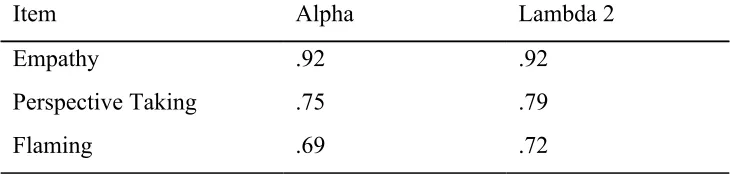
an emotional impact on me“. The Cronbach’s alpha for empathy was .92 and the Lambda 2 was .92. Afterwards perspective taking was measured with items such as “As I read the text, I
could easily imagine the events that occurred” (Davis, 1980). Perspective taking had a Cronbach’s alpha of .75 and a Lambda 2 of .80. Acceptance of antisocial behavior is
measures with Flaming. Before asking questions such as “When I see flaming behavior on Facebook, I find it amusing” flaming was explained with a definition and an example. The
was measured with the question if the respondents would donate blood and if they are willing
to leave their email address in order to get information about the next donation activities. At
the end of the survey the respondents were thanked for participating. In conclusion all constructs are reliable and that is important for further measurements.
All items were measured with a 5point scale from 0 to 4. Six items were recoded into
the same variable. One example of a recoded variable is the empathy item’ I didn't feel sorry for the described people when they were having problems’. In this case people were more
empathic if they score low. Therefore the item is recoded so that participants still score high if they feel empathy.
On the basis of high reliability of the constructs empathy, perspective taking and
flaming, it is now possible to calculate the means of the constructs. The mean value of
empathy is 3,14 with a standard deviation of 0,37. The participants scored in average 2,78 for perspective taking. There is an standard deviation of 0,62. The mean value of flaming is 2,30
with a standard deviation of 0,48. The mean score of blood donation is 3,20 with a standard deviation of 1,30 (Table 2). The construct prosocial behavior will be measured with Blood
Donation. Acceptance of Antisocial behavior will be measured with Flaming.
[image:12.594.64.429.543.630.2]
Table 1 Reliability of Empathy, Perspective Taking and Flaming
Item Alpha Lambda 2
Empathy
Perspective Taking Flaming
.92
.75 .69
.92
.79 .72
Table 2 Descriptive Statistics of Empathy, Perspective Taking, Flaming and Blood Donation
Empathy 3,14 0,67
Perspective Taking 2,78 0,62
Flaming 2,30 0,48
Blood Donation 3,18 1,28
Results
Before analyzing the research question and hypothesis it was important to make a
manipulation check. Therefore an ANOVA were carried out in order to look, if the perspective condition showed more perspective taking in comparison to the information
condition. The manipulation check demonstrated that there were no significant differences between the mean value of information condition and perspective condition. Therefore it can
be concluded, that the manipulation was not successful (Table 3).
Table 3 Manipulation check
Mean
Std. Deviation
Control 2,77 ,541
Experimen
t 2,81 ,731
Total 2,78 ,617
is possible that the demographic variable have influence of the other variables. For analyzing,
it was decided to calculate the pearson correlation. The results let see, that there is a
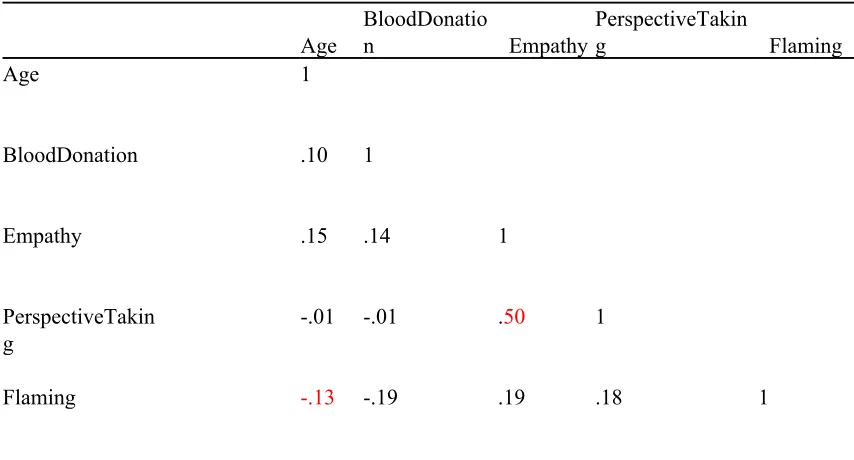
significant correlation between empathy and perspective taking (Pearson’s r = .50, with a p value of .00). Furthermore there was a negative correlation of .13 between flaming and age
(Table 4). The analysis of Pearson’s correlation showed two interesting correlations. First the correlation between perspective taking and empathy was relevant. The second interesting
correlation was between flaming and age. The hypothesis was that there is a correlation between perspective taking and empathy. The hypothesis is therefore confirmed. The second
finding, the negative correlation between flaming and age, was not hypothesized.
[image:14.594.69.496.427.657.2]
Table 4 Correlations between Age, Empathy, Perspective Taking and Flaming and Blood Donation
Age
BloodDonatio
n Empathy
PerspectiveTakin
g Flaming
Age 1
BloodDonation .10 1
Empathy .15 .14 1
PerspectiveTakin g
.01 .01 .50 1
Flaming .13 .19 .19 .18 1
Because the pearson analysis showed a correlation with the demographic variable age, it is
decided to make a Ttest in order to look if there was significant differences between the
condition. If there was a different, for example if people in one condition were significantly older compared to the other condition it could influences the results. The same would be made
with the demographical variable gender. The results showed no significant differences between the conditions with regard to age and gender (see Appendix).
Therefore it was chosen to do an ANOVA analysis, in order to investigate if there were, as hypothesizes, differences between the conditions. The factor was conditions and the
dependent variables were Perspective taking, empathy, prosocial behavior and acceptance of antisocial behavior. Pro social behavior is described as Blood Donation and acceptance of
anti social behavior is described as Flaming.
[image:15.594.67.340.594.740.2]
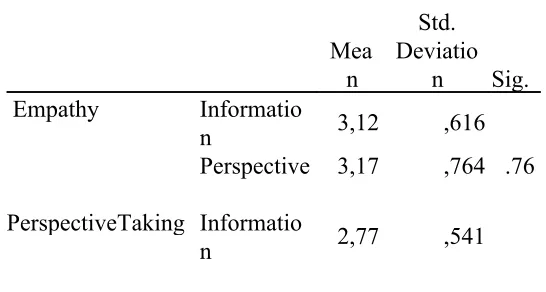
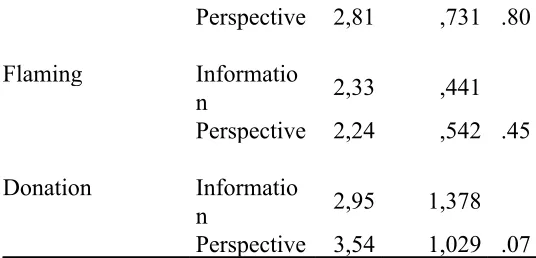
Table 5 Anova with Factor Conditions
Mea n
Std. Deviatio
n Sig.
Empathy Informatio
n 3,12 ,616
Perspective 3,17 ,764 .76
PerspectiveTaking Informatio
n 2,77 ,541
Perspective 2,81 ,731 .80
Flaming Informatio
n 2,33 ,441
Perspective 2,24 ,542 .45
Donation Informatio
n 2,95 1,378
Perspective 3,54 1,029 .07
The table showed, that there were no significant differences in the conditions in regard to empathy, perspective taking and Acceptance of Anti social behavior. There is one nearly
significant difference in the view of Prosocial behavior (F (, 1,67) = 3,5 and pvalue of .07). It is only nearly significant, because the pvalue is more than .05.
Furthermore it was interesting to investigate, if there was a difference in gender and
[image:16.594.69.337.70.199.2]empathy. Therefore an ANOVA was conducted with the dependent variable conditions and the factor gender. Women showed in average more empathy than men (Table 6)
Table 6 Gender difference in Empathy
N Mean
Std. Deviation
Male 28 2,91 0,66
Female 39 3,31 0,64
Total 67 3,14 0,67
The last question of the survey was if participants want to write down their email
address for further information over blood donation activities. 17 people left their email address. Eight of them were in the perspective condition and nine in the information
condition. It is no difference between the conditions in regard to this question as well.
Discussion
In conclusion the research question cannot be confirmed on the basis of the results. The manipulation in this experiment was not successful. One explanation for the fact, that there
were only some effects, can be based on the text itself. After finishing the survey a lot of people said, they found the text quite interesting, but by questioning the participants which
instruction they had it was noticeable, that said they had the perspective instruction as well as the information instruction. There was no difference between the groups.
Another explanation for these outcomes is the sensitivity of the topic. Nowadays the topic of climate change is omnipresent. There are a lot of organizations all over the world
which are fighting against climate change and its consequences. Prominent presidents and politicians know that it is an important problem in our world. Therefore other people who
were not interested in the topic of climate change in the past are now aware of the problem and the consequences. The participants in the information condition were asked to keep
information from the text. Because the text was personally written it is possible that they remembered a lot of information in connection to the residents and the consequences of
climate change and not of only facts. This led to empathy for the residents and perspective taking, although they had not the instruction to take the perspective of people in the text.
Another explanation is that a lot of participants came from the researcher’s own environment.
It is possible that they answered the questions social preferably, because they wanted to be seen as an empathic and social person. Furthermore the analysis showed that women were
more empathic in comparison to men. This result can be explained by the fact, that women have the ability to feel empathy more than men (Hodges, Laurent & Lewis, 2011). Another
aspect is the length of the text. It is also possible that they read the text only roughly. It was only possible to look at the time they needed for the whole survey and not the time to read
only the text. In discussions after completing the survey, some participants said to the researcher, that the text was too long for them, so that they weren’t very concentrated in the
Nevertheless there are some outcomes which were hypothesized. People who are more
empathic, for example people who scored high on the empathy scale, have also an increased
ability of perspective taking. This correlation was hypothesized before and it was confirmed in the results. People who take the perspective of others are more able to feel with other
people. Perspective taking creates a feeling of empathy. Another interesting finding is that older people have lower acceptance of antisocial behavior by means of flaming than young
people. It was not hypothesized, but it makes a lot of sense. The correlation can be explained by the fact, that flaming is something that happens mostly in this time (Avgerinakou, 2003).
Often older people don’t have any idea, what flaming is. Another important aspect is that older people often don’t handle with social media such as facebook (Althaus & Tewksbury,
2000).In discussion after completing the survey, especially older respondents told that they don’t really know what flaming is and that they had no experiences with it until now.
According to the norm – activation model which is introduced in the theoretical
framework, there are three components. The first is Personal norm, the second is awareness of
consequences and the last one is ascription of responsibility. The text was on the one hand personally written, so that the personal norm is given. Furthermore consequences of climate
change for the residence are presented in the text. Although the information condition got the instruction to keep information of the text, they also see the consequences. The people in the
information condition also keep the information of the residents and their feeling of losing their country. The norm activation model could therefore be one reason why the manipulation
had low effects (De Groot and Steg, 2009).
Another point is the personal factor. The personal factor facilitates remembering information
(Charon, 2016). The personal norm describes the fact, that people are likely to remember information of other people and their personal stories more than factual information. Because
of the high amount of personal stories in the text people also in the information condition keep personal information, for example of the destiny of the residents and the island itself.
This personal factor led to an increased feeling of empathy and perspective taking. People are more likely to keep information, whereby other people and their personal experiences are
another reason why there are no differences between perspective condition and information
condition. One reason for remembering personal stories of the text from people in the
information condition is the personal factor. People can easier remember personal stories than pure facts such as numbers of floods in one year or the increase of the sea level.
For further research it would be interesting to look at the individual personality of
respondents. Some people are more empathic than others. To handle with this one option could be to measure first the empathic and perspective taking capacities. Another possibility
is to make clear instructions. The information instruction could be directed to facts of climate change and consequences such as increase of sea level, instead of the instruction just to keep
information of the text in their mind. This would be more factual and the personal factor would be decreased. It would be also interesting to know which part influences the other. Do
people have to take the perspective of others to feel empathy? It is possible that empathy leads
to prosocial behavior and have acceptance of antisocial behavior something to do with a lack of perspective taking? After this study all the questions came to mind and it would be
interesting to make further research on the basis on this study.
The question now is why it is necessary and important to make further research with this topic. Prosocial behavior is often seen as voluntary help. Voluntary donations are an
important factor of medical help. The number of sick people who need blood, bone marrow or organs continuously increase. Therefore hospitals and organizations try to increase the
motivation to donate. Because such interventions such as financial incentives, allowing a marked in body parts, tax rebates or using organs which are not allowed to use before, are not
successful, the United Network on Organ Sharing (UNOS) try to find a more effective way to
motivate people to donate (McGee, 2005). According to McGee the most effective way is to focus on altruism as a motivating factor. She concludes that the best way to reach empathy for
the recipients is to show who they are and what stories they have. The best solution would be to create a forum where the transplant candidates are presented. In little narratives each
patient and their needs are presented. Long ago Switzer, Dew, Butterworth, Simmons and Schimmel (1997) came to a similar conclusion. They were searching for motives of bone
bone marrow donation. If people feel with the recipients they are motivated to act prosocial.
It is shown, that personal narratives, which present the sorrow of people facilitates the helping
intention. Thereby it does not matter if the sorrow is grounded of illnesses or existential problems, such as people who lost their homes because of rising water.
Furthermore as shown in the literature, reading influences prosocial behavior,
because reading facilitates the intention to take the perspective of others. It is also shown, that the personal factor in a text and the presence of consequences facilitates the intention to help.
The literature of personal illness narratives also supports this relationship. In conclusion the study took a closer look at reading and its influences. Although the manipulation was not
successful as it should be, the experiment indicates the importance of empathy and
perspective taking in order to behave prosocially. It is also shown, that reading influences
people. With this knowledge it is possible for the future to motivate people to act prosocially
through perspective taking and empathy. This knowledge could help for example sick people who need a donation of blood, organs or bone marrow or it led to an increased donation for
people which are affected by the consequences of climate change.
Literature
Avgerinakou,A (2003).Flaming in computer mediated interactions. Rethinking Communicative Interaction:New interdisciplinary horizon. John Benjamins Publishing Company. Amsterdam/Philadelphia. Retrieved from:
https://books.google.de/books?hl=en&lr=&id=7U49AAAAQBAJ&oi=fnd&pg=PA273&dq=flaming+ nowadays&ots=KPFIGwK7NH&sig=Dz_FOO4KjvvaHyxZ184PAKSjFpI#v=onepage&q=flaming%2 0nowadays&f=false
Batson,D.Early,S &Salvarani,G.(1997).Perspective taking: Imagining how another feels versus imagining how you would feel. Personality and social psychology bulletin.23(7), 751758
Biswas, R., Riffe, D., & Zillmann, D. (1994). Mood influence on the appeal of bad news. Journalism & Mass Communication Quarterly, 71(3), 689696.
Chandler, M. J. (1973). Egocentrism and antisocial behavior: The assessment and training of social perspectivetaking skills. Developmental psychology, 9(3), 326.
Charon,R. (2016). A Model for Empathy, Reflection, Profession, and Trust. Narrative Medicine . 286(15), 1897–1902.doi:10.1001/jama.286.15.1897
Darwin, C. R. (1859). The Origin of Species by Means of Natural Selection, or the Preservation of Favoured races in the Struggle for Life. London: John Murray
Davis, M. H. (1980). A multidimensional approach to individual differences in empathy. JSAS Catalog of Selected Documents in Psychology, 10, 85.
De Groot, J. I. M., & Steg, L. (2009). Morality and prosocial behavior: the role of awareness, responsibility, and norms in the norm activation model. The Journal of social psychology , 149 (4), 425–49. doi:10.3200/SOCP.149.4.425449
Hodges, S. D., Laurent, S. M., & Lewis, K. L. (2011). Specially motivated, feminine, or just female: Do women have an empathic accuracy advantage. Managing interpersonal sensitivity: Knowing when—and when not—to understand others, 5974.
Kruger, D. J. (2003). Evolution and altruism Combining psychological mediators with naturally selected tendencies. Evolution and Human Behavior, 24, 118–125
KleinMenting, S. (2014). 'You can't see me': the role of group conformity and anonymity within the social mediausing the example of flaming.Bachelor thesis University of Twente
Mackenzie, S., Bannister, J., Flint, J., Parr, S., Millie, A., & Fleetwood, J. (2010). The drivers of perceptions of antisocial behaviour. Home Office Research Report, (34).
McGee, E. M. (2005). Using personal narratives to encourage organ donation. The American journal of bioethics : AJOB, 5(4), 19–20. doi:10.1080/15265160500193966
Pieterman, Frank van de (2015) The role of perspective taking on prosocial behavior. Bachelor thesis
University of Twente,
http://essay.utwente.nl/68482/1/Pieterman%2C%20F.G.%20van%20de%20%20s1108530%20%28ve rslag%29.pdf
Pinker, S. (2011). The Better Angels of Our Nature, Viking Books.
Schwartz,S.H.(1977). Normative influence on altruism . Advances in experimental social psychology . Vol. 10Academic Press, New York, NY (1977), pp. 221–279
Silva, C., Montant, M., Ponz, A., & Ziegler, J. C. (2012). Emotions in reading: disgust, empathy and the contextual learning hypothesis. Cognition, 125(2), 333–8. doi:10.1016/j.cognition.2012.07.013 Steffen, V. (1997). Life stories and shared experience. Social Science & Medicine . 45(1), 99–111.
doi:10.1016/S02779536(96)00319X
Stephan, W. G., & Finlay, K. (1999). The Role of Empathy in Improving Intergroup Relations, 55(4), 729–743.
Switzer,G., Dew,M.,Butterworth,V., Simmons,R, Schimmel,M., (1997). Understanding donors`motivations: A study of unrelated bone marrow doners. Social Science& Medicine . Vol45(1), 137–147. doi:10.1016/S02779536(96)003279
Trzebiński, J. (2005). Narratives and understanding other people. Research in Drama Education: The Journal of Applied Theatre and Performance, 10(1), 15–25. doi:10.1080/13569780500053098 Vescio, T. K., Gretchen, B., & Paolucci, M. P. (2003). Perspective taking and prejudice reduction : the mediational role of empathy arousal and situational attributions, 472(April 2002), 455–472.
Warne, K.(2015). Rising Seas Threaten These Pacific Islands but Not Their Culture. National
Geographic. Oktober 15. Retrieved from:
http://ngm.nationalgeographic.com/2015/11/climatechange/kiribatiagainstthetidetext,
http://www.nationalgeographic.de/reportagen/kiribatisieweichennicht
Appendix
Informed Consent English:
‘I hereby declare that I have been informed in a manner which is clear to me about the nature and method of the research. I agree of my own free will to participate in this research. I reserve the right to withdraw this consent without the need to give any reason and I am aware that I may withdraw from the experiment at any time. If my research results are to be used in scientific publications or made public in any other manner, then they will be made completely anonymous. My personal data will be treated confidentially and will not be disclosed to third parties without my express permission. If I request further information or have any questions about the research, now or in the future, I may contact [email protected].
If you have any complaints about this research, please direct them to the secretary of the Ethics Committee of the Faculty of Behavioural Sciences at the University of Twente, Drs. J. Rademaker P.O. Box 217, 7500 AE Enschede (NL), telephone: +31 (0)53 489 4591; email: [email protected].
If you give your voluntary consent to participate in this research and agree with the processing of your data, you may now proceed.
Signature: ...
Informed Consent German:
"Ich erkläre hiermit, dass ich auf eine mir deutliche Art und Weise über die Art und Methode der Untersuchung informiert worden bin. Ich stimme aus eigenem freiem Willen zu, an dieser Forschung teilzunehmen. Ich behalte mir das Recht vor, diese Zustimmung ohne Nennung eines Grundes zurückziehen zu können, und bin mir bewusst, dass ich meine Teilnahme jederzeit widerrufen kann. Falls meine Forschungsergebnisse in wissenschaftlichen Publikationen verwendet oder auf irgendeine andere Art veröffentlicht werden sollen, werden sie vollständig anonymisiert. Meine persönlichen Daten werden vertraulich behandelt und nicht ohne meine ausdrückliche Zustimmung an Dritte weitergegeben werden. Falls ich, jetzt oder in Zukunft, weitere Informationen anfordern möchte oder Fragen über die Forschung habe, so kann ich [email protected] kontaktieren.
Falls Sie Beschwerden über diese Forschung haben, wenden Sie sich bitte an die Sekretärin der Ethikkommission der Fakultät für Verhaltenswissenschaften an der Universität Twente, Drs.J.Rademaker P. O. Box 217, 7500 AE Enschede (NL), Telefon: +31 (0) 53 489 4591; EMail:
Wenn Sie Ihre freiwillige Zustimmung an der Teilnahme dieser Forschung geben und mit der Verarbeitung Ihrer Daten einverstanden sind, können Sie nun fortfahren.
Unterschrift: ………..
Introduction:
Welcome Participant!
Thank you for taking part in my study. I am a psychology student at the University of Twente. Now I am writing my bachelorthesis in the field of Psychology of Safety.
In the following you will be asked to read a text . The text of the journal national geographic is about climate change. After reading the text you will be asked to answer a few questions. The study takes about 20 minutes.
Best regards,
Sandra Ellerkamp, April 2016
What is your age?
What is your nationality? ( Dutch, German, Other)
What is your gender? ( Male or Female)
What is your highest achieved level of education? (Secondary modern school (Hauptschule), Middle school (Mittlere Reife, vmbo), High school (Abitur, havo, vwo), Bachelor, Master, Other
Instructions:
Perspective condition:
The following text is about residents of Kiribati, which are confronted with the consequences of climate change. Please try to take the perspective of the residents as much as you can.
Information condition:
The following text is about residents of Kiribati, which are confronted with the consequences of climate change. Keep as much information as you can, because they will be asked afterwards.
English version:
It was the time called itingaaro, the dawn twilight, when the island was just waking up and the roosters were vying to outcrow each other and the angel terns were twittering their love talk in the breadfruit trees. People drifted sleepily into the lagoon to wash, splashing water on their faces, then tightening their sarongs and diving under.
The tide was full and taut like the skin of a pregnant woman. Beyond the lagoon the ocean stretched to the horizon. Marawa, karawa, tarawa— sea, sky, land. These are the ancient trinity of the people of Kiribati (keereebahss), the IKiribati. But the trinity is tilting out of balance. Mother Ocean isn’t the heart of providence the people have always known. She is beginning to show a different face, a menacing one of encroaching tides and battering waves.
IKiribati now live with the reality of marawa rising. This is the time of bibitakin kanoan boong—“change in weather over many days”—the Kiribati phrase for climate change. The people live with the fear and uncertainty of those words.
But it is surely suffering. The sea is becoming an unwelcome intruder, eroding the shoreline and infiltrating soils, turning wells brackish and killing crops and trees. Atolls like Tarawa rely for their fertility on a lens of freshwater, replenished by rain, which floats on a saltwater aquifer. As the sea level rises—a few millimeters a year at the moment but likely to accelerate—so does the level of salt water underground, shrinking the freshwater sweet spot.
“Now we hate the sea,” Henry Kaake told me as we sat in his kiakia, an opensided hut on stilts used for both sleeping and chatting with friends. “Yes, the sea is good for us to get our food, but it is going to steal our land one day.”
It is a mercy that rainfall is predicted to increase over the coming decades, although downpours are likely to be more extreme, causing flooding. As underground freshwater reserves are compromised by rising seas—and in Tarawa’s case, heavy population pressure—harvesting rainwater from roofs may offer an alternative. On Abaiang foreign aid has provided some communities with simple systems that catch, filter, treat, and store rainfall. As long as you have freshwater, you can cope with other changes—at least for a while. How long, no one knows.
Coral reefs are suffering as well—and worse is yet to come. As the sea grows warmer and more acidic throughout this century, reef growth is predicted to slow and even stop. Coral bleaching—when stressed corals expel the symbiotic algae that give them color and nutrients—used to happen every ten years or so. But it’s becoming more frequent and eventually could happen yearly, threatening coral survival and dimming the reefs’ living rainbow to a shadow.
Where reefs go, islands will follow. Atoll islands rely on deposits of sediment from corals and other marine organisms—often dumped onshore by storms—to keep their heads above water. They are like construction sites: If the materials run out, building will cease. A dead reef cannot sustain the islands it has built.
What kind of world is this, where the sea consumes its own creation?
When you travel to another island for the first time, before you do anything else, you announce yourself to the place by visiting a sacred site. You make a gift of cigarettes or a few coins, and the caretaker picks up damp sand and pats it on your cheeks and ties a tendril of green vine around your head. After performing this ritual on Abaiang, the caretaker of the shrine told me, “You now belong to this island.”
There is sometimes an expectation that the young will leave Kiribati and the old will stay. But some of the young choose to live a simple life on ancestral land rather than pursue prosperity abroad. Mannie Rikiaua, a young mother who works in Kiribati’s environment ministry, told me she would rather work for her own people than serve another country, despite her father’s urging that she migrate to a “higher place.“Part of me wants to go,” she admitted. But then she added, as if she had made her mind up once again, “Kiribati is the best place for my sons, regardless of the threats.”
To protect that home from the hungry ocean, some islanders have taken to planting mangroves, whose matrix of roots and trunks traps sediment and quells scouring waves. I joined some women who were picking ripe seedlings that dangled in bunches like string beans among the glossy green leaves of a mature mangrove stand. A few days later we planted them in a part of the lagoon that needs extra protection from king tides. It wasn’t much, but there’s little else islanders can do to hold on to their land except rebuild their seawalls when the waves smash them.
German version:
Zusammenfassung: Dem Pazifikstaat Kiribati droht durch den steigenden Meeresspiegel der Untergang. Die Atolle liegen meist nur etwa einen Meter über dem Ozean . Auch die Süßwasserspeicher versalzen. Genug Gründe, um Kiribati zu verlassen. Unser Autor Kennedy Warne traf Inselbewohner , die ihre Heimat dennoch nicht aufgeben wollen.
Itingaaro, die „Morgendämmerung“, bricht an, die Insel erwacht. Die Hähne krähen um die Wette und die Feenseeschwalben zwitschern wie verliebt in den Brotfruchtbäumen. Schlaftrunken laufen die Leute zur Morgenwäsche in die Lagune und spritzen sich Wasser ins Gesicht, dann binden sie ihre Sarongs fester und tauchen unter.
Die Flut steht hoch. Hinter der Lagune erstreckt sich der Ozean bis zum Horizont. Marawa, karawa, tarawa – „Meer, Himmel, Land“. Für die Bewohner von Kiribati bilden sie eine uralte Dreieinigkeit. Doch die Dreieinigkeit gerät aus dem Gleichgewicht. Die Südsee, die fürsorgliche Mutter von einst, zeigt jetzt ein anderes Gesicht. Sie droht mit tosenden Wellen und gierigen Fluten.
Bibitakin kanoan boong – „Wechselndes Wetter über viele Tage“ – heißt der Klimawandel in der Sprache der Einheimischen, die sich selbst IKiribati nennen. Sie leben mit der Angst und Unsicherheit, die er mit sich bringt.
Wie sollte es auch anders sein, wenn man ständig zu hören bekommt, dass tief liegende Länder wie das eigene bald im Meer versinken werden? Wenn die Regierung sagt, dass die 33 Korallenatolle im Zentralpazifik, die über eine Fläche größer als Indien verteilt sind, zu den „besonders gefährdeten unter den gefährdeten“ Ländern gehören?
Glaubt man den Prognosen, wird das TarawaAtoll innerhalb einer Generation unbewohnbar sein. Dort lebt auf einer Fläche von knapp 16 Quadratkilometern die Hälfte der Bevölkerung des Landes. Sind sie nicht die Nachkommen von Seefahrern, die Erben einer stolzen Tradition, die von Durchhaltevermögen und Überlebenswillen geprägt wurde? Ihr Paradies geben sie noch lange nicht verloren.
Das Meerwasser nagt bereits an der Küste, sickert in den Boden, versalzt die Brunnen und vernichtet Ernten und Bäume. Dass Atolle wie Tarawa derart fruchtbar sind, liegt an einer Süßwasserlinse, einer großen Blase unter der Erdoberfläche, die durch Regenwasser regelmäßig aufgefüllt wird. Doch wenn der Meeresspiegel tatsächlich bald stärker steigt als nur um ein paar Millimeter jährlich, wird sich auch der unterirdische Salzwasserspiegel heben und die Süßwasserreserven verdrängen.
„Das Meer ist jetzt unser Feind“, sagt Henry Kaake, während wir in seiner kiakia sitzen, einer offenen Hütte auf Stelzen, die als Schlafplatz und Treffpunkt dient. „Natürlich gibt es uns Nahrung. Aber eines Tages wird es uns das Land wegnehmen.“
Eines der ersten Opfer des steigenden Salzgehalts war bwabwai . Die meterhoch wachsende Sumpfpflanze wird auf Kiribati traditionell bei besonderen Festen verzehrt. Es reagiert empfindlich, wenn Salzwasser in die Gruben eindringt, in denen es angebaut wird. Womöglich wird bwabwai hier bald ganz von der Speisekarte verschwinden. Regierungs und Hilfsorganisationen helfen derzeit bei der Umstellung auf andere Pflanzen. Einer von vielen kleinen Versuchen, das Land zu retten.
Behandlung und Speicherung von Regenwasser ausgestattet. Solange genügend Süßwasser vorhanden ist, lässt sich vieles verkraften – zumindest eine Zeit lang.
Auch die Korallenriffe leiden schon jetzt. Und wenn das Meer im Laufe des Jahrhunderts wärmer und saurer wird, werden sie noch langsamer wachsen, vielleicht gar nicht mehr. Unter Stress stoßen Korallen die symbiotischen Algen ab, die ihnen die Farbenpracht verleihen und sie mit Nährstoffen versorgen. Während solche Korallenbleichen früher etwa alle zehn Jahre auftraten, könnten sie bald schon jährlich stattfinden und die Riffe in ihrer Existenz bedrohen. Der lebendige UnterwasserRegenbogen wäre dann nur noch trist und grau.
Wo die Riffe sterben, sterben bald auch die Inseln. Die Atolle sind aus Sedimenten von Korallen und anderen Meeresorganismen entstanden, die vor allem durch Stürme ans Ufer gespült wurden. Sie brauchen Nachschub, um sich über Wasser zu halten. Ein totes Riff liefert kein Material mehr und kann die Inseln, die es geschaffen hat, nicht am Leben erhalten.
Was ist das für eine Welt, in der das Meer seine eigene Schöpfung zerstört?, fragen sich viele IKiribati. Ist es nicht zutiefst ungerecht, dass ihr Land unter Klimaproblemen leidet, die sie selbst gar nicht verursacht haben? Seit den Achtzigerjahren feilschen Vertreter der Pazifikstaaten mit den großen CO2 Verschmutzern und versuchen, ihnen ins Gewissen zu reden. Was den Beitrag zum Klimawandel angeht, seien die Inseln Ameisen und die Industrieländer Elefanten, erklärte Teburoro Tito, der ehemalige Präsident Kiribatis.
Wenn man zum ersten Mal eine andere Insel betritt, geht man zuerst zu einer heiligen Stätte und legt ein paar Zigaretten oder ein paar Münzen hin. Der Hüter der Stätte klopft dem Besucher feuchten Sand auf die Wangen und windet ihm eine grüne Ranke um den Kopf. Auf Abaiang sagt er nach dem Ritual zu mir: „Jetzt gehörst du zur Insel.“
In manchen Familien wird es geradezu erwartet, dass die Jungen Kiribati verlassen und nur die Alten bleiben. Einige entscheiden sich dennoch für ein einfaches Leben auf dem Land ihrer Vorfahren, anstatt im Ausland ihr Glück und Wohlstand zu suchen. Mannie Rikiaua, eine junge Mutter, die im Umweltministerium von Kiribati arbeitet, sagt, sie wolle lieber für ihr Volk arbeiten als in einem anderen Land, auch wenn ihr Vater sie dränge, in „höhere Lagen“ zu ziehen. „Ein Teil von mir will durchaus weggehen“, gesteht sie. Dann fügt sie hinzu, als hätte sie gerade noch mal darüber nachgedacht: „Aber trotz der Gefahren ist Kiribati für meine Söhne der beste Ort.“
Zum Schutz ihrer Heimat vor dem Ozean pflanzen einige Inselbewohner jetzt Mangroven. Ihr Wurzelgeflecht und ihre Stämme bremsen die Wucht der Wellen und halten die Sedimente zurück. Ich begleite ein paar Frauen, die sich zwischen den grünen Blättern der ausgewachsenen Mangroven abmühen. Sie ernten die reifen Samen, die in Büscheln vom Baum hängen. Ein paar Tage später pflanzen wir sie in einem besonders gefährdeten Bereich der Lagune. Viel mehr können die IKiribati zum Erhalt ihres Landes nicht tun – außer vielleicht die Kaimauern, die von den Wellen zerschmettert wurden, wieder aufbauen. Oder etwa doch?
Obwohl die IKiribati auf kleinen verstreuten Inseln leben, wissen sie ganz genau, wo sie ihren Platz auf diesem Planeten haben.
Written Text:
Please write down the information you could remember from the text above. Its enough to write down the three most important facts about the story.
In the following you will be asked to answer a number of questions about empathy
Use the following range to describe to what extent you are agree or disagree with the statements. 0 means "strongly disagree" and 4 means "strongly agree"
Through this text I feel…
0 1 2 3 4
alarmed
upset
disturbed
compassionate
moved
warmhearted
sad
burdened
warm
worried
0 1 2 3 4
The text had an
I felt kind of protective toward the people described in the text.
I felt pity for the people
described in the text.
During reading I had tender, concerned feelings for people less fortunate than me.
I didn't feel sorry for the described people when they were having problems.
The people‘s misfortunes described in the text did not disturb me a great deal.
I was touched by the
things I read.
Perspective taking:
0 1 2 3 4
Before judging the people described in the text, I try to imagine how I would feel if I were in their place.
I tried to understand the people described in the text better by imagining how things look from their perspective.
I found it difficult to see things from the point of view of the people in the text.
I could imagine myself being in the situation that was described in the text.
I was mentally involved while I was reading the text.
When I had finished reading the text, I could easily put it out of my head.
I recognized that I was wondering how the text could have run out differently.
I could identify myself with the described people.
I asked myself what I would have done in the described situation.
As I read the text, I could easily imagine the events that occurred.
Flaming:
The next questions are about flaming.
networks and game lobbies, where there is a mix of people with differing ideologies from different cultures " (https://www.techopedia.com/definition/5356/flaming).( Example)
0 1 2 3 4
I think flaming is
annoying.
When I see flaming behavior on Facebook or other social media, I find it amusing.
I think flaming is usually
meant to be funny.
I think flaming is a norm for communicating in the digital world.
I think flaming is just an honest way of expressing disagreement.
In my opinion people flame because they just have to pass time when they are bored.
I think flaming has no dramatic consequences for the flamer himself.
I think flaming has no dramatic consequences for the victim who gets flamed.
I think it is the victim's own fault for getting flamed.
Prosocial behaviour:
Thankyouforparticipating.
Something different now, i want to ask you if you are willing to donate blood
0 1 2 3 4
I am willing to donate
blood
If you are interested in donating blood in the next time you are able to leave your email address if you want information of next blood donating activities
End of survey:
Thank you for participating my research project.
The real purpose of this study is to investigate to what extent reading influences empathy and perspective taking. I hypothesized, that reading influences empathy and perspective taking and that these factors influences prosocial behavior. Pro social behavior is measured with the blood donation question. Furthermore I wanted to indicate if there is a relation between reading and acceptance of antisocial behavior such as flaming.
If you are still interested in donating blood, i will give you the information surely
Recoded Variables:
● Empathy 15&16, Perspective 3&7, Flaming 1& 6
Randomizzation of Age and Gender in ANOVA Tables:
Group Statistics
Conditions N Mean Std. Deviation Std. Error Mean
Age Control 41 25,32 8,542 1,334 Experiment 26 27,23 11,247 2,206
Group Statistics
Conditions N Mean Std. Deviation Std. Error Mean
What is your gender Control 41 1,63 ,488 ,076 Experiment 26 1,50 ,510 ,100