A Thesis Submitted for the Degree of PhD at the University of Warwick
Permanent WRAP URL:
http://wrap.warwick.ac.uk/110850/
Copyright and reuse:
This thesis is made available online and is protected by original copyright.
Please scroll down to view the document itself.
Please refer to the repository record for this item for information to help you to cite it.
Our policy information is available from the repository home page.
S
u
b
m
it
te
d
A
u
g
u
st
1
99
Acknowledgements... iii
A Note on Sources...vi
List of Abbreviations...vii
Abstract... viii
PARI ONE Chapter One INTRODUCTION and OVERVIEW : The Study of International Regions in the Post-Cold W ar... 1
1.1 Main Trends and Approaches in the Study of Regionalism...2
1.1.1 The Case of Regionalism in the Mediterranean... 14
Chapter Two The Concept of Regionalism... 21
TABLE OF CONTENTS 2.1 Literature Survey of Regionalism... 22
2.2 Contemporary Theories about Regionalism... 37
2.2.1 The Concept of Regionalism...37
2.3 The Framework of Analysis... 51
2.3.1 The Transnational International Region... 59
2.3.2 The Intergovernmental International Region... 65
2.3.3 The Comprehensive International Region... 72
2.4 Conclusions... 76
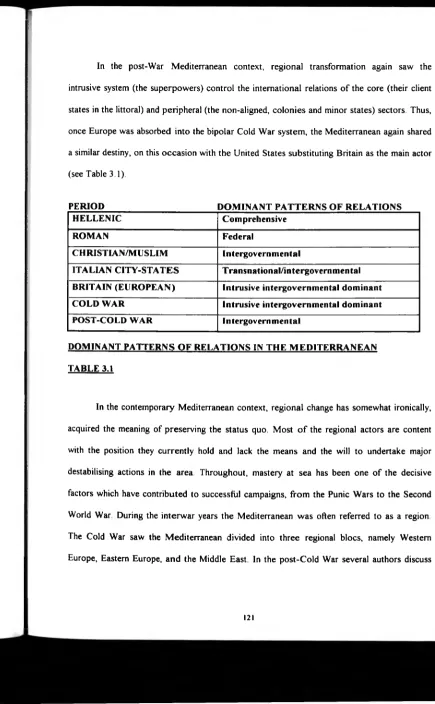
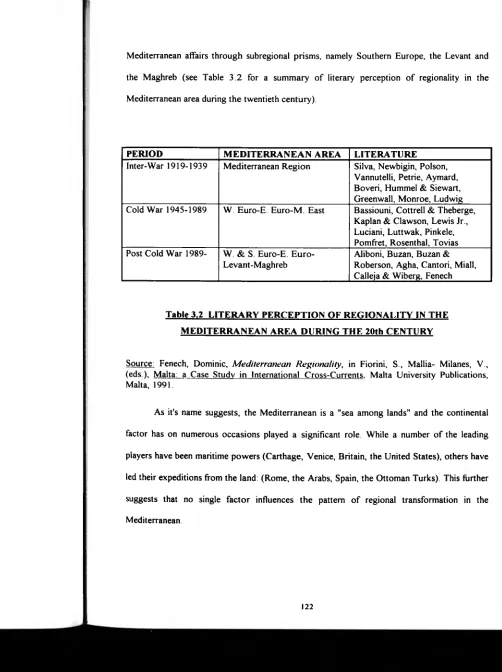
PART TWO Chapter Three An Historical Perspective on Regionalism in the Mediterranean... S3 3.1 The Mediterranean As A Region: An Historical Perspective...S4 3.1.1 The Early Mediterranean World: Hellenic Civilisation -Roman Empire (3000 B.C. - 565 A.D.)...85
3.1.2 The Christian/Muslim World (600 - 1517 A.D.)...92
3.1.3 The Rise of the European Nation-States (1500 - 1900)... 98
3.1.4 The Twentieth Century... 106
3.2 Conclusions...117
PARI THREE Chapter Eour Conceptualising Regionalism in the Mediterranean Area... 126
4.1 The Western European International Region...128
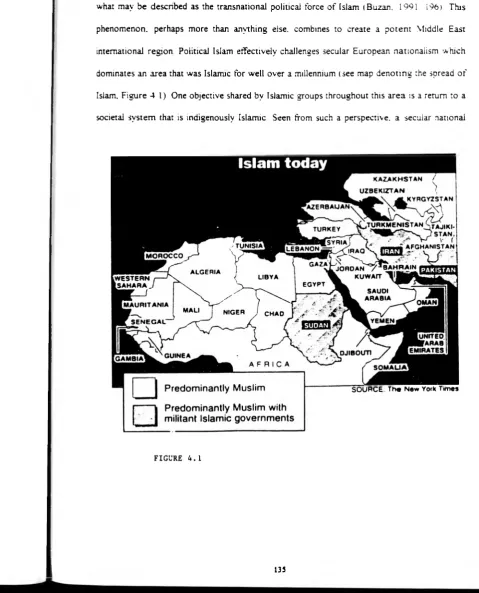
4.2 The Middle Eastern International Region...134
4.3 International Region Subgroupings in the Mediterranean...144
4.3.1 Degree and Types of Interaction in Southern Europe...148
4.3.2 Degree and Types of Interaction in the Levant...166
4.3.3 Degree and Types of Interaction in the Maghreb... 177
4.4 Southern Europe, the Levant and the Maghreb: Connections and Disconnections... 186
4.5 Conclusions... 193
Chapter Five An Assessment of Trans-Mediterranean Initiatives. 199
5.1 Trans-Mediterranean Security Initiatives... 200
5.1.1 The West Mediterranean Forum: "5+5 talks" (IG Model)...206
5.1.2 The Council of the Mediterranean (CM) (IG/Trans Model)... 211
5.1.3 The Conference on Security and Co-operation in the Mediterranean (CSCM) (IG/Trans/Comprehensive Model)...216
5.2 Conclusions: Prospects for Institutionalising Regional Dynamics in the Mediterranean Area, An Attempt to Square the Circle?...224
PART FOUR The Influence of External Powers on Regional Development in the Mediterranean Area Chapter Six The Role of Great Powers... 235
6.1 Introduction...236
6.2 The Role of External Powers... 237
6.2.1 The Role of an External Great Power: the United States... 242
6.2.2 The Role of an Internal Great Power: F'ranee... 249
6.3 Conclusions... 257
Chapter Seven The Role of Multilateral Organisations... 267
7.1 Introduction... 268
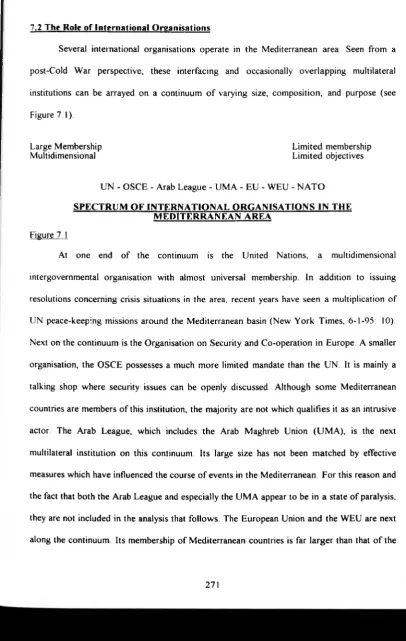
7.2 The Role of International Organisations...271
7.2.1 The Role of the European Union (EU)... 273
7.2.1.1 Global Mediterranean Policy...273
7.2.1.2 EU relations with Malta, Cyprus and Turkey... 279
7.2.1.3 Euro-Maghreb Partnership Policy... 283
7.2.1.4 EU Policies in the Levant and the Balkans... 287
7.2.1.5 EU’s attempt to navigate regional dynamics... 292
7.2.2 The Role of the Organisation on Security and Co-operation in Europe...302
7.2.2.1 The OSCE and the CSCM: What Relationship?... 310
7.2.3 The Role of the North Atlantic Treaty Organisation (NATO)... 313
7.3 Conclusions... 320
PART FIVE Chapter Eight General Conclusions: A Resurgence of Regionalism in the Post-Cold War World? Regional Dynamics in the Mediterranean Area... 327
ACKNOWLEDGEMENTS
I am grateful to the Rotary Club International for helping me meet the initial financial costs this endeavour has entailed. I also thank the academic staff in the Department of Politics and International Studies at the University of Warwick for their assistance and support, in particular, Barbara Allen Roberson, Charles Jones, Wyn Grant, Susan Strange, and Peter Burnham. I also thank the stafT at the International Office, in particular Director Anthony Gribbon, and the staff at Warwick University Library and Computer Services for their continuous assistance. I am also grateful to my brother Peter for his assistance throughout my research at Warwick and would also like to thank my colleague Richard Stables for his support and encouragement throughout this research project.
Most of all, however, a special thanks to my supervisor Professor Barry Buzan, for bringing his corrective expertise to bear on a much scribbled thesis draft and for his encouragement whilst writing this thesis. The final product has been improved a great deal as a result of his endless advice and support.
DECLARATION
I hereby declare that all the results presented within this dissertation were obtained by myself under the supervision of Professor Barry Buzan. with the exception of those instances where the contribution of others has been acknowledged. These results have not been submitted for a degree at any other institution.
A NOTE ON SOURCES
Throughout the three years of research on this project I have focused on secondary literature relating to the concept of regionalism in the discipline of international relations under the guidance of my supervisor, Professor Barry Buzan. I also reviewed primary and secondary documents referring to security initiatives in the Mediterranean. I achieved this by conducting specialised study and consultations at several British and international academic institutions which include the International Institute of Strategic Studies, the School of Oriental and African Studies (SOAS), the Royal Institute of International Affairs at Chatham House and the British Library in London, St. Antony’s Library and the Bodleian Library in Oxford, Warwick University Library, the Hellenic Foundation for European and Foreign Policy in Athens, the Mediterranean Academy of Diplomatic Studies in Malta, the NATO Library and Policy Planning Section in Brussels, the Institute for Security Studies of the Western European Union in Paris, the Centre for Peace and Disarmament at the Universität de Barcelona, the Council on Foreign Relations in New York, and the Library of Congress in Washington D.C.
LIST OF ABBREVIATIONS
5 + 5 - West Mediterranean Forum
AFSOUTH - Allied Forces of Southern Europe
CIS - Commonwealth of Independent States
CM - Council of the Mediterranean
CSCE - Conference on Security and Cooperation in Europe
CSCM - Conference on Security and Cooperation in the Mediterranean
EC - European Community
ECSC - European Coal and Steel Community
E FT A - European Free Trade Area
EU - European Union
GATT - General Agreement on Tariffs and Trade
GCC - Gulf Cooperation Council
IMF - International Monetary Fund
NACC - North Atlantic Cooperation Council
NATO - North Atlantic Treaty Organisation
OSCE - Organisation on Security and Cooperation in Europe
PFP - Partnership for Peace
PLO - Palestine Liberation Organisation
SADR - Saharan Democratic Republic
UMA - Union Maghreb Arabe (Arab Maghreb Union)
UN - United Nations
WEU - Western European Union
ABSTRACT
NAVIGATING REGIONAL DYNAMICS IN THE POST-COLD WAR WORLD
PATTERNS OF RELATIONS IN THE MEDITERRANEAN AREA
By providing a holistic viewpoint this thesis has gone some way to correct the imbalance in the secondary literature which has been dominated by coverage of the Mediterranean from either a domestic or international perspective.
The thesis clarifies whether there has been a re-surgence of regionalism in the Mediterranean since the end of the Cold War by examining regional dynamics in the area from five different perspectives. The first investigates the concept of regionalism in international relations. The second gives an historical perspective of regionalism in the Mediterranean. The third focuses on contemporary international relations in the Mediterranean. The fourth examines the influence of external actors in the international politics of the Mediterranean. The fifth provides a “reality check” of the Mediterranean in the post-Cold War world.
PART ONE
CHAPTER ONE
Introduction and Overview
THE STUDY OF INTERNATIONAL REGIONS IN THE POST-COLD WAR WORLD
This thesis deals with the issue of international regions in the aftermath of the Cold
War The study of the international politics of regions has often been described as being
underdeveloped (Buzan, 1991a 198, Neumann, 1994: 53) This thesis seeks to clarify the
confusion surrounding the theories, models, paradigms, and analytical frameworks already
existing in this field The aim of this introductory chapter is to summarise the main trends and
approaches in the study of regionalism It will also be demonstrated that the regionalising
world’ theme has re-emerged as a dominant topic in contemporary international relations
literature and a brief survey of recent references to regionalism in the Mediterranean area will
be conducted
1.1 Main Trends and Approaches in the Study of Regionalism:
Although the parameters of the post-Cold War world are still in a state of flux, it
seems apparent that the bipolar international system o f the past fifty years is being replaced by
a more multipolar configuration The demise of the Soviet Union and the limited withdrawal of
the United States from the centre stage of international affairs has ushered in a period where
international power relations are more erratic The equilibrium which the bipolar Cold War
provided, through its configuration of blocs, alliances, stalemates and sustained crisis, has been
superseded by a fluid system A distinct feature of the present transformation is that regional
politics have gradually gained in prominence
As the post-Cold War label suggests, the 1990s are not a period completely different
with the previous bipolar international system Contemporary international relations tend to be
neither moving in the optimistic direction of a new world order nor in the pessimistic one of
"chaos" and "turbulence" as has been suggested (Rosenau, 1992). Instead, the dynamics of
international relations appear to be going through a transitory phase, which one author
describes as "disorder restored" (Mearsheimer, 1992: 213-237). Cantori recently described the
post-Cold War pattern of relations as a dynamic multipolar international system based on
regions and regional subordinate systems within which the struggles o f nationalist identities
and hegemonic leadership rivalries are taking place (Cantori, 1994: 22). From a regional
perspective, this is illustrated by the fact that the principal change in the geopolitics of the
world-system in the 1970s and 1980s has been the decline in the relative power of the United
States This trend is a key feature of the post-Cold War international system and is a normal
cyclical occurrence (Wallerstein, 1993: 4)
The economic strengths of the European Union (EU) and Japan have been steadily
increasing since the mid-1960s, and the United States has not been able to keep pace. As a
result, U S. foreign policy in the past two decades has been centred around ways to slow the
pace of this loss of hegemony by exerting pressure on its allies to share the burden of global
security.
The emergence of a more polycentric power structure at the system level is therefore
certain to have a profound impact on regional relations The superpower grip on international
relations in some instances resulted in overlay. This occurs when the direct pressure of outside
powers in a region is strong enough to suppress the normal operation of security dynamics
among the local states (Buzan, 1991a 198).
On some occasions overlay stifled interaction among regional actors by limiting the
America and the Soviet's policy in Eastern Europe are examples of this development. Bipolar
intervention quelled regional hostilities when it took the form of overlay, as in Europe But
when it took the form of direct intervention, as was the case throughout the Third World, it
often amplified crises across a larger geographic area rather than subdued them (ibid : 208).
The collapse of superpower overlay has led some international relations scholars to
forecast that regional international politics will again become a dominant characteristic o f the
international system (Rostow, 1990: 3-7) The World Bank has recently made the argument
that economically, "regionalism is back and here to stay" (Melo and Panagariya, 1992: 1). The
increase in regional agreements that have been reported to the GATT in the last five years
tends to verify this trend (see Graph 1.1). In his economic analysis o f the world’s future,
Kennedy proceeds by regional analysis and comparisons and by identifying likely regional
winners (Kennedy, 1993). These analysts base their assumptions on the premise that a
multipolar system of states, where power is more evenly distributed among a number of
regional powers, is in itself conducive to the rise of regional politics (Buzan, 1991a: 207).
Buzan illustrates this development by identifying that regional dynamics are evolving against a
background in which the higher-level complex is also entering a period of transformation In
other words, the intrusive patterns from higher to lower levels which were characteristic of the
bipolar rivalry between the superpowers (the creation o f alliances, sustained crisis and military
Graph 1.1
Number of Regional Integration
Agreements Notified to GATT 1948-1994
Source: The Financial Times, 27 April 1995: p.7.
A plethora of paradigms have been conjured up hy international relations scholars, to
help explain the implications of the sea-change in international affairs since 1989. Huntington
predicts that the end of the Cold War does not mark the end of history, or a return of
traditional rivalries between nation-states, but a new phase in world politics where conflicts of
global politics will occur between nations and groups of different civilisations (Huntington,
1993: 22). Nye, Jr. describes world order after the Cold War as sui generis which cannot be
understood by "trying to force it into the procrustean bed of traditional metaphors with their
mechanical polarities" (Nye, Jr. 1991: 88). Power is constantly becoming more
multidimensional. Nyc, Jr. states that the distribution of power in world politics has become
like a layer cake. The top military layer is mainly unipolar, with the U.S. dominant in military
power. The economic middle layer is tripolar and has been for two decades, with the United
States, the European Union, and Japan governing. The bottom layer of transnational
interdependence shows a diffusion o f power to the peripheral sector of the international
system (ibid ). y , ^ ¡- 'A 3 ^ .
Buzan agrees that the diffusion of power in the contemporary system raises the
importance of actors at the bottom of the power hierarchy for the functioning of the system as
a whole. A reduction in the intensity o f global political concerns and a decrease in the
resources available for sustained intervention is conducive to the rise of regional politics
(Buzan, 1991b: 435). Buzan adopts a structural realist approach and a centre-periphery model
of the international system to depict the changes taking place. In his model of concentric
circles, the "centre" implies a globally dominant core of capitalist states; the "semi-periphery"
consists o f the more robust and industrialised states in the periphery; while the "periphery" is a
set of politically and economically weaker states operating within a network system mainly
created by the centre (ibid : 432).
A review of the various models noted above, reveals that there is no consensus about
the fact that diffusion of power from the centre to the periphery is taking place. Although the
pattern outlined above strongly suggests that a different pattern o f geopolitics is evolving in
the world, there is not enough consensus among international relations scholars on whether
the advent of a multipolar system will increase or decrease the likelihood of regional conflicts.
Cantori and Spiegal suggest that a multipolar structure is the system most conducive to
amplification of local conflicts In areas where the superpowers had a strong degree of
influence over the foreign policy agenda o f client states, like U S dominance over South
Korea, or the Soviet Union over Cuba, a high degree of co-operation took place. When either
and even led to outright conflict in places such as the Middle East, North Africa, South-East
Asia, and the Gulf (Cantori & Spiegal, 1970: 33-37).
Buzan counters that although a multipolar architecture permits for a more uncertain
chain of events, it is also less intense than a bipolar zero-sum competition. In addition, a
multipolar matrix grants regional powers more room to manoeuvre when conducting their
external political relations. Hence, the disappearance o f superpower rivalry and the
decentralisation o f power throughout the international system are two tendencies that
forebode an era where great power intervention in regional affairs is likely to diminish (Buzan,
1991a: 208).
Another factor that supports the regional resurgence school o f thought is that for the
r
first time the seeds sowad during the period o f decolonisation are in a position to develop now
that the superpower strait-jacket has been removed. In his study on regional conflict
formations, Vavrynen cites the 1950s as the starting point o f the rise o f regionalism time-line
(Vayrynen, 1984: 339 and 345). At the time, integration efforts in the industrialised world
were mainly sponsored by the great powers.
Decolonisation, the second main phase, paved the way for early efforts at regional
economic integration and regional security arrangements in the Third World. Economic
integration was mainly a response to the economic predominance by industrial powers.
Security groupings tried to cope with the departure of colonial powers and the multiplicity of
newly independent nation-states and their military establishments. The most recent phase of
regionalism is a manifestation of the effective spread o f power from the core of the
international system to its peripheries It has given rise to new regional power centres,
integration schemes, and regional conflict formations
Whether the absence of the superpower constraint will mute or exacerbate regional
conflicts will very much depend on the circumstances of each particular regional grouping In
some areas it may increase the intensity of conflict as rivals attempt to settle long subdued
scores, as is the case in the former Yugoslavia In others, as the example of the Middle East
demonstrates, it may encourage external assistance for regional endeavours at conflict
resolution. In any case, post-Cold War developments support the theory that the intrinsic
dynamics of subordinate systems are becoming more significant features of the international
system, a trend that is likely to continue as technological advancements are more widely
dispersed (Buzan, 1991a: 208). The recent increase in references to the regionalising world’
theme by scholars of international relations is reflective of the multiplicity of regional
agreements that have been signed since the end o f the Cold War (see Graph 1.1).
China has already established itself as an independent great power in Asia, with India
and perhaps South Africa poised to become dominant actors in their areas of the world. The
gradual retrenchment of the United States and Russia in Europe and Northeast Asia, presents
both the European Union and Japan with the opportunity to play roles in the international
system commensurate with their power (ibid : 207-208). Despite this development, can we
talk about the resurgence of regionalism in international relations9 Or are we perhaps
confronted rather by derivations and extensions o f constellations and potential conflict, the
nuclei of which lie elsewhere9 What theoretical explanation do we have to interpret this unit of
analysis? In addition, what are the empirical indicators of regional transformation?
In an attempt to answer these questions this research project provides a schema for the
analysis patterns of interaction within and between international regions This will include
assist in the task of identifying tendencies towards regionalism In this sense, the thesis adopts
the framework of regional system theorists who attempt to understand what role such factors
as symmetry or asymmetry in capacity and similarity or dissonance in ideology, play in
encouraging conflict or co-operation in regional international politics When international
regions interact, particular regularities occur, and under certain specific conditions certain
cause-effect relationships become more apparent The empirical systems approach encourages
the postulation of particular types of hypotheses for investigation Each question put forward
will assist in identifying which factors enhance or constrain the evolution and development of
international regions.
For example, do certain international regions stimulate, induce, or contribute to the
formation of other international region types? This will include examining which types of
foreign policy interaction are more likely to nurture similar models of international regions An
international region can influence other states in a number of ways: it can be perceived as a
threat against their self interests (the "threat effect"), or an international region can be
perceived as a role model to other group of states (the "demonstration effect").
In the first instance, an international region assists in the creation of other regional
types whenever other states feel that their interests are being undermined One could for
example argue that the North American Free Trade Area is mainly an initiative aimed at
countering the integration efforts being pursued by the European Union member states In the
second instance, an international region may simply be imitated because it has served as an
adequate model for problem-solving or it has demonstrated how a group of states can enhance
their international weighting by participating in a larger network system (the demonstration
effect) This may help explain the emergence of numerous regional integration schemes over
the years that in some manner or other have tried to replicate the process of European
integration that began in 1957 (Helleiner, 1994: 1-5).
These questions expand our field of concern from the task of international region
formation to that of interaction after such systems are functioning An initial assessment
reveals that there are no specific patterns observable in this field o f research - for instance, at
an economic level, how do certain regions react to the elaboration of specific policies of
multinational companies vis-à-vis those regions? Does economic interaction between societies
in an international region stimulate responses on a regional level somewhere else'1 The
interaction between transnational dominant international regions at first appears important as
this is an area of social action in which one of the constituents of "interdependence" is located
Both economic theory, such as Viner's concepts of "trade creation" and "trade diversion", and
communications theory (employed to measure the intensity of relations in trade or in shared
membership in international organisations) have registered some of the phenomena in
transnational society, but have not been able to explain their social and political relevance, let
alone their causes
Focusing attention on the interaction between already functioning international regions
reveals that no single recurrent pattern of interaction is discernible In general, two patterns of
interaction appear to occur frequently between intergovernmental dominant types of
international regions in the field of "high politics", (high politics is here referring to matters of
national prestige, survival, and defence or power status in international politics, the main
international regions types are elaborated on in the framework of analysis in section 2.3, but it
is not entirely clear what triggers these patterns to occur or why they sometimes appear to
The first type of interaction is the symmetry pattern: international regions interact in
such a way as to produce similar processes within both systems The second type of
interaction is the contrast pattern: international regions interact in such a way as to produce
different, if not opposite, processes within each region
The symmetry pattern is observable under the following conditions: international
regions tend to reinforce each other if i) there exists a mutual involvement between the
societies of the two international regions, ii) regional processes within one system hurt the
interests of the other, and iii) there is no real possibility o f participation in the other
international region. Once again the "threat effect" constitutes the main transmission belt In
less abstract terms, this hypothesis suggests that the success of one international region is
detrimental to the development of another similar system This effect forces the latter to co
ordinate policies among states in the area and to arrive at a consensus on how to maximise
their comparative advantages In his analysis of the Central American Common Market,
Schmitter suggests that relations with the international community are the primary factor that
influenced the development of integration once a certain level of internal integration had
already been achieved in what he defines as an "externalisation hypothesis" (Kaiser, 1968:
100).
The functioning of this pattern can also be observed in the interaction between the
European Union and other industrialised countries (primarily the United States). Throughout
the GATT Uruguay Round, and especially in the months leading up to the set deadline for
negotiations, pronouncements often reached quasi-hostility and the Round often looked like a
regulated conflict between international regions
The contrast pattern is observable in the following circumstances international regions
weaken other similar systems if i) they hurt the interests of members of other international
regions, ii) they are reasonably strong and offer rewards for participation, and iii) participation
in or access to the benefits o f the international region is an option that is reasonably open to
individual members of the other international regions.
In the Mediterranean area, one can argue that the European Union has weakened the
prospects of other regional movements in the vicinity such as the European Free Trade Area
and the Arab Maghreb Union. The opportunity o f direct association to a certain number of
European and Arab states to participate in the benefits of this comprehensive international
region is enough to discourage the states concerned from pursuing the establishment of their
own international region Hence, by offering sufficient enough rewards and remaining "open"
enough to make participation through membership, association, or special arrangement a
reasonable alternative, the European Union has hindered other regional efforts. (The impact of
the European Union on the Mediterranean is discussed in detail in section 4.4).
States which are confronted with the dilemma of either joining such an "open"
international region or attempting to form their own international region have two alternatives
to chose from: they can either strengthen their own grouping (the contrast model), or they can
individually seek direct accommodation with, or participation in, the other international region
(the symmetry model). If they opt for the second alternative, however, they do so at the cost
of undermining their own international region, and, potentially upsetting bilateral relations.
Contrary to the criticism of a "Fortress Europe", which stresses the threat of adopting
an inward-looking or closed model, an international region can become a threat to the survival
of other regional groupings when it is prepared, or potentially willing, to concede participation
in the benefits of its system to "outsiders". Such a possibility presupposes that there are real
rewards for participation, and that it cannot take place if there is a significant geographical
Latin American countries have had little choice but to pursue the contrast pattern in order to
counter the EU integration process, a number of African countries, tied to the EU by bonds
dating back to the colonial period, are seeking the symmetry course through participation in
association agreements.
Each hypothesis assists in assessing the specific features of any particular international
region and when applied to the Mediterranean area, will facilitate in the complex task of
identifying regional demarcation lines The complexities involved in formulating such a basis of
analysis is one of the reasons that has discouraged research into this area over the last two
decades. In particular, power theorists have tended to underplay the significance of the
regional level in international relations (Buzan, 1991a: 186) During the 1970s and 1980s
attention focused on relations between the superpower dyad, with regional dynamics largely
discussed as an extension of this power struggle However, the challenge which one must
confront when attempting to explain patterns of regional interaction and regional
transformation should be regarded as part of the process o f developing a coherent theory that
attempts to provide a framework categorising and illustrating the dynamics o f such a complex
research question. This problem has been increasingly prioritised in the post-Cold War era.
The collapse of superpower influence in international relations, coupled with the rise of
independent regional actors, implies a new epoch in which the region will again become one of
the crucial traits of international politics.
1.1.1 The Case of Regionalism in the Mediterranean Area.
This scheme of analysis has been applied to the Mediterranean basin in order to
examine the dynamics of regional international politics in the post-Cold War world. As a
conceptual entity, the Mediterranean area eludes a coherent and comprehensive definition.
Contemporary political and academic interpretations are susceptible to subjective reasoning.
For example the European Union defines the Mediterranean as countries with a Mediterranean
coastline plus Jordan. The inclusion of the latter transforms the logic of a geographically based
definition into one affected by political considerations (Henson, 1994: 1). Much like Europe,
the Mediterranean suffers from the vagaries of geography: just how far north, south, east, and
west should one take the boundaries of the Mediterranean area? Geographically, the concept
of a Mediterranean area is primarily limited to the three regional subgroupings which
encompass the basin, namely Southern Europe, the Maghreb and the Levant. However,
throughout this study, the concept of a Mediterranean area is geopolitical in nature. It
represents all countries which border the Mediterranean sea plus those countries with an
interest in the area. The regional dynamics operating in Central and Eastern Europe and
especially the Black Sea area also impact on the littoral states of the Mediterranean but are
excluded from this study for two reasons. First the patterns of interaction between these
subregions and the riparian states of the Mediterranean are of a largely limited nature. Second,
inclusion of this group of countries would only add to the already elaborate schematising
framework that has been set up without contributing any different dimension to the overall
investigation. Thus attention is specifically focused on the pattern of relations within and
between the Western European and Middle Eastern international regions and external actors
The main reason the Mediterranean area was selected as a case study is due to the fact
that in recent years there has been a rapid increase in Mediterranean regional rhetoric. The
purpose of this thesis is to investigate what substance, if any, is behind this rhetoric.
Given that the Mediterranean is an area whose varied regional parameters cannot be
easily reconciled in a single equation, the framework o f analysis proposed seeks to identify the
tendencies that contribute to regional variation in the Mediterranean This is sought by
applying the threefold scheme of analysis, described at the end of this chapter, to the various
phases of Mediterranean history, from Antiquity through to contemporary times.
Since the collapse of the Cold War a series o f conflict prevention and peace-building
proposals have been presented by Mediterranean countries in an attempt to promote the
notion of a Mediterranean region'. The breakthrough in September 1993 in the Middle East
peace process somewhat accentuated this effort. Unless all interested parties in the littoral are
involved in region-building deliberations, the goal o f establishing a trans-Mediterranean
regional network cannot be realised. A thorough analysis of these initiatives can be found in
chapter five. An assessment of pan-Mediterranean proposals will require applying the
framework of analysis to the Mediterranean area to detect which patterns of interaction are
taking place. As a means of introduction, a brief synopsis of the numerous contemporary
proposals follows.
The most far reaching trans-Mediterranean regional proposal put forward since 1989 is
the Italian-Spanish project. The proposal was officially presented in September 1990 and
envisages the involvement of all Mediterranean states (from Mauritania to Iran) in a
Conference on Security and Cooperation in the Mediterranean (CSCM) (Italo-Spanish CSCM
Non-paper, 1991; Ordonez, 1990: 1-8, Martinez, 1991: WEU Doc 1271)
A yet more intensive sub-set of regional dialogue can be found in the French initiative,
established in the western sector of the Mediterranean: the Western Mediterranean Forum
The Forum was officially launched at a foreign ministerial level in Rome on 10 December 1990
and was composed of four Southern European members (France, Italy, Portugal, Spain) and
five North African members (Algeria, Libya, Mauritania, Morocco and Tunisia) The Forum
developed into the "5+5 talks" when Malta joined the process in 1991 and attended the
follow-up meeting in Algiers in October 1991. The third meeting that was scheduled to take
place in Tunis in 1992 has not yet materialised This is largely due to the breakdown in
relations with Libya because of the Lockerbie affair and the deterioration of political stability
in Algeria For the time being, Libyan intransigence and the Algerian domestic crisis have
relegated the French initiative to diplomatic limbo (Joffe, 1994: 29-30)
A succession of other efforts at creating a trans-Mediterranean regional network have
been proposed In June 1992 a CSCM-type meeting took place at Malaga and adopted a final
document that was divided into three sections: a security chapter, a co-development and
partnership chapter, and a human rights chapter The Malaga document also incorporated a
preamble stating that although the conference was not mandated to devise direct solutions to
conflicts in the Mediterranean, the purpose was "to launch a pragmatic process of co
operation which will gradually gain in strength and coverage, generate a positive and
irrepressible momentum, and facilitate the settlement of these conflicts" (Ghebali, 1993: 100-
101)
Although the Conference on Security and Cooperation in Europe (CSCE) avoids
mentioning the CSCM project in the Helsinki Declaration of July 1992 entitled The Challenges
of Peace, it still recognises the significance of the Mediterranean to the future of European
We recognise that the changes which have taken place in Europe are relevant to the Mediterranean region and that, conversely, economic, social, political and security developments in the region have a direct bearing on Europe (CSCE Helsinki II Declaration, July 1992: Point 37)
Despite the indifference manifested by the CSCE (since December 1994 the
Conference has become the Organisation for Cooperation and Security in Europe, OSCE)
towards the Italian-Spanish CSCM project, it also organised a CSCM-type meeting in Malta in
May 1993. In fact, the CSCE seminar was held in accordance with the provisions of the
Helsinki Document of 1992 (CSCE Mediterranean Seminar's Chairman's Report, 1993). As
was the case at Malaga, the Seminar's participants were free to discuss problems pertaining to
the Mediterranean without the inhibitions normally associated with the onus o f a negotiated
text.
Throughout 1993, a group o f Mediterranean countries led by Malta proposed the
creation of a Council of the Mediterranean The forum could be established upon the
framework of the Council of Europe, creating facilities required to involve all the parties
concerned in a continuous dialogue towards the solution of problems affecting the area. The
Council would also incorporate the active participation of all integrated parties including the
European Union, the Arab Maghreb Union, and the Arab League. As guide-lines for
membership, the following criteria have been drawn up: adherence to the principles o f the UN
Charter, respect for the dignity of the human person and the Rule of Law, and respect for the
establishment and development of representative institutions (De Marco, 1993: 1-7)
When outlining the structure of the Council, proponents o f the idea proposed
appointing a Committee of Ministers, a general assembly with consultative powers where
representatives o f Mediterranean states can form a Parliamentary Assembly of the
Mediterranean, supported by a secretariat intended to co-ordinate activities of the Council in
the political, economic, social, environmental and cultural fields (ibid ). To date this initiative
has only received lukewarm support from representatives of the Maghreb region, particularly
Tunisia, for whom the establishment of a CSCM remains a priority. Yet the concept of a
Mediterranean Council remains a viable option as it complements the new spheres of co
operation that the EU has highlighted in its Euro-Maghreb Partnership document, which is
discussed at length in chapter four (Rato, 1994).
In November 1993 Italy proposed establishing a Mediterranean type "Eurocorps"
(Atlantic News, 1993: 2). The corps would incorporate Spanish, French and Italian military
and naval forces and would be the South's contribution to the pre-existing Eurocorps, which
brings together French, German and Belgian military units. At the start o f 1995, the three
Southern European Union member states and Portugal established a joint land force called
Eurofor, with a headquarters in Florence, and a joint naval force under French command,
called Euromarfor. The new forces fall under WEU command and control structures but are
also at the disposal of NATO (Financial Times, 2-6-95: 2)
The creation of such a security organisation could exacerbate the socio-economic
disparities that exist in the Mediterranean if it remained an exclusively European endeavour
On the other hand, it could assist in bridging the existing North-South divide in the basin if, for
instance, it extended membership to non-European Union Mediterranean member states But
bridging entails the notion of two way traffic The Southern Mediterranean states must be
allowed to participate in the decision making process if co-operation in the area is to increase
NATO's North Atlantic Cooperation Council (NACC) and its Partnership For Peace proposal
are models that a Mediterranean Eurocorps or "Medcorps" might consider imitating as a
means of achieving such an objective (Financial Times, 27/28-12-93: 3) Both promote the
active involvement of non-member states by granting observer status to interested countries in
security ventures among the parties concerned which serves as a step towards a better
understanding of the security concerns of the area
In the post-Cold War climate, there are suggestions that region-building theories are
re-emerging (Neumann, 1994: 53) After fifty years of stability under superpower
constellations, secondary and more minor powers are having to re-assess their strategies on
the basis of the changes in the world power structure In the seventies, interest in the field
declined, mainly because difficulties arose in locating empirical proof o f the theoretical
hypotheses concerning both the dependent variable (region transformation) and the various
independent variables (geographical size, political system, and the degree of development) in
the equation This thesis therefore attempts to go some way towards filing the research gap
that has existed for the last twenty years in this field of study and put the issue of regionalism
back at centre-stage For this purpose, this research project is structured as follows.
The first and second chapters are conceptual and deal with three issues: various
approaches to the study of the politics of international regions, a survey of the literature on
international regions, and the framework of analysis to be applied in the case study Chapter
Three provides a historical perspective of regionalism in the Mediterranean The aim of this
chapter is to outline the way in which the Mediterranean has evolved as a region which will
assist in evaluating on current regional tendencies
Chapters Four and Five are concerned with current trends in the international politics
of the Mediterranean The former examines the internal dynamics of the international regional
subgroupings bordering the Mediterranean area, namely. Southern Europe, the Maghreb and
the Levant, by applying the framework o f analysis to the three The latter assesses future
prospects for regional development in the Mediterranean It assesses the various
Mediterranean initiatives that have emerged in the last few years in a particular effort to detect
which tendencies, if any, point towards a resurgence of regionalism taking place in the
Mediterranean in the aftermath of the Cold War
Chapters Six assesses the influence of bilateral external intervention in the international
politics o f the Mediterranean. The penultimate chapter examines the relationship between
international organisations and regional developments across the Mediterranean Both
chapters attempt to identify what impact the collapse of the Cold War is having on intrusive
action in the Mediterranean
The final chapter provides a "reality check" of the Mediterranean area in the post-Cold
War era. It discusses the likelihood of the Mediterranean becoming an international region in
the near future and the possibility of alternative patterns of interaction.
This structure then provides a guide to the complex issues involved in addressing the
subject of regional interaction and transformation. It suggests the main themes for analysis and
CHAPTER TWO THE CONCEPT OF REGIONALISM
2.1 A Literature Review Of Regionalism
The aims of this chapter are to survey the literature on international regions', and to
suggest a framework for analysis that takes into account the major conceptual contributions in
international regions theory in the previous decades The results of these theoretical
investigations will later be applied to contemporary patterns of interaction in the
Mediterranean in an effort to identify any regional tendencies in the area
The notion of employing regions as a basis for international schemes to promote world
order is a relatively recent exercise. Peace initiatives presented during the classical world
order, o f European-dominated international relations until up to the First World War, had very
little o r nothing to say about regionalism (Hinsley, 1963: 10). Official and academic thinking
during the inter-war years continued to be universalistic rather than regionally based It was
only after the collapse of the League of Nations, and the return of alliance theory that
regionalism became, in the 1940s, a major topic of discussion.
Regionalist thinking developed rapidly in the decades of the 1940s and 1950s.
Prompted by the emergence of European regional organisations, regional research
programmes flourished in the 1950s and 1960s Interests in this area of study waned in the
seventies as the European integration experiment slowed down Another factor which
contributed to the lack of academic interest in regionalism was the influence o f the realist and
later the neo-realist approaches to international relations Throughout the 1970s and 1980s
they dominated the study of international relations and stressed the importance of assessing
interaction between the state and the international system Very little or no regard was given
developments in the international political economy has renewed academic interests in the
study of regionalism. This thesis aims to help achieve a better understanding of the process of
international region formation and transformation in light of post-Cold War changes in the
international system
The fundamental issue in international relations theory is which units of analysis and
which sources of explanation tell us most about events. While no one level of unit or source of
explanation is always dominant in explaining international events, examining interactions
among units, particularly durable or recurrent patterns in such interactions, reveals how units
are differentiated from one another, how they are arranged in the international system, and
how they stand in relation to one another in terms of relative capabilities (Buzan, 1995: 204-
205 and 212-213). In thinking about how to define varieties of international regions, it is
therefore worth noting the significance of interaction capacity for the different types of
interaction (Buzan, Jones, and Little, 1993a: ch 4 and see Buzan, and Little, 1994: 231-56).
In the first two decades after the Second World War the themes of the regional
literature can be classified under four headings Firstly, the theme of normative writing which
debates the problem of world order; second, in response to this mainly speculative material, a
number of empirical studies were carried out which attempted to answer the question of
whether regional security organisations are, in fact, effective in keeping the peace, third, a
constant flow of descriptive materials which either gave accounts of the regional structures in
traditional institutional terms, or attempted to deal with particular regions in the
multidisciplinary style of the new "area studies" approach which emerged in the late 1950s;
fourth, throughout this period there was a separate debate about the respective merits of
regional versus universal functional interaction The latter theme gave rise to the
"neofunctionalist" theories which are discussed at length below (Claude, 1959: ch 6 , see also
Banks, 1969: 339-340).
Although a review of the extant literature offers a heterogeneous body of knowledge,
it is possible to establish a level of coherence when these theories are arranged along a
continuum. At the two extremes of the continuum, regionalists focus completely on either the
internal or external factors that influence régionalisation. These two distinct perspectives are
supplemented by a significant body of literature which operates at the centre and at various
degrees along the continuum. Theorists in these categories attach different weighting to the
One group of scholars who emphasise the importance of internal dynamics when
assessing the international politics of regions are those that perceive the world through the lens
of civilisations. A recent article by Huntington postulates that nation-states will remain the
most powerful actors in global affairs, but the fault lines between civilisations will be the battle
lines of the future He defines a civilisation as a cultural entity: villages, regions, ethnic groups,
nationalities and religious groups are all characteristics that constitute civilisations. A
civilisation is thus the highest cultural grouping o f people and the broadest level o f cultural
identity that people have (Huntington, 1993: 22-4)
Huntington is essentially picking up from where other scholars contending with
theories of civilisation left off. Toynbee, Sorokin, and Wright have all pointed to the
authoritarian, egoistic and compulsive nature of civilisation as its war-making essence
(Toynbee, 1972, Sorokin, 1962; Wright, 1965) Braudel discusses at length the notion of
civilisations with particular reference to the Mediterranean in the sixteenth century (Braudel,
1973: 757). He identifies the three great Mediterranean civilisations, Latin, Islamic and Greek,
which he describes as groupings of sub-cultures linked by a common destiny.
There are at least three criticisms of this view First, it seems anachronistic Before the
nationalism of the nineteenth century, peoples felt truly united only by the bonds of religious
belief; in other words by civilisation. The rise of the nation-state has not replaced, but has
certainly diminished this trend Second, although increased interaction - greater
communication and transportation - among peoples has not produced a universal culture, and
has on occasion amplified perceived differences among states, it can also be argued that it has
the international politics of regions leaves little scope for the possibility that modernisation and
economic development have a homogenising effect and could produce a near universal
civilisation structure. This approach suffers from oversimplification, generalisation, selective
presentation of facts, and historical misinterpretation (Couloumbis and Veremis, 1994: 36-44).
Integration theory, which presupposes the concept o f a region, operates completely
within the internal dynamic end of the continuum The first o f the two integrationist theories,
and the most influential one, is that of the neo-functionalists. Haas, Lindberg, Scheingold,
Schmitter, and Nye are among those scholars identified with this viewpoint (Canton and
Spiegal, 1973: 468). One o f weak features of this theory is the apparent insularity neo
functionalists attach to the regional integration process In other words, their assumptions fail
to make theoretical provisions for the influence of extra-regional powers.
A similar theory was presented by Amitai Etzioni in the 1960s (Etzioni, 1965: 220-
221, and Etzioni, in James N Rosenau, ed , 1969: 346-58). He explains the existence of
regions and regional institutional co-operation by emphasising the common cultural
background variables' as well as data about the internal transactions between the inhabitants,
goods, capital and services Etzioni includes culture, tradition, language, ethnic origin, political
structure, and religion among some of the criteria used to identify the background variables'
and identitive elements.
Even though scholars such as Etzioni, Nye, and Kaiser made note of the role of
external actors in later works, they have viewed them as either positive influences upon
integration or, at most, as outside threats against which the subordinate system unites (Kaiser,
1968: 84-107; Etzioni, 1965; Etzioni in Rosenau, 1970: 70-71; Nye, 1965 870-84) Only Nye
later makes provisions for external regional powers to actually thwart regional integration or
to assume the role o f exacerbating conflict (Nye, 1970: 475).
Next along the continuum are the transactionalists who are also concerned with the
process of integration. In the 1950s Karl Deutsch argued that cultural interaction can become
r'c-'S
so intense that a region can become a security community (Deutsch, 1957;). According to
Deutsch, although the institutional strategies associated with the supranational co-operation
do not necessarily exist, common cultural traits can sometimes, in themselves, be strong
enough for the region to transcend international anarchy.
Those who focus on the internal dynamics of regional transformation such as Deutsch,
concentrate on indicators such as contacts, interchange, and communication between peoples
to measure the level o f regional integration (Deutsch, 1966). In the case o f the Mediterranean,
this perspective corresponds with the school of thought that advocates the case for the
establishment of a trans-Mediterranean security arrangement. Like their neo-functionalist
counterparts, transactionalists are not influenced by the effect external powers can have on the
integration process. According to Deutsch and his colleagues, "even where foreign threats
were present, their effects were transitory" (Deutsch et al, 1966: 25; see also Puchala, 1968:
38-64).
The literature that emerged shortly after publication of the Deutsch and Haas works is
classified as follows by Banks in 1969: i) the macroscopic approach to the identification of
regions using aggregate data analysis, led by Bruce Russett, which is examined below; ii) and
iii) the "neofunctional" investigations of Earnest Haas and colleagues, and the social
communication researchers of Karl Deutsch; iv) the research of Joseph Nye and others which
v) the work o f Brecher and other scholars which attempts to apply broad categories of
systems theory to regional studies (Banks, 1969: 349-350).
Banks also provides the following summary of trends in the literature during the first
two decades after the Second World War. "Regionalism and security" was the principal theme
during the first post-war decade. This was replaced by "integration" in the second decade and
the period of transition between the two, the late 1950s, coincided with the shift to "systems
thinking" (ibid.: 337). Bengt Sundelius also stresses that social dynamics are the main
determinant in the creation of a region (Sundelius, (ed ), 1982: 177-96). He argues that
common cultural traits spur regional elites to perceive their periphery in a similar manner. This
view is shared by Fleming who stipulates that the stronger the pan-ideology of the regional
environment, the more politics will be oriented toward relationships beyond immediate
neighbours (Fleming, 1969: 116).
Although the external dimension is brought into the equation, this assessment is still on
the internal dynamic wing of the continuum. This perspective may explain why there has been
a resurgence of regional rhetoric in the Mediterranean following the collapse of the Cold War
Fearing that the stability offered by the bipolar nature o f the international system of states was
being replaced by a more anarchic and volatile model, with the European Union gradually
increasing its influence in the Mediterranean theatre of operations, Mediterranean countries
reorganised their joint activities in the early nineties to at least give the impression that they
would not allow outsiders to completely dictate the course of events in the area. In the case of
the Mediterranean, one of the features that would figure in the analysis o f those focused on the
internal factors, would be the similar climate shared throughout the basin that in turn has had
an affect on the lifestyles of the inhabitants Similar agricultural trends would be another
feature of investigation. Neo-functionalists also focus on linguistic trends to help them
delineate human collectives. In the case of the Mediterranean area, linguistic diversity
(Semitic, Greek, Arabic, Latin) only adds to the complexity of attempting to establish regional
borders upon these lines
More recently, a group of scholars who might be labelled neo-transactionalists have
responded to the increasing importance of regionalism They argue that the sources of
regionalism are to be found in the interaction of domestic politics and the changing
international economy, and not in structural changes in the distribution o f power among states
(Busch and Milner, 1994: 273). They base their theory on the fact that current trends in
regionalism precede the decline of U S. hegemony and the collapse o f bipolarity Anderson
and Norheim suggest basing the definition of regionalism on continental demarcation lines, and
then by subdividing these areas according to the intensity of interaction among the countries
on cultural, language, religious and stage-of-development criteria They emphasise the
necessity to include an assessment of historical trade data as this sheds light on the patterns of
relations in any particular area (Anderson and Norheim, 1994: 26). Stubbs and Underhill
describe the concept o f regionalism as having three distinct dimensions The first concerns the
extent to which countries in a definable geographic area share significant historical experiences
and contemporary international relations The second dimension stresses the extent to which
these same countries have developed socio-cultural, political, and/or economic linkages that
distinguish them from the rest of the global community. The third factor is the extent to which
a specific group of geographically proximate countries have developed organisations to
regulate crucial aspects of their collective affairs (Stubbs and Underhill, 1994: 33 1-332). This
group of scholars must be credited for identifying the significant role international
the impact of the increasing globalisation o f the international political economy on regional
dynamics (Keohane and Hoffman, (eds ), 1991; Palmer, 1991). In his assessment of
regionalism in the world economy, Richard Gibb views the resurgence of current regional
dynamics as an attempt to promote the theory of free trade on a more restricted geographical
basis: "the resurgence of international regionalism is the result rather than the cause of
growing tensions within the established economic and social order" (Gibb, 1994: 7-34). Hettne
also tends to emphasise the transnational forces of regionalism in his assessment of the
regional factor in the post-Cold War international system (Hettne, 1994: 136-137). One
criticism against these neo-transactionalists is that they tend to underplay the important
influence that intergovernmental international relations still have on the process of regional
development The increasing importance o f the political economy of regionalism therefore
dominates too many of the observations in this school of thought. Nevertheless, I adopt this
transactionalist approach in my framework of analysis in an attempt to assess the influence of
transnational forces on regional development in the post-Cold War climate
At the centre of the continuum is a considerable body o f literature which takes into
consideration both the internal and external factors that influence regional transformation In
1961 Modelski had already identified that international regions are the result of changing great
power configurations and variable regional integration pressures (Modelski, 1961 150).
Young developed this school of thought when he highlighted the influence that changes in the
nature of the international system have upon regional system development He particularly
focused on the demise of colonialism, the general rise in political consciousness and the spread
in active nationalism, and the absence of large-scale international war and accompanying
polarisation (Young, 1969: 341).
The protagonists in this category are Cantori and Spiegal whose study is used as one
of the principal yardsticks in this thesis (Cantori & Spiegal, 1970). Their comparative
framework divides all regions, subordinate systems', in their terminology, into a core and
periphery. They define the core as the grouping which consists o f the principal actor/s in a
given region. The periphery on the other hand, consists of states that are in some form
alienated from the core. They are much more politically, socially and culturally heterogeneous
than the latter, and interaction among the periphery is much less frequent than in the core.
Cantori and Spiegal also dedicate a significant section of their study to the influence the
international system has upon the international politics of regions They label this component
the intrusive system' and largely discuss the various ways external actors can influence the
course of events within a particular region.
Cantori and Spiegal's theory on the international politics o f regions therefore offers a
more complex and broader model for the analysis of regional transformation through
operationalizing three sets of variables: the core sector, the peripheral sector, and the intrusive
system. Although this model may be theoretically attractive, it remains difficult to
operationalize its cluster of variables when dealing with multidimensional international regions.
The specification of the variables appears confusing, and sometimes overlapping, as it is
difficult to determine clearly into which set of variables the data properly fit. In addition, there
is little discussion on how the various variables interact with each other - a fundamental