Strengthen the HRM value by a position
in the management team.
Thesis MSc - Human Resource Management
Author:
Monique Kosse
(S1927981)21 – 09 – 2018
Master of Science in Business Administration - Human Resource Management
University of Twente
P.O. Box 217, 7500 AE Enschede The Netherlands
1st supervisor: Prof. Dr. T. Bondarouk
1
Preface
Dear reader,
This research has been written to fulfil the graduation requirements of the Master Business Administration at the University of Twente. I was engaged in writing and researching from December 2017 till September 2018. This research process was a tough but enjoyable time. It was really interesting to get in contact with so many companies and in addition, visiting these companies was fun, a bit exciting and especially interesting. It was nice to meet many people from different companies and to listen to their perceptions on the position of HRM. In this preface I would like to thank some people in particular who helped me conducting this research.
I would like to thank my supervisors, Prof. Dr. T. Bondarouk and Dr. J. de Leede, for their guidance and support during this research process. The provided feedback really helped me to conduct a research of high value. In particular I would like to thank Prof. Dr. T. Bondarouk for providing this absolutely interesting research topic.
My special thanks go out to my co-student and friend M. Barink. We did the interviews together and some of the respondents came from her network. Without her it would have been harder to find enough respondents, because we also used her network. Doing interviews together is experienced to be of high value, because it gives the opportunity to get as much information as possible. When I forgot to ask something, she asked it and vice versa. We complemented each other. In addition, we exchanged feedback and gave advice on each others research. Together we were a good team!
Twelve companies joined this research. Therefore I would like to thank all the respondents that were willing to join this research. I would like to thank them for the input which was of really high value.
I do like to thank my family, friends and boyfriend for their support and trust during this graduation phase.
2
Abstract
This research is focussed on the added value of HRM when they obtain a position in the organisational management team and when they do not obtain this position. In this, several factors are included like the view of the director, the expertise of HRM and the added value of HRM. Semi-structured interviews were held at twelve different companies to provide an answer on the research question. “What are the differences in perceived value of HRM depending on the representativeness of HRM in the MT?”
The research sample included four companies where HRM is not member of the MT, and eight companies in which HRM is member of the MT. The results of this research showed that the expertise of HRM and the view of the CEO on HRM are crucial factors in determining which position HRM should obtain. Some negative factors are found when HRM is not part of the MT. These factors include that HRM misses important information, is not taken seriously and might be too late to act. Therefore their strategical contribution will be not as high as desired.
This research advises organisations to provide HRM a position in the MT, because it strenghtens the HRM position by having the opportunity to act as soon as possible, having the opportunity to be taken seriously and having all the information needed. It prevents HRM from being solely an administrative function. A position in the MT strenghthens the strategical contribution and therefore the value of HRM for the organisation. Thereby, it gives HRM the opportunity to influence the performance of the organisation positively.
To be of high value in the management team, the HRM expertise and the view of the CEO on HRM are crucial. Therefore it is for organisations recommended to get insight in the value of the CEO/director on HRM and in the HRM expertise. HRM in the MT will not succeed if the CEO/director does not support HRM in the meetings and in addition HRM must have the right expertise to be a successful contributor in the meetings. The right expertise implies that HRM must have the ability to influence and convince the board. Also, a strong personality is needed to give the human aspect a stage in decision making.
3
Table of contents
1. Introduction ... 4
2. Involvement of the HRM position in the boardroom and their perceived value ... 6
2.1. Involvement of HRM in the boardroom ... 7
2.2. The HRM expertise ... 9
2.3. The view from the Top Management/CEO on HRM ... 10
2.4. Type of organisation and perceived value of HRM ... 11
2.5. Conceptual landscape ... 11
3. Methodology ... 13
3.1. Research design and data collection ... 13
3.2. Data analysis and operationalisation ... 14
4. Results ... 18
4.1. HRM Expertise ... 18
4.2. The composition of the MT ... 19
4.3. Communication HRM and director ... 21
4.4. Contribution HRM in MT ... 23
4.5. Advantages/disadvantages of HRM in MT ... 28
4.6. Type of organisation ... 30
4.7. View from TM/CEO ... 32
5. Discussion ... 36
6. Conclusion ... 44
References ... 46
Appendix 1. Table 1: definitions of ‘boardroom’ ... 49
Appendix 2. Qualitative research semi-structured interview questions (in Dutch) ... 51
4
1. Introduction
In most organisations, the role of Human Resource Management (HRM) has changed a lot during the years (Russ, Galang & Ferris, 1998). A transition made in HRM is seen by researchers from an administrative contribution to a strategic business contribution (e.g., Sheehan, Cieri, Greenwood & van Buren, 2014), which is promised to contribute to the organisational effectiveness (Ulrich & Dulebohn, 2015). This transition of HRM does not appear in all organisations. HRM is still fighting for its position and is discovering its added value for organisations. According to Golden and Ramanujam (1985) an interaction between HRM and organisational specific factors is necessary for the HRM contribution to the strategic processes. Researchers initiate that the HRM function is especially meaningful in carrying the HRM initiations and is even more influential in strategic decision making (Enns & McFarlin, 2005; Sheppeck & Militello, 2000).
A seat in the board of directors is seen by Caldwell (2011) as the ultimate achievement for HRM in order to contribute to the strategic processes of an organisation. He has found four key areas why it matters to be on the board. First, board members find themselves greater involvement and influence in business planning processes. Secondly, board members are more positive in their perceptions of the HRM performance. Third, board members provide higher ratings of CEO perceptions of the function of HRM. Fourth, board members believe in achieving an integration of the HRM strategy and the business strategy when HRM is part of the board.
Despite the increasing HRM contribution towards strategic processes, there is little research concerning the right position of HRM in an organisation towards their strategic decision making. Although, there is a tacit assumption that strategic decision making occurs within the board of directors which is also confirmed by Kelly & Gennard (2007) who found that formulation of the strategy takes place in the Chief Executive Officer Group.
5 HRM when they obtain a seat in the boardroom and when they have not. The perceived value term is used because this research is intended to represent people’s reaction on the perceptions when HRM is on board and when HRM is not on board.
This research is focused on the perceived value of HRM if HRM takes a position in the boardroom.
Solely large entrepreneurs in the Netherlands dispose of a board of directors (highest group form of decision making), in SMEs this is mostly the MT consisting of managers of different departments and the director(s).
When the board of directors is not present in organisations, the MT is seen as the highest form of decision making. Therefore in this research, the literature search is based on studies into both the management team as well as the board of directors. Also, both the terms are used in this research.
The purpose of the paper is to examine the perceived importance of presence of HRM in the MT, and to explore differences in exercising strategic impact by HRM directors with and without this presence. This research was guided by questions like, what the reasons for representing HRM in the MT are, and what are the reasons for keeping them out of the MT. Furthermore, what is expected from HRM when occupying a seat in the MT? What role plays recognition of HRM in it? Are there differences between organisations?
Therefore, the following research question is formulated: What are the differences in perceived value of HRM depending on the representativeness of HRM in the MT?
6
2. Involvement of the HRM position in the boardroom and their perceived value
In literature, several descriptions are found in which organisational position the HRM function has to be to influence the strategic processes. In this researchers refer to different definitions (Appendix 1). For example, Oh, Blau, Han and Kim (2015) defined board membership as an executive who reports directly to the CEO. In addition, Golden and Ramanujam (1985) find that board membership includes that HRM is linked to corporate governance. Sheehan, De Cierie and Cooper (2014) defined the board of directors as: “a key formal decision making arena, for example, is the board of directors as it provides formal sanction for strategic decisions and approval of business strategy.” (p. 195). Kelly and Gennard (2007) assume that the aim of the board of an organisation is to approve or consider the decisions which are conducted by executives. These decisions relate to the strategy of the organisation and the formed policies.
Also the term top management is used. This term includes the CEO, executive committee members, executive board members, inside directors, and top management team members (Vinkenburg, Jansen, Dries, Pepermans, 2014).
Nowadays, it is a conventional wisdom to discuss the HRM function as an integral part of the strategic business and its ability to grab the core out of the business. This does not imply that every HR manager is operating on strategic level. Ulrich (1997) assumes that a source for value creation of an organisation is the direction between HRM to the strategic business processes.
Also emphasized by Spencer (1995) who claimed that the added value of HRM lies in the strategic domain, which is depending on the involvement of the function in an organisation. When HRM is involved at the first stage of the decision-making process, Buyens and Verbrigghe (2015) assume that HRM could be appointed as value-driven. The earlier the involvement of HRM in the decision-making process, the greater the impact of the HRM function will be to influence board decisions. (Buyens et al. 1997; Buyens & de Vos 1999; Buyens & De Vos 2001; Brewster & Harris, 1999). According to Towers (2006), besides the decision-making processes, the involvement of HRM activities contribute to the organisational strategy formulation. Therefore, the definition of strategic role of HRM is defined as the ability of HRM to align the strategic HRM goals with the organisational goals to increase the organisational performance and the ability to influence the strategic decision making by using the HRM knowledge.
Literature states furthermore that being a member of the MT requires occupation with organisational profits, business results, firm survival and organisational effectiveness. This gives HRM, as member of the MT, the ability to link the business issues with the HRM strategy (Buyens & de Vos, 2001).
7 however; if the perceived added value of HRM is depending on the board position of HRM in the organisation.
2.1. Involvement of HRM in the boardroom
There are different views from researchers about the perceived value of HRM towards the position in an organisation (in the boardroom, not in the boardroom).
HRM in the boardroom
According to Caldwell (2011) it is important that HRM obtains a seat in the boardroom. This opportunity will improve the strategic influence and involvement (Caldwell, 2011) on the decision-making of an organisation by access to important information and legitimacy for example (Carpenter, Geletkanycz & Sanders, 2004).
Except from contributing to the decision-making process, there are other benefits of a representation in the boardroom. Caldwell (2011) found that the representation of HRM provides information about the perceived HRM performance and it increases the integration of the business strategy with the HRM strategy. Furthermore, there is an opening to influence CEOs perception about the function of HRM. As HRM, being part of the boardroom is symbolic for the legitimacy and identity of the function. The membership influences the strategic role, the influence and the professional status. Furthermore, according to Caldwell (2011) “The boardroom appears to exercise a symbolic hold over the ambitions of the HRM profession.” (p. 60). Francis and Keegan (2006) found that most of the HRM board members discern themselves as a strategic business partner. Thereby, adopting this role is found as a direction to obtain a seat in the boardroom where most HRM directors are ambitious for.
HRM not in the boardroom
However, next to the positive outcomes of the HRM representativeness in the boardroom, there are contradictions in the literature about the perceived value of the HRM function linked to their position. Kelly and Gennard (2007) found that the representativeness on the main board of directors is not necessary for a function to influence the formulation of a strategy(Torrington and Hall, 1996; Armstrong, 2000; Kelly and Gennard, 2001; Stiles and Taylor, 2002). They stated that formulating the organisational strategy is not done at the board of directors, as is often thought. They assume that their role is to approve or correct the strategy that the Chief Executive Officer Group (CEOG) formulated. In the CEOG (including marketing, HRM and finance strategies) these strategies are formulated, integrated and implemented. The board of directors almost never rejects the strategy proposals of the CEOG because the CEO keeps to be informed of the activities of the executive group (Kelly & Gennard, 2007).
8 If senior executives are not members of a board and/or the Chief Executive Officer Group (CEOG), there are a lot of channels where they can exercise influence on the formulation of the strategy from the organisation. These channels are informal and consist of direct access to the CEO, attendance, invitation from the CEO, to meetings of the CEOG and having an office vicinity to the CEO.
Finally to become involved as a senior executive into formulating the strategy of the organisation, directly or indirectly, they must dispose of a business and not a functional orientation (Kelly & Gennard, 2007). They stated that strategic decision makers are business-focused general managers rather than proponents of their management specialty (Kelly & Gennard, 2007).
Thus, it seems that the formulation of the organisational strategy is often done at the CEOG and not at the board of directors. Secondly, when not in the board of directors as well as the CEOG, senior executives can influence the formulation of the organisations’ strategy through informal channels, but their requirement therefore is to be business orientated.
From this view it becomes clear that skills of HRM (business orientated) are probably more important than the position of the function in an organisation. Adequate language contributes to the credibility and legitimacy of the HRM position (Bowen & Ostroff, 2004). The HRM position can gain support in financial decisions, for example, by being financially well-grounded by using metrics to convince the board of directors or MT (Sheehan et al., 2014). Also, the board will adopt practices of the HRM function rather when the HRM function is managing their perceptions (Ferris & Judge, 1991; Galang & Ferris, 1997).
9
2.2. The HRM expertise
Building further on the view of Kelly and Gennard (2007) concerning necessary business-orientated skills, other researchers supplement further on the necessity of the expertise of HRM towards the perceived value of HRM in organisations. This expertise of HRM might influence the gained position in the organisation. Barney and Wright (1997) argued that a lack of organisational decisions made by HRM is the result of the fact that few HRM executives can explain, in economic terms, how an organisation can furnish sustainable competitive advantage, and a lot are not aware of the role that they play in this process. Vinkenburg, Jansen, Dries and Pepermans (2014) mentioned that the top management’s function in an organisation is not clearly described. Therefore, HRM is desired to clarify the priorities and roles in their function to elaborate a common understanding for the other members (Sheehan, et al. 2014). This finding emphasizes the necessity of a well-developed HRM expertise.
In order to detect where the HRM function should be focused on in an organisation the HRM function should seek for shared meanings with the members of the board. This will contribute to the future guidance of the policies and interpretations of the HRM function. These shared meanings will result in more influence of the function. Solely the presence of the function might be not enough (Sheehan et al., 2014). By contributing to the aims of the organisation, the adequate language used by HRM ought to be the same as the CEO of the organisation to be taken seriously.
Furthermore, the HRM function needs to cope with high complexity in the organisation. Being on board or being a top management member of an organisation implies that complex decisions must be taken. The HRM function must be able to handle this kind of complexity on this high organisational level (Vinkenburg, Jansen, Dries & Pepermans, 2014).
The change of HRM from an administrative contributor to a strategic business partner is not possible in one day. HRM can become a strategic business partner by obtaining the following factors that increase the strategic value of HRM. First, HRM needs to place emphasize on the knowledge and competences of their employees that can contribute to the business strategy. Second, HRM can add value by developing the organisation, the planning, organisational design and its strategic capabilities. Third, expand the vision and application of e-HRM to turn data into valuable information. Fourth, increase the business knowledge of HRM to contribute to the strategy. Fifth, HRM must understand the complexity of human capital management to integrate the HRM practices with the business orientation (Lawler & Mohrman, 2003).
10
2.3. The view from the Top Management/CEO on HRM
Apart from the HRM expertise and competences, the view from top management members’ on HRM and their behaviour seem to be factors that influence the perceived value of HRM in organisations (Barney & Wright, 1997; Han & Zhao, 2013). Research has shown that the attitude of the CEO is crucial towards the influence of HRM in organisations (Hall & Torrington, 1998; Kelly & Gennard, 2001). Besides this, researchers found the support of the CEO in the whole organisation (substantive value) is more important than the representativeness of HRM in the board of directors (symbolic value) towards political influence of HRM. (Sheehan, Cooper, Holland & De Cieri, 2007; Lengnick-Hall, Lengnick-Hall, Andrade, Drake, 2009).
First of all, Reichel et al. (2010) assume that to become valuable and non-substitutable as HRM, there has to be an adequate focus on high commitment and high involvement towards the HRM function. Literature states therewithal that top managers do enfold their commitment towards HRM, and that the HRM function is considerable responsible for the management of valuable resources in an organisation. However, many organisational decisions do not evidence the executed effort of HRM, neither does the top manager always respect the HRM function (Barney & Wright, 1997). According to Barney & Wright (1997) this is due to the fact that many HRM executives fail to relate their HRM activities towards developing the human resources in the organisation whose are sources of sustainable competitive advantage. This might be owed to the lack of expertise as told before.
A second condition towards raising the perceived value of the HRM function is that HRM needs to be treated by the top management as a strategic partner in formulating the corporate strategy. Business information needs to be shared by the senior executives with HRM to make them able to facilitate the decision-making. Furthermore, HRM executives have to be abandoned of administrative tasks to give them more opportunities and capacity to facilitate senior executives formulating and implementing the organisational strategy (Han & Zhao, 2013). This will empower HRM to create and develop a good understanding of the external environment and the customers’ needs in which the organisation is operating. Close collaboration of top management with the HRM function will then result in a better understanding from top managers of the HRM challenges (e.g. recruitment, promotion and performance management) (Han & Zhao, 2013).
The collaboration between top management and HRM, which includes HRM as strategic partner and commitment from the top management, has to be present to raise the perceived value of HRM in organisations.
11 of the HRM function. The importation and retention of this combination might achieve the biggest contribution towards strategic decision making from the HRM field within organisations.
2.4. Type of organisation and perceived value of HRM
Welbourne and Cyr (1999) recognized the importance of the HRM function and determined that firms that have a committed senior HRM executive, especially in smaller fast-growing firms, are more likely to have an impact on organisational performance.
The skill level that is required in the organisation is likewise an influencer of the involvement of the HRM function in strategic management processes. Organisations that require high skilled employees, the strategic importance of compensation and staffing will grow and so does the the strategic importance of HRM (Welbourne & Cyr, 1999). Marsh (1970) reported that merely 9% of his sample of engineering (high-skilled) organisations had an HRM-director on the board of directors. This low percentage is conflicting the finding of Welbourne and Cyr (1999).
From this point, it seems that the type of organisation could be an influencer towards the position of HRM. Small organisations with high skilled employees are most likely to have HRM presence in the MT. However, the sources are not that recent. Therefore, these factors will be included in this research to detect if the type of organisation is an influencer towards the perceived value of HRM and an influencer towards the representativeness of HRM in the boardroom.
2.5. Conceptual landscape
The described literature results in an overview of the different views about the MT as well as the board of directors and chief executive groups. It represents the conflict found between the views on implementing HRM in the boardroom and not. The contradiction describes that a seat in the boardroom might not be important concerning the perceived value of the HRM function. But in contrast, the required HRM expertise, the behaviour of the board of directors towards HRM and the type of organisation might be an important influencer towards the perceived value of HRM.
12
[image:13.595.28.563.99.626.2]HRM in MT HRM not in MT
Figure 1. Conceptual landscape: benefits from HRM in a boardroom. Symbolic hold over
ambitions HRM Occupying profits, business results, firm survival and organisational
effecitveness Access to CEO perceptions
Improved strategic influence and involvement
on decision-making Providing info about
perceived HRM performance
Increased influence HRM Increased HRM strategy with the business strategy
Increased strategic role HRM
Access to important information and legitimacy
Just business orientated Meetings CEOG Close office to CEO
Not neccessary to influence strategy Direct access to CEO
Attendance and invitation from CEO Perceived value of
HRM
HRM expertise
- Knowing the business - Having shared
meanings - Using the same
language - Coping with high complexity - Characteristics Type of organisation View from TM/CEO - Support - Committed - High involvement - Strategic partner - collaboration
13
3. Methodology
An exploratative research is used to meet the goal of the research. This chapter describes the sample used in this research, the research design, the data collection and the analysis of the data. Also, the operationalisation of the terms used is included and a coding scheme is displayed.
3.1. Research design and data collection
To answer the research question, a qualitative research approach is used. Data collection is provided by in-depth interviews (see Appendix 2) to explore actors’ perceptions concerning the perceived value of HRM. The purpose of the qualitative research is to contribute to a body of knowledge that is conceptual and theoretical and is based on the meanings that life experiences hold for the interviewees. (DiCicco-Bloom, Crabtree, 2006). This method also provides new information, because respondents have opportunities and freedom to explain new possible factors and reasons behind thoughts. This method is used to extend the current theoretical and conceptual body of knowledge.
The interviews are semi-structured, because this gives respondents the freedom to answer in-depth on their own perceptions, feelings and experiences and to get new and most information possible but also to make the research as valid as possible. Semi-structured interviews are widely the most used qualitative method (DiCicco-Bloom, Crabtree, 2006). The semi-structured interview questions are based on the theoretical landscape model derived from the theory. The interviews are conducted with a colleague. Working together was necessary because some of the interviewees were at high level of authority in organisations.
The interviews were tape-recorded and transcribed to allow an analysis of the raw data.The interview data remains anonymous. Our personal network is used and appeared to be an important resource to approach the desired targeted audiences. In approaching the companies, no distinction was made between companies concerning their sector, size or goals for example because this would be measured as a possible influencer. A lot of organisations were approached until no new information was acquired.
The data is collected in May and June 2018. A distinction has been made between two different targets groups.
14 Target group 2: The second target group consists of four organisations in the Netherlands where HRM is not positioned in the MT, whereas one respondent from HRM and a representative from the direction are interviewed per organisation. The nineth analysis consists of two employees from a production company (named Company9NMT), the tenth analysis consists of two employees from an IT company (named as Company10NMT) and so on until twelve analyses from this target group were obtained and no new information was acquired.
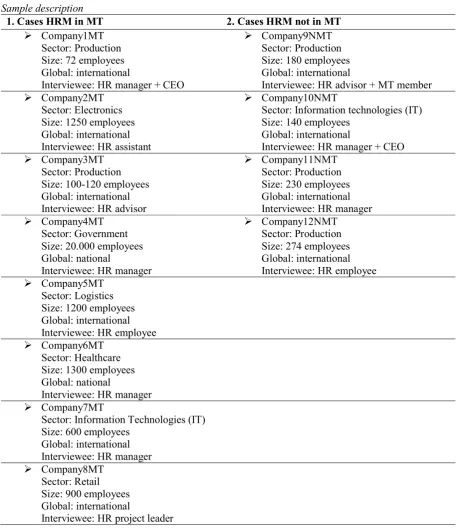
Thus, in total the analysed sample consists of twelve different organisation located in the Netherlands. Both HRM as director are interviewed, because this provides a different and broad view of the analysis of the perceived value of HRM concerning the position in the boardroom (or not). Table 1 below gives the complete overview of the target groups and organisations (including the sector) of the research.
3.2. Data analysis and operationalisation
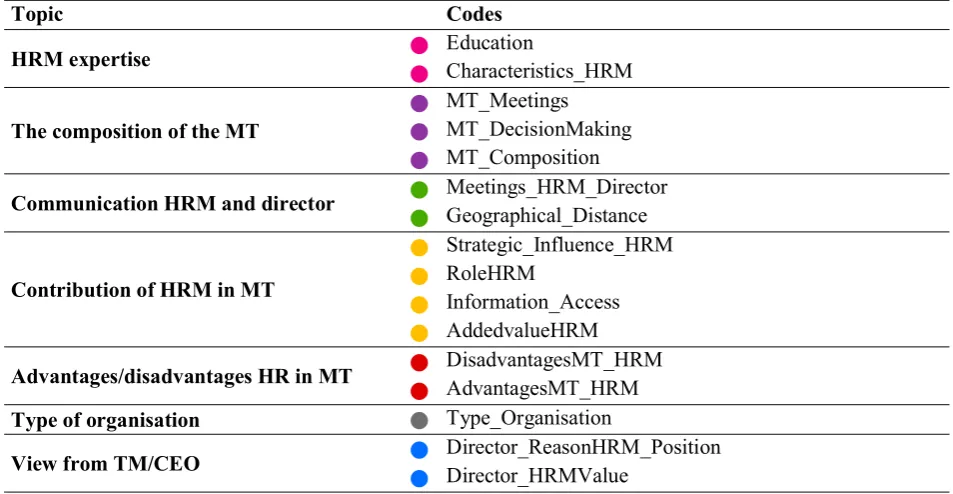
The collected data from the interviews are recorded and transcribed (appendix 2). On average, the interviews lasted an hour. Transcribing the data lasted at least three hours per interview. This means that on an average 36 hours of transcribing is done. The collected data is thereafter analysed by using the program ‘Atlas’. This program gives researchers the opportunity to analyse the outcomes of the interviews. This program gives the opportunity to provide codes to the quotes in the raw data. The codes are based on the theory and are provided by Atlas in a codebook, which results in qualitative data schemes. The codebook of this research is included in table 2 on the next page. This table shows the named codes related to the topics of this research. In addition, each code is related to a specific colour to give a clearer overview of the separate topics and the associated codes. These topics are: HRM expertise, the composition of the MT, communication HRM and director, contribution of HRM in the MT, advantages/disadvantages of HRM in the MT, type of organisation and the view from TM/CEO. These topics form the categories in de results which are showed in the next chapter. The topics and the codebook are used ditto for both target groups (HRM in the MT and HRM not in the MT).
16 Table 1
Sample description
1. Cases HRM in MT 2. Cases HRM not in MT
Company1MT
Sector: Production Size: 72 employees Global: international
Interviewee: HR manager + CEO
Company9NMT
Sector: Production Size: 180 employees Global: international
Interviewee: HR advisor + MT member
Company2MT
Sector: Electronics Size: 1250 employees Global: international Interviewee: HR assistant
Company10NMT
Sector: Information technologies (IT) Size: 140 employees
Global: international
Interviewee: HR manager + CEO
Company3MT
Sector: Production Size: 100-120 employees Global: international Interviewee: HR advisor
Company11NMT
Sector: Production Size: 230 employees Global: international Interviewee: HR manager
Company4MT
Sector: Government Size: 20.000 employees Global: national
Interviewee: HR manager
Company12NMT
Sector: Production Size: 274 employees Global: international Interviewee: HR employee
Company5MT
Sector: Logistics Size: 1200 employees Global: international Interviewee: HR employee
Company6MT
Sector: Healthcare Size: 1300 employees Global: national
Interviewee: HR manager
Company7MT
Sector: Information Technologies (IT) Size: 600 employees
Global: international Interviewee: HR manager
Company8MT
Sector: Retail Size: 900 employees Global: international
17 Table 2
Code scheme linked to topics (both HRM part and not part of the MT) (Atlas, 2018)
Topic Codes
HRM expertise ⬤ Education
⬤ Characteristics_HRM
The composition of the MT
⬤ MT_Meetings ⬤ MT_DecisionMaking ⬤ MT_Composition
Communication HRM and director ⬤ Meetings_HRM_Director ⬤ Geographical_Distance
Contribution of HRM in MT
⬤ Strategic_Influence_HRM
⬤ RoleHRM
⬤ Information_Access
⬤ AddedvalueHRM
Advantages/disadvantages HR in MT ⬤ DisadvantagesMT_HRM
⬤ AdvantagesMT_HRM
Type of organisation ⬤ Type_Organisation
View from TM/CEO ⬤ Director_ReasonHRM_Position
18
4. Results
The results are separated in the target groups where HRM is part of the MT and where HRM is not part of the MT. The different factors, as well as topics from the method, described in the literature part are analysed and displayed in a table. In the next section the conclusion and discussion will be described.
4.1. HRM Expertise
Education
With regard to the educational background of the HRM respondents, all the respondents in the MT are HRM trained at an University or University of Applied Sciences. From those eight respondents, four respondents followed additional courses in the field of HRM or Business related courses. The four HRM respondents where HRM is not part of the MT are also HRM educated at the University or University of Applied Sciences including additional courses. From this view, it can be concluded that there is no determinative distinction in educational background in relation to the position of HRM in the MT.
HRM Characteristics
19 it is not necessary to have a position in the MT, it is possible (Company7MT) to search for other paths to influence the business.
[image:20.595.67.529.293.552.2]The respondents, where HRM is not part of the MT, convince to gain perceived value as HRM this is related to the characteristics of HRM. Company12NMT mentioned: ‘You have to bring the facts and the attention. You have to have the persuasiveness to explain why you think something’. Knowledge about the whole business seems important, as well as persuasiveness. Furthermore, daring to give a reply to the director and MT seems important towards the perceived value of HRM.
Table 3
Comparison of the HRM expertise, including the education and HRM characteristics, in both of the respondent groups.
HRM Expertise HRM is part of the MT HRM is not part of the MT
Education All respondents are HRM educated (University of Applied Sciences or University)
All respondents are HRM educated (University of Applied Sciences or University)
HRM
Characteristics Perceived value of HRM arises when: - HRM knows the business
- HRM is able to forecast future visions and scenarios
- HRM is able to defend and insert HR in the MT
- Has characteristics*: Power, having own opinions, ensure that people listen to you, able to negotiate and convince
* When having these characteristics, HRM is easier able to influence the business in other ways than in the MT.
Perceived value of HRM arises when:
- HRM knows the business
- Consist of the characteristics*: persuasiveness, dare to give a reply and convince towards CEO/MT
4.2. The composition of the MT
Meetings MT
From the interviews with HRM in the MT, there is a distinction between the amounts of MT meetings in a year. Organisations have MT meetings every month, every week, every two weeks, but also every six weeks. This distinction is also noticed at respondents who are not part of the MT. They mention that the meetings are every two weeks or once a month.
MT composition
20
the Finance manager, and the Managing Director.’ There is a difference in size of companies compared to the amount of members in the MT. Company3MT is a small/medium enterprise. As an HRM respondent from Company2MT stated: ‘Ten till twelve members. The CEO, and relevant departments like Purchasing, HR, Engineering, CEO Huizen, Finance etcetera.’ Company2MT is a large organisation and the composition of the MT is also bigger than Company3MT. A distinction is found between the MT composition where HRM is part of the MT and where HRM is not. It can be expected that HRM is or is not a member of it in the second target group. Company11NMT includes a lot of managers in the MT, except HR, Finance and ICT for example. ‘Two sales managers, production manager, R&D manager, the manager who is responsible for technical support and compliance and both of the managing directors.’ HRM from Company6MT highlights the importance of HRM in the MT by the following quote: ‘The thought was, the MT should exist of people of the primary process. Well, luckily that did not happen. But you notice that you need also the other side in the MT. Of course, the supportive services are serving the primary process, otherwise that would be too unilateral. You need the supportive side in the MT.’
MT decision-making
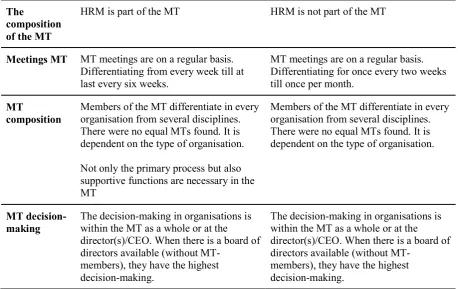
21 Table 4
Comparison of the amount of MT meetings, the composition of the MT and the responsible persons for decision-making process in the MT in both the respondent groups.
The
composition of the MT
HRM is part of the MT HRM is not part of the MT
Meetings MT MT meetings are on a regular basis. Differentiating from every week till at last every six weeks.
MT meetings are on a regular basis. Differentiating for once every two weeks till once per month.
MT
composition Members of the MT differentiate in every organisation from several disciplines. There were no equal MTs found. It is dependent on the type of organisation.
Not only the primary process but also supportive functions are necessary in the MT
Members of the MT differentiate in every organisation from several disciplines. There were no equal MTs found. It is dependent on the type of organisation.
MT
decision-making The decision-making in organisations is within the MT as a whole or at the director(s)/CEO. When there is a board of directors available (without
MT-members), they have the highest decision-making.
The decision-making in organisations is within the MT as a whole or at the director(s)/CEO. When there is a board of directors available (without
MT-members), they have the highest decision-making.
4.3. Communication HRM and director
Geographical distance
22
managing director also, he sits next to us in the office. It is easy to approach the board of directors. The managing director also has his office with us in the building.’
Meetings HRM and director
[image:23.595.68.524.546.688.2]Overall, the contact between the Director/CEO and HRM is found open and this person is found easily to approach. The door is always open for HRM. HRM from Company7MT emphasizes this: ‘We just walk in at each other’s offices every day’. The companies where HRM is not part of the MT mention that they have contact moments with the Director/CEO on a regular basis. The director is seen as a sparring partner as HRM from Company6MT stated: ‘For me, he is a real sparring partner.’ Also, the Director/CEO is found as easy to approach. HRM from Company9NMT has daily contact by bilaterals twice a week. Also, there is contact by App. HRM from Company10NMT also have contact moments twice a week but also during the week: ‘And also in between, he walks into my room. I walk to his desk. That goes over and over again.’ Also HRM from Company11NMT mention the distinction between formal and informal meetings with the Director/CEO: ‘The door is always open and I think that I speak a couple of times a week with the Director/CEO. That is informal, on a formal basis we have a meeting every 14 days. But in the meantime there is also, I think maybe on a daily basis contact.’ HRM from Company11NMT also mention that the band of trust is really important between HRM and the Director/CEO: ‘But because in general I am early involved, therefore I can also send along and suggest joh this is handy and this is not handy. But it is really coherent with how well your collaboration is with your Director/CEO. A band of trust in this is really important.’ On the other hand HRM from Company12NMT does not have a really good relationship with the Director/CEO: ‘Minimal. You could knock, but it was not the case that you had a lot of that. It was not that he thought: I listen and we are working on it.’
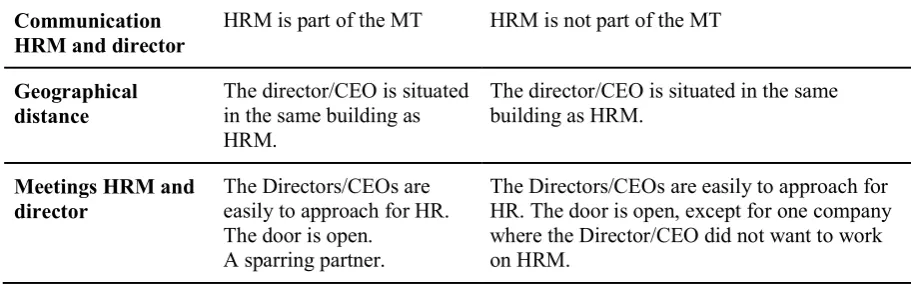
Table 5
Comparison of the geographical distance between HRM and the CEO in the organisation and the contact between HRM and the CEO in both the respondent groups.
Communication
HRM and director HRM is part of the MT HRM is not part of the MT
Geographical
distance The director/CEO is situated in the same building as HRM.
The director/CEO is situated in the same building as HRM.
Meetings HRM and
director The Directors/CEOs are easily to approach for HR. The door is open.
A sparring partner.
23
4.4. Contribution HRM in MT
Added value
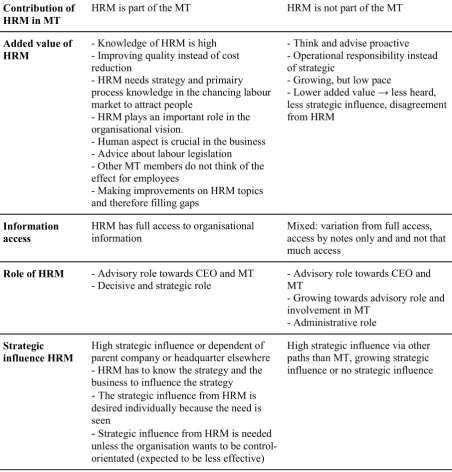
The difference in added value of HRM in organisations where HRM is part of the MT lies in the knowledge of the HRM professionals. HRM respondent Company1MT stated: ‘I am the initiator. I present my idea and the MT is shooting at this. This is because I know how it works. Also the added value of HRM in the MT is explained by the HRM contribution to the organisational vision. When HRM plays an important role in the organisational vision, HRM is more valued. As HRM respondent Company2MT explains: ‘At our organisation you have to have a strong HRM vision, otherwise people do not work at our company and people go away. This is crucial in an innovative organisation. This is why it is from high value that HRM is strongly connected’. The added value from HRM lies within the general importance of the human aspect and knowledge of laws. As Company3MT mentioned: ‘An organisational change, you cannot just do that. First you have to know all the legalisation and I think that the human aspect of the MT is very valuable’. MT members not from the HRM part do not think about the effects of employees that well. Company5MT mentioned: ‘Sometimes MT members conceive or set up something that is not desirable for the employees or is not possible because of labour legalisation. Than you notice that it is good that HRM is in the MT and can advise on the subject.’ The perceived value of HRM is in filling the gaps. Company7MT mentioned: ‘You only have to add there where your profession is designed insufficiently’. Furthermore, the added value of HRM is that HRM needs the primair process and the strategy to do the job well regarding to the changing labour market in the sentence of the importance of money and people in a company. As Company6MT mentioned: ‘HRM is very important. I mean money and people are very important in organisations, but I think in the time we live right now HRM is much more important.’ The labour market is changing and we have to attract the people. The added value is in the cost reduction because of HRM. Company6MT mentioned: ‘The phrase when you focus on costs, the quality goes down. If you focus on quality, the costs go low. That's why I think HR should be in the cockpit, because when you focus on costs, it's about management and costs’.
24
Nowadays they do’. Decisions are made without agreement from HRM. Because of the lower added value, interviews show that the strategic influence also becomes lower. When HRM is part of the MT it seems that opinions from HRM can be communicated easier and MT members would listen to HRM more. As Company12NMT stated: ‘Director only thinks, this is cheap. They do not think about the consequences towards sickness and contracts. I think, when you are part of the MT as HRM you can explain it more clearly. There will be better listened’ and ‘I think as HRM, you are responsible for all the people and when you are not decisive than the whole organisation loses its balance.’
Information access
According to the access to information of HRM in the MT it is found that the HRM respondents all have full access to the information of the organisation. Company2MT stated: ‘HRM in the MT does not know everything about the financial status, quality of products for example, but has access to this’. The access to information is obtained by being present in the MT where organisational information is often discussed and shared.
In organisations where HRM is not part of the MT the access to information in the organisation is less and mixed. One respondent indicates that there is not that much access, one respondent indicates that there is full access and one respondent indicates that there is access by notes. Company11NMT stated: ‘I can see the notes of the MT meetings. And I have meetings with the director, so then we discuss the things that are going around’.
Role of HRM
From the organisations where HRM is part of the MT six companies indicate that the HRM manager in the MT has an advisor role. Company1MT stated: ‘The director is end-responsible. I give advice. He certainly communicates my advice’. Company5MT stated: ‘HRM is advising, gets involved in management issues, but does not really play an important role in this. The decision of HRM is not decisive’. One respondent indicates that the MT group not always sees HRM as a full-fledged-member of the MT, because
HRM is part of the line staff. As Company7MT stated: ‘Because of positioning in the line staff and not in
the primairy part, we always stay in the line staff. The environment always thinks we are advisors and that is how they react. This is what my experience is in the MT. Two respondents where HRM is part of the MT indicate that HRM has a decisive and a strategic role in the MT. As Company2MT stated: ‘The highest MT is all about strategy and vision of the company. That is the job of HRM in the MT. Also in France’. One respondent (Company3MT) indicates that HRM is the female role: We females, think about the details.
Human aspects, the men do not think about that. They think about numbers and hard results. HRM says then, this is not possible, laws say....’.
25 Company9NMT mentioned: ‘We join sometimes, and we are growing to be taken into account with changes. The official role is not in the MT, but we are fighting to get this done’. Company10NMT (advisor role) mentioned: ‘The director has the final voice’. If I think this is not useful, then I will say that to the director. Eventually, this goes in good consultation’. Company11NMT (advisor role) indicates again: ‘Some themes are in my profession, and then I will make an advice and present this in the MT. Generally, I am involved but on in a different and less efficient way to my opinion. Company12NMT however mentioned: ‘We are in a really administrative role’.
Strategic influence HRM
27
Table 6
Comparison of the added value, the access to organisational information, the role of HRM in the organisation and the strategic influence of HRM in both the respondent groups.
Contribution of
HRM in MT HRM is part of the MT HRM is not part of the MT
Added value of
HRM - Knowledge of HRM is high - Improving quality instead of cost reduction
- HRM needs strategy and primairy process knowledge in the chancing labour market to attract people
- HRM plays an important role in the organisational vision.
- Human aspect is crucial in the business - Advice about labour legislation
- Other MT members do not think of the effect for employees
- Making improvements on HRM topics and therefore filling gaps
- Think and advise proactive - Operational responsibility instead of strategic
- Growing, but low pace
- Lower added value → less heard, less strategic influence, disagreement from HRM
Information
access HRM has full access to organisational information Mixed: variation from full access, access by notes only and and not that much access
Role of HRM - Advisory role towards CEO and MT - Decisive and strategic role
- Advisory role towards CEO and MT
- Growing towards advisory role and involvement in MT
- Administrative role
Strategic
influence HRM High strategic influence or dependent of parent company or headquarter elsewhere - HRM has to know the strategy and the business to influence the strategy
- The strategic influence from HRM is desired individually because the need is seen
- Strategic influence from HRM is needed unless the organisation wants to be control-orientated (expected to be less effective)
28
4.5. Advantages/disadvantages of HRM in MT
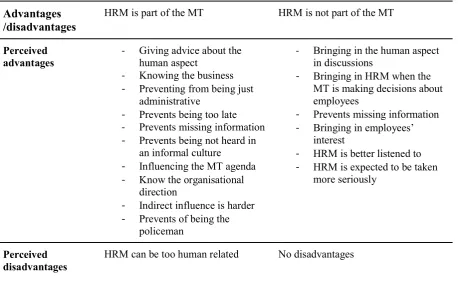
The respondents were asked if they found any advantages or disadvantages of being positioned in the MT. From the interviews is noticed that the advantages sounded stronger than the disadvantages. Advantages
HRM respondents who were part of the MT mention that being a part of the MT contributes to the fact that HRM needs to know the business where the organisation is operating in. Also, as is explained by HRM from Company4MT: ‘No, otherwise you are just an administrative employee.’ HRM needs to be part of the MT to avoid the administrative function of HRM. Another advantage of being part of the MT is that you hear the information you need as soon as possible. The membership avoids HRM from missing out on important information and therefore it prevents HRM from being too late to come up with extra advice in decisions. In addition, HRM from Company7MT mentions that being part of the MT means that you have the opportunity to be heard: ‘If the culture is formal, that you are not being heard.’ Therefore you have the opportunity to influence the agenda and bring in HRM topics. HRM topics are emphasized by HRM from Company8MT: ‘I think that she finds it important, that she attends in MT meetings and can give her advice. How our human resources can be used.’ Being part of the MT is found as essential according to HRM from Company6MT: ‘If we are not on the MT agenda then I would suffer. But then we are not doing well. Then I would be worried about the direction of the organisation.’ This quote emphasized the importance for HRM of being part of the MT. It is also mentioned that being part of the MT is more beneficial than not being part is stated by Company6MT: ‘You can find other ways to have influence, but that is always indirect. Harder.’ Lastly, it prevents organisations from being the pain in the ass at the end according to Company6MT: ‘When you are not part of the MT then you run behind, that is also the role of HR, that you will point your finger like a policeman and then you are the frustrating factor that you do not want to be.’
29
there is spoken about the policy and the strategy.’ Fourth, being part of the MT gives HRM the opportunity to bring in the employees’ interest. Fifth, the MT does not always take into account the risks or workload for the organisation of the ideas that they have. As HRM from Company12NMT mentioned: ‘While we, they do not think about the workload, the risk that you have with illness, permanent contracts, they do not even think about this. And, I think that when you are part of the MT that you can make this more clear. That you are better listened to.’ A last advantage of being part of the MT is the seriousness of the HRM role in the organisation. As HRM from Company12NMT mentioned: ‘I also think that when you are part of the MT, HR is taken more seriously.’
Disadvantages
The respondents were also asked about disadvantages for organisations when HRM is part of the MT. The group of respondents where HRM is part of the MT found it hard to find disadvantages. However, one HRM respondent “Company3MT” found that when HRM is part of the MT everything is too human:
‘Well, sometimes too human yes. But that also depends on the person. Sometimes it is really hard as HR to influence or convince people, for example the director because you cannot come up with hard data.’
30 Table 7
Comparison of the mentioned advantages and disadvantages of a position of HRM in the MT of both the respondent groups.
Advantages /disadvantages
HRM is part of the MT HRM is not part of the MT
Perceived
advantages - Giving advice about the human aspect
- Knowing the business
- Preventing from being just administrative
- Prevents being too late
- Prevents missing information
- Prevents being not heard in an informal culture
- Influencing the MT agenda
- Know the organisational direction
- Indirect influence is harder
- Prevents of being the policeman
- Bringing in the human aspect in discussions
- Bringing in HRM when the MT is making decisions about employees
- Prevents missing information
- Bringing in employees’ interest
- HRM is better listened to
- HRM is expected to be taken more seriously
Perceived
disadvantages HRM can be too human related No disadvantages
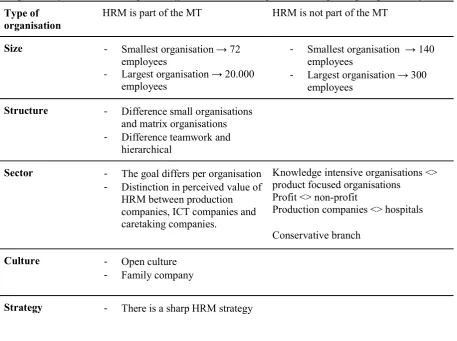
4.6. Type of organisation
Organisations differ regarding their size, structure, sector, culture and strategy. HRM from Company6MT perceived that these factors do not matter: ‘If you do well, then the type of organisation does not matter, because then HR is involved in the direction of the organisation and then the director wants you in the cockpit of the organisation.’
31 Regarding the structure of the organisation it is mentioned in the group where HRM is part of the MT by HRM from Company1MT that the role of HRM differs per organisation: ‘In a smaller organisation the role is different than in a matrix organisation.’ HRM from Company2MT adds to this that this difference might occur in hierarchical organisations: ‘Yes, it is really teamwork. And so is the entire organisation. I think that every organisation, that every organisation is different. Offcourse, if you have a really hierarchical organisation and you have a director that says; guys I want to enrol this, take care of it. That is not the case here, certainly not.’ The respondents who are not part of the MT did not mention anything about organisational structure.
Regarding to the respondents who are part of the MT the sector of the organisation explains the importance of HRM in the MT. In Company2MT HRM is seen as important because of the importance of employer branding, as HRM from Company2MT mentioned: ‘Yes, well HR is so important here because you really need to be a special strong employer when you want to succeed in this business. I think that when you work for example in a chicken factory, then HR is less important.’ HRM from Company7MT makes a distinction between production companies, IT and caretaking companies: ‘You need the people. In a production process it is more a tool. At, for example, Heineken the factor people is even more a tool than in IT where people make the difference and that is what is also seen in caretaking organisations.’
Regarding to the respondents who are not part of the MT the sector is seen as an influencer on HRM. In a knowledge intensive company HRM is seen as more important than in product oriented companies. A distinction is also made between profit and non-profit companies and production companies and hospitals. HRM from Company12NMT mentioned: ‘A production company is very focused on making money. I think of companies where employees get more attention, sounds negative, but more focused on employees instead of making effort. I think that a MT in a hospital is differently equipped. So, I think that it is influenced for sure.’ Also HRM from Company9NMT mentioned the sector as an influencer: ‘Traditionally, this is a machine building branch, reasonably conservative. And HR is like an administrative client, but currently we do not do this anymore.’
The organisational culture is described in the group of respondents who are in the MT as an open culture and a family company is described. The group of respondents who are not part of the MT did not describe anything about the MT.
One company in the group of respondents who are part of the MT described the influence of the organisational strategy. As mentioned by HRM from Company8MT: ‘But the director/CEO has the opinion that his people, those that work for him were the most important for his organisation.’ Just let people go to work with a happy feeling. So that is also a way of how the director thinks about it.’
32 Table 8
Comparison of the mentioned expected differences between organisations regarding the position of HRM.
Type of
organisation HRM is part of the MT HRM is not part of the MT
Size - Smallest organisation → 72 employees
- Largest organisation → 20.000 employees
- Smallest organisation → 140 employees
- Largest organisation → 300 employees
Structure - Difference small organisations and matrix organisations
- Difference teamwork and hierarchical
Sector - The goal differs per organisation
- Distinction in perceived value of HRM between production companies, ICT companies and caretaking companies.
Knowledge intensive organisations <> product focused organisations
Profit <> non-profit
Production companies <> hospitals
Conservative branch
Culture - Open culture
- Family company
Strategy - There is a sharp HRM strategy
4.7. View from TM/CEO
Percieved HRM value
It was not possible to contact all of the CEOs from the organisations. Therefore, HRM discussed the experienced perceived value of HRM by their director.
33 director to increase the added value. As HRM from Company7MT stated: ‘Ensure for a trustworthy relationship. Or that you need HRM. One of those two’. The extension of the HRM department (from two to six HRM employees for example) in an organisation is also a factor that shows that directors see more often the added value of HRM in organisations. Furthermore, directors value HRM as strategic important. HRM from Company6MT mentioned: ‘There is a strategic importance to HRM. The question is how to position this. Is it also necessary to have the formal status to be in the board of directors? If this is not the case, then it would arise practical. The themes are that big. In sum, the added value is seen from all the directors where HRM is part of the MT. Another director (Company3MT) sees the added value in HRM by the terms ‘Hire, fire and motivation’ which makes HRM experienced of high added value in the organisation. Company12NMT stated about the values of the director: ‘The added value of HRM is not seen by the old director. Solely if the absenteeism was high, HRM got involved’. In sum, some directors from companies where HRM is not part of the MT did not think well about the HRM position to involve HRM and did hardly see the added value of HRM.
Directors from organisations where HRM is part of the MT attach value towards the field of HRM. Those directors see HRM for example as a business partner. The director from Company1MT stated: ‘I think the business partner role of HRM is the most important of HRM. In times of reorganisations you have to know as a company how this works for example’.‘It is an evolution of terms in HRM, you are not part of supporting the business, but you are part of the business because you are a partner as HRM’.
The HRM value of directors can be seen as important in organisations, however there are found other factors that influence the position of HRM in the MT. Director Company10NMT stated: ‘I see the added value of HRM as crucial discipline. Despite the fact that we saw HRM as important, we may not have thought about this well enough, because it is growing from generic towards professional’. The HRM value of directors from organisations where HRM is not part of the MT has to do with the values and personality of the director according to several respondents. As an MT member of Company9NMT stated:
‘It is what you think it is the most important for your organisation. The members of the MT put something on the agenda that they think is important from the view of HRM’. In addition from Company9NMT: ‘Not everybody sees the added value of HRM, it is in your blood group or not, in your DNA’.
Reason HRM position in the MT or not
34
[image:35.595.69.566.331.718.2]sometimes on your mouth’. Directors also have to see the human factor as important. People with a technical background often see the hard side of the organisation instead of the soft side which makes HRM of less importance, which also seems to link with historical factors. As HRM from Company9NMT stated: ‘See the organisation as a machine that is from yesterday. I am not convinced that you can reach goals by SMART. To convince customers, you have to reach the soft sides of organisations more often’. Moreover, in subsidiaries from parent companies, HRM has often an operational role and HRM is in the MT in the parent company itself and not in the subsidiary. The subsidiary is more operational regarding HRM. HRM from Company10NMT stated: ‘On the topic of HRM, a lot is developed from the parent concern. We are in the operational mode’.
Table 9
Comparison of the interviews with the CEO in both the respondent groups, including the perceived value of HRM and the reason why HRM is or is not in the MT.
View of TM/CEO towards perceived value of HRM
HRM in the MT HRM not in the MT
Perceived HRM
value HRM value is seen as strong by CEOs and HRM experiences their value by the CEO:
- HRM is seen as business partner
- HRM is of strategic importance
- HRM is seen as hire, fire and motivation
- HRM has to show their added value
- Employees are most valuable asset
- Create trustworthy relationship
- Expansion of HRM departments
HRM value is seen and experienced mixed from CEOs by:
- Seen the importance of HRM, not thought well enough about this to gain a position in the MT
- Value and personality of CEO less human related
Reason HRM position in the MT or not
- Values/personality of CEO organisation importance human factor
- Head office decided (CEO no influence)
- Values/personality CEO organisation lower importance human factor
- Head office decides (CEO no influence)
- Fear from the CEO (minimal entrepreneurship, dodge the human factor of organisations)
- Historical reasons (human factor more important)
36
5. Discussion
This chapter describes the limitations of this research and implications for future research. In addition, the added value of this research is shown by the theoretical and practical contributions. The discussion ends with practical recommendations which are displayed in the decision tree.
Possible scenarios
The HRM expertise and the HRM value according to the CEO are found as the two crucial factors in the decision if HRM can be successful. These two factors can be combined with the possibility in an organisation to be part of the MT. With these three factors, eight scenarios are possible who can be divided in scenarios where HRM is on board and not on board.
HRM on board
1) Low HRM expertise + HRM on board + high value of HRM from CEO = passive role 2) Low HRM expertise + HRM on board + low value of HRM from CEO = passive role
3) High HRM expertise + HRM on board + high value of HRM from CEO = desired and perfect situation 4) High HRM expertise + HRM on board + low value of HRM from CEO = not taken seriously
37 HRM not on board
5) Low HRM expertise + HRM not on board + low value of HRM from CEO = solely administrative role, lowest perceived value
6) Low HRM expertise + HRM not on board + high value of HRM from CEO = administrative role 7) High HRM expertise + HRM not on board + high value of HRM from CEO = advising role
8) High HRM expertise + HRM not on board + low value of HRM from CEO = administrative/advising role
In the fifth scenario, HRM has an administrative role because of a lack of expertise, no presence in the MT and HRM has low value for the CEO. In the sixth scenario, HRM is seen as high valuable regarding the CEO. However, HRM does not have the expertise to join the board and therefore does not have a place in the boardroom. The contribution of HRM is solely an administrative one. In the seventh scenario, the HRM expertise is high and HRM is valued high by the CEO. In this situation HRM misses information and does not have the opportunity to act on time or to have an influence on the organisational strategy. However, because of the expertise HRM can give advice to the CEO. In the eighth scenario, HRM has the expertise, but is not on board because the CEO does not see the value of HRM. HRM can use its expertise to convince the CEO of their value.
38
Figure 2.Empirical flowchart explaining the added value of HRM on board.
From this flowchart the question arises if HRM can be of strategic influence when they are not on board. To answer this question it should be noted that the times are rapidly changing. Therefore differences are expected regarding the sharing of information in organisations. The digitalisation of information implies that there are opportunities including meetings by Skype for example. The digitalisation makes the access to information and information sharing in organisations more easy. This means that strategic influence by the use of other paths might increase. In this case, one could claim that HRM can be strategic without a position in the MT. However, HRM is still not involved in the discussion, is not able to share their expertise in the meetings, might still be not on time, and might have not the possibility to chance decisions that are already made in the meeting. In addition, this method is less efficient than HRM being in the same room as the other managers.
39 bring these topics on the agenda on time. Other topics that are important for the strategy of the organisation are the aging of the employees, the changing labour laws and the flexibility on the labour market.
Theoretical and practical contributions
During the years research is done on the position of HRM in organisations. Therefore this topic is not new. This research differs from other literature, because times are changing and therefore the results will differ. The upcoming technology and organisational developments influenced the topics. This research provides new insights on existing literature. In addition, this research developed two new business models including the empirical flowchart and the decision tree (figure 2 and 3).
In the theory two thoughts where found. One claims that HRM does not have to be part of the MT and one claims that HRM should be part of the MT. The theoretical contribution of this research includes that this research tested both of the theories and therefore enlarges the existing theory.
This research is practical contributing by giving organisations the answer in case when they are not sure if they should present HRM in the MT. In addition, it gives insight in needed strong characteristics for HRM to be influential and the crucial role of the CEO.
Limitations
This qualitative study is indicated to gain insight in the differences between perceived value of HRM when positioned in the MT or not. For this research several companies were approached. The total amount of respondents included twelve companies. These twelve companies included eight companies where HRM is part of the MT and four companies where HRM is not part of the MT. In this it can be noticed that the group of respondents where HRM is not part of the MT is remarkably smaller than the group where HRM is part of the MT. This difference can be explained by the fact that HRM is making progress regarding their strategic position in the organisation and therefore is member of the MT more often. However, it might have a negative influence on the reliability of this research.
It was not always possible in this research to get in contact with the HR managers from the organisations. Therefore, also HR advisors and HR employees are interviewed. For future research it is recommended to find solely HR managers because it is experienced in the interviews that they provide more information. Also, it was not always possible to get in contact with the director of the organisation. For future research it is recommended to find a director who is not enthusiastic about HRM because this might give new insights.
40 HRM is in some cases defined different by the respondents. They see the strategic contribution solely as the involvement of HRM in strategic decision making.
Implications for future research
The characteristics of HRM are found to be an important factor. For future research is might be interesting to focus on the characteristics of HRM in organisations where HRM is part of the MT. In this, interest lies in the fact if HRM is a great discussion partner, if HRM has enough expertise to give the best advice, and if HRM has enough character to be taken seriously in the organisation for example. This additional research will give insight in the ability of HRM to be a valuable member of the MT.
Also, this research claims that there is a transition of HRM from being an administrative partner to a strategic business partner. For future research it is recommended to check in a large sample if this is actually the case in the Netherlands.
This research solely took place in the Netherlands including a real diverse sample. Future research might focus on other countries. Also, future research can be focused on a less diverse sample or a broader sample including for example 12 companies in each sector.
The theoretical framework of this research has not been focused on the composition of the MT. However, this subject is asked in the interviews. Additional research is found on this topic and this implies that there are several factors which are important regarding the composition of the MT.
First, the management team should consist of employees that have the required competences to participate. Second, commitment regarding the strategic initiatives of the CEO is important. Third, the members do need to have access to meaningful information that can be included in the meetings. Fourth, the members need to have a personal fit with the CEO (Ma & Seidl, 2017). Fifth, the diversity of the team is important. Lyngsie and Foss (2016) found that including women in the management team will contribute to the organisational outcomes. Although it should be noted that this effect is weakened in organisations that have a workforce consisting of a lot of women (Lyngsie & Foss, 2016).