Does eustress play a role in the relationship between optimism and mental wellbeing? Amelie Pösse
Supervisor 1: Dr. M. Radstaak Supervisor 2: Prof. L. van Zyl
Author Note:
Amelie Pösse, Department of Psychology, Behavioral Management and Social Sciences, University of Twente
Abstract
The purpose of this study was to investigate the relationship between optimism, eustress and mental wellbeing. Specifically, it was determined to what extent eustress indirectly affects the relationship between optimism and mental wellbeing. A questionnaire was set up to measure participants (n =101) scores on the concepts optimism, eustress and mental wellbeing. Preacher & Hayes (2004) indirect effect assessment was conducted to identify if eustress is indirectly effecting the relationship between optimism and mental wellbeing. Distress was found to be significantly related with all concepts, therefore it was added as a control variable. Results indicated that the variables optimism, eustress and mental wellbeing are positively associated. Eustress was found to play a mediating role in the
Introduction
In the daily language use the term stress is widespread. People talk about being stressed or experience a situation as too stressful. It seems as stress is inevitable in our modern life (Kupriyanov & Zhadanov, 2014). Human bodies are constantly responding to demands of the environment. Those demands are the stressors (Hargrove et al., 2013). The stressors are cognitively appraised by the people that experience them. According to Selye (1950) the feeling of stress is the response to those stressors. The response could be either positive or negative. Positive stress response is called eustress and negative stress response is called distress. Positive stress response in the end will lead to either positive outcome such as an increased healthiness (Lazarus,1993). Distress can lead to negative outcome like high blood pressure (Le Fevre et al.,2003). Le Fevre et al. (2003) declared that if a reaction to stress will be positive or negative is influenced by characteristics of the individual and the individuals’ perception of the situation. One characteristic of an individual influencing stress appraisal is optimism. Optimists respond with less distress and more eustress (Scheier, 1987). The optimistic appraisal of stressors could lead to eustress and the optimist being healthier (Scheier, 1987). Optimist seems to be an interesting concept in the enhancement of
wellbeing. Moreover, it could be possible that eustress plays an important role in it. The study is aimed to further examine the relationship between optimism, eustress and mental wellbeing.
Optimism
Optimism can be defined as the capability to await the best possible future, the
to happen is low. Optimism is the ability to have positive expectations (Dember et al.,1999, Hayes &Waethington, 2007). It also includes interpreting events, good and moreover bad ones with a general positive attitude which leads to the future be seen in a more positive light (Huan, Yeo, Ang, & Chong, 2006).
Optimism relates to plenty of positive outcomes. A strong correlation is found
between an optimistic personality and the perceived quality of life. A reason could be a better adjustment to daily hassles and the ability to overcome challenges (Hayes and Waethington, 2007). Since optimists have the capability to look at daily hassles and challenges in a positive way, they need less effort to overcome them. Furthermore, optimistic individuals score higher on self-confidence and have higher levels of self-efficacy which makes it easier for them to perform well and achieve their goals (Peterson & Bossio, 1991).
As the relationship of optimism and stress is regarded, positive outcomes could be found as well. Optimism influences the coping behavior to various stressor which in turn can be beneficial for physical as well as psychological wellbeing (Scheier,1987, Hayes and Waethington ,2007). It appears that optimists mainly cope in a problem focused way (Scheier et al., 1986). Hayes and Waethington (2007) argued optimism being one of the main accounts of why people go on and try to carry on instead of giving up in difficult situations.
Also in other environments optimism was found to have positive effects. Scheier (1987) studied the expectations of patients with severe illnesses. Differences are found in the way optimistic and pessimistic individuals cope with stressors of surgery and recovery. It appears as optimistic individuals more often made plans and set goals for recovery.
Furthermore, the optimistic individuals were less likely to extremely focus on the negative emotional aspects of their illness like being nervous or sad. That lead to conclusion that optimists respond to stressor in the way of formulating plans for action taking, keeping themselves focused and not getting over attached with negative emotions that are associated with the stressor. Especially in breast cancer patient one factor that is foreseen to impact on the patient’s wellbeing is optimism which presume a better adjustment to the stressful circumstance (Karademas et al., 2007). Also, optimistic college students could cope with the stressors of studying in a more effective way. They reported low levels of distress, loneliness and depression (Hayes &Waethington, 2007).
Eustress
Most knowledge about stress is about the negative effects whereas the positive side of stress is less often studied (Hagrove et al., 2013). Kupriyanov & Zhdanov (2014) stated that there must be a shift away from combining the term stress with only negative reaction to stressors and the so-called distress. Eustress is a positive response to stressful events which comes along with healthy physical states and positive emotions (Lazarus, 1993). Eustress is often perceived as an optimal level of stress (Le Fevre et al., 2003).
eustress are vigor and positive affect. Also, meaningfulness and manageability are said to play a role. Nurses mention to experience eustress through the hope, meaningfulness and engagement they experience at work. So, it can be stated that eustress is a response with goodwill and hope (Hargrove et al., 2015). Eustress is thought to arise through experience of only a little or nearly no gap between desired and current reality (Le Fevre et al., 2003). Benefit of one’s own wellbeing or the realization of goals lead to a positive appraisal. As well as the possible fulfillment of wishes (Edwards & Cooper, 1988). Lazarus (1966) argued that if a stress response will be positive is influenced by the individual’s appraisal. Optimism is an important personality trait influencing the stress appraisal. Optimists expect that positive changes are about to happen (Scheier, Weintraub & Carver, 1986). Implicating that optimists mostly deal with stressors in a positive manner leading to a eustress response.
Positive outcome is associated with eustress. As stated in Hargrove et al. (2013) positive stress can lead to a state of being fully present, having an optimal state of attention, being completely focused and being exhilarated. Intensive care nurses are exposed to extreme stressors. On the other hand, they often report themselves being satisfied at work. This shows that even in a high stressing work environment eustress can be experienced (Nelson &
Mental wellbeing
Mental wellbeing is not just the absence of disease. Mental wellbeing is the presence of positive emotional states and positive functioning in life (Nelson & Cooper, 2005). It is an umbrella term for presence of various positive feelings and functioning (Keyes,2002).
Positive psychology is getting more spread and mental wellbeing is getting more important. Slade (2010) argued that there is a need of creating a shift away from just treating illnesses to also create wellbeing. Mental wellbeing and mental illness share only a quarter of variance. Therefore, professionals need to focus on both, reduction of illness and creating wellbeing (Slade, 2010). Promotion of mental wellbeing is important because of its impact on personal identity and maintenance of social roles (Slade,2010). Furthermore, it is a predictor of overall life satisfaction and leads to longevity and physical health (Kupriyanov &
Zhdanov, 2014).
Genetic make-up and personality traits are mentioned to be powerful predictors of mental wellbeing (Helliwell & Putnam, 2005). Examples could be self-esteem or optimism. Optimists display various positive emotional states. They report a greater amount of
wellbeing could be directly and indirectly associated. Eustress could be directly associated with mental wellbeing through hormonal and biochemical changes. Indirectly by the capability and effort to cope with existing distress.
Current research
This research should examine if there is a positive relationship between optimism and mental wellbeing and if the concept of eustress plays a role by enhancing this relationship. Optimism is thought to be associated with eustress because of the optimist’s capability to interpret stressors with their general positive attitude. Furthermore, optimism is thought to be one factor related to mental wellbeing because of their tendency to have positive expectations that are followed by positive emotional states like happiness and relief. Eustress could
enhance mental wellbeing trough the fact that it makes goal realization and personal growth likely which is followed by positive emotions. Improvement of mental wellbeing is getting more important in the psychological practice and optimism and eustress seem to be
associated with it. Expected is that eustress is the factor influencing the association between optimism and mental wellbeing. The following research question has been formulated. Does eustress play a significant role in the relationship between optimism and mental wellbeing?
The following hypotheses have been formulated.
H1: Positive association between optimism and mental wellbeing exists. H2: Positive association between optimism and eustress exists.
H3: Positive association between eustress and mental wellbeing exists.
Method
Design
A descriptive cross-sectional survey based design was employed in this study. The dependent variable is mental well-being and the independent variable is optimism. Eustress is thought to function as a mediator between independent and dependent variable. Distress was added as a control variable to ascertain that the effect of eustress is measured independent of levels of distress.
Participants
Table 1 Characteristics of participants in frequencies and percentages (n=101) Male N (%) Female N (%) Total N (%) Marital status
Single 18 (40,9) 26 (45,6) 44 (43,6)
In a relationship 21 (47,7) 27 (47,4) 48 (47,5)
Married 5 (11,4) 4 (7,0) 9 (8,9)
Highest educational Qualification
Vocational education 2(4,5) 1(1,8) 3 (3,0) Secondary education 1 (2,3) 0 (0,0) 1 (1,0) Higher secondary education 24 (54,5) 40 (70,2) 64 (43,4) Bachelor`s Degree 9 (20,5) 11 (19,3) 20 (19,8) Master’s Degree 8 (18,2) 5 (8,8) 13 (12,9)
Current occupational status
Student 25 (56,8) 39 (68,4) 64 (63,4)
Employee for wages 15 (34,1) 15 (26,3) 30 (29,2)
Self-employed 1 (2,3) 0 (0,0) 1 (1,0)
Unemployed 2 (4,5) 1 (1,8) 3 (3,0)
Supported by religion
Yes 9 (20,5) 19 (33,3) 28 (27,7)
No 35 (79,5) 38 (66,7) 73 (72,3)
Procedure
After receiving ethical approval, the data collection started from the 31. March 2017 until the 28. April 2017. The survey was spread through social media (Facebook and
WhatsApp) and face to face interaction. Relatives and acquaintances of the researchers were asked if they were willing to participate. Participation was completely anonymous and voluntary. The participants obtained a link to the survey made on Qualtrics. First, the
order: Hospital Anxiety and Depression Scale (HADS) (Zigmond & Snaith,1983), Levenson Multidimensional Locus of Control Scales (Levenson, 1973), Mental Health Continuum Short Form (MHC -SF) (Keyes, 2009), General Self Efficacy (GSE) (Schwarzer &
Jerusalem. 1995), Resilience scale by Block and Kremen (1996), COPE Inventory (Carver, Scheier & Weintraub, 1989), the LOT- R (Scheier, Carver & Bridges, 1994) and a scale to measure the concept of eustress and a scale to measure distress. Participation took 35 to 45 minutes on average to fill in the questionnaire. Participants who were interested in receiving further information about the study and the outcome where able to leave their email
addresses. After this the participants were guided back to the website of the university.
Materials
Optimism
Eustress
To measure eustress a new questionnaire was developed. Participants rated on a 6-point Likert scale [1 = Never; 6 = Always] how many times during the past month they experienced eustress. Fifty items measured eustress. To reduce number of items, a principal component analysis with orthogonal rotation (varimax) and one fixed factor was conducted. The seven items on the factor eustress with the highest factor loading were selected for the questionnaire. An example item of eustress is: “In the last month, how often have you learned from coping with a difficult situation?”. The scale had a good internal stability (Cronbach’s α: Eustress = .88).
Mental Wellbeing
To measure mental wellbeing the Mental Health Continuum – short form (MHC-SF) (Keyes, 2009) was used. It is made up of 14 questions belonging to three subscales:
emotional wellbeing, psychological wellbeing and social wellbeing. There are three items to measure emotional well-being. Six items are representing psychological well-being and another five items are detecting social well-being. The items are of a six-point-Likert-type [1 = Never; 6 = Every day]. An example of a question is “During the past month, how often did
Distress
Distress was measured through a new developed questionnaire. Participants rated on a 6-point Likert scale [1 = Never; 6 = Always] how many times during the past month they experienced distress. Fifty items measured distress. To reduce number of items, a principal component analysis with orthogonal rotation (varimax) and one fixed factor was conducted. The seven items on the factor distress with the highest factor loading were selected for the questionnaire. An example item of distress is: “In the last month, how often have you felt incapable to overcome difficulties?”. The scale had a good internal stability (Cronbach’s α:
Distress = .93).
Analysis
The analysis was done with SPSS version 24. First, descriptive statistics were calculated to get means and standard deviations. Skewness and kurtosis was calculated to determine the normality of the data. Second, Spearman correlation coefficients were computed to determine the relationship amongst the variables. Spearman’s rho correlation measurement was chosen because not all variables were normally distributed. Effect sizes for the correlation coefficients were set at .3 (medium effect) and .5 (large effect). Statistical significance was set at p < 0.01.
Results Descriptive Statistics
Optimism (skewness = -.43 (SE = .24); kurtosis = .73 (SE=.48)), Eustress (skewness = -.26 (SE =.24); kurtosis =-.35 (SE=.48)) and Mental wellbeing (skewness = .05 (SE=.24); kurtosis =-.23 (SE=.48)) were normally distributed. Distress was highly skewed. (skewness = 1.02 (SE=.24); kurtosis = 1.23 (SE=.48).
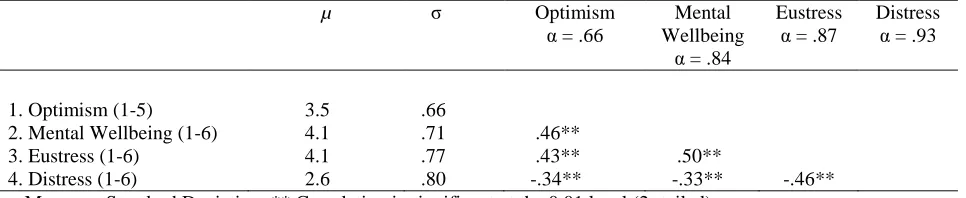
Descriptive statistics showed that participant scored above the mean of the scale on the concepts optimism (µ =3,46), eustress (µ = 4.04), and mental wellbeing (µ =4,1). Scores on the concept distress (µ = 2.6) were average.
Spearman’s rho correlation test showed that Eustress has a large correlation with mental wellbeing (r=.50, p<0.01; large effect). The correlation between Eustress and optimism (r= .43, p<0.01; medium effect,) was medium. As well as the correlation between optimism and mental wellbeing (r=.46, p<0.01¸, medium effect,). All relations are positive and significant.
Correlation analyses showed that distress is significantly related to the concepts optimism (r= - .34, p<0.01) and mental wellbeing (r= - .33, p<0.01). Furthermore, eustress and distress are related (r = -.46, p < 0.01). Therefore, the variable was added as a control variable to the indirect effect analysis.
Correlation of eustress and mental wellbeing (r = .5, p < 0.01; large effect) was stronger than the correlation with distress and mental wellbeing (r = .33, p < 0.01; medium effect). Correlation with optimism has nearly the same strength for distress (r = -.34) and
Table 2 Means, Standard deviations and Spearman Correlations between concepts (N =106)
µ σ Optimism
α = .66
Mental Wellbeing
α = .84
Eustress
α = .87
Distress
α = .93
1. Optimism (1-5) 3.5 .66
2. Mental Wellbeing (1-6) 4.1 .71 .46**
3. Eustress (1-6) 4.1 .77 .43** .50**
4. Distress (1-6) 2.6 .80 -.34** -.33** -.46**
µ Mean σ Standard Deviation, ** Correlation is significant at the 0.01 level (2- tailed)
Hypothesis testing
Results showed that 31 % of the variance could be explained trough the indirect effect model of the association between optimism, eustress and mental wellbeing (R² = .31, F (2,98) = 22.2, p = 0.00)
Results indicated that optimism has a positive association with mental wellbeing when controlled for distress (β = .30, SE = .10, t (101) =2.9, p < 0.05). Hypothesis one is accepted. Positive association between optimism and eustress was found when controlled for
distress (β =.31, SE = .10, t (101) = 2.94, p < 0.05). Hypothesis two is accepted. Eustress is found to be positively associated with mental wellbeing when controlled for distress (β = .31, SE = .10, t (101) = 3.25, p < .05). Therefore, the third hypothesis can be accepted.
Figure 1: Mediation Model Standardized Regression Coefficients and Standard Error for the relationship between optimism and mental wellbeing mediated by eustress, controlled for distress. *p < 0.05
Optimism Mental Wellbeing
Eustress β =.31 *
Discussion
The purpose of this paper was to investigate the relationship between optimism, eustress and mental wellbeing. Specifically, the purpose was to determine to what extent eustress indirectly affects the relationship between optimism and mental wellbeing. Because optimism is related to well-being (Scheier & Carver, 1992), knowing if eustress is related to optimism can be a useful tool in achieving well-being. Eustress is found to be a significant mediator in the relationship between optimism and mental wellbeing. This means, that the positive association between optimism and mental wellbeing is expected to exist trough the experience of eustress.
Eustress as a mediator in the association between optimism and mental wellbeing was not examined earlier. This result could be explained as follows. Eustress is defined as the positive response to the appraisal of stressors. It is often experienced as a state of stress that goes along with being fully present, an optimal level of attention and being fully focused (Hargrove et al., 2013). Optimists were thought to basically appraise stressors in a more positive way by their capability to interpret events with a general positive attitude (Huan et al., 2006). This indicates that optimists could have the potential to mainly respond with eustress. Eustress is likely to arise when mastering of challenges generate personal
development and achievement of personal goals (Hargrove et al., 2015). Optimists mostly cope in a problem focused way which makes mastering of great challenges more realistic. All this strengthen the association with mental wellbeing.
more challenges. The actions people are taking are mostly influenced by the expectations they have about it (Scheier & Carver, 1992). Optimists have in general positive expectations and this could let them be more open for challenging behavior. Since seeing the desired outcome as realizable will trigger the wish to strive for it (Scheier & Carver, 1992). If optimists more often accept challenges, they on the one hand would generally be exposed to more stressors. On the other hand, it could lead to more situations where it is possible to experience eustress. Accepting more challenges, and trying to realize goals could be a factor leading to eustress and personal growth. This in turn could be a predictor of the enhanced wellbeing.
Limitations
The current study showed some limitations. First, mediation analysis showed that the variables are associated. But, cross sectional studies could not predict causality. To estimate the direction of the relations, it would be necessary to set up an experiment.
norms in the general population. Factors that could be of influence are student’s financial difficulties and academic concerns (Andrews & Wilding, 2004). Research with different kind of populations would be suggested to be certain that results are generalizable to the general population.
Scales for measurement of eustress and distress were set up through a factor analysis. The scales were no validated scales that are known to have good psychometrics and construct validity. Still, all scales display a good Cronbach’s alpha. Furthermore, it was controlled for distress in the analysis to ensure that effects are only assessed with the concept eustress. It must be considered that there is no validated scale available measuring eustress response. One existing scale is the Valencia eustress – distress appraisal scale (Rodríguez, Kozusznik & Peiró, 2013) which is focusing on the appraisal, not the response. Furthermore, there exist a perceived stress scale (Cohen, Kamarck & Mermelstein, 1994) measuring the degree to which situation in life are appraised as stressful. Also, this scale does not focus on the positive stress response.
Practical implications
If the results could be generalized to the society practical implications could be the following. In the psychology, it is getting more and more common to not just focus on the treatment of mental illnesses, but to create mental wellbeing (Slade,2010). Herman and Jané-Llopis (2005) stated that strategies to create and implement mental health promoting
mental wellbeing is necessary to let an individual and the community function actively (Herman & Jané-Llopis,2005). Furthermore, mental wellbeing necessary for people that they could use their capacities, work productively and contribute to the community (Herman & Jané-Llopis,2005). Mental health promoting intervention could lead to improved quality of life, better educational or work performance and prevention of health damaging and anti- social behavior (Herman & Jané-Llopis,2005).
Interventions, until now are mostly named as anti-stress training. Those anti-stress trainings are focusing on the reduction of stressors (Kupriyanov & Zhdanov, 2014). Because reduction of stressors seems to be impossible, those trainings are hardly working
(Kupriyanov & Zhdanov). Also in the work environment, it is important to invest in stress interventions. DeFrank and Cooper (2013) argued that employers could be held accountable for the physical and mental problems their employees experience through job stress. Now, there exist different kind of intervention for every problem as negative mood states, low job satisfaction or absenteeism. But to let these interventions work, the conceptualization of those interventions needs to be broaden (DeFrank & Cooper, 2013).
styles that optimists are using could be an important factor. There is the view that optimist mainly deal with challenges in a problem focused way (Scheier, 1986). Optimists more often make plans and set goals and are less likely to focus on negative emotions (Scheier, 1987). This seems to make it easier for optimist to overcome daily hassles as well as great
challenges. Also, optimists challenge accepting behavior could influence the stress response. Accepting more challenges can lead to a greater realization of goals and personal growth. These strategies could be considered to create an intervention to improve mental wellbeing using optimists and their strategies to experience eustress as a model.
Recommendations for further research
Optimism and the relation with eustress needs further research. First, to see what besides of coping styles are the characteristics that made eustress for optimists more likely. It could be of interest to research if optimists accept challenges more often. Knowledge about coping styles, challenges and other variables triggering eustress is necessary to use those strategies.
pressure would be interesting to study. Furthermore, mediation analysis is no predictor of causality. To gather information about the direction of relationships it would be necessary to set up an experiment studying the cause and effect relationship of the variables.
Conclusion
References
Andrews, B., & Wilding, J. M. (2004). The relation of depression and anxiety to life-stress and achievement in students. British Journal of Psychology, 95(4), 509-521. doi:10.1348/0007126042369802
Block, J., & Kremen, A. M. (1996). IQ and ego-resiliency: Conceptual and empirical connections and separateness. Journal of Personality and Social Psychology, 70(2), 349-361. doi:10.1037//0022-3514.70.2.349
Carver, C. S., & Connor-Smith, J. (2010). Personality and coping. Annual Review of Psychology, 61(1), 679-704. doi:10.1146/annurev.psych.093008.100352
Carver, C. S., Scheier, M. F., & Weintraub, J. K. (1989). Assessing coping strategies: A theoretically based approach. Journal of Personality and Social Psychology, 56, 267-283.
Chang, E. C. (1998). Does dispositional optimism moderate the relationship between perceived stress and psychological well-being? A preliminary investigation. Personality and Individual Differences, 25, 233–240.
Chang, E. C., & Bridewell, W. B. (1998). Irrational beliefs, optimism, pessimism, and psychological distress: A preliminary examination of differential effects in a college population. Journal of Clinical Psychology, 54(2), 137-142. doi:10.1002/(sici)1097-4679(199802)54:2<137::aid-jclp2>3.0.co;2-p
Ciarrochi, J., Deane, F. P., & Anderson, S. (2002). Emotional intelligence moderates the relationship between stress and mental health. Personality and Individual
Cohen, S., Kamarck, T., & Mermelstein, R. (1983). Perceived stress scale. PsycTESTS Dataset. doi:10.1037/t02889-000
Cohen, S., Kamarck, T., & Mermelstein, R. (1994). Perceived stress scale. Measuring stress: A guide for health and social scientists.
Cooper, C. L., Rout, U., & Faragher, B. (n.d.). Mental Health, Job Satisfaction, and Job Stress among General Practitioners. From Stress to Wellbeing Volume 1. doi:10.1057/9781137310651.0026
DeFrank, R. S., & Cooper, C. L. (2013). Worksite stress management interventions: Their effectiveness and conceptualisation. From Stress to Wellbeing Volume 2, 3-13. doi:10.1057/9781137309341_1
Dember, W. N., Helton, W. S., Matthews, G., & Warm, J. S. (1999). Optimism,
pessimism, and false failure feedback: Effects on vigilance performance. Current Psychology: Developmental, Learning, Personality, Social, 18(4), 311-325.
Edwards, J. R., & Cooper, C. L. (1988). The impacts of positive psychological states on physical health: A review and theoretical framework. Social Science &
Medicine, 27(12), 1447-1459. doi:10.1016/0277-9536(88)90212-2
Edwards, J. R., & Rothbard, N. P. (1999). Work and family stress and well-being: An examination of person-environment fit in the work and family
Hargrove, M. B., Becker, W. S., & Hargrove, D. F. (2015). The HRD eustress model. Human Resource Development Review, 14(3), 279-298.
doi:10.1177/1534484315598086
Hayes, C. T., & Weathington, B. L. (2007). Optimism, stress, life satisfaction, and job burnout in restaurant managers. The Journal of psychology, 141(6), 565-579. Helliwell, J. F., & Putnam, R. D. (2005). * The social context of well-being. The Science of
Well-Being, 434-459. doi:10.1093/acprof:oso/9780198567523.003.0017
Herman, H., & Jané-Llopis, E. (2005). Mental health promotion in public health. Promotion & Education, 12(2_suppl), 42-47.
Huan, V. S., Yeo, L. S., Ang, R. P., & Chong, W. H. (2006). The influence of
dispositional optimism and gender on adolescent’s perception of academic stress. Adolescence, 41(163), 533-546.
Hargrove, M. B., Nelson, D. L., & Cooper, C. L. (2013). Generating eustress by challenging employees. Organizational Dynamics, 42(1), 61-69.
doi:10.1016/j.orgdyn.2012.12.008
Keyes, C. L. M. (2009). Atlanta: Brief description of the mental health continuum short form (MHC-SF). Available: http://www.sociology.emory.edu/ckeyes/. [On–line, retrieved insert date retrieved].
Kupriyanov, R., & Zhdanov, R. (2014). The eustress concept: problems and outlooks. World Journal of Medical Sciences, 11(2), 179-185. Retrieved from DOI:
10.5829/idosi.wjms.2014.11.2.8433
Lamers, S.M.A., Westerhof, G.J., Bohlmeijer, E.T., ten Klooster, P.M., & Keyes, C.L.M. (2011). Evaluating the psychometric properties of the Mental Health Continuum-Short Form (MHCSF). Journal of Clinical Psychology, 67(1), 99-110.
Lazarus, R. (1993). From Psychological Stress to the Emotions: A History of Changing Outlooks. Annual Review of Psychology, 44(1), 1-21.
doi:10.1146/annurev.psych.44.1.1
Lazarus, R.S. (1966), Psychological Stress and the Coping Process ,NewYork: McGraw-Hill.
Le Fevre, M., Matheny, J., & Kolt, G. S. (2003). Eustress, distress, and interpretation in occupational stress. Journal of Managerial Psychology, 18(7), 726-744.
doi:10.1108/02683940310502412
Levenson, H. 1973. Multidimensional locus of control in psychiatric patients. Journal of Consulting and Clinical Psychology 41:397–404. Used with permission of the
author.
Peterson, C., & Bossio, L. M. (2001). Optimism and physical well-being. Optimism and Pessimism: Implications for theory, research, and practice (pp.127-145).
Preacher, K. J., & Hayes, A. F. (2004). SPSS and SAS procedures for estimating indirect effects in multiple mediator models. Behavior Research Methods, Instruments, and Computers, 37, 717-731.
Roberts, R., Golding, J., Towell, T., Reid, S., Woodford, S., Vetere, A., & Weinreb, I. (2000). Mental and physical health in students: The role of economic circumstances. British Journal of Health Psychology, 5(3), 289-297. doi:10.1348/135910700168928
Rodríguez, I., Kozusznik, M. W., & Peiró, J. M. (2013). Valencia eustress-distress appraisal scale. PsycTESTS Dataset. doi:10.1037/t27744-000
Scheier, M. E. (1987). Dispositional Optimism and Physical Well-Being: The Influence of Generalized Outcome Expectancies on Health. Journal of Personality, 55(2), 169-210. doi:10.1111/j.1467-6494.1987.tb00434.x
Scheier, M. F., & Carver, C. S. (1992). Effects of optimism on psychological and physical well-being: Theoretical overview and empirical update. Cognitive Therapy and Research, 16(2), 201-228. doi: 10.1007/bf01173489
Scheier, M. F., Weintraub, J. K., & Carver, C. S. (1986). Coping with stress: Divergent strategies of optimists and pessimists. Journal of Personality and Social
Psychology, 51(6), 1257-1264. doi:10.1037//0022-3514.51.6.1257
Schwarzer, R., & Jerusalem, M. (1995). Generalized Self-Efficacy scale. In J. Weinman, S. Wright, & M. Johnston, Measures in health psychology: A user’s portfolio. Causal and control beliefs (pp. 35-37). Windsor, UK: NFER-NELSON.
Selye, H. (1950). Stress and the General Adaptation Syndrome. BMJ, 1(4667), 1383-1392. doi:10.1136/bmj.1.4667.1383
Slade, M. (2010). Mental illness and well-being: the central importance of positive psychology and recovery approaches. BMC Health Services Research, 10(1). doi: 10.1186/1472-6963-10-26
Weinstein, N., & Ryan, R. M. (2011). A self-determination theory approach to understanding stress incursion and responses. Stress and Health, 27(1), 4-17. doi:10.1002/smi.1368 Zigmond, AS; Snaith, RP (1983). The hospital anxiety and depression scale. Acta