MASTER’S THESIS
MEASURING
ARCHITECTURAL
COMPLEXITY
Quantifying objective and subjective complexity in enterprise architecture
Jeroen Monteban
Business Information Technology
Faculty of Electrical Engineering, Mathematics and Computer Science (EEMCS)
Measuring Architectural Complexity
Quantifying objective and subjective complexity in enterprise architecture
A
UTHORJeroen Monteban
Programme Business Information Technology Track IT Management & Innovation Faculty Electrical Engineering, Mathematics
and Computer Science Student number 1220837
E-mail [email protected]
G
RADUATIONC
OMMITTEEMaria Iacob
Department Industrial Engineering and Business Information Systems
E-mail [email protected]
Marten van Sinderen
Department Computer Science
E-mail [email protected]
Erik Hegeman
Department Enterprise Architecture
E-mail [email protected]
Kiean Bitaraf
Preface
The writing of this Master’s thesis marks the end of my days as a student at the University of Twente. These days started almost seven years ago, when a younger version of myself moved to Enschede to study Business Information Technology. After a relatively calm first year, I started a series of extracur-ricular adventures, during which I met countless of amazing people, and learned much about the world and myself. These years have been a pleasant mix of studying, board years, committees, foreign trips and of course the occasional drink. They have brought me many great experiences, and taught me a great deal, both personal and professional.
The final adventure I embarked upon as a student was this Master’s thesis. In October of last year, I started as a graduate intern at the Enterprise Architecture department of Deloitte Consulting. The road towards a completed thesis is a tricky one, with many hurdles to take and crossings to navigate. Un-avoidably, I took some side paths that lead nowhere, and miscalculated the distance to some milestones. However, I never lost sight of the destination, and am glad to have finally arrived at a completed thesis.
Of course, such a long road cannot be journeyed alone. First of all, I would like to thank my University supervisors, Maria and Marten, for their guidance and support. Their experience provided valuable insights in this project, and helped to improve its quality. Next, I would like to thank Erik en Kiean for their supervision, inspiring ideas and critical view; their detailed feedback and practical knowledge greatly contributed to this research. I have really enjoyed our collaboration over the past months. Additionally, I would like to thank my colleagues at the Enterprise Architecture department. Their insights, ideas, feedback and critical questions always inspired me to keep improving this research. And of course, I really enjoyed the coffee breaks, foosball matches and Friday afternoon drinks!
A special thanks goes out to the companies that helped me by providing interviews or a case study. Their involvement supplied the data for this research, and provided interesting insights in their organiza-tions.
Last but not least, I would like to thank my family and friends for their support during this thesis, and during my days as a student.
This journey now comes to an end, and I hope you enjoy reading its results!
Executive Summary
The fast pace of economic growth and technological advances have increased the dependence of busi-ness on IT and vice versa. Due to these developments, enterprise architecture (EA) - a discipline aiming to integrate business and IT - has witnessed a surge of complexity, often leading to an inefficient use of the architecture and a lack of control. Yet, an architecture that is too simple for its complex environment cannot support the functionalities required to operate in that environment. Complexity management has become an essential undertaking for enterprise architecture. It strives for an optimal level of complexity to efficiently and effectively deal with the complexity of the architecture’s environment.
The basis for effective complexity management is measurement, yet no standardized or proven method for EA complexity measurement currently exists, nor is there consensus about the attributes contributing to complexity. Additionally, the many stakeholders involved in an enterprise architecture all have a different perception of complexity, which impedes their collaboration. Understanding this differ-ence in complexity perception is essential to enable effective complexity management. To accomplish this, this research aims to incorporate objective and subjective complexity metrics in an EA complexity measurement model.
A literature review was conducted to gain insight into the state of the art of EA complexity research, and create an overview of the existing complexity metrics. Next, a series of twelve interviews were held at four organizations, during which participants were queried on the complexity of the enterprise archi-tecture in their organization, and the attributes influencing their perception of this complexity. Using the data obtained through literature and interviews, a conceptual model of EA complexity was designed. This conceptual model contains constructs that influence EA complexity and stakeholders’ perception thereof, and describes the relations between these constructs. Next, constructs have been operational-ized through the design of metrics. Using these metrics, the constructs influencing complexity can be measured, thus creating a measurement model for EA complexity. Finally, the measurement model was validated through three expert interviews, and a case study applying the model in practice.
The identification of the constructs influencing objective and subjective complexity showed many aspects affecting EA complexity that are currently not considered in literature and practice. Whereas constructs such as size and heterogeneity are well-represented in literature, many other factors are ignored. These include enterprise- and environment-related constructs such as politics, technical debt or industry. Additionally, several constructs were found to specifically influence the perception of complexity, such as documentation, communication between stakeholders, the presence of an architectural vision, and several stakeholder qualities. A full list of these constructs and the metrics required to measure them can be found in this research.
Contents
List of Figures ix
List of Tables xi
1 Introduction 1
1.1 Introduction . . . 1
1.2 Background . . . 2
1.3 Research objectives . . . 8
1.4 Research design . . . 9
2 Literature Review 13 2.1 Literature review methodology . . . 13
2.2 Complex systems . . . 15
2.3 Objective complexity metrics . . . 16
2.4 Stakeholders . . . 20
2.5 Subjective complexity . . . 24
2.6 Requisite complexity . . . 26
3 Methodology 28 3.1 Conceptual model . . . 28
3.2 Interviews . . . 30
3.3 Model design . . . 33
3.4 Validation . . . 37
4 Interview Results 41 4.1 Analysis . . . 41
4.2 Results . . . 42
5 Model Design 46 5.1 Construct identification . . . 46
5.2 Construct relations . . . 49
5.3 Conceptual model . . . 52
5.4 Operationalization . . . 55
5.5 Measurement model . . . 65
6 Validation 66 6.1 Expert validation . . . 66
7 Discussion 75
7.1 Constructs . . . 75
7.2 Conceptual model . . . 76
7.3 Measurement model . . . 78
7.4 Construct weights . . . 79
7.5 Recommendations . . . 80
7.6 Limitations . . . 82
7.7 Future research . . . 82
8 Conclusion 84 8.1 Conclusions . . . 84
8.2 Contributions . . . 91
9 Bibliography 93 Appendix A Structured Literature Review Protocol 100 A.1 Review overview . . . 100
A.2 Research question . . . 101
A.3 Search strategy . . . 101
A.4 Data extraction . . . 102
Appendix B Structured Literature Review Results 104 B.1 Review paper selection . . . 104
B.2 Metric matrix . . . 105
B.3 Metric description . . . 107
B.4 Metric-concept overview . . . 108
B.5 Concept matrix . . . 109
B.6 Complexity classification . . . 110
Appendix C Interview Guide 111 C.1 Introduction . . . 111
C.2 Interview blueprint . . . 111
C.3 Interview questions . . . 112
C.4 Participants . . . 115
Appendix D Detailed Interview Results 116
List of Figures
1.1 Enterprise architecture domains . . . 3
1.2 Complexity dimensions (Schneider, Zec & Matthes, 2014) . . . 5
1.3 Definition overview and relations . . . 7
1.4 Research questions relations . . . 10
1.5 Negative effects of architectural complexity in EA . . . 11
1.6 Research process flowchart . . . 11
2.1 Exploratory search strategy . . . 14
2.2 Structured literature review results . . . 16
2.3 Data extraction process . . . 17
2.4 Stakeholder attributes and their possible values . . . 24
2.5 Classification of software complexity (Cant, Jeffery & Henderson-Sellers, 1995) . . . 25
2.6 Requisite complexity: balancing between internal and external complexity . . . 27
3.1 Conceptual model of enterprise architectures and their context . . . 29
3.2 Data analysis process . . . 32
3.3 Reflective and formative metrics and their characteristics . . . 34
3.4 Comparison of reliability and validity . . . 36
5.1 Overview of constructs and their grouping . . . 48
5.2 Architecture-related constructs and their relations . . . 50
5.3 Enterprise-related constructs and their relations . . . 51
5.4 Environment-related constructs and their relations . . . 51
5.5 Mission-related constructs and their relations . . . 51
5.6 Model-related constructs and their relations . . . 52
5.7 Stakeholder-related constructs and their relations . . . 52
5.8 Conceptualization of objective complexity . . . 53
5.9 Conceptual model of architectural complexity . . . 54
6.1 Respecification of architecture-related constructs and their relations . . . 67
6.2 Respecification of enterprise-related constructs and their relations . . . 67
6.3 Improved conceptual model of architectural complexity . . . 68
6.4 Validated conceptual model of subjective complexity . . . 70
7.1 Alternative conceptualization of objective complexity . . . 78
8.1 Stakeholder attributes and their possible values . . . 86
8.2 Overview of constructs and their grouping . . . 87
List of Tables
2.1 Search term overview . . . 14
2.2 Complex system characteristics . . . 15
2.3 Identified concepts . . . 18
2.4 Complexity dimension distribution . . . 20
2.5 Example stakeholders and their classification in van der Raadt, Schouten & van Hans’s framework . . . 22
3.1 Number of participants interviewed per role and industry . . . 31
3.2 Metric selection criteria . . . 35
3.3 Overview of validation experts . . . 38
4.1 Identified codes and their prevalence . . . 43
5.1 Identified codes and their assigned constructs . . . 47
6.1 Validation survey results . . . 69
6.2 Total prevalence per construct . . . 73
6.3 Calculation of subjective complexity based on construct values . . . 73
7.1 Hypothetical calculation of a new subjective complexity by including objective complexity . 79 8.1 Identified concepts in literature . . . 84
8.2 List of metrics for each construct . . . 90
8.3 Relative weight of constructs influencing subjective complexity . . . 91
A.1 Study selection criteria . . . 102
B.1 Identified papers . . . 104
B.2 Identified metrics and their prevalence . . . 106
B.3 Description of the identified metrics . . . 107
B.4 Identified metrics and assigned concepts . . . 108
B.5 Identified concepts and their prevalence . . . 109
B.6 Identified metrics and their classification . . . 110
C.1 Interview participant overview . . . 115
1.
Introduction
1.1
Introduction
Throughout history, humankind has busied itself with the creation of increasingly complex tools and sys-tems. What started out with a stone spear, over the ages turned into water wheels, pyramids, steam engines and the International Space Station. The evolution of human tools has known periods of rapid in-novation and acceleration, the most famous being the agricultural and industrial revolution, and the most recent being known as the digital or information revolution (Freeman & Louc¸ ˜a, 2001). With the invention of computers and the rise of Information Technology (IT), humans have created systems of unprece-dented complexity, creating possibilities unimaginable before (Kandjani, Bernus & Wen, 2014). The use of IT in modern enterprises is widespread, and its value to business undeniable and well-established in literature (Cardona, Kretschmer & Strobel, 2013; Liang, You & Liu, 2010; Mithas, Ramasubbu & Sam-bamurthy, 2011). The size and complexity of these IT landscapes have been rising ever since; a trend that is expected to continue (Landthaer, Kleehaus & Matthes, 2016).
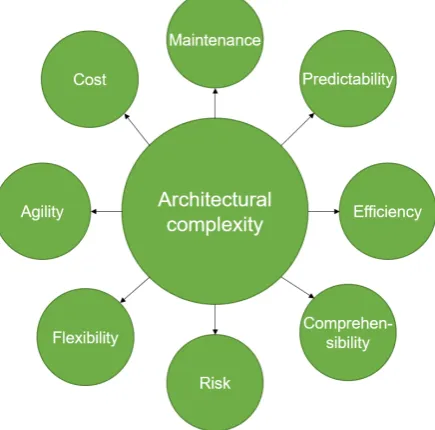
Due to their growing size and complexity, the need rose for a structured approach in the development of IT systems and landscapes. To this end, architecture has had an increasingly important role. In their Foundations for the Study of Software Architecture, Perry & Wolf (1992) already stated the benefits of architecture and argued to increase efforts on its development. A proper architectural basis has shown to benefit both the development and maintenance of a system (Shaw, DeLine, Klein, Ross, Young & Zelesnik, 1995) and can yield a competitive advantage (Bradley & Byrd, 2006). Either directly or indirectly, architecture impacts cost, maintainability and interoperability (Osvalds, 2001). Especially in an enterprise-wide context, architecture is an important basis for IT management (Rood, 1994). However, an often reported problem is that over time, architectures tend to become more complex. Subsequent expansions and modifications of an IT landscape can result in a lack of architectural structure, or having multiple design patterns intertwined. This increase in architectural complexity can, in turn, impact a system and its environment in many ways. Besides higher costs, increased architectural complexity can lead to lower adaptability and maintainability of the entire IT landscape (Wehling, Wille, Seidl & Schaefer, 2017), increase operational risk and reduce flexibility (Schmidt & Buxmann, 2011). Moreover, the increasing size and complexity of IT landscapes poses the need to ensure IT is properly aligned with, and enables, business goals. Hence, the field of enterprise architecture (EA) was born.
The evidence above suggests architectural complexity can have an important influence on the per-formance of enterprises and their IT landscapes, and should be managed properly. In fact, Lange & Mendling (2011) found that in a panel of experts, almost 90% considered complexity management as one of the primary goals of enterprise architecture. Yet, hardly any existing enterprise architecture methodologies and research directly addresses complexity management. At the same time, little re-search on complexity management in other areas is applicable to the field of enterprise architecture (Lee, Ramanathan, Hossain, Kumar, Weirwille & Ramnath, 2014). One of the problems in this regard is measurement. The lack of any recognized methodology of complexity measurement indicates a short-age of research in this field. Simultaneously, complexity measurement can be considered a prerequisite for proper complexity management. As Sch ¨utz, Widjaja & Kaiser (2013, p.1) note: “Measurability is the essential basis for management”. However, quantifying architectural complexity is in itself a very complex process, indicated by that fact that no standardized or proven method currently exists.
This study aims to create a model of enterprise architecture complexity measurement, including the variables influencing architectural complexity and the appropriate metrics to measure these. Ultimately, this will enable the management of complexity in enterprise architectures.
1.2
Background
1.2.1
Architecture
Effective measurement requires a thorough understanding and proper definition of the target of mea-surement and its context. “Architecture” is quite a general term; it is defined in many different contexts and disciplines. The International Organization for Standardization (ISO) provides widely applicable and accepted standards and definitions, and this research will adopt their definition of architecture:
Definition 1. Architecture: The fundamental concepts or properties of a system in its environment embodied in its elements, relationships, and in the principles of its design and evolution (ISO/IEC/IEEE, 2011).
Though widely applicable, this definition is very dependent on the interpretation and scope of the terms “system” and “environment”, since both are again very general terms.
The environment in which this research operates is that of organizations. However, not only orga-nizations as a whole are considered; focus may lie on a subset or superset of an organization as well, such as departments or an ecosystem of organizations. Thus, the environment of focus is that of an enterprise, which can be defined as follows:
Definition 2. Enterprise: Any collection of organizations that has a common set of goals (The Open Group, 2011).
Defining the system under consideration requires an elaboration on the exact meaning of enterprise architecture. Though up for debate and different interpretations, a generally accepted definition for enterprise architecture is as follows:
Definition 3. Enterprise architecture: A coherent whole of principles, methods, and models that are used in the design and realization of an enterprise’s organizational structure, business processes, infor-mation systems, and infrastructure (Lankhorst, 2017).
models designed by an architect. Secondly, one can consider thepractice of enterprise architecture, which is the set of principles and methods used to design and realize the enterprise architecture. In practice, the process of enterprise architecture entails the definition of a current and future state archi-tecture. In this research, “the complexity of an enterprise architecture” refers to the complexity of the architecture of the enterprise’s elements, not the process of their design or realization.
The definition of enterprise architecture suggests that it regards to multiple aspects of an enter-prise, and would thus consist of multiple “sub-architectures”. Indeed, the popular enterprise architecture framework TOGAF identifies four architectures, called domains, commonly accepted as subsets of an overall enterprise architecture (The Open Group, 2011): business, data, application and technology ar-chitecture. This subdivision of enterprise architecture is supported by additional frameworks, such as the Integrated Architecture Framework by Capgemini (van ’t Wout, Waage, Hartman, Stahlecker & Hof-man, 2010), ArchiMate (The Open Group, 2017), and the research by Wagter, van den Berg, Luijpers & van Steenbergen (2005). The different domains focus on different aspects of the enterprise architec-ture, and are visualized in Figure 1.1. Thebusiness architectureconcerns the strategy and objectives, products and services, governance, organizational structure and processes of an enterprise. Thedata architecture regards the data and information that an enterprise holds, and its structure, relationships and management. Application architecture refers to the applications deployed in the enterprise, their relationships and their support of the business processes. Finally, the technology architecture, also called infrastructure domain, concerns all the hardware, network and middleware components required to support the other domains, describing their types and structure. All domains are considered to be related and interdependent, and it is therefore considered to be a holistic approach to architecture.
Figure 1.1: Enterprise architecture domains
1.2.2
Complexity
The concept of complexity seems hard to measure, but perhaps even harder to define. It is used through-out many research disciplines, and open to an array of different interpretations. Since this research focuses on the complexity of (enterprise) architectures, the definition of complexity should be focused likewise.
complex-ity within each domain as well as interrelations between its domains should be considered. Several studies look at patterns in these elements and relations: Kazman & Burth (1998) define complexity by considering the pattern coverage of an architecture, whereas Efatmaneshnik & Ryan (2016) calculate its distance from reference simplicity. Other studies define complexity in terms of their proposed metrics (Gao, Warnier, Splunter, Chen & Brazier, 2015; Lankford, 2003). Interestingly, all of these papers on complexity use measurable terms to define complexity, such as the number of elements and relations. Literature on business complexity, the non-technological domain of enterprise architecture, agrees on this as well (Collinson & Jay, 2012; Gharajedaghi, 2011). Therefore, this research adopts the view that complexity is best defined in measurable terms.
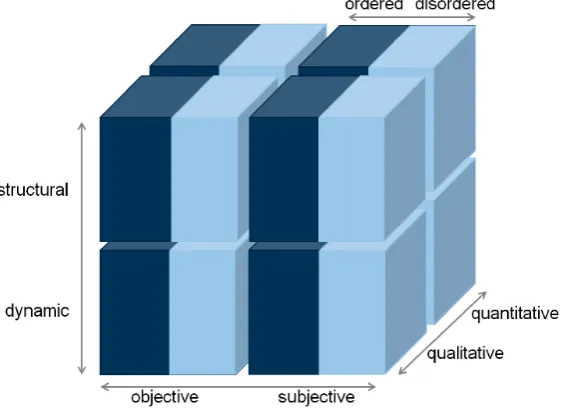
Although all of the previously mentioned researchers aim for the measurement of complexity, their exact interpretations of complexity differ. As a result, Schneider et al. (2014) take a more abstract approach to complexity in enterprise architecture. They note that different interpretations of complexity throughout research impedes the common acceptance of the field. Therefore, they propose a conceptual framework aimed at unifying these views on complexity. According to Schneider et al. (2014), the various aspects of complexity can be specified by four dimensions, as exhibited in Figure 1.2, which can be described as follows.
1.2.2.1 Objective versus subjective complexity
The first dimension is based on the role and influence of the observer. Objective complexity is indepen-dent of any observer, and therefore an inherent property of the object of study. Subjective complexity occurs when complexity is a part of the relationship between the object of study and its observer, and therefore dependent on this relationship. In enterprise architecture, different stakeholders may have a different perception of an architecture’s complexity. In other words: subjective complexity exists in the eye of the beholder.
1.2.2.2 Structural versus dynamic complexity
This dimension relates to the internal structure of a system and the time frame considered. Structural, or static, complexity looks at system components and their cause-and-effect relationships in a static snapshot of the system. Dynamic complexity, on the other hand, refers to the interaction between com-ponents within the system, and the change of their relationship over a period of time. Beese, Aier, Haki & Aleatrati Khosroshahi (2016) argue that these concepts are closely connected; dynamic complexity is highly influenced by structural complexity and results from the interaction between a system’s structural complexity and its dynamics.
1.2.2.3 Quantitative versus qualitative complexity
The next dimension refers to the way certain properties or attributes are evaluated. In the qualitative notion, complexity is evaluated through the qualitative assessment of elements within a system, and therefore not dependent on the quantity of these elements. In contrast, the quantitative notion concerns the quantification of elements within a system, relating its complexity to these numbers.
1.2.2.4 Ordered versus disordered complexity
are not predictable, the system as a whole may have analyzable attributes and behaviour. This statisti-cal analysis of system behaviour applies a disordered notion of complexity. On the other hand, ordered complexity refers to a moderate and known number of attributes, with strong and clear internal rela-tions. Although statistics are not applicable, these attributes and their relations may be studied to predict system behaviour.
Figure 1.2: Complexity dimensions (Schneider et al., 2014)
As is illustrated by the complexity cube in Figure 1.2, these dimensions are independent of each other and can be combined in any way applicable in practice. Furthermore, they show that a system can combine both complexity notions along a single dimension. This is illustrated by the research of Beese et al. (2016), where structural complexity is considered to be an indispensable element of dynamic complexity.
This research adopts this four-dimensional view on complexity. Using this theory, definitions of com-plexity can be classified by identifying the appropriate dimensions. As a result, a comcom-plexity metric (CM) can be defined as a quadruple:
CM = (x1, x2, x3, x4)
This is based on the four dimension sets:
x1⊆ {objective, subjective}
x2⊆ {structural, dynamic}
x3⊆ {quantitative, qualitative}
x4⊆ {ordered, disordered}
Using these complexity dimensions “allows [researchers] to apply their own choice of complexity notions without having to argue for a specific definition of complexity” (Schneider et al., 2014, p.8). Therefore, this research will not adhere to a specific definition of complexity, but rather proposes the view that complexity is a property of a system that is defined by the relevant set of metrics used to measure it.
1.2.3
Metrics
In order to properly measure the complexity of an architecture, it is important to clearly understand and define the process of measurement, as well as the object to be measured and its attributes.
Definition 5. Attribute:A quality or feature regarded as a characteristic or inherent part of someone or something (Oxford Dictionary, 2018a)
To define the measurement of these attributes, the International Organization of Standardization has adopted the International Vocabulary of Metrology, providing definitions for measurement and mea-surement standards (Joint Committee for Guides in Metrology, 2008). The meamea-surement definitions formulated in this research are based on that document, though adopting its own terminology.
In order to quantify and measure the attributes of an architecture, one or more metrics have to be designed.
Definition 6. Metric: The property of an attribute, where the property has a magnitude that can be expressed as a number and a reference.
Definition 7. Measurement: The process of obtaining one or more metric values that can reasonably be assigned to an attribute.
From these definitions it can be inferred that measuring architectural complexity is the process of finding the value of architectural complexity metrics. In order to do this, the attributes contributing to complexity have to be found, and the appropriate metrics to measure these attributes designed.
Abran (2010) describes the process of designing a measurement method, consisting of three steps: 1. Measurement principle:gives the description of the attribute to be measured and its metrics; 2. Measurement method: operationalizes the principle, defining the steps to be followed in order to
measure the attribute;
3. Measurement procedure: implements one or more measurement principles by implementing a measurement method.
The first step of measurement, defining the measurement principle, is an essential basis for proper measurement, and is the focus of this research. To develop a measurement principle for architectural complexity, the appropriate attributes and metrics should be identified first. Vasconcelos, Sousa & Tri-bolet (2007) introduce a template for architecture metrics, which include the following information:
1. Name and description 2. Value
3. Computation:describes the method of value calculation 4. Architectural level:the correlated architectural domain
Additionally, while developing a measurement principle for architectural complexity in software, Mccabe & Butler (1989, p.1423) present a list of properties that support the applicability of metrics when quanti-fying complexity:
2. “The metric should be related to the effort to integrate the design.” Since the integration of an architectural design is the most costly phase, the metrics should relate to this aspect. When measuring the complexity of an enterprise architecture, this means that the integration of the four architecture domains should be strongly considered when drafting metrics.
3. “The metric should help generate an integration test plan early in the life cycle.” Metrics should be applicable early in the life cycle of an architecture, so they can be used to positively influence its complexity in an early stage. In enterprise architecture, this means that metrics should be applicable on an architecture design.
4. “The metric and associated process should be automatable.”
[image:20.595.72.528.326.657.2]1.2.4
Definition overview
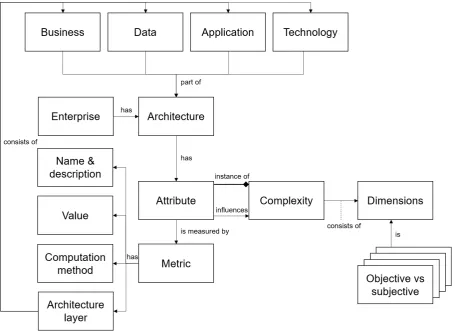
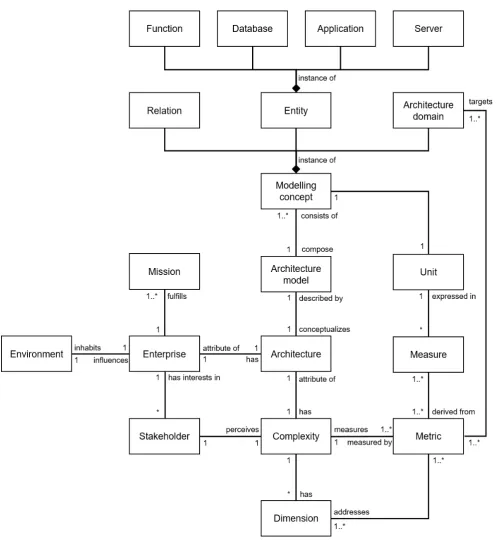
Figure 1.3 provides an overview of the definitions introduced so far and the relations between them. This shows that the architecture of an enterprise has a certain amount of attributes, one of which is complexity. Complexity is, in turn, influenced by one or more of these attributes. Each of these attributes in measured by one or more metrics.
1.3
Research objectives
1.3.1
Problem statement
Complexity has been identified as one of the key challenges of enterprise architecture (Lucke et al., 2010), and finding the optimal level of complexity is essential in order to maximize the performance of organizations and their IT landscapes (Collinson & Jay, 2012; Heydari & Dalili, 2012; Schmidt, 2015). The goal of complexity management in enterprise architecture is to achieve the appropriate level of plexity for the architecture’s context and purpose. To determine the current and desirable level of com-plexity for an enterprise architecture, measurement is an important basis (Sch ¨utz et al., 2013). However, quantifying architectural complexity is in itself a very complex process, and no standardized or proven method exists (Schneider et al., 2014). Furthermore, there is no consensus on the attributes contributing to complexity. Without these attributes and the appropriate metrics to measure them, measurement of architectural complexity is not possible, making complexity management impracticable.
1.3.2
Objective
The measurement of architectural complexity is required to enable proper enterprise architecture com-plexity management. To accomplish this, the attributes contributing to this comcom-plexity should be identi-fied, and their impact on complexity described. Additionally, metrics should be composed to measure these attributes. This research will propose a model which includes these attributes and their impact on complexity, and provides metrics for their measurement, enabling the quantification of complexity in enterprise architectures.
1.3.3
Scope
In this research, complexity has been defined according to the dimensions proposed by Schneider et al. (2014). To properly manage architectural complexity, all dimensions have to be considered. However, Schneider et al. (2014) indicate that current research is limited in its investigation of different dimen-sions. This was confirmed by a structured literature review carried out in this research, suggesting little to no research is focused on the subjective and dynamic notions of complexity (see section 2.3 “Ob-jective complexity metrics”, specifically Table 2.4). Whereas both dimensions are relevant to enterprise architecture complexity, the subjective notion seems particularly interesting in regards to complexity management, for several reasons. Firstly, an enterprise architecture is usually designed and maintained by multiple stakeholders. By definition, each of these stakeholders will perceive the complexity of the architecture differently. Understanding this difference in perception will help to consolidate their views and could greatly improve their collaboration. Additionally, there are many other stakeholders that are required to work with an enterprise architecture. Considering their perception of its complexity may help to increase their understanding of the architecture. This might in turn lead to a higher compliance with architecture standards or increase stakeholders’ efficiency when working with the architecture. Finally, knowing which factors influence perceived complexity may help to simplify an inherently complex ar-chitecture, making the architecture more manageable (Jochemsen, Mehrizi, van den Hooff & Plomp, 2016). Therefore, this research will focus on the dimension of objective/subjective complexity, and will not differentiate between the other complexity dimensions.
1.4
Research design
1.4.1
Research questions
This research will answer the following main research question to achieve the stated objective:
How can objective and subjective complexity metrics be incorporated in a unified enterprise architecture complexity model?
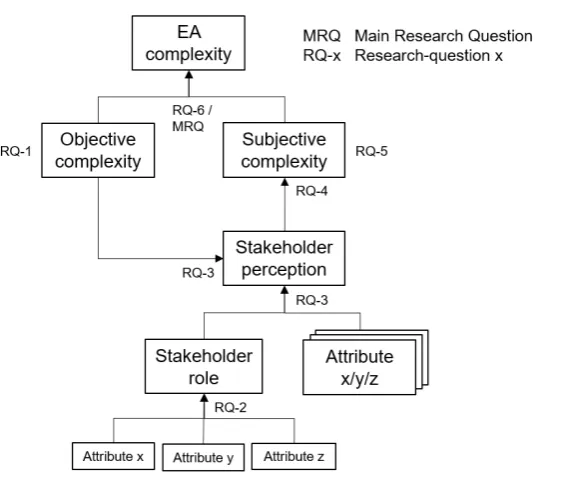
This research question reflects the goal of this study to measure architectural complexity, and incor-porates its scope on the objective/subjective complexity dimension. To answer the main research ques-tions, several sub-questions have to be answered regarding the context of the enterprise architecture and both types of complexity. The following sub-questions are studied:
1. Which existing metrics are most prevalent for measuring objective complexity in an enterprise architecture?
Existing literature already defines several metrics for the measurement of objective complexity in an enterprise architecture. This research aims to review this literature and identify the most prevalent and appropriate objective complexity metrics.
2. How can stakeholders be defined in a context-agnostic way?
According to the Oxford dictionary, subjectivity means to be “dependent on [...] an individual’s per-ception” (Oxford Dictionary, 2018b). Therefore, in order to measure the subjective complexity of an architecture, it is important to define the different stakeholders that interact with it. This stakeholder definition has to be context-agnostic in order to be applicable in all different types of enterprises.
3. Which attributes influence a stakeholder’s perception of enterprise architecture complexity? The definition of subjectivity introduced above makes clear that subjectivity is influenced by the object of study, and a stakeholder’s perception of this. Therefore, to measure subjective complexity, the attributes influencing stakeholder perception should be identified.
4. How does stakeholder perception lead to subjective complexity?
Subjective complexity is based on the object of study and the perception of stakeholders. This relation needs to be carefully specified and modelled.
5. What metrics are suitable for measuring subjective complexity in an enterprise architecture? Based on the attributes found by previous research questions, appropriate metrics to measure these will be proposed.
6. How can both types of metrics be combined to create a unified model for enterprise architecture complexity measurement?
Combining the objective and subjective complexity metrics in a single model for enterprise architecture complexity leads to the complexity model defined in the main research question.
Figure 1.4: Research questions relations
1.4.2
Relevance
Consolidating the existing research on architectural complexity measurement and complementing this with subjective complexity has both an academic and practical relevance. Firstly, the current efforts on enterprise architecture complexity measurement are dispersed: many metrics are suggested by different studies. Consolidating the existing research will help to create an insight of the current state of the art. Furthermore, complexity research in enterprise architecture seems to be developing, but still incomplete. Schneider et al. (2014) observes an underrepresentation of the subjective complexity dimension in existing literature, which was verified in the structured literature review of this research. No more than 2% of existing enterprise architecture complexity metrics consider subjectivity (see section 2.3 “Objective complexity metrics”, specifically Table 2.4). Extending the state of the art on complexity research by studying a dimension that has been little-researched will contribute to the existing body of literature.
Additionally, this research has great potential relevance in practice. Excessive complexity in the archi-tecture of an enterprise or its IT landscape has been found to have a series of negative effects. Figure 1.5 presents the negative effects of excessive complexity found by five empirical studies (Beese et al., 2016; Beese, Kazem Haki, Aier & Winter, 2017; Mocker, 2009; Schmidt & Buxmann, 2011; Wehling et al., 2017).
Ultimately, this could have a positive influence on the effects influenced by enterprise architecture com-plexity, as visualized in Figure 1.5.
Figure 1.5: Negative effects of architectural complexity in EA
1.4.3
Research process
Answering the research questions posed earlier requires the design of a complexity measurement model. In Information Systems (IS) research, a widely-accepted methodology for the design of IS ar-tifacts is Design Science. This methodology structures the process of investigation of the context, the design of an artifact and its validation. This research adopts the Design Science Methodology (DSM) introduced by Wieringa (2014) as overarching research process.
The DSM introduces the design cycle as a basis for the development of IS artifacts, which consists of three stages. Theproblem investigationprepares the design of an artifact by learning more about the problem it aims to solve and the context in which is operates. Next, thetreatment designencompasses the actual design of the artifact. Finally, the treatment validation checks whether the artifact helps to achieve the desired goals. Note that the DSM is an overarching research process, and the steps described are accomplished through the use of several other methodologies. Figure 1.6 visualizes the entire research process and specifies the appropriate methodologies used for each step of the design cycle. These methodologies are introduced below, and described in more detail in chapter 3 “Methodology”.
First, a structured literature review has been conducted to answer the first research question. Since objective complexity metrics have already been described in existing literature, they will be accumulated through a literature review. Through the structural approach by Kitchenham & Charters (2007), all metrics proposed by literature have been searched and analyzed. Data was extracted in a systematic way, using the concept matrix as suggested by Webster & Watson (2002). Based on these results, appropriate metrics have been selected for further use in the complexity model. By structurally searching all available literature and extracting the appropriate objective complexity metrics, broad applicability and academic support of these metrics can be ensured. An exploratory literature review has been conducted on the second research question. Stakeholders are an essential element to consider in subjective complexity, and their definition should be applicable in the different contexts of enterprise architecture. More details on the methodologies used for literature can be found in section 2.1 “Literature review methodology”.
The third and fifth research questions have been answered empirically. Since very little literature considers the subjective notion of complexity in enterprise architecture, the attributes contributing to this are unknown. To identify these attributes, semi-structured interviews have been held with the different stakeholders found during the literature review. Details on the methodology used for these interviews can be found in section 3.2 “Interviews”. The interview protocol used is added in Appendix C “Interview Guide”. After identifying the attributes influencing subjective complexity, appropriate metrics to measure these have been designed according to the template introduced by Vasconcelos et al. (2007). These metrics have been based on the results of both the literature review and the interviews.
From this, a measurement model has been designed in order to answer research questions four and six. This was, in turn, done in two steps. The first and most important step is the conceptualization of complexity. Based on the data found in the previous parts of this research, descriptive inference was used to build a conceptual model of enterprise architecture complexity. This entails the identification of constructs influencing complexity and defining their relationships (Wieringa, 2014). Next, each of the constructs identified has been operationalized through the design of metrics. Using these metrics, the constructs influencing complexity can be measured, thus creating a measurement model for enter-prise architecture complexity. A detailed explanation of this process can be found in section 3.3 “Model design”.
Finally, the composed measurement model has been validated. This was done using expert inter-views and a case study. During the expert validation, three experts were asked to judge the correctness of the designed model, and make suggestions for its improvement. Following its optimization using the expert feedback, the model was applied in practice during a case study. More details on the validation of the measurement model can be found in section 3.4 “Validation”.
1.4.4
Research structure
2.
Literature Review
2.1
Literature review methodology
A literature review can serve multiple purposes in research, dependent on the question it attempts to answer. This research aims to answer multiple research questions, which require a different approach to literature review. According to Schneider et al. (2014), there is a substantial amount of literature to be found on the measurement of objective complexity in enterprise architecture, whereas subjective complexity has little to no research available. In this section, a structured literature is performed to review all available literature on complexity measurement, and identify and classify the available complexity metrics. The unexplored area of subjective complexity measurement requires an exploratory literature review to investigate the existing theories and information available on the topic (Adams, Khan, Raeside & White, 2007). Below, a methodology is provided for both types of literature review.
2.1.1
Structured literature review
Conducting a structured literature review should be a structured and rigorous process, and result in an exhaustive overview of all available literature on the topic. An essential step in this process is the creation of a protocol, explicating the steps to be taken in the review (Kitchenham & Charters, 2007). Such a protocol was drafted based on the works of Kitchenham & Charters (2007) and Webster & Watson (2002). It was used to guide the search and selection of, and data extraction from, relevant studies. The review protocol can be found in Appendix A “Structured Literature Review Protocol”. This protocol was used to extract the existing metrics for complexity measurement, and can be found in section 2.3 “Objective complexity metrics”.
2.1.2
Exploratory literature review
According to Adams et al. (2007), an exploratory literature review aims at finding the existing theories, empirical evidence and research methods related to a certain research topic. The goal of the review is not so much to provide a comprehensive meta-analysis of the existing literature, like a structured review aims to; rather it aims to provide a better insight in the existing theories, methods and data on the topic. This can be used as a theoretical foundation for further research.
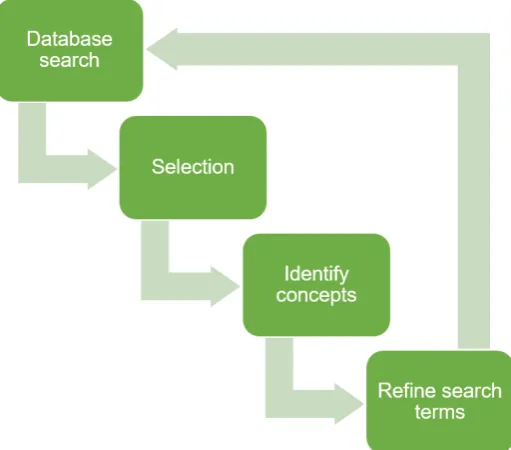
iterative process was repeated until no more relevant literature was found, and eventually resulted in the identification of several concepts as described in this chapter. An overview of the search terms used can be found in Table 2.1.
Figure 2.1: Exploratory search strategy
Search term Search term Search term
complex AND systems
complex AND systems AND characteristics
”complex systems” AND ”enterprise architecture”
“enterprise architecture” AND (stakeholder* OR “stakeholder framework”) “enterprise architecture” AND stakeholder AND perception
subjective AND complexity AND “enterprise architecture”
cognitive AND complexity AND “enterprise architecture”
complexity AND perception AND “enterprise architecture”
(subjective OR cognitive) AND complexity
cognitive AND complexity AND architectur*
requisite AND complexity
optimal AND complexity AND “enterprise architecture”
optimal AND system AND complexity
[image:27.595.85.513.403.747.2]2.2
Complex systems
Introduced in the 1920s by Ludwig von Bertalanffy, General Systems Theory argues to view the world in terms of systems. A system can be defined as “a set of elements standing in interrelation among themselves and with the environment” (Von Bertalanffy, 1972, p.417). The theory provides a conceptual framework to approach science, namely by researching a system in relation with itself and its environ-ment (Von Bertalanffy, 1975). This approach was necessitated by the increasing complexity of systems in modern technology (Von Bertalanffy, 1968). The research on these complex systems advanced the field of complexity science, looking for a theory to unify the research on complexity in different fields, and studying the characteristics and behaviour of complex systems (Kandjani et al., 2014).
Research on complex systems extends the General Systems Theory and thus focuses on (complex) systems in their environments. A substantial amount of research has been done on the measurement of these complex systems, and could therefore be applicable to enterprise architecture. That is, if an enterprise architecture were to be considered a complex system. To determine whether the research in complexity science is applicable to enterprise architecture, four studies have been considered that provide one or more characteristics that make a system complex, shown in Table 2.2.
Study Characteristics
Ottino (2003) 1. Displays organization without any external organizing principle being applied.
Norman & Kuras (2006)
1. Large number of useful potential arrangements of its elements;
2. Elements can change when interacting with their neighboring elements;
3. Structure and behavior is not deductible from its components;
4. Its own complexity is increased, when given a steady inflow of resources;
5. Independent change agents are present.
Ladyman, Lambert & Wiesner (2013)
1. Nonlinearity;
2. Feedback;
3. Spontaneous order;
4. Robustness and lack of central control;
5. Emergence;
6. Hierarchical organisation;
7. Numerosity.
Cilliers (1998)
1. Large number of elements;
2. Elements interact dynamically;
3. Every element influences, and is influenced by, quite a few others;
4. Interactions are non-linear;
5. Interactions have a limited range;
6. There are loops in the interaction (recurrency);
7. Interacts with its environment;
8. Operates far from equilibrium;
9. Evolves through time, and its past is co-responsible for its present behavior;
10. Each element is ignorant of the behavior of the system as a whole.
Table 2.2: Complex system characteristics
it own complexity. Most importantly, an enterprise architecture does not display self-organization, which is often considered an important aspect of complex systems. Consequently, despite adhering to many of the characteristics listed in Table 2.2, an enterprise architecture cannot be considered a complex system as defined in literature.
However, these characteristics can also be applied to the environment of an enterprise architecture, the enterprise itself. Doing so shows that an enterprise is clearly a complex system, which is confirmed in literature (Kandjani, Bernus & Nielsen, 2013; Kandjani et al., 2014; Bar-Yam, 2003). Kandjani et al. (2014) argue for a classification of complexity in complex systems, providing three aspects of complexity:
1. Complexity of the system’s function;
2. Complexity of the process creating the system; 3. Complexity of its architecture.
This third complexity aspect relates to enterprise architecture. Therefore, although not being a complex system itself, enterprise architecture does contribute greatly to the complexity of its environment, the enterprise. Consequently, results from this study can be used not only to identify the complexity of enterprise architectures, but has applications in research on the complexity of enterprises as well.
2.3
Objective complexity metrics
2.3.1
Search and selection
[image:29.595.206.381.435.630.2]2.3.1.1 Database search and selection
Figure 2.2: Structured literature review results
studies were excluded. Most of these were discarded because they did not meet the second inclusion criteria, whereas some met one of the exclusion criteria. Finally, for the remaining 32 studies, the full text was obtained and read. By carefully applying all selection criteria on these texts, another 17 studies were excluded. With this, a set of 15 studies remained that met all criteria. It is important to note that in the above process, the selection criteria were applied conservatively, in order to ensure no relevant studies were missed. This means that when in doubt, studies were included.
2.3.1.2 Reference search
After the first database search and the refinement of the selection, a forward and backward reference search was performed. First, all references in the remaining selection were scanned to search for additional relevant research, meaning those studies that meet the selection criteria. Subsequently, using the previously listed databases, all studies that referenced to the selected studies were evaluated. The reference search is an iterative process, meaning the search was repeated until no new studies were found. This step found another 5 relevant studies. Therefore, the final selection of relevant research contained a total of 20 studies. This selection can be found in Table B.1 in Appendix B.1 “Review paper selection”.
2.3.2
Quality assessment
The final set of papers were assessed on their quality based on the the checklist provided by Kitchenham & Charters (2007). No papers were excluded in the process.
2.3.3
Data extraction
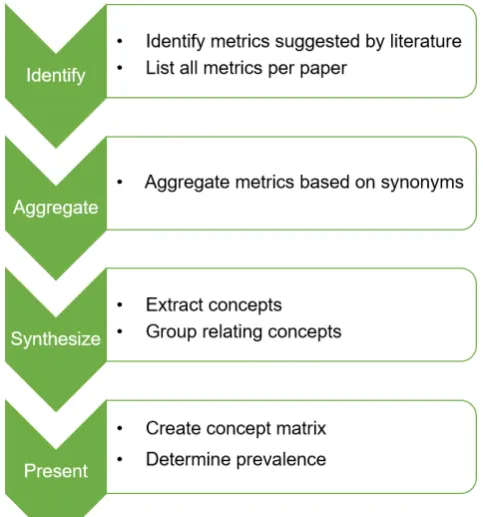
[image:30.595.177.419.463.722.2]The process of data extraction from the resulting set is based on the concept matrix of Webster & Watson (2002), and can be summarized by Figure 2.3.
First, all suggested metrics were identified and listed for each paper. Metrics that use synonyms and/or are obviously highly similar, were aggregated to form a list of forty-two unique metrics that are suggested by literature at least once. Next, different concepts were extracted from these metrics, based on the author’s judgment. This resulted in the identification of twelve concepts, which can be combined into four concept-groups. Using this data, a concept matrix was created, and the prevalence of the concepts among literature was determined.
2.3.4
Results
2.3.4.1 Metric matrix
The aim of this structured literature review was to answer the following research question, as defined in Appendix A “Structured Literature Review Protocol”:
1. Which existing metrics are being used to measure complexity in an enterprise architecture, and how can these be classified using the complexity dimensions by Schneider et al. (2014)?
In order to answer this question, all metrics suggested by the selected papers were identified and listed. This included a lot of similar results, which were aggregated in a resulting list of forty-two metrics. In Table B.2 in Appendix B.2 “Metric matrix”, the metric matrix can be found. This matrix contains all identified complexity metrics, showing their relation to the included papers and their resulting prevalence. As the matrix shows, the metric number of relations is the most prevalent, being used in 55% of the papers, closely followed by number of elements, with a prevalence of 40%. Of all forty-two metrics identified, thirteen were used in more than one paper, together accounting for about two-thirds of the total number of mentioned metrics. Following the metric matrix, Table B.3 in Appendix B.3 “Metric description” offers a list providing a short description of each metric.
2.3.4.2 Concepts
Based on the list of metrics, twelve concepts were extracted, which can be divided into four groups, as shown in Table 2.3. Table B.4 in Appendix B.4 “Metric-concept overview” shows an overview of all metrics and their assigned concept(s). Below, a short description of each concept is provided.
Graph-based Functional Non-functional Other
Elements and relations Functions Quality Expert opinion
Patterns Redundancy Reliability Cost
Application-data Conformity Hardware-data Service time
Table 2.3: Identified concepts
Graph-based
Thepatternsconcept identifies existing design-patterns within the graph by using pattern-matching al-gorithms. An architecture that is based on an existing design-pattern is easier to comprehend, and pattern-matching can therefore be used to measure complexity.
Functional
These concepts look at functional properties of the system and/or its elements.Functionsrelates to the functions a system can perform, or the processes to accomplish these. Redundancy occurs when the functionality of multiple elements overlap, meaning the architecture is larger than necessary. Application-data andhardware-data refers to data or statistics of the software or hardware deployed in the archi-tecture. These concepts are related to a specific architectural domain: the application domain and infrastructure domain.
Non-functional
Non-functional concepts relate to the non-functional properties of an architecture.Qualityandreliability look at the quality and reliability requirements set, since high requirements in these aspects could lead to higher complexity.Conformity evaluates to what extent elements conform to standardization.Service timeis a concept that looks at the required time to perform a specific service or function.
Other
Finally,expert opinionuses the opinion of experts to provide weight factors for other metrics.Costlooks at the cost and effort required to make changes to the architecture.
2.3.4.3 Concept matrix
As a next step, a concept matrix was created, which can be found in Table B.5 in Appendix B.5 “Concept matrix”. This matrix creates an overview of the twenty papers of the literature review and the concepts they use to measure architectural complexity. Included is again the total number of papers that mention each concept, and their prevalence. This shows that the elements and relations concept is by far the most popular, being used in 80% of the papers. After this, conformity is most prevalent (35%), followed by functions and application-data (both 30%). The concept-groups show that graph-based metrics are highly used (with a prevalence of 85%), followed by functional properties (55%). Half the papers use a single concept to measure complexity, whereas the other half combines multiple concepts, often from multiple groups.
2.3.4.4 Complexity dimensions
Prevalence Count Dimension Dimension Count Prevalence
98% 41 Objective Subjective 1 2%
100% 42 Structural Dynamic 1 2%
98% 41 Quantitative Qualitative 4 10%
86% 36 Ordered Disordered 7 17%
Table 2.4: Complexity dimension distribution
As is apparent from this data, the most common complexity metric (CM) can be described as follows: CM = (objective, structural, quantitative, ordered)
This quadruple describes 79% of the enterprise architecture complexity metrics in the current literature.
2.3.5
Discussion
In this section, the current state of the art on the measurement of architectural complexity was reviewed. Existing metrics have been broken down into concepts, and classified into complexity dimensions. Most of these metrics propose to look at an architecture as a graph; 17 out of 20 studies found made use of graph-based metrics in some form. However, over half of the studies found combined multiple types of metrics to get a thorough view of an architecture’s complexity. This indicates that, since complexity is such a comprehensive property, multiple metrics with different viewpoints should be combined. The division of existing metrics into the complexity dimensions shows a very low variation: 79% of the met-rics can be described with the quadruple(objective, structural, quantitative, ordered). Moreover, 98% of the metrics found focused on the objective dimension of complexity, confirming the observation by Schneider et al. (2014) that subjective complexity metrics are yet to be found in the context of enterprise architecture.
The list of metrics found can be employed to extract metrics regarding the objective complexity of enterprise architecture. Of course, employing the entire list of metrics in an enterprise architecture complexity model would neither be efficient nor feasible. Therefore, a selection of metrics has to be chosen to be included in the model. The selection of objective metrics is described and effectuated in section 3.3.2 “Operationalization”.
2.4
Stakeholders
Subjective complexity, per definition, is dependent on the perception of a stakeholder, and therefore different for each stakeholder. In order to measure the subjective complexity of an architecture, the different stakeholders that interact with it should be defined. Making this definition context-agnostic is an important requirement to ensure applicability in different organizations and contexts. To make the concept of stakeholder applicable in a model intended for complexity measurement, attributes should be identified that collectively constitute any enterprise architecture stakeholder.
2.4.1
Stakeholder definition
the stakeholder as a concept and important factor in enterprises. Ever since, stakeholders and their management have been considered an essential aspect of organizations.
Over the past decades, numerous definitions of the word “stakeholder” have been proposed, ad-dressing different organizations and contexts. In enterprise architecture, the leading definition of stake-holder is adopted from the 42010 IEEE standard:
Definition 8. Stakeholder: Individual, team, organization, or classes thereof, having an interest in a system (ISO/IEC/IEEE, 2011).
In the context of enterprise architecture, this means that anyone who has an interest in the architecture and its results can be considered a stakeholder.
2.4.2
Stakeholders in enterprise architecture
In the study and practice of enterprise architecture, stakeholders play an important role. Insufficient involvement of business (or other organizational) stakeholders has been identified as one of the main threats to enterprise architecture (Gartner, 2009). Collaboration with stakeholders is considered chal-lenging, but a requisite for successful implementation of enterprise architecture (van der Raadt et al., 2008; Niemi, 2007; Puspitasari, 2016). Since different stakeholders have different and often conflicting needs and perspectives (Niemi, 2007), identification of the various types of stakeholders involved with enterprise architecture is an important first step in analyzing their perception.
2.4.2.1 Views and viewpoints
In enterprise architecture, stakeholders are seldom interested in the full scope of the architecture, in-cluding all its details. In order to cater the needs of different stakeholders, views were introduced. A view is a representation of the architecture intended for a specific (group of) stakeholder(s) (Lankhorst, 2017). By constructing views for different stakeholders, only relevant information can be included, leav-ing out unnecessary details. To create these views, viewpoints are composed. A viewpoint contains all information needed to construct a specific view; it is a template from which an individual view can be developed, establishing the purpose and audience of a view, and dictating the techniques used for its creation (Lankhorst, 2017).
2.4.3
Stakeholder classification frameworks
Over the past years, numerous frameworks have been proposed for the classification of stakeholders. However, leading stakeholder classification models, such as Mitchell, Agle & Wood (1997), are neither intended for, nor validated in the context of, enterprise architecture. Furthermore, most stakeholder theories are mainly focused on management and decision making. Although this does play a part in enterprise architecture, modelling complexity perception requires a more comprehensive approach to stakeholder classification. Recently, enterprise architecture research has increased its focus on stake-holders, identifying collaboration as a requisite for success.
2.4.3.1 Role
Niemi (2007) aims to create a holistic view on the stakeholders of an enterprise architecture. By analyz-ing a large body of existanalyz-ing literature on the subject and supplementanalyz-ing this with interviews, he proposes three roles, which can be used to classify stakeholders:
involved with its management. Producers aim to satisfy the facilitators’ and users’ requirements. Example: (enterprise/domain/solution) architect, project manager.
• Facilitators are the stakeholders involved with the governance, management, maintenance or sponsorship of the enterprise architecture. Contrary to producers, they do not directly conduct planning or development of the architecture. They differ from users in the sense that their work affects the architecture.
Example: board of directors, project management office.
• Usersare the stakeholders that utilize enterprise architecture work and its products in their daily work. In contrast to the other roles, they do not carry out work that directly affects the architecture. However, they can be involved in architecture work by providing requirements or feedback. Example: application developer, IT operator.
2.4.3.2 Domain-level matrix
In their paperStakeholder Perception of Enterprise Architecture, van der Raadt et al. (2008) propose a matrix for the classification of stakeholders. For this, they identify two attributes:
• Levelrefers to the organizational level a stakeholder operates in. Four levels can be distinguished: ◦ Atenterpriselevel, management focuses on the strategy of the architecture, making decisions
regarding the future state of the architecture. This level typically operates at C-level.
◦ Atdomainlevel, domain owners and change managers coordinate and mange the programs running in their domain, and IT focuses on the domain architecture. This level operates at business unit-level.
◦ Atproject level, stakeholders run project and implement changes, executing the decisions made by the first two levels.
◦ Atoperational level, stakeholders are responsible for the stability and continuity of the op-erational environment, the day-to-day operations, and the maintenance and optimization of platforms.
• Domain refers to the architectural domain that constitute enterprise architecture. These do-mains arebusiness,data,applicationandtechnology, and are described in detail in section 1.2.1 “Architecture”.
Business Data Application Technology
Enterprise CEO CIO Enterprise architect CTO
Domain Head of business unit Domain architect Domain architect Platform manager
Project Project manager Information analyst Solution architect Infrastructure engineer
Operational Business process engineer Data administrator Application administrator Infrastructure administrator
2.4.3.3 Zachman Framework
The Zachman Framework is one of the most widely-known enterprise architecture frameworks. In this framework, enterprise architecture is viewed in a matrix of perspectives and dimensions. The columns of the matrix focus on different dimensions: data, function, network, people, time and motivation. The rows represent the view of different stakeholders, taking into consideration those who are involved in the planning, conception, building, using and maintaining activities of an enterprise architecture (Pereira & Sousa, 2004):
• Theplannerfocuses on positioning the architecture in its environment and specifies its scope. • Theownerfocuses on the management and application of the architecture.
• Thedesigner composes the requirements of the architecture, ensuring it will fulfill the owner’s expectations.
• Thebuildermanages the creation of the actual products.
• Thesubcontractorfabricates out-of-context components based on the specification of the builder. These views can be identified as roles focused on the production and facilitation of the enterprise architecture. They can be mapped to the roles of producer (planner, designer, builder, subcontractor) and facilitator (owner) introduced earlier, and can be viewed as a specifications of the more generally applicable model of Niemi (2007).
2.4.3.4 Viewpoint classification framework
Views and viewpoint in enterprise architecture are used to create a representation of the architecture in-tended for a specific (group of) stakeholder(s). Steen, Akehurst, ter Doest & Lankhorst (2004) propose a classification framework for viewpoints, aimed at enterprise architecture. In this framework, they include a classification of stakeholders and their goals:
• Designis focused on stakeholders in the design process. These viewpoints focus on the details of a specific architectural domain, or the interdependencies between domain.
• Decideis focused on manager in the process of decision making, and offers insights into different architectural domains and their relations.
• Inform is focused on aiding other stakeholders to understand the architecture, and obtain their commitment.
This categorization of viewpoints can be mapped to the framework of roles by Niemi (2007): Design⇒Producer
Decide⇒Facilitator Inform⇒User
This supports the categorization of roles by Niemi (2007) and provides the possibility to create viewpoints focused on these roles.
2.4.4
Stakeholder attributes
Figure 2.4: Stakeholder attributes and their possible values
2.5
Subjective complexity
Enterprise architures are socio-technical systems, meaning their functioning heavily depends on their in-teraction with stakeholders. This means that subjective aspects, stemming from stakeholders interacting with the architecture, are an inherent part of an enterprise architecture. Capturing the subjective aspects of complexity can therefore help organizations to manage their IT landscape more effectively (Jochem-sen et al., 2016). Subjective complexity is dependent on the perception of stakeholders, meaning it is essential to first understand perception itself.
Cognitive informatics is the science studying human perception and the internal processing of infor-mation. It is an interdisciplinary research area focusing on cognition, problem understanding, informa-tion processing and artificial intelligence (Singh & Misra, 2006). Human cogniinforma-tion defines the property of comprehension or understandability, which in turn influences whether an entity is perceived to be complex or simple (Singh & Misra, 2006). Cognitive informatics considers the transfer of information essential in this process. It proposes “information” as the third essence making up the natural world, supplementing the traditional essences matter and energy (Wang, 2007), and defines information as follows:
Definition 9. Information: A generic abstract model of properties or attributes of the natural world that can be distinctly elicited, generally abstracted, quantitatively represented, and mentally processed (Wang, 2007, p.4).
The latter part of this definition - elicitation, abstraction, representation and processing - can be seen as the perception of information. Perception can therefore be defined in terms of information processing:
Definition 10. Perception: A set of interpretive cognitive processes of the brain at the subconscious cognitive function layers that detects, relates, interprets, and searches internal cognitive information in the mind (Wang, 2007, p.7).
In cognitive informatics, complexity is considered to be related to the easy of comprehension. Bieri (1955) states that a system of constructs that has a highly differentiated interpretation among persons, i.e. one that is difficult in interpret and thus interpreted differently, is cognitively complex. The applica-tion of cognitive complexity in enterprise architectures has not yet been studied1. However, cognitive software complexity has been studied for quite some time, and has resulted in a series of cognitive complexity metrics (Cant et al., 1995; Singh & Misra, 2006; Wang, 2006; Wijendra & Hewagamage,