ISSN Online: 2161-6809 ISSN Print: 2161-6795
MCNP Simulation of Physics Parameters of
Dispersion Fuels for Conversion of NIRR-1 to
LEU
Kola Ibikunle
1, Umar Sadiq
2, Yakubu Viva Ibrahim
2, Sunday Adesunloye Jonah
2*1Department of Physics, Ahmadu Bello University, Zaria, Nigeria
2Centre for Energy Research and Training, Ahmadu Bello University, Zaria, Nigeria
Abstract
The Nigeria Research Reactor-1 (NIRR-1) is one of the Commercial Minia-ture Neutron Source Reactors (MNSRs) sited outside China and scheduled for conversion under the auspices of Reduced Enrichment for Research and Test Reactors (RERTR) program. Since 2006, the reduction in the fuel enrichment of MSNR facilities from greater than 90% HEU cores to less than 20% LEU cores has been embarked upon. Consequently in this work, the physics para-meters of three dispersion LEU fuels, which include U3Si, U3Si2, and U9Mo
enriched to 19.75% were determined by the MCNP code to investigate their suitability for the conversion of NIRR-1 to LEU. The following reactor core physics parameters were computed for the LEU fuel options: clean cold core excess reactivity (ρex), control rod (CR) worth, shut down margin (SDM),
neutron flux distributions in the irradiation channels and kinetics data (i.e.
effective delayed neutron fraction, βeff and prompt neutron lifetime, lf). Results
are compared with experimental and calculated data of the current HEU core and indicate that it would be feasible to use any of the LEU options for the conversion of commercial MNSR in general and NIRR-1 in particular from HEU to LEU.
Keywords
Neutronics Data, HEU to LEU Conversion, MNS Reactors, Dispersion Fuels, MCNP
1. Introduction
The Nigeria Research Reactor-1 (NIRR-1) is one of the five commercial MNSR How to cite this paper: Ibikunle, K., Sadiq,
U., Ibrahim, Y.V. and Jonah,S.A. (2018) MCNP Simulation of Physics Parameters of Dispersion Fuels for Conversion of NIRR-1 to LEU. World Journal of Nuclear Science and Technology, 8, 23-29.
https://doi.org/10.4236/wjnst.2018.82003
Received: January 3, 2018 Accepted: March 30, 2018 Published: April 2, 2018
Copyright © 2018 by authors and Scientific Research Publishing Inc. This work is licensed under the Creative Commons Attribution International License (CC BY 4.0).
http://creativecommons.org/licenses/by/4.0/
Open Access
facilities designed by China Institute of Atomic Energy (CIAE) that are sited outside China. First criticality was achieved on 3 February 2004 and has been operated safely [1] [2] [3]. It is specifically designed for use in neutron activation analysis (NAA) and limited radioisotope production. Neutronics calculations were first performed for the current HEU core in order to validate the developed MNCP model and the computational methods [4]. Under the aegis of the Inter-national Atomic Energy Agency’s (IAEA) Coordinated Research Project (CRP) from 2006 to 2012, a neutronics feasibility study for LEU conversion of the reactor was performed [5]. The major outcome of the CRP is that UO2 pellets
enriched to 12.5% would be used for the conversion of commercial MNSR facili-ties and the prototype in China. Similar investigations with the UO2 pellets with
enrichment of 12% and 12.5% have been reported for NIRR-1 in particular and MNSR in general [6] [7]. A detailed description of NIRR-1 and measured core physics data can be found in the final SAR [1]. The objective of this study is to further identify other qualified LEU fuels that can match the HEU core in terms of core physics parameters and magnitudes of the neutron flux in the irradiation channels. In a previous work, Matos et al., 2005 [8] investigated the use of some qualified LEU fuels that can be used for the conversion of commercial MNSR. The results they obtained were found to be outside the recommended data for the cold core excess reactivity. Therefore, three of the dispersion fuels, which in-clude U3Si, U3Si2, and U9-Mo enriched to 19.75% were re-investigated in this
work vis-à-vis their core physics parameters.
2. Materials and Method
Three qualified LEU fuels were used to substitute the HEU in the original input deck developed for NIRR-1. An MCNP diagram of the established HEU model of NIRR-1 is depicted in Figure 1. Since NIRR-1 is specifically designed for NAA, conversion to LEU should not compromise its utilization capacity, espe-cially with respect to the neutron flux and spectrum distributions. Consequently, the methodology and MCNP model that were used in the neutronics analysis of the HEU were also used to search for the LEU options. The first step in the con-version study was to determine the impact of replacing HEU fuel with LEU in the same core configuration. The three potential dispersion LEU fuels are U3Si,
U3Si2, and U9Mo enriched to 19.75%. For these three options, the core
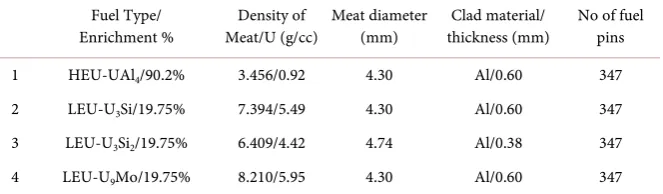
configu-ration of 347 pins is maintained and the fuel pin outer diameter is also fixed at 5.5 mm. However, the volume fraction of the dispersed phase was varied for each of the fuels such that the core excess reactivity is kept the same (~4.7 mk) as the HEU reference core. The parameters of the three LEU fuel options consi-dered in this study are listed in Table 1.
In the MCNP model, the HEU fueled core of NIRR-1 was created in a three-dimensional, Cartesian coordinate system. The input deck was constructed using detailed engineering drawings of the reactor obtained from the SAR [1]. The deck was run as a KCODE source problem for criticality calculations using
Figure 1. An MCNP diagram of NIRR-1 core in the x-y plane.
Table 1. Design data of the HEU and LEU fuel options.
Fuel Type/
Enrichment % Meat/U (g/cc) Density of Meat diameter (mm) thickness (mm) Clad material/ No of fuel pins
1 HEU-UAl4/90.2% 3.456/0.92 4.30 Al/0.60 347
2 LEU-U3Si/19.75% 7.394/5.49 4.30 Al/0.60 347
3 LEU-U3Si2/19.75% 6.409/4.42 4.74 Al/0.38 347
4 LEU-U9Mo/19.75% 8.210/5.95 4.30 Al/0.60 347
the MCNP code version 5 - 1.6.
With the increasing availability of affordable computing devices and taking advantage of parallel features of the MCNP code to speed up the Monte Carlo simulations, a computing cluster made up workstations running Microsoft Windows & Linux (Cent OS) operating systems was set up for this work.
On the windows platform, the default binaries supplied with the code was in-stalled, while for the Linux environment, the binaries were built using the Intel Fortran complier 12.1.5 version. MPICH2 version 1.4.1p1 was chosen as the pa-rallel communication software. MPICH is a high performance portable imple-mentation of the Message Passing Interface standards whose software is distri-buted under the BSD license and is available on common platforms such as Windows, Linux and Mac OS/X. An IP network is configured for layer 3 com-munications between all the nodes participating in the calculations and the MCNP jobs are assigned based on each computing node’s capabilities such as the processor speed and number of cores per processor. Only the master node needs to have the complete MCNP code with the data library installed, while the platform specific binaries are installed on the secondary nodes.
Several runs were made with 1/2 a million particles in 400 cycles. Tallies were
[image:3.595.208.540.344.441.2]constructed for the calculation of axial neutron flux distributions in the fuel pins, fission chambers irradiation channels and the slant tube. Similarly, tally cards for power distributions in the different fuel pins and the 10 fuel rings were added. The following neutronics data were calculated and they include clean cold core excess reactivity (ρex), control rod (CR) worth, shut down margin
(SDM), neutron flux distributions in the irradiation channels and kinetics data (i.e. effective delayed neutron fraction, βeff and prompt neutron lifetime, lf).
Re-sults obtained were benchmarked by calculated data for the HEU and measured data in the final SAR
3. Results and Discussion
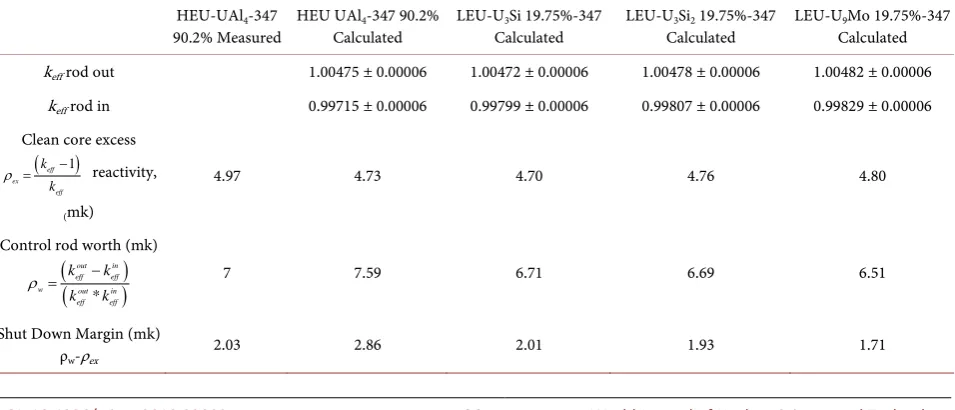
Results of the core physics neutronics data obtained in this work are compared with calculated and measured data for the current HEU core in Table 2. The cold core excess reactivity determined for the HEU core during the on-site start-up and power rising experiment was 4.97 mk. In order to obtain the li-censed value of 3 - 4 mk for MNSR, a Cd absorber with reactivity worth of −1.2 mk was inserted into an unconnected inner irradiation channel. The calculated result obtained for the HEU core was found to be 4.73 mk and was used as the benchmark for the design of the three LEU fuels considered in this work. As can be seen in Table 2, the keff, clean cold core excess reactivity (ρex), control rod
(CR) worth and the shutdown margin (SDM) compare well with data for the HEU core.
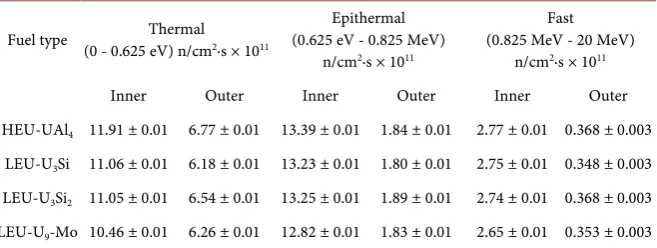
Furthermore, magnitudes of the thermal, epithermal and fast neutron flux in the irradiation channels for the current HEU core and the LEU options are compared in Table 3.
The calculated thermal neutron flux value of 1.19 × 10¹² n/cm2.s for the
present HEU core at the inner irradiation site is in close agreement with the no-minal value of 1.0 × 10¹² n/cm2.s typically displayed on the control console
[image:4.595.61.539.539.744.2]dur-ing the steady state operation at full power (i.e. 31 kW). In the case of the outer
Table 2. Measured and calculated core physics data of reference HEU and candidates LEU fuels.
HEU-UAl4-347
90.2% Measured HEU UAlCalculated 4-347 90.2% LEU-UCalculated 3Si 19.75%-347 LEU-UCalculated 3Si2 19.75%-347 LEU-UCalculated 9Mo 19.75%-347 keff rod out 1.00475 ± 0.00006 1.00472 ± 0.00006 1.00478 ± 0.00006 1.00482 ± 0.00006
keff rod in 0.99715 ± 0.00006 0.99799 ± 0.00006 0.99807 ± 0.00006 0.99829 ± 0.00006 Clean core excess
(
eff 1)
ex eff
k
k
ρ = − reactivity,
(mk)
4.97 4.73 4.70 4.76 4.80
Control rod worth (mk)
(
)
(
*)
out in eff eff w out in eff eff
k k
k k
ρ = − 7 7.59 6.71 6.69 6.51
Shut Down Margin (mk)
ρw-ρex 2.03 2.86 2.01 1.93 1.71
irradiation channel, the calculated thermal neutron flux is 6.77 × 10¹¹ n/cm2∙s
representing approximately 50% of the value obtained in the inner channel; this is in agreement with the manufacturer’s data. As shown in Table 3, there is a reduction of an average of approximately 10% in the magnitude of thermal neu-tron flux in the irradiation channels for the three LEU fuels in comparison with the HEU. Consequently, for an LEU fueled core, the reactor power level would need to be raised from the current value of 31 kW to 34 kW in order to match the nominal flux level (i.e. of 1 × 10¹² n/cm2∙s in the inner channel) for NIRR-1
thus ensuring that NAA utilization for which MNSR facilities were specifically designed is not compromised.
In order to further assess the suitability of the three fuels for NIRR-1 conver-sion, kinetics parameters of the fuels used in this work are compared with those of the HEU core and the results are presented in Table 4. The kinetics parame-ters of the fuel options were calculated using the adjoint method (KOPTS) and by turning “on” and “off” the physics card (TOTNU) option. The adjoint me-thod derives from the reactor point kinetic equation and employs an enhanced feature of the MNCP in version 5 - 1.6 to calculate the kinetics parameters. For the effective delayed neutron fraction, βeff, the calculation was performed using
the KOPTS and TOTNU card options, while the prompt neutron lifetime, lf of
the fuel options were calculated using the adjoint method.
Results show that the βeff for the three fuels compare well with calculated and
[image:5.595.210.539.443.567.2]measured data for the current HEU core. Similarly, the lf for the three fuels
Table 3. Calculated thermal, epithermal and fast flux in the inner and outer irradiation sites.
Fuel type (0 - 0.625 eV) n/cmThermal 2∙s × 1011
Epithermal (0.625 eV - 0.825 MeV)
n/cm2∙s × 1011
Fast (0.825 MeV - 20 MeV)
n/cm2∙s × 1011
Inner Outer Inner Outer Inner Outer
HEU-UAl4 11.91 ± 0.01 6.77 ± 0.01 13.39 ± 0.01 1.84 ± 0.01 2.77 ± 0.01 0.368 ± 0.003 LEU-U3Si 11.06 ± 0.01 6.18 ± 0.01 13.23 ± 0.01 1.80 ± 0.01 2.75 ± 0.01 0.348 ± 0.003 LEU-U3Si2 11.05 ± 0.01 6.54 ± 0.01 13.25 ± 0.01 1.89 ± 0.01 2.74 ± 0.01 0.368 ± 0.003 LEU-U9-Mo 10.46 ± 0.01 6.26 ± 0.01 12.82 ± 0.01 1.83 ± 0.01 2.65 ± 0.01 0.353 ± 0.003
Table 4. Comparison of kinetics data of LEU fuels with data for the HEU core.
Kinetic Parameters
CIAE (quoted values)
HEU 90%
(347) LEU U(347) 3Si 19.75% 19.75% (347) LEU U3Si2 LEU-U(347) 9Mo 19.75%
βeff
(TOTNU) 0.0081 0.00834 ± 0.00008 0.00831 ± 0.00008 0.00841 ± 0.00008 0.00836 ± 0.00008
βeff (KOPTS) 0.0081 0.00849 ± 0.00008 0.00840 ± 0.00008 0.00843 ± 0.00008 0.00844 ± 0.00008
lf (KOPTS)
(μs) 81.2 56.09 ± 0.09 50.33 ± 0.09 50.21 ± 0.09 48.71 ± 0.09
compare well with calculated data for the HEU core but deviate from the manu-facturer’s value. In order to ascertain the suitability of the three LEU fuels for NIRR-1 conversion, there is a need to investigate their steady state and tran-sients characteristics in comparison with the current HEU core. Consequently, the reactivity feedback coefficients are desirable for this endeavor and will form the basis of further investigations.
4. Conclusions
The physics parameters of three dispersion LEU fuels, which include U3Si, U3Si2,
and U9Mo enriched to 19.75% have been determined by the MCNP code in
or-der to investigate their suitability for the conversion of NIRR-1 to LEU. Results obtained for the clean cold core excess reactivity (ρex), control rod (CR) worth
and the shutdown margin (SDM) of the three LEU fuels compare well with data for the HEU core. Additionally, data for the thermal neutron flux in the irradia-tion channels of the dispersion fuels indicate a reducirradia-tion of an average of ap-proximately 10% in the magnitude in comparison with the HEU core. Conse-quently, for an LEU fueled core, the reactor power level would need to be raised from the current value of 31 kW to 34 kW in order to match the nominal flux level (i.e. of 1 × 10¹² n/cm2.s in the inner channel). Furthermore, calculated
ki-netics data of the three LEU fuels indicate their suitability for NIRR-1 conver-sion to LEU.
References
[1] Nigeria Research Reactor-1 (NIRR-1). (2005) Final Safety Analyses Report (FSAR) CERT/NIRR1/SAR/02, CERT.
[2] Jonah, S.A., Balogun, G.I., Umar, I.M. and Mayaki, M.C. (2005) Neutron Spectrum Parameters in Irradiation Channels of the Nigeria Research Reactor-1 (NIRR-1) for the k0-NAA Standardization Method. Journal of Radioanalytical and Nuclear Che-mistry, 266, 83-88. https://doi.org/10.1007/s10967-005-0873-8
[3] Jonah, S.A., Umar, I.M., Oladipo, M.O.A., Balogun, G.I. and Adeyemo, D.J. (2006) Standardization of NIRR-1 Irradiation and Counting Facilities for Instrumental Neutron Activation Analysis. Applied Radiation and Isotopes, 64, 818-822.
https://doi.org/10.1016/j.apradiso.2006.01.012
[4] Jonah, S.A., Liaw, J.R. and Matos, J.E. (2007) Monte Carlo Simulation of Core Physics Parameters of Nigerian Research Reactor-1. Annals of Nuclear Energy, 34, 953-957. https://doi.org/10.1016/j.anucene.2007.05.010
[5] Jonah, S.A. and Ibrahim, Y.V. (2016) Final Report of Analyses Performed under the IAEA CRP (NIR/13934) for the Conversion of Nigeria MNSR (NIRR-1) to LEU, 2006-2012. IAEA-TEDOC 2016. (In Press)
[6] Jonah, S.A., Ibikunle, K. and Li, Y. (2009) A Feasibility Study of LEU Enrichment Uraniumfuels for MNSR Conversion Using MCNP. Annals of Nuclear Energy, 36, 1285-1286. https://doi.org/10.1016/j.anucene.2009.05.001
[7] Li, Y., Xia, P., Zou, S., Zhan, Y., Lu, Z., Zheng, W., Shi, Y., Gao, J. and Zhou, Y. (2007) The Physics Experimental Study for the Special MNSR. The 2007 Interna-tional Meeting on Reduced Enrichment for Research and Test Reactors, Prague, Czech Republic, 23-27 September 2007.
[8] Matos, J.E. and Lell, R.M. (2005) Feasibility Study of Potential LEU Fuels for a Ge-neric MNSR Reactor. Proceedings of 2005 International Meeting on Reduced Enrichment for Research and Test Reactors, Boston, Massachusetts, 6-10 November 2005.