Keyword based Shuffling Algorithm for Question Paper
Generator
Deepali Naglot
Assistant Professor
MGM’s Jawaharlal Nehru
Engineering College,
Aurangabad
Seema Gaikwad, Pooja
Gaikwad
Research Scholar
MGM’s Jawaharlal Nehru
Engineering College,
Aurangabad
Abhilasha Salvi, Shriya
Mutyal
Research Scholar
MGM’s Jawaharlal Nehru
Engineering College,
Aurangabad
ABSTRACT
Teaching by teachers and learning skills or acquiring knowledge by students bind together to apply learning what we call is evaluation of students which has been conducting through exams. Examinations play an important role in student’s assessment. Exams assess the performance of student which requires question papers to be generated manually which consumes a lot of time. It is a challenging and tedious task for teachers to manually prepare question papers. In the proposed system we have generated question papers automatically with ease. Teachers can store questions of their subjects respectively. Admin can stock questions for generating question paper of respective subjects.
The system stores a set of different questions with keyword which will help in setting question paper. The proposed system fetches questions based on keyword stored in database. The system also checks for diagrams if present in question and then accordingly fetches particular diagram from database. We have implemented keyword based shuffling algorithm through randomization technique to automatically generate question paper. This system rejuvenates generation of automatic question paper for Dr. Babasaheb Ambedkar Marathwada University (BAMU) in a short span of duration. This system helps to generate class test paper as well. The proposed system allows maintaining coverage of whole syllabus. This system upgrades quality of question paper to set a standard of examination.
Keywords
Randomization, Duplication, Shuffling Algorithm, Keyword,
Generate Question Paper, BAMU.
1.
INTRODUCTION
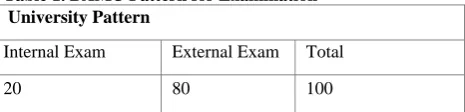
[image:1.595.314.547.234.290.2]In today’s modern era application of acquiring knowledge encourages analyzing and monitoring learning skills through testing. This stimulates need of standardized education system. The manual paper generation is slower due to involvement of human labor while automatic paper generation is faster due to computer based automation. At any instance we can add new question in the database without any limitations. The manual question paper system is replaced with automatic question paper system for examination. The system assists to prepare question paper automatically without any repetition of questions. The BAMU pattern for examination is shown in Table 1.
Table 1. BAMU Pattern for Examination University Pattern
Internal Exam External Exam Total
20 80 100
There are 20 marks for internal assessment and 80 marks for external assessment. Proposed System generates question paper for external exam and internal exam. In this system, Admin can generate question paper for university exam and teacher can generate question paper for class test. System generates question paper for external exam for section A and section B. Section A consists of question from Q.1 to Q.5. In section A Q.1 is compulsory. Student needs to attempt any two questions from Q.2 to Q.5. Admin can select either 2 or 5 marks for Q.1. Admin can select 5, 7, 8 or 15 marks for Q.2 to Q.5. Section B consists of question from Q.6 to Q.10. In section B Q.6 is compulsory. Student needs to attempt any two questions from Q.7 to Q.10. Admin can select either 2 or 5 marks for Q.6. Admin can select 5, 7, 8 or 15 marks for Q.7 to Q.10. Admin can select difficulty level for particular question. Admin can select unit number for particular question to cover coverage of full syllabus. System generates question paper for internal exam that is class test paper. In class test paper, Q.1 is compulsory. Teacher can select either 6 or 5 marks for Q.1. If Q.1 is of 6 marks then Student needs to attempt any two questions from Q.2 to Q.5 which are of 7 marks each. If Q.1 is of 5 marks then Student needs to attempt any three questions from Q.2 to Q.6 which are of 5 marks each. Teacher can select difficulty level for particular question. Teacher can select unit number for particular question.
The proposed system consists of two modules Admin module and Teacher Module.
1.1
Teacher Module
1.1.1
Edit Profile
TheTeacher can edit his/her own information.
1.1.2
Add Questions
Teacher can add questions to database.
1.1.3
Generate Class Test Paper
Teacher can generate class test paper.1.1.4
View Questions
37
1.2
Admin Module
1.2.1
Add Member
Admin can add teacher.1.2.2
Generate Question Paper
Admin can fill information to generate question paper.
1.2.3
View Questions
Admin can view questions stored in database.
1.2.4
Delete Member
Admin can delete teacher record.1.2.5
Edit Profile
Admin can edit teacher information.
1.2.6
View Tutor Info
Admin can view teacher information.
1.2.7
View Question Papers
Admin can view previous years’ question papers.
2.
LITERATURE SURVEY
Automatic Test Paper Generator with Shuffling Algorithm [1] in this paper the system generates different sets of questions through unlimited question entered in the database. Here teacher has to enter department, subject, unit number, semester for generating question paper. The main goal of this paper is to generate question paper using shuffling algorithm for randomization.
Automated Question Paper Generation System [2] this is an integrated automated system where questions are stored according to particular course and question paper is printed based on syllabus and curriculum. A role based hierarchy is implemented to restrict access to users. This paper aims at proposed automated model for question paper generation to implement as a real-time application.
Automatic Question Paper Generator System [3] in this paper randomization algorithm is implemented for generating question paper for various autonomous universities. The paper aims to overcome question selection difficulty as a multi-constraint optimization issue generating question papers fulfilling many constraints as per the paper setter.
Automatic Generation of Question Paper from User Entered Specifications Using a Semantically Tagged Question Repository [4] this is flexible software which supports set of tags such as cognitive level, difficulty level, type of question, content /topic for defining a question etc. The proposed question paper is generated in xml format and Microsoft Word Document.
Automatic Question Paper Generation system using Randomization Algorithm [5] in this paper Shuffling Algorithm as a randomization technique is used by the system. In design part process performs scrutiny and generates an efficient examination question paper using modules as user administration, subject selection, difficulty level specification, question entry, question management, paper generation and paper management.
3.
PROPOSED SYSTEM
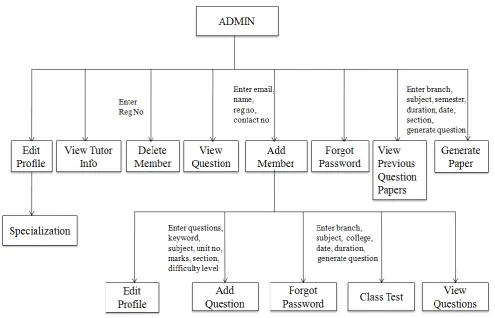
Proposed system uses keyword based shuffling algorithm for automatic question paper generation. In this system diagrams are also included in question paper. System uses Microsoft Office Access to store data in database. Proposed System Architecture is shown in Fig 1.
Proposed System generates random and secured passwords for the users. Here system is modified by using keyword to generate unique set of question papers to avoid repetition. We have also implemented logic for diagram. The
Automatically generated question paper is generated in PDF file format.
The proposed system is divided into two modules:
3.1
Admin Module
In Admin Module, admin will enter login id and password credentials to login. It has various authorities and access over the system.
Admin module is subdivided into following modules:
3.1.1
Add Member
In this module admin adds new teacher by filling information which contains name, email, contact number, registration number, department, college and password. It generates random password for password field to login.
3.1.2
Delete Member
If teacher leaves job then admin deletes the teacher record through registration number field.
3.1.3
View Questions
In this module, admin view questions provided by teachers in the database. It contains fields like question, keyword, difficulty level, unit number, marks, subject, section, numerical, diagram, email-id of teacher. The admin can easily view which question has been added by which faculty.
3.1.4
Edit Profile
In this module admin can edit profile of teacher through email field. Contact number, department, college information can be changed. Admin can add specialization for a particular teacher.
3.1.5
View Tutor Info
In this module, admin views information of the teacher. It contains fields such as name, email, contact no, registration no, department, college.
3.1.6
Generate Question Paper
In this module question paper is generated by filling fields as branch, month & year, subject, section, date, duration, difficulty level, generate questions which contains subfields main questions, sub questions, options, compulsory attempts, marks. Finally the unique question paper is generated. Question paper in generated in PDF file format, it is automatically downloaded and stored in database.
3.1.7
View Question Papers
In this module Admin can view as well as download previous question papers stored in database.
3.1.8
Forgot Password
In this module, admin can recover his account by entering his email-id. Email is sent to his email-id to recover his account.
3.2
Teacher Module
3.2.1
View Question Papers
3.2.2
Add Questions
In this module, teacher can add questions by providing information to fields like question, keyword, difficulty level, unit number, marks, subject, section, numerical, diagram. The teacher can input questions only of the subject it teaches.
3.2.3
Forgot Password
In this module teacher can recover his account by entering his email-id. Mail is sent to his email-id to recover his account.
3.2.4
View Questions
In this module, teacher can view questions added by him in the database. It contains fields like question, keyword, difficulty level, unit number, marks, subject, section, numerical, diagram.
3.2.5
Generate Class Test Paper
In this module, question paper is generated by filling fields as branch, class test number, subject, date, duration, difficulty level and generate questions which contains subfields main questions, sub questions, options, compulsory attempts, marks. Finally the unique question paper is generated.
Question paper in generated in PDF file format, it is automatically downloaded and stored in database.
Microsoft Access is used for the database where questions are stored. The teacher inputs the questions stored in the database. We have used keyword based shuffling algorithm for randomly generating unique question in the question paper. The logic of diagram is also used to provide diagram in the question paper for particular question.
Teacher module plays the role of providing questions to the database. The faculty then provides questions of the subject it teacher. Admin module gives the output to of the system by generating question paper for external exam through random questions. Teacher module gives the output to of the system by generating question paper for internal exam through random questions. The unique sets of question paper are generated.
[image:3.595.54.550.312.630.2]On generating question paper, this question paper is then converted to PDF file and then mailed to different institutes and colleges.
Fig 1: Architecture of Automatic Question Paper Generator System
4.
PROPOSED ALGORITHM
Keyword based shuffling algorithm is an efficient algorithm for randomization to automatically generate question paper. The questions stored in database are fetched to set question paper checking repetition using logical keyword based shuffling algorithm. This algorithm also fetches particular
diagram from database if question has diagram. The algorithm is implemented as follows:
1) Create an array for storing question number (eg arr[length])
39 3) Create an array for storing diagram (e.g.
Diagram[length])
4) Fetch question number from database which satisfy required criteria & store it in an array (for storing question number)
5) Generate random number
6) If (position==0)
Store generated number in arr[0]
String s= select keyword from TABLE-NAME
Where question number= generated number
Store s in keyword array i.e. key[0]
End if
Else
Compare the number with previous numbers in array
If it is present
Go to step 5
End if
Else
String s= select keyword from TABLE-NAME
Where question no=generated number
If s is present in key[length]
Go to step 5
End if
Else
Store the number in next location array(question number array)
Store s in keyword array
End else
End else
End else
7) Select questions from database which correspond to array position one by one
8) Fetch question number from database which satisfy required criteria & store it in an array (for storing question number)
5.
CONCLUSION
The main purpose of this system is to generate automatic question paper using keyword based shuffling algorithm for randomization. The system features to provide unique set of question papers without duplication. The system avoids leakage of question paper maintaining security.
We have overcome the system from converting the generation of question papers from manually to automatically consuming efforts and time. This system frameworks standard question papers for examination by involving coverage of the syllabus and maintaining weightage to every chapter of the subject. This helps to evaluate the assessment of the student easily as examinations play an important role. The proposed system
reiterates the system by advantage of keyword logic for shuffling algorithm. The logic for diagram puts feather in the cap of the system to ease use of diagram in particular questions.
We implemented the system as per the paper pattern of engineering for Dr. Babasaheb Ambedkar Marathwada University (BAMU). Our future scope is to implement the same logic for other University paper patterns too. The algorithm logic can be implemented for Multiple Choice Questions by providing proper modules.
6.
REFERENCES
[1] Rasika Dhondibhau Dhavale, Dr. M.Z.Shaikh, “Automatic Test Paper Generator with Shuffling Algorithm”, February 2016Vol. 4, Issue 2.
[2] Rohan Bhirangi, Smita Bhoir, April 2016,” Automated Question Paper Generation System”, International Journal of Emerging Research in Management and Technology IISN: 2278-9359 (Volume-5, Issue-4).
[3] Fenil Kiran Gangar, Hital Gopal Gori, Ashwini Dalvi, “Automatic Question Paper Generator System”, May 2017, International Journal of Computer Applications (0975 – 8887) Volume 166- No. 10.
[4] Gauri Nalawade, Rekha Ramesh,”Automatic Generation of Question Paper from User Entered Specifications Using a Semantically Tagged Question Repository”, IEEE Conference.
[5] Kapil Naik, Shreyas Sule, Shruti Jadhav, Surya Pandey, “Automatic Question Paper Generation system using Randomization Algorithm,”,International December 2014, Journal of Engineering and Technical Research (IJETR) IISN-232- 0869,Volume-2, Issue-12.
[6] Nor Shahida bt Mohd Jamail & Abu Bakar Md Sultan, “Shuffling Algorithms for Automatic Generator Question Paper System”, Computer and Information Science Journal.
[7] Sai Krishna, Ravi Kumar, Vishnu Vardhan, M Sai Sindhura, Manne Suneetha, ”Automatic Question Paper Generator System with Bloom’s Taxonomy Catogerization”, March- April 2017, Volume-5, Issue-2.
[8] KapilNaik, ShreyasSule, ShrutiJadhav and Surya Pandey, “Automatic Question paper Generation System with help of randomization algorithm” IJETR, V, Issue 12, pp.1-3, Dec 2014.
[9] Ashok Immanuel and Tulasi.B, “Framework for Automatic Examination Paper Generation System,” International Journal of Computer Science Trends and Technology, Jan - March 2015.
[10]Sheetal Rakangor and Dr. Y. R. Ghodasara, “Literature review of Automatic Question Generation System”, IJSRP, Issue 1, pp.346-350, Jan 2015.
[11]Dr.P Pabitha, M.Mohana, S.Suganthi, B.Sivanandhini, ”Automatic Question Generation System”, 2014 International Conference on Recent Trends in Information Technology.
[13]Deepshree S. Vibhandik , Rucha C. Samant,” Automatic / Smart Question Generation System for Academic Purpose”, International Journal of Emerging Trends & Technology in Computer Science (IJETTCS) Volume 4, Issue 4, July - August 2015 ,ISSN 2278-6856.
[14]Wikipedia(2010a).Randomization.http://en.wikipedia.org /wiki/Randomization.