DEVELOPMENT OF MIXED REALITY GAME SYSTEM LINKING MULTI
EVALUATE BEHAVIOR OF EVACUEES
*
,1Masahiro Arakawa,
2Keita Sugiura,
1
Department of Civil Engineering and Systems Management,
2
Graduate School of Engineering, Nagoya Institute of Technology,
3
Faculty of Environmental and Urban Engineering, Kansai
ARTICLE INFO ABSTRACT
Predicti
department stores, schools, and office buildings. In this study, we develop a mixed reality game system
simulation
use the mixed reality game the game
performance of the
the effectiveness of emergency exit signs to manage
Copyright © 2014 Masahiro Arakawa et al. This is an open access article distributed under the Creative Commons Att use, distribution, and reproduction in any medium, provided the original work is properly cited.
INTRODUCTION
Occurrence of natural disasters such as typhoons, earthquakes, heavy rains, and floods has been increasing globally. Many large-scale buildings with complex internal structures have been constructed. Given these situations, building design focused on reducing damage to persons and structures has become significantly difficult. Ordinarily, computer simulation plays an important role in the prediction of damage caused by a disaster. In addition, these simulations aid in the proposal of strategies and procedures to avoid damage to people. Predicting behavior of persons during a disaster plays a useful role in the design of urban structures such as department stores, schools, and office buildings. However, given the difficulty of investigating the behavior of persons in damaged structures during actual disasters, we use computer simulation. In fact, computer simulation is used to design structures to reduce the damage to structures and persons, as well as predicting the effects of disaster situations (Ohata et al.,
2005). Primarily, we use multi-agent simulations to investigate the behavior of evacuees, including decision
as many rules as possible given the disaster area. In past studies, simulations are adopted to model the beha
*Corresponding author: Masahiro Arakawa
Department of Civil Engineering and Systems Management, of Technology, Nagoya, Japan.
ISSN: 0975-833X
Vol. 6, Issue,
Article History:
Received 19th September, 2014
Received in revised form 24th October, 2014
Accepted 05th November, 2014
Published online 30th December,2014
Key words:
Multi-agent simulation, Mixed reality game, Behavior of evacuees, Mathematical model, Emergency Exit signs.
REVIEW ARTICLE
DEVELOPMENT OF MIXED REALITY GAME SYSTEM LINKING MULTI-AGENT SIMULATION TO
EVALUATE BEHAVIOR OF EVACUEES
Keita Sugiura,
1Shingo Muramatsu and
3Keiichi Kitazume
Department of Civil Engineering and Systems Management, Nagoya Institute of Technology, Nagoya, Japan
Graduate School of Engineering, Nagoya Institute of Technology, Nagoya, Japan
Faculty of Environmental and Urban Engineering, Kansai University, Osaka
ABSTRACT
Prediction of human behavior in a disaster is a useful role in the design of urban structures such as department stores, schools, and office buildings. In this study, we develop a mixed reality game system linking a multi-agent simulation for behavioral evaluation of evacuees. We use a multi
mulation to evaluate the behavior of persons evacuating a floor given as many rules as possible. We use the mixed reality game to evaluate the complex and distinctive behavior
the game. This paper presents the characteristics of the developed game system, and presents the performance of the game system as a case study using an actual floor layout
effectiveness of emergency exit signs to manage the evacuees’
is an open access article distributed under the Creative Commons Attribution License, which use, distribution, and reproduction in any medium, provided the original work is properly cited.
Occurrence of natural disasters such as typhoons, earthquakes, heavy rains, and floods has been increasing globally. Many scale buildings with complex internal structures have been constructed. Given these situations, building design ing damage to persons and structures has become significantly difficult. Ordinarily, computer simulation plays an important role in the prediction of damage caused by a disaster. In addition, these simulations aid in the proposal of es to avoid damage to people. Predicting behavior of persons during a disaster plays a useful role in the design of urban structures such as department stores, schools, and office buildings. However, given the difficulty of rsons in damaged structures during actual disasters, we use computer simulation. In fact, computer simulation is used to design structures to reduce the damage to structures and persons, as well as predicting the 2007; Hori et al., agent simulations to investigate the behavior of evacuees, including decision-making based on as many rules as possible given the disaster area. In past studies, simulations are adopted to model the behavior of
Department of Civil Engineering and Systems Management, Nagoya Institute
persons under the following conditions: customers moving in shops (Masuda et al., 2009), persons escaping from a building (Pelechano et al., 2006), and passengers moving in a rail station (including platforms) (
others. The simulation is useful in the building structure and floor layout design because we c
evacuees under various conditions. However, evaluation of the evacuee’s subconscious decision
addition, due to the potential for increased damage given the collective behavior of evacuees, we should discu
that allows for dynamic behavior control of the evacuees to reduce damage. However, a dynamic control system comprising the collective behavior of the evacuees has not been discussed enough.
We use a mixed reality game system to evaluate unconscious behavior of evacuees under approximate emergency condition in this study. There are studies related to evacuation using virtual reality system as similar studies to this study. Virtual reality system including avatars is used in these studies. Some studies focus on pre-learning for easy escape at complex structure of building and training for complex operation under emergency condition (Nakanishi
2001; Rickel et al., 2002). Other studies focus on investigation of human evacuation behavior as group (Meguro
However, the complex and distinctive behavior of evacuees is not investigated in these studies.
International Journal of Current Research
Vol. 6, Issue, 12, pp.11004-11012, December, 2014
AGENT SIMULATION TO
Keiichi Kitazume
Nagoya Institute of Technology, Nagoya, Japan
Nagoya, Japan
University, Osaka, Japan
a useful role in the design of urban structures such as department stores, schools, and office buildings. In this study, we develop a mixed reality game agent simulation for behavioral evaluation of evacuees. We use a multi-agent given as many rules as possible. We distinctive behavior of individual players in e developed game system, and presents the actual floor layout. In addition, we evaluate
’ escape from the floor.
ribution License, which permits unrestricted
persons under the following conditions: customers moving in 2009), persons escaping from a building 2006), and passengers moving in a rail station (including platforms) (Nichinari et al., 2004), among others. The simulation is useful in the building structure and floor layout design because we can simulate the behavior of evacuees under various conditions. However, evaluation of the evacuee’s subconscious decision-making is difficult. In addition, due to the potential for increased damage given the collective behavior of evacuees, we should discuss a system that allows for dynamic behavior control of the evacuees to reduce damage. However, a dynamic control system comprising the collective behavior of the evacuees has not
We use a mixed reality game system to evaluate unconscious behavior of evacuees under approximate emergency condition in this study. There are studies related to evacuation using virtual reality system as similar studies to this study. Virtual em including avatars is used in these studies. Some learning for easy escape at complex structure of building and training for complex operation under emergency condition (Nakanishi et al., 2007; Okada et al.,
). Other studies focus on investigation of human evacuation behavior as group (Meguro et al., 1997). However, the complex and distinctive behavior of evacuees is not investigated in these studies.
In this study, we develop a mixed reality game system linking a multi-agent simulation. We use a multi-agent simulation to evaluate the behavior of persons evacuating a floor given as many rules as possible. Players then play a mixed reality game, including the resultant behavior of many evacuees obtained by the agent simulation. We analyze the behavior of the players to investigate the complex and distinctive behavior of evacuees. Evaluation of this behavior is difficult through simulation. In this paper, the characteristics of the developed game system are explained. The developed game system is executed as a case study using an actual floor layout, including emergency exit signs. Additionally, we investigate the effectiveness of emergency exit signs and the resulting behavior of evacuees affected by the emergency exit signs.
Mixed Reality Game System Linked to a Multi-Agent Simulation
In this study, an information system used to analyze the behavior of evacuees is developed by linking a mixed reality game and multi-agent simulation. The game is developed to simulate evacuation from a complex floor layout in a building. The system includes the following characteristics which cause subjects to remain in disaster situation:
(1) The system constructs an environment such that the subjects must navigate and escape as soon as possible. (2) Information related to the player’s evacuation is collected.
This information is used to investigate the behavior of the evacuees and reasons for increased damage.
(3) A new method for effective evacuation is proposed from information gathered during the investigation. We can evaluate the effectiveness of the new method on the simulation game.
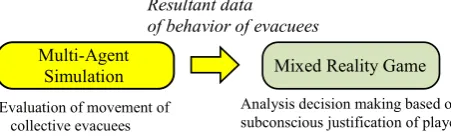
[image:2.595.319.544.187.302.2]This system is composed of two subsystems as shown in Fig. 1. The first subsystem is a multi-agent simulation system designed to simulate evacuee behavior in a building. The other system is a mixed reality game used to calculate the elapsed time to escape from the building. First, we perform the multi-agent simulation to evaluate the behavior of both the individual evacuee, and the group of evacuees. The simulation system is comprised of a two-dimensional floor layout with agents, including rules to justify movement on the floor.
Fig. 1. Schematic diagram of the proposed combination system
The simulation data is analyzed to characterize the behavior of evacuees. Furthermore, we use the simulation data to propose new methods to effectively guide evacuees. In this paper, emergency exit signs are installed on the floor to effectively guide evacuees. We use a mathematical model to calculate optimal sign locations. We use the simulation to compare the behavior of evacuees obtained given emergency exit signs in different locations.
[image:2.595.50.276.573.642.2]Second, the mixed reality game is performed by using a simulation result, such as the movements of evacuees, locations of emergency guide signs, floor layout, and so on. The players play the game to compute the elapsed escape time from the floor, as shown Fig. 2. We consider that the mixed reality game (including calculation of the elapsed time) can simulate conditions similar to a real building evacuation. Since players use many types of information to escape in the game, the players uncover rules and phenomena which cannot be included in agent-simulation. Therefore, we can investigate the player’s subconscious decision-making in the game.
Fig. 2. A display sample from the mixed reality game system, including the resultant behavior of evacuees obtained by the
agent-simulation
Mixed Reality Game System
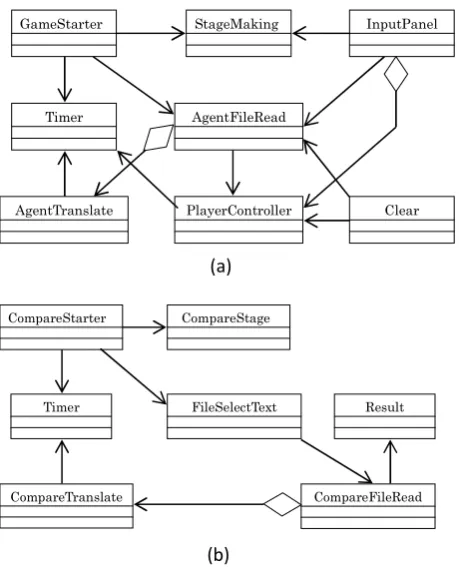
We used the “Unity (Unity3D: Unity Technologies)” game creation system to develop the mixed reality system. We use the developed system to show movement of evacuees simulated by the agent simulation and movements of the layout changed dynamically the floor. In addition, players are displayed on the game as game players. We save the player’s running path in the system. Fig. 3 contains class diagrams of the structure of the mixed reality game system. The system is composed of two subsystems: the subsystem (a) to control the game and render the behavior of the evacuees obtained by the multi-agent simulation, and the subsystem (b) to store the player’s path, and to present the layout while players play the game for comparison against simulated agents. The subsystems are developed using C#.
With consideration to the diagrams in subsystem (a), “GameStarter” is a class representing the start of the game, “Timer” is a class to control time, and “StageMaking” is a class to draw walls, floors, and emergency exit signs from the resultant data obtained by the agent-simulation. “Clear” is a class to delete agents when the agents arrive at exits; this class is also used to end the game and record the elapsed time when a player arrives at an exit. “AgentFileRead” is a class for generation of player agents. “PlayerController” is a class to record agent locations in the system at every time step. “AgentTranslate” is a class which moves agents according to the locations simulated by the agent-simulation. “InputPanel” is a class of Graphic User Interface to start game. In subsystem (b), “CompareStarter” is a class to begin comparison of the path of players and the path of agents obtained by the agent-simulation. “CompareStage” is a class designed to draw walls, floors, and emergency exit signs at comparison stage as “StageMaking.” “FileSelectText” is a class to select simulation
Resultant data of behavior of evacuees
Evaluation of movement of collective evacuees
Analysis decision making based on subconscious justification of player
Multi-Agent
data. “CompareFileRead” is a class to generate agents for players and to locate the agents at their initial positions. “Compare Translate” is a class to select simulation data calculated under different gameplay conditions. ”Result” is a class which presents the elapsed time of players upon game completion.
Fig. 3. Class diagrams structures of the mixed reality game system
Muli-Agent Simulation
A. Structure
We developed the agent simulation software used in this study in Java. The software is referred to as the "Agent Simulator" hereafter. The Agent Simulator is comprised of "Agents" and a "Field." An Agent denotes an object containing the property of an individual person. The Field denotes an object containing the property of a field in which agents can move. The characteristics of these objects are as follows:
(A) Agent
1. The initial locations and the number of agents can be arbitrarily decided.
2. An agent collects information regarding the field environment and decides which direction to move.
3. Initially, an agent does not know the exit locations. It moves toward a target in its field of vision.
An agent moves toward targets in the following order of priority: (1) the nearest exit, (2) emergency exit signs, (3) the nearest agent. When none of these targets is located in the agent's field of vision, the agent continues to move in its original direction (4). Fig.4 depicts a schematic diagram of the objects regarded as targets.
Fig.4. Target priority
The speed and initial positions of the agents are randomly pre-determined. In this model, the agents are positioned in an aisle. Two agents are prohibited from overlapping each other and must be located at two adjacent grid cells on the floor. Therefore, the distance maintained between different agents is greater than the predetermined cell size on the floor. When the agent meets an obstacle, it moves along the shape of the obstacle with the shortest length.
(B) Field
Fig. 5 depicts a sample layout of a floor used in agent simulation. The floor is the field object in the simulation, and agents can move on it. Black blocks denote walls and white blocks denote aisles in which the agents can move. The field object maintains the positions and dynamic variable data for walls, exits, and emergency exit signs as properties of the floor. Grid cells are generated on the field object. Positions and dynamic variable data for walls, exits, and emergency exit signs are also available in the corresponding grid cells as properties of the floor. An agent retrieves the grid cell properties in its field of vision and evaluates the locations and situation of these objects (as exits, walls, and signs). When an agent meets an obstacle, he passes alongside the obstacle after a uniformly distributed random number determines his route.
Fig.5. Floor layout for agent simulation
CompareStarter CompareStage
Timer
CompareTranslate
FileSelectText Result
CompareFileRead
(b) (a)
GameStarter StageMaking
Timer
AgentTranslate
AgentFileRead
Clear PlayerController
InputPanel
The field of vision
Agent
Exit
Lamp
(1)
(2)
(4)
(3)
Exit sign
E E E
E E E E
O E
LO L O
E
L E
L O E
O O L
O L
LO
E L O E E E
[image:3.595.52.282.126.410.2] [image:3.595.313.557.548.725.2](C) Simulation Condition
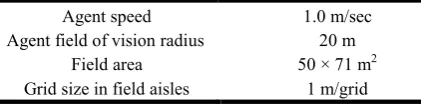
In the proposed simulator, the agent's speed and field of vision can be determined. In this study, a single time step in the simulation corresponds to 0.1 sec. in real-time. With respect to each agent, we collect the object information from its field of vision at each time step. Table I lists the parameters for the agent speed and field of vision used in the simulation.
(D) Emergency Exit Sign System
In order to effectively guide persons to exits, the optimal locations of emergency exit signs are analyzed. We investigate the effectiveness of these locations using agent simulation. an emergency exit sign is a general sign that indicates the direction to the nearest exit. The locations of the signs must satisfy the Fire Service Act in Japan (Fire and Disaster Management Agency 2014). We consider it effective when all signs are positioned such that an agent can recognize one or more signs at an arbitrary location. According to this condition, we construct a model to position the signs as follows:
(1) An agent moves directly to the nearest exit when it recognizes an exit.
(2) An agent moves to the nearest emergency exit sign when there are multiple signs in its field of vision.
(3) When an obstacle is located between a sign and the agent, the agent cannot recognize the sign.
(4) An emergency exit sign indicates the direction to the nearest exit from the sign.
An agent moves to the emergency exit sign when the agent recognizes the sign. Therefore, the agent can arrive at the nearest exit. An emergency exit sign is an "A" class emergency exit sign that satisfies the Fire Service Act in Japan [5]. A mathematical model was constructed to determine the optimal locations of emergency exit signs from the sign characteristics. A set of candidate agent locations on the floor is denoted by H = {1, 2, …, h }, the set of candidate sign locations on the floor is denoted by I = {1, 2, …, i }, and the set of exit locations is denoted by J = {1, 2, …, j }. Using these sets, a mathematical model to calculate the locations of the signs is constructed as follows:
Parameters:
dhi: distance between agent h and sign i dik: distance between sign i and sign k dij: distance between sign i and exit j
MDLE: maximum distance between sign and exit MDLL: maximum distance between different signs MNL: maximum number of signs
Variables:
xi: this variable is set to 1 when the sign is positioned at location i; otherwise, it is set to 0.
xhi: this variable is set to 1 when an agent moves from location h and location i; otherwise, it is set to 0.
yij: this variable is set to 1 when an agent moves from location i to exit j; otherwise, it is set to 0.
Objective function: ) 1 (
I i j Jj i j i H h i h I i i
h x d y
d Min Subject to ) 7 ( , ) 1 ( ) 1 ( ) 6 ( , ) 5 ( ) 4 ( , ) 3 ( ) 2 ( 1 J j I i MDLL x M x M d J j I i MDLE y d I i x y I i H h x x MNL x H h x k i k i j i j i i J j j i i hi I i i I i i h
Here, M is defined as a big number. Fig. 6 depicts a schematic diagram of the agent’s pattern of movement and the relationships between the agent, sign, and exit. Equation (1) is an objective function that denotes the sum of two types of distance: the total distance between any agent’s location and its nearest sign, and the total distance between any sign and its nearest exit. In the second term, variable yij denotes the
[image:4.595.57.268.180.232.2]relationship of a sign at location i and exit j, as calculated by (5). Here, the distance between the sign and the exit equals the maximum length of the field if there is an obstacle between the sign and exit. Equation (2) specifies that an agent moves with respect to a single sign. Equation (3) states that the number of signs located on the field is less than or equal to the maximum number of signs. Equation (4) specifies that any agent moves to a single sign. Equation (5) states that any sign refers to a single sign. Equation (6) specifies that all signs are located in an area relative to the exit that satisfies the Fire Service Act of Japan [8]. Equation (7) specifies that two different signs are positioned in an area that satisfies the Fire Service Act. Fig. 5 depicts an example of a general emergency exit sign in an actual building. The mathematical model was resolved using the Gurobi Optimizer (October Sky Co. Ltd.).
Fig. 6. Schematic diagram of agent movement Table 1. Basic Parameters For Agent Simulation
Agent speed 1.0 m/sec
Agent field of vision radius 20 m
Field area 50 × 71 m2
Grid size in field aisles 1 m/grid
h
i
j
[image:4.595.323.546.637.710.2]Numerical Experiments of Agent Simulation
In this section, we used the floor layout from an actual department store as a case study. Fig. 5 depicts the layout and floor separated into a grid, and the actual positions of the signs on the floor. Fig. 5 also depicts the layout of signs positioned at their optimal location calculated by the mathematical model. The layout of the floor is 50 × 71 m2. The grid, constructed of 1-m squares, is generated on the model floor. Fourteen grid points are assigned to exits on the field. In addition, there are 750 aisle grid points. The exit locations are predetermined, but the agents and signs may be positioned on any aisle grid point. In the mathematical model, the number of signs is predetermined. Eight signs are located on the actual floor. Eight signs were specified for the mathematical model. The optimal sign locations are identified by the model. This figure shows the actual sign locations on the floor. The total distance calculated by the objective function was 5628.12 m for the optimal sign locations obtained by the model. On the other hand, the actual sign positions give an objective function distance of 30965.09 m because the layout includes obstacles between the signs and agents. The total distance obtained from the optimal sign locations is clearly smaller than the distance obtained from the actual sign locations. In addition, this result suggests that the actual layout could make it difficult for people to evacuate effectively.
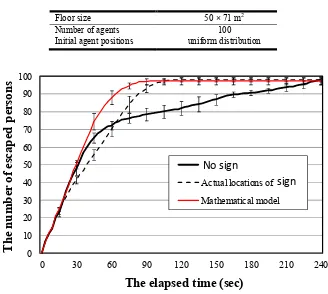
In this section, we perform agent simulation to evaluate the sign locations determined by the mathematical model. Table 2 lists the field parameters. One hundred agents were distributed on the floor. We measured the agent’s required escape time from the floor to evaluate the effectiveness of the sign locations. Ten trials were performed.
Fig. 7 depicts the number of agents who escaped versus the elapsed time. Curved lines denote the number of agents who escaped, averaged over ten trials. The error bars denote the standard deviation. This figure shows that it takes approximately 120 seconds for all agents to escape when the signs are positioned at the actual locations. Conversely, although the numbers of escaped agents given either no signs or optimal signs are similar in the first 30 seconds, it takes more than 240 seconds for all agents escape when no signs are installed on the floor. This result demonstrates that the installation of signs assists the remaining agents’ escape.
When the signs were located at optimal locations obtained by the mathematical model, it took approximately 90 seconds for all agents to escape. This elapsed time is 20% smaller than the time obtained when the signs were positioned at the actual locations. Furthermore, this figure shows that 90% of all agents escape from the floor within 60 seconds when the signs were positioned at the optimal locations. This result indicates that the mathematical model can effectively generate sign locations to help agents escape efficiently. In addition, behavior of evacuees based on universal behavior rule can be analyzed by the agent simulation.
Case study of the mixed reality game
Condition of Experiment
[image:5.595.135.463.460.754.2]The simulation contains objects ordered by priority, which evacuees reference as they move on the floor; this assists in evaluation of the general behavior of the evacuees. We perform the mixed reality game system to analyze the complex and subconscious behavior of evacuees.
Table 2. Floor Parameters
Floor size 50 × 71 m2
Number of agents 100
Initial agent positions uniform distribution
Fig.7. Sign locations versus the number of escaped persons obtained by agent simulation 0
10 20 30 40 50 60 70 80 90 100
0 30 60 90 120 150 180 210 240
Th
e
n
u
m
b
er
o
f
es
ca
p
ed
p
er
so
n
s
The elapsed time (sec)
No lamp
Actual locations of lamps
Mathematical model
No sign
This behavior is difficult to analyze by using the agent-simulation in this chapter. Six subjects between the ages of 21 and 22 play on the mixed reality game to analyze the subconscious behavior of players on the game. Three types of conditions are performed: (1) no emergency exit signs are located on the floor, (2) emergency exit signs are located on the floor, and (3) emergency exit signs with sound are located on the floor. Sound indicates the direction of the sign. The sound is developed using a function of "Unity."
Three different locations are predetermined as the initial position for each player under each condition. All players share a single common locations in three different locations in order to compare player’s elapsed arrival times. The common location is randomly assigned at one of these locations. The floor layout used in the game is identical to the layout in Fig. 5. Eight emergency exit signs are located at actual positions on the floor.
RESULTS
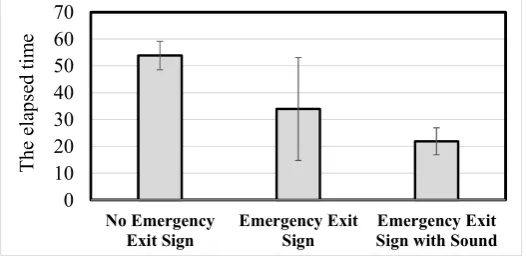
Fig. 8 shows the player’s elapsed arrival time at the exit from a starting location under different conditions. The bar graph denotes the average of the elapsed time of six subjects, while the error bar denotes the standard deviation of the elapsed time. The figure denotes that introduction of the emergency exit sign is effective in reducing the elapsed time. In addition, combining sound with the emergency exit sign is effective in reducing the elapsed time. The figure depicts a clear reduction of elapsed time due to the introduction of functions that guide persons to exits. However, when an emergency exit sign is introduced, the standard deviation of the elapsed time takes the longest, given all conditions. The reasoning for this are the characteristics of independent players, as shown in the next section.
DISCUSSION
The following general characteristics of players are analyzed from results obtained by the mixed reality game.
(A) Initial movement of players is affected by objects which the players see at the initial start of the game, such as emergency exit signs and different agents.
(B) The length of the path and the elapsed time to escape strongly depend on the initial direction of the players.
We analyze two types of categorized characteristics of individual evacuees. One characteristic depends on the game players always looking around. The categorized characteristics are as follows:
(1) For many game players who do not always look around, their direction of movement is decided by the direction of their eyes when the game begins. In addition, many evacuees have a tendency to follow other evacuees. Therefore, since players tend to crowd at exits, it increases the elapsed escape time.
(2) As for game players who always carefully look around, they are not affected by the direction to which other evacuees move when the game starts. They decide which direction to move according to the direction which emergency exit signs indicate.
The other characteristic depends on whether players can find an emergency exit sign or other agents at the start of the game. The categorized characteristics are shown as follows:
(1) When players can find an emergency exit sign or other agents at the start of the game, the players exhibit the following characteristics: most players follow the emergency exit sign indicator, or the movement of other agents. When players find both emergency exit sign and other agents, many players follow the movement of the agents. Some players try to catch other clues related to the exit.
(2) When players cannot find emergency exit signs and other agents at the start of the game, some players exhibit the following characteristics: after players move in an arbitrary direction, they follow the emergency exit sign indicator or the movement of other agents which they encounter.
When some players find other agents after first finding emergency exit signs, they subsequently follow the other agents. This characteristic denotes that movement of other agents takes priority over the emergency exit sign indicator for some players.
Investigation of the Complex and Distinctive Behavior of Players
[image:6.595.169.433.465.593.2]In the previous section, the experimental result demonstrates that several players move by following agents presented in the Fig. 8. Comparison of elapsed time of players under different conditions
0 10 20 30 40 50 60 70
No Emergency Exit Sign
Emergency Exit Sign
Emergency Exit Sign with Sound
The el
ap
se
d
tim
game, despite emergency exit signs located in their field of vision. In addition, the result demonstrates that the direction of players at the start strongly affects their movement. Therefore, we analyze the decision-making characteristics of evacuees focusing on the following issues in this section.
>What information is used for player movement when the game starts?
>What situation causes players to take a long time to arrive at exits?
In order to investigate the complex and distinctive behavior of evacuees, we create game trials under the following conditions:
[image:7.595.306.559.237.303.2]We predetermine the ratio of agents who move in the opposite direction of simulated agent movement. Players play the mixed reality game including this predetermined ratio. Here, a multi-agent simulation is performed under the condition that the predetermined ratio of agents who move in the opposite direction is included in advance. The paths of all agents are collected for use in the mixed reality game. We use an eye-mark recorder device to investigate the viewpoints of players on the game. This "View Tracker" device is produced by Ditect Co., Ltd. Fig. 9 shows layout of devices.
Fig. 9 Layout of devices for the experiment on a mixed reality game
Fig. 10 Initial positions of players on different patterns
[image:7.595.46.287.350.508.2]There are six subjects between 21 and 23 years old. Subjects playing the game in this experiment are different from the subjects in the previous section. We chose different subjects because the previous subjects memorized the route and exit locations. Table 3 shows the experiment patterns. Fig. 10 shows the initial locations of players under the conditions of different ratios related to agents moving in the opposite direction. Emergency exit signs are located in the field of view of players at initial positions in all patterns. Different ratios of agents who move in the opposite direction are determined in different patterns. In addition, players are located at different initial positions in different patterns to avoid memorizing the routes to exits.
Table 3. Experiment patterns of the Mixed Reality Game
Pattern The ratio of agents who move
in the opposite direction to original agents
Initial position of game player in Fig. 10
A 10:0 A
B 8:2 B
C 5:5 C
Pattern A includes the condition that all agents move in the opposite direction of agents originally obtained by the simulation. Pattern B includes the condition that 80% of all agents move in the opposite direction of the original agents. Pattern C includes the condition that half of all agents move in the opposite direction of the original agents. Fig. 11 shows the objects the players refer to when they start to move.
Projector
200cm
100cm
150cm
80cm
Screen
150 cm
Stand to keep
player face
A
B
[image:7.595.331.543.416.534.2]C
Fig. 11. Ratio of agents who refer to different objects at different patterns
Fig. 12. Number of players who arrive at different exits when they refer to an emergency exit sign
0.0 0.2 0.4 0.6 0.8 1.0
Pattern A Pattern B Pattern C
R
a
ti
o
o
f
p
la
y
er
s
Agent
Emmergency exit sign
0
1
2
3
4
5
6
7
8
9
The nearest exit
The second nearest exit The farthest exit
T
h
e
n
u
m
b
er
o
f
p
la
y
er
s
[image:7.595.48.282.549.735.2] [image:7.595.319.550.566.717.2]Fig. 11 denotes that many players refer to emergency exit signs when they start to move. Almost all players refer to emergency exit signs when they start to move in Patterns A and C. However, half of the players refer to agents when they start to move in Pattern B.
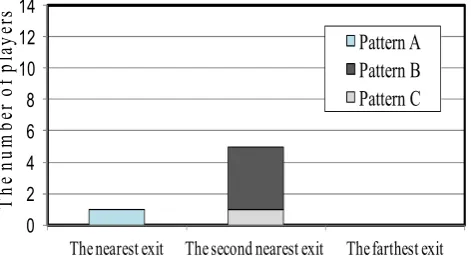
Figs. 12 and 13 show the number of players who arrive at exits. Exits are categorized into the nearest exit, the second nearest exit, and the furthest exit. Fig. 12 shows the number of players who arrive at different exits under the condition that the players refer to emergency exit signs when they start to move. Fig. 13 shows the number of players who arrive at different exits under the condition that the players refer to other agents. Fig. 12 denotes that all players can arrive at the nearest exit by referencing emergency exit signs in Pattern C. However, almost all players arrive at the second nearest exit in Pattern A although they refer to emergency exit signs. The reason they arrive at the second nearest exit is because they miss the nearest exit while focusing on the second nearest exit located in the direction of their movement. The result obtained from Pattern B denotes that many players arrive at the second nearest exit by referring to agents who move in the opposite direction. We consider the objects which players refer to are affected by not only the ratio of agents moving in the opposite direction, but also floor layout.
The following distinctive player characteristics are obtained from experimental data including video:
(1) Many players focus on the narrow area in the direction of movement. Therefore, the players could not notice the nearest exit located at the side of the aisle (ref. Fig.12). (2) There are cases in which players stop to look for new
targets as they cannot easily locate exits at corners, although the signs do indicate exits (ref. Fig.12).
(3) There are cases when players return to an aisle because they cannot locate exits, and follow agents who move in the opposite direction. Even if the players arrive at the nearest exits, the elapsed time is longer (ref. Fig.13). (4) There are cases of players unaffected by agents when there
are a small number of agents near the player. In this case, players mainly refer to emergency exit signs.
These player behaviors are difficult to install in the developed agent-simulation as a universal behavior rule. In the future, when these behaviors are installed in the multi-agent
simulation as evacuee behavior rules, the evacuee behavior will increase in accuracy. In addition, the developed simulation with consideration to the complex and distinctive characteristics of evacuees, is useful for creating new methods of evacuee escape.
Conclusion
In this study, we develop a mixed reality game system linking a multi-agent simulation. The multi-agent simulation is performed to evaluate the general behavior of evacuees using as many rules for movement as possible. Players play the mixed reality game including the simulation data to evaluate complex decision making of the players. The developed game system is performed as case study including an actual floor layout and emergency exit sign. The experimental result demonstrates that the game system is useful to investigate not only the general behavior of evacuees, but also to investigate the complex decision making of evacuees.
In a future study, we will develop rules of agents to judge movement in agent-simulation by using characteristics of agents investigated in the mixed reality game and the agent-simulation will be developed for agent-simulation of behavior of agents a@@@. We will measure a player’s brain waves to investigate the relationship between behavior and emotion of players in the mixed reality game. In addition, we will modify behavior rules in multi-agent simulation from resultant behaviors of players in the game in order to simulate more actual behavior of evacuees in the multi-agent simulation.
Acknowledgment
This study was supported by a 2013 Research Grant from the HAYAO NAKAYAMA Foundation for Science, Technology, and Culture, and a 2013 Research Grant from Foundation for the Fusion of Science and Technology.
REFERENCES
Fire and Disaster Management Agency, 1999. Fire Service Act in Japan, http://www.fdma.go.jp/concern/law/kokuji/
hen52/ 52030103020.htm (Accessed: 2014.11.01) (in Japanese).
Hori, M., Inukai Y., Oguni K. and Ichimura, T. 2005. Study on Developing Simulation Method for Prediction of Evacuation Processes after Earthquake, Sociotechnica, Vol.4: 138-145 (Japanese)
Masuda, H., Kikuchi, S., and Arai, T. 2009. Performance Analysis of Retail Store Layout Using Agent-Based Simulation, Journal of Japan Industrial Management Association, 60: 128-144.
Meguro, K., Haga, Y., Yamazaki, F., and Katayama, T. 1997. Application of Virtual Reality to Human Evacuation behavior, Journal of Japan Society of Civil Engineers, No.556, I-38: 197-207(Japanese)
Nakanishi, H., Ishida, T., and Koizumi, S. 2007. Multiagent Simulation for large-scale Experiments in Physical Environments, The Virtual reality Society of Japan, Vol.12, No.4: 509-518 (Japanese)
Fig. 13 Number of players who arrive at different exits when they refer to agents
0 2 4 6 8 10 12 14
The nearest exit The second nearest exit The farthest exit
T
h
e n
u
m
b
er
o
f
p
la
y
er
s
Nichinari, K., Kirchner, A., Namazi, A., and Schadschneider, A. 2004. Extended Floor Field CA Model for Evacuation Dynamics, IEICE Transactions on Information and Systems, E87-D(3): 726-732.
Ohata, D., Takai, N., and Kagami, H. 2007. Spatial evaluation of tsunami refuge facilities in the central Kushiro city: simulation of evacuation behavior from Tsunami utilizing multi agent system Part 2, J. Archit. Plann., AIJ, Vol.74, No.612: 87-91 (in Japanese).
Okada, M., Tarumi, H., Yoshimura, T., and Moriya, K. 2001 Collaborative Environmental Education Using Distributed Virtual Environment Accessible from Real and Virtual Worlds, ACM SIGAPP Applied Computing Review, Vol.9, No.1: 15-21.
Pelechano, N., Badler, N.I. 2006. Modeling crowd and trained leader behavior during building evacuation, Computer Graphics and Applications, IEEE, Vol.26, No.6: 80-86. Rickel, J., Marsella, S., Gratch, J., Hill, R., Traum, D.R., and
Swartout, W.R. 2002 Toward a New Generation of Virtual Humans for Interactive Experiences, IEEE Intelligent Systems, Vol.17, No.4: 32-38