Network Reconfiguration and DG Placement in Distribution Systems
for Power Loss Minimization and Reliability Optimization
Divya Teja
1, Syed Saheb
21
PG Scholar, EEE Department, BITS College, Andhra Pradesh, India
2Assistant Professor, EEE Department, BITS College, Andhra Pradesh, India
---***---Abstract -
A method to improve reliability and also tominimize losses in radial distribution system (RDS) ,through a process of network reconfiguration will be considered. The methodology adopted to enhance reliability, uses Cutset approach and historical data of the network such as the level of reliability and the severity of potential contingencies in each branch. The method analyses the Radial Distribution System in two perspectives. First perspective of optimization is considering that investment is not there, so we are using only switches which are there in the network, and a second perspective of optimization is where it is given the chance to place a limited number of tie switches and Distributed Generators. The effectiveness of the proposed method will be demonstrated through the analysis of a 33 bus Radial Distribution System.
Key Words: — Distributed Generators (DG), Network Reconfiguration (NR), Radial Distribution System (RDS), Voltage Stability Index (VSI). Optimal capacitor placement.
1.
INTRODUCTION
The Power System is categorized into 3 types, called Generation system, Transmission system and Distribution system. We focus on the Distribution system. Distribution systems are used to supply power to consumers. Distribution networks are low voltage systems and hence efficiency is low. There is a necessity to maintain Distribution network with the high reliability, and there is need to improve efficiency and reliability.
The ability of a Distribution network is to provide uninterrupted power to its consumers is a measure of reliability of the network. Reliability indices are SAIFI,SAIDI AND CAIDI etc., which are called performance indices. The alternative means is to expensive methods are power system equipment up gradation, network expansion, can be more efficient and economic solutions such as Network Reconfiguration(NR) and Distributed Generators (DG) installation.
Network reconfiguration is a promising solution for improving reliability of the distribution system. The distribution network feeders are accommodated with switches ,by opening and closing of particular set of switches. NR improves network parameters. NR has been run to improve efficiency of the 33bus RDS and also minimization of
power losses and improves reliability.
DG is a method in which power generated at the load centers by using available source of energy like thermal, wind energy etc. DG method is for bulk generation of power has its own advantages such as low operation cost, low investment cost, and low maintenance cost.
The main objective of this project are
To enhance reliability of a Distribution system by NR algorithm method. To reduce Distribution System losses with NR and DG placement and also we can compare with capacitor placement.
2. METHODOLOGY
A.Problem Formulation
The system constraints such as voltage limits, power flows and line loading capabilities are considered.
Radial distribution system is considered for the simulation. A reduction in power losses and increase in performance indices is expected after network reconfiguration.
i. Node voltages:
Here V imin and V imax are the permissible RMS voltage limits at Ith node.
ii. .Reliability indices and power losses
The power flow analysis is carried out by Distribution load Flow Algorithm[1].The power flows and voltages constraints have to be satisfied while minimizing the reliability. To obtain load flow analysis a simple matrix multiplication and the Branch -current to Bus voltage matrix(BCBV) and the Bus-Injection to Branch-current matrix(BIBC)are utilized.
B. Reliability evaluation
Reliability analysis also plays a key role in planning up gradation of the distribution network, thus meeting new and ever increasing demands. The principles of series system is applied to this system. To evaluate reliability of system load point indices are used.
ii. Average annual outage (Us)
iii. Average outage time (Rs) Rs = Us │λs hrs
Where (λi) is the failure rate of a component i, and (ri ) is the repair time of component i. In order to consider the significance of a system outage , customer oriented indices can be evaluated, that are given by
a.
System Average Interruption Frequency Index,
SAIFI:
SAIFI = Total Number of Customer Interruptions iv.
Total Number of Customers Served v.
Where we say that Ni is the number of customers of load point i.
b.
System Average Interruption Duration Index,
SAIDI
:
SAIDI is also very commonly used. It is the average duration of an interruption and is usually reported annually. It is given by
c.
Customer Average Interruption Duration Index,
CAIDI:
It describes the duration of an average customer suffering from interruption. It is given by
CAIDI=
Where, λi is a failure rate , Ui is a annual outage time and Ni is number of customers at load point i.
d.
Average Service Availability Index, ASAI:
ASAI =Customer Hours Service Unavailability
Customer Hours Service Demand
ASAI=
e.
Average Service Unavailability Index, ASUI:
ASUI
=1 -
ASAI
Where 8760 is the number of hours in a calendar year.
C
.Network Reconfiguration Algorithm:
Network reconfiguration is one of the feasible methods in which power flow is altered by opening or closing the switches on the feeders. It is implemented by opening a sectionalizing switch and closing a tie switch to conserve radial structure of the feeders.
The algorithm steps for network reconfiguration of radial distribution system as follows
Step1:Read the Bus data, Line data, the probability of distribution system and set the flag to zero for all the tie switches.
Step2:Run the distribution load flow by using BIBC,BVBC matrices and compute the node voltages, real power losses, reactive power losses and reliability indices.
Step3:The voltage should be within the specified limits │Vi │min ≤ │Vi│ ≤ │Vi │max
i.e. within the 6% of rated voltage;0.94≤Vi ≤1.06,if yes then go step 11.
Step4:Calculate the VSI difference between end node k and m of the tie switches with zero flag. The tie switch with maximum VSI difference is chosen.
Step5: Check if the VSI at kth node is greater than that at the mth node. If yes go to step7.
Step6: The sectionalizing switch between k and k-1 should be opened.
Step7: The sectionalizing switch between m and m-1 1 should be opened.
Step8: Connect the tie switch and the flag is set to 1.
Step9:Check if the tie switches with flag equal to 1 else then go to step10.
Step10: Calculate power losses if not 0 < PL , QL Lb, QLb, open tie switch and close sectionalizing switch and go to step 2.
Step11: Calculate reliability indices: SAIFI, SAIDI, CAIDI and ASUI
b SUI)b ;
,open tie switch and close sectionalizing switch and go to step 2.
Step12: Print Vi , (VSI)i, PL, QL, SAIFI, SAIDI,CAIDI and ASUI.
The flow chart for the above algorithm is shown in figure A.
D. Optimal placement of a DG
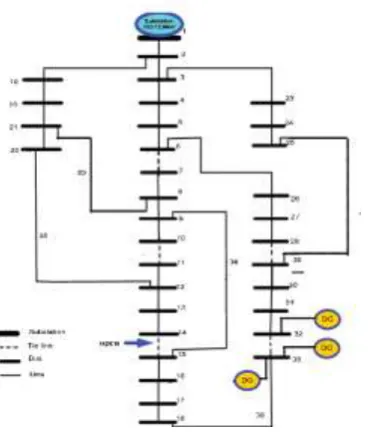
There are several benefits by installing a DG unit at an optimal location. These include minimizing of line losses, enhancement of voltage profile, peak demand shaving, relieving overloaded lines, improvement of the overall system efficiency. DG is placed at three optimal locations in 33-bus radial distribution system with 0.1070 MW(18) and 0.5724 MW(17), 1.0462 MW (33). Single line diagram of 33-bus radial distribution system with DG installation is shown in figure A.
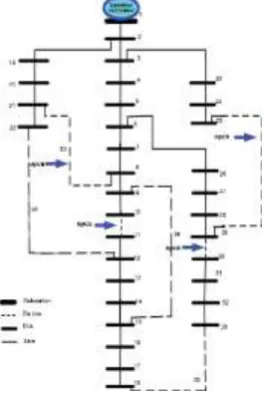
[image:3.595.94.229.360.557.2]Fig.B. Single line diagram for 33bus base configuration
Fig .A. Flow Chart for network reconfiguration of 33-bus RDS.
I. Result analysis and Discussions:
33-Bus RDS having voltage of 12.66 KV and the relevant data for this system are taken here.
Case1:The test system base configuration is without placement of DG and without NR.
Case2:The test system with Network Reconfiguration algorithm.
Case3:The test system with Reconfiguration only. Case4:The test system with DG placement only.
Case5:The test system with Reconfiguration and DG placement
[image:4.595.346.535.256.500.2]The algorithm is applied to a 33 bus RDS in section C using MATLABTM programming. Results are validated and evaluated. The 33bus RDS for base configuration is shown in figure .A. For the base configuration is shown in figure B.
Bus data ,Line data and reliability data of 33bus RDS is provided here. The NR algorithm for 33bus RDS is implemented in MATLABTM
Table A. Shows converged values of voltage magnitude , phase angle, VSI
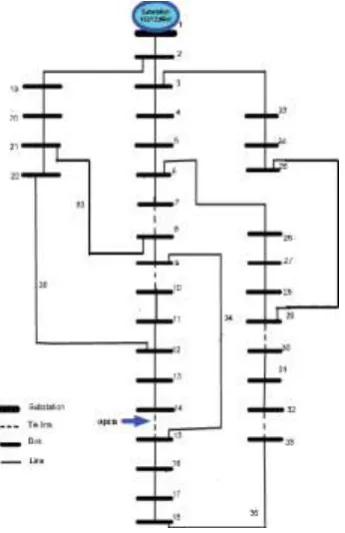
Figure.C .Single line diagram of 33bus RDS with reconfiguration
VSI difference is highest between the tie switches22-12. So this tie switch is closed first. VSI of 12 is less than the VSI of 22,switch in the branch of 10 and 11 should be opened. The total real power loss is 153.93KW.Next tie switches to be closed are 25-29 and procedure is repeated and switches should be opened are 28-29 and now real power losses are 145.88KW.Next tie switches are 18-33 should be closed and
142.12KW.The procedure has to be repeated until the final optimal configuration is achieved.
After Reconfiguration the real power loss is 140.00KW. The final optimal configuration is shown in figure D. tie switches are10-11,28-29,33-32,14-15,7-8.
1) Power loss analysis:
After applying NR power losses are reduced to 140.00KW as shown in table C. Switches that are opened in NR are 7,14,9,32 and 37. Base case power loss without NR is 202.66KW. After placement of DG the real power losses have been reduced to 96.76KW and are observed from table D. In DG placement switches which are opened are33,34,35,36,37.
Figure D. Single diagram of 33bus RDS with DG installation.
The real power losses without DG placement is 202.66KW. After applying NR with simultaneous DG placement the real power losses have been reduced to 73.50 KW and are observed in Table E. The switches which are opened in DG placement are 7,14,10,32 and 37. The line diagram for simultaneous NR with DG placement is shown in Figure E.
1) Reliability analysis:
[image:4.595.55.228.386.653.2]Figure E. Single line diagram of 33bus RDS with simultaneous NR and DG installation.
Figure F. Comparison of voltage magnitudes for base case, DG, NR, NR with DG installation.
Table A. Converged values of bus voltage magnitude, VSI, phase angle before NR.
Table B .Converged values of bus voltage magnitude VSI, phase angle after NR.
Comparision of power losses
Table C. Variation in power losses of 33 bus RDS for base case and NR.
Power loss Before NR After NR % Decrease Real power
loss(KW) 202.6650 140.00 30.92 Reactive
Power loss(KVAR)
135.1327 104.9 22.37
Total power loss(KVA)
[image:5.595.338.546.121.399.2]243.5856 174.9 28.19
Table D. Variation in power losses for base case and DG installation
Power loss Base
case DG %Decrease
Real power
loss(KW) 202.6650 96.76 52.256
Reactive Power
loss(KVAR) 135.1327 69.7426 48.38
Total power
loss(KVA)loss(KVA) 243.5856 119.2577 51.04
Table E.Variation in power losses of 33 bus RDS for NR and NR with DG installation.
Power loss After NR NR with
DG units %Decrease
Real power
[image:5.595.40.567.508.772.2]Reactive Power loss(KVAR)
104.9 55.72 46.88
Total power
loss(KVA) 174.9 92.16 47.30
Comparison of reliability indices for base case and after NR.
Table F. Variation in the reliability of 33bus RDS for base case and NR.
Index Before NR After NR %Decrease SAIFI(f/yr) 2.4126 2.135 11.6 SAIDI(hr/yr) 2.0436 1.4357 30.5 CAIDI(hr) 0.8470 0.6722 20.83 ASUI 203328e.04 1.6389e.04 30.04
Table G. Variation in the reliability of 33bus RDS for base case and DG installation.
Index Base case DG
placement %Decrease SAIFI(f/yr) 2.4126 2.368 1.80 SAIDI(hr/yr) 2.0436 2.001 2.13 CAIDI(hr) 0.8470 0.8449 0.247 ASUI 2.03328e.04 2.284e.04 2.099
Table H. Variation in the reliability of 33bus RDS for NR and NR with DG installation.
Index
After NR NR with DGunits %Decrease SAIFI(f/yr) 2.135 1.967 7.86 SAIDI(hr/yr) 1.4357 1.293 9.79 CAIDI(hr) 0.6722 0.657 2.261 ASUI 1.6389e.04 1.4767e.04 9.89
[image:6.595.316.546.146.273.2]Comparison of power losses for base case, NR, DG placement, NR with DG placement.
Figure G. Comparison of power losses for all 5 cases.
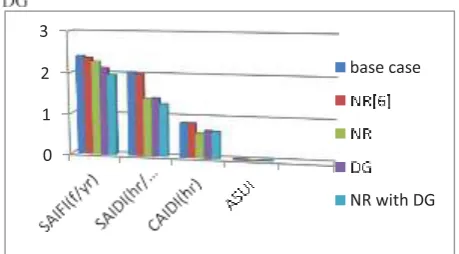
Comparison of Reliability indices for base case, NR, DG placement , NR with DG placement.
Figure H. Comparison of power losses for all 5 cases.
CONCLUSIONS
A new approach has been developed to reconfigure 33 bus RDS and reconfigured. A new algorithm is developed and reconfigured to 33 bus RDS to improve reliability and stability. Algorithm is based on VSI and found to improve voltage stability and to improve voltage profile. As power losses are reduced in this system and reliability is improved. NR, DG placement, NR with DG are all simulated in MATLAB programming to establish superi0rity of prop0sed method. NR with DG installation shows best results where power losses are decreased more. As the number of DG installation location increases more and power loss reduction percentage is improving.
REFERENCES
1. Merlin and H. Back, “Search for a minimal-loss in operation spanning tree configuration in associate to urban power distribution system,” in Proc. 5th Power System Computation Conf. (PSCC), Cambridge, U.K., 1975, pp.1–18.
2. S. Civanlar, J. Grainger, H. Yin, and S. Lee, “Distribution feeder reconfiguration here for loss reduction,” IEEE Trans. Power Del., vol. 3, no.3, pp. 1217–1223, Jul. 1988. 3. D.Shirrmohammadi and H. W. Hong, “Reconfiguration of electrical distribution Networks for resistive line losses reduction,” IEEE Trans. Power Del., vol. 4, no. 2, pp. 1492–1498, Apr.1989.
4. Borozan, D. Rajicic, and R. Ackovski, “Improved methodology for loss reduction In distribution networks,” IEEE Trans. Power Syst., Vol. 10, No. 3, pp. 1420– 1425, Aug.1995.
5. Jen-HaoTeng, “A Direct Approach for Distribution System Load Flow Solutions”, IEEE Trans. PD, Vol. 18, No.3, 2003 pp. 882-887.
[image:6.595.43.278.562.697.2]System Victimization Network Reconfiguration within the presence of Distributed Generation” IEEE dealing on power systems, Vol. 28,
No. 1, pp. 317-325, February
2013
7. D. Ravi Kumar and V. Sankar, “Loss reduction and reliability optimization in electrical distribution system using network reconfiguration”, the journal of CPRI, vol.11, No.2, pp.259-268, June 2015.