AUTHORS’ ACCEPTED MANUSCRIPT
Definitive version:http://dx.doi.org/10.1007/978-3-030-29387-1_19
Visual Methods for the Design of
Shape-Changing Interfaces
Miriam Sturdee[0000−0002−8417−191X], Aluna Everitt[0000−0002−0974−2559],
Joseph Lindley[0000−0002−5527−3028], Paul Coulton[0000−0001−5938−4393], and
Jason Alexander[0000−0001−6093−6116]
Lancaster University, Bailrigg, Lancaster LA1 4YW, UK (m.sturdee, a.everitt, j.lindley, p.coulton, j.alexander)@lancaster.ac.uk
www.lancaster.ac.uk
Abstract. Shape-changing interfaces use physical change in shape as input and/or output. As the eld matures, it will move from technology-driven design toward more formal processes. However, this is challenging: end-users are not aware of the capabilities of shape-change, devices are dicult to demonstrate, and presenting single systems can `trap' user-thinking into particular forms. It is crucial to ensure this technology is developed with requirements in mind to ensure successful end-user experiences. To address this challenge, we developed and tested (n=50) an approach that combines low-delity white-box prototypes and high-delity video footage with end-user diagram and scenario sketching to design context dependent devices. We analysed the outputs of our test process and identied themes in device design requirements, and from this constructed a shape-change stack model to support practitioners in developing, classifying, and synthesising end-user requirements for this novel technology.
Keywords: Shape-Changing Interfaces · Sketching · Visual Methods
1 Introduction
For existing systems, User-Centered Design ensures that the tasks, needs, and context of end-users drive and reect upon the development of a new system, but we cannot presently apply this to shape-changing interfaces. This is because current shape-changing interface design is not targeted at solving a particular problem, or trying to design specic hardware or interaction we are purely striving for innovation. In addition to this, possible end users are not aware of shape-change as a technology, what it can do, and the range of available hardware is dicult to demonstrate due to issues of location, portability or safety. In the cases where users are given the opportunity to interact with a shape-changing interface prototype, they may also become trapped into thinking about shape-change as being of one particular form (e.g. actuated pins [6]). Much of the work on shape-change appears to pick from dierent areas of existing design processes, but does not seek to employ them as a specic methodology during the research process: for example, building hardware is often the rst step in exploring shape-changing interfaces, and is then followed by a short usability study for whichever application best suits the platform [54] [58]; or studies might focus on user-ideation or co-design for non-specic products [5] [56]. The reason behind this may be that, traditional, sequential processes (e.g. planning, user research, user evaluation, information architecture) may not t exactly with emergent hardware which does not already have a predened role.
At this early stage, we hope to utilise readily available methods to provide a baseline of requirements for shape-changing interfaces. By focusing on a prac-tical start-point requirements generation we believe we can begin to adapt and build formal design process for this exciting technology from the ground up. Following the generation of requirements, we can model these to form an overview of the eld and its possibilities. This paper therefore contributes: 1) A practical, readily available approach for requirements generation for shape-changing interfaces; 2) A 50 participant study that demonstrates the validity of this approach to generate requirements for this novel technology; (3) A thematic analysis of the generated user requirements; (4) A shape-change stack model to support practitioners in design requirements-gathering activities for shape-changing interfaces, intended to provide a cohesive resource for those building and testing shape-changing interfaces with the view to their eventual adoption.
2 Related Work
2.1 Shape-Changing Interfaces
Shape-changing interfaces are an exciting subset of tangible computing hard-ware, with the potential to not only use 3D form in input/output, but to also allow for this form to be manipulated by the user, and sometimes, self actu-ated. Examples include (but are not limited to): interactive tabletop surfaces such as InFORM [9] or the elastic-pin hybrid Tablehop [49]; rapid prototyping devices like ShapeClip [20]; mobile phones like WhammyPhone which explores bendable audio interaction [14] or Reex which uses the bend action to enhance reading on small displays [54]; furniture such as the unexpectedly actuating Co-Motion bench [17]; or even public installations like Aegis Hyposurface [16] and Protrude/Flow [24]. Although a large number of works focus on hardware devel-opment, there also exist examples which periodically review, critique and ponder the state of the eld of shape-change, notably Rasmussen et al. [44], Coelho & Zigelbaum [3], and recently, Sturdee & Alexander [55] but these oer general overviews of interactive capabilities or material properties rather than advice on building these novel devices (although the latter suggests material properties may be a helpful starting point for a design framework). Additionally, research touches upon particular aspects of design for these devices such as emotional or anthropometric content [27], vocabularies for design [45] or constructing form language for shape-change [61], but there still exists a gap in the literature for a consolidated framework or process for the building and development of shape-changing interfaces.
2.2 Requirements for Shape-Change
2.3 Accessible Techniques for Design Requirements Generation The techniques described below enable us to address the challenge of generating design requirements for shape-change.
Video High-quality video is often produced alongside published work in order provide quick explanations of a hardware or system concept, without reading the accompanying text. It can also be used to inform, communicate or explore concepts [62]. To a large percentage of users, receiving information in this way is a normal, accessible part of smart (and other) device interaction (such as YouTube or Vimeo) [10]. For actuated prototypes, a realistic rendering style was found to be the optimal way of communicating a concept to users in a study of shape-changing phones [40], whereas Gong et al. [15] suggest that high quality videos depicting novel hardware allow users to suspend their disbelief and make judgements about how useful a prospective technology might be. Videos have also been used within studies in combination with low-delity prototypes to generate high-level comments [34] which suggests that combining this media with other techniques may yield useful results. In context, video also enables us to present work that we do not have access to, due to geographical, or other constraints, and is an apt method to communicate high-level concepts.
box prototypes are helpful, as humans may require material anchors to be, by their nature, sketchy in order to facilitate cognitive processes [35].
Sketching and Storyboards Sketches are often seen as low-delity they are rough ideas that welcome opinion and modication [7], and also explain con-cepts that are hard to suggest with words [12]. Sketching has long been part of the user-centred design process, and Buxton's book Sketching User Experiences has actively encouraged and enhanced researcher engagement with this format [2]. Sketches are also cheap to produce, and are an inclusive way of generating output as they require only access to a pen and paper and have additional cog-nitive benets [13]. Sketching also has an established place in the design of user interfaces (UI), giving rise to computer-based UI design programs which either utilise, or appear to be sketches and storyboards [18] [28] and can be annotated or embedded with metadata [19]. Storyboards used in the design process can also lead to more eective design [60] or help communicate research ndings [22]. There is already a precedence for using storyboards to generate requirements, whether via sketched, computationally enhanced outputs [19] or the traditional, hand drawn versions [57], and participatory sketching has also been shown to help generate requirements for real-world interaction (e.g. elevators) [59]. Story-boards and comics are also already used in HCI within areas such as software engineering [60] and cyber-security [30] [63], and are accessible, quick-to-produce medium for proposing future scenarios. Finally, sketching in direct application to shape-change has already been employed in the user ideation process [56], as a way of exploring the design of interactions for shape-changing devices [45] and even to examine a futuristic material [23].
3 Method
3.1 Study Overview
The study was a ve-stage process lasting between 40 minutes to 1 hour, includ-ing explanation, questions and feedback: 1) Introduction to shape-change usinclud-ing video material from existing research; 2) Exploration and interaction with white box prototypes; 3) Idea generation; 4) Idea elaboration and diagram creation; 5) Storyboarding and scenario generation. The participant output was collected for coding and analysis.
3.2 Participants
Fifty participants (24 male/26 female) were recruited using social media, email, or from volunteering after observing the study set-up directly in shared so-cial/study spaces. For example, 8 participants responded to a pre-organised workshop call hosted internally within the university, another 12 participated after approaching the study team voluntarily in a shared postgraduate student study and social space, and 8 were invited via email and snowball sampling to participate whilst the study was set up in a general-use study-hub meeting room on the university campus. Participants with diverse social and professional backgrounds took part (of the 50, 22 were not involved in academic research or study, and 28 were either students or university sta). Those participants who were not aliated with the university were recruited via email and word of mouth from existing social and professional relationships of the study team, and encompassed backgrounds as diverse as call-centre worker, marketing manager and retiree. The age range of participants was 21-69, (mean 49).
3.3 Video Material
Participants were shown 7 videos relating to existing research, chosen for quality, specic actuation type and related to the material properties of white box proto-types. The videos served to inform those taking part about the state-of-the-art in shape-change research, and introduce the concepts of materiality in proto-typing. The chosen works were: Physical Telepresence [29] (actuated interface); Protrude, Flow [24] (liquid interface); Lightcloth [21] (paper/cloth interface); Re-Flex [54] (bendable interface); Paddle [43] (foldable interface); Claytric Surface [36] (malleable interface); Obake [4] (elastic/inatable interface).
3.4 White Box Prototypes
Fig. 1. White-box prototypes based on shape-change categories from [55], with exam-ples of how interaction occurs for each: 1. Foldable; 2. Bendable; 3. Paper/Cloth; 4. Elastic/Inatable; 5. Actuated; 6. Liquid; 7. Malleable; 8. Jamming.
3.5 Ideation, Elaboration and Storyboarding
Participants were asked to explore the white box prototypes through touch and comparison, then write down ideas for applications, hardware, surfaces or spaces that would benet or enhance their own lives in some way (e.g. in work, hobbies, social contexts). This was based on the process employed in Sturdee et al.'s public ideation study [56]. Following this, they were asked to choose their favourite idea and expand on it via sketching a diagram and writing notes about for example how it works, the user base, interaction, and so on. Finally, the chosen idea was put into context within a storyboarded scenario of use (see Fig. 3).
4 Analysis
Fifty participants generated 255 ideas and corresponding sketches for shape-changing interfaces, applications, surfaces and spaces (mean 5.1). They then selected one idea to elaborate upon (n=50). The majority of chosen ideas were indicative of shape-changing hardware (43/50) rather than specic applications for a generic device, although most would allow for multiple applications. Two of the chosen ideas did not specically address shape-changing technology so were not used in the analysis.
4.1 Generating Design Requirements
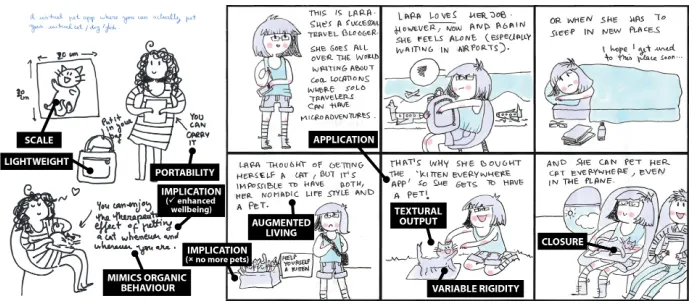
worked on the data, and these pairs were rotated. Requirements were extracted in several ways (see Figs. 2. & 3. for an example of participant data): directly through notation on the diagrams and storyboards (e.g. device is 20x20cm, de-vice is portable); from examining the interaction (dede-vice has furry texture, fold-ing and closure must be possible); from the proposed output (mimics organic form); and from context (device has therapeutic purpose). The implications of the technology then arose from the idea of having access to a lifelike, adaptable non-organic representation of a pet e.g. decline in pet ownership. A guide to the coding and requirements generation is overlaid on Fig. 2.
Fig. 2. Diagram & scenario for Kitten Everywhere app, annotated to show how require-ments were generated. For example, bottom right the kitten's paw is overlapping the person's hand and reconnecting with the interface surface closure [47].
4.2 Results
Analysis of the 255 participant idea sketches produced 506 coded items across three categories Requirements (333), Applications (104) and Implications (69) with multiple sub-categories. An item refers to all text-based outputs from the coding process. Items from Requirements and Applications were synthesised to produce the stack model in Fig. 4. by using top level categories for each and ordering them logically for a prototype build process. From those items falling under the Requirements category, we provide those most frequently occurring so as to give an overview of how people appear to think about shape-change (Section 5), and show a categorisation of the top level themes which enables a stacked requirements model (Section 6). Finally, we analyse individual ndings and current works to demonstrate the validity of the stack model (Section 7).
5 Frequently Occurring Requirements
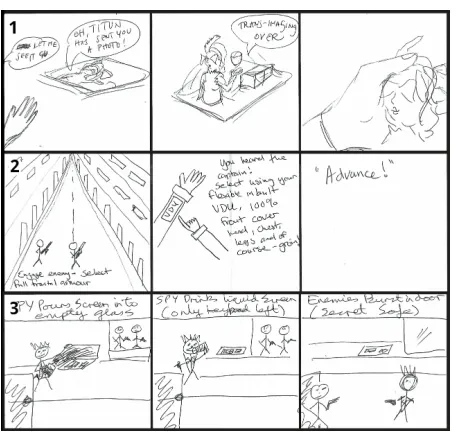
In total, 333 requirements were generated, across 5 top level categories (Input, Output, Construction & Assembly, Control Systems, and Interactions & Be-haviour) which directly relate to the top level headings for the stack model in Fig. 4. The following text contains the highest frequency sub-themes emerging from the analysis (in order of highest frequency), suggesting specic, perhaps essential, requirements for the design of shape-changing interfaces. Examples of sections of original data relating to the categories below are shown in Fig. 3.
Between Device Communication (Interactions & Behaviour) This nding suggests that our current devices will co-exist with their newer, physically dy-namic counterparts. Concepts such as up-scaling of lm or image from 2D to physical 3D are explored. Shape-change is also expected to communicate be-tween devices (e.g. Photo album for the blind Fig. 3.1).
Rigidity (Construction & Assembly) Varying the material qualities of a device was communicated by the jamming box, and was used in conjunction with other material categories to create behaviours in which a device or application moves between states depending on context of use. This variation is especially impor-tant in generic devices where multiple uses are anticipated (e.g. interface which becomes a playable guitar).
Fig. 3. Examples of shape-changing interface relating to frequently occurring require-ments: 1) Photo album for blind; 2) Battle armour; 3) Drinkable Tablet.
Modularity (Construction & Assembly) Modularity not only refers to the abil-ity of identical devices to communicate with each other, but for parts of other types of material surface to be removed, used, and reintegrated, or for compo-nents of shape-change such as actuators to communicate with each other (e.g. toy blocks).
Portability (Construction & Assembly) Many of the participant ideas were categorised as portable object-scale devices, suggesting the need for novel bat-teries or charging methodologies such as using body movement (kinetic), solar, or wireless. In the requirements, portability emerged as a distinct theme (e.g. armour Fig. 3.2).
Multi-sensory Input & Output (Input & Output) Users are expecting inter-faces to have deformation as an interaction technique, and for this technology to also employ the full range other human senses in their application and design, emphasising the organic potential of shape-change (e.g. drinkable computer Fig. 3.3).
shape-change links to comfort and sensitivity, reecting a positive behaviour (e.g. prosthetics).
Device Personalisation (Interactions & Behaviour) For planar, screen based devices, personalisation usually takes the form of a physical accessory such as a screen protector, or amendments to the display or applications. These amend-ments can also be attributed to shape-changing devices, but additionally we might control the shape, texture and even how it connects with our bodies (e.g. adaptive training shoes).
6 Toward a Design Requirements Model
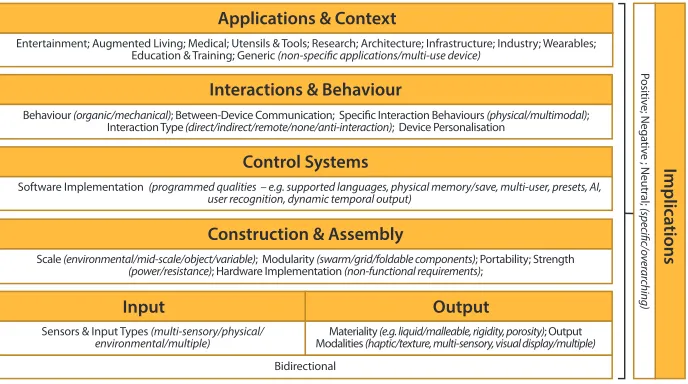
Our synthesis of requirements of shape-changing interfaces revealed ve over-arching categories, each at a dierent level of abstraction. Together, they logi-cally t into a stacked layer model (Fig. 4) describing levels of requirement and implementation in shape-changing interfaces, and dierentiating between physi-cal/operational characteristics. Under the top-level categories, we also identied eight sub-categories of requirements. The top-level categories are outlined below alongside the Implications category which was major theme arising from the data not directly connected to design requirements.
Applications & Context
Entertainment; Augmented Living; Medical; Utensils & Tools; Research; Architecture; Infrastructure; Industry; Wearables; Education & Training; Generic (non-specific applications/multi-use device)
Interactions & Behaviour
Behaviour (organic/mechanical); Between-Device Communication; Specific Interaction Behaviours (physical/multimodal); Interaction Type (direct/indirect/remote/none/anti-interaction); Device Personalisation
Control Systems
Software Implementation (programmed qualities – e.g. supported languages, physical memory/save, multi-user, presets, AI, user recognition, dynamic temporal output)
Construction & Assembly
Scale (environmental/mid-scale/object/variable); Modularity (swarm/grid/foldable components); Portability; Strength
(power/resistance); Hardware Implementation (non-functional requirements);
Input
Sensors & Input Types (multi-sensory/physical/ environmental/multiple)
Output
Materiality (e.g. liquid/malleable, rigidity, porosity); Output Modalities (haptic/texture, multi-sensory, visual display/multiple)
Bidirectional
Implica
tions
Positiv
e; Nega
tiv
e ; Neutr
al;
(sp
ecific/o
ver
ar
[image:11.612.136.480.404.596.2]ching)
6.1 Applications & Context
Applications are dened as the specic use envisaged for the device (e.g. battle armour in Fig. 3.3), and apps (such as Kitten Everywhere in Fig. 2). Con-text applies to where, when, what and why of using the application (e.g. at home, working hours, provide remote massage, travel less for work). Just over a fth of the items produced during coding were application and context re-lated. Often the context also dictates the application, and this is especially the case for generic, catch-all devices. Poupyrev et al. [42] reviewed potential uses for actuated, tangible interfaces ten years ago and suggested applications and areas based on the literature at that time, creating ve categories: Aesthetics; Information Communication; Mechanical Work; Controls Data Consistency; and, People to People Communication. In the intervening 10 years however, the range of devices and applications has grown and the ve categories remain rel-evant, but can be blended into the overarching contextual categories generated from more recent work [56]. The application areas generated in this work can be mapped directly onto those found in Sturdee et al. [56] (with the exception of the infrastructure category), with some exact application ideas being repeated such as responsive computational owers, remote massage, or actuated storybooks for children. However we also propose here a wider generic category where the properties of the device or surface are used for multiple use-cases.
6.2 Interactions & Behaviour
Interaction refers to the relationship the user has with the device and includes the type of interaction, e.g. specic behaviours identied during coding (squash-to-delete) but also the interaction the device has with other technology (between device communication). Behaviour encompasses software actions what the de-vice does (switches between planar/3D output). Eighty-four items fall into this category. Interaction for shape-changing interfaces is perhaps best classied by Rasmussen [44] who developed the framework of Direct, Indirect and No In-teraction. The requirements for basic interaction in this model also oer other options: anti-interaction (the device actively avoids or puts o, interaction), encouraging interaction, and device-to-device communication, covering interac-tion between shape-changing devices and also between shape-change and current mobile devices and computers. In addition to these high level categories, the be-havioural aspects of shape-change are explored with regards to how the device or surface acts or moves to initiate the programmed output, and whether you can personalise your device.
6.3 Control Systems
6.4 Construction & Assembly
The physical requirements that are unrelated to sensory input and output are contained in this layer, it contains specic information on hardware and ap-pearance of the device (such as size and portability) as well as non-functional requirements (washable, lightweight). It also contains the Hardware Implemen-tation which includes information such as integral camera or low latency over internet. This layer contains over a third of the requirements and over a fth of the total items.
6.5 Input & Output
This layer describes input and output sensors for shape-change, incorporating multi-sensory information in addition to visual and shape output, and specic information such as GPS, speed, texture, temperature and air pressure. Despite a tendency toward two-way multi-sensory interaction for generic shape-changing devices, bi-directionality was not seen as an essential quality for application specic shape-change, which contradicts previous work which suggests this is an overarching feature of tangible interfaces [3].
6.6 Implications
Sixty-nine implications were generated from the context and use cases implied by the applications. An implication, in this format is a possible direct result or reaction deriving from the adoption and use of a shape-changing technology. The Implications were realised both from the application ideas that were generated, but also from specics within the scenarios and diagrams that the participants created. They are categorised into: Positive (of benet to the majority of the population, such as faster recovery from debilitating injury, improved well-being, and sustainability); Neutral (not clearly mapped onto a specic target group or are cannot be categorised, such as more money for cinemas or consequences of shape-changing AI left to own decisions) and Negative (of negative benet to the majority of the population, such as removing the need for labouring work, or reducing human contact). The possibility of AI taking jobs from people is already a hot topic, and shape-change could enable a far greater obsolescence.
7 Using the Requirements Model
incorrect assumptions at one level can propagate), and technologists can use it to understand the impact of their technology decisions (bottom layers) on the upper layers. Within the existing framework of shape-change, it could also be used to assist researchers to better understand existing prototypes however, we envisage further development before it can be fully adopted by the community.
7.1 Applying the Requirements Model to the Dataset
The overarching requirements and subcategories are distributed across the stack, with a slight bias toward the multi-sensory, bottom layer of the stack (in-put/output). Software implementation (Control Systems) is the most under-represented layer, perhaps due to the participant sample we used (non-computer background), but this omission could be addressed by asking users to specically think within the stack system. Looking at the participant data in relation to the stack model, we could re-analyse the diagrammatical and storyboard data and identify extra requirements that the user may not have explicitly thought about during the study. In the case of the drinkable tablet (Fig. 3.3) which we know has variable rigidity and is safe to ingest we might now return to the under-represented software implementation and extract the information that if it is a tablet then it also runs apps, and we can see from the sketch that it also supports a 2D planar screen, meaning it should be backward-compatible. The demonstrates that the stack model therefore can support directed thinking for the researchers by identifying specic areas and therefore eliciting further re-quirements. Observation of the participants during the study suggests that a mixture of top-down and bottom-up approach is used to create the data: either where an application idea was realised via consideration of what hardware would be required to achieve that goal, or beginning with an idea relating to a specic hardware type based on the white box prototypes, and moving up the stack for application and contextual design. For example, the drinkable tablet idea (Fig. 3.3) came directly from the liquid interface prototype (Fig. 1.6), blended with the idea of variable rigidity (Fig. 1.8), and although in context of a science c-tion story, the practical informac-tion remains relatable. Following the ideac-tion and diagram creation, the context in which a drinkable tablet would be helpful was then realised in this case the spy conceals their data by ingesting it and a scenario based on this idea was drawn.
7.2 Application to Existing Prototypes
and what display mechanism does it have? By querying existing research using the stack model as a basis it is possible to retrospectively apply its principles.
Applications & Context Applications & Context Artistic installation Rapid-prototyping Interactions & Behaviour Interactions & Behaviour Dynamic reaction to changes in magnetic eld,
trembling/rotating, defying gravity, increase/decrease in size, organic movement,
forms spikes along magnetic eld lines
Variable topology, height changes in response to input,
recongurable Control systems Control systems
Variable magnetic uid supports HTML5, WebSocket-to-Serial bridge,Javascript API, RGB value sampling, awareness of clip-position Construction & Assembly Construction & Assembly Ferrouid contained in plate,
helical iron tower
Stepper motor, LDRs, RGB LED, ATmega328p, arduino, 3D printed base, circuit board,
modular, portable,
Physical Input Materiality/Output Physical Input Materiality/Output Magnetic eld, electromagnet Liquid, dynamic shape, texture Light sensor, gesture, force, data Actuated pins, form, colour, light
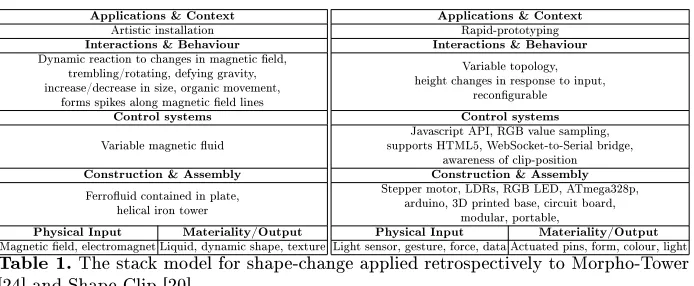
Table 1. The stack model for shape-change applied retrospectively to Morpho-Tower [24] and Shape-Clip [20].
Kodama's ferrouid works [24] are born of the desire to emulate organic move-ment and create art, therefore the focus in the stack is on application, and the interactive/behavioural qualities: a top-down perspective (Table 1, left). Con-versely, for ShapeClip [20] the focus was on the hardware: building a bidirectional actuation device that was low cost, modular and easy to use (Table 1, right). This suggests a focus on the lower two layers of the stack (bottom-up), with omissions in detailing interaction behaviours. Both papers refer to future hard-ware improvements, applications or use-cases (e.g. advertising, sound equaliser; third skin) but do not consider the longer-term implications for their projects (this loosely supports the notion that this research is very technology driven, and not focused on long term adoption [25]). This is not a criticism of existing re-search, but identies the requirements focus for dierent types of shape-change, and where researchers have concentrated their eorts. It also demonstrates the dierence between application (Morpho Tower) and utility (ShapeClip).
7.3 Limitations & Additions
[image:15.612.136.483.158.301.2]construction phases of implementation (which makes sense if the purpose of the device is as a furniture provider). In terms of emotional content or outputs, these are more likely be an implication of, or bound up in, the type of application (such as a virtual physical pet to provide company). However, Kwak et al. [27] noted that the behaviour of his prototypes was implied by their actuation, and gave rise to emotional content e.g. stubbornness or feeling hopeful. This links to the Interactions & Behaviour category within the stack, within which a number of the behavioural themes related to organic movement, meaning emotions would be built in after the software implementation cycle. The stack model could thus be adapted to add a subcategory of emotional content, bound up in the design of organic movement (one of the minor themes from the coding process), whereas aesthetics would become a category within Construction & Assembly.
8 Discussion
The stack model and analysis suggests that the methodology has the potential to expand our understanding of how these devices will be built, and applies an organisational structure to the development process; whereas the implications generated can stimulate discussion about future adoption of physically dynamic interfaces. Our methods full their intended purpose: we communicated complex, novel technology to non-expert end-users who were able to generate detailed out-puts from which researchers could elicit requirements. The commonly occurring sub-themes also threw up some novel requirements for shape-change that (to our knowledge) have not been documented. Between device communication within shape-change is not a new concept, but these requirements also consider inte-gration of shape-changing interfaces into existing technological structure e.g. having an integrated USB port, or sending planar data to be up-scaled. Device personalisation has been addressed in shape-change, but only in attribution of types of actuation to dierent mobile phone notications [39], when personali-sation could potentially also involve texture, form, complex organic movement and multi-sensory experiences that shape-change should be multi-sensory is another under-explored facet, especially given that the only essential output is change in form. Finally, although many of the requirements are pre-existing in other technology development processes, the way the stack model addresses these requirements, and how the extra dimensions of movement, organic behaviours (and so on) are integrated makes the result specic to the application of shape-changing technology. The fact that we are producing similarities with other work also means that we are in a good place to begin formalising process and practice for shape-change design requirements needed to be approached in a tailored way to shape-change, and we have appropriately managed this process.
8.1 Methodological Reection
music app for a malleable device). Given the nature of our approach, we felt that choosing one application or problem would ask the researcher to arbitrar-ily dene that issue, and bias the process toward one kind of shape-change. By asking users to dene their own problem and solution, we explored the nature of the process in way that still provided focus. During introduction and ideation, participants found the videos helpful, though two found it dicult to relate what they had seen to the boxes which did not self-actuate. Others became quite ex-cited by the boxes, choosing to have one next to them so they could return to a concept, or taking part of the material (malleable) with them to work through interactions. The jamming prototype box was seen as the most engaging, as the material concept was novel and the transition between states illustrated how a shape-changing interface might move between material properties, but also be-cause it was in context of the other boxes. Another observation was one of the hedonic qualities of material interaction [44], some participants enjoyed touching the materials, and focused upon how the pleasant sensations could be utilised. Removal of either of the stages would be detrimental, as establishing technologi-cal context sets the scene and explains what, but providing tangible, low-delity examples encourages participants to ask questions and suggest improvements about how without focusing on single use-cases.
The sketching and storyboarding process allowed the contextualisation of ideas in an easily understandable, visual output. Some participants expressed anxiety during the task, but were reassured by focusing on the ideas rather than producing high quality artwork. Sketching even had a positive eect: I haven't drawn in years, I had forgotten how much fun it was. Given the success engag-ing with end-users for shape-change, we envisage this process beengag-ing used in the early stages of new research. In future work, the technique could be applied using a single white box prototype, and specic application, and to explore the next stages of developing shape-changing interfaces functional prototype develop-ment/interface design), and the stack model evaluated in the early development of shape-changing interfaces.
8.2 Implications for Adoption?
the adoption of shape-change. This allows researchers to focus on potentially interesting build-concepts but to also ask should we?
9 Conclusion
We investigated both the application of visual methods to explore complex tech-nology, and also the value of providing structure to the design and development phase of shape-changing interfaces. Novel requirement themes emerged such as the need for integration into existing technology, device personalisation and be-tween device communication, alongside those already existing in technology. The process used has provided a helpful means of accessing thoughts on pre-existing technology in novice users, and may assist others in researching along these lines by using sketching and lo-delity prototyping capitalising on the engaging and hedonic qualities of shape-change. Not only this, but the formal guidelines for design and development of shape-change could help researchers at the beginning of their work in prototype development. We also imagine that the technique of image generation and analysis requires further work to consolidate it as a viable technique in HCI research, perhaps in the context of other types of prototype or interface design.
Despite the focus of participants on the practical and not aesthetic aspects, aesthetics can be built in by designers and developers once the practicalities of the build are concrete and the same can apply to emotionality. These particular elements of shape-change are evident in other work in the eld, e.g. Kwak et al. [27] and Rasmussen et al. [44], so by integrating our work with that of others in future research, we can formulate a 'world-view' of shape-change made stronger still by examining existing processes in commercial design and engineering. This may help the eld towards adoption rather than becoming trapped in a cycle of rapid development without xed end-goals. The overall implications of this work relate not only to the eventual adoption of shape-change technology, but how this might change the way in which we consume technology in the future.
References
1. Atkinson, D., Orzechowski, P., Petreca, B., Bianchi-Berthouze, N., Watkins, P., Baurley, S., Padilla, S., Chantler, M.: Tactile perceptions of digital textiles: a design research approach. In: Proceedings of the SIGCHI conference on human factors in computing systems. pp. 16691678. ACM (2013)
2. Buxton, B.: Sketching user experiences: getting the design right and the right design. Morgan Kaufmann (2010)
3. Coelho, M., Zigelbaum, J.: Shape-changing interfaces. Personal and Ubiquitous Computing 15(2), 161173 (2011). https://doi.org/10.1007/s00779-010-0311-y 4. Dand, D., Hemsley, R.: Obake: interactions on a 2.5d elastic display. In:
Proceedings of the adjunct publication of the 26th annual ACM sympo-sium on User interface software and technology. pp. 109110. ACM (2013). https://doi.org/10.1145/2508468.2514734
5. Everitt, A., Alexander, J.: Polysurface: A design approach for rapid prototyp-ing of shape-changprototyp-ing displays usprototyp-ing semi-solid surfaces. In: Proceedprototyp-ings of the 2017 Conference on Designing Interactive Systems. pp. 12831294. ACM (2017). https://doi.org/10.1145/3064663.3064677
6. Everitt, A., Taher, F., Alexander, J.: Shapecanvas: An exploration of shape-changing content generation by members of the public. In: Proceedings of the 2016 CHI Conference on Human Factors in Computing Systems. pp. 27782782. ACM (2016). https://doi.org/10.1145/2858036.2858316
7. Fish, J., Scrivener, S.: Amplifying the mind's eye: sketching and visual cognition. Leonardo pp. 117126 (1990)
8. Follmer, S., Leithinger, D., Olwal, A., Cheng, N., Ishii, H.: Jamming user inter-faces: programmable particle stiness and sensing for malleable and shape-changing devices. In: Proceedings of the 25th annual ACM symposium on User interface soft-ware and technology. pp. 519528. ACM (2012)
9. Follmer, S., Leithinger, D., Olwal, A., Hogge, A., Ishii, H.: inform: dynamic physical aordances and constraints through shape and object actuation. In: Uist. vol. 13, pp. 417426 (2013). https://doi.org/10.1145/2501988.2502032
10. Frommer, D.: These are the 10 most popular mobile apps in america. Blog (Au-gust 2017), retrieved Au(Au-gust 28, 2017 from http://www.recode.net/2017/8/24/ 16197218/top-10-mobile-apps-2017-comscore-chart-facebook-google 11. Giaccardi, E., Karana, E.: Foundations of materials experience: An
ap-proach for hci. In: Proceedings of the 33rd Annual ACM Conference on Human Factors in Computing Systems. pp. 24472456. ACM (2015). https://doi.org/10.1145/2702123.2702337
12. Goldschmidt, G.: The dialectics of sketching. Creativity research journal 4(2), 123 143 (1991). https://doi.org/10.1080/10400419109534381
13. Goldschmidt, G.: Manual sketching: Why is it still relevant? In: The Active Image, pp. 7797. Springer (2017). https://doi.org/10.1007/97833195646614
14. Gomes, A., Priyadarshana, L., Carrascal, J.P., Vertegaal, R.: Whammyphone: Ex-ploring tangible audio manipulation using bend input on a exible smartphone. In: Proceedings of the 29th Annual Symposium on User Interface Software and Technology. pp. 159161. ACM (2016). https://doi.org/10.1145/2984751.2985742 15. Gong, J., Li, L., Vogel, D., Yang, X.D.: Cito: An actuated smartwatch for extended
16. Goulthorpe, M., Burry, M., Dunlop, G.: Aegis hyposurface: The bordering of uni-versity and practice. In: Proc. of ACADIA. pp. 344349. Association for Computer-Aided Design in Architecture (2001)
17. Grönvall, E., Kinch, S., Petersen, M.G., Rasmussen, M.K.: Causing commotion with a shape-changing bench: experiencing shape-changing interfaces in use. In: Proceedings of the 32nd annual ACM conference on Human factors in computing systems. pp. 25592568. ACM (2014). https://doi.org/10.1145/2556288.2557360 18. Haesen, M., Van den Bergh, J., Meskens, J., Luyten, K., Degrandsart, S.,
De-meyer, S., Coninx, K.: Using storyboards to integrate models and informal design knowledge. Model-Driven Development of Advanced User Interfaces pp. 87106 (2011)
19. Haesen, M., Luyten, K., Coninx, K.: Get your requirements straight: Storyboarding revisited. Human-Computer InteractionINTERACT 2009 pp. 546549 (2009) 20. Hardy, J., Weichel, C., Taher, F., Vidler, J., Alexander, J.: Shapeclip: towards
rapid prototyping with shape-changing displays for designers. In: Proceedings of the 33rd Annual ACM Conference on Human Factors in Computing Systems. pp. 1928. ACM (2015). https://doi.org/10.1145/2702123.2702599
21. Hashimoto, S., Suzuki, R., Kamiyama, Y., Inami, M., Igarashi, T.: Lightcloth: senseable illuminating optical ber cloth for creating interactive surfaces. In: Pro-ceedings of the SIGCHI Conference on Human Factors in Computing Systems. pp. 603606. ACM (2013). https://doi.org/10.1145/2470654.2470739
22. Haughney, E.: Using comics to communicate qualitative user research ndings. In: CHI'08 Extended Abstracts on Human Factors in Computing Systems. pp. 2209 2212. ACM (2008). https://doi.org/10.1145/1358628.1358653
23. Ishii, H., Lakatos, D., Bonanni, L., Labrune, J.B.: Radical atoms: beyond tangible bits, toward transformable materials. interactions 19(1), 3851 (2012)
24. Kodama, S.: Dynamic ferrouid sculpture: organic shape-changing art forms. Com-munications of the ACM 51(6), 7981 (2008)
25. Kostakos, V.: The big hole in hci research. Interactions 22(2), 4851 (2015) 26. Kotonya, G., Sommerville, I.: Requirements engineering: processes and techniques.
Wiley Publishing (1998)
27. Kwak, M., Hornbæk, K., Markopoulos, P., Bruns Alonso, M.: The design space of shape-changing interfaces: a repertory grid study. In: Proceedings of the 2014 conference on Designing interactive systems. pp. 181190. ACM (2014). https://doi.org/10.1145/2598510.2598573
28. Landay, J.A., Myers, B.A.: Sketching interfaces: Toward more human interface design. Computer 34(3), 5664 (2001). https://doi.org/10.1109/2.910894
29. Leithinger, D., Follmer, S., Olwal, A., Ishii, H.: Physical telepresence: shape capture and display for embodied, computer-mediated remote collaboration. In: Proceed-ings of the 27th annual ACM symposium on User interface software and technology. pp. 461470. ACM (2014). https://doi.org/10.1145/2642918.2647377
30. Lewis, M.M., Coles-Kemp, L.: Who says personas can't dance?: the use of comic strips to design information security personas. In: CHI'14 Extended Abstracts on Human Factors in Computing Systems. pp. 24852490. ACM (2014)
31. Lindley, J., Coulton, P., Sturdee, M.: Implications for adoption. In: Proceedings of the 2017 CHI Conference on Human Factors in Computing Systems. pp. 265277. ACM (2017). https://doi.org/10.1145/3025453.3025742
33. Lucero, A.: Using anity diagrams to evaluate interactive prototypes. In: Human-Computer Interaction. pp. 231248. Springer (2015)
34. Mackay, W.E., Ratzer, A.V., Janecek, P.: Video artifacts for design: Bridging the gap between abstraction and detail. In: Proceedings of the 3rd conference on De-signing interactive systems: processes, practices, methods, and techniques. pp. 72 82. ACM (2000). https://doi.org/10.1145/347642.347666
35. Malafouris, L.: The cognitive basis of material engagement: where brain, body and culture conate. In: Rethinking materiality: The engagement of mind with the material world, pp. 5361. Cambridge: McDonald Institute Monographs (2004) 36. Matoba, Y., Sato, T., Takahashi, N., Koike, H.: Claytricsurface: an interactive
sur-face with dynamic softness control capability. In: ACM SIGGRAPH 2012 Emerging Technologies. p. 6. ACM (2012). https://doi.org/10.1145/2343456.2343462 37. Muller, M.J.: Participatory design: the third space in hci. Human-computer
inter-action: Development process 4235, 165185 (2003)
38. Nelson, J., Buisine, S., Aoussat, A.: Anticipating the use of future things: Towards a framework for prospective use analysis in innovation design projects. Applied ergonomics 44(6), 948956 (2013). https://doi.org/10.1016/j.apergo.2013.01.002 39. Park, Y.W., Park, J., Nam, T.J.: The trial of bendi in a coeehouse: use of a
shape-changing device for a tactile-visual phone conversation. In: Proceedings of the 33rd Annual ACM Conference on Human Factors in Computing Systems. pp. 21812190. ACM (2015). https://doi.org/10.1145/2702123.2702326
40. Pedersen, E.W., Subramanian, S., Hornbæk, K.: Is my phone alive?: a large-scale study of shape change in handheld devices using videos. In: Proceedings of the 32nd annual ACM conference on Human factors in computing systems. pp. 25792588. ACM (2014). https://doi.org/10.1145/2556288.2557018
41. Petrelli, D., Soranzo, A., Ciol, L., Reidy, J.: Exploring the aesthetics of tangible interaction: experiments on the perception of hybrid objects. In: Proceedings of the TEI'16: Tenth International Conference on Tangible, Embedded, and Embodied Interaction. pp. 100108. ACM (2016). https://doi.org/10.1145/2839462.2839478 42. Poupyrev, I., Nashida, T., Okabe, M.: Actuation and tangible user interfaces: the
vaucanson duck, robots, and shape displays. In: Proceedings of the 1st international conference on Tangible and embedded interaction. pp. 205212. ACM (2007) 43. Ramakers, R., Schöning, J., Luyten, K.: Paddle: highly deformable mobile devices
with physical controls. In: Proceedings of the 32nd annual ACM conference on Human factors in computing systems. pp. 25692578. ACM (2014)
44. Rasmussen, M.K., Pedersen, E.W., Petersen, M.G., Hornbæk, K.: Shape-changing interfaces: a review of the design space and open research questions. In: Proceedings of the SIGCHI Conference on Human Factors in Computing Systems. pp. 735744. ACM (2012). https://doi.org/10.1145/2207676.2207781
45. Rasmussen, M.K., Troiano, G.M., Petersen, M.G., Simonsen, J.G., Hornbæk, K.: Sketching shape-changing interfaces: Exploring vocabulary, metaphors, use, and aordances. In: CHI. pp. 27402751 (2016)
46. Read, J.C., Fitton, D., Horton, M.: Theatre, playdoh and comic strips: designing organic user interfaces with young adolescent and teenage participants. Interacting with Computers 25(2), 183198 (2013). https://doi.org/10.1093/iwc/iws016 47. Roudaut, A., Karnik, A., Löchtefeld, M., Subramanian, S.: Morphees: toward high
shape resolution in self-actuated exible mobile devices. In: Proceedings of the SIGCHI Conference on Human Factors in Computing Systems. pp. 593602. ACM (2013)
49. Sahoo, D.R., Hornbæk, K., Subramanian, S.: Tablehop: an actuated fabric dis-play using transparent electrodes. In: Proceedings of the 2016 CHI Conference on Human Factors in Computing Systems. pp. 37673780. ACM (2016)
50. Schmid, M., Rümelin, S., Richter, H.: Empowering materiality: inspiring the design of tangible interactions. In: Proceedings of the 7th International Conference on Tangible, Embedded and Embodied Interaction. pp. 9198. ACM (2013)
51. Sefelin, R., Tscheligi, M., Giller, V.: Paper prototyping-what is it good for?: a com-parison of paper-and computer-based low-delity prototyping. In: CHI'03 extended abstracts on Human factors in computing systems. pp. 778779. ACM (2003). https://doi.org/10.1145/765891.765986
52. Sommerville, I., Sawyer, P.: Requirements engineering: a good practice guide. John Wiley & Sons, Inc. (1997)
53. Strauss, A., Corbin, J.M.: Basics of qualitative research: Grounded theory proce-dures and techniques. Sage Publications, Inc (1990)
54. Strohmeier, P., Burstyn, J., Carrascal, J.P., Levesque, V., Vertegaal, R.: Reex: A exible smartphone with active haptic feedback for bend input. In: Proceed-ings of the TEI'16: Tenth International Conference on Tangible, Embedded, and Embodied Interaction. pp. 185192. ACM (2016)
55. Sturdee, M., Alexander, J.: Analysis and classication of shape-changing inter-faces for design and application-based research. ACM Computing Surveys (CSUR) 51(1), 2 (2018). https://doi.org/10.1145/3143559
56. Sturdee, M., Hardy, J., Dunn, N., Alexander, J.: A public ideation of shape-changing applications. In: Proceedings of the 2015 International Con-ference on Interactive Tabletops & Surfaces. pp. 219228. ACM (2015). https://doi.org/10.1145/2817721.2817734
57. Sutherland, M., Maiden, N.: Storyboarding requirements. IEEE software 27(6), 911 (2010). https://doi.org/10.1109/MS.2010.147
58. Taher, F., Jansen, Y., Woodru, J., Hardy, J., Hornbæk, K., Alexander, J.: Inves-tigating the use of a dynamic physical bar chart for data exploration and presen-tation. IEEE transactions on visualization and computer graphics 23(1), 451460 (2017). https://doi.org/10.1109/TVCG.2016.2598498
59. Wang, J.Y., Ramberg, R., Kuoppala, H.: User participatory sketching: A comple-mentary approach to gather user requirements. In: Proc. of APCHI 2012: The 10th Asia Pacic Conference on Computer Human Interaction. pp. 481490 (2012) 60. Williams, A.M., Alspaugh, T.A.: Articulating software requirements comic book
style. In: Multimedia and Enjoyable Requirements Engineering-Beyond Mere De-scriptions and with More Fun and Games, 2008. MERE'08. Third International Workshop on. pp. 48. IEEE (2008). https://doi.org/10.1109/MERE.2008.3 61. Winther, M., Vallgårda, A.: A basic form language for shape-changing
in-terfaces. In: Proceedings of the TEI'16: Tenth International Conference on Tangible, Embedded, and Embodied Interaction. pp. 193201. ACM (2016). https://doi.org/10.1145/2839462.2839496
62. Ylirisku, S.P., Buur, J.: Designing with Video: Focusing the user-centred design process. Springer Science & Business Media (2007)
![Fig. 1. White-box prototypes based on shape-change categories from [55], with exam-ples of how interaction occurs for each: 1](https://thumb-us.123doks.com/thumbv2/123dok_us/9308852.432498/7.612.135.482.114.240/white-prototypes-based-shape-change-categories-interaction-occurs.webp)