An MEI-based standard encoding for hierarchical music analyses
David Rizo · Alan Marsden
Received: date / Accepted: date
Abstract We propose a standard representation for hierar-chical musical analyses as an extension to the Music Encod-ing Initiative (MEI) representation for music. Analyses of music need to be represented in digital form for the same reasons as music: preservation, sharing of data, data link-ing, and digital processing. Systems exist for representing sequential information, but many music analyses are hierar-chical, whether represented explicitly in trees or graphs or not. Features of MEI allow the representation of an analysis to be directly associated with the elements of the music ana-lyzed. MEI’s basis in TEI (Text Encoding Initiative), allows us to design a scheme which reuses some of the elements of TEI for the representation of trees and graphs. In order to capture both the information specific to a type of music analysis and the underlying form of an analysis as a tree or graph, we propose related “semantic” encodings, which cap-ture the detailed information, and generic “non-semantic” encodings which expose the tree or graph structure. We il-lustrate this with examples of representations of a range of different kinds of analysis.
Keywords Encodings·standards·music analysis·music representations
This work was partially supported by the Spanish Ministerio de Econom´ıa, Industria y Competitividad through HispaMus project (TIN2017-86576-R).
David Rizo
Department of Software and Computing Systems, University of Ali-cante
Instituto Superior de Ense˜nanzas Art´ısticas de la Comunidad Valen-ciana
E-mail: [email protected]
Alan Marsden
Lancaster Institute for the Contemporary Arts, Lancaster University E-mail: [email protected]
1 Introduction: desirability of an analysis encoding standard
Musical scholarship in the digital age requires not just digi-tal representations of music, but also digidigi-tal representations of data associated with that music. For some time, it has been recognised that standards are required for recording
bibliographic and related metadata about music.1More
re-cently, well defined and controlled vocabularies [21] and
on-tologies [27, 4]2for musical metadata have been established.
However, commentary about pieces of music and analyses go beyond what can properly be called metadata: they can be quite extensive, they can constitute original works in their own right, but still require association with specific pieces of music and often specific locations within those pieces. Anal-yses are commonly referred to in academic writing about pieces of music, and the knowledge which they embody has other musical uses also. For example, to segment a piece of music at an appropriate place requires knowledge of the phrase structure. To present a snippet which is properly rep-resentative of a piece requires knowing where the theme oc-curs. (It might not be at the beginning!)
As documents progressively move into or are created in the digital domain [33], it is therefore important that there are proper ways of representing and preserving analytical musical knowledge. There are well established means of
dealing with text (e.g. Voyant Tools3), and sophisticated
dig-ital representations of music are being adopted, for example the Music Encoding Initiative described below [10]. Analy-ses are often represented in diagrams. These can be scanned and stored as images, of course, but this does not
necessar-1See for example the Variations projects at the Indiana
Uni-versity, http://www.dlib.indiana.edu/projects/
variations3/
ily preserve the knowledge they embody. An image can be separated from the text which explains it, the knowledge of how to interpret its notation can become obsolete, or a scan might simply be at too low a resolution for the details of the diagram to be readable. (Both authors have experienced this situation when using repositories of scanned printed jour-nal articles or books – see figures of ajour-nalyses containing big trees in [19]). If, on the other hand, a representation uses a scheme which has a precise and formal description, it re-mains readable so long as the language used for its defi-nition remains current. Furthermore, assistive technologies are able to use such representations to render information in a way accessible to those with visual impairments and on different devices using responsive technologies.
By “reading” we mean not only reading by humans, of course. To be properly usable in the digital domain, a rep-resentation of an analysis needs also to be readable by soft-ware. It needs to be searchable and, with the growth of the semantic web, it needs also to be linkable [34]. After reading an analysis, it can be useful also for an application to be able to “play” or render it either visually or acoustically. In the field of music information retrieval (MIR), sets of machine-readable data are increasingly important for research. Data-sets containing harmonic analyses have been widely used in MIR where modern machine-learning methods require large quantities of data. Commonly used examples include
chord-labelling data for Beatles songs [11]4and other
pop-ular music [3].5In the symbolic domain, harmonic analyses
of Bach’s chorales are also commonly used.6The
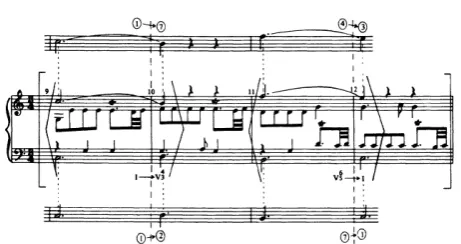
represen-tations which such datasets use, though usually well defined, aread hocand not always related to established standards. Such standards would significant improve the reusability of data and the scope for widespread testing of research results. The situation is particularly complicated for kinds of analysis which are essentially hierarchical, such as reduc-tions using Schenkerian theory [31] or that of Lerdahl and Jackendoff [19]. These are two highly influential methods of music analysis, and while they strictly cover only a small portion of analytical commentary on music, it is common to find that other analyses have a similar (though often less well developed) hierarchical aspect. Figure 1 for example, taken from [6], points out a recurring pattern in this mu-sic. It first extracts the four measures containing the pattern from the rest of the score (as indicated by the square brack-ets), and then identifies two smaller units within those four bars (indicated by the angled brackets). Across this runs an-other level of extraction which identifies two pairs of notes
4http://isophonics.net/content/ reference-annotations-beatles
5http://ddmal.music.mcgill.ca/research/ billboard
6https://github.com/craigsapp/ bach-370-chorales
Fig. 1 Example of an analytical diagram with implicit hierarchical el-ements; from Gjerdingen [6, Ex. 4-11, p.65].
in just the upper and lower voices. These are labelled with their scale degrees (1, 7, 4, 3 and 1, 2, 7, 1, indicating the first, seventh, etc., note of the scale) and arrows indicate the opposite directions of movement. Other labels are added to indicate the chord progressions of the two sub-units. There are several layers to this analysis, therefore, which align with the details of the score in different ways.
While schemes such as Humdrum7already exist which
are good for representing sequential information to be
align-ed with score information, andad hocsequential
represen-tations using an underlying scheme such as Humdrum can be easy to define and use, this is not true for representing the information in hierarchical analyses. Some datasets con-taining hierarchical musical analyses do exist (e.g., analyses in the style of Lerdahl and Jackendoff [8] and Schenkerian analyses from text books and the like [17]) but their rep-resentation schemes are idiosyncratic and not easy to asso-ciate with a representation of the music analyzed. In this pa-per we therefore propose a means of representing hierarchi-cal music-analytihierarchi-cal information, i.e., information naturally represented in trees or graphs, strongly related to a standard for representing musical scores, allowing the tight associa-tion of the analytical informaassocia-tion and the informaassocia-tion in the score.
In section 2 we discuss hierarchical analysis further, to illustrate the issues and more precisely define what we mean. In section 3 we describe some existing representations of hi-erarchical analyses before describing the required features of a standard scheme in section 4. We describe the reasons for using the Music Encoding Initiative (MEI) standard in section 5 and present our proposals for an extension to this standard for hierarchical music analyses.
2 Hierarchical analysis and representation
Hierarchies have had an important role both in musical anal-ysis and, more recently, in representations of music in tasks
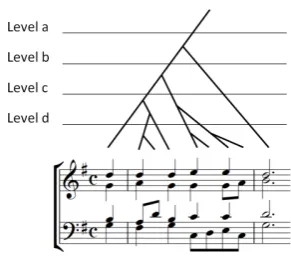
[image:3.595.303.534.84.206.2]Fig. 2 Generative theory of tonal music (GTTM) reduction at different levels
such as computer assisted composition or music information retrieval. By “hierarchical analysis” or “hierarchical resentation”, we mean an analysis or representation which pre-sents the structure of the music on different levels, in which higher levels correspond to larger spans of the music. Re-lations between different elements are shown, but only be-tween neighbouring elements, either above or below in the hierarchy, or side-to-side from one “branch” to another. An analysis which is based on the relationships of distant seg-ments of music, such as a “paradigmatic analysis” in the style of Nattiez [25], is not hierarchical according to our
def-inition.8While hierarchical analyses and representations are
often presented as trees, it is not essential for them to be so, as will become clear from the examples below.
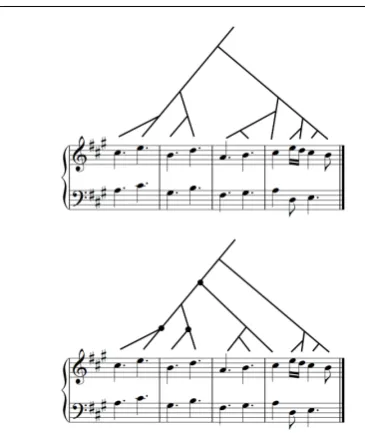
The two most famously hierarchical kinds of music anal-ysis are those of Schenker and of Lerdahl and Jackendoff. The well known Generative Theory of Tonal Music (GTTM) [19] proposes several viewpoints for analyzing tonal music based on generative linguistic theory, i.e., modeling analy-sis using formal grammars such as those used to identify the parts of speech(i.e. noun, verb, etc.) in a written sentence (see Figures 2, 10, 11, and 13). Although the theory is pre-sented as a set of rules, and the results are prepre-sented in tree diagrams, the analyses are not so systematic as this might suggest. For discussion of some of the difficulties concern-ing polyphony and uncertainties over what information is maintained from one level to the next, see [23]. Other issues are discussed in [8] which also demonstrates some of the difficulties over systematic treatment of Lerdahl and Jack-endoff’s “preference rules.”
While the analyses of Heinrich Schenker were not pre-sented in trees, levels of hierarchy are explicit, and the anal-yses can (with the loss of some information) be converted to trees, as demonstrated in [23] (see Figure 3). Further sys-tematisations of Schenkerian analysis are found in [22, 24]
8The relationships which a paradigmatic analysis shows, however,
could be represented in the form of a graph, and so representation of paradigmatic analyses might be possible within the general framework we propose here. We leave development of this possibility to future work.
(a) Schenker’s analysis of the first phrase of Mozart’s piano sonata in A, K.331 ([31], fig. 157)
(b) Tree representation derived from Schenker’s analysis
Fig. 3 Marsden’s tree representation Schenker’s analysis as proposed in [23] (figures 5 and 6).
and [17]. The latter presents an analysis not as a tree but as aMaximal outerplanar graph (MOP), a representation for Schenkerian analyses introduced by Yust [35] (see Fig-ure 16).9
Less obviously, traditional tonal-harmonic analysis of music is also hierarchical: spans of music are identified as being in a key, which are identified as subordinate to longer spans which might be goverened by a different, related, key. This is most evident in the “keyscale plots” presented by Sapp [30], whose triangular shape shows the structural sim-ilarities to the reduction trees of Lerdahl and Jackendoff (see Figure 4).
Not surprisingly, in the domain of digital music research, such as algorithmic analysis, classification, retrieval or com-position, it is common to find that hierarchical representa-tions of several kinds are used. Below, different examples are listed that illustrate the importance of this kind of rep-resentation. For automated composition, H¨ogberg et al., in
the systemWind in the willows, proposed the use of tree
transducers [12]. The same hierarchical structure type was used by Jacquemard et al. [15] for elegantly representing and transforming rhythm notation (see Figure 5). With the objective of measuring the similarity of music, “metric tree” structures were introduced by Rizo [28] (see Figure 6) and
extended withk-testables by Bernabeu et al. [1]. With the
9Yust argues that a graph better represents elaborations which
[image:4.595.85.537.66.343.2] [image:4.595.86.232.86.214.2]Fig. 4 Sapp’s keyscape plot (extracted from [30], figure 3.14)
. . .
Fig. 5 Tree rewrite sequence proposed by Jacquemard et al. [15] (fig-ure 7)
44
(a) Source melody.
s
F F
A G
G G F
F
A A
G F
r4 r4
r5 r3
r2 r6
r3
A G
r4 p=2
(b) Propagation and prunning.
Fig. 6 Rizo’s metric trees propagation and prunning [28] (figure 3.28).
same purpose, Pinto and Tagliolato [26] proposed a graph representation of melodic sequences (see Figure 7). Finally, several syntactic analysis systems have been proposed that produce parse trees such as the work by Gilbert and Con-klin [5] for melody reduction, the contribution by Bod [2] for formalizing the perception of phrase structures (see Fig-ure 8), or the syntactic perspective of simple rhythm struc-tures by Lee [18].
Fig. 7 Pinto’s graph encoding of a sequence. Figure 6 in [26]
(3 221 -5)(-533221 -5)(13335432)(13335432 )(3 221 -5 ) (a) Bracket representation for folksong K0029, ”Schlaf Kindlein feste”
S(P(N(3 )N(2)N(2)N(1 )N(-5))P(...)P(...) ... ) (b) Labeled bracket representation for (first five notes of) the structure above
S
P P P
N N N N N ... ...
3_ 2 2 1_ -5
(c) Graphical representation of parenthesized no-tation above as found in [28] (figure 3.6)
Fig. 8 Example of data used to learn Bod’s grammar in [2] (figures 7 and 8).
3 Existing hierarchical representations
Many of the approaches for hierarchical analysis and rep-resentations introduced above have points in common that could foster interesting synergies, but these are currently dif-ficult to achieve due to the different representations and en-codings of nevertheless similar concepts. A first humble at-tempt to normalize some representations was made by Rizo [28] (see figures 3.11 and 3.14 in that work) where stan-dardized tree representations were offered to model differ-ent melodic reduction strategies such as the GTTM [19] and Marsden’s elaboration trees [23]. However, no proposal for encoding datasets of this kind of tree structures was offered. Thus, the field of potentially useful standardization of many
differentad-hocencodings of similar musical-analysis and
intermediate representation remains open.
To illustrate the issues, we discuss the case of the
valu-able SCHENKER41 database of analyses by Kirlin [16]. Each
analyzed work is encoded in two files: the music itself is en-coded in a MusicXML file [7], and the analysis is enen-coded
in a text file with extension.analysis(see Figure 16).
[image:5.595.373.457.88.175.2] [image:5.595.45.280.94.231.2] [image:5.595.329.499.276.385.2] [image:5.595.51.278.285.383.2] [image:5.595.66.258.441.579.2]Fig. 9 GTTM Time-span encoding extract Hamanaka et al. [9]
the prolongation operation are described. Once the
devel-oper opens the.analysisfile, he/she has to figure out the
meaning of some of the elements not described in the paper. In [17] Kirlin says that “The text file description is more re-laxed than the MOP representation to allow for easy human
creation of analyses.” But SCHENKER41 is proposed as a
corpus for use in other music analysis applications, which means that its format must also be readable by other com-puter software.
Another notable corpus has been produced by Hamanaka et al. [9] containing 300 musical pieces analyzed using the
GTTM paradigm.10For encoding music, the MusicXML [7]
format was used. The different GTTM analyses (grouping, metrical, time-span, prolongational, and harmonic) were
en-coded using severalad-hocXML grammars (see Figure 9).
All these encodings share the same drawbacks. When music content is kept in a file different from that of the inter-mediate or analysis representation, tricks to unambiguously link analysis to music are devised that in many cases com-plicate the parsing of the format (see Figure 16). In cases where musical content and analysis is recorded in the same file, usually the original musical content is modified to ac-commodate the specifics of the representation (in Figure 6 long notes in the original score are replaced by tied shorter ones to be suitable for representation using the tree struc-ture), and, even worse, only minimal content is kept, dis-carding what the representation does not need but could be useful in the future.
The main problem that arises from having so many dif-ferent encodings comes from the fact that in order to repre-sent similar concepts different parsers have to be built with nuances that are not always cross-compatible. In the fol-lowing sections a standard encoding proposal is offered that tries to overcome these problems.
[image:6.595.319.526.82.162.2]10http://gttm.jp/gttm/
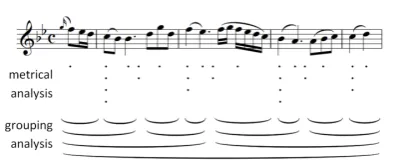
Fig. 10 Metrical and grouping analysis in GTTM style
4 Requirements of the encoding
Here we identify the requirements of a standard for the rep-resentation of hierarchical music analyses, taking into ac-count the observations of the previous sections. The encod-ing must allow linked data requirements as detailed in [34]. Analytical and musical information need to be associated, and to facilitate this it should be possible to record the anal-ysis and music in the same file. Section 2 has introduced the wide variety of kinds of analysis in use. It would be pre-sumptuous to try to cover all of these in our proposals, and in any case it is important to be open to kinds of analyses which might emerge in the future. We therefore require that the standard allow for extensions with minimal effort.
Many segmentation analyses and elaboration reductions are usually represented using nested slurs (see Figure 10). As those slurs can be represented hierarchically, tree struc-tures will be used for encoding this kind of analysis.
GTTM explicitly prohibits the crossing of branches and avoids gaps between them. Nevertheless, we do not want to exclude the possibility of future analyses which contain crossing branches or gaps, even if these are used only to illustrate the problems of such an analysis. We therefore do not make it a requirement of the standard that these kinds of branching are prohibited.
Apart from the hierarchical structure itself, one of the most important elements in the structures is the node, which can be a terminal or intermediate element of the tree or graph. It encodes most of the semantics of an analysis. The mean-ing of a node varies, dependmean-ing on the approach. Some
ex-amples are Marsden’s elaborations in Figure 3, theleftand
right branching in GTTM that denote which note is more important, or the music content embedded in Rizo’s metric trees (see Figure 6) or Pinto’s graphs (Figure 7) and Yust’s MOP (Figure 16). Sometimes the original graphical repre-sentations have to be interpreted as being node information.
In GTTM, for example, cadences11 that are represented by
using ellipse shapes that connect branches can be encoded as node labels. In any case, nodes must be able to contain both analysis information and links to the musical events referred to.
11A cadence is sequence of at least two chords helping to conclude
Fig. 11 Two different types of reductions of the same musical segment
Another essential feature of any analysis encoding is the ability to represent simultaneous alternative analyses of the same musical event or segment. Figure 11 shows different
reduction approaches12to the same extract of music. In
ad-dition to concurrent analysis, annotations must be allowed to record alternative explanations, whether originating from an analyst or generated by a computer algorithm. It is not un-common for analysts to disagree about the interpretation of a particular passage, or even for a single analyst to recognize that there are alternative interpretations. A large quantity of the literature about music analysis is concerned with the dis-cussion of such cases, so it is essential to be able to represent alternative analyses in a way which allows accurate compar-ison.
Sometimes not everything in a hierarchical tree-like rep-resentation can be strictly encoded in a tree. In some cases links are made between the branches of a tree, as proposed in [23] and implemented in [24]. The “retained cadence” concept of Lerdahl and Jackendoff (indicated in a tree by the use of an ellipse shape between two branches) can also be considered as a case of such linking. In these cases, the structure is no longer strictly a tree, but instead a graph. For-mally, the set of possible trees is a subset of the set of pos-sible graphs, so any system for representing graphs is also capable of representing trees. From this perspective, it is not necessary to have a specific mechanism for representing trees but we have chosen to retain the tree type explicitly be-cause trees have properties not found in all graphs which can facilitate efficient processing. (An example is simple branch pruning operations (see Figures 2 and 6) which are simple to perform on a tree but complex if done on a graph.) We be-lieve that the benefit of this will outweigh the complication
12A reduction is the removal of what a given analysis technique
considers as non-essential or less important notes (see Figure 13).
of dealing with the rare special cases of non-tree elements in an otherwise tree-like representation.
On the other hand, some analyses and intermediate rep-resentations require full graph encodings as previously indi-cated (Figures 7 and 16). These could be encoded as trees by unfolding the graphs and using the mechanism for rep-resenting linking between branches as mentioned above, but the semantics of the graph itself would be lost. We therefore consider it important to be able to use a graph representation when appropriate.
Finally, following the principle of encoding music and analysis together, it should be possible to record the results of analytical processes such as reductions in the same file as well. In many cases, notations such as GTTM trees im-plicitly encode the reduction in the tree. For example, a left branching implies that the content represented by the sub-tree on the right branch is more important than the content on the left branch, so the reduction can be accomplished just by pruning the left branch and retaining the notes in the right branch. However, there are situations where those reductions need to be explicitly encoded because they are not implied by the tree structure. In the case of a “fusion” branching in GTTM, for example, some notes are retained from both the left and right branch, and the representation needs to encode exactly which. In the case of a Roman-numeral analysis, the numeral and perhaps other information will need to be en-coded to represent the interpretation of the harmony in this span (see Figure 17). In other cases (e.g., in a ground-truth corpus for machine-learning purposes), it is not necessary but more useful to represent the reduction results at the node concerned.
5 Music encoding initiative customization
Several formats have been proposed to represent music in a standardized way [32]. We are aware of one other proposal for the standardization of analytical processes [13] but it has a different scope from our project and lacks the embedding of music and analysis together. The XML format named Music Encoding Initiative (MEI) [10], based on the success-ful experience of the Text Encoding Initiative (TEI) [14], is able to encode music of different notations, such as mensu-ral and common western notation, together with metadata for bibliographic cataloguing. We have chosen to use this representation as the basis for our proposal because of its wide musical scope, its sound design, and its strong support. Furthermore, it natively allows the use of linked data tech-nologies over the encoding itself.
Fig. 12 Form analysis from [20].
hierarchical. If the hierarchical analysis matches the begin-ning and ending of work divisions, voices or measures (see Figure 12), the XML structure itself could be used to encode analyses. However, this is not always the case (see Figure 1). It is therefore necessary to make use of some other mecha-nism to explicitly represent the hierarchy of the analysis and not to rely on the inherent hierarchy of the XML analysis of the music for this purpose.
The MEI initiative is conceived to accommodate any kind of musical content, for which it has been equipped with an extension and customization mechanism [10]. This de-vice enables the incorporation of our needs, taking advan-tage of all MEI infrastructures. In particular, we have reused all musical content elements from MEI and some of its anal-ysis module that will be used to encode the musical content of nodes and the results of analytical processes such as re-ductions (e.g., the bottom system in Figure 13). MEI does not have components for explicitly encoding tree or graph structures but its parent format, TEI, includes such
struc-tures in thenetmodule that we will adapt to fulfil our needs.
5.1 Semantic encoding
We stated above that one of the objectives of a representa-tion should be to preserve the knowledge embodied in an analysis. This implies that the representation should be, to some degree, “semantic.” Ideally it should be possible to determine unambiguously what the representation “means,” and analyses with different meanings should have different representations. This means that the elements of the analy-sis should not be simply those elements which represent the tree or graph structure (nodes and arcs) but that they should also make explicit the nature of the entity represented by a node or the relationship represented by an arc. In fact, this is a design principle of MEI.
However, this ideal is neither always possible nor desir-able. For one thing, the underlying analysis can be ambigu-ous, and a degree of interpretation might be required from the person reading the analysis. The encoding might over-come this by representing a particular interpretation unam-biguously. We have mentioned above that it is necessary to have a means of representing alternative analyses, and the same mechanism could represent alternative interpretations. As an example, consider the notation which Schenker some-times uses where a slur turns back on itself in a sigmoid
of the scale, and indicates a common progression13 which
Schenker always notates in this fashion (this is explained in
paragraph 56 ofDer Freie Satz[31, p. 30]). In the melody
(the upper staff), it is not clear whether the turn in the slur is simply to avoid a collision with some text above (not shown in the figure) or whether it is intended to show something meaningful about the melodic progression here (perhaps the repetition of the notes D and C sharp). Later in the same figure in the original, a parallel passage has a similar turn-ing slur in the melodic line but there is no text with which it might collide. On the other hand, in another graph
ear-lier inDer Freie Satz[31, fig. 87, no. 5], Schenker analyzes
the same melodic passage in a similar way but without slurs which turn. The evidence for whether or not this notation in the melodic line is meaningful or accidental is therefore contradictory.
Furthermore, it is sometimes desirable to process analy-ses which have different origins and which will therefore, in a fully semantic encoding, be represented according to dif-ferent semantic frameworks. For example, we might want to compare analyses in the GTTM format with Schenkerian analyses. Some of the detail will be incomparable, but the basic tree structures will be comparable and might, for ex-ample, indicate whether or not a passage is considered to be segmented in the same way. We therefore propose mecha-nisms which allows some representations to be semantic and others to be non-semantic (representing only the structure of the essential tree or graph).
5.2 Encoding examples
All requirements expressed in the section 4 have been adopt-ed into our proposal. The result is a self-containadopt-ed music and analysis format that allows both a semantic and a non-semantic encoding. As we cannot give here a comprehensive explanation of all its elements, only some representative ex-amples are offered.
As has been mentioned above, in some cases a seman-tic encoding with explicit elements only applicable to the analysis type at issue is desirable over a more general non-semantic encoding that explicitly reflects the tree or graph structure. For each analysis format, we propose two alterna-tive encodings: a semantic schema and a non-semantic one. An XSLT for converting from the semantic XML to the non-semantic structure can be easily prepared, in some cases the reverse transformation may not be possible because of ambi-guities of interpretation such as illustrated in the discussion of turning slurs above.
Fig. 13 The bottom part contains the result of the GTTM reduction depicted in the tree above
It will be the encoding author who determines which coding approach is more suitable for the objective of the en-coding.
In this section three different types of semantic encod-ings of analyses are detailed and their non-semantic equiv-alent encodings are presented. In order to express in a
com-pact way a Relax NG Comcom-pact Syntax14is used rather than
showing the complete ODD15file as used in TEI [14] and
MEI [10].
5.3 GTTM basic tree encoding
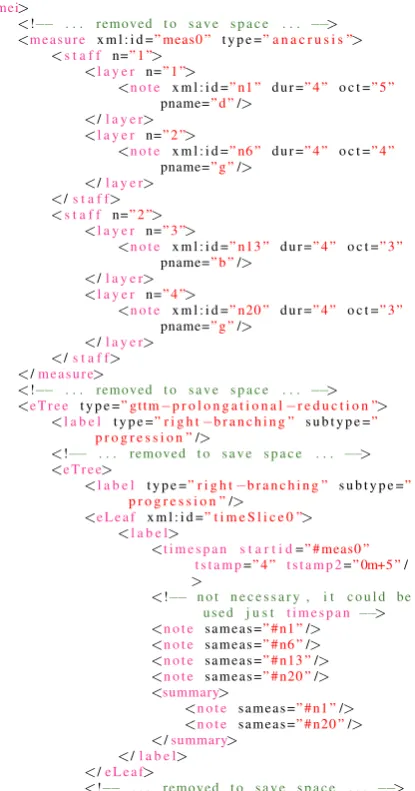
As mentioned above, we use elements from MEI’s parent, TEI, for the representation of trees and graphs. Listing 1 shows an extract of the first, incomplete measure of the GTTM reduction in Figure 13. Only essential elements for understanding the example have been kept in the XML. Both music and analysis are encoded in the same file: the music
extract is shown in the listing inside an MEI<measure>
element; the analysis is encoded using aneTreeelement,
adapted from the netmodule of TEI. Branches of the tree
are also encoded using eTree elements (since by
defini-tion branches of a tree are also trees). The leaves are
repre-sented usingeLeafelements, which formally are nodes as
well. Each node contains alabelelement which encodes
additional useful information. In the case of the leaf, for ex-ample, the alignment with the music analyzed is encoded.
14http://relaxng.org/compact-tutorial.html 15‘One Document Does it all’, a literate programming language for
XML schemas.
<mei>
<!−− . . . removed t o s a v e s p a c e . . . −−> <m e a s u r e x m l : i d =” meas0 ” t y p e =” a n a c r u s i s ”>
<s t a f f n=” 1 ”> <l a y e r n=” 1 ”>
<n o t e x m l : i d =” n1 ” d u r =” 4 ” o c t =” 5 ”
pname=” d ”/>
</l a y e r> <l a y e r n=” 2 ”>
<n o t e x m l : i d =” n6 ” d u r =” 4 ” o c t =” 4 ”
pname=” g ”/>
</l a y e r> </s t a f f> <s t a f f n=” 2 ”>
<l a y e r n=” 3 ”>
<n o t e x m l : i d =” n13 ” d u r =” 4 ” o c t =” 3 ”
pname=” b ”/>
</l a y e r> <l a y e r n=” 4 ”>
<n o t e x m l : i d =” n20 ” d u r =” 4 ” o c t =” 3 ”
pname=” g ”/>
</l a y e r> </s t a f f> </m e a s u r e>
<!−− . . . removed t o s a v e s p a c e . . . −−> <e T r e e t y p e =” g t t m−p r o l o n g a t i o n a l−r e d u c t i o n ”>
<l a b e l t y p e =” r i g h t−b r a n c h i n g ” s u b t y p e =” p r o g r e s s i o n ”/>
<!−− . . . removed t o s a v e s p a c e . . . −−> <e T r e e>
<l a b e l t y p e =” r i g h t−b r a n c h i n g ” s u b t y p e =” p r o g r e s s i o n ”/>
<e L e a f x m l : i d =” t i m e S l i c e 0 ”> <l a b e l>
<t i m e s p a n s t a r t i d=” # meas0 ”
t s t a m p=” 4 ” t s t a m p 2=” 0m+5 ”/
>
<!−− n o t n e c e s s a r y , i t c o u l d be u s e d j u s t t i m e s p a n −−> <n o t e s a m e a s =” # n1 ”/> <n o t e s a m e a s =” # n6 ”/> <n o t e s a m e a s =” # n13 ”/> <n o t e s a m e a s =” # n20 ”/> <summary>
<n o t e s a m e a s =” # n1 ”/> <n o t e s a m e a s =” # n20 ”/> </summary>
</l a b e l> </e L e a f>
<!−− . . . removed t o s a v e s p a c e . . . −−>
Listing 1 Extract of encoding of analysis in Figure 13 (first, incomplete measure)
The leaf represents a time slice which in this case spans the
measure. This time span is represented using atimespan
element introduced by us that contains attributes for
set-ting the measure the segment starts (startid) and
met-rical positions to show the beginning (tstamp) and ending
(tstamp2) of the time span following the MEI guidelines. Some other combinations of MEI attributes that unambigu-ously identify timespans or individual events have been used in other encodings. In addition, this label contains a link to the notes in the musical part of the encoding using the
sameasattribute from the analysis module andxml:id
attributes that anchor the target notes. The other parts of the
encoding add information about the analysis. Thetype
at-tribute of the root node shows that this analysis contains a
GTTM prolongation reduction, and otherlabelelements
n1 n2 n3 n4
Fig. 14 Time-span reduction with “‘fusion” branching (See [19], fig. 7.11)
represent. Finally, thesummaryelement inside the leaf
la-bel allows the product of the analysis, in this case a reduction or music summarization, to be emitted.
The content of theselabelelements andtype
attrib-utes are semantic, in the sense used above, but they are at-tached to a representation which is fundamentally not se-mantic beyond the basic tree structure which it conveys. A system using this representation would not be able to make assumptions about the presence of these elements and at-tributes, for example. In the following sections we make pro-posals for semantic encoding schemes, with examples of en-codings using both these schemes and, for the reasons stated above, equivalent representations in a non-semantic scheme.
5.3.1 GTTM Time-span reduction
Listing 2 shows an example of our proposal for the semantic encoding of GTTM time-span reduction.
Theletterattribute is used for labelling levels [19, p. 132]. The different kinds of branching (which have
differ-ent meanings [19, p. 128]), are encoded using the
branch-ingattribute whose values are described as follows: letxbe
the left tree andythe right tree, “right” value is used when
xdominatesyand “left” value whenydominatesx. In the
case of ternary branching, with subtreesx,y,z, “left” means
z dominates x and y, “right” means xdominates yand z,
and “center” is used whenydominates bothxandz. GTTM
[image:10.595.295.486.321.591.2]proposes two other branching kinds, “fusion” as shown in Figure 14, and “cadentialRetention”. In these cases, the con-tents of the reduction are not simply the concon-tents of one child or the other but a combination of their contents.
This format has been used to encode the music excerpt in Figure 14 into the XML shown in Listing 2. Note that only the analysis part of the XML is shown. An equivalent non-semantic encoding is presented in Listing 3.
5.3.2 GTTM Prolongational reduction
This is the kind of reduction introduced previously in the non-semantic encoding of example of Listing 1. The gram-mar in Listing 4 is a proposal for the semantic encoding of GTTM prolongational reduction. This kind of tree usu-ally contains two children, encoded using two successive
<e v e n t s>
<n o t e s a m e a s=” # n1 ”/> </e v e n t s>
<e v e n t s>
<n o t e s a m e a s=” # n2 ”/> </e v e n t s>
</t i m e S p a n R e d u c t i o n>
<t i m e S p a n R e d u c t i o n b r a n c h i n g=” f u s i o n ”> <e v e n t s>
<n o t e s a m e a s=” # n3 ”/> </e v e n t s>
<e v e n t s>
<n o t e s a m e a s=” # n4 ”/> </e v e n t s>
</t i m e S p a n R e d u c t i o n> </t i m e S p a n R e d u c t i o n>
<!−− removed t o s a v e s p a c e −−> </t i m e S p a n R e d u c t i o n>
Listing 2 Time-span reduction using a semantic encoding
<e T r e e t y p e =” g t t m−t i m e−s p a n−r e d u c t i o n ”> <!−− Removed t o s a v e s p a c e −−> <e T r e e>
<l a b e l t y p e =” r i g h t−b r a n c h i n g ”/> <e T r e e>
<l a b e l t y p e =” f u s i o n−b r a n c h i n g ”/> <e L e a f>
<l a b e l>
<n o t e s a m e a s =” # n1 ”/>
</l a b e l> </e L e a f> <e L e a f>
<l a b e l>
<n o t e s a m e a s =” # n2 ”/>
</l a b e l> </e L e a f> </e T r e e> <e T r e e>
<l a b e l t y p e =” f u s i o n−b r a n c h i n g ”/> <e L e a f>
<l a b e l>
<n o t e s a m e a s =” # n3 ”/>
</l a b e l> </e L e a f> <e L e a f>
<l a b e l>
<n o t e s a m e a s =” # n4 ”/>
</l a b e l> </e L e a f> </e T r e e> </e T r e e>
<!−− Removed t o s a v e s p a c e −−> </e T r e e>
Listing 3 Time-span reduction using a non-semantic encoding
prolongationalReductionelements. The
branch-ingattribute is similar to that used in the time-span
reduc-tion, but with different meaning. In this case, “right” denotes tensing motion and “left” denotes relaxing motion (see page 185 in [19]).
e l e m e n t p r o l o n g a t i o n a l R e d u c t i o n {
a t t r i b u t e b r a n c h i n g {” l e f t ” | ” r i g h t ”},
a t t r i b u t e c o n n e c t i o n K i n d {” p r o g r e s s i o n ” |
” weak ” | ” s t r o n g ” },
e l e m e n t {p r o l o n g a t i o n a l R e d u c t i o n},
e l e m e n t {p r o l o n g a t i o n a l R e d u c t i o n},
e l e m e n t r e d u c t i o n {
e l e m e n t r e d u c t i o n N o t e {
a t t r i b u t e copyOf {xml : i d} }+
}?
|
e l e m e n t e v e n t s { e l e m e n t t i m e s p a n {
a t t r i b u t e s t a r t i d {xml : i d},
a t t r i b u t e t s t a m p {xml : i d},
a t t r i b u t e t s t a m p 2 {xml : i d},
a t t r i b u t e t y p e {” r e g u l a r ” | ” a u g m e n t e d ”} }
|
e l e m e n t n o t e {
a t t r i b u t e s a m e a s {xml : i d} }+
} }
[image:11.595.41.247.482.621.2]Listing 4 GTTM Prolongational reduction semantic encoding
Fig. 15 Time-span reduction example with a “progression” and a “‘strong” branching
<p r o l o n g a t i o n a l R e d u c t i o n b r a n c h i n g=” r i g h t ”
c o n n e c t i o n K i n d=” s t r o n g ”> <e v e n t s>
<t i m e s p a n s t a r t i d=” # meas0 ” t s t a m p=” 4 ”
t s t a m p 2=” 1m+1 ”/> </e v e n t s>
<p r o l o n g a t i o n a l R e d u c t i o n b r a n c h i n g=” l e f t ”
c o n n e c t i o n K i n d=” p r o g r e s s i o n ”> <e v e n t s>
<t i m e s p a n s t a r t i d=” # meas1 ” t s t a m p=” 1 ”
t s t a m p 2=” 0m+2 ”/> </e v e n t s>
<e v e n t s>
<t i m e s p a n s t a r t i d=” # meas1 ” t s t a m p=” 2 ”
t s t a m p 2=” 0m+3 ”/> </e v e n t s>
</p r o l o n g a t i o n a l R e d u c t i o n> </p r o l o n g a t i o n a l R e d u c t i o n>
Listing 5 Prolongational reduction using a semantic encoding (see Fig. 15)
<e T r e e t y p e =” g t t m−p r o l o n g a t i o n a l−r e d u c t i o n ”> <l a b e l t y p e =” r i g h t−b r a c h i n g ” s u b t y p e =” s t r o n g ”/> <e L e a f>
<l a b e l>
<t i m e s p a n s t a r t i d=” # meas0 ” t s t a m p=” 4 ”
t s t a m p 2=” 1m+1 ”/> </l a b e l>
</e L e a f>
<e T r e e>
<l a b e l t y p e =” l e f t−b r a c h i n g ” s u b t y p e =” p r o g r e s s i o n ”/>
<e L e a f> <l a b e l>
<t i m e s p a n s t a r t i d=” # meas1 ” t s t a m p=” 1 ” t s t a m p 2=” 0m+2 ”/>
</l a b e l> </e L e a f> <e L e a f>
<l a b e l>
<t i m e s p a n s t a r t i d=” # meas1 ” t s t a m p=” 2 ” t s t a m p 2=” 0m+3 ”/>
</l a b e l> </e L e a f> </e T r e e> </e T r e e>
Listing 6 Prolongational reduction using a non-semantic encoding (see Fig. 15)
5.3.3 MOP graph encoding
Another example, this time encoding a graph (from Fig-ure 16), is shown in Listing 7. The same principles hold for encoding the music content. Now the structural elements of
the analysis, all of them adapted from thenetmodule of the
TEI format, are thegraph,node, andarcelements. The
nodeencoding follows the same principles as theeLeaf
in the case of trees. Thearcrepresent the edges between
nodes and contain the semantics of the edge, in this case the
type of MOP elaboration, in thelabelelement.
(a) Melodic sequence with note identifiers.
D G
B
C F#
(b) MOP representation of this music.
1d5-1 (1c5-1) 1b4-1 (1f#4-1) 2g4-1 1d5-1 (1b4-1) 2g4-1
[image:11.595.307.526.520.705.2](c) An encoding of this MOP representation.
<l a y e r n=” 1 ”>
<n o t e x m l : i d =” n1 ” d u r =” 4 ” l a y e r=” 1 ”
o c t =” 5 ” pname=” d ”/>
<n o t e x m l : i d =” n2 ” d u r =” 4 ” l a y e r=” 1 ”
o c t =” 5 ” pname=” c ”/>
<n o t e x m l : i d =” n3 ” d u r =” 4 ” l a y e r=” 1 ”
o c t =” 4 ” pname=” b ”/>
<n o t e x m l : i d =” n4 ” d u r =” 4 ” l a y e r=” 1 ”
o c t =” 4 ” pname=” f ” a c c i d =” s ”/>
</l a y e r> </s t a f f>
<!−− . . . removed t o s a v e s p a c e . . . −−> </m e a s u r e>
<!−− . . . removed t o s a v e s p a c e . . . −−> <g r a p h t y p e =”MOP”>
<n o d e x m l : i d =”vD”> <!−− v = v e r t e x −−> <l a b e l>
<n o t e s a m e a s =” # n1 ”/> </l a b e l>
</n o d e>
<n o d e x m l : i d =”vC”> <l a b e l>
<n o t e s a m e a s =” # n2 ”/> </l a b e l>
</n o d e>
<n o d e x m l : i d =”vB”> <l a b e l>
<n o t e s a m e a s =” # n3 ”/> </l a b e l>
</n o d e>
<a r c f r o m=”vD” t o=”vC”>
<l a b e l t y p e =” e l a b o r a t i o n ” s u b t y p e =” e l a b o r a t e d N o d e ” v a l u e =”vC”/> </a r c>
<a r c f r o m=”vB” t o=”vC”>
<l a b e l t y p e =” e l a b o r a t i o n ” s u b t y p e =” e l a b o r a t e d N o d e ” v a l u e =”vC”/> </a r c>
<!−− . . . removed t o s a v e s p a c e . . . −−>
Listing 7 Extract of encoding of Figure 16 (first three notes)
MOP structures can be semantically encoded following the grammar in Listing 8. Using it, the example shown above in Figure 16 that was non-semantically encoded in Listing 7, is codified semantically as shown in Listing 9 (only the anal-ysis content is shown to save space).
5.3.4 Roman-numeral analysis
A tonal analysis of a work decomposes a work into tonal regions with a key and in turn divides each one into chords with some tonal function assigned, establishing the melodic function of each note in the context of the underlying har-mony. While this kind of analysis is not usually represented
e l e m e n t mop {
e l e m e n t e l a b o r a t i o n { a t t r i b u t e f r o m {xml : i d},
a t t r i b u t e t o {xml : i d},
a t t r i b u t e p r o l o n g a t i o n {xml : i d} }+
}
Listing 8 MOP semantic encoding.xml:idis a MEI attribute that references a MEI element
nF ”/>
<e l a b o r a t i o n f r o m =” #nD” t o =” #nG” p r o l o n g a t i o n =” #nB”/>
</mop>
Listing 9 Semantic encoding of Figure 16
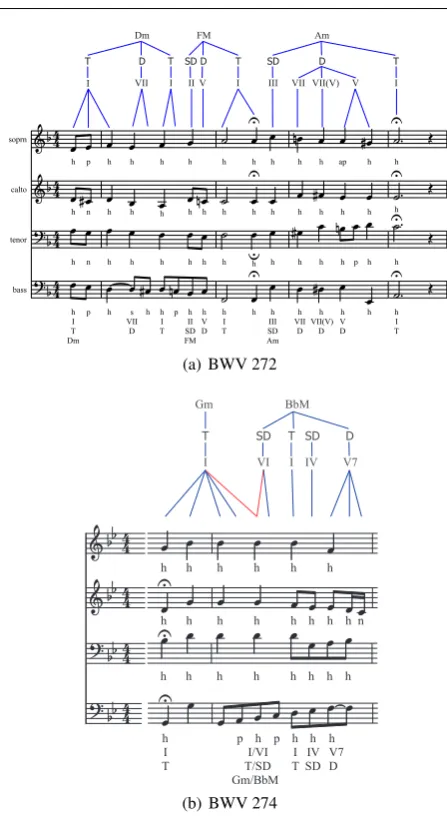
in a hierarchical manner, it can, as in many other cases, be expressed as a tree-like structure. Figure 17(a) shows an example. The melodic analysis can be encoded using the
@mfuncattribute from the MEI format. The tree perfectly reflects the nature of the key, tonal function, degree hierar-chy. The only case in which the resulting structure is not strictly a tree can be found in the pivot chords that belong at the same time to the two different branches encoding a
modulation,16 the first branch representing the source key
and the second branch defining the target key. In this case, the tree leaf that encodes the pivot chord has two parents, the left one belongs to the hierarchy of the source key and the right parent that corresponds to the hierarchy of the target key (see Figure 17(b)).
This structure can be encoded both semantically and non-semantically using the same approach used in the exam-ples of GTTM and MOP introduced above. The encoding of pivot chords is performed as a strict tree where the labels of both leaves point to the same event, the one containing the pivot chord.
6 Conclusions
If format standards did not exist digital libraries would not be possible, and all possible research based on data and its further application to methods useful for society. This condi-tion, while obvious, is not always met. There are formats for encoding music content, either notated or played, metadata describing content or the source of music documents, and some standards allowing the encoding of critical apparatus. However, few standards exists yet for the encoding of the analysis of musical works. It seems that in the near future, methods in digital musicology will not only require dard formats to encode music and metadata, but also stan-dard representations of the output of analytical processes, both as a means for sharing results and as an intermediate step for building more complex systems that have as input the yield of music analysis methods.
In this work we have introduced a proposal for a stan-dard for the encoding of hierarchical analyses and interme-diate representations of music that fulfils these needs.
I VII I II V I III VII VII(V) V I
T D T SD D T SD D T
Dm FM Am
(a) BWV 272
T h
h
h I h
h h
h h
h
h
T/SD h
h
h
h I/VI
Gm/BbM
p h
h
h
IV SD h I T
h
h h
h
h V7 D
44 4
p h
h hn
h
4 44 44
VI I I IV V7
SD T
T SD D
BbM Gm
[image:13.595.46.270.76.486.2](b) BWV 274
Fig. 17 The Roman-numeral analysis below the system can be en-coded in the form of a tree. Extracts from two Bach chorales.
Our proposal has recently been presented at the Music Encoding Initiative Conference 2016 in Montr´eal and Digi-tal Libraries for Musicology 2016. This paper substantially extends the text in the proceedings of that conference [29], including more examples and introducing semantic encod-ings. Our encoding proposals are under continual develop-ment and are being steadily improved and the final eledevelop-ments and attributes may slightly change in the near future. Never-theless, the core idea and principles are expected to be main-tained.
Complete details, examples, and the customization files
and grammars can be found online and updated athttp:
//grfia.dlsi.ua.es/cm/worklines/mei-ha.
Acknowledgements We would like to thank Eleanor Selfridge-Field, Don Byrd, Tom Collins, and Phillip Kirlin for contributions during the MEC 2016 and DLfM 2016 conferences which have informed this
work, and to thank Ichiro Fujinaga and Perry Roland for their encour-agement to continue it.
References
1. Jos´e F. Bernabeu, Jorge Calera-Rubio, Jos´e M. I˜nesta, and David Rizo. Melodic Identification Using
Proba-bilistic Tree Automata.Journal of New Music Research,
40(2):93–103, June 2011.
2. Rens Bod. A General Parsing Model for Music and
Language. Music and Artificial Intelligence, pages 77–
90, 2002.
3. John Ashley Burgoyne, Jonathan Wild, and Ichiro Fuji-naga. An expert ground truth set for audio chord
recog-nition and music analysis. InProceedings of the 12th
International Society for Music Information Retrieval Conference, Miami, Florida, USA, 2011, pages 633–38, 2011.
4. Gy¨orgy Fazekas, Yves Raimond, Kurt Jacobson, and Mark Sandler. An overview of semantic web
activi-ties in the omras2 project. Journal of New Music
Re-search, 39(4):295–311, 2010. doi: 10.1080/09298215. 2010.536555.
5. ´Edouard Gilbert and Darrell Conklin. A probabilistic
context-free grammar for melodic reduction.
Interna-tional Workshop on Artificial Intelligence and Music at IJCAI-07. Twentieth International Joint Conference on Artificial Intelligence, Hyderabad, India, 2007.
6. Robert O. Gjerdingen.A Classic Turn of Phrase: Music
and the Psychology of Convention. University of Penn-sylvania Press, Philadelphia, 1988.
7. Michael Good and Geri Actor. Using
Mu-sicXML for file interchange. Web Delivering of
Music, International Conference on, 0:153, 2003. doi: http://doi.ieeecomputersociety.org/10.1109/WDM. 2003.1233890.
8. Masatoshi Hamanaka, Keiji Hirata, and Satoshi Tojo. Implementing “A Generative Theory of Tonal Music”. Journal of New Music Research, 35(4):249–277, De-cember 2006.
9. Masatoshi Hamanaka, Keiji Hirata, and Satoshi Tojo. Musical Structural Analysis Database Based on GTTM. In Proceedings of the 15th International Society for Music Information Retrieval Conference, ISMIR 2014, Taipei, Taiwan, October 27-31, 2014, pages 325–330, 2014.
10. Andrew Hankinson, Perry Roland, and Ichiro Fuji-naga. The Music Encoding Initiative as a
Document-Encoding Framework.ISMIR, 2011.
11. Christopher Harte, Mark Sandler, Samer Abdallah, and
Emilia G´omez. Symbolic representation of musical
chords: A proposed syntax for text annotations. In
Music by Means of Tree Transducers. InCIAA, pages 153–162, 2005.
13. Eric J. Humphrey, Justin Salamon, Oriol Nieto, Jon Forsyth, Rachel M. Bittner, and Juan Pablo Bello. JAMS: A JSON Annotated Music Specification for
Re-producible MIR Research. InProceedings of the 15th
International Society for Music Information Retrieval Conference, ISMIR 2014, Taipei, Taiwan, October 27-31, 2014, pages 591–596, 2014.
14. Nancy M. Ide and C. M. Sperberg-McQueen. The TEI:
History, goals, and future. Computers and the
Humani-ties, 29(1):5–15, 1995.
15. Florent Jacquemard, Pierre Donat-Bouillud, and Jean
Bresson. A Structural Theory of Rhythm Notation
Based on Tree Representations and Term Rewriting. In Advances in Artificial Intelligence, pages 3–15. Springer International Publishing, Cham, June 2015. 16. Phillip B. Kirlin. A data set for computational
stud-ies of Schenkerian analysis. InProceedings of the 15th
International Society for Music Information Retrieval Conference, ISMIR 2014, Taipei, Taiwan, October 27-31, 2014, pages 213–218, 2014.
17. Phillip B. Kirlin. A probabilistic model of hierarchical
music analysis. PhD thesis, University of Massachusetts Amhers, Massachusetts, 2014.
18. C. S. Lee. The rhythmic interpretation of simple musi-cal sequences: Towards a perceptual model. In R. West,
P. Howell, and I. Cross, editors, Musical Structure
and Cognition, pages 53–69. Academic Press, London, 1985.
19. Fred Lerdahl and Ray Jackendoff.A Generative Theory
of Tonal Music. MIT Press, 1983.
20. Christiane Linster. On analyzing and representing mu-sical rhythm. In Mira Balaban, Kemal Ebcio˘glu, and
Otto Laske, editors,Understanding music with AI:
per-spectives on music cognition, pages 414–427. AAAI Press/MIT Press, Menlo Park, California, USA, 1992. 21. Pasquale Lisena, Konstantin Todorov, C´ecile Cecconi,
Franc¸oise Leresche, Isabelle Canno, Fr´ed´eric Puyrenier, Martine Voisin, Thierry Le Meur, and Rapha¨el Troncy.
Controlled vocabularies for music metadata. In
Pro-ceedings of the 19th ISMIR Conference, Paris, France, September 23-27, 2018, pages 424–430, 2018.
22. Alan Marsden. Representing Melodic Patterns as
Net-works of Elaborations.Computers and the Humanities,
35(1):37–54, 2001.
23. Alan Marsden. Generative structural representation of
tonal music. Journal of New Music Research, 34(4):
409–428, December 2005.
25. Jean-Jacques Nattiez. Fondements d’une s´emiologie de
la musique. Union G´en´erale d’ ´Editions, 1975.
26. Alberto Pinto and Paolo Tagliolato. A generalized
graph-spectral approach to melodic modeling and
re-trieval. InMIR ’08: Proceeding of the 1st ACM
interna-tional conference on Multimedia information retrieval, pages 89–96, New York, NY, USA, 2008. ACM. 27. Sabbir Rashid, Deborah L. McGuinness, and David
De Roure. A Music Theory Ontology. InInternational
Workshop on Semantic Applications for Audio and Mu-sic - ISWC, Monterey, Califormia, 2018.
28. David Rizo.Symbolic music comparison with tree data
structures. PhD thesis, Universidad de Alicante, 2010. 29. David Rizo and Alan Marsden. A standard format
pro-posal for hierarchical analyses and representations. In Proceedings of the 3rd International workshop on Dig-ital Libraries for Musicology, pages 25–32, New York, New York, USA, 2016. ACM Press.
30. Craig Stuart Sapp.Computational methods for the
anal-ysis of musical structure. PhD thesis, Stanford Univer-sity, 2011.
31. Heinrich Schenker.Free Composition (Der Freie Satz).
Longman, 1979 (1935).
32. Eleanor Selfridge-Field. Beyond MIDI: The handbook
of musical codes. Beyond MIDI: The handbook of musical codes. MIT Press, Cambridge, Massachusetts, USA, 1997.
33. Giorgio Uboldi and Giorgio Caviglia. Information
Vi-sualizations and Interfaces in the Humanities. InNew
Challenges for Data Design, pages 207–218. Springer London, London, December 2014.
34. David M. Weigl, David Lewis, Tim Crawford, Ian
Knopke, and Kevin R. Page. On providing
se-mantic alignment and unified access to music
li-brary metadata. International Journal on Digital
Li-braries, Aug 2017. ISSN 1432–1300. doi: 10.1007/
s00799-017-0223-9. URLhttps://doi.org/10.
1007/s00799-017-0223-9.
35. Jason Yust. The Geometry of Melodic, Harmonic, and
Metrical Hierarchy. InMathematics and Computation
![Fig. 4 Sapp’s keyscape plot (extracted from [30], figure 3.14)](https://thumb-us.123doks.com/thumbv2/123dok_us/9305503.432146/5.595.51.278.285.383/fig-sapp-s-keyscape-plot-extracted-gure.webp)
![Fig. 12 Form analysis from [20].](https://thumb-us.123doks.com/thumbv2/123dok_us/9305503.432146/8.595.40.283.81.144/fig-form-analysis-from.webp)
![Fig. 14 Time-span reduction with “‘fusion” branching (See [19], fig.7.11)](https://thumb-us.123doks.com/thumbv2/123dok_us/9305503.432146/10.595.295.493.95.268/fig-time-span-reduction-fusion-branching-g.webp)
![Fig. 16 MOP encoding as found in SCHENKER41 dataset (figures ex-tracted from [16], figures 1, 3, and 2).](https://thumb-us.123doks.com/thumbv2/123dok_us/9305503.432146/11.595.307.526.520.705/fig-mop-encoding-schenker-dataset-gures-tracted-gures.webp)