ISSN Online: 2327-509X ISSN Print: 2327-5081
DOI: 10.4236/jbm.2018.65002 May 21, 2018 9 Journal of Biosciences and Medicines
Expression Analysis of MiR-124 in
Experimental Cerebral Hypoperfusion
Tang Li
1, Huizi Lei
2, Linhui Wang
2, Yu Li
2*1Department of Pathophysiology, Chongqing Medical University, Chongqing, China
2Department of Pathology, Institute of Neuroscience, Chongqing Medical University, Chongqing, China
Abstract
MicroRNAs (miRNAs) are small noncoding single-stranded RNA molecules that act as negative regulators of gene expression and modulate the stability and/or the translational efficiency of target messenger RNAs. Studies have shown that miRNAs control diverse aspects of brain disease. In this study, the expression of miR-124 was investigated to explore the possible impacts of them on cerebral hypoperfusion. The model of aging rats with cerebral hypo-perfusion was established by permanent occlusion of bilateral common caro-tid arteries (2VO). The expression of miR-124 was determined by real-time PCR. Cell cycle analysis was performed by fluorescence-activated cell sorting (FACS). Results showed that compared with control group, the expression of miR-124 decreased at early stage after operation in 2VO rats, the lowest level appeared on day 7 (p < 0.05). Then the expression of miR-124 increased slightly on day 14. Overexpression of miR-124 in SH-SY5Y cell exposed to oxygen and glucose deprivation (OGD) induced cell cycle arrested in G1 phase. MiR-124 is potentially involved in cerebral hypoperfusion progression which may provide a novel therapeutic strategy for treatment of cerebral hy-poperfusion.
Keywords
MiRNA-124, Cerebral Hypoperfusion, 2VO, OGD
1. Introduction
MicroRNAs (miRNAs) are 20- to 22-nucleotide RNAs that regulate the expres-sion of multiple target genes by repressing translation and inducing mRNA de-gradations through binding to the 3' untranslated region (UTR) of target genes [1]. Negative regulation of gene expression by miRNAs occurs in a variety of bi-How to cite this paper: Li, T., Lei, H.Z.,
Wang, L.H. and Li, Y. (2018) Expression Analysis of MiR-124 in Experimental Ce-rebral Hypoperfusion. Journal of Bios-ciences and Medicines, 6, 9-14.
https://doi.org/10.4236/jbm.2018.65002
DOI: 10.4236/jbm.2018.65002 10 Journal of Biosciences and Medicines ological processes including differentiation, morphogenesis, proliferation and apoptosis. However, recent researches have also found that this regulation may be a positive activation [2]. MiR-124 (also called miR-124a) is the most abun-dant miRNAs in the brain. It is considered neuron specific because it is not ex-pressed by astrocytes. Studies have shown that miRNA plays an important role in the development of ischemic brain injury [3]. In this study, the change of miR-124 expression and its role in cell cycle were observed in experimental ce-rebral hypoperfusion. The correlations were investigated to clarify the potential target for cerebral hypoperfusion treatment.
2. Materials and Methods
2.1. Animals
Fifty 12-month-old ageing male Sprague-Dawley rats (450 to 500 g) were ob-tained from the laboratory animal center of Chongqing Medical University (Animal license: No. SCXK 07-0001). Their use was approved by the Animal Ethics Committee of Chongqing Medical University.
2.2. Experimental Design
The model of ageing rats with cerebral hypoperfusion was established by per-manent occlusion of bilateral common carotid arteries (2VO). In brief, after in-duction of anesthesia with chloral hydrate (350 mg/kg, intraperitoneal (i.p.)), both common carotid arteries were exposed through a midline ventral incision and permanently ligated with silk suture. The surgical wound was then sutured. After operation, alive rats were randomly divided into 2VO group (1.7, 14, 21 and 28 days after operation). The sham-operation group underwent an identical procedure without ligation of the bilateral common carotid arteries.
2.3. Determination of Cerebral Cortex Blood Flow
Rats were sacrificed and the brain was taken out completely. Image Launcher Software 1.4 Software was used to analyze brain tissue images of rats, and the changes of cerebral cortex blood flow were analyzed.
2.4. Hematoxylin-Eosin (HE) Staining
The brain was fixed with 4% PFA, dehydrated and embedded in paraffin. Two-micrometer frozen sections were prepared, and HE staining was performed to assess pathological changes in the CA1 regions of hippocampal tissue by light microscopy.
DOI: 10.4236/jbm.2018.65002 11 Journal of Biosciences and Medicines with default parameters. U6 RNA was used as the internal reference.
2.6. Cell Cycle Analysis
SH-SY5Y cells transfected with pre-miR-124 by lipidosome to overexpress miR-124. SH-SY5Y-miR-124 cells and control cells were seeded in 6 well plate and cultured 24 h. After that, cells were washed with PBS twice. Oxygen and glucose deprivation (OGD) was induced by incubating the cells for 30 min in a
glucose and serum-free DMEM medium equilibrated with a 94.5% N2/0.5%
O2/5% CO2 atmosphere at 37˚C. Control group was cultured with DMEM
con-taining glucose and 10% FBS. Cells were harvested,fixed with ice-cold 70% (v/v)
ethanol and stored at 4˚C overnight. Fixed cells were washed and resuspended in PBS and incubated with 20 μg/mL RNase A and 12 μl 10 × PI at 4˚C for 30 min. PI staining was measured at 488 nm with a FACScalibur flow cytometer.
2.7. Statistical Analysis
All data analyses were conducted using SPSS17.0. Statistical comparisons were performed using the Student’s t-test. The differences between groups were eva-luated using one-way ANOVA, with P < 0.05 being considered significant.
3. Results
3.1. Cerebral Blood Flow Altered in 2VO Rats
Compared with the sham-operation group, the blood flow in the cerebral cortex of 2VO rats altered significantly. The blood supply in the temporal region of the cerebral cortex decreased on day 7 and 14 after operation, and reached to the lowest level (42%) on day 14 (P < 0.05). Regenerated branch vessels formed in brain cortex on day 21 and day 28, the blood supply increased but did not re-cover. The blood supply reached to control group level (96%) on day 28 after operation.
3.2. Expression of miR-124 in Ischemic Hippocampal Area
Decreased in 2VO Rats
DOI: 10.4236/jbm.2018.65002 12 Journal of Biosciences and Medicines
3.3. Morphological Changes of Brain Tissue in 2VO Rats
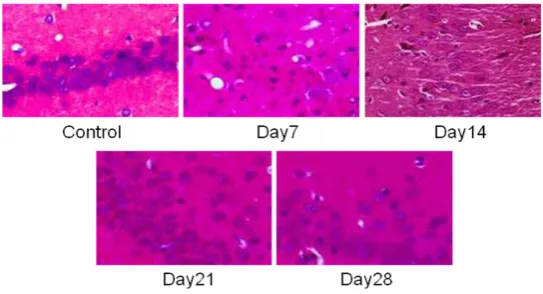
Due to cerebral hypoperfusion, pyramid neuron degenerated and lost in CA1 area on day 7 after operation, and several red neurons could be seen on day 14 after operation. The ischemic injury of the pyramidal neurons improved gradu-ally on day 21 and 28 after operation, but did not restored completely (Figure 1).
3.4. Overexpression of miR-124 Arrested Cell Cycle of SH-SY5Y
Cells
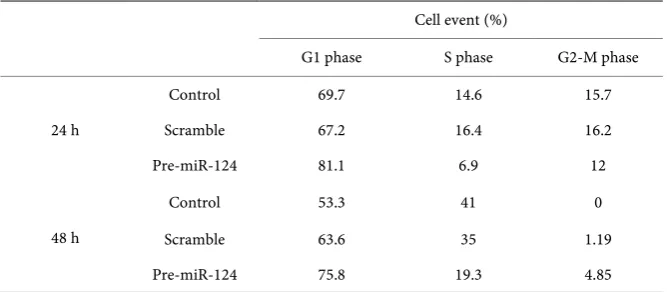
The analogue of miR-124 was transfected in SH-SY5Y cells and OGD was in-duced. The results showed that overexpression of miR-124 arrested cell cycle in G1 phase. After exposed to OGD for 24 h and 48 h, SH-SY5Y-miR-124 cells in G1 phase increased 14% and 16%, respectively (p < 0.05) (Table 1).
4. Discussion
MicroRNAs (miRNAs) are small non-coding RNAs that negatively regulate gene expression at the post-transcriptional level [4]. They are involved in important biological processes including development, homeostasis, and ageing. It is now evident that miRNAs are able to regulate the expression of at least one third of the human genome and play a critical role in a variety of normal biological processes, including cell differentiation, apoptosis, development, and metabol-ism. MiR-124 is the most abundant miRNAs expressed in the brain, it is enriched in the CNS with more than 100 times higher than that in other organs and accounting for more than a quarter of all brain miRs [5]. It is considered neuron specific because it is not expressed by astrocytes. The levels of miR-124 increase over time in the developing brain [6]. MiR-124 has been shown to play a key role in neuronal differentiation and neurogenesis [7]. The present in vivo studies revealed continuously downregulation of miR-124 in the hippocampus from acute to chronic phase of hypoxia as well as under Aβ insult. However, few scholars have studied the role of miR-124 in cerebral ischemia.
[image:4.595.236.508.547.694.2]Permanent bilateral common carotid artery occlusion or two-vessel occlusion (2VO) model is a classic model of cerebral hypoperfusion, and closely
DOI: 10.4236/jbm.2018.65002 13 Journal of Biosciences and Medicines Table 1. Overexpression of miR-124 arrested cell cycle in SH-SY5Y cells.
Cell event (%)
G1 phase S phase G2-M phase
24 h
Control 69.7 14.6 15.7
Scramble 67.2 16.4 16.2
Pre-miR-124 81.1 6.9 12
48 h
Control 53.3 41 0
Scramble 63.6 35 1.19
Pre-miR-124 75.8 19.3 4.85
related with vascular dementia and Alzheimer’s disease. In our study we found that there was a dynamic change of cerebral blood flow from decrease to in-crease in 2VO rats. The expression of miR-124 also showed this dynamic change, and the expression of miR-124 decreased to the lowest level on day 7 af-ter operation (p < 0.05). Due to the significant changes of miR-124 expression in the ischemic hippocampal area, we further explored the possible biological signi-ficance of it in sustained cerebral ischemia. It is evident that miR-124 played an important role in cell proliferation, oxygen-glucose deprivation is a commonly used model to mimic an ischemic milieu in vitro. So we established OGD model and transfected plasmid in SH-SY5Y cell to overexpress miR-124. The results showed that overexpress of miR-124 could arrest SH-SY5Y cell in G1 phase. It indicated that the decreased expression level of miR-124 might promote the cell cycle progression, thus played a neuroprotective role in the acute phase of ischemic brain injury.
DOI: 10.4236/jbm.2018.65002 14 Journal of Biosciences and Medicines
References
[1] Ullah, S., John, P. and Bhatti, A. (2014) MicroRNAs with a Role in Gene Regulation and in Human Diseases. Mol Biol Rep, 41, 225-232.
https://doi.org/10.1007/s11033-013-2855-1
[2] Chan, S.H., Wu, C.W., Li, A.F., et al. (2008) miR-21 microRNA Expression in Hu-man Gastric Carcinomas and Its Clinical Association. Anticancer Res, 28, 907-911. [3] Jung, H.J. and Suh, Y. (2014) Circulating miRNAs in Ageing and Ageing-Related
Diseases. J Genet Genomics, 41, 465-472. https://doi.org/10.1016/j.jgg.2014.07.003 [4] Bartel, D.P. (2004) MicroRNAs: Genomics, Biogenesis, Mechanism, and Function.
Cell, 116, 281-297.https://doi.org/10.1016/S0092-8674(04)00045-5
[5] Krichevsky, A.M., King, K.S., Donahue, C.P., et al. (2003) A microRNA Array Re-veals Extensive Regulation of microRNAs during Brain Development. RNA, 9, 1274-1281. https://doi.org/10.1261/rna.5980303
[6] Makeyev, E.V., Zhang, J., Carrasco, M.A., et al. (2007) The MicroRNA miR-124 Promotes Neuronal Differentiation by Triggering Brain-Specific Alternative pre-mRNA Splicing. Mol Cell, 27, 435-448.
https://doi.org/10.1016/j.molcel.2007.07.015
[7] Yoo, A.S., Sun, A.X., Li, L., et al. (2011) MicroRNA-Mediated Conversion of Human Fibroblasts to Neurons. Nature, 476, 228-231. https://doi.org/10.1038/nature10323 [8] Sun, Y., Gui, H., Li, Q., et al. (2013) MicroRNA-124 Protects Neurons against
Apoptosis in Cerebral Ischemic Stroke. CNS Neurosci Ther, 19, 813-819.
https://doi.org/10.1111/cns.12142
[9] Liu, X., Li, F., Zhao, S., et al. (2013) MicroRNA-124-Mediated Regulation of Inhibi-tory Member of Apoptosis-Stimulating Protein of p53 Family in Experimental Stroke. Stroke, 44, 1973-1980.https://doi.org/10.1161/STROKEAHA.111.000613 [10]Zhu, F., Liu, J.L., Li, J.P., et al. (2013) Microrna-124 (mir-124) Regulates ku70
Ex-pression and Is Correlated with Neuronal Death Induced by Ischemia/Reperfusion. J Mol Neurosci, 52, 148-155.https://doi.org/10.1007/s12031-013-0155-9
[11]Doeppner, T.R., Doehring, M., Bretschneider, E., et al. (2013) MicroRNA-124 Pro-tects against Focal Cerebral Ischemia via Mechanisms Involving Usp14-Dependent REST Degradation. Acta Neuropathol, 126, 251-265.