Can Automated Homes be used as Assistants for
Elderly?
Aneela Mazhar
12031719-009 Department of Computer Sci.
University of Gujrat Pakistan
Irfan Hussain
13031756-019 Department of Computer Sci.
University of Gujrat Pakistan
Abdul Manan
13031756-018 Department of Computer Sci.
University of Gujrat Pakistan
ABSTRACT
World Elderly population is rising day by day, which increases demand for healthcare and number of caregivers. Ambient assisted livings is an emerging field(AAL) aimed at making Elderly and physically challenged people’s life self-sufficient, safe and independent. Due to progresses in technology our surroundings are being automated. These may include homes, hospitals, factories and transportation. Ambient Assisted Environments for elder people monitor their daily activities to detect any abnormal or abrupt behavior. Any anomaly detected can be then sent to the concerned person who can be physician or family member of the elderly. As Ambient is a diverse field having a lot of technologies and application areas. Activity monitoring can be specified to a certain specific activity e.g. Fall detection and monitoring Vital Signs. This paper specifically focuses on smart home projects of Ambient Assisted Livings for elderly people monitoring overall daily activities. Out of two Ambient Technologies aspects providing support for indoor and outdoor activities of aged people this paper is focused on indoor smart environments. The prime objective of this paper is to analyze different researches being done in Ambient Assisted Livings (AAL) used for home automation or building smart homes. A comparative study of various AAL environments is followed by a discussion on issues linked with AAL. Along with the analysis of issues and challenges associated with these, a roadmap is also provided for the researchers for knowledge acquisition bout AAL systems.
General Terms
Ambient Technologies, Security, Care giver, AmI
Keywords
Activity Recognition, Anomaly Detection, AAL, Sensors, Smart Homes
1.
INTRODUCTION
Ambient Assisted Livings is a multidisciplinary and rapidly developing field [1].A generalized purpose of AAL is to deal with information and communication technologies, services and systems to cater needs of increasing older population. Due to tremendous technological development and multidisciplinary nature it is difficult to precisely define AAL [2].One of its contributing fields include Ambient Intelligence [3, 4, and 5]. Ambient Intelligence envisions that technology will turn out to be unseen, fixed in our natural environs, available whenever needed [1, 15]. Due to huge scientific and technological progress in the fields of HCI, AI, Sensors and networks a new term AmI has been originated [4]. AmI is a vast field having a lot of application areas but more specifically AmI systems are used to enhance life quality of aged people and those having some disabilities either physical or mental [1,4,15].
The application of AmI dealing with elder health by building smart environments is called Ambient Assisted Livings (AAL).AAL systems have a huge impact on the lives of elder people depending on others or having certain health issues [6]. One of the aims of AAL for healthcare is to reduce burden on hospitals by monitoring patients at their homes and providing them a better independent life [3, 7]. As population of adult is increasing the ratio of dependent people has also risen. Increased age could have issues like deafness, Heart diseases, Parkinson’s disease, Alzheimer‘s disease, inability to move etc. Along with other technologies of AAL Smart Homes can be one of the solutions to these problems of elderly [5]. Technological developments in field of sensors and actuators have made it possible to record and analyze actions of adults to provide them care [8]. Other than providing care to older adults AAL systems provide interaction with friends and family to enhance the quality of care [9].
According to the EU roadmap, AAL is further divided into sub classes as AAL for person, AAL for community, AAL at work AAL [4, 10]. AAL systems use interconnected technologies for data exchange like medical sensors, wireless sensor and actuator networks (WSANs), computer hardware, computer-networks, software applications, and databases. The collected data is send to health monitoring systems and concerned persons which include physician and caregiver [10, 11].
The objective of this article is to provide a comparative
study of the AAL projects and to highlight issues and challenges associated with ALL systems. Furthermore some more important aspects of AAL systems will be reviewed including design methodologies, specific features of AAL system, advantages and limitations.2.
COMPARATIVE ANALYSIS OF
TECHNIQUES
In this section, working, performance criteria of different methods will be analyzed. AAL projects selected for discussion in this paper are on the basis of their popularity. Various Ambient Assisted environments used in recent few years are discussed briefly as below
2.1
Ambient Assisted Living for All
(AAL4AAL)
35 Doctors and nurses fall under category of formal care givers.
Friends and Family members are informal caregivers. As both formal and informal caregivers have important roles in AAL systems. So both types of caregivers have different requirements based on different technological advancement. At the same time certain challenges are also associated with caregivers. So the AAL4AAL has considered different caregivers perspectives and economy with UserAcces platform. The smart environment designed by [12] has capability to generate automated warnings, manages events and monitor environment. One Most distinguished feature of [12] is the UserAcces platform accessible in android based mobiles and web page formats. The information produced by AAL4AAL platform (a sensor warning or calendar update) is sent to the Information integration segment in UserAcces platform. AAL4AAL has different Modules. The Reasoning module is agent based module of the platform. The Reasoning module is still undergoing several developments.
2.2
SOPRANO
The approach of [13] is based on a combination of and service-oriented device architecture. The basic components of the system are Semantic service layer, the context manager, the composer and the procedural manager.
The SOPRANO ontology provides a common interconnected vocabulary on different layers. The lowest level provides a vocabulary for the semantic description and state of all supported devices. The high-level ontology defines a vocabulary centered on the environment of the Assisted Person. The service-oriented infrastructure is highly extensible where new system components can easily be added. For Communication purpose [13] used a new technology called as “The open-service gateway initiative” (OSGi). The most sticking feature of OSGi is operational reliability, remote access, inter-component communication and the complete service lifecycle. The OSGi service registry constitutes the most basic layer of the architecture. New agents can easily be plugged in and extract additional information out of the provided data and better computation. The SOPRANO has also considered Caregivers and provided them with the options of customization of home environment so that caregivers can add information about Assisted Person’s environment. The care provider is able to easily personalize the system to the conditions at a particular home. It is based on extensible and open platform and innovative technologies.
2.3
DOMUS
A complete home is designed in [14] DOMUS system. DOMUS monitors activities and provides cognitive assistance to elderly and patients of Alzheimer patients. This system provides alerts to caregivers. The architecture of [14] is based on different types of sensors. The most differentiating concept of DOMUS is to cater cognitively impaired people. For that purpose sensors are embedded in whole apartment including kitchen, living room, dining hall, bedroom, and bathroom Doors, cupboards and closets drawers etc. The smart apartment is based on Cutting edge technology. The Architecture of [14] composed of three layers. To validate the System experimentation was performed in the smart apartment of DOMUS involving 12 people with mild intellectual disabilities. For each participant, the experimentation was performed over a three-day period. Participants had no prior knowledge of the DOMUS kitchen having two Assistants namely i) PCA ii) Archipel. PCA (A pervasive cognitive assistant) deals with lack of attention, initiation, memory, and planning.
The PCA assistant provides help to patients in morning routine. The other artificial assistant, Archipel provides assistance while cooking. Archipel emerged from a multidisciplinary partnership: computer science, psychology, design, psycho-education, and front-line workers. Archipel monitors and finds if the cooking step was done correctly and completely. In case any anomaly is found, Archipel can intervene by using prerecorded voice messages. Early data analysis shows that Archipel reduced human assistance by half. The important characteristic of both Assistance services is their unobtrusive nature. Software Assistants are distributed in the home avoiding the need for the person to carry a device or to focus on a specific place to receive assistance [14].
2.4
Context Awareness in Residences for
Elderly CARE
CARE Stands for Context Awareness in Residences for Elderly. Along with other techniques and methodologies [15] uses Data Mining Technique [16] and Pattern recognition. It is used to find out trends in data collected by various sensors. Comparing it with standard activity identifies a specific activity. CARE project has used more refined classes of message passing to caregivers. Messages are classified as alert, notification, and alarm.
On the basis of found anomaly in activities message which can be a reminder, an alert, a notification or an alarm, be sent to the concerned caregiver for example in case Assisted Person is having less sleep at night, a notification is sent to the caregiver. Consider another case if Assisted Person forgot to take medicines a reminder is sent. Nature of message will define to which caregiver message will go. CARE uses simple switches as sensors having only 0 0r 1 state. Activity anomaly is calculated using following probabilistic approach.
The activity “ak” is calculated at a particular time “k” from the state “xk”. Probability is calculated using the state “xk”in Bayes rule:
p(ak | xk) ∝ p(xk | ak)p(ak) [15]
Two models are used for tracking abnormal activity i) Naïve Bayes model ii) Hidden Markov Model. Use of Data Mining techniques has a drawback. As [15] used unsupervised clustering method. It makes different clusters for an activity that is carried out in a different way. The system was experimented for 6 days on a house with 72 year old Assisted Person. One of the advantages is that certain activities that are not interpreted will become visible. Future work will involve reliability and larger data sets to test given method.
2.5
HicMO
Stands for Hic Manebimus Optime”, Latin sentence which means “here we will live very well. Concept of SO is used by [17]. It is defined as “any object or home device that is able to communicate its interactions with the user in order to monitor the daily activities”. HicMO is based on an Assistive Integration Platform (AIP)
striking features of HicMO is that it can be implemented in older buildings too. Its future work involves testing the project with final users [17].
3.
DISCUSSION
This section discusses issues associated with reviewed techniques of AAL systems. Moreover general issues associated with ambient systems. Discussion below is about the Issues of AAL domain mentioned by various researchers. An overall comparison of all Ambient Assisted Systems is made in Table 2.
3.1
Structural Issues
One of the drawbacks of Smart environments is that they provide health information of a person at a particular time.AAL systems are expected to provide health conditions over a continuous period of time [18].
3.2
Security Issues
An important issue of Ambient Intelligent systems is security. Most of AmI systems do not provide appropriate security as AmI systems use Internet gadgets. Only a few systems deal with security at a very basic level [19].
3.3
Privacy Issues
A very crucial issue for AAL systems is maintaining privacy of the assisted person as most of the systems use cameras for monitoring activities. And within a home there are a lot of devices installed in bedroom, living room, washroom and. Kitchen. Privacy is also major issue in terms of data. Personal data collected through various devices is very private and protecting that data from malicious use is a major issue. [19] Has suggested that growth of AAL systems is associated with redefining privacy [20, 21].
3.4
Economical Issues
Care must be taken to ensure that AmI technology is not limited to the affluent individuals. Heavy cost of AAL environments will make them limited to only riches.AAL systems must be designed keeping in view the economic perspective to make AAL available to common people.
4.
RESULTS
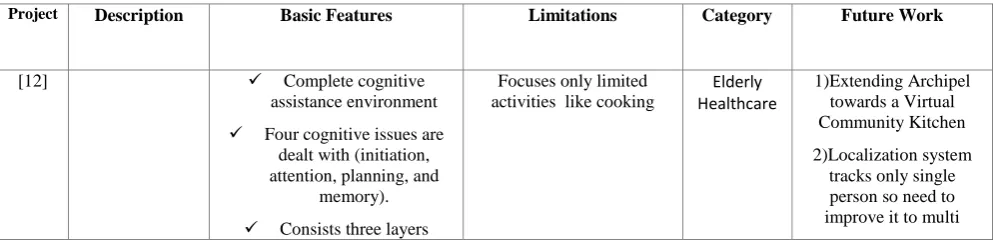
In this section a comparative study of five projects is made. Table 1campres on the specific grounds whereas Table 2 presents limitations and proposed future work of studied AAL projects.
From table 1 it can be analyzed that out of 5 studied AAL projects only one has Android support so it can be concluded that to make android systems more approachable they must support android based systems
Despite huge research and development some aspects of AAL needs more attention. Studied literature revealed that
Assistance is provided mostly using one technology at a time e.g. Sensors, Robots or smart cloths .But more mature smart environment can be established by integrating these technologies into single environment.
Due to multidisciplinary nature of AAL researchers from different disciplines must be encouraged to perform research to enhance all aspects of AAL. One of the major issues of AAL could be Adoptability as it would be difficult for people of developing nations to adopt it due to complexity and technological ignorance so AAL systems needs to be made as simple as possible.
[image:3.595.310.565.268.406.2]Keeping in view the broader scope of AAL it can be extended for children with special needs. Moreover some standard must be set regarding reliability of different instruments and devices used in smart environments.
Table 1. Comparison of presented ambient projects based on Technologies used
Project Activity Alerts Technology
Android
support Security
[12]
Daily
activities Yes
Sensors, Virtual
actors Yes No
[18]
Daily activities No
Sensors,
Actuators No No
[14]
Cooking, behavior
tracking No Sensors, RFID No NO
[15]
Daily
activities Yes Sensors No No
[17]
Daily activities
Bluetooth,
ZigBee, RFID No Yes
5.
CONCLUSIONS
AAL is a vast and complex research area having a lot of unsolved issues. Still AAL has broad scope of applicability. It can be extended in many dimensions. Different home environments are discussed. On the basis of analysis it can be concluded that the best part of DOMUs Project is software assistance in for of voice but it is only limited to cooking. It can be extended to assist in other activities too.
CARE Project used Naïve Bayes on sensor data. Other Data mining techniques e.g. clustering and classification can be used for a different set of results.
[image:3.595.50.547.643.765.2]This paper presented a review of various Ambient Assisted Systems established to provide assistance to the elderly people. Several AAL projects were debated and different researches on the models, which have their own characteristics, were presented. The challenges discussed will provide researchers with the help to improve upcoming projects
Table 2. General Comparison of presented ambient projects
Project Description Basic Features Limitations Category Future Work
[12] Complete cognitive
assistance environment
Four cognitive issues are dealt with (initiation, attention, planning, and
memory).
Consists three layers
Focuses only limited activities like cooking
Elderly Healthcare
1)Extending Archipel towards a Virtual Community Kitchen
37 Hardware ,Middle and
Decision making layer
Two prototypes.PCA to monitor morning routine .It can intervene by using
recorded messages
Second prototype Archipel is assistant for Cooking
person
[18] Context Awareness in Residences for
Elderly
Pattern recognition method
switch-like sensors
Ease of installation and minimal intrusion.
New sensor can be easily added to the network
Experimentation was performed for 6 Days
Makes different clusters for same activity that is carried out in a different way e.g. person can leave home using front or back
door
Elderly care To have a more reliable annotation scheme and
larger data sets to increase accuracy of
models.
[14] Cooking,
behavior tracking
An extensible and open and flexible platform
For Functionally impaired people
Personalisable solution.
Semantic-enabled technologies and
service-orientation.
Medication reminder, home automation, home
safety and security.
Activity monitoring, coping with cognitive ageing, forgetfulness and
dealing with social separation.
Predefined interfaces
Trials in 300 existing homes.
Elderly care Testing the approach with cutting edge
technology
[15] Ambient Assisted Living
for All
Most important feature UserAcces platform
Considered caregivers
Two main features: integration with AA4AAL
platform
and certification
AAL4ALL solutions include virtual actors that
interact with the users
Heavy data processing
6.
ACKNOWLEDGMENTS
We are very grateful to Dr Naveed Anwar Butt [Associate Professor University Of Gujrat] for his assistance in [Pattern recognition, Data mining techniques].We are also grateful to [Dr. Muhammad Shehzad Sarfraz] for providing their expert advice and support for this work.
7.
REFERENCES
[1] A. Giovanni, D.J. Cook, P.Rashidi, A.V. Vasilakos, 2013.A Survey on Ambient Intelligence in HealthCare in Proceedings of the IEEE.
[2] B. Ann, K.M .Anne. 2015 The Living Challenge of Ambient Assisted Living – a literature review In Proceedings of the 13th Scandinavian Conference on Health Informatics, Tromsø, Norway.
[3] ISTAG, Scenarios for Ambient Intelligence in 2010. Feb. 2001. http://www.cordis.lu/ist/istag.htm
[4] G. Broek, F. Cavallo, C. Wehrmann, “AALIANCE Ambient Assisted Living Roadmap”, IOS Press BV, Netherlands 2010, ISBN 978-1-60750-498-6
[5] Qin Ni , H .G .B. Ana, I. P. de la Cruz, “The Elderly’s Independent Living in Smart Homes: A Characterization of Activities and Sensing Infrastructure Survey to Facilitate Services Development”, Sensors 2015,Vol. 15, pp.11312-1136,2015
[6] B.Stephanie,M.Claudine,B.Charisse,W.Ashley,”Ambient Assisted Living Technologies for Aging Well: A Scoping Review”, Journal of Intelligent. Systems. 2016; pp. 55–69, 2016.
[7] M.Friedwald,O.DaCosta,Y.Punie,P.Aahuhuta,”Perspecti ves of Ambient Intelligence in the Home Environment”, Telematics and Informatics 2005, pp 221-238 ELSEVIER
[8] G.L.Alexander, M. Rantz, M. Skubic,”Sensor Systems for Monitoring Functional Status in Assisted Living Facility Residents”, Research in Gerontological Nursing, Vol.1, 4,pp. 238-244,2008
[9] L. Ivo, D. Ivan,” Assisted Living Systems for Elderly and Disabled People: A Short Review”, International. Journal of Bio automation, 15(2), pp.131-139, 2011
[10]F.C.Delicato,L.Fuentes,N.Gámez,P.F.Pires,“Variabilities of Wireless and Actuators Sensor Network Middleware for Ambient Assisted Living. In Distributed Computing, Artificial Intelligence” ,Bioinformatics, Soft Computing, and Ambient Assisted Living; Springer: Berlin/Heidelberg, Germany, pp. 851–858,2009
[11] J. Sliwa ,E. Benoist, 2011 Wireless sensor and actor networks: E-health, E-science, E-decisions”, In Proceedings of the International Conference on Selected Topics in Mobile and Wireless Networking (iCOST), Shanghai, China, pp. 1–6.
[12] A. Costa1, P. Magalhães, J. F.-Alves, T. Peixoto, R.Simoes, P. Novais “The caregiver perspective: an assistive AAL platform” 6th International Work-Conference, IWAAL 2014, Belfast, UK, Proceedings, Volume 8868,pp 304-311, December 2-5, 2014
[13] A. Costa1, P. Magalhães, J. F.-Alves, T. Peixoto, R.Simoes, P. Novais “The caregiver perspective: an assistive AAL platform” 6th International Work-Conference, IWAAL 2014, Belfast, UK, Proceedings, Volume 8868,pp 304-311, December 2-5, 2014
[14] S. Giroux, J. Bauchet, H. Pigot, D.Lussier-Desrochers, Y.Lachappelle “Pervasive behavior tracking for cognitive assistance”, Athens, Greece. ACM -, July 15-19, 2008
[15] B. Kröse, T. van Kasteren, C. Gibson, T. van den Dool “CARE: Context Awareness in Residences for Elderly”ISG 2008 - The 6th International Conference of the International Society for Gerontechnology, ,pp 101-105, Pisa 2008
[16] A.K.Chaudhary, J.A.Harding, M.KTiwari,”Data mining in manufacturing: Review based on the kind of knowledge”, Journal of Intelligent Manufacturing, Vol.20, pp.501-521, 2009.
[17] M.Peruzinni, M. Germani, “A Service-oriented Architecture for Ambient-assisted Living”, Conference: 22nd ISPE Inc. International Conference on Concurrent Engineering, At Delft Pages. 523 – 532, Aug 10, 2015.
[18] A. Giovanni, D.J. Cook, P.Rashidi, A.V. Vasilakos, Member, “A Survey on Ambient Intelligence in HealthCare “Proceedings of the IEEE, 2013.
[19] G. Hayes, E. Poole, G. Iachello, S. Patel, A. Grimes, G. Abowd, and K. Truong, “Physical, social, and experiential knowledge in pervasive computing environments,” IEEE Pervasive Computing, pp. 56–63, 2007.
[20] P.Rashidi, and A. Mihailidis”A Survey on Ambient-Assisted Living Tools for Older Adults”IEEE Journal Of Biomdical And Health Informatics, VOL. 17, NO. 3, MAY 2013