Geotechnical Characteristics of lime and cement stabilized lateritic soils from Sedimentary terrain, Nigeria Ogunribido T.H.T. (PhD)
Department of Earth Sciences,
AdekunleAjasin University, AkungbaAkoko, Nigeria Corresponding author e-mail:ogunribido_henry @yahoo.com
Abstract
This study investigated the effects of cement and lime on geotechnical properties of lateritic soil from the sedimentary terrain of Southwestern Nigeria. Three soils samples were collected at depth of 1.0 metre from Agbabu, Okitipupa and Irele in the sedimentary basin of Southwestern Nigeria. Soil samples were taken to the Engineering Geological laboratory of the Federal University of Technology Akure and were air dried for two weeks before analyses. The tests carried out were : compaction, California Bearing Ratio, consistency limits, linear shrinkage, specific gravity, and shear strength on the three bulk soil samples prior to and thereafter subjected to stabilization at 2%, 4%, 6%, 8% and 10% by weight of cement and lime respectively. Results shows that the optimum moisture content, maximum dry density, liquid limits, plastic limits, linear shrinkage, shear strength and specific gravity increases with stabilization of the soil with cement and lime at 6% and 8% by weight of the soil respectively. The 6% and 8% were observed to be the optimum content for cement and lime stabilizers after which the geotechnical properties of the soil decline. Soil samples at Agbabu exhibit higher degree of laterization than soil samples from Irele and Okitipupa.Samples of soils from the study area indicate that they have poor geotechnical properties and therefore these properties must be improve before the soils could be used for construction purposes. From the study, addition of cement or lime improved the strength properties of the soil for construction purposes and better performance.
Keywords: Geotechnical properties, cement, lime, lateritic soil, compaction 1. INTRODUCTION
Improving on site geotechnical properties of is called stabilization [1], [2], [3], [4] Stabilized soils are used in foundation design where improvement of mechanical properties is needed. This may be done by mixing stabilizing agent with natural soil in order to improve strength properties of the soil. One of the major challenges of road construction and air field pavement is the durability of pavement that will not be easily susceptible to failure. There are many factors that govern the expansion behavior of soil such as change in water content and amount and type of clay size particles [5].Most research works are mainly on lateritic soil from the Basement Complex terrain rather thanlateritic soil from the sedimentary terrain. Lateritic soil is abundant in the Basement Complex and as well as theSedimentary terrain of the tropical climate, where there is alternate wet and dry season characterized with heavy rainfall. Many researchers have carried out research on how to improve the geotechnical properties of lateritic soil from Basement Complex terrain in Nigeria using various stabilization agents, [6], [7], [8], [9], [10], [11], [12], [13], [14], [15]. In this study, lime and cement were used for stabilization of lateritic soil derived from the sedimentary rocks in Southwestern Nigeria. The purpose is to determine the effect of lime and cement on the geotechnical properties of the lateritic soil sample in the study area.
2. LOCATION AND GEOLOGY OF THE STUDY AREA
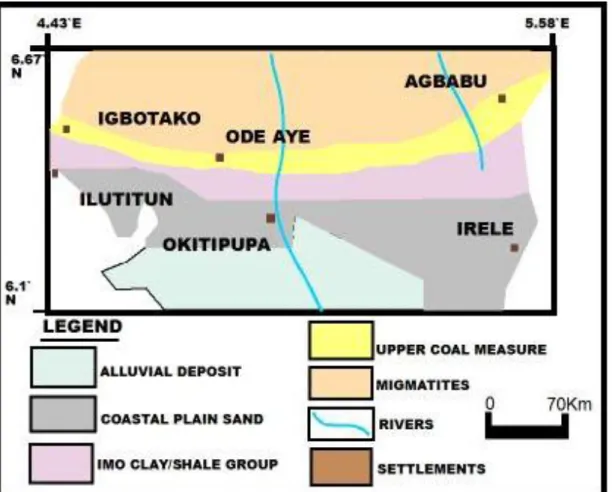
The soils investigated were collected from Agbabu, Irele and Okitipupa area of Ondo State. The study area lies within longitude 4038I E and 4053I East of the Greenwich Meridian and Latitude 6027I and 6037 I North of the Equator.(Figure 1). The study area occurred within the Dahomey sedimentary basin of Southwestern Nigeria. The predominant rock types includes alluvial deposits, Ilaro Formation, Ofosun Formation and Araromi Formation [16].
Figure 1: Geological map of the study area
3 BODY TEXT
Three soil samples A, B and C were collected from Okitipupa, Agbabu and Irele towns at a depth of 1metre from the ground surface using hand auger and were collected inpolyethene bags. The soil samples were taken to Engineering Geological Laboratory of theFederal University of Technology Akure where they were air dried for three weeks to allow partial elimination of natural water which may affect laboratory analysis and thereafter soil samples were sieved with sieve 4.76 mm. Tests such as compaction, California Bearing Ratio (CBR), specific gravity, grain size analysis, consistency limits, shear strength and linear shrinkage were performed on the un - stabilized samples A, B and C. Cement and lime were then added to each of the soil samples in 2,4,6,8 and 10 % by weight of the soil respectively and the above mentioned tests were repeated on each sample.
4 RESULTS AND DISCUSSION.
The results of the analysis is presented in Table 4.1, 4.2, 4.3 and 4.4.
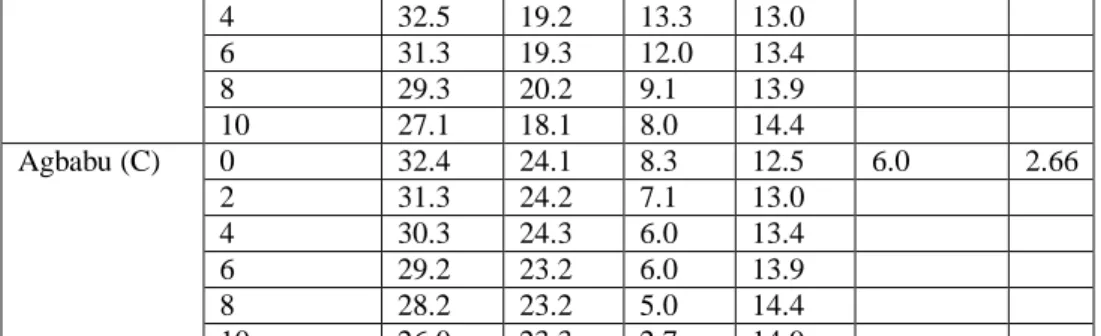
Table 4.1: Index properties with cement stabilization
Sample Code Cement (%) LL (%) PL (%) PI (%) LS (%) NMC (%) Gs
Okitipupa (A) 0 32.4 20.2 12.2 12.5 9.2 2.64
2 31.3 20.3 11.0 13.0
4 31.4 20.3 11.1 13.4
6 30.2 20.3 9.9 13.9
8 29.3 20.2 9.1 14.4
10 28.1 21.2 6.9 14.9
Irele (B) 0 33.6 19.2 14.3 12.0 8.7 2.65
2 33.5 19.3 14.2 12.5
4 32.5 19.2 13.3 13.0
6 31.3 19.3 12.0 13.4
8 29.3 20.2 9.1 13.9
10 27.1 18.1 8.0 14.4
Agbabu (C) 0 32.4 24.1 8.3 12.5 6.0 2.66
2 31.3 24.2 7.1 13.0
4 30.3 24.3 6.0 13.4
6 29.2 23.2 6.0 13.9
8 28.2 23.2 5.0 14.4
10 26.0 23.3 2.7 14.9
Table 4.2: Index properties with lime stabilization
Sample Code Lime (%) LL (%) PL (%) PI (%) LS (%) NMC (%) Gs
Okitipupa (A) 0 32.4 20.2 12.2 12,5 9.2 2.64
2 31.5 20.4 11.1 13.0
4 31.5 20.3 11.2 13.4
6 30.3 20.3 10.0 13.9
8 29.3 20.2 9.1 14.4
10 28.2 21.2 7.0 14.9
Irele (B) 0 33.6 19.2 14.3 12.0 8.7 2.65
2 33.5 19.3 14.2 12.5
4 32.4 19.2 13.2 13.0
6 31.3 19.3 12.0 13.4
8 29.3 20.2 9.1 13.9
10 28.2 19.1 9.1 14.4
Agbabu (C) 0 32.4 24.1 8.3 12.5 6.0 2.66
2 31.4 24.2 7.3 13.0
4 30.4 24.3 6.1 13.4
6 29.2 23.2 6.0 13.9
8 28.2 23.2 5.0 13.9
10 27.1 23.3 3.8 14.9
Table 4.3: Summary of Strength tests with lime stabilization
Sample Code Lime (%) OMC (%) MMD (Kg/m3) CBR (%) SS (KN/m3)
Okitipupa (A) 0 11.4 1951 32.0 128.3
2 10.7 1980 33.5 129.0
4 10.2 2004 35.0 130.9
6 9.6 2031 37.5 133.3
8 9.0 2078 42.0 136.8
10 8.5 2056 39.5 135.1
Irele (B) 0 11.7 1935 30.0 125.0
2 11.0 1966 33.5 127.7
4 10.6 1986 36.0 130.2
6 9.9 2015 39.5 133.3
8 8.4 2082 42.5 138.5
10 9.5 2035 46.0 135.7
Agbabu (C) 0 10.0 2011 37.5 132.1
2 9.5 2035 40.5 136.2
4 8.9 2060 45.5 138.0
6 8.5 2076 51.0 140.2
8 7.5 2122 61.0 143.8
10 8.2 2093 55.5 142.3
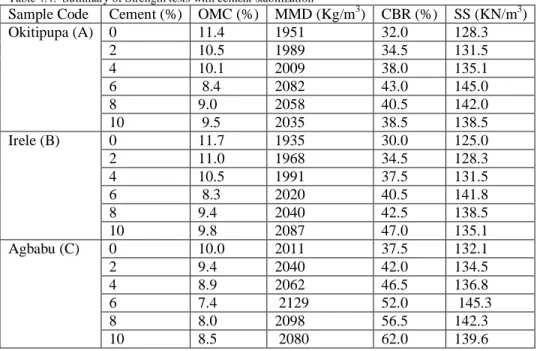
Table 4.4: Summary of Strength tests with cement stabilization
Sample Code Cement (%) OMC (%) MMD (Kg/m3) CBR (%) SS (KN/m3)
Okitipupa (A) 0 11.4 1951 32.0 128.3
2 10.5 1989 34.5 131.5
4 10.1 2009 38.0 135.1
6 8.4 2082 43.0 145.0
8 9.0 2058 40.5 142.0
10 9.5 2035 38.5 138.5
Irele (B) 0 11.7 1935 30.0 125.0
2 11.0 1968 34.5 128.3
4 10.5 1991 37.5 131.5
6 8.3 2020 40.5 141.8
8 9.4 2040 42.5 138.5
10 9.8 2087 47.0 135.1
Agbabu (C) 0 10.0 2011 37.5 132.1
2 9.4 2040 42.0 134.5
4 8.9 2062 46.5 136.8
6 7.4 2129 52.0 145.3
8 8.0 2098 56.5 142.3
10 8.5 2080 62.0 139.6
4.1 COMPACTION
The influence of increase in percentage by weight of cement and lime employed for stabilization between 2, 4, 6, 8 and 10% indicates improvement in engineering properties of the soil. The addition of between 2, 4, 6, 8 and 10% by weight of cement led to progressively increase in the MDD which increase from 1951 to 2082 Kg/m3, 1935 to 2087 Kg/m3 and 2011 to 2129Kg/m3 for Okitipupa, Irele and Agbabu soil samples. The Optimum moisture content decreases from 11.40 to 8.4%, 11.7 to 8.3% and 10.0 to 7.4% for Okutipupa, Irele and Agbabu soil samples. The optimum percentage of cement by weight of soil is 8% after which the effect of cement as stabilizer reduces drastically. This finding agrees with other researchers [17].
4.2 CALIFORNIA BEARING RATIO (CBR)
The CBR is a semi empirical test for evaluating highway sub- base and sub- grade soils [11]. For the soil-lime and cement combinations at different percentage, the CBR values increase with increasing lime content up to 6% and for cement up to 8%. Nigeria specification of CBR for road and bridge works recommended a minimum CBR value of 80% for base course in pavement design, hence the peak CBR values 32, 30 and 37.5% for the three soil samples do not satisfy the condition to be used as base -course. However, the lime treated soils of Okitipupa can be used as sub base for lightly traffic road, Agbabu and Irele soil as sub base for minor road. For the cement treated soil, Okitipupa soil can be used as sub base for the lightly traffic road, while Agbabu and Irele soil can be used as sub- base for minor road [18].
4.3 SHEAR STRENGTH CHARACTERISTICS
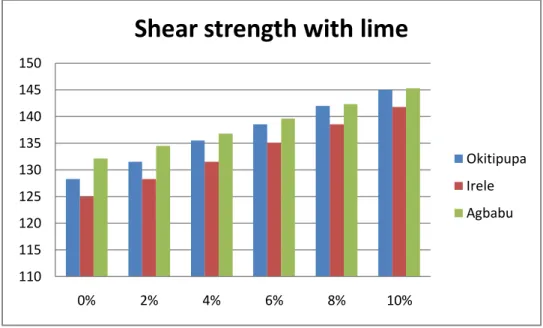
The additions of 8% lime increase the shear strength from 128.3 to 135 KN/m2, 125.0 to 135.7 KN/m2 and 132.1 to 142.3 KN/m2 and for cement at addition of 6%, shear strength increases from 128.3 to 138.5 KN/m2, 125.0 to 135.KN/m2 and 132.1 to 139.6KN/m2 for Okitipupa, Irele and Agbabu soil samples as shown in Figures 2 and 3
Figure 2: Bar charts of shear strength of lime stabilized soil samples
Figure 3: Bar charts of shear strength of cement stabilized soil samples
4 .4 GRAIN SIZE DISTRIBUTION
The grain size distribution curve of the un-treated soil in the study areas are shown in Figures 4, 5 and 6. The average amounts of fines are 34.2%, 36.2% and 32.0% for Okitipupa, Irele and Agbabu respectively. Since the percentage of fines is less than 50% this shows thatthe engineering properties of the soil in the study area are fairly good. Since Agbabu soil sample has the lowest amount of fines it is therefore regarded as the soil with the best engineering properties when compared with the soil from Okitipupa and Irele. The percentages of gravel are 0.9%, 2.2% and 11.4%; sand percentages are 65.0%, 61.6% and 56.6% and fines percentages are 34.2, 36.2 and 32.0% for Okitipupa, Irele and Agbabu respectively, this indicates that sand is predominant.
110 115 120 125 130 135 140 145 150
0% 2% 4% 6% 8% 10%
Shear strength with lime
Okitipupa Irele Agbabu
110 115 120 125 130 135 140 145 150
0% 2% 4% 6% 8% 10%
Shear strength with cement
Okitipupa Irele Agbabu
The result of the sieve analysis from the graph showed that less than 37% of the three samples pass through the sieve number 200 (75µm sieve) and can be interpreted as all the samples are within the granular material family, showing that they are fairly good for road construction.
Figure 4: Grain size distribution of Okitipupa soil sample
0.002 0.006 0.02 0.06 0.2 0.6 2 6 20 60 200
BS Sieve Appature
Size, mm 0.063 0.2120.4250.6 1.18 2 3.35 6.3 1420 37.5 6375
CLAY FINE
SILT
FINE
SAND
FINE
GRAVEL
COBBLE
MEDIUM COARSE MEDIUM COARSE MEDIUM COARSE
0 10 20 30 40 50 60 70 80 90 100
PERCENTAGE PASSING (%)
PARTICLE SIZE (mm)
sieve analysis
© skea 2010
Figure 5: Grain size distribution of Irele soil sample
Figure 6: Grain size distribution of Agbabu soil sample
0.002 0.006 0.02 0.06 0.2 0.6 2 6 20 60 200
BS Sieve Appature
Size, mm 0.063 0.2120.4250.6 1.18 2 3.35 6.3 1420 37.5 6375
CLAY FINE
SILT
FINE
SAND
FINE
GRAVEL
COBBLE
MEDIUM COARSE MEDIUM COARSE MEDIUM COARSE
0 10 20 30 40 50 60 70 80 90 100
PERCENTAGE PASSING (%)
PARTICLE SIZE (mm)
sieve analysis
© skea 2010
0.002 0.006 0.02 0.06 0.2 0.6 2 6 20 60 200
BS Sieve Appature
Size, mm 0.063 0.2120.4250.6 1.18 2 3.35 6.3 1420 37.5 6375
CLAY FINE
SILT
FINE
SAND
FINE
GRAVEL
COBBLE
MEDIUM COARSE MEDIUM COARSE MEDIUM COARSE
0 10 20 30 40 50 60 70 80 90 100
PERCENTAGEPASSING(
PARTICLE SIZE (mm)
sieve analysis
© skea 2010
4.5 ATTERBERG LIMITS
The liquid limit and plastic limit (Table 4.1 and 4.2) can be used to obtain plasticity index (19). Plastic limits, liquid limits and plasticity indices of soil from Okitipupa, Irele and Agbabu in the study area without the addition of lime and cement are 32.4%, 20.2% and 12.2%, 33.5%, 19.5% and 14.4%, and 32.4%, 24.1% and 8.3% respectively . Liquid limit is a measure of water content at which the soil behaves practically like a liquid and plasticity index indicates the magnitude of water content range over which the soil remain plastic. The higher the plasticity index, the higher the potential to shrink, as the soil undergoes moisture content fluctuations. The test results generally indicate that the natural soil was progressively loses its plasticity with increase amount of lime or cement from 2, to 4, 6, 8 and 10%. Hence the plasticity index decrease steadily with higher cement contents from 12.2 to 6.9, 14.3 to 8.0 and 8.3 to 2.7 for cement content between 0 and 10% for Okitipupa, Irele and Agbabu respectively. The reduction in atterberg limit of soil treated with cement were small compared to lime may be due to low calcium ion concentration in cement. Plasticity index reduction may be attributed to the replacement of the soil particles by lime or cement fines with consequent reduction in clay content. The plasticity index of a soil decreases as the amount of clay fraction decreases (20). The decrease in the plasticity index shows that the engineering properties of the soils were improved.
The additions of cement and lime by 2,4,6,8, and 10% by weight to the soil samples caused a change in the liquid limits, plastic limits and plasticity index of all the soil samples. Liquid limits decreases to the minimum of 28.2, 28.2 and 27.1% when the soils were stabilized with lime and to 19.2, 19.1 and 23.3% with cement as a stabilizer for Okitipupa, Irele and Agbabu respectively.
4.6 SPECIFIC GRAVITY
The results of the specific gravity analysis of Okitipupa, Irele and Agbabu soil samples were 2.64, 2.65 and 2.66 respectively. The higher the specific gravity, the higher is the degree of laterization of the soil. This indicates that soil sample at Agbabu exhibit higher degree of laterization than soil samples from Irele and Okitipupa.
4.7 LINEAR SHRINKAGE
The shrinkage limits is the water content where further loss of moisture will not result in any more volume reduction. The addition of lime or cement to the soil samples increases the shrinkage limits. It is clear from the result of the analysis that the cement or lime treated soil absorb more water to change it from semi solid state to solid state.(21) classified soil based on degree of shrinkage as follows, soil with shrinkage limit less than 5 as good, 5- 10 as medium, 11-15 as poor and greater than 15 as very poor.Based on this classification, since soil samples in the study area range between 12.5 and 14.9, the soil sample in Okitipupa, Irele and Agbabu may crack and may cause differential settlement in foundation as well as in road pavement. They may also lead to formation of pot holes if roads are constructed on them. They are classified as poor soils.
5 CONCLUSIONS
The following conclusions may be drawn from the study:
Agbabu soil exhibit higher degree of laterization than soils from Irele and Okitipupa.The increase in lime and cement contents decreases the plasticity indices of the soil. This confirmed that the activity of the mixture reduced with the addition of lime and cement.Soil samples in the study area are not good for construction purposes except they are stabilized.The soil samples in the study area are generally poor soils, since pot holes would be formed when roads are constructed on them.Cement and lime creates bonds between clay particles which remove excess moisture from the soil leading to the improvement in the geotechnical properties of the soil at 6% and 8% for cement and lime respectively.
REFERENCES
[1]Ankit, S.N, Mohammed, F, Devashish, P.S and Rehanjot, S (2013): Soil stabilization using lime,International Journal of Innovative Research Science, Engineering and Technology, Vol. 2(2), 290– 297
[2]Bergado, D.L, Anderson, N and Miura, A.B (1996): Soft ground improvement: In Lowland and other Environment, N.Y, American Society of Engineers
[3]Amadi, A.N, Akande, W.G, Okunlola, I.A. Jimoh, M.O and Francis, D.G (2015): Assessment of Geotechnical properties of lateritic soil in Mina, North Central Nigeria for Road design and Construction, American Journal of Mining and Metallurgy, Vol. 3(1),, 15 -20
[4 Ali, Ates (2013): The effect of polymer – cement stabilized on the Unconfined Compressive Strength of liquefiable soils, International Journal of Polymer Science, Vol. 2013, Pp. 1- 8
[5]Mohammed, Y.F, Firas, A.S and Bestum, J.N (2010) :A treatment of expansive soil usingdifferent additives, Acta MontanisticaSlovaca, 15(4), 290 – 297.
[6]Ogunribido, T.H.T (2012a): Effects of rock flour on some Engineering properties oflateritic soil, InternationalJournal of Pure, Applied science and Technology, Vol. 10, No. 1, pp. 10 – 16.
[7]Ogunribido, T.H.T (2012b): Potentials of Sugar cane straw ash for lateritic soil Stabilization inroad construction, International Journal of Science and Emerging Technology, Vol. 3, no. 5, pp. 102 -107
[8]Ogunribido, T.H.T (2012c): Geotechnical properties of saw dust ash stabilized SW, Nigeria Lateritic soils, Scientific Journal of Environmental research, Engineering and Management, No. 2(60), pp. 29 – 33.
[9]Ogunribido T.H. T, Mohammed, M Zaid and Adesuyi A. Raymond (2015): Effects of Engineering properties of Soil on pavement failures in OgbagiAkoko Area, SW Nigeria, Journal of Environmental and Earth Science, Vol, 5 no.4, 39 – 42.
[10]Okunade, E.A. (2010): Geotechnical Properties of some coal Fly Ash Stabilized Southwestern NigeriaLatentic soil. Modern Applied Sciences. Vol. 4, No 12, pp. 66-73.
[11]Oloruntola, M.O., Adeyemi, G.O and Oduneye, O.C. (2008):Comparative study of the Influence of Cement and Lime Stabilization on Geotechnical Properties of Latentic soil Derived from Pegmatite in Ago- Iwoye, Southwestern Nigeria, Journal of Mining and Geology. Vol. 44(1), pp. 95-105.
[12]Okafor, F.O. and Okonkwo, U.N. (2009): Effects of Rice Husk ash on some Geotechnical Properties of Lateritic soil. Leonardo Electronic Journal of Practices and Technologies, Issue 15, pp 67-74
[13] Amu, O.O., Origbemide, A.R. and Saseun, E.O. (2010): Effects of dissolved Alum on the Geotechnical Properties
of Lateritic soil for Road Construction, Research Journal of Applied Sciences, Engineering and Technology. Vol. 2(6) pp 543-546.
[14] Amu, O.O., Ogunniyi, S.A. and Oladeji O.O. (2011): Geotechnical Properties of Lateritic soil stabilized with sugar cane straw ash, American journal of Scientific and industrial Research, Pp. 323 -331
[15]Otoko, G.R (2014): Stabilization of lateritic silty clays with common stabilization agents, International Journal of Engineering Science and Research Technology, 3(4), 5021 - 5024
[16]Omotshola, M.E and Adegoke, O.S (1981): Tectonic evolution and Cretaceous stratigraphy of Dahomey Basin, Journal of Mining and Geology, 18(1), 130 – 137
[17]Adeyemi, G.O (2003): The influence of topography on some engineering and geological Characteristics of sandstone derived lateritic soil from Ishara, SW, Nigeria, Journal of Applied Science and Technology, Vol.3, Pp. 1- 6.
[18]Osunubi K.J (1998): Permeability of lime treated lateritic soil, Journal of transportation engineering 124 (5), pp. 465 – 469.
[19]Obiefuna, G.I. and A. Nur, (2003): Hydrogeological and geotechnical study of Bauchi and environs, Northeast Nigeria. Global J. Geol. Sci., 1(2): 187- 198.
[20]Eberemu, A.O (2011): Consolidation Properties of compacted lateritic soil treated with rice husk ash, Geomterials, Vol. 1, Pp 70 – 78
[21]Schedig, A in T.N. Ramarnurthy and Sitharain(1948): Geotechnical Engineering (Basic of SoilMechanics), (1st Edition), Schand and Company Ltd, Ram Nagar, New Delhi 11055,