Bond, M. (2015) Experiences of mindfulness for clients with OCD: An IPA study. DCounsPsych, University of the West of England. Available from: http://eprints.uwe.ac.uk/27181
We recommend you cite the published version. The publisher’s URL is:
https://eprints.uwe.ac.uk/secure/27181/
Refereed: No (no note)
Disclaimer
UWE has obtained warranties from all depositors as to their title in the material deposited and as to their right to deposit such material.
UWE makes no representation or warranties of commercial utility, title, or fit-ness for a particular purpose or any other warranty, express or implied in respect of any material deposited.
Experiences of
Mindfulness for clients
with OCD: An IPA study
Miya Bond
Supervised by
Dr Gary Christopher, University of the West of England
Dr Naomi Moller, The Open University
Submitted in partial fulfilment of the requirements of the University of the West of England, Bristol for the degree of Professional Doctorate in Counselling
Psychology
Faculty of Health and Life Sciences
University of West of England, Bristol
July 2015
Table of Contents
Journal Article ... 5
Abstract ... 6
Introduction ... 7
Mindfulness ... 8
Mindfulness and OCD ... 8
Methodology ... 10
Participants ... 10
Data Collection ... 12
Results ... 13
Mindfulness as reassurance and memory aid ... 14
Mindfulness as distraction... 16
When mindfulness fails ... 18
Discussion ... 19
Mindfulness as reassurance and memory aid ... 19
Mindfulness as distraction... 20
When mindfulness fails ... 21
Summary of the negative impact of mindfulness in the context of OCD ... 22
Future Research ... 22
Implications for Practice ... 23
Limitations ... 23
References ... 23
Dissertation Abstract ... 28
Literature Review ... 31
Obsessive-Compulsive Disorder ... 31
Definition of OCD ... 32
Early References to OCD... 33
Categories of OCD ... 34
Prevalence ... 34
Onset ... 35
Comorbidity ... 35
Impact ... 37
Aetiology ... 38
Theoretical Perspectives on OCD ... 40
Treatment Guidelines ... 49
Summary ... 51
Mindfulness ... 52
Mindfulness and Mental Health ... 53
Efficacy of Mindfulness Based Treatments ... 55
Disadvantages of Mindfulness ... 56
Patient experience of mindfulness ... 59
Neurology of Mindfulness ... 60
Mindfulness and Cognitive-Behavioural Therapy ... 61
Summary ... 62
Mindfulness and OCD... 63
Mindfulness OCD Research ... 65
Mindfulness and OCD Summary ... 68
Research rationale ... 68
Research aims ... 69
Research questions ... 70
Methodology ... 71
Design ... 71
Rationale for Chosen Methodology ... 71
Qualitative versus Quantitative ... 71
Epistemology ... 73
Rationale for IPA ... 74
Data Collection... 77
Interview use in research. ... 77
Weblog as data ... 78
Email Interview ... 78
Ethical Matters ... 80
Ethical Approval ... 80
Informed Consent ... 80
Confidentiality ... 80
Risk ... 80
Participants ... 81
Number of Participants ... 82
Inclusion Exclusion Criteria ... 83
Transcription ... 85
Process of Analysis ... 85
Approach to Quality ... 88
Reflexivity ... 89
Bracketing Assumptions ... 89
The Researcher ... 90
Choice of research topic ... 91
Researcher’s position on mindfulness ... 91
Influence of the Participants ... 91
Influences on the data ... 92
Being mindful in the process ... 92
Analysis ... 94
Key to Conventions Used in Transcriptions ... 96
Superordinate Theme 1: Changing Relationship to Thoughts ... 96
Sub Theme 1b: Thoughts are not facts ... 102
Superordinate Theme 2: New Way of Being ... 104
Sub Theme 2a: Mindfulness facilitates new sense of self / new way of being .... 104
Sub Theme 2b: Giving up wanting things to be different ... 105
Sub Theme 2c: Mindfulness helps participants be with anxiety ... 107
Sub Theme 2d: Increased awareness of body and emotions... 109
Sub Theme 2e: Trusting the senses and being present ... 111
A summary of participants experience ... 113
Discussion ... 116
The Fit with Cognitive Behavioural Models... 118
Mindfulness as a Tool or a Philosophy ... 127
Mindfulness as an Approach to Research ... 129
Conclusion ... 130
Implications for Practice ... 132
Implications for the Practice of Counselling Psychology ... 133
Limitations ... 134
Further Research... 136
Concluding remarks ... 137
References ... 139
Appendices ... 155
Appendix A Introductory Letter ... 155
Appendix B Information Sheet ... 156
Appendix C Consent Form ... 158
Appendix D Interview Guide... 159
Appendix E Example from Analysis ... 162
Appendix F Letter to OCD Clinics ... 168
Appendix G Project Protocol Summary... 170
Appendix H NHS Ethical Approval ... 171
Appendix I NHS Research and Development Approval ... 175
Appendix J University of the West of England Ethical Approval ... 177
Appendix K Part of Reflexive Journal ... 179
"If the quality with which a person handles a difficult moment shifts by even one per cent, then that is an important shift, because it affects the next moment, and the next and so on, so one small change can have a large impact in the end."
Journal Article
The following journal article forms part of the research dissertation into the experience of mindfulness by people with OCD.
The dangers of mindfulness for
OCD: An IPA study
Miya Bond
1*, Naomi Moller
2and Gary Christopher
11
University of the West of England
2
The Open University
Word count (exc. figures/tables): 5,355
Abstract
Objectives
Mindfulness has been proposed as a potential treatment for
obsessive-compulsive disorder (OCD), a debilitating condition, which for many is life-long. However, it is not clear whether, and how, mindfulness is experienced as helpful by OCD sufferers. The current study explored the experiences of people with OCD who used mindfulness practices.
Design
Semi-structured interviews were carried out with participants who had been diagnosed with OCD between 1 and 40 years ago and who had experience of mindfulness.
Methods
Interpretative Phenomenological Analysis (Smith, Flowers & Larkin, 2009) was used to analyse semi-structured interview transcripts from seven participants (3 men, 4 women).
Results
The analysis revealed that all the participants considered mindfulness practice to be a beneficial adjunct to treatment for OCD. However, the study also found that mindfulness could, for some, be used or become incorporated into the OCD in ways that might be considered unhelpful.
Conclusions
The finding that there are possible areas of concern for the use of mindfulness in the treatment of OCD is discussed, alongside the implications for clinical practice.
Practitioner Points
• IPA study of OCD sufferers’ experiences found unexpected negative consequences of using mindfulness practice.
• Care may be needed when teaching mindfulness to people with OCD to reduce the likelihood of mindfulness being used solely to reduce short-term anxiety.
• More research is needed into the potential disadvantages and long-term effectiveness of mindfulness for OCD.
Introduction
Obsessive-Compulsive Disorder (OCD) is a debilitating mental health condition that is typically characterised by distressing thoughts, images, impulses and fears (obsessions) that lead to ritualised or repetitive behaviours (compulsions; DSM-IV: American Psychiatric Association, 2000). The obsessive thoughts may be connected to the phenomena that are the subject of OCD sufferers’ obsessions, or to cognitions or beliefs about what will occur should they fail to carry out neutralising compulsions (Salkovskis, 1999).
Mindfulness
There are many definitions of mindfulness. Kabat-Zinn defines mindfulness as “the awareness that emerges through paying attention on purpose, in the present moment, and nonjudgmentally to the unfolding of experience moment by moment” (Kabat-Zinn, 2003, p. 145); while Siegel suggests that mindfulness is a state of internal attunement that includes curiosity, openness, and acceptance (Siegel, 2007) - to which Turner adds with an “attitude of equanimity” (Turner, 2009, p. 96).
Originating in eastern philosophy, mindfulness has been secularised and
separated from its spiritual roots (Appel & Kim-Appel, 2009) and is now offered as a treatment strategy for many mental health disorders. These include Mindfulness-Based Stress Reduction (Kabat-Zinn, 2003), Mindfulness-Based Cognitive Therapy for relapse prevention in depression (MBCT; Segal, Williams & Teasdale, 2013). Mindfulness also constitutes a significant element of
Dialectical-Behavioural Therapy for borderline personality disorder (Linehan, 1993) and Acceptance and Commitment Therapy (Hayes et al., 2006) and is increasingly being used in the treatment of a wide range of other conditions (Keng, Smoski & Robins, 2011). Mindfulness differs from conventional treatments in that change is not the primary focus; mindfulness does not preclude change, but sees this as secondary to a process of self-acceptance and self-understanding (Bishop et al., 2004).
The research base suggests that mindfulness based treatments are helpful in alleviating symptomology over a wide range of conditions and disorders (e.g. Chadwick, Newman Taylor & Abba, 2005; Finucane & Mercer, 2006; Brown, Ryan & Creswell, 2007; Roemer, Orsillo & Salters-Pedneault, 2008). Findings also show that mindfulness is an acceptable and well-liked treatment that has a significant positive impact on wellbeing and quality of life (Greeson, 2009).
Mindfulness and OCD
known to affect people with OCD (Fairfax, 2008). Mindfulness encourages participants to observe current experiences in a non-judgemental manner and it is thought this may assist individuals to become habituated to intrusive thoughts, as well as reduce counterproductive thought suppression efforts (Hepburn et al., 2009). Fairfax (2008) conjectures that mindfulness-based therapies might also teach participants that ‘thoughts are not facts’, something which may be of particular importance in OCD to help to bring about metacognitive change and a reduction in thought-action fusion (where a thought about doing something is considered to be evidence for the action having taken place; Shafran, Thordarson & Rachman, 1996).
While there is some theoretical rationale for why mindfulness may offer hope to OCD sufferers, there is as yet little research evidence to support this (Hale, Strauss & Taylor, 2012). One quantitative study, comparing strategies to manage obsessive thoughts in OCD participants, found a reduction in anxiety following a mindfulness-based strategy compared to a distraction technique (Wahl, Huelle, Zurowski & Kordon, 2013). In a review of non-conventional interventions for OCD, Sarris, Camfield & Berk (2012) also found tentative evidence to support the use of mindfulness meditation, however the studies examined were not deemed methodically robust. Only one limited controlled pilot study of mindfulness for OCD has been published to date (Hanstede, Gidron & Nyklíček, 2008). The participants for this trial were a non-clinical sample of 17 Dutch students who had at least one OCD symptom. The study reported a significant reduction in OCD symptoms at the end of mindfulness treatment when compared to a control group.
conclusions about the components of MBCT that were useful for OCD sufferers (self-acceptance, the acceptance of private events and the use of a three-minute breathing space).
One of the apparent benefits of mindfulness over pharmacology and CBT/ERP, in the treatment of OCD, is that there have been few, if any, reported adverse effects from the mindfulness treatment. Numerous research studies outline the positive effects mindfulness or regular meditation practice can have on health and wellbeing (Keng et al., 2011), however it is possible that in all this positivity negative consequences have been overlooked. Klainin-Yobas, Cho and Creedy (2012), for example, note in a review of 40 mindfulness studies that adverse effects were not addressed in a single study.
For the reasons summarised here, mindfulness is being increasingly promoted as a treatment for OCD (e.g. Schwartz & Beyette, 2009; Hershfield & Corboy, 2013). This is despite the fact that it is not yet established if mindfulness is effective or even helpful in treating OCD. It is also not clear if mindfulness may be potentially harmful; to date there has been little attention in the literature on reporting of adverse or negative responses to the use of mindfulness for people with OCD. Alderson (1999) argues for more qualitative research to inform healthcare decisions and services. In response to this lack of qualitative research and with the aim to improve service provision for people with OCD, this study thus explored the experiences of seven OCD sufferers who used mindfulness to help alleviate the symptoms and distress of their OCD.
Methodology
Ethical approval for this study was granted by the National Health Service National Research Ethics Service (South West – Cornwall and Plymouth), UK and ratified by the University of the West of England.
Participants
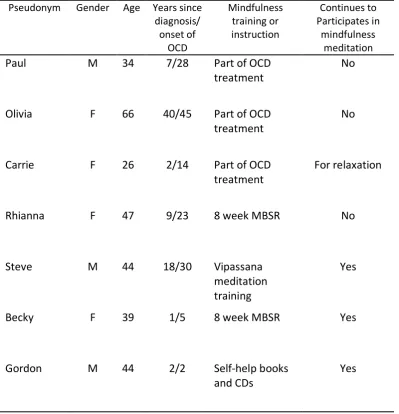
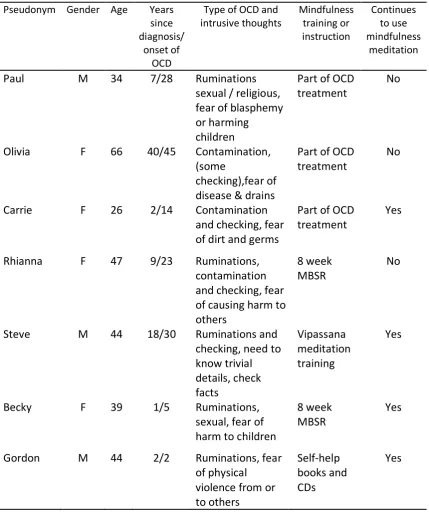
Table 1 Participants
Pseudonym Gender Age Years since diagnosis/
onset of OCD
Mindfulness training or instruction
Continues to Participates in
mindfulness meditation
Paul M 34 7/28 Part of OCD
treatment No
Olivia F 66 40/45 Part of OCD
treatment No
Carrie F 26 2/14 Part of OCD
treatment For relaxation
Rhianna F 47 9/23 8 week MBSR No
Steve M 44 18/30 Vipassana
meditation training
Yes
Becky F 39 1/5 8 week MBSR Yes
Gordon M 44 2/2 Self-help books
and CDs Yes
One participant was recruited after participating in an NHS OCD group in a secondary mental health setting where the first author worked; the remainder were recruited through notices placed on OCD websites, forums, or were ex-clients of two specialist OCD treatment centres.
All participants had a diagnosis of OCD. One participant was undergoing
cognitive-behavioural therapy (CBT) for the OCD at the time of interview; all the remaining participants had undertaken some form of treatment for their OCD in the past. The interview included questions about current psychological
functioning and all participants reported some current difficulties related to their OCD although one described herself as recovered from the condition. In
in conjunction with OCD (Torres et al., 2006). None of the participants reported experiencing significant difficulties due to any other co-morbid condition. Some of the participants were taking medication in the form of SSRI antidepressants; this is normal practice for the treatment of OCD (NICE, 2006).
Six out of the seven participants had more than a years’ experience of
mindfulness practice; the seventh had practiced mindfulness for four months. Most had learnt mindfulness through formal training (a public MBSR course or as part of their OCD treatment); one had undertaken extensive self-help instruction (see Table 1 for further information).
Data Collection
Semi-structured interviews were used to collect the study data. Interviews are a well-established method of data collection in qualitative studies (Willig, 2013). Willig argues that interviews allow “participants to challenge the researcher’s assumptions about the meaning and relevance of concepts and categories” (ibid., p. 16).
The schedule for the semi-structured interviews was prepared in accordance with the recommendations of Smith et al. (2009). Questions were open-ended, and designed to invite participants to narrate and reflect upon their experiences of mindfulness practice and its effect on their OCD symptomology or their general wellbeing.
Analysis: The data were analysed following the steps for Interpretative
Validity: Guidelines for enhancing the validity of qualitative research were consulted during the planning of the study (e.g. Elliott, Fischer & Rennie, 1999; Yardley, 2000; Flick, 2009) and the standard analytic processes for IPA, as set out by its developer, were also followed (Smith et al., 2009). In doing so, the
researchers adhered to the following characteristics of good qualitative research: sensitivity to context, commitment and rigour, transparency and coherence (Yardley, 2000). A line-by-line analysis of the transcripts was undertaken by the main author, who also took the lead in the identification of the emergent patterns and themes within the data set. Confidence that the final themes accurately reflected the participants’ experiences was achieved through grounding the analysis using examples from all participants that reflected the thematic structure. At each stage, the emerging analysis was discussed and developed through collaboration with the co-authors, who checked that the emergent themes accurately reflected the data and that the selected example quotes were relevant.
Reflexivity: The first author is a counselling psychologist in training and was drawn to this topic due to her clinical experience working with people with OCD. The second author is a Counselling Psychologist by training with an interest in mindfulness approaches but limited clinical experience with OCD. The third author is an academic Psychologist with a research interest in anxiety and mindfulness.
This research was conducted within a scientist-practitioner model, which makes explicit that the actions of a counselling psychologist cannot be separated from the economic, political and social contexts in which they operate (Bury & Strauss, 2006). This involves recognition that the research process was influenced by the researcher’s inter-subjective experiences as a counselling psychologist, and other wider contexts.
Results
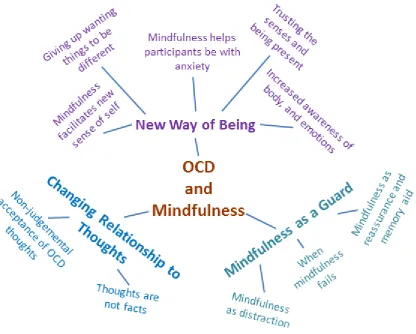
The analysis found three super-ordinate themes; the first two highlighted the participants’ changing relationship to their thoughts and anxiety and
being through the practice of mindfulness (Bond, 2015). For reasons of space, only the third theme “Mindfulness as a Guard” against OCD is described here. This theme is presented because it was both unexpected and has significant implications for the mental-health profession.
The Mindfulness as a Guard theme emerged as participants reflected on how they used mindfulness practice as an active strategy, or technique, to combat intrusive thoughts or compulsive behaviours. The theme contains three sub-themes: “Mindfulness as reassurance and memory aid”, “Mindfulness as distraction” and “When mindfulness fails”.
Mindfulness as reassurance and memory aid
Seeking reassurance is a common characteristic of sufferers of OCD (Veale & Roberts, 2014). This reassurance-seeking behaviour can take many forms, such as asking others to disconfirm beliefs or engaging in neutralising behaviours. Some of the participants of this study appeared to use mindful awareness to check the validity of their intrusive thoughts and thereby reassure themselves the thought was not true. In addition, one participant described using
mindfulness to reassure herself she had performed compulsions in response to intrusive thoughts.
For example, Olivia talked about her anxiety as a “spike” that appears to take up her full attention, and how, with mindful attention, she brings herself back to experiencing the present moment. This paying attention to her senses in the moment provided her with a powerful argument against her intrusive thoughts.
I’ll still get the spike and then at that moment I have to actually say, "Go through the list of: you know you didn't do it, no, no way, no senses, nothing else", which I call self-reassurance, which is much better than asking somebody else.
Similarly, Carrie also described using mindful awareness to combat intrusive thoughts. For example, Carrie explained how by “making myself aware“, she was able to test out a thought and reassure herself that she did not perform some unwanted action.
When I’m out and about, if I think I might have touched something or done something, I’ll question what I, what was happening at that time. ‘Okay, so you think you touched that? What, hand, what part of your hand did you touch it with? What finger did you touch it?’. And then you think, ‘Well I don’t know, because I didn’t touch it did I?’ So it’s making myself aware.
Thus increased mindfulness awareness allowed Carrie to check back through her memory and argue against her OCD intrusive thoughts; so, like Olivia, she
appeared to be using mindfulness as reassurance to manage the doubt created by her intrusive thoughts. Carrie also reported that if she began a compulsion, that she performed the ritual with more focused attention to “reinforce” or reassure herself that she had completed it. This use of mindful attention apparently reduced the need to repeat compulsive behaviours and thereby lessened the overall time Carrie would spend on compulsions.
I think, um, a lot of my OCD is around doubt, so being, doing a
compulsion and then being doubtful that I’ve done it, so I’ve done it and my anxiety is reduced, then I sit down and I think ‘I don’t remember doing it,’ so I have to do it again. Whereas being mindful it, it, well I don’t know what the word is, it reinforces the fact that I've done it.
experience than many of the other study participants, had found that when he used what he labelled as “mindful checking” or “wrong mindfulness”, defined as: “performing mental checking with awareness” that his anxiety was reduced but this did not help reduce the symptoms of his OCD. Whereas he suggested that: “Right mindfulness for OCD is observing and radically accepting the obsessive thoughts and urges to perform compulsive behaviour – without doing it, just watching the urges to do it.” However, changing the response to thoughts, rather than using mindfulness to reduce anxiety was not the easy option as demonstrated by Steve’s comment: “Right mindfulness is remembered all the way to the peak level of anxiety.”
Mindfulness as distraction
Distraction, or what is sometimes termed refocusing, is promoted by some authors (e.g. Schwartz & Beyette, 2009) as a useful strategy for combating of OCD. All of the participants, apart from Gordon, talked about being more mindfully aware so they could notice that they needed to distract themselves, and some reported using mindfulness practices, such as performing an activity mindfully, as way to distract from problematic thoughts.
There were many instances in Olivia’s dialogue where she described using distraction. For example, Olivia described paying mindful attention to her surroundings to distract herself from thoughts of the contamination she fears from public drains: “And therefore I'll listen to the birds, and instead of looking down at the drain I'll listen to the birds and I’ll see the blueness of the sky and I’ll feel the air and it's very, very grounding.”
Similarly, for Paul, distraction was seen as an important strategy to manage his OCD, “So obviously if I get an obsessive thought, I will say, obviously it's my OCD, accept it, ignore it and refocus [on something else], and that is the key”.
There is a general sense, in these and similar quotes, of the participants actively avoiding their OCD by focusing attention on something else. By distracting from the intrusive thoughts, Carrie, Paul and Olivia were also apparently giving
themselves a period of time free of OCD so that they could renew the fight later on.
Becky seemed to need to avoid the symptoms of her OCD less than most of the other participants. Hence, Becky did not regularly use distraction, but instead talked about how she used her mindfulness training to stay with the thoughts, as she said, “respond more wisely and from a place of less confusion, or if you are feeling confused just let yourself be like that for a while without trying to act out on it”. However Becky also acknowledged that “a bit of distraction can help, you know, going for a walk and literally focus on the here and now”. This indicates clearly that although Becky had found a way to be much more comfortable with the symptoms of her OCD, she still needed to deliberately create some time to be free of her OCD.
While several participants described using mindfulness in a manner that was akin to the use of distraction, Steve did not advocate this approach. Rather, Steve warned against using mindfulness as a way to aid refocusing or distraction, something he termed a “false fear blocker”, because he had found this prolonged his OCD attacks. Instead, his advice was that:
To treat a longer lasting OCD episode it is necessary to recognize and eliminate all the false fear blockers so the thoughts and anxieties can be fully accepted and experienced with a mindful awareness.
When mindfulness fails
In addition to reassurance and distraction, some participants described other ways in which they attempted to use mindfulness as a defence against their intrusive thoughts. In some of these descriptions, it was clear that there were times when participants could experience a rebound effect of the more intrusive obsessive thoughts, which they attributed to mindfulness dropping their guard down.
Paul for example used mindful awareness to ward off his OCD:
Everything can be fine, you can go through a spout of stressful situations and you will be okay and then, because you're not mindfully aware, then your OCD may come out of the closet, and it can at any time.
Paul’s quote shows how he conceptualised his mindful practice as an attentional guard against his OCD, which he experienced as lurking always ready to attack him.
Rhianna similarly described how she used mindfulness to “strengthen the rational part of [her] brain”. This allowed Rhianna to take a more observing stance on her thoughts. However, this was not always successful and both Carrie and Rhianna used the word “battle” to describe how they struggled to use
mindfulness to defend against being caught in an obsessive cycle with their intrusive thoughts.
[Mindfulness] makes me question the obsessions that come into my mind and I kind of battle with them a bit more rather than just giving in to them straightaway and carrying out the compulsion. [Carrie]
That's the thing, I think the OCD is having a battle with [mindfulness]. [Rhianna]
Gordon also talked about mindfulness strengthening his mind so that he could choose to respond to the thoughts in a different way, but his seemed to be a more gentle approach: “so it's just kind of just like taking a different path … the mindfulness, yes it certainly strengthens my mind and allows me to do that”. However, while Gordon did not conceive of himself as caught in an
OCD/mindfulness battle, he did report that mindfulness practice could also lower his defences against OCD thoughts.
Sometimes I can come out of a meditation and at just, at the key point an obsessive thought will sneak in and ruin it, and make me feel quite off for a while. [The OCD has] planted its own little IED in there.
Mindfulness practice for Gordon therefore had a bittersweet quality. On the one hand it was the way forward, on the other hand it could appear to leave him more vulnerable to the effect of an OCD thought; whose occurrence, when he was relaxed by his practice, was experienced like a terrorist explosion.
It appears that the study participants, to counter and resist OCD, sometimes experienced a conflict between their mindfulness and their OCD symptomology where sometimes victory went to the mindfulness, and sometimes to the OCD.
Discussion
Participants of this study regarded mindfulness practice as an extremely useful, if not essential, adjunct to cognitive-behavioural treatments and also a useful addition to the toolkit of strategies to combat OCD (see Bond, 2015, for fuller description of these findings). However, this paper has presented evidence that despite participants’ positive experience of mindfulness practice, it had the potential to exacerbate OCD symptoms and be used in ways that may not be helpful for the long-term management of OCD.
Mindfulness as reassurance and memory aid
responsibility, which is a main tenet of the Salkovskis’ (1985)
cognitive-behavioural model of OCD. It is possible that participants were potentially using a different type of reassurance when they talked about the relief of ‘mindfully’ reminding themselves that their thoughts were due to OCD and that they could thus reassure themselves that they were not their thoughts. Abramowitz & Arch (2014) call this type of “it’s not me, it’s my OCD” reassurance ‘self-coaching’ and suggest it helps to improve meta-awareness of the OCD and strengthens the ability to engage in the exposure work required to eliminate compulsive behaviours. However, the way that participants talked about their use of mindfulness did not, in the view of the researchers, support the idea that the participants were always using mindfulness in this ‘self-coaching’ way. The distinction is important because in the cognitive treatment of OCD an
overinflated sense of responsibility and reassurance seeking is generally seen as an avoidance strategy (Veale & Roberts, 2014) and part of the treatment involves bringing attention to this behaviour so it can be eliminated (Himle & Franklin, 2009).
In the current study, some of the participants also appeared to use mindfulness explicitly as a replacement for other reassurance-seeking behaviours. The questions are whether this mindful reassurance-seeking acts as a form of
neutralising and whether this is helpful or not. The Salkovskis cognitive model of OCD and the apparent success of conventional CBT/ERP OCD treatment would imply that it is not, and indeed, it has been suggested that mindfulness may prevent successful exposure work in OCD by becoming a counter-productive neutralising technique (Fairfax, 2008). Mindfulness for some of the participants in this study would therefore seem to have been used for short-term alleviation of anxiety in a way that may not provide long-term benefit. This finding
therefore has implications for the how mindfulness should be used in the treatment of OCD.
Mindfulness as distraction
way reported experiencing it as useful. This report is consistent with the
empirical findings that distraction can be useful for phobia (Oliver & Page, 2003) and anxiety (Simon, Adler, Kaufmann & Kathmann, 2014). Studies examining the use of mindfulness techniques alongside distraction with obsessive intrusive thoughts have however found mixed results: Najmi, Riemann & Wegner (2009) found some benefit from focused distraction but Wahl et al. (2013) found no benefit of distraction.
Further, while there is still debate about the effect and use of distraction in the treatment of OCD (Gillihan, Williams, Malcoun, Yadin & Foa, 2012), in a
summation of a number of studies Parrish, Radmosky & Dugas (2008) concluded that anxiety-neutralising strategies, such as distraction, have the potential to become counter-productive in the treatment of anxiety disorders. This suggests that while participants reported positive effects from using mindfulness to distract themselves that this too, in the long term, may potentially exacerbate the effects of OCD; significantly, this was also a view expressed by one of the participants based on his own experience of managing his OCD.
When mindfulness fails
The active use of mindfulness to supress or protect against OCD intrusive thoughts was an unexpected finding, but it was not used by all participants. Those who did use mindfulness in this way appeared to be using it more as a tool or strategy, explicitly and almost exclusively, to combat their OCD
symptomology. In contrast, other participants who had embraced mindfulness more broadly and adopted a non-striving attitude to a range of different experiences seemed more able to accept, and even welcome, their OCD (Bond, 2015). The use of mindfulness simply as a therapeutic technique has been questioned by Moss & O’Neill (2003) and this study would appear to indicate, that at least for OCD, that there might an issue with incorporating mindfulness purely as a strategy to help combat symptoms.
Summary of the negative impact of mindfulness in the context of OCD
The use of the strategies outlined in this paper could be regarded as reluctance on the part of some of the participants to accept their intrusive thoughts and perhaps even the condition itself; this failure to accept their OCD challenges one of the main tenets of mindfulness, which is to be with experience exactly as it is (Kabat-Zinn, 2003). Therefore, there is a question as to whether the mindfulness practiced by some of the participants can truly be called mindfulness. This paper thus provides support for those like Moss & O’Neil (2003) who question whether mindfulness can be just another technique in mental health settings and whether it is helpful to deconstruct mindfulness into discrete components while stripping out any philosophical or cultural context.
Future Research
The analysis in this study found instances of mindfulness practice being conducted in a way that may not help in the long-term recovery from OCD. Therefore, more longitudinal studies are required to assess how people with OCD use and experience mindfulness to assess its effectiveness as an adjunct to treatment.
would seem that these components might be helpful even when used in isolation. However, for OCD, there would appear to be problems with using increased attention without acceptance. More research is therefore needed to evaluate if the deconstructed components of mindfulness are sufficient to bring relief of OCD symptoms, or if mindfulness is more than the sum of its parts.
Implications for Practice
This study has important implications for both service providers and improving client care in all forms of OCD treatment. It identified that mindfulness was being incorporated into OCD compulsions in ways that contradict the current evidence base and accepted practice. As mindfulness reduced anxiety and distress, the participants reported this as helpful. Clinicians therefore need to be aware of these findings and be vigilant for ways in which mindfulness may be used for short-term relief, rather than as a long-term effective way to help manage OCD.
Limitations
The current study brings with it limitations inherent in the IPA qualitative method used, particularly the difficulty in generalising the findings beyond the current sample (Maxwell, 1992).
It should be noted that the participants in this study did not come from a wide socio-cultural background, and were exclusively Caucasian. However, the lack of variation in OCD across ethnic and social cultures reduces the impact of this limitation (NICE, 2006).
In addition, the sample was subject to bias in that all the participants had found the use of mindfulness in the treatment and management of their OCD useful. In view of this, the fact that participants’ reports provide evidence that mindfulness may not always be helpful in the context of OCD is especially significant.
References
Abramowitz, J. S. & Arch, J. J. (2014). Strategies for Improving Long-Term Outcomes in Cognitive Behavioral Therapy for Obsessive-Compulsive Disorder: Insights From Learning Theory.
Alderson, P. (1999). On doing qualitative research linked to ethical healthcare. London: The Wellcome Trust.
Appel, J. & Kim-Appel, D. (2009). Mindfulness: Implications for Substance Abuse and Addiction.
International Journal of Mental Health Addiction, 7, 506-512.
Bishop, S. R., Lau, M., Shapiro, S., Carlson, L., Anderson, N. D.et al. (2004). Mindfulness: A proposed operational definition. Clinical Psychology: Science and Practice, 11(3), 230-241.
Bond, M. S. (2015). Experiences of Mindfulness for clients with OCD: An IPA study. (Unpublished doctoral dissertation).University of the West of England, Bristol, United Kingdom. Brown, K. W., Ryan, R. M. & Creswell, J. D. (2007). Mindfulness: Theoretical foundations and
evidence for its salutary effects. Psychological Inquiry, 18(4), 211-237.
Bury, D. & Strauss, S. M. (2006). The Scientist-Practitioner in a Counselling. In D. A. Lane & S. Corrie (Eds.), The Modern Scientist-Practitioner: A Guide to Practice in Psychology (pp. 112-126). London: Routledge.
Chadwick, P., Newman Taylor, K. & Abba, N. (2005). Mindfulness Groups for People with Psychosis. Behavioural and Cognitive Psychotherapy, 33, 351-359.
Eddy, K. T., Dutra, L., Bradley, R. & Westen, D. (2004). A multidimensional meta-analysis of psychotherapy and pharmacotherapy for obsessive-compulsive disorder. Clinical Psychology Review, 24(8), 1011-1030.
Elliott, R., Fischer, C. & Rennie, D. (1999). Evolving guidelines for publication of qualitative research studies in psychology and related fields. British Journal of Clinical Psychology, 38(3), 215-229.
Fairfax, H. (2008). The use of Mindfulness in Obsessive Compulsive Disorder: Suggestions for its Application and Integration in Existing Treatment. Clinical Psychology and
Psychotherapy, 15, 53-59.
Finucane, A. & Mercer, S. W. (2006). An exploratory mixed methods study of the acceptability and effectiveness of mindfulness -based cognitive therapy for patients with active depression and anxiety in primary care. BMC Psychiatry, 6(14).
Fisher, P. L. & Wells, A. (2005). How effective are cognitive and behavioural treatments for obsessive-compulsive disorder? Behaviour Research and Therapy, 43, 1543-1558. Flick, U. (2009). An introduction to qualitative research (4th ed.). London: Sage Publications Ltd. Gillihan, S. J., Williams, M. T., Malcoun, E., Yadin, E. & Foa, E. B. (2012). Common pitfalls in
exposure and response prevention (EX/RP) for OCD. Journal of obsessive-compulsive and related disorders, 1(4), 251-257.
Greeson, J. M. (2009). Mindfulness Research Update: 2008. Complementary Health Practice Review, 14(10), 10-18.
Hale, L., Strauss, C. & Taylor, B. L. (2012). The Effectiveness and Acceptability of Mindfulness-Based Therapy for Obsessive Compulsive Disorder: A Review of the Literature.
Hanstede, M., Gidron, Y. & Nyklíček, I. (2008). The Effects of a Mindfulness Intervention on
Obsessive-Compulsive Symptoms in a Non-Clinical Student Population. The Journal of Nervous and Mental Disease, 196(10), 776-779.
Hayes, S. C., Luoma, J. B., Bond, F. W., Masuda, A., & Lillis, J. (2006). Acceptance and commitment therapy: Model, processes and outcomes. Behaviour Research and Therapy, 44(1), 1-25. Hepburn, S. R., Crane, C., Barnhofer, T., Duggan, D. S., Fennell, M. J. & Williams, J. M. (2009).
Mindfulness-based cognitive therapy may reduce thought suppression in previously suicidal participants: Findings from a preliminary study. British Journal of Clinical Psychology, 48, 209-215.
Hershfield, J. & Corboy, T. (2013). The Mindfulness Workbook for OCD: A Guide to Overcoming Obsessions and Compulsions Using Mindfulness and Cognitive Behavioral Therapy
(Kindle Edition ed.). New Harbinger Publications.
Hertenstein, E., Rose, N., Voderholzer, U., Heidenreich, T., Nissen, C., Thiel, N.et al. (2012). Mindfulness-based cognitive therapy in obsessive-compulsive disorder - A qualitative study on patients' experiences. BMC Psychiatry, 12.
Himle, M. B. & Franklin, M. E. (2009). The more you do it, the easier it gets: Exposure and response prevention for OCD. Cognitive and Behavioral Practice, 16(1), 29-39. Kabat-Zinn, J. (2003). Mindfulness-Based Interventions in Context: Past, Present, and Future.
Clinical Psychology Science and Practice, 10, 144-156.
Keng, S. L., Smoski, M. J. & Robins, C. J. (2011). Effects of mindfulness on psychological health: A review of empirical studies. Clinical Psychology Review, 31(6), 1041-1056.
Klainin-Yobas, P., Cho, M. A. & Creedy, D. (2012). Efficacy of mindfulness-based interventions on depressive symptoms among people with mental disorders: A meta-analysis.
International Journal of Nursing Studies, 49(1), 109-121.
Linehan, M. M. (1993). Cognitive-Behavioral Treatment of Borderline Personality Disorder (Diagnosis and Treatment of Mental Disorders). Kindle Edition ed. s.l.:Guilford Publications.
Madill, A. & Gough, B. (2008). Qualitative research and its place in psychological science.
Psychological Methods, 13(3), 254-271.
Maxwell, J. A. (1992). Understanding and validity in qualitative research. Harvard Educational Review, 62(3), 279-301.
Moss, D. & O’Neill, B. (2003) Just another technique? Possibilities and paradoxes in working with mindfulness. Clinical Psychology, Volume 31, pp. 29-33.
Najmi, S., Riemann, B. C. & Wegner, D. M. (2009). Managing unwanted intrusive thoughts in obsessive–compulsive disorder: Relative effectiveness of suppression, focused distraction, and acceptance. Behaviour Research and Therapy, 47(6), 494-503.
NICE. (2006). Obsessive compulsive disorder: Clinical Guideline 31 - Core interventions in the treatment of obsessivecompulsive disorder and body dysmorphic disorder. The British Psychological Society and The Royal College of Psychiatrists.
Oliver, N. S. & Page, A. C. (2003). Fear reduction during in vivo exposure to blood-injection stimuli: Distraction vs. attentional focus. British Journal of Clinical Psychology, 42(1), 13-25.
Parrish, C. L., Radomsky, A. S. & Dugas, M. J. (2008). Anxiety-control strategies: Is there room for neutralization in successful exposure treatment? Clinical Psychology Review, 28(8), 1400-1412.
Purdon, C. (2004). Empirical investigations of thought suppression in OCD. Journal of Behavior Therapy and Experimental Psychiatry, 35(2), 121-136.
Purdon, C. & Clark, D. A. (1999). Metacognition and Obsessions. Clinical Psychology and Psychotherapy, 6, 102-110.
Roemer, L., Orsillo, S. M. & Salters-Pedneault, K. (2008). Efficacy of an Acceptance-Based Behavior Therapy for Generalized Anxiety Disorder: Evaluation in a Randomized Controlled Trial. Journal of Consulting and Clinical Psychology, 76(6), 1083-1089. Salkovskis, P. M. (1985). Obsessional-compulsive problems: A cognitive-behavioural analysis.
Behaviour research and therapy, 23(5), 571-583.
Salkovskis, P. M. (1999). Understanding and treating obsessive-compulsive disorder. Behaviour Research and Therapy, 37, 29-52.
Sarris, J., Camfield, D. & Berk, M. (2012). Complementary medicine, self-help, and lifestyle interventions for Obsessive Compulsive Disorder (OCD) and the OCD spectrum: A systematic review. Journal of Affective Disorders, 138(3), 213-221.
Schwartz, J. M. & Beyette, B. (2009). Brain Lock: Free Yourself from Obsessive-Compulsive Behavior (Kindle Edition ed.). HarperCollins.
Shafran, R., Thordarson, D. S. & Rachman, S. (1996). Thought-Action Fusion in Obsessive Compulsive Disorder. Journal of Anxiety Disorders, 10(5), pp. 379-391.
Siegel, D. J. (2007). The Mindful Brain: Reflection and Attunement in the Cultivation of wellbeing.
New York: WW Norton & Company.
Simon, D., Adler, N., Kaufmann, C. & Kathmann, N. (2014). Amygdala hyperactivation during symptom provocation in obsessive–compulsive disorder and its modulation by distraction. NeuroImage: Clinical, 4, 549-557.
Smith, J. A., Flowers, P. & Larkin, M. (2009). Interpretive Phenomenological Analysis. London: Sage.
Stanley, M., Turner, S., Heiser, N. & Beidel, D. (2004). Obsessive-Compulsive Disorder. In H. E. Adams & P. B. Sutker (Eds.), Comprehensive Handbook of Psychopathology. Dordrecht, The Netherlands: Springer Science+Business Media, Inc.
Turner, K. (2009). Mindfulness: The Present Moment in Clinical Social Work. Clinical Social Work Journal, 37, 95-103.
Veale, D. & Roberts, A. (2014). Obsessive-compulsive disorder. BMJ, 348.
Wahl, K., Huelle, J. O., Zurowski, B. & Kordon, A. (2013). Managing Obsessive Thoughts During Brief Exposure: An Experimental Study Comparing Mindfulness-Based Strategies and Distraction in Obsessive–Compulsive Disorder. Cognitive Therapy and Research, 37, 752-761.
Wegner, D. M., Schneider, D. J., Carter, S. R. & White, T. L. (1987). Paradoxical effects of thought suppression. Journal of Personality and Social Psychology, 53(1), 5-13.
Wilkinson-Tough, M., Bocci, L., Thorne, K. & Herlihy, J. (2010). Is Mindfulness-Based Therapy an Effective Intervention for Obsessive–Intrusive Thoughts: A Case Series. Clinical
Psychology and Psychotherapy, 17, 250-268.
Willig, C. (2013) Introducing qualitative research in psychology. 3rd ed. Maidenhead: Open University Press.
Dissertation Abstract
Mindfulness has been proposed as a potential treatment for obsessive-compulsive disorder (OCD), a debilitating condition that for many is life-long. However, it is not clear whether, and how, mindfulness is experienced as helpful by OCD sufferers. The aim of this research was to explore the experiences of people with OCD who used mindfulness practices in order to investigate these questions. A study into how mindfulness is experienced within the context of OCD is important to establish how OCD sufferers apply mindfulness both in the treatment of their OCD and more generally in their lives; to hear from them what understanding they have about how mindfulness affects their OCD; and to
discover what they perceive as helpful or unhelpful.
Interpretative Phenomenological Analysis (Smith, Flowers & Larkin, 2009) was used to analyse semi-structured interview transcripts from seven participants (3 men, 4 women) who had lived with OCD for between 2 and 45 years and who had used mindfulness from four months to five years.
The analysis revealed that while mindfulness was not a cure for OCD, all the participants considered it to be a beneficial adjunct to, or replacement for, the existing treatment for OCD. Mindfulness helped participants change their relationship to intrusive thoughts and develop a new way of being more comfortable with themselves and their OCD. This finding has added to the limited research that has shown mindfulness practice can be a useful addition to the treatment for OCD. However, this study also found that mindfulness could, for some, become incorporated into the OCD in ways that might be considered unhelpful (see journal article).
Introduction
This dissertation explores the accounts that people with OCD give about their experiences of mindfulness. While there has been significant examination of OCD, both theoretical and investigational, the accumulated knowledge base falls predominately within a positivist epistemological and quantitative perspective and the voice of OCD sufferers is not well represented in academic literature (Murphy & Perera-Delcourt, 2012). The author of this study is a trainee
counselling psychologist and this influenced the author’s aim to provide a critical realist view that is more in keeping with the philosophy and character of
counselling psychology practice. At this point, it should be noted that the author is aware of the tension between a counselling psychology position and the use of diagnosis such as OCD (Larsson, Brooks & Loewenthal, 2012). This subject is expanded on later in the dissertation, but with this in mind, the word treatment is often enclosed in single quotation marks to indicate the author is utilising a counselling psychology perspective to question the use of this term.
While many studies have demonstrated the benefits of mindfulness
interventions for wellbeing and the ‘treatment’ of various medical and mental health conditions (e.g. PTSD, Wahbeh, Lu & Oken, 2011; borderline personality disorder, O’Toole, Diddy & Kent, 2012; psychosis, Dennick, Fox, & Walter-Brice, 2013), it will be shown there is as yet little research pertaining to its use with OCD. The following literature review will demonstrate both the debilitating nature of OCD and some problems with current treatments. If more people with OCD are to be offered a better quality of life then alternative ‘treatments’ or ways of managing the condition need to be found. It is hoped that this qualitative study will add to the current knowledge base and bring to the fore the voice of people with OCD, in order that more sufferers of the condition can be helped. It is anticipated that through increasing understanding of the
Literature Review
This literature review examines the research relating to OCD and mindfulness and the use of mindfulness as a psychotherapeutic intervention for OCD. After providing an overview of OCD, it sets the context for this research study by providing a synopsis of the literature on OCD aetiology, theoretical perspectives and treatment. The topic of mindfulness is introduced with a brief coverage of its origins and some definitions, followed by an examination of the ways in which mindfulness has contributed to the psychotherapeutic treatment of a number of mental health issues and conditions. Some proposed mechanisms for how mindfulness effects change are also reviewed. Finally, the small number of studies exploring the use of mindfulness as a treatment for OCD are considered in more detail, with the aim of showing how this study fills a gap in the literature.
As will be shown, OCD is often a chronic and debilitating condition. A large percentage of OCD sufferers fail to access treatment or only do so after a considerable number of years of living with the condition, and when they do access treatment many fail to find full relief from symptoms and a significant percentage relapse following treatment. Whilst mindfulness is not commonly used in the treatment of OCD, there are a number of reasons to suggest it may be an effective adjunct to conventional treatment, since mindfulness may address some of the underlying factors believed to contribute to the symptoms or maintenance of OCD (Fairfax, 2008).
As will be noted in this literature review, the application of mindfulness to OCD is a relatively recent practice. Not only does this research aim to understand how mindfulness is experienced by those with OCD and how it may function as a ‘treatment’ for OCD, it is also hoped it will add significantly to the small amount of qualitative research into the lived experience of OCD sufferers - who rarely have a voice in current research (Murphy & Perera-Delcourt, 2012).
Obsessive-Compulsive Disorder
the creation of a grouping titled “Obsessive-Compulsive and Related Disorders”, which includes body dysmorphic disorder (a disorder in which a person becomes obsessed with imaginary defects in their appearance ) and trichotillomania (a compulsive desire to pull out one's hair; Grohol, 2013). This separation has been made “to reflect the increasing evidence of these disorders’ relatedness to one another and distinction from other anxiety disorders” (APA, 2013, p. 235) and is not an indication that OCD is no longer considered an anxiety condition.
Similarly, OCD is described as a Neurotic, Stress-related and Somatoform Disorder in the International Classification of Diseases (ICD-10; World Health Organization, 2010).
Definition of OCD
Both the ICD-10 and the DSM-5 describe and classify OCD in terms of its
symptoms; which, according to the ICD-10, are: recurrent obsessional thoughts (ideas, images or impulses that enter the patient's mind repeatedly in a
stereotyped form), or compulsive acts (ritualised behaviours performed as a symbolic and ineffectual attempt to avert danger), or both obsessions and compulsions. In order to receive a diagnosis of OCD it is not sufficient to have intrusive thoughts and compulsions, the symptoms must also cause distress (i.e. they must be ego-dystonic) or interfere with daily functioning. In addition, the diagnosis of OCD is ruled out where the behaviours result in the completion of inherently useful tasks (World Health Organization, 2010).
Another problem is that the system of categorisation of mental health conditions is potentially subject to unconscious bias. For example, Ian Parker argues that diagnostic systems such as the DSM or ICD classifications are contingent upon narrow historical and cultural conventions that favour modern, white, Western assumptions about the self, emotions and pathology (Parker, 2006).
On the other side of the argument, Norman Macaskill (2006) agrees that diagnostic labels can be problematic, leading to stigma, dehumanising and coercive treatment and the potential abuse of power, but argues that diagnostic labels can also provide meaning, relief or hope to otherwise confused or
frightened patients.
The author was aware of the debate and controversy of the use of diagnostic labels within the mental health arena; however, when planning this study she chose to adopt a pragmatic approach. In order to recruit participants with a common experience of intrusive thoughts and compulsions and also to obtain ethical approval within the NHS it was a practical requirement to use the term OCD. However, the most compelling reason for the use of the term is the way it is used and accepted by people with OCD. In a qualitative study undertaken by Murphy and Perera-Delcourt (2012) into the lived experience of people with OCD, they concluded that participants valued a medical diagnosis of OCD as it provided them with an understanding of a baffling condition and gave them hope that they could recover.
Early References to OCD
does vary (NICE, 2006). However, as will be seen, the condition is still perceived by many of its sufferers as a form of madness (NICE, 2006).
Categories of OCD
Although OCD is categorised in the DSM 5as a unitary syndrome (APA, 2013), it is increasingly being regarded it as a heterogeneous condition incorporating a number of different sub-types (Taylor, 2005). Categorisations based on the type of compulsions or behaviours, such as “washers”, “checkers” or “phobics”, have been suggested (Turner et al., 1979) but this type of categorisation is
problematic as few OCD sufferers have distinct, non-overlapping symptoms (Mataix-Cols et al., 2002).
Calamariandcolleagues(2004) found support for a seven-subgroup taxonomy that included: contamination, harming, hoarding, symmetry, certainty
(characterised as a need to have absolute certainty on many issues, often to prevent harm occurring), obsessional and contamination/harming. However, they go on to say that, a taxonomy of this kind is only useful if it is found that each sub-group responds differently to treatment, and this has yet to be established.
Prevalence
Studies using community samples show an average lifetime prevalence of OCD to be 1% to 3% (Samuels & Nestadt, 1997; Wittchen & Jacobi, 2005). Using data from the 2000 British National Psychiatric Morbidity Survey, Torres and
colleagues (2006a) found the incidence of OCD to be 1.1% in a sample of 8,580 individuals living in England, Wales and Scotland. In line with other studies, Torres et al. found OCD is more prevalent in females than males (1.3% vs. 0.9%) and declined with increasing age, from 1.4% among those aged 16-24, 1.2% aged 25-44, 1.1% aged 45-64 and 0.2% aged 65-74. They concluded that OCD is a “rare yet severe mental disorder”, and “is an atypical neurosis, of which the public health significance has been underestimated” (ibid., p. 1978).
Organization in the top 10 of the most disabling illnesses by lost income and decreased quality of life (Doron & Kyrios, 2005; Koran et al., 2007), and a US national comorbidity survey indicated that OCD is the anxiety disorder with the highest percentage (50.6%) of serious cases (Koran et al., 2007). It is therefore a condition that merits significant research effort in order to help alleviate
symptoms and improve quality of life.
Onset
OCD typically starts in childhood or adolescence with over 80% of individuals having onset before the age of 18 (Riddle, 1998). Recent research has suggested factors that predict good treatment outcomes vary according to the age of onset (Langner et al., 2009). In a study of 63 OCD patients, Langner and colleagues also found that with early onset OCD (EOCD; typically before the age of 13) sufferers experienced a greater diversity of symptoms, more familial aggregation of the condition and more comorbid tic-disorders than those with late onset OCD (LOCD; typically after the age of 15). In a separate study, adults with EOCD and LOCD showed differences in the patterns of regional cerebral blood flow in the frontal-subcortical regions of the brain; as will be shown later, these regions of the brain are implicated in presentations of OCD (Taylor, 2005).
This is one of the many indications of the heterogeneous nature of OCD and why it is important that individual experience of the condition be considered.
Comorbidity
Estimates for comorbidity accompanying OCD vary from 60-75%, with, perhaps unsurprisingly, major depressive disorder being the most common comorbid condition. This is followed by generalized anxiety disorder, agoraphobia or panic disorder, social phobia, and specific phobia (Samuels & Nestadt, 1997; Torres et al., 2006b). Torres et al. (2006b) also reported that 12.7% of OCD sufferers screened positive for possible psychosis representing a larger percentage than would be expected in the general population.
Scandinavian clinical examination that found 75% of OCD sufferers had a comorbid personality disorder (Bejerot, Ekselius & von Knorring, 1998). The same study also analysed personality traits and proposed that people with OCD are hypersensitive worriers, with a great deal of somatic anxiety and an inability to relax. They go on to suggest that such individuals seem to lack
self-assertiveness, and avoid involvement with others. These traits have relevance for this study as will be described later when difficulties in recruiting participants are discussed.
A link with obsessive-compulsive personality disorder (OCPD; also known as anankastic personality disorder; a personality characterized by extreme perfectionism, preoccupation with neatness and detail, and a need to control one's environment) has been both disputed and corroborated in several studies (Bejerot et al., 1998). Albert and colleagues (2004) found the prevalence of OCPD was higher in OCD sufferers than in non-clinical individuals but they also found OCPD was higher in other populations so concluded that there is not a specific association between OCD and OCPD.
Although the above suggests there is a link between OCD and a number of comorbid conditions, Samuels and Nestadt (1997) suggest, “[c]omorbidity
between OCD and another disorder may be an artefact of treatment seeking or a result of confounding by a factor associated with both disorders“ (ibid., p. 66). They go on to offer an alternative explanation, that OCD and the comorbid disorder may share a common aetiology. Therefore, it would appear the relationship between OCD and other presenting issues may be a complex one.
further testimony to its complexity and severity and the importance of finding new ways to relieve symptoms of the condition.
Impact
There is good evidence that OCD significantly impairs quality of life for both sufferers (Torres et al., 2006b) and for family members (Cicek et al., 2013). In a study of the lived experience of OCD sufferers, Murphy and Perera-Delcourt (2012) concluded that individuals experience a “sense of overwhelming personal failure matched against age appropriate life cycle goals” (ibid., p. 1). In addition, OCD sufferers are more likely to report an impact on their social and work
functioning than both non-sufferers and individuals diagnosed with other mental health conditions (Torres et al., 2006b). Torres and colleagues also note that individuals with OCD are “less likely to be married, more likely to be
unemployed, more likely to have very low income levels, and more likely to have low occupational status” (ibid., p. 1983). This impact of OCD can therefore be viewed as multi-layered; behind the more obvious OCD symptomology, OCD affects sufferers’ ability to lead fulfilling lives. Macy and colleagues (2013) reviewed the literature on quality of life for OCD sufferers and conclude that patient satisfaction and functioning in their daily lives should be addressed directly by health care professionals and that quality of life should become one of the measures of effectiveness of any OCD treatment (Macy et al., 2013).
In their qualitative study, Murphy and Perera-Delcourt (2012) report on the lived experience of OCD sufferers. Their aim was to go beyond the psychopathology of OCD to explore psychosocial aspects of having the condition, as well as attempting to understand the impact of cognitive-behavioural treatment (CBT) on the participants. The OCD sufferers they interviewed described a sense of being rejected by others and this rejection had become internalized: “OCD bolsters a deficit identity through processes of self-stigma” (ibid., p. 11). The participants also appeared to find relief in a medical classification of their
Both the evidence of the impact on the quality of life and the finding that for sufferers it is important to change the meaning of their OCD are relevant for this study, as is the role of self-stigma or shame.
Aetiology
Despite several epidemiological community studies of OCD a common
aetiological cause has not been identified (Samuels & Nestadt, 1997). Indeed, the condition appears to be a heterogeneous one with a multiplicity of
expression and range of symptoms, which, it has been argued, makes it difficult to establish a common cause (NICE, 2006). However, this has not stopped theorists presenting aetiological factors for OCD, which support their
epistemological perspectives on the cause, maintenance and effective treatment for the condition. These theoretical perspectives and other possible aetiological factors are summarised here in order to demonstrate the complexity of current understandings of OCD and the possible individual nature of experience of the condition.
Genetics
The role of heredity in OCD has been debated and investigated from the earliest clinical writings on the subject (Carr, 1974). In a detailed study of the literature, Samuels and Nestadt (1997) found evidence for a genetic component to the disorder. For example, results from the Maudsley Twin Register show concordance rates for “obsessive symptoms or features” were 87% for
monozygotic twins and 47% for dizygotic twins. However, in this and many of the twin and family studies, the genetic and environmental influences could not be separated, and controlled studies of twins raised together and apart are needed to establish any genetic component of OCD.
Neurological Basis of OCD
As with the genetic link, speculation on a neurological cause for OCD was described as far back as 1917 by Constantin von Economo, a Romanian psychiatrist and neurologist (Rapaport, 1990).
Additional support for a neurological basis for OCD is that obsessive-compulsive symptoms can present in adults as a consequence of certain neurological conditions such as a brain tumour, Sydenham’s chorea, Huntington’s disease, fronto-temporal dementia, or as a complication of brain injury to the frontal lobe (Veale & Roberts, 2014). Also there is evidence that some people with OCD, when compared with control participants, have deficits on a range of inductive reasoning, executive functioning (e.g. planning) and some learning and memory tasks (Greisberg & McKay, 2003). However, this is not universal and when deficits do exist they tend to be mild (Taylor, Abramowitz & McKay, 2007).
It is thought that people with OCD have a malfunctioning of the so called “orbitofrontal loop” or “OCD circuit”. This consists of a pathway in the brain from the basal ganglia (which is involved in voluntary motor control, procedural learning relating to routine behaviours or "habits”, and cognitive and emotional functions) to the orbitofrontal cortex (responsible for social adjustment and the control of mood, drive and responsibility). This neurological mechanism in OCD is supported by evidence from neuroimaging studies that indicate abnormal activity in the cortico-basal ganglia circuits and other volumetric differences in parts of the brains of OCD sufferers (Lagemann et al., 2012). However, it is not yet clear how these contribute to the expression of OCD symptoms. In addition, there is the question of the direction of the correlation as it is not been shown that brain abnormalities precede the development of OCD; instead they may be due to an adaption to over-activity caused by long practiced behaviours
(Nedeljkovic et al., 2011).
Trauma and Adverse Life Events
A number of studies have found evidence for an increase in the reports of childhood incidences of trauma or adverse life events in OCD sufferers (e.g. Lochner et al., 2002; Gothelf et al., 2004; Lafleur et al., 2011). However, this does not establish a causal link between life events and OCD, but may instead indicate that for those with a biological or psychological predisposition to OCD, a life event could be a triggering factor.
Social and Cultural Factors
There appears to be little evidence to support a socio-cultural explanation of OCD. Prevalence rates show consistency across different national studies (NICE, 2006). While the expression of symptoms of OCD may reflect socio-cultural factors, there is no consistent evidence that any social or cultural factor has any causal role (NICE, 2006).
Personality
As has already been discussed, there is mixed evidence for an association between OCPD (obsessive-compulsive personality disorder) and OCD. Despite some similarity in presentation, these are considered to be separate conditions, with one of the main distinctions being that with OCPD the individual perceives the obsessions and compulsions as rational and desirable; whereas in contrast, OCD sufferers typically find obsessions and compulsions extremely distressing.
It is important to note that the participants in this study met the criteria for OCD and not OCPD. This was also borne out by the language participants used to describe the symptoms of OCD and their struggle with the condition, e.g. they described their OCD experience as aversive.
Theoretical Perspectives on OCD
is based. Before this, a brief coverage of the historical influences on the theories of OCD is given to provide historical context.
Historical Influences
At the beginning of the 20th century, the two figures who had the most
significant contribution to the understanding of OCD, and who are still influential today, were the French psychiatrist Janet (Pitman, 1987; Janet, 2010) and the Austrian psychiatrist Freud (Freud, 1952; Moritz et al., 2011).
Janet’s 1903 understanding of OCD, a condition he called psychasthénia, has much in common with more modern interpretations of the condition (Pitman, 1987). Janet’s clinical observations led him to suggest that sufferers of the condition had a difficulty with tasks involving adaption to reality and personal relationships and that obsessions and compulsions arise from attempts to address and reduce psychological tensions (Janet, 2010). As will be seen, this is analogous to a modern cognitive-behavioural understanding of the maladaptive use of compulsions to reduce anxiety caused by cognitions.
At the same time and in contrast to Janet, Freud drew on psychoanalytic theories to explain an individual’s OCD symptoms. Freud determined that an obsessive-compulsive neurosis was the result of psychological defence mechanisms set up to respond to conflicts between unacceptable, unconscious sexual, or aggressive id impulses, and the demands of conscience and reality (Freud, 1952). The Janet and Freud conceptualisations of OCD are not just of historic interest as their influence can still be seen in present literature and in treatment guidelines for the condition (NICE, 2006), as discussed in the following sections.
Modern Psychodynamic Theories on OCD
The modern psychodynamic understanding of OCD acknowledges the evidence for a biological basis for OCD (DiCaccavo, 2008) but Gabbard (2001) argues that biologically created symptoms still have unconscious meanings to the patient that may lead the patient to be highly invested in maintaining and strengthening the symptoms. Perhaps more importantly, Gabbard goes on to say that
treatment guidelines and is relevant to a discussion as to what extent the content of obsessive and intrusive thoughts needs to be tackled. This feeds into a debate, which is discussed later in this section, and in the discussion, about whether beliefs are important in the maintenance of the condition and to what extent there needs to be a focus on beliefs in the treatment of the condition.
Social Learning Theory
According to learning theory, OCD symptoms originate in learned negative thoughts and behaviour patterns resulting from traumatic life experiences (Carr, 1974; Mowrer, 1956). Based on Mowrer’s two-factor model of fear, obsessional anxiety is acquired by classical conditioning and maintained by operant
conditioning (Rachman, 1971). Whilst behavioural and learning approaches were the dominant empirical perspective on anxiety disorders from the 1920s until the 1970s they have received a great deal of criticism since then for failing to address individual differences in the development and expression of disorders (Mineka & Zinbarg, 2006). Carr, who was one of the first to suggest a model based on unrealistic threat appraisals, overestimation of probability, and cost of undesired outcomes, undertook a literature review and found no evidence for compulsions being the result of traumatic learning (Carr, 1974). However there is some evidence that the verbal transmission of dangerous thoughts (e.g. “my mother told me that dirt and contamination may be on doorknobs or toilet seats”) may occur in OCD (Mineka & Zinbarg, 2006). The influence of the behavioural explanation of OCD however has led to the most effective treatment for OCD: exposure and response prevention (see section on Treatment Guidelines).