Creating Seating Plans: A Practical Application
Rhyd Lewis
1and Fiona Carroll
21
Cardiff School of Mathematics, Cardiff University, WALES.
2
Faculty of Computing, Engineering and Science, University of South Wales, WALES.
Email:
,
.
April 28, 2016
Abstract
This paper examines the interesting problem of designing seating plans for large events such as wed-dings and gala dinners where, amongst other things, the aim is to construct solutions where guests are sat on the same tables as friends and family but, perhaps more importantly, are kept away from those they dislike. This problem is seen to beN P-complete from a number of different perspectives. We describe the problem model and heuristic algorithm that is used on the commercial websitewww.weddingseatplanner.com. We present results on the performance of this algorithm, demonstrating the factors that can influence run time and solution quality, and also present a comparison with an equivalent IP model used in conjunction with a commercial solver.
Keywords: Seating Plans; Graph Colouring; Combinatorial Optimisation; Metaheuristics; Integer
Pro-gramming.
1
Introduction
Consider an event such as a wedding or gala dinner where, as part of the formalities, thenguests need to be divided on tok≤ndining tables. To ensure that guests are sat at tables with appropriate company, it is often necessary for organisers to specify a seating plan, taking into account the following sorts of factors:
• Guests belonging to groups, such as couples and families, should be sat at the same tables, preferably next to each other.
• If there is any perceived animosity between different guests, these should be sat on different tables. Similarly, if guests are known to like one another, it may be desirable for them to be sat at the same table.
• Some guests might be required to sit at a particular table. Also, some guests might be prohibited from sitting at other tables.
• Since tables may vary in size and shape, each table should be assigned a suitable number of guests, and these guests should be arranged around the table in an appropriate manner.
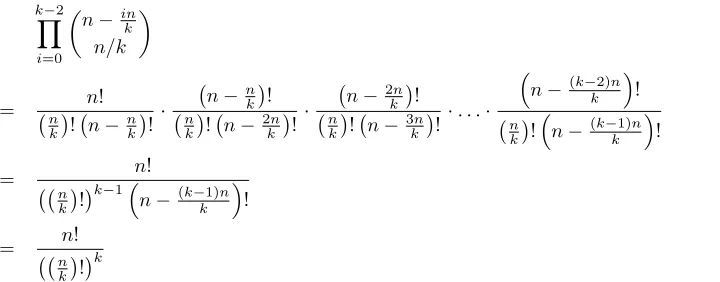
further choices, and so on. Assuming thatnis a multiple ofk(allowing equal sized tables), the number of possible plans is thus calculated:
k−2
Y
i=0
n−in k
n/k
= n n!
k
! n−n k
!·
n−n k ! n k
! n−2n k
!·
n−2n k ! n k
! n−3n k
! ·. . .·
n−(k−k2)n!
n k
!n−(k−k1)n!
= n!
n k
!k−1
n−(k−k1)n!
= n!
n k
!k (1)
This function clearly features a growth rate that is subject to a combinatorial explosion—even for the modestly sized example above, the number of distinct solutions to check is approximately2.9×1033, which is far
beyond the capabilities of any state of the art computing equipment. Furthermore, if we were to relax the problem by allowing tables of any size, the task would now be to partition thenguests intoknon-empty subsets, meaning that the number of solutions would be equal to a Stirling number of the second kindS(n, k). These numbers feature even higher growth rates than Equation (1), giving even larger solution spaces.
Such arguments demonstrate that this sort of naive method for producing a desirable seating plans is clearly infeasible in most cases. However, the problem of constructing seating plans is certainly important since (a) it is regularly encountered by event organisers and (b) the quality of the proposed solution could have a significant effect on the success (or failure) of the gathering.
[image:2.612.128.488.70.211.2]Currently there is a small amount of commercial software available for constructing seating plans [1, 2, 3]. The first of these, for example, allows users to input a list of guest names and then specify preferences between these guests (such as whether they need to be sat apart or together). It then allows users to define table shapes, sizes and locations, before assisting the user in placing the guests at these tables via drag and drop functionality and also an auto assign tool. The details of the underlying algorithm used with the auto assign tool are commercially sensitive, though the software’s documentation states that a genetic algorithm is used, with different penalty costs being applied for different types of constraint violation. The fitness function of the algorithm is simply an aggregate of these penalties.
In its simplest form the problem of constructing a seating plan might be defined using ann×nbinary matrixW, where elementWij = 1if guestsiandjare required to be sat at different tables andWij = 0
otherwise. We can also assume thatWij =Wji. Given this input matrix, our task might then be to partition
thenguests intoksubsetsS={S1, . . . , Sk}, such that the objective function:
f(S) =
k
X
t=1
X
∀i,j∈St:i<j
Wij (2)
is minimised. The problem of confirming the existence of a zero cost solution to this problem is clearly equivalent to theN P-complete graphk-colourability problem [8, 10], in which each guest corresponds to a vertex, and two verticesvi andvj are considered adjacent if and only ifWij = 1. ThisN P-completeness
obviously suggests that there exists no polynomially bounded algorithm for exactly solving all instances of the problem [8].
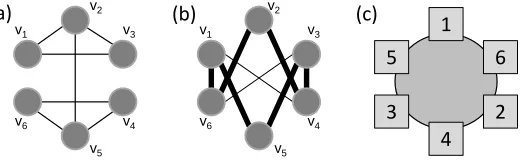
From an alternative perspective, consider the situation where we are again given the binary matrixW, and where we are now given a subsetSof guests that have been assigned to a particular circular shaped table. Here, we might be interested in arranging the guests onto the table such that, for all pairs of guestsi, j∈S, if
Wij = 1theniandjare not sat in adjacent seats. This problem can also be described by a graphG= (V, E)
for which the vertex setV = {vi : i ∈ S}and the edge setE = {{vi, vj} : Wij = 1 ∧ vi, vj ∈ V}.
1
4
6
2
5
3
v1v2
v3
v4
v5 v6
v1
v2
v3
v4
v5 v6
(a)
(b)
(c)
Figure 1: (a) A graphGin which edges specify pairs of guests who should not be sat in adjacent seats; (b) the compliment graphG¯, together with a Hamiltonain cycle (shown in bold); and (c) the corresponding seating arrangement around a circular table.
In practical situations it might be preferable forWto be an integer or real-valued matrix instead of binary, allowing users to place greater importance on some of their seating preferences compared to others. Assuming lower values forWij indicate an increased preference for guestsiandj to be sat together, the problem of
partitioning the groups on toktables now becomes equivalent to the edge-weighted graph colouring problem, while the task of arranging people on to circular tables in the manner described above becomes equivalent to the travelling salesman problem. Of course, both of these problems are also N P-complete since they generalise the graphk-colorability problem and the Hamiltonian cycle problem respectively [8]. In addition, the problem of arranging guests around tables can become even more complicated when tables of different shapes are used. For example, with rectangular tables we might also need to take account of who is sat opposite a guest in addition to their neighbours on either side.
At the time of writing, there seems to be very little research into the problem of constructing seating plans. In fact, we have come across just one paper on the subject written in 2012 by Bellows and Luc Peterson [4] who proposed an approach using IP methods. In their case, the authors made use of ann×ninteger matrix as described above. They also specified a limit on the number of guests allowed per table, and stipulated a parameterγsuch that a solution was considered feasible only if each guest was friends with at leastγguests on his or her table. In their paper, the authors then went on to consider a practical problem involving 107 guests and 11 tables (actually from their own wedding day!) and ran this on the commercial solver CPLEX for 36 hours. A feasible solution to their problem was produced in this time, but no certificate of optimality was obtained by the software.
In this current paper we also focus our attention on creating seating plans for wedding parties making use of the problem model used with our commercial websitewww.weddingseatplanner.com. This website contains a free tool, embedded within a webpage, for inputting and solving instances of the problem. It is stated by Nielsen [13] that users tend to leave a website in less than two minutes if it is not understood or perceived to fulfil their needs. Consequently, our particular problem model is designed to strike what we feel to be the right balance between being quickly accessible to users, while still being useful in practice. This means that some of the issues discussed above are deliberately left out. The main focus of this paper is to describe the heuristic algorithm that is used for calculating seating plans based on the users’ input. Since users will typically have little knowledge of optimisation algorithms and the implications ofN P-hardness, this algorithm is specifically designed to supply the user with high-quality (though not necessarily optimal) solutions in very short amounts of run time (typically less than three seconds). In particular, our approach seeks to exploit the underlying graph-based structures of this problem, encouraging an effective navigation of the solution space via specialised neighbourhood operators.
[image:3.612.156.416.41.121.2]2
Problem Description
In our definition of this problem, we choose to first partition the guests into a number ofguest groups. Each guest group refers to a subset of guests who are required to sit together (couples, families with young children, etc.) and will usually be known beforehand by the user. In addition to making the problem smaller, specifying guest groups in this way also means that users do not have to subsequently input preferences between pairs of people in the same families etc. to ensure that they are sat together in a solution.
Having done this, the Wedding Seating Problem (WSP) can now be formally stated as type of graph partitioning problem. Specifically, we are given a graph G = (V, E)comprising a vertex setV and edge setE. Each vertexv ∈ V represents a guest group, with the size of each guest group denotedsv. The total
number of guests in the problem is thusn=P
v∈V sv.
InG, each edge{u, v} ∈Edefines the relationship between verticesuandvaccording to a weighting
wuv(wherewuv=wvu). Ifwuv>0this is interpreted to mean that we would prefer the guests associated with
verticesuandvto be sat on different tables. Larger values forwuvreflect a strengthening of this requirement.
Similarly, negative values forwuvmean that we would ratheruandvwere assigned to the same table.
A solution to the WSP is consequently defined as a partition of the vertices intoksubsetsS={S1, . . . , Sk},
such that:
k
[
i=1
Si = V, and (3)
Si∩Sj = ∅ ∀i, j∈ {1, . . . , k}, i6=j (4)
The requested number of tableskis defined by the user, with each subsetSidefining the guests assigned to
a particular table.
Under this basic definition of the problem, the quality of a particular candidate solution might be calcu-lated according to various different metrics. In our case we use two objective functions, both that are to be minimised. The first of these is analogous to Equation (2):
f1=
k
X
i=1
X
∀u,v∈Si:{u,v}∈E
(sv+su)wuv (5)
and reflects the extent to which the rules governing who sits with whom are obeyed. In this case the weighting
wuv is also multiplied by the total size of the two guest groups involved sv +su. This is done so that
violations involving larger numbers of people contribute more to the cost (i.e., it is assumed thatsvpeople
have expressed a seating preference in relation to guest groupu, andsupeople have expressed a preference
in relation to guest groupv).
The second objective function used in our model is intended to encourage equal numbers of guests being assigned to each table. In practice some weddings may have varying sized tables, and nearly all weddings will have a special “top table” where the bride, groom and their associates sit. In practice the top table and its guests can be ignored in this particular formulation because they can easily be added to a table plan once the other guests have been arranged. We also choose to assume that the remaining tables are be equi-sized, which seems to be a very common option, particularly for large venues. Consequently, the second objective function measures the degree to which the number of guests per table deviates from the required number of eitherbn/kcordn/ke:
f2=
k
X
i=1
(min (|τi− bn/kc|,|τi− dn/ke|)). (6)
Hereτi = P∀v∈Sisv
denotes the number of guests assigned to each tablei. Obviously, if the number of guestsnis a multiple ofk, then Equation (6) simplifies tof2=Pik=1(|τi−n/k|).
2.1
Problem Complexity
Top table?
Guest name
Companion 1
Companion 2
Companion 3
1 Cath Michael Kurt Rosie
2 John Sarah Jack Jill
3 Bill June
4 Pat Susan
5 Una Tom
6 Ruth Kevin Gareth
7 Ken Frank Bobby
8 Rod Dereck Freddy
9 Jane
John+3 Bill+1 Pat+1 Una+1 Ruth+2 Ken+2 Rod+2 Jane
Jo
h
n
+3
B
ill+1
P
at
+1
Una
+1
Rut
h
+2
K
en
+2
R
o
d
+2
Jan
e
(a)
(b)
Figure 2: Specification of guest groups (a) and seating preferences (b).
• IfE =∅thenf1(Equation (5)) will always equate to zero. This means that the only goal is to ensure
that the number of guests per table is as equal as possible. Hence, the problem reduces to theN P-hard
k-partition problem.1
• Ifsv= 1∀v∈V, then all guest groups contain just one person, and the number of guests assigned to a
tableiwill equal the number of vertices in the group|Si|. Hence, the problem will now be equivalent to
theN P-hard equitable weightedk-colouring problem, itself a generalisation of theN P-hard equitable graphk-colouring problem [8].
3
Problem Interpretation and Tabu Search Algorithm
On entering the website, the user is first asked to input (or import) the names of all guests into an embedded interactive table. Guest groups that are to be seated together (families etc.) are placed on the same rows of the table, thus defining the various values forsv. Guests to be sat at the top table are also specified. At the next
step the user is then asked to define seating preferences between different guest groups. Since guests to be sat at the top table have already been given, constraints only need to be considered between the remaining guest groups (guests at the top table are essentially ignored from this point onwards).
Figure 2 shows a small example of this process. Here, nine guest groups ranging in size from 1 to 4 have been input, though one group of four has been allocated to the top table. Consequently, only the remaining eight groups (n= 20guests) are considered. The right-hand grid then shows the way in which the seating preferences (values forwuv) are defined between these. On the website this is done interactively by clicking
on the relevant cells in the grid. In our case, users are limited to three options: (1) “Definitely Apart” (e.g., Pat and John); (2) “Rather Apart” (Pat and Ruth); and (3) “Rather Together” (John and Ken). These are allocated weights of∞,1, and−1respectively for reasons that will be made clear below. Note that it would have been possible to allow the user to input their own arbitrary weights here; however, while being more flexible, it was felt by the website’s interface designers that this ran the risk of bamboozling the user while not improving the effectiveness of the tool [6].
Once the input to the problem has been defined by the user, the overall strategy of our algorithm is to classify the requirements to the problem as either hard (mandatory) constraints or soft (optional) constraints. In our case we consider just one hard constraint, which we attempt to satisfy in Stage 1—specifically the constraint that all pairs of guest groups required to be “Definitely Apart” are assigned to different tables. In Stage 2, the algorithm then attempts to reduce the number of violations of the remaining constraints via specialised neighbourhood operators that do not allow any of the hard constraints satisfied in Stage 1 to be re-violated. The two stages of the algorithm are now described in more detail.
1Note that thek-partition problem is also variously known as the load balancing problem, the equal piles problem, or the
3.1
Stage 1
In Stage 1 the algorithm operates on the sub-graphG0= (V, E0), where each vertexv∈V represents a guest group, and the edge setE0 ={{u, v} ∈E :wuv =∞}. That is,G0contains only those edges fromEthat
define the “Definitely Apart” requirement.2 Using this sub-graph, the problem of assigning all guests tok
tables (while not violating the “Definitely Apart” constraint) is equivalent to the graphk-colouring problem, as noted in Section 1.
The graphk-colouring problem is a widely studied combinatorial optimisation problem for which a mul-titude of different approximation algorithms have been proposed [10]. In our case, we use a variant of the DSATURheuristic [5] to produce an initial solution. DSATURis a constructive algorithm that seeks to colour the most constrained vertices first. Specifically, at each iteration DSATUR selects the uncoloured vertexv
that currently has the largest number of distinct colours assigned to adjacent vertices. Any ties are broken by selecting the vertex amongst these with the largest degree. In our case the selected vertexvis then assigned to the colouri ∈ {1, . . . , k}that (a) currently features no other vertices adjacent tov, and (b) contains the fewest vertices, encouraging an equitable spread of the vertices amongst the colours. If no colour satisfying (a) exists, thenvis kept to one side and is assigned to a random colour at the end of the construction process, thereby introducing hard constraint violations.
If the solution produced by the above constructive process contains hard constraint violations, an attempt is then made to eliminate these. This is achieved using the TABUCOLalgorithm of Hertz and de Werra [9, 7] which, while perhaps not as powerful as more contemporary graph colouring algorithms, does have the advan-tage of being very fast (see [10] for further details). In essence, TABUCOLuses the tabu search metaheuristic to make a series of small changes (moves) to the candidate solution, attempting to find a solution for which the cost functionf1= 0(usingG0). A move in the search space is performed via a neighbourhood operator
that takes a vertexvwhose assignment to colouriis currently contributing to the cost, and then assigns it to a new colourj 6=i. The tabu list is stored in a matrixT|V|×k and, upon performing this move, the element
Tviis marked as tabu for the nexttiterations (meaning thatvcannot be transferred back to colouriduring
this time). In each iteration of TABUCOL, all possible moves from the current solution are considered, and the one that is chosen is the move seen to invoke the largest decrease (or failing that, the smallest increase) in cost of any non-tabu move. Ties are broken randomly and, as an aspiration criterion, tabu moves are also permitted if they are seen to improve on the best solution observed so far by the algorithm.
Because speed is a major issue with our online tool, TABUCOLis only run for a fixed number of itera-tions.3 In the online tool, if at the end of the process a solution with costf
1 = 0(usingG0) has not been
achieved,kis incremented by one, and Stage 1 of the algorithm is repeated. This situation might occur be-cause the user has specified ak-value for which nok-colouring exists (that is,kis smaller that the chromatic number ofG0); however, it might also be the case that feasible solutionsdoexist, but that the algorithm has been unable to find one within the given computation limit. This process of incrementingkand reapplying DSATURand TABUCOLcontinues until all of the hard constraints have been satisfied, resulting in a proper
k-colouring ofG0.
3.2
Stage 2
At the start of Stage 2 we will have achieved ak-colouring ofG0 = (V, E0)for which no pair of adjacent vertices is assigned the same colour. We call such a solutionfeasiblebecause it obeys all of the imposed hard constraints of the problem. In the second stage of this algorithm we now try to eliminate violations of the soft constraints by exploring the space of feasible solutions: that is, we will attempt to make alterations to our seating plan in such a way that no violations of the “Definitely Apart” constraint are reintroduced. Note that movements in this space might be restricted—indeed the space might even be disconnected—and so it is necessary to use neighbourhood operators that provide as much solution space connectivity as possible. In our case this is achieved using tabu search in conjunction with two neighbourhood operators, both that attempt to exploit the structure of the underlying graph colouring problem. These operators are defined as follows:
2For example, using the problem shown in Figure 2,V ={v
2, v3, . . . , v9}andE0={{v2, v4},{v3, v5},{v4, v8}}.
3Specifically, TABUCOLis executed for20niterations, using a tabu tenuretproportional to the current cost (t= 0.6f
1+r, where
1
1
2
2
2
5
5
v1 v2
v3
v4
v5
v6
v7 v8
v9 v10
3
3
1
1
2
2
2
5
5
v1 v2
v3
v4
v5
v6
v7 v8
v9 v10
3
3
[image:7.612.86.501.36.123.2](a)
(b)
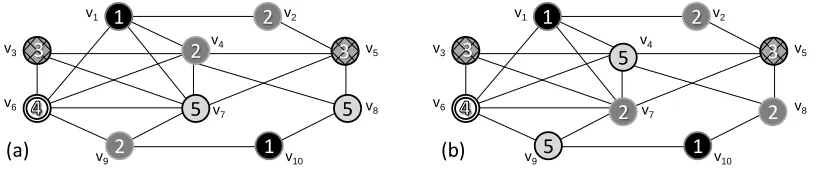
Figure 3: Two examples of a feasible five-colouring of graphG0 = (V, E0).
Kempe-Chain Interchange: Given an arbitrary vertexvcurrently assigned to colouri, and given a second
colourj 6= i, a Kempe-chain is defined as a connected subgraph inG0 that containsvand that only comprises vertices coloured withiandj. Such a chain can be denoted KEMPE(v, i, j).
A Kempe-chain interchange involves taking a particular Kempe-chain and swapping the colours of all vertices contained within it. For example, in Figure 3(a), KEMPE(v7,5,2) results in a chain involving
vertices{v4, v9}(assigned to colour 2) and{v7, v8}(assigned to colour 5). The colours of these vertices
are then interchanged, as with Figure 3(b). With regards to seating plans, a Kempe-chain move therefore involves interchanging two sets of guest groups between their respective tables.
It is worth noting that, given a feasible solutionS ={S1, . . . , Sk}, the application of a Kempe-chain
interchange will always result in a new solutionS0 that is also feasible. To prove this, consider the
contrary situation in whichSis feasible but whereS0is not. Since a Kempe-chain interchange involves
two colours iandj, this means S0 features a pair of adjacent verticesuandv that are assigned the
same colour. Without loss of generality, assume this to be colouri. Moreover,uandvmust have both been in the Kempe chain used for the interchange since they are adjacent. This now implies thatuand
vwere both assigned to colourjinS, which is impossible sinceSis known to be feasible.
It is also worth noting that Kempe-chains can vary in size (in terms of the number of vertices they contain), and and that some combinations for KEMPE(v, i, j) willoverlapin that they result in the same Kempe-chain being identified (e.g., KEMPE(v7,5,2) = KEMPE(v9,2,5) in Figure 3). Indeed, as
the number of colours k is reduced, or the density ofG0 is increased, then so will the size of the chains and the amount of overlap. This feature is relevant with applications of tabu-search such as ours because, with appropriate book-keeping, we can avoid evaluating the effects of a particular interchange more than once when scanning the entire neighbourhood in each iteration.
Swaps: The swap operator is used for performing further moves that are not contained within the
Kempe-chain neighbourhood. Specifically, when scanning the set of Kempe-Kempe-chain interchanges, we might also identify pairs of non-adjacent vertices u, v that both feature Kempe-chains KEMPE(u, i, j) and KEMPE(v, j, i) that are of size 1 (see, for example KEMPE(v1,1,3)and KEMPE(v5,3,1) in Figure. 3(a).)
In these particular casesuandvcan have their colours swapped, but no hard constraint violations will occur as a result.
In each iteration of Stage 2, all possible moves from both of the above neighbourhoods are evaluated and the same acceptance criteria as Stage 1 are applied. Once a move is performed, all relevant parts of the tabu list
Tare updated to reflect the changes made to the solution.4
The cost function used in this stage is simply(f1+f2). This will always evaluate to a value less than
∞since violations of the hard constraints cannot occur. Although such an aggregate function is not wholly ideal (because it involves adding together two different forms of measurement) it is considered acceptable in our case because in some sense both metrics relate to the number of people effected by the violations—that is, a table that is considered too havextoo many (or too few) people will garner the same penalty cost asx
violations of the “Rather Apart” constraint.
4That is, all vertices and colours involved in the move are marked as tabu inT. For speed’s sake, in our application a fixed-size tabu
0 10 20 30 40 50 60 70
3 8 13 18 23 28 33 38
Cos
t
k p=0.0
p=0.3 p=0.6 p=0.9
0 1 2 3 4 5
3 8 13 18 23 28 33 38
CPU
ti
m
e (
s
)
k p=0.0
p=0.3 p=0.6
[image:8.612.78.499.43.157.2]p=0.9
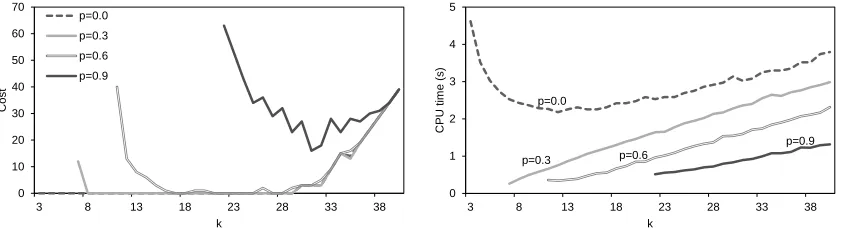
Figure 4: Solution costs (left) and run times (right) for four instances using variousk-values. For most of the left figure, the line forp= 0.0is obscured by the line forp= 0.3(i.e., the same results were achieved).
4
Algorithm Performance
The algorithm and interface described above has been implemented in ActionScript 3.0 and can be accessed atwww.weddingseatplanner.com(note that an installation of Adobe Flash Player is required). The opti-misation algorithm is therefore run at the client side. To ensure run times are kept relatively short, and to also allow the interface to be displayed clearly on the screen, problem size has been limited to|V| = 50guest groups of up to 8 people, allowing a maximum ofn= 400guests.
To gain an understanding of the performance characteristics of this algorithm, a set of maximum-sized problem instances of|V|= 50guest groups were constructed, with the size of each group chosen uniform randomly in the range 1 to 8 givingn ≈ 50×4.5 = 225. These instances were then modified such that a each pair of vertices was joined by an∞-weighted edge with probabilityp, meaning that a proportion of approximatelypguest group pairs would be required to be “Definitely Apart”. Tests were then carried out using values ofp={0.0,0.3,0.6,0.9}with numbers of tablesk={3,4, . . . ,40}.
Figure 4 shows the results of these tests with regard to the costs and run times that were achieved by our algorithm at termination. Note that forp≥0.3, values are not reported for the lowestk’s because feasible
k-colourings were not achieved (possibly because they do not exist). Also note that all runs took less than five seconds on a fairly standard desktop computer (all results reported in this paper were achieved using a 3.0 GHz Windows 7 machine with 3.18 GB RAM).
Figure 4 (left) shows that, with no hard constraints (p= 0.0), balanced table sizes have been achieved with allk-values up to 30. Beyond this point, however, it seems there are simply too many tables (and too few guests per table) to spread the groups evenly. Higher costs are also incurred for larger values ofpbecause, in these cases, many guest group combinations (including many of those required for achieving low cost solutions) will now contain at least one hard constraint violation, meaning they cannot be assigned to the same table. That said, in these trials similar solutions have been achieved forp= 0.0,0.3, and0.6for various values of k, suggesting that the cost of the best solutions found is not unduly affected by the presence of moderate levels of hard constraints. The exception to this pattern, as shown in Figure 4 (left), is for the lowest achievable values for k. Here, the larger number of guest groups per table makes it more likely that any particular combination will be deemed infeasible, reducing the number of possible feasible solutions, and making the presence of a zero-cost solution less likely.
5
Comparison to an IP Model
To further analyse the performance of our algorithm in terms of both solution quality and run time, we also choose to compare our results to those achieved by a commercial solver (using a branch and bound framework) applied to an equivalent integer programming (IP) version of this problem. One of the advantages of an IP approach is that, given excess time, we can determine with certainty the optimal solution or, indeed, whether a feasible solution actually exists to the problem. In contrast to our tabu search-based method, the IP solver is therefore able to provide the user with a certificate of optimality and/or infeasibility, at which point it can be halted. Of course, due to the underlying complexity of the WSP these certificates will not always be produced in reasonable time, but given the relatively small problem sizes being considered here, it is still pertinent to ask how often this is the case, and to also compare the quality of the IP solver’s solutions to our tabu search approach under similar time limits.
The WSP can formulated as an IP problem as follows. Recall that there are|V|guest groups that we seek to partition on toktables. Accordingly, the seating preferences of guests can be expressed using a symmetric
|V| × |V|matrixW, where:
Wij =
∞ if we require guest groupsiandjto be “definitely apart”;
1 if we would preferiandjto be on different tables (“rather apart”);
−1 if we would preferiandjto be on the same table (“rather together”);
0 otherwise.
(7)
As before, we also letsidefine the size of each guest groupi∈ {1, . . . ,|V|}. A solution to the problem can
then be represented by a|V| × |V|binary matrixX, where:
Xit=
1 if guest groupiis assigned to tablet,
0 otherwise, (8)
and a binary vectorYof length|V|, where:
Yt=
1 if at least one guest group is assigned to tablet,
0 otherwise, (9)
subject to the following constraints:
|V| X
t=1
Xit = 1,∀i∈ {1, . . . ,|V|} (10)
Xit+Xjt ≤ Yt,∀i, j:Wij =∞,∀t∈ {1, . . . ,|V|} (11)
Xit = 0,∀i∈ {1, . . . ,|V|},∀t∈ {k+ 1, . . . ,|V|} (12)
Yt = 0,∀t∈ {k+ 1, . . . ,|V|} (13)
Xit = 0,∀i∈ {1, . . . ,|V|},∀t∈ {i+ 1, . . . ,|V|} (14)
Xit ≤ i−1
X
j=t−1
Xjt−1,∀i∈ {2, . . . ,|V|},∀t∈ {2, . . . , i−1}. (15)
Here, Constraints (10) to (15) stipulate the hard constraints of the problem as before; hence, a solution sat-isfying these can be considered feasible in the same sense as defined in Section 3.2. These constraints are essentially an IP formulation of the graphk-colouring problem. Constraint (10) states that each guest group should be assigned to exactly one table, while (11) specifies that no pair of guest groups should be assigned to the same table if they are subject to a “Definitely Apart” constraint, withYt = 1when at least one guest
group has been assigned to table t. Constraints (12) and (13) then ensure that a maximum ofktables are used. Finally, Constraints (14) and (15) are used to eliminate symmetries in the IP model, as suggested by M´end´ez-Diaz and Zabala [12]. Without these, any particular solution usingktables could be expressed in
for each possible feasible solution (that is, the columns are sorted according to the minimally labelled guest group in each table).
As before, the quality of a feasible candidate solution is quantified using the sum of the two previously defined objective functions(f1+f2). For this IP model,f1is rewritten:
f1=
k
X
t=1 |V|−1
X
i=1 |V| X
j=i+1
XitXjt(si+sj)Wij (16)
in order to cope with the binary matrix method of solution representation; however, it is equivalent in form to Equation (5). Similarly,f2in the IP model is defined in the same manner as Equation (6), except thatτiis
now calculated asτi=P| V|
j=1Xjtsj. Again, this is equivalent to Equation (6).
It is worth noting here that the objective function defined in Equation (16) actually contains a quadratic term, making our proposed mathematical model a binaryquadraticinteger program. Although modern com-mercial IP solvers such as XPressMP and CPLEX can cope with such formulations, the use of quadratic objective functions is often known to hinder performance. One way to linearise this model is to introduce an additional auxiliary binary variable:
Zijt =
1 if guest groupsiandjare both assigned to tablet,
0 otherwise, (17)
together with the following additional constraints:
Zijt = 0,∀i∈ {1, . . . ,|V|},∀j∈ {1, . . . , i},∀t∈ {1, . . . , k} (18)
Zijt = 0,∀i∈ {1, . . . ,|V|},∀j∈ {1, . . . ,|V|},∀t∈ {k+ 1, . . . ,|V|} (19)
Zijt ≤
1
2(Xit+Xjt),∀i∈ {1, . . . ,|V| −1},∀j∈ {i+ 1, . . . ,|V|},∀t∈ {1, . . . , k} (20) Zijt ≥ (Xit+Xjt)−1,∀i∈ {1, . . . ,|V| −1},∀j∈ {i+ 1, . . . ,|V|},∀t∈ {1, . . . , k}. (21)
These constraints ensure that the correct values are assigned to the variablesZijt. They also allow us to restate
the objective functionf1in the linear form:
f1=
k
X
t=1 |V|−1
X
i=1 |V| X
j=i+1
Zijt(si+sj)Wij. (22)
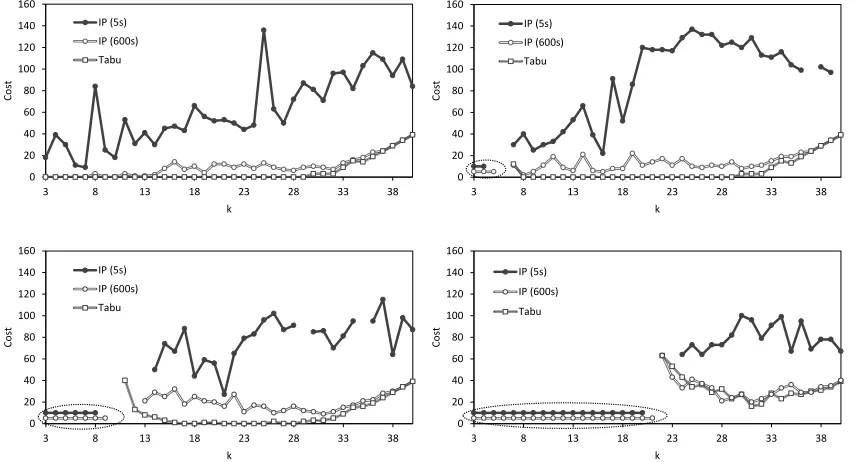
In our experiments, both IP formulations were tested using the commercial software XPressMP (version 7.7). We repeated the experiments of Section 4 using two time limits: five seconds, which was approximately the longest time required by our tabu search algorithm (see Figure 4); and 600 seconds, to gain a broader view of the IP solver’s capabilities with these formulations. Across the 152 combinations ofpandk, under the five second limit the linear model produced feasible solutions for just 11 cases compared to the quadratic model’s 112. Similarly, the number of cases where certificates of infeasibility were returned were 24 and 26 respectively. The underperformance of the linear model in these cases may well be due to the much larger number of variables and constraints involved, which seems to present difficulties under this very strict time limit. That said, even though the models’ results became more similar under the 600 second time limit, the costs returned by the linear model were still consistently higher than the quadratic model’s. Consequently, only the results from the quadratic model are considered for the remainder of this section.
[image:10.612.101.506.296.367.2]The results of the trials are summarised in Figure 5. The circled lines in the left of the graphs indicate values ofkwhere certificates of infeasibility were produced by the IP solver under the two time limits. As might be expected, these certificates are produced for a larger range ofk-values when the longer time limit is used; however, for p ∈ {0.3,0.6}there remain values ofk for which feasible solutions have not been produced (by any algorithm) and where certificates of infeasibility have not been supplied. Thus we are none the wiser as to whether feasible solutions exist for these particulark-values. Also note that certificates of optimalitywere not provided by the IP solver in any of the trials conducted.
0 20 40 60 80 100 120 140 160
3 8 13 18 23 28 33 38
C
ost
k IP (5s)
IP (600s) Tabu
0 20 40 60 80 100 120 140 160
3 8 13 18 23 28 33 38
C
os
t
k IP (5s)
IP (600s) Tabu
0 20 40 60 80 100 120 140 160
3 8 13 18 23 28 33 38
Cost
k IP (5s)
IP (600s) Tabu
0 20 40 60 80 100 120 140 160
3 8 13 18 23 28 33 38
C
os
t
k IP (5s)
[image:11.612.74.500.45.276.2]IP (600s) Tabu
Figure 5: Comparison of solution costs achieved using the IP solver (using 2 different time limits) and our tabu search-based approach forp= 0.0(top-left),p= 0.3(top-right),p= 0.6(bottom-left), andp= 0.9
(bottom-right).
in seven of the 121 cases where tabu search has been successful. When the extended run time limit is applied, this gap in performance diminishes, but similar patterns still emerge. We see that the tabu search algorithm has produced feasible solutions whenever the IP approach has, plus three further cases. In addition, in the 119 cases where both algorithms have achieved feasible solutions, tabu search has produced superior quality solutions in 94 cases, compared to the IP method’s six. However, we must bear in mind that the IP solver has required more than400times the CPU time of tabu search to achieve these particular solutions, making it much less suitable for an online tool.
Finally, for completeness we also chose to re-implement the IP model of Bellows and Luc-Petersen [4] in our experiments. Recall from Section 1 that instead of using guest groups, their method uses the larger matrix
Wn×n in order to specify seating preferences between guests, with elementsWij receiving particularly
small values if the associated guests belong to families/couples etc.. However, their use of this larger problem matrix seems to increase run times quite dramatically. Indeed, in our tests using the same problem instances as Sections 4 and 5, no integer solutions were returned within the five second time limit forp≥0.3.
6
Conclusions and Discussion
This paper has discussed the interesting combinatorial problem of constructing seating plans. We have looked at this problem in broad terms and have then gone on to propose a formulation that generalises both the weighted graph colouring problem and thek-partition problem. An effective two-stage heuristic algorithm making use of concepts taken from the underlying graph colouring problem has been described for this model, and experiments have demonstrated the factors that influence solution quality and run times. The algorithm has also shown to produce solutions that are generally superior to those achieved by an IP approach under similar and extended time limits.
typically interested in dividing competitors into equal sized groups at the start of a tournament; however, we may also require seeded competitors to be assigned to separate tables. The vertices associated with such competitors would therefore form a clique in the underlying graph colouring model.
As we have noted, our algorithm design choices have been heavily influenced by the need of our online tool to produce good solutions in short amounts of time. If more computing power/time is available, further improvements to Stage 1 might be achieved using some of the more elaborate algorithms for graph colouring appearing in the literature, such as the evolutionary-based methods of Galinier and Hao [7] or Malaguti et al. [11] (see [10] for a survey). On the other hand, other neighbourhood operators or search methodologies (such as simulated annealing or tabu search with diversification techniques) might show promise in Stage 2, or we may see some benefit in choosing not to aggregate the objective functionsf1andf2and instead optimise
them separately using multiobjective-based techniques.
As we have seen, our problem formulation has been chosen to try to strike the right balance between being useful to users, while also being easy to understand. As part of this, in our online application we have chosen to allow only three different weights on edges:−1,1, and∞, corresponding to the constraints “Rather Together”, “Rather Apart”, and “Definately Apart” respectively. In practice however, our proposed algorithm could be applied to any set of weights. For example, we might choose to define a threshold valuec, and then consider any edge{u, v}with weightwuv ≥ cas a hard constraint, with the remaining edges then being
treated as soft constraints.5 On the other hand, if it is preferable to treat all constraints as soft constraints,
we might simply abandon Stage 1 and use the optimisation process of Stage 2 to search through the solution space comprising allk-partitions of the guest groups.
An additional advantage of our graph colouring-based model is that it can be easily extended to incorpo-rate “table specific” constraints that specify which table each guest group can and cannot be assigned to. To impose such constraints we first need to addkadditional vertices to the model, one for each available table. Next, edges of weight∞then need to be added between each pair of these “table-vertices”, thereby forming a clique of sizekand ensuring that each table-vertex is assigned to a different colour in any feasible solution. Having introduced these extra vertices we are now able to introduce other types of constraints into the model:
• If guest groupvis not permitted to sit at tablei, then an edge is imposed between vertexvand theith table vertex.
• If a guest groupvmust be assigned to tablei, then edges are imposed between vertexvand all table vertices except theith table vertex.
Note that if our model is extended in this way, we will now be associating each subset of guest groupsSiin
a solutionS = {S1, . . . , Sk}with a particular table numberi. Hence, we might also then permit tables of
different sizes and shapes in the model, perhaps also incorporating constraints concerning these factors into the objective function. Further constraints, such as making sure that a pair of guests are “at least xtables apart” might then also be considered [14].
Acknowledgement
The authors would like to thank the anonymous referee whose comments and suggestions helped to improve this manuscript.
References
[1] www.perfecttableplan.com. [2] www.seatingarrangement.com. [3] www.toptableplanner.com.
[4] M. Bellows and J. Luc Peterson. Finding an optimal seating chart.Annals of Improbable Research, 2012. [5] D. Brelaz. New methods to color the vertices of a graph.Commun. ACM, 22(4):251–256, 1979.
[6] F. Carroll and R. Lewis. The ‘engaged’ interaction: Important considerations for the hci design and development of a web application for solving a complex combinatorial optimization problem.World Journal of Computer Application and Technology, 1(3):75–82, 2013.
5That is, the graphG0used in Stages 1 and 2 would comprise edge setE0={{u, v} ∈E:w
[7] P. Galinier and J-K. Hao. Hybrid evolutionary algorithms for graph coloring.Journal of Combinatorial Optimiza-tion, 3:379–397, 1999.
[8] M. R. Garey and D. S. Johnson. Computers and Intractability - A guide to NP-completeness. W. H. Freeman and Company, San Francisco, first edition, 1979.
[9] A. Hertz and D. de Werra. Using tabu search techniques for graph coloring.Computing, 39(4):345–351, 1987. [10] R. Lewis, J. Thompson, C. Mumford, and J. Gillard. A wide-ranging computational comparison of
high-performance graph colouring algorithms.Computers and Operations Research, 39(9):1933–1950, 2012.
[11] E. Malaguti, M. Monaci, and P. Toth. A metaheuristic approach for the vertex coloring problem.INFORMS Journal on Computing, 20(2):302–316, 2008.
[12] I. M´endez-D´ıaz and P. Zabala. A cutting plane algorithm for graph coloring. Discrete Applied Mathematics, 156:159–179, 2008.
[13] J. Nielsen. The need for web design standards. Online Article: www.nngroup.com/articles/the-need-for--web-design-standards, September 2004.