Affectability of Splash Erosion by Polyacrylamide
Application and Rainfall Intensity
Mahdi BOROGHANI
1, Feryal HAYAVI
2and Hamzeh NOOR
31Department of Watershed Management Engineering, College of Natural Resources, Tarbiat Modares University, Noor, Iran; 2Department of Watershed Management Engineering,
Faculty of Natural Resources and Geo Sciences, Shahrekord University, Shahrekord, Iran; 3Young Researchers Club, Arak Branch, Islamic Azad University, Arak, Iran
Abstract: Splash erosion is recognized as the first stage in a soil erosion process and results from the soil surface bombing by rain drops. At the moment when rain drops conflict with the soil surface, soil particles move and destruct the soil structure. Soil particles dispersed by rain drops and moved by runoff are two basic soil erosion processes. In this study, the effect of applying various amounts of polyacrylamide (PAM) (0, 0.2, 0.4 and 0.6 g/m2) on the quantity of splash erosion at three rainfall intensities of 65, 95 and 120 mm/h by using of FEL3 rainfall simulator was investigated in marly soil in a laboratory. Results indicated differences in the effects of various treatments with PAM at all rainfall intensities, such as 0.6 g/m2 PAM had the maximum effect on the splash erosion control by reducing soil erosion by about 28.93%. But statistical results showed that the use of various amounts of PAM (0.2, 0.4 and 0.6 g/m2) for con-trolling splash erosion at various rain intensities to decrease splash erosion did not reveal a statistically significant difference. Therefore, the application of 0.2, 0.4 and 0.6 g/m2 PAM reduced the splash erosion, however, there was no statistical difference among these application rates of PAM. Finally, the results of statistical analysis of different inten-sities showed that only at 120 mm/h there was a significant difference between PAM treatment and control treatment (0 g/m2 PAM) in the splash erosion control. At this intensity, the treatment with 0.4 g/m2 PAM produced a maximum effect on the splash erosion control with 40% in comparison with the control treatment.
Keywords: marl formation; polyacrylamide; FEL3 rainfall simulator; splash erosion
Soil erosion is a global problem that threatens the natural resources seriously (Tripathi & Singh 2001). So the most important environmental issues are agriculture and food production in the world. In recent years these factors have been intensified with the population increase and human activi-ties transformation, so that about 75 billion tons of soils are eroded from lands each year (Lafen & Roose 1998; Brown & Quine 1999; Toy et al. 2002; Bayramin et al. 2003). Splash erosion is recognized as the first stage in a soil erosion process that results from the soil surface bombing by rain drops. Soil particles are separated by rain drops and these particles will be transmitted by
be identified as cationic, anionic or even nonionic atoms. Anionic PAMs, water-soluble compounds with about 150 000 monomers per molecule, are used for erosion and runoff control (Sojka et al. 2004). In comparison with other polymers, PAM is the best soil conditioner because the amount of PAM needed to achieve the same or even better results of soil protection is 10–100 times lower (Sojka 2006). The first comprehensive research on splash erosion and rain drop action mechanism on the soil surface was conducted by Elison at 1940 (Ghadiri 2006). The assessment of rain drop splash importance in water erosion that was an unantici-pated growth, opened a new era in soil erosion researches and caused a great extension in ero-sion anticipating models such as USLE, UROSEM and RUSLE. In these models the rain erosion po-tential is expressed as rain energy. After this big start, studying the rain drop effect and splash erosion was stopped for about 40 years. The main reason for this suspension was the complexity of processes that occur in a short time and result from rain drop confliction and studies of these processes also needed advanced equipment and accurate devices (Ghadiri 2006). Also marly lands with high development in Zagros, Alborz and central regions of Iran, cover a large area of the country (Feiznia et al. 2007). Marly units in watersheds have the highest rate of soil erosion and runoff yield. This property of marl plays an important role in reducing dam’s useful age, increasing the flooding potential in watersheds, increasing water channel sedimentation areas and marine deaths (Naghavi et al. 2008). In relation to the application of different materials in controlling soil erosion a lot of researches have been done, some of them are as follows.
Öztaş et al. (2002) studied the effect of differ-ent levels (0, 0.001, 0.003, 0.005 w/w) of polyvinyl alcohol in stabilizing clay, sandy clay loam and sandy soils. The results showed that the amount of 0.005 w/w in clay soil had the highest influence and stabilized the soil about 95% more than the control treatment. Xiubin and Zhanbin (2001) illustrated that a kind of soil that includes Zeolite can increase water infiltration in soil between 7 and 20% on a moderate slope, while on steep slopes it can cause a 30% increase in the infiltra-tion amount. Also studies that were conducted by researchers show that moisture increased between 0.4 and 1.8% in very dry conditions and between 5 and 15% in normal conditions. Sepaskhah and
Bazrafshan-Jahromi (2006) examined the effects of different levels of PAM (0, 1, 2, 4 and 6 kg/ha) on different slopes (2.5, 5 and 7.5%) using a rainfall simulator in Shiraz University laboratory. Results indicated that (7.5%) the amount of 6 kg/ha for reducing runoff had the greatest impact in steep slopes while the amount of 4 kg/ha had the great-est impact on erosion reduction in 5 and 7.5%. Wuddivira et al. (2009) examined the polar ef-fect of organic material and clay on the aggregate decomposition and splash value under different moisture treatments for 6 types of agricultural soils. Results showed that aggregate decomposi-tion and splash value for soil with average clay content and low organic matter were lower than this amount in soil with a great amount of clay and low organic matter. Therefore there is one threshold container for clay and an assumption that the more the amount of clay increases because of ability of cementation of removing mechanism the more erosion is reduced was rejected. The studies were accomplished using a soil conditioner on the runoff and sediment value and the effect of this material upon soil erosion includes remov-ing, transferring and deposition particularly of splash erosion as a starter and as the first process of soil erosion has not been attended yet. Stabili-zation of splash erosion, besides attention to its importance in destructing soil particles, moving these particles and polluters as the first process of soil erosion causes other kinds of erosions to be controlled. Also splash erosion control needs low cost in relation to other erosions. The purpose of this research is to investigate effects of various amounts of PAM (0, 0.2, 0.4 and 0.6 g/m2) on the
splash erosion control in marly soil and with rain intensities of 65, 95 and 120 mm/h using a FEL3 rainfall simulator.
MATERIAL AND METHODS
of Soil Conservation and Watershed Management Research Institute; the results of these studies are shown in Table 1.
Soil texture according to a hydrometer method was determined as silt-clay-loam and includes 34.8% clay, 17.2% sand and 48% silt.
FEL3 rainfall simulator model. For simulating rainfall, a FEL3 simulator model was used in the Soil Conservation and Watershed Management Institute. FEL3 rainfall simulator is a battalion page simulator that creates a good distribution of the raindrop sizes with their kinetic energy. Studying and researching on erosion, sedimentation, hydrol-ogy and watershed management are not possible without having proper and complete knowledge of rain and its related properties (Armen 2006). For studying soil erosion accurately, the rain that is produced by rainfall simulator must be quite similar to natural rainfall. This similarity must be applied in rainfall intensity, uniformity of rainfall intensity, raindrop size and velocity of rain drop incidence (Toy et al. 2002). In this study for the calibration of FEL3 rainfall simulator model two experiments were conducted as follows:
(1) Assessment of rainfall intensity and uniformity of rain intensity by increasing disk degrees (disk degrees can be changed by about 5–40 degrees). (2) Measuring the droplet diameter and its distribu-tion in order to assess the disk crater size in rainfall distribution. The rainfall intensities of 65, 95 and 120 mm/h were considered as suitable intensities for tests. Average simulated rain diameters equal to 1.2, 1.48 and 1.57 mm were calculated at inten-sities of 65, 95 and 120 mm/h. Kinetic energy of simulated rain for rain intensities of 65, 95 and 120 mm/h equal to 27.7, 29.14 and 30.02 J/m2 × mm
was calculated using the Wishmayer Smith equation (1958) (Jayavardn & Rzaur 1999).
Experiments. After calibration of the rainfall simulator and measuring oven-dried samples and treating them with PAM, samples were put un-der the rainfall simulator with rain intensity of 65, 95 and 120 mm/h for about 10 min for each treatment, there were 3 repetitions. In this study 3 treatments of PMA, i.e. 0.2, 0.4 and 0.6, were used and a comparison with the control treatment.
After stopping the rainfall, samples were put in an oven again for 24 h at a temperature of 105 cen-tigrade until their second weights were calculated.
Splash rate calculation method. According to Luk and Cai definition (1990), the splash erosion measure in time units and surface units is defined as erosion rate and calculated on the basis of Eq. (1) (Qinjuan et al. 2008).
(1)
where:
S – splash rate (g/(min × m2))
Dt1, Dt2 – sediment yield between t1 and t2 (g) t1, t2 – rain duration (min)
A – splash vessel surface (m2)
Splash erosion measure on the basis of Eq. (1) and splash erosion rate for each treatment were obtained by calculating the average from 3 exam-ined repetitions for that treatment in each sample.
Statistical analysis. After gathering and recording data in Excel environment, the SPSS 16.6 software (IBM, Armonk, USA)was used for statistical analy-ses. At the first stage, normally distributed variable test was performed using the Kolmogorov-Smirnov test. Then effectiveness value and significance of various values of PAM on controlling the splash erosion rate at each texture were tested by compar-ing averages and uscompar-ing one-way analysis of variance and simultaneous investigation of 2 factors intensity and different treatments of PAM on splash erosion and also by using two-way analysis of variance (Jain & Indurthy 2003). In this research all statistical analyses were done at a 95% certainty level.
RESULTS
The results of statistical analyses show that dif-ferent rates of PAM (0, 0.2, 0.4 and 0.6 g/m2) for
controlling erosion at rain intensities of 65, 95 and 120 mm/hdid not provide any significant ences. In contrast, there was a significant differ-ence between different rates of PAM and control treatment. In addition, the interaction between
Table1. Tested soil characteristics
Organic material (%) Lime stone (%) Electrical conductivity (MS/cm) pH
0.333 7.03 16.96 7.52
the intensity of two main factors and treatments (the rates of PAM) was not significantly different (Table 2). These results show that different rates of PAM (0, 0.2, 0.4 and 0.6 g/m2) had a considerable
effect on splash erosion reduction in comparison with the control treatment.
The results of Table 3 document that there is a significant difference between treatment 1 and treatments 3 and 4. With no consideration of rain-fall intensity treatment, the rate of 0.6 g/m2 of PAM
has the highest effect on the splash erosion control. Using this amount of PAM, we would have about 27.44% reduction in splash erosion while the rates of 0.2 and 0.4 g/m2 cause about 13.8 and 23.43%
decrease in soil erosion, respectively.
[image:4.595.64.534.258.311.2]In order to investigate the effects of treatments in each intensity of rain individually, one-way analysis of variance was performed. Now the ef-fects of different treatments of PAM were studied at rain intensities separately.
Table 2. The results of two-way analysis of variance of the intensity of two factors and various treatments with polyacrylamide (PAM)
Sum of squares df Mean square F Significance
Rain intensity 823 2 411.5 2.1 0.135
PAM treatment 2246 3 748.7 3.9 0.02
Treatment × rain intensity 923 6 153.8 0.81 0.568
Within groups 4527 24 188.6 – –
df – degree of freedom
Table 3. The results of a comparison of all treatment averages according to Duncan’s test (mean ± SD)
Treatment Control PAM (kg)
2 4 6
Splash (g/(min × m2)) 74.7 ± 15.1a 64.39 ± 14.3ab 57.2 ± 16.2b 54.2 ± 15.6b
PAM – polyacrylamide; bars with the same letters (a, b) do not differ significantly at level P = 0.05
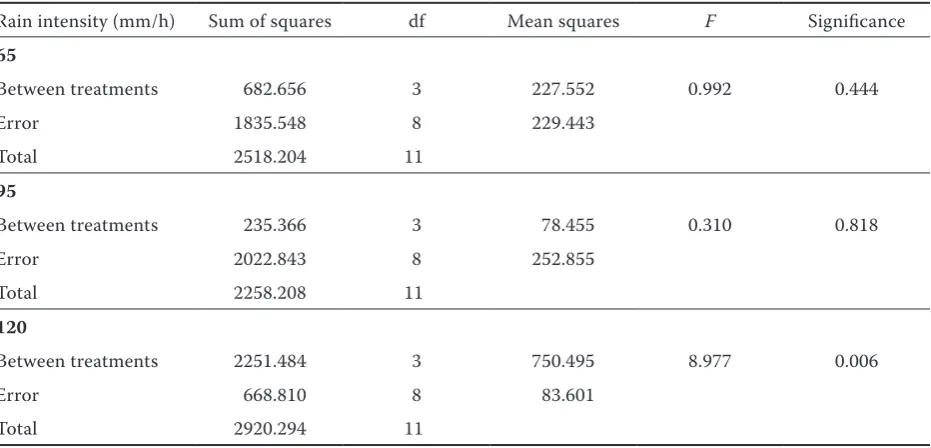
Table 4. The results of one-way analysis of variance at different rain intensities
Rain intensity (mm/h) Sum of squares df Mean squares F Significance
65
Between treatments 682.656 3 227.552 0.992 0.444
Error 1835.548 8 229.443
Total 2518.204 11
95
Between treatments 235.366 3 78.455 0.310 0.818
Error 2022.843 8 252.855
Total 2258.208 11
120
Between treatments 2251.484 3 750.495 8.977 0.006
Error 668.810 8 83.601
Total 2920.294 11
[image:4.595.66.532.516.740.2]Intensity of 65 mm/h
The results showed that different rates of PAM (0, 0.2, 0.4 and 0.6 g/m2) in the splash erosion
control did not produce any statistically signifi-cant difference in comparison with the control treatment (Table 4).
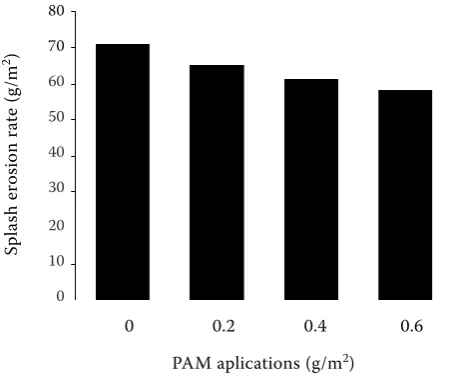
Figure 1 shows the effect of PAM on splash ero-sion in marly soil at the rain intensity of 65 mm/h. This figure also illustrates that the control treat-ment had the highest splash measure and by in-creasing PAM rates the amount of splash erosion is reduced. In this figure it can be understood
that the rate of 0.6 g/m2 has the highest effect
on reducing splash erosion. According to Table 4 there are not any significant differences between variant rates of PAM in comparison with the control treatment.
Intensity of 95 mm/h
Results of statistical analysis showed that at this rain intensity, different amounts of PAM did not provide any significant difference from the control treatment. In Table 4 one of the outputs of statistical analysis is presented.
Figure 2 illustrates the results of investigation of different rates of PAM (0.2, 0.4 and 0.6 g/m2)
on splash erosion reduction in marly soil at the rain intensity of 95 mm/h. As you can see, the higher the amount of this material, the lower the amount of splash erosion. According to what is presented in Table 4 there was not a significant difference between various amounts of PAM and control treatment.
Intensity of 120 mm/h
The results of statistical analysis show a significant difference between different rates of PAM (0.2, 0.4 and 0.6 g/m2) and control treatment at the rain
[image:5.595.63.287.80.276.2]intensity of 120 mm/h. This proves that PAM can be effective only at this rain intensity (Table 4). Figure 1. The variation of splash at different rates of
[image:5.595.314.530.84.266.2]polyacrylamide (PAM) at the rain intensity of 65 mm/h
Figure 2. The variation of splash at different rates of polyacrylamide (PAM) at the rain intensity of 95 mm/h
Figure 3. The variation of splash at a variant concen-tration of polyacrylamide (PAM) at the rain intensity of 120 mm/h
Spl
as
h er
osion ra
te (
g/m
2 )
PAM aplications (g/m2)
0 0.2 0.4 0.6
70
60
50
40
30
20
10
0
Spl
as
h er
osion ra
te (
g/m
2 )
PAM aplications (g/m2)
0 0.2 0.4 0.6
100 90 80 70
60 50 40 30 20 10 0
Spl
as
h er
osion ra
te (
g/m
2 )
PAM aplications (g/m2)
0 0.2 0.4 0.6
80 70
60 50
40 30
20 10
[image:5.595.62.289.529.718.2]The results in Table 5 show that the rate of 0.4 g/m2
has the highest effect on the splash erosion control in comparison with the others, as it caused about 40% depression in splash erosion while the rates of 0.2 and 0.6 g/m2 caused about 22 and 33%
de-crease, respectively. Figure 3 illustrates the results of PAM effects on splash erosion in marly soil at the rain intensity of 120 mm/h.
DISCUSSION
The results of this research document that the rates of 0.2, 0.4 and 0.6 of PAM did not result in any significant difference in reducing splash erosion at rain intensities of 65, 95 and 120 mm/h among all the intensities. The reason is that the molecules of polyacrylamide do not enter in the soil clog and remain on the soil surface and it can prevent soil surface cracks and stabilize soil clogs. In soils that are exposed to rain, aggregate fragmentation is the first stage that leads to the soil crust forma-tion. Due to high molecular weight this substance cannot penetrate into the aggregates and remains on their surfaces and causes the hardness of soil to be increased and not to be collapsed when the rain drops collide with soil and be resistant to erosion. This process decreases the splash erosion.
In this research due to high rain intensity and as a result of intensified bombardment of the soil surface with rain drops, the protective layer formed by polymers was degraded rapidly and did not have any effect on reducing splash erosion at various rain intensities. So lower rates should be considered for studying the effects of intensity. This paper aimed to study the effects of polymers in heavy and destruc-tive showers in arid and semiarid regions of Iran.
In contrast, the effect of different amounts of po-lyacrylamide (0.2, 0.4 and 0.6 g/m2) and the control
treatment illustrated a significant difference, in the interaction of intensity of two main factors and treatment no statistically significant difference was observed. Results showed that different amounts of polyacrylamide (0.2, 0.4 and 0.6 g/m2) were effective
in the splash erosion control in comparison with the control treatment and decreased the rate of splash erosion. The application of polyacrylamide (PAM) for stabilizing the soil structure and increasing its resistance to erosion causes a great depression in soil erodibility factor, increases water infiltration and reduces runoff. So this kind of polymer reduces splash erosion by increasing the resistance of soil to rain drop impact. On the other hand, this kind of erosion does not depend only on rain drop impact and the creation of one layer of water on the soil surface is worse than this factor and has a higher effect on erosion rate. In this situation the use of polymer can decrease the thickness of water layer by increasing penetration and also increase splash erosion. The results showed that the rate of 0.6 g/m2 had the
highest efficiency in the splash erosion control in comparison with the other rates of PAM at the rain intensity of 120 mm/h and the amount of 0.4 g/m2
was so effective in the splash erosion control that it could reduce the amount of soil erosion by about 40%. Aggregating PAM molecules on the soil surface cause the soil aggregations to become firm and soil erosion to be reduced. Splashing soil aggregations as the first step in the soil erosion process leads to the soil surface sealing. Because molecular weight is so high, soil erosion would be reduced as well. We can understand from the results of this research that for controlling soil erosion in marly soils, there is a need to use a considerable amount of PAM, because soil winds have a high potential in generating sediments and also as it was mentioned in research, the rate of 0.4 g/m2 of PAM has the highest effect on
[image:6.595.62.529.103.147.2]reduc-ing the erosion rate in soils. The result of this study has a great accordance with the results obtained by Sepaskhah and Bazrafshan-Jahromi (2006) and Aase et al. (1998). We concluded from results that PAM reduces erosion and it mainly reduces the initial stage of erosion, i.e. splash erosion. Controlling splash erosion is the most important factor in an erosion control program especially in the arid environment. Aggregating PAM molecules on the soil surface cause the soil aggregations to become firm and soil erosion to be reduced. Splashing soil aggregations Table 5. The results of a comparison of the means on the basis of Duncan’s test (mean ± SD)
Treatment Control 2 PAM (kg)4 6
Splash (g/(min × m2)) 89.3 ± 3.85a 69.2 ± 8.29b 53.12 ± 3.21b 59.4 ± 15.50b
as the first step in the soil erosion process leads to the soil surface sealing. Because molecular weight is so high, soil erosion would be reduced as well.
References
Aase J.K., Bjorneberg D.L., Sojka R.E. (1998): Sprinkler irrigation runoff and erosion control with polyacryla-mide – laboratory test. Soil Science Society of America Journal, 62: 1681–1687.
Armen M. (2006): Appointment effect land slope, soil texture, rainy period and intensity at soil erosion quan-tity with used rainfall simulator. [MS Thesis.] Gorgan University of Natural Resource and Agriculture Science, Gorgan. (in Persian)
Bayramin I.O., Baskan D., Parlak M. (2003): Soil erosion assessment with CONA model: case study Beypazri area. Turk Journal of Agriculture, 27: 105–116.
Brown A.G., Quine T.A. (1999): Fluvial Processes and Environmental Change. John Wiley and Sons, Chichester. Feiznia S., Heshmati M., Ahmadi H., Ghodosi J. (2007):
Investigation of gully erosion in marly Agha-Jari forma-tion in Zagross (case study: Ghasre-shirin, Kermanshah). Journal of Constituent Research in Natural Resource, 74: 32–40. (in Persian)
Ghadiri H. (2006): Raindrop impact and splash erosion. In: Lal R. (ed.): Encyclopedia of Soil Science. Taylor and Francis, New York, 1428–1432.
Jain A., Indurthy S.K.V.P. (2003): Comparative analysis of event based rainfall-runoff modeling technique-deter-ministic, statistical and artificial neural networks. Journal of Hydrologic Engineering, 8: 459–471.
Jayawardena A.W., Rezaur R.B. (1999): Evaluation of an interrill soil erosion model using laboratory catchment data. Hydrological Processes, 13: 89–100.
Lafen J.M., Roose E.J. (1998): Methodologies for assess-ment of soil degradation due to water erosion. In: Law R., Balum W.E., Valentine C. (eds): Soil Degrading. CRC Press, Boca Raton.
Leguedois S., Plannchon O., Legout C., Bissonnais Y.L. (2005): Splash projection distance for aggregated soils: theory and experiment. Soil Science Society of American Journal, 69: 30–37.
Luk S.H., Cai Q.G. (1990): Laboratory experiments on crust development and rain splash erosion of Loess soils, China. Catena, 17: 261–276.
Morgan R.P.C. (1987): Field studies of rainsplash erosion. Earth Surface Processes, 3: 295–299.
Naghavi Hassan Zade M., Feiznia S., Ahmadi H., Pey-rovan H.R., Ghayomean J. (2008): Investigation effect chemical and physical characteristic marl on the measure sediment with use rainfall simulator physical model. Journal of Geology Institute Iran Ingenerating, 1: 35–48. (in Persian) Öztaş T., Özbek A.K., Aksakal E.L. (2002): Structural
developments in soil treated with Polyvinylalcohol. In: Int. Conf. Sustainable Land Use and Management. Soil Science Society of Turkey, Canakkale, 143–148. Qinjuan C., Qiangguo C., Wenjun M. (2008):
Compara-tive study on rain splash erosion of representaCompara-tive soils in China. Chinese Geographical Science, 18: 155–161. Sepaskhah A.R., Bazrafshan-Jahromi A.R. (2006):
Controlling runoff and erosion in sloping land with po-lyacrylamide under a Rainfall Simulator. Biosystems En-gineering, 93: 497–474.
Sojka R.E., Orts W.J., Entry J.A. (2004): Soil physics and hydrology: conditioners. In: Hillel D. (ed.): Encyclopedia of Soil Science. Elsevier, Oxford, 301–306.
Sojka R.E. (2006): PAM Research Project. Available at http://kimberly.ars.usda.gov/pampage.html (accessed January 2, 2008).
Toy T.J., Foster G.R., Renard K.G. (2002): Soil Erosion: Processes, Prediction, Measurement, and Control. John Wiley and Sons, New York.
Tripathi R.P., Singh H.P. (2001): Soil Erosion and Conserva-tion. New Age International Ltd. Publishers, New Delhi. van Dijk A.I.J.M., Bruijnzeel L.A., Eisma E. H. (2003): A
methodology to study rain splash and wash processes un-der natural rainfall. Hydrological Processes, 17: 153–167. Wallace A., Wallace G.A. (1986): Effects of soil condi-tioners on emergence and growth of tomato, cotton, and lettuce seedlings. Soil Science, 141: 313–316.
Wischmeier W.H., Smith D.D. (1958): Rainfall energy and its relationship to soil loss. Transactions – American Geophysical Union, 39: 285–291.
Wuddivira M.N., Stone R.J., Ekwue E.I. (2009): Clay, organic matter and wetting effects on splash detachment and aggregate breakdown under intense rainfall. Soil Sci-ence Society of American Journal, 73: 226–232.
Xiubin H.E., Zhandin H. (2001): Zeolite application for enhancing water infiltration and retention in loess soil. Resources, Conservation and Recycling, 34: 45–52.
Received for publication November 22, 2011 Accepted after corrections May 29, 2012
Corresponding author: