1,8-Diiodoanthracene
Waka Nakanishi, Shunpei Hitosugi, Anna Piskareva and Hiroyuki Isobe*
Department of Chemistry, Tohoku University, Aoba-ku, Sendai 980-8578, Japan Correspondence e-mail: [email protected]
Received 25 August 2010; accepted 31 August 2010
Key indicators: single-crystal X-ray study;T= 100 K; mean(C–C) = 0.002 A˚; Rfactor = 0.014;wRfactor = 0.038; data-to-parameter ratio = 20.0.
The molecule of the title compound, C14H8I2, an intermediate in the synthesis of organic materials, is nearly planar, the maximum deviation from the mean plane being 0.032 (1) A˚ for the C atoms and 0.082 (2) A˚ for the I atoms. In the crystal structure, a sandwich–herringbone arrangement of molecules is observed, whereas a columnar-stacking arrangement has been reported for the chlorinated congener 1,8-dichloro-anthracene. Similar effects of halogen substituents on the modulation of packing arrangements are reported for halogenated aromatic compounds such as tetracenes and chrycenes.
Related literature
For the synthesis, see: Lovell & Joule (1997); Goichi et al.
(2005). For the crystal structure of related 1,8-dichloro-anthracenes, see: Desvergneet al., (1978); Beniteset al., (1996). For similar halogen effects on the arrangement of aromatic molecules, see: Moonet al.(2004); Isobeet al.(2009). For an example of synthetic utility of the title compound in organic materials, see: Nakanishiet al.(2010).
Experimental
Crystal data
c= 11.3930 (12) A˚
= 101.829 (1) V= 1226.0 (2) A˚3
Z= 4
= 5.10 mm
T= 100 K
0.200.200.10 mm
Data collection
Bruker APEXII CCD area-detector diffractometer
Absorption correction: multi-scan (SADABS; Sheldrick, 1996)
Tmin= 0.429,Tmax= 0.630
13646 measured reflections 2904 independent reflections 2783 reflections withI> 2(I)
Rint= 0.016
Refinement
R[F2> 2(F2)] = 0.014
wR(F2) = 0.038
S= 1.09 2904 reflections
145 parameters
H-atom parameters constrained
max= 0.62 e A˚ 3 min= 0.63 e A˚ 3
Data collection:APEX2(Bruker, 2006); cell refinement:SAINT (Bruker, 2004); data reduction:SAINT; program(s) used to solve structure:SHELXS97(Sheldrick, 2008); program(s) used to refine structure: SHELXL97 (Sheldrick, 2008); molecular graphics: ORTEP-3(Farrugia, 1997) andMercury(Macraeet al., 2008); soft-ware used to prepare material for publication:SHELXL97, Yado-kari-XG(Kabutoet al., 2009) andpublCIF(Westrip, 2010).
This study was partly supported by KAKENHI (21685005, 20108015 to HI and 22550094 to WN) and the Global COE
Program (Molecular Complex Chemistry). We thank
Professor T. Iwamoto for generous time for X-ray analysis. SH thanks the Global COE program for a predoctoral fellowship.
Supplementary data and figures for this paper are available from the IUCr electronic archives (Reference: JH2197).
References
Benites, M. R., Maverick, A. W. & Fronczek, F. R. (1996).Acta Cryst.C52, 647–648.
Bruker (2004).SAINT. Bruker AXS Inc., Madison, Wisconsin, USA. Bruker (2006).APEX2. Bruker AXS Inc., Madison, Wisconsin, USA. Desvergne, J.-P., Chekpo, F. & Bouas-Laurent, H. (1978).J. Chem. Soc. Perkin
Trans. 2, pp. 84–87.
Farrugia, L. J. (1997).J. Appl. Cryst.30, 565.
Goichi, M., Segawa, K., Suzuki, S. & Toyota, S. (2005).Synthesis, pp. 2116– 2118.
Isobe, H., Hitosugi, S., Matsuno, T., Iwamoto, T. & Ichikawa, J. (2009).Org. Lett.11, 4026–4028.
Kabuto, C., Akine, S., Nemoto, T. & Kwon, E. (2009).J. Cryst. Soc. Jpn,51, 218–224.
Lovell, J. M. & Joule, J. A. (1997).Synth. Commun.27, 1209–1216. Macrae, C. F., Bruno, I. J., Chisholm, J. A., Edgington, P. R., McCabe, P.,
Pidcock, E., Rodriguez-Monge, L., Taylor, R., van de Streek, J. & Wood, P. A. (2008).J. Appl. Cryst.41, 466–470.
Moon, H., Zeis, R., Borkent, E.-J., Besnard, C., Lovinger, A. J., Siegrist, T., Kloc, C. & Bao, Z. (2004).J. Am. Chem. Soc.126, 15322–15323.
Nakanishi, W., Hitosugi, S., Piskareva, A., Shimada, Y., Taka, H., Kita, H. & Isobe, H. (2010).Angew. Chem. Int. Ed.doi:10.1002/anie.201002432. Sheldrick, G. M. (1996).SADABS. University of Go¨ttingen, Germany.
Structure Reports Online
supporting information
Acta Cryst. (2010). E66, o2515 [doi:10.1107/S1600536810035191]
1,8-Diiodoanthracene
Waka Nakanishi, Shunpei Hitosugi, Anna Piskareva and Hiroyuki Isobe
S1. Comment
Acenes are important compounds for the development of organic electronics, and the halogenated derivatives are of
topical interest due to the unique packing arrangements (Moon et al., 2004; Isobe et al., 2009). The crystal structure of
1,8-dihaloanthracenes has been reported only for a chlorinated compound (Desvergne et al., 1978; Benites et al., 1996),
and a columnar π-stacking arrangement of the molecules in the crystal has been revealed. We obtained a single-crystal of
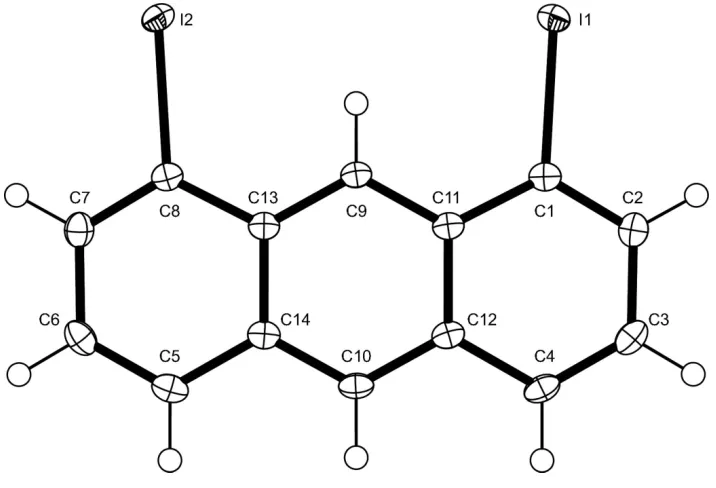
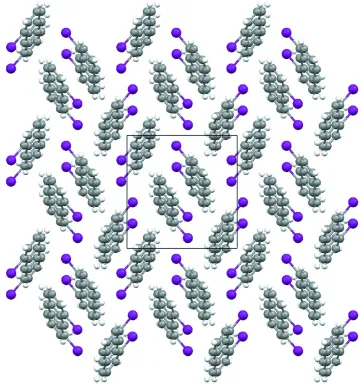
1,8-diiodoanthracene and found a sandwich-herringbone arrangement of the molecules in the crystal. The molecular
structure is shown in Fig. 1, and the packing structure is shown in Fig. 2. The distance of π-stacking between the
sandwiched dimer is 3.401 Å. The CH-π and halogen-π distances for the herringbone contacts are 2.908 (7) and 3.446 (3)
Å, respectively.
S2. Experimental
The title compound was synthesized from 4,5-diiodo-9-anthrone by a procedure similar to those reported in literatures
(Lovell et al., 1997; Goichi et al., 2005). A single-crystal suitable for X-ray crystallographic analysis was obtained by
recrystallization from a mixture of hexanes and dichloromethane (5:1).
S3. Refinement
H atoms were included in calculated positions and treated as riding atoms, with C—H = 0.9 Å (aromatic) and Uiso(H) =
Figure 1
Figure 2
The sandwich-herringbone packing of the title compound, viewed along the a axis.
1,8-Diiodoanthracene
Crystal data
C14H8I2
Mr = 430.00
Monoclinic, P21/c
Hall symbol: -P 2ybc
a = 10.1167 (11) Å
b = 10.8680 (11) Å
c = 11.3930 (12) Å
β = 101.829 (1)°
V = 1226.0 (2) Å3
Z = 4
F(000) = 792
Dx = 2.330 Mg m−3
Mo Kα radiation, λ = 0.71073 Å
Cell parameters from 5335 reflections
θ = 2.6–27.8°
µ = 5.10 mm−1
T = 100 K
Cubic, green
Bruker APEXII CCD area-detector diffractometer
Radiation source: Bruker TXS fine-focus rotating anode
Bruker Helios multilayer confocal mirror monochromator
Detector resolution: 8.333 pixels mm-1
φ and ω scans
Absorption correction: multi-scan (SADABS; Sheldrick, 1996)
Tmin = 0.429, Tmax = 0.630
13646 measured reflections 2904 independent reflections 2783 reflections with I > 2σ(I)
Rint = 0.016
θmax = 27.9°, θmin = 2.1°
h = −13→12
k = −14→14
l = −14→14
Refinement
Refinement on F2
Least-squares matrix: full
R[F2 > 2σ(F2)] = 0.014
wR(F2) = 0.038
S = 1.09
2904 reflections 145 parameters 0 restraints
Primary atom site location: structure-invariant direct methods
Secondary atom site location: difference Fourier map
Hydrogen site location: inferred from neighbouring sites
H-atom parameters constrained
w = 1/[σ2(F
o2) + (0.0197P)2 + 0.8912P]
where P = (Fo2 + 2Fc2)/3
(Δ/σ)max = 0.005
Δρmax = 0.62 e Å−3
Δρmin = −0.63 e Å−3
Special details
Geometry. All e.s.d.'s (except the e.s.d. in the dihedral angle between two l.s. planes) are estimated using the full covariance matrix. The cell e.s.d.'s are taken into account individually in the estimation of e.s.d.'s in distances, angles and torsion angles; correlations between e.s.d.'s in cell parameters are only used when they are defined by crystal symmetry. An approximate (isotropic) treatment of cell e.s.d.'s is used for estimating e.s.d.'s involving l.s. planes.
Refinement. Refinement of F2 against ALL reflections. The weighted R-factor wR and goodness of fit S are based on F2,
conventional R-factors R are based on F, with F set to zero for negative F2. The threshold expression of F2 > σ(F2) is used
only for calculating R-factors(gt) etc. and is not relevant to the choice of reflections for refinement. R-factors based on F2
are statistically about twice as large as those based on F, and R- factors based on ALL data will be even larger.
Fractional atomic coordinates and isotropic or equivalent isotropic displacement parameters (Å2)
x y z Uiso*/Ueq
I1 0.760513 (11) 1.050372 (9) 0.779962 (10) 0.01704 (4)
I2 0.242248 (11) 1.052601 (9) 0.591438 (9) 0.01734 (4)
C8 0.21957 (18) 0.93209 (15) 0.73076 (15) 0.0147 (3)
C9 0.46782 (17) 0.93129 (14) 0.81821 (14) 0.0138 (3)
H7 0.4839 0.9827 0.7552 0.017*
C13 0.33549 (17) 0.89456 (14) 0.81903 (14) 0.0136 (3)
C7 0.09231 (17) 0.89426 (16) 0.73555 (15) 0.0178 (3)
H6 0.0179 0.9195 0.6752 0.021*
C5 0.17608 (18) 0.77913 (15) 0.91729 (15) 0.0174 (3)
H4 0.1600 0.7278 0.9804 0.021*
C10 0.42066 (17) 0.77828 (15) 1.00274 (14) 0.0158 (3)
H8 0.4048 0.7258 1.0651 0.019*
C4 0.66292 (18) 0.77839 (15) 1.09544 (15) 0.0173 (3)
H3 0.6470 0.7262 1.1580 0.021*
C1 0.71420 (18) 0.93258 (15) 0.91241 (15) 0.0143 (3)
C2 0.81750 (17) 0.89582 (15) 1.00237 (15) 0.0171 (3)
H1 0.9071 0.9225 1.0032 0.020*
C3 0.79074 (18) 0.81744 (16) 1.09492 (15) 0.0186 (3)
H2 0.8631 0.7920 1.1572 0.022*
Atomic displacement parameters (Å2)
U11 U22 U33 U12 U13 U23
I1 0.01809 (7) 0.01676 (6) 0.01754 (7) −0.00121 (4) 0.00662 (5) 0.00173 (4)
I2 0.02054 (7) 0.01650 (7) 0.01391 (6) 0.00081 (4) 0.00105 (5) 0.00270 (3)
C8 0.0183 (8) 0.0134 (7) 0.0128 (7) 0.0009 (6) 0.0040 (6) −0.0012 (5)
C9 0.0178 (7) 0.0117 (7) 0.0126 (7) 0.0006 (6) 0.0042 (6) 0.0000 (5)
C13 0.0178 (8) 0.0097 (7) 0.0139 (7) 0.0001 (6) 0.0045 (6) −0.0019 (5)
C7 0.0160 (8) 0.0192 (8) 0.0173 (8) 0.0001 (6) 0.0015 (6) −0.0039 (6)
C5 0.0231 (8) 0.0144 (7) 0.0163 (7) −0.0032 (6) 0.0083 (6) −0.0024 (6)
C6 0.0170 (8) 0.0199 (8) 0.0209 (8) −0.0043 (6) 0.0069 (6) −0.0057 (6)
C14 0.0193 (8) 0.0105 (7) 0.0141 (7) −0.0005 (6) 0.0051 (6) −0.0023 (6)
C11 0.0182 (8) 0.0100 (7) 0.0134 (7) 0.0015 (6) 0.0048 (6) −0.0012 (5)
C12 0.0200 (8) 0.0104 (7) 0.0135 (7) 0.0015 (6) 0.0040 (6) −0.0008 (6)
C10 0.0225 (8) 0.0116 (7) 0.0145 (7) 0.0006 (6) 0.0063 (6) 0.0012 (6)
C4 0.0245 (8) 0.0130 (7) 0.0141 (7) 0.0045 (6) 0.0032 (6) 0.0018 (6)
C1 0.0182 (8) 0.0114 (7) 0.0145 (7) 0.0022 (6) 0.0060 (6) −0.0017 (5)
C2 0.0162 (8) 0.0168 (8) 0.0179 (8) 0.0019 (6) 0.0026 (6) −0.0030 (6)
C3 0.0218 (8) 0.0170 (8) 0.0152 (7) 0.0052 (6) −0.0006 (6) −0.0009 (6)
Geometric parameters (Å, º)
I1—C1 2.1037 (17) C6—H5 0.9500
I2—C8 2.1064 (17) C14—C10 1.396 (2)
C8—C7 1.363 (2) C11—C1 1.438 (2)
C8—C13 1.439 (2) C11—C12 1.443 (2)
C9—C11 1.399 (2) C12—C10 1.394 (2)
C9—C13 1.399 (2) C12—C4 1.430 (2)
C9—H7 0.9500 C10—H8 0.9500
C13—C14 1.444 (2) C4—C3 1.362 (3)
C7—C6 1.428 (2) C4—H3 0.9500
C7—H6 0.9500 C1—C2 1.365 (2)
C5—C6 1.357 (3) C2—C3 1.424 (2)
C5—C14 1.430 (2) C2—H1 0.9500
C5—H4 0.9500 C3—H2 0.9500
C7—C8—C13 121.86 (16) C9—C11—C1 123.92 (15)
C11—C9—C13 121.88 (15) C10—C12—C4 121.32 (15)
C11—C9—H7 119.1 C10—C12—C11 119.07 (15)
C13—C9—H7 119.1 C4—C12—C11 119.60 (15)
C9—C13—C8 123.96 (15) C12—C10—C14 122.18 (15)
C9—C13—C14 119.05 (15) C12—C10—H8 118.9
C8—C13—C14 116.99 (15) C14—C10—H8 118.9
C8—C7—C6 120.19 (16) C3—C4—C12 120.49 (15)
C8—C7—H6 119.9 C3—C4—H3 119.8
C6—C7—H6 119.9 C12—C4—H3 119.8
C6—C5—C14 120.88 (15) C2—C1—C11 121.93 (15)
C6—C5—H4 119.6 C2—C1—I1 117.90 (13)
C14—C5—H4 119.6 C11—C1—I1 120.17 (12)
C5—C6—C7 120.50 (16) C1—C2—C3 119.90 (16)
C5—C6—H5 119.8 C1—C2—H1 120.0
C7—C6—H5 119.8 C3—C2—H1 120.0
C10—C14—C5 121.54 (15) C4—C3—C2 120.95 (16)
C10—C14—C13 118.87 (15) C4—C3—H2 119.5
C5—C14—C13 119.59 (15) C2—C3—H2 119.5
C11—C9—C13—C8 178.61 (15) C9—C11—C12—C10 −0.2 (2)
C11—C9—C13—C14 −0.4 (2) C1—C11—C12—C10 178.63 (14)
C7—C8—C13—C9 −179.73 (16) C9—C11—C12—C4 −179.06 (15)
I2—C8—C13—C9 −1.4 (2) C1—C11—C12—C4 −0.2 (2)
C7—C8—C13—C14 −0.7 (2) C4—C12—C10—C14 178.48 (15)
I2—C8—C13—C14 177.65 (11) C11—C12—C10—C14 −0.3 (2)
C13—C8—C7—C6 1.1 (2) C5—C14—C10—C12 −178.59 (15)
I2—C8—C7—C6 −177.28 (12) C13—C14—C10—C12 0.5 (2)
C14—C5—C6—C7 −0.1 (3) C10—C12—C4—C3 −178.73 (16)
C8—C7—C6—C5 −0.7 (3) C11—C12—C4—C3 0.1 (2)
C6—C5—C14—C10 179.61 (16) C9—C11—C1—C2 178.97 (16)
C6—C5—C14—C13 0.5 (2) C12—C11—C1—C2 0.2 (2)
C9—C13—C14—C10 −0.1 (2) C9—C11—C1—I1 −0.2 (2)
C8—C13—C14—C10 −179.24 (14) C12—C11—C1—I1 −178.97 (11)
C9—C13—C14—C5 178.98 (15) C11—C1—C2—C3 0.0 (2)
C8—C13—C14—C5 −0.1 (2) I1—C1—C2—C3 179.15 (12)
C13—C9—C11—C1 −178.17 (15) C12—C4—C3—C2 0.1 (2)