eLEM: A Novel e-Learner Experience Model
Rawad Hammad, Mohammed Odeh and Zaheer Khan
Software Engineering Research Group (SERG), Faculty of Environment and Technology,
University of the West of England, UK
Abstract: Many e-learning artefacts have been developed and promoted based on their ability to enhance learning and e-learner experience. However, there is a lack of precise definition of what the e-learner experience implies and associated models to inform this experience. This paper introduces a novel e-Learner Experience Model (eLEM) along with its roots in: (i) e-learning domain research, and (ii) user experience/usability. It also proposes a definition for the e-learner experience model based on the particularities of e-learning. eLEM has been derived based on a state of the art literature review and consists of a number of constructs along with measures of their effectiveness in evaluating the e-learner experience in an e-learning environment. eLEM has been comprehensively evaluated using a set of sufficient and representative case studies. It has also demonstrated modelling the e-learner’s experience in various contexts and identified four key challenges for further research. Finally, the eLEM has been integrated with the HeLPS e-learning framework and contributed to validating its process-centric models.
Keywords: e-learner experience, e-learning evaluation, learner modelling, user experience, usability, Technology-Enhanced Learning/e-learning.
1. Introduction
The inclusive aim of adopting e-learning technologies or Technology Enhanced Learning (TEL) is to improve the learning process and increasing its efficiency, effectiveness and flexibility [17]. However, literature evidence shows that it is not clear what is meant by enhancement as well as the components targeted by this enhancement [26]. Also, it is not obvious how to measure such potential enhancements, for example are they related to technology, institutions, processes, stakeholders or content? Though e-learner experience has been researched in a number of studies (e.g., [37]), it has been restricted to certain concerns (e.g., student perceptions or usability). More comprehensive evaluation approaches have been proposed (e.g., [18]), but, still needs further research to precisely define the term “e-learner experience”, and what constitutes an e-learner experience model. In this regard, this paper is an attempt to introduce an e-learner experience model that can be used to assess the effectiveness of a particular e-learning approach. The rest of this paper is organised as follows: Section II discusses the concepts of e-learner experience model along with its roots and defines the term e-learner experience; Section III establishes the e-learner experience model and describes its constituent constructs; Section IV elaborates further on two main aspects of the model (i.e., structural and measurement) to suggest weights to different model constructs; Section V proposes a scale for those constructs to measure the overall effectiveness of the model; Section VI discusses the evaluation part of this research; and Section VII concludes the paper.
2. The e-Learner Experience Model
Investigating the e-learner experience has its roots in two different research domains: (i) e-learning, and (ii) user experience or usability. On the one hand, researchers from e-learning perspective use the results of assessment elements (e.g., exams), self-completion surveys) [1], focus groups/case studies [39], etc. to measure the enhancements brought by technology to learning. Moreover, they combine different e-learning concerns (e.g., the quality of learning [9], currency of e-learning contents [15], supporting students and student perceptions) in unstructured ways, which impacts evaluation efficiency. On the other hand, researchers from user experience or usability perspective commonly ignore the particularities of e-learning research and focus on user experience, and hence the objectives of e-learning are often not considered to the sufficient level [6]. In addition, user experience research focus moved towards leisure, and therefore, factors such as context of use and anticipated use need further investigation [6].
adopted in this research, affirmed that Usability is subsumed by User Experience. Nonetheless, User Experience includes usability, cognitive, socio-cognitive and affective aspects of users’ experience such as users’ enjoyment, desire to use the system again, and enhanced mental models [28]. This suggests identifying the e-Learner Experience Model (eLEM) by combining research from UX and the e-learning domain. This model should define what constitutes the e-learner experience, and how can it be evaluated/measured. Such a model will be useful for evaluation purposes and to assess to what extent e-learners can enrich their experiences through technology utilisation.
The difference between applying UX research in e-learning and other domains is obvious. For instance, applying UX in e-commerce aims to increase product efficiency and support the user in his/her actions (e.g., purchasing a DVD). But in e-learning, the e-learner is expected to spend time to learn, communicate and share experiences and values with others, face challenges and may struggle to achieve his/her final learning goals. Hence, it is quite challenging to measure e-learner’s achievements especially if we consider the different learning process/paths the e-learner can take during his/her learning journey [34]. eLearning research is best described as complex system includes communities, technologies and practices that are informed by pedagogy (i.e., theory and practice of teaching, learning and assessment). This combination of technology and pedagogy allows experimentation to generate further insights and willingness to engage different learning communities in a set of e-learning practices [35].
In the light of the previous discussion and for the purpose of this research, e-Learner Experience is defined as a special type of User Experience, where the cognitive aspects (e.g., knowledge and values) acquired; socio-cognitive aspects (e.g., relationship with the community); and the mechanism of learning (e.g., e-learning processes and their underpinning pedagogy) form the foundation of the e-learner perception and responses. This definition needs to be decomposed in order to identify the constituent constructs of the e-learner experience model as well as the potential approaches to measure the changes (i.e., enhancements or declines) that could happen during a learner’s learning journey.
The importance of this model stems from its role in the process of e-learning research and innovations. As explained in Figure 1, e-learning research process starts with identifying the limitations in current approaches which could be considered as drivers and motivations for the new research, then making the technological interventions through research, design and development phases. Applying research outcomes (i.e., artefacts) should bring certain enhancements to learning experience that need to be measured or proven by some evidences. Generally, the enhancements technology
bring to learning can be classified into different clusters. For instance, they could be related to: (i) information and support provided to e-learners, (ii) e-learner performance, or (iii) e-learner satisfactions [4].
Figure 1: The Cycle of e-Learning Research and Innovations
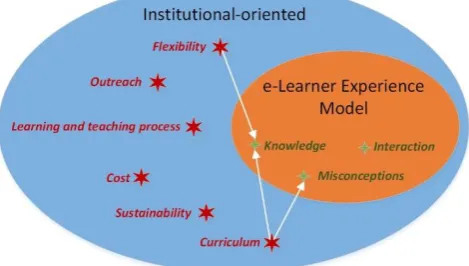
[image:2.595.313.548.480.613.2]Alternatively, they can be classified into: (i) operational improvements (e.g., flexibility), (ii) quantitative changes in learning (e.g., test scores) or (iii) qualitative changes in learning (e.g., reflections and critical awareness) [26]. For the sake of this research, enhancements are classified into the following two categories, as shown in Figure 2: (i) e-learner-oriented which includes enhancements that are directly related to e-learner experience and (ii) institutional-oriented which includes enhancements that are related to the institution or any of its components, such as instructors, technology, teaching and learning processes, regulations, systems, community relationship, etc.
Figure 2: The Classification of the Enhancements of e-Learning
investigation for the institutional-oriented enhancements remains for future research.
3. e-Learner Experience Model Constituent
Constructs
Literature evidence indicates that the learner’s experience is conceived, to large extent, as quantitative changes in: (i) e-learner’s knowledge that is assessed by assessment elements (e.g., exams), or (ii) e-learner behaviour and satisfaction that is assessed by self-completion surveys [32]. However, the proposed e-learning experience model is an attempt towards identifying an extended list of constructs and potential approaches to measure them. To achieve this goal, a wide range of e-learning models have been investigated. These models stretch from simple models (e.g., Learning Object [5]) to complicated systems (e.g., Intelligent Tutoring Systems [30, 29], Adaptive Systems [32, 8]) and from classical systems (e.g., Learning Management System [12]) to research-based artefacts (e.g., Recommended Systems [7,13,24,31], Game-based [21], Immersive-based System [11]). This investigation leads to identifying the following eight main constructs for the e-learner experience model.
The first construct is the Knowledge and Skills. In most e-learning settings (e.g., universities) module learning outcomes form the base for the expected e-learner’s behaviour. Learning outcomes are combinations of knowledge to be acquired and skills/competences to be developed. Knowledge refers to the mastering, understanding or the state of knowing a particular concept of the module being taught, while skills reflect the e-learner’s abilities to apply acquired knowledge in actual case studies. Differentiating knowledge and skills is important because they usually represent theory and practice, respectively. For instance, effective writing of a computer programme that needs analytical, logical and integration abilities (i.e., skills) differs from knowing how to write a programme in a certain programming language (i.e., knowledge). e-Learners’ goals are enclosed as well, because they are focused around acquiring knowledge and skills. This includes goals identified by instructors in formal settings or by learners in Self-Regulated Learning (SRL) settings (i.e., they are named as proximal goals because they represent the breakdown of goals defined by instructors) [10].
Second, the Overall Assessment results of learning outcomes which can be done through exams, projects, essays or similar comprehensive assessment elements. These comprehensive assessment elements can provide reasonable results; however and for the purpose of improved adaptive e-learning processes, fine-grained modelling techniques for the e-learner experience are needed so that generating flexible e-learning processes to e-learners becomes possible. This is based on the assumption that exams and other comprehensive
assessment elements (i.e., course-grained) assess the overall learning outcomes attained by a particular e-learner, but simpler and fine-grained assessment elements (e.g., quizzes) that follow each learning unit are used to assess the e-learner understanding for that particular topic. Third, e-Learner Misconceptions which represent errors and mistakes that exist in the conceptual understanding of a particular e-learner. They will be stored in his/her behavioural model as a subset of the overall misconceptions modelled about a topic.
The previously-identified three constructs are the basic individual constructs that constitute the e-learner experience model. The remaining constructs are either related to the social dimension or the advanced individual dimension of e-learning processes. The social dimension of learning is an important factor because it handles the social interaction of the e-learner and his relation with the community. The importance of this dimension differs from one learning approach to another. For instance, it is crucial in situated learning, where the e-learner knowledge is shaped by his/her relation to the community. The latest survey “top 100 tools used in education” reveals the high use of social tools (e.g., social networking, podcasting, RSS feeds, blogging, sharing) in e-learning. For the sake of this research, this social dimension will be broken down into the following two sub-constructs: (i) e-learner interaction with the community (the Fourth construct of the e-learner experience model) and (ii) the social presence which has been simplified to annotations that represent comments, tags, shares, and the likes that the learner gets when publishing his/her artefacts (the Fifth construct of the e-learner experience model).
Sixth, Support provided to the e-learner should be taken into account as well. Support can be technical to help e-learners accessing the system capabilities. Referring to this research scope, technical help has no considerable impact on the e-learner experience model since it will be measured by other metrics/attributes (e.g., satisfaction). The other type of support, which is important in this research, is the academic support, which is an intervention to help e-learners to progress in their learning journey. This academic support can be divided into the following two types: (i) negative-based academic support, which is made by instructors, or other academic roles such as facilitators, based on negative assessment indicators (e.g., to correct an e-learner misconception), and (ii) positive-based academic support, which is made by instructors or other academic roles to encourage advanced learners to progress (e.g., providing additional resources for e-learners who are eager to learn more, faster and/or in a reflective way). The negative-based support decreases e-learner’s skills and knowledge, while positive-based support gives an indicator for reflective e-learner skills.
meaningful way to build knowledge through participation (i.e., named as engagement, the more time spent by a learner to use the interaction tools the more engaged with the system he is), and (b) learning speed, which refers to the time of consuming a learning unit by a particular learner. There is a time period identified by the instructor for each learning unit, so that the e-learner is expected to approximately use that time to achieve the early-identified learning outcomes. Two different indicators can be taken from this construct. If a large number of e-learners exceeded the specified time limit of a given learning unit, then this learning unit might be difficult or not well-designed, and hence there is a need to re-design it again by the instructor and with the help of other supportive team members such as instructional designers. However, if a particular e-learner: (i) consumes a particular learning unit in less than the specified time, and (ii) scores high in the assessment element, then he/she is an advanced learner. Yet the main criteria here is to achieve the goals of the learning unit rather than time spent to do so.
Eighth, the learner Ability to Think Critically. This includes higher order thinking skills such as meta-cognitive skills that help the learner to regulate her/his learning and to be more reflective [19]. Critical thinking and higher order thinking are used interchangeably in this research since they refer to skills that include critical, reflective, metacognitive and creative thinking skills [25]. However, some researchers use critical thinking as a form of higher order thinking or problem solving. This construct is qualitative and will be evaluated by: (i) instructor, (ii) positive support
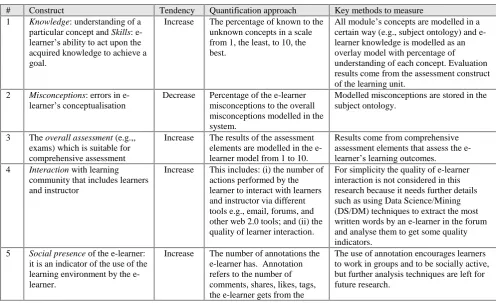
[image:4.595.55.552.493.796.2]interventions, and (iii) looking at the meta-cognitive skills in the e-learner behavioural model. So, the more successful self-regulated learning processes taken by a learner, the more thorough he/she is because a learner cannot has reflection qualities unless he masters other metacognitive skills such as self-management, finding suitable resources, etc. As a final remark, the proposed e-learner experience model focuses on two aspects: (1) the objective data rather than subjective ones, and this is the reason for excluding the e-learner self-completion survey/constructs such as affects (e.g., boredom). These constructs can be used to provide different treatments (e.g., provide game-based learning or interesting contents) for the e-learner but not to evaluate his/her experience. However, e-learner will be judged based on the achievement of the learning outcomes not his/her affects, and (2) quantitative data rather than qualitative. Quantitative data includes: e-learner behaviour (e.g., grades, assessment results, system usage data, completion rate, and further evaluation approaches such as evaluation tests by the technical team, etc.). Other qualitative data (e.g., open-ended questions in surveys, interviews or observations) should be quantified to help in producing suitable conclusions. In this way, the proposed e-leaner experience deal with objective and quantitative data. Table 1 describes the constituent constructs of the e-Learner Experience Model, the tendency per each construct, which summarises the aim of the ideal system whether to increase this construct or to decrease it, the quantification approach and measurement considerations.
Table 1: e-Learner Experience Model Constituent Constructs
# Construct Tendency Quantification approach Key methods to measure 1 Knowledge: understanding of a
particular concept and Skills: e-learner’s ability to act upon the acquired knowledge to achieve a goal.
Increase The percentage of known to the unknown concepts in a scale from 1, the least, to 10, the best.
All module’s concepts are modelled in a certain way (e.g., subject ontology) and e-learner knowledge is modelled as an overlay model with percentage of understanding of each concept. Evaluation results come from the assessment construct of the learning unit.
2 Misconceptions: errors in e-learner’s conceptualisation
Decrease Percentage of the e-learner misconceptions to the overall misconceptions modelled in the system.
Modelled misconceptions are stored in the subject ontology.
3 The overall assessment (e.g.,, exams) which is suitable for comprehensive assessment
Increase The results of the assessment elements are modelled in the e-learner model from 1 to 10.
Results come from comprehensive assessment elements that assess the e-learner’s learning outcomes. 4 Interaction with learning
community that includes learners and instructor
Increase This includes: (i) the number of actions performed by the learner to interact with learners and instructor via different tools e.g., email, forums, and other web 2.0 tools; and (ii) the quality of learner interaction.
For simplicity the quality of e-learner interaction is not considered in this research because it needs further details such as using Data Science/Mining (DS/DM) techniques to extract the most written words by an e-learner in the forum and analyse them to get some quality indicators.
5 Social presence of the e-learner: it is an indicator of the use of the learning environment by the e-learner.
Increase The number of annotations the e-learner has. Annotation refers to the number of comments, shares, likes, tags, the e-learner gets from the
member of his/her learning community when he/she produces an artefact. 6 Academic support provided to the e-learner
6.1 Negative-based academic support: interventions based on negative assessment indicators
Decrease Number of negative-based academic interventions.
Should be linked with the concept that the e-learner is working on at the time of providing support.
6.2 Positive-based academic support: interventions to encourage advanced learners to progress
Increase Number of positive-based academic interventions.
This gives an indicator for reflective e-learner which is considered as a way to quantify the e-learner reflection abilities.
7 Time-on-task: time spent by a given e-learner on a specific task (learning or interaction tasks). This gives indication for engagement and learning speed.
7.1 Learning speed: time spent by the e-learner on a specific learning task
Stable The time span with which the e-learner is involved in consuming a learning unit. This can be measured by comparing the time of use with the time attached to every learning unit.
Learning speed is not the criteria to judge to what extent this learning content is understood by the e-learner. But, it will be used to give indications regarding the learning content de sign.
7.2 Engagement: time spent by the e-learner on participatory learning approaches such as blogging, interacting with the learning community.
Increase Time-on-task can be calculated by minutes or other time units to measure the use of
collaborative activities such as discussion, wiki, etc. where the aim is to increase.
For the context of this research, engagement attribute has been separated from the interaction and social presence (i.e., annotation) of the e-leaner. Further future research is recommended to investigate the correlation between these attributes specially the quality of e-learner interaction. This requires the use of specific learning analytics and the DS/DM techniques in the context of big data or large data set.
8 Critical thinking: e-learner ability to reflect and learn thoroughly.
Increase This is a qualitative construct, but it can be quantified by the assessment results of the advanced questions and the number of successful SRL processes taken by the e-learner.
The relation between SRL (i.e., metacognitive) skills and high quality learning (i.e., higher order thinking process or skills) is based on the assumption that both of them are tightly coupled.
4. e-Learner Experience Model: the
Structural and Measurement Perspectives
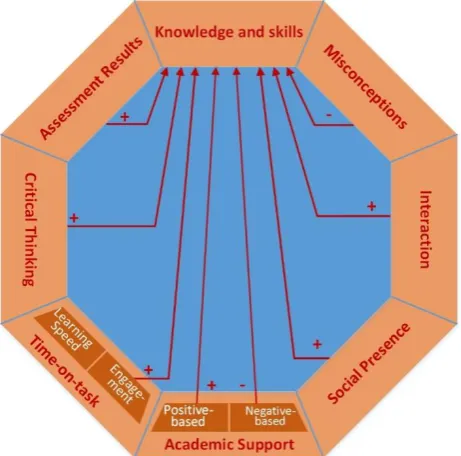
[image:5.595.314.545.499.727.2]Combining both measurement and structural perspectives is inevitable to bring success to technological artefacts that deal with behaviour [12]. Simply, measurement perspective is concerned with defining the model’s qualities (e.g., interoperability) along with rigorous measures to allow measuring the overall user experience or other aspects that the model will measure. While the structural perspective is of explanatory or predictive models that are established to understand and predict the relations between the model’s constructs [14]. For instance, the less misconception that the e-learner has, the better for his/her knowledge and skill. Similarly, the less negative-based support is, the better for his/her experience model. Knowledge and skills gained through the e-learner’s learning journey represent the backbone of the e-learner experience, and therefore all other constructs are investigated in terms of their impacts on knowledge and skills.
Figure 3: e-Learner Experience Model: a Structural View
positively impacting the knowledge and skills construct. For instance, better assessment results lead to better experience, and so on. Based on the explanatory investigation of the e-learning literature, especially the learner’s modelling, the eight constructs of the e-learner experience model along with their relationships are represented in Figure 3.
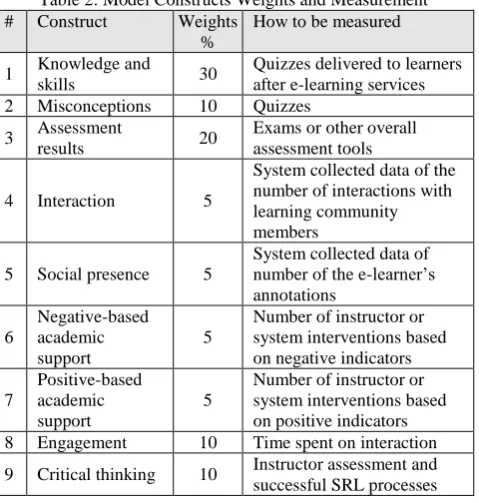
[image:6.595.46.286.349.601.2]Analysing the relationship between these eight constructs helps in assigning proximate weights for each construct. Due to the importance of the first construct, knowledge and skills, the approximate weight that will be given to this construct is 0.3, and it will come from the quizzes given to learner after each learning unit. Second, the misconception which comes from repeated mistakes of the e-learner minimises the e-learner abilities to act upon the learnt knowledge. For instance, one of the misconception in the confusion between area and perimeter. So, the e-learner still has a level of knowledge and skills but he fails to respond correctly until the misconception is being resolved. Therefore, misconception is assigned the value 0.1.
Table 2: Model Constructs Weights and Measurement # Construct Weights
%
How to be measured
1 Knowledge and
skills 30
Quizzes delivered to learners after e-learning services 2 Misconceptions 10 Quizzes
3 Assessment
results 20
Exams or other overall assessment tools
4 Interaction 5
System collected data of the number of interactions with learning community members
5 Social presence 5
System collected data of number of the e-learner’s annotations
6
Negative-based academic support
5
Number of instructor or system interventions based on negative indicators
7
Positive-based academic support
5
Number of instructor or system interventions based on positive indicators 8 Engagement 10 Time spent on interaction
9 Critical thinking 10 Instructor assessment and successful SRL processes
Third, assessment results that come from comprehensive assessment elements such as exams and projects, mostly give indicators to coarse-grained or high-level of the e-learner understanding. Therefore, it is assigned 0.2. Fourth, the social dimension of the learning process which includes both interaction and social presence contributes to the socially-constructed and shaped knowledge and experience. Findings show that the usefulness of this dimension, if it has been managed and monitored well. Hence, this construct is assigned 0.1. Fifth, the academic support, both negative and positive-based, affects the e-learner knowledge in different ways. Positive-based support indicates the well-progress of the e-learner and should increase with the e-learner’s knowledge and skills, and
consequently the e-learner’s experience. Yet the negative-based support indicates some of the misconception or missing conceptions that the e-learner has. This construct, academic support is assigned 0.1. Sixth, time-on-task is also divided into: (i) learning speed and (ii) engagement. Only engagement is assigned 0.1 and it has been treated separately from the social dimension for the sake of data objectiveness. This decomposition allows better future investigation of correlation between different constructs. Finally, the critical thinking which also contributes positively to the e-learner knowledge and skills; and consequently his experience model is assigned 0.1. Table 2 shows the proposed weights and collection methods.
5. e-Learner Experience Model: A Proposed
Scale
In order to allow for a clear and concise measurement mechanism, there is a need to adopt or define a scale where the previously-presented criteria can be measured. One of the widely-adopted scales for this purpose is Likert scale. This scale refers to a set of statements to which the respondents rate their own degree of agreement or disagreement. More specific, 5-point scale is one of the variations of Likert scale that is commonly used. It is composed of: (i) strongly disagree, (ii) disagree, (iii) neither agree nor disagree, (iv) agree and (v) strongly agree. Some researchers prefer 7-point scale, but this makes it harder to find proper descriptive terms for each degree [2]. 5-point Likert scale is adopted in this research because: (i) it is simple to construct, its neutrality due to the use of odd numbers of responses, and (iii) can produce a highly reliable scale despite some limitations in specific cases, such as avoiding extreme response categories.
Consequently, the next section addresses how each of the previously-identified constructs (e.g., knowledge) will be assigned a certain value (e.g., 3 out of 5). Both knowledge and assessment will use the results of quizzes and exams, respectively, converted to a scale ranging from 1 to 5. In addition, the proposed e-learner experience model consists of three socially-constructed constructs which are: interaction, social presence and engagement. As a way to make this experience model generic so that it can be used in different courses, these three constructs are set to work on the basis of thresholds that are defined by the instructor or other concerned roles. For instance, instructor has to assign the suitable level of interactions (i.e., number of expected messages to be sent by the e-leaner, the expected number of annotations, and the time spent on interactions). This threshold can be general per all interaction tools (i.e., email, wiki, forum, etc.) or specific per each tools (e.g., 10 email messages and 5 posts on discussion forum).
their own modules, whether a considerable or minimal emphasis should be placed on communication and other social tools. In such way, instructor or other concerned technical and academic staff can maximise, minimise, or even eliminate (i.e., zero-threshold) the role of the social dimension in their modules. Adopting zero-threshold means that this module/course focus goes away from situative-based learning approaches towards pure behavioural ones.
Similarly, a threshold should be assigned by the instructor for positive-based and negative-based academic support attributes. Again, this allows flexible learning management and interpretation for the results of the e-learner experience model. For instance, assigning a high number to the positive-based support, which is related to e-learner reflection, indicates that this module needs a critical thinking skills. Hence, it is not expected to see the same positive-based academic support threshold for two different modules, whereas the first module is designed for first-year students and the second module belongs to MSc/PhD programme.
[image:7.595.311.551.446.603.2] [image:7.595.45.285.473.716.2]Finally, the critical thinking/learning skills construct is quantified by the percentage of successful SRL processes to the overall successful learning processes taken by a particular e-learner. The threshold here is the number that represents half of the successful learning processes for a particular e-learner. For instance, if the e-learner has 20 successful learning processes in his behavioural model, then 10 is the threshold for the critical thinking attribute. Hence, if that e-learner has 3 SRL successful processes then he will be given 2.
Table 3: e-Learner Experience Model Proposed Scale # Construct 1 2 3 4 5 1 Knowledge
and skills 0-19 % 20-39 % 40-59 % 60-79 % 80-100 %
2 Misconceptio ns 100-80 % 79- 60 % 59-40 % 39-20
% 19-0 %
3 Assessment
results 0-19 20-39
40-59 60-795 80-100
4 Interaction 0-19 % 20-39 % 40-59 % 60-79 % 80-100 %
5 Social presence 0-19 % 20-39 % 40-59 % 60-79 % 80-100 %
6 Negative academic support 100-80 % 79- 60 % 59-40 % 39-20
% 19-0 %
7 Positive academic support 0-19 % 20-39 % 40-59 % 60-79 % 80-100 %
8 Engagement (part of time-on-task) 0-19 % 20-39 % 40-59 % 60-79 % 80-100 %
9 Critical thinking 0-19 % 20-39 % 40-59 % 60-79 % 80-100 %
6. Evaluation
Evaluating the proposed eLEM is challenging because it is aimed at capturing the e-learner experience in various contexts. eLEM has been developed based on a wide literature survey to make it as generic as possible;
and hence its evaluation should be driven accordingly. The experimental set-up included 65 artificially constructed test cases aligned with the HeLPS (Hybrid e-Learning Framework that is Process-based, Semantically-enriched and Service-oriented enabled) in generating a specific unique e-learning process for each e-learner particular context supplemented by a set of competency questions investigating each of these e-learner processes; and hence informing the representative and sufficient construction of the e-learner data set.
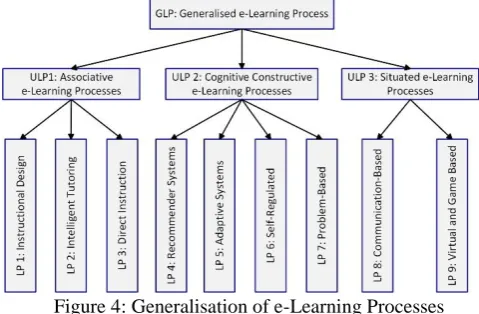
In general, the HeLPS e-Learning Framework interacts with e-learners based on their behavioural models as well as the contexts of their learning processes. To achieve this goal, HeLPS: (i) starts with a Generic e-Learning Process (GLP), depicted in Figure 4, identified from literature and generalised according to the approach proposed in [19], (ii) specifies the e-learning process for each e-learner based on his/her behavioural model as well as the overall context of the e-learning process, and (iii) enacts the specific/customised e-learning process in a software service-oriented enabled environment to meet the e-learner’s demands. Such a framework has produced a large number of variant e-learning processes, based on combinations of various detailed e-learning processes appeared at the bottom of Figure 4 (i.e., LP1, LP2, LP3, LP4, LP5, LP6, LP7, LP8, and LP9).
Figure 4: Generalisation of e-Learning Processes
Various evaluation methods have been reported in the literature to evaluate adaptive e-learning artefacts such as: dataset-driven evaluation [38], user studies [27] and real life testing or case studies [36]. Dataset-driven or simulation-based evaluation approaches are widely used in evaluating e-learning artefacts [38]. Datasets used in such experiments can be: (i) extracted from a real system interaction history which is challenging in this research because current e-learning systems do not have such a comprehensive set of data, or (ii) artificially constructed datasets to verify the system behaviour, test the performance of the algorithm, unit or system.
[image:7.595.42.286.476.717.2]and taking into consideration: (a) the extended time needed by e-learners to use the e-learning systems in order to capture their preference and model their behaviour, (b) certain e-learners’ capabilities (e.g., critical thinking or higher order skills) require long-time and various experiments, and (c) the system must have a proper graphical user interface so e-learners do not get dissatisfied when contrasting it with current e-learning systems. The outcomes of running the above-mentioned testing cases demonstrated that the eLEM is capable of modelling the e-learner experience in various contexts ensuring the sufficiency and enough representation of the combination of e-learner processed and associated data sets, as discussed below.
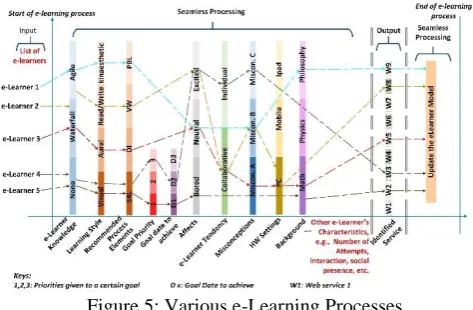
[image:8.595.44.281.445.600.2]The HeLPS e-Learning Framework provides a customised e-learning process for each e-learner based on his/her context, in particular his/her behavioural model. This leads to a wide number of different e-learning processes as depicted in Figure 5, which shows few examples of unique e-learning processes or learning paths produced by the HeLPS. Such e-learning processes are formed by certain rules applied on each e-learner behavioural model/profile as explained in Figure 6. For instance, e-Learner 9 has a list of attributes related to his/her knowledge level, misconceptions, etc. According to the conducted evaluation experiment, the eLEM was successful in modelling the majority of the 65 testing cases (i.e., 93%), and fail in 7% of the testing cases.
Figure 5: Various e-Learning Processes
The above-mentioned e-learning processes combine elements from the detailed e-learning processes (e.g., instructional design process, problem-based process, etc.), and therefore, they target more than one eLEM constructs. For example, the focus of the first e-learning process (i.e., e-Learner 1, Figure 5) is increasing the e-learner’ knowledge as well as resolving his/her misconceptions. However, the focus of the fifth e-learning process (i.e., e-Learner 5, Figure 5) goes to increase the e-learner’s critical thinking abilities and his/her interaction. Overall, all of the abovmentioned testing cases aim is to increase the e-learner knowledge and skills and this must be reflected on the e-learner’s assessment results. As stated above, the eLEM successfully models the e-learner experience
according to the following details. 20% of the testing cases target eLEM academic support construct, 18% of the testing cases target eLEM engagement construct, 16% target the eLEM critical thinking construct and engagement construct, 14% of the testing cases target eLEM interaction construct, 11% of the testing cases target eLEM misconception construct, and 8% of the testing cases target eLEM social presence construct. This proves the eLEM capability to model the e-learner experience in various contexts (behavioural, pedagogical, etc.)
Figure 6: e-Learner Behavioural Model Record Examples
Reflecting on our proposed evaluation approach in the context of similar evaluation studies such as [3] and [20] would be useful. The former research aims at evaluating the user experience of children when interacting with e-learning systems, and it uses questionnaire-based approach to do so. The results show distinction between the younger children and older ones in terms of: (i) preferring certain parts of the educational system, or (ii) being frustrated at some sections. However, in the latter research, an experiment is conducted to explore lecturers’ acceptance of e-learning environments. Data is collected and analysed to infer the usability degree from: (i) the estimated usage metrics and (ii) exploratory analysis from user feedback via System Usability Scale. The results reveal that the System Usability Scale score is not a sufficient measure to express the actual acceptance and satisfaction level for using the e-learning systems. Therefore, more comprehensive evaluation tools/approach need to be used for more accurate evaluation. This reveals the need for more comprehensive approach to critically evaluate the e-learner experience.
considerations, but because of some usability issues. Hence, it is challenging to isolate these concerns from each other. Third, providing further focus on the quality instead of quantity of data is problematic in such distributed environments. This is due to the difficulty of collecting quantitative and objective data, and also the nature of the data itself. Some data constructs require different treatment techniques/scales. For instance, learner interaction with tools might be taking different time intervals due emotional reasons or the e-learner’s willingness to learn a topic. Fourth, tracking every single action done by the e-learner will complicate analysing his/her data, and consequently taking the right decision; for instance, the possibility of enhancing the quantification approach of the higher order/critical thinking skills through assigning a specific attribute for each question in any online assessment element. Hence, HeLPS can provide a better inference about the e-learner reflection abilities (e.g., adding the pair {skill: reflection, topic: requirement analysis} to each question in the exam/quiz). However, this will increase instructors’ effort in designing assessment elements and may minimise their use for these technologies. The above-mentioned concerns could impact in a way or another the validity of e-learning evaluation research, especially the interrelated aspects of the e-learning application in certain context. It has been reported in various research (e.g., [38]) to what extent it is challenging to separate the concerns in e-learning domain. Other threats to validity could stem from the sufficiency of the testing case study and whether it representative enough. We have responded to this as we have built the artificially-constructed data set based on proper sufficiency analysis.
7. Conclusion
The proposed e-Learner Experience Model is an attempt to understand the behaviour of e-learners by modelling the constructs that affect their experience, and the interrelationships between them; and hence to better inform the impact of e-learning processes on the e-learner experience. The eLEM model constructs have been identified based on surveying the e-learning literature with emphasis on user experience/usability, along with weights assigned to the model constructs. Furthermore, eLEM has been an integral part of validating the HeLPS framework. It has also demonstrated that the eLEM is not only capable of integrating with HeLPS as a hybrid framework employing process-based and service-oriented architecture, but it has also demonstrated modelling the e-learner experience in various contexts and identified four key challenges that need to be addressed as further research directions. In addition, the current eLEM does not include institutional-related enhancements influenced by e-learning technologies; and hence the
need to investigate the interrelationships between the learner and institution related model constructs.
References
[1] Abushaban, S. and Hammad, R., “Evaluating the Use of WebCT in Teaching at the Islamic University of Gaza,” Proc. 4th International Conference on e-Learning Applications, Cairo, Egypt, pp 42-51, 2006.
[2] Albert W. and Tullis T., Measuring the User Experience: Collecting, Analyzing, and Presenting Usability Metrics, 2nd ed, Morgan Kaufmann, 2013.
[3] Alhussayen, A., Alrashed, W. and Mansor, E., “Evaluating the User Experience of Playful Interactive Learning Interfaces with Children,” Procedia Manufacturing Journal, vol. 3, pp. 2318-2324, 2015.
[4] Antonis K. et al, “Evaluation of the Effectiveness of a Web-based Learning Design for Adult Computer Science Courses,” IEEE Transactions on Education Journal, vol. 54, no. 3, pp. 374-380, 2011.
[5] Balatsoukas P., Morris. A and O'Brien A., “Learning Objects Update: Review and Critical Approach to Content Aggregation,” Educational Technology & Society Journal, vol. 11, no. 2, pp. 119-130, 2008.
[6] Bargas-Avila JA. and Hornbæk K., “Old Wine in New Bottles or Novel Challenges: A Critical Analysis of Empirical Studies of User Experience,” Proc. 11th SIGCHI Conference on Human Factors in Computing Systems, Vancouver, Canada, pp. 2689-2698, 2011.
[7] Buder J. and Schwind C., “Learning with Personalised Recommender Systems: A Psychological View,” Computer Human Behavior Journal, vol. 28, no. 1, pp. 207-216, 2008. [8] Ciloglugil B. and Inceoglu M., “User Modeling for Adaptive
e-Learning Systems,” Proc. 12th International Conference on Computational Science and its Applications, Omaha, Nebraska, USA, pp. 550-561, 2012.
[9] Conole G., “MOOCs as Disruptive Technologies: Strategies for Enhancing the Learner Experience and Quality of MOOCs,” Revista de Educación a Distancia Journal, vol. 39, pp. 1-17, 2013.
[10] Dabbagh N. and Kitsantas A., “Personal Learning Environments, Social Media, and Self-regulated Learning: A Natural Formula for Connecting Formal and Informal learning,” The Internet and Higher Education Journal, vol. 15, no, 1, pp. 3-8, 2012.
[11] Dawley L. and Dede. C., “Situated Learning in Virtual Worlds and Immersive Simulations. In: Spector JM, Merrill MD, Elen J, Bishop MJ, eds. The handbook of research for educational communications and technology, 4th ed., Springer, New York, pp. 723-734, 2014.
[12] Despotovic-Zrakic M. et al, “Providing Adaptivity in Moodle LMS Courses,” Educational Technology & Society Journal, vol. 15, no. 1, pp.326-338, 2012.
[13] Drachsler H. et al, “Panorama of Recommender Systems to Support Learning,” In Ricci F., Rokach L., Shapira B., eds. Recommender Systems Handbook, 2nd ed., Springer, USA, pp. 421-451, 2015.
[14] Edwards JR. and Bagozzi RP., “On The Nature and Direction of Relationships between Constructs and Measures,” Psychology Methods Journal, vol. 5, no. 2, pp. 155, 2000. [15] Gilbert J., Morton S., Rowley J., “e-Learning: The Student
Experience,” British Journal of Educational Technology, vol. 38, no. 4, pp. 560-573, 2007.
[16] Graf S. and Kinshuk, “Adaptive Technologies,” In Spector JM, Merrill MD, Elen J, Bishop MJ, eds. Handbook of Research on Educational Communications and Technology, 4th ed, Springer, New York, pp. 771-779, 2014.
Computing Technology and Science (CloudCom), Bristol, UK, pp. 106-111, 2013.
[18] Hammad R, Odeh M and Khan Z., “Towards a Model-based Approach to Evaluate the Effectiveness of e-Learning,” Proc. 9th European Conference on IS Management and Evaluation (ECIME), Bristol, UK, pp. 111-119, 2015.
[19] Hammad, R., Odeh, M. and Khan, Z., “Towards a Generalised e-Learning Business Process Model,” Proc. 7th International Conference on Business Intelligence and Technology (BUSTECH), Athens, Greece, pp. 20-28, 2017. [20] Harrati, N. et al, “Exploring User Satisfaction for e-Learning
Systems via Usage-based Metrics and System Usability Scale Analysis,” Computers in Human Behavior Journal, vol. 61, pp. 463-471, 2016.
[21] Hauge JB. et al., “Field Assessment of Serious Games for Entrepreneurship in Higher Education” Journal of Convergence Information Technology, vol. 8, no. 13, 2013. [22] International Standard Organisation, ISO/DIS 9241-11,
Ergonomics of Human-System Interaction - part 11: Usability: Definitions and Concepts, 2015.
[23] International Standard Organisation, ISO 9241-210:2010, Ergonomics of Human-System Interaction - part 210: Human-centred Design for Interactive Systems, 2010. [24] Khribi MK., Jemni M. and Nasraoui O., “Automatic
Recommendations for e-Learning Personalization Based on Web Usage Mining Techniques and Information Retrieval,” Educational Technology & Society Journal, vol. 12, no. 4, pp. 30-42, 2008.
[25] King F, Goodson L. and Rohani F., “Higher Order Thinking Skills: Definition, Teaching Strategies, Assessment,” Centre for Advancement of Learning and Assessment, Florida State University, Educational Services Program, 1998.
[26] Kirkwood A. and Price L., “Technology-Enhanced Learning and Teaching in Higher Education: What is ‘Enhanced’ and How Do We Know? A Critical Literature Review,” Learning, Media and Technology Journal, vol. 39, no. 1, pp. 6-36, 2014. [27] Knijnenburg, B. P., “Conducting User Experiments in Recommender Systems,” Proc. 6th ACM Conference on Recommender Systems, Dublin, Ireland, pp. 3-4, 2012. [28] Law EL., and van Schaik P., “Modelling User Experience–
An Agenda for Research and Practice,” Interact Computer Journal, vol. 22, no. 5, pp. 313-322, 2010.
[29] Ma W., et al, “Intelligent Tutoring Systems and Learning Outcomes: A Meta-Analysis,” Journal of Educational Psychology, vol. 6, no. 4, pp. 901-918, 2014.
[30] Nye BD., “Barriers to ITS Adoption: A Systematic Mapping Study,” Proc. International Conference on Intelligent Tutoring Systems, Madrid, Spain, pp. 583-590, 2014. [31] Park DH. et al, “A Literature Review and Classification of
Recommender Systems Research,” Expert System Application Journal, vol. 39, no. 11, pp. 10059-10072, 2012. [32] Ramos V., “Adaptive Hypermedia Courses: Qualitative and Quantitative Evaluation and Tool Support,” Technische Universiteit Eindhoven, 2014.
[33] Saks K., Leijen Ä., “Distinguishing directed and Self-regulated Learning and Measuring them in the e-Learning Context,” Procedia - Social and Behavioural Sciences Journal, vol. 112, pp. 190-198, 2014.
[34] Scanlon E., McAndrew P. and O'Shea T., “Designing for Educational Technology to Enhance the Experience of Learners in Distance Education: How Open Educational Resources, Learning Design and MOOCs are Influencing Learning,” Journal of Interactive Media in Education, vol. 1, 2015.
[35] Scanlon E., et al., “Beyond Prototypes: Enabling Innovation in Technology-Enhanced Learning,” Open University, Melton Keynes, UK, 2013.
[36] Shani, G. and Gunawardana, A., "Evaluating Recommendation Systems," In Recommender Systems Handbook, Springer US, pp. 257-297, 2011.
[37] Sudhakar A., Tyler J. and Wakefield J., “Enhancing Student Experience and Performance through Peer-assisted Learning,” Issues in Accounting Education Journal, vol. 31, no. 3, pp. 321-336, 2015.
[38] Verbert, K. et al, "Dataset-driven Research for Improving Recommender Systems for Learning," Proc. the 1st International Conference on Learning Analytics and Knowledge, Banff, Canada, pp. 44-53, 2011.