• No results found

N Phenylpyridine 2 carb­amide

N/A
N/A
Protected

Academic year: 2020

Share "N Phenylpyridine 2 carb­amide"

Copied!
6
0
0

Loading.... (view fulltext now)

Full text

(1)

N

-Phenylpyridine-2-carbamide

Yu-Guo Zhuang,* Hua-Jiang Jiang, Zhi Hong and Fang-Li Qiu

School of Pharmaceutical and Chemical Engineering, Taizhou University, Linhai 317000, People’s Republic of China

Correspondence e-mail: [email protected]

Received 1 September 2008; accepted 4 September 2008

Key indicators: single-crystal X-ray study;T= 296 K; mean(C–C) = 0.003 A˚;

Rfactor = 0.030;wRfactor = 0.075; data-to-parameter ratio = 8.5.

In the title compound, C12H10N2O, the dihedral angle between the pyridine ring system and the phenyl ring is 1.8 (1). There

is an intramolecular N—H N hydrogen bond between the pyridine N atom and the amide NH function.

Related literature

For general background, see: Sousa & Filgueiras (1990); Gomeset al.(2007); Morsaliet al.(2003); Jacob & Mukherjee (2006); Marumotoet al.(1981); Piatnitski & Kiselyov (2004). For related structures, see: Qiet al.(2003); Zhanget al.(2006); Yinet al.(2007). For the synthesis, see: Chanet al.(2004).

Experimental

Crystal data

C12H10N2O

Mr= 198.22 Monoclinic,Pn a= 5.7469 (2) A˚

b= 6.2382 (2) A˚

c= 14.0158 (3) A˚ = 94.752 (2)

V= 500.74 (3) A˚3

Z= 2

MoKradiation = 0.09 mm 1

T= 296 (2) K 0.150.140.09 mm

Data collection

Bruker APEXII CCD diffractometer

Absorption correction: multi-scan (SADABS; Bruker, 2004)

Tmin= 0.968,Tmax= 0.992

5000 measured reflections 1162 independent reflections 1036 reflections withI> 2(I)

Rint= 0.017

Refinement

R[F2> 2(F2)] = 0.030

wR(F2) = 0.075

S= 1.00 1162 reflections

137 parameters

H-atom parameters constrained

max= 0.11 e A˚ 3

min= 0.12 e A˚ 3

Table 1

Hydrogen-bond geometry (A˚ ,).

D—H A D—H H A D A D—H A

N1—H101 N2 0.86 2.28 2.697 (2) 110

Data collection:APEX2(Bruker, 2004); cell refinement: SAINT-Plus(Bruker, 2004); data reduction:SAINT-Plus; program(s) used to solve structure:SHELXL97(Sheldrick, 2008); program(s) used to refine structure:SHELXL97(Sheldrick, 2008); molecular graphics:

ORTEP-3 for Windows(Farrugia, 1997); software used to prepare material for publication:WinGX(Farrugia,1999).

The authors are grateful for financial suport from the Key Discipline Open Foundation of Zhejiang University of Tech-nology (grant No. 20080604). The authors thank Mr Jian-Ming Gu (Testing and Analysis Center, Zhejiang University) for guidance in the structure analysis.

Supplementary data and figures for this paper are available from the IUCr electronic archives (Reference: IM2083).

References

Bruker (2004). APEX2, SAINT-Plus and SADABS. Bruker AXS Inc., Madison, Wisconsin, USA.

Chan, A. S. C., Qi, J. Y., Pai, C. C., Li, X. J., Deng, L. S., Li, W. Z. & Hu, J. Y. (2004). US Patent 6 680 385.

Farrugia, L. J. (1997).J. Appl. Cryst.30, 565. Farrugia, L. J. (1999).J. Appl. Cryst.32, 837–838.

Gomes, L., Low, J. N., Valente, M. A. D. C., Freire, C. & Castro, B. (2007).Acta Cryst.C63, m293–m296.

Jacob, W. & Mukherjee, R. (2006).Inorg. Chim. Acta,359, 4565–4573. Marumoto, R., Shunsuke, S. & Masao, T. (1981). Eur. Patent EP 38 161. Morsali, A., Ramazani, A. & Mahjoub, A. R. (2003).J. Coord. Chem.56, 1555–

1566.

Piatnitski, E. & Kiselyov, A. S. (2004). US Patent 0 017 248.

Qi, J. Y., Yang, Q. Y., Lam, K. H., Zhou, Z. Y. & Chan, A. S. C. (2003).Acta Cryst.E59, o374–o375.

Sheldrick, G. M. (2008).Acta Cryst.A64, 112–122.

Sousa, G. F. & Filgueiras, C. A. L. (1990).Transition Met. Chem.15, 286–289. Yin, X.-H., Zhao, K., Feng, Y. & Zhu, J. (2007).Acta Cryst.E63, o4617. Zhang, Q., Zhang, S.-P. & Shao, S.-C. (2006).Acta Cryst.E62, o4695–o4696.

Acta Crystallographica Section E

Structure Reports

Online

(2)

supporting information

Acta Cryst. (2008). E64, o1904 [doi:10.1107/S1600536808028274]

N

-Phenylpyridine-2-carbamide

Yu-Guo Zhuang, Hua-Jiang Jiang, Zhi Hong and Fang-Li Qiu

S1. Comment

Pyridine-containing amides continue to attract considerable interest as ligands for metals (Sousa & Filgueiras, 1990;

Gomes et al., 2007; Jacob & Mukherjee, 2006), building blocks in organic synthesis (Marumoto et al., 1981) and

physiologically active compounds (Piatnitski & Kiselyov, 2004). As part of our studies on the synthesis and

characterization of these compounds, we report here the crystal structure of the title compound.

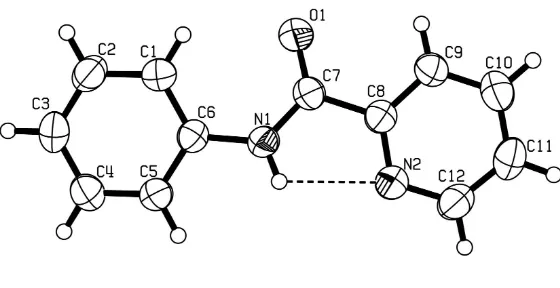
The C7—O1 [1.223 (3) Å], N1—C7 [1.344 (3) Å] and N1—C6 [1.410 (2) Å] bond lengths indicate extensive electron

delocalization in the amide linkage. The pyridyl and phenyl rings of the title compound are almost coplanar, forming a

dihedral angle of 1.8 (1)°. In the crystal structure, there is an intramolecular hydrogen bond (N1—H101···N2) and no

intermolecular hydrogen bonds are observed (Table 1).

The reported monoclinic space-group is in a non-standard setting (Pn, #7). There is a strong feature (h + l = 2n) in hkl

data. Setting up the space group as Pc results in a β angle of 23° or 157°, respectively. Obviously such an unit-cell

division is inappropriate. Therefore, the non-standard setting Pn was chosen.

S2. Experimental

The title compound was synthesized from pyridine-2-carboxylic acid and aniline according to the procedure of Chan et

al. (2004). The crystal used for data collection was obtained by slow evaporation from a saturated ethanol/water solution

at room temperature.

S3. Refinement

All H atoms were placed in geometrically idealized positions and constrained to ride on their parent atoms, with N—H =

(3)
[image:3.610.152.432.128.272.2]

Figure 1

The molecular structure of the title compound, shown with 50% probability displacement ellipsoids.

N-Phenylpyridine-2-carbamide

Crystal data

C12H10N2O

Mr = 198.22

Monoclinic, Pn

Hall symbol: P -2yac

a = 5.7469 (2) Å

b = 6.2382 (2) Å

c = 14.0158 (3) Å

β = 94.752 (2)°

V = 500.74 (3) Å3

Z = 2

F(000) = 208

Dx = 1.315 Mg m−3

Mo radiation, λ = 0.71073 Å

Cell parameters from 2226 reflections

θ = 2.9–25.1°

µ = 0.09 mm−1

T = 296 K

Block, colourless 0.15 × 0.14 × 0.09 mm

Data collection

Bruker APEXII CCD diffractometer

Radiation source: fine-focus sealed tube Graphite monochromator

Detector resolution: 10 pixels mm-1

ω scans

Absorption correction: multi-scan (SADABS; Bruker, 2004)

Tmin = 0.968, Tmax = 0.992

5000 measured reflections 1162 independent reflections 1036 reflections with I > 2σ(I)

Rint = 0.017

θmax = 27.7°, θmin = 2.9°

h = −7→7

k = −8→5

(4)

Refinement

Refinement on F2

Least-squares matrix: full

R[F2 > 2σ(F2)] = 0.030

wR(F2) = 0.075

S = 1.00

1162 reflections 137 parameters 0 restraints

Primary atom site location: structure-invariant direct methods

Secondary atom site location: difference Fourier map

Hydrogen site location: inferred from neighbouring sites

H-atom parameters constrained

w = 1/[σ2(F

o2) + (0.0365P)2 + 0.0548P]

where P = (Fo2 + 2Fc2)/3

(Δ/σ)max < 0.001

Δρmax = 0.11 e Å−3

Δρmin = −0.12 e Å−3

Special details

Geometry. All e.s.d.'s (except the e.s.d. in the dihedral angle between two l.s. planes) are estimated using the full covariance matrix. The cell e.s.d.'s are taken into account individually in the estimation of e.s.d.'s in distances, angles and torsion angles; correlations between e.s.d.'s in cell parameters are only used when they are defined by crystal symmetry. An approximate (isotropic) treatment of cell e.s.d.'s is used for estimating e.s.d.'s involving l.s. planes.

Refinement. Refinement of F2 against ALL reflections. The weighted R-factor wR and goodness of fit S are based on F2,

conventional R-factors R are based on F, with F set to zero for negative F2. The threshold expression of F2 > σ(F2) is used

only for calculating R-factors(gt) etc. and is not relevant to the choice of reflections for refinement. R-factors based on F2

are statistically about twice as large as those based on F, and R- factors based on ALL data will be even larger.

Fractional atomic coordinates and isotropic or equivalent isotropic displacement parameters (Å2)

x y z Uiso*/Ueq

N1 −0.0173 (3) 0.2086 (3) 0.59409 (11) 0.0452 (4)

H101 −0.1420 0.2510 0.6183 0.054*

C8 0.1414 (3) 0.5113 (3) 0.68241 (13) 0.0435 (4)

C6 −0.0401 (3) 0.0235 (3) 0.53631 (12) 0.0412 (4)

C1 0.1246 (4) −0.0375 (4) 0.47407 (15) 0.0509 (5)

H1 0.2570 0.0459 0.4685 0.061*

C7 0.1751 (4) 0.3270 (3) 0.61595 (15) 0.0475 (5)

C2 0.0901 (4) −0.2230 (4) 0.42049 (16) 0.0569 (5)

H2 0.1999 −0.2635 0.3787 0.068*

N2 −0.0537 (3) 0.5139 (3) 0.72828 (12) 0.0526 (4)

C5 −0.2373 (4) −0.1016 (3) 0.54213 (15) 0.0476 (5)

H5 −0.3507 −0.0595 0.5819 0.057*

O1 0.3656 (3) 0.2937 (3) 0.58575 (15) 0.0753 (6)

C10 0.2767 (5) 0.8384 (3) 0.75234 (17) 0.0575 (5)

H10 0.3863 0.9481 0.7597 0.069*

C11 0.0794 (4) 0.8441 (4) 0.80026 (16) 0.0612 (6)

H11 0.0523 0.9575 0.8410 0.073*

C3 −0.1044 (4) −0.3483 (4) 0.42826 (16) 0.0553 (5)

H3 −0.1255 −0.4731 0.3923 0.066*

C12 −0.0787 (4) 0.6788 (4) 0.78711 (17) 0.0629 (6)

H12 −0.2107 0.6823 0.8213 0.076*

C9 0.3106 (4) 0.6677 (3) 0.69302 (15) 0.0516 (5)

H9 0.4451 0.6581 0.6607 0.062*

C4 −0.2676 (4) −0.2879 (4) 0.48961 (17) 0.0553 (5)

(5)

Atomic displacement parameters (Å2)

U11 U22 U33 U12 U13 U23

N1 0.0458 (9) 0.0397 (9) 0.0515 (9) −0.0007 (7) 0.0121 (7) −0.0031 (7)

C8 0.0478 (10) 0.0408 (10) 0.0422 (10) 0.0013 (8) 0.0051 (8) 0.0021 (8)

C6 0.0458 (10) 0.0369 (10) 0.0408 (10) 0.0030 (8) 0.0042 (8) 0.0021 (8)

C1 0.0504 (11) 0.0521 (12) 0.0517 (11) −0.0041 (10) 0.0120 (9) −0.0028 (10)

C7 0.0497 (11) 0.0398 (11) 0.0539 (12) −0.0030 (9) 0.0092 (9) −0.0007 (9)

C2 0.0594 (13) 0.0609 (14) 0.0515 (12) 0.0060 (11) 0.0117 (9) −0.0103 (10)

N2 0.0477 (9) 0.0540 (10) 0.0566 (10) −0.0015 (8) 0.0067 (8) −0.0096 (8)

C5 0.0464 (10) 0.0458 (11) 0.0515 (10) −0.0004 (9) 0.0088 (8) −0.0024 (9)

O1 0.0531 (9) 0.0669 (11) 0.1095 (15) −0.0111 (9) 0.0283 (9) −0.0330 (10)

C10 0.0699 (14) 0.0471 (11) 0.0550 (11) −0.0102 (12) 0.0014 (10) −0.0007 (11)

C11 0.0714 (16) 0.0553 (14) 0.0559 (13) 0.0065 (12) −0.0002 (11) −0.0156 (11)

C3 0.0652 (13) 0.0459 (11) 0.0537 (11) 0.0014 (11) −0.0023 (10) −0.0119 (10)

C12 0.0561 (13) 0.0705 (15) 0.0635 (14) 0.0047 (11) 0.0122 (11) −0.0168 (12)

C9 0.0559 (11) 0.0486 (12) 0.0513 (11) −0.0086 (10) 0.0116 (9) −0.0018 (9)

C4 0.0550 (12) 0.0506 (13) 0.0598 (12) −0.0070 (10) 0.0027 (10) −0.0027 (11)

Geometric parameters (Å, º)

N1—C7 1.344 (3) N2—C12 1.333 (3)

N1—C6 1.410 (2) C5—C4 1.379 (3)

N1—H101 0.8600 C5—H5 0.9300

C8—N2 1.338 (2) C10—C11 1.365 (4)

C8—C9 1.377 (3) C10—C9 1.375 (3)

C8—C7 1.502 (3) C10—H10 0.9300

C6—C5 1.384 (3) C11—C12 1.377 (3)

C6—C1 1.392 (3) C11—H11 0.9300

C1—C2 1.385 (3) C3—C4 1.377 (3)

C1—H1 0.9300 C3—H3 0.9300

C7—O1 1.223 (3) C12—H12 0.9300

C2—C3 1.376 (4) C9—H9 0.9300

C2—H2 0.9300 C4—H4 0.9300

C7—N1—C6 128.07 (17) C4—C5—H5 119.6

C7—N1—H101 116.0 C6—C5—H5 119.6

C6—N1—H101 116.0 C11—C10—C9 118.9 (2)

N2—C8—C9 123.48 (19) C11—C10—H10 120.6

N2—C8—C7 117.62 (17) C9—C10—H10 120.6

C9—C8—C7 118.89 (18) C10—C11—C12 118.7 (2)

C5—C6—C1 119.06 (17) C10—C11—H11 120.7

C5—C6—N1 117.74 (17) C12—C11—H11 120.7

C1—C6—N1 123.19 (17) C2—C3—C4 119.6 (2)

C2—C1—C6 119.57 (19) C2—C3—H3 120.2

C2—C1—H1 120.2 C4—C3—H3 120.2

C6—C1—H1 120.2 N2—C12—C11 123.8 (2)

(6)

O1—C7—C8 120.61 (18) C11—C12—H12 118.1

N1—C7—C8 114.58 (18) C10—C9—C8 118.7 (2)

C3—C2—C1 120.8 (2) C10—C9—H9 120.6

C3—C2—H2 119.6 C8—C9—H9 120.6

C1—C2—H2 119.6 C3—C4—C5 120.1 (2)

C12—N2—C8 116.38 (18) C3—C4—H4 119.9

C4—C5—C6 120.77 (19) C5—C4—H4 119.9

Hydrogen-bond geometry (Å, º)

D—H···A D—H H···A D···A D—H···A

Figure

Figure 1

References

Related documents

In this study, we identified 9 protein markers for predicting time to recurrence using the protein expression data on 222 TCGA pri- marily high-grade serous ovarian cancers

For the purpose of analyzing the impurities in the water samples coming from different roofs, four building within the KCAET campus viz location 1(library -

To overcome the problems and weakness, this project need to do some research and studying to develop better technology. There are list of the objectives to be conduct

The above block diagram shows the SPV fed to Dc/Dc Converter for different dc applications, To analysis the performance of dc-dc converters(Buck, Boost,

22 subjects showing low or undetectable activities of BAT were randomly divided into 2 groups: one was exposed to cold at 17°C for 2 hours every day for 6 weeks (cold group; n

Foxo deletion on osteoblast differentiation in both bone marrow and calvaria cells suggests that the increases in ALP activity and mineralization observed in the bone

Histologically, the lesion is composed of fibrous connective tissue trabeculae (top quarter of image) and adipose connective tissue (bottom three quarters of image); within

• Data shows credit using and rationing of risk averts, risk neutrals and risk lovers respectively. As to risk averts, the credit is mainly used to pay children’s tuition, medical