Journal of the Statistical and Social Inquiry Society of Ireland Vol XXVI, Part II
BORROW AND PROSPER
NOTES ON THE USER COST OF CAPITAL
JOHN FRA1N* Research Division Central Bank of Ireland
(read before the Society 31 May 1990)
1. INTRODUCTION
It is often argued that many firms can do very well by borrowing. The conclusion is based on two points which may be illustrated as follows. Firstly suppose that the effective rate of income tax is 50%, the nominal interest rate 8% and inflation 3%. Then the effective interest rate after deducting tax allowances on interest paid is 4% which is equivalent to a real interest rate of 1 % . Now suppose that the nominal interest rate increases to 12% and inflation to 7%, then tax allowances reduce the effective interest rate to 6% and the real interest rate becomes negative. Variations on this theme are many.
The second point concerns the large increases in the value of the fixed capital of independent businesses e.g. pubs, hotels, restaurants, land, houses, etc. In some periods the capital gains on such items may have exceeded any interest paid on loans to finance their purchase.
The purpose of this paper is to look at these problems in a systematic way. For this purpose I will look at an indicator known as the User Cost of Capital. This is defined as the minimum rate of return that an investment must yield in order to pay all its financing costs. It must include both the interest paid on borrowing and the economic depreciation of the invest-ment as offset by any capital appreciation. This must then be amended to take account of taxes paid on earnings, the tax treatment of depreciation (capital allowances), the tax treatment of interest paid, and of grants paid on capital expenditure. Analyses of this type for Ireland were undertaken previously by Geary and McDonnell (1979), Flynn and Honahan (1984) and Ruane and John (1984). This analysis presents revised and/or new estimates covering the period 1960 to 1989. The revisions arise from the use of both different data and a revised methodology. I will comment on these points later when I am setting out definitions etc. It should be noted that the three previous analyses did not use uniform methodologies.
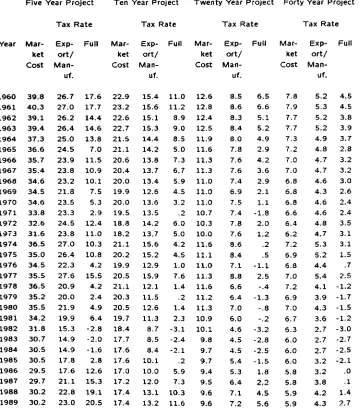
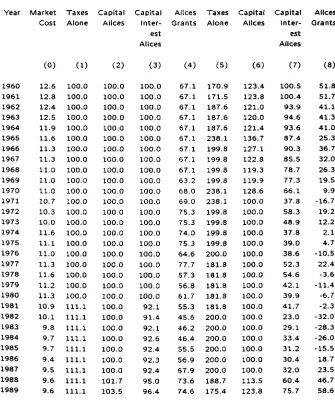
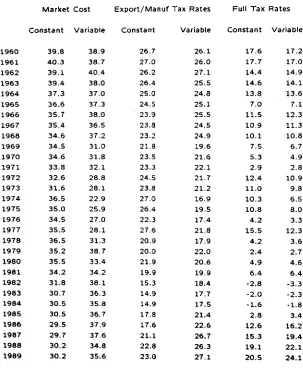
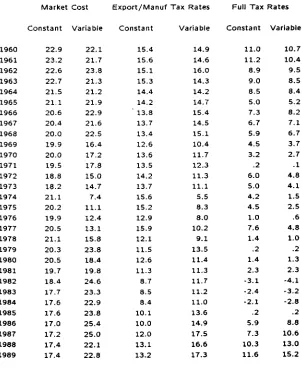
Section 2 and appendices 1 and 2 set out the theoretical foundations of the analysis and give details of the data used. The User Cost of Capital depends on many factors including in particular the life of the project and the corporate tax regime. In Section 3 we set out the results of the analysis for projects with lives of five, ten, twenty and forty years. In Table 1 we look at the overall effect of taxes and grants. Tables 2, 3, 4 and 5 look separately at the effects of taxes, capital allowances, interest paid allowances and Capital grants. Tables 6(a) and 6(b) look at the effects of changes in the real interest rate. Tables 7(a), 7(b), 7(c) and 7(d) compare the effects of assuming fixed real rates of interest and using the ex post real rate. Table 8 looks at the effect on the 1989 data of changes in the nominal rate of interest. Table 9 looks at the effects of the provisions for company taxation in the 1988/90 Budgets. Tables 10(a) and lO(b) contain some international comparisons. Section 3 contains a commentary on these tables. Section 4 concludes the analysis.
2. DERIVATION OF COST OF CAPITAL AND DATA SOURCES
The concept of a "user" or "rental" Cost of Capital is based on the neo-classical investment theory originally proposed by Jorgenson (1963). A critical survey of recent developments in this theory or of investment theory in general is contained in Precious (1987). Auverbach (1983) surveys the application of the Cost of Capital concept in taxation and Corporate
Financial Policy.
Neo-classical investment theory is based on a textbook world of perfect competition where a firm can choose time paths for its Capital Stock and Labour Force to maximize the present value of its flow of earnings. Details of the maximization problem are given in appendix 1.
The firm has a smooth production function F(K(£), N(t)) where K{t) and N(t) are the capital stock and labour force employed at time t. ?(<),;>(£) and w(t), the prices of capital goods, output and labour respectively, are taken as given to the firm. In some cases N(t) may be taken as a vector of inputs (e.g. labour, energy, intermediate inputs, etc.) and then w(t) is a vector of the prices of such inputs. In such cases the result derived in the appendix still holds.
Capital is taken to decay exponentially at a rate 8 . Thus a unit of existing capital at age t is the same as e~St units of new capital. Thus the capital
stock at time t is given by
K{t) = f e^
t~^I{s)ds (2.1)
J -oowhere I(s) is investment at time s(s < t)
Differentiating 2.1 with respect to t gives
(2.2)
and this expression has been substituted for I(t) in the expression for the firms discounted net cash flow.
its original capacity. For consistency, however, a Jorgenson type analysis requires an exponential rate of economic depreciation. Appendix 2 shows how I have converted the straight line depreciation system to an exponen-tial scheme. If the annual growth rate of gross investment in assets of life T is a (a > 1) then the corresponding depreciation rate is given by
Ta^+i - (T + l)aT + 1
{'
Numerical values for this expression are given at the end of appendix 2 for values of a corresponding to 1 (same investment each year), 1.04, 1.07 and 1.10. 1.07 is the average rate of growth of gross industrial investment in the period 1960-1984 (Henry (1989)) and it is this value that is used in the analysis. It should be noted that this leads to greater economic depreciation rates and thus to a cost of capital which is considerably higher than that found in earlier analyses.
The adoption of an exponential rate of depreciation has the important consequence that it is invariant with respect to the real interest rate. A unit asset of age t is identical as regards output capacity to (1 — 8)* new assets which have a value determined by the cost of new assets.
The implied deflator of Gross Domestic Product was used as a proxy for output prices.
A price index for gross fixed capital formation in industry was derived from Tables 6.1 and 6.4 of Henry (1989). This data was updated us-ing the Wholesale Price capital goods price index (excludus-ing VAT) for Transportable Capital for use in industry.
The firm is assumed to receive an investment grant as a proportion of Capital Expenditure. The various agencies have over the years had con-siderable discretionary power in the amount of grants awarded. These have depended on various factors such as the location of the plant, projected employment, export-import ratios etc. The data used in this analysis are averages for projects approved in any one year and do not reflect the wide
variations in amounts actually paid. Such averages have been extracted from various annual reports of the IDA.
Details of tax rates and capital allowances have been extracted from vari-ous issues of the Annual Reports of the Revenue Commissioners. Prior to the assessment year 1975/76 firms paid income tax at the standard rate. In addition they also paid a separate levy known as "Corporation Profits Tax". A combined rate is used here. From 1975/76 these taxes were consolidated to form Corporation Tax. Special lower tax rates for small firms and miscellaneous minor incentive rates have been ignored. Where a rate was changed during the year the part operative for the greater part of the year was used.
I have examined two types of tax regime. The first type is a manufacturing company that exported its total product. This company benefited from full export sales relief and was therefore taxed at a zero rate up to 1980. From 1981 it was taxed as a manufacturing company at the 10% rate (i.e. it claimed manufacturing relief rather than the export relief it might have been eligible for up to the current year). The second company is taxed at the full rate. Many companies would have been taxed separately on export and domestic earnings at both rates prior to 1981 and for them the result would be a weighted average of the two. It is also possible that some manufacturing companies produced for the domestic market and therefore earned little or no export relief but thereafter were taxed as manufacturers. These points should be borne in mind in reading the tables in Section 3.
Accelerated depreciation allowances (initial allowance/free depreciation) have been provided at separate rates for plant/machinery and for industrial building. The rates for plant/machinery were used for projects with a life of 20 years or less while those for industrial buildings were applied to the 40 year project. It should be noted that from 1986 capital allowances were granted on expenditure on plant and machinery after deducting grants as was always the case of expenditure on industrial buildings.
Tax relief on interest paid is accounted for by reducing the effective cost of an investment by an amount equal to the present value of the flow of tax relief on the investment. In calculating this present value we have assumed that the project is financed by a loan which is repaid in equal yearly installments (interest and capital) over half the life of the asset (three years in the case of a five year project). We have also assumed that only the non-grant aided portion of the cost of the project is borrowed.
In theory a firm should decide whether or not to undertake an investment project by computing the present value of the net cash flows generated by the project using a discount rate corresponding to the cost of funds whether raised from loans, equity or retained earnings. The discount rate should depend on the degree of risk attached to the return. It has been argued (Summers (1988)) that as various components of the cost of capital have different degrees of risk they should be discounted at different rates. In particular he argues that depreciation allowances have a low risk and should be discounted using a smaller discount factor. In the same article, however, he reports that practice does not coincide with this theory. He refers to a survey based on the top 200 corporations in the FORTUNE 500 which shows that firms apply a higher than expected discount rate to depreciation allowances. 94% of responding firms in that survey used the same discount factor for all components of a project evaluation. For the purpose of this analysis I have decided to abstract from risk factors and have used the standard A overdraft rate.
The main results in Section 3 are based on a constant real rate of interest of 3.47% i.e. the geometric average derived from the nominal interest rate and capital goods inflation as defined by the implied price index of capital goods described above. The effect of this assumption is examined below in the commentary on tables 7(a)f (b), (c) and (d) where the outcome is
compared with corresponding data using the ex post realized real interest rate.
The results for 1989 are based to some extent on data for part of the year supplemented by various forecasts and to this extent are subject to a wider margin of error than earlier data.
3. RESULTS
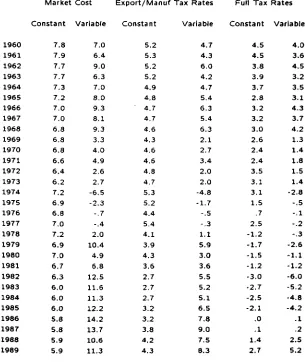
As emphasized already each type of investment will have its own user cost. Thus rather than examine a typical or average project we have examined four projects. Table 1 sets out the Cost of Capital for investments in plant and machinery with lives of five, ten and twenty years and industrial buildings with a life of forty years. Using the notation of Appendix 1 the columns headed market Cost gives
6-q/q (3.1)
i.e. the cost of capital to a hypothetical firm or person not subject to taxes and not receiving grants. The columns marked 'Export/Manuf.' give the cost of capital adjusted according to the formulae in appendix 1 for a Manufacturing company who prior to 1980 exported its entire output. The columns marked 'full tax' give the corresponding data for a firm subject to the full profits tax rate. Both of these latter columns allow average capital grants. Up to 1980 a manufacturing firm which exported a fraction of it's output would have been subject to a weighted average of these latter pairs of columns. The data in the table are illustrated on the graphs in figures 1 to 4. These are best examined in conjunction with Tables 2 to 5 which show cumulatively the effects of (1) Taxes alone, (2) Taxes and Capital Allowances, (3) Taxes, Capital and Interest paid allowances and (4) Taxes, Capital and Interest paid allowances and capital grants.
Thus the final row of Table 2 may be explained as follows:
(a) 30.2 is the market cost of capital as in Table 1
(b) Taxes as paid by an Export/Manufacturing firm increase this to 111.1% of (a) (i.e. 33.5)
(c) These taxes offset by capital allowances give 101.2% of (a) (i.e. 30.6)
(d) These taxes offset by capital and interest paid allowances give 98.2% of (a) (i.e. 29.7)
( f ) The next four columns give results for firms paying full taxes corresponding to (b), (c), (d) and (e) above.
Figure 1 and Table 2 give the results of the analysis for a five year project. In the figure the no-tax line represents the market cost of capital, the low tax those taxed as export/manufacturing firms and the full tax those on full profits tax. Figure 1 shows a downward trend in the market cost of capital - the exception being the years 1974 and 1977 as the price of capital goods as measured was rising more slowly than prices in general.
Column 6 (1971 to 1987) and part of column 2 (1981 to 1987) demon-strate the neutrality of full expensing (i.e. 100% free depreciation or initial allowances). By neutrality we mean that the marginal incentive to invest is unaffected by taxation. When full expensing is not allowed the value of the depreciation allowances are reduced as shown and the tax system provides a disincentive to investment. However when the allowance for interest paid is taken into account this disincentive is more than removed as is obvious in columns (3) and (7). Columns (4) and (8) show that over the years capital grants at average rates provide a large incentive to invest. Because of the low tax rates paid by Export/Manufacturing firms these have provided the major incentive to investment.
I have not examined the inter-company effects of corporate taxation on companies investment decisions. Ruane and John (1987) and Flynn and Honohan (1984) deal with the question of tax avoidance by forming "coali-tions" and/or leasing arrangements. These have the effect of reducing the cost of capital and the subsequent benefit can be "shared" between the partners. Measures taken in recent budgets (e.g. ceilings imposed on Section 84 loans and limitations on group relief) will tend to reduce the availability of such facilities in future. An inter-company impact may also occur if a firm is carrying forward taxable losses or has insufficient prof-its to offset the capital and/or interest paid allowances. In the United Kingdom Devereux (1989) estimates that in the early 1980fs 40-50% of
commercial firms were fully tax exhausted. These figures are likely to have fallen substantially by the late 1980's due to their higher profitability and the 1984 reforms to the United Kingdom Corporation tax system. In this analysis we have treated all firms as having sufficient profits to offset against any tax allowances due.
- COST OF CAPITAL - 5 YEAR PROJECT
21
»J 10
12
t
I /
6 *—i i Tr i r i i r i r I1J6O 196J 1966 l*J6li
( | i , i | i I I n j - | —
Fig 2 ~ COST OF CAPITAL - 10 YEAR PROJECT
I I I 1 1 t
NU iAX
1 OU iAX M i l l 1AX
v
S /
\
Fig 3 - COST OF CAPITAL - 20 YEAR PROJECT
12 0
10 0
-N O 1 A X
I O W ( A X
X mu iAX
8 0
6-0
2 0
- 2 0
\ V /
/ /
i960 i'jf,«j rj/7 I*J/»# I * J O I
BO
6 0
Fig. 4 - COST OF CAPITAL - 10 YEAR PROJECT
V / \
2 0
- 2 0
- 1 0
FULL_TAX
Some negative entries may be found in column 8 of Tables 2 to 5 and in the corresponding entries in Table l . These negative values are caused by a combination of 100% depreciation allowances payable, in most cases, on the full cost of the project, interest paid allowances on high rates of interest and capital grants at a high average level. They occur only if the firm received no appreciable export tax relief or was not taxed as a manufacturing firm. Given the stated aims of industrial policy it is unlikely that these values occurred to any significant extent.
Table 3 to 5 and Figures 2 to 4 show similar trends to those in Table 2 and Figure 1. The importance of the system of capital grants as an incentive to investment is clearly shown.
It has been argued that negative Costs of Capital are caused, at least in part, by taking insufficient account of the riskiness of various projects. A higher risk project will involve a higher discount factor. Looking at the formula in APPENDIX 1 we see that the term
r + 8 - q/q
is clearly increased. The present value of the flow of depreciation al-lowances S(r,t) is no greater. However any decrease in S(r,t) is more than offset, in the circumstances given full tax rates, by a rise in the present value of interest payments. Thus in those cases the inclusion of a higher real rate of interest corresponding to the extra risk premium makes the negative data more negative.
This is verified in Tables 6(a) and 6(b) which compare the Cost of Capital for various projects with real interest rates of 3.47% (the rate used in the previous table) and 7%.
Looking at the results we see that when capital allowances are most valu-able the Cost of Capital is greater for the lower real rate of interest. For a firm on full tax the exceptions in 1988 and 1989 follow the reductions in capital allowances. For the companies on lower tax rates Table 6(a) shows a rise in the Cost of Capital consequent on a rise in the real interest
Tables 7(a), 7(b), 7(c) and 7(d) examine the effects of our assumption of a constant real rate of interest. The Cost of Capital given a real rate of interest of 3.47% is compared with that given the ex post real rate calculated by deducting the inflation rate for capital goods from the nominal interest rate. In general the effect is not as important for the 5 year project where depreciation is the dominant cost. As the life of the project extends the differences are more marked. For these longer life projects ex post inflation does not provide a realistic estimate of inflation expectations and therefore of expectations of the real interest rate. I have looked at the term structure of interest rates to see if they would provide more realistic estimates but I was not able, in the time available, to do so. For these reasons the constant real exchange rate was used.
Table 8 examines the effect on the 1989 Cost of Capital of (1) a 1 % in-crease in both the nominal and real interest rates and (2) a 1 % inin-crease in the nominal interest keeping the real interest rate constant. The increase in the nominal interest rate alone has little or no effect. The extra in-terest relief outweighs slightly the fall in the present value of depreciation allowances and the rise of 1 % in the nominal interest rate gives rise to a fall of the order of 0 . 1 % and 0.2% to manufacturing firms and others respectively. The increase of 1 % in both nominal and real interest rates causes the market Cost of Capital to rise by about 0.9% in the market cost, and 0.6% and about 0.3% in the cost of capital for manufacturing firms and others respectively.
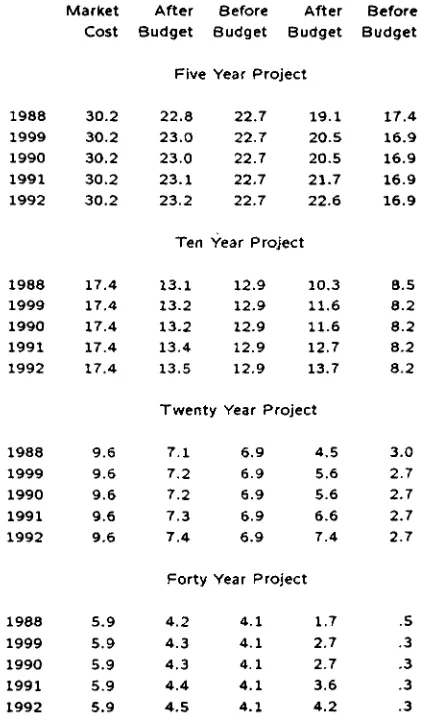
The 1988 and 1990 budgets introduced various new provisions as regards capital allowances and rates of Corporation tax. First year capital al-lowances for plant, machinery and industrial buildings were reduced
• from 100% to 75% on investment in year 1 April 88 to 31 March 89
• from 75% to 50% on investment from 1 April 89 to 31 March 91
• from 50% to 25% on investment from 1 April 91 to 31 March 92
• from 25% to zero thereafter
The standard rate of corporation tax was also reduced
• to 47% for year 1 April 88 to 31 March 89
• to 43% for years 1 April 89 to 31 March 91
• to 40% thereafter
Table 9 examines the effect of these changes by assuming that interest rates and grant levels remain at their 1989 levels up to and including 1992. The Before Budget columns holds capital allowances and taxes constant at their 1988 levels. The After Budget columns introduce the budget changes. The various provisions increase the Cost of Capital for all firms. The increases for manufacturing firms are relatively small and by 1992 the Cost of Capital is almost equated for manufacturing and other firms.
The result of these changes are in line with the policy directions proposed in the White Paper on Industrial Policy (1984) which proposes inter alia that industrial incentives be applied selectively, concentrating resources on internationally-traded manufacturing and services industries, particularly Irish-owned firms. The large reductions in Cost of Capital that occurred in earlier years in this analysis depended in large part on the ability of the firm to take advantage of the various tax-breaks and were not in general determined by an objective of maximizing Welfare.
for example, international competition for resources and/or EC legislation.
McCauiey and Zimmer (1989) have estimated the Cost of Capital for USA, Japan, Germany and the UK. While their methodology was somewhat different some of their results are broadly comparable with those in this analysis. These comparisons are set out in Tables 10(a) and 10(b). The tables contain two columns of Irish data - the first including and the second excluding Capital Grants. The data for the other countries do not include any Capital Grants.
For a twenty year project the Irish Cost of Capital before capital grants is close to average for the other four countries while the cost after grants, excluding 1977 is less than all other countries. The Irish cost before grants for a forty year project is similar to that of Japan and Germany but consid-erably less than that of the UK or USA. The table shows that, from 1982 to 1987, the cost of a forty year project (factory with physical life of 40 years) in the US is greater than that of a twenty year project (Equipment and Machinery with a physical life of 20 years). McCauley and Zimmer do not give sufficient information to determine what particular combination of depreciation and capital allowances have brought this about. Presum-ably it is partly due to a very long schedule of tax depreciation allowances for the factory which decreases their present value. The relatively high "cost of funds" would also affect these data.
Concluding Remarks
The concept of a user Cost of Capital can be used as an indicator to examine the effects of various policies or combinations of policies (e.g. tax rates, capital allowances, interest paid allowances, capital grants etc.) and of changes in interest rates on the incentive to invest. In Section 3 the feasibility of such an approach has been clearly set out.
The report highlights the importance of the system of Capital Grants as incentives to industrial investment. These can be targeted to areas where the greatest benefit to the community can arise. On the other hand the system of profits taxation in conjunction with capital allowances and allowances on interest paid benefit those on high tax rates. Thus these
allowances, which involve large losses of revenue to the Exchequer and considerable benefit to recipients, may not always apply where they would lead to the greatest welfare gains. In many cases the allowances are so generous that the necessary minimum return on investment is less for a firm on the higher rate of tax than for one on the manufacturing rate. In effect these allowances reduce the effective investment to the extent that the extra value of the tax allowances more than compensate for the extra tax paid.
The analysis highlights the economic distortions introduced into the tax system by deferred depreciation allowances. With a neutral tax system the incentive to invest is unchanged by the tax system. A tax system with 100% initial allowances is neutral. When the allowances are deferred their present value is less than the initial investment. In former days when infla-tion was not significant the present value of interest paid allowances would have redressed the balance. In current times the present value of such al-lowances far outweighs the "loss" on the deferred alal-lowances. Neutrality can be achieved by the reintroduction of full depreciation in the absence of interest paid allowances or by restricting interest paid allowances so that the present value of depreciation allowances and interest paid allowances equals the initial investment.
The analysis also indicates that the effects of the reforms in corporation tax in the period 1988 to 1992, introduced in the 1988 and 1990 bud-gets, have changed investment incentives in the directions set out in the White Paper on Industrial Policy (1984) (i.e. concentrating resources on internationally traded manufacturing and services industries).
paid.
The results for Ireland obtained in this analysis are compared with those obtained in a similar study completed in the Federal Reserve Bank of New York for the United States, United Kingdom, Germany and Japan. Their results show that this group of countries split into two groups. A high cost group consisting of the United States and United Kingdom and a low cost group comprising the other two countries. Be for capital grants are taken into account the Irish Cost of Capital for a manufacturing project with a life of 20 years lies between the extremes of the high and low cost groups. The Federal reserve analysis does not include capital grants as these would not be generally available in those countries. The Irish Cost of Capital after grants is less than that of the low cost group (before grants)
Further analysis is required to establish the relationship between the Cost of Capital and actual investment and to determine the relative importance of other factors in determining investment (eg. aggregate demand, supply of investment goods etc.)
Appendix 1
Derivation of Cost of Capital
Consider a firm with production function given by F(K(t)1 N(t)) where
K(t) is the capital stock and N(t) represents other inputs which are
thought of as Labour but may include other inputs. If q(t),p(t) and w(t) are the unit prices of capital goods, output and other inputs, respectively, then we may express the firms discounted net cash flow as
L(K(t)yK(t),N(t)) =
e~rt{p(t)F(K(t)yN(t))-w(t)N(t)
-T\p(t)F(K(t),N(t))-w(t)N(t)
-q(t)(6K(t) + K{t))0 (initial allowance) ~q(t){6K(t) + K(t))S{r,T)(l - 9) (depreciation)
-q(t){l ~ <t>)(6K(t) + K{t))I{r,M)l)} (interest allowance)
where
4> is the capital grant rate
r is the rate of corporate income tax S is the economic depreciation rate r is the interest rate
0 is the initial depreciation allowance T is the length of time over which an asset
is depreciated for tax purposes
S(r,T) is the present value of a stream of T
equal payments whose sum is unity
M is the length of time over which the project is
financed
/ ( r , M) is the present value of the flow of
interest payments on a unit mortgage over M years at an interest rate of r.
We assume that the firm is a price taker i.e. p(t),w(t)tanti q(t) are given.
Appendix 1 (Contd.)
pv = [ L(K(t),K(t)
yN(t))dt
Jo
A necessary conditions for the existence of an extreme is the following Euler equation
dL d dL
dK
Tdt dK
Substituting for L we get
-| £ = e-
rt{-q{t)[l -4>-r(9 + 5(r,T)(l - 9)
- <t> -
T(0 + 5(r,T)(l - 0)
+e-
rt{-q{t)[l -<fi-T(0 + 5(r,T)(l - 0) + (
Thus the Euler equation becomes
-~
Note that the term 0+S(r,T)(l-0)) is the current value of the tax
depreci-ation allowance on one unit of capital expenditure. Writing this as Z and
the current value of the interest allowance as Y we may reduce our formula
to
Appendix 1 (Contd.)
q(t)^l-4>~r(Z + Y).
Prom 1986 we have assumed that capital allowances were granted on ex-penditure on plant and machinery after deducting grants as in the case of expenditure on industrial buildings. In this case both the initial allowance and the depreciation allowances must be multiplied by a factor of (l-<f>) and the formula above reduces to
FK =
iM
( ( r +^ M
H^ ^
Appendix 2
Derivation of Geometric Depreciation Rate corresponding to an asset life of T years
The purpose of this appendix is to show how a straight line depreciation scheme can give rise to geometric depreciation. Let the amount of assets
purchased each year grow geometrically by a factor a (a > 1).
let X be purchased in year l be purchased in year 2
an lX be purchased in year n
an + r - 2x b e pUrChased in year n + T - 1
an + r~1X be purchased in year n + T
A fraction ^ of purchases in year k is depreciated each year for the following T years. Assume that purchases are made at the beginning of each year. Thus at the beginning of year n + T assets amount to
T K ( a - I )2
Depreciation in that year then amounts to
- + a
~X
+. . . +
anX ,
Appendix 2 (Contd.)
Thus the depreciation rate is
aT
-a - 1 (T-a
r+
1-(T+l)a
r+ l) (Ta^
1- (T + l)a
it may be verified that as a —• 1 this factor tends to ^~^ (using L'HopitaPs Rule). The average value of a for Irish industry over the years 1960 to 1984 was 1.07. The table below gives the geometric depreciation rates corresponding to values of a of 1.00, 1.04, 1.07, and 1.10 for various asset lives.
Rate of growth of Gross Investment
Life of Asset
4
5
6
7
8
9
1 0
1 5
2 0
2 5 3 0
4 0
5 0
1.00
. 4 0
. 3 3
. 2 9
. 2 5
. 2 2
. 2 0 . 1 8
. 1 3
.095
.077
.065
.049
.039
1.04
. 3 9
. 3 2
. 2 8
. 2 4
. 2 1
. 1 9 . 1 7
. 1 1 .085
.067
.054
.039
.030
1.07
. 3 9 . 3 2
. 2 7
. 2 3
. 2 1
. 1 8
. 1 7
. 1 1
.078
.061
.049
.035
.027
1.10
. 3 8
. 3 1
. 2 6
. 2 3 . 2 0
. 1 8
. 1 6
. 1 0
.074
.057
.046
.032
Table 1: Cost of Capital (% per year) of projects of various length
Five Year Project Ten Year Project Twenty Year Project Forty Year Project
Tax Rate Tax Rate Tax Rate Tax Rate
Year Mar- Exp- Full Mar- Exp- Full Mar- Exp- Full Mar- Exp- Full ket ort/ ket ort/ ket ort/ ket ort/ Cost Cost Cost Cost Man-uf. Man-uf. Man-uf. Man-uf.
Table 2: Effect of taxes, capital alowances, allowances on interest paid and Grants on Cost of Capital for a five year project
Year 1960 1961 1962 1963 1964 1965 1966 1967 1968 1969 1970 1971 1972 1973 1974 1975 1976 1977 1978 1979 1980 1981 1982 1983 1984 1985 1986 1987 1988 1989
Export or Manufacturing Tax
Market Cost
( 0 ) 39.8 40.3 39.1 39.4 37.3 36.6 35.7 35.4 34.6 34.5 34.6 33.8 32.6 31.6 36.5 35.0 34.5 35.5 36.5 35.2 35.5 34.2 31.8 30.7 30.5 30.5 29.5 29.7 30.2 30.2 Taxes Alone
( 1 ) 100.0 100.0 100.0 100.0 100.0 100.0 100.0 100.0 100.0 100.0 100.0 100.0 100.0 100.0 100.0 100.0 100.0 100.0 100.0 100.0 100.0 111.1 111.1 111.1 111.1 111.1 111.1 111.1 111.1 111.1 Capital Alices
( 2 ) 100.0 100.0 100.0 100.0 100.0 100.0 100.0 100.0 100.0 100.0 100.0 100.0 100.0 100.0 100.0 100.0 100.0 100.0 100.0 100.0 100.0 100.0 100.0 100.0 100.0 100.0 100.0 100.0 100.6 101.2 Capital Inter-est Alices
( 3 ) 100.0 100.0 100.0 100.0 100.0 100.0 100.0 100.0 100.0 100.0 100.0 100.0 100.0 100.0 100.0 100.0 100.0 100.0 100.0 100.0 100.0 96.5 96.1 96.5 96.8 96.6 96.6 96.7 97.7 98.2 Rates Alices Grants
( 4 ) 67.1 67.1 67.1 67.1 67.1 67.1 67.1 67.1 67.1 63.2 68.0 69.0 75.3 75.3 74.0 75.3 64.6 77.7 57.3 56.8 61.7 58.2 48.2 48.6 48.8 58.3 59.6 71.1 75.7 76.0
Fuli Tax Rates
Taxes Alone
( 5 ) 170.9 171.5 187.6 187.6 187.6 238.1 199.8 199.8 199.8 199.8 238.1 238.1 199.8 199.8 199.8 199.8 200.0 181.8 181.8 181.8 181,8 181.8 200.0 200.0 200.0 200.0 200.0 200.0 188.7 175.4 Capital Alices
( 6 ) 106.5 106.6 105.8 105.4 105.9 110.5 107.8 106.6 105.7 106.0 108.8 100.0 100.0 100.0 100.0 100.0 100.0 100.0 100.0 100.0 100.0 100.0 100.0 100.0 100.0 100.0 100.0 100.0 104.6 108.4 Capital Inter-est Alices
( 7 ) 97.5 97.4 95.2 95.5 95.0 90.9 93.2 91.7 89.4 88.8 83.3 74.7 83.2 78.8 73.3 73.9 73.7 79.8 80.9 74.4 73.1 74.1 65.1 68.6 70.9 69.7 69.3 70.2 82.0 87.6 Alices Grants
( 8 ) 44.2 44.0 36.9 37.1 36.9 19.0 32.3 30.9 29.0 21.6 15.3 8 . 7 38.0 34.7 28.3 31.0 12.2 43.7 11.4 6 . 9 13.8 18.6 -8.7 -6.4 -5.1 9 . 3 42.7 51.6 63.4 67.8
(1) Cost after profits tax as allowances or
Capital Allowances - Export or manufacturing tax rates (2) Column ( l ) adjusted for Capital Allowances
(3) Column ( 2 ) adjusted for tax allowances on interest paid (4) Column ( 3 ) adjusted for Capital Grants
Table 3: Effect of taxes, capital alowances, allowances on Interest paid and Grants on Cost of Capital for a ten year project
Year
Export or Manufacturing Tax
Market Taxes Capital Capital Cost Alone Alices
Inter-est
Alices Rates
Alices Grants
Full Tax Rates
Taxes Capital Alone Alices Capital inter-est Alices Alices Grants
( 0 ) ( 1 ) ( 2 ) ( 3 ) (4) (5) ( 6 ) ( 7 ) ( 8 )
1960 1961 1962 1963 1964 1965 1966 1967 1968 1969 1970 1971 1972 1973 1974 1975 1976 1977 1978 1979 1980 1981 1982 1983 1984 1985 1986 1987 1988 1989 22.9 23.2 22.6 22.7 21.5 21.1 20.6 20.4 20.0 19.9 20.0 19.5 18.8 18.2 21.1 20.2 19.9 20.5 21.1 20.3 20.5 19.7 18.4 17.7 17.6 17.6 17.0 17.2 17.4 17.4 100.0 100.0 100.0 100.0 100.0 100.0 100.0 100.0 100.0 100.0 100.0 100.0 100.0 1C0.0 100.0 100.0 100.0 100.0 100.0 100.0 100.0 111.1 111.1 111.1 111.1 111.1 111.1 111.1 111.1 111.1 100.0 100.0 100.0 100.0 100.0 100.0 100.0 100.0 100.0 100.0 100.0 100.0 100.0 100.0 100.0 100.0 100.0 100.0 100.0 100.0 100.0 100.0 100.0 100.0 100.0 100.0 100.0 100.0 101.1 102.3 100.0 100.0 100.0 100.0 100.0 100.0 100.0 100.0 100.0 100.0 100.0 100.0 100.0 100.0 100.0 100.0 100.0 100.0 100.0 100.0 100.0 95.0 94.5 95.0 95.4 95.2 95.1 95.3 97.0 97.9 67.1 67.1 67.1 67.1 67.1 67.1 67.1 67.1 67.1 63.2 68.0 69.0 75.3 75.3 74.0 75.3 64.6 77.7 57.3 56.8 61.7 57.2 47.3 47.8 48.0 57.4 58.7 70.0 75.1 75.8 170.9 171.5 187.6 187.6 187.6 238.1 199.8 199.8 199.8 199.8 238.1 238.1 199.8 199.8 199.8 199.8 200.0 181.8 181.8 181.8 181.8 181.8 200.0 200.0 200.0 200.0 200.0 200.0 188.7 175.4 113.3 113.5 111.8 111.2 112.1 121.2 115.7 113.3 111.4 111.9 117.3 100.0 100.0 100.0 100.0 100.0 100.0 100.0 100.0 100.0 100.0 100.0 100.0 100.0 100.0 100.0 100.0 100.0 108.7 115.6 100.1 100.0 96.3 96.6 96.1 92.5 94.3 91.5 87.6 86.8 80.3 63.2 75.5 69.3 61.7 62.6 62.3 70.9 72.5 63.6 61.9 63.3 50.7 55.4 58.5 56.9 56.3 57.5 76.2 85.8 48.2 48.0 39.6 39.7 39.6 23.6 35.6 32.9 29.7 22.5 15.9 . 8 32.2 27.6 19.7 22.5 4 . 8 36.9 6 . 6 . 8 6 . 9 11.6 -16.7 -13.8 -12.0 1.0 34.7 42.3 19.0 66.4
( 1 ) Cost after profits tax as % of Market Cost - No Capital .Interest paid allowances or Capital Allowances - Export or manufacturing tax rates
(2) Column ( l ) adjusted for Capital Allowances
Column (2) adjusted for tax allowances on interest paid Column (3) adjusted for Capital Grants
(3) (4)
(5) to (8) as ( l ) to (4) but full tax applied
Table 4: Effect of Taxes, Capital Alowances, Allowances on Interest paid and Grants on Cost of Capital for a twenty year project
Year Export or Market Taxes Cost Alone Manufacturing Tax Capital Capital Alices Inter-est Alices Rates Alices Grants
Full Tax Rates
Taxes Capital Alone Alices Capital Inter-est Alices Alices Grants
( 0 ) ( 1 ) ( 2 ) ( 3 ) (4) (5) ( 6 ) ( 7 ) ( 8 )
1960 1961 1962 1963 1964 1965 1966 1967 1968 1969 1970 1971 1972 1973 1974 1975 1976 1977 1978 1979 1980 1981 1982 1983 1984 1985 1986 1987 1988 1989 12.6 12.8 12.4 12.5 11.9 11.6 11.3 11.3 11.0 11.0 11.0 10.7 10.3 10.0 11.6 11.1 11.0 11.3 11.6 11.2 11.3 10.9 10.1 9 . 8 9 . 7 9 . 7 9 . 4 9 . 5 9 . 6 9 . 6
100.0 100.0 100.0 100.0 100.0 100.0 100.0 100.0 100.0 100.0 100.0 100.0 100.0 100.0 100.0 100.0 100.0 100.0 100.0 100.0 100.0 111.1 111.1 111.1 111.1 111.1 111.1 111.1 111.1 111.1 100.0 100.0 100.0 100.0 100.0 100.0 100.0 100.0 100.0 100.0 100.0 100.0 100.0 100.0 100.0 100.0 100.0 100.0 100.0 100.0 100.0 100.0 100.0 100.0 100.0 100.0 100.0 100.0 101.7 103.5 100.0 100.0 100.0 100.0 100.0 100.0 100.0 100.0 1O€.O 100.0 100.0 100.0 100.0 100.0 100.0 100.0 100.0 100.0 100.0 100.0 100.0 92.1 91.4 92.1 92.6 92.4 92.3 92.4 95.0 96.4 67.1 67.1 67.1 67.1 67.1 67.1 67.1 67.1 67.1 63.2 68.0 69.0 75.3 75.3 74.0 75.3 64.6 77.7 57.3 56.8 61.7 55.3 45.6 46.2 46.4 55.5 56.9 67.9 73.6 74.6 170.9 171.5 187.6 187.6 187.6 238,1 199.8 199.8 199.8 199.8 238.1 238.1 199.8 199.8 199.8 199.8 200.0 181.8 181.8 181.8 181.8 181.8 200.0 200.0 200.0 200.0 200.0 200.0 188.7 175.4 123.4 123.8 121.0 120.0 121.4 136.7 127.1 122.8 119.3 119.9 128.6 100.0 100.0 100.0 100.0 100.0 100.0 100.0 100.0 100.0 100.0 100.0 100.0 100.0 100.0 100.0 100,0 100.0 113.5 123.8 100.5 100.4 93,9 94.6 93.6 87.4 90.3 85.5 78.7 77.3 66.1 37.8 58.3 48.9 37.8 39.0 38.6 52.3 54.6 42.1 39.9 41.7 23.0 29.1 33.4 31.2 30.4 32.0 60.4 75.7 51.8 51.7 41.1 41.3 41.0 25.3 36.7 32.0 26.3 19.5 9 . 9 -16.7 19.2 12.2 2 . 1 4 . 7 -10.5 22.4 -3.6 -11.4 -6.7 -2.3 -32.0 -28.3 -26.0 -15.5 18.7 23.5 46.7 58.6
(1) Cost after profits tax as % of Market Cost - No Capital .Interest paid allowances or Capital Allowances - Export or manufacturing tax rates
(2) Column ( l ) adjusted for Capital Allowances
(3) Column (2) adjusted for tax allowances on interest paid (4) Column (3) adjusted for Capital Grants
Table 5: Effect of Taxes, Capital AIowancesp Allowances on Interest paid and Grants
on Cost of Capital for a forty year project
Export or Manufacturing Tax Rates Full Tax Rates
Year Market Taxes Capital Capital Alices Taxes Capital Capital Alices Cost Alone Alices Inter- Grants Alone Alices Inter- Grants
(0) CD ( 2 )
est Alices
(3) (4) (5) ( 6 )
est Alices
(7) ( 8 )
I960 1961 1962 1963 1964 1965 1966 1967 1968 1969 1970 1971 1972 1973 1974 1975 1976 1977 1978 1979 1980 1981 1982 1983 1984 1985 1986 1987 1988 1989 7.8 7.9 7.7 7.7 7.3 7.2 7.0 7.0 6.8 6.8 6.8 6.6 6.4 6.2 7.2 6.9 6.8 7.0 7.2 6.9 7.0 6.7 6.3 6.0 6.0 6.0 5.8 5.8 5.9 5.9 100.0 100.0 100.0 100.0 100.0 100.0 100.0 100.0 100.0 100.0 100.0 100.0 100.0 100.0 100.0 100.0 100.0 100.0 100.0 100.0 100.0 111.1 111.1 111.1 111.1 111.1 111.1 111.1 111.1 111.1 100.0 100.0 100.0 100.0 100.0 100.0 100.0 100.0 100.0 100.0 100.0 100.0 100.0 100.0 100.0 100.0 100.0 100.0 100.0 100.0 100.0 100.0 100.0 100.0 100.0 100.0 100.0 100.0 102.2 104.5 100.0 100.0 100.0 100.0 100.0 100.0 100.0 100.0 - 100.0 100.0 100.0 100.0 100.0 100.0 100.0 100.0 100.0 100.0 100.0 100.0 100.0 88.8 88.3 88.9 89.3 89.1 89.0 89.2 92.2 94.1 67.1 67.1 67.1 67.1 67.1 67.1 67.1 67.1 67.1 63.2 68.0 69.0 75.3 75.3 74.0 75.3 64.6 77.7 57.3 56.8 61.7 53.2 43.8 44.4 44.6 53.4 54.9 65.5 71.4 72.8 170.9 171.5 187.6 187.6 187.6 238.1 199.8 199.8 199.8 199.8 238.1 238.1 199.8 199.8 199.8 199.8 200.0 181.8 181.8 181.8 181.8 181.8 200.0 200.0 200.0 200.0 200.0 200.0 188.7 175.4 135.3 135.8 132.0 131.0 132.4 154.1 139.6 133.2 127.6 128.1 139.7 100.0 100.0 100.0 100.0 100.0 100.0 100.0 100.0 100.0 100.0 100.0 100.0 100.0 100.0 100.0 100.0 100.0 117.5 130.3 96.4 96.2 85.8 87.3 85.2 71.5 78.4 71.2 61.0 59.0 39.6 .1 32.0 20.3 8.2 9.4 8.9 28.2 30.6 18.0 16.0 17.6 -5.7 -.3 3.7 1.6 .8 2.4 38.1 59.7 53.0 52.8 39.3 39.9 39.0 20.4 32.8 25.9 17.2 10.9 -4.6 -42.7 -.5 -9.4 -19/* -17.6 -29.7 3.6 -17,4 -25.1 -21.4 -17.8 -47.8 -44.7 -42.4 -34.6 .5 1.7 29.5 46.2
(1) Cost after profits tax as % of Market Cost - No Capital ,Interest paid allowance Capital Allowances - Export or manufacturing tax rates
(2) Column ( l ) adjusted for Capital Allowances
(3) Column (2) adjusted for tax allowances on interest paid (4) Column (3) adjusted for Capital Grants
(5) to (8) as (1) to (4) but full tax applied
Table 6(a): Comparisons of Cost of Capital (% per year) with tax paid at Export/Manuf. rates for projects of various lengths
for real interest rates of 3.47% and 7%
Five Year Project Ten Year Project Twenty Year Project
3.47% 7% 3.47% 7% 3.47% 7%
Forty Year Project 3.47% 7% 1980 1981 1982 1983 1984 1985 1986 1987 1988 1989 21.9 19.9 15.3 14.9 14.9 17.8 17.6 21.1 22.8 23.0 24.1 21.7 16.7 16.3 16.2 19.4 19.2 23.1 24.9 25.1 12.6 11.3 8.7 8.5 8.4 10.X 10.0 12.0 13.1 13.2 14.8 13.1 10.1 9.8 9.8 11.7 11.6 14.0 15.2 15.4 7. 6. 4. 4. 4. 5. 5. 6. 7. 7. 0 0 6 5 5 4 3 4 1 2 9.1 7.8 6.0 5.8 5.8 7.0 6.9 8.3 9.1 9.3 4.3 3.6 2.7 2.7 2.7 3.2 3.2 3.8 4.2 4.3 6.5 5.3 4.1 4.0 4.0 4.8 4.7 5.7 6.2 6,4
Table 6(b): Comparisons of Cost of Capital (% per year) with full tax paid for projects of various lengths for real interest rates of 3.47% and 7%
Five Year Project Ten Year Project Twenty Year Project Forty Year Project
3.47% 7% 3.47% 7% 3.47% 7% 3.47% 7%
Table 7(a): Comparisons of Cost of Capital (% per year) for a five year project under various tax regimes for constant (3.47%) and variable real rates of interest
I960 1961 1962 1963 1964 1965 1966 1967 1968 1969 1970 1971 1972 1973 1974 1975 1976 1977 1978 1979 1980 1981 1982 1983 1984 1985 1986 1987 1988 1989 Market Constant 39.8 40.3 39.1 39.4 37.3 36.6 35.7 35.4 34.6 34.5 34.6 33.8 32.6 31.6 36.5 35.0 34.5 35.5 36.5 35.2 35.5 34.2 31.8 30.7 30.5 30.5 29.5 29.7 30.2 30.2 Cost Variable 38.9 38.7 40.4 38.0 37.0 37.3 38.0 36.5 37.2 31.0 31.8 32.1 28.8 28.1 22.9 25.9 27.0 28.1 31.3 38.7 33.4 34.2 38.1 36.3 35.8 36.7 37.9 37.6 34.8 35.6 Export/Manuf Constant 26.7 27.0 26.2 26.4 25.0 24.5 23.9 23.8 23.2 21.8 23.5 23.3 24.5 23.8 27.0 26.4 22.3 27.6 20.9 20.0 21.9 19.9 15.3 14.9 14.9 17.8 17.6 21.1 22.8 23.0 Tax Rates Variable 26.1 26.0 27.1 25.5 24.8 25.1 25.5 24.5 24.9 19.6 21.6 22.1 21.7 21.2 16.9 19.5 17.4 21.8 17.9 22.0 20.6 19.9 18.4 17.7 17.5 21.4 22.6 26.7 26.3 27.1 Full Tax Constant 17.6 17.7 14.4 14.6 13.8
7 . 0
11.5 10.9 10.1
7 . 5 5 . 3 2 . 9
12.4 11.0 10.3 10.8
4 . 2
15.5
4 . 2 2 . 4 4 . 9 6 . 4
-2.8 -2.0 -1.6
2 . 8
12.6 15.3 19.1 20.5 Rates Variable 17.2 17.0 14.9 14.1 13.6
7 . 1
12.3 11.3 10.8
6 . 7 4 . 9 2 . 8
10.9
9 . 8 6 . 5 8 . 0 3 . 3
12.3
3 . 6 2 . 7 4 . 6 6 . 4
-3.3 -2.3 -1.8
3 . 4
16.2 19.4 22.1 24.1
[image:28.455.60.363.148.529.2]Table 7(b): Comparisons of Cost of Capital (% per year) for a ten year project under various tax regimes for constant (3.47%) and variable real rates of interest
Market Cost Export/Manuf Tax Rates
Constant Variable Constant Variable
Full Tax Rates
[image:29.478.88.390.161.542.2]Table 7(c): Comparisons of Cost of Capital (% per year) for a twenty year project under various tax regimes for constant (3.47%) and variable real rates of interest
Market Cost Export/Manuf Tax Rates
Constant Variable Constant Variable
Full Tax Rates
Constant Variable I960 1961 1962 1963 1964 1965 1966 1967 1968 1969 1970 1971 1972 1973 1974 1975 1976 1977 1978 1979 1980 1981 1982 1983 1984 1985 1986 1987 1988 1989 12.6 12.8 12.4 12.5 11.9 11.6 11.3 11.3 11.0 11.0 11.0 10.7 10.3 10.0 11.6 11.1 11.0 11.3 11.6 11.2 11.3 10.9 10.1 9.8 9.7 9.7 9.4 9.5 9.6 9.6 11.8 11.2 13.7 11.1 11.5 12.4 13.6 12.4 13.5 7.4 8.2 9.0 6.6 6.5 -2.0 2.0 3.5 3.9 6.4 14.7 9.2 10.9 16.4 15.4 15.0 15.9 17.8 17.3 14.2 15.0 8.5 8.6 8.3 8.4 8.0 7.8 7.6 7.6 7.4 6.9 7.5 7.4 7.8 7.6 8.6 8.4 7.1 8.8 6.6 6.4 7.0 6.0 4.6 4.5 4.5 5.4 5.3 6.4 7.1 7.2 7.9 7.5 9.2 7.5 7.7 8.3 9.2 8.3 9.1 4.7 5.6 6.2 5.0 4.9 -1.5 1.5 2.2 3.0 3.7 8.3 5.7 6.0 7.5 7.1 7.0 8.8 10.1 11.8 10.5 11.2 6.5 6.6 5.1 5.2 4.9 2.9 4.2 3.6 2.9 2.1 1.1 1.8 2.0 1.2 .2 .5 1.1 2.5 -.4 1.3 -.8 -.2 3.2 2.8 2.5 1.5 1.8 2.2 4.5 5.6 6.1 5.8 5.6 4.6 4.7 3.1 5.0 4.0 3.6 1.4 .8 -1.5 1.3 .8 .0 .1 -.4 .9 -.2 -1.7 -.6 -.2 -5.2 -4.4 -3.9 -2.5 3.3 4.1 6.7 8.8
[image:30.454.71.371.161.522.2]Table 7(d): Comparisons of Cost of Capital (% per year) for a forty year project under various tax regimes for constant (3.47%) and variable real rates of interest
Market Cost Export/Manuf Tax Rates
Constant Variable Constant Variable
Full Tax Rates
[image:31.479.79.384.156.518.2]Table 8: Effects on 1989 Cost of Cost of Capital of
(1) 1 % increase in nominal and real interest rates (2) 1 % increase in nominal interest rate only
Actual ( l ) (2)
Five Year Project Market Cost Export/Manuf. Full Tax
Ten Year Project Market Cost Export/Manuf. Full Tax
Twenty Year Project Market Cost Export/Manuf. Full Tax
Forty Year Project Market Cost Export/Manuf. Full Tax
T a x
Tax
Tax
Tax
30.2 23.0 20.5
17.4 13.2 11.6
9.6 7.2 5.6
5.9 4.3 2.7
31.1 23.6 20.8
18.3 13.8 12.0
10.4 7.8 6.0
6.8 4.9 3.0
30.2 22.9 20.3
17.4 13.2 11.4
9.6 7.1 5.5
5.9 4.3 2.6
Table 9: Effects of 1988/1990 Budgets on Cost of Capital
Export/Manuf Tax Rates Full Tax Rates
Market After Before After Before Cost Budget Budget Budget Budget
Five Year Project
1988 1999 1990 1991 1992
30.2 30.2 30.2 30.2 30.2
22.8 23.0 23.0 23.1 23.2
22.7 22.7 22.7 22.7 22.7
19.1 20.5 20.5 21.7 22.6
17.4 16.9 16.9 16.9 16.9
Ten Year Project
1988 1999 1990 1991 1992
17.4 17.4 17.4 17.4 17.4
13.1 13.2 13.2 13.4 13.5
12.9 12.9 12.9 12.9 12.9
10.3 11,6 11.6 12.7 13.7
8.5 8.2 8.2 8.2 8.2
Twenty Year Project
1988 1999 1990 1991 1992
9.6 9.6 9.6 9.6 9.6
7.1 7.2 7.2 7.3 7.4
6.9 6.9 6.9 6.9 6.9
4.5 5.6 5.6 6.6 7.4
3.0 2.7 2.7 2.7 2.7
Forty Year Project
1988 1999 1990 1991 1992
5.9 5.9 5.9 5.9 5.9
4.2 4.3 4.3 4.4 4.5
4.1 4.1 4.1 4.1 4.1
1.7 2.7 2.7 3.6 4.2
References
Averback, A. J. 1983. "Taxation, Corporate Financial Policy and the Cost of Capital", Journal of Economic Literature, Vol. XXI, pp 905-940, Septem-ber.
Devereux, M.. "Tax Asymmetries, The cost of capital and investment: Some evidence from United Kingdom Panel Data", Economic Journal, 99, (Conference 1989), pp 103-112
Diewert, W.E., 1988. "On tax reform", Canadian Journal of Economics, pp 1-40, February.
FitzGerald, J.D., 1983."Comment on Paper on the Cost of Capital in ire-land by Flynn and Honohan", Paper read at Annual Conference, Irish
Assocoation of University Teachers of Economics, April.
Flynn, J. and P. Honohan, 1984. "Notes on the cost of capital in Ireland",
I BAR - Journal of Irish Business and Administrative Review, Vol. 6, No.
1, pp 58-69, April.
Geary, P.T. and E. McDonnell, 1979. "The Cost of Capital to Irish Industry: Revised Estimates", Economic and Social Review, Vol. 10, No. 4f pp
287-299, July.
Henry, E.W., 1989. "The Capital Stock of Ireland 1950-1984", Dublin, Economic and Social Research Institute, September.
Jorgenson, Dale W., 1963. "Capital Theory and Investment Behaviour",
American Economic Review, 53(2) pp 247-59, May.
McCauley, R.N. and S.A. Zimmer, 1989. "Explaining International Differences in the cost of Capital", Federal Reserve Bank of New York Quarterly
Review, pp 7-28, Summer .
Precious, Mark, 1987. ''Rational Expectations, Non-market clearency and
Investment Theory", Clarendon Press, Oxford
Ruane, F.P. and John A.A, 1984. "Government Interventions and the cost of capital to Irish Manufacturing Industry", Economic and Social Review, Vol. 16, No. 1, pp 31-50, October.
Summers, L.H., 1987. "Investment Incentives and the Discounting of De-preciation Allowances", in Feldstein, M. (ed.) "The Effects of Taxation on Capital Accumulation", Chicago and London, University of Chicago Press.
DISCUSSION
F. Ruane: I am delighted to propose a vote of thanks to John Frain for presenting such a stimulating paper to the Society.
The literature to which this paper has contributed originated in the United States in the 1960s. In the earlier literature up to and including Harberger's influential paper on the incidence of the US corporation tax in 1962, it was widely presumed by economists that the effect of this tax is to increase the cost of capital to the corporate sector. However, Jorgenson in a study of the determinants of investment, published in the American Economic Review in 1963, noted that the effect of the tax system on the cost of capital depended crucially on the particular set of capital allowances which are available against that tax. In particular, he pointed out that the tax system had no effect at all on the cost of capital in two special cases: (i) when true economic depreciation allowances were given in combina-tion with full tax deducibility of the borrowing costs associated with the investment, or (ii) when there was full expensing of capital expenditures (free depreciation allowances). In either case the corporate tax system applies effectively to super-normal profits only; such a system is described as being "neutral", with the decision to make the investment independent of the rate of corporate tax. In such a case, the effective cost of capital to the firm is the same as the market cost.
Over the past two and a half decades this literature has developed and has been refined to take account of more complex tax systems, and in particular, the interaction between the corporate and the personal tax systems, and their influence on the cost of capital. Recent developments in the theory of finance have also being exploited to further develop the analysis.
In Ireland the first study of the impact of the corporate tax system on the cost of capital was published in the Economic and Social Review in 1975. Until the publication of that study, the relationship of government policy to investment was examined solely in terms of the impact of Industrial Development Authority (IDA) capital grants on the cost of investment. What Geary, Walsh and Copeland showed was that the corporate tax system had a significant direct effect on reducing the cost of investment to Irish manufacturing industry, and furthermore, that its interaction with
the grant system resulted in an effect greater than the sum of the effects of the two systems taken separately. The reason for this is that in the Irish fiscal system, and not anywhere else in the world to my knowledge, the depreciation allowances granted covered all capital expenditures, including those actually financed by the state through the IDA. Thus the write-off against tax exceeded the actual expenditure made by the firm. Subsequent papers in this tradition incorporated the developments in the theoretical literature, as well as developments in the Irish system. In particular, the important influence of leasing and Section 84 loans on the cost of capital was analysed independently by Flynn and Honohan and Ruane and John in papers published in 1984. While similar tax-based financing devices exist in other countries, their significance in Ireland was enhanced both by the granting of the tax allowances on total investment as well as by the preferential rate of corporate tax available to manufacturing firms compared with the rest of the corporate sector.
What does John Frain's study add to the existing literature? Firstly, it presents a much wider range of capital costs than have hitherto been estimated. The estimates for five-year assets are especially interesting because, with technological change, there are now many assets with short lives, and from the paper it is clear that the costs of holding such assets are very high. Secondly, the paper shows the reduction in the cost of capital resulting from interest and depreciation allowances separately; in all of the earlier papers these influences were only considered jointly. Furthermore, the paper contrasts with earlier research in its approach to specifying both the depreciation and non-depreciation costs of capital. In the case of the depreciation cost, the growth of the capital stock is built into the estimates presented, by using Eamonn Henry's work and geometric depreciation rates derived in Appendix 2. This approach results in much higher depreciation rates than found in earlier analyses; for example, a ten-year asset in this paper has a depreciation rate of 17%, compared with 9.5% in Ruane and John. In the case of the non-depreciation cost of holding an asset, most of the tables in the paper assume that this cost (r - q/q) is constant and equal to 3.74%, so that the expression (r + 6 - q/q) is constant in each year. Thus the market cost of capital in the Tables 1 to 5 only varies from year to year through changes in the relative cost of investment goods to output [q(t)/p(t)] in equation 3.1.
both interest and depreciation, and of capital grants on the cost of capi-tal. This focus is evident from looking at a table such as Table 3, which presents a time series for the case of a ten-year project. There is a wealth of information in this table, and it is useful to identify different periods, illustrating the effects of changes in the corporate tax system. Consid-ering the case of Full Tax Rates, Columns 5 to 8, it is evident that the tax system was approximately neutral in 1960/61; i.e., the combination of capital allowances and interest allowances resulted in a cost of capital which was virtually identical to the market cost. With an average grant rate of 50%, the effective cost of capital was about 50% of the market cost. In the period 1962/69, the effect of changes in the tax system was to reduce the cost of capital progressively over the period, and during the same period the combination of grants and allowances reduced the cost gradually to 15% of the market cost. 1970 saw the introduction of free depreciation allowances, so that the capital allowances alone were suffi-cient to reduce the cost of capital to the market cost. These allowances operated until 1987. Thus the addition of interest deducibility allowances resulted in an effective cost of capital before the payment of any grants which was substantially less (a half to three quarters) than the market cost of capital. The estimates of the grant rates were the averages given in each year and these changed annually over the period, interacting with the tax allowances. Finally, the reduction in the tax allowances in 1988 shows up clearly as the cost of capital, including the depreciation allowances, is greater than the market cost (108.7 in 1988 and 115.6 in 1989). The cost of capital, allowing for all allowances and grants, has risen in the same period, reflecting both the reduction in the allowances and the reduced average grant rates being given by the IDA.
My reservations with this paper are that it may create two impressions which I believe would be misleading. The first is that the tables imply that the cost of capital is actually much lower for non-exporting firms than for exporting firms. In fact the figures presented in the main tables do not represent a comparison of the effective costs of capital faced by exporting and non-exporting firms; rather they indicate the basis for arbitraging in which firms engaged over the 1970s and 1980s, as leasing agreements and Section 84 loans were used to transfer allowances from agents without tax liabilities (exporting manufacturers) to agents with liabilities (banks). Thus many exporting firms enjoyed close to the same costs of capital as the full tax rate firms in the paper, while paying no taxes at all.
Secondly, the tables suggest that the exporting firms became liable for the 10% tax in 1981. My concern here is that the impression may be created that 1981 was a year of major adjustment for exporting firms, whereas in fact for very many of them 1990 is actually the first year in which they become liable for the higher tax rate. Furthermore, because of the arbitraging already noted, the decline in costs noted in column 3 between 1981 and 1986 would not have been realised in practise by most firms; indeed the reduction in the gap between the two tax rates from 45% to 35% would have reduced the potential tax savings which were available to be shared between the lessor and the lessee, thus possibly raising the effective cost of capital.
Finally, it should be noted that the estimates presented in the paper relate solely to the effects of the corporate tax system on the cost of capital. All interactions between the corporate and the personal tax system are ignored, and the estimates are those of debt-financed capital, since all finance is assumed to be eligible for interest deductibility allowances. To the extent that dividend finance was more costly (and the growth in the extent of debt finance over the period would suggest that it was), the cost of capital would be higher than that shown in the estimates presented in the paper.