Radial Basis Function-Assisted Turbo Equalization
Mong-Suan Yee, Associate Member, IEEE, Bee Leong Yeap, Member, IEEE, and Lajos Hanzo, Senior Member, IEEE
Abstract—This paper presents a turbo equalization (TEQ) scheme, which employs a radial basis function (RBF)-based equalizer instead of the conventional trellis-based equalizer of Douillard et al. Structural, computational complexity, and perfor-mance comparisons of the RBF-based and trellis-based TEQs are provided. The decision feedback-assisted RBF TEQ is capable of attaining a similar performance to the logarithmic maximum a posteriori scheme in the context of both binary phase-shift keying (BPSK) and quaternary phase-shift keying (QPSK) modulation, while achieving a factor 2.5 and 3 lower computational complexity, respectively. However, there is a 2.5-dB performance loss in the context of 16 quadrature amplitude modulation (QAM), which suffers more dramatically from the phenomenon of erroneous decision-feedback effects. A novel element of our design, in order to further reduce the computational complexity of the RBF TEQ, is that symbol equalizations are invoked at current iterations only if the decoded symbol has a high error probability. This techniques provides 37% and 54% computational complexity reduction compared to the full-complexity RBF TEQ for the BPSK RBF TEQ and 16QAM RBF TEQ, respectively, with little performance degradation, when communicating over dispersive Rayleigh fading channels.
Index Terms—Decision-feedback equalizer (DFE), Jacobian log-arithm, neural network, radial basis function (RBF), turbo coding, turbo equalization (TEQ).
I. BACKGROUND
P
REVIOUS TURBO equalization (TEQ) research has invoked component equalizer implementations using the soft-output Viterbi algorithm (SOVA) [1], [2], the optimal maximum a posteriori (MAP) algorithm [2], [3], and linear filters [4]. In this paper, we employ a radial basis function (RBF)-assisted equalizer as the soft-in/soft-out (SISO) equal-izer in the context of TEQ. In Sections I-A and I-B, we will introduce the RBF equalizer and the TEQ scheme, followed by the implementation details of the RBF TEQ in Section II. Section III is dedicated to the comparison of the RBF and MAP equalizers, while Section IV entails our discussions related to the complexity reduction issues of the RBF TEQ when using the Jacobian logarithm known from the field of turbo-channel coding. In Section V, the proposed scheme’s performance is benchmarked against that of the optimal MAP TEQ scheme of [1]. Finally, in Section VI, we proposed a further computational complexity-reduction technique for the RBF TEQ, and in Section VII, we conclude our investigations.Paper approved by M. Chiani, the Editor for Wireless Communication of the IEEE Communications Society. Manuscript received September 14, 2000; re-vised June 15, 2002. This paper was presented in part at the IEEE Vehicular Technology Conference, Tokyo, Japan, May 15–18, 2000.
The authors are with the Department of Electronics and Computer Science, University of Southampton, Southampton SO17 1BJ, U.K. (e-mail:[email protected]).
[image:1.612.308.552.138.302.2]Digital Object Identifier 10.1109/TCOMM.2003.810807
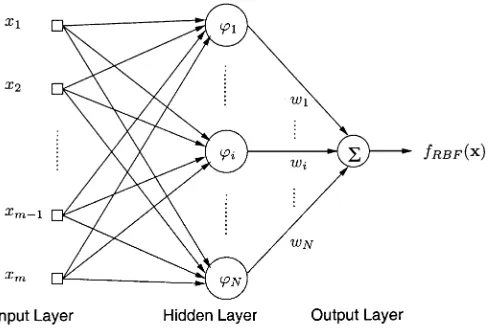
Fig. 1. Architecture of an RBF network.
A. Introduction to RBF-Based Equalization
Channel equalization can be viewed as a received phasor clas-sification problem. However, due to channel effects, the phasors may become linearly nonseparable, and in these scenarios, the nonlinear structure of RBF-assisted equalizers can enhance the performance of conventional channel equalizers [5]. The RBF network [6] shown in Fig. 1 has an equivalent structure to the so-called optimal Bayesian equalization solution [7], and it can provide the conditional density function (CODF) of the trans-mitted symbols. Hence, the RBF network has been employed in various channel equalization applications [7], [8]. The overall response of the RBF network of Fig. 1 using Gaussian RBF can be formulated as
(1)
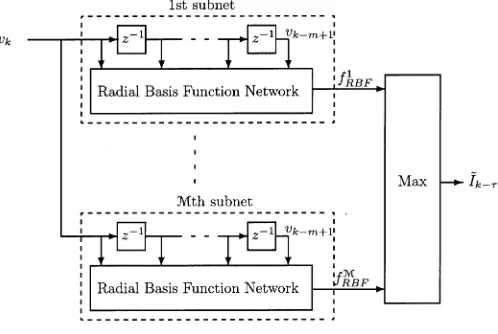
where , represents the RBF centers, which have the same dimensionality as the input vector , denotes the Euclidean norm, is the RBF, is a positive constant de-fined as the width of the RBF, is the weight of the RBF, and is the number of hidden nodes in the RBF network [9]. The architecture of the RBF network-based equalizer designed for an -level modulation scheme is shown in Fig. 2. The optimal Bayesian decision solution of the th order, -ary RBF equal-izer receiving the signal vector and optimized in order to achieve the minimum error probability of the detected symbol
delayed by is as follows [10], [11]:
if
(2)
Fig. 2. RBF equalizer for anM-ary scheme.
where is the th -ary symbol, and is the decision variable provided by the th sub-RBF network of Fig. 2 based on the CODF
(3)
(4)
The quantities , , denote the a
priori probability of occurance for each possible channel output
state associated with the transmitted -ary symbol , , and is the probability density function (PDF) of the additive noise imposed by the channel. The channel output state is described by the noise-free channel output vector ob-served in the RBF equalizer’s -dimensional input space. We will briefly describe this concept.
The symbol-spaced channel output can be defined by
(5)
where is the additive white Gaussian noise (AWGN) se-quence with variance , , is the channel impulse response (CIR), is the channel input sequence, and is the noise-free channel output. The channel output observed by the linear th-order equalizer can be written in
vector form as , and hence,
we can say that the equalizer has an -dimensional channel output observation space. For a CIR of length , there are possible combinations of the channel input
se-quence that produce
dif-ferent possible values of the noise-free channel output vector . The possible values or par-ticular points in the observation space are referred to as the channel output states, , . We denote each of the possible combinations of the channel input
se-quence of length symbols as , , where
the channel input state
de-termines the desired channel output state , with the aid of the CIR. This is formulated as
if (6)
The channel output state can be defined as
(7)
where is the CIR matrix given in the form of
..
. ... ...
(8)
with , being the CIR taps. There are channel output states corresponding to the transmitted symbol . Linking (1) with (4), we have assigned the weight of the RBF network to the a priori probability of occurance of the channel output state, yielding and the centers of the RBF to the channel output state vectors,
for-mulated as , , . The
number of hidden nodes of each sub-RBF network is given by . In their seminal papers, Chen et al. [10], [12], [13] introduced decision feedback into the RBF equalizer in order to reduce its computational complexity via subset center selec-tion. A significantly lower number of noiseless channel states are considered by the RBF decision-feedback equalizer (DFE) in computing the decision variable of (4) with the additional in-formation of the detected symbols, which were fed back from the output of the decision device in order to assist in the RBF subcenter selection. Note that for matched filters that introduce band-edge distortion, a fractional-symbol-spaced RBF equal-izer that classifies the fractionally sampled received signal cor-responding to the transmitted symbol is required. A study of the fractional-symbol-spaced RBF equalizer is, however, beyond the scope of this paper. Having introduced the concept of the RBF equalizer, we will now present the proposed TEQ scheme in the next section.
B. Introduction to TEQ
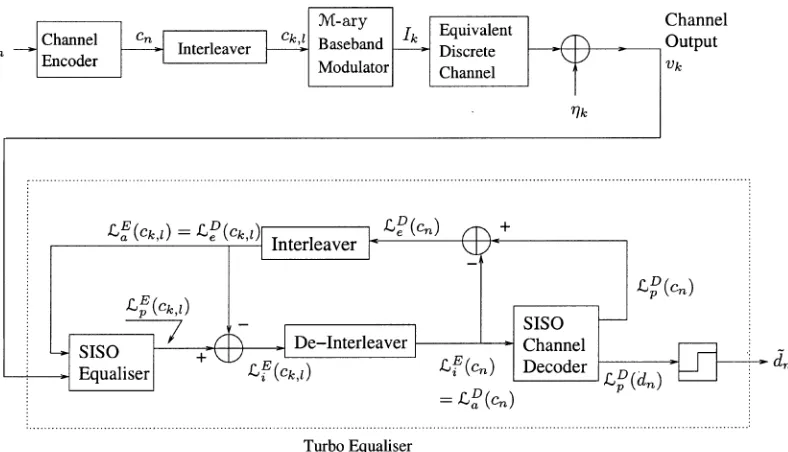
Turbo coding was combined with an RBF DFE scheme in [14], where equalization and channel decoding ensued indepen-dently. However, it is possible to improve the receiver’s perfor-mance, if the equalizer is fed by the channel outputs plus the soft decisions provided by the channel decoder, invoking a number of iterative processing steps, as proposed by Douillard et al. [1] for a convolutional coded binary phase-shift keying (BPSK) system. This scheme can be extended to number of modula-tion levels, and the corresponding scheme is illustrated in Fig. 3.
Fig. 3. Serially concatenated codedM-ary system using the turbo equalizer, which performs the equalization, demodulation, and channel decoding iteratively.
the outer decoder. At the receiver, the equalizer and decoder employ a SISO algorithm. In previous TEQ research the SISO equalizer invoked the SOVA [1], the optimal MAP algorithm [3], and linear filters [4]. By contrast, we introduce the pro-posed RBF-based equalizer as the SISO equalizer in the context of TEQ. The SISO equalizer processes the a priori information associated with the coded bits transmitted over the channel and, in conjunction with the channel output values , computes the a posteriori information concerning the coded bits. The soft values of the channel coded bits are typically quantified in the form of the log-likelihood ratio (LLR) defined as follows:
(9)
where the term is the
log-likelihood of the th data bit concerning the th trans-mitted symbol having the value conditioned on the received sequence .
In our description of the turbo equalizer depicted in Fig. 3, we have used the notation and to indicate the LLR values output by the SISO equalizer and SISO decoder, respectively. The subscripts , , , and were used to represent the extrinsic LLR, the combined channel and extrinsic LLR, the a priori LLR, and the a posteriori LLR, respectively. The following sec-tions will discuss the associated implementation details, where the performance of the RBF TEQ scheme is compared with that of the optimal MAP TEQ scheme of [3].
II. RBF-ASSISTEDTEQ
The RBF network-based equalizer is capable of utilizing the
a priori information provided by the channel decoder of Fig. 3, in order to improve its performance. This a priori in-formation can be assigned to the weights of the RBF network
[11]. Note that the weights of the equalizer, provided by the soft inputs of the equalizer, are in the form of the a priori proba-bility of each possible channel output state , as demonstrated in (4). However, the soft information provided by the decoder is in the form of the LLR of the interleaved coded bits , as shown in Fig. 3. Additionally, the decoder requires soft in-puts in terms of the LLR of the coded bits , whereas, the equalizer provides soft outputs in the form of the CODF of the transmitted symbols. Therefore, a mapping/demapping of the soft information is required between the two components. This process is highlighted below in more detail.
Referring to (7) for the specific scenario of a time-invariant CIR, and assuming that the symbols in the sequence are statis-tically independent of each other, the probability of the received channel output vector is given by
(10)
The transmitted symbol vector component , i.e., the th symbol in the vector, is given by number of bits
. Therefore, we have
(11)
We have to map the bits representing the -ary symbol to the corresponding bit . Note that the probability of the channel output states, and therefore, also the RBF weights defined as in (4) are time variant, since the values of
the probability of bit having the value of or can be obtained from the a priori information provided by the channel decoder of Fig. 3, according to
(12)
Hence, referring to (10), (11), and (12), the probability of the received channel output vector can be represented in terms of the bit LLRs as follows:
(13)
where the constant
is independent of the bit .
Therefore, we have demonstrated how the soft output of the channel decoder of Fig. 3 can be utilized by the RBF equalizer. Another way of viewing this process is that the RBF equalizer is trained by the information generated by the channel decoder. The RBF equalizer provides the a posteriori LLR values of the bits according to
(14)
where was defined by (4), and the received sequence is shown in Fig. 3. In the next section, we will provide a comparative study of the RBF equalizer and the conventional MAP equalizer of [16].
III. COMPARISON OF THERBFANDMAP EQUALIZERS
The MAP equalizer provides the a posteriori LLR values by calculating the transition probabilities through the trellis stages, based on a sequence of the received signal . We will first present a brief description of the MAP equalizer in order to show the commonalities between the MAP and RBF equalizer structures. For the MAP equalizer, the a posteriori LLR value
of the coded bit , given the received sequence of Fig. 3, can be calculated according to [3]
(15)
where and denote the states of the corresponding trellis [6] at trellis stages and , respectively. The joint probability
is the product of three factors [3]
(16) where the term and are the so-called forward-and backward-oriented transition probabilities, respectively, which can be obtained recursively, as follows [3]:
(17)
(18)
Furthermore, , represents the trellis tran-sitions between the trellis stages and . The trellis has to be of finite length and for the case of MAP equalization, this cor-responds to the length of the received sequence or the trans-mission burst. The branch transition probability can be expressed as the product of the a priori probability
and the transition probability
(19)
The transition probability is given by
(20)
where is the noiseless channel output, and the a priori probability of the th bit of symbol , being a log-ical 1 or a loglog-ical 0, can be expressed in terms of its LLR values, according to (12). Since the term in the transition probability expression of (20) and the term in the a priori probability formula of (12) are constant over the summation in the numerator and denominator of (15), they cancel out. Hence, the transition probability is calculated according to [3]
(21)
(22)
Equations (15)–(23) describe the MAP equalization process. Note the similarity of the transition probability derived for the MAP equalizer in (21) to the PDF of the RBF equalizer’s th symbol described by (4), where the terms and are the RBF’s weight and activation function, respectively, while the number of RBF nodes is one. We also note that the com-putational complexity of both the MAP and the RBF equalizers can be reduced by representing the output of the equalizers in the logarithmic domain, utilizing the generalized Jacobian log-arithmic relationship defined by [17]
(24) where
. The correction
function has a dynamic range of
, and it is significant only for small values of . Thus, can be tabulated in a lookup table in order to reduce the computational complexity [17]. The correction function only depends on , therefore, the lookup table is one dimensional, and simulation results show that only a few values have to be stored [18]. The RBF equalizer based on the Jacobian logarithm, highlighted in [14], was termed as the Jacobian RBF equalizer.
The memory of the MAP equalizer is limited by the length of the trellis, provided that decisions about the th transmitted symbol are made in possession of the information related to all the received symbols of a transmission burst. In the MAP algorithm, the recursive relationships of the forward and back-ward transition probabilities of (17) and (18), respectively, allow us to avoid processing the entire received sequence every time the a posteriori LLR is evaluated from the joint probability , according to (15). This approach is dif-ferent from that of the RBF-based equalizer having a feedfor-ward order of , where the received sequence of -symbols is required each time the a posteriori LLR is evalu-ated using (14). However, the MAP algorithm has to process the received sequence both in a forward- and backward-ori-ented fashion and store both the forward and backward recur-sively calculated transition probabilities and , be-fore the LLR values can be calculated from (15). The equalizer’s delay facilitates invoking information from the fu-ture samples in the detection of the transmitted symbol . In other words, the delayed decision of the MAP equalizer provides the necessary information concerning the fu-ture samples , relative to the delayed th decision, to be utilized, and the information of the future samples is generated by the backward recursion of (18).
The MAP equalizer exhibits optimum performance. How-ever, if decision feedback is used in the RBF subset center se-lection, as proposed in [12], the performance of the RBF DFE TEQ in conjunction with the idealistic assumption of correct de-cision feedback is better than that of the MAP TEQ, due to the increased Euclidean distance between channel states, as will be demonstrated in Section V. However, this is not so for the more practical RBF DFE feeding back the detected symbols, which may be erroneous.
IV. COMPARISON OF THE JACOBIAN RBF
ANDLOG-MAP EQUALIZER
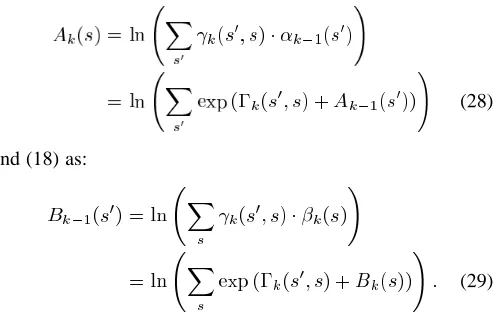
Building on Section III, in this section, the Jacobian log-arithmic algorithm is invoked, in order to reduce the com-putational complexity of the MAP algorithm. We denote the forward, backward, and transition probability in the logarithmic form as follows:
(25)
(26)
(27)
which we also used in Section III. Thus, we could rewrite (17) as
(28)
and (18) as:
(29)
From (28) and (29), the logarithmic-domain forward and backward recursions can be evaluated, once was obtained. In order to evaluate the logarithmic-domain branch metric , (21)–(23) and (27) are utilized to yield
(30)
By transforming , , and into the logarithmic domain in the context of the logarithmic maximum a
poste-riori (Log-MAP) algorithm, the expression of the LLR, namely
in (15) is also modified to yield (31) as shown at the bottom of the next page.
In the decoding trellis of the scheme considered there are possible transitions from state to all possible states , or to state from all possible states . Hence, there are summations of the exponentials in the forward and backward recursions of (28) and (29), respectively. Using the Jacobian logarithmic relationship of (24), summations of the exponentials require additions/subtractions, maximum search operations, and table lookup steps. Together with the additions necessitated to evaluate
the term and in (28)
and (29), respectively, the forward and backward recursions require a total of additions/subtractions,
maximum search operations, and table lookup steps.
Assuming that the term in (30) is
[image:5.612.307.555.239.399.2]By considering a trellis having number of states at each trellis stage and legitimate transitions leaving each state, there are number of transitions due to the bit . Each of these transitions belongs to the set
. Similarly, there will be
number of transitions, which belong to the
set . Evaluating , ,
and of (28), (29), and (30), respectively, at each trellis stage associated with a total of transitions re-quires additions/subtractions,
maximum search operations, table lookup steps, plus multiplications and divisions. With
the terms , , and of (28), (29), and
(30) evaluated, computing the LLR of (31) (shown at the bottom of the page) using the Jacobian logarithmic relationship of (24) for evaluating the summation terms
and
requires a total of
[image:6.612.335.521.133.250.2]addi-tions/subtractions, maximum search operations, and table lookup steps. The number of states at each trellis stage is given by . Therefore, the total computational complexity associated with generating the
a posteriori LLRs using the Jacobian logarithmic relationship
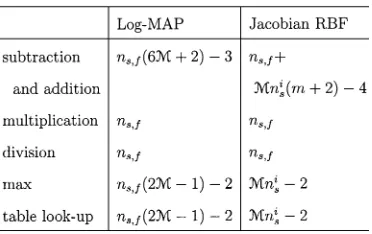
for the Log-MAP equalizer is given in Table I.
For the Jacobian RBF equalizer, the LLR expression of (14) is rewritten in terms of the logarithmic form , yielding
(32)
TABLE I
COMPUTATIONALCOMPLEXITY OFGENERATING A POSTERIORILLRL FOR
LOG-MAP EQUALIZER ANDJACOBIANRBF EQUALIZER[14]. THERBF EQUALIZERORDER ISDENOTED BYmANDNUMBER OFRBF CENTERS ISn . THENOTATIONn = M INDICATESNUMBER OFTRELLIS
STATES FORLOG-MAP EQUALIZER ANDALSONUMBER OFSCALAR
CHANNELSTATES FORJACOBIANRBF EQUALIZER
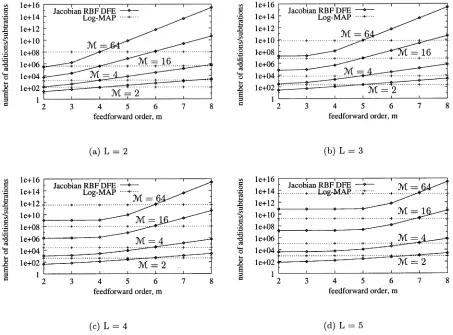
Therefore, similar to the Log-MAP equalizer, the computa-tional complexity associated with generating the a posteriori LLR for the Jacobian RBF equalizer is given in Table I. Fig. 4 compares the number of additions/subtractions per turbo iteration involved in evaluating the a posteriori LLRs for the Log-MAP equalizer and Jacobian RBF equalizer according to Table I. More explicitly, the complexity is evaluated by varying the feedforward order for different values of , where is the CIR duration under the assumption that the feedback order is , and the number of RBF centers is . Since the number of multiplications and divisions involved is similar, and by comparison, the number of maximum search and table lookup stages is insignificant, the number of log-domain additions/subtractions incurred in Fig. 4 approximates the relative computational complexities involved. Fig. 4 shows significant computational complexity reduction upon using Jacobian RBF equalizers of relatively low feedfor-ward order, especially for higher order modulation modes, such as . The figure also shows an exponential increase of the computational complexity, as the CIR length increases. Ob-serve in Fig. 4 that as a rule of thumb, the feedforward order of the Jacobian RBF DFE must not exceed the CIR length in order to achieve a computational complexity improvement relative to the Log-MAP equalizer, provided that we use the optimal number of RBF centers, namely, .
Fig. 4. Number of additions/subtractions per iteration for the Jacobian RBF DFE of varying equalizer orderm and the Log-MAP equalizer for various values of
L, where L + 1 is the CIR length. The feedback order of the Jacobian RBF DFE is set to n = L and the number of RBF centers is set to n = M =M.
We conclude that the Jacobian RBF DFE having a feedforward order that is equivalent to the symbol-spaced CIR length provides a computational complexity advantage, although only in terms of the additions/subtractions imposed, whereas, the number of multiplications/divisions is the same as for Log-MAP-based equalizers.
The length of the trellis determines the storage requirements of the Log-MAP equalizer, since the Log-MAP algorithm has to store both the forward- and backward-recursively calculated
metrics and before the LLR values
can be calculated. For the Jacobian RBF DFE, we have to store the value of the RBF centers, and the storage requirements will depend on the CIR length as well as on the -ary mod-ulation mode.
V. RBF TEQ PERFORMANCE
The schematic of the entire system was shown in Fig. 3, where the transmitted source bits are convolutionally encoded, channel interleaved, and mapped to an -ary modulated symbol. The encoder utilized is a half-rate recursive systematic convolutional (RSC) code, having a constraint length of and octal generator polynomials of and as recommended in the global system for mobile communications (GSM). The transmission burst structure used in this system is the FRAMES multiple access (FMA) 1 nonspread speech burst,
The RBF TEQ system incorporates iterative least mean square (LMS)-based CIR estimation [20], where we first esti-mate the CIR with the aid of the 27-symbol training midamble of the transmission burst during the first TEQ iteration. During the subsequent TEQ iterations, all the symbols in the trans-mission burst, which include the estimated data symbols from the previous iterations, were utilized for training the LMS CIR estimator. Therefore, the number of effective training symbols used for CIR estimation was higher. An initial step size of 0.1 was used for the first iteration, while in the subsequent iterations, the CIR was reestimated and refined using a smaller step size of 0.01.
Fig. 5(a)–(c) portray the performance of the Log-MAP TEQ with advent of perfect CIR information, and that of the Jacobian RBF DFE TEQ for BPSK, 4QAM, and 16QAM, respectively. The Jacobian RBF DFE had a feedforward order of , feedback order of , and decision delay of sym-bols. Fig. 5(a) and Fig. 5(b) show that the Log-MAP TEQ and the Jacobian RBF DFE TEQ converged to a similar bit-error rate (BER) performance for BPSK and 4QAM systems. How-ever, the Log-MAP TEQ required a lower number of iterations for most cases. Specifically, two iterations were required for the Log-MAP TEQ for all the modulation schemes studied. By contrast, two, three, and eight iterations were necessary for the BPSK, 4QAM, and 16QAM Jacobian RBF DFE TEQ, respec-tively, in order to achieve near-perfect convergence, since the Log-MAP TEQ exhibited a better BER performance for an un-coded system than that of the Jacobian RBF DFE. The perfor-mance of the Log-MAP TEQ and that of the Jacobian RBF DFE TEQ at the final iteration was about 2 dB away from the zero-intersymbol interference (ISI) Gaussian BER curve for both BPSK and 4QAM, at a BER of . For 16QAM, the effect of error propagation degraded the performance of the Jacobian RBF DFE TEQ by 7 dB at a BER of , when we compared the Jacobian RBF DFE TEQ’s correct feedback-based and de-cision-feedback-assisted performance after three iterations, as seen in Fig. 5(c). The performance of the 16QAM Jacobian RBF DFE TEQ is worse than that of the Log-MAP TEQ by only 2.5 dB at the final iteration, and is only 4.5 dB away from the zero-ISI Gaussian BER curve at a BER of . We note finally that the performance can be further improved by increasing the equalizer’s feedforward order at the expense of a higher compu-tational complexity, as discussed in [11] for an uncoded system. The iteration gain was defined as the difference between the channel signal-to-noise ratio (SNR) required in order to achieve a certain BER after one iteration, and the corresponding channel SNR required after number of iterations. The iteration gain of the Jacobian RBF DFE TEQ at the final iteration was 1.3, 3.5, and 16 dB at a BER of for the modulation modes of BPSK, 4QAM, and 16QAM, respectively. By contrast, for the Log-MAP TEQ, the corresponding iteration gains were 0.5, 0.9, and 2 dB for the modulation modes of BPSK, 4QAM, and 16QAM, respectively. The iteration gain was higher for the higher order modulation modes, since the distance between two neighboring points in the higher order constellations was lower, and hence, it was more gravely affected by ISI and noise.
Based on the implementation complexity summarized in Table I and considering only the addition/subtraction
opera-(a)
(b)
[image:8.612.323.529.52.717.2](c)
tions, since the number of multiplications/divisions is similar, the per iteration complexity of the Jacobian RBF DFE TEQ was approximately a factor of 2.5, 4.4, and 16.3 lower than that of the Log-MAP TEQ, for BPSK, 4QAM, and 16QAM, respectively. The overall computational complexity reduction of the Jacobian RBF DFE TEQ compared to the Log-MAP TEQ using two iterations, when considering the extra iterations necessary for achieving the best performance, are 2.5, 3, and 4 for BPSK, 4QAM, and 16QAM, respectively. Overall, due to the error propagation effects, which gravely degraded the performance of the Jacobian RBF DFE TEQ in the context of 16QAM, the Jacobian RBF DFE TEQ was restricted to providing a favorable performance versus complexity tradeoff only for the lower order modulation modes, such as BPSK and 4QAM.
TEQ research has been focused on developing reduced-com-plexity equalizers, such as the receiver structure proposed by Glavieux et al. [4], where the equalizer is constituted by two linear filters. Motivated by this trend, Yeap et al. [21] proposed a reduced-complexity trellis-based equalizer scheme equalizing the in-phase and quadrature-phase component of the transmitted signal independently. This novel reduced-complexity equalizer is termed as the in-phase/quadrature-phase equalizer (I/Q EQ), where the associated cross coupling of the in-phase and quadra-ture-phase tranmsitted signal components was removed, hence, rendering the real and imaginary parts of the channel output to be dependent only on the corresponding quadrature component of the modulated signal. This reduces the number of channel states from to . The complexity of the RBF DFE is reduced similarly to that of the I/Q EQ by equalizing the in-phase and quadrature-phase components of the transmitted signal separately in [22]. Yee et al. demonstrated in [22] that the I/Q RBF-TEQ attained the same performance as the con-ventional trellis-based TEQ, while achieving a complexity re-duction by a factor of 1.5 and 109.6 for 4QAM and 16QAM, respectively. Note that the high performance degradation of the 16QAM scheme, which was attributed to the erroneous deci-sion-feedback effects of the RBF DFE and was characterized in Fig. 5(c), is resolved with the aid of the I/Q RBF TEQ arrange-ment, since the number of possible transmitted symbols to be detected is reduced from to . In the following sec-tion, we proposed another novel method of reducing the TEQ’s complexity by making use of the fact that the RBF DFE evalu-ates its output on a symbol-by-symbol basis.
VI. REDUCED-COMPLEXITYRBF-ASSISTEDTEQ
The Log-MAP algorithm requires forward and backward re-cursions through the entire sequence of symbols in the received burst, in order to evaluate the forward and backward transition probability of (17) and (18), before calculating the a posteriori LLR values . Effectively, the computation of the a
[image:9.612.307.550.62.240.2]pos-teriori LLRs is performed on a burst-by-burst basis. The RBF-based equalizer, however, performs the evaluation of the a posteriori LLRs on a symbol-by-symbol basis. Therefore, in order to reduce the associated computational com-plexity, the RBF-based TEQ may skip evaluating the bit LLRs of a particular symbol, which were formulated in (14), in the
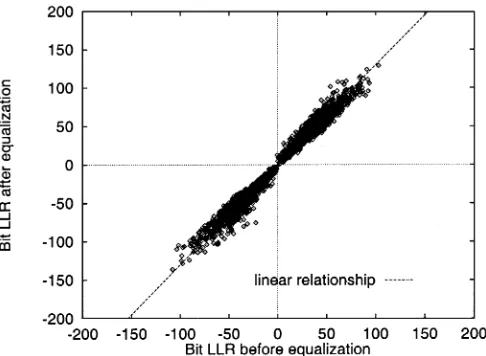
Fig. 6. LLR of the BPSK RBF turbo equalized bits before and after equalization over the three-path, symbol-spaced fading channel of equal CIR tap weights, where the Rayleigh fading statistic obeyed a normalized Doppler frequency of3:3 2 10 , at an E =N of 4 dB using BPSK.
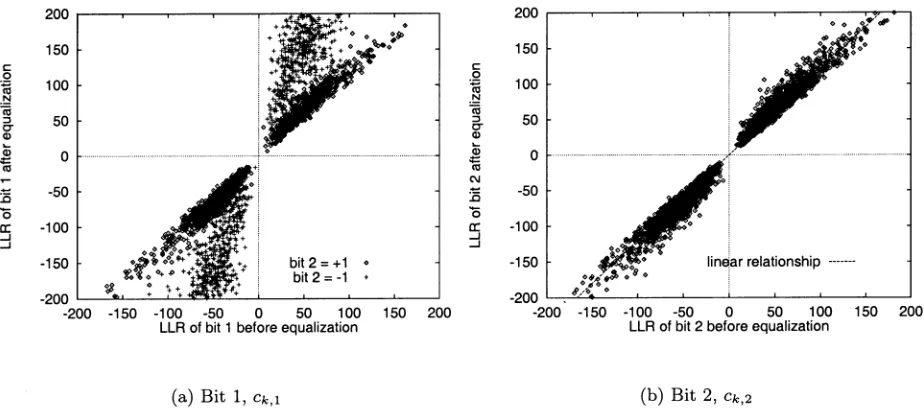
current iteration, when the symbol has a low error probability. Equivalently, this condition implies that all the bits in the symbol exhibit a high a priori LLR magnitude after channel decoding in the previous iteration. If, however, this is not the case, the equalizer invokes a further iteration and at-tempts to improve the decoder’s reliablility estimation of the coded bits. The output of the RBF equalizer pro-vides the LLR values of bit at instant , according to (14). The bit LLRs generated by the equalizer in the current itera-tion obey an approximately linear relaitera-tionship versus the LLRs recorded at the input of the equalizer. These equalizer input LLRs were provided by the channel decoder in the previous iteration, as is demonstrated in Figs. 6 and 7 for the BPSK and 16QAM modes, respectively, when communicating over a three-path fading channel having symbol-spaced equal CIR tap weights. The Rayleigh fading statistics obeyed a normalized Doppler frequency of . Therefore, the bit LLRs evaluated by the RBF equalizer can be estimated based on this near-linear relationship portrayed in Figs. 6 and 7 according to
(33)
where is the estimated LLR of the th bit of the trans-mitted symbol at instant , based on the decoder’s soft output and where is the LLR gradient. The LLR gradient can be inferred from Figs. 6 and 7 for the BPSK and 16QAM modem modes, respectively. Note that for the 16QAM scenario, the LLR gradient of the four bits constituting a symbol, namely, that of , , , and , differs, depending on the spe-cific bit’s protection distance measured from the demodulation decision boundary of each of the received phasors in the ab-sence of noise. Here, the bits and correspond to the in-phase component, while the bits and correspond to the quadrature-phase component. Considering only the in-phase component, Fig. 7(a) demonstrates that the LLR gradient of the most significant bit (MSB), namely, that of bit 1 or , de-pends on the least significant bit (LSB), namely, on bit 2 or . This is a consequence of the different protection distances
Fig. 7. LLR of the 16QAM RBF turbo equalized bits before and after equalization over the three-path, symbol-spaced fading channel of equal CIR tap weights, where the Rayleigh fading statistic obeyed a normalized Doppler frequency of3:3 2 10 , at an E =N of 16 dB using 16QAM.
. The same characteristic properties are also valid for the quadrature-phase component.
Next, we have to set the LLR magnitude threshold , where the estimated coded bits output by the decoder in the previous iteration become sufficiently reliable for refraining from further iterations. Hence, the symbols ex-hibiting an LLR value which is above this particular threshold are not fed back to the equalizer for further iterations, since they can be considered sufficiently reliable for subjecting them to hard decision. The LLRs passed to the decoder from the equalizer are calculated based on the linear relationship of (33) instead of the more computationally demanding (14), in order to reduce the computational complexity. We refer to this RBF-based TEQ as the reduced-complexity RBF TEQ.
The above mentioned log-likelihood gradient of (33) was found to be , according to the near-linear relation-ship of Fig. 6 for BPSK. For 16QAM, the LLR gradient for the LSB and , corresponding to and , respec-tively, is approximately 1.2. For the MSB, the LLR gradient
and correspond to and ,
respec-tively, when the LSB is 1, is equivalent to 1.2, whereas, when the LSB is 1, according to Fig. 7. We set the LLR magnitude threshold
such that the symbols in the burst that were not fed back to the equalizer for further iterations became sufficiently reliable, and hence, exhibited a low probability of decoding error.
The probability of error for the detected bit can be es-timated on the basis of the soft output of the turbo decoder. Referring to (9) and assuming
, the probability of error for the detected bit is given by (34) at the bottom of the page. With the aid of the definition in (9), the probability of the bit having the value of 1 or 1 can
be rewritten in terms of the a posteriori LLR of the bit, as follows:
(35)
Upon substituting (35) into (34), we redefined the probability of error of a detected bit in terms of its LLR as
(36)
where is the magnitude of . The
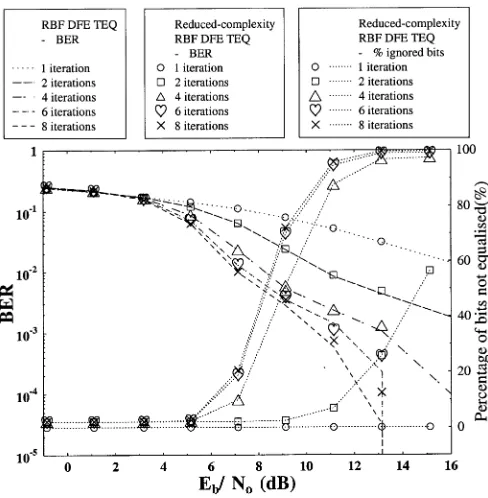
threshold was set to 10 for BPSK such that the symbols that were not fed back to the equalizer exhibited a probability of error below , according to (36). For 16QAM, in order to compensate for the BER degradation due to error propa-gation induced by incorrectly detected symbol feedback, the threshold was set to 20, which corresponds to a probability of error below . Fig. 8 and Fig. 9 depict the performance of the reduced-complexity Jacobian RBF DFE TEQ relying on detected, rather than perfect, decision feedback over the three-tap equal gain, symbol-spaced Rayleigh faded CIR obeying a Doppler frequency of . Referring to Fig. 8, the reduced-complexity BPSK Jacobian RBF DFE TEQ using decision feedback achieved a computational complexity
reduction of approximately (0%,
40%, and 72% bits were not equalized at first, second, and third iterations, respectively) at an of 4 dB, compared to the full-complexity RBF TEQ. For 16QAM, the computational complexity reduction of the reduced-complexity Jacobian RBF DFE TEQ is approximately 54% at 10 dB according to Fig. 9.
if
Fig. 8. BER performance and the percentage of symbols not requiring equalization by the reduced-complexity RBF TEQ using detected decision feedback over the three-tap equal-gain Rayleigh fading channel for BPSK. The LLR magnitude threshold and the LLR gradient were set tojLj = 10,
g = 1:3, respectively. The system incorporates iterative LMS-based CIR
estimation.
Fig. 9. BER performance and the percentage of symbols not requiring equalization by the reduced-complexity RBF TEQ using detected decision feedback over the three-tap equal-gain Rayleigh fading channel for 16QAM. LLR magnitude threshold and LLR gradients were set tojLj = 20,
g = g = 1:2, g = g = 3:2, and g = g = 1:2, respectively. The system incorporates iterative LMS-based
CIR estimation.
The reduced-complexity RBF DFE TEQ implementation can be used instead of the RBF DFE TEQ in order to provide substantial computational reductions without degrading the BER performance. Since the reliability of the symbols in
the decoded burst is provided by the channel decoder in the previous iteration, we were capable of designing a system where the percentage of bits not equalized in the decoded burst was set according to our design criteria for every iteration, such that each burst exhibited a predetermined fixed computational complexity reduction for the sake of practical, constant-com-plexity implementations.
VII. CONCLUSION
In this paper, the Jacobian RBF DFE TEQ has been pro-posed and analyzed comparatively in conjunction with the well-known Log-MAP TEQ [3], [17]. The associated performances and complexities have been compared in the context of BPSK, 4QAM, and 16QAM. The computational complexity of the Ja-cobian RBF DFE TEQ is dependent on the number of RBF centers, the CIR length, and modulation mode. The associated per-iteration-based implementation complexity of the Jacobian
RBF DFE TEQ ( , , ) compared to that
of the Log-MAP TEQ was approximately a factor 2.5, 4.4, and 16.3 lower in the context of BPSK, 4QAM, and 16QAM, respec-tively, when communicating over the three-path, equal-weight, symbol-spaced burst-invariant Rayleigh fading channel envi-ronment considered. This computational complexity advantage is only attained, however, in terms of the additions/subtractions, whereas the number of multiplications/divisions is the same as for Log-MAP equalizers. The performance degradation com-pared to the conventional Log-MAP TEQ [3] was negligible for BPSK and 4QAM, but was approximately 2.5 dB for 16QAM at BER of . The significant performance degradation of the 16QAM scheme is due to the error propagation effect of the DFE, which becomes more grave in conjunction with higher order constellations. Our proposed reduced-complexity Jaco-bian RBF DFE TEQ was shown to provide an equivalent BER performance to that of the RBF DFE TEQ at a reduced computa-tional load for both BPSK and 16QAM schemes. The reduced-complexity Jacobian RBF DFE TEQ using detected decision feedback provided approximately 37% (at of 4 dB) and 54% (at of 10 dB) computational reduction for BPSK and 16QAM, respectively, over dispersive Rayleigh channels.
REFERENCES
[1] C. Douillard, M. Jézéquel, and C. Berrou, “Iterative correction of inter-symbol interference: turbo equalization,” Eur. Trans. Telecommun., vol. 6, pp. 507–511, Sept./Oct. 1995.
[2] L. Hanzo, T. H. Liew, and B. L. Yeap, Turbo Coding, Turbo Equalization and Space-Time Coding. New York: Wiley/IEEE, 2002.
[3] G. Bauch, H. Khorram, and J. Hagenauer, “Iterative equalization and decoding in mobile communications systems,” in Proc. European Per-sonal Mobile Communications Conf., Bonn, Germany, Sept. 30–Oct. 2, 1997, pp. 301–312.
[4] A. Glavieux, C. Laot, and J. Labat, “Turbo equalization over a frequency selective channel,” in Proc. Int. Symp. Turbo Codes, Brest, France, 1997, pp. 96–102.
[5] J. G. Proakis, Digital Communications. New York: McGraw-Hill, 1995.
[6] L. Hanzo, C. H. Wong, and M. S. Yee, Adaptive Wireless Trans-ceiver. New York: Wiley/IEEE, 2002.
[image:11.612.43.287.371.620.2][8] M. S. Yee, B. L. Yeap, and L. Hanzo, “Radial basis function-assisted turbo equalization,” in Proc. IEEE Vehicular Technology Conf., Tokyo, Japan, May 15–18, 2000, pp. 640–644.
[9] S. Haykin, Neural Networks: A Comprehensive Foundation. New York: Macmillan, 1994.
[10] S. Chen, S. McLaughlin, and B. Mulgrew, “Complex-valued radial basis function network—part II: Application to digital communications channel equalization,” EURASIP Signal Processing, vol. 36, pp. 175–188, Mar. 1994.
[11] M. S. Yee and L. Hanzo, “Multi-level radial basis function network-based equalisers for Rayleigh channels,” in Proc. IEEE Vehicular Tech-nology Conf., Houston, TX, May 16–19, 1999, pp. 707–711.
[12] S. Chen, B. Mulgrew, and S. McLaughlin, “Adaptive Bayesian equalizer with decision feedback,” IEEE Trans. Signal Processing, vol. 41, pp. 2918–2927, Sept. 1993.
[13] S. Chen, S. McLaughlin, B. Mulgrew, and P. M. Grant, “Adaptive Bayesian decision feedback equalizer for dispersive mobile radio channels,” IEEE Trans. Commun., vol. 43, pp. 1937–1945, May 1995. [14] M. S. Yee, T. H. Liew, and L. Hanzo, “Block turbo coded burst-by-burst
adaptive radial basis function decision feedback equalizer assisted modems,” in Proc. IEEE Vehicular Technology Conf., vol. 3, Ams-terdam, The Netherlands, Sept. 1999, pp. 1600–1604.
[15] A. Knickenberg, B. L. Yeap, J. Hamorsky, M. Breiling, and L. Hanzo, “Non-iterative joint channel equalization and channel decoding,” in Proc. GLOBECOM’99, Rio de Janeiro, Brazil, Dec. 1999, pp. 442–446. [16] K. Abend, T. J. Harley, Jr., B. D. Fritchman, and C. Gumacos, “On optimum receivers for channels having memory,” IEEE Trans. Inform. Theory, vol. IT-14, pp. 818–819, Nov. 1968.
[17] P. Robertson, E. Villebrun, and P. Hoeher, “A comparison of optimal and suboptimal MAP decoding algorithms operation in the log domain,” in Proc. IEEE Int. Conf. Communications, vol. 2, Seattle, WA, June 1995, pp. 1009–1013.
[18] P. Robertson, P. Hoeher, and E. Villebrun, “Optimal and suboptimal maximum a posteriori algorithms suitable for turbo decoding,” Eur. Trans. Telecommun., vol. 8, pp. 119–125, Mar./Apr. 1997.
[19] A. Klein, R. Pirhonen, J. Sköld, and R. Suoranta, “FRAMES multiple access mode 1—wideband TDMA with and without spreading,” in Proc. PIMRC’97, Sept. 1997, pp. 37–41.
[20] C. H. Wong, B. L. Yeap, and L. Hanzo, “Wideband burst-by-burst adap-tive modulation with turbo equalization and iteraadap-tive channel estima-tion,” in Proc. IEEE VTC 2000, Tokyo, Japan, 2000, pp. 2044–2048. [21] B. L. Yeap, C. H. Wong, and L. Hanzo, “Reduced complexity
in-phase/quadrature-phase turbo equalization using iterative channel estimation,” in Proc. IEEE Int. Conf. Communications, Helsinki, Finland, June 2001, pp. 393–397.
[22] M. S. Yee, B. L. Yeap, and L. Hanzo, “Reduced complexity in-phase/quadrature-phase turbo equalization using radial basis func-tions,” in Proc. IEEE VTC 2001, Rhodes, Greece, May 6–9, 2001, pp. 1395–1399.
Mong-Suan Yee (S’97–A’00) received the B.Eng. degree in electronics engineering and the Ph.D. degree from the University of Southampton, Southampton, U.K.
She is continuing her research as a Postdoc-toral Research Fellow with the University of Southampton, Southampton, U.K. Recently, she joined the Toshiba Research Laboratories, Bristol, U.K. Her current research interests are in the field of neural network-based algorithms and their application to various wireless communications problems. She has coauthored numerous papers and a monograph in this field.
Bee Leong Yeap (S’97–M’00) graduated from the University of Southampton, Southampton, U.K., with a first-class honors degree in 1996 in electronics en-gineering, and in 2000, he received the Ph.D. degree from the same university.
He is continuing his research as a Postdoctoral Re-search Fellow with the University of Southampton, Southampton, U.K. His research interests include turbo coding, turbo equalization, adaptive mod-ulation, and space–time coding. He coauthored numerous papers and a research monograph.
Lajos Hanzo (M’91–SM’92) received the master de-gree in electronics in 1976 and the doctorate dede-gree in 1983, both from the Technical University of Bu-dapest, Hungary.
During his 26-year career in telecommunications, he has held various research and academic posts in Hungary, Germany, and the U.K. Since 1986, he has been with the Department of Electronics and Computer Science, University of Southampton, Southampton, U.K., where he holds the Chair in Telecommunications. He has coauthored ten IEEE Press/Wiley books on mobile radio communications, published in excess of 400 research papers, organized and chaired conference sessions, presented overview lectures, and has been awarded a number of distinctions. Currently, he is managing an academic research team, working on a range of research projects in the field of wireless multimedia communications sponsored by industry, the Engineering and Physical Sciences Research Council (EPSRC) U.K., the European IST Programme, and the Mobile Virtual Center of Excel-lence (VCE), U.K. He is an enthusiastic supporter of industrial and academic liaison and he offers a range of industrial courses.