A Computational Trust Model for Multi-Agent Interactions based
on Confidence and Reputation
Sarvapali D. Ramchurn,
Nicholas R. Jennings
IAM group, ECS
University of Southampton, UK.
{sdr01r,nrj}@ecs.soton.ac.uk
Carles Sierra,
Llu´ıs Godo
IIIA, CSIC
Bellaterra, Barcelona, Spain.
{sierra,godo}@iiia.csic.es
Abstract
In open environments in which autonomous agents can break contracts, computational models of trust have an important role to play in determining who to interact with and how interactions unfold. To this end, we develop such a trust model, based on confi-dence and reputation, and show how it can be con-cretely applied, using fuzzy sets, to guide agents in evaluating past interactions and in establishing new contracts with one another.
1
Introduction
Agents generally interact by making commitments to (con-tracts with) one another to carry out particular tasks. How-ever, in most realistic environments there is no guarantee that a contracted agent will actually enact its commitments (be-cause it may defect to gain higher utility or be(be-cause there is uncertainty about whether the task can actually be achieved). In such situations, computational models of trust (here de-fined as the positive expectation that an interaction part-ner will act benignly and cooperatively in situations where defecting would prove more profitable to itself [Dasgupta, 1998]) have an important role to play. First, to help deter-mine the most reliable interaction partner (i.e. those in which the agent has the highest trust). Second, to influence the inter-action process itself (e.g. an agent’s negotiation stance may vary according to the opponent’s trust level). Third, to define the set of issues that need to be settled in the contract (i.e. the higher the trust, the more that can be left implicit in the contract).
Generally speaking, interactions go through three main phases; (i) a negotiation dialogue during which the terms of the contract are agreed upon and agents assign an expected utility to the contract, (ii) an execution phase during which there are opportunities for the contracted agent to defect, and (iii) an outcome evaluation phase where the client agent as-sesses the outcome of the task and finally derives some util-ity. In the cases where an agent has an incentive to defect, the client agent can judge whether the contractor is trustwor-thy by assessing its performance, relative to the initially con-tracted agreement, given its perception of the prevailing task and the context. Thus, the trust value for a specific agent for a specific task needs to take into account the potential utility loss or risk (associated with the task in question) in a contract given information about the context in which the contract is
enacted [Marsh, 1994]. This follows from the fact that coop-erating under high potential losses shows greater trustworthi-ness than otherwise [Yamagishi et al., 1998].
Trust values, thus devised, can guide future contract nego-tiation in order to ensure that guarantees are provided against losses. Thus, if trust is sufficiently high, the contracted agent is deemed reliable. This means less time can be spent looking for potential contractors, negotiating about the minute guar-antees present in the contract and, accordingly, giving more freedom to the contracted agent to enact its part of the deal. Conversely, when trust is low, the agents may spend a signifi-cant time specifying the guarantees associated with a contract or, if possible, avoiding future interactions with such agents.
Given this background, a number of computational models of trust have been developed (mainly based on theories from sociology). In [Marsh, 1994] for example, trust is taken to be a value between -1 and 1 that is calculated by taking into account risk in the interaction and the competence level of an interaction partner. However, these concepts are not given any precise grounding and they do not take into account past experience and reputation values of the contracted agent. In [Sabater and Sierra, 2002], reputation symbolises trust and competence levels are gathered from the social network in which the agents are embedded. The main value of this model lies in showing how reputation can be used to guide an agent’s negotiation stance, but the evaluation of direct interactions is overly simple (disregarding utility loss and context). [Mui et al., 2002] adopt a probabilistic approach to modelling trust that takes into account past encounters as well as reputation information. However, it is not obvious how the model can concretely guide an agent’s decision making since the trust value is not associated to particular issues of the contracts that have been reneged upon. In a more realistic setting, Witowski et al. develop an objective trust measure from an evaluation of past performance [Witowski et al., 2001]. However, their approach overly simplifies the trust modelling problem and avoids reputation measures which could have enhanced the performance of their agents.
By taking into account its past experience (from direct in-teractions) and information gathered from other agents (in-direct interactions), an agent can build up beliefs about how trustworthy a contracted agent is likely to be in meeting the expected outcomes of particular contract issues (e.g. deliv-ering goods on time or delivdeliv-ering high quality goods). In this respect, we conceive of two ways of assessing trustwor-thiness: (i) Confidence derived (mainly) from analysing the result of previous interactions with that agent, and (ii) Rep-utation acquired from the experiences of other agents in the community through gossip or by analysing signals sent by an agent. Both measure the same property; that is, the agent’s believed reliability in doing what it says it will regarding par-ticular issues of a contract. Here these measures are modelled using fuzzy sets to give agents a robust means of assessing the extent to which their interaction partners satisfy the issues of a contract. In particular, we advance the state of the art in the following ways. First, we delineate and computationally model context information, confidence measures, and risk in agent interactions. Second, we show how, using fuzzy sets, a measure of trust can be derived from the latter concepts and reputation information. Finally, we show how the trust mea-sure can guide the choice of interaction parties, the stance that is taken during negotiation, and the issues that need to be agreed upon in a contract. The rest of the paper is organised as follows. Section 2 introduces the basic notions that we use throughout the paper, while section 3 shows how we devise a confidence measure. Section 4 details the trust model itself. Section 5 indicates how the model can be used and section 6 concludes.
2
Basic Notions
LetAg be the society of agents noted asα, β, ... ∈ Ag. A particular group of agents is noted asG⊆Ag. G denotes a partition{G1, G2, . . . , Gl}of the society of agents into non-empty groups. That is, for allGi, Gj ∈ G, Gi∩Gj = Ø,
S
iGi =Ag. Therefore, any agent belongs to one and only one group. T denotes a totally ordered set of time points (sufficiently large to account for all agent interactions) noted as t0, t1, . . ., such thatti > tj if and only if i > j. Con-tracts are agreements about issues and the values these issues should have. Let X = {x, y, z, . . .} be the set of poten-tial issues to include in a contract, and the domain of val-ues taken by an issuex, be noted as Dx (for simplicity we assume that all Dx are a subset of real numbers R). We
will note that issue xtakes the value v ∈ Dx as x = v. Thus, a contract is a set of issue-value assignments noted as
O = {x1 = v1, x2 = v2, ..., xn = vn} where xi ∈ X andvi ∈ Dxi. We consider that agents invariably interact
within an electronic institution [Esteva et al., 2001] which specifies norms and conventions of interactions and dictates (some) issue-value assignments of contracts (see section 2.1). From now on, we will refer to the agent devising the contract as the manager and the contracted agent as the contractor.
2.1
Rules Dictating Expected Issue Assignments
We now consider how expectations aboutX are built based upon the agreed contract and the social setting. Here, the former provides a clear statement of what is expected with respect to each issue, while the latter may also give rise to expectations but these are not explicitly stated in the contract itself. For example, a buyer agentαmight expect seller agent
βto deliver goods nicely wrapped up in gift paper as opposed to in a carton box. This clause may not have been specified in the contract as it is a common belief in the client’s group that goods must be nicely wrapped up.
Thus, at execution time, the contractor may not satisfy the manager’s (contracted or not) expectations because (i) it is not able to meet the expectations, (ii) it is not willing to meet the expectations, or (iii) it is not aware of the unspecified ex-pectations. In any case, the non-satisfaction of expectations directly impacts on the trust the client has in the contractor [Molm et al., 2000] (unless a satisfactory reason is given for poor performance, but this is not considered here).
Here we consider three basic sources of unspecified expec-tations: (i) General rules that all agents in the society possess in common, (ii) Social rules that all agents within a particu-lar group have in common, and (iii) Institutional norms that all agents interacting within a particular electronic institution have in common. This classification is necessary when we evaluate the performance of a contracted agent (see section 3). In more detail, rules allow an agent to infer expected issue-value assignments from a contract. Rules will be writ-ten in the following logical-like expressions:
Ifx1=v1∧x2=v2∧...∧xm=vmThenx=v
meaning that if(xi=vi)∈Ofor alli= 1, . . . , m, then issue x’s value is expected to be equal tov. We assume thatxis not appearing in the premise of the rule. We note byRulesthe set of all possible rules written using the above syntax1over the setXof issues and corresponding domains of values.
GroupG’s social rules, noted asSocRules(G)⊆Rules, are those shared by all agents in G. General rules, noted
GenRules ⊆ Rules, are those shared by all agents. In-stitutional norms, noted asInstN orms ⊆ Rules, specify those rules that are enforced by the institution within which the (negotiating) agents interact. These norms are accepted by the agents involved in the negotiation process.
Given a contract O, we can devise the set of all of a manager’s expectations (unspecified and specified), such that, given a managerα ∈ G, we compute the set Oexp of ex-pected issue-value assignments fromOas the set of all con-clusions of the rules of agentα,Rules(α) = GenRules∪
SocRules(G)∪InstN orms, that have their premise satis-fied by the equalities in the contractO. The complete ex-panded contract is therefore defined asO+=O∪O
exp. For each issue therein, the manager will have a confidence that the expected values will actually be met.
2.2
Confidence
In measuring confidence in an issue, different managers may have different opinions of the reliability of a particular con-tractor. We initially consider trustworthiness on a per issue basis given that agents may be more reliable in satisfying some issues than others. These measures of satisfaction on contractors’ behaviours are not strictly probabilistic in nature (since they cannot be analysed just in terms of frequency of occurrence), but may depend on the individual view of the agent as well. We therefore choose a fuzzy set based approach to relate confidence levels with expected values for issues.
1Richer syntaxes could also be thought of for premises in these
In our approach we assume that agents share a (small) setL ={L1, L2, . . . , Lk}of linguistic labels to qualify the performance of a contractor on each issue. For instance,
L={Bad, Average, Good}. These labels model the agent’s view on the possible (approximate) deviations from the con-tractually signed values. For example, “good” for agent α
may mean that contractorβ delivers articles on time or that it will actually give a discount on the initially quoted price, but for agentγ, it means thatβwill deliver articles before the quoted time of delivery or thatβwill not overprice its article. A managerα assigns a confidence level to each labelL
when modeling the performance of a contractorβover a par-ticular issuex, noted asC(β, x, L)∈ [0,1](we will not in-clude the agent identifiers to simplify notation when the con-text permits). Intuitively, this models the manager’s belief that the deviation of the contractor on that issue will be within the possible values determined by that label. For instance, a manager may express his belief that a contractor is “good” to a confidence level 0.8 in fulfilling the contractual values on price, “average” to a level of 0.4, and “bad” to a level of 0.
For each issuex, a manager defines the meaning of each label L by a fuzzy set over Ras if 0 were the contractual
value for the issue, and whose membership function is noted asµx
L : R → [0,1]. And now, given an issue-value assign-ment in a contract,(x=v) ∈O, the actual meaning of the labelLwith respect toxin the contract is represented by a new fuzzy set noted asL∗ which is the shift ofLbyv, and whose membership function isµx
L∗(u) =µxL(u−v), where
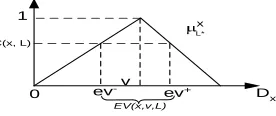
u∈R. From this, we can compute the set of expected values determined by a confidence level C(x, L)on a labelL for issuexin contractO, noted asEVc(O, x, L), as those val-ues whose membership degree toL∗is above the confidence level. That is,
EVc(O, x, L) ={u|µxL∗(u)≥C(x, L)}.
This is graphically2shown in figure 1. To illustrate the above concept, consider the following example; a manager is confi-dent to the degree of 0.9 that the contractor delivers goods “on time” if the goods arrive 1 day late (or 1 day earlier). How-ever, if the confidence in being “on time” is 0.5 (i.e. the un-certainty is larger), it might expect the goods to arrive 3 days late (or 3 days earlier). Finally, having devised confidence
1
0
L*
C(x, L)
Dx
x
ev- ev+
EV(x,v,L)
[image:3.612.108.246.511.569.2]v
Figure 1: Confidence in a labelLof an issuex.
values for each label of an issue, a manager can compute the set of expected values for that issue as the intersection of the expected values for each label. That is,
EVc(O, x) =
\
L∈L
EVc(O, x, L) (1)
In this context, an assignment of confidence values to labels inLis said to be consistent ifEVc(O, x)6= Ø. This means
2The shape of the membership function given only serves as an
example. Arbitrarily complex functions can be used in reality.
that the manager always has a non empty set of expected val-ues for an issue given its confidence valval-ues in different labels.
2.3
Reputation
Several models of reputation have been developed to illustrate how the transmission of (confidence) measures of reliability can be done [Yu and Singh, 2000; Sabater and Sierra, 2002]. Therefore, here we do not consider how this reputation in-formation is gathered (and aggregated) from the other agents in the society. Rather, we assume this information is simply available from a social network that structures the knowledge that each agent has of its neighbours and keeps track of past interactions (as per [Sabater and Sierra, 2002]). Hence, we assume that a functionRep : Ag ×X × L → [0,1] ex-ists whereRep(β, x, L)represents the reputation degree of agentβ with respect to the qualifying label Lover issuex. (The name of the contractor will be omitted when the con-text unambiguously determines it.) The meaning of reputa-tion here is an aggregareputa-tion of opinions (confidence values in the previous sense) of some or all agents inAg about one of them over a particular issue. Therefore, we can use rep-utation values in a similar way as before to compute the ex-pected values for an issuexin a contractO, and labelLas
EVr(O, x, L) ={u|µxL∗(u)≥Rep(x, L)}And, also
simi-larly:
EVr(O, x) =
\
L∈L
EVr(O, x, L). (2)
We initially assume that the assignment of reputation values for all labels are consistent such thatEVr(O, x, L)6= Ø. This means that the manager always has a non-empty set of ex-pected values for an issue given its reputation values in dif-ferent labels.
2.4
Combined Range of Expected Values
Using just confidence levels or just reputation values to com-pute the set of expected values for a given issue xcan be useful in certain extreme contexts (e.g. when the contractor does not rely at all on societal information, or when it has no other choice than to fully rely on it). However, in most sit-uations, we consider that both sources of information should be taken into account in order to come up with a sensible set of expected values, applicable not only in the above two con-texts but also to intermediate situations. In these situations we may want to consider a combination of both measures
CR:Ag×X× L →[0,1], which is, in the simplest case, a weighted average of both kinds of degrees (as in the previous cases we omit references to the agent whenever possible):
CR(x, L) =κ·C(x, L) + (1−κ)·Rep(x, L), (3)
whereκand1−κare suitable weightings that aim to model the relative importance of both information sources. This fi-nal range is computed as in the previous cases by first com-puting the expected values for an issue x and label L as
EVcr(O, x, L) ={u | µxL∗(u) ≥CR(x, L)}, and then the
intersection of the expected ranges for all the labelsL∈ L:
EVcr(O, x) =
\
L∈L
EVcr(O, x, L). (4)
lead us to devising actual trust values. However, the calcula-tion of confidence (and indirectly trust) needs to take into ac-count the context within which interactions take place since it is the context that determines the risk associated with each interaction.
3
Computing Confidence and Context
3.1
Interaction Context
Context, by definition, is the setting in which an interaction between a manager and a contractor takes place. Generally speaking, a setting can cover anything that relates to the in-teraction, but here we restrict3 it to the rules that apply to the contract being negotiated (section 2.1) together with the agent’s previous interaction experience.
In more detail, institutional norms and general rules are shared rules that form the objective context, while the sub-jective context is formed by the social rules of the group to which the managerαbelongs and its interaction history with a given contractorβ. Rules were defined in section 2.1 and history can be understood as the set of precedent cases. Each manager agent is assumed to have a utility function (applying over the domain of values) defined asUx : Dx → [0,1]for each issuex. Utility values will be used as a common scale to compare and aggregate information from past cases.
Given that each interaction takes place through a con-tract, each case records information about the initially agreed upon issue-value pairs of a contractO, the actual results af-ter execution,O0, the confidence levels ofαon the contrac-tor agent β, {C(β, x, L)}L∈L, the reputation degrees of β,
{Rep(β, x, L)}L∈L, and the time, t, at which the contract was executed. Thus each case is represented as a tuple:
case=hO, O0,{C(β, x, L)}L∈L,{Rep(β, x, L)}L∈L, ti
and the history of interactions as a case base CB =
{case1, case2, . . .}.
Given the case base, the set of utility functions for each issue in the contract, and the set of rules that apply to the interaction between the agents αandβ,α’s context within which a new contract is executed is represented as the set:
Σα,β =hCB,{Ux}x∈X, Rules(α)i.
This context is dynamic since rules or cases can be added or removed over time (and/or utilities change).
3.2
Utility loss and confidence
From the context we can now infer the probability of a con-tractor defecting (hence causing some utility loss) from a pro-posed contract given the rules that apply to it. If, for example, most interaction partners are known to have defected many times in the previous contracts relating to the same issues be-ing negotiated in a new contract, we can reasonably assume that there is a high probability that the agent chosen will de-fect again in future interactions. Conversely, if the interac-tions have been successful or more profitable than expected, there is low probability of making a loss.
Therefore, given a contextΣα,βand a current agreed con-tractO, for each issue x inO, we can estimate, from the history of past interactions, a probabilistic distributionP of
3
We believe these are necessary rather than sufficient features and future work will investigate exactly what other characteristics could usefully be incorporated.
α’s utility variation ∆Ux ∈ [−1,1](negative or positive) relative to issuex. Values of∆Uxcorrespond to the possi-ble differences between the utilityUx(v)of the agreed value
(x = v) ∈ O and the utilityUx(v0)of the (unknown) final value(x=v0)in the executed contractO0. Then we can say that the manager agentαhas a certain risk with issuexwhen it estimates thatP(∆Ux < 0) > 0. Of course, the higher this probability is, the higher the risk is (i.e. the higher the expected utility loss).
Therefore, we need to estimate the probability distribution4 of∆Ux, not only for those issuesxappearing inO, but also on the expanded contract O+ = O ∪Oexp resulting from the application of the rules in the current context (see section 2.1). We have to do so analogously with the contracts in the precedent cases of the case baseCBof the context. However, if we assume that the agreed contract is signed such that the norms of the institutionInstN ormsunder which the agents are operating are fully enforced (i.e. punishments are given for not acting by the norms), then the risk is zero5for those issue-value assignments insured by institutional norms, even though the inference from previous interactions could suggest that the agent would defect. We then remove all these insured issues from the analysis.
Now, assume we have a probability distribution P for
∆Ux, and letx = v be the signed issue value according to the contractO+. This allows us to compute confidence lev-els C(x, L)for each L ∈ L. In order to determine confi-dence levelsC(x, L)we initially need to determine a signifi-cantly representative interval[δ1, δ2]for∆Ux(e.g. such that P(∆Ux ∈ [δ1, δ2]) = 0.95). The latter denotes the change
of utility interval which determines (under reasonable condi-tions) an interval of issue values around the agreed valuevfor
x,[v−, v+] ={U−1
x (δ+u)|δ∈[δ1, δ2],0≤δ+u≤1},
whereu=Ux(v). The interval[v−, v+]is actually the range where agentαcan expect (with high probability) to find the final value for issuex.
Finally, to calculate confidence levelsC(x, L)for each la-belL∈ L, we want the interval[v−, v+]to coincide with the
set of expected valuesEV(O, x)as computed in section 2.2. Therefore the solution amounts to devising an inverse proce-dure to that of section 2.2 to come up with appropriate values
C(x, L)for eachL∈ Lsuch that
[v−, v+] = \
L∈L
{u∈Dx|µxL∗(u)≥C(x, L)} (5)
The confidence values are updated whenever the ranges they define do not cover the range determined through the pro-cedure above. The following example illustrates the above method. Assume an agentαhasP(∆Ux ∈[−0.3,+0.1]) =
0.95and that a valuev = 100has been proposed for an is-sue x. Also,αhasUx(v) = 0.4. Therefore, it can expect v− =U−1
x (0.4−0.3)andv+ =Ux−1(0.4 + 0.1). Suppose v− = 75andv+ = 105. This range determines the
con-4Several methods can be used to estimate these probability
dis-tributions, but the way the probability model is derived is not central to the trust model we wish to devise.
5
fidence level in the issue by having the confidence in each label cover as much of the range[75,105]as possible.
4
The Trust Model
As argued in section 1, there are two sources of information that permit an agent to build trust: confidence and reputation. We can therefore imagine three ways of defining trust (we consider the third one as the most appropriate):
1. Trust = Confidence
In this case only the direct interaction is considered as a valuable source of information about the performance of another agent. The manager’s first contract will be subject to total uncertainty and only after the number of interactions is significant will this way of defining trust start to work effectively. In cases where the trust in most agents of the society is low, this measure may be valid since the agent may not believe the opinions gathered to build a reputation value (e.g. due to known collusion among contractors and other managers).
Given an issue-value assignment, x = v, present in a proposed contract, agent α’s confidence levels
{C(β, x, L)}L∈Lcan be used (as shown in section 2.2) to determine the intervalEVc(O, x)of expected values at the time of the contract execution. Therefore, the overall trust on issuexis defined through an inverse rela-tion to the maximum utility loss when the value of issue
xis varied on the intervalEVc(O, x). In effect, if we let
∆c
loss= sup{Ux(v)−Ux(w)|w∈EVc(O, x)}(supis the least upper bound of the set), then we simply define the trust of the managerαin the contractorβover issue
xas:
Tc(β, x) = min(1,1−∆closs) (6) 2. Trust = Reputation
Using confidence on its own, the trust in an agent be-comes a useful measure only when there are a suffi-ciently large number of interactions. However, when the encounters have been scarce at the time of signing a contract, reputation information may be more useful [Mui et al., 2002; Sabater and Sierra, 2002]. This is the usual case; when an agent first joins a society and decides to interact with its members, the only meaning-ful information it can have about the others’ behaviour is their reputation, since it has not signed any contracts yet. Similar to the previous case, where trust = con-fidence, we can use the range EVr(O, x) to compute
∆r
loss = sup{Ux(v)−Ux(w) | w ∈ EVr(O, x)} in order to define a trust value as:
Tr(β, x) = min(1,1−∆rloss) (7)
3. Trust = Confidence and Reputation
As already mentioned in section 2.4, in most situations we believe it is preferable to consider both confidence and reputation. The rationale is that as the agent in-teracts with another agent more (and more), it will put correspondingly greater reliance on its personal confi-dence measures rather than reputation values (since per-sonal interactions are deemed to be more accurate than information gathered from other agents, which might be subject to noise). Therefore, in our trust model we use the combined degrees {CR(x, v, L)}L∈L, as
given by equation 3, to define the interval of expected values EVcr(O, x), that provides us with a maximum loss in utility ∆crloss = sup{Ux(v)−Ux(w) | w ∈ EVcr(O, x)}. Then, similarly to the previous two cases, we can define the overall trust on agentβ over issuex
as:
T(β, x) = min(1,1−∆crloss) (8) The weight κin equation 3 should reflect the number of past interactions betweenαandβ. Therefore, given a contextΣα,β =hCB,{Ux}x∈X, Rules(α)i, here we propose to defineκasκ= max(1,|CB|/θmin), where
|CB|is the number of interactions in the context of both agents andθminis the minimum number of interactions above which only the direct interaction is taken into ac-count (other types of functions could be used as well). Our three definitions (especially the last one) take trust to be a dynamic and rational concept relating past experience and reputation to newly contracted values (i.e. depending on the situation [Marsh, 1994; Molm et al., 2000]).
Depending on the environment, a specific definition of trust will be chosen. In any case, we can now define the trust
T(β, X0)of the manager agentαon a contractor agentβover a particular setX0 ={x1, ..., xk}of issues appearing in the contractO (or in the expanded one O+) as an aggregation of the trust in each individual issue (e.g. trust in delivering on time, paying on time and the product having the quality specified in the contract). That is, we postulate
T(β, X0) =g(T(β, x1), ..., T(β, xk)) (9)
whereg: [0,1]k →[0,1]is a suitable aggregation function6. If some issues are considered to be more important than oth-ers, the aggregation function should take this into consider-ation, for instance by means of different weights7 given for each issuexi ∈ X0 where some are considered to be more important than others. A typical choice would be to take the aggregation8function as a weighted mean:
T(β, X0) = X
xi∈X0
wi·T(β, xi) (10)
whereP
wi= 1and0≤wi≤1.
5
Using the Trust Model
The trust model we have built is not meant to stand by itself. Therefore, in this section we illustrate how our model can be effectively used to guide negotiations and aid agents in forming profitable groups.
5.1
Choosing Interaction Partners
When an agent, sayα, has a particular task to contract for, it will decide on the issues to be negotiated and identify possi-ble interaction partners, say{β1, β2, ..., βp} ⊆Ag. For each agent in this set, we can calculate the trust value for each is-sue (as per equations 6, 7, or 8) and aggregate those to give
6Generally, an aggregation function is defined as a
mono-tonic function such that min(u1, ..., uk) ≤ g(u1, ..., uk) ≤ max(u1, ..., uk)(see [Calvo et al., 2002] for a survey).
7
Most aggregation operators are defined parametrically with re-spect to weights assigned to each component to be aggregated.
8
a general trust value for each agent (using equation 9). That is,T(β1, X0), T(β2, X0)...T(βp, X0), whereX0 ⊆ X is the set of issues under consideration. Trust can thus provide an ordering of the agents in terms of their overall reliability for a proposed contract. The client agent can then easily choose the preferred agent or set of agents it would want to negotiate with (i.e. by choosing the most trustworthy one(s)).
5.2
Redefining Negotiation Intervals
At contracting time, issue-value assignments, x = v, are agreed upon. Agents accept values that lie within a range
[vmin, vmax], such thatUx(vmin) > 0andUx(vmax) > 0. This interval is the acceptable range which it uses to offer and counter offer (according to a strategy) during negotia-tion [Jennings et al., 2001]. On the other hand, given a po-tential issue-value assignmentx = v in an offer, an agent can compute, as shown in section 2, an interval of expected valuesEV(O, x) = [ev−, ev+]over which the valuev0 ob-tained after execution can vary (as shown in equations 1, 2 or 4). This range defines the uncertainty in the value of the is-sue and if the acceptable range[ev−, ev+]does not fit within
[vmin, vmax], there exists the possibility that the final value lies outside the acceptable region.
Therefore, the agent can restrict the negotiation inter-val,[vmin, vmax]with respect to the set of expected values,
[ev−, ev+]as shown below. We first define the set of possible contracts,O¯x, that are consistent with the expected values of xand then define the corrected values forvminandvmax:
¯
Ox={O|(x=v)∈O, EV(O, x)⊆[vmin, vmax]} vmin0 =inf{v|x=v∈O, O∈O¯x}
v0
max=sup{v|x=v∈O, O∈O¯x}
This will shrink or extend the range of negotiated values (i.e.
[vmin, vmax]to[vmin0 , vmax0 ]) to ensure that the final outcome fits within the range [vmin0 , v0max] (depending on the utility obtained by the agent due to high or low values of the issue
x, it can decide to stick to one of the two limits defined in
[vmin, vmax]. On the one hand, this can help the agent reduce the time to negotiate over the value of each issue (e.g. if the range is small, the number of offers possible is also small), while on the other hand, the manager can make better deci-sions in parallel with the negotiation (e.g. if the contractor is expected to deliver 1 day late rather than in the agreed 3 days, the manager can instead agree on 4 days and adjust its other tasks to fit with the new delivery date). The above operation can also allow the agent to achieve better deals (e.g. if the redefined range specifies high utility values of the issue the negotiation strategy, can be adjusted in order to concede less than it would otherwise).
5.3
Extending the Set of Negotiable Issues
Initially we argued that higher trust should reduce the nego-tiation dialogue and lower trust should increase the number of issues negotiated over. In this section we deal with this particular use of trust in defining the issues that need to be negotiated over. To this end, issues not explicitly included in a contract may receive an expected value through one of the rules mentioned before:
r:Ifx1=v1∧x2=v2∧...∧xm=vmThenx=v
Thus, if the premise of such a rule is true in a contract, the issuexis expected to have the valuev. In case the trust in the
agent fulfilling the premises is not very high, it would mean that the valuesv1, v2, ..., vn may not be eventually satisfied. In such a case, to ensure that the issuex actually receives valuevit should be added to the negotiated terms of the con-tract. Formally, this means that if T(β, Xr) < threshold, (T(β, Xr)defined as per equation 9), and whereXris the set of issues in the premise of ruler, then the issuexin the conclusion of the rule should be added to the set of contract terms. On the other hand, as an agent becomes more confi-dent that its interaction partner is actually performing well on the issues in the contract, it might eventually be pointless ne-gotiating on the issue if the premises of the issue pre-suppose that the value expected will actually be obtained. This is, if
T(β, Xr)> threshold, then the issuexin the conclusion of the rule can be removed from the set of contract terms.
The two processes described above serve to expand and shrink the space of negotiation issues. For a new entrant to the system, for example, the trust value others have in it would probably be very low and hence the number of issues negotiated over will be large. But, as it acquires the trust of others, the number of issues it would need to negotiate will go down. Ultimately, with more trust, the set of negotiable issues can thus be reduced to a minimal set, affording shorter negotiation dialogues. Conversely, with less trust, the nego-tiable issues expand, trading off the length of dialogues with better expected utility than otherwise.
6
Conclusions and Future Work
In this paper we have described the necessary components to build up a concrete computational trust model based on di-rect and indidi-rect multi-agent interactions. We have instanti-ated context, risk and confidence values using rules that apply over the issues negotiated in a contract. From these compo-nents a measure of trust has been proposed. Moreover, we have shown the worth of our model by describing how it can directly guide an agent’s decisions in (i) choosing interaction partners, (ii) devising the set of negotiable issues, and (iii) determining negotiation intervals. The latter enable an agent to reduce time spent in negotiation dialogues, choose more reliable contractors and adapt the negotiation strategy to each contractor. These are not possible using current trust mod-els. However, Due to time limitations, it was not possible to simulate the use of the model in such a context and show the results.
Future work will focus on studying and refining the prop-erties of the model for both cooperative and competitive set-tings through simulations. Also, we aim to enhance the con-text model to define more attributes of interactions (including network topology and task complexity). The trust measure will be made more sensitive to the stance taken by an op-ponent during the negotiation dialogue (e.g. if the opop-ponent provided arguments backing its reliability). The variableκ
will take into consideration such aspects. We will also con-sider in what respects the variablethresholdcan be calcu-lated through the expected utility to be obtained from the val-ues in those issval-ues concerned. Finally we will investigate the properties of the model relative to the number of agents in the system and the number of interactions possible.
Acknowledgements
Disappearing Computer initiative. This work was also sup-ported by the AgentCities mobility grant (IST-2000-28384).
References
[Calvo et al., 2002] T. Calvo, A. Kolesarova, M. Komornikova, and R. Mesiar. Aggregation operators: Properties, classes and con-struction methods. In T. Calvo, G. Mayor, and R. Mesiar, editors, Studies in Fuzziness and Soft Computing, Vol. 97, pages 3–104. Physica-Verlag, Heilderberg, 2002.
[Dasgupta, 1998] P Dasgupta. Trust as a Commodity, in Trust: Mak-ing and BreakMak-ing Cooperative Relations, chapter 4, pages 49–72. Gambetta(ed), Blackwell, Department of Sociology, University of Oxford, 1998.
[Esteva et al., 2001] M. Esteva, J. A. Rodr´ıguez, C. Sierra, P. Gar-cia, and J. L. Arcos. On the formal specifications of electronic institutions. Lecture Notes in Artificial Intelligence, (1991):126– 147, 2001.
[Jennings et al., 2001] N. R. Jennings, P. Faratin, A. R. Lomuscio, S. Parsons, C. Sierra, and M. Wooldridge. Automated negotiation: prospects, methods and challenges. Int. J. of Group Decision and Negotiation, 10(2):199–215, 2001.
[Marsh, 1994] S. Marsh. Formalising Trust as a Computational Concept. PhD thesis, Department of Mathematics and Computer Science, University of Stirling, 1994.
[Molm et al., 2000] L. D. Molm, N. Takahashi, and G. Peterson. Risk and trust in social exchange: An experimental test of a classi-cal proposition. American Journal of Sociology, 105:1396–1427, 2000.
[Mui et al., 2002] L. Mui, M. Mohtashemi, and A. Halberstadt. A computational model of trust and reputation. In 35th Hawaii In-ternational Conference on System Science (HICSS), 2002. [Sabater and Sierra, 2002] J. Sabater and C. Sierra. Regret: a
rep-utation model for gregarious societies. In C. Castelfranchi and L. Johnson, editors, Proc. of the 1st Int. Joint Conference on Au-tonomous Agents and Multi-Agent Systems, pages 475–482, 2002. [Witowski et al., 2001] M. Witowski, A. Artikis, and J. Pitt. Exper-iments in building experiential trust in a society of objective-trust based agents. In R. Falcone, M. P. Singh, and Y. Tan, editors, Trust in Cyber-societies, volume 2246 of Lecture Notes in Com-puter Science, pages 111–132. Springer, 2001.
[Yamagishi et al., 1998] T. Yamagishi, K. Cook, and M. Watabe. Uncertainty, trust, and commitment formation in the united states and japan. American Journal of Sociology, pages 104:165–94, 1998.