National Academy for Integration of Research, Teaching and Learning Acadamh Náisiúnta um Chomhtháthú Taighde, Teagaisc agus Foghlama
Developing an institutional framework for
supporting supervisors of research students
1. Introduction
NAIRTL’s Supervisor Support and Development Working Group:Alan Kelly, University College Cork (Chair of Working Group), Lucy Byrnes, National University of Ireland, Galway, Veronica Campbell, Trinity College Dublin, Janet Carton, University College Dublin, Siobhan Harkin, Waterford Institute of Technology, Anna Marie Leonard, National University of Ireland, Galway, Pat Morgan, National University of Ireland, Galway, Ciara O’Farrell, Trinity College Dublin, Catherine O’Mahony, NAIRTL, and Niall Smith, Cork Institute of Technology
The production of this publication was a collaborative effort between the members of NAIRTL’s Supervisor Support and Development working group, with thanks for comment and input to Hugh Kearns, Flinders University, Australia.
NAIRTL is a collaborative initiative between University College Cork (lead partner), Cork Institute of Technology, National University of Ireland Galway, Trinity College Dublin and Waterford Institute of Technology. It is supported by the Higher Education Authority under the Strategic Innovation Fund. For further information on other educational activities undertaken by NAIRTL please email [email protected] or write to: NAIRTL, Distillery House, North Mall, Cork, Ireland.
ISBN: 978-1-906642-51-8
For further information regarding this publication please contact Professor Alan Kelly, Dean of Graduate Studies, University College Cork at [email protected].
This work is licensed under the Creative Commons Attribution-NonCommercial-ShareAlike 3.0 Unported License. To view a copy of this license, visit http:// creativecommons.org/licenses/by-nc-sa/3.0/ or send a letter to Creative Commons, 444 Castro Street, Suite 900, Mountain View, California, 94041, USA.
Unless otherwise indicated, all usage of third party copyright works in this collection, by way of quotation or otherwise, is done in good faith under the “fair dealing” and/or “incidental inclusion” provisions of the Irish Copyright And Related Rights Act, 2000 (www.irishstatutebook.ie/ZZA28Y2000. html), sections 51 and 52. Any specific query in relation to such usage should be referred to the individual authors. While every effort has been made to contact owners of copyrighted material, we apologise to any copyright holders whose rights we may have unwittingly infringed.
Copyright © NAIRTL 2012
Designed by Brian Wilson, OMF Publicity Published and distributed by: NAIRTL
Authors
Acknowledgememnts
Contacts
place to provide support and training for research supervisors, including obligatory structured courses with a range of activities, ideally organised within larger programmes leading to formal qualifications. In parallel, informal evidence arising from discussions within Irish Higher Education Institutions in the last number of years has strongly indicated growing demand for structured training of supervisors of research (PhD and Masters) students.
Thus, in Ireland and elsewhere, many Higher Education Institutions are currently striving to establish formal procedures for the
professionalization of supervision and the support of academic staff in this critically important element of their work.
In parallel, in many cases, qualitative changes in the nature of supervision are rapidly being introduced, e.g., increasingly structured quality assurance procedures, such as the use of Thesis Committees, Advisors, regular progress reviews, and, more recently, introduction of skills development programmes for PhD students. Research supervisors thus face an increasing challenge in meeting academic quality assurance standards and supporting skills acquisition for their students, and are encountering new roles and responsibilities which are not associated with the traditional apprenticeship model of research training.
1 INTRODUCTION
1.1 The changing context of supervision
The nature of graduate education in Ireland, as in many countries, has undergone a fundamental restructuring in recent years. Ambitious targets for increasing PhD student numbers, establishing Graduate Schools, and introducing structured PhD programmes have been set, and academic staff in all institutions have key roles to play in achieving these objectives. In considering the changes in doctoral education from a student perspective and developing the best quality graduate education system, it is critically important to identify and address the needs of those supporting, creating and developing the research postgraduate students (Masters and PhD). This is recognised by many national regulatory authorities; for example, in Ireland, the Higher Education Authority in its recent Strategic Plan 2012-20161 referred explicitly to the
need for greater use of quality metrics and standards in PhD education.
However, much of the focus in graduate education is, perhaps not surprisingly, concerned with student education. The need for support, development and training of staff, while very important, has not been directly addressed in many cases, and certainly in the Irish context, although some institutions have addressed this area in an informal manner, the outcomes of which have helped inform the development of the framework. Specifically, most third-level institutions providing doctoral education have not traditionally had formal structures for training of staff, particularly new or inexperienced staff, in supervision of research students.
Emerging international best practice in many countries involves formal structures for the development of supervisory skills among staff, frequently as a prerequisite to being allowed to
1 www.hea.ie/files/HEA-STRATEGIC-PLAN.pdf
accept PhD students, and often in parallel with requirements such as compulsory co-supervision for inexperienced supervisors. The 2007 European University Association (EUA) report on ‘Doctoral Programmes in Europe’s Universities: Achievements and Challenges’ (EUA, 2007) includes the demand that universities must do more to improve mechanisms for supervision and assessment, and must also ensure that professional skills development is an integral part of all doctoral training.
The importance of supervision was also explicitly recognised in the EU context in the Salzburg Principles (2005 and 2010, I and II)2, as follows:
Supervision must be a collective effort with clearly defined and written responsibilities of the main supervisor, supervisory team, doctoral candidate, doctoral school, research group and the institution, leaving room for the individual development of the doctoral candidate. Providing professional development to supervisors is an institutional responsibility, whether organised through formal training or informal sharing of experiences among staff. Developing a common supervision culture shared by supervisors, doctoral school leaders and doctoral candidates must be a priority for doctoral schools. Supervisors must be active researchers.
In the UK, the Higher Education Funding Council for England (HEFCE) policy on ‘improving standards in postgraduate research degree programmes’ has, for a number of years, indicated that all new supervisors must undertake mandatory specified training. Likewise, in Ireland, the Irish Universities Quality Board’s ‘Good Practice in the Organisation of PhD Programmes in Irish Higher Education’ recommended in 2009 that methods be put in
2 www.eua.be/Libraries/Publications_homepage_list/ Salzburg_II_Recommendations.sflb.ashx
The Higher Education Authority Strategic Plan 2012-2016 & the Salzburg Principles (2005 and 2010 I and II)
4: Conclusions, future actions 5. Suggested reading 6. Resources on VLE
National Academy for Integration of Research, Teaching and Learning Acadamh Náisiúnta um Chomhtháthú Taighde, Teagaisc agus Foghlama
Higher Education Authority
HEA strap 1216eng 22/3/12 09:45 Page 1
Salzburg ii rEcommEndationS EuroPEan univErSitiES’ achiEvEmEntS SincE 2005 in imPlEmEnting thE Salzburg PrinciPlES
•
Heads of Department/School/Institutes and Department Managers who need to be aware of regulations and best practice for research students in their Department;•
Administrative staff in Departments or central offices who deal directly with postgraduate students.In any institution, it is likely that the training needs of these diverse categories may require different sessions/courses, or parts thereof. For experienced staff, for example, particularly those with research leadership responsibilities, keeping up to date with policies, practices and developing their capability to support and manage diverse research staff roles within a team or centre is a critical development step, and the participation of such staff in training sessions for less experienced staff will unquestionably yield valuable benefits. Also, it is clear that administrative and academic staff could benefit from combined initiatives that build bridges and understanding between these key sources of support for students.
Thus, the Working Group proposed to develop a multi-strand strategy for support of staff involved in research student supervision and support, involving induction sessions for new staff, workshops for experienced staff, and support through development of training materials, guidelines and handbooks, and an on-line forum for discussion of issues.
An agreed division of elements to be developed and piloted in each partner institution was agreed to allow eventual sharing of materials and experience between partners, and joint collaborative initiatives. Added value was a natural consequence of the collaborative nature of the project across so many institutions.
1.2 Developing an inter-institutional
framework
In Ireland, a project was commenced in 2008 to develop a framework to provide training and support for academic supervisors of research postgraduate students, including workshops, short courses and other initiatives. This project was funded through a major national initiative, the National Academy for Integration of Research, Teaching and Learning (NAIRTL), which was in turn funded by the Irish Higher Education Authority through its Strategic Innovation Fund.
The project initially involved three universities (University College Cork [co-ordinating the project], National University of Ireland, Galway and Trinity College Dublin) and two Institutes of Technology (Cork and Waterford), each of which was represented on the project Working Group by a senior officer with responsibility for graduate education (e.g., Dean of Graduate Studies). This group met 4-6 times per year over the course of the project to discuss plans for training development and share experiences of roll-out and delivery of training elements. Approximately half way through the project, University College Dublin joined the group and, at a later stage, Dublin City University adopted the training framework which had been developed and also joined the Working Group. Thus, this project is notable for engaging in a single purpose a high proportion of the institutions in one country, and hence representing a very significant proportion of the total PhD student population in Ireland.
The initial discussions of the Working Group considered in detail existing good practice in a number of institutions, where programmes were in place that could serve as models for developments elsewhere and nuclei for their own larger developments. However, where such programmes were in place, they existed solely at an institutional level, without an over-arching, national, common approach; thus, prior to the commencement of the
project, co-ordination of supervisor development at an inter-institutional level had not been considered in any strategic sense.
In the initial stages of developing the Irish framework, a number of key themes to be addressed in the training and support for supervisors were identified:
•
Working within institutional administrative systems relating to postgraduate education (e.g., registration, examination);•
Mentoring and support of individual students, and guiding the development of students as independent researchers (e.g., advising on training strategies, helping students with Personal Development Plans/Training Needs Analysis or other developmental tools, giving students criticism, drawing on existing support services for students in difficulty);•
Understanding key stages of progress for students and projects, and appropriate principles of project management;•
Managing academic aspects of supervision (e.g., preparing students for evaluations, examinations and theses).In addition, it was recognised that there are a number of different categories of supervisory staff, whose training needs may be substantively different, for example:
•
Early-stage researchers working with students, usually as co-supervisors (e.g., post-docs);•
Newly-appointed academic staff without experience of supervision (including probationary staff);•
Newly-appointed academic staff without experience of supervision in an Irish HEI;•
Academic staff with experience of supervision, either within or new to an Irish HEI;•
Research staff who do not hold academic positions, but who are in day-day contact with students, e.g., in research centres;Minimum lecturing content, maximum use of discussion
1.3 Overview of Guide
This guide is comprised of five additional sections. Section 2 explores the main considerations when developing the workshop programme for your institution, i.e. the audience and delivery methodologies. Section 3 provides details of the five workshop framework devised by the NAIRTL working group including learning outcomes and suggested exercises. Section 4 identifies the benefits of Supervisor development programmes and the recommendations of the NAIRTL working group on how best to support and develop these activities at an institutional and national level. Section 5 is an extensive bibliography of supportive literature of relevance to workshop coordinators, supervisors and postgraduate research students. Section 6 provides a link to an online Virtual Learning Environment which is populated with template workshop programmes, case study examples and similar materials for the development and delivery of your own workshop programme.
When courses were being designed, the guiding principle was as follows:
•
Minimum lecturing content, maximum use of discussion, case studies, reflection, exercises etc., based on a survey of international best practice;•
Blending academic disciplines for generic areas where possible, perhaps with follow-up individual sessions for particular disciplines, and subsequent support through, for example, on-line resources;•
Drawing on a mix of international experts and experienced supervisors for course development and delivery.Within the partner institutions, and under the NAIRTL umbrella, the issue of formal accreditation of training for staff was carefully considered. The possibility of integrating such staff development within (e.g., as a module, or part of a module, of) formal programmes such as Certificate/Diploma/ Masters Programmes in Teaching and Learning in Higher Education programmes was discussed, and this approach adopted in different ways as appropriate for each partner institution. In general, it was intended that the training and skills development could perhaps be taken as stand-alone activities, but also be awarded credit in formal qualifications taken in parallel or at a later date.
As one model for formal accreditation within the project, the Centre for Excellence in Learning and Teaching (CELT) at NUI Galway delivers a 10-credit (within the European Credit Transfer System, ECTS) module entitled Postgraduate Research Supervision, as part of the Certificate/Diploma/ MA in Academic Practice (or it can be taken as a stand-alone module with or without credit). The module consists of seven three-hour workshops, which take place on alternate Friday afternoons in the Spring semester. Supporting resources
include relevant on-line modules and recommended reading, provided via the Blackboard Virtual Learning Environment. Workshop presentations are delivered by CELT academic staff, experienced supervisors, external speakers and senior leaders in the university (e.g. the Vice-President for Research and the Dean of Graduate Studies) and discussion and sharing of practice is actively encouraged. Class size is limited to twenty-two participants, and assessment is based on participation in workshops and preparation of a 5,000 word project report/ paper. This module has now been delivered four times since 2008/09 to about sixty academic staff members from NUI Galway. Evidence of the positive impact of this module on postgraduate research has been significant including changes to the PhD examination regulations, publication of a guide for students preparing for their viva, and development of a policy on article-based PhDs, all initiatives that have arisen from papers submitted as part of this module.
Whatever model of Supervisor support is adopted, to ensure high rates of participation by academic staff, clear benefits must be demonstrable, or elements must be formally associated with ongoing training and induction programmes.
The overall inter-institutional project was managed by the Working Group, working closely with the NAIRTL management team and relevant other bodies and offices, within and across the institutions. In line with each HEI’s research strategy, the programme was developed in such a way as to facilitate a unified approach to enhancing the research supervisory capacity and quality and ultimately the research activity of each institute. This approach was based on a common framework for knowledge acquisition and assessment of progress.
Develop a workshop programme for your institution
4: Conclusions, future actions 5. Suggested reading 6. Resources on VLE
National Academy for Integration of Research, Teaching and Learning Acadamh Náisiúnta um Chomhtháthú Taighde, Teagaisc agus Foghlama
category will help to establish a vibrant supervisor development culture.
Finally, it must be recognized that the introduction of such supports requires supervisors, and others, to have a willingness to learn new ways of interacting with students. Examples of the latter include how to develop and monitor student personal development plans, how to employ new technologies such as e-portfolios, and how to learn less well-defined skills such as conflict resolution.
2.2 Targeting the right audience
A key question in developing a supervisor training framework concerns identifying the desired audience. The profile of the intended audience has a significant impact on the framework and content of the support programme. Programme co-ordinators should define the target audience using, for example, the following headings:
•
New (to the Institution) and Inexperienced Research Supervisors•
New and/or Inexperienced Research Supervisors•
Experienced Research SupervisorsThe disciplinary distribution of the intended audience should also be clarified. The experience of the institutions involved in the NAIRTL Supervisor Support and Development working group has been that, in general, mixed audiences gain the most from programmes delivered in a workshop-style model.
The next element for consideration is the level of requirement for attendance, and whether the programme should be offered as a compulsory or voluntary support mechanism. Experience has shown that the initial introduction of such programmes are embraced more readily by staff if the nature of attendance is voluntary; a compulsory requirement to attend could be introduced at a later stage.
The profile of the intended audience has a significant impact on the framework and content of the support programme
2 KEY THEMES AND ISSUES
2.1 The requirement for institutional
support
When implementing a supervisor support and development framework, there are many considerations which need to be taken into account with respect to supporting academic staff.
A critical consideration is to ensure that the idea of a formal Framework for Supervisor Support and Development has been adopted at the highest levels within the institution after significant consultation amongst the relevant officers, bodies and committees; a highly visible working group on supervisor training may help in this regard. It is important to embed the framework within the policies governing postgraduate research education via the Academic Council or equivalent responsible body within the institution. Many frameworks are possible and staff will have different opinions; thus, different institutions may implement training in different, but equally valid, ways. The critical issue is to have a framework that works within the strategic and operational constraints of each institution and that is clearly recognised as institutional policy.
Designing a framework for a particular institution should take into account the diversity of supervisors’ previous experiences, time commitments, sizes of research group, discipline areas and so forth. A one-size-fits-all approach is unlikely to be successful even within an individual institution. It is important to avoid isolating disciplines; the world is an inherently multidisciplinary place and supervisors who can work effectively in a multidisciplinary environment can bring a richness of experience and a broader working ethos to their students that will help the students in their research careers, whilst simultaneously enhancing the supervisor’s own research capacity.
It must also be accepted that establishing an appropriate framework takes time and that such a framework must be customised to reflect individual institutional structures. Some staff will be less supportive of both the structured PhD approach and the supervisor support and development framework, however, and establishing the framework is only part of the overall process. Implementing it may require something of a cultural change within an institution and this is one reason why it is important to ensure that the framework is widely discussed and formally adopted.
The introduction of the Structured PhD model in many HEIs, in Ireland and elsewhere, has added a significant degree of complexity to the support mechanisms required within an institution. Consequently, it is important for managers and staff at all levels within an organisation to be aware of what is involved in delivering a high quality structured PhD programme and what the associated benefits are for the organisation. While this might be well understood in relation to supporting the postgraduate students themselves, it is perhaps less understood and appreciated in relation to the benefits of supervisor support.
Since the introduction of structured programmes for both PhD students and supervisors should be seen as a strategic investment by an institution, it is important for supervisors and managers to understand that an upfront investment of time and effort in the support and development of supervisors will have beneficial results for the institution in the long run. While providing supervisor support must be seen as an ongoing process within an institution, over time it can be expected that the process will involve less investment of time and resources as more staff are appropriately trained. At any given time, some academic staff will be directly involved in the supervision process, others will have a role in supporting it, and yet others will fall into the category of advocates or champions; understanding the support and information needed for each
6. Resources on VLE
4: Conclusions, future actions 5. Suggested reading
National Academy for Integration of Research, Teaching and Learning Acadamh Náisiúnta um Chomhtháthú Taighde, Teagaisc agus Foghlama
3. Framework
each other from sitting together), who will work together on the various exercises and case study discussions which are integral parts of the workshops.
v. Varied delivery methods (e.g., formal presentations, case studies, topics for small group discussion, video clips) is found to work best in terms of engaging staff in workshops. Case Studies (some internal to Institution but perhaps anonymised or made generic but still relevant, and some from external sources) can provide excellent foci for discussion.
vi. Participation and/or presentations by research students (at appropriate life cycle stages for relevance to the topic under discussion) and experienced supervisors have been consistently found to add valuable perspective and raise interesting points for discussion.
vii. Use of support materials (e.g., folders or
resource packs containing key policies, quick guides, frequently used forms etc.), with particular emphasis on currency of document versions and opportunity for participants where possible to provide input and feedback on implementation, in particular of new policies. The inclusion of facts and figures relating to doctoral studies (internal and others as appropriate) is also useful.
viii. Visible support from senior management
(e.g., workshops being opened by Registrar, participant nomination by Faculty/School Head), as mentioned earlier, shows clear institutional endorsement of the importance of such training.
ix. Requesting information on participant training needs and expectations in advance (or in a five minute brainstorm at the start of the session) can ensure that needs are best met
Acting on participant feedback and implementing suggestions from the supervisors attending the
workshops ensures continuous development and relevance. In addition, shorter forum-style workshops (e.g., lunchtime sessions) have been found to complement the principal training framework of workshops etc., and have proven to work well for (i) small institutions where most of the research supervisors have engaged with development workshops fairly quickly and (ii) larger institutions to keep the training “alive” for those staff who have done the formal training. Forums are breathing grounds for good ideas, but care must be taken to ensure that these do not become a place where researchers simply complain about problems, rather a place where solutions and peer supports are offered.
Conversely, experience has shown that the provision of excessive volumes of material does not work well. It appears that it is better for supervisors to be walked through the supervisor training maze rather than parachuted into it with a map. The volume of material and level of expertise should be correlated with the time available to the supervisor and having too much material can turn them against the process. In addition, a key caution is to ensure appropriate moderation at sessions, to ensure broad participation in discussions, and particularly the participation of new supervisors, rather than dominance by individual participants.
As mentioned above, support from senior institution management for a support programme for
supervisors is critical, as they can easily place the value of staff and their supervisory practices in the context of the Institution’s strategy and emphasise this importance.
Local academic management (e.g., school or discipline level) should be invited by co-ordinators to communicate the advantages of programme attendance; in some cases selection of appropriate attendees may be made by Heads of School or equivalent. Other models have been equally as effective by targeting their intended audiences by direct communication.
The audience can also be targeted through local Human Resources/Staff Support and Development offices, where requests for additional ‘training’ and support in research supervision are often directed by staff.
2.3 Delivery methodologies
The combined experiences of the members of the project described have led to a number of recognized key factors for success in delivery of supervisor training, as follows:
i. The choice of staff for delivery of workshops is a key decision. In the Irish project, workshops were typically delivered by a mixture of academic staff (experienced supervisors, typically with functional responsibility in the area of graduate studies, e.g., Dean or Head of Graduate School) and staff from offices with specific responsibility for the topic in question (e.g., Careers, Examinations, International Education). Input from directly involved practitioners ensures that the context is appropriately tailored to the training and audience, and that discussions and questions can be best handled. It has also been found that there
is some benefit in the participation of staff from other institutions (but within cognate practices and systems) as ‘guest’ presenters, to provide a relevant but yet slightly external perspective.
ii. The length of workshops is obviously a key issue, and workshops have ranged in length from 2 - 6 hours in the Irish project. The length is also correlated closely with frequency and, in one participant institution (University College Cork), the programme was ultimately embedded as a series of five 3.5 hour (afternoon-long) workshops, run at approximately monthly intervals over the academic year. Models used in the other member institutions included a blend of full-day and half-day workshops, ultimately moving to half day workshop models as appropriate.
iii. The use of mixed disciplinary audiences (as
opposed to organising workshops at School or College level, for example) enhances group discussions in workshops and encourages both openness of participants in discussions and learning from different areas (as well as frequently reassuring participants that similar issues arise in very different disciplines). By reflecting on their experiences and on the student perspective, and perhaps by discussion of the literature of supervision pedagogy, evaluations of supervision can take place in a cross-discipline environment of systematic dialogue, reflection, peer review, and shared analysis.
iv. Small groups (15-30) are generally found to work best in terms of balancing a critical mass of ideas and participation with manageability, and ensuring that all participants can contribute directly. These staff are frequently encouraged to sit in groups of five (normally randomised, perhaps through colour-coded name badges, to discourage staff from similar areas who know
3. A Framework of Development Workshops
6. Resources on VLE
4: Conclusions, future actions 5. Suggested reading
Suggested Content and Tasks/ Exercises
A key message for this workshop will be the changing nature of the role of the institution and supervisors vis-á-vis research students. It is important to remember that most supervisors will themselves have experienced a very different structure when undertaking their own studies.
A brief brain-storming session on the perceived roles of supervisors and the institution at the start of the workshop will assist in determining attendee’s level of knowledge and stimulates discussion early in the workshop. It is also useful to ask participants what they expect to learn from the workshop.
It is essential that the roles and responsibilities of the supervisor and the following institutional offices (as appropriate to the institution) are described:
•
Academic Council, and relevant sub-committee(s)•
Dean of Graduate Studies, or equivalent•
Graduate Studies Board, or equivalent•
Research office, including Vice-President for Research•
College/Faculty, including Dean•
School/Centre/Department/Discipline, including Head•
Research Student Supervisory CommitteeRather than providing an exhaustive list of all roles and responsibilities, it is recommended that key responsibilities are highlighted in the workshop, and supporting documentation referred to for the rest. Attendees should also be advised on how to keep abreast of changes to policies in the future.
As Structured PhD programmes are still relatively new in many institutions, it is important that the general principles governing such programmes in the institution are described, including information on generic and transferrable skills training and advanced discipline-specific modules and their accreditation. Information on the input of graduate
3 A FRAMEWORK OF
DEVELOPMENT WORKSHOPS
When the project described was initiated, the initial phase concerned agreement of a broad framework within which the training would be structured. This phase lasted around 6 months, and consisted of reviews of training frameworks available elsewhere and literature in the area. Based on this review and discussion between the Working Group members thereof, it was initially agreed to divide the training into two main themes:
a. The relationship between the supervisor and the institution
b. The relationship between the supervisor and the research student
The second theme was immediately accepted as requiring significantly more hours of training than the first, and was subdivided into a number of themes based around the concept of the research student life-cycle, from recruitment to viva and beyond.
Each of the elements of training developed around these themes and sub-themes will be discussed in the following sections. It should be noted that the full plan for each workshop was developed in roughly the sequence described, and typically each workshop was rolled out in one institution at least before the next was fully developed, with constant review and sharing of experiences between the Working Group members informing ongoing development.
3.1 The supervisor and the Institution
Workshop overview
The first workshop in the programme focuses on the relationship between the supervisor and the institution, in terms of explaining the various layers of regulatory framework (e.g., local, institutional, national and perhaps international) within which supervisors and students operate. For example, in the case of Irish institutions, which have been challenged in recent years to develop ambitious structures and targets for graduate education, a key element of this workshop is to explain the key policy drivers and political considerations within which institutions have developed their own policies and practices, thus ensuring that attendees understand the broad context for the developments which affect their roles as supervisors. In addition, this workshop should provide supervisors with an overview of the institutional supports in place for research students.
This workshop is particularly relevant to supervisors who are new to the institution, or who are
supervising their first student.
As the role of supervisors in Irish institutions has changed considerably in recent years, due primarily to the introduction of doctoral schools/structured PhDs, it should also be kept in mind that shorter, more focused workshops, e.g. lunchtime sessions, may be useful in informing experienced supervisors of the changed roles for supervisors and the institution. Seminars by invited external speakers (both national and international) on the changing nature of research degree education are also a useful way to raise awareness and to engage supervisors. The workshop should take 3 - 4 hours.
Key supervisor responsibilities should be highlighted in the workshop
•
Salzburg II Principles (2010)•
Good Practice in the Organisation of PhD Programmes in Irish Higher Education (Irish Universities Quality Board, 2009)•
Institutional Regulations for Research Degrees and Guidelines•
Relevant Research Degree ‘Goals’ from Institutional Strategic and Operational PlansA dedicated institutional portal for supervisory support on the local Graduate Studies website is a very useful resource for future reference.
All participants should be invited to complete a brief questionnaire at the end of the workshop, particularly asking if their expectations for the workshop were met. Suggestions received should inform future development of this workshop.
Who should deliver this workshop?
It is important that senior members of the institution are involved in delivering this workshop, e.g. the Dean of Graduate Studies, and/or Vice-Deans for Graduate Studies. Presentations by staff from the Graduate Studies and/or Postgraduate Admissions Offices, or equivalent, on institutional
processes also serve the useful function of introducing supervisors to the relevant support staff. For case studies, it is also useful to involve representatives from other relevant offices in the institution. Research funding is a very significant consideration for most research degree programmes. It may be useful for institutional Research offices to participate in this workshop to describe their role in supporting research students and their supervisors.
Learning outcomes
On successful completion of this part of the training, supervisors will be able to:
Outline the policy issues nationally and internationally which inform local guidelines. Recognise the general nature of, and be able to access details on, the key institutional regulations and processes governing postgraduate education.
Identify who, other than the supervisor, provides support and training for students.
students into decision making bodies, such as College boards, Academic Council and Governing Body and postgraduate societies should also be provided.
Table 1 provides a list of core activities that all supervisors need to understand and the main considerations associated with each. It is suggested that attendees work in groups, and each group is assigned an activity to discuss. Additional considerations for each activity might be: who needs to be contacted in each case; expected timing of the various steps etc. Depending on the time available and the knowledge of the particular group of attendees, it may be useful to extend this section using more specific activities which would be more
rarely encountered, for example, registering an international student, seeking a leave of absence for a student, or adding a co-supervisor. Short vignettes or case studies are particularly useful in describing situations where student support services may be required, for example, a student experiencing financial difficulties, or health issues.
[image:11.998.39.418.136.416.2]There is an abundance of literature on the role of supervisors and institutions. A useful information pack for this workshop will provide a considered selection of relevant materials (with a list of additional sources as further reading for those interested). Examples of current relevant materials are:
Table 1: Responsibilities of supervisors and the institution
Activity Considerations
Registration What is process for applying, admitting and registering students?
Approval of Supervisor(s)
Who can act as supervisor?
What is the role of primary and co-supervisors? What is the role of Supervisory teams?
Monitoring of progress Who is responsible?
Are there yearly progress reports?
Who determines transfer from Master to PhD or vice versa? Is there a right of appeal on a transfer decision?
Examination Who decides that the thesis is suitable for examination? Who selects the internal and external examiners?
What input has the student into the selection of examiners? How often can external examiners act?
What are the criteria for award of the PhD? Can the supervisor attend the viva? Who writes the report of the examination? Who approves the examination report? When is the student informed of the result? Who monitors corrections if required? What are the rights for appeal of the result?
1.
2.
3.
6. Resources on VLE
4: Conclusions, future actions 5. Suggested reading
National Academy for Integration of Research, Teaching and Learning Acadamh Náisiúnta um Chomhtháthú Taighde, Teagaisc agus Foghlama
3. Framework
3.2 Supervision lifecycle 1:
preparing to supervise and optimising
quality student recruitment
Workshop overview
The first stage of the student life-cycle, as applied to this training framework, concerns the key question of how to find the best student and preparation by the supervisor for receipt of the student. Many supervisors will testify that careful selection of students in the first instance optimises the chances of a successful process and outcome. Understanding the processes of recruitment within their own institution and implementing key quality processes (such as interviewing, written material analysis, general assessment of proficiency in language of study), are important first measures in framing the PhD candidature. This workshop should take 2 - 3 hours.
Suggested Content and Tasks/ Exercises
Key topics which may be covered here include the following:
•
How do I find students? The area of recruitment of research students is of key importance, and in general contributions from institutional offices with responsibility for admission, international recruitment and research funding during this workshop can provide participants with important perspective and ideas. The challenges and responsibilities of recruiting international students (and associated issues, from visas to cultural compatibility and financial aspects such as fees) should also be considered here.•
How do I identify a good research student? A useful exercise here is for participants to list (5 minute table discussions with a flip-chart) the characteristics of an ideal research student, and then perhaps discuss which of those need to be innate to a student before they start (as opposed to developing during the project) and how these can be recognized during the recruitmentprocess. Case studies which specifically address examples of recruitment of students without demonstration of written or oral ability are ideal to discuss at this stage. The roles of interviews (formal and informal, in person or via the web), references and other supports in a decision as to whether to accept a research student can be discussed, as well as the difference between considering a student who the supervisor already knows (e.g., through an undergraduate research project) or does now know at all (and who may be entirely new to the university or even country).
•
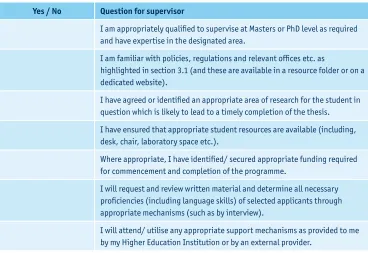
Whose project is it anyway? One major difference across disciplines may concern the different scenarios where a student is effectively hired to work on a project which is already in place through funding the supervisor has secured (a model perhaps most common in the sciences) or where the student comes to the supervisor with a clear proposal for an exact project, which may even be self-funded by the student (perhaps most common in the humanities). In this project origin can be sown the seeds of the student-supervisor relationship in the future, as well as issues to do with ultimate intellectual ownership and responsibility of the work, and even student motivation. In addition, the success or failure of the research can be determined by non-convergent expectations at the outset of the work. Discussion of this issue has proven very rich in these workshops, particularly when staff from very different disciplines share experiences and perspectives. The use of tools such as learning agreements, student-supervisor contracts or candidature plans to structure the initial student-supervisor discussions should be explored here, where locally relevant.To ensure that adequate preparation has been made before undertaking supervision, the Institution can, for example, encourage staff to complete Table 2, which is a checklist of areas to consider before a research student is recruited.
Who should deliver this workshop?
A number of key institutional players can contribute to workshops in this area (Graduate Studies, International Office, Recruitment and/or Funding Office, experienced supervisors).
Learning outcomes
On successful completion of this part of the training, supervisors will be able to:
Approach recruitment of research students in a manner which maximises the likelihood of selecting the best candidate for a position. Assess a potential student who presents with a research idea in terms of their suitability for postgraduate research.
Navigate the institutional procedures involved in recruitment and commencement of a research student.
[image:12.998.588.956.142.395.2]Identify potential sources of funding for research students, and institutional sources of advice and expertise on such matters.
Table 2: Recruitment Checklist
Yes / No Question for supervisor
I am appropriately qualified to supervise at Masters or PhD level as required and have expertise in the designated area.
I am familiar with policies, regulations and relevant offices etc. as
highlighted in section 3.1 (and these are available in a resource folder or on a dedicated website).
I have agreed or identified an appropriate area of research for the student in question which is likely to lead to a timely completion of the thesis.
I have ensured that appropriate student resources are available (including, desk, chair, laboratory space etc.).
Where appropriate, I have identified/ secured appropriate funding required for commencement and completion of the programme.
I will request and review written material and determine all necessary proficiencies (including language skills) of selected applicants through appropriate mechanisms (such as by interview).
I will attend/ utilise any appropriate support mechanisms as provided to me by my Higher Education Institution or by an external provider.
3. 1.
2.
4.
3.3 Supervision lifecycle 2:
making progress
Workshop overview
The objective of this workshop is to support supervisors during the “making progress” part of the supervision life cycle and to provide them with relevant resources. The themes pick up on those covered in the workshop described in section 3.2, and are intended to address the initial stages of a research student’s work (perhaps the first two years), where they are developing skills, fleshing out their research topic and gaining independence as a researcher. This is a particularly challenging phase for the supervisor, as the key elements for success of the student’s work are determined here, and a balance of ownership and direction of the work must be found, as well as the establishment of a productive working relationship between supervisor and student.
Training in this workshop should cover the areas summarised below, as appropriate to individual institutional context and for which supervisors will need to have knowledge and awareness. For each area, suggestions are made as to the content of the training and ideas on how the training could be structured by individual institutions. This workshop should take 2 - 3 hours.
Suggested Content and Tasks/ Exercises
In terms of content for this workshop, this will depend on the manner in which postgraduate training is structured in the institution (i.e., whether the institution has developed a structured PhD approach or not and if graduate schools exist).
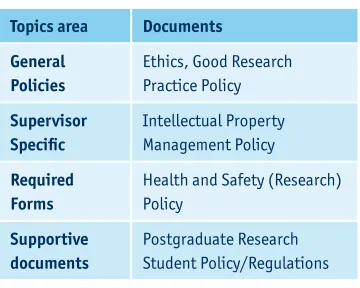
In any case, a basic overview presentation of the policies and procedures covering this stage could be provided, accompanied by a pack containing the relevant policies and forms (see Table 3).
An area of particular relevance to this workshop
(and increasingly so in many institutions) is the training framework for structured PhD education, where it exists in the institution. Participants could be introduced to any nationally agreed principles which exist in this area (e.g., joint skills statement in the UK3 or PhD skills statement in
Ireland4), and then the institutional practice in
this regard explained, along with information on available training workshops or courses and responsible offices (full details of this should be provided in a resource pack or as a handout). Following this information provision, the key is then to get participants to think about how to guide their students within these systems in terms of developing and implementing a formal or informal professional/personal development plan, including the use of tools such as Training Needs Analysis.
The following areas and topics are suggested for this phase:
•
Clarification of roles, responsibilities and expectations of Research Students and3 http://www.vitae.ac.uk/cms/files/RCUK-Joint-Skills-Statement-2001.pdf
4 www.4thlevelireland.ie/publications/Graduate_Skills_ Statement.pdf
Supervisors. Whereas this will have been explored in earlier workshops, the continuing relationship between the supervisor and student warrants attention. Table 4 (overleaf) sets out, in broad terms, the roles and responsibilities of student, supervisor and institution. Instead of simply presenting such information however, more value can be gained from brainstorming on this topic in the workshop.
•
A presentation on How to be an Effective Supervisor could provide useful guidance and tools to help supervisors facilitate the project planning and reporting process for supervision and help highlight the most common pitfalls for supervisors in the administration of this part of the process. The particular considerations which may arise where a student is working on an externally-funded research project (e.g., in terms of requirements of funding agencies for reports, or pre-set deliverables and milestones which are expected of the work) should be considered specifically. [image:13.998.232.412.152.296.2]•
Coupled to the two previous points, an appropriate topic for this workshop concerns the establishment of ground-rules for the relationship between students and supervisors, particularly in the case of inexperienced supervisors. While clearly no two student-supervisor relationships are the same, the key principles of establishing a working relationship which is acceptable to all parties and productive must be stressed; group discussions of how this might work and scenarios which might emerge could be helpful. The use of exercises to demonstrate how there are different basic personality types, and how different types of students and supervisors might as a result work more or less effectively together, can be a useful and light component of such discussions, to nonetheless raise important issues for all supervisors. Various frameworks of supervision type could be discussed and participants encouraged to map their own style to such models (see Anne Lee video for suggestedTable 3: Proposed Content of Information Pack for
Supervisors
Topics area Documents General
Policies
Ethics, Good Research Practice Policy Supervisor Specific Intellectual Property Management Policy Required Forms
Health and Safety (Research) Policy
Supportive documents
Postgraduate Research Student Policy/Regulations
Research Councils UK’s joint skills statement. Irish Universities Association’s PhD skills statement.
6. Resources on VLE
4: Conclusions, future actions 5. Suggested reading
National Academy for Integration of Research, Teaching and Learning Acadamh Náisiúnta um Chomhtháthú Taighde, Teagaisc agus Foghlama
3. Framework
Table 4: Clarification of the roles, responsibilities and expectations of the student and the supervisor
Instructions: Read each pair of statements below
and then estimate your position on each. For example with statement 1 if you believe very strongly that it is the supervisor’s responsibility to select a good topic you should put a ring round “1”. If you think that both the supervisor and student
“3” and if you think it’s definitely the student’s responsibility to select a topic, put a ring round “5”
Student-Supervisor roles, responsibilities and expectations
It is the supervisor’s responsibility to
select a research topic 1 2 3 4 5
The student is responsible for selecting his/her own topic
The supervisor decides which theoretical framework or methodology is most appropriate
1 2 3 4 5
The student should decide which methodology or theoretical framework they wish to use
The supervisor should develop an appropriate programme and timetable of research and study for the student
1 2 3 4 5
The supervisor should leave the development of the programme of study to the student
The supervisor is responsible for ensuring that the student is introduced to the appropriate services and facilities in the department and the University/HEI
1 2 3 4 5
It is the student’s responsibility to ensure that he/she has located and accessed all relevant services and facilities for research
Supervisors should only accept students when they have specific knowledge of the student’s chosen topic
1 2 3 4 5
Supervisors should feel free to accept students, even if they do not have specific knowledge of the student’s topic
A warm, supportive relationship between supervisor and student is important for
successful candidature 1 2 3 4 5
A personal, supportive relationship is inadvisable because it may obstruct objectivity for both student and supervisor during the candidature
The supervisor should insist on regular
meetings with the student 1 2 3 4 5
The student should decide when he/she wants to meet with the supervisor
The supervisor should check regularly that the student is working consistently and on task
1 2 3 4 5
The student should work independently and not have to account for how and where time is spent
*Original from Ingrid Moses, 1985, Higher Education Research and Development Society of Australasia. Adapted by Margaret Kiley and Kate Cadman, 1997, Centre for Learning & Teaching, University of Technology, Sydney.
Cont’d »
mapping tool). A final useful discussion point in this regard concerns the extent to which a staff member’s approach to supervision is influenced by the manner in which they themselves were supervised when completing their doctorate.
•
Case studies or examples (anonymized) could be provided by experienced supervisors in the institution or alternatively from the NAIRTL set of case study resources. Case studies by supervisors who use particular project management tools (e.g., GANNT charts) with their students, andwho can show examples of these, could be very useful, as this approach is not widespread, but may be of interest for use by staff who had not previously thought of their use with research student projects.
•
Ethics, Safety and Intellectual Property. While the institutional policies and procedures on ethics, safety and intellectual property may be summarised in an overview presentation, specific sessions on these aspects of supervision may be of benefit, given their specialised nature. These sessions can be provided by the relevant officer/ manager in the institute. Introducing supervisors to key staff and local procedures in the area of technology transfer and intellectual property is increasingly important as industry-funded or -linked PhD projects (or the Industrial PhD model) become increasingly common.•
Where relevant to a specific institution, a specific presentation could be made on Supervising a Professional Doctorate or Performance-Based Doctorate.The supervisor is responsible for providing emotional support and encouragement to the student
1 2 3 4 5
Personal counselling and support are not the responsibility of the supervisor - students should look elsewhere
The supervisor should insist on seeing all drafts of work to ensure that the student is on the right track
1 2 3 4 5
Students should submit drafts of work only when they want constructive criticism from the supervisor
The supervisor should assist in the
writing of the thesis if necessary 1 2 3 4 5
The writing of the thesis should only ever be the student’s own work
The supervisor is responsible for decisions regarding the standard of the thesis
1 2 3 4 5
The student is responsible for decisions concerning the standard of the thesis
National Academy for Integration of Research, Teaching and Learning Acadamh Náisiúnta um Chomhtháthú Taighde, Teagaisc agus Foghlama
Anne Lee video from NAIRTL conference 2009.
Available to view on www.nairtl.ie/index. php?pageID=423
Providing Good Feedback
Hugh Kearns, Flinders University, Australia
Whenever someone asks me to provide feedback on their work, my first question is “What kind of feedback do you want?” Do you want me to tick and flick? Do you want me to comment on the overall structure or argument? Do you want me to check the spelling? It’s a bit more complicated than just “Here’s my chapter. Give me feedback”.
The following are some aspects of the nature of feedback to get supervisors thinking of how to manage this key aspect of the relationship with their students.
1. What type of feedback does the student want?
Here’s just a sample of the types of feedback a supervisor could provide:
•
Spell checking and proof-reading•
Checking facts and references for accuracy•
Commenting on argument and logic•
Level of critical thinking•
Structure and flow•
Style•
What’s missingWhen a supervisor gives feedback, are they doing all of the above at once? Or do they separate them out? How?
2. Feedback can be positive
Academics and researchers are trained to be critical, to look for the flaws in arguments; to find inconsistencies. However, this leads to a tendency to assume that feedback must be negative. The reality of course is that people can learn just as much from positive feedback, for example, telling a student “The way you expressed that idea is really good” or “I like the way you’ve structured your argument here”. The good news is that as well as being effective, people like getting good feedback! How much positive feedback do participant supervisors give?
3. Feedback for the Stages
Supervisors often treat PhD students as though they were fully formed right from the start, but doing a PhD is a learning process. So the type of feedback a supervisor gives at the start needs to be different from the feedback they’ll give to the final thesis. How do participants think their feedback will vary over the stages?
DISCUSSION PAPER 1:
4. The Person v The Thesis
When a supervisor writes “This isn’t good enough”, they may think they are commenting on the thesis. What do they think the student sees when they look at that feedback? “I am not good enough”. Supervisors must always remember there is a person behind the words (to help empathise, participants should remember the last rejection letter they got from a journal!). How do they react to negative feedback?
5. Timeliness
Feedback that comes three months after a student has written something is too late. In most cases, their head has moved on. To be most effective, feedback needs to be close to when the work is done. What is a reasonable turnaround time?
6. Can you be more specific?
Comments like
•
“This needs work” or•
“Not at the standard” or•
“A bit unclear”don’t help students very much. In fact, they probably lead to confusion. So, what type of work is needed, where is the standard, which piece is unclear and why.
How do supervisors avoid spoon-feeding while still being specific?
Conclusion
The next time a student asks their supervisor for feedback, a key point is to remember to ask them what type of feedback they want.
DISCUSSION PAPER 1:
3. Framework 2. Key themes & issues
Some suggested exercises would be as follows:
•
Distribute a questionnaire among groups of participants in the workshop and ask them to identify whether roles and responsibilities for specific tasks lie with the student or the supervisor.•
Through group activity, identify the key expectations of supervisors of their research students and then highlight the common expectation of research students. The interesting likely outcome of this activity is that, overall, many of the expectations do not match.•
Create a discussion around the key issue of feedback and how supervisors can best achieve a contructive dialogue with students about their work. An example exercise in this regard (developed by Hugh Kearns, Flinders University, Australia) is presented opposite.Who should deliver the workshop?
Experience has shown that this content is often best structured as a facilitated peer-to-peer support workshop, where supervisors at different stages are able to share their experiences and knowledge. This sharing and exploration of issues has proven to be extremely beneficial to those attending such workshops. The workshop could be facilitated by a colleague from the office of Graduate Studies or Registrar’s Office, as appropriate.
Learning outcomes
On successful completion of this part of the training, supervisors should:
1. Describe the nature and proposed duration of this part of the supervisory life cycle and be able to put it into the context of the overall student life-cycle.
Know the institutional policies and procedures governing this stage, including reporting requirements and processes
3. Identify their own role as supervisor, the role of co-supervisors and offices and committees of the institution relevant to this stage
4. Recognise relevant policies on health and safety, research ethics and intellectual property management as they pertain to supervision
5. Be equipped with planning and project management approaches to facilitate their supervision of students
6. Be capable of carrying out a training needs analysis (formally or informally) with their students
7. Appreciate the challenges, problems and pitfalls that can accompany this stage and have developed potential approaches to manage them.
3.4 Supervision lifecycle 3:
progress to completion
Workshop overview
The rationale for this workshop is to support supervisors during the “progress to completion” part of the supervision life cycle and to provide them with relevant information and resources. This phase is multifaceted for supervisors, ranging from formal, institutional aspects, such as the appointment of external examiners, to “softer” support of students as they write up, to advising students on matters of academic quality, coherence and outputs of their work. A key area to be considered here concerns problems which students can encounter during their research (including financial, personal and
project-related problems) and how supervisors can deal with these, including formal institutional procedures for advising students and conflict or dispute resolution in the worst-case scenarios. This workshop should take 3 - 4 hours.
Suggested Content and Tasks/ Exercises
[image:16.998.588.945.365.626.2]This workshop covers a range of issues, from the very practical considerations of institutional requirements around thesis preparation and external examiner appointments, to career and personal support of students, and finally to exploring the role of the supervisor as a “guardian of standards” in the write-up phase. As such, the content for this stage could broadly be divided into three aspects: procedural, academic and student support, with
Table 5: Information required to support students as they ‘progress to completion’
Aspect Description Proposed Delivery
Procedural Imparting information on the formal institutional policies and procedures governing this stage is important. Failure to comply with them can result in delays to the student’s progress.
An information session on these procedures, given by the relevant office (Graduate Studies, Registrar) is proposed/recommended
Academic Advising students on scholarly aspects, norms for the discipline and coherence of the research is a core requirement of this stage. Assessing and advising on the readiness of the student’s work for write-up is the obvious outward sign of this aspect.
Peer-to-peer workshops on research quality and dissemination, as well as an information session on plagiarism could be considered
Student Support
Generic and broader student support in this stage includes: time and workload management, dealing with stress, conflict resolution, career progressing etc.
Presentations from student welfare officer, careers office and research office are appropriate; workshops with experienced supervisors, employing a case study approach are beneficial for exploring problem areas.
different training approaches being appropriate to each. A proposed framework is shown in Table 5 (overleaf).
•
The workshop could initially provide an overview of the relevant information on the institution’s procedural aspects in preparing for thesis submission. This is particularly useful and important information for new supervisors, as timing of these tasks relates to the academic regulations in force in the institution. This presentation should therefore cover:-
Notice period and process for submission of the thesis-
The appointment and roles of examiners (both internal and external)-
Thesis requirements (length, structure etc.)•
An important part of this phase of supervision is preparing the student for the world beyond the viva. For students choosing to develop their research career further, the supervisor can provide much practical support for career development, including sign-posting to appropriate research funding and guiding the student on successfully disseminating their work through publications and conferences. This workshop can bring in expertise from the Research office (or equivalent) to advise on funding matters and draw on colleagues with a strong track record in publication to share their experiences.•
Supervisors see it as a key part of their role to give advice on the readiness of a thesis for submission and to act therefore as a gatekeeper for quality and rigour within their own discipline. This is an area for discussion in this workshop, and it has both practical and more philosophical aspects. Practical advice for supervisors on supporting students with academic writing as they prepare their thesis, including advice fornon-English-speaking students, is helpful. Advice on the use of regular review meetings between the supervisor and student at this stage, for drafting and redrafting can be discussed in the workshop. Practical tools to help students plan and manage their workload can be presented also.
•
This phase of the PhD is usually the most stressful for students and there is real benefit in exploring the institutional supports and policies in relation to students who are experiencing difficulties coping. It is appropriate, in covering this topic, to request that the institute’s student counsellor presents an overview to supervisors in such situations. Other challenges can arise, for example, conflict with a student or plagiarism.Some suggested exercises would be as follows:
•
The use of case studies, which might include examples from the student or supervisor perspective with respect to thesis write-up and the relationship at this stage between the supervisor and the student regarding meetings, correction review etc.•
Presentations or open question and answer sessions, particularly if an institutional representative responsible for assessment is present•
A group activity in relation to management of research groups as well as individual students, which can also incorporate the development of a framework which can be used by the supervisor to guide the student in project management tools (e.g., GANNT charts) which may be helpful in their research and thesis preparation.Who should deliver this workshop?
Participants can be drawn from academic staff members, new and experienced supervisors, and relevant representatives from the Graduate Studies office and Research office.
Learning outcomes
On successful completion of this part of the training, supervisors should be able to:
1. Provide guidance and direction to students on academic writing, as well as more fundamental writing skills
2. Help students disseminate their research through publication and conference presentations as appropriate, and identify suitable routes for such dissemination
3. Advise and assist students on structuring and managing the work associated with the later phases of a research project, including completing data collection/experimentation and commencing write-up
4. Be knowledgeable on formal policies and procedures governing this stage
5. Have an awareness of challenges that can accompany this stage and have developed potential approaches to manage them
6. Support students with relevant information on research careers, including funding sources and signposting to relevant resources
3.5 Supervision lifecycle 4:
the Viva and beyond
Workshop overview
The demystification of the doctoral examination is not just important for students, but also for supervisors. While supervisor behaviour and conceptions of the role vary widely across disciplines, by cultivating scholarly exchange there is much that staff can learn from the experiences of supervisors in other disciplines, as in all the workshops described.
In the final stages of a PhD project, supervision requires the supervisor to reflect on their role in the relationship, not only as provider of support in preparation for the viva, but also in providing opportunities or advice, following the viva, for student acculturation into the academic community or, increasingly, preparation for non-academic careers. The rationale for this final workshop is to provide a forum where supervisors from across disciplines meet to discuss how to best support students through and beyond the viva.
The workshop could take place over a full day, or be divided into two half-day sessions. It could be discipline specific or multi-disciplinary. As the suggested format is a discussion forum, the emphasis should be on facilitated discussion, supported by the literature where necessary.
6. Resources on VLE
4: Conclusions, future actions 5. Suggested reading
National Academy for Integration of Research, Teaching and Learning Acadamh Náisiúnta um Chomhtháthú Taighde, Teagaisc agus Foghlama
3. Framework
Suggested Content and Tasks/ Exercises
As in previous workshops, a short overview presentation of the policies and procedures relating to this stage could be provided where institutional practice is explained; a resource pack might also be supplied which would contain relevant documentation pertaining to institutional procedures for submission and examination of research degrees, and of institutional procedures for awarding the PhD and appealing it. Some brief presentations or case studies from the representatives of participant groups might frame activities or discussion of policy.
Above all, participants should be encouraged to reflect on and share their experiences of supervision with the group.
Some suggested activities for this part of the workshop could include:
•
‘Top tip’ discussion: This could be a simple round-table discussion where everyone writes down one piece of advice they would give a student going into a viva. This might be a good way to open a workshop to spark discussion. Other ‘tips’ from the literature and website resources can be presented for discussion if needed. For example, the website PhD Viva stories and advice5 presents some tips fromexaminers on how to prepare for a viva, while the University of Nottingham also has a series of YouTube videos6 which addresses various topics
which could also be used to spark discussion. A recent publication from NUI Galway “The PhD Viva Guide - A Springboard for your PhD Viva Preparation”7 may also be a useful resource.
5 http://phd-viva.com/category/viva-preperation 6 www.youtube.com/watch?v=wjBrDKcgLqA&feature=relat
ed
7 www.nuigalway.ie/graduatestudies/documents/phd_ viva_guide.pdf