6.3. Ef\ciency Terms
6.3.01. Peak resolution (R1/2) The deRnition of this term is identical to that given in 3.10.01.
R1/2"
VR1!VR2 (wb1#wb2)/2
HereVR1andVR2represent the peaks corresponding to compounds with molecular massesM1andM2 respec-tively: by deRnition M2'M1. In exclusion chromatography, larger molecules are eluted Rrst, therefore,
VR1'VR2.
Because of the addition of a new term, the speciRc resolution (see 6.3.02), the symbolR1/2is suggested for peak resolution in exclusion chromatography.
6.3.02. SpeciVc resolution (Rsp) Peak resolution also considering the molecular masses of the two test compounds:
Rsp"
VR1!VR2 (wb1#wb2)/2
1 log(M2/M1)
The test compounds used for the determination of the speciRc resolution should have a narrow molecular-mass distribution (the ratio of the mass-average and number-average molecular masses should be equal to or less than about 1.1) and differ by a factor of about 10 in their molecular masses.
Note: In some nomenclatures, the symbolRs is used for the speciRc resolution. Due to the possibility of confusing it with the general resolution term (see 3.10.01), the symbolRspis suggested here.
6.3.03. Plate number and plate height (N, H ) The deRnitions of these terms are identical to those given in 3.10.03 and 3.10.05.
6.3.04. Effective plate number and effective plate height (Neff, Heff) The deRnitions of these terms are identical to those given in 3.10.04 and 3.10.06, except that the retention volume of a non-retained compound (Vo; see 6.2.01) is used in the calculations:
Neff"16
VR!Vo
wb
2"5.545
(VR!Vo)wh
2Neff"16
tR!to
wb
2"5.545
(tR!to)wh
2Heff"L/Neff
6.3.05. Reduced plate height (h) The deRnition of this term is identical to that given in 3.10.07.
12B. Liquid-Liquid Distribution (Solvent Extraction)
(IUPAC Recommendations 1993)
Prepared for publication by
N. M. Rice, H. M. N. H. Irving (1980) and M. A. Leonard*(1987)
Abstract
The widespread use of liquid-liquid distribution, ranging from an analytical chemical technique to a unit operation in variousRelds of chemical technology (e.g. petroleum reRning, nuclear fuel reprocessing, hydro-metallurgy, food technology, biochemistry) has led to a proliferation of terminology. This paper extends the scope of the deRnitions beyond those previously recommended (Pure Appl.Chem. 1970,21, 111}113) and a list of terms, including those previously published, is presented under the following general headings: general deRnitions of phenomena, operations and relationships; components of the solvent phase; fundamental parameters for quantitative description of liquid-liquid distribution systems; process terminology applicable to large scale continuous operations.
Introduction
In 1970 IUPAC published ‘Recommended Nomenclature for Liquid-Liquid Distribution’ [1] which represent-ed the work of several generations of the Nomenclature Commission V.3 of the International Union of Pure and Applied Chemistry, assisted by the work of anad hocworking party which considered the whole of the nomenclature of separation processes. The choice of terms selected for deRnition was somewhat arbitrarily restricted to those commonly used in what might be termed small scale batch or laboratory analytical procedures. Many requests were received to extend the range of terms deRned and the need for a complete revision was emphasized by the publication independently of other nomenclature proposals [2}5].
The wide variation [6] in the choice of symbols and in nomenclature adopted by authors of papers published in the Proceedings of the International Conferences on Solvent Extraction in Gothenburg (1966) and in Scheveningen (1971) convinced the organizing committee of the next conference at Lyons (ISEC-1974) of the desirability of providing authors with an extensive set of recommendations in order to aim at consistency in nomenclature and symbols in the published proceedings. These were drawn up by a working party of the Solvent Extraction and Ion Exchange Group of the Society of Chemical Industry (SCI), after meetings at Bradford and Birmingham (England) attended by representatives of all aspects of theReld. Their report, drawn up by Dr Rice (as Secretary) formed the basis of discussions at the IUPAC General Assembly held in Munich during August 1973. This led to a new set of recommendations which were made available for comment at ISEC-74. After further discussions at a meeting of Commission V.3 of IUPAC in London in November 1974 and at the IUPAC General Assembly in Madrid in 1975, a tentative document was issued as an Information Bulletin [7] by IUPAC in July 1977 and further discussed at the IUPAC General Assembly in Warsaw in August 1977. At almost the same time the Solvent Extraction and Ion Exchange Group of the SCI authorized publication of their considered proposals for Recommended Nomenclature for Solvent Extraction in Chem-istry in Industryto coincide with the International Solvent Extraction Conference (ISEC-77) in Toronto [8]. A synthesis of all these proposals including the comments received on the tentative IUPAC proposals was discussed at the IUPAC General Assembly in Davos in September 1979, and circulated in draft form at ISEC-80 in Liege in September 1980, where some minor amendments to process terminology were proposed. Further discussion took place at Commission meetings in London in December 1980 and Leuven in September 1981.
These revised recommendations have been drawn up in collaboration with the Committee of the Solvent Extraction and Ion Exchange Group of the Society of Chemical Industry and have been discussed at several International Solvent Extraction Conferences.
Following the rearrangement of Commissions at the 35th IUPAC General Assembly in Lund in 1989, this project became the responsibility of the Limited Life Time Commission on Chromatography and Other Analytical Separations.
liquid-liquid extraction cannot be overstressed. The distinction between the two sets of terms is merely one of convenience and does not imply any real difference in their importance. In many instances, it is difRcult to decide the appropriate category for a certain term so that the classiRcation is somewhat arbitrary. Furthermore, some additional terms commonly used in the metallurgical industry have been added since publication of the tentative proposals [7].
In order to keep the deRnitions as general as possible the liquid phases involved have been designated as ‘extract’ or ‘solvent’ rather than ‘organic phase’ and ‘other phase’ or ‘feed’ rather than ‘aqueous phase’. The need clearly to label and specify the relevant phase in any equations or graphs is emphasized. Symbols are recommended for a few of the more important parameters. The clear designation of the extract phase components is stressed; the term ‘solvent’ should be reserved for the composite phase rather than any individual component although it may be the only component in that phase. Terms which have become jargon in particular industrial situations or which may be confusing because of ambiguity have been listed as`not recommendeda. No attempt has been made to deRne standard chemical engineering terms, e.g. mass transfer coefRcient, but certain terms, e.g. ‘equilibrium constant’ are discussed in relation to their usage in liquid-liquid distribution.
When the nomenclature is applied to other types of extraction systems (e.g. two immiscible aqueous phases, such as a concentrated salt solution and a concentrated aqueous solution of poly(ethylene glycol), two immiscible non-aqueous liquids or two immiscible molten salts), the two immiscible phases should be clearly speciRed and can equally well be distinguished and denoted by the general terms, Phase I and Phase II. It is also recognized that in the petrochemical and food-processing industries the extractant phase may well be an inorganic liquid (e.g. liquid sulfur dioxide, supercritical carbon dioxide). This situ-ation can be described by using the terms `epi-phasea and `hypo-phasea for the less dense and more dense phases, respectively, recognizing that mass transfer could be in either direction. Occasionally, cases arise where metals are partitioned among three liquid phases, such as concentrated KCl, aceto-nitrile and hexane. The application of the recommended nomenclature to any situation is clearly a matter of common sense. What is important is that in a given situation the phases used should be completely speciRed.
Since the ‘organic phase’ is commonly quite a complex solution of one or more organic liquids containing one or more extractants and possibly ‘modiRers’ of various sorts as well as a ‘diluent’, particular care has been taken over the deRnitions applicable to these various components.
‘Concentration’ is frequently used in the list of deRnitions. In general any suitable concentration units may be employed but thesame units should be used for each phase and should be clearly speciRed in the text.
Following normal convention, ‘activities’ rather than ‘concentrations’ should be used where thermodynamic equilibrium quantities are implied. However, use of the appropriate ‘concentration quotient’ as an approxima-tion for the equilibrium constant in the limiting case of dilute soluapproxima-tions or in conjuncapproxima-tion with the appropriate activity coefRcients follows logically.
One semantic problem is the occurrence of three English terms}‘extraction’, ‘distribution’ and ‘partition’ }to describe the transfer of a solute between phases whereas in many other languages only one suitable term exists (e.g. Verteilung). An attempt has been made to obviate this difRculty in the present work but its complete avoidance is not possible owing to established usage. The terms and symbols, which have been deRned are listed in Tables 1 and 2, respectively. In some cases these represent changes, clariRcations, or speciRc usages of previously deRned terms [9], in particular those related to chromatographic separations [10], and the differences are not in Appendix 1.
The current reviser (MAL) suggests use of the term ‘distribution’ when referring to the total concentration of related species and ‘partition’ when referring to a single species. The term ‘constant’ should be reserved for
Rxed thermodynamic true constants, otherwise ‘ratio’ should be used. A survey of the literature shows reasonable agreement over the symbol and title ofpartition constantanddistribution ratiobut nomenclature for thepartition ratiois a nightmare. Appendix 2 summarizes past usage.
1. General De
\
nitions
1.1 Antagonism
The converse tosynergism(1.23).
1.2 Coextraction
Formation of mixed-species aggregates in a low-polarity organic phase.
1.3 Conditioning
A synonym forpre-equilibration(1.16).
1.4 Distribution
The apportionment of a solute between two phases.
Note: the termpartition(1.15) orextraction(1.9) may also be used in this sense where appropriate.
1.5 Distribution Isotherm
The relationship (algebraic or graphical) between the concentration of a solute in theextract(2.7) and the corresponding concentration of the same solute in the other phase at equilibrium at a speciRed temperature.
Note: Alternative terms in common use areequilibrium line(1.7) and in the appropriate contexts:extraction isotherm,scrubbing isothermandstripping isotherm.Partition isothermis not normal usage.
1.6 Equilibration
The operation by which a system of two or more phases is brought to a condition where further changes with time do not occur.
Note: This term is not synonymous with pre-equilibration(1.16) and should not be used in that sense.
1.7 Equilibrium Line
A plot of the distribution isotherm (1.5).
1.8 Extract (Verb)
To transfer a solute from a liquid phase to another immiscible or partially miscible liquid phase in contact with it.
Notes:
(i) The term is also applied to the dissolution of material from a solid phase with a liquid in which it is not wholly soluble (i.e.leaching). Seesolvent extraction(1.19).
(ii) For usage as a noun see under ‘2 Components of the Solvent Phase’.
1.9 Extraction (in Liquid-liquid Distribution) Seeliquid-liquid extraction.
Notes:
(i) See under ‘4 Process Terminology’ for a more speciRc usage of extraction.
(ii) Distribution (1.4) and partition (1.15) are often used as synonyms for the general phenomenon of
extractionwhere appropriate.
1.10 Liquid Ion Exchange
A term used to describe a liquiddliquid extraction process that involves a transfer of ionic species from the extractant to the aqueous phase in exchange for ions from the aqueous phase.
Notes:
(i) The term does not imply anything concerning the nature of the bonding in the extracted complex. (ii) The term`Solvent Ion Exchangea(SIX) is not recommended.
1.11 Liquid-liquid Distribution (Extraction) (Partition)
Note: Althoughextraction,partitionanddistributionare not synonymous,extractionmay replace distribu-tionwhere appropriate.
1.12 Macro-element SeeMain Solute. Notes:
(i) This term is vague and is not recommended.
(ii) Macroelement has a different meaning in analytical chemistry and the term major component, the meaning of which is obvious, is preferable.
1.13 Main (extractable) solute.
That (or those) species transferred which is of greatest economic or chemical interest.
Note: It is not necessarily the species present at greatest concentration.
1.14 Micro-element
This term shouldnotbe used in the sense of a minor component or acontaminantin the feed to a liquid-liquid distribution system.
Note: Microelement has a different meaning in analytical chemistry and the terms minor component,
impurity or contaminantthe meaning of which are obvious, are preferable.
1.15 Partition
This term is often used as a synonym for distribution (1.4) and extraction (1.9). However, an essential difference exists by deRnition between distribution constant or partition ratio (3.17) and partition constant(3.16).
Note: This term should be, but is not invariably, applied to the distribution of a single deRnite chemical species between the two phases.
1.16 Pre-equilibration
(i) Preliminary treatment of a solvent in order to convert the extractants into a suitable chemical form. (ii) Preliminary treatment of either phase with a suitable solution of the other phase (in the absence ofmain
extractable solute(s) (1.13)) so that when the subsequentequilibration(1.6)) is carried out changes in the (volume)phase ratio(3.19) or in the concentrations of other components are minimised.
Notes:
(i) The use ofequilibration(1.6) in this sense is confusing and should be avoided. (ii) The termconditioningmay be used as a synonym forpre-equilibration.
1.17 Re-extraction
Since the preRx ‘re-’ can signify ‘back’ as well as ‘again’ this term is ambiguous andshould be avoided, except where the process of extraction (e.g. from aqueous solution to an organic phase) in a single direction is repeated (following stripping). It should not be used as a synonym forstripping(4.3) orback-extraction(4.1).
1.18 Salting Out
The addition of particular electrolytes to an aqueous phase in order to increase thedistribution ratio(3.5) of a particular solute.
Notes:
(i) The addition of electrolytes to improve phase separation behaviour should not be referred to as salting out.
(ii) The term is also used for the addition of electrolytes to reduce the mutual partial miscibility of two liquids.
1.19 Solvent Extraction
The process of transferring a substance from any matrix to an appropriate liquid phase. If the substance is initially present as a solute in an immiscible liquid phase the process is synonymous with liquid-liquid extraction(1.11).
Notes:
(i) If the extractable material is present in a solid (such as a crushed mineral or an ore) the termleachingmay be more appropriate. The extractable material may also be a liquid entrapped within or adsorbed on a solid phase.
(ii) Common usage has established this term as a synonym for liquid}liquid distribution (1.11). This is acceptable provided that no danger of confusion with extraction from solid phases exists in a given context.
1.20 Solvent Ion Exchange (SIX)
This term is not recommended (seeliquid ion exchange) (1.10).
1.21 Sublation
ASotation process in which the material of interest, adsorbed on the surface of gas bubbles in a liquid, is collected on an upper layer of immiscible liquid.
Notes: There is no liquid-phase mixing in the bulk of the system; as a result recoveries can approach 100%.
1.22 Substoichiometric Extraction
Here the amount of reagent used is lower than that dictated by stoichiometry. If the constants of formation and extraction of the complexes are high, the amount of extracted metal is dictated by the amount of extractant introduced.
1.23 Synergism
A term describing the co-operative effect of two (or more) extractants (2.8) where the distribution ratio
(3.5) for the combination is greater than the largest individualdistribution ratio(measured under comparable conditions)
Notes:
(i) The corresponding adjective issynergicand the termsynergisticshould not be used.
(ii) No standard method for quantiRcation of the phenomenon has been agreed and any approach should be clearly deRned in a given situation.
2. Components of the Solvent Phase
2.1 Accelerator SeeCatalyst (2.3), Kinetic Synergist (2.10), Modi\er (2.11) Note: This term may be used as a synonym for catalyst.
2.2 Carrier SeeDiluent (2.5) This term is not recommended.
2.3 Catalyst (in Liquid-liquid Distribution)
A substance included in thesolvent(2.12) to increase the rate of transfer without affecting the position of equilibrium.
Notes: The termacceleratormay also be used butkinetic synergistis not recommended.
2.4 Cosolvent SeeDiluent (2.5) 2.5 Diluent
Notes:
(i) The termcarrier, which implied an inert diluent is not recommended.
(ii) Although the diluent may well be a single liquid or even the major portion of the extracting phase, the termsolvent(2.12) should not be used in this sense as it has a much wider meaning in the context of liquid-liquid extraction, although the termcosolventmay be used in certain circumstances.
(iii) The diluent by itself does not extract themain(extractable)soluteappreciably
2.6 Epi-Phase
The less dense phase in a distribution system.
Note: The term is often used when two non-aqueous phases are present or when the solvent (2.12) is an aqueous solution. See alsohypo-phase(2.9).
2.7 Extract (Noun)
The separated phase (often but not necessarily organic) that contains the material extracted from the other phase.
Notes:
(i) Where appropriate the term`loaded solventa(4.15) may be used, but is not recommended. (ii) For usage as a verb see 1.8.
2.8 Extractant
The active component(s) primarily responsible for transfer of a solute from one phase to the other.
Notes:
(i) The termextracting agentis a synonym butsolvent(2.12) andligandshould not be used in this context. (ii) Certain extractantsthat consist of liquids immiscible with water (e.g. Tributyl phosphate or certain ketones) might comprise the only component of the initial organic phase butextractant(s) can also be dissolved indiluent(2.5).
2.9 Hypo-Phase
The denser phase in an extraction system.
Note: The term is often used when two non-aqueous phases are present or when the solvent (2.12) is an aqueous phase. See alsoepi-phase(2.6).
2.10 Kinetic Synergist
This term is not recommended as a synonym forcatalyst(2.3) oraccelerator(2.1).
2.11 Modi\er
A substance added to asolvent(2.12) to improve its properties e.g. by increasing the solubility of anextractant
(2.8), changing interfacial parameters, or reducing adsorption losses.
Note: Additives used to enhance extraction rates should be calledaccelerators(2.1) orcatalysts(2.3).
2.12 Solvent (in Liquid-liquid Distribution)
The term applied to the whole initial liquid phase containing theextractant(2.8).
Notes:
(i) The solvent may contain onlyextractantor it may be a composite homogeneous mixture ofextractant(s) (2.8) withdiluent(s) (2.5) and also sometimes modiTers(2.11) andaccelerators(2.1).
(ii) The termsolventmust not be used as a synonym for any of the individual components of a composite liquid phase even where, in the case of a single component (e.g. 3-methylbutan-2-one or tributyl phosphate), it becomes identical with theextractant.
(iii) The term may be qualiRed to denote theextractfrom a given processingstep(4.41), e.g.loaded solvent
3. Fundamental Parameters
3.1 Concentration Factor
Not recommended. Seeextraction factor(3.10).
3.2 Decontamination Factor
The ratio of the proportion of contaminant to product before treatment to the proportion after treatment. It is the reciprocal of theenrichment factor(3.6).
3.3 Distribution Coef\cient
This term is not recommended as a synonym fordistribution ratio(3.5).
3.4 Distribution Constant
A synonym forpartition ratio(3.17).
3.5 Distribution Ratio (in Liquid-liquid Distribution) (D)
The ratio of the total analytical concentration of a solute in theextract(2.7) (regardless of its chemical form) to its total analytical concentration in the other phase.
Notes:
(i) If there is possible confusion with theextraction factor or (mass)distribution ratio (3.13), the term
concentration distribution ratio (symbolDC) should be used, but this is not common usage. This is reasonably compatible with chromatographic nomenclature.
(ii) The terms distribution coefTcient, extraction coefTcient and, where appropriate, scrubbing coefTcient, stripping coefTcient are widely used alternatives but are not recommended. If they must be used in a given situation the termratiois preferable tocoefTcient.
(iii) In equations relating to aqueous/organic systems the organic phase concentration is, by convention, the numerator and the aqueous phase concentration the denominator. In the case of stripping ratio the opposite convention is sometimes used but should then be clearly speciRed.
(iv) In the past there has been much confusion between thedistribution ratioas deRned above, the value of which varies with experimental conditions, e.g. pH, presence of complexing agents, extent of achieve-ment of equilibrium, etc. and the truepartition constant(3.16) which is by deRnition invariable or the
partition coefTcient or distribution constant which apply to a particular chemical species under speciRed conditions. For this reason the terms distribution constant(3.4), partition constant(3.16),
partition coefTcient(3.15), partition ratio(3.17) andextraction constant(3.9) should not be used in this context.
(v) The use of the ratio:light phase concentration to heavy phase concentrationis ambiguous and is not recommended.
(vi) The distribution ratio is an experimental parameter and its value does not necessarily imply that distribution equilibrium between the phases has been achieved.
3.6 Enrichment Factor (in Liquid-liquid Distribution) (S )
The factor by which the ratio of the amounts of two substances in thefeed(4.11) must be multiplied to give their ratio after treatment.
QA/QB"SA,B(QA/QB) whereQAandQAare theRnal and initial amounts of species A andQBandQBare the
Rnal initial amounts of species B. HenceSA,B"EA/EBwhereEis thefraction extracted(3.11). In terms ofD,n,
r(wherenis the number of stages andrthephase ratio(3.19))
SA,B"
1!(1#rDA)\n 1!(1#rDB)\n
3.7 Extractability
Note: This term is imprecise and generally used in a qualitative sense. It is not a synonym forfraction extracted
(3.11).
3.8 Extraction Coef\cient
This term is not recommended as a synonym fordistribution ratio(3.5).
3.9 Extraction (Equilibrium) Constant at Zero Ionic Strength (Ko ex)
The equilibrium constant of the distribution reaction expressed in terms of the reacting species. Thus, for the gross reaction:
Mn#
aq #nHLorg&MLn,org#nH#aq
in which the reagent HL initially dissolved in an organic phase reacts with a metal ion Mn# in aqueous solution to form a product MLnwhich is more soluble in the organic phase than in water,
Ko ex"
aMLn,org;anH#, aq
aMn#, aq;anHL,org
Notes:
(i) When concentrations are used instead of activities or mixed terms are employed as when H#and/or Mn# are measured with an electrode, the appropriate name is extraction constant, symbol K
ex, accompanied by a careful deRnition.Ko
exmay be termed thethermodynamic extraction constant. (ii) The extraction constant is related to other terms relevant to such systems by:
Kex"
DMLnnKna
Dn
HL
wherenis the overall formation constant of MLnandKais the dissociation constant of HL. When the reagent HL is more soluble in water than the other immiscible phase it may be more convenient to deRne a special equilibrium constant in terms of HLaq:
Kex"DML,nnKna
(iii) In distribution equilibria involving non-aqueous systems, e.g. liquid SO2, molten salts and metals, the mass action equilibrium constant for the relevant extraction process can be identiRed with Kexwhich should be explicitly deRned in this context.
(iv) In actual practice, it may be necessary to include other terms to take into account other complexes formed by auxiliary reagents and the solvation and/or polymerization of the various species. In such cases, Kex must be deRned with reference to the relevant explicit chemical equation. An example is complex formation between the metal ion and an uncharged crown ether or cryptand molecule followed by ion-pair extraction:
Mn#
aq #Lorg#nA\aq"(MLn#)Ann\)org
Kex"
[MLn#An\ n ]org [Mn#]aq[L]org[A\]naq
(v) Use of Ringbom’s`conditional extraction constanta,
Keff ex"
an
H#) [MLn]org [M]aq[HL]norg in conjunction with alpha coefRcients is useful [11].
(vi) The phases can also be speciRed by the formula of the solvent or by other symbols (preferably Roman numerals) or by overlining formulae referring to one phase, usually the less polar one. The subscript aq (or w) is often omitted; aq is preferable to w as the latter is appropriate only in English and German. (vii) The qualiRcation`Equilibriumais often omitted.
3.10 Extraction Factor (Dm)
The ratio of the total mass of a solute in the extract to that in the other phase.
Notes:
(i) It is the product of the (concentration)distribution ratioand the appropriatephase ratio.
(ii) It is synonymous with the concentration factor or mass distribution ratio, this latter term being particularly apt.
(iii) The termconcentration factoris often employed for the overallextraction factorin a process or process step.
3.11 Fraction Extracted (E )
The fraction of the total quantity of a substance extracted (usually by the solvent) under speciRed conditions, i.e.EA"QA/QA whereQAis the mass of A extracted andQAis the total mass of A present at the start.
Notes:
(i) Emay be expressed as a percentage, %E.
(ii) The termextractabilityis qualitative and should not be used as a synonym forfraction extracted. (iii) If the aqueous phase is extracted with n successive portions of solvent, the phase volume ratio
(solvent/feed) beingreach time, the fraction extracted is given by:
En"1!(rD#1)\n
Ifn"r"1,E1"D/(1#D) this expression is a concept of value in chromatography theory. (iv) The fraction extracted is also known as the recovery factor, especially for a multistage process.
3.12 Loading Capacity
The maximum concentration of solute(s) that asolvent(2.12) can contain under speciRed conditions.
Notes:
(i) The termsmaximum loading,saturation capacityandsaturation loadingare synonymous. (ii) All the above terms should clearly be distinguished fromultimate capacity(3.29)
3.13 Mass Distribution Ratio SeeExtraction Factor (3.10) 3.14 Maximum Loading SeeLoading Capacity (3.12) 3.15 Partition Coef\cient
This term is not recommended and should not be used as a synonym forpartition constant(3.16),partition ratioordistribution ratio(3.5).
3.16 Partition Constant (Ko D)
The ratio of activity of a given species A in the extract to its activity in the other phase with which it is in equilibrium, thus
(Ko
D)A"aA,org/aA,aq
Its value should not vary with composition but depends on the choice of standard states and on the temperature (and eventually the pressure).
Note: Seetransfer activity coefTcient(3.28).
3.17 Partition Ratio (KD)
The ratio of the concentration of a substance in a single deRnite form, A, in the extract (4.8) to its concentration in the same form in the other phase at equilibrium, e.g. for an aqueous/organic system
Notes:
(i) KD is sometimes called the distribution constant; this is a good synonym. The terms distribution
coefTcient, distribution ratio (3.5), partition constant (3.16) and extraction constant (3.9) should not be used as synonyms forpartition ratio.
(ii) The use of the inverse ratio (aqueous/organic) may be appropriate in certain cases, e.g. where the organic phase forms the feed (4.11) but its use in such cases should be clearly speciRed. The ratio of the concentration in the denser phase to the less dense phase is not recommended as it can be ambiguous. (iii) If the pure solvent and inRnitely dilute feed are taken as the standard state, KDPKoD as the total
concentration of dissolved materials decreases.
3.18 pH0.5or pH1/2
That value of pH in an aqueous phase at which thedistribution ratio(3.5) is unity at equilibrium.
Note: 50% of the solute is extracted (E"0.5)onlywhen thephase ratio (3.19) is unity.
3.19 Phase Ratio (in Liquid-liquid Distribution) (r)
The ratio of the quantity of the solvent (2.12) to that of the other phase.
Notes:
(i) Unless otherwise speciRed the phase ratio refers to thephase volume ratio.
(ii) If other aspects of the phase ratio are employed viz.phase mass ratio,phaseUow ratio, these should be speciRed.
3.20 Recovery Factor
This term is not recommended.Fraction extracted(3.11) should be used.
3.21 Saturation Capacity SeeLoading Capacity (3.12) 3.22 Saturation Loading SeeLoading Capacity (3.12) 3.23 Selectivity Coef\cient
This term should not be used as a synonym forseparation factor(3.26).
Note: This term has a speciRc meaning in relation to ion exchange by solid exchangers.
3.24 Selectivity Ratio
Synonym forselectivity coefTcient(3.23). It should not be used as a synonym forseparation factor(3.26).
3.25 Separation Coef\cient
This term is not recommended. A synonym forseparation factor(3.26).
3.26 Separation Factor (in Liquid-liquid Distribution) (A,B)
The ratio of the respective distribution ratios (3.5) of two extractable solutes measured under the same conditions.
A,B"DA/DB
Notes:
(i) By convention the solutes designated as A and B in the above are chosen so as to make'1. (ii) The termseparation coefTcientis not recommended.
3.27 Stoichiometric Capacity SeeUltimate Capacity (3.29) 3.28 Transfer Activity Coef\cient (t)
A term used to quantify the difference in the free energy of a solute ion in two different standard states often in two different liquid phases. The relationship istG3"vRTlntwheretG3is the transfer Gibbs energy and v is the number of ions in the solute. Seepartition constant.
Notes:
(i) SeeIUPAC Information BulletinNo. 34 (1974) [12] for full details.
(ii) It should not be confused with the mass transfer coefTcient which represents the speciRc rate of transfer of a species from one phase to another.
(iii) It does not necessarily imply the physical transfer of a solute between two liquid phases.
3.29 Ultimate Capacity
The theoretical maximum capacity of asolvent(2.12) containing a given concentration ofextractant(2.8) for a solute under any conditions.
Note: Where appropriate the termstoichiometric capacitycan be used.
4. Process Terminology
4.1 Back Extraction
A synonym forstripping(by extraction) (4.43).
4.2 Back Washing
Often used as a synonym forstripping(4.43). This term is not recommended.
4.3 Continuity Inversion
A change in the mutual dispersion of two phases in contact. Seeinversion(4.13).
4.4 Crowding
The displacement of an impurity from an extract phase by contact with a solution containing the main extractable solute. See scrubbing(4.23),exchange extraction(4.8).
Note: The main solute need not be present in a pure solution but should have a higherdistribution ratio(3.5) than the impurities present.
4.5 Crud
A deposit or emulsion at the interface between two partially settled phases.
Notes:
(i) The phenomenon of crud formation arises from many causes and this deRnition does not imply any single one.
(ii) Other terms}some unprintable}have been used butcrudis the generally accepted term.
4.6 Density Inversion
The interchange of the denser and less dense phases due to changes in solute concentration. Seeinversion
(4.13).
Note:Phase inversion(4.20) is often used in this context but is ambiguous.
4.7 Differential Contactor
4.8 Exchange Extraction
An extraction operation or process in which a metal from one phase is exchanged with the equivalent amount of a second metal from the other phase. Seecrowding(4.4).
Note:
(i) This term may be used in connection with any step (e.g.loading, (4.16),scrubbing(4.23) orstripping
(4.43) in a process).
(ii) This applies also to organic or molecular species.
4.9 Extraction (in Process Liquid-liquid Distribution)
In connection with processes, this term often refers to the initial transfer step whereby themain solute(1.13), often together with impurities, is transferred fromfeedto solvent(2.12). Seeloading(4.16).
Notes:
(i) Partition and distribution(1.4) are not synonyms in this speciRc instance.
(ii) The termextractionmay be used in a more general sense. See under`General DeRnitionsa(1.9).
4.10 Extraction Isotherm SeeDistribution Isotherm (1.5) 4.11 Feed
A solution introduced into anextractionsystem.
Note: It should be clearly identiRed (e.g. scrub feed) but, if used without qualiRcation, it may be taken to designate the initial liquid phase containing the main solute to be transferred.
4.12 Height Equivalent to a Theoretical Stage (HETS) See explanation ofTheoretical Stage(4.52).
4.13 Inversion (or Phase Inversion)
This term is used in two senses which should be speciRed.
(i) density inversion(4.6) (ii) continuity inversion(4.3)
4.14 Load (in Liquid-liquid Distribution) (Verb)
To transfer solute from afeed(4.11) to another liquid phase.
4.15 Loaded Solvent SeeExtract (2.7)
Note: This term is usually used to denote theextract(2.7) after completion of a particular step, e.g.extraction
orscrubbing(4.23)
4.16 Loading (Noun)
The concentration of an extracted solute in theextract(2.7).
4.17 Loading (Verb) See Load (4.14)
Note: Used in this sense the term normally refers to the operation of transferring themain solute(1.13)), often with impurities from the feed to thesolvent(2.12).
4.18 O.K. Liquor
Sometimes used as a synonym forstrip product solution(4.48) orstrip liquor(4.42)
Note: This term is confusing andshould notbe used. 4.19 Operating Line
4.20 Phase Inversion SeeDensity Inversion (4.6) 4.21 Raf\nate
The phase remaining after extraction of some speciRed solute(s).When necessaryit should be further speciRed, e.g.scrub rafTnate(4.30).
Note: The original meaning of rafTnate as a `reRned producta has become extended and changed by common usage.
The term should normally be applied only to waste streams but the latter may form the feed to a further extraction process for another solute.
4.22 Regeneration SeeSolvent Regeneration (4.37)
4.23 Scrubbing SeeCrowding (4.2) and Selective Stripping (4.33)
The process of selectively removing contaminating solutes (impurities) from an extract (2.7) that contains these as well as themain extractable solute(1.13) by treatment with a new immiscible liquid phase.
Note: The termstripping(4.43) has a different meaning and should not be used in this sense although this usage has been customary in certain industries.
4.24 Scrubbing Agent
The chemical reagent used to effectscrubbing(4.23).
Note: Often used as a synonym for its solution.
4.25 Scrubbing Agent Solution
The solution used to effectscrubbing(4.23)
Note: The termscrub solutionis ambiguous and is not recommended.
4.26 Scrubbing Isotherm SeeDistribution Isotherm (1.5) 4.27 Scrub Feed
Theextract(2.7) to be scrubbed.
4.28 Scrub Liquor SeeScrub Raf\nate (4.30)
Note: This term is ambiguous and is not recommended.
4.29 Scrub Product Solution
The solution that results from thescrubbingof impurities from an extract phase.
Note: The termscrub liquoris also used but can be confused with thescrubbing agent solution(4.25) and is not recommended. Seescrub rafTnate(4.30).
4.30 Scrub Raf\nate
This term should only be used where the product solution from scrubbing is discharged to waste. Scrub product solution(4.29) is better where this stream is combined withfeed(4.11) to the loading section.
4.31 Scrubbing Ratio SeeDistribution Ratio (3.5)
Note: The termscrubbing coefTcientis not recommended. This term is not common.
4.32 Scrub Solution SeeScrubbing Agent Solution (4.25)
Note: This term should not be used as it is ambiguous and can be confused withscrub rafTnate (4.30) or
4.33 Selective Scrubbing Seestripping (4.43) 4.34 Solvent Inventory
The total quantity of solvent present in the process.
4.35 Solvent Loss
The total quantity of solvent lost during the operation of a process.
Note: There are a number of ways currently in use to express bothsolvent inventoryandsolvent lossand authors should carefully deRne how they are using the terms until a generally agreed procedure can be recommended.
4.36 Solvent Puri\cation
Seesolvent regeneration. The descriptionsolvent puriTcationnaturally applies also to the puriRcation of fresh
solvent(2.12).
4.37 Solvent Regeneration
Treatment of the solvent for re-cycling, e.g. by removal of degradation products or non-strippable solutes.
Note: The term solvent puriTcation is synonymous, but the terms scrubbing (4.23), stripping (4.31) and
washingshould not be used in this context.
4.38 Stage
That physically distinct part of an extraction process in which transfer of solute(s) occurs, followed by phase separation. Seetheoretical stage(4.52).
Notes:
(i) For certain types of equipment with a single phase separation interface, the termtheoretical stage(4.52) is more appropriate.
(ii) Equilibrium need not necessarily be established in a stage.
4.39 Stagewise Contactor
A type of continuous multi-stage liquiddliquid contactor in which each stage has a physically distinct cycle of interphase contact and separation.
Note: There will be the same number of phase separation interfaces as there are stages.
4.40 Steady State (in Liquid-liquid Distribution)
The state of a continuous process when it is operating in such a way that the concentration of solutes in exit streams remains constants with respect to time for constant feed concentrations, even though the two phases are not necessarily in thermodynamic equilibrium in any part of the process.
Note: The termequilibriumshould not be used to describe this situation.
4.41 Step (in Liquid-liquid Distribution)
That operation in an overall extraction process in which transfer of solute(s) occurs in a particular direction, e.g. Loading(4.16), stripping(4.43),scrubbing(4.23).
4.42 Strip Liquor
A liquid phase resulting from the operation of stripping(4.43). See strip solution(4.50) andstrip rafTnate
(4.49).
Notes:
4.43 Stripping
The process of removing solute(s) from aloaded solvent orextract(2.7). Generally this refers to the main solute(s) present.
Notes:
(i) Where appropriate, e.g. when liquid-liquid distribution is used forstripping, the termback-extraction
can be used. The termsback-washingandre-extraction(1.17) are not recommended.
(ii) The recent application ofselective strippingof solutes as a separation method leads to some confusion between the termsstrippingandscrubbing(4.23). It is recommended that the termscrubbingbe reserved for the operation of removing contaminants (impurities) from an extract (2.7) (where the scrub rafTnate (4.30) is often recycled to the loading step) and the term selective strippingbe used where two or more main solutes are stripped successively from an extract, usually with different stripping agents(4.44), with a view to their subsequent separate recovery from solution for analysis.
4.44 Stripping Agent
The active substance effective instripping(4.43).
4.45 Stripping Agent Solution
The liquid phase used to accomplishstripping(4.43).
4.46 Stripping Ratio SeeDistribution Ratio (3.5) Notes:
(i) This term is usually deRned as the inverse ratio to the distribution ratio (3.5, comment iii), i.e. in aqueous-organic systems the aqueous phase concentration of solute is the numerator and the organic phase concentration the denominator. Their usage should be clearly deRned.
(ii) The termstripping coefTcientis not recommended.
4.47 Stripping Ratio SeeDistribution Isotherm (1.5), Equilibrium Line (1.7)
Note: In the graphical representation ofstripping isotherms, the axes are often interchanged from those used to represent the phases forextraction isotherms. It is essential that the axes be clearly labelled.
4.48 Strip Product Solution
The liquid phase resulting fromstripping(4.43) of asolvent(2.12). Seestripping liquor(4.42),strip solution
(4.50),strip rafTnate (4.30),O.K.liquor(4.18). Note: The last four terms are not recommended.
4.49 Strip Raf\nate
This term is not recommended.RafTnate (4.21) should be reserved for waste streams and the liquid phase resulting from stripping normally contains the desired product.
4.50 Strip Solution
The liquid phase used forstripping(4.43).
Note: There is some ambiguity between the terms strip liquor and strip solution. Perhaps strip product solution(4.48) would be more appropriate to the former andstripping agent solution(4.45) for the latter. Seestripping agent(4.44).
4.51 Tenor
A term sometimes used to denote the concentration levels of various solutes in the feed (4.11). It is not recommended.
4.52 Theoretical Stage
That part of a continuous multi-stage contactor in which the amount of solute transferred from one phase to the other is equivalent to that which would be transferred in an actual stage at equilibrium under comparable conditions of solute concentration in each phase as determined from the distribution isotherm (1.5) and
Table 1 Index of terms
Accelerator 2.1
Antagonism 1.1
Back extraction 4.1 Back washing 4.2
Carrier 2.2
Catalyst (in liquid-liquid distribution) 2.3 Coextraction 1.2 Concentration factor 3.1 Conditioning 1.3 Continuity inversion 4.3
Cosolvent 2.4
Crowding 4.4
Crud 4.5
Decontamination factor 3.2 Density inversion 4.6 Differential contactor 4.7
Diluent 2.5
Distribution 1.4 Distribution coefficient 3.3 Distribution constant 3.4 Distribution isotherm 1.5 Distribution ratio (in liquid-liquid distribution) 3.5 Enrichment factor (in liquid-liquid distribution) 3.6
Epi-phase 2.6
Equilibration 1.6 Equilibrium line 1.7 Exchange extraction 4.8 Extract (noun) 2.7 Extract (verb) 1.8 Extractability 3.7
Extractant 2.8
Extraction 1.9
Extraction (in process liquid-liquid distribution) 4.9 Extraction coefficient 3.8 Extraction factor 3.10 Extraction isotherm 4.10
Feed 4.11
Fraction extracted 3.11 Height equivalent to a theoretical stage (HETS) 4.12
Hypo-phase 2.9
Inversion 4.13
Kinetic synergist 2.10 Liquid ion exchange 1.10 Liquid-liquid distribution (extraction) (partition) 1.11 Load (in liquid-liquid distribution) (verb) 4.14 Loaded solvent 4.15 Loading (noun) 4.16 Loading (verb) 4.17 Loading capacity 3.12 Macro-element 1.12 Main (extractable) solute 1.13 Mass distribution ratio 3.13 Maximum loading 3.14 Micro-element 1.14
Modifier 2.11
O.K. Liquor 4.18 Operating line 4.19
Partition 1.15
Partition coefficient 3.15 Partition constant 3.16 Partition ratio 3.17 pH0.5or pH1/2 3.18 Phase inversion 4.13, 4.20 Phase ratio (in liquid-liquid distribution) 3.19 Pre-equilibration 1.16
Raffinate 4.21
Regeneration 4.22 Recovery factor 3.20 Re-extraction 1.17 Salting out 1.18 Saturation capacity 3.21 Saturation loading 3.22
Scrubbing 4.23
Scrubbing agent 4.24 Scrubbing agent solution 4.25 Scrubbing isotherm 4.26 Scrub feed 4.27 Scrub liquor 4.28 Scrub product solution 4.29 Scrub raffinate 4.30 Scrubbing ratio 4.31 Scrub solution 4.32 Selectivity coefficient 3.23 Selectivity ratio 3.24 Selective stripping 4.33 Separation coefficient 3.25 Separation factor (in liquid-liquid distribution) 3.26
Solvent 2.12
Solvent extraction 1.19 Solvent inventory 4.34 Solvent ion exchange (six) 1.20 Solvent loss 4.35 Solvent purification 4.36 Solvent regeneration 4.37
Stage 4.38
Stagewise contactor 4.39 Steady state (in liquid-liquid distribution) 4.40 Step (in liquid-liquid distribution) 4.41 Stoichiometric capacity 3.27 Strip liquor 4.42
Stripping 4.43
Stripping agent 4.44 Stripping agent solution 4.45 Stripping ratio 4.46 Stripping isotherm 4.47 Strip product solution 4.48 Strip raffinate 4.49 Strip solution 4.50
Sublation 1.21
Substoichiometric extraction 1.22
Synergism 1.23
Tenor 4.51
Theoretical stage 4.52 Transfer activity coefficient 3.28 Ultimate capacity 3.29
Washing 4.53
Note: Thus from the number of theoretical stages so determined and the height of the contactor theheight equivalent to a theoretical stage(HETS) may be calculated.
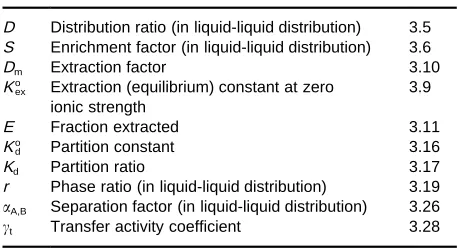
Table 2 Index of symbols
D Distribution ratio (in liquid-liquid distribution) 3.5 S Enrichment factor (in liquid-liquid distribution) 3.6 Dm Extraction factor 3.10 Ko
ex Extraction (equilibrium) constant at zero ionic strength
3.9
E Fraction extracted 3.11 Ko
d Partition constant 3.16 Kd Partition ratio 3.17 r Phase ratio (in liquid-liquid distribution) 3.19
A,B Separation factor (in liquid-liquid distribution) 3.26
t Transfer activity coefficient 3.28
Appendix 1. Comparison of Nomenclature With Previously De
\
ned Terms
(OB, Orange Book [9]; Chrom, Nomenclature for Chromatography [10]
Carrier(2.12) This term is not recommended in this area (OB p54)
Catalyst(in liquid-liquid distribution) (2.3) DeRned as a speciRc use ofcatalyst(OB p56).
Diluent(2.5) RedeRned from OB 9.2.4 and 9.2.10 in a more general sense
Distribution(1.4) Now deRned}only mentioned in OB 9.2.6
Distribution coefTcient(3.3) Not recommended in this area (OB 9.4.10)
Distribution constant(3.4) Matches uses in Chrom 3.9 and 5.6.
Distribution ratio(in liquid-liquid distribution) (3.5) Slight clariRcation of usage from OB 9.2.6
Enrichment factor(in liquid-liquid distribution) (3.6) Rewording of OB 9.2.8 to make more general.
Extractant(2.8) RedeRned compared to OB 9.2.11
Extraction(in liquid-liquid distribution) (1.9) See more precise term OB 9.2.4
Extraction coefTcient(3.8) Not recommended (OB 9.2.6)
Extraction constant(3.9) Slightly amended from OB 9.2.5
Liquid-liquid distribution(1.11) RedeRned from OB 9.2.4
Mass distribution ratio(3.13) Unchanged from OB 9.4.10. Not recommended in Chrom 3.7.12.
ModiTer (2.11) Term now deRned (see OB 9.2.4)
Partition(1.15) Term now deRned (OB 9.2.1)
Partition coefTcient(3.15) andpartition constant(3.16) Not recommended (OB 9.2.6) agrees 3.9.01
Recovery factor(3.20) Now not recommended (OB 9.2.7)
Salting out(1.18) DeRnition broadened from OB 9.2.15
Selectivity coefTcient(3.23) Not recommended in this area (used in Chrom 5.5.02)
Separation factor(in liquid-liquid distribution) (3.25) SpeciRcally deRned for this area to distinguish from Chrom 3.7.14.2 and 5.5.04
Appendix 2. Survey of Partition Terminology Used by Authors of Books
Term: Activities of a single speciesaA,org
aA,aq
Symbol Name Reference
K3D Partition constant 9
P3 Activity partition constant 13
P Partition coefRcient or
Distribution coefRcient 14, 15
Kp Thermodynamic partition
constant 16
p3orK3p Thermodynamic partition
constant 17
P Thermodynamic partition
coefRcient or
Partition coefRcient 18
KD Distribution coefRcient 19
K Distribution coefRcient 15
Term: Concentration distribution of [A]org [A]aq
a single
species
Symbol Name Reference
KD Distribution constant 9, 20, 21
KD Distribution coefRcient 21, 22, 23, 24
KD Distribution or partition
coefRcient 25
KD Partition coefRcient 26
KD Partition constant 27
K Partition coefRcient 14, 28, 29
Kor Partition ratio 30
K Partition or Distribution
coefRcient 31
K Distribution coefRcient 15
Kp Partition coefRcient 16
P Partition constant or
coefRcient 32
P Partition coefRcient or
distribution constant 33
P Partition ratio 17,18
D Distribution ratio 11,34
Q Partition ratio 35
Qc Molar partition constant 36
Term: Total concentration of related species(CA)org (CA)aq)
Symbol Name Reference
Dc Concentration distribution
ratio 9, 16, 31
D Distribution ratio 14, 19, 20,
22, 23, 25, 26, 27, 31, 33, 34, 37
D Distribution coefRcient 17, 18, 37, 38
DTotal Distribution coefRcient 34
q Distribution coefRcient 11
Q Extraction coefRcient 39
E Extraction coefRcient 36
E Distribution ratio 17, 35
Term: Equilibrium constant for:
Mn#aq #nHLorg&MLn,org#nH#aq
i.e."[MLn]org;[H
#]n
aq [Mn]#
aq;[HL]norg
Symbol Name Reference
K3ex Extraction constant at zero ionic strength (activities
in above) 9
Kex Extraction constant or
Overall extraction constant 9, 19, 20
Kext Extraction equilibrium
constant 32
K Extraction constant 39
Kex Conditional extraction
References
1. Recommended Nomenclature for Liquid-Liquid Distribution,Pure Appl.Chem.,21, 111}113 (1970). 2. Y. Marcus,Rev.Pure Appl.Chem.,18, 460}464 (1969).
3. A. W. Ashbrook and G. M. Ritcey,Canad.Mining J, 70}72 (May 1972).
4. D. W. Bridges and J. B. Rosenbaum,U.S.Bureau of Mines Information Circular,IC7139, (1962).
5. W. Fischer, K. Biesenberger, J. Happner and U. Noltzol,`Old and New Processes for Multiplicative Distribution (liquid-liquid extraction)aAngew.Chem.Internat.Edn.,3, 791}800 (1964).
6. Proceedings ISEC-71, Society of Chemical Industry, London,2, 25}27 (1971). 7. H. M. N. H. Irving and N. M. Rice,IUPAC Inform.Bull.No. 63. (July 1977). 8. N. M. Rice,Chem.Ind., 718}723 (1977).
9. H. Freiser and G. H. Nancollas, Compendium of Analytical Nomenclature, Blackwell ScientiRc Publications, Oxford, 2nd Ed., (1987).
10. Recommendations on Nomenclature for Chromatography,Pure Appl.Chem.,65, 819}872 (1993). 11. A. Ringbom,Complexation in analytical chemistry, Interscience, New York, 1963.
12. IUPAC Inform.Bull.34, (1974).
13. I. M. Kolthoff, E. B. Sandell, E. J. Meehan and S. Bruckenstein, Quantitative chemical analysis, 4th Ed., Macmillan, London, 1969.
14. M. S. Cresser,Solvent extraction inUame spectroscopic analysis, Butterworths, London, 1978. 15. E. W. Berg,Physical and chemical methods of separation, McGraw Hill, New York, 1963.
16. D. G. Peters, J. M. Hayes and G. M. Hieftje, Chemical Separations and measurements, theory and practice of analytical chemistry, Saunders, New York, 1974.
17. E. B. Sandell and H. Onishi,Photometric determination of traces of metals(General aspects), 4th Ed., Part 1., Wiley Interscience, New York, 1978.
18. Y. Marcus and A. S. Kertes,Ion-exchange and solvent extraction of metal complexes, Wiley, Chichester, 1969. 19. R. A. Day and A. L. Underwood,Quantitative analysis, Prentice-Hall, Engelwood Cliffs, NJ, 1980.
20. H. A. Laitinen and W. E. Harris,Chemical analysis, 2nd Ed., McGraw Hill, New York, 1975. 21. J. S. Fritz and G. H. Shenk,Quantitative analytical chemistry, Allyn and Bacon, Boston, 1969. 22. G. H. Morrison and H. Freiser,Solvent extraction in analytical chemistry, Wiley, Chichester, 1957. 23. G. D. Christian and J. E. O'Reilly,Instrumental analysis, Allyn and Bacon, Boston, 1986.
24. D. A. Skoog and D. M. West,Fundamentals of analytical chemistry, Holt, Rinehart and Winston, New York, 1976. 25. A. I. Vogel,Quantitative inorganic analysis, 3rd Ed., Longmans, London, 1961.
26. F. W. FiReld and D. Kealy,Principles and practice of analytical chemistry, International Textbook, London, 1983. 27. A. S. Kertes and Y. Marcus (Eds),Solvent extraction chemistry1968, Wiley InterScience, New York, 1969. 28. Cumming and Kay, Revised by R. A. Chalmers,Quantitative chemical analysis, 11th Ed. Oliver and Boyd, Edinburgh,
1956.
29. R. U. Brumblay,ATrst course in quantitative analysis, Addison Welsey, Reading, MA, 1970. 30. H. F. Walton,Principles and methods of chemical analysis, 2nd Ed., Prentice Hall, London, 1964. 31. D. J. Pietrzyk and C. W. Frank,Analytical chemistry, Academic, New York, 1979.
32. I. M. Kolthoff and E. B. Sandell,Textbook of quantitative inorganic analysis, Macmillan, London, 1950.
33. H. A. Flaschka, A. J. Barnard, and P. E. Sturrock, Quantitative analytical chemistry, 2nd Ed., Willard Grant/Wadsworth, Belmont CA 1980.
34. G. H. Brown and E. M. Sallee,Quantitative chemistry, Prentice Hall, London, 1963. 35. R. A. Chalmers,Aspects of analytical chemistry, Oliver and Boyd, Edinburgh, 1968.
36. L. Sucha and S. Kotryl.Solution equilibria in analytical chemistry, Van Nostrand/Reinhold, New York, 1972. 37. H. A. C. McKay, T. V. Healy, I. L. Jenkins and A. Naylor,Solvent extraction of metals, Macmillan, London, 1966. 38. Z. Marczenko,Separation and spectrophotometric determination of elements, Ellis Horwood, Chichester, 1986. 39. J. Stary,Solvent extraction of metal chelates, Pergamon, Oxford, 1974.
12C. Non-Linear Chromatography
(IUPAC Recommendations 1996)
Prepared for publication by