FM 4-01.30
(FM 55-10)
MOVEMENT
CONTROL
DISTRIBUTION RESTRICTION:
Approved for public release; distribution is unlimited.
HEADQUARTERS,
Washington, DC, 1 September 2003
MOVEMENT CONTROL
TABLE OF CONTENTS
Page
PREFACE………i
CHAPTER 1 MOVEMENT CONTROL OVERVIEW
Definition of Movement Control... 1-1 Elements of a Transportation System ... 1-1 Basic Principles of Movement Control... 1-2 The Functions of Movement Control... 1-4 Other Considerations... 1-6 Emerging Doctrine ... 1-9
CHAPTER 2 MOVEMENT CONTROL IN THE FORCE PROJECTION PROCESS
Force Projection... 2-1 Intratheater Unit Movement... 2-1 Intertheater Unit Movement... 2-2 Transformation ... 2-2 Movement Control ... 2-3 Unit Movement Coordinator ... 2-3 Brigade Movement Coordinator ... 2-4 Mobility Support Element... 2-4
CHAPTER 3 STRATEGIC MOVEMENT CONTROL
Strategic Movement Control Organizations... 3-1 Theater Joint Movement Control Organizations ... 3-1
CHAPTER 4 MOVEMENT CONTROL AT ECHELONS ABOVE CORPS (EAC)
The Army in an Area of Operations ... 4-1 Transportation Command ... 4-2 Theater Support Command ... 4-6 Transportation Command Element...4-7 Movement Control Battalion (EAC) ...4-10 Movement Control Teams ... 4-11
____________________________
DISTRBUTION RESTRICTION: Approved for public release; distribution is unlimited.
*This publication supersedes FM 55-10, dated 9 February 1999.
CHAPTER 5 MOVEMENT CONTROL IN THE CORPS
Corps Movement Control Staff ... 5-2 Corps Support Command ... 5-3 Corps Movement Control Battalion... 5-4 Division Support Movement Control Team... 5-6 Functional Relationships... 5-7 Movement Control Battalion and Corps Support Group Interface... 5-8
CHAPTER 6 MOVEMENT CONTROL IN THE DIVISION
Organization...6-2 Division Transportation Officer ... 6-3 Mobility Warrant Officer ... 6-3 Division Support Command ... 6-4 Movement Control Officer... 6-4 Movement Control Cell in the Division Rear Command Post... 6-6 Brigade Movement Control ... 6-6
CHAPTER 7 DEVELOPING A MOVEMENT PROGRAM
Introduction ... 7-1 Assess the Distribution Pattern... 7-2 Determine Requirements... 7-3 Determine Capabilities... 7-3 Balance Requirements Against Capabilities... 7-9 Planning Sequence for Reception and Onward Movement ... 7-9 Requirements Schematic... 7-11 Mode Schematic ...7-12 Selecting a Mode ... 7-13 Determine Critical Points ... 7-15 Determine Check Points ... 7-16 Determine Shortfalls and Recommended Solutions... 7-17 Coordinate the Program ... 7-17 Format and Publish the Program...7-18 Executing the Movement Program ...7-20 Preparing the Port Clearance Program ... 7-21
CHAPTER 8 TRANSPORTATION REQUEST PROCEDURES
Planning for Highway Regulation... 8-2 Principles of Routing... 8-6 Methods of Scheduling ... 8-7 Clearance Requests ... 8-8 Coordinating Movements... 8-9 Diverting and Rerouting ... 8-9 Large Unit Movements... 8-9 Sample Highway Regulation Plan ...8-11
CHAPTER 9 HIGHWAY REGULATION PROCEDURES
Transportation Request Procedures... 9-3 Division Transportation Request Procedures ... 9-6 Corps Transportation Request Procedures ... 9-7 Echelons Above Corps Transportation Request Procedures... 9-8 Clearance Requests ... 9-10 Coordinating and Monitoring Movements...9-11 Request for Theater Airlift... 9-12 Army Airlift... 9-12 Air Force Airlift ... 9-16
CHAPTER 10 CONTAINER OPERATIONS
Container Management ... 10-1 Container Control... 10-1
CHAPTER 11 AUTOMATED IDENTIFICATION TECHNOLOGY
General Preparation for AIT Use ... 11-1 Unit Responsibilities ... 11-2 AIT in Aerial Port Operations ... AIT in Seaport Operations ... AIT in Railhead Operations...
APPENDICES
APPENDIX A AUTOMATION INFORMATION SYSTEMS...A-1
APPENDIX B GEOGRAPHICAL CONSIDERATIONS...B-1
APPENDIX C AUTOMATED IDENTIFICATION TECHNOLOGY EQUIPMENT... C-1
APPENDIX D TABLES OF ORGANIZATION AND EQUIPMENT... D-1
APPENDIX E TRANSPORTATION MOVEMENT RELEASE...E-1
APPENDIX F COMMUNICATIONS...F-1
APPENDIX G ROAD MOVEMENT PLANNING... G-1
APPENDIX H. INTERMODAL TERMINALS... H-1
APPENDIX I. EXAMPLE HIGHWAY REGULATION PLAN ... I-1
APPENDIX J. TYPES OF INTERMODAL ASSETS AND HANDLERS... J-1
GLOSSARY...Glossary-1
REFERENCES... Reference-1
PREFACE
This manual describes the organizations, processes, procedures, and systems involved in the control of movements across the military spectrum. The focus of this manual is for the reader to gain an understanding of the movement control system and how it functions from the strategic to the tactical level. It focuses on the planning, controlling, and managing of the use of available modes of transport to move units, equipment, and materiel. It also describes transportation request procedures, container operations, and how transportation resources are controlled and managed.
The Chief of Staff of the Army has mandated that the Army be able to move a combat capable brigade anywhere in the world within 96 hours. To put a viable combat capability on the ground anywhere in the world in this time frame will require effective movement control.
This manual remains consistent with Army operations, logistics doctrine, and concepts currently published or in the process of being published. However, the reader is cautioned that logistics doctrine is changing — and changing rapidly. The on-going efforts to reduce the Army logistics footprint and move to the Objective Force will require doctrinal change. Users acting within the scope of their authority may vary from this doctrine in this manual when such variation will result in improved operations.
The Army’s environmental strategy into the 21st century defines its philosophy and commitment in protecting and preserving the environment and natural resources for present and future generations. Sound environmental practices and considerations must be integrated into all Army documents, missions, and operations. In keeping with the Army’s vision to be a national leader in environmental stewardship, commanders and leaders must ensure that all local, state, federal, and host nation laws and regulations pertaining to the environment are included in the planning process and followed to an extent consistent with operational considerations.
The proponent of this publication is the United States Army Combined Arms Support Command (CASCOM). Send comments and recommendations on Department of the Army (DA) Form 2028 to Commander, US Army Combined Arms Support Command and Fort Lee, ATTN: ATCL-T, Fort Lee, Virginia, 23801.
1-1
Chapter 1
Movement Control Overview
DEFINITION OF MOVEMENT CONTROL
1-1. Movement control is the planning, routing, scheduling, controlling, coordination, and in-transit visibility of personnel, units, equipment, and supplies moving over Line(s) of Communication (LOC) and the commitment of allocated transportation assets according to command planning directives. It is a continuum that involves synchronizing and integrating logistics efforts with other programs that span the spectrum of military operations. Movement control is a tool used to help allocate resources based on the combatant commander’s priorities, and to balance requirements against capabilities.
ELEMENTS OF A TRANSPORTATION SYSTEM
1-2. The transportation system is comprised of three distinct elements (see Figure 1-1). These elements are mode operations (highway, rail, water, and air), terminal operations, and movement control. Of these elements, movement control is the most critical component of the system. A movement control system must coordinate the efforts of transportation modes, terminals, services, commands, contractors, and host nations during deployment, sustainment, and redeployment. The timely insertion of movement control capability into the area of operation is critical.
Mode Operations
Terminal Operations
Movement Control
1-2
BASIC PRINCIPLES OF MOVEMENT CONTROL
1-3. The five basic principles of movement control provide a basis for all transportation operations (see Figure 1-2). These principles are discussed below:
CENTRALIZED CONTROL AND DECENTRALIZED EXECUTION
FLUID AND FLEXIBLE MOVEMENTS REGULATED
MOVEMENTS
FORWARD SUPPORT
EFFECTIVE USE OF CARRYING CAPACITY PRINCIPLES OF
MOVEMENT CONTROL
Figure 1-2. Movement Control Principles
• Centralized Control and Decentralized Execution. Centralized Control means that a focal point for transportation planning and resource allocation exists at each level of command involved in an operation. The focal point is an individual or unit that is aware of the current and future requirements of the supported force as well as the capabilities available to meet the requirements. Centralization of movement control normally occurs at the levels charged with integrating logistics support. Decentralized Execution of mode and terminal operations is equally important. Decentralized execution of transportation missions means terminal and mode operators remain free to assign and control the specific transportation assets that will meet the requirement. This practice enhances the flexibility to prioritize support and accomplish the mission.
1-3
The regulation of movements has three applications. One application is the apportionment of cargo carrying capacities to movement requirements. The second is the regulation of traffic through the LOCs, including MSRs. The third deals with force projection. Transportation planners must determine which traffic and LOCs require control.
The free flow of goods and services will work in a non-saturated environment. However, saturation of the system normally occurs because highly mobile forces extend resupply lines. As we move to the objective force, one critical aspect is the reduction of consumption. However, the concept of support (i.e., number of distribution points, dispersion of forces, frequency of resupply, distance of LOCs, non-contiguous area of operations, etc.) can saturate the transportation system. Inadequate transportation capabilities in relationship to the size of the force supported will require prioritization. Movement controllers must therefore regulate movements and execute the commander’s priorities for use.
An additional consideration is the support the Army provides to the other Services. In joint and combined environment, regulation of transportation assets and LOCs will prevent congestion and enforce priorities. Regulation of LOC movements is critical. This is always important when US forces must share available airfields, roads, rail lines, water terminals, and inland waterways with allied forces, contractors, commercial users, and the host nation. A clear articulation of priorities is essential.
• Fluid and Flexible Movements. Transportation systems must provide the uninterrupted movement of personnel, supplies, and services. To do this, the system must be capable of rerouting and diverting traffic. Maintaining flexibility is one of the biggest challenges facing transportation planners and operators in a changing battlefield with shifting conditions and priorities. The assurance of an uninterrupted flow of traffic is essential to battlefield superiority. Movement control has failed if it does not provide uninterrupted flow of traffic. To accomplish this task, the transportation system must be linked to information and communications systems, without these systems movement control cannot support the future force.
• Effective Use of Carrying Capacity. This principle is simple: Keep transportation assets fully loaded and moving as much as the tactical situation permits. This includes the disciplined use of returning transportation assets to support retrograde of equipment, personnel, and supplies; and fast off-loading to return them to the system to increase capability for later operations. Transport capability that is not used one day cannot be stored to provide an increase in capability for subsequent days. Similarly, fully loaded transport equipment sitting idle is as inefficient as moving partially loaded equipment. Maximum use includes the prompt return of transportation assets to ensure their rapid availability for subsequent operations. (It also avoids demurrage, storage, and other penalty charges against the government.). Planners must temper this principle with appropriate attention to adequate equipment maintenance and crew rest.
• Forward Support. Forward support is rapid delivery of supplies and personnel as far forward as possible. It is dependent on fast, reliable transportation to move supplies and personnel as far forward as the tactical situation requires and permits. The key to forward support is rapid reception and clearance at destination units. It is frequently necessary to temporarily augment destination units’ reception and clearance capabilities to ensure success.
1-4
THE FUNCTIONS OF MOVEMENT CONTROL
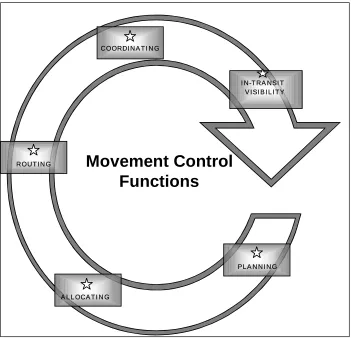
1-4. The functions of movement control consist of planning, allocating, routing, coordinating, and in-transit visibility (ITV). Figure 1-3 shows these functions.
Movement Control
Functions
COORDINATING
ROUTING
ALLOCATING
PLANNING IN-TRANSIT
[image:10.612.96.447.153.491.2]VISIBILITY
Figure 1-3. Movement Control Functions
1-5
planning function is vital to the success of military operations at all levels of command. Staff planners serve on the coordinating or special staffs at each echelon of command. Integral to staff planning is coordination with other functional planners to ensure plans are synchronized with supporting and supported commands, and that they support the concept of operation.
• Allocating. The allocation function assigns transportation capability against planned transportation tasks. It is a critical function in decision making because it forces planners to analyze and synchronize transportation tasks, capabilities, and priorities. An army’s ability to marshal, transport, and distribute large quantities of materiel and personnel over the strategic, operational, and tactical levels of war can make the difference between victory or defeat. Maneuver and exploitation of tactical gains often depend on the adequacy of the forces’ ability to respond to changing and competing priorities. Rapid response is required to meet emergencies and support unexpected opportunities. Frequent movement of combat forces using transport capability normally committed to other tasks, makes maintaining continuity of sustainment support a challenge. Plans are made to respond to these kinds of contingencies. When the response is demanded, the planner must have the needed information immediately available with which to make decisions on how best to meet the emergency or support the discovered opportunity. Knowledge of LOC status, MSR condition, asset location and eligibility, are all crucial elements to the transporters decision process. The transportation planner must constantly review and adjust available capabilities to maximize the support provided. Movement control personnel allocate needs to capabilities based on priorities when there are not enough assets to satisfy all transportation demands. Movement control units require automated information system support coupled with assured communications to execute the allocation function in a timely manner.
• Routing. The routing function is the process of coordinating and directing movements on Main Supply Routes (MSR) or alternate supply route, and regulating movement on LOCs to prevent conflict and congestion. When routing traffic, movement planners consider the following routing principles.
Assign highest priority traffic to routes that provide the minimum time-distance. Consider the sustained capabilities of roads and bridges when assigning movements. Separate motor movements from pedestrian movements.
Separate civilian traffic (vehicular or pedestrian) from military movements. Consider consolidating shipments that can be applied to a selected route.
The routing fundamentals are balance, separation, and distribution.
Balance. This fundamental matches vehicle characteristics with route
characteristics. Balance ensures that traffic never routinely exceeds the most limiting feature of a route. It considers the military load classification of the vehicles, bridges, and the route. Balancing also identifies requirements for upgrading routes or ordering caution crossings for certain bridges. Planners should use TB 55-46-1 to obtain vehicle characteristics. Route characteristics are obtained during the planning process using automated information systems, maps, or route reconnaissance.
Separation. This technique allocates road space for movements to ensure that
1-6
routes. Planners must not allocate road space or time blocks to more than one movement requirement.
Distribution. This practice uses as many routes as possible to reduce the potential
for congestion and prevent deterioration of road surfaces. Distribution also promotes passive defense by distributing and separating traffic.
• Coordinating. Coordinating is where movement control units interface with units and shippers to provide transportation support. During this process, they match requirements with modes based on priorities, the principles of movement control, and the mode selection guidelines. Movement control units then task mode and terminal operators to provide support. Coordination extends to allied forces, host nations, and non-governmental agencies. Reliable communications are crucial to this process.
• In-transit Visibility. ITV is the capability to track from origin to destination, equipment, personnel, and supplies, as they more through the transportation system. Gathering information from different sources (including automated information systems) meets the need to keep track of equipment, personnel, and supplies, as they move through the transportation system. ITV enables movement control units to answer the commanders information needs and accomplish the planning and allocation functions to support them. The United States Transportation Command (USTRANSCOM) uses the Global Transportation Network (GTN) for tracking strategic movements. Theater Transportation Commanders will use the Movement Tracking System to track movements.
OTHER CONSIDERATIONS
1-5. In addition to the basic principles and functions of movement control, there are several other considerations that are involved. The other considerations have a direct bearing on how movement control is performed. They are discussed in the following paragraphs.
• Improvising. Improvising is taking an action with assets immediately available to accomplish something that would not ordinarily be attempted with them. The key to improvising is not to limit one’s thinking. Unexpected tactical opportunity, enemy action, interrupted communication lines, and unexpected weather conditions disrupt plans and require improvisation. When this happens, normal procedures are bypassed and unusual transportation actions taken. Improvising involves risk, but the risk of not improvising is greater.
• Continuity. The frequent movement of combat forces using transport capability, normally committed to other tasks, makes maintaining continuity of sustainment support a challenge. The transportation planner must constantly review and adjust available capabilities to maximize the support provided. While it is very difficult to balance these two tasks (transport of combat forces and maintaining sustainment), it remains the goal of the transportation planner.
1-7
an increase in intensity, not a shift to new structure, procedures, and systems. Movement control elements should be among the early elements deployed in the theater force. Early deployment allows for the timely establishment of a transportation system with the capability to receive and manage the onward movement of the deploying force.
• Throughput. The goal of the Army transportation system is the movement of passengers and cargo from origin to destination. This goal can be achieved most efficiently when cargo and personnel proceed with minimum disruptions while in-transit. This concept of operations is called throughput. To the maximum extent possible, Army transportation planners strive to move cargo and personnel from origin to destination using throughput. If throughput cannot be accomplished, Army transportation organizations use intermodal capabilities available. Intermodality is the use of multiple modes for the same shipment.
• Geographic Location. Each theater faces its own unique set of challenges when planning a transportation network and its associated movement control capability, because of varied world geography and climatology. Appendix D provides guidance for transportation and movement control managers when planning for a specific geographic area.
1-6. Hostile Environment. Transportation units must be prepared to perform their mission in an environment where the enemy’s capabilities vary widely. In high- or mid-intensity conflicts, these may be modern tank, motorized, or airborne forces. In low-intensity conflicts, less mechanized but otherwise well-equipped regular and irregular forces and terrorist groups will operate against US forces. Transportation units and infrastructure will be prime targets for all threat levels. Transportation units can expect the use of nuclear, biological, and chemical (NBC) weapons on logistical facilities such as ports, airfields, supply points, and other areas where transporters must operate. One way to lower the threat level is with good intelligence. Good intelligence is critical to any military operation. Mission, enemy, terrain, troops, time available, and civilian considerations (METT-TC) is a guide for intelligence preparation of the battlefield. METT-TC components are:
• Mission. The first consideration in planning a CSS mission is to know and understand the mission of the supported combat commander. What is his objective? What is his intent? What is his scheme of maneuver? What is the timeframe for achieving the objective?
• Enemy. Movement planners must anticipate enemy intentions and capabilities and how they can affect CSS operations. The enemy’s nature and capabilities should be considered in making and executing CSS plans. The enemy’s air capability affects the location of critical ports, airfields, and transportation routes. It also influences the decision on conducting CSS activities at night.
1-8
equal number of cautions. The transportation planner must keep all these considerations in mind for the whole area through which his transportation must move.
• Troops. The elements over which the commander can exert the most influence are his or her troops. It is also the element which, more than any other can effect success. The commander and staff must consider the training, readiness, morale and well being of their personnel, preferably prior to engaging in combat operations. The morale and training of the troops will influence how successfully the transportation mission is accomplished. Differences in skills, experience, training, and leadership make some units more suitable for some missions than others.
• Time. The amount of time available to plan and execute a transportation mission is measured by the clock and distance. Fifty miles on a first-class four-lane highway is shorter
in time than 50 miles on an unimproved two-lane road. At the operational level, time for
planning is probably adequate. At the tactical level, time is more critical because the situation changes rapidly as tactical situations and requirements change. The commander that has learned to most effectively use time and distance has learned something valuable.
• Civilian Considerations. Civilian considerations relate to civilian populations, culture, organizations, and leaders within the area of operation (AO). Commanders consider the natural environment, to include religious and cultural sites, in all operations directly or indirectly affecting civilian populations. Operational considerations include civilian political, economic, and information matters, as well as more immediate civilian activities and attitudes.
At the operational level, civil considerations include the interaction between military
operations and the other instruments of national power. It also includes decisions relating to the use of contractors accompanying the force. The consideration of METT-TC impacts how contractors will be used in support of a military operation. These considerations assist commanders and staff planners in evaluating the risk of using contractors throughout the AO. When the commander determines the contractor’s risk to be unacceptable, contractors will not be used until the risk is reduced.
At the tactical level, commanders must first consider protection of the force. After
that consideration is satisfied, commanders must then consider of the impact of civilians
on the operation — a different perspective than at the operational level (where impact of
operations on civilians is the consideration). Even so, the tactical commander must be
1-9
EMERGING DOCTRINE
1-7. U.S. forces seek to dominate an expanded combat zone through depth and simultaneous attack with a minimal number of deployed forces. This implies that future operations happen in a nonlinear, noncontiguous combat zone; therefore, movement control operations will face vast challenges. They will have to meet simultaneous demands across a potentially large combat zone with a reduced transportation presence. They can accomplish this only with an agile system in which the distribution flow suffers no breaks in the seams between levels and with dedicated force protection of convoys. As the Army emphasizes even more rapid deployment timeliness, the requirement to have a capable, yet limited in size, operational-level movement control element up front in the deployment sequence becomes even more critical.
Chapter 2
Movement Control In Force Projection Operations
FORCE PROJECTION
2-1. Current US military strategy rests on forward presence and power projection to facilitate the accomplishment of military objectives in pursuit of US policy. Complementing overseas presence, power projection is the ability of the US to apply all the necessary elements of national power (military, economic, diplomatic, and informational) at the place and time necessary to achieve national security objectives. Credible power projection requires the capability to rapidly move sufficient military forces to terminate conflicts on terms favorable to the US and its allies. Effective and demonstrated power projection capability can deter potential adversaries, demonstrate US resolve, and if necessary, enable successful military operations anywhere in the world.
2-2. Deployments are unit movement operations, which are part of the force projection process. Deployment is the planning, preparation, and movement of forces and their support from any location to an area of operations in response to a military need
INTRATHEATER UNIT MOVEMENT
2-3. Figure 2-1 depicts present doctrine for intratheater unit movements. Intratheater unit
movements normally involve units moving from an origin location to a Tactical Assembly Area (TAA). Based on the transportation assets available and the unit movement plan, any available mode may be used for intratheater movements. How the unit moves from the origin to the TAA depends on the modes selected (e.g., a unit may move by highway directly by from its motor pool to the TAA). Some of the functions depicted in Figure 2-1 may occur at the same geographical location. For instance, if there are rail ramps in or near the motor pool, a unit moving by rail may find the origin and rail marshalling areas collocated.
INTERTHEATER UNIT MOVEMENT
2-4. Figure 2-2 depicts present doctrine for intertheater unit movements. Intertheater unit movements
normally involve units moving from an origin location to a TAA. The strategic lift portion of intertheater unit movements is by air or sea. As in intratheater moves, all available modes can be used for intertheater moves. And depending on the facilities available and activities to be performed, staging and marshaling area functions may be collocated.
STRATEGIC LIFT
SPOE Mobilization
Station
APOE
Air
Sea Staging/Alert
Holding Area
APOD
SPOD
Staging/ Marshalling
Area Alert Holding
Area
APOE APOD IntratheaterAir
Highway
Rail
Waterways SPOD SPOE
Staging/ Marshalling
Area SPOE
Staging Area
TAA
Rail Yard Rail Yard Marshalling
Area
AOR THEATER
Figure 2-2. Intertheater Unit Movement (Current Doctrine)
TRANSFORMATION
2-5. The military element of power projection is force projection. Force projection is the
demonstrated ability to alert, mobilize, and deploy rapidly to operate effectively anywhere in the world. The US Army is the nation’s strategic land force and the core of US forces for joint or combined operations. The Army is developing changes to organizational designs and their employment. Transformation of the force into lighter and more mobile forces is driving change to the force projection doctrine.
THEATER STRATEGIC LIFT
AOR DEPLOYING UNITS
UNIT MVMT MOBILZATION
STATION
MARSHALLING AREA STAGING AREA OR ALERT HOLDING AREA
Air
Sea APOE
SPOE
Intermodal Transfer
Point
Air Lift
Sea Lift
Point of Entry
Figure 2-3. Future Intertheater Unit Movement (With Intermodal Transfer)
THEATER STRATEGIC LIFT
AOR DEPLOYING UNITS
UNIT MVT MOBILZATION
STATION
MARSHALLING AREA STAGING AREA OR ALERT HOLDING AREA
Air
Sea APOE
SPOE
Point of Entry
Figure 2-4. Future Intertheater Unit Movement (Direct)
MOVEMENT CONTROL
2-7. The employment of military ground forces and combat power decides the outcome of campaigns and operations. The success of these forces often depends on sound, timely deployment and sustainment support. A well-defined, integrated, transportation system is important to the success of these operations. Movement control is the most critical component of a transportation system. It is also the linchpin for all transportation actions in a theater of operations. Movement control contributes significantly toward the success (or failure) of any operation. Effective movement control of forces, units, and logistics enhances combat effectiveness. Inadequate control results in reduced efficiency and loss of potential combat power.
UNIT MOVEMENT COORDINATOR
Movement Control Team (MCT) OCONUS. However, especially in CONUS, the UMC location is the commander’s discretion and can be found outside the ITO or its equivalent.
2-9. The UMC is the command technical movements expert. As such, the UMC provides advice to those in both superior and subordinate positions. The position is responsible for providing guidance and training to units and command elements relating to preparation, maintenance, and execution of movement plans. When reviewing plans, the UMC ensures that they adequately address all aspects of logistics and are designed to meet the needs of the unit. This ensures their feasibility, and that they adequately meet the needs of the unit. UMCs coordinate and monitor unit movement via military and commercial transport and can also prepare reports and process requests for convoy clearances and permits.
BRIGADE MOVEMENT COORDINATOR
2-10. Normally located in the S4 office, the brigade movement coordinator (BMC) coordinates the movement of personnel and equipment beyond the capability of organic unit assets with the ITO or UMC. The BMC is the liaison between the UMO (at battalion and company) and the ITO in CONUS locations, the MCT in OCONUS locations; and in both locations, the UMC. BMCs are appointed to coordinate and support brigade movement activities and to assist in the development, maintenance, and evaluation of subordinate units’ movement plans. BMC is responsible to:
2-11. The BMC provides the UMC consolidated unit movement plans via TC-AIMS II. If the BMC has access to the UMC server, the transfer is accomplished electronically, otherwise it is transferred via electronic media and hand carried to the UMC. The BMC also provides the UMC a transportation request. These documents provide the UMC with the non-organic transportation and other support requirements for the move. The UMC uses TC-AIMS II to plan the support requirements for each OPLAN to facilitate moving the units.
MOBILITY SUPPORT ELEMENT (MSE)
2-12. The MSE is a new Transportation organization recently approved to support deployment and operational mobility for brigade, regiment, battalion and squadron headquarters level units.
2-13. The organizational designs the MSE in three variations to support deployments and operational maneuver in several type organizations. The basic structure that forms the foundation of the MSE consists of a two-member team composed of an 882A CW2 Mobility Officer and an 88N30 Transportation Movement Coordinator, which provides this element the capability to perform 24-hour operations. This team is assigned to brigade and regimental level commands. A similar element, consisting of an 88N30 Transportation Coordinator, is assigned to battalion and squadron level headquarters. This single person element is developed into two separate variants to support battalion units with a Direct Combat Position Coding (DCPC) of 1 and 2. The MSE provides fielding flexibility based on availability of spaces and the current training base.
Chapter 3
Strategic Movement Control
3-1. This chapter describes strategic level movement control organizations. Movement control at the strategic level of war is primarily the responsibility of the Department of Defense (DOD). JCS Pub 4-01.3 outlines the procedures for conducting movement control in a joint environment.
3-2. Movement control is the cornerstone of strategic movements because it coordinates integration of modes and ports in executing strategic movement.
STRATEGIC MOVEMENT CONTROL ORGANIZATIONS
US Transportation Command (USTRANSCOM)
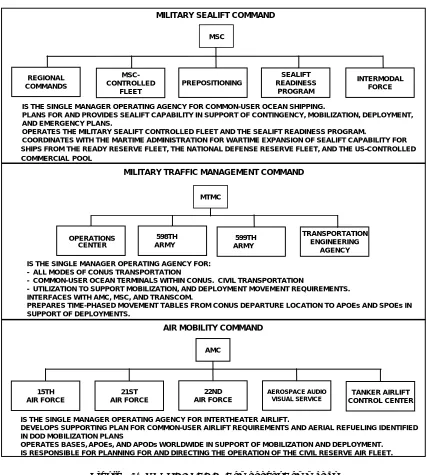
3-3. USTRANSCOM is the single transportation manager for DOD. It is responsible for providing global transport in support of national security objectives. It also uses Global Transportation Network (GTN) and the Joint Operation Planning and Execution System (JOPES) to manage the movement of cargo and passengers through the Defense Transportation System (DTS). Three Transportation Component Commands (TCC) are subordinate to USTRANSCOM. These TCCs are:
• Military Sealift Command (MSC). Responsible for providing all strategic sealift movements.
• Military Traffic Management Command (MTMC). Manages the surface transport of defense
materiel and the CONUS air and surface transport of passengers.
• Air Mobility Command (AMC). Responsible for providing all strategic air movements.
MILITARY SEALIFT COMMAND
MSC
SEALIFT READINESS
PROGRAM
PREPOSITIONING INTERMODALFORCE
REGIONAL COMMANDS
MSC-CONTROLLED
FLEET
y IS THE SINGLE MANAGER OPERATING AGENCY FOR COMMON-USER OCEAN SHIPPING.
y PLANS FOR AND PROVIDES SEALIFT CAPABILITY IN SUPPORT OF CONTINGENCY, MOBILIZATION, DEPLOYMENT,
AND EMERGENCY PLANS.
y OPERATES THE MILITARY SEALIFT CONTROLLED FLEET AND THE SEALIFT READINESS PROGRAM.
y COORDINATES WITH THE MARTIME ADMINISTRATION FOR WARTIME EXPANSION OF SEALIFT CAPABILITY FOR
SHIPS FROM THE READY RESERVE FLEET, THE NATIONAL DEFENSE RESERVE FLEET, AND THE US-CONTROLLED
COMMERCIALPOOL
MILITARY TRAFFIC MANAGEMENT COMMAND
y IS THE SINGLE MANAGER OPERATING AGENCY FOR:
- ALL MODES OF CONUS TRANSPORTATION
- COMMON-USER OCEAN TERMINALS WITHIN CONUS. CIVIL TRANSPORTATION
- UTILIZATION TO SUPPORT MOBILIZATION, AND DEPLOYMENT MOVEMENT REQUIREMENTS.
y INTERFACES WITH AMC, MSC, AND TRANSCOM.
y PREPARES TIME-PHASED MOVEMENT TABLES FROM CONUS DEPARTURE LOCATION TO APOEs AND SPOEs IN
SUPPORT OF DEPLOYMENTS.
AIR MOBILITY COMMAND
y IS THE SINGLE MANAGER OPERATING AGENCY FOR INTERTHEATER AIRLIFT.
y DEVELOPS SUPPORTING PLAN FOR COMMON-USER AIRLIFT REQUIREMENTS AND AERIAL REFUELING IDENTIFIED
IN DOD MOBILIZATION PLANS
y OPERATES BASES, APOEs, AND APODs WORLDWIDE IN SUPPORT OF MOBILIZATION AND DEPLOYMENT.
y IS RESPONSIBLE FOR PLANNING FOR AND DIRECTING THE OPERATION OF THE CIVIL RESERVE AIR FLEET.
AMC
AEROSPACE AUDIO VISUAL SERVICE 22ND
AIR FORCE 15TH
AIR FORCE
21ST AIR FORCE
TANKER AIRLIFT CONTROL CENTER MTMC
TRANSPORTATION ENGINEERING
AGENCY 599TH
ARMY 598TH
ARMY OPERATIONS
[image:21.612.93.520.110.585.2]CENTER
Figure 3-1. USTRANSCOM Component Commands
Military Sealift Command (MSC)
Military Traffic Management Command (MTMC)
3-6. MTMC manages the surface transport of defense materiel and the CONUS air and surface transport of passengers. Transport is from the point of origin to the Seaport of Embarkation (SPOE) or Aerial Port of Embarkation (APOE). MTMC does the following:
• Coordinates all activities with the supported combatant commander.
• Works with the combatant commander to create water terminal force packages for situations
where reliable stevedore labor or support infrastructure is needed.
• Recommends SPOEs, establishes cargo-booking procedures, and manages the movement of
cargo onto ships.
• Operates USTRANSCOM CONUS SPOEs and some SPODs in theater.
3-7. USTRANSCOM, through the MTMC, is the DOD-designated single port manager for all worldwide DOD seaports. MTMC performs all functions necessary to support the strategic flow of the deploying force’s equipment and its follow-on sustainment supply to the SPOE and transitions them to the combatant commander at the SPOD. MTMC is responsible for all phases of the theater port operational continuum, which ranges from a bare beach deployment (logistics-over-the-shore operation) to a totally commercial contract-supported deployment. In all cases, MTMC is responsible for coordinating with the combatant commander to workload the SPOD port operator in a manner that responds to the combatant commander’s priorities, and to provide movement status information to the SPOD and other interested parties.
Air Mobility Command (AMC)
3-8. The US Air Force Air Mobility Command provides the airlift for strategic deployment and sustainment operations and for other missions such as theater aeromedical evacuation. The Air Mobility Command is also responsible for operating some aerial ports in CONUS and some theater aerial ports. (Other aerial ports are operated by civilian authority.) During strategic deployment, Air Mobility Command aircraft may be augmented by aircraft from US commercial carriers, either through contracts or activation of the Civil Reserve Air Fleet (CRAF).
State Area Command (STARC)
3-9. STARCs are state area commands. Defense Movement Coordinators (DMC) in the state movement control centers manages military highway movements. They assign road space for units based on port calls, monitor all DOD military movements, and coordinate with federal and state agencies for the units’ mobilization and deployment needs. For mobilization, the STARCs and installations play an important role in military convoy movements in CONUS. STARCs grant convoy clearances for routine convoys that do not have special requirements (e.g., hauling ammunition).
Military Installations
• Prepare units for deployment.
• Guide and assist assigned and supported units in preparing, maintaining, and executing unit
move plans.
• Process convoy clearances and special hauling permits for moves that have special
requirements.
• Procure transportation for movement to the POE.
• Provide an Arrival/Departure Airfield Control Group (A/DACG) to the APOE and a port
support activity (PSA) to the SPOE.
• Provide selected logistics support to the POEs and en route deploying units as outlined in
coordinated plans, Standard Operating Procedures (SOPs), or regulations.
• Control units until deployed from POE.
• Provide marshaling and convoy holding areas.
• Serve as Point of Contact (POC) for updating unit movement data through OEL refinement.
3-11. The unit movement coordinator (UMC) is the command technical movements expert. As such, it is the principal transportation point of contact for deploying units. When reviewing plans, the UMC ensures that they adequately address all aspects of logistics and are designed to meet the needs of the unit. UMCs are located at the installation staff in CONUS and within the MCT structure OCONUS and supports movement preparation and planning.
Federal and State Agencies
3-12. Federal and state agencies play an important role in movement control. When directed by the President of the United States, the Federal Emergency Management Agency (FEMA) coordinates and settles issues involving priorities and allocation of non-industrial facilities. FEMA, as one of its many responsibilities, maintains a national system for emergency coordination of transportation activities to include resource mobilization policy guidance and procedures. State Departments of Transportation (DOT) or equivalent agencies for public highways, toll roads, bridges, and tunnels administer traffic regulations for their states and agencies.
Logistics in a Joint Force
3-13. The combatant commander exercises directive authority over logistics operations within his area of responsibility. This authority is given to the combatant commander so he can do the following:
• Ensure the effective execution of OPLANs.
• Provide effectiveness and economy in operations.
• Prevent or eliminate unnecessary duplication of facilities and overlapping of functions
among the components.
ACC
CORPS
COSCOM
MCB
TSC
TCE
MCB
AFCC MCCC
Provisional Joint Transportation
Board (JTB)
Joint Movement Center (JMC)
Combatant Commander
[image:24.612.116.499.129.394.2]NCC
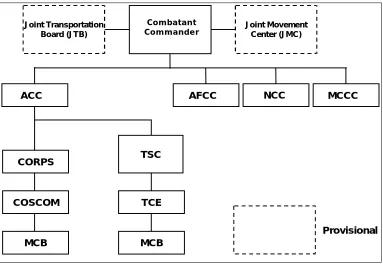
Figure 3-2. Transportation Movement Control Organizations in a Joint Command
Army Component
3-15. The Army Component Command (ACC) provides land, intratheater water, and inland waterway transportation to the joint force. It also furnishes water, rail, and intermodal terminal operations and when necessary, logistics-over-the-shore operations. It provides land and water transportation through the Theater Support Command (TSC), Transportation Command Element (TCE), and Movement Control Battalions (MCB).
Air Force Component
3-16. The Air Force Component Command (AFCC) provides theater airlift to the joint force. The theater combatant commander exercises command authority over all theater-assigned airlift forces through the Air Force Component Commander. USTRANSCOM exercises command authority of strategic airlift forces supporting the theater.
Navy Component
3-17. The Navy Component Command (NCC) provides movement control operations using advanced logistics sites and advanced logistics support sites, or a designated fleet port representative. The Navy provides sealift for the theater, and cargo-handling and port group organizations can also provide limited port operations.
3-18. The Marine Corps Component Command (MCCC) has a Strategic Movement Officer (SMO) organic to its air-ground task force staff. The SMO coordinates Marine Corps movement requirements with the TSC. The Marine Corps activates a Force Movement Control Center (FMCC) within theater to coordinate and provide transportation services to all its land-based elements. As the Marine Corps primary movement control agency within theater, the FMCC establishes liaison and communications with the Joint Movement Center (JMC) and forwards all transportation shortfalls to the TSC.
THEATER JOINT MOVEMENT CONTROL ORGANIZATIONS
3-19. The theater commander may decide to form a JMC or a Joint Transportation Board (JTB). The usual activities of these organizations are discussed generally below, but since the theater commander creates them, their mission and function are totally tailorable by the theater commander.
Joint Movement Center (JMC)
3-20. A JMC is normally established by the combatant commander. It coordinates the employment of all means of theater transportation (including that provided by allies or host nations) to support the concept of operations. The JMC is also the single coordinator of strategic movements.
3-21. The JMC oversees the execution of theater transportation priorities. It is also responsible for planning movement operations and for monitoring the overall performance of the theater transportation system. In the absence of a JTB, the JMC is the primary advisor to the combatant commander in the transportation apportionment process. The JMC identifies the difference between forecasted requirements and current capabilities of all modes to assist in the planning process.
3-22. The JMC is organized along functional lines and is designed with a peacetime nucleus that can expand in proportion to the size of the joint forces and the desires of the combatant commander. The theater transportation command provides the Army resources to the JMC. A fully developed JMC will have an administrative section and two divisions such as plans and programs and operations. The combatant commander will first use his own staff and Service component staff personnel resources for the nucleus of the JMC. When expanding a JMC, the combatant commander will consider the structure of his dominant force and component-unique movement control requirements. The combatant commander may also draw on reserve personnel to augment the JMC. The JMC’s major responsibilities include the following:
• Forecasting long-term movement requirements.
• Planning theater transportation by land, sea, and air (excluding bulk liquid fuel that moves by
pipeline).
• Apportioning transportation capability available within the command among the projected
transportation tasks and components.
• Receiving and validating airlift requests and coordinating with Air Mobility Command for
intratheater air and USTRANSCOM for intertheater airlift.
• Monitoring sea deployment and recommending changes to movement requirements in
JOPES.
• Coordinating all seaport operations and reviewing and validating sea channels
• Managing transportation requirements that cannot be met at lower levels in the movement control system.
Joint Transportation Board (JTB)
3-23. A theater JTB is not normally established. However, the combatant commander may establish a JTB to review and manage policies, priorities, and transportation apportionment, beyond the authority of a JMC. The theater transportation command provides the Army resources if a JTB are established. The JTB may consist of representatives from the Service components, movement control agencies, and the command J3 (Operations), J4 (Logistics), and J5 (Plans and Policy). The combatant commander determines who should chair the theater JTB (normally the J4). The JTB is not a day-to-day activity. The JTB's major responsibilities include the following:
• Recommend priorities.
• Recommend allocation of assets.
• Review priorities and policies.
Chapter 4
Operational Movement Control
At Echelons Above Corps (EAC)
The weakest segment is in the theater of operations. Specifically, the hand-off of personnel, equipment and materiel from
USTRANSCOM to the [Combatant Commander] at the ports of debarkation appears to be the "critical seam" where disruption of the deployment flow is most likely to occur.
Report of the Defense Science Board Task Force on Strategic Mobility August 1996
4-1. This chapter describes movement control functions performed by the theater support command (TSC), Army transportation command (TRANSCOM), transportation command element (TCE), movement control battalions (MCB), and movement control teams (MCT). Movement control organizations above corps are in the operational and tactical phases of wartime movement control.
THE ARMY IN AN AREA OF OPERATIONS
4-2. Each geographic combatant commander has a Service component commander from each Service-level organization (Army, Navy, Marines, and Air Force). In order to fulfill the requirement to provide a Service component commander, the combatant commander activates an Army service component command (ASCC) headquarters.
4-3. The ASCC commander is specifically responsible for service-related U.S. Code (USC) Title 10 tasks to prepare, train, equip, administer, and provide combat service support (CSS) to Army forces assigned or attached to combatant commands. The ASCC may also have many lead service responsibilities, which entail common-user logistics (CUL) support to other services, multinational forces, government agencies (OGAs), and/or nongovernmental organizations (NGOs). (See FM 4-93.4 (63-4) for more details.)
4-4. At theater level, centralized movement control coordinates the flow of units, personnel, and material (including sustainment) into the theater and forward destinations. These actions are vital for processing deploying units and sustaining them in theater. The ASCC headquarters provides command and staff supervision of movement control units through the assigned TSC and TCE. The ASCC calls for deployment of a TSC, or elements of a TSC, to open lines of communications (LOC) in the theater. LOC components include facilities required to move, maintain, and sustain theater forces. LOC components consist of the following:
Aerial ports of embarkation and debarkation. Seaports of embarkation and debarkation. Water, rail, and highway networks. Host Nation (HN) resources.
manage the theater level logistics effort and provide command and control to the theater level logistics units.
TRANSPORTATION COMMAND (TRANSCOM)
4-6. The Army Transportation Command, (TRANSCOM) is a one-of-a-kind multi-component organization designed to provide worldwide planning and operational skill. (See figure 4-2.) TRANSCOM is a major subordinate command of the Army Service Component Command. The Army TRANSCOM has the single multi-theater role as the transportation organization that serves the warfighting combatant commanders by forming the link between operational and strategic transportation. The Army TRANSCOM is the appropriate operational interface between the Defense Transportation System and the theater distribution system. The organization can react to all levels of the spectrum of conflict by providing transportation support in the form of early entry modules, command cells for command and control of transportation units and planning support to functional commands.
4-7. The TRANSCOM is to the Army Service Component Commander as the TCE is to the Theater Support Command Commander. That is, they work on different levels and have a different scope. They are as dissimilar as the Corps Transportation Officer is to the COSCOM.
4-8. The Army TRANSCOM provides the ASCC commander with a transportation workforce to use to support joint requirements with the combatant commander. The Army TRANSCOM provides a substantial number of trained transporters in the right grades to support ARCENT or J4 requirements. The TRANSCOM staff element is used to working together because they train as a unit. This provides a cohesive workforce to the ASCC commander (who does not have to strain his J4 transportation staff) to call into play as needed.
Transportation Command
TRANSCOM
Cmd Sec
HHC
C of S
Spec Staff
IG
Chaplain
SJA
PAO
G5 Sec G1 Sec
Per Mgt
TCE
Strat Plans
JMC G 2/3 Sec
Plans&Mvt Wtrcft Ops
Sec & Ops
Intel Ops
Security
NBC
G4 Sec
Svcs Br SupplyBr
Maint Br
G6 Sec
Comm Br IM Br
Figure 4-2. Army TRANSCOM
4-9. The Army TRANSCOM is best employed on the battlefield by apportioning operational modules that enable the combatant commander to turn to a single competent organization for the management of transportation services and support. The TRANSCOM supports the theater through the deployment of the entire TRANSCOM headquarters, or through the deployment of modular components of staff from the TRANSCOM. The TRANSCOM, from its fixed base in CONUS and its ability to rapidly project into a theater, is a provider of a responsive right-sized core of subject matter experts (SME) that can be called upon to enable transportation support to rapid force projection throughout the phases of a campaign plan. The TRANSCOM can provide the Army component of two joint movement control centers (JMC) at a time. Once employed, it is built up or relocated to expedite critical or time sensitive transportation operations based upon METT-TC. This employment capability also includes theater watercraft operations planning and capabilities analysis or validation.
4-10. Task organization is accomplished to provide the mix needed to conduct transportation operations. The provided capability includes not only functional expertise in transportation, but also a capability to accomplish internal support for administration, logistics and special staff functions. Taken as a whole, the TRANSCOM is employed to provide all theater transportation functions required by the ASCC, land force commander, or theater level command, as dictated by METT-TC. The TRANSCOM deployable module, in short, provides flexibility and transportation specific augmentation tailored to theater commander requirements.
theater while maintaining the highest efficiency and capability in the business of transportation and distribution of personnel and materiel.
4-12. Prior to deployment, the TRANSCOM will concentrate on mission and readiness tasks and on training personnel on mission essential tasks. It will provide focused transportation training exercise, planning, execution and functional analysis of deliberate, contingency and exercise plans. It is the only Army organization structured with the capability to provide analytical planning and operational oversight for the entire transportation spectrum in all AOs.
Modular Support
4-13. The Army TRANSCOM functions at the theater level as the Army piece of the joint transportation structure. The TRANSCOM ensures the maneuver commander gets the priority of transportation support needed to accomplish a given mission or campaign. The TRANSCOM provides subject matter expertise in the form of deployable modules that are tailored and apportioned to meet the METT-TC operational requirements of a theater commander’s campaign. The TRANSCOM provides early entry modules to the theater commander, ASCCs, and joint force commanders for theater transportation plans, policies and procedures. Among the deployable module actions the TRANSCOM can take are:
• Provides SMEs to the Strategic Movements Center (SMC) which works with the deploying
combatant commander to deconflict strategic movement priorities.
• Provides tailored modules to establish the Army component of a joint movements center
(JMC) at Theater level.
• Provides Army transportation SMEs to a joint transportation board and other boards and
centers, as needed.
• Provides expertise to the conduct of other joint transportation requirements such as joint
logistics-over-the-shore operations.
• Provides staff augmentation for existing staff functions of the TCEs, which can include:
providing for administrative support, intelligence, force protection, NBC, information management, special staff, miscellaneous logistics, mobilization, and deployment support.
• Provides modules directly to the TSC, ASCC, land component commander, and the theater
commander to support all operations worldwide, as required.
Planning Capabilities
4-14. The TRANSCOM is the enabler for critical planning and operational linkage for worldwide transportation operations. Home station and deployable modules can:
• Perform initial crisis, contingency and deliberate planning.
• Provide theater level deliberate and contingency transportation throughput analysis,
movement capability assessment, development of time-phased force deployment data (TPFDD), and synchronized operations in a theater, coordinating with USTRANSCOM and the TSC, contractors, and wartime host nation support.
• Prior to mobilization and deployment, the TRANSCOM, coordinating with the TSCs,
Command and Control
4-15. The Army TRANSCOM —
• Commands, controls and provides technical direction to all transportation units subordinate
to the ASCC.
• Provides peace time training and readiness support to non deployed TCEs.
• Controls designated wartime host nation support resources, and acts as liaison with other
United States and allied forces.
• Coordinates military transportation support to civilian authorities and synchronizes the
transportation needs of non-governmental organizations and humanitarian organizations.
Concept of Employment
4-16. As the Army's operational level transportation planning organization, the TRANSCOM works with the supported combatant commanders to develop and validate theater transportation plans in support of current and future operations. The TRANSCOM bridges the strategic and operational levels of Transportation logistics. In this role, the TRANSCOM also provides training, readiness support, and integrated operational planning focus to the TCEs. It is the only Army organization structured with the capability for analytical and operational and training oversight to the entire transportation spectrum in all areas of responsibilities (AOR). In this capacity the TRANSCOM provides —
Coordination and operational transportation support to combatant commanders OPLAN and CONPLAN. Staff planning for coordination of transportation combat service support activities as assigned by the ASCC or joint force commander. As organized under this concept, the TRANSCOM provides all combatant commanders a centralized single source of strategic, operational, and tactical transportation expertise.
• The Army core component to staff the joint movements center. Combatant commanders
establish JMCs at the component level to enable the interface of strategic and theater movements. The JMC executes the combatant commander’s movement priorities, deconflicts, manages, reports, and validates theater movement requirements within the AOR. The TRANSCOM can generate an Army core to a JMC to support two combatant commanders simultaneously when needed. This capability allows the combatant commander to interject the organization that was directly engaged in the writing of the transportation portions of the OPLAN.
• Command, control, and staff supervision in the training and readiness of TCEs prior to
deployment. Once deployed, the TCE is OPCON to the TSC or the joint force commander.
• Augmentation for the TCE for prolonged contingencies or campaigns. If a campaign
requires two TCEs, the TRANSCOM may deploy additional logistics, administrative or other functional structure to augment the TSC or TCE as the operational environment expands.
• Modular deployable capability for the ASCC to provide information analysis, current and
This capability is configured as early entry modules to fill battle rostered positions within the ASCC, JMC, TSC and TCE staffs.
FM 4-01 (55-1) provides additional information on transportation services in the theater.
THEATER SUPPORT COMMAND
4-17. The TSC is designed to be a modular organization that can deploy incrementally into an AO to command and control various operational-level support functions. The ASCC commander determines the composition and flow of TSC elements into an AO. Within an AO, the ASCC determines the scope of TSC responsibilities over the array of operational-level support functions, on the basis of the ASCC commander’s plan and subsequent guidance. The TSC reports to the ASCC and serves as the coordinating agent with links to both the strategic and tactical levels. The ASCC commander may attach other units for specific operations. Support requirements at the operational-level vary considerably depending on the type of operations and the scale of the deployment. The usual mission of the TSC is to maximize throughput and follow-on sustainment of Army forces and other supported elements and to provide area support to the operational-level units in the area of operations. This support may include tactical-level support to early deploying units. The TSC also executes any lead Service common user logistic support requirements that the ASCC commander assigns to it. Also, the TSC can help synchronize support operations of all the ASCC’s lead Service support responsibilities to the joint force. (FM 4-93.4 discusses the TSC in detail.) Within this framework, the TSC provides support to the theater and tactical level support on an area basis to units operating within and passing through its area of operations. This support might include the following:
• Movement control
• Materiel management
• Supply
• Contracting
• Property disposal
• Maintenance
• Transportation
• Field services
• Health services
• Civil military affairs
• Finance
• Postal
• Personnel management
• Religious services
4-18. Due to the continued emphasis on force projection operations and the desire to increase the
strategic responsiveness of the Army, TSC forces will remain a vital early deploying force. As
the Army emphasizes even more rapid deployment timelines, the requirement to have a capable, yet small, operational-level support element up front in the deployment sequence, becomes even more critical. The ASCC headquarters and the supporting TSC must plan to lead the opening of the AO in
every possible case that offers permissive entry.
provides movement control throughout the area. The TCE provides supervision of the movement control and mode operations efforts to maintain a seamless distribution continuum in the area and as part of the theater distribution system as a whole.
4-20. The distribution management center (DMC) coordinates the efforts of the movement control section in the TCE and the material management center (MMC). The TCE mode assets support the material movement requirements from the MMC. The TCE mode assets support the material movement requirements from the MMC.
Transportation Command Element (TCE)
4-21. The TCE is the senior transportation command and control headquarters in a theater of operations when no TRANSCOM is assigned. It commands all EAC level transportation units, (movement control, terminal, mode, etc). The TCE is responsible for developing theater plans, policies, procedures, and programs for transportation requirements, use of Army transportation, and terminal transfer operations. It prepares estimates, plans, and policies for mode and terminal operations. It advises the TSC on the effective use and operation of transportation units and services. The TCE provides transportation policy as input to the plans and policies directorate. It also provides supervision for subordinate transportation units. The TCE is functionally organized to plan for all modes of theater transportation operations. The TCE supports the Army and provides common transportation support to joint or combined commands.
4-22. The Army executes in-theater EAC movement control through a TCE with subordinate movement control battalions (MCB). The TCE implements the theater priorities established by the ASCC in support of the combatant commander’s concept of the operation. The TCE is focused on transportation operations in a specific AO, regardless of the nature of the contingency operation. This requires close direct coordination with the ASCC deputy chief of staff for operations. It also requires close coordination with the MMC.
4-23. The TCE organization is flexible and designed to meet the specific transportation and movement control requirements of the theater. A detailed description of a TCE organization is in Appendix D. The TCE uses a building block concept, which assigns the correct mix of battalions and teams to perform its missions based upon the following:
Geographic characteristics of the theater. Number of forces.
Transportation infrastructure.
Number and type of movement requirements.
4-24. The TCE plans and coordinates reception and onward movement so units, personnel, and materiel are received in the theater and delivered to destinations with minimum delays. It also coordinates and maintains the status of shipments into the theater and their delivery to destinations.
• Coordinates with the DMC to balance the existing transportation capabilities of the distribution system with the day-to-day and projected operational requirements.
• Manages transportation flow capability by maintaining visibility of resources that are being
transshipped at transhipping nodes.
• Coordinates the use of road networks.
• Monitors the movement of personnel, equipment and supplies from their arrival into theater
until their delivery to destinations.
• Plans and coordinates reception and onward movement so that units, personnel, and
materiel are received in the theater and delivered to destinations.
• Develops procedures and programs for transportation requirements, uses of Army
transportation, and terminal transfer operations.
• Supports US, allied nations, and HN forces as required.
• Prepares movement and port clearance plans and programs, including reception and onward
movement.
• Prepares estimates, plans, and policies for movement control, mode operations, and terminal
operations.
• Conducts liaison with higher and lower movement control organizations, HN transportation
agencies, commercial agencies, transportation mode operators, and customers.
• Maintains status of movement capabilities.
• Commands and controls movement control battalions (Figure 4-3).
• Commands and controls assigned mode transportation groups and battalions (Figure 4-3).
• Commands and controls rail and terminal operation units (Figure 4-3).
• Serves as the functional transportation command and control headquarters for a corps when
a corps acts as the ASCC for a JTF.
• Supports the transportation requirements of its MCBs and a corps MCB.
• Develops theater movement control procedures.
• Coordinates the movement of major units.
• Prepares and recommends policies to control, regulate, and expedite the movement of
intermodal assets (leased containers, flatracks, 463L pallets, and so forth) within the theater.
• Recommends site selection for transportation activities (MCBs, MCTS, truck units, trailer
transfer points, transshipment locations, air terminals, railheads, pipeline take-off points, and inland waterway terminals).
• Selects the transportation mode suited for each movement and coordinates cargo transfer
operations.
• Exchanges reports and plans with USTRANSCOM and Military Traffic Management
TRANS GP
MCT
TCE
X
MCB
HHC
TML
Rail
MTR
Figure 4-3. Transportation Command Element
Transportation Command Element (TCE)
TCE
HHC
Plans&
Ops
Auto/
Commo
Admin
Log
Mvt Cntrl
Ops
Transport
Ops
Tml Ops
Hwy Ops
Rail Ops
Air Ops
Watercraft
Mvt Ops
Hwy Reg
Figure 4-4. TCE Organization
Movement Control Battalion (EAC)
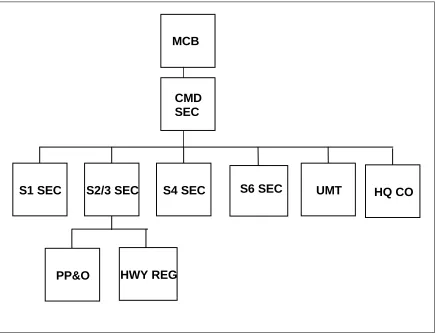
4-27. The MCB (EAC) commands, controls, and supervises MCTs. An MCB will have as many subordinate MCTs as needed to operate in its AO, based on factors such as number of customers; air terminals, rail terminals, and sea ports; and MSRs. The battalion provides asset visibility and maintains in-transit visibility of tactical and nontactical moves within the TCE defined geographical area. To decentralize execution of its transportation management and movement control functions, the TCE may divide the AO into transportation movement regions each with an MCB. The number of customers served, number of modes and nodes, and the geographical size of the AO influence the size of the regions. MCBs (EAC) provide command and control of movement control functions in these regional areas, and are responsible to the TCE for the management of movement matters that take place in their respective regions. The MCB (EAC) is organized as shown in figure 4-5. The MCB is responsible to the TCE for the control and management of movement control activities that take place in their respective regions. The TCE determines which specific functions the MCB will perform. Some responsibilities of MCBs are as follows:
• Coordinates with corps MCBs, HN transportation agencies, transportation mode operators,
and customers.
• Assists in planning and executing plans for the reception, staging, onward movement, and
• Monitors, manages, and executes the TCE’s movement and port clearance plans and programs.
• Monitors the use of trailers, containers, and flatracks located in its AOR. Coordinates with
users to expedite return of these assets to the transportation system.
• Applies and meets the priorities provided by the TCE. Performs highway regulation functions in
its AOR to prevent congestion. Balances transportation assets with requirements according to directed priorities. Advises the TCE on the need for cross l