Optimal Control in a Single Server Queueing
System with Setup Times
Yan Ma
Abstract—In this paper, we study the optimal control of an M/M/1 queue with exponential setup times. Customer’s equilibrium joining strategies and facility manager’s profit-maximizing pricing policies are explored under two common toll structures. The first one is flat fee model and the second one is time-based fee model. It is found the two different charging mechanisms do not affect customers’ equilibrium joining rate, server’s maximal profit and social welfare. Furthermore, the price decision of a profit-maximizing server is always socially optimal. In conclusion, under customers’ equilibrium, the two different toll schemes are equivalent from the economic point of view.
Index Terms—Queueing system, Setup times, Optimal con-trol, Nash equilibrium, Profit maximizing.
I. INTRODUCTION
I
N many situations, controlling quality of service is an im-portant task. Indeed, when resource is limited and demand is high, congestion occurs and service completion delay may increase to an unacceptable level. By choosing a suitable pricing scheme for the real conditions, facility managers can control congestion and allocate resource properly. A wise decision can benefit both the toll collectors and customers to get to a win-win status.Tolling a flat fee or charging by time are two common pricing schemes in real life. It is expected that the two different pricing policies may lead to different customer’s entering rate as well as different server’s profits. Hence, how to choose pricing schemes so that the service providers can make a maximal profit and at the same time customers can achieve Nash equilibrium state (no one can benefit by changing the equilibrium strategies) is a valuable subject to explore.
Generally, a service system can be described as a queueing model. The queueing theory has been rapidly developed in the past several decades. A lot of research has been carried, such as [13], [9], [10]. In many queueing systems, a server may be deactivated for economic reasons, suffer random failures, go under preventive maintenance or attend to a secondary system. Such situations often incur in real applications. Due to the versatility and applicability, queue-ing systems with removable servers have been extensively explored. Detailed surveys are contained in [14,15]. Espe-cially, a significant portion of these literatures are dedicated to queues with setup times. In such models once a server is reactivated, a random time is required for setup before it can begin serving customers. Initially, Doshi [5] explored a
Manuscript received Dec. 26, 2017; revised May 21, 2018. This work was supported by the National Science Foundation of China (No.11601489), Startup Research Fund of Zhengzhou University (No.129-51090091), Out-standing Young Talent Research Fund of Zhengzhou University (No.129-32210453).
Yan Ma is with the School of Mathematics and Statistics, Zhengzhou University, Zhengzhou, P.R.China (e-mail: yan ellen [email protected]).
GI/G/1 queueing system with setup times. Krishna Reddy et al. [6] examined a bulk queueing model with multiple vacations and setup times. Then Choudhury [4], Bischof [1] and the references therein analyzed various single-server systems with setup times. Recently, Yajima and Phung-Duc [17] dealt with a Batch arrival single-server queue with setup times.
Meanwhile, with the development of economics of queue-ing systems, optimal pricqueue-ing issues and equilibrium control in service facilities have attracted more and more attention. Low [7] considered an optimal dynamic pricing policies in an M/M/s queue where customers’ arrival rate is a strictly decreasing function of currently advertised price. Mendelson and Whang [8] studied optimal incentive-compatible priority pricing for an M/M/1 queue. Stidham [11] analyzed optimal pricing and capacity for a service facility, in which the design variables are the service rate and the arrival rate. Wang et al. [16] presented the cost analysis of a Discrete-time queue. Subsequently, Chen and Frank [2] carried out research that allows the firm to adjust price to the state of demand for maximizing social welfare. Subsequently, Sun and Li [12] concerned the effect of information and pricing strategies on servers profits in an unobservable single server queue. Chen and Zhou [3] focused on the equilibrium strategies in the single server queue with setup times and breakdowns. Zhang and Wang [18] studied equilibrium strategies in an M/G/1 retrial queue with reserved idle times and setup times.
In the present paper, we study equilibrium strategies for customers and optimal pricing polices for facility managers. On one hand, Nash equilibrium state is favorable among customers since no one will benefit by changing it. To identify equilibrium strategies is a main objective for cus-tomers. On the other hand, facility managers concern much about toll mechanisms because it is expected they directly affect business profits. Combining the two stakeholders’ goals, we investigate customers’ equilibrium strategies and servers’ optimal pricing polices in an M/M/1 queue with setup times. We give a multi-discussion and comparison under two common toll structures. The first one is flat fee model, in which customers are charged by a fixed fee if they decide to join the queue. It is a pretty simple pricing scheme for servers to collect fees. The second one is time-based fee model where the server tolls a fee that is proportional to the time of facility use. Thus the longer service time needed, the more fees will pay.
The reminder of this paper is organized as follows. Section 2 presents the description of the model. Section 3 develops the flat fee model. The time-based fee model is analyzed in Section 4. We derive the equilibrium joining rate and inves-tigate profit-maximizing server’s pricing behaviors. Then in Section 5, we make a comparison between the two pricing models and carry out numerical experiments. Finally, the
IAENG International Journal of Applied Mathematics, 49:1, IJAM_49_1_01
conclusions come in Section 6.
II. MODEL DESCRIPTION
Generally, facility managers concern much about the profits and want to gain the maximum value. Thus here we consider a profit-maximizing server, who sets prices to maximize his own benefit. Arriving customers do not know the queue length and server state. The decision to join or balk is irrevocable. After joining the queue, customers are served according to first-come-first-served (FCFS) discipline.
Our model is based on the following assumptions. 1. Customers arrive according to a Poisson stream with rate
Λ at a single-server station. Λ is the potential arrival rate which is not necessarily the actual joining rate of customers to be served (which we refer to as λ) due to balking. 2. Service times are independently and identically distributed (i.i.d.) exponential random variables with rateµ. For system stability, we assumeµ > λ.
3. In a queue with setup times: the server is deactivated as soon as the queue becomes empty. When a new customer arrives at an empty system, a setup process starts for the server to be reactivated. The time required for setup is also exponentially distributed with rate θ.
4. Inter-arrival times, service times, and setup times are mutually independent.
5. Every joining customer receives a reward of R for com-pleting service. There is a waiting cost of C per time unit for a customer staying in the system (in queue or in service). 6. Customers are risk neutral.
7. For the model to be non-trivial, the condition of R ≥ C
(
1 µ +
1 θ
)
is assumed. This condition ensures that the reward for service exceeds the expected waiting cost for a customer joining an empty system. Otherwise, after the system becomes empty for the first time, no customers will ever enter.
We use the following notations:
ω Expected waiting time of a customer in the system (including the service time). P Price charged by the service provider
(0< P < R).
U Expected utility of a joining customer. B Expected benefit per time unit for the service
provider.
SW Expected social welfare per time unit in the system.
Customers make joining or balking decision upon their arrival instants. There exist two kinds of possible equilibria in the system. In the first case, all the customers seeking service enter the queue, i.e.λ= Λ. Clearly, customers have a nonnegative expected utility so that all prefer to join in this case. Hence, the profit-maximizing server could increase his price without causing any balking until the expected customer utility becomes zero. In the second case, arriving customers follow a mixed strategy, where they join the queue with a probability such that λ <Λ, for which the expected customer utility is zero. Thus, there is no incentive for customers to change their joining or balking behavior.
It is possible that the customer self-interest equilibrium (denoted as λf in flat fee model and λt in time-based fee
model) cannot be reached because of the arrival rate’s upper
boundΛ. Hence, we study two cases: unbounded case (λf ≤ Λor λt≤Λ) and bounded case (λf >Λ or λt>Λ).
III. FLAT FEE MODEL
Firstly, we consider the flat fee model, in which the service provider charges a fixed price. We add a subscriptf at the bottom right corner of some variables. Thus, the expected utility for a customerU =R−Pf−Cω.
In M/M/1 queue with exponential setup times, the mean sojourn time for a customerω= µ−1λ +1θ.
Suppose λf = µ − √ Cµθ
CRµθ2−C2µθ, then we give the following theorem.
Theorem 1
(1) if λf ≤ Λ, there exists a unique equilibrium where
λ=λf and Pf =R− √
CRµθ2−C2µθ+Cµ
µθ , Bf =
(
µ−√ Cµθ
CRµθ2−C2µθ
) (
R−
√
CRµθ2−C2µθ+Cµ µθ
)
.
(2) if λf > Λ, there exists a unique equilibrium where
λ= Λand Pf =R−C
(
1 µ−Λ+
1 θ
)
,
Bf = Λ
(
R−C
(
1 µ−Λ+
1 θ
))
.
Proof: (I) We begin with the case ofλf ≤Λ (Λ is large
enough).
Based on the fact that in equilibrium the expected utility for a customer is zero, we obtainR=Pf+C
(
1 µ−λ+
1 θ
)
. Hence the joining rate:
λ=µ− Cθ
(R−Pf)θ−C. (1)
Substituting (1) intoBf =λPf, we have
Bf =Pf
(
u+ Cθ
C+θ(Pf−R)
)
.
Since R > Pf +C1θ, the second-order derivatives of the
profit function
∂2B f
∂P2 f
= 2Cθ
2(Rθ−C)
(C+Pfθ−Rθ)3
<0,
which meansBf is concave in Pf. Based on the necessary
conditions of maximizingBf with respect toPf, we obtain
the optimal prices of the service provider as
Pf =R−
√
CRµθ2−C2µθ+Cµ
µθ . (2)
Substituting (2) into (1), we obtain
λ=µ−√ Cµθ
CRµθ2−C2µθ =λf (3)
Hence,
ωf =
√
CRµθ2−C2µθ
Cµθ +
1
θ, (4)
Bf =
(
µ−√ Cµθ
CRµθ2−C2µθ
)
∗
(
R−
√
CRµθ2−C2µθ+Cµ
µθ
)
. (5)
IAENG International Journal of Applied Mathematics, 49:1, IJAM_49_1_01
(II) Next we consider the case whereΛposes an effective limitation, namelyλf >Λ. In this case, the profit
maximiza-tion equilibrium determined by (3) cannot be reached since the maximal joining rate is Λ. Moreover, the server could increase his price from it in (2) without affecting the joining rate of the system untilU equals zero. So we conclude
Pf =R−C
(
1
µ−Λ +
1
θ
)
, (6)
Bf = Λ
(
R−C
(
1
µ−Λ +
1
θ
))
. (7)
IV. TIME-BASED FEE MODEL
Next, we consider the time-based fee model, in which the service provider charges a price that is proportional to the time interval of facility use. We add a subscript tat bottom right corner of some variables. Thus, the expected utility for a customerU =R−Pt/µ−Cω.
Letting λt = µ−
√
Cµθ
Rθ−C, we can give the following
theorem.
Theorem 2
(1) if λt ≤ Λ, there exists a unique equilibrium where
λ=λtand Pt=Rµ− √
Cµθ(Rθ−C)+Cµ
θ ,
Bt=
(
µ−
√
Cµθ Rθ−C
) (
R−Cθ −
√
C(Rθ−C) µθ
)
.
(2) if λt > Λ, there exists a unique equilibrium where
λ= Λand Pt=µ
(
R−µ−CΛ −Cθ
)
,
Bt= Λ
(
R−µ−CΛ−Cθ
)
.
Proof:(I) Firstly, we consider the unbounded caseλt≤Λ.
Based on the fact that in equilibrium the expected utility for a customer is zero, we obtainR=Pt/µ+C
(
1 µ−λ +
1 θ
)
. Hence the joining rate:
λ=µ− Cθ
(R−Pt/µ)θ−C
. (8)
Substituting (8) into Bt=λPt/µ, we have
Bt=Pt+
PtCθ
Ptθ+Cµ−Rµθ
.
Since R > Pt/µ+C/θ, the second-order derivatives of the
profit function
∂2Bt
∂P2 t
=− 2Cµθ
2(Rθ−C)
(Rµθ−Cµ−Ptθ)3
<0,
which means Bt is concave in Pt. We could maximize Bt
with respect toPt, and get the optimal price as
Pt=Rµ−
√
Cµθ(Rθ−C) +Cµ
θ . (9)
Substituting (9) into (8), we obtain
λ=µ−
√
Cµθ
Rθ−C =λt. (10)
Hence,
ωt= 1
θ+
√
Rθ−C
Cµθ , (11)
and
Bt=
(
µ−
√
Cµθ
Rθ−C
) (
R−C
θ −
√
C(Rθ−C)
µθ
)
.
(12) (II) Next we consider the case ofλt>Λ. In this case, the
profit maximization equilibrium determined by (10) cannot be reached since the maximal joining rate isΛ. Moreover, the server could increase his price without causing any balking untilU equals zero. So we conclude
Pt=µ
(
R− C
µ−Λ−
C θ
)
, (13)
Bt= Λ
(
R− C
µ−Λ −
C θ
)
. (14)
V. ANALYSIS ANDNUMERICALEXPERIMENTS
Based on the above results, we make some conclusions and then carry out numerical experiments in this section.
In the unbounded case, we obtain the equilibrium joining rate λf in flat fee model and λt in time-based fee
model. In the bounded case, Λ is always the customers’ equilibrium joining rate, no matter in flat toll model or in time-based toll model. We can give the following corollaries.
Corollary 3
The charging mechanism does not affect customers’ equilibrium joining rate and social welfare.
Proof:In the unbounded case, from (3) and (10), we find λf =λt. In the bounded case, the equilibrium joining rate
is always Λ. Those results indicate the equilibrium joining rate is identical in the two different toll mechanisms. Hence, the expected waiting timeωis also the same (i.e.ωf =ωt).
SinceSW =λ(R−Cω), it is clear that the social welfare is thus identical in the two toll models.
Therefore, the charging mechanism makes no difference in customers’ joining behaviors as well as social welfare between the flat fee model and the time-based fee model.
Corollary 4
The price decision of a profit-maximizing server is socially optimal.
Proof:In both the two charging models, the social welfare SW =λ(R−Cω).
In the fixed fee model, the server’s profit function Bf =
λfPf. The customers’ total expected utilityλfU =λf(R−
Pf −Cωf). When the joining rate is not constrained, this
expected utility equals zero in customers’ equilibrium, which implies
Bf =λfPf =λf(R−Cωf) =SWf,
so that the server’s profit-maximizing price decision is consistent with the society to achieve social optimization.
In time-based fee model, Bt = λtPt/µ and
U = R − Pt/µ − Cωt. Similarly, We could conclude
Bt = SWt. The price chosen by profit-maximizing server
also maximize the social welfare.
Corollary 5
IAENG International Journal of Applied Mathematics, 49:1, IJAM_49_1_01
In customers’ equilibrium, the server’s maximal profit in flat fee model is the same as in time-based fee model.
Proof: In unbounded case, from Corr. 3 and Corr. 4, we obtain
Bf =SWf =SWt=Bt.
In bounded case, from (7) and (14), we make it directly.
Remark Corr.3-5 indicate in customers’ equilibrium, the two different toll mechanisms are equivalent from the economic point of view. Although customers charged by different toll systems, they enter with the same probability and the social as a whole obtain the same welfare. It is an interesting conclusion that reveals some features not being found before. Since obtaining the same maximal profits, the facility manager can simply set a fixed price instead of tolling by time so as to reduce workload.
Now we present a set of numerical experiments in the unbounded case. Here we concern about the sensitivity of customers’ equilibrium joining rate λand server’s expected benefitB (also seen as social welfareSW) with respect to system parameters.
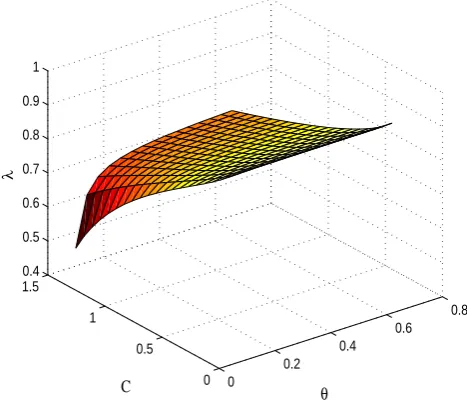
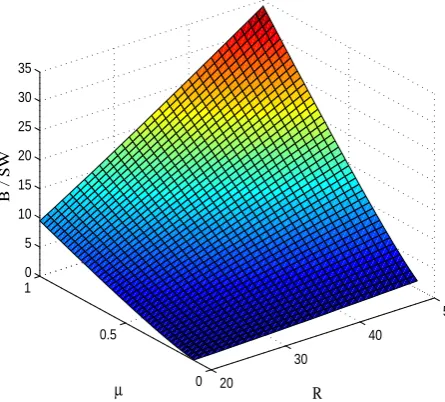
In Fig. 1 and 3, it is obvious thatλandB are increasing withθ, while decreasing withC. This means a small mean setup time or per time unit cost is beneficial for customers’ joining rate and social welfare. Furthermore, if there is a smaller value forC, the sensitivity ofλorBwith respect to θturns to be less. In Fig. 2, the value of entering rate presents as a plane with the variation of µ and R. If we choose a certain value for R, there are more customers entering the queue when higher service rate is provided. However, if we choose a fixed value forµ, the joining rate varies as a slight growth line, and is not affected very much by the variation of service rewardR. In Fig. 4, it is found that there is a ridge on the protruding surface, which implies a higher service rate or service reward is better for both facility managers and customers.
0 0.2
0.4 0.6
0.8
0 0.5 1 1.5 0.4 0.5 0.6 0.7 0.8 0.9 1
θ
C
[image:4.595.315.545.69.271.2]λ
Fig. 1. Joint effect of vacation rate and per time waiting cost onλ, when µ= 1, R= 20.
20
30
40
50
0 0.5
1 0 0.2 0.4 0.6 0.8 1
R
µ
[image:4.595.317.548.338.541.2]λ
Fig. 2. Joint effect of vacation rate and service reward onλ, whenC=
1, θ= 0.3.
0 0.2
0.4 0.6
0.8
0 0.5 1 1.5
0 5 10 15 20
θ
C
B / SW
Fig. 3. Joint effect of vacation rate and per time waiting cost onB/SW, whenµ= 1, R= 20.
VI. CONCLUSION
In this paper, we discuss the optimal control of M/M/1 queueing system with setup times. Customer’s equilibrium strategy and server’s optimal pricing behavior are explored under two common toll structures. The first one is flat fee model and the second one is time-based fee model. Facility manager sets prices to gain the maximal profits, which is common and practical. It is found that customers in equi-librium have an identical entering rate in the two different toll models. Furthermore, the server’s maximal benefit in the fixed fee model is identical with it in the time-based fee model. In addiation, the price decisions chosen by the profit-maximizing facility manager are consistent with the social to achieve social optimization. That is the objective of a profit-maximizing server and the society coincides.
IAENG International Journal of Applied Mathematics, 49:1, IJAM_49_1_01
[image:4.595.56.290.534.734.2]20
30
40
50
0 0.5
1 0 5 10 15 20 25 30 35
R
µ
[image:5.595.60.283.70.271.2]B / SW
Fig. 4. Joint effect of vacation rate and service reward onB/SW, when C= 1, θ= 0.3.
In all, under customers’ equilibrium, the two different toll mechanisms are equivalent from the economic perspective. It is a valuable conclusion for facility managers since they can simply choose the flat fee model by charging customers with a fixed fee, instead of collecting tolls by time to avoid heavy jobs.
Those research conclusions could instruct customers to take optimal strategies and provide managers with reference information on pricing problems in queueing systems. A possible extension to this work could be to consider these pricing schemes in multiple servers queues.
REFERENCES
[1] W. Bischof, “Analysis of M/G/1 Queues with Setup Times and Vaca-tions under Six Different Service Disciplines,”Queueing System, vol. 39, no. 4, pp. 265-301, 2001.
[2] H. Chen, M.Z. Frank, “State Dependent Pricing with a Queue,” IIE Transactions, vol. 33, no. 10, pp. 847-860, 2001.
[3] P. Chen, Y. Zhou, “Equilibrium Balking Strategies in the Single Server Queue with Setup Times and Breakdowns,”Operational Research, vol. 15, no. 2, pp. 213-231, 2015.
[4] G. Choudhury, “An MX/G/1 Queueing System with a Setup Period and a Vacation Period,”Queueing System, vol. 36, no. 1, pp. 23-38, 2000. [5] B.T. Doshi, “Queueing Systems with Vacations – a Survey,”Queueing
System, vol. 1, no. 1, pp. 29-66, 1986.
[6] G.V. Krishna Reddy, R. Nadarajan, R. Arumuganathan, “Analysis of a Bulk Queue with N-policy Multiple Vacations and Setup Times,”
Computers & Operations Research, vol. 25, no. 11, pp. 957-967, 1998. [7] D.W. Low, “Optimal Dynamic Pricing Policies for an M/M/s Queue,”
Operations Research, vol. 22, no. 3, pp. 545-561, 1974.
[8] H. Mendelson, S. Whang, “Optimal Incentive-Compatible Priority Pric-ing for the M/M/1 Queue,”Operations Research, vol. 38, no. 5, pp. 870-883, 1990.
[9] S. Ramasamy, O.A. Daman, S. Sani, “Discrete-time Geo/G/2 Queue under a Serial and Parallel Queue Disciplines,”IAENG International Journal of Applied Mathematics, vol. 45, no. 4, pp. 354-363, 2015. [10] S. Sani, O.A. Daman, “The M/G/2 Queue with Heterogeneous Servers
under a Controlled Service Discipline: Stationary Performance Analy-sis,”IAENG International Journal of Applied Mathematics, vol. 45, no. 1, pp. 31-40, 2015.
[11] S. Stidham, “Pricing and Capacity Decisions for a Service Facility: Stability and Multiple Local Optima,”Management Science, vol. 38, no. 8, pp. 1121-1139, 1992.
[12] W. Sun, S. Li, “Effect of Information, Uncertainty and Parameter Variability on Profits in a Queue with Various Pricing Strategies,”
International Journal of Systems Science, vol. 45, no. 8, pp. 1781-1798, 2013.
[13] H. Takagi,Queuing Analysis: A Foundation of Performance Evaluation in Discrete-time Systems, North-Holland, Amsterdam, 1993.
[14] H. Takagi,Vacation and Priority Systems, North-Holland, Amsterdam, 1991.
[15] N. Tian, Z.G. Zhang,Vacation Queueing Models: Theory and Appli-cations, Springer, Berlin, 2006.
[16] T. Wang, F. Chang, J. Ke, “Cost Analysis of a Discrete-time Queue,”
Lecture Notes in Engineering and Computer Science: Proceedings of The International MultiConference of Engineers and Computer Scientists 2013, IMECS 2013, 13-15 March, 2013, Hong Kong, pp. 1061-1065.
[17] M. Yajima, T. Phung-Duc, “Batch Arrival Single-server Queue with Variable Service Speed and Setup Time,” Queueing Systems: Theory and Applications, vol. 86, no. 3, pp. 241-260, 2017.
[18] Y. Zhang, J. Wang, “Equilibrium Pricing in an M/G/1 Retrial Queue with Reserved Idle Time and Setup Time,” Applied Mathematical Modelling, vol. 49, no. 3, pp. 514-530, 2017.