Mixtures of two or more odorants in a blend frequently give rise to novel perceptual qualities that are not present in any of the components individually. These ‘perfume’ qualities can arise during early processing of odors by the sensory cells in the antennal system of insects (Ache, 1989; Akers and Getz, 1993; Wibe and Mustaparta, 1996; Getz and Akers, 1997; Laing and Glemarec, 1992) or in the broadly tuned cells in the sensory epithelium of vertebrates (Getchell, 1986; Buck, 1996). Different odor molecules can interact in the transduction machinery of sensory cells, causing some cells to fire action potentials when the blend is present, whereas other cells might be suppressed (Cromarty and Derby, 1997). At the same time, other sensory elements remain relatively unaffected by the presence of other molecules in the blend. In this way, blends of odorants activate sensory elements that are unique to the individual components as well as patterns that are unique to the blends.
The early olfactory processing centers of both vertebrates and a large number of invertebrate species display similar anatomical and physiological features (Hildebrand and Shepherd, 1997; Lancet, 1986; Getchell, 1986; Buck, 1996). It is frequently assumed that these olfactory centers are sensitive to blend-specific perfume qualities. Indeed, appropriate conditioning protocols (Rescorla, 1973; Rudy and Sutherland, 1992; Pearce, 1994; Rabin and Cain, 1989) have been utilized to show that animals can be conditioned to discriminate odor blends in a manner that would only be possible if attention
were devoted to blend-unique qualities (Chandra and Smith, 1998). It is still unclear, however, whether the brain can process the sensory information produced by a blend in such a way that component or submixture information can be perceived and processed.
An ability to process component-specific information is likely to be important because odor signals vary from one presentation to the next. The floral odors that attract important pollinators are a classic case study. Floral odors are typically complex blends of tens to hundreds of components (Knudsen et al., 1993). The composition of the blend, in terms of the exact components and the ratios among them, can vary from flower to flower within and between plants because of a variety of genetic and environmental causes (Pham-Delegue et al., 1989). A pollinator, such as a foraging honeybee, that focused only on blend qualities would risk perceiving each flower as unique, and generalization from one flower to the next one that contains the same nectar and/or pollen resources might be difficult. The problem, therefore, revolves around how animals generalize from one flower to the next given the slight differences in blend composition between those flowers. This specific question is one of many that are involved in the more general problem of stimulus generalization (Shephard, 1987). The results of recent studies of odor learning (Sahley et al., 1981; Staubli et al., 1987; Smith and Cobey, 1994; Smith, 1996, 1997; Funayama et al., 1995; Couvillon et al., 1996, 1997; Thorn and Smith, 1997) have already provided some Printed in Great Britain © The Company of Biologists Limited 2000
JEB2838
Recent studies of olfactory blocking have revealed that binary odorant mixtures are not always processed as though they give rise to mixture-unique configural properties. When animals are conditioned to one odorant (A) and then conditioned to a mixture of that odorant with a second (X), the ability to learn or express the association of X with reinforcement appears to be reduced relative to animals that were not preconditioned to A. A recent model of odor-based response patterns in the insect antennal lobe predicts that the strength of the blocking effect will be related to the perceptual similarity between the two odorants, i.e. greater similarity should increase the blocking effect. Here, we test that model in the honeybee
Apis mellifera by first establishing a generalization matrix for three odorants and then testing for blocking between all possible combinations of them. We confirm earlier findings demonstrating the occurrence of the blocking effect in olfactory learning of compound stimuli. We show that the occurrence and the strength of the blocking effect depend on the odorants used in the experiment. In addition, we find very good agreement between our results and the model, and less agreement between our results and an alternative model recently proposed to explain the effect.
Key words: odour, olfaction, blocking, conditioning, learning, memory, generalization, honeybee, Apis mellifera.
Summary
Introduction
BLOCKING AND THE DETECTION OF ODOR COMPONENTS IN BLENDS
JAY S. HOSLER ANDBRIAN H. SMITH*
Department of Entomology, 1735 Neil Avenue, Ohio State University, Columbus, OH 43210-1220, USA
*Author for correspondence (e-mail: [email protected])
indications of how honeybees may optimize their learning capacity for olfactory signals composed of several odorant components. When honeybees are conditioned to a mixture of two odorants that contains, as one of its components, an odorant to which they have previously been conditioned, then their response to the second component, when presented alone, is reduced compared with the performance of animals conditioned to the mixture without prior conditioning to one component. This phenomenon, termed ‘blocking’ (Kamin, 1968, 1969; Mackintosh, 1983; Pearce, 1994), suggests that the qualities of the previously conditioned component are likely to be recognized in the mixture, whereas the qualities of the other component are not. In other words, animals generalize from the previously conditioned stimulus to the mixture that contains it.
We must therefore consider whether the brain can construct perceptual qualities of odors that depend, at least in part, on previous experience. Such a capability is expected to require modification of more central, synaptic processing of olfactory information, as opposed to a sensory mechanism. In the foraging analogy referred to above, a component or submixture that is relatively invariant and a good predictor of reinforcement might gain in associative strength faster than the more variable components, which are less often associated with reinforcement (Smith, 1996). The more informative components or submixtures might thereby be filtered out and processed separately from the more variable, less predictive components. In the sense that components or submixtures of an odor blend are processed independently, the capability revealed by blocking is functionally analogous to the capabilities exhibited by insect pheromone systems (Boeckh et al., 1984; Christensen et al., 1989; Masson and Mustaparta, 1990; Hildebrand, 1995, 1996; Smith, 1996). The underlying physiological bases for these types of behavior must, however, be radically different.
Linster and Smith (1997) proposed a computation model of the honeybee antennal lobe, which is analogous to the vertebrate olfactory bulb, that helped explain how blocking might be implemented at that level of processing in the brain. The authors assumed that the incoming sensory information about a blend is based on inputs from broadly tuned sensory elements. The model also incorporated a representation of an identified neuron, called VUMmx1, which responds to the sucrose unconditioned stimulus (Hammer, 1993; Hammer and Menzel, 1995) and is strongly represented in the antennal lobes. Although VUMmx1 does not normally respond to odor, its response to an odor increases when that odor is associated with sucrose reinforcement. This neuron modulates the association between a sensory representation for odor and sucrose reinforcement. By assuming that VUMmx1 modifies antennal lobe inhibitory transmission in a Hebbian fashion, Linster and Smith (1997) were able to simulate a blocking effect. In essence, the configural representation of a blend of two components A and X is biased to be more like that of a previously reinforced component (A).
One major prediction from this model regards the expression
of blocking. Odorants would only block one another when there was significant overlap in the spread of lateral inhibitory processes between the representations of those odors in the antennal lobe. Thus, blocking should occur for some pairs of odorants but not for others. The pattern of blocking or failure to block across a set of odorants would serve as a prediction for later physiological investigation of antennal lobe odor representations.
One purpose of the present study was to examine for the first time whether odor pairs differ in the expression of the blocking effect. A second goal was to respond to the work of Gerber and Ullrich (1999), who reported a failure to resolve a blocking effect in odor blends. They speculated, although they did not test experimentally, that unequal generalization between odors could give rise to an artifact that resembles a blocking effect, but for reasons other than those given by Linster and Smith (1997) in their model. Here, we have replicated previous blocking designs (Smith and Cobey, 1994; Smith, 1997; Smith and Thorn, 1997) to test whether their explanation could account for blocking.
Materials and methods
We collected worker honeybees (Apis mellifera) from a colony maintained in an indoor flight room at approximately 24 °C on a 16 h:8 h light:dark cycle. Individuals were collected by placing a small glass vial over them as they landed on the mesh of a tent in which the colony was housed. A small hole in the vial caps prevented oxygen deprivation during the set-up procedure. Immediately after collection, the vials were placed into an ice/water bath until the individuals inside ceased movement. Subjects were then placed into restraining harnesses that allowed free movement of antennae and mouth parts. Each subject was fed 1.0µl of 1.25 mol l−1sucrose/water solution and was allowed to remain undisturbed on a counter top at room temperature (22 °C) for 1.5 h. Immediately prior to beginning an experiment, each subject was evaluated for motivation to respond to the sucrose/water unconditioned stimulus by lightly touching one antenna with the sucrose/water solution without subsequent feeding. If a subject responded by extending its proboscis, it was selected for use in the procedure on that day.
Odor cartridges were prepared freshly each day according to our standard procedure (Smith, 1997, 1998). We applied 3µl of pure odorant onto small strips of filter paper. To produce blends, we applied 3µl of each of two odorants onto the filter paper. The filter paper strips were then inserted into 1 ml glass syringes, and the wide end of the syringe, in which the plunger usually sits, was constricted to approximately 1 mm. The unconditioned stimulus was always 0.4µl of 1.25 mol l−1 sucrose/water solution.
airstream flowing at approximately 0.5 m s−1; the duration of odor delivery was controlled by a computer. At 3 s after the onset of odor, a tone, which was audible to the experimenter but not to the subject, signaled the presentation of the sucrose/water unconditioned stimulus. Subjects always consumed the entire droplet within the allotted 2 s feeding period. After completion of the trial, the subject was rotated back onto the holding tray. The intertrial interval was always 6 min.
Response measures and statistical analyses
During all acquisition trials, we registered whether or not a subject extended its proboscis (mouthparts) after the onset of the odor but before application of the unconditioned stimulus. An increase in probability (given as a percentage) of extension over one or more trials is due mainly to associative learning (Bitterman et al., 1983). All acquisition curves were plotted in terms of the frequency of the proboscis extension reflex across N subjects during the first 3 s of odor presentation on a given trial.
Tests for the occurrence of blocking were conducted by presenting odor without subsequent reinforcement with the unconditioned stimulus. We videotaped these trials for offline calculation of response duration (Smith, 1997). We use this measure of response because it is more sensitive to differences across treatment groups than is the percentage of proboscis extension (Smith, 1998). The camera recorded responses head-on, i.e. down the longitudinal axis of the insect. Using single-frame playback mode, we registered the beginning of an extension response when the proboscis, which unfolds from underneath the head capsule in the line of sight of the camera, broke the line between the opened tips of the mandibles of the subject. The duration then corresponded to the total time that the proboscis was extended beyond this line during the 20 s recording period. The fixed-length 20 s recording period began when the odor was presented to the subject.
We log-transformed all duration measures prior to statistical analysis. We had to add 1 to the duration score of each subject to successfully transform scores of zero duration, which were registered when a subject failed to respond to the odor-conditioned stimulus during the test trial. The transformed duration measures were subjected to one- or two-way analysis of variance (ANOVA) (Sokal and Rohlf, 1995). Gerber and Ullrich (1999) criticized earlier work (Smith and Cobey, 1994) because, in one experiment, subjects that failed to respond to the conditioned stimulus were deleted from analyses. However, this was only applied in one of several experiments in that publication and it did not apply to later work (Smith, 1996, 1997; Thorn and Smith, 1997) or to the present work.
Blocking among odorant combinations
Our blocking experiments employed two treatment groups and two conditioning phases (Table 1). In the first (Preconditioning) phase, each group was conditioned across six forward pairing trials to a different pure odorant. One group (BLOCK) was preconditioned to odorant (A) and the second
group (NOVEL) was preconditioned to a different odorant (N). During the second (Mixture) conditioning phase, both groups were subjected to six forward pairing trials with a mixture of two odorants (A+X). Subjects in the BLOCK group had previously experienced A, but not X, during the preconditioning phase. Subjects in the NOVEL group, in contrast, had experienced neither A nor X prior to training them to the mixture. Three odorants (1-hexanol, 1-octanol and geraniol) were used equally often, and counterbalanced across days, as N, A and X.
After the second conditioning phase, subjects in the NOVEL and BLOCK groups were tested during a videotaped extinction trial with odorant X. It is important to note that subjects in the NOVEL and BLOCK groups experienced X in an identical manner; i.e. they all experienced X in a mixture with A over six forward pairing trials with the sucrose/water unconditioned stimulus. The pairing condition of X and the unconditioned stimulus would normally produce robust learning (Smith and Cobey, 1994; Smith, 1996, 1997; Couvillon et al., 1996, 1997; Thorn and Smith, 1997), albeit with some response decrement due to overshadowing by A (Smith, 1998). However, the groups differed with respect to the role that odorant A played as a predictor of reward at the onset of the second training phase. If blocking occurs, then the response to X is expected to be lower in the BLOCK group than in the NOVEL group. Thus, with each of the pairs of odorants used as A and X, the results obtained from the NOVEL group served as a control.
Generalization among odorants
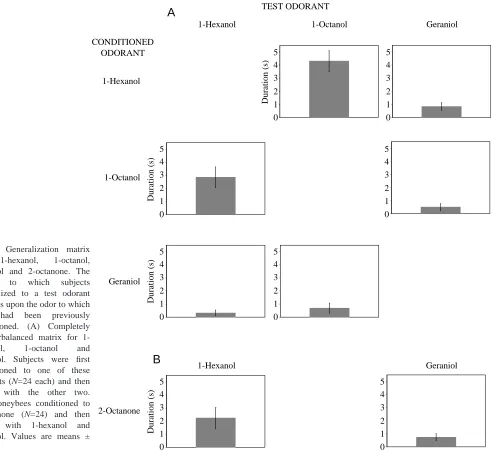
The accounts of blocking provided by Gerber and Ullrich (1999) and Linster and Smith (1997) both relate the level of blocking to perceptual similarities among the three odorants required for a typical blocking design. We therefore quantified the level of generalization among the odorants used in the blocking experiments reported below and in other work (Smith and Cobey, 1994; Smith, 1991, 1996, 1997). We assume that the degree of generalization of a conditioned response between a conditioned odorant and a test odorant reflects perceptual similarity. Subjects each received six forward pairing conditioning trials with a pure odorant (1-hexanol, 1-octanol, geraniol or 2-octanone) as described above. Two groups of six subjects each were conditioned to a different odorant each day, and the odorants were fully counterbalanced over successive 2-day blocks until the reported sample size for each group was reached.
After the acquisition phase, the reponses of each subject to two test odorants were videotaped during extinction (test)
Table 1. Treatment groups and conditioning phases
Treatment Phase I Phase II Test
Novel N →sucrose A+X →sucrose X
Block A →sucrose A+X →sucrose X
A, X and N are odorants.
trials, which were presented in random order across subjects and separated by 6 min. Geraniol, 1-hexanol and 1-octanol, the three odorants used in the blocking experiments reported below, were chosen because honeybees typically display more generalization between 1-hexanol and 1-octanol than between geraniol and either of the aliphatic alcohols (Smith and Menzel, 1989a,b; Smith and Cobey, 1994; Smith, 1991). Thus, these three odorants in particular could provide an explicit test of the hypotheses of Gerber and Ullrich (1999) and Linster and Smith (1997). After conditioning to one of the three odorants, subjects were tested with the other two.
Previous blocking experiments (Smith, 1997; Thorn and Smith, 1997) used exclusively 2-octanone as the novel odorant to minimize the generalization between odorants used as N, A and X. Here, we tested generalization from that odorant to geraniol and 1-hexanol to provide a replication of earlier data (Smith and Menzel, 1987a,b). In this case, we tested only one combination because that is the one that directly relates to how that odorant was used in the experiments of Smith and Menzel (1987a,b).
Results
Generalization among odorants
To test whether the occurrence and strength of blocking does indeed depend on the degree of generalization among odorants, we first determined the levels of generalization among the odorants used in this study. Subjects displayed rapid and statistically identical (F=0.1, d.f.=3,92, not significant) acquisition to all conditioned odorants (Fig. 1). At least 70 % of subjects in each group responded to the conditioned odor after only two conditioning trials, and 80–95 % responded to the conditioned odor after six trials.
After conditioning, subjects showed different levels of generalization that depended on the chemical structure of the test odorants (Fig. 2). In particular, generalization between 1-hexanol and 1-octanol was symmetrical and was greater than generalization from those alcohols to geraniol (Fig. 2A). When subjects were conditioned to 1-hexanol, they generalized strongly to 1-octanol but significantly less to geraniol (t=4.6, d.f.=46, P<0.001). Similarly, bees conditioned to 1-octanol generalized strongly to 1-hexanol but significantly less to geraniol (t=2.7, d.f.=46, P<0.01). Conversely, when bees were conditioned to geraniol, their responses to both 1-hexanol and 1-octanol were weak and not significantly different (t=0.8, d.f.=46, not significant). Finally, when subjects were conditioned to 2-octanone (Fig. 2B), they showed somewhat stronger generalization to 1-hexanol than to geraniol, but the difference failed to reach statistical significance (t=1.7, d.f.=46, P=0.1).
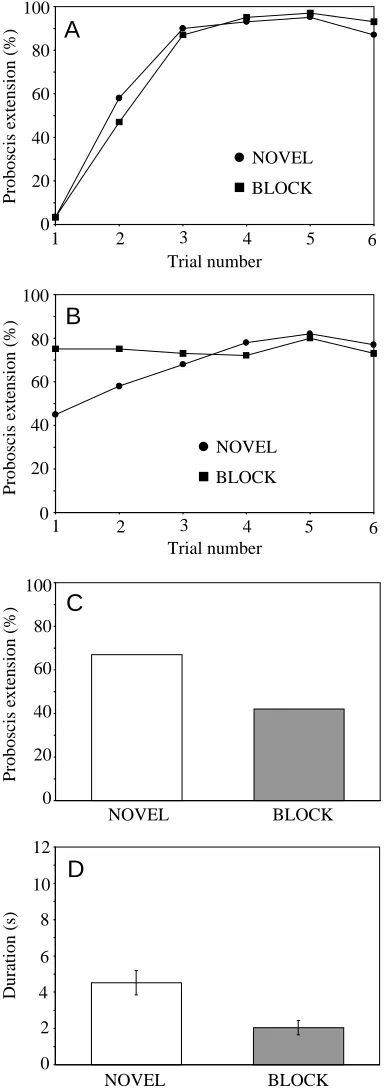
Blocking in different combinations of odorants As before, subjects showed rapid acquisition to odors during the preconditioning and mixture conditioning phases of the blocking experiment (Fig. 3A,B). Both the NOVEL and BLOCK groups showed rapid and equivalent acquisition to the
conditioned odorant during preconditioning (Fig. 3A; F=0.1, d.f.=1,118, not significant). At least 80 % of the subjects responded to the odorant after the second acquisition trial of this phase. The performance during mixture conditioning was typical for a blocking experiment (Fig. 3B). Subjects in the BLOCK group displayed stronger generalization to the A+X mixture on the first trial of this phase than did subjects in the NOVEL group. Both groups reached the same level of performance by trial 3, and the groups did not differ in overall performance during this phase (F=1.3, d.f.=1,118, not significant).
The final test with odorant X, to which the two groups had been identically conditioned, revealed blocking. Subjects in the NOVEL group responded to X significantly more strongly than did subjects in the BLOCK group, whether the response was measured as the percentage of proboscis extensions (Fig. 3C; χ2=7.6, N=120, P<0.01) or as the duration of the proboscis extension response (Fig. 3D; F=12.2, d.f.=1, P<0.001). However, the different odorants used as X elicited significantly different response levels (F=5.9, d.f.=5, P<0.001). Furthermore, the relative expression of blocking depended on the odorants used as N, A and X, which is revealed by the significant interaction term (F=2.4, d.f.=5, P<0.05).
The reason for the significant interaction term is evident in Fig. 4, in which the responses to odorant X are shown separately for each of the six different combinations N, A and X. We have analyzed the results according to which odorant was used as N in the NOVEL control group (Table 1), thus counterbalancing the remaining two odorants as A and X. This analysis revealed three different blocking patterns. First, in the groups in which octanol was N (Table 2A,B; Fig. 4A,B), 1-hexanol elicited a significantly higher level of response than did geraniol when those odors were the test odor X (F=22.9,
1-Octanol
Geraniol
2-Octanone 1-Hexanol
0 10 30 40 50 70
60 90 80 100
20
Proboscis extension (%)
1 2 3 4 5 6
[image:4.612.320.553.71.234.2]Trial number
d.f.=1, P<0.001). There was also a significant difference between the NOVEL and BLOCK groups (F=17.8, d.f.=1, P<0.001). However, the interaction term was also significant (F=10.7, d.f.=1, P<0.01), indicating that the blocking effect differed for the two groups. The blocking effect was only evident when the test odorant was hexanol. Second, when 1-hexanol was N (Table 2C,D; Fig. 4C,D), 1-octanol elicited a significantly higher level of response than geraniol when those odorants were used as X (F=3.9, d.f.=1, P=0.05). In the latter case, however, there was no difference between the NOVEL and BLOCK groups (F=0.1, d.f.=1, not significant) and the interaction term was not significant (F=0.1, d.f.=1, not significant). Third, when geraniol was N (Table 2E,F; Fig. 4E,F), 1-hexanol and 1-octanol elicited approximately the same level of response as X (F=3.6, d.f.=1, not significant), and there was a significant difference in response to X between the NOVEL and BLOCK groups (F=4.9, d.f.=1, P<0.05). In
addition, the blocking effect was symmetrical, as indicated by the lack of significance of the interaction term (F=0.8, d.f.=1, not significant).
Discussion
We have shown that the blocking effect between two odorants in a binary mixture depends on the chemical structures of the odorants. The existence of blocking between two conditioned stimuli (A and X; see Table 1) indicates that the two stimuli are not processed independently when they are conditioned in a mixture. In the honeybee, several studies have failed to find overshadowing and blocking in mixtures of stimuli from different modalities (Funayama et al., 1995). It seems likely, therefore, that these stimuli are processed independently when they occur together and are associated with reinforcement. Recently, Couvillon et al. (1997), using a
1-Hexanol 1-Octanol Geraniol
TEST ODORANT
B
A
0 1 2 3 4 5
0 1 2 3 4 5
0 1 2 3 4 5
0 1 2 3 4 5
0 1 2 3 4 5
0 1 2 3 4 5
0 1 2 3 4 5
0 1 2 3 4 5
Duration (s)
Duration (s)
Duration (s)
Duration (s)
1-Hexanol Geraniol
1-Hexanol
1-Octanol
2-Octanone Geraniol CONDITIONED
[image:5.612.75.570.71.522.2]ODORANT
conditioning procedure that utilized freely flying honeybees, compared the expression of the blocking effect between intra-modal and inter-intra-modal binary mixtures. They found that blocking was detectable when conditioned mixtures were composed of stimuli from the same modality, i.e. odor/odor and color/color mixtures. As expected from earlier studies, however, blocking was not detectable in color/odor mixtures. They proposed that the capacity for interaction was greater for
intra- than for inter-modal mixtures, as it is in vertebrates (Kehoe et al., 1994).
It is reasonable to propose that this interference is based on the overlap of sensory representations that are set up in the antennal lobes, where the sensory axons make first synaptic contact with interneurons of the brain (Hildebrand and Shepherd, 1997). Linster and Smith (1997) have related blocking to the overlap of inhibitory processes in the antennal lobe. In their model, odors activate broadly tuned sensory representations. Some pairs of odors activate partially overlapping representations, whereas other pairs activate representations that display little or no overlap. The lateral overlap of inhibitory transmission is directly related to the degree of overlap of the incoming sensory patterns. Once one sensory pattern, e.g. that produced by A in our study, is associated with reinforcement, its capacity to suppress the activity pattern evoked by a second odor (e.g. X) is enhanced as long as there is sufficient overlap in inhibitory transmission. A mixture of A and X which, under unconditioned circumstances, would produce a mixture-unique configural pattern of sensory input, therefore becomes much more A-like after A has been associated with reinforcement.
A critical test of the model would be to attenuate blocking by choosing pairs of A and X odors that differ in the degree of perceptual similarity between A and X. We assume here that pairs of odors between which subjects generalize strongly will also activate similar spatiotemporal patterns of activity in the antennal lobes. Our results agree reasonably well with the predictions of the model of Linster and Smith (1997). Blocking should be stronger when hexanol and 1-octanol are A and X (Table 2E,F) than when either is combined in a mixture with geraniol, which is what we found. The model also predicts that blocking will be attenuated when either alcohol is combined with geraniol as A and X. Blocking was not statistically evident when geraniol and 1-octanol were assigned to A and X status (Table 2C,D), and blocking was less evident when 1-hexanol and geraniol were A and X (Table 2A,B). The only case that the model fails to
A
Proboscis extension (%)
Proboscis extension (%)
Proboscis extension (%)
Duration (s)
0 40 60 80 100
20
NOVEL
BLOCK
D
0 4 6 8 10
2 12
NOVEL BLOCK
1 2 3 4 5 6
Trial number
B
0 40 60 80 100
20
NOVEL
BLOCK
1 2 3 4 5 6
Trial number
C
0 40 60 80 100
20
[image:6.612.69.261.73.617.2]NOVEL BLOCK
predict occurs when 1-hexanol is assigned to X (Fig. 4A). In that case, we observed a strong blocking-like effect even though there was little detectable generalization between that odorant and geraniol. It should be noted that blocking may occur between odorants that show less generalization, but it would be attenuated relative to odorants that show strong generalization. Because we attempted to counterbalance all possible combinations of odorants, the sample sizes were low (10 subjects in each case), which would limit our ability to resolve weak blocking effects.
Gerber and Ullrich (1999) recently criticized olfactory blocking studies (Sahley et al., 1981; Staubli et al., 1989; Smith and Cobey 1994; Smith, 1996, 1997; Thorn and Smith, 1997) because, in those studies, odors were not always used in a completely counterbalanced manner. They point out that a blocking-like effect might arise as an artifact of higher generalization from N to X in the NOVEL group than from A to X in the BLOCK group (Table 1). If generalization between N and X is stronger than between A and X, then this generalization could increase the response to X above that in
the BLOCK group. They never tested this hypothesis, but they argue that odorants need to be completely counterbalanced as N, A and X.
Our present analyses were undertaken in part to respond to that criticism. The patterns of generalization among odors in our study do not follow the predictions of Gerber and Ullrich (1999). If these predictions are correct, then two odorants that show strong generalization should give rise to a blocking-like effect in groups in which they are assigned to N and X. This hypothesis could account for the pattern we observe in Fig. 4A, which is the one case of the six that the Linster and Smith (1997) model cannot explain. In that case, 1-hexanol was N and 1-octanol was X, which show strong generalization. Furthermore, like the model of Linster and Smith (1997), the explanation of Gerber and Ullrich (1999) would predict little or no blocking in Fig. 4B,C. But the experimental outcomes contradict Gerber and Ullrich (1999) for Fig. 4D–F. Gerber and Ullrich (1999) predict a blocking-like effect in Fig. 4D, because the odorants used as N and X show strong generalization. They would also predict little or no detectable
Duration (s)
C
0 2 4 6 8 10 12NOVEL BLOCK
A
E
B
N:A:
X:
1-octanol
geraniol
1-hexanol
D
F
02 4 6 8 10 12
NOVEL BLOCK
N:
A:
X:
1-hexanol
1-octanol
geraniol
0 2 4 6 8 10 12
NOVEL BLOCK
N:
A:
X:
geraniol
1-hexanol
1-octanol
0 2 4 6 8 10 12
NOVEL BLOCK
N:
A:
X:
1-octanol
1-hexanol
geraniol
0 2 4 6 8 10 12
NOVEL BLOCK
N:
A:
X:
1-hexanol
geraniol
1-octanol
0 2 4 6 8 10 12
NOVEL BLOCK
N:
A:
X: geraniol
1-octanol
[image:7.612.191.568.70.473.2]1-hexanol Fig. 4. Breakdown of duration
blocking in Fig. 4E,F, because the odorants used as N and X in those groups show little generalization.
It seems reasonable, therefore, to conclude that the blocking effect identified in earlier studies is robust, and that the model proposed by Linster and Smith (1997) provides a reasonably good fit to the data. However, in interpreting the acceptability of one or another model with respect to its ability to predict blocking, caution should be exercised with regard to the proper control groups in a blocking experiment. The exclusive use of any given control procedure can be criticized for different reasons. Thorn and Smith (1997) used only the NOVEL control because of the large number of treatment groups that each required control and blocking subtreatments. However, they used the NOVEL control only after it had been evaluated in parallel with a number of other controls and revealed the same blocking effect (Smith, 1997). Furthermore, they chose 2-octanone as N because it shows relatively little generalization to the odorants counterbalanced as A and X (1-hexanol and geraniol; Smith and Menzel, 1989a,b; Fig. 2 in the present study). The slight trend for 2-octanone to generalize more to 1-hexanol than to geraniol would have been offset by the counterbalanced assignment of the latter two odorants to A and X.
Our choice of the NOVEL control here was also motivated by the fact that it was the specific focus of criticism by Gerber and Ullrich (1999). The primary concern in the case of a NOVEL control stems from the arguments about generalization among odorants. The pattern of blocking in Fig. 4A could arise, as noted above, because subjects generalize more from N to X than from A to X. The higher level of response to X in the NOVEL group would produce a blocking-like effect that, in a mechanistic sense, is not true blocking. Furthermore, the lack of blocking in Fig. 4B,C could be due to generalization between N and A such that both the NOVEL and BLOCK treatment groups experience blocking.
This possibility might explain the low level of response in both groups in our experiments.
It is clear that other control groups need to be explored in future studies of within-modality blocking. In the meantime, however, several arguments can be made in favor of the blocking effect in the case of odor/odor mixtures. First, a recent replication of the blocking effect in honeybees used a different control procedure that would not have the same problem as the novel control procedure (Couvillon et al., 1997). Second, Gerber and Ullrich (1999) proposed that odorants should be completely counterbalanced as N, A and X so that the possibility that blocking might be based on differential generalization among the odorants could be ruled out. Although we feel that this kind of statistical analysis is inappropriate (see below), we have nevertheless done that and still reveal a blocking effect (Fig. 3). Third, one would ideally need to use as N an odorant that shows little or no generalization to A or, more importantly, to X and still have that combination reveal blocking. Odorants used in previous work were chosen partly on the basis of this criterion (Smith, 1997; Thorn and Smith, 1997). This combination is recorded in Fig. 4E,F as a subset of the odorant combinations we used in the present experiment and, again, the blocking effect appears to be robust.
[image:8.612.44.561.85.265.2]The question of why Gerber and Ullrich (1999) failed to induce blocking still remains. Regardless of why differences in expression across different odorant combinations arise, it is clear that some combinations fail to reveal blocking. We have not yet evaluated the complete odor set used by Gerber and Ullrich (1999), because they counterbalanced the use of limonene with 1-octanol, 1-hexanol and geraniol in their study. It is possible that enough of their odorant combinations failed to reveal blocking so that when the data were pooled, as they were in that study, the average result failed to reveal blocking. They did not show the separate evaluations for each of the Table 2. Treatment groups separated by odorant combinations
Odor group Odor* Treatment Phase I‡ Phase II Test
A O G H Novel O →sucrose G+H →sucrose H
Block G →sucrose G+H →sucrose H
B O H G Novel O →sucrose H+G →sucrose G
Block H →sucrose H+G →sucrose G
C H O G Novel H →sucrose O+G →sucrose G
Block O →sucrose O+G →sucrose G
D H G O Novel H →sucrose G+O →sucrose O
Block G →sucrose G+O →sucrose O
E G H O Novel G →sucrose H+O →sucrose O
Block H →sucrose H+O →sucrose O
F G O H Novel G →sucrose O+H →sucrose H
Block O →sucrose O+H →sucrose H
*O, 1-octanol; H, 1-hexanol; G, geraniol; the sequence of the letters reflects assignment of odorants as N, A and X, respectively (see Table 1).
odorant combinations used, as we have done here (see Fig. 4). Indeed, we show that odorant combinations differ in the extent to which they induce blocking. This would be an argument against the use of a statistical analysis that would not be capable of revealing this interaction, as was the case in the study of Gerber and Ullrich (1999). In addition, their study did not focus on the use of a novel odor that showed little or no generalization to A and X, as we have done in the past (Smith, 1997; Thorn and Smith, 1997).
Furthermore, although we have consistently shown blocking using both the percentage of responding honeybees and the mean duration of proboscis extension as response measures, it is possible that a blocking effect might have been evident in the study of Gerber and Ullrich (1999) if they had used duration or response latency. Along that line of argument, Smith (1998) has shown how the latter two measures can be more sensitive in detecting differences in response topology across treatments. When response probabilities approach a ceiling, such that all the animals that can learn the association actually display the proboscis extension reflex, or when sample sizes are limited, this measure becomes less sensitive to differences across treatments. In these cases, more sensitive measures of response topology still change and are capable of revealing treatment effects. For that reason, we have relied on duration as the primary measure here, although we show both types of measure in Fig. 3.
In conclusion, we feel that the blocking effect is robust and, although further behavioral analyses with different control procedures are warranted, it can now be used as a predictive tool for physiological analyses of antennal lobe processing. Clearly, a larger generalization matrix of odors needs to be developed and tested. Within that matrix, odorants that show stronger blocking should also show greater overlap of the spatiotemporal activity patterns that represent those odorants in the antennal lobe or higher processing centers of the brain (Linster and Smith, 1997). Lower levels of blocking between two odorants should reveal less spatial and/or temporal overlap of the representations of those odorants when they are combined in a mixture. Recordings from large populations of neurons using techniques that can provide both spatial (Joerges et al., 1997) and fast temporal (Stopfer et al., 1997) information will be necessary to test this hypothesis.
This work was supported by a grant from NIH-NCRR (9 R01 RR14166–06) to B.H.S. and by an NRSA from NIH to J.S.H.
References
Ache, B. W. (1989). Central and peripheral bases for mixture suppression in olfaction. In Perception of Complex Smells and Tastes (ed. D. G. Laing, W. S. Cain, R. L. McBride and B. W. Ache), pp. 101–114. Marrickville, NSW, Australia: Academic Press.
Akers, R. P. and Getz, W. M. (1993). Response of olfactory receptor neurons in honeybees to odorants and their binary mixtures. J. Comp. Physiol. A 173, 169–185.
Bitterman, M. E., Menzel, R., Fietz, A. and Schäfer, S. (1983). Classical conditioning of proboscis extension in honeybees Apis mellifera. J. Comp. Psychol. 97, 107–119.
Boeckh, J., Ernst, K. D., Saaa, H. and Waldow, U. (1984). Anatomical and physiological characteristics of individual neurones in the central antennal pathway of insects. J. Insect Physiol. 30, 15–26.
Buck, L. B. (1996). Information coding in the vertebrate olfactory system. Annu. Rev. Neurosci. 19, 517–544.
Chandra, S. and Smith, B. H. (1998). An analysis of synthetic processing of odor mixtures in the honeybee (Apis mellifera). J. Exp. Biol. 201, 3113–3121.
Christensen, T. A., Mustaparta, H. and Hildebrand, J. G. (1989). Discrimination of sex pheromone blends in the olfactory system of the moth. Chem. Senses 14, 463–477.
Couvillon, P. A., Arakaki, L. and Bitterman, M. E. (1997). Intramodal blocking in honeybees. Anim. Learn. Behav. 25, 277–282.
Couvillon, P. A., Mateo, E. T. and Bitterman, M. E. (1996). Reward learning in honeybees: Analysis of an overshadowing effect. Anim. Learn. Behav. 24, 19–37.
Cromarty, S. I. and Derby, C. D. (1997). Multiple excitatory receptor types on individual olfactory neurons: implications for coding of mixtures in the spiny lobster. J. Comp. Physiol. A 180, 481–491.
Funayama, E. E., Couvillon, P. A. and Bitterman, M. E. (1995). Compound conditioning in honeybees: Blocking tests of the independence assumptions Anim. Learn. Behav. 23, 429–437. Gerber, B. and Ullrich, J. (1999). No evidence for olfactory
blocking in honeybee classical conditioning. J. Exp. Biol. 202, 1839–1854.
Getchell, T. V. (1986). Functional properties of vertebrate olfactory receptor neurons. Physiol. Rev. 66, 772–818.
Getz, W. M. and Akers, R. P. (1997). Response of American cockroach (Periplaneta americana) olfactory receptors to selected alcohol odorants and their binary combinations. J. Comp. Physiol. A 180, 701–709.
Hammer, M. (1993). An unidentified neuron mediates the unconditioned stimulus in associative olfactory learning in honeybees. Nature 366, 59–63.
Hammer, M. and Menzel, R. (1995). Learning and memory in the honeybee. J. Neurosci. 15, 1617–1630.
Hildebrand, J. G. (1995). Analysis of chemical signals by nervous systems. Proc. Natl. Acad. Sci. USA 92, 67–74.
Hildebrand, J. G. (1996). Olfactory control of behavior in moths central processing of odor information and the functional significance of olfactory glomeruli. J. Comp. Physiol. A 178, 5–19. Hildebrand, J. G. and Shepherd, G. M. (1997). Mechanisms of olfactory discrimination: Converging evidence for common principles across phyla. Annu. Rev. Neurosci. 20, 595–631. Joerges, J., Küttner, A., Galizia, C. G. and Menzel, R. (1997).
Representations of odours and odour mixtures visualized in the honeybee brain. Nature 387, 285–288.
Kamin, L. J. (1968). Attention-like processes in classical conditioning. In Miami Symposium on Predictive Behavavior: Aversive Stimuli (ed. M. R. Jones), pp. 9–32. Coral Gables, FL: Miami University Press.
Kehoe, E. J., Horne, A. J., Horne, P. S. and Macrae, M. (1994). Summation and configuration between and within sensory modalities in classical conditioning of the rabbit. Anim. Learn. Behav. 22, 19–26.
Knudsen, J. T., Tollsten, L. and Bergstrom, L. G. (1993). Floral scents – a checklist of volatile compounds isolated by headspace techniques. Phytochem. 33, 253–280.
Laing, D. C. and Glemarec, A. (1992). Selective attention and the perceptual analysis of odor mixtures. Physiol. Behav. 52, 1047–1053.
Lancet, D. (1986). Vertebrate olfactory reception. Annu. Rev.
Neurosci. 9, 329–355.
Linster, C. and Smith, B. H. (1997). A computational model of the response of honey bee antennal lobe circuitry to odor blends: Overshadowing, blocking and unblocking can arise from lateral inhibition. Behav. Brain Res. 87, 1–14.
Macintosh, N. J. (1983). Conditioning and Associative Learning. Oxford: Oxford University Press. 316pp.
Masson, C. and Mustaparta, H. (1990). Chemical information processing in the olfactory system in insects. Physiol. Rev. 70, 199–245.
Pearce, J. M. (1994). Similarity and discrimination: A selective review and a connectionist model. Psychol. Rev. 101, 587–607. Pham-Delegue, M. H., Etievant, P., Guichard, E. and Masson, C.
(1989). Sunflower volatiles involved in honeybee discrimination among genotypes and flowering stages. J. Chem. Ecol. 15, 329–343.
Rabin, M. D. and Cain, W. S. (1989). Perception of Complex Smells
and Tastes. Marrickville, NSW, Australia: Academic Press. 160pp
Rescorla, R. A. (1973). Evidence for the ‘unique stimulus’ account of configural learning. J. Comp. Physiol. Psychol. 85, 331–338. Rudy, J. W. and Sutherland, R. J. (1992). Configural and elemental
associations and the memory coherence problem. J. Cogn. Neurosci. 4, 208–216.
Sahley, C. L., Rudy, J. W. and Gelperin, A. (1981). An analysis of associative learning in a terrestrial mollusc. I. Higher-order conditioning, blocking and a transient US pre-exposure effect. J. Comp. Psychol. 144, 1–8.
Shephard, R. N. (1987). Toward a universal law of generalization for psychological science. Science 237, 1317–1323.
Smith, B. H. (1991). The olfactory memory of the honey bee, Apis
mellifera. I. Odorant modulation of short- and intermediate-term memory after single trial conditioning. J. Exp. Biol. 161, 367–382.
Smith, B. H. (1996). The role of attention in learning about odorants.
Biol. Bull. 191, 76–83.
Smith, B. H. (1997). An analysis of blocking in binary odorant mixtures: An increase but not a decrease in intensity of reinforcement produces unblocking. Behav. Neurosci. 11, 57–69. Smith, B. H. (1998). An analysis of interaction in binary mixtures.
Physiol. Behav. 65, 397–407.
Smith, B. H. and Cobey, S. (1994). The olfactory memory of the honeybee Apis mellifera. II. Blocking between odorants in binary mixtures. J. Exp. Biol. 195, 91–108.
Smith, B. H. and Menzel, R. (1989a). An analysis of variability in the feeding motor program of the honey bee: The role of learning in releasing a modal action pattern. Ethology 82, 68–81.
Smith, B. H. and Menzel, R. (1989b). The use of electromyogram recordings to quantify odorant discrimination in the honey bee, Apis mellifera. J. Insect Physiol. 35, 369–375.
Sokal, R. R. and Rohlf, F. J. (1995). Biometry (3rd edition). New York: W. H. Freeman. 887pp.
Staubli, U., Fraser, D., Faraday, R. and Lynch, G. (1987). Olfaction and the ‘data’ memory system in rats. Behav. Neurosci. 101, 757–765.
Stopfer, M., Bhagavan, S., Smith, B. H. and Laurent, G. (1997). Impaired odour discrimination on desynchronization of odour-encoding neural assemblies. Nature 390, 70–74.
Thorn, R. S. and Smith, B. H. (1997). The olfactory memory of the honeybee Apis mellifera. III. Bilateral sensory input is necessary for the induction and expression of olfactory blocking. J. Exp. Biol. 200, 2045–2055.