The environmental clues used by homing pigeons to navigate are a matter of some debate. Atmospheric odours appear to play a central role (e.g. Papi, 1991; Wallraff, 1990, 1996; Able, 1996; Bingman et al., 1998; Guilford et al., 1998) but are not the only environmental signals used by pigeons to find the way home. In this perspective, we focus on two other sources of spatial information, the visual landscape and the sun. There is currently some disagreement over the extent to which topographical features are involved in pigeon homing. Some authors doubt that pigeons make any orientational use of the visual landscape outside their immediate home range (Schmidt-Koenig, 1979, 1991; Wiltschko, 1991, 1996; Wiltschko and Wiltschko, 1998), while others are convinced that they do (e.g. Luschi and Dall’Antonia, 1993; Wallraff et al., 1994; Bingman, 1998; Gagliardo et al., 1999). In contrast, nobody doubts that pigeons make use of a sun compass, but since quantitative experimental results are often at variance with theoretical predictions, the factors involved in the pigeons’ responses to the sun are not yet clearly identified (e.g. Wiltschko et al., 1994; Chappell, 1997). We shall show that considering the sun problem and the landscape problem together may lead to a solution of both.
We begin with the sun problem. When homing pigeons are released at a site distant from home with their circadian clocks experimentally shifted by 6 h, their initial bearings deviate
considerably from those of non-shifted controls. Deflections are counterclockwise when the circadian clock is shifted forward by accustoming the birds for several days to a light/dark cycle beginning and ending 6 h earlier than the natural one; deflections are clockwise when the clock is shifted correspondingly backwards. This effect is generally accepted as evidence that pigeons make use of a time-compensated sun compass (Schmidt-Koenig, 1958, 1961, 1979). However, when averaged across the many published experiments, the degree of deflection is considerably smaller than would be predicted on the basis of the angular difference between the actual sun azimuth at the time of release and that expected according to the birds’ phase-shifted time scale. In pigeons clock-shifted 6 h forwards, the mean deflection of a total of 383 bearings was 70 ° (Schmidt-Koenig, 1979), which is approximately 40–50 ° less than theoretically expected (see Wallraff, 1974; Wiltschko et al., 1994; Chappell, 1997). Moreover, the mean angular scatter of the vanishing bearings for each release was significantly increased in the clock-shifted pigeons, indicating that these birds were exposed to less clear-cut conditions than the birds flying with unmanipulated clocks.
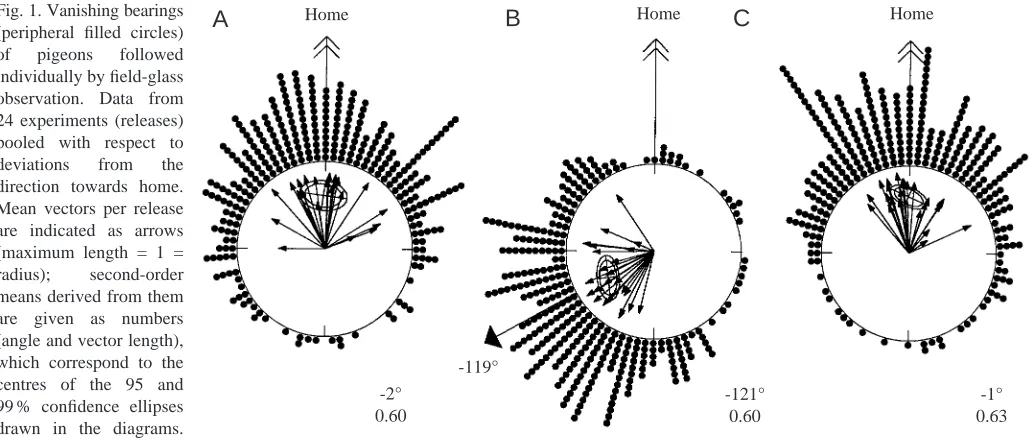
In an attempt to search for an explanation, Neuss and Wallraff (1988) started a new series of clock-shift experiments, but unexpectedly did not find any such discrepancies between theoretical predictions and experimental results (Fig. 1). When JEB2202
It seems reasonable to assume that pigeons use visual features in the landscape for orientation when they are homing over familiar terrain. Experimental evidence to prove or disprove this possibility is, however, difficult to obtain. Here, we link the problem with the observation that deflections of initial orientation caused by clock-shift are often smaller than predicted on a pure sun compass basis. We substantiate the hypothesis that consistently reduced deflections and increased angular scatter occur only when pigeons are released in familiar areas where a remembered pattern of landscape features can conflict with the position of the sun. Repeated releases of the same individuals under clock-shift, or elimination of non-visual navigational clues
(odours), appear to strengthen the conflicting influence of familiar visual landmarks. Accelerated returns of birds allowed to preview the surrounding familiar scenery before release also support the conclusion that the visual environment is included in the homing system of pigeons. The landscape, however, not only helps home-finding, if it is familiar, but may also have a distracting influence that contributes to the great variability of initial orientation patterns.
Key words: pigeon, Columba livia, navigation, orientation, homing, sun compass, clock-shift, landmarks, landscape, odours, olfaction. Summary
PERSPECTIVE
THE ROLES OF THE SUN AND THE LANDSCAPE IN PIGEON HOMING
HANS G. WALLRAFF1,*, JACKIE CHAPPELL2 ANDTIM GUILFORD2
1Max-Planck-Institut für Verhaltensphysiologie, D-82319 Seewiesen, Germany and 2Department of Zoology, South
Parks Road, Oxford OX1 3PS, UK *e-mail: [email protected]
the angles of the initial bearings were recalculated by adding the angular difference between the actual and expected sun azimuth, the accuracy of home orientation of the clock-shifted pigeons was equivalent to that of the controls (compare Fig. 1C with Fig. 1A). Thus, the clock-shift effect was explicable on a pure sun-azimuth basis with no need to invoke additional factors. The birds did not show, for instance, any indication of conflict between a shifted sun compass and a non-shifted magnetic compass, nor did the ‘map’ appear to be confused by the pigeons’ altered circadian phase.
Consequently, additional interfering factors must have been involved only in the earlier experiments. But what were these factors? On the assumption that pigeons might utilize visual landmarks for home-finding, it appeared possible that reduced clock-shift deflections and increased angular scatter might occur in familiar, but not in unfamiliar, areas (Wallraff, 1991; Wallraff et al., 1994).
Landscape features could only act as home-guiding orientational clues if the birds had been given an opportunity to learn the spatial configurations from previous individual experience. Pigeons prevented from using olfactory signals only show homeward orientation in areas in which they had been before (e.g. Papi, 1991; Wallraff, 1990, 1996; Wallraff et al., 1993; Bingman et al., 1998). It is a logical hypothesis that this non-olfactory homing is based on the use of visual features of the landscape. Since olfactory and non-olfactory home orientation show similar inaccuracies and since the latter functions even at sites 10 km from previous release sites, it seems reasonable to assume that the birds make use of a wide aerial view over the land rather than following a chain of small-scale landmarks (Wallraff et al., 1994).
Although the landscape hypothesis looks trivial, it is difficult to test its validity. Impairment of vision using translucent lenses or spectacles (Schmidt-Koenig and Schlichte, 1972; Schmidt-Koenig and Walcott, 1978) is insufficient as long as olfactory information remains available. Although the additional elimination of olfactory information prevented homeward orientation, basic problems involving the visual impairment in these experiments made conclusions about the role of visual landmarks difficult to draw (Streng and Wallraff, 1992; see also their discussion of findings published by Benvenuti and Fiaschi, 1983). A more indirect approach to the problem was, therefore, necessary.
Atmospheric odours perceived at an unfamiliar site are known to provide information about the approximate direction of home (Papi, 1991; Wallraff, 1996). According to the map-and-compass concept (Kramer, 1953), the pigeon is then able to select the home direction by means of its sun compass. If this compass is rotated by clock-shift, the animal cannot perceive any peculiarity and hence has no reason to distrust its compass. Familiar visual landmarks, however, not only provide information on the pigeon’s own current position, but also provide a spatial pattern of configurations that extends far beyond the animal’s own corporal standpoint. If pigeons use visual clues from a familiar landscape, then a clock-shifted bird that begins to follow its shifted sun compass should recognize that its course with respect to the landscape pattern is wrong. Information from the sun and the landscape will then be in conflict, unless the bird ignores one of the two. When a sample of pigeons is tested, such a conflict is likely to lead to an increase in angular scatter and to a mean direction that is somewhere between the direction indicated by the sun and that appropriate to the familiar landmarks.
A
HomeB
C
-119° -2°
0.60
-121° 0.60
-1° 0.63
[image:2.609.44.560.456.676.2]Home Home
Fig. 1. Vanishing bearings (peripheral filled circles) of pigeons followed individually by field-glass observation. Data from 24 experiments (releases) pooled with respect to deviations from the direction towards home. Mean vectors per release are indicated as arrows (maximum length = 1 = radius); second-order means derived from them are given as numbers (angle and vector length), which correspond to the centres of the 95 and 99 % confidence ellipses drawn in the diagrams.
It follows that full-scale deflection by clock-shift (as in Fig. 1) would be expected in unfamiliar areas, where the landscape is unknown and, therefore, cannot provide homing clues. In contrast, pigeons prevented from receiving olfactory site information and released in a familiar area will perceive conflicting signals if they are influenced by both the landscape and the sun. This should result in a reduced mean deflection and increased scatter. If both familiar landmarks and olfactory signals are available, the pigeons may show some intermediate behaviour, although responses to either odours or landmarks may predominate.
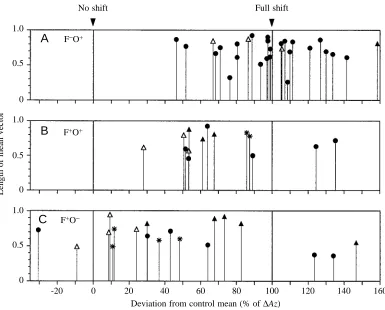
Fig. 2 shows that these predictions were fairly well met by the results from four separate investigations. Even though conditions in the different familiar-site series were somewhat heterogeneous (method of familiarization, topography), a general trend in Fig. 2 from A through B to C is obvious. Variability was greatest and mean deflection smallest when pigeons were familiar with the landmarks and had no access to local olfactory signals (Fig. 2C). But even when olfactory signals were available, deflections were smaller in familiar rather than unfamiliar areas (compare Fig. 2B with Fig. 2A). A fifth experimental approach, not fitting into the scales of
Fig. 2, corroborates these findings (Dall’Antonia and Luschi, 1993; see Fig. 9 in Wallraff et al., 1994).
Most of the clock-shift experiments reported by Schmidt-Koenig (1958, 1961) were conducted with old experienced pigeons released many times at various sites around their loft. In successive releases, individuals were usually alternated between a clock-shifted and a non-shifted state. Thus, it seems reasonable to assume that in many experiments the pigeons were familiar with the area of release and, moreover, were progressively trained to distrust their unreliable map-and-compass system and to rely instead, wherever possible, on familiar visual landmarks alone. At the same time, those individuals most reliant on their sun compass may have been lost during the first releases, from which very many birds clock-shifted by 6 h usually fail to return, so that only the more flexible and trainable birds were available for the later experiments, in which homing success was only moderately reduced by clock-shift (compare Fig. 45 in Schmidt-Koenig, 1979, with Neuss and Wallraff, 1988). We consider it possible that pigeons familiar with the area and subjected to repeated releases under clock-shift might eventually produce results similar to those shown in Fig. 2C.
A
B
C
1.0
0.5
0
0 0.5 1.0
1.0
0 0.5
Length of mean vector
-20 0
No shift
F−O+
F+O+
F+O−
Full shift
20 40 60 80 100 120 140 160
[image:3.609.175.560.367.677.2]Deviation from control mean (% of ∆Az)
Fig. 2. Angular deviations of mean vectors of 6 h clock-shifted pigeons from the mean vector of non-shifted control pigeons as a percentage of
∆Az (see Fig. 1) per release.
100 % corresponds to the theoretical full shift (∆Az).
Depending on latitude, date and time of day, ∆Az varied
between 88 and 144 °, with an overall mean of approximately 122 °. Conditions in A–C: F+,
site and/or area familiarized by 4–7 previous releases; F−, site and area of release largely unfamiliar; O+, pigeons with
unrestricted olfactory access to natural air; O−, pigeons prevented from smelling natural air. Sources: 䊉 in A from Neuss and Wallraff (1988) (same data as in Fig. 1); 䊉 in B and C from Wallraff et al. (1994) for simultaneous releases of pigeons in the O+ and O−
conditions; 䉭 from Bingman and Ioalè (1989); 䉱 from Luschi and Dall’Antonia
Findings reported by Wiltschko et al. (1994) may also fit this interpretation. Full-scale deflections in response to a 6 h clock-shift were found in untrained and sparsely trained young pigeons and then, as the homing experience and age of the birds increased, deflections were progressively reduced. We assume that with increasing age and experience the pigeons became increasingly familiar with the whole area around the loft (Wiltschko et al., 1994, p. 69: “... for adult birds there are few releases that can be classed as ‘from unfamiliar site’...”). Repeated releases under clock-shift inside the familiar area were certainly also more frequent in old rather than in young birds. Nevertheless, the authors dispute an influence of familiar landmarks, although they present neither conclusive data in support of this position nor an alternative explanation. Clearly distinguishable unfamiliar and familiar sites were apparently rarely used within the age classes. The observation of full-scale deflections in response to clock-shift after more than 50 consecutive releases from the same site (see also Füller et al., 1983), not fitting into the general age/experience trend, must be seen as a special case, since the birds had been trained always to fly on the same compass course. Under clock-shift, directional aspects of the familiar landscape were apparently less influential than the entrained compass direction (for a discussion, see p. 5 in Wallraff et al., 1994; for directional uncoupling of landscape and sun, see also Gagliardo et al., 1999; for related cage experiments, see Chappell and Guilford, 1995; Gagliardo et al., 1996).
In contrast to this example of full deflections at familiar sites, studies involving other special conditions show incomplete deflections at unfamiliar sites. In very young pigeons, for instance, less than 12 weeks old, 6 h clock-shifts had little effect, suggesting that the sun compass, or its application in homing, had not yet fully developed (Wiltschko and Wiltschko, 1981). Another special situation concerns pigeons kept in a clock-shifted state for long periods (weeks or months) while being exposed to the environmental conditions, including the sun, at the home site. When released at a distant site, these birds do not deviate, or deviate only slightly, from non-shifted control birds (Wiltschko et al., 1976, 1984). The necessary linkage between environmental ‘map’ factors and the sun compass (see, for example, Wallraff, 1991) had been established with the apparent orbit of the sun adjusted to a phase-shifted time scale. Consequently, compass deflections could be achieved in these birds by a shift back to the natural light/dark cycle. Experiments using short-term clock-shifting while allowing outside access resulted in reduced angular deflections (Alexander and Keeton, 1974; Edrich and Keeton, 1978; Foà and Albonetti, 1980). In these experiments, the pigeons were in a poorly defined intermediate state between the old entrained calibration and the beginning of recalibration. Most of the experiments compiled by Chappell (see Table 2 in Chappell, 1997) that show incomplete deflections at unfamiliar sites were extracted from the above publications and had been conducted under one or another of these exceptional circumstances.
Apart from such clearly discernible conditions leading in a
plausible way to special effects, we have found no results to contradict the hypothesis that deflections caused by clock-shift are consistently reduced, and angular scatter is increased, only in familiar areas and/or after repeated releases of an individual bird in a clock-shifted state. Thus, whenever smaller than expected deflections are found in a series of releases, the possibility that landscape features have become familiar to the birds should be examined. Only if this possibility can be excluded is it necessary to look for other influences, such as conflicting directional signals coming from a non-shifted magnetic compass. On the other hand, full deflections observed at sites considered familiar do not automatically disprove our hypothesis for two reasons. First, it is often impossible to make a sharp distinction between familiar and unfamiliar or to determine the level of familiarity. We do not know, for instance, whether a site is more familiar to pigeons released a year before at that exact point, or a day before 5 or 10 km away, or over several weeks before at various sites in the surrounding area. Second, we do not know the hierarchical weight of visual and non-visual clues in any given situation.
The general conclusion that pigeons use the familiar visual landscape while homing is supported by experiments unconnected with clock-shifts (Braithwaite and Guilford, 1991; Braithwaite, 1993; Burt et al., 1997). Pigeons released a few kilometres away from the loft homed significantly faster if allowed a 5 min preview of the landscape, provided that they had previously been released at that particular site. In addition, investigations into the role of the hippocampal formation in pigeon homing support the assumption that the spatial representations analysed are familiar visual landmarks (Bingman et al., 1995; Gagliardo et al., 1999).
Landscape may have more than one effect, not only being helpful for finding the way home but also serving to distract the pigeons from the course they would have chosen in a homogeneous environment. Birds may be attracted by some features, such as human settlements, and avoid others, such as extended areas of water, large forests or mountains. The influences of prominent features are immediately obvious (Wagner, 1968, 1972), but also in moderately structured landscapes such influences can be revealed by statistical means (Wallraff, 1994).
Topographical influences certainly contribute to many of the site-specific patterns of initial orientation (‘release-site biases’). In clock-shift experiments, the directions chosen by shifted and non-shifted pigeons on a navigational basis may differ by 120 ° or more, so that the two groups encounter, and respond to, different features of the surrounding landscape, leading either to a smaller or a larger angular difference than theoretically predicted (see Fig. 7 in Wallraff, 1994) and resulting in site-specific clock-shift biases as reported by Schmidt-Koenig (1958, 1961). In a larger sample, differences in either direction balance one another out, so that the mean coincides with the predicted value, but little can be concluded from the size of a clock-shift effect in a single release or a small sample of releases.
visual landscape for purposes of home-finding is still a matter of debate. Who can doubt that topographical features, once their configurations have been learned by experience, contain suitable information for spatial orientation? Humans and many animals are known to make use of this source of information, so why should homing pigeons neglect it? Doubts and difficulties may arise from the fact that pigeons and other birds are able to apply, in addition, a navigation system that is independent of learned landmarks and makes them largely redundant. Responses to the landscape therefore become recognizable only under specifically designed experimental conditions such as those discussed above (and in Wallraff, 1991; Wallraff et al., 1994).
References
Able, K. P. (1996). The debate over olfactory navigation by homing
pigeons. J. Exp. Biol. 199, 121–124.
Alexander, J. and Keeton, W. T. (1974). Clock-shifting effect on
initial orientation of pigeons. Auk 91, 370–374.
Benvenuti, S. and Fiaschi, V. (1983). Pigeon homing: combined
effect of olfactory deprivation and visual impairment. Comp.
Biochem Physiol. 76A, 719–723.
Bingman, V. P. (1998). Spatial representations and homing pigeon
navigation. In Spatial Representation in Animals (ed. S. Healy), pp. 69–85. Oxford: Oxford University Press.
Bingman, V. P., Alyan, S. and Benvenuti, S. (1998). The importance
of atmospheric odours for the homing performance of pigeons in the Sonoran desert of the southwestern United States. J. Exp. Biol.
201, 755–760.
Bingman, V. P. and Ioalè, P. (1989). Initial orientation of anosmic
homing pigeons based on information gathered at familiar release sites remains homeward directed following clock-shift. Behaviour
110, 205–218.
Bingman, V. P., Jones, T.-J., Strasser, R., Gagliardo, A. and Ioalè, P. (1995). Homing pigeons, hippocampus and spatial cognition. In
Behavioural Brain Research in Naturalistic and Semi-naturalistic Settings (ed. E. Alleva, A. Fasolo, H. P. Lipp, L. Nadel and L.
Ricceri), pp. 207–223. Dordrecht: Kluwer.
Braithwaite, V. A. (1993). When does previewing the landscape
affect pigeon homing? Ethology 95, 141–151.
Braithwaite, V. A. and Guilford, T. (1991). Previewing familiar
landscapes affect pigeon homing. Proc. R. Soc. Lond. B 245, 183–186.
Burt, T., Holland, R. and Guilford, T. (1997). Further evidence for
visual landmark involvement in the pigeon’s familiar area map.
Anim. Behav. 53, 1203–1209.
Chappell, J. (1997). An analysis of clock-shift experiments: is scatter
increased and deflection reduced in clock-shifted homing pigeons?
J. Exp. Biol. 200, 2269–2277.
Chappell, J. and Guilford, T. (1995). Homing pigeons primarily use
the sun compass rather than fixed directional visual cues in an open-field arena food-searching task. Proc. R. Soc. Lond. B 260, 59–63.
Dall’Antonia, P. and Luschi, P. (1993). Orientation of pigeons
exposed to constant light and released from familiar sites. Physiol.
Behav. 54, 1173–1177.
Edrich, W. and Keeton, W. T. (1978). Further investigations of the
effect of ‘flight during clock shift’ on pigeon orientation. In Animal
Migration, Navigation and Homing (ed. K. Schmidt-Koenig and
W. T. Keeton), pp. 184–193. Berlin: Springer-Verlag.
Foà, A. and Albonetti, E. (1980). Does familiarity with the release
site influence the initial orientation of homing pigeons? Experiments with clock-shifted birds. Z. Tierpsychol. 54, 327–338.
Füller, E., Kowalski, U. and Wiltschko, R. (1983). Orientation of
homing pigeons: compass orientation vs. piloting by familiar landmarks. J. Comp. Physiol. 153, 55–58.
Gagliardo, A., Ioalè, P. and Bingman, V. P. (1999). Homing in
pigeons: the role of the hippocampal formation in the representation of landmarks used for navigation. J. Neurosci. 19, 311–315.
Gagliardo, A., Mazzotto, M. and Bingman, V. P. (1996).
Hippocampal lesion effects on learning strategies in homing pigeons. Proc. R. Soc. Lond. B 263, 529–534.
Guilford, T., Gagliardo, A., Chappell, J., Bonadonna, F., Burt de Perera, T. and Holland, R. (1998). Homing pigeons use olfactory
cues for navigation in England. J. Exp. Biol. 201, 895–900.
Kramer, G. (1953). Wird die Sonnenhöhe bei der Heimfindeorientierung verwertet? J. Orn. 94, 201–219.
Luschi, P. and Dall’Antonia, P. (1993). Anosmic pigeons orient
from familiar sites by relying on the map-and-compass mechanism.
Anim. Behav. 46, 1195–1203.
Neuss, M. and Wallraff, H. G. (1988). Orientation of displaced
homing pigeons with shifted circadian clocks: prediction vs observation. Naturwissenschaften 75, 363–365.
Papi, F. (1991). Olfactory navigation. In Orientation in Birds (ed. P.
Berthold), pp. 52–85. Basel: Birkhäuser Verlag.
Schmidt-Koenig, K. (1958). Experimentelle Einflussnahme auf die
24-Stunden-Periodik bei Brieftauben und deren Auswirkungen unter besonderer Berücksichtigung des Heimfindevermögens. Z.
Tierpsychol. 15, 301–331.
Schmidt-Koenig, K. (1961). Die Sonne als Kompass im Heimorientierungssystem der Brieftauben. Z. Tierpsychol. 18, 221–244.
Schmidt-Koenig, K. (1979). Avian Orientation and Navigation.
London: Academic Press.
Schmidt-Koenig, K. (1991). Über Karten und Kompasse bei
Brieftauben. Verh. Dt. Zool. Ges. 84, 125–133.
Schmidt-Koenig, K. and Schlichte, H. J. (1972). Homing in pigeons
with impaired vision. Proc. Natl. Acad. Sci. USA 69, 2446–2447.
Schmidt-Koenig, K. and Walcott, C. (1978). Tracks of pigeons
homing with frosted lenses. Anim. Behav. 26, 480–486.
Streng, A. and Wallraff, H. G. (1992). Attempts to determine the
roles of visual and olfactory inputs in initial orientation and homing of pigeons over familiar terrain. Ethology 91, 203–219.
Wagner, G. (1968). Topographisch bedingte zweigipflige und schiefe
Kreisverteilungen bei der Anfangsorientierung verfrachteter Brieftauben. Rev. Suisse Zool. 75, 682–690.
Wagner, G. (1972). Topography and pigeon orientation. In Animal
Orientation and Navigation (ed. S. R. Galler, K. Schmidt-Koenig,
G. J. Jacobs and R. E. Belleville), pp. 259–273. Washington, DC: NASA SP-262.
Wallraff, H. G. (1974). Das Navigationssystem der Vögel. Munich:
R. Oldenbourg Verlag.
Wallraff, H. G. (1990). Navigation by homing pigeons. Ethol. Ecol.
Evol. 2, 81–115.
Wallraff, H. G. (1991). Conceptual approaches to avian navigation
systems. In Orientation in Birds (ed. P. Berthold), pp. 128–165. Basel: Birkhäuser Verlag.
Wallraff, H. G. (1994). Initial orientation of homing pigeons as
affected by the surrounding landscape. Ethol. Ecol. Evol. 6, 23–36.
Wallraff, H. G. (1996). Seven theses on pigeon homing deduced
from empirical findings. J. Exp. Biol. 199, 105–111.
experiments on olfactory navigation and non-olfactory pilotage by homing pigeons. Behav. Ecol. Sociobiol. 32, 387–390.
Wallraff, H. G., Kiepenheuer, J. and Streng, A. (1994). The role
of visual familiarity with the landscape in pigeon homing. Ethology
97, 1–25.
Wiltschko, R. (1991). The role of experience in avian navigation and
homing. In Orientation in Birds (ed. P. Berthold), pp. 250–269. Basel: Birkhäuser Verlag.
Wiltschko, R. (1996). The function of olfactory input in pigeon
orientation: does it provide navigational information or play another role? J. Exp. Biol. 199, 113–119.
Wiltschko, R., Kumpfmüller, R., Muth, R. and Wiltschko, W.
(1994). Pigeon homing: the effect of a clock-shift is often smaller than predicted. Behav. Ecol. Sociobiol. 35, 63–73.
Wiltschko, R. and Wiltschko, W. (1981). The development of sun
compass orientation in young homing pigeons. Behav. Ecol.
Sociobiol. 9, 135–141.
Wiltschko, W. and Wiltschko, R. (1998). The navigation system of
birds and its development. In Animal Cognition in Nature (ed. R. P. Balda, I. M. Pepperberg and A. C. Kamil), pp. 155–199. Academic Press.
Wiltschko, W., Wiltschko, R. and Keeton, W. T. (1976). Effects of
a ‘permanent’ clock-shift on the orientation of young homing pigeons. Behav. Ecol. Sociobiol. 1, 229–243.
Wiltschko, W., Wiltschko, R. and Keeton, W. T. (1984). The effect
of a ‘permanent’ clock-shift on the orientation of experienced homing pigeons. I. Experiments in Ithaca, New York, USA. Behav.