c
Owned by the authors, published by EDP Sciences, 2017
The new front end and DAQ of the ICARUS detector
Christian Farnese1,a, On behalf of the ICARUS collaboration
1Dep. of Physics and Astronomy G. Galilei, via Marzolo 8, 35131 Padova, Italy
Abstract. ICARUS is the largest imaging LAr TPC ever operated. During its LNGS run on the CNGS neutrino beam, from 2010 to 2013, produced some thousands neu-trino events of unprecedented quality. This was possible thanks its mechanical precision and stability, liquid argon purity and electronics front-end and DAQ. Actually ICARUS T600, in view of its operation at FNAL on the SBN neutrino beam, is undergoing a major overhauling that implies cathode mechanics improvement, additional PMTs installation and a new electronics front-end and DAQ. This electronics implements a new architec-ture, integrated onto the flange proprietary design, and a new front-end that improves S/N and induction signals treatment. This issue will be presented in detail together with data recently recorder at CERN in the FLIC, 50 litres, LAr facility.
1 The ICARUS T600 detector
The Liquid Argon Time Projection Chamber (LAr TPC) is a powerful detection technique that can provide a detailed 3D imaging and a precise calorimetric reconstruction of any ionizing event. The operating principle of this innovative detector, first proposed by C. Rubbia in 1977 [1], is rather simple: the ionization electrons produced by each ionizing event taking place in highly purified LAr can be transported by the uniform electric field and can be detected by the wire planes, placed at the end of the drift path, providing simultaneous different projections of the same event. The information
from these three projections allow a precise reconstruction of the recorded particle trajectories and a precise calorimetric measurement. In addition, the scintillation light produced by the crossing particles can be collected by PMTs located behind the wire planes and this signal can be used in particular for the trigger of the detector.
This continuously sensitive and self triggering detector is characterized by an high granularity and spatial resolution, similar to bubble chambers. Moreover it is an excellent calorimeter that allows also an efficient particle identification based on the energy deposition vs range measurements.
The ICARUS T600, the largest LAr-TPC detector ever built, represents the state of the art of this detection technique. This detector is the result of the combined effort of the ICARUS Collaboration
and the Istituto Nazionale di Fisica Nucleare support and its successful operation for 3 years in the Hall B of the Gran Sasso underground National Laboratory demonstrates that the single phase LAr-TPC is the leading technology for the future short and long baseline accelerator driven neutrino physics. The T600 is made by two identical modules, each made of two TPCs sharing a common cathode in the middle. The internal dimensions of each half module are 3.6×3.9×19.6m3and the
total volume results 760 tons of ultra-pure LAr. The TPCs are characterized by a 1.5 m drift length, over which a uniform electric fieldED=500V/cmis maintained. The anode plane is made of three
parallel wire planes, 3 mm apart, biased in such a way to have ionization electrons going around the wires of the first two (Induction) planes, and being collected on the third, Collection plane. Behind the wire planes, an array of 74 PMTs has been located and used to collect the scintillation light produced in the LAr and this signal is the basis for the trigger of the detector [2, 3]. A more detailed description of the ICARUS T600 detector can be found in [4–6].
2 The future Short Baseline Neutrino program
While the 3-neutrino oscillation scenario is largely confirmed by experimental data, a few anomalous results [7–12] at accelerators, reactors and radioactive sources appear to point to the possible existence of a fourth sterile neutrino flavor with a mass∼1 eV/c2. ICARUS-T600 searched for a
possible LSND-like effect through the appearance ofνein the CNGSνµbeam; in the∼7.9 1019pot exposure, sevenνeevents have been observed while the expected background (mainly related to the ∼ 1% intrinsicνecontamination in the beam and to the standard 3-flavor neutrino oscillations) was ∼8.5. This negative result [13, 14], confirmed also by the OPERA experiment [15], allowed to define a very small parameter region, around∆m2 ∼ 1eV2, in agreement with all available positive and
negative results. However, some recent results [16–18] disfavor this interpretation, making the sterile neutrino scenario inconclusive and calling for a definitive answer. A conclusive experiment, capable of clarifying at 5σ level the described neutrino anomalies, is now under preparation at the Fermi National Accelerator Laboratory. In the Short Baseline Neutrino program (SBN), fully described in [19], three liquid-Argon TPC detectors (SBND, MicroBooNE, ICARUS-T600, with active masses of 82, 89 and 476 ton) will be exposed to the Boosterνµbeam at FNAL (averageEν ∼ 800 MeV) at different distances (110, 470, 600 meters respectively) from the target. The use of similar detectors
in different positions along the beam line will allow to strongly reduce systematics and to study both
theνµ → νeappearance and theνµdisappearance channels, providing a full coverage of the LSND parameter region with 5σsignificance in 3 years of data-taking (6.6 1020pot).
In order to prepare the detector for this new experimental phase, starting from December 2014 the T600 underwent a intensive overhauling phase in the framework of CERN Neutrino Platform (WA104 project). The main innovation introduced in the detector are related to the installation of an improved PMT system, the flattening of the TPC cathode, the construction of new cold vessels and of the new passive insulation, the refurbishment of the cryogenics and LAr purification system and the realisation of a new, higher-performance read-out electronics. The two T600 modules were transported to FNAL in July 2017 and are currently being installed in the far position at the FNAL Booster beam; the detector commissioning is expected in the summer of 2018.
3 The new read-out electronics for the ICARUS T600 detector
The ICARUS electronics, used in the LNGS run, performed efficiently and allowed to collect∼3000
total volume results 760 tons of ultra-pure LAr. The TPCs are characterized by a 1.5 m drift length, over which a uniform electric fieldED =500V/cmis maintained. The anode plane is made of three
parallel wire planes, 3 mm apart, biased in such a way to have ionization electrons going around the wires of the first two (Induction) planes, and being collected on the third, Collection plane. Behind the wire planes, an array of 74 PMTs has been located and used to collect the scintillation light produced in the LAr and this signal is the basis for the trigger of the detector [2, 3]. A more detailed description of the ICARUS T600 detector can be found in [4–6].
2 The future Short Baseline Neutrino program
While the 3-neutrino oscillation scenario is largely confirmed by experimental data, a few anomalous results [7–12] at accelerators, reactors and radioactive sources appear to point to the possible existence of a fourth sterile neutrino flavor with a mass∼1 eV/c2. ICARUS-T600 searched for a possible LSND-like effect through the appearance ofνein the CNGSνµbeam; in the∼7.9 1019pot
exposure, sevenνeevents have been observed while the expected background (mainly related to the ∼ 1% intrinsicνecontamination in the beam and to the standard 3-flavor neutrino oscillations) was ∼8.5. This negative result [13, 14], confirmed also by the OPERA experiment [15], allowed to define a very small parameter region, around∆m2 ∼ 1eV2, in agreement with all available positive and
negative results. However, some recent results [16–18] disfavor this interpretation, making the sterile neutrino scenario inconclusive and calling for a definitive answer. A conclusive experiment, capable of clarifying at 5σ level the described neutrino anomalies, is now under preparation at the Fermi
National Accelerator Laboratory. In the Short Baseline Neutrino program (SBN), fully described in [19], three liquid-Argon TPC detectors (SBND, MicroBooNE, ICARUS-T600, with active masses of 82, 89 and 476 ton) will be exposed to the Boosterνµbeam at FNAL (averageEν ∼ 800 MeV) at
different distances (110, 470, 600 meters respectively) from the target. The use of similar detectors
in different positions along the beam line will allow to strongly reduce systematics and to study both
theνµ → νeappearance and theνµdisappearance channels, providing a full coverage of the LSND
parameter region with 5σsignificance in 3 years of data-taking (6.6 1020pot).
In order to prepare the detector for this new experimental phase, starting from December 2014 the T600 underwent a intensive overhauling phase in the framework of CERN Neutrino Platform (WA104 project). The main innovation introduced in the detector are related to the installation of an improved PMT system, the flattening of the TPC cathode, the construction of new cold vessels and of the new passive insulation, the refurbishment of the cryogenics and LAr purification system and the realisation of a new, higher-performance read-out electronics. The two T600 modules were transported to FNAL in July 2017 and are currently being installed in the far position at the FNAL Booster beam; the detector commissioning is expected in the summer of 2018.
3 The new read-out electronics for the ICARUS T600 detector
The ICARUS electronics, used in the LNGS run, performed efficiently and allowed to collect∼3000
neutrino interactions and events associated to cosmic rays with unprecedented quality. The overhaul-ing of the T600 gave the opportunity to design a new upgraded “warm” TPC read-out electronics. The most important improvements, finalized to a better event reconstruction quality, concern first of all the analogue front-end: a∼1.5µs faster shaping time is now used for both Induction and Collection wires
to obtain a better hit position separation, a drastic reduction of undershoot in the preamp response as
well as of the low frequency noise while maintaining the same or better Signal-to-Noise ratio. The in-troduction, after each amplifier associated to each channel, of a serial 12 bit ADCs provides the same sampling rate used in the old system (400ns per channel), avoiding at the same time the cumbersome use of multiplexers and most of all providing a synchronous sampling on the whole detector. The data stream of each channels is fed into a single high-performance FPGA, that performs data compression, buffering and transmission to DAQ. The throughput of the read-out system has been improved up
to 10 Hz by replacing the VME and the single board sequential access mode inherent to shared bus architecture, with a modern switched I/O where transactions are carried over optical Gigabit/s serial
links. Finally a new compact design allow to host both the analogue and digital electronics directly on ad-hoc detector feed-throught flanges. In particular the analogue and digital part associated to 64 channels are housed in a single board (A2795) and on each flange a custom crate hosts nine boards, corresponding to 576 channels (see figure 1).
Figure 1. On the left a picture of the new board A2795, designed and implemented in close cooperation with CAEN S.p.A.: the front part contains the digital section with FPGA and optical driver, while in back part the 64 channels front-end amplifiers are visible. Finally in the right figure, the detail of the crate housing 9 boards, mounted on top of the signal flange, is visible
4 Tests of the new electronics with cosmic rays
The performance of the new full electronic chain has been tested with a 50 liter LAr-TPC prototype installed at CERN. The TPC anode is made by two parallel wire planes spaced by 4 mm: the first one (facing the drift volume) works in induction mode and is made of vertical wires while the second one collects the drifting electrons and is made of horizontal wires. Each plane is made of 128 wires with a 2.54 mm pitch. A third wire plane (grid) is placed in front of the Induction wires and acts as an electromagnetic screen against the noise due to the HV biasing, improving the induction signal shape. The grid is electrically biased at -300V but no signal is recorded from this plane; the induction plane was biased at 0V while the collection was biased+300V to guarantee grid and induction transparence.
The maximal drift length (distance between the cathode and the wire planes), is∼0.52 m and the used drift field is 500 V/cm. This detector has been exposed to cosmic-rays and through-going muons have
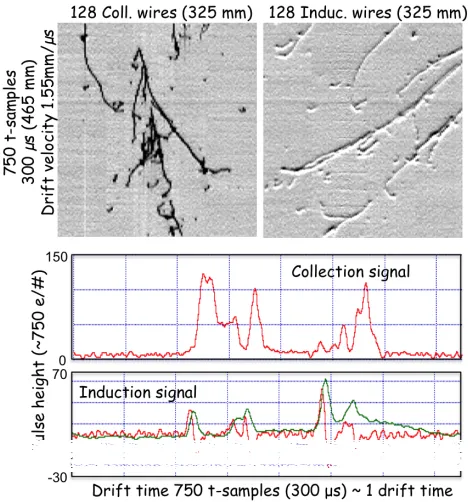
a better hit separation, in particular in crowded events. Finally these improvements will allow the measurement of the energy deposition in the Induction view also, providing a significant increase of the electron neutrino detection efficiency at the next SBN FNAL experiment. A first preliminary test
for the calorimetric reconstruction in the Induction view provides an energy resolution on the single wire signal∆E/E∼27%.
Figure 2. Two muon tracks with different inclinations in the mini LAr-TPC at CERN equipped with the new
read-out electronics. Both Induction and Collection views are shown (left), together with the signal from one of the wires (right). The very stable baseline without any undershoot allows for an improved hit position separation.
a better hit separation, in particular in crowded events. Finally these improvements will allow the measurement of the energy deposition in the Induction view also, providing a significant increase of the electron neutrino detection efficiency at the next SBN FNAL experiment. A first preliminary test
for the calorimetric reconstruction in the Induction view provides an energy resolution on the single wire signal∆E/E∼27%.
Figure 2. Two muon tracks with different inclinations in the mini LAr-TPC at CERN equipped with the new
read-out electronics. Both Induction and Collection views are shown (left), together with the signal from one of the wires (right). The very stable baseline without any undershoot allows for an improved hit position separation.
Figure 3.A shower collected in the mini LAr-TPC at CERN equipped with the new read-out electronics. Both Induction and Collection views are shown (top), together with the signal from one of the wires (bottom). The quality of the bipolar signal in Induction view allows to extract the energy deposition in Induction view with a dedicated algorithm (e.g. a running sum shown in green).
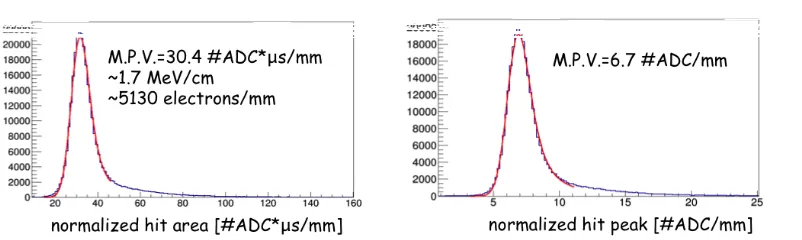
Figure 4.Distributions of the normalised hit area (left) and of the normalised hit peak (right) for the collected muon tracks.
The muon tracks collected have been used in particular to extract a first rough evaluation of the signal to noise ratio in the Collection view for this new read-out electronics. Single cosmic muon track events have been automatically selected off-line analyzing the Collection view signals and using
simple events selection criteria to extract an isolated track sample, without large delta-rays or e.m. shower activities. For each physical signal (hit) in the Collection view, the signal height and the signal area (proportional to the local deposited energy) have been calculated. The selected tracks have been then reconstructed in 3D in order to obtain also an evaluation of the dE/dx along the track. The
obtained distributions for the hit areas and heights, normalized to 1 mm of track, are shown in figure 4. In order to convert the collected signal in the corresponding deposited energy, a calibration of the response of each electronic channel has been also performed injecting dedicated test-pulse signals: the obtained dE/dx for the studied tracks, corrected also for the recombination, results roughly in
agreement with the expectations. In addition, the RMS of the collected signals for each Collection wire has been also evaluated, providing on average 2.4 ADC counts.
Starting from the parameters described above, two different definition for the signal to noise ratio have
been considered:
• thepeak signal-to-noise ratiois defined as the ratio between the most probable value (M.P.V.) of the hit height distribution (see figure 4 right) and the RMS of the wire signal
• thearea signal-to-noise ratiois defined as the ratio between the most probable value of the physical hit area distribution (see figure 4 left) and the RMS of the distribution of the area of hits with a duration similar to the physical one but generated in events where there are no real physical signals. Considering as a reference ∼20000 electrons collected in the wire, the peak signal-to-noise ratio results∼11 while the area signal-to-noise ratio results∼10. A similar procedure has been applied also in the events collected during the Gran Sasso run and so using the previous read-out electronics, providing a signal-to-noise ratio∼8.
5 Conclusions
In addition the new front-end amplifiers with a sharp signal shaping time result to be effective in the
reconstruction of the Induction (bipolar) signals, allowing also an evaluation of the energy deposition in the Induction view and improving at the same time the hit separation and the spatial resolution.
References
[1] C. Rubbia,CERN-EP/77-08(1977).
[2] A. Ankowski et al. (ICARUS Coll.), Nucl. Instr. and Meth.A556149 (2005). [3] M. Antonello et al. (ICARUS coll.), JINST9P08003 (2014)
[4] S. Amerio et al. (ICARUS Coll.), Nucl. Instr. and Meth. A527, 329 (2004). [5] C. Rubbia et al.(ICARUS Coll.), JINST6P07011 (2011)
[6] C. Farnese,The ICARUS experiment, these proceedings (2017) [7] A. Aguilar et al. (LSND Coll.), Phys. Rev. D64, 112007 (2001).
[8] A. A. Aguilar-Arevalo et al. (MiniBooNE Coll.), Phys. Rev. Lett.110, 161801 (2013) and refer-ences therein.
[9] G. Mention et al., Phys. Rev. D83(2011) 073006 and references therein. [10] C. Zhang, X Quian and P. Vogel, Phys. Rev. D87(2013) 073018. [11] J. N. Abdurashitov et al (SAGE Coll.), Phys. Rev. C80, 015807 (2009).
[12] F. Kaether, W. Hampel, G. Heusser, J. Kiko, and T. Kirsten, Phys. Lett. B47, 685 (2010) and references therein.
[13] M. Antonello et al. (ICARUS Coll.), Eur. Phys. J. C,732345 (2013). [14] M. Antonello et al., Eur. Phys. J. C732599 (2013).
[15] N. Agafonova et al., JHEP1307004 (2013)
[16] Planck Collaboration, Astron.Astrophys,594, A13 (2016)