CONIKS: Bringing Key Transparency to End Users
Marcela S. Melara, Aaron Blankstein, Joseph Bonneau
†, Edward W. Felten, Michael J. Freedman
Princeton University,
†Stanford University/Electronic Frontier Foundation
Abstract
We present CONIKS, an end-user key verification ser-vice capable of integration in end-to-end encrypted com-munication systems. CONIKS builds on transparency log proposals for web server certificates but solves sev-eral new challenges specific to key verification for end users. CONIKS obviates the need for global third-party monitors and enables users to efficiently monitor their own key bindings for consistency, downloading less than 20 kB per day to do so even for a provider with billions of users. CONIKS users and providers can collectively audit providers for non-equivocation, and this requires downloading a constant 2.5 kB per provider per day. Ad-ditionally, CONIKS preserves the level of privacy offered by today’s major communication services, hiding the list of usernames present and even allowing providers to con-ceal the total number of users in the system.
1
Introduction
Billions of users now depend on online services for sensi-tive communication. While much of this traffic is trans-mitted encrypted via SSL/TLS, the vast majority is not end-to-end encrypted meaning service providers still have access to the plaintext in transit or storage. Not only are users exposed to the well-documented insecurity of cer-tificate authorities managing TLS cercer-tificates [10, 11, 65], they also face data collection by communication provid-ers for improved pprovid-ersonalization and advertising [26] and government surveillance or censorship [25, 58].
Spurred by these security threats and users’ desire for stronger security [44], several large services including Apple iMessage and WhatsApp have recently deployed end-to-end encryption [20, 63]. However, while these services have limited users’ exposure to TLS failures and demonstrated that end-to-end encryption can be deployed with an excellent user experience, they still rely on a centralized directory of public keys maintained by the service provider. These key servers remain vulnerable to technical compromise [18, 49], and legal or extralegal pressure for access by surveillance agencies or others.
Despite its critical importance, secure key verification for end users remains an unsolved problem. Over two decades of experience with PGP email encryption [12,
56, 71] suggests that manual key verification is error-prone and irritating [23, 70]. The EFF’s recent Secure Messaging Scorecard reported that none of 40 secure messaging apps which were evaluated have a practical and secure system for contact verification [51]. Similar conclusions were reached by a recent academic survey on key verification mechanisms [67].
To address this essential problem, we present CONIKS, a deployable and privacy-preserving system for end-user key verification.
Key directories with consistency. We retain the basic model of service providers issuing authoritative name-to-key bindings within their namespaces, but ensure that users can automatically verifyconsistencyof their bind-ings. That is, given anauthenticated bindingissued by
foo.comfrom the [email protected] one or more public keys, anybody can verify that this is the same bind-ing [email protected] every other party observed.
Ensuring a strongercorrectnessproperty of bindings is impractical to automate as it would require users to verify that keys bound to the [email protected] genuinely controlled by an individual named Alice. Instead, with CONIKS, Bob can confidently use an authenticated bind-ing for the [email protected] he knows Alice’s software will monitor this binding and detect if it does not represent the key (or keys) Alice actually controls.
These bindings function somewhat like certificates in that users can present them to other users to set up a secure communication channel. However, unlike certificates, which present only an authoritative signature as a proof of validity, CONIKS bindings contain a cryptographic proof of consistency. To enable consistency checking, CONIKS servers periodically sign and publish an authenticated data structure encapsulating all bindings issued within their namespace, which all clients automatically verify is consistent with their expectations. If a CONIKS server ever tries toequivocateby issuing multiple bindings for a single username, this would require publishing distinct data structures which would provide irrefutable proof of the server’s equivocation. CONIKS clients will detect the equivocation promptly with high probability.
structures often calledtransparency logs[4, 35, 39, 40, 54, 61]. The security model is similar to CONIKS in that publication does not ensure a certificate is correct, but users can accept it knowing the valid domain owner will promptly detect any certificate issued maliciously.
Follow-up proposals have incorporated more advanced features such as revocation [4, 35, 39, 61] and finer-grained limitations on certificate issuance [4, 35], but all have made several basic assumptions which make sense for web PKI but not for end-user key verification. Specif-ically, all of these systems make the set of names and keys/certificates completely public and rely to varying degrees on third-party monitors interested in ensuring the security of web PKI on the whole. End-user key verifi-cation has stricter requirements: there are hundreds of thousands of email providers and communication appli-cations, most of which are too small to be monitored by independent parties and many of which would like to keep their users’ names and public keys private.
CONIKS solves these two problems:
1. Efficient monitoring. All previous schemes in-clude third-party monitors since monitoring the certifi-cates/bindings issued for a single domain or user requires tracking the entire log. Webmasters might be willing to pay for this service or have their certificate authority pro-vide it as an add-on benefit. For individual users, it is not clear who might provide this service free of charge or how users would choose such a monitoring service, which must be independent of their service provider itself.
CONIKS obviates this problem by using an efficient data structure, aMerkle prefix tree, which allows a single small proof (logarithmic in the total number of users) to guarantee the consistency of a user’s entry in the direc-tory. This allows users to monitor only their own entry without needing to rely on third parties to perform expen-sive monitoring of the entire tree. A user’s device can automatically monitor the user’s key binding and alert the user if unexpected keys are ever bound to their username.
2. Privacy-preserving key directories. In prior sys-tems, third-party monitors must view the entire system log, which reveals the set of users who have been is-sued keys [35, 40, 54, 61]. CONIKS, on the contrary, is privacy-preserving. CONIKS clients may only query for individual usernames (which can be rate-limited and/or authenticated) and the response for any individual queries leaks no information about which other users exist or what key data is mapped to their username. CONIKS also naturally supports obfuscating the number of users and updates in a given directory.
CONIKS in Practice.We have built a prototype CON-IKS system, which includes both the application-agnostic CONIKS server and an example CONIKS Chat appli-cation integrated into the OTR plug-in [8, 27, 66] for
Pidgin [1]. Our CONIKS clients automatically monitor their directory entry by regularly downloading consis-tency proofs from the CONIKS server in the background, avoiding any explicit user action except in the case of notifications that a new key binding has been issued.
In addition to the strong security and privacy features, CONIKS is also efficient in terms of bandwidth, compu-tation, and storage for clients and servers. Clients need to download about 17.6 kB per day from the CONIKS server and verifying key bindings can be done in milliseconds. Our prototype server implementation is able to easily sup-port 10 million users (with 1% changing keys per day) on a commodity machine.
2
System Model and Design Goals
The goal of CONIKS is to provide a key verification sys-tem that facilitates practical, seamless, and secure com-munication for virtually all of today’s users.
2.1
Participants and Assumptions
CONIKS’s security model includes four main types of principals: identity providers, clients (specifically client software), auditors and users.
Identity Providers. Identity providers run CONIKS servers and manage disjoint namespaces, each of which has its own set of name-to-key bindings.1 We assume a separate PKI exists for distributing providers’ public keys, which they use to sign authenticated bindings and to transform users’ names for privacy purposes.
While we assume that CONIKS providers may be mali-cious, we assume they have a reputation to protect and do not wish to attack their users in a public manner. Because CONIKS primarily provides transparency and enables reactive security in case of provider attacks, CONIKS cannot deter a service provider which is willing to attack its users openly (although it will expose the attacks).
Clients. Users run CONIKS client software on one or more trusted devices; CONIKS does not address the prob-lem of compromised client endpoints. Clientsmonitor
the consistency of their user’s own bindings. To support monitoring, we assume that at least one of a user’s clients has access to a reasonably accurate clock as well as access to secure local storage in which the client can save the results of prior checks.
We also assume clients have network access which can-not be reliably blocked by their communication provider. This is necessary forwhistleblowingif a client detects
misbehavior by an identity provider (more details in §4.2). CONIKS cannot ensure security if clients have no means of communication that is not under their communication provider’s control.2
Auditors. To verify that identity providers are not equiv-ocating,auditorstrack the chain of signed “snapshots” of the key directory. Auditors publish and gossip with other auditors to ensure global consistency. Indeed, CONIKS clients all serve as auditors for their own identity provider and providers audit each other. Third-party auditors are also able to participate if they desire.
Users. An important design strategy is to provide good baseline security which is accessible to nearly all users, necessarily requiring some security tradeoffs, with the op-portunity for upgraded security for advanced users within the same system to avoid fragmenting the communication network. While there are many gradations possible, we draw a recurring distinction betweendefault usersand
strict usersto illustrate the differing security properties and usability challenges of the system.
We discuss the security tradeoffs between these two user security policies in §4.3.
2.2
Design Goals
The design goals of CONIKS are divided into security, privacy and deployability goals.
Security goals.
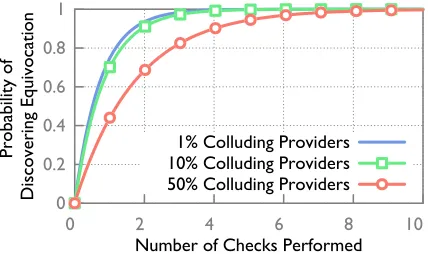
G1: Non-equivocation. An identity provider may at-tempt to equivocate by presenting diverging views of the name-to-key bindings in its namespace to different users. Because CONIKS providers issue signed, chained “snap-shots” of each version of the key directory, any equivoca-tion to two distinct parties must be maintained forever or else it will be detected by auditors who can then broad-cast non-repudiable cryptographic evidence, ensuring that equivocation will be detected with high probability (see Appendix B for a detailed analysis).
G2: No spurious keys. If an identity provider inserts a malicious key binding for a given user, her client software will rapidly detect this and alert the user. For default users, this will not produce non-repudiable evidence as key changes are not necessarily cryptographically signed with a key controlled by the user. However, the user will still see evidence of the attack and can report it publicly. For strict users, all key changes must be signed by the user’s previous key and therefore malicious bindings will not be accepted by other users.
2Even given a communication provider who also controls all network access, it may be possible for users to whistleblow manually by reading information from their device and using a channel such as physical mail or sneakernet, but we will not model this in detail.
Privacy goals.
G3: Privacy-preserving consistency proofs.CONIKS servers do not need to make any information about their bindings public in order to allow consistency verification. Specifically, an adversary who has obtained an arbitrary number of consistency proofs at a given time, even for adversarially chosen usernames, cannot learn any infor-mation about which other users exist in the namespace or what data is bound to their usernames.
G4: Concealed number of users. Identity providers may not wish to reveal their exact number of users. CON-IKS allows providers to insert an arbitrary number of
dummy entriesinto their key directory which are indis-tinguishable from real users (assuming goal G3 is met), exposing only an upper bound on the number of users.
Deployability goals.
G5: Strong security with human-readable names.
With CONIKS, users of the system only need to learn their contacts’ usernames in order to communicate with end-to-end encryption. They need not explicitly reason about keys. This enables seamless integration in end-to-end encrypted communication systems and requires no effort from users in normal operation.
G6: Efficiency.Computational and communication over-head should be minimized so that CONIKS is feasible to implement for identity providers using commodity servers and for clients on mobile devices. All overhead should scale at most logarithmically in the number of total users.
3
Core Data Structure Design
At a high level, CONIKS identity providers manage a directory of verifiable bindings of usernames to public keys. This directory is constructed as a Merkle prefix tree of all registered bindings in the provider’s namespace.
At regular time intervals, or epochs, the identity pro-vider generates a non-repudiable “snapshot” of the di-rectory by digitally signing the root of the Merkle tree. We call this snapshot asigned tree root(STR) (see §3.3). Clients can use these STRs to check the consistency of key bindings in an efficient manner, obviating the need for clients to have access to the entire contents of the key directory. Each STR includes the hash of the previous STR, committing to a linear history of the directory.
key data is equal to some known value even given this user’s lookup index, a cryptographiccommitment3to each user’s key data is stored at the private index, rather than the public keys themselves.
3.1
Merkle Prefix Tree
CONIKS directories are constructed as Merkle binary prefix trees. Each node in the tree represents a unique prefixi. Each branch of the tree adds either a 0 or a 1 to the prefix of the parent node. There are three types of nodes, each of which is hashed slightly differently into a representative value using a collision-resistant hashH():
Interior nodesexist for any prefix which is shared by more than one index present in the tree. An interior node is hashed as follows, committing to its two children:
hinterior=H(hchild.0||hchild.1)
Empty nodesrepresent a prefixiof length`(depth`in the tree) which is not a prefix of any index included in the tree. Empty nodes are hashed as:
hempty=H kempty||kn||i||`
Leaf nodes represent exactly one complete index i
present in the tree at depth`(meaning its first`bits form a unique prefix). Leaf nodes are hashed as follows:
hleaf=H(kleaf||kn||i||`||commit(namei||keysi))
where commit(namei||keysi)is a cryptographic
commit-ment to the name and the associated key data. Committing to the name, rather than the indexi, protects against colli-sions in the VRF used to generatei(see §3.4).
Collision attacks.While arbitrary collisions in the hash function are not useful, a malicious provider can mount a birthday attack to try to find two nodes with the same hash (for example by varying the randomness used in the key data commitment). Therefore, fort-bit security our hash function must produce at least 2tbits of output.
The inclusion of depths` and prefixes iin leaf and empty nodes (as well as constantskemptyandkleafto
dis-tinguish the two) ensures that no node’s pre-image can be valid at more than one location in the tree (including inte-rior nodes, whose location is implicit given the embedded locations of all of its descendants). The use of a tree-wide nonceknensures that no node’s pre-image can be valid at
the same location between two distinct trees which have chosen different nonces. Both are countermeasures for themulti-instance settingof an attacker attempting to find
3Commitments are a basic cryptographic primitive. A simple imple-mentation computes a collision-resistant hash of the input data and a random nonce.
…
…
H(child0) H(child1)kleaf||kn||iBob||l||
commit(bob, PKBob)
H(child0) H(child1)
H(child0) H(child1)
H(child0) H(child1)
…
H(child0) H(child1)
0
0
0
1
1
1
root
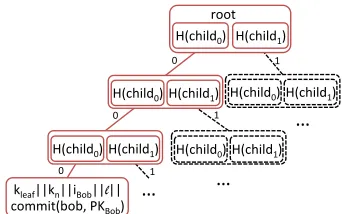
Figure 1: An authentication path from Bob’s key en-try to the root node of the Merkle prefix tree. Bob’s index,iBob, has the prefix “000”. Dotted nodes are not included in the proof’s authentication path.
a collision at more than one location simultaneously.4. Uniquely encoding the location requires the attacker to target a specific epoch and location in the tree and ensures fullt-bit security.
If the tree-wide nonceknis re-used between epochs, a
parallel birthday attack is possible against each version of the tree. However, choosing a newkneach epoch means
that every node in the tree will change.
3.2
Proofs of Inclusion
Since clients no longer have a direct view on the contents of the key directory, CONIKS needs to be able to prove that a particular index exists in the tree. This is done by providing a proof of inclusion which consists of the completeauthentication pathbetween the corresponding leaf node and the root. This is a pruned tree containing the prefix path to the requested index, as shown in Figure 1. By itself, this path only reveals that an index exists in the directory, because the commitment hides the key data mapped to an index. To prove inclusion of the full binding, the server provides an opening of the commitment in addition to the authentication path.
Proofs of Absence.To prove that a given index jhas no key data mapped to it, an authentication path is provided to the longest prefix match ofjcurrently in the directory. That node will either be a leaf node at depth`with an indexi6=jwhich matches jin the first`bits, or an empty node whose indexiis a prefix of j.
3.3
Signed Tree Roots
At each epoch, the provider signs the root of the direc-tory tree, as well as some metadata, using their direcdirec-tory- directory-signing keySKd. Specifically, an STR consists of
STR=SignSK
d(t||tprev||roott||H(STRprev)||P)
root0
H(seed) 0
…
.
STR0 STRprev STRt
P
rootprev
H(STRprev-‐1)
tprev
P
roott
H(STRprev)
t
P tprev-‐1 tprev
Figure 2: The directory’s history is published as a lin-ear hash chain of signed tree roots.
wheretis the epoch number andPis a summary of this provider’s current security policies. Pmay include, for example, the keyKVRFused to generate private indices,
an expected time the next epoch will be published, as well as the cryptographic algorithms in use, protocol version numbers, and so forth. The previous epoch numbertprev
must be included because epoch numbers need not be sequential (only increasing). In practice, our implementa-tion uses UNIX timestamps.
By including the hash of the previous epoch’s STR, the STRs form ahash chain committing to the entire history, as shown in Figure 2. This hash chain is used to ensure that if an identity provider ever equivocates by creating a fork in its history, the provider must maintain these forked hash chains for the rest of time (i.e. it must maintainfork consistency[42]). Otherwise, clients will immediately detect the equivocation when presented with an STR belonging to a different branch of the hash chain.
3.4
Private Index Calculation
A key design goal is to ensure that each authentication path reveals no information about whether any other
names are present in the directory. If indices were com-puted using any publicly computable function of the user-name (such as a simple hash), each user’s authentication path would reveal information about the presence of other users with prefixes “close” to that user.
For example, if a [email protected]’s shortest unique prefix in the tree isiand her immediate neighbor in the tree is a non-empty node, this reveals that at least one users exists with the same prefixi. An attacker could hash a large number of potential usernames offline, searching for a potential username whose index shares this prefixi.
Private Indices. To prevent such leakage, we compute private indices using averifiable random function, a pseu-dorandom function that requires a private key to compute. VRF computations can be verified with a short proof, but without the proof the result is indistinguishable from ran-dom.5 Given such a function VRF(), we generate the indexifor a useruas:
i=H(VRFKVRF(u))
5Related to VRFs are verifiable unpredictable functions [48], whose output is self-verifying without a distinct proof and therefore not indis-tinguishable from random. This is insufficient for privacy because a username might be recovered given some bits of a VUF result.
KVRFis a public key belonging to the provider, and it is
specified in the policy field of each STR. A full proof of inclusion for userutherefore requires the value of VRF(u)
in addition to the authentication path and an opening of the commitment to the user’s key data.
We can implement a VRF by applying a hash function (modeled as a random oracle) to the result of any deter-ministic, existentially unforgeable signature scheme [48]. The signature scheme must be deterministic or else the identity provider could insert multiple bindings for a user at different locations each with a valid authentication path. We discuss our choice for this primitive in §5.2.
Note that we might like our VRF to be collision-resistant to ensure that a malicious provider cannot pro-duce two usernamesu,u0 which map to the same in-dex. However, VRFs are not guaranteed to be collision-resistant given knowledge of the private key (and the ability to pick this key maliciously). To prevent any po-tential problems we commit to the usernameu in each leaf node. This ensures that only one ofuoru0can be validly included in the tree even if the provider has crafted them to share an index.
4
CONIKS Operation
With the properties of key directories outlined in §3, CON-IKS provides four efficient protocols that together allow end users to verify each other’s keys to communicate se-curely: registration, lookup, monitoring and auditing. In these protocols, providers, clients and auditors collaborate to ensure that identity providers do not publish spurious keys, and maintain a single linear history of STRs.
4.1
Protocols
4.1.1 Registration and Temporary Bindings
CONIKS provides a registration protocol, which clients use to register a new name-to-key binding with an identity provider on behalf of its user, or to update the public key of the user’s existing binding when revoking her key. An important deployability goal is for users to be able to communicate immediately after enrollment. This means users must be able to use new keysbeforethey can be added to the key directory. An alternate approach would be to reduce the epoch time to a very short interval (on the order of seconds). However, we consider this undesirable both on the server end and in terms of client overhead.
CONIKS providers may issuetemporary bindings with-out writing any data to the Merkle prefix tree. A tempo-rary binding consists of:
TB=SignK
The binding includes the most recent signed tree root
ST Rt, the indexifor the user’s binding, and the user’s
new key informationk. The binding is signed by the identity provider, creating a non-repudiable promise to add this data to the next version of the tree.
To register a user’s key binding with a CONIKS iden-tity provider, her client now participates in the following protocol. First, the client generates a key pair for the user and stores it in some secure storage on the device. Next, the client sends a registration request to the provider to the bind the public key to the user’s online name, and if this name is not already taken in the provider’s namespace, it returns a temporary binding for this key. The client then needs to wait for the next epoch and ensure that the provider has kept its promise of inserting Alice’s binding into its key directory by the next epoch.
4.1.2 Key Lookups
Since CONIKS clients only regularly check directory roots for consistency, they need to ensure that public keys retrieved from the provider are contained in the most recently validated directory. Thus, whenever a CONIKS client looks up a user’s public key to contact her client, the provider also returns a proof of inclusion showing that the retrieved binding is consistent with a specific STR. This way, if a malicious identity provider attempts to distribute a spurious key for a user, it is not able to do so without leaving evidence of the misbehavior. Any client that looks up this user’s key and verifies that the binding is included in the presented STR will then promptly detect the attack.
In more detail, CONIKS’s lookup protocol achieves this goal in three steps (summarized in Fig. 3). When a user wants to send a secure message to another user, her client first requests the recipient’s public key at her provider. To allow the client to check whether the recipi-ent’s binding is included in the STR for the current epoch, the identity provider returns the full authentication path for the recipient’s binding in the Merkle prefix tree along with the current STR. In the final step, the client recom-putes the root of the tree using the authentication path and checks that this root is consistent with the presented STR. Note that, if the recipient has not registered a binding with the identity provider, it returns an authentication path as a proof of absence allowing the client to verify that the binding is indeed absent in the tree and consistent with the current STR.
4.1.3 Monitoring for Spurious Keys
CONIKS depends on the fact that each client monitors its own user’s binding every epoch to ensure that her key binding has not changed unexpectedly. This prevents a malicious identity provider from inserting spurious keys
Lookup alice Iden/ty Provider foo.com
Client B
User Bob 1
PKA + auth. path for alice + STR 2
Verify auth. path 3
Figure 3: Steps taken when a client looks up a user’s public key at her identity provider.
Lookup bob Iden,ty Provider
foo.com
Client
B
User Bob 1
PKB + auth. path for bob + STR 2
Verify validity of PKB & auth. path consistent w/ STR 3
Figure 4: Steps taken when a client monitors its own user’s binding for spurious keys every epoch.
that are properly included in the STR. Clients do not mon-itor other user’s bindings as they may not have enough information to determine when another user’s binding has changed unexpectedly.
Fig. 4 summarizes the steps taken during the monitor-ing protocol. The client begins monitormonitor-ing by performmonitor-ing a key lookup for its own user’s name to obtain a proof of inclusion for the user’s binding. Next, the client checks the binding to ensure it represents the public key data the user believes is correct. In the simplest case, this is done by checking that a user’s key is consistent between epochs. If the keys have not changed, or the client detects an authorized key change, the user need not be notified.
In the case of an unexpected key change, by default the user chooses what course of action to take as this change may reflect, for example, having recently enrolled a new device with a new key. Alternatively, security-conscious users may request a stricter key change policy which can be automatically enforced, and which we discuss further in §4.3. After checking the binding for spurious keys, the client verifies the authentication path as described in §3, including verifying the user’s private index.
4.1.4 Auditing for Non-Equivocation
Fail Not matching Invalid
Valid Match STRt
No response Check signature on
STR
Compare hash of cached STRprev with
H(STRprev) in STRt
STRprev
Check passed Get provider's
STR for epoch t
Figure 5: Steps taken when verifying if a provider’s STR history is linear in the auditing protocol.
Compare observed
STRs from foo.com
Chosen randomly, request latest STR
from foo.com
Iden:ty Provider
rand.com
Client
B
1
Latest STR observed
from foo.com
2
3 Iden:ty Provider
bar.com
1
2 Latest STR observed
from foo.com
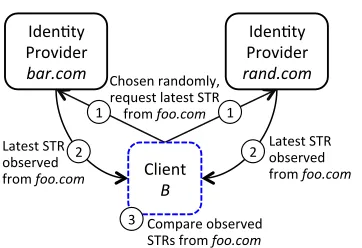
Figure 6: Steps taken when comparing STRs in the auditing protocol.
that the identity provider of any user they contact is not equivocating about its directory. In other words, clients need to verify that any provider of interest is maintaining a linear STR history. Comparing each observed STR with every single other client with which a given client com-municates would be a significant performance burden.
Therefore, CONIKS allows identity providers to facili-tate auditing for their clients by acting as auditors of all CONIKS providers with which their users have been in communication (although it is also possible for any other entity to act as an auditor). Providers achieve this by dis-tributing their most recent STR to other identity providers in the system at the beginning of every epoch.6
The auditing protocol in CONIKS checks whether an identity provider is maintaining a linear STR history. Iden-tity providers perform the history verification whenever they observe a new STR from any other provider, while clients do so whenever they request the most recent STR from a specific identity provider directly. We summa-rize the steps required for an auditor to verify an STR history in Fig. 5. The auditor first ensures that the pro-vider correctly signed the STR before checking whether the embedded hash of the previous epoch’s STR matches what the auditor saw previously. If they do not match, the provider has generated a fork in its STR history.
Because each auditor has independently verified a pro-vider’s history, each has its own view of a propro-vider’s STR, so clients must perform an STR comparison to check for possible equivocation between these views (summarized in Fig. 6). Once a client has verified the provider’s STR history is linear, the client queries one or more CONIKS
6CONIKS could support an auditing protocol in which clients di-rectly exchange observed STRs, obviating the need of providers to act as auditors. The design of such a protocol is left as future work.
identity providers at random.7The client asks the auditor for the most recent STR it observed from the provider in question. Because the auditor has already verified the provider’s history, the client need not verify the STR re-ceived from the auditor. The client then compares the auditor’s observed STR with the STR which the provider directly presented it. The client may repeat this process with different auditors as desired to increase confidence. For an analysis of the number of checks necessary to detect equivocation with high probability, see App. B.
CONIKS auditors store the current STRs of CONIKS providers; since the STRs are chained, maintaining the current STR commits to the entire history. Because this is a small, constant amount of data (less than 1 kB) it is efficient for a single machine to act as an auditor for thousands of CONIKS providers.
4.2
Secure Communication with CONIKS
When a user Bob wants to communicate with a user Al-ice via their CONIKS-backed secure messaging servAl-ice
foo.com, his clientclient Bperforms the following steps. We assume both Alice’s and Bob’s clients have registered their respective name-to-key bindings withfoo.comas described in §4.1.1.
1. Periodically,client Bchecks the consistency of Bob’s binding. To do so, the client first performs the monitoring protocol (per §4.1.3), and then it audits
foo.com(per §4.1.4).
2. Before sending Bob’s message toclient A,client B
looks up the public key for the usernamealiceat
foo.com(§4.1.2). It verifies the proof of inclusion foraliceand performs the auditing protocol (§4.1.4) forfoo.comif the STR received as part of the lookup is different or newer than the STR it observed for
foo.comin its latest run of step 1.
3. Ifclient Bdetermines that Alice’s binding is consis-tent, it encrypts Bob’s message usingalice’s public key and signs it using Bob’s key. It then sends the message.
Performing checks after missed epochs.Because STRs are associated with each other across epochs, clients can “catch up” to the most recent epoch if they have not
fied the consistency of a binding for several epochs. They do so by performing a series of the appropriate checks un-til they are sure that the proofs of inclusion and STRs they last verified are consistent with the more recent proofs. This is the only way a client can be sure that the security of its communication has not been compromised during the missed epochs.
Liveness. CONIKS servers may attempt to hide mali-cious behavior by ceasing to respond to queries. We provide flexible defense against this, as servers may also simply go down. Servers may publish an expected next epoch number with each STR in the policy sectionP. Clients must decide whether they will accept STRs pub-lished at a later time than previously indicated.
Whistleblowing.If a client ever discovers two inconsis-tent STRs (for example, two distinct versions signed for the same epoch time), they should notify the user and
whistleblowby publishing them to all auditors they are able to contact. For example, clients could include them in messages sent to other clients, or they could explicitly send whistleblowing messages to other identity providers. We also envision out-of-band whistleblowing in which users publish inconsistent STRs via social media or other high-traffic sites. We leave the complete specification of a whistleblowing protocol for future work.
4.3
Multiple Security Options
CONIKS gives users the flexibility to choose the level of security they want to enforce with respect to key lookups and key change. For each functionality, we propose two security policies: a default policy and a strict policy, which have different tradeoffs of security and privacy against usability. All security policies are denoted by flags that are set as part of a user’s directory entry, and the consistency checks allow users to verify that the flags do not change unexpectedly.
4.3.1 Visibility of Public Keys
Our goal is to enable the same level of privacy SMTP servers employ today,8in which usernames can be queried
(subject to rate-limiting) but it is difficult to enumerate the entire list of names.
Users need to decide whether their public key(s) in the directory should be publicly visible. The difference be-tween the default and the strict lookup policies is whether the user’s public keys are encrypted with a secret sym-metric key known only to the binding’s owner and any
8The SMTP protocol defines aVRFYcommand to query the exis-tence of an email address at a given server. To protect user’s privacy, however, it has long been recommended to ignore this command (report-ing that any usernames exists if asked) [43].
other user of her choosing. For example, if the user Al-ice follows the default lookup policy, her public keys are not encrypted. Thus, anyone who knows Alice’s name
[email protected] look up and obtain her keys from her
foo.com’s directory. On the other hand, if Alice follows the strict lookup policy, her public keys are encrypted with a symmetric key only known to Alice and the users of her choosing.
Under both lookup policies, any user can verify the consistency of Alice’s binding as described in §4, but if she enforces the strict policy, only those users with the symmetric key learn her public keys. The main advantage of the default policy is that it matches users’ intuition about interacting with any user whose username they know without requiring explicit “permission”. On the other hand, the strict lookup policy provides stronger privacy, but it requires additional action to distribute the symmetric key which protects her public keys.
4.3.2 Key Change
Dealing with key loss is a difficult quandary for any secu-rity system. Automatic key recovery is an indispensable option for the vast majority of users who cannot perpet-ually maintain a private key. Using password authenti-cation or some other fallback method, users can request that identity providers change a user’s public key in the event that the user’s previous device was lost or destroyed. If Alice chooses the default key change policy, her iden-tity providerfoo.comaccepts any key change statement in which the new key is signed by the previous key, as well as unsigned key change requests. Thus,foo.com
should change the public key bound [email protected]
only upon her request, and it should reflect the update to Alice’s binding by including a key change statement in her directory entry. The strict key change policyrequires
that Alice’s client sign all of her key change statements with the key that is being changed. Thus, Alice’s client only considers a new key to be valid if the key change statement has been authenticated by one of her public keys.
ever lost. We discuss some implications for key loss for strict users in §6.
5
Implementation and Evaluation
CONIKS provides a framework for integrating key verifi-cation into communiverifi-cations services that support end-to-end encryption. To demonstrate the practicality of CON-IKS and how it interacts with existing secure communi-cations services, we implemented a prototype CONIKS Chat, a secure chat service based on the Off-the-Record Messaging [8] (OTR) plug-in for the Pidgin instant mes-saging client [1, 27]. We implemented a stand-alone CONIKS server in Java (∼2.5k sloc), and modified the OTR plug-in (∼2.2k sloc diff) to communicate with our server for key management. We have released a basic reference implementation of our prototype on Github.9
5.1
Implementation Details
CONIKS Chat consists of an enhanced OTR plug-in for the Pidgin chat client and a stand-alone CONIKS server which runs alongside an unmodified Tigase XMPP server. Clients and servers communicate using Google Protocol Buffers [2], allowing us to define specific message for-mats. We use our client and server implementations for our performance evaluation of CONIKS.
Our implementation of the CONIKS server provides the basic functionality of an identity provider. Every ver-sion of the directory (implemented as a Merkle prefix tree) as well as every generated STR are persisted in a MySQL database. The server supports key registration in the namespace of the XMPP service, and the directory efficiently generates the authentication path for proofs of inclusion and proofs of absence, both of which implicitly prove the proper construction of the directory. Our server implementation additionally supports STR exchanges be-tween identity providers.
The CONIKS-OTR plug-in automatically registers a user’s public key with the server upon the generation of a new key pair and automatically stores information about the user’s binding locally on the client to facilitate future consistency checks. To facilitate CONIKS integration, we leave the DH-based key exchange protocol in OTR unchanged, but replace the socialist millionaires proto-col used for key verification with a public key lookup at the CONIKS server. If two users, Alice and Bob, both having already registered their keys with theconiks.org
identity provider, want to chat, Alice’s client will auto-matically request a proof of inclusion for Bob’s binding inconiks.org’s most recent version of the directory. Upon
9
https://github.com/coniks-sys/coniks-ref-implementation
receipt of this proof, Alice’s client automatically verifies the authentication path for Bob’s name-to-key binding (as described in §4.1.2), and caches the newest information about Bob’s binding if the consistency checks pass. If Bob has not registered his key withconiks.org, the client falls back to the original key verification mechanism. Ad-ditionally, Alice’s client and Bob’s clients automatically perform all monitoring and auditing checks for their re-spective bindings upon every login and cache the most recent proofs.
CONIKS Chat currently does not support key changes. Furthermore, our prototype only supports the default lookup policy for name-to-key bindings. Fully imple-menting these features is planned for the near future.
5.2
Choice of Cryptographic Primitives
To provide a 128-bit security level, we use SHA-256 as our hash function and EC-Schnorr signatures [22, 64].
Unfortunately Schnorr signatures (and related discrete-log based signature schemes like DSA [37]) are not imme-diately applicable as a VRF as they are not deterministic, requiring a random nonce which the server can choose arbitrarily.10 In Appendix A we describe a discrete-log based scheme for producing a VRF in the random-oracle model. Note that discrete-log based VRFs are longer than basic signatures: at a 128-bit security level using elliptic curves, we expect signatures of size 512 bits and 768 bits for the VRF result and proof.
Alternately, we could build a VRF from a deterministic signature scheme like classic RSA signatures [60] (using a deterministic padding scheme such as PKCS v. 1.5 [32]) plus an additional hash, although RSA is not particularly space-efficient at a 128-bit security level. Using RSA-2048 provides approximately 112 bits of security [3] with proofs of size 2048 bits.11
Using elliptic curve groups equipped with a pairing, we can use BLS “short signatures” [7] plus the VRF con-struction of Dodis et al. [15] to achieve 256-bit signatures and VRFs of 512 bits (including the result and a 256-bit proof). BLS signatures also supportaggregation, that is, multiple signatures can be compressed into a single signature, meaning the server can combine the signatures onnconsecutive roots. However support for pairing cal-culations required for BLS is not as widespread, making it more difficult to standardize and deploy.
We evaluate performance in Table 1 in the next section for all three potential choices of primtives to build the signature and VRF schemes.
10There are deterministic variants of Schnorr or DSA [5, 50] but these are notverifiablydeterministic as they generate nonces pseudorandomly as a symmetric-key MAC of the data to be signed.
�� ���� �� ���� �� ���� �� ����
����� ����� �����
�����������������������
������������������������
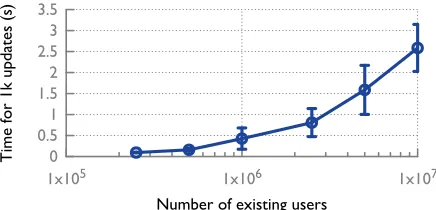
Figure 7: Mean time to re-compute the tree for a new epoch with 1K updated nodes. The x-axis is logarith-mic and each data point is the mean of 10 executions. Error bars indicate standard deviation.
5.3
Performance Evaluation
To estimate the performance of CONIKS, we collect both theoretical and real performance characteristics of our prototype implementation. We evaluate client and server overheads with the following parameters:
• A single provider might supportN≈232users.
• Epochs occur roughly once per hour.
• Up to 1% of users change or add keys per day, mean-ingn≈221directory updates in an average epoch. • Servers use a 128-bit cryptographic security level.
Server Overheads. To measure how long it takes for a server to compute the changes for an epoch, we evaluated our server prototype on a 2.4 GHz Intel Xeon E5620 machine with 64 GB of RAM allotted to the OpenJDK 1.7 JVM. We executed batches of 1000 insertions (roughly 3 times the expected number of directory updates per epoch) into a Merkle prefix with 10 M users, and measured the time it took for the server to compute the next epoch.
Figure 7 shows the time to compute a version of the directory with 1000 new entries as the size of the original namespace varies. For a server with 10 M users, com-puting a new Merkle tree with 1000 insertions takes on average 2.6s. As epochs only need to be computed every hour, this is not cumbersome for a large service provider. These numbers indicate that even with a relatively unopti-mized implementation, a single machine is able to handle the additional overhead imposed by CONIKS for work-loads similar in scale to a medium-sized communication providers (e.g., TextSecure) today.
While our prototype server implementation on a com-modity machine comfortably supports 10M users, we note that due to the statistically random allocation of users to indices and the recursive nature of the tree structure, the task parallelizes near-perfectly and it would be trivial to scale horizontally with additional identical servers to compute a directory with billions of users.
Lookup Cost. Every time a client looks up a user’s binding, it needs to download the current STR, a proof of of inclusion consisting of about lg2(N) +1 hashes plus one 96-byte VRF proof (proving the validity of the binding’s private index). This will require downloading 32·(lg2(N) +1) +96≈1216 bytes. Verifying the proof will require up to lg2(N) +1 hash verifications on the authentication path as well as one VRF verification. On a 2 GHz Intel Core i7 laptop, verifying the authentication path returned by a server with 10 million users, required on average 159µs(sampled over 1000 runs, withσ=30).
Verifying the signature takes approximately 400µs,
domi-nating the cost of verifying the authentication path. While mobile-phone clients would require more computation time, we do not believe this overhead presents a signifi-cant barrier to adoption.
Monitoring Cost.In order for any client to monitor the consistency of its own binding, it needs fetch proof that this binding is validly included in the epoch’s STR. Each epoch’s STR signature (64 bytes) must be downloaded and the client must fetch its new authentication path. How-ever, the server can significantly compress the length of this path by only sending the hashes on the user’s path which have changed since the last epoch. Ifnchanges are made to the tree, a given authentication path will have lg2(n)expected changed nodes. (This is the expected longest prefix match between thenchanged indices and the terminating index of the given authentication path.) Therefore each epoch requires downloading an average of 64+lg2(n)·32≈736 bytes. Verification time will be similar to verifying another user’s proof, dominated by the cost of signature verification. While clients need to fetch each STR from the server, they are only required to
storethe most recent STR (see §5.3).
To monitor a binding for a day, the client must down-load a total of about 19.1 kB. Note that we have assumed users update randomly throughout the day, but for a fixed number of updates this is actually the worst-case scenario for bandwidth consumption; bursty updates will actually lead to a lower amount of bandwidth as each epoch’s proof is lg2(n)fornchanges. These numbers indicate that neither bandwidth nor computational overheads pose a significant burden for CONIKS clients.
# # # approximate bandwidth
VRFs sigs. hashes RSA traditional EC EC w/pairings lookup (per binding) 1 1 lgN+1 1600 B 1216 B 1152 B
monitor (epoch) 0 1 lgn 928 B 736 B 704 B
monitor (day) 1 k† klgn 22.6 kB 17.6 kB 16.9 kB
audit (epoch, per STR) 0 1 1 288 B 96 B 64 B
audit (day, per STR) 0 k† k 6.9 kB 2.3 kB 0.8 kB
Table 1: Client bandwidth requirements for three underlying public-key cryptographic primitive: RSA, elliptic curves using EC-Schnorr plus the VRF defined in Appendix A, and an elliptic curve group equipped with a bilinear pairing using BLS signatures [7] and the Dodis et al. VRF [15]. Results are given for routine lookups, monitoring, and auditing in terms of the number of signatures, VRFs and hashes downloaded assumingN≈232
total users,n≈221changes per epoch, andk≈24epochs per day. Signatures that can be aggregated into a single signature to transmit in the BLS signature scheme are denoted by†.
6
Discussion
6.1
Coercion of Identity Providers
Government agencies or other powerful adversaries may attempt to coerce identity providers into malicious behav-ior. Recent revelations about government surveillance and collection of user communications data world-wide have revealed that governments use mandatory legal pro-cess to demand acpro-cess to information providers’ data about users’ private communications and Internet activity [9, 24, 25, 52, 53]. A government might demand that an identity provider equivocate about some or all name-to-key bindings. Since the identity provider is the entity actually mounting the attack, a user of CONIKS has no way of technologically differentiating between a mali-cious insider attack mounted by the provider itself and this coerced attack [19]. Nevertheless, because of the con-sistency and non-equivocation checks CONIKS provides, users could expose such attacks, and thereby mitigate their effect.
Furthermore, running a CONIKS server may provide some legal protection for service providers under U.S. law for providers attempting to fight legal orders, because complying with such a demand will produce public ev-idence that may harm the provider’s reputation. (Legal experts disagree about whether and when this type of argument shelters a provider[46].)
6.2
Key Loss and Account Protection
CONIKS clients are responsible for managing their pri-vate keys. However, CONIKS can provide account pro-tection for users who enforce the paranoid key change policy and have forfeit their username due to key loss. Even if Alice’s key is lost, her identity remains secure; she can continue performing consistency checks on her old binding. Unfortunately, if a future attacker manages
to obtain her private key, that attacker may be able to assume her “lost identity”.
In practice, this could be prevented by allowing the provider to place a “tombstone” on a name with its own signature, regardless of the user’s key policy. The provider would use some specific out-of-band authorization steps to authorize such an action. Unlike allowing providers to issue key change operations, though, a permanent account deactivation does not require much additional trust in the provider, because a malicious provider could already render an account unusable through denial of service.
6.3
Protocol Extensions
Speeding up auditing with version history.By default, clients who go offline for an extended period of time, say
`epochs, faceΘ(`)monitoring costs to verify that their
data was not changed in any of the epochs they missed. It is not sufficient to simply check that their data in the most recent STR is the same as it was at the point they went offline, as the server might have changed their binding at some point but changed it back prior to the client coming back online.
However, clients would need to trust a third-party audi-tor to check that in each epoch the server correctly updates the version history information for all leaves which have changed. This would requireΘ(n)work by the auditor if
nchanges are made in a typical epoch, so it may not be realistic in all deployments to assume an auditor exists that will do this checking for free. However, there is little cost to adding version history information—clients which don’t want to trust any third-party auditors can continue to monitor their binding for changes in every epoch.
Limiting the effects of denied service.Sufficiently pow-erful identity providers may refuse to distribute STRs to providers with which they do not collude. In these cases, clients who query these honest providers will be unable to obtain explicit proof of equivocation. Fortunately, clients may help circumvent this by submitting observed STRs to these honest identity providers. The honest identity pro-viders can verify the other identity provider’s signature, and then store and redistribute the STR.
Similarly, any identity provider might ignore requests about individual bindings in order to prevent clients from performing consistency checks or key changes. In these cases, clients may be able to circumvent this attack by using other providers to proxy their requests, with the caveat that a malicious provider may ignore all requests for a name. This renders this binding unusable for as long as the provider denies service. However, this only allows the provider to deny service, any modification to the binding during this attack would become evident as soon as the service is restored.
Obfuscating the social graph.As an additional privacy requirement, users may want to conceal with whom they are in communication, or providers may want to offer anonymized communication. In principle, users could use Tor to anonymize their communications. However, if only few users in CONIKS use Tor, it is possible for providers to distinguish clients connecting through Tor from those connecting to the directly.
CONIKS could leverage the proxying mechanism de-scribed in §6.3 for obfuscating the social graph. If Alice would like to conceal with whom she communicates, she could require her client to use other providers to proxy any requests for her contacts’ bindings or consistency proofs. Clients could choose these proxying providers uniformly at random to minimize the amount of infor-mation any single provider has about a particular user’s contacts. This can be further improved the more pro-viders agree to act as proxies. Thus, the only way for providers to gain information about whom a given user is contacting would be to aggregate collected requests. For system-wide Tor-like anonymization, CONIKS providers could form a mixnet [13], which would provide much
higher privacy guarantees but would likely hamper the deployability of the system.
Randomizing the order of directory entries. Once a user learns the lookup index of a name, this position in the tree is known for the rest of time because the index is a deterministic value. If a user has an authentication path for two [email protected]@foo.comwhich share a common prefix in the tree, the Bob’s authentica-tion path will leak any changes to Alice’s binding if his key has not changed, and vice-versa.foo.com can prevent this information leakage by randomizing the ordering of entries periodically by including additional data when computing their lookup indices. However, such random-ized reordering of all directory entries would require a complete reconstruction of the tree. Thus, if done every epoch, the identity provider would be able to provide en-hanced privacy guarantees at the expense of efficiency. The shorter the epochs, the greater the tradeoff between efficiency and privacy. An alternative would be to reorder all entries everynepochs to obtain better efficiency.
Key Expiration.To reduce the time frame during which a compromised key can be used by an attacker, users may want to enforce key expiration. This would entail includ-ing the epoch in which the public key is to expire as part of the directory entry, and clients would need to ensure that such keys are not expired when checking the consis-tency of bindings. Furthermore, CONIKS could allow users to choose whether to enforce key expiration on their binding, and provide multiple security options allowing users to set shorter or longer expiration periods. When the key expires, clients can automatically change the expired key and specify the new expiration date according to the user’s policies.
Support for Multiple Devices. Any modern communi-cation system must support users communicating from multiple devices. CONIKS easily allows users to bind multiple keys to their username. Unfortunately, device pairing has proved cumbersome and error-prone for users in practice [33, 68]. As a result, most widely-deployed chat applications allow users to simply install software to a new device which will automatically create a new key and add it to the directory via password authentication.
bind-ings are inconsistent, but will require users to execute a manual pairing procedure to sign the new keys as part of the paranoid key change policy discussed above.
7
Related Work
Certificate validation systems. Several proposals for validating SSL/TLS certificates seek to detect fraudulent certificates via transparency logs [4, 35, 39, 40, 54], or observatories from different points in the network [4, 35, 55, 59, 69]. Certificate Transparency (CT) [40] publicly logs all certificates as they are issued in a signed append-only log. This log is implemented as a chronologically-ordered Merkle binary search tree. Auditors check that each signed tree head represents an extension of the pre-vious version of the log and gossip to ensure that the log server is not equivocating.
This design only maintains a set of issued certificates, so domain administrators must scan the entire list of is-sued certificates (or use a third-party monitor) in order to detect any newly-logged, suspicious certificates issued for their domain. We consider this a major limitation for user communication as independent, trustworthy moni-tors may not exist for small identity providers. CT is also not privacy-preserving; indeed it was designed with the opposite goal of making all certificates publicly visible.
Enhanced Certificate Transparency (ECT) [61], which was developed concurrently [47] extends the basic CT design to support efficient queries of the current set of valid certificates for a domain, enabling built-in revoca-tion. Since ECT adds a second Merkle tree of currently valid certificates organized as a binary search tree sorted lexicographically by domain name, third-party auditors must verify that no certificate appears in only one of the trees by mirroring the entire structure and verifying all insertions and deletions.
Because of this additional consistency check, audit-ing in ECT requires effort linear in the total number of changes to the logs, unlike in CT or CONIKS, which only require auditors to verify a small number of signed tree roots. ECT also does not provide privacy: the proposal suggests storing users in the lexicographic tree by a hash of their name, but this provides only weak privacy as most usernames are predictable and their hash can easily be determined by a dictionary attack.
Other proposals include public certificate observato-ries such as Perspectives [55, 59, 69], and more com-plex designs such as Sovereign Keys [54] and AK-I/ARPKI [4, 35] which combine append-only logs with policy specifications to require multiple parties to sign key changes and revocations to provide proactive as well as reactive security.
All of these systems are designed for TLS certificates, which differ from CONIKS in a few important ways. First, TLS has many certificate authorities sharing a single, global namespace. It is not required that the different CAs offer only certificates that are consistent or non-overlapping. Second, there is no notion of certificate or name privacy in the TLS setting,12and as a result, they use
data structures making the entire name-space public. Fi-nally, stronger assumptions, such as maintaining a private key forever or designating multiple parties to authorize key changes, might be feasible for web administrators but are not practical for end users.
Key pinning.An alternative to auditable certificate sys-tems are schemes which limit the set of certificate au-thorities capable of signing for a given name, such as certificate pinning [17] or TACK [45]. These approaches are brittle, with the possibility of losing access to a do-main if an overly strict pinning policy is set. Deployment of pinning has been limited due to this fear and most web administrators have set very loose policies [36]. This dif-ficulty of managing keys, experienced even by technically savvy administrators, highlights how important it is to require no key management by end users.
Identity and key services.As end users are accustomed to interacting with a multitude of identities at various online services, recent proposals for online identity ver-ification have focused on providing a secure means for consolidating these identities, including encryption keys. Keybase [38] allows users to consolidate their online account information while also providing semi-automated consistency checking of name-to-key bindings by verify-ing control of third-party accounts. This system’s primary function is to provide an easy means to consolidate online identity information in a publicly auditable log. It is not designed for automated key verification and it does not integrate seamlessly into existing applications.
Nicknym [57] is designed to be purely an end-user key verification service, which allows users to register existing third-party usernames with public keys. These bindings are publicly auditable by allowing clients to query any Nicknym provider forindividualbindings they observe. While equivocation about bindings can be detected in this manner in principle, Nicknym does not maintain an authenticated history of published bindings which would provide more robust consistency checking as in CONIKS.
Cryptographically accountable authorities. Identity-based encryption inherently requires a trusted private-key generator (PKG). Goyal [29] proposed the accountable-authority model, in which the PKG and a user cooperate
to generate the user’s private key in such a way that the PKG does not know what private key the user has chosen. If the PKG ever runs this protocol with another party to generate a second private key, the existence of two private keys would be proof of misbehavior. This concept was later extended to the black-box accountable-authority model [30, 62], in which even issuing a black-box decoder algorithm is enough to prove misbehavior. These schemes have somewhat different security goals than CONIKS in that they require discovering twoprivatekeys to prove misbehavior (and provide no built-in mechanism for such discovery). By contrast, CONIKS is designed to provide a mechanism to discover if two distinctpublickeys have been issued for a single name.
VRFs and dictionary attacks.DNSSEC [16] provides a hierarchical mapping between domains and signing keys via an authenticated linked list. Because each domain ref-erences its immediate neighbors lexicographically in this design, it is possible for an adversary to enumerate the entire set of domains in a given zone viazone walking (re-peatedly querying neighboring domains). In response, the NSEC3 extension [41] was added; while it prevents trivial enumeration, it suffers a similar vulnerability to ECT in that likely domain names can be found via a dictionary attack because records are sorted by the hash of their do-main name. Concurrent with our work on CONIKS, [28] proposed NSEC5, effectively also using a verifiable ran-dom function (also in the form of a deterministic RSA signature) to prevent zone enumeration.
8
Conclusion
We have presented CONIKS, a key verification system for end users that provides consistency and privacy for users’ name-to-key bindings, all without requiring explicit key management by users. CONIKS allows clients to effi-ciently monitor their own bindings and quickly detect equivocation with high probability. CONIKS is highly scalable and is backward compatible with existing se-cure communication protocols. We have built a prototype CONIKS system which is application-agnostic and sup-ports millions of users on a single commodity server.
As of this writing, several major providers are im-plementing CONIKS-based key servers to bolster their end-to-end encrypted communications tools. While au-tomatic, decentralized key management without least a semi-trusted key directory remains an open challenge, we believe CONIKS provides a reasonable baseline of secu-rity that any key directory should support to reduce user’s exposure to mass surveillance.
Acknowledgments
We thank Gary Belvin, Yan Zhu, Arpit Gupta, Josh Kroll, David Gil, Ian Miers, Henry Corrigan-Gibbs, Trevor Per-rin, and the anonymous USENIX reviewers for their feed-back. This research was supported by NSF Award TC-1111734. Joseph Bonneau is supported by a Secure
Us-ability Fellowship from OTF and Simply Secure.
References
[1] Pidgin.http://pidgin.im, Retr. Apr. 2014.
[2] Protocol Buffers. https://code.google.com/p/
protobuf, Retr. Apr. 2014.
[3] E. Barker, W. Barker, W. Burr, W. Polk, and M. Smid. Special Publication 800-57 rev. 3.NIST, 2012.
[4] D. Basin, C. Cremers, T. H.-J. Kim, A. Perrig, R. Sasse, and P. Szalachowski. ARPKI: attack resilient public-key infrastructure.ACM CCS, 2014.
[5] D. J. Bernstein, N. Duif, T. Lange, P. Schwabe, and B.-Y. Yang. High-speed high-security signatures. Journal of Cryptographic Engineering, 2(2), 2012.
[6] D. J. Bernstein, M. Hamburg, A. Krasnova, and T. Lange. Elligator: Elliptic-curve points indistinguishable from uni-form random strings.ACM CCS, 2013.
[7] D. Boneh, B. Lynn, and H. Shacham. Short signatures from the weil pairing. ASIACRYPT, 2001.
[8] N. Borisov, I. Goldberg, and E. Brewer. Off-the-record communication, or, why not to use PGP.WPES, 2004. [9] S. Braun, A. Flaherty, J. Gillum, and M. Apuzzo. Secret
to Prism program: Even bigger data seizure. Associated Press, Jun. 2013.
[10] P. Bright. Another fraudulent certificate raises the same old questions about certificate authorities. Ars Technica, Aug. 2011.
[11] P. Bright. Independent Iranian hacker claims responsibility for Comodo hack. Ars Technica, Mar. 2011.
[12] J. Callas, L. Donnerhacke, H. Finney, and R. Thayer. RFC 2440 OpenPGP Message Format, Nov. 1998.
[13] D. Chaum. Untraceable electronic mail, return addresses, and digital pseudonyms. Communications of the ACM, 24(2), Feb. 1981.
[14] D. Chaum and T. P. Pedersen. Wallet databases with ob-servers.CRYPTO, 1993.
[15] Y. Dodis and A. Yampolskiy. A verifiable random function with short proofs and keys. Public Key Cryptography, 2005.
[16] D. Eastlake. RFC 2535: Domain Name System Security Extensions. 1999.
[17] C. Evans, C. Palmer, and R. Sleevi. Internet-Draft: Public Key Pinning Extension for HTTP. 2012.
[18] P. Everton. Google’s Gmail Hacked This Weekend? Tips To Beef Up Your Security. Huffington Post, Jul. 2013. [19] E. Felten. A Court Order is an Insider Attack, Oct. 2013. [20] T. Fox-Brewster. WhatsApp adds end-to-end encryption
using TextSecure. The Guardian, Nov. 2014.
[22] P. Gallagher and C. Kerry. FIPS Pub 186-4: Digital signa-ture standard, DSS. NIST, 2013.
[23] S. Gaw, E. W. Felten, and P. Fernandez-Kelly. Secrecy, flagging, and paranoia: Adoption criteria in encrypted email.CHI, 2006.
[24] B. Gellman. The FBI’s Secret Scrutiny. The Wasington Post, Nov. 2005.
[25] B. Gellman and L. Poitras. U.S., British intelligence min-ing data from nine U.S. Internet companies in broad secret program. The Washington Post, Jun. 2013.
[26] S. Gibbs. Gmail does scan all emails, new Google terms clarify. The Guardian, Apr. 2014.
[27] I. Goldberg, K. Hanna, and N. Borisov.
pidgin-otr. http://sourceforge.net/p/otr/pidgin-otr/
ci/master/tree/, Retr. Apr. 2014.
[28] S. Goldberg, M. Naor, D. Papadopoulos, L. Reyzin, S. Vas-ant, and A. Ziv. NSEC5: Provably Preventing DNSSEC Zone Enumeration.NDSS, 2015.
[29] V. Goyal. Reducing trust in the pkg in identity based cryptosystems.CRYPTO, 2007.
[30] V. Goyal, S. Lu, A. Sahai, and B. Waters. Black-box accountable authority identity-based encryption. ACM CCS, 2008.
[31] T. Icart. How to hash into elliptic curves.CRYPTO, 2009. [32] J. Jonsson and B. Kaliski. RFC 3447 Public-Key Cryptog-raphy Standards (PKCS) #1: RSA CryptogCryptog-raphy Specifi-cations Version 2.1, Feb. 2003.
[33] R. Kainda, I. Flechais, and A. W. Roscoe. Usability and Se-curity of Out-of-band Channels in Secure Device Pairing Protocols.SOUPS, 2009.
[34] J. Katz. Analysis of a proposed hash-based signa-ture standard. https://www.cs.umd.edu/~jkatz/
papers/HashBasedSigs.pdf, 2014.
[35] T. H.-J. Kim, L.-S. Huang, A. Perrig, C. Jackson, and V. Gligor. Accountable key infrastructure (AKI): a pro-posal for a public-key validation infrastructure. WWW, 2013.
[36] M. Kranch and J. Bonneau. Upgrading HTTPS in midair: HSTS and key pinning in practice.NDSS, 2015. [37] D. W. Kravitz. Digital signature algorithm, 1993. US
Patent 5,231,668.
[38] M. Krohn and C. Coyne. Keybase. https://keybase. io, Retr. Feb. 2014.
[39] B. Laurie and E. Kasper. Revocation Trans-parency. http://sump2.links.org/files/
RevocationTransparency.pdf, Retr. Feb. 2014.
[40] B. Laurie, A. Langley, E. Kasper, and G. Inc. RFC 6962 Certificate Transparency, Jun. 2013.
[41] B. Laurie, G. Sisson, R. Arends, and D. Black. RFC 5155: DNS Security (DNSSEC) Hashed Authenticated Denial of Existence. 2008.
[42] J. Li, M. Krohn, D. Mazières, and D. Shasha. Secure untrusted data repository (SUNDR).OSDI, 2004. [43] G. Lindberg. RFC 2505 Anti-Spam Recommendations for
SMTP MTAs, Feb. 1999.
[44] M. Madden. Public Perceptions of Privacy and Security in the Post-Snowden Era.Pew Research Internet Project, Nov. 2014.
[45] M. Marlinspike and T. Perrin. Internet-Draft: Trust Asser-tions for Certificate Keys. 2012.
[46] J. Mayer. Surveillance law. Available athttps://class.
coursera.org/surveillance-001.
[47] M. S. Melara. CONIKS: Preserving Secure Communica-tion with Untrusted Identity Providers. Master’s thesis, Princeton University, Jun 2014.
[48] S. Micali, M. Rabin, and S. Vadhan. Verifiable random functions. FOCS, 1999.
[49] N. Perloth. Yahoo Breach Extends Beyond Yahoo to Gmail, Hotmail, AOL Users. New York Times Bits Blog, Jul. 2012.
[50] T. Pornin. RFC 6979: Deterministic usage of the digi-tal signature algorithm (DSA) and elliptic curve digidigi-tal signature algorithm (ECDSA). 2013.
[51] Electronic Frontier Foundation. Secure Messaging Score-card.
https://www.eff.org/secure-messaging-scorecard, Retr. 2014.
[52] Electronic Frontier Foundation. National Security Letters - EFF Surveillance Self-Defense Project.https://ssd.
eff.org/foreign/nsl, Retr. Aug. 2013.
[53] Electronic Frontier Foundation. National Security Letters.
https://www.eff.org/issues/national-security-letters, Retr. Nov. 2013.
[54] Electronic Frontier Foundation. Sovereign Keys.https:
//www.eff.org/sovereign-keys, Retr. Nov. 2013.
[55] Electronic Frontier Foundation. SSL Observatory.https:
//www.eff.org/observatory, Retr. Nov. 2013.
[56] Internet Mail Consortium. S/MIME and OpenPGP.
http://www.imc.org/smime-pgpmime.html, Retr.
Aug. 2013.
[57] LEAP Encryption Access Project. Nicknym. https://
leap.se/en/docs/design/nicknym, Retr. Feb. 2015.
[58] Reuters. At Sina Weibo’s Censorship Hub, ’Little Brothers’ Cleanse Online Chatter, Nov. 2013.
[59] Thoughtcrime Labs Production. Convergence. http:
//convergence.io, Retr. Aug. 2013.
[60] R. L. Rivest, A. Shamir, and L. Adleman. A method for obtaining digital signatures and public-key cryptosystems.
Communications of the ACM, 21(2):120–126, 1978.
[61] M. D. Ryan. Enhanced certificate transparency and end-to-end encrypted email. NDSS, Feb. 2014.
[62] A. Sahai and H. Seyalioglu. Fully secure accountable-authority identity-based encryption. In Public Key Cryptography–PKC 2011, pages 296–316. Springer, 2011. [63] B. Schneier. Apple’s iMessage Encryption Seems to Be Pretty Good. https://www.schneier.com/blog/
archives/2013/04/apples_imessage.html, Retr.
Feb. 2015.
[64] C.-P. Schnorr. Efficient signature generation by smart cards.Journal of Cryptology, 4(3), 1991.
[65] C. Soghoian and S. Stamm. Certified Lies: Detecting and Defeating Government Interception Attacks against SSL. Financial Crypto’, 2012.
[66] R. Stedman, K. Yoshida, and I. Goldberg. A User Study of Off-the-Record Messaging.SOUPS, Jul. 2008. [67] N. Unger, S. Dechand, J. Bonneau, S. Fahl, H. Perl, I.


![Table 1: Client bandwidth requirements for three underlying public-key cryptographic primitive: RSA, ellipticcurves using EC-Schnorr plus the VRF defined in Appendix A, and an elliptic curve group equipped with abilinear pairing using BLS signatures [7] and](https://thumb-us.123doks.com/thumbv2/123dok_us/7902516.1311916/11.612.103.513.73.156/bandwidth-requirements-underlying-cryptographic-primitive-ellipticcurves-appendix-signatures.webp)