H
OW HAS CHILD POVERTY CHANGED UNDER THE
L
ABOUR GOVERNMENT
? A
N UPDATE
Mike Brewer
Alissa Goodman
Andrew Shephard
THE INSTITUTE FOR FISCAL STUDIES
How has child poverty changed under the Labour government?
An update
Mike Brewer, Alissa Goodman and Andrew Shephard*
Institute for Fiscal Studies
Acknowledgements: Financial support from the ESRC-funded Centre for the Microeconomic Analysis of Public Policy at IFS is gratefully acknowledged. We thank Michal Myck for comments on earlier drafts. This Briefing Note is based on the data on household incomes and poverty contained in Department for
Work and Pensions, Households Below Average Income 1994/5 to 2001/02, CDS, Leeds, released on 13 March
2003. The Department for Work and Pensions bears no responsibility for the views expressed here.
Summary
An additional 100,000 children were lifted out of poverty on the most commonly cited of the government’s relative poverty measures between 2000–01 and 2001–02. The most recent figures show 3.8 million children (roughly 30 per cent of all children) in Britain in households with income below 60 per cent of the median income after housing costs. Although this means that almost one in three children in Britain live in poverty on this definition, this is the lowest level recorded since 1991. Since the Labour government came to power, the total drop in the numbers in child poverty has been around 500,000.
In 1998–99, the government set a target for child poverty in 2004–05. If the rate of decline in child poverty observed since 1998–99 continues for three more years, then the government will miss this target. Indeed, it is now further behind schedule than it was based on figures from 2000–01.
The rather slow decline in recorded child poverty is due, in large part, to the fact that the government is targeting relative, rather than absolute, poverty. Income growth has been particularly strong across society since 1998–99, and this means that the poverty line has risen significantly over this time. Although the government is continuing to increase the living standards of low-income households with children, the gap with the rest of society is not closing as fast as the government would like. Rectifying this may require additional resources to be directed to families with children in the forthcoming Budget, on top of measures already announced.
1. What are the government’s targets for child poverty?
In March 1999, the Prime Minister announced a radical ambition to eradicate child poverty within a generation, later defined as meaning by 2020. Subsequently, the Treasury set out further objectives: to halve child poverty by 2010 and to ‘make
* This Briefing Note updates the analysis in M. Brewer, T. Clark and A. Goodman, The Government’s Child Poverty Target:
2
substantial progress towards eliminating child poverty by reducing the number of children in poverty by at least a quarter by 2004’.1
The government has yet to specify how we might tell whether poverty has been eradicated in 2020 and what measure of poverty is due to be halved by 2010, although the Department for Work and Pensions has been consulting on a new measure of poverty and is due to announce its conclusions shortly.2 But the government’s target for 2004–05 is more specific: ‘the target for 2004 will be monitored by reference to the number of children in low-income households by 2004/5. Low-income households are defined as households with income below 60% of the median, as reported in the Households Below Average Income (HBAI) statistics… Progress will be measured against the 1998/9 baseline figures and methodology’.3
The wording of the government’s target suggests that it must reduce poverty by a quarter ideally on two separate household income measures – namely, income measured before housing costs (BHC) and income after housing costs have been deducted (AHC).4 In practice, ministers’ statements have tended to focus on progress on the AHC measure.5 As there were 4.2 million children in poverty in 1998–99 on this definition, there will need to be fewer than 3.1 million children in poverty in 2004–05 to meet this target. We focus on progress towards that particular target in this Briefing Note, detailing progress based on other definitions of the poverty line where they differ substantively.
2. What are the latest child poverty figures?
The number of children below the poverty line (defined as 60 per cent of median income after housing costs) fell by 100,000 between 2000–01 and 2001–02, to a level of 3.8 million. The fall since 1998–99 is now 400,000, or around 10 per cent.6 This continues the downward trend that began in 1996–97, since when the total drop in the number of children in poverty has been around 500,000 (see Table 1; Figures A1 and A2 in the Appendix show the proportion of children in poverty under these same measures since 19797). Though not directly targeted by government, there have also been declines in the numbers below 50 per cent and 70 per cent of the median AHC income in the last year of the data.
1 HM Treasury, Spending Review 2000: Public Service Agreements 2001–04, Cm. 4808, The Stationery Office, London, 2000.
The target was initially a joint PSA target for HM Treasury and the former DSS accompanying the 2000 Spending Review, and was carried forward in the 2002 Spending Review. In this, and the rest of the Briefing Note unless otherwise specified, ‘child’ means ‘dependent child’: a child under 16, or under 19 and in full-time education.
2 Department for Work and Pensions, Measuring Child Poverty: A Consultation Document, London, 2002.
3 HM Treasury, Technical Note for HM Treasury’s Public Service Agreement 2003–2006, London, 2002, (
www.hm-treasury.gov.uk/mediastore/otherfiles/tech_notes.pdf). The median household is the one for which half the rest of the population has an income higher than it does and half has an income lower.
4 It does not specify whether self-employed households are to be included.
5 For example, page 87, box 5.3 of HM Treasury, Budget 2001: Investing for the Long Term, London, 2001. 6 The fall since 1998–99 is statistically significant, but the fall since 2000–01 is not.
7 Comparable figures from 1994–95 to 2000–01 can be found in M. Brewer, T. Clark and A. Goodman, The
Table 1. Number of children below various poverty lines: after housing costs
No. of children (million) Income after housing costs
50% median 60% median 70% median
1996–97 3.0 4.3 5.4
1997–98 3.0 4.2 5.2
1998–99 3.0 4.2 5.3
1999–2000 2.8 4.1 5.2
2000–01 2.5 3.9 5.0
2001–02 2.4 3.8 4.9
Change 1998–99 to 2001–02 –0.5 –0.4 –0.4 Change required 2001–02 to
2004–05 to reduce by one-quarter since 1998–99
–0.2 –0.6 –1.0
Notes: These numbers are almost the same as those to be found in Department for Work and Pensions,
Households Below Average Income 1994/5 to 2001/02, CDS, Leeds, 2003. Changes are based on unrounded numbers. The changes in child poverty between 2000–01 and 2001–02 are not statistically significant, but the changes between 1998–99 and 2001–02 are statistically significant at the 5 per cent level.
Source: Authors’ calculations based on Family Resources Survey.
When poverty is measured before housing costs, the pattern of changes is less consistent: on the targeted measure (the number below 60 per cent median BHC income), child poverty remained unchanged in the last year of the data but has fallen by 500,000 since 1998–99 (a drop of around 15 per cent) (see Table A1 in the Appendix). Looking at the other two poverty measures shown in Table A1, child poverty fell in the last year of the data on one (the number below 50 per cent of the median) and rose on the other (the number below 70 per cent median), although neither of these changes is statistically significant, and both measures show falls since 1998–99.
Summarising the changes across all six of these relative poverty measures: child poverty fell on four of them, remained constant on one and increased on one when comparing data from 2000–01 and 2001–02, although the trend since 1998–99 is still down on all of them.
3. Is the government likely to meet its target for 2004–05?
The figures now available allow us to assess progress during the first three years of the six-year period (1998–99 to 2004–05) over which the government wants to reduce child poverty by a quarter. At this halfway point, the figures show that the government needs to reduce child poverty by more in the second three years than it has managed so far on the AHC measure. It is more than halfway there on the BHC measure (see Tables 1 and A1, bottom two rows).
Tables 1 and A1 also show that the government is having more success in reducing poverty, the lower the poverty line: although there is no explicit target for the number of children below 50 per cent and 70 per cent of the median, the tables show that the
4
government is considerably more than halfway towards reducing the number of children below 50 per cent median by one-quarter (both AHC and BHC), but a long way off this in reducing the number whose incomes are below 70 per cent median.8
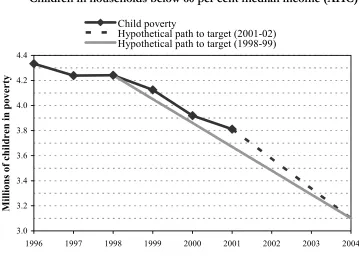
Figure 1 compares the observed decline in child poverty (on the 60 per cent median AHC measure) since 1998–99 and a hypothetical path to the target in which child poverty declines by an equal amount in every year. This shows that the fall in child poverty has been slower than this hypothetical path, and so the government is ‘behind schedule’ in this sense. The graph also shows that the government is further behind schedule after the data from 2001–02 than it was based on data a year before that.
Figure 1. On track for 2004–05?
Children in households below 60 per cent median income (AHC)
3.0 3.2 3.4 3.6 3.8 4.0 4.2 4.4
1996 1997 1998 1999 2000 2001 2002 2003 2004
Million
s of child
re
n in
pover
ty
Child poverty
Hypothetical path to target (2001-02) Hypothetical path to target (1998-99)
Notes: Figure shows unrounded levels of child poverty and assumes that the target for 2004–05 is 3.1 million children in poverty. Financial years are shown, e.g. 1998 means 1998–99.
Source: Authors’ calculations based on Family Resources Survey.
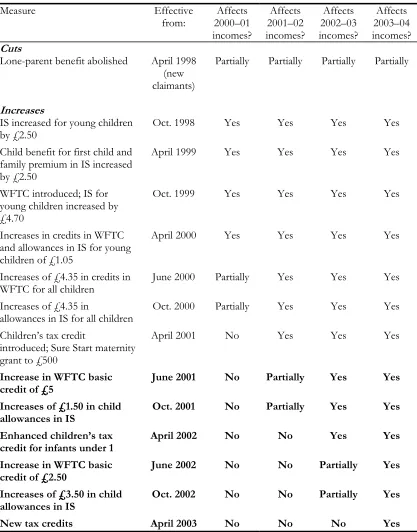
However, there is no reason why the government should reduce child poverty equally in six consecutive years. Table A4 in the Appendix lists the main changes in child-contingent benefits and tax credits since April 1998; the measures marked in bold have either been announced but not yet introduced (such as the new tax credits), or have been introduced since April 2001 but are not fully reflected in the latest data on household incomes (such as the increases in working families’ tax credit during 2002–03).
Analysis carried out by Brewer and Kaplan at IFS before data on 2001–02 were available suggested that, even taking into account the likely impact of all of the tax and benefit
8 These poverty measures are monitored in Opportunity for All, the government’s official audit of poverty and social
measures announced but yet to be reflected in the data, the government would fall short of meeting its child poverty target measured AHC.9 It has not yet been possible to update that analysis fully to reflect the latest data, but some tentative conclusions can be reached.
The earlier analysis suggested that child poverty would have to fall by 800,000 children over the four years 2000–01 to 2004–05 for the government to hit its target on the AHC measure. The analysis predicted that all else being equal, tax and benefit changes affecting incomes between 2000–01 and 2004–05 could reduce child poverty by around 800,000 children, but that likely growth in real earnings and median income would put 200,000 of these children back below the poverty line. The net reduction of 600,000 children would therefore leave the government 200,000 short of its target.
As we have shown, child poverty fell by just 100,000 in the last year of the data, slower than the 200,000 per year required to keep the government on track to hit its target. Some of the impact of the changes in taxes and benefits between 2000–01 and 2004–05 will now be reflected in the new figures for 2001–02 (for example, the large increases in the child allowances in income support in October 2000 should now be fully reflected, as will be the children’s tax credit and increases in the Sure Start maternity grant effective from April 2001). Brewer and Kaplan’s estimate that tax and benefit changes from 2000– 01 to 2004–05 could reduce child poverty by 800,000 is an overestimate of the likely impact of the tax and benefit changes still to come now. However, even if we assume the most optimistic scenario for the government – that 800,000 children are due to be lifted from poverty through tax and benefit measures yet to be reflected in the latest data – then likely future real earnings growth (which Brewer and Kaplan assumed to be 2.3 per cent a year) still means the government will fall short of its target in 2004–05, by at least 150,000.
This would suggest that some of the possible measures outlined by Brewer and Kaplan, such as increases to the child element of the new child tax credit, might be needed in the forthcoming Budget to put the government back on track.
4. What is happening to incomes amongst low-income households with children?
One reason why the government is falling behind schedule in meeting its child poverty target is that it has chosen a definition of poverty that is relative: whether a child is poor depends not only on the income of the household in which the child lives, but also on the incomes of society as a whole (or, more precisely, the median household income). Since 1998–99, there has been strong growth in median household income, with particularly high rates of growth in the last two years (see Table 2). This means that the poverty line is now almost 15 per cent higher in real terms than it was in 1998–99.
9 See M. Brewer and G. Kaplan, ‘What do the child poverty targets mean for the child tax credit?’, in R. Chote, C.
6
Table 2. Median household income (in 2001–02 prices)
Income after housing costs
Median income 60% median
(i.e. the poverty line) Annual growth
1996–97 £231 £138 5.3%
1997–98 £235 £141 1.7%
1998–99 £239 £144 2.0%
1999–2000 £249 £149 4.0%
2000–01 £260 £156 4.4%
2001–02 £274 £165 5.6%
Change 1998–99 to 2001–02 £35 £21 14.7%
Notes: These numbers are almost the same as those to be found in Department for Work and Pensions,
Households Below Average Income 1994/5 to 2001/02, CDS, Leeds, 2003. In HBAI, incomes are adjusted for household composition; these figures relate to a couple household with no children. Values for other types of household can be calculated using the McClements scale, the details of which can be found in appendix B of the 2003 HBAI publication.
Source: Authors’ calculations based on Family Resources Survey.
If the government had instead chosen a definition of poverty that was fixed in real terms (i.e. only increasing in line with the growth in prices, rather than the growth in median household income), then it could have claimed far greater success in reducing child poverty: since 1998–99, the number of children in households below 60 per cent of the 1996–97 median AHC income has fallen from 4.0 million to 2.5 million, a decline of 37 per cent.10 The conclusion is very similar when looking at the other five poverty lines defined as a fraction of some fixed real income level in Tables A2 and A3.
5. Conclusion
Child poverty, defined in terms of relative incomes, fell slightly in 2001–02, continuing the downward trend since 1998–99. On the most commonly cited definition of the poverty line – 60 per cent median income measured after housing costs – there are now 3.8 million children in poverty, or 30 per cent of children in Britain, the lowest level since 1991. But if the current rate of decline in child poverty persists for three more years, the government will miss its child poverty target for 2004–05. In fact, it is further behind schedule now than it was based on figures from 2000–01.
This rather slow decline in child poverty is partly a reflection of the government’s measure of child poverty being a relative one, because income growth has been particularly strong across society in the period over which the government has set its target. The government is, then, managing to increase the living standards of low-income households with children, but the gap between them and the rest of society is perhaps not closing as fast as the government would like. Rectifying this may require additional resources to be directed to families with children in the forthcoming Budget.
10 We chose median income AHC in 1996–97 as that is one of the indicators tracked in Department for Work and
Appendix
Table A1. Number of children below various poverty lines: before housing costs
No. of children (million) Income before housing costs
50% median 60% median 70% median
1996–97 1.6 3.2 4.6
1997–98 1.6 3.2 4.6
1998–99 1.6 3.1 4.5
1999–2000 1.5 3.0 4.5
2000–01 1.4 2.7 4.2
2001–02 1.3 2.7 4.3
Change 1998–99 to 2001–02 –0.3 –0.5 –0.2 Change required 2001–02 to
2004–05 to reduce by one-quarter since 1998–99
–0.1 –0.3 –0.9
Notes: These numbers are almost the same as those to be found in Department for Work and Pensions,
Households Below Average Income 1994/5 to 2001/02, CDS, Leeds, 2003. Changes are based on unrounded numbers. The changes in child poverty between 2000–01 and 2001–02 are not statistically significant, but the changes between 1998–99 and 2001–02 are statistically significant at the 5 per cent level.
Source: Authors’ calculations based on Family Resources Survey.
Table A2. Number of children below various poverty lines fixed in real terms: after housing costs
No. of children (million) Income after housing costs
50%
1996–97 median 1996–97 median 60% 1996–97 median 70%
1996–97 3.0 4.3 5.4
1997–98 2.8 4.2 5.1
1998–99 2.6 4.0 5.0
1999–2000 2.2 3.6 4.7
2000–01 1.7 3.0 4.2
2001–02 1.3 2.5 3.7
Notes: These numbers are almost the same as those to be found in Department for Work and Pensions,
Households Below Average Income 1994/5 to 2001/02, CDS, Leeds, 2003. Changes are based on unrounded numbers. All of the changes in child poverty shown in this table between 2000–01 and 2001–02, and between 1998–99 and 2001–02, are statistically significant at the 5 per cent level.
Source: Authors’ calculations based on Family Resources Survey.
Table A3. Number of children below various poverty lines fixed in real terms: before housing costs
No. of children (million) Income before housing costs
50%
1996–97 median 1996–97 median 60% 1996–97 median 70%
1996–97 1.6 3.2 4.6
1997–98 1.6 3.2 4.6
1998–99 1.5 3.1 4.5
1999–2000 1.4 2.8 4.2
2000–01 1.2 2.4 3.9
2001–02 1.0 2.0 3.4
8
Table A4. Reforms to support for families with children announced 1997–2002
Measure Effective
from: 2000–01 Affects incomes? Affects 2001–02 incomes? Affects 2002–03 incomes? Affects 2003–04 incomes? Cuts
Lone-parent benefit abolished April 1998 (new claimants)
Partially Partially Partially Partially
Increases
IS increased for young children
by £2.50 Oct. 1998 Yes Yes Yes Yes
Child benefit for first child and family premium in IS increased by £2.50
April 1999 Yes Yes Yes Yes
WFTC introduced; IS for young children increased by £4.70
Oct. 1999 Yes Yes Yes Yes
Increases in credits in WFTC and allowances in IS for young children of £1.05
April 2000 Yes Yes Yes Yes
Increases of £4.35 in credits in
WFTC for all children June 2000 Partially Yes Yes Yes Increases of £4.35 in
allowances in IS for all children Oct. 2000 Partially Yes Yes Yes Children’s tax credit
introduced; Sure Start maternity grant to £500
April 2001 No Yes Yes Yes
Increase in WFTC basic
credit of £5 June 2001 No Partially Yes Yes
Increases of £1.50 in child
allowances in IS Oct. 2001 No Partially Yes Yes
Enhanced children’s tax
credit for infants under 1 April 2002 No No Yes Yes
Increase in WFTC basic
credit of £2.50 June 2002 No No Partially Yes
Increases of £3.50 in child
allowances in IS Oct. 2002 No No Partially Yes
New tax credits April 2003 No No No Yes
IS = income support
WFTC = working families’ tax credit
Notes: In the table, benefit and tax credit increases are recorded in current prices but net of default indexation (an increase in April benefit rates in line with the inflation in the ROSSI index in the year up to the preceding September). The increases that will have more impact on incomes in 2002–03 than in 2001– 02 are shown in bold. Although the new tax credits do not affect families on income support until April 2004, the levels of income support have been changed from April 2003 so that the vast majority of families are no worse off during this transition period.
Figure A1. Children falling below various relative income poverty lines (AHC)
0% 5% 10% 15% 20% 25% 30% 35% 40% 45%
1979 1981 1983 1985 1987 1989 1991 1993 1995 1997 1999 2001
50% median 60% median 70% median
Notes: From 1994–95 onwards, these numbers are the same as those to be found in Department for Work
and Pensions, Households Below Average Income 1994/5 to 2001/02, CDS, Leeds, 2003. Poverty lines are
fractions of the contemporary median of household income across the whole population (i.e. not just for children). Years are calendar years up to and including 1992, and financial years after that, e.g. 1998 means 1998–99.
Source: Authors’ calculations based on Family Expenditure Survey for years until 1993–94 and on Family Resources Survey thereafter.
Figure A2. Children falling below various relative income poverty lines (BHC)
0% 5% 10% 15% 20% 25% 30% 35% 40% 45%
1979 1981 1983 1985 1987 1989 1991 1993 1995 1997 1999 2001
50% median 60% median 70% median