Flavour physics and extra-dimensions
Abhishek M. Iyer1,∗
1INFN-Sezione di Napoli, Via Cintia, 80126 Napoli, Italia
Abstract. Randall-Sundrum (RS) model of warped extra-dimensions were originally proposed to explain the Planck-weak scale hierarchy. It was soon realised that modifications of the original setup, by introducing the fields in the bulk, has several interesting features. In particular it imbues a rich flavour structure to the fermionic sector thereby offering an understanding of the Yukawa hierarchy problem. This construction is
also useful in explaining the recently observed deviations in the decay of theBmesons. We consider two scenarios to this effect : A) Right handed muon fields coupled more to NP that the corresponding muon doublets
(unorthodox case). Non-universality exists in the right handed sector. B) Standard scenario with anomalies explained primarily by non-universal couplings to the lepton doublets. Further, we establish correlation with the parameter space consistent with the flavour anomalies in the neutral current sector and obtain predictions for rareK- decay which are likely to be another candle for NP with increased precision. The prediction for rare K-decays are different according to the scenario, thereby serving as a useful discriminatory tool. We also discuss
the large flavour violation in the lepton sector and present an example with the implementation of bulk leptonic MFV which is essential to realize the model with low KK scales. Further we consider a radical solution, called GUT RS models, where the RS geometry can work as theory of flavour in the absence of flavour symmetries. In this case the low energy brane corresponds to the GUT scale as a result of which RS is no longer solution to the gauge hierarchy problem. The Kaluza Klein (KK) modes in this setup are naturally heavy due to which the low energy constraints can be easily avoided. We use this framework to discuss the supersymmetric version of the RS model and provide means to test this scenario by considering rare lepton decays likeτ→µγ.
1 Introduction
Flavour physics offers an indirect probe towards the
pos-sible existence of new physics (NP) effects which may be
characterized by a flavour structure different from that of
the SM. Process likeµ → eγ,τ → µγin leptonic
sec-tor and rare K decays in the hadronic sector are char-acterised by small contributions in the SM but relatively weaker experimental bounds. More recently, the anoma-lous decays of theBmesons has generated a lot of interest. Specifically the measurement ofB(B+ → K+µ+µ−) and B(B+ → K+e+e−) was quoted in form of the following ratio [1]
RK = B(B
+→K+µ+µ−) B(B+→K+e+e−)
q2=1−6GeV2
= 0.745+0.090
−0.074(stat)±0.036 (syst)
(1)
while the SM expectation isRS M
K =1.003 [2]. This implies a∼2.6σdeviation as a possible evidence of lepton non-universality. This observation was further validated by the
∗e-mail: [email protected]
following measurement
RK∗ = B(B
0→K∗0µ+µ−) B(B0 →K∗0e+e−)
= 0.660+0.110
−0.070(stat)±0.024(syst), lowq2
= 0.685+0.113
−0.069(stat)±0.047(syst), midq(2)2 (3) where lowq2corresponds to 0.045≤q2≤1.1 GeV2while mid q2 corresponds to 1.1 ≤ q2 ≤ 6.0 GeV2 The SM values for the correspondingq2 bins are:RS M
K∗ 0.93 for low q2 while RS M
K∗ = 1 elsewhere. This corresponds to a 2.4σdeviation for low q2 and∼ 2.5 σfor mediumq2. The deviations from the SM values can parametrized by additional contributions to the Wilson coefficientsCi of the following effective operators: [3]:
L ⊃G√Fα 2π
i
CiOi (4)
whereCi=CS Mi + ∆Ci.
O9 = ( ¯sLγµbL)(¯lγµl) O9=( ¯sRγµbR)(¯lγµl) O10 = ( ¯sLγµbL)(¯lγµγ5l) O10=( ¯sRγµbR)(¯lγµγ(5)5l) Here∆Ci determines the NP contributions to the Wilson coefficients and ldenotes a lepton. In the following we
will consider a scenario where NP effects exits in both the
In this talk we discuss the explanation of these anoma-lies in a model with a single warped extra-dimension with the following line element [4]:
ds2=e−2A(y)η
µνdxµdxν−dy2 (6) whereA(y)=k|y|,k∼ MPl
4π and 0≤y ≤πR. The coordi-natesy=0, πRcorrespond to the location of the (UV,IR) brane respectively. A generalization of this framework setup with a bulk custodial symmetry [5] in considered to evade constraints from Z → bb¯. In addition to the KK states of the SMW,Z, the model is characterized by addi-tional ‘custodial’ heavy gauge bosons thereby leading to a distinct phenomenology, in the flavour sector in particular. A comprehensive analysis of different flavour transitions
in this setup was considered in [6–9]. We explore the pa-rameter space admitted by the current anomalies and offer
predictions for theK → πννdecays, in the s → dsector [10]. Fits with two scenarios are demonstrated:
Scenario A. Right handed leptons are more composite (closer to the IR brane) than the left handed leptons. This is particularly true for the muon and tau. The left handed lepton couple universally to the NP. Non-universality in this case exists in the right-sector. ,
ScenarioB. Left handed leptons are more composite than the right handed leptons.
For ScenarioA, the NP contribution to∆Cµ9,10is dominant
with a smaller contribution to∆Ce
9,10, thereby resulting a 4-Dfit along the lines of [11]. The primed operators do not contribute as we assume universality in the bulk wave-functions of the right handed quarks. Both these scenarios are characterized by different predictions for the theK
de-cays thereby making it a useful discriminant.
The note is organized as follows: In Section 2 we com-pute the fits for the anomalies inb→sllprocesses for two different 1-D hypotheses. In Section 3 we consider the
rare kaon decays and demonstrate how it can be utilised to possibly distinguish between the two scenarios used to fit theb → sllanomalies. In Section 4 we give an explicit example with MFV implemented in the lepton sector, in particular for the first scenario. in Section 5 we discuss a radical solution with the implementation of RS model at the GUT as a means to avoid the introduction of additional flavour symmetries and we finally conclude.
2
b
→
sll
processes :
B
anomalies
In bulk custodial models in RS , neutral currents at tree level receive contribution fromX ∈ZS M,ZX,ZH,γ(1). The
ex-pression for the coupling of the SM fermions to these NP states can be written as:
LNP⊂Xµ
αbsL(X)( ¯sLγµbL)+αbsR(X)( ¯sRγµbR)+ ¯
µαlV(X)γµ−αlA(X)γµγ5µ (7)
whereαlV,A(X) = αlL(X)±αlR(X)
2 . αgives the coupling in the zero mode fermions to the gauge bosons in the mass ba-sis of the latter. Using these expressions, the Wilson
co-efficients for each gauge fieldXare written as:
∆C9 = −
√ 2π
M2 XGFα
αbsL(X)αlV(X),
∆C10 =
√ 2π
M2 XGFα
αbsL(X)αlA(X), (8)
For the primed operators the expressions are similar with
L↔R. In the above we assumed that the up-sector quark are in the mass-diagonal basis and down quark rotation matrices areDL,R ∼VCKM. We now discuss the following two possibilities for the fits to the data:
1) Scenario A: This scenario is characterized by the relatively larger contribution of the lepton singlets to the NP than the doublets. The doublets are chosen to have to have universal bulk wavefunction with c > 0.5. This
choice is particularly helpful in obtaining an anarchic neu-trino mixing matrix which is roughly given asUPMNSi j ∼
f(ci L)
f(cLj)
The contributions to∆C
9,10 are made consistent with zero by assuming that the right handed down quarks cou-ple similarly to the NP. Numerically this impliescdR,sR,bR>
0.55. The ranges chosen for cparameter scan are cho-sen to be: cQ3 ∈ [0,0.5], cµL = cL ∈ [0.51,0.6] and cµR ∈ [0.45,0.55]. Further by choosing thecparameters
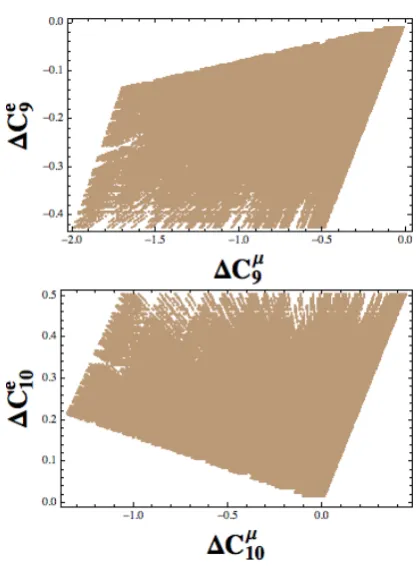
for the first two quark generationscQ1,2 > 0.55 ensures a universality of their coupling to the NP states. Fig. 1 gives the results of the scan: The top plot gives the correlation between∆Cµ
9−∆Ce9while the bottom gives the correlation between∆Cµ
10−∆Ce10. The 2-σregions for a 4D fit to the data is [11]
Cµ
9 ∈[−0.33,0.06] Ce9∈[−2.23,0.74]
Cµ
10∈[−0.29,0.14] Ce10∈[−2.60,0.60] (9) The non-negligible values of the ∆Ce is due to left
doublets having c ∼ 0.5 thereby resulting in a mildly larger coupling to the NP states than would be expected of states havingc≥0.55. For these choices ofcparameters
corresponding to the values in Fig.1, fitting the muon mass requires choosing theO(1) Yukawa∼0.03. Though
slightly fine tuned with regards to the fit to the muon mass, this scenario is more favorable with regards to an anarchic neutrino mixing matrix but also in suppressing FCNC in the lepton sector through the implementation of 5D MFV.
2) ScenarioB: In this case the non-universality is now transferred to the lepton doublets while the singlets are closer to the UV brane and their coupling to the NP is uni-versal. Further, without loss of generality we assume that theτdoublets are closer to the IR brane than theµdoublets (cτL <cµL). All the lepton singlets and the electron doublet
satisfyc>0.55. This results in∆Ce9,10much smaller than
∆Cµ
9,10, with its magnitude being at most∼0.2. For most of the region, it effectively reduces this to a 2-D fit where
the value ofCe
9,10is an order of magnitude less,
Top left plot of Fig.2 gives the correlation in the
∆Cµ
sat-In this talk we discuss the explanation of these anoma-lies in a model with a single warped extra-dimension with the following line element [4]:
ds2=e−2A(y)η
µνdxµdxν−dy2 (6) whereA(y)=k|y|,k∼ MPl
4π and 0 ≤y ≤πR. The coordi-natesy=0, πRcorrespond to the location of the (UV,IR) brane respectively. A generalization of this framework setup with a bulk custodial symmetry [5] in considered to evade constraints from Z → bb¯. In addition to the KK states of the SMW,Z, the model is characterized by addi-tional ‘custodial’ heavy gauge bosons thereby leading to a distinct phenomenology, in the flavour sector in particular. A comprehensive analysis of different flavour transitions
in this setup was considered in [6–9]. We explore the pa-rameter space admitted by the current anomalies and offer
predictions for theK → πννdecays, in thes → dsector [10]. Fits with two scenarios are demonstrated:
Scenario A. Right handed leptons are more composite (closer to the IR brane) than the left handed leptons. This is particularly true for the muon and tau. The left handed lepton couple universally to the NP. Non-universality in this case exists in the right-sector. ,
ScenarioB. Left handed leptons are more composite than the right handed leptons.
For ScenarioA, the NP contribution to∆Cµ9,10is dominant
with a smaller contribution to∆Ce
9,10, thereby resulting a 4-Dfit along the lines of [11]. The primed operators do not contribute as we assume universality in the bulk wave-functions of the right handed quarks. Both these scenarios are characterized by different predictions for the theK
de-cays thereby making it a useful discriminant.
The note is organized as follows: In Section 2 we com-pute the fits for the anomalies inb→sllprocesses for two different 1-D hypotheses. In Section 3 we consider the
rare kaon decays and demonstrate how it can be utilised to possibly distinguish between the two scenarios used to fit theb → sllanomalies. In Section 4 we give an explicit example with MFV implemented in the lepton sector, in particular for the first scenario. in Section 5 we discuss a radical solution with the implementation of RS model at the GUT as a means to avoid the introduction of additional flavour symmetries and we finally conclude.
2
b
→
sll
processes :
B
anomalies
In bulk custodial models in RS , neutral currents at tree level receive contribution fromX ∈ZS M,ZX,ZH,γ(1). The
ex-pression for the coupling of the SM fermions to these NP states can be written as:
LNP⊂Xµ
αbsL(X)( ¯sLγµbL)+αbsR(X)( ¯sRγµbR)+ ¯
µαlV(X)γµ−αlA(X)γµγ5µ (7)
whereαlV,A(X) = αlL(X)±αlR(X)
2 . αgives the coupling in the zero mode fermions to the gauge bosons in the mass ba-sis of the latter. Using these expressions, the Wilson
co-efficients for each gauge fieldXare written as:
∆C9 = −
√ 2π
M2 XGFα
αbsL(X)αlV(X),
∆C10 =
√ 2π
M2 XGFα
αbsL(X)αlA(X), (8)
For the primed operators the expressions are similar with
L↔R. In the above we assumed that the up-sector quark are in the mass-diagonal basis and down quark rotation matrices areDL,R ∼VCKM. We now discuss the following two possibilities for the fits to the data:
1) Scenario A: This scenario is characterized by the relatively larger contribution of the lepton singlets to the NP than the doublets. The doublets are chosen to have to have universal bulk wavefunction with c > 0.5. This
choice is particularly helpful in obtaining an anarchic neu-trino mixing matrix which is roughly given asUPMNSi j ∼
f(ci L)
f(cjL)
The contributions to∆C
9,10 are made consistent with zero by assuming that the right handed down quarks cou-ple similarly to the NP. Numerically this impliescdR,sR,bR>
0.55. The ranges chosen for cparameter scan are cho-sen to be: cQ3 ∈ [0,0.5], cµL = cL ∈ [0.51,0.6] and cµR ∈ [0.45,0.55]. Further by choosing thecparameters
for the first two quark generationscQ1,2 > 0.55 ensures a universality of their coupling to the NP states. Fig. 1 gives the results of the scan: The top plot gives the correlation between∆Cµ
9−∆Ce9while the bottom gives the correlation between∆Cµ
10−∆Ce10. The 2-σregions for a 4D fit to the data is [11]
Cµ
9∈[−0.33,0.06] Ce9∈[−2.23,0.74]
Cµ
10∈[−0.29,0.14] Ce10∈[−2.60,0.60] (9) The non-negligible values of the ∆Ce is due to left
doublets having c ∼ 0.5 thereby resulting in a mildly larger coupling to the NP states than would be expected of states havingc≥0.55. For these choices ofcparameters
corresponding to the values in Fig.1, fitting the muon mass requires choosing theO(1) Yukawa∼0.03. Though
slightly fine tuned with regards to the fit to the muon mass, this scenario is more favorable with regards to an anarchic neutrino mixing matrix but also in suppressing FCNC in the lepton sector through the implementation of 5D MFV.
2) ScenarioB: In this case the non-universality is now transferred to the lepton doublets while the singlets are closer to the UV brane and their coupling to the NP is uni-versal. Further, without loss of generality we assume that theτdoublets are closer to the IR brane than theµdoublets (cτL <cµL). All the lepton singlets and the electron doublet
satisfyc>0.55. This results in∆Ce9,10much smaller than
∆Cµ
9,10, with its magnitude being at most∼0.2. For most of the region, it effectively reduces this to a 2-D fit where
the value ofCe
9,10is an order of magnitude less,
Top left plot of Fig.2 gives the correlation in the
∆Cµ
9-∆C10µ plane which correspond to points which
sat-Figure 1. ScenarioA: Plot show the correlation in theC9and
C10parameter plane for both the electron and the muon. We use
MKK=3TeV
isfy 0.36 < |∆Cµ
9,10| < 0.87. There also exist solutions for which ∆Cµ9 = −∆C10µ further reducing it to a 1-D fit
as discussed in [18, 19]. The only two relevant parame-ters for the fits to the B-anomalies arecQ3−cµL and the
correlation is shown in right plot of Fig. 2.
3 Kaon decays
In this section we use rare K decays to differentiate
be-tween the two scenarios considered earlier. K+ → π+νν
andKL→ π0ννare likely to constitute the next probe to-wards the possible existence of NP. They correspond to
s→dννform of transitions and are likely to be correlated tob→slltransitions in most NP scenarios. The SM value for theK+→π+νν¯andK
L→π0νν¯is [12, 13, 21]: B(K+→π+νν¯)=8.3±0.3±0.3×10⁻¹¹
B(KL→π0νν¯)=2.9±0.2±0.0×10⁻¹¹ (10) where the first error is due to the uncertainty in the param-eters ofVCKMmixing matrix and the second one is due to the remaining theoretical uncertainties. The current exper-imental bound is [22]
B(K+→π+νν¯) = 17.3+11.5
−10.5×10⁻¹¹
B(KL→π0νν¯) ≤ 2.6×10⁻⁸ (90% C.L.) (11) These measurements are likely to be significantly im-proved in the future. The NA62 experiment at CERN [14, 15] is pursuing to reach a precision of 15% com-pared to the SM in 2018. while 5% accuracy will be
Figure 2. ScenarioB: Top plot gives the distribution for∆C9
and∆C10. The correspondingcparameters ranges are given in
the bottom plot.
achieved with more time. With regards to the KL →
π0νν, the KOTO experiment at J-PARC aims at measur-ingB(KL → π0νν) around the SM sensitivity in the first instance [16, 17]. Moreover, the KOTO-step2 experiment will aim at 100 events for the SM branching ratio. This implies a precision of 10% of this measurement.
These processes can be described by the following ef-fective Lagrangian parameterizing for s → dνν transi-tions:
L= 4GFα
2√2πV
∗ tsVtdCds,l
¯
sLγµdL
( ¯νlγµνl) (12)
The Wilson co-efficientCds,lin the SM is given as:
CS M ds,l =−
1
s2 θw
Xt+V ∗ csVcd
V∗ tsVtdX
l c
(13)
where Xt and Xcl are the loop functions for the top and charm contribution respectively and given as:Xt=1.481± 0.009 and1
3l X
l c
λ4 =0.365±0.012 [20] the branching ratio forK+→π+ννis given as:
B(K+
→π+νν)
= κ+(1+ ∆em)
3
l=e,µ,τ Vts∗Vtd
λ5 Xt
+ V
∗ csVcd
λ
Xl c
λ4 +δP
l c
2
B(KL→π0νν) = κL 3
l=e,µ,τ Im(V∗
tsVtd)
λ5 Xt
whereκL=2.231±0.013×10⁻¹⁰(λ/0.225),κ+=5.173±
0.025×10⁻¹¹(λ/0.225), ∆
em =−0.003 [23] andδPlc,u = 0.04±0.02 [24]. The individual values ofXlwere obtained from Table 1 of [25]:Xe,µ =11.18×10⁻⁴,Xτ=7.63×10⁻⁴. We now consider the NP contributions to the process
s→dllgiven in Eq. 12. In the bulk custodial model under consideration, the effective lagrangian for the process is
given as
Ls→dνν≡
αLsd( ¯sLγµdL)+αsdR( ¯sRγµdR)( ¯νLγµν)αlL(15)
In general this includes both the left handed and the right handed current in the quark sector signaling a possible de-viation from the (V−A)(V−A) structure given in Eq. 12. This aspect was explored in great detail in [7]. We discuss this process in the context of the two scenarios discussed in Section 2. It is worth stressing at this point that the
s→dννtransitions only depend on the left handedcL pa-rameters for the leptons, while bothcQ3andcbRplay a role.
However, since we assumed only the third generation dou-blets to havecQ3 < 0.5, there are no tree-level FCNC in the right handed sector. The contribution can be quantified by making the following change to theXtin Eq. 13:
Xt→Xt+
X=ZX,Hγ(1) √
22π
4Gfα
αsd(X)αlL(X)
M2 KK
(16)
where as earlier the contribution due toZX is suppressed. The SM limit is computed in the limitMKK → ∞.
We consider the following ratio for both the decays Bi
total/BiS M for i = KL,K+ and evaluate it for the two scenarios discussed earlier:
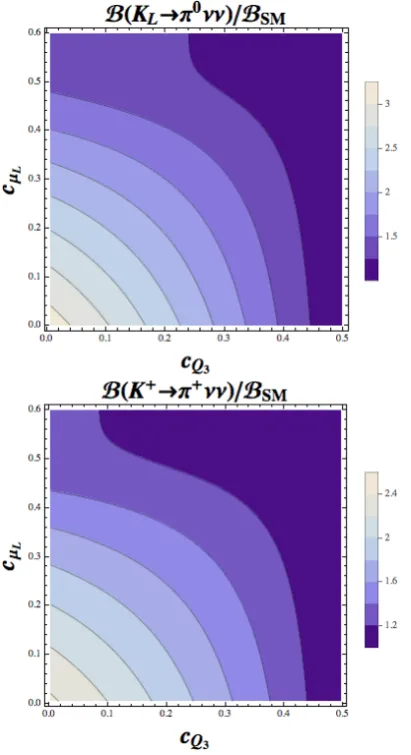
1) Scenario A: This case is characterized by the univer-sality in the left handed lepton sector. Since neutrinos in the final state are left handed, only cL (parameter for the lepton doublets) will play a role its computation. To stress the fact that B anomalies are explained purely due to non-universality in the right handed sector for leptons we choose :cµR∼0.48 for the muon singlet while cL ∼ 0.51 for all three generations. Fig. 3 gives plot of Bi
total/BiS M computed as a function ofcQ3 and evaluated for cL = 0.51. This corresponds to the parameter space of the hypothesis under consideration. It can be seen that for both the decays, the ratio is very close to the SM prediction thereby predicting no net enhancement. In principle one can choose to reducecQ3lesser than 0 at the cost of increasing its compositeness and possible tension withZ →bb¯constraints.
2) Scenario B: This case is characterized by non-universality in the left handed lepton sector while the NP coupling to the right handed singlets are universal. Fig. 4 gives the ratioBi
total/BiS M for both the kaon decays as a function ofcµL andcQ3. We note that for this scenario wherecµL < 0.5, the region consistent with theb → sll
leads to enhancement of∼ 1.2−1.6, depending on the
value ofcµL andcQ3. This is an useful example where a more accurate measurement of certain process may help in narrowing down the NP parameter space.
Figure 3. ScenarioA: Plots depicting the excess over the SM expectation for theK decays modes. Thecparameters for the doublets is universal and chosen to becL=0.51.
Process Experimental(Upper Bound) B(µ→eγ) 4.2×10⁻¹³[27] B(µ→eee) 1.1×10⁻¹²[28] B(µ−e) Conv(Ti) 6.1×10⁻¹³[29]
Table 1.Experimental upper bound for the branching fraction of leptonic flavour observables in the 1-2 sector.
4 Leptonic MFV
The localization of the fermions at different points in the
bulk leads to their non-universal coupling to the gauge KK states, These typically give rise to additional contributions to different to FCNC processes at tree level. Thus this is
whereκL=2.231±0.013×10⁻¹⁰(λ/0.225),κ+=5.173±
0.025×10⁻¹¹(λ/0.225), ∆
em = −0.003 [23] andδPlc,u = 0.04±0.02 [24]. The individual values ofXlwere obtained from Table 1 of [25]:Xe,µ=11.18×10⁻⁴,Xτ=7.63×10⁻⁴. We now consider the NP contributions to the process
s→dllgiven in Eq. 12. In the bulk custodial model under consideration, the effective lagrangian for the process is
given as
Ls→dνν≡
αLsd( ¯sLγµdL)+αsdR( ¯sRγµdR)( ¯νLγµν)αlL(15)
In general this includes both the left handed and the right handed current in the quark sector signaling a possible de-viation from the (V−A)(V−A) structure given in Eq. 12. This aspect was explored in great detail in [7]. We discuss this process in the context of the two scenarios discussed in Section 2. It is worth stressing at this point that the
s→dννtransitions only depend on the left handedcL pa-rameters for the leptons, while bothcQ3andcbRplay a role.
However, since we assumed only the third generation dou-blets to have cQ3 < 0.5, there are no tree-level FCNC in the right handed sector. The contribution can be quantified by making the following change to theXtin Eq. 13:
Xt→Xt+
X=ZX,Hγ(1) √
22π
4Gfα
αsd(X)αlL(X)
M2 KK
(16)
where as earlier the contribution due toZX is suppressed. The SM limit is computed in the limitMKK→ ∞.
We consider the following ratio for both the decays Bi
total/BiS M for i = KL,K+ and evaluate it for the two scenarios discussed earlier:
1) Scenario A: This case is characterized by the univer-sality in the left handed lepton sector. Since neutrinos in the final state are left handed, only cL (parameter for the lepton doublets) will play a role its computation. To stress the fact that B anomalies are explained purely due to non-universality in the right handed sector for leptons we choose :cµR∼0.48 for the muon singlet while cL ∼ 0.51 for all three generations. Fig. 3 gives plot of Bi
total/BiS M computed as a function ofcQ3 and evaluated for cL = 0.51. This corresponds to the parameter space of the hypothesis under consideration. It can be seen that for both the decays, the ratio is very close to the SM prediction thereby predicting no net enhancement. In principle one can choose to reducecQ3lesser than 0 at the cost of increasing its compositeness and possible tension withZ →bb¯constraints.
2) Scenario B: This case is characterized by non-universality in the left handed lepton sector while the NP coupling to the right handed singlets are universal. Fig. 4 gives the ratioBi
total/BiS M for both the kaon decays as a function ofcµL andcQ3. We note that for this scenario wherecµL < 0.5, the region consistent with theb → sll
leads to enhancement of∼ 1.2−1.6, depending on the
value of cµL andcQ3. This is an useful example where a more accurate measurement of certain process may help in narrowing down the NP parameter space.
Figure 3. ScenarioA: Plots depicting the excess over the SM expectation for the Kdecays modes. Thecparameters for the doublets is universal and chosen to becL=0.51.
Process Experimental(Upper Bound) B(µ→eγ) 4.2×10⁻¹³[27] B(µ→eee) 1.1×10⁻¹²[28] B(µ−e) Conv(Ti) 6.1×10⁻¹³[29]
Table 1.Experimental upper bound for the branching fraction of leptonic flavour observables in the 1-2 sector.
4 Leptonic MFV
The localization of the fermions at different points in the
bulk leads to their non-universal coupling to the gauge KK states, These typically give rise to additional contributions to different to FCNC processes at tree level. Thus this is
an example of a scenario where lepton non-universality leads to flavour violation. In minimal setup and for KK scales within the reach of LHC, these contributions can be particularly large in the lepton sector. This is mainly due to the strong upper bounds on processes in the 1-2 sector µ → eγ, µ → eee, µ−e conversion [26]. The current experimental upper bounds on these processes are given in Table 1. The large contributions can be attributed to the misalignment between the Yukawa coupling matrix and the bulk mass parameters which determine the nature of the fermionic profiles in the bulk. A complete model explaining anomalies inBsector with a relatively low NP scale must also satisfy constraints given in Table 1.
Figure 4. ScenarioB: Plots depicting the excess over the SM expectation for theKdecays modes.cτL=0.4 andceL=0.6 are
fixed for the computation whilecµLis varied.
One possibility to alleviate these constraints is to con-sider the implementation of MFV in 5D [30]. The large contributions to FCNC are primarily due to the misalign-ment between the flavour violating combinationYY† and the mass-squared matrixm2 ∼(F(c)YY†F(c)). HereF(c) is the diagonal matrix of bulk profiles given as F(c) = Diag(f(ce),f(cµ),f(cτ)). SinceY andF(c) do not com-mute in general, diagonalization ofm2does not necessar-ily imply diagonalization ofYY†. This misalignment can be reduced by making the specific choice where the 5D Yukawa parameters are written in terms of the bulk mass parameters as follows:
cL = aLI+bLYEYE†+dLYNYN†
cE = aEI+bEYE†YE
cN = aN+bNYN†YN (17)
where ai,bi ∈ . We also assume the presence of a bulk flavour symmetry group in the leptonic sector as
S U(3)L×S U(3)E ×S U(3)N. Using the flavour symme-try we can work in a basis in whichYE is diagonal. Thus
flavour violations are embedded in YN which transforms under the flavour group asYN → V5YN whereV5 is the anarchic mixing matrix. Without loss of generality we can choose V5 =VPMNS. To enable the explanation of the B anomalies, we assume that the corresponding bulk flavour symmetry in the hadronic sector is broken with the corre-sponding cparameters not satisfying to similar relations like Eq. 17 in the hadronic sector. We now discuss its im-plementation for the two scenarios discussed in Section 2. a) ScenarioA: In this scenario the lepton doublets are lo-calized closer to the UV brane and are assumed to have universal coupling to NP. TheµRis relatively closer to the IR brane We assumecL 0.51 for all three generations. Thecvalues for the charged lepton singlets are chosen as
cE = {0.4,0.48,0.764} and correspondingO(1) Yukawa couplings areYE ={0.77,0.03,0.32}. ThecE are written in terms ofYE by choosingaE =0.49,bE =−0.84 in Eq.
17. ForcLwe chooseaL bL,dLto preserve the univer-sality for the left handed doublets.
To fit the neutrino mass date we make choices for
cN and YN as: cN = {1.17,1.17,1.21} and Diag(YN) ≡ {0.1,0.1,0.134}leading to the following fit for the neutrino oscillation data:
∆m2sol=7.7×10⁻⁵eV2 ∆m2
atm=1.98×10⁻³eV2 (18) which corresponds to an inverted hierarchy spectrum.
Corresponding to these choices, the B(µ → eγ) is given as [31]:
B(µ→eγ)=4×10⁻⁸×(YNYN†)2123TeV
MKK (19)
where
YN =
0.0823679 0.0548227 0.0194184 −0.0477093 0.0531867 0.0937521 0.0306488 −0.0645418 0.0937521 (20)
leading toB(µ→ eγ)∼2.5×10⁻¹⁴. Similarly the other 1−2 transitions are also within the experimental bounds quoted in Table 1 forMKK=3 TeV.
b) ScenarioB: In the earlier case we saw that the univer-sality of the lepton doublet parameterscLwas essential to implement the MFV ansatz and obtain satisfactory fits to the neutrino mases. Universality ensures that the values of the rotation matrixUi j ∼ ffLiLi ∼ O(1) which roughly corre-spond to the elements of the PMNS rotation matrix. Since thecLis not universal in this scenario, fits to the neutrino data also require hierarchical choices incN. This makes the implementation ofcN proportional toYN†YN in 17 ex-tremely challenging and difficult to achieve. This possibly
requires a more complicated parameter scan and will not be discussed here.
5 Randall Sundrum model at the GUT
scale
problem simultaneously. It might be that RS as a theory of a flavour might be better suited at the GUT scale rather than at the weak scale. The Froggatt-Nielsen models are typically defined at scales closer to the Planck scale, so perhaps flavour physics might have its origins at the Planck scale. With this point of view, we will now consider RS to span between the Planck and the GUT scales. As a result the lowest lying KK scales areO(MGUT) and are
decou-pled from the low energy theory. Introducing bulk super-symmetry serves as a solution to the hierarchy problem at the weak scale. The supersymmetric case has the added advantage that it could lead to observable signatures at the weak scale and will be the focus of attention in this section [35].
In addition to the matter fields, we consider the the case with bulk Higgs doublets (Hu,d) and a SUSY
break-ing spurionX. The Kähler terms, leading to non-negative contributions to the scalar masses are given as [32, 33]
K =
M=Q,U,D,L,E
e−2σ(y)δ(y−y 0,πR)
ˆ Ci j M4
pl
X†XM†M (21)
ReplacingX≡ F, leads to the non-tachyonic soft masses as
m2
i j = m23/2r2mˆi j
ξUV(ci)ξUV(cj)ξUV2 (cS)
+ 1
2ξIR(ci)ξIR(cj)ξ2IR(cS)
(22) and where
ξUV(c)=
1−2c
2c−1−1 ξIR(c)=
1−2c 1−2c−1 (23)
and where the dimensionless parameter r is defined as r = Mk
5 withM5 being the fundamental 5D Planck scale.
Typicallyr<1 so that the assumption of a classical grav-ity is valid. The gravitino massm3/2 = MF5 is the ratio of
the vacuum expectation value of the F-term of the SUSY breaking field Xto the Planck scale. In addition to this, the theory also leads to tachyonic masses atMGUTand are
given as [34] m2
tachyonic(cm,cs) = −2m23/2(1+2αms) (24)
where 1 +2αms = (1−2cm)(2−2cs)
2(4−2cm−2cs)
(1−3−2cm)(1−3−2cs)
2(1−1−2cm)(1−1−2cs)−1
. Owing to the presence of these tachyonic terms, which are more prominent for the third generation quarks and less mildly for the thrid generation lepton, large values ofM3
are required so as to drive the masses to positive values by RGE effects. Further, owing to the tachynic masses of ˜τ, M2must be greater thatM2to avoid the presence of
tachy-onic staus in the model. This can be seen from Fig. 5 Which predominantly prefersM2 > M1. This figure was
obtained using analytic expressions for one-loop RGE in the limitYτ→0.
The flavoured masses in Eq. 22 has interesting phe-nomenological implications. It leads to mixing between different fermionic generations possibly leading to new contributions to FCNC. Defining the flavour violating pa-rameter asδi j = m˜
2 i j
˜
m2 im˜2j
i j, which controls the extent
500 600 700 800 900 1000 500
600 700 800 900 1000
M
1M
2
0 200 400 600
6402246
Figure 5.Lightest stau eigenstate a a function ofM1,2
of flavour violating in the theory. Fig. 6 gives the running ofδin the leptonic setor.
Figure 6.Running ofδfor the leptonic sector.
problem simultaneously. It might be that RS as a theory of a flavour might be better suited at the GUT scale rather than at the weak scale. The Froggatt-Nielsen models are typically defined at scales closer to the Planck scale, so perhaps flavour physics might have its origins at the Planck scale. With this point of view, we will now consider RS to span between the Planck and the GUT scales. As a result the lowest lying KK scales areO(MGUT) and are
decou-pled from the low energy theory. Introducing bulk super-symmetry serves as a solution to the hierarchy problem at the weak scale. The supersymmetric case has the added advantage that it could lead to observable signatures at the weak scale and will be the focus of attention in this section [35].
In addition to the matter fields, we consider the the case with bulk Higgs doublets (Hu,d) and a SUSY
break-ing spurionX. The Kähler terms, leading to non-negative contributions to the scalar masses are given as [32, 33]
K=
M=Q,U,D,L,E
e−2σ(y)δ(y−y 0,πR)
ˆ Ci j M4
pl
X†XM†M (21)
ReplacingX≡ F, leads to the non-tachyonic soft masses as
m2
i j = m23/2r2mˆi j
ξUV(ci)ξUV(cj)ξUV2 (cS)
+ 1
2ξIR(ci)ξIR(cj)ξ2IR(cS)
(22) and where
ξUV(c)=
1−2c
2c−1−1 ξIR(c)=
1−2c 1−2c−1 (23)
and where the dimensionless parameter r is defined as r = Mk
5 withM5 being the fundamental 5D Planck scale.
Typicallyr<1 so that the assumption of a classical grav-ity is valid. The gravitino massm3/2 = MF5 is the ratio of
the vacuum expectation value of the F-term of the SUSY breaking field X to the Planck scale. In addition to this, the theory also leads to tachyonic masses atMGUTand are
given as [34] m2
tachyonic(cm,cs) = −2m23/2(1+2αms) (24)
where 1 + 2αms = (1−2cm)(2−2cs)
2(4−2cm−2cs)
(1−3−2cm)(1−3−2cs)
2(1−1−2cm)(1−1−2cs)−1
. Owing to the presence of these tachyonic terms, which are more prominent for the third generation quarks and less mildly for the thrid generation lepton, large values ofM3
are required so as to drive the masses to positive values by RGE effects. Further, owing to the tachynic masses of ˜τ, M2must be greater thatM2to avoid the presence of
tachy-onic staus in the model. This can be seen from Fig. 5 Which predominantly prefersM2 > M1. This figure was
obtained using analytic expressions for one-loop RGE in the limitYτ→0.
The flavoured masses in Eq. 22 has interesting phe-nomenological implications. It leads to mixing between different fermionic generations possibly leading to new contributions to FCNC. Defining the flavour violating pa-rameter asδi j = m˜
2 i j
˜
m2 im˜2j
i j, which controls the extent
500 600 700 800 900 1000 500
600 700 800 900 1000
M
1M
2
0 200 400 600
6402246
Figure 5.Lightest stau eigenstate a a function ofM1,2
of flavour violating in the theory. Fig. 6 gives the running ofδin the leptonic setor.
Figure 6.Running ofδfor the leptonic sector.
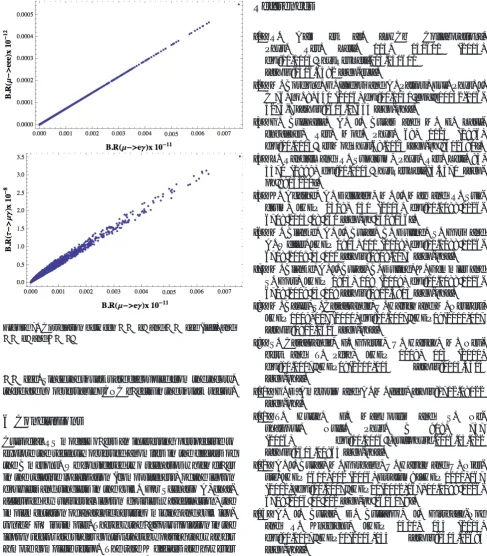
ThoughO(1) at the high scale, it runs down to accept-ably small values leading to possible signatures of these scenarios through FCNC processes. For instance Fig. 7 gives the correlation between τ → µγ, µ → eγ and
Figure 7. Correlation betweenµ→eγandµ→eee(left) and µ→eγandτ→µγ
µ→eee. Since the squarks are decoupled from the theory, there are no observable FCNC effects in the squark sector.
6 Conclusions
Custodial RS models offers an interesting perspective to explore the recently observed anomlies in the decays of theBmesons. We considered two scenarios which differ in the relative localization (compositeness) of the lepton doublets and singlets in the bulk. For ScenarioA, char-acterized by universal lepton doublet wavefunction, the implementation of anarchic neutrino mixing and bulk lep-tonic MFV is simpler. Thereby the flavour violation in the lepton sector are under control thereby paving the way for a more complete setup. The rareK decays are however consistent with the SM expectation. Finally we discuss a scenario with GUT RS where the model serves a theory of flavour while the effective low energy theory is MSSM. This has interesting implications for flavour in the lepton sector.
Acknowledgements
I would like to thank the organizers of FCCP 2017 for the opportunity to present my work in the workshop. I am also grateful to my collaborators: Giancarlo D’Ambrosio, Emilian Dudas, Sudhir Vempati for the fruitful collabora-tions which have lead to the interesting results presented in the workshop.
References
[1] R. Aaij et al. [LHCb Collaboration],
Phys. Rev. Lett. 113, 151601 (2014)
doi:10.1103/PhysRevLett.113.151601 [arXiv:1406.6482 [hep-ex]].
[2] M. Bordone, G. Isidori and A. Pattori, Eur. Phys. J. C76, no. 8, 440 (2016) doi:10.1140/epjc/ s10052-016-4274-7 [arXiv:1605.07633 [hep-ph]].
[3] G. Buchalla, A. J. Buras and M. E.
Laut-enbacher, Rev. Mod. Phys. 68, 1125 (1996)
doi:10.1103/RevModPhys.68.1125 [hep-ph/9512380]. [4] L. Randall and R. Sundrum, Phys. Rev. Lett. 83,
3370 (1999) doi:10.1103/PhysRevLett.83.3370 [hep-ph/9905221].
[5] K. Agashe, A. Delgado, M. J. May and R. Sun-drum, JHEP 0308, 050 (2003) doi:10.1088/ 1126-6708/2003/08/050 [hep-ph/0308036].
[6] M. Blanke, A. J. Buras, B. Duling, S. Gori and A. Weiler, JHEP0903, 001 (2009) doi:10.1088/ 1126-6708/2009/03/001 [arXiv:0809.1073 [hep-ph]]. [7] M. Blanke, A. J. Buras, B. Duling, K. Gemmler and
S. Gori, JHEP 0903, 108 (2009) doi:10.1088/ 1126-6708/2009/03/108 [arXiv:0812.3803 [hep-ph]]. [8] M. Bauer, S. Casagrande, U. Haisch and M. Neubert,
JHEP1009, 017 (2010) doi:10.1007/JHEP09(2010)017 [arXiv:0912.1625 [hep-ph]].
[9] S. Casagrande, F. Goertz, U. Haisch, M.
Neu-bert and T. Pfoh, JHEP 1009, 014 (2010)
doi:10.1007/JHEP09(2010)014 [arXiv:1005.4315 [hep-ph]].
[10] G. D’Ambrosio and A. M. Iyer, arXiv:1712.08122 [hep-ph].
[11] T. Hurth, F. Mahmoudi and S.
Ne-shatpour, Nucl. Phys. B 909, 737
(2016) doi:10.1016/j.nuclphysb.2016.05.022
[arXiv:1603.00865 [hep-ph]].
[12] A. J. Buras, M. Gorbahn, U. Haisch and U. Nier-ste, JHEP0611, 002 (2006) Erratum: [JHEP1211, 167 (2012)] doi:10.1007/JHEP11(2012)167, 10.1088/ 1126-6708/2006/11/002 [hep-ph/0603079].
[13] A. J. Buras, D. Buttazzo, J. Girrbach-Noe
and R. Knegjens, JHEP 1511, 033 (2015)
doi:10.1007/JHEP11(2015)033 [arXiv:1503.02693 [hep-ph]].
[14] A. Romano, arXiv:1411.6546 [hep-ex]. [15] F. Newsonet al., arXiv:1411.0109 [hep-ex]. [16] T. K. Komatsubara, Prog. Part. Nucl. Phys.
67, 995 (2012) doi:10.1016/j.ppnp.2012.04.001 [arXiv:1203.6437 [hep-ex]].
[17] K. Shiomi [KOTO Collaboration], arXiv:1411.4250 [hep-ex].
[18] B. Capdevila, A. Crivellin, S. Descotes-Genon, J. Matias and J. Virto, arXiv:1704.05340 [hep-ph]. [19] W. Altmannshofer, P. Stangl and D. M. Straub,
Phys. Rev. D 96, no. 5, 055008 (2017)
[20] G. Buchalla and A. J. Buras, Nucl. Phys. B 548, 309 (1999) doi:10.1016/S0550-3213(99)00149-2
[hep-ph/9901288].
[21] J. Brod, M. Gorbahn and E. Stamou, Phys. Rev. D
83, 034030 (2011) doi:10.1103/PhysRevD.83.034030
[arXiv:1009.0947 [hep-ph]].
[22] C. Patrignani et al. [Particle Data Group], Chin. Phys. C40, no. 10, 100001 (2016). doi:10.1088/
1674-1137/40/10/100001
[23] F. Mescia and C. Smith, Phys. Rev. D 76, 034017 (2007) doi:10.1103/PhysRevD.76.034017
[arXiv:0705.2025 [hep-ph]].
[24] G. Isidori, F. Mescia and C. Smith, Nucl. Phys. B
718, 319 (2005) doi:10.1016/j.nuclphysb.2005.04.008
[hep-ph/0503107].
[25] G. Buchalla and A. J. Buras, Nucl. Phys. B 412, 106 (1994) doi:10.1016/0550-3213(94)90496-0
[hep-ph/9308272].
[26] K. Agashe, A. E. Blechman and
F. Petriello, Phys. Rev. D 74, 053011 (2006) doi:10.1103/PhysRevD.74.053011 [hep-ph/0606021].
[27] A. M. Baldiniet al.[MEG Collaboration], Eur. Phys. J. C 76, no. 8, 434 (2016) doi:10.1140/epjc/
s10052-016-4271-x [arXiv:1605.05081 [hep-ex]].
[28] U. Bellgardt et al. [SINDRUM Collaboration], Nucl. Phys. B 299, 1 (1988). doi:10.1016/
0550-3213(88)90462-2
[29] J. Kaulard et al. [SINDRUM II Collaboration], Phys. Lett. B 422, 334 (1998). doi:10.1016/
S0370-2693(97)01423-8
[30] A. L. Fitzpatrick, G. Perez and L. Ran-dall, Phys. Rev. Lett. 100, 171604 (2008) doi:10.1103/PhysRevLett.100.171604
[arXiv:0710.1869 [hep-ph]].
[31] G. Perez and L. Randall, JHEP 0901, 077 (2009) doi:10.1088/1126-6708/2009/01/077
[arXiv:0805.4652 [hep-ph]].
[32] K. w. Choi, D. Y. Kim, I. W. Kim and T. Kobayashi, Eur. Phys. J. C35, 267 (2004) doi:10.1140/epjc/
s2004-01749-9 [hep-ph/0305024].
[33] D. Marti and A. Pomarol, Phys. Rev. D 64, 105025 (2001) doi:10.1103/PhysRevD.64.105025
[hep-th/0106256].
[34] E. Dudas and G. von Gersdorff, JHEP 1210,
100 (2012) doi:10.1007/JHEP10(2012)100
[arXiv:1207.0815 [hep-th]].
[35] E. Dudas and A. M. Iyer and S. K. Vempati, To ap-pear