Exotics at BESIII
Riccardo Farinelli1,∗
on behalf of the BESIII Collaboration
1INFN Sez. Ferrara and University of Ferrara - Via Saragat 1, Ferrara
Abstract.With a collected integrated luminosity of about 12 fb−1, useful data
set for XYZ new resonances, BESIII continues the exploration of these ex-otic charmonium-like states. In this proceeding, recent results on the mea-surements of the line-shape ofe+e− → π+π−ψ
(3868) and π+D0D∗− , as well as the JPdetermination ofZC(3900) will be presented. An abundance ofYwill
be reported in several decay channels. Finally the present BESIII data above thee+e−→Λ
CΛCthreshold will be shortly discussed because they are barely
in agreement with the current Belle data on the candidate charmed baryonium stateY(4660). A BEPCII upgrade, that will allow to settle this open question, has been funded.
1 Introduction
Strong interaction is one of the four fundamental forces and it acts on elementary particles such as quarks. Quarks are bound together intohadronsfollowing strict rules given by color quantum number. Only certain combination of bound states are allowed: they are classified baryons, bound states with three quarks ormesonswith a quark and an anti-quark. The strong interaction does not forbid others kinds of bound states but up to a few years ago only those two categories had been discovered. In the past years physicists searched for other kinds of bound states such as glueball, tetraquark or pentaquark. In the last years two discoveries of interest have to be cited: theZ(3900) [1] discovered by BESIII is a tetraquark candidate and theP+c [2] discovered by LHCb is referred as pentaquark.
In the heavy meson sector, the potential model describes the bound states of charm and anti-charm quarks, called charmonium, and it can predict the mass and width of the bound state, e.g. ηc,ψ andχcparticles as a function of its quantum number. Charmonium state masses range from about 4.0 GeV to 4.4 GeV and the energy region of interest is divided by the production threshold of the Dmeson around 3.74 GeV: below this energy the char-monium decays only to in un-charmed baryons, other charchar-monium states. Once the mass of the charmonium states is above 3.74 GeV then they decay mostly inDD[3]. The theoretical prediction of the potential model and the measured masses of the charmonium states are in agreement below the open charm threshold . Above this energy it was expected to discover the excited states of the charmonium states but only a few have been measured and many others have not been found.
Since 2003 many states have been discovered around this energy region, some of those show connections to the charmonium but they can not be described by charmonium states.
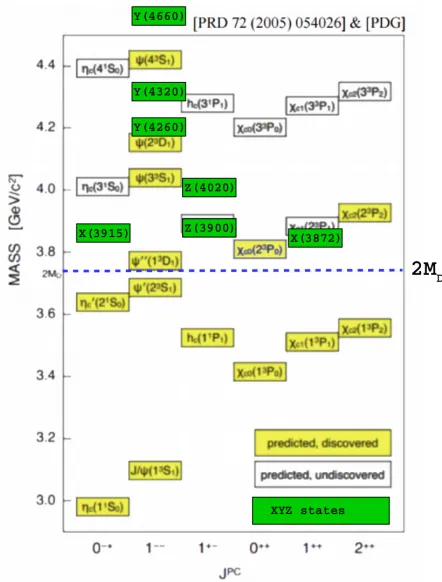
First of all theX(3872) [4] observed by Belle in the decay channel J/ψπ+π− is manifestly exotic due to its width, smaller than 1.2 MeV/c2, and because it violates its quantum num-ber in certain decay [5]. Later on in 2005 BaBar observed theY(4260) [6], a structure with quantum number 1−−that does not match with any J/ψexcitation and populates an energy region with an abundance of states with the same quantum number. While BESIII was study-ing theY(4260) decay, another particle with a clear exotic behaviour shows up: the Z(3900) [1], a resonance decaying inJ/ψa charmonium state and a charged pion. TheZ(3900) is the first evidence of a new kind of bound state that it is not neither a meson nor a baryon. Those XYZstates have been labelled with different letters to define different behaviors:Ystates have quantum number 1−−whileZstates are connected to this possible tetraquark explanation. All of them decay in charmonium states and some of them show connection such as theY(4260) which is connected to both theX(3872) with a radiative transition [7] and the Z(3900) with an hadronic transition [1]. Figure 1 shows the charmonium spectrum as a function of quantum number and the discovered exotic states.
Figure 1. The charmonium spectrum in the mass (vertical axis) vs quantum number (horizontal axis) plane. XYZare also represented in order to show graphically the abundance in the considered energy region.
2 The BESIII experiment
of mass energy between 2 and 4.6 GeV [8]. The detector is built around the interaction point with a cylindrical symmetry given by a barrel and two end-caps. It is composed by a multilayer drift chamber that surrounds the beam pipe then there is a time-of-flight system and an electromagnetic calorimeter. Those detectors are placed inside a 1 T superconducting magnet. The muon identifier is placed in the return yoke of the solenoidal magnet. The geometrical coverage is 93 % of the solid angle.
The energy range achieved by BEPCII constrains most of BESIII studies in the charmed region and BESIII accumulated during the years the world largest sample ofJ/ψandψ(3686). Thanks to the electron and positron beam, BESIII produces directly particles of quantum number JPC=1−−then it is a suitable experiment to study theYstates because it can produce them directly.
3 The Z states
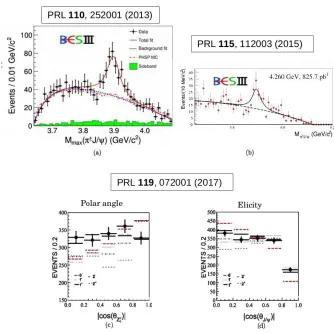
After the discovery of the firstZ particle that has been claimed as tetraquark. the BESIII collaboration opened a new field of research to understand the nature of this particle. It has been observed in the decay channele+e− → (J/ψπ+)π−and since it decays in charmonium plus a charged pion it should contain at least four quarks: accand aud. Its mass is 3899± 3.6±4.9 MeV/c2 and its width is 46±10±20 MeV/c2, the first error is statistical and the second is systematic [1]. Several theoretical papers described this resonance as a tetraquark, a molecular state or a charmonium hybrid [9, 10]. The resonance has been confirmed by Cleo-C and Belle.
In 2015 the same decay with neutral pionse+e−→(J/ψπ0)π0shows a resonance with a mass and a width close to the charged mode ones [11]. This established the isospin triplet for this resonance. In order to understand the nature of this particle the measurement of its quantum number is needed and in 2017 the likelihood method has been used to support the quantum number 1+with a significance of 7σwith respect the others [12].
Between 2013 and 2018 many otherZstates have been discovered. Some of them have been observed in the invariant mass spectrum of a pion plus a charmonium state such as the previous channel, or with an hC or ψ(3686) [13–15]; others decays into D meson or its excitation. Examples are e+e− → π+(DD∗)− or e+e− → π+(D∗D∗)− [16–18]. Those measurements indicate that theZstate decay both in charmonium and inDmeson states and the masses of those resonances show two values of accumulation: 3900 MeV/c2 inπJ/ψ and inDD∗modes, whileπhC andD∗D
∗
modes report a mass of about 4020 MeV/c2. The quantum number ofZ(3885)→DD∗has been measured to be 1+and it is in agreement with the one measured inZ(3900)→πJ/ψ. Summary plots are shown in Fig. 2.
4 The Y states
Figure 2.Summary of the plots of interest for theZ(3900). On the top the invariant mass spectrum of theZ(3900) with a charged (neutral) pion is shown (a and b). On the bottom the polar angle and elicity distribution used to define its quantum number (c and d).
measured by BaBar and Belle inππψ(3686) decay channel.
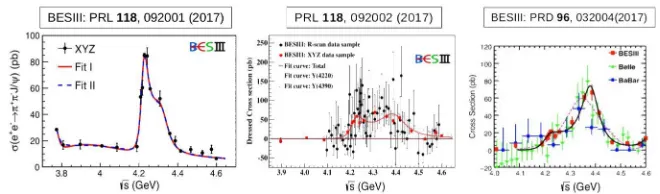
A similar behavior has been observed in 2017 in the decay channele+e−→π+π−hC[20]. The hChas been reconstructed inhC→γηCandηChas been reconstructed in 16 different modes. The cross section of the process can be described with two resonances too. This study reports masses of 4218 and 4391 MeV/c2. Within the errors thisY(4218) is compatible with the pre-viousY(4222). It is important to report also the observation of two resonances in the decay channele+e−→π+DD∗−that shows the presence of two resonances at the mass of 4228 and 4404 MeV/c2. The values are not totally compatible but they indicate and abundance ofY states in this energy region.Summary plots are shown in Fig. 3.
Looking at the cross section ofe+e− → π+π−ψ(3686) BaBar and Belle saw two resonances in the mass spectrum:Y(4360) andY(4660) [21, 22]. BESIII could confirm the line-shape of theY(4360) and it measured two resonances with masses 4209 and 4383 MeV/c2 [23]. Due to its limit in the beam energy BESIII could not confirm theY(4660).
resonances with similar masses and widths in the energy region between 4.1 and 4.5 GeV in three modes with charmonium and one with open charm mesons, as shown is Fig. 3.
Figure 3.Cross section of the the Y process of interest:π+π−
J/ψon the left,π+π−
hCin the middle and
π+π−ψ
(3686) on the right.
5 The key particle: Y(4660)
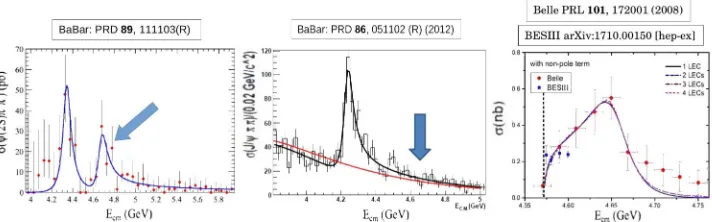
TheY(4660) is a resonance observed by Belle and BaBar ine+e−→π+π−ψ(3686) by means of ISR [21, 22]. BaBar reports a mass of about 4669 MeV/c2and Belle 4652 MeV/c2. The cross section in the resonance peak is around 30 pb. Moreover BaBar performed a similar study in the decay channele+e−→π+π−J/ψ[24] but in this mode there is no evidence of the Y(4660) state despite this would be expected to be larger ifY(4660) is accstate. According to BaBar data [25] as elaborated in [26], at 90% C.L. :
BR[Y(4660)→π+π−J/ψ]
BR[Y(4660)→π+π−ψ(3686)]<0.46 (1)
TheY(4660) has neither been observed in open charm channels such asDD,DD∗orD∗D∗ [3].
Belle collaboration observed a baryonic decay of theY(4660) intoΛCΛC [27] with a mass of 4652±3.4 MeV/c2and a width of 62.6±5.6 MeV/c2. The cross section at the peak is around 0.55 nb and the lineshape follows a nontrivial trend. BESIII collaboration studied the cross section ofe+e−→ ΛCΛCup to 4.6 GeV and it has no sufficient energy to confirm the entire line-shape [28], see Fig. 4 on the right. The trend reported from the two experiments seems different around the baryon production threshold. The cross section ofY(4660) to baryons at peak is about 0.55 nb and can be compared with the cross section ofe+e−→ pp of about 0.8 nb at threshold while the cross section toππJ/ψis about 0.04 nb. From those observations it is possible to conclude that the baryonic coupling of theY(4660) is 10 times greater than the mesonic coupling. Since there is not another mesonic decay with larger branching ratio thanππJ/ψit is possible to describe the behavior of this state with the old G.C. Rossi, G. Veneziano, G.F. Chew paradigm [29, 30] of an hidden charm baryonium decay where mostly poping up from the vacuum a light quark pair and falling apart as a charmed baryon pair.
6 Upgrades in BEPCII and BESIII
Figure 4.Cross section of the theY(4660) process of interest:π+π−ψ
(3686) on the left,π+π−
J/ψin the middle andΛCΛCon the right.
tracker with Cylindrical triple-GEM technology will increase the spatial resolution of the secondary vertex needed for theΛC reconstruction. The top-up injection will be implement to keep the beam current nearly constant so that the integrated luminosity can be improved of 20-30%. Finally the beam energy of BEPCII will be increased up to 2.45 GeV in order to study theΛCΛCline-shape.
7 Conclusion
A large number of Z states has been discovered in charmonium and open-charm decays. Masses and widths are compatible. Isospin triplet has been established for all the decays. Quantum number JP =1+has been measured in a couple of channels. Y(4220) andY(4390) have been observed in several decays while theY(4660) shows a more puzzling behavior. An increase in the beam energy will enable a comparison between BESIII and Belle results about theΛCΛCcross section line-shape.
References
[1] M. Ablikimet al., [BESIII Collaboration] Phys. Rev. Lett.110, 252001 (2013) [2] R. Aaijet al., [LHCb Collaboration] Phys. Rev. Lett.115, 072001 (2015) [3] K.A. Oliveet al., [Particle Data Group] Chin. Phys. C38, 090001 (2014) [4] G. Pakhlovaet al., [Belle Collaboration] Phys. Rev. Lett.26, no.26 (2008)
[5] S. Godfrey and S. L. Olsen, Annual Review of Nuclear and Particle Science58:1, 51-73 (2008)
[6] B. Aubertet al., [BaBar Collaboration] Phys. Rev. Lett.95, 142001 (2005) [7] M. Ablikimet al., [BESIII Collaboration] Phys. Rev. Lett.112, 092001 (2014) [8] M. Ablikimet al., [BESIII Collaboration] Nucl. Instr. A614, Issue 3 (2010) [9] R. T. Kleivet al., Phys. Pev. D87, 125018 (2013)
[10] Q. Wanget al., Phys. Rev. Lett.111, 132003 (2013)
[16] M. Ablikimet al., [BESIII Collaboration] Phys. Rev. Lett.115, 222002 (2015) [17] M. Ablikimet al., [BESIII Collaboration] Phys. Rev. Lett.112, 132001 (2013) [18] M. Ablikimet al., [BESIII Collaboration] Phys. Rev. Lett.115, 182002 (2015) [19] M. Ablikimet al., [BESIII Collaboration] Phys. Rev. Lett.118, 092001 (2017) [20] M. Ablikimet al., [BESIII Collaboration] Phys. Rev. Lett.118, 092002 (2017) [21] B. Aubertet al., [BaBar Collaboration] Phys. Rev. D89, 111103(R) (2014) [22] G. Pakhlovaet al., [Belle Collaboration] Phys. Rev. D91, 112007 (2015) [23] M. Ablikimet al., [BESIII Collaboration] Phys. Rev. Lett.96, 032004 (2017) [24] B. Aubertet al., [BaBar Collaboration] Phys. Rev. D86, 051102 (R) (2012) [25] B. Aubertet al., [BaBar Collaboration] arXiv:0808.1543 [hepex] (2008) [26] G. Cotugnoet al., arXiv:0911.2178v5 [hepph] (2017)
[27] G. Pakhlovaet al., [Belle Collaboration] Phys. Rev. Lett.101, 172001 (2008) [28] M. Ablikimet al., [BESIII Collaboration] arXiv:1710.00150 [hepex] (2017) [29] G. C. Rossi and G. Veneziano, Nucl. Phys. B123, 507 (1977)