Cryptanalysis of a Universally Verifiable Efficient
Re-encryption Mixnet
Shahram Khazaei,[email protected] Bj¨orn Terelius,[email protected] Douglas Wikstr¨om,[email protected]
February 24, 2012
Abstract
We study the heuristically secure mix-net proposed by Puiggal´ı and Guasch (EVOTE 2010). We present practical attacks on both correctness and privacy for some sets of pa-rameters of the scheme. Although our attacks only allow us to replace a few inputs, or to break the privacy of a few voters, this shows that the scheme can not be proven secure.
1
Introduction
A fundamental problem in implementing electronic elections is how to guarantee the anonymity of the voters. Chaum [3] studied the similar problem of how to allow people to send anonymous e-mail, and introducedmix-netsas a solution to this problem.
In Chaum’s mix-net,kmix-serversM1, . . . ,Mkare arranged in sequence. Each mix-server
Mjgenerates a public/private key pair and publishes his public keypkj. To anonymously send a messagemi, theith sender encrypts the message with all public keys and publishes the resulting ciphertext Encpk1(Encpk2(· · ·Encpkk(mi)· · ·))on a bulletin board. Then L0 is defined to be the list of all submitted ciphertexts. Forj = 1, . . . , k, thejth mix-serverMj then takesLj−1 as input, removes the outermost layer of encryption using his private key, and permutes the resulting ciphertexts to form its output Lj. Once the last mix-server Mk has decrypted and shuffled the list, he can publish the plaintext messages. One can easily see that Chaum’s mix-net prevents linking the plaintext messages published by the last mix-server to the original senders as long as at least one of the servers is honest. On the other hand, any mix-server can replace any ciphertext with a ciphertext of his choice. This is clearly unacceptable in a voting context.
Many other works in the field aim to improve the efficiency of mix-nets, e.g., [11, 10, 8, 12, 13], but vulnerabilities have been found in most mix-nets not based on proofs of shuffles [18, 15, 4, 22, 14].
Puiggal´ı and Guasch [20] proposed a heuristically secure mix-net at EVOTE 2010 (called the Scytl mix-net in the rest of the paper) which combines ideas of Golle et al. [8] and Jakobsson et al. [13]. To verify that a mix-server correctly re-encrypts and permutes the votes in Scytl’s mix-net, a verifier partitions the server’s input into blocks and the server reveals the correspond-ing output blocks. Furthermore, the server proves that the product of the votes in each output block is a re-encryption of the product of the votes in the corresponding input block. This ap-proach is significantly faster than even the most efficient proofs of shuffles [9, 6], but the security is not as well understood.
A version of Scytl’s mix-net was implemented and used with four mix-servers in the Nor-wegian electronic trial elections [1], but all four mix-servers were run by the same semi-trusted party and there was an additional “ballot box”. Privacy was ensured under the assumption that either the “ballot box” or the semi-trusted party remained honest. The mix-net was merely used as a way to allow the semi-trusted party to convince auditors that it performed the shuffling correctly, but as far as we know the original plan was to distribute trust on multiple parties by letting different parties run the mix-servers as proposed in [20].
1.1 Motivation and Contribution
We think it is important to study the Scytl mix-net, since it has already been used in real elections to ensure correctness, and may be used to provide privacy in future elections.
In this paper we demonstrate attacks against both the correctness and the privacy of the proposed mix-net. The attacks are based on a recent attack [14] on mix-nets with randomized partial checking [13] and the observation that votes can be modified without detection if the modified elements end up in the same block in the verification.
Our first attack lets the first mix-server break the privacy of any chosen voter or small group of voters, assuming that the server can corrupt O(√b)voters, where bdenotes the number of blocks in the verification step. The second attack is similar to the first, but reduces the number of voters that have to be corrupted if the two first mix-servers collude. Our third attack uses the particular way the lists are partitioned to allow any mix-server except the first to replace a relatively small number of votes and remain undetected as long as the number of replaced votes isO(√b). The last attack can be used to violate the privacy ofO(√b)voters.
1.2 Summary of the Attacks
Our Attacks
claimed Sect. 5.1 Sect. 5.2 Sect. 5.3 Sect. 5.3
condition – – – `≥b `≥b
# corrupted servers 1 1 2 1 1
# corrupted voters b+ 1 O(√b) O(p
b/`) – –
attack on privacy privacy privacy correctness privacy # targeted ciphertexts O(1) O(1) O(1) O(√b) O(√b)
2
Notation
We consider a mix-net withkmix-servers M1, . . . ,Mk that provides anonymity for a group ofN voters. We denote a cryptosystem byCS = (Gen,Enc,Dec), whereGen,Enc, andDec
denote the key generation algorithm, the encryption algorithm, and the decryption algorithm respectively. The key generation algorithmGenoutputs a pair (pk,sk)consisting of a public key and a private key. We let Mpk, Cpk, and Rpk be the sets of plaintexts, ciphertexts, and randomizers, respectively, associated with the public key pk. We write c = Encpk(m, r) for the encryption of a plaintextmusing randomnessr, andDecsk(c) =mfor the decryption of a ciphertextc. We sometimes viewEncas a probabilistic algorithm and droprfrom our notation. Recall that a cryptosystem is calledhomomorphic if for every public keypk: Mpk, Cpk, and
Rpk are groups and for everym0, m1 ∈ Mpk andr0, r1 ∈ Rpk we have
Encpk(m0, r0)Encpk(m1, r1) =Encpk(m0m1, r0+r1) .
Homomorphic cryptosystems allow ciphertexts to bere-encrypted. This means that anybody with access to the public key can take a ciphertext cand formc·Encpk(1, r), for a randomly chosenr∈ Rpk, and the resulting ciphertext is identically, but independently, distributed to the original ciphertext.
Throughout the paper we employ the estimate of collision probabilities used to prove the birthday bound. More precisely, we use the fact that if we pick selements from a large set of sizebwith repetition, then some element in the set is picked at least twice with probability roughly1−e−λ2/2, whereλ=s/√b.
3
Description of the Mix-Net
If the verification is passed, then the mix-servers jointly decrypt the final list of ciphertexts and otherwise the mixing restarts. Below we give more details on the scheme. The reader is referred to [20] for the original description.
3.1 Setup
The mix-net uses a homomorphic cryptosystem, e.g. ElGamal. The public key pk and the corresponding secret keysk are generated during a setup phase and the secret key is verifiably secret shared among the servers [5]. To ensure that the result can be decrypted even if some servers refuse to cooperate there is typically some thresholdλsuch that any set ofλservers can decrypt the results, but smaller subsets gain no information about the secret key. The details of how this is done is not important for our attacks.
There is also a parameterbfor the mix-net. The input ciphertext list of each mix-server, of size N, will be divided intob blocks of (almost) equal size`. To simplify the exposition we assume thatN =`b. Our results are easily generalized to the case wherebdoes not divideN, e.g., by allowingN modbblocks to have size`+ 1and the remaining blocks to have size`.
3.2 Ballot Preparation and Encryption
Theith voter computes an encryptionc0,i=Encpk(mi)of its votemi, and posts the ciphertext on the bulletin board. To prevent voters from performing Pfitzmann’s attack [19, 18] directly, each ciphertext is also augmented with a non-interactive zero-knowledge proof of knowledge of the plaintext.
3.3 Initial Ballot Checking
When all voters have submitted their ciphertexts, the mix-servers agree on an initial listL0 = (c0,1, . . . , c0,N) of submitted ciphertexts. Without loss of generality, we assume that this list containsN distinct well-formed ciphertexts. That is, duplicates are removed and the ciphertexts with invalid proofs are eliminated.
3.4 Mixing Phase
Forj= 1, . . . , k, thejth mix-serverMjreads the list of ciphertextsLj−1 = (cj−1,1, . . . , cj−1,N) from the bulletin board, chooses a permutationπj and re-encryption factors rj,1, . . . , rj,N ran-domly, computes
cj,i=Encpk(1, rj,πj(i))·cj−1,πj(i) ,
and writesLj = (cj,1, . . . , cj,N)on the bulletin board.
3.5 Verification Phase
Challenge-Response. Each mix-serverMj, receives a partitioning of its input listLj−1 into bblocks as a challenge. More precisely,Mj receives a partitioningIj−1,1, . . . , Ij−1,bof the set
[1, N]where thetth block of ciphertexts are those inLj−1whose indices are inIj−1,t. For each Ij−1,t, the server reveals the corresponding block of re-encrypted votes. In other words, Mj defines
Oj,t =nπj−1(i)
i∈Ij−1,t o
and publishesOj,1, . . . , Oj,balong with a proof that the product of the ciphertexts in each output block is a re-encryption of the ciphertexts in the corresponding input block, i.e., a proof of knowledge of anRj,tsuch that
Y
i∈Oj,t
cj,i =Encpk (1, Rj,t)· Y
i∈Ij−1,t
cj−1,i .
ClearlyMj knowsRj,t =Pi∈Ij−1,trj,isince he picked the re-encryption factors himself. Note that the mix-servers do not prove that each output block is a permutation and re-encryption of the input block.
Input Partitioning. The partitioning of the input of the first mix-server is generated randomly by a trusted party, jointly by the mix-servers themselves, or using a random oracle. For every other mix-server the partitioning of the input is determined by the partitioning of the output of the preceding mix-server.
More precisely, to form the input partitioning of Mj, the indices of each output block Oj−1,1, . . . , Oj−1,b are first sorted by numerical value. Then the first input block Ij−1,1 of mix-serverMj is defined by choosing the first element ofOj−1,1, the first element ofOj−1,2, the first element ofOj−1,3and so on until the block is full; once the first elements of every block Oj−1,1, . . . , Oj−1,bhas been used, the process is continued with the second element from each of those blocks in the same order. This process is continued until all output blocks are full.
Puiggal´ı and Guasch have considered other ways of generating the challenge partition-ings [2], e.g., a random partitioning could be chosen independently for each mix-server. When we present our attacks we also discuss the impact of changing the partitioning scheme.
3.6 Ballot Decryption
If the mixing operation completes without detecting any cheating mix-server, then the holders of the secret keysk jointly decrypt all output ciphertexts, yielding the full list of plaintext ballots. Otherwise, the mixing starts from the beginning after eliminating the mix-server that failed to respond to its challenge partitioning.
4
Pfitzmann’s Attack
The attacker knows the correspondence between voters and initial ciphertexts and targets a group of svoters with submitted ciphertextsc1, . . . , cs ∈ L0. It corrupts the first mix-server and selects two additional ciphertexts c0,1, c0,2 ∈ L0. Then he chooses exponents δ1, . . . , δs randomly and forms a modified listL0
0by replacingc0,1 andc0,2by
u1= s Y
i=1 cδi
i and u2=
c0,1c0,2 u1
.
Finally, he re-encrypts the ciphertexts inL00and permutes them to formL1and publishesL1on the bulletin board like an honest mix-server.
If the mix-net produces an output, then the attacker searches fors+ 1plaintextsm1, . . . , ms andm in the final list of plaintext ballots that satisfy m = Qsi=1mδi
i . This lets the attacker conclude that with overwhelming probability theith targeted ciphertext is an encryption ofmi. We must show thatM1passes the verification step with probability1/b.
By constructionu1u2=c0,1c0,2so if1,2∈I0,tfor somet, then
Y
i∈O1,t
c1,i=Encpk(1, R1,t)· Y
i∈I0,t c0,i ,
whereR1,t =P
i∈I0,tr1,i. That is, the proof that the first mix-server provides for the modified listL0
0is also a valid proof for the original listL0. Thus, the attack succeeds with probability1/b and breaks the privacy of a constant number of voters. More voters can not be attacked, since the complexity of identifying the desireds+ 1plaintexts in the output list grows exponentially with the number of attacked voterss.
We remark that the attack may be detected at the end of the mixing if the modified ciphertexts u1andu2do not decrypt to valid votes.
5
Attacks
The basic attack of Section 4 only requires corrupting the first mix-server without corrupting any voter, but it is only successful with low probability. In this section, we first show how an attacker can perform Pfitzmann’s attack without detection by corrupting a small number of voters in addition to the first mix-server. Then we describe an attack on privacy which reduces the required number of corrupted voters further, but needs two mix-servers to be corrupted. Finally, we present an attack on the correctness of the mix-net which can also be turned into an attack on privacy. We detail our attacks below.
5.1 Attack on Privacy Without Detection
ciphertextsu1andu2defined as in Section 4. This happens with high probability by the birthday bound if the attacker corrupts enough voters. We now detail the attack.
Without loss of generality we assume that the corrupted voters submit ciphertextsc0,1, . . . , c0,B that are constructed to be re-encryptions of one another. It is not essential that the adversary cor-rupts the firstB voters; the attack works the same with anyB corrupted voters as long as the attacker knows how to re-encrypt one vote to any other. To simplify the exposition we assume thatc0,i=Encpk(1, ri)for these ciphertexts. The first mix-server is corrupted and forms a mod-ified listL00by replacingc0,1andc0,2byu1andu2, which are computed as in Section 4. That is, the attacker chooses random exponentsδ1, . . . , δsand setsu1=Qsi=1cδi
i andu2 =c0,1c0,2/u1, where theci’s are the ciphertexts submitted by the targeted voters. All the remainingN−2 ci-phertexts are left unchanged. Then the first mix-server re-encrypts each ciphertext in L0
0 and permutes them to formL1as an honest mix-server.
If any two ciphertexts submitted by corrupted voters end up in the same input block to the first mix-server, we say that a collision has occurred. More precisely, we have a collision if there are two ciphertextsc0,i1 andc0,i2 submitted by corrupted voters and an input blockI0,tsuch that
i1, i2 ∈I0,t. Letc1,i0
1 andc1,i02 be the re-encryptions ofu1 andu2respectively. Then we have
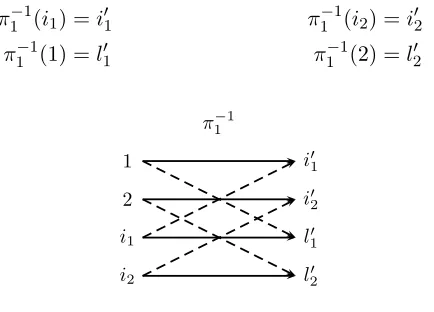
π1(i01) = 1andπ1(i02) = 2. Define
l01 =π1−1(i1) and l20 =π1−1(i2) .
To answer the challenge partitioning, the first mix-server re-definesπ1 such that
π1−1(i1) =i01 π−11 (i2) =i02
π−11 (1) =l01 π1−1(2) =l02 .
π1−1
i2 l2′
i1 l′
1
2 i′2
1 i′1
Figure 1: Modification for re-definition ofπ1.
In other words, the first mix-server chooses to view it as if it replacedc1,i1 andc1,i2 byu1
andu2 to formL00, see Figure 1. To see that the first mix-server can pass the verification test, note that
c1,i0
1c1,i02 =u1u2·Encpk(1, r1,1+r1,2)
=c1,i1c1,i2 ·Encpk(1,(r1−ri1 +r1,1) + (r2−ri2 +r1,2))
c1,l0
1 =c1,1·Encpk(1, ri1−r1+r1,i1)
c1,l0
i.e., it can: replacer1,i1 byr1−ri1+r1,1, replacer1,i2 byr2−ri2 +r1,2, replacer1,1byri1−
r1+r1,i1, and replacer1,2byri2−r2+r1,i2 and then compute the response withR1,1, . . . , R1,b
to the challenge partitionings as an honest mix-server.
Due to the pigeonhole principle, if the attacker corruptsB = b+ 1voters, he will get a collision with probability one. However, thanks to the birthday paradox, the success probability is already significant if about √b voters are corrupted. In particular, if bis large and we set B = 3√b, then we get a collision with probability1−e−32/2
≈0.98.
It is natural to assume that the adversary can choose the indices of his ciphertexts inL0 or at least influence the order enough to get a random partition to the first mix-server. When this is the case, the attack above applies regardless of how the challenge partitioning is defined. Thus, this is a fundamental flaw of the verification scheme.
5.2 Additional Attack on Privacy
Suppose that the following modified way to define a challenge partitioning for the first mix-server is used instead. A random partitioningO0,1, . . . , O0,b of[1, N]is chosen and then the challenge partitioningI0,1, . . . , I0,b is derived from this exactly asIj−1,1, . . . , Ij−1,bis derived fromOj−1,1, . . . , Oj−1,b when forming the challenge partitioning to Mj forj > 1 (see Sec-tion 3.5). We now consider the problem of attacking the mix-net with this modified challenge scheme by corrupting the first mix-server and the firstBvoters. The attack proceeds exactly as the previous attack. The only difference is that the probability of a collision is much larger here.
Let O0,i1, . . . , O0,iB0, B
0 ≤ B, be the blocks that contain at least one of the integers
1, . . . , B. Then within each such block the smallest integer is one of 1, . . . , B. Let S be the set of such smallest integers. Then by construction, the integers in S are contained in I0,1 ∪ · · · ∪I0,db/`e. We say that we get a collision if at least two integers of S appear in someI0,t.
For any db/`e, it suffices that |S| > db/`e to ensure that there is a collision due to the pigeonhole principle. Whendb/`eis large, then it suffices that|S| >3p
b/`to get a collision with probability at least 0.98 by the birthday bound. The success probability of the attack drops slightly due to the event|S| < B. Suppose that`≥ 36andbis large. If we setB = 3pb/`, then we getλ = 3/√`in the approximation of the collision probability, so we can conclude that|S| =B with probability roughlye−λ2/2
≥ e−1/8 ≈ 0.88(and this probability increases rapidly with increasing `). Thus, the probability that the attacker is not detected is roughly
0.98e−λ2/2≥0.86.
Finally, we note that we can transform the attack on the mix-net with the modified way to generate the challenge partitioning ofM1into an attack on the real mix-net by corrupting both
M1 and M2. The first mix-server follows the protocol except that it does not re-encrypt its input ciphertexts and it chooses the permutation such that the inputs of corrupted voters appear at the top ofL1. ThenM2plays the role ofM1 in the attack on the modified mix-net.
It is easy to see that the attack can be adapted to the case where the permutationπ1 used by
When one of the mix-servers can influence the challenge partitioning of the input to the following mix-server, then we expect to find similar vulnerabilities, but our attack fails if the challenge partitioning is chosen randomly and independently for each mix-server.
5.3 Attack on Correctness
This attack requires only one corrupted mix-server and shows that if`≥b, then the correctness can be attacked by replacingR= 13√b−1votes with small probability of detection.
The attacker corrupts a mix-server Mj other than the first one. The mix-server replaces cj−1,1, . . . , cj−1,Rby its own ciphertextsu1, . . . , uRand it replacescj−1,R+1by
uR+1= R+1
Y
i=1 cj−1,i
R Y
i=1 ui
to form a modified list L0j−1. Note that the products of the respective ciphertexts are equal, i.e.,QR+1
i=1 ui= QR+1
i=1 cj−1,i. Then it re-encrypts and permutesL 0
j−1to formLj following the protocol.
The challenge partitioningOj−1,1, . . . , Oj−1,bis randomly chosen. ModifyingR+1 = 13√b votes givesλ = 1/3in the birthday bound, so we may conclude that the probability that two integers in[1, R+ 1]belong to the same block is roughly1−e−λ2/2
≈0.05. When this is the case, the integers1, . . . , R+ 1all belong toIj−1,1. To see that this implies that the attack goes undetected it suffices to note that
Y
i∈Oj,1
cj,i =Encpk(1, Rj,1) R+1
Y
i=1 ui
Y
i∈Ij−1,1\[1,R+1]
cj−1,i
=Encpk(1, Rj,1) Y
i∈Ij−1,1
cj−1,i ,
i.e., the revealed randomness is valid for bothL0j−1andLj−1.
The mix-server can double the number of replacements by doing the same trick for the ciphertexts that appear at the end ofLj−1at the cost of squaring the probability of executing the attack without detection. This is far better than simply increasingRby a factor of two.
It is straightforward to turn this attack on correctness into an attack on privacy by using the ciphertextsu1, . . . , uRto employ Pfitzmann’s attack.
6
Conclusion
Our first attack shows that by corrupting O(√b) voters and the first mix-server, the privacy of any targeted voter can be broken without detection. This attack is applicable regardless how the challenge partitioning of the first mix-server is chosen. Thus, this attack illustrates a fundamental shortcoming of the construction unlessbis very large.
Our second attack shows that if a mix-server can influence the challenge partitioning of the the next mix-server, then by corrupting both servers and O(p
targeted voter can be violated. Thus, bmust be much larger than`. On the other hand, if`is very small, then the overall privacy of the mix-net starts to deteriorate, since much more infor-mation about the permutations are revealed. The complexity of the construction also increases drastically. One way to reduce the second attack to the first attack is to choose the challenge partitioning randomly and independently for each mix-server, but this also reduces the overall privacy of the mix-net compared to the proposed scheme.
The third attack shows that if` ≥ b, then no matter how big bis, an adversary that cor-rupts a single mix-server can replaceO(√b)ciphertexts, or violate the privacy of up toO(√b)
arbitrarily targeted voters, without detection. Thus, the mix-net must not be used with`≥b. Our attacks do not apply directly to the implementation used in the recent electronic elec-tions in Norway due to a small value of ` and additional components in the overall protocol that help to ensure the privacy of the voters. However, there is no guarantee that more serious vulnerabilities cannot be found and our attacks precludes a proof of security for the mix-net.
Acknowledgments
We are grateful to Jordi Puiggal´ı for clarifying some details of their mix-net. We thank Kristian Gjøsteen for answering questions about his analysis of the voting system used in Norway.
References
[1] Norwegian e-vote 2011 project. http://www.regjeringen.no/en/dep/krd/ prosjekter/e-vote-2011-project.html?id=597658, 17 February, 2012.
[2] Private communication. Jordi Puiggal´ı, January, 2012.
[3] D. Chaum. Untraceable electronic mail, return addresses, and digital pseudonyms. Com-mun. ACM, 24(2):84–88, 1981.
[4] Y. Desmedt and K. Kurosawa. How to break a practical mix and design a new one. In B. Preneel, editor, EUROCRYPT, volume 1807 of Lecture Notes in Computer Science, pages 557–572. Springer, 2000.
[5] P. Feldman. A practical scheme for non-interactive verifiable secret sharing. In FOCS, pages 427–437. IEEE Computer Society, 1987.
[6] J. Furukawa. Efficient and verifiable shuffling and shuffle-decryption.IEICE Transactions, 88-A(1):172–188, 2005.
[7] J. Furukawa and K. Sako. An efficient scheme for proving a shuffle. In J. Kilian, editor, CRYPTO, volume 2139 ofLecture Notes in Computer Science, pages 368–387. Springer, 2001.
[9] J. Groth. A verifiable secret shuffle of homomorphic encryptions. In PKC ’03: Proc. of the 6th International Workshop on Theory and Practice in Public Key Cryptography, pages 145–160, London, UK, 2003. Springer-Verlag.
[10] M. Jakobsson. A practical mix. InEUROCRYPT, pages 448–461, 1998.
[11] M. Jakobsson. Flash mixing. InPODC, pages 83–89, 1999.
[12] M. Jakobsson and A. Juels. An optimally robust hybrid mix network. InPODC, pages 284–292, New York, NY, USA, 2001. ACM Press.
[13] M. Jakobsson, A. Juels, and R. L. Rivest. Making mix nets robust for electronic voting by randomized partial checking. In D. Boneh, editor,USENIX Security Symposium, pages 339–353. USENIX, 2002.
[14] S. Khazaei and D. Wikstr¨om. Randomized partial checking revisited. Cryptology ePrint Archive, Report 2012/063, 2012.http://eprint.iacr.org/.
[15] M. Mitomo and K. Kurosawa. Attack for flash mix. In T. Okamoto, editor,ASIACRYPT, volume 1976 ofLecture Notes in Computer Science, pages 192–204. Springer, 2000.
[16] C. A. Neff. A verifiable secret shuffle and its application to e-voting. InCCS ’01: Proc. of the 8th ACM conference on Computer and Communications Security, pages 116–125, New York, NY, USA, 2001. ACM.
[17] C. Park, K. Itoh, and K. Kurosawa. Efficient anonymous channel and all/nothing election scheme. InEUROCRYPT, pages 248–259, 1993.
[18] B. Pfitzmann. Breaking efficient anonymous channel. InEUROCRYPT, pages 332–340, 1994.
[19] B. Pfitzmann and A. Pfitzmann. How to break the direct rsa-implementation of mixes. In EUROCRYPT, pages 373–381, 1989.
[20] J. Puiggal´ı Allepuz and S. Guasch Castell´o. Universally verifiable efficient re-encryption mixnet. In R. Krimmer and R. Grimm, editors,Electronic Voting, volume 167 of LNI, pages 241–254. GI, 2010.
[21] K. Sako and J. Kilian. Receipt-free mix-type voting scheme — a practical solution to the implementation of a voting booth. InEUROCRYPT, pages 393–403, 1995.