The
Ac and Uq Transposable Element Systems
in Maize: Interactions Among
Components
Elizabeth E. 0. Caldwell* and Peter A. Peterson’
*Zoology and Genetics Department and TAgronomy Department, Iowa State University, Ames, Iowa 50011 Manuscript received November 18,1990
Accepted for publication March 9, 1992
ABSTRACT
Components of the Uq and Ac transposable element systems interact. A large sample of Ds-containing and ruq-containing alleles were tested against Uq and Ac. The Uq elements elicit a mutable response from only one of the classes of Ds elements (Dsl) in the Ac family. This response is similar to the response from rug to Uq. In contrast, Ac elicits mutable responses from all Ds and rug elements tested. This represents a lack of reciprocity of interaction for the components of the two elements, Ac and
Uq. Further, two atypical Ac and Uq elements (Ac2 and Uq-Mn) were examined. All rug and Ds
elements tested respond to four doses of Ac2. (Responses to lower doses were not compared.) Only the rug (Dsl) containing alleles respond to Uq-Mn. The other Ds containing alleles were nonresponsive. The finding of nonreciprocating interaction between components suggests a heterogeneous nature for transposable element systems in maize.
T
HE Ubiquitous (Uq) transposable element system was first identified by FRIEDEMANN and PETER-SON (1982; PETERSON and FRIEDEMANN 1983) in a
maize line originating from material exposed to the Barley Stripe Mosaic Virus (SPRAGUE and MCKINNEY
1966, 1971). With the available rug reporter allele, the Uq element was identified in numerous genetic stocks and was hence named Ubiquitous (Uq). Further investigations revealed the pervasiveness of this system with the frequent identification of Uq elements in many important corn breeding populations (PETER-
SON 1986; PETERSON and SALAMINI 1986; CORMACK,
Cox
and PETERSON 1988; LAMKEY, PETERSON, and HALLAUER I99 1).T h e distinctiveness of Uq as a new transposable element system was based on standard genetic tests for transposable element systems (FRIEDEMANN and PETERSON 1982). These tests established the lack of interaction between the elements of the Uq system and elements belonging to the known systems. This type of test was the basis of identification for several systems (BARCLAY and BRINK 1954; NUFFER 1955; PETERSON 1965; GONEELA and PETERSON 1977). Some of these systems were distinguished later at the molecular level [POHLMAN, FEDOROFF and MESSING (1984a,b) for Ac; PEREIRA et al. (1985); and MASSON et al. (1987) for En/Spm]. With the Uq system, genetic tests were conducted with the then published Ac-Ds, Dt-a-dt, En(Spm)-Z and Fcu-rcu systems (FRIEDEMANN and PETERSON 1982).
Figure 1 illustrates the crosses used to test the Uq
system against the Ac system. First, a standard reporter allele for Ac (C-Z Ds) was crossed with the Uq regula-
Genetics 131: 723-731 (July, 1992)
tory element (cross 1). No “Ac-like” activity was ob- served (FRIEDEMANN and PETERSON 1982). Used as a female, the C-Z Ds tester expresses small sectors in the presence of Ac. (The result of two overlapping loss events.) Ideally, if screening for possible weak Ac elements, the C-Z Ds tester should be used as the male parent. (Sectors dependent on only one loss event.)
In the reverse test, progeny from cross
2
between an Ac regulatory element and a-ruq (the first reporter allele identified for Uq) were backcrossed with both the C-ZDs
and a-ruq testers (crosses 3 and 4). Both“Ac-” and “Uq-like” activities were observed, but they seemed to segregate independently in the plants tested. That is, some progeny from cross
2
produced spotted kernels in either cross 3 or 4 but not in both. This implied the nonrelationship between the two different elements, especially when coupled with the observed nonrecognition of C-Z Ds by Uq. Therefore, it was concluded that the Ac-Ds and Uq-ruq elements belong to separate systems. Results from the testing of other systems also proved negative for transactiva- tion; hence, the establishment of a new system, Uq- ruq (FRIEDEMANN and PETERSON 1982).CROSS 1 GI5 -t X € & -. no Ac-like
C-I Ds
+
C + activityC R O S S 2 A_€& x &au€-+ -. -€A&
A C + a-fuq C
+
A C +CROSS 3 L; Aclt x 4
a
& -. "Ac-Activity"A C
+
A C-I D S t SegregatesCROSS4 =€A& x-€ + "Uq-Activity" A C
+
a-ruq C SegregatesFIGURE 1 .-Crosses used by FRIEDEMANN and PETERSON (1 982)
to establish nonrelatedness of the Uq and Ac systems. Cross 1
established that the Uq containing stock did not contain Ac (based
o n one receptor allele). Cross 2 produced F I progeny which were then used in crosses 3 and 4. These last two crosses establish that Uq and Ac activities are present in individual FI progeny (from cross 2) but do not cosegregate within the F 1 population (ie., Some F I individuals produced spotted progeny in cross 3 but not in cross 4
and vice versa).
MATERIALS AND METHODS
Uq regulatory elements: The Uq elements listed below are not linked to either the A 1 or Cl loci.
Uq-St: The standard U9 element described by FRIEDE-
MANN and PETERSON (1 982).
Uq-13: Isolated from the Uq-controlled a-m13 mutant (PEREIRA and PETERSON 1985), this Uq element produces a flow spotting pattern (spots restricted to kernel gown) with the a-ruq and a-ruql3 alleles. CALDWELL and PETERSON (1989) showed that Uq-13 distinguishes between the a-ruq and c-ruq receptor alleles. This is based on alterations in the frequency and timing of mutability when compared to the alleles' responses to Uq-St.
Uq-31, Uq-65, U9-66 and Uq-67: Phenotypically indistin- guishable from Uq-St. Isolated from material with Uq-St in pedigree. Known to transactivate a-rug (CALDWELL and PETERSON 1989).
Uq-Mn: This U9 element is inserted into the Mn locus (PAN and PETERSON 1989). The resulting mutant locus is not male transmissible.
ruqcontaining reporter alleles: The following were used.
a-ruq: The originally identified ruq receptor element- containing allele (FRIEDEMANN and PETERSON 1982).
a-ruql3: An ruq-containing allele originally isolated with Uq-13 (PEREIRA and PETERSON 1985).
a-ruql6: An rug-containing allele originally isolated with Uq-16 (PEREIRA and PETERSON 1985).
c-rug31: This ru9 exhibits a phenotypically distinguishable response to Uq-13 when compared with a-rug, c-ruq65, c- rug66, and c-rug67 (CALDWELL and PETERSON 1989).
c-ru965, c-ruq66, c-ruq67: Phenotypically indistinguisha- ble ruq receptors. May be reisolates of the same mutation (CALDWELL and PETERSON 1989).
Ac regulatory elements: The classically behaving Ac ele- ments are from several sources. These include: c sh wx Ac,
wx-m7::Ac, and wx-m9::Ac.
Ac2: Provided by M. M. RHOADES. Ac2 is a weak acting
Ac when compared with the classical Ac elements (M. M. RHOADES and E. DEMPSEY, personal communications and Maize Genetics Cooperation News Letter (MGCNL) 5 6 2 1-26,
57: 14-17). It is required in two or more doses to induce mutability in bz2-m, and in four doses for C-I Ds and wx-ml
mutability. Does not induce c-ml mutability. This compares with the classical Ac elements which induce bz2-m, C-I Ds,
wx-ml and c-ml mutability when one active cofy is present. Stock contains two linked Ac2 elements (Ac2 Ac2) on the long arm of chromosome 8.
Dscontaining reporter alleles: The following were used. a-m3: A Ds-containing mutant (MCCLINTOCK 1952) used alone and in combination with wx-m6, another Ds-containing allele.
bz-md: A complex Ds-containing mutation, it also contains a linked deletion of shrunken 1 (MCCLINTOCK 1953; KLEIN, ROMAN and PAJE-MANOLO 1990).
bz2-m: Provided by M. M. RHOADES. bz2-m contains a Ds2- type receptor element (THERES, SCHEELE and STARLINCER 1987) and responds to lower Ac2 doses than other Ds ele- ments (M. M. RHOADES and E. DEMPSEY, personal commu- nication).
C Ds: This Ds element causes chromosome breaks in response to Ac (MCCLINTOCK 1951a; DORING et al. 1989). Thought to be a complex or double Ds.
C-I Ds: See C Ds.
wx-ml: Provided by S. R. WESSLER. A Dsl-containing mutant originally identified by B. MCCLINTOCK (1948, 195 1 b) and sequenced by WESSLER and co-workers (1 986). This line is segregating for both c and r.
wx-m6: A Ds-containing mutant (MCCLINTOCK 1952) car- ried in a stock with a-m3, another Ds-containing mutant allele.
wx-m9::Ds: A Ds-containing mutant derived from the orig- inal wx-m9::Ac mutation which contained an Ac element at the waxy locus (MCCLINTOCK 1963; FEDOROFF, WESSLER
and SHURE 1983; POHLMAN, FEWROFF and MESSING
1984a,b). Stock provided by H.-P. DORING.
Ds receptor elements: The following were used.
Dsl: Molecularly, this receptor element exhibits the 11- bp inverted repeat and 8-bp host direct repeat that are characteristic of elements belonging to the Ac-Ds family (SUTTON et al. 1984). The possession of an A-T rich internal sequence that is not derived from Ac defines this distinct class of Ds receptors. The wx-ml reporter allele carries a Dsl element (WESSLER et al. 1986).
Ds2: Originally, Ds2 was identified as an insert in the Adhl-2Fll allele (DORING et al. 1984). Ds2 is described as a 13 19-bp Ds element sharing with other Ds elements the 1 1-bp terminal inverted repeats and several hundred base pairs adjacent to each termini. The internal region differs substantially from the Ac sequence (DORING and STARLIN- GER 1984; MERCKELBACH, DORINC and STARLINCER 1986). T h e bz2-m reporter allele carries a Ds2 element (THERES, SCHEELE and STARLINGER 1987).
Complex Ds: Refers to any of the Ds elements containing duplications of the Ds sequence. One example is the double Ds in sh-m5933. This element consists of one Ds inserted in the reverse direction into a second Ds (DORING, TILLMANN and STARLINGER 1984). DORINC et al. (1989) showed that double Ds elements are involved with Ac induced chromo- some breakage similar to that observed for chromosome 9 in the C Ds and C-1 Ds stocks. Although the structure of this Ds is not known, with the breakage event, a complex (Dou-
ble) Ds structure is inferred.
Deletion-derived Ds: Refers to any of the Ds elements that are deletion derivatives of Ac based on either genetic and/ or sequence analysis. The Ds element in wx-m9::Ds is one example (MCCLINTOCK 1963; FEDOROFF, WESSLER and
SHURE 1983; and POHLMAN, FEDOROFF and MESSING
1984a,b).
Crossing procedures and plant identification: There is the potential for genetic stocks to carry more than one element; ie., an Ac line might harbor an undetected Uq element if no reporter allele for Uq was present. Hence, all
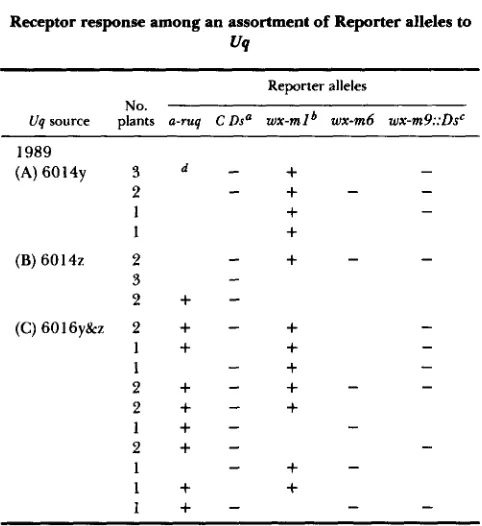
TABLE I
Receptor response among an assortment of Reporter alleles to
4
~~~ ~ ~~ ~ ~ ~~ ~~ ~ ~
Reporter alleles
Ug source plants No. a-rug C D s a wx-mlb wx-m6 wx-m9::Dsc
1989
(A)6014y 3
-
+
-2
+
1
+
1
+
-
-
-
-
(B) 60 147. 2
-
+
-
3
2 +
--
-
(C) 6016y&z 2
+
-
+
-
1 +
+
-
1
2 + -
+
-
-
2 + -
+
1 + -
-
2 +
-1
1 +
I + -
-
-
-
+
-
-
-
+
+
-
Spotted selections (first column) of the general genotype c-rug wxlc-ruq wx, Up/+ were crossed with a selection of Ds and ruq testers. These testers include: a-ruq, C Ds, c wx-ml, C wx-m6, and c wx-m9::Ds. (A) The c-ruq Uq selection has the genotype c-rug31 wx/
c-rug31 wx, a-ruq/A (or A/A), Uq-St/+. (B) T h e Uq source is c-rug31 Wx/c-ruq31 Wx (or c-ruq3l Wx/c-ruq31 wx), a-ruq/A, Uq-31/+. ( C ) c-rug67 Wx/c wx (or c-rug67 wx/c wx), a-ruq/A (or a/A), Uq-67/+ is the Uq source.
C Ds; of the 24 crosses in this series, 4 use the C Ds parent as the male parent.
wx-ml mutability co-segregates with c-rug31 mutability.
wx-m9::Ds mutability was tested on c-ruq3I or c-ruq67 spotted kernels. N o wx-m9::Ds mutability was observed.
+
indicates muta- bility observed. Used here and throughout.-
indicates no mutabil-ity observed. Used here and throughout.
Blank indicates cross not available. Used here and throughout.
emerge even if more than one autonomous element is segregating in a cross.
Crosses were made in both directions except where indi- cated. In order to minimize table lengths, male and female parents were only identified in selected crosses. Where the
direction of the crosses are not identified, crosses were
available in both directions and were in agreement.
RESULTS
Response of different r u ~ and
Ds
receptors to Uq elements with the Uq-St phenotype: A representative assortment of rug (CALDWELL and PETERSON 1989) and Ds containing mutant alleles (see MATERIALS ANDMETHODS) were crossed to standard confirmed Uq
elements. T h e results from crosses with the a-rug, c- ruq31, c-ruq65, c-ruq67, C Ds, wx-ml, wx-m6 and wx- m9::Ds reporter alleles are itemized in Tables 1 and
2.
Four sources of standard type Uq elements were used; Uq-St, 7.79-31, Uq-66 and Uq-67.T h e crossing strategies used to produce the crosses reported in Tables 1 and 2 differ. In Table 1 the cosegregation of Uq induced mutability (c-ruq31 or c-
ruq67 spotted phenotype) and waxy mutability (wx-m1
or wx-m9::Ds sectored phenotype) can be determined on an individual kernel basis. This is because the c- r u q ( 3 l or 6 7 ) Uq parents carry recessive wx alleles and the wx-m1 and wx-m9::Ds testers carry recessive c al- leles. For the other testers examined in Table l and all of the testers in Table 2 , it is not possible to expose the phenotype of two reporter alleles with one cross. Therefore, the cosegregation of mutability for the rug
and
Ds
elements is determined by using paired crosses. Duplicate crosses were made using alleles in different stocks. This precaution was taken to increase the opportunity of observing any previously undetectedAc or Uq regulatory elements.
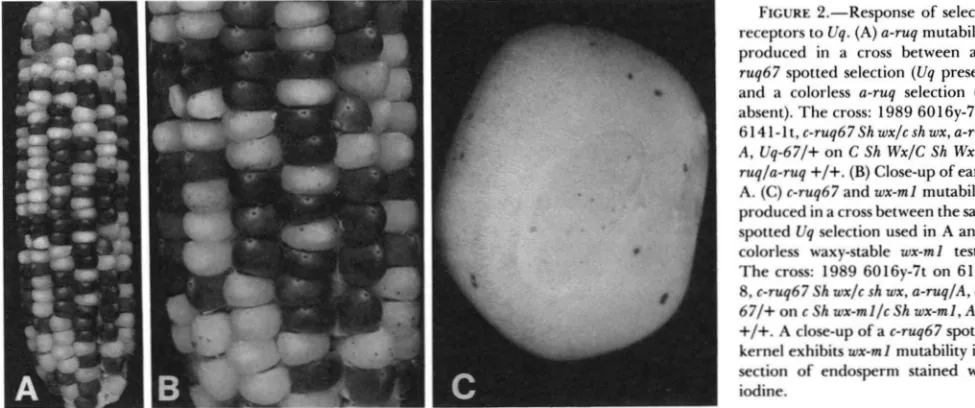
T h e Uq elements tested in Tables 1 and 2 trigger mutability with the following reporter alleles: a-rug
(Figure
2,
A and B), c-ruq31, c-ruq66, c-ruq67, andwx-ml. No mutability is evident in crosses between these same Uq elements and the complex or deletion derived Ds elements carried by the C Ds, wx-m6, or
wx-m9::Ds alleles. In the crosses where c-rug ( 3 1 or 6 7 ) and wx-ml mutability could be scored on the same kernel (Table l), the c-rug31 and c-rug67 spotted kernels always exhibited wx-mI mutability (Figure 2C). T h e c-ruq3I/c wx-m9::Ds/wx Uq/+ and c-ruq67lc wx- m9::Dslwx Uq/+ kernels were always spotted waxy- stable. Therefore, of the classes of Ds elements tested in Tables 1 and 2, only the D s l element (wx-m1) is responsive to Uq elements.
To further explore the diversity of Ds elements, other Ds elements were tested for Uq responsiveness. These include the
Ds
elements at bz-m4, bz2-%, and a-m3. Two generations of crosses were necessary for these tests because of the lack of appropriate tester genotypes. First, a Uq source ( a Uq-St, c-rug67 Uq-St
or c Uq-67) was crossed with the Ds containing re- porter allele. In the second generation, the colored F1 kernels were backcrossed with either the a-rug or
c-rug67 tester to confirm the Uq content of each. Backcrossing the same F1 plants with the bz-m4 recep- tor exposes the responsiveness of the bz-m4 allele to
Uq-St. Although Uq was present in two F, plants, neither exhibited bz-m4 mutability (results not shown). Therefore, the Ds receptor element in bz-m4 is not activated by Uq-St. Similar crosses test the response of the bz2-m and a-m3 alleles to Uq-St and Uq-67. A
complete lack of bz2-m and a-m3 mutability (1 5 and 2
plants, respectively) demonstrates that Ds2 (bz2-m) and a deletion derived Ds (a-m3) are Uq nonresponsive.
A summary of all the
Ds
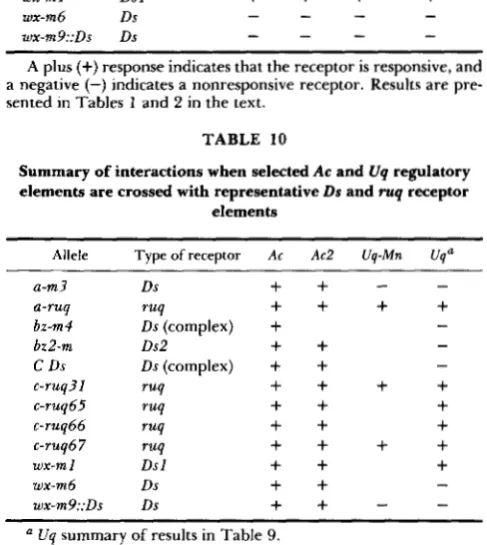
and rug receptor elements tested in response to the Uq-St, Uq-31, and Uq-67regulatory elements is given in Table 9. All of the ruq
elements (a-rug, c-ruq31, c-rug66 and c-ruq67) and the
TABLE 2
Receptor response of selected Ds and nq alleles to Up
Reporter alleles
U9 source plants C DP c - r ~ q 3 1 c - r ~ q 6 7 c - r ~ q 6 6 wx-m 1 wx-m6 wx-m9 No.
6022 to 6025 3
-
-
1 3 1 2
1
-
+b +b3
4
-
+b +b1
+
+b2
1
-
+b +b1
-
+b1
-
+b +b1
1
-
+b +b-
-
-
-
-
+
+
+
+
+
-
-
-
-
-
-
-
-
-
+
-
-
-
c sh wx lines segregating for Uq-31, Uq-66 or Uq-67 were crossed with selected Ds and ruq testers. These include C Ds, c-ruq31 Sh W X , C-
O C Ds; of the 26 crosses, 5 used the C Ds parent as the male parent.
rug65 Sh wx, c-rug66 Sh Wx. c-rug67 Sh wx, (c) Sh wx-ml, C Sh wx-m6. and c sh wx-m9::Ds. Crosses made summer, 1989.
Ratios indicate more than one element segregating. I f
+
stands alone, one element is segregating.FIGURE 2.-Response of selected receptors to Uq. (A) a-ruq mutability: produced in a cross between a c- ruq67 spotted selection (Uq present) and a colorless a-rug selection (Uq absent). The cross: 1989 60 16y-7 on
614l-lt,c-ruq67Shwx/cshwx,a-ruq/
A, Uq-67/+ on C Sh Wx/C Sh Wx, a- r u g fa-ruq
+
/+.
(B) Close-up of ear inA. (C) c-ruq67 and wx-ml mutability: produced in a cross between the same spotted Uq selection used in A and a colorless waxy-stable wx-ml tester. The cross: 1989 6016y-7t on 61 1 1- 8. c-ruq67 Sh wxfc sh wx, a-ruqlA, Uq- 6 7 / + on c Sh wx-mllc Sh wx-ml, AIA,
+/+.
A close-up of a c-rug67 spotted kernel exhibits wx-ml mutability in a section of endosperm stained with iodine.bz2-m) do not respond to the Uq (confirmed) regula- tory elements.
Response of different receptors to Ac elements: Having established that wx-m1, a Dsl containing allele, responds to Uq, it was next necessary to test the response of the ruq containing elements to Ac. In the original work on the Uq system, FRIEDEMANN and PETERSON (1982) showed that the two responding genotypes a-ruq and C-I Ds did not respond to the same elements. However, their test used the C-I Ds
tester as the female parent. A more sensitive test would use the C-I Ds tester as the male parent. In addition, the response of the c-ruq alleles to Ac was never tested (CALDWELL and PETERSON 1989). In the present work the a-rug Ac interaction was retested
along with an investigation of the c-ruq Ac interactions. As a control, the Ds testers are retested against Ac.
Retest of the a-ruq response to standard Ac elements: Three different tests and Ac sources were used to reexamine the a-rug Ac interaction. In the first test (Table 3), spotted non-waxy a-ruqla-rn3 wx-m7::Ac/Wx plants were crossed with the a wx tester to expose the a-ruq or a-m3, and wx-m7::Ac phenotypes. Because the only Ac in the cross is at the W x locus (wx-m7::Ac), the a-m3 allele will always be spotted in the presence of wx-m7::Ac (non-waxy sectors) and colorless when seg- regating with W x . T h e other half of the progeny kernels are either a-ruqla, wx-m7::Ac/wx or a-ruqla, Wxlwx. If a-ruq is Ac nonresponsive, then a-ruq will
Ac Uq 727
TABLE 3
Response of a-rug to Ae
Kernel phenotype
~ ~ ~~~~~~
No. rows
stained Spotted,
per ear waxy-mutable Ac source
Spotted, non-waxy
Colorless, waxy-mutable
Colorless/pale, non-waxy
1990, 2407-1 3 34 2 0 47
-2 4 26 0 0 39
-9 3 35 2 0 46
This was tested by crossing the colorless a-ruq (no Uq) tester by a line homozygous for wx-m7::Ac and the a-m3 reporter allele (deletion derived Ds). The spotted non-waxy F, progeny, a-ruq/a-m3 wx-m7::Ac/Wx, were next crossed to the a wx tester to assess the co-segregation of a-rug and a-m3 spotting with wx-m7::Ac mutability. Counts for phenotypic classes segregating in three to four contiguous rows on each of three ears are listed.
termine the a-ruq Ac relationship, three or four con- tiguous unselected rows of kernels from three ears were stained to confirm the wx-m7::Ac phenotype (Table 3). All of the waxy-mutable kernels were spot- ted. This indicates that both the a-m3 and a-ruq alleles respond to Ac. (If a-ruq was not responsive, half of the waxy-mutable would be colorless. No colorless waxy- mutable class was observed.)
In the second test of the a-ruq response to Ac, a-ruq
spotted and colorless selections (Ac and wx in pedigree) were tested for their Ac content. Each selection was crossed with the wx-m9::Ds tester and/or the C-I Ds
tester (results not shown). All nine a-ruq spotted selec- tions produced waxy-mutable (wx-m9::Ds) or colored sectors (C-I D s ) when tested. None of the progeny from the nine a-ruq colorless selections exhibited wx- m9::Ds or C-I Ds mutability. Therefore, selecting a- rug mutability selected Ac.
In the final test, remnant kernels from the original test by FRIEDEMANN and PETERSON (1 980) were used. These kernels were heterozygous for a-ruq and wx,
and segregated for Ac. Each was crossed with a-ruq
and one or more of the following testers: bz-m4, wx- m9::Ds and wx-m1. Together, the bz-m4 and wx-m9::Ds
testers should provide a more powerful test than the original test using C-I Ds as the female parent. In Table 4, a-ruq mutability cosegregates with the com- plex Ds, deletion derived Ds, and D s l mutabilities.
Together these three tests support the conclusion that a-ruq responds to Ac. As such, these results cor- rect the earlier finding (FRIEDEMANN and PETERSON 1982) which reported no interaction.
Test of other ruq receptors and a comparison with the Ds receptors: A c sh wx Ac line was crossed with a selection of mutants carrying ruq and Ds inserts on chromosome 9 . The results of these crosses with the
C Ds, c-ruq31, c-ruq65, c-ruq66, c-ruq67, wx-ml wx-m6,
and wx-m9::Ds alleles are given in Table 5 . All of these receptors produce a mutable phenotype when a con- firmed Ac is present. (The presence of an Ac element is confirmed by the expression of mutability with C Ds, wx-m6, and wx-m9::Ds.) Therefore, c-ruq mutability
TABLE 4
A retest of the rug response to Ac
Reporter alleles
Ac source a-rug br-m4 wx-m9::Ds wx-ml
1990,2406
Y-2
+
+
+
Y-3 +a
+"
2-2
+
+
2-4
2-6
+
+
-
-
Colored seed of the genotype a-ruq/A, C Sh Bx Wx/C sh bx wx,
+
or-
Ac, was crossed with a-rug and assorted Ac testers. The Ac containing plants were the FI progeny from the cross of a-ruq/a- ruq, C Sh Bz Wx/C Sh Bz Wx, no Uq X A / A , C sh bz ws/C sh br wx, Ac (79g 220 X 209 and 220 X 207).Ratios indicate more than one element segregating. If
+
stands alone, then it indicates one element is segregating.(c-ruq31, c-ruq65, c-ruq67) and Ac-induced Ds muta- bility (C Ds, wx-m6 and wx-m9::Ds) are correlated. The alternative possibility is that the Ac containing chro- mosome carries a linked Uq element. This second hypothesis is excluded with the following test.
T o further support the results of Ac action on the
ruq alleles shown in Table 5 , crosses with an Ac ele- ment from a different pedigree ( C Ds wx/c wx, Ac/+)
were examined (Table 6). The phenotype of this Ac
source was sectored, and therefore, confirmed its Ac
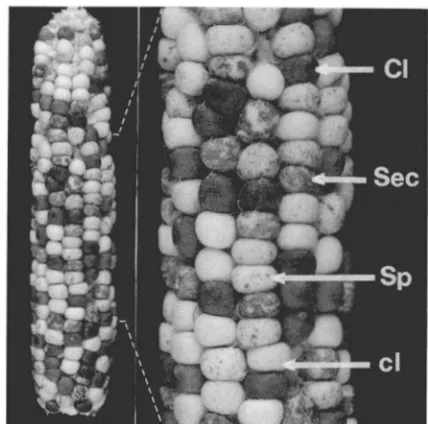
content. Crosses with the c-ruq alleles expose both the
C Ds and c-ruq phenotypes on the same ear. In all cases, the pattern of expression of both alleles indi- cates the presence of only one element (Figure 3). Such a confirmation of a single element excludes the possibility of a second element causing the ruq re- sponse. This result supports the hypothesis that c- ruq31, c-ruq65, c-ruq66 and c-ruq67 are receptive to (recognized by) Ac. Note that these same alleles were distinguishable from Ds containing alleles other than
wx-ml, when Uq was the only confirmed active element (Table 2).
For the comparison of phenotypes, the a-m3 and
TABLE 5
Receptor response to Ac Reporter alleles
Ac source C Ds c-suq31 c-ruq65 c-rug66 c-rug67 wx-ml wx-m6 wx-m9
1989,6018 Y-2 y-3
Y-4
+
+
+
+
+
Y-5
+
+
+
Y-1 +b
+
+
+
Y-2
Y-3 + b +
+
+
+
+
+ + eY-4
Y-5 +b
-
-
-
-
"
-
-
-
+
+
+
60182-2
-
+'
-
6019
-
+
-
-
-
-
-
-
" +d-
-
-
-
-
h c h plant of a c sh wx, Ac line was crossed with a selection of Ds and rug testers. These include the following testers: C Ds, c-rug31
Sh wx, c-rug65 Sh wx, c-rug66 Sh Wx, c-mg67 Sh wx, ( c ) Sh wx-ml, C S h wx-m6, and c sh wx-m9::Ds. The C Ds, wx-m6 and wx-m9::Ds alleles confirm the presence of Ac.
Spots are fine type. Only 8% spotted. May represent element activation or tassel sector.
C Ds was the female parent and may account for the observed weak or no response. Expect 50% sectored for one Ac. Observe
21% for 6019~-1, 6% for 6019y-3,and 10% for 6019~-5. Only 9/30 kernels stained waxy mutable. A weak element or a tassel sector are possible explanations. The wx-m9::Ds and C Ds results are in agreement.
Only 2/20 kernels stained with either a single Wx sector or a sector of Wx sectors. May represent element activation.
TABLE 6
Receptor response of assorted reporter alleles to Ac Reporter alleles
Ac source C Ds' wx-mlb c-rug31 c-rug65 c-rug66 c-rug67
1989,6019
E- 1
+
+
+
+
2-2
+
+
+
+
+
2-3
+
+
+
+
+
2-4
+
+
+
+
+
2-5
+
+
+
+
2-6
+
+
+
+
2-7 +c
+
+
+
Each plant is of the confirmed Ac containing genotype: C Ds wx/ c wx Ac/+ (Phenotype is colored with colorless sectors.) These plants were tested with the rug and Ds containing alleles located on chromosome 9 . The C Ds phenotype was confirmed in crosses to C
Ds and/or a null c allele linked to several of the receptor alleles. C Ds phenotype determined in backcross to C Ds or in cross t o c.
Expect all C Ds sectored kernels to also be wx-ml mutable if rux-ml responds to Ac. This is not the case for 2-1, -2, -3, -4. "7. Likely due to difficulty in separating C Ds sectored from C Ds
colored plus "5"-mottling.
C Ds phenotype determined solely on cross to c Sh wx-ml. 2-7 exhibits excess sectored progeny. Likely "r" mottling due to r segregating in the wx-mI line. (Also observed "r" mottling in 2-1, -2, -3, -4 crosses with wx-ml.)
(MCCLINTOCK 1952; M. M. R H O A D E S ~ ~ ~ E. DEMPSEY, personal communication).
Response of different receptors to Ac2: Ac2 was
FIGURE .?.--Progeny ear from the cross 1989 60 19z-6t on 6027- 2, C Ds wx/c wx Acl+ on c-mq3l/c-ruq31. Ear segregates % colored (C Dslc-ruq N o Ac):% sectored (C Dslc-rug Ac):% spotted (clc-rug
Ac):% colorless (clc-rug no Ac). Segregation ratios (data not shown) suggest that the c-rug31 allele is responding to the same element as
C Ds (ie., Ac). Individual kernels are marked on close-up to show each of the phenotypic classes: CI = colored, Sec = sectored, Sp = spotted, cl = colorless.
TABLE 7
Test of the response of the standard ruq receptor, a-ruq, to Ac2
Reporter alleles Ac2 source
(Fd No. ears bz2-m a-ruq
-
1989,6003 5
-
7
-
+
+
Each plant tested is an F, resulting from the cross a-ruq/a-ruq, Bz2/Bz2 X A/A, bz2-m/bz2-m, Ac2"Ac2/++. In 1989 these colored
FI progeny were backcrossed by the bz2-m tester to confirm the Ac2 content. They were also backcrossed by a-rug to determine the a-
rug interaction with Ac2.
next tested because it is unique among the Ac regula- tory elements. M. M. RHOADES and E. DEMPSEY (per- sonal communication) described this element as elic- iting differing degrees of response from a selection of receptor alleles. To extend the description of receptor interactions with Ac regulatory elements, a series of crosses were initiated to compare rug and
Ds
responses to Ac2. Since the Ac2 line is homozygous dominant for A I , C l and Wx, all tests required two generations to complete. In the second generation, the Ac2 car- rying parent was always used as a female to prevent confounding the results with the dosage effect of Ac2(M. M. RHOADES and E. DEMPSEY, personal commu- nication).
TABLE 8
Test of the response of the ruq receptors, e-mq31 and e-mq67, and the Ds receptors, wr-m6 and w-m9::Ds, to Ac2
Reporter alleles Ac2 source
(F,) No. ears brZ-m c-ruq3l c-ruq67 wx-m6 wx-m9::Ds
1989
(A) 6005 1
-
-
5 +
+
3 1
-
-
-
-
-
-
(B) 6004 2
+
+
1
1 -a -
-
2 -a 1
+
1
+
+
+
1 -a
-
1
+
+
+
-
-
-
+
-
Each plant tested is an FI resulting from the cross of either c- ruq3I wx/c-ruq31 wx, Bz2/Bz2 (A) or c-ruq67 wx/c-ruq67 wx, Bz2/
Bz2 (B) by C Wx/C Wx, bz2-m/bz2-m, Ac2"Ac2/++. In 1989, these colored F, were backcrossed to the bz2-m tester to confirm the Ac2 content and also backcrossed to the c-ruq3l wx, c-ruq67 wx, C wx- m6, and c wx-m9cDs testers to determine the Ac2 interactions with these receptor alleles.
c-rug67 dosage (c-ruq67/c-ruq67/C
+
Vq = pale+
spots) inter- feres with scoring for Ac2 presence (bz2 background+
622 spots).with the bz2-m tester confirmed the Ac2 content of each F 1 . T h e paired crosses with the a-ruq tester exposed the a-ruq response to Ac2. These crosses establish that a-ruq is mutable in the presence of Ac2.
Similar results from three plants demonstrated cose- gregation of a-ruql6 mutability and Ac2 (results not shown).
T h e responses of other reporter alleles to Ac2 were also examined. T h e c-ruq31, c-ruq67, wx-m6 and wx- m9::Ds alleles were tested by first crossing bzZ-mlbz2- m AcZAAc2/++ by either c-ruq31 wx (Table 8A) or c- ruq67 wx (Table 8B) testers. T h e colored FI progeny were then crossed with bz2-m, no Ac2 to confirm their
Ac2 content. These same F1 progeny were also crossed with c-ruq31 or c-ruq67, wx-m6 and wx-m9::Ds to estab- lish the response of these receptors to Ac2. All 4
receptor alleles (c-ruq31, c-ruq67, wx-m6 and wx- m9::Ds) respond to Ac2 by exhibiting mutable pheno- types.
Limited tests between the Ac2"AcZ and c-ruq65, c- rug66 and wx-m1 testers were also made. All 3 testers responded to the Ac2 element (results not shown).
Response of different receptors to Uq-Mn: T h e different receptor elements were also tested with a unique Uq, Uq-Mn (Table 10). This Uq element is located at the M n (miniature) locus, Uq::Mn, and can be followed by the dominant miniature kernel phe- notype (PAN and PETERSON 1989). It is the only Uq
located at a known gene site and as such, it is impor- tant to establish its action potential. T h e receptor elements tested are those located in the a-ruq, a-m3,
TABLE 9
Summary of the responses of alleles with Ds or rug inserts with the Uq-St, Uq-31, and Uq-67 regulatory elements
Allele Type of receptor Uq-St Uq-31 Uq-67 (combined) Uq
a-m3 Ds
-
-
a-ruq rug
+
+
+
+
bz-m4 Ds (complex) -
-
6.22-m Ds2
-
-
C Ds Ds (complex)
-
-
-
-
c-rug31 ruq
+
+
+
c-rug65 ruq
+
+
c-rug67 ruq
+
+
+
+
wx-m I Ds I
+
+
+
+
wx-m6 Ds -
-
-
wx-m9::Ds Ds
-
-
-
A plus (+) response indicates that the receptor is responsive, and a negative (-) indicates a nonresponsive receptor. Results are pre- sented in Tables 1 and 2 in the text.
-
-
-
TABLE 10
Summary of interactions when selected Ac and Uq regulatory elements are crossed with representative Ds and ruq receptor
elements
Allele Type of receptor Ac Ac2 Uq-Mn Uqa
a-m3 Ds
+
+
-
-
a-rug ruq
+
+
+
+
bz-m4 Ds (complex)
+
-
bz2-m Ds2
+
+
C Ds Ds (complex)
+
+
-e-ruq3l ruq
+
+
+
+
c-rug65 rug
+
+
+
c-ruq66
+
+
+
c-rug67 rug
+
+
+
+
wx-m I Ds I
+
+
+
wx-m6 Ds
+
+
-
wx-m9::Ds Ds
+
+
-
-
-
a Uq summary of results in Table 9.
c-ruq31, c-ruq67 and wx-m9::Ds reporter alleles. Only the a-ruq, c-ruq31, and c-ruq67 alleles are mutable in response to Uq-Mn. T h e two deletion derived Ds ele- ments located in the a-m3, and wx-m9::Ds alleles are not responsive to Uq-Mn (data not shown). Although the D s l element in wx-m1 was not tested by Uq::Mn,
this Uq is expected to recognize the wx-mI receptor element. This is based on the molecular studies of PISABARRA et al. (1991) where it was shown that there is a 93 to 95 percent sequence homology between several D s l elements.
DISCUSSION
Transposable elements in maize were classified into systems soon after the original isolation of Ac and Ds
(RHOADES 1938; MCCLINTOCK 195 lb). Thus, the Dt
system was distinguished from the Ac system even though both systems have mutable alleles at the same locus.
Numerous transposable elements are described for maize. These elements are classified into systems based on genetic tests of reporter alleles response to regulatory elements such as Ac, EnlSpm, and others (PETERSON 1987). These system relationships were finally clarified with the initiation of molecular stud- ies. Many, but not all receptor elements are deficiency derivatives of their related regulatory elements [Ac:
FEDOROFF, WESSLER and SHURE (1983); En/Spm:
SCHWARZ-SOMMER et al. (1984); PEREIRA et al. (1985); MASSON et al. (1987)l. For all elements of a system, the characteristic features are the sequence of their terminal inverted repeats and the length of their target site duplication. With these findings, the struc- tural features of regulatory-element reporter allele interactions as well as the genetic exclusiveness of systems were established.
There are some inconsistencies. If a regulatory ele- ment of one system (system 1) recognized a reporter allele of another system (system
2),
one would expect that the regulatory element of system 2 would recog- nize the reporter allele of system 1. This was not true for the Fcu-r(cu) system (Factor Cuna, GONELLA and PETERSON 1977). Here, Fcu recognizes its own r(cu)and also the R-r#2 receptor allele of the Spf system ( G . R. K. SASTRY and S. L. KURMI, personal commu- nications and M G C N L 44: 10 1-105; I. SINGH, J. K . S. SACHAN, G. GUHA and K. R. SARKAR, personal com- munications and M G C N L 49: 45-49). Yet Spfdoes not recognize r(cu) (GONELLA and PETERSON 1978).
The Ubiquitous transposable-element system consists
of both Uq and ruq elements. This system, was first identified genetically by FRIEDEMANN and PETERSON (1982). In an attempt to molecularly describe the ruq
elements inserted at the C locus, W. MARTIN (unpub- lished results) discovered that the ruq element was present in the c-ruq3l allele (CALDWELL and PETER- SON 1989) and has a sequence identical with the D s l
element in wx-ml (WESSLER et al. 1986). PISSABARRO
et al. 1991 found that the ruq in a-ruq is a slightly
altered D s l element. Hence, the genetic tests reported here were initiated to reexamine the relationship be- tween the Ac-Ds and Uq-ruq systems.
These tests confirm the occurrence of a class of regulatory elements ( U q ) which only elicit a mutable response with reporter alleles carrying either a ruq or
D s l insert. Crosses with stocks carrying C Ds confirm
the original observation that Uq does not transactivate the “complex Ds” class of Ds elements (FRIEDEMANN and PETERSON 1982). These Ds elements contain in- ternal rearrangements or duplications and cause chro- mosome breaks (DORING et al. 1989). T h e Uq elements
are also not capable of transactivating two other classes of Ds elements. These are the deletion derived
Ds elements (a-m3, wx-m9::Ds and wx-m6) and the Ds2
(bz2-m) elements. Hence, the Uq regulatory elements
have the ability to transactivate only D s l which is one of the four classes of Ac-related receptor elements.
In contrast to the results with Uq, the Ac regulatory elements transactivate all four classes of Ds receptor elements (complex Ds, Ac deletion derivatives, D s l ,
and Ds2). T h e D s l class includes a-ruq and all of the ruq receptor elements inserted into the C locus (c-
ruq31, c-ruq65, c-ruq66 and c-ruq67).
T o examine the genetic relationships between ele- ments assigned to the Ac and Uq systems, the interac- tions between selected receptor elements and two unique regulatory elements (Ac2 and Uq-Mn) were examined. M. M. RHOADES and E. DEMPSEY (personal communication) described the Ac2 element and found it incapable of inducing Ds mutability when present in less than two copies. With Ds2, a minimum of two doses of Ac2 is necessary for excision (bz2-m mutabil- ity). For C-I Ds chromosome breakage and wx-m1
mutability, four or more doses of Ac2 are needed.
Using a stock with two linked Ac2 elements ( A c ~ ~ A c ~ ) ,
the selected receptor elements were tested for re- sponse to four Ac2 elements. All three classes of Ds
elements tested (deletion derived D s , D s l , and D s 2 )
respond to Ac2. So do all of the ruq elements tested. T h e second unique regulatory element tested was
U9-Mn. This element induces mutability for all ruq
( D s l homologous) containing reporter alleles tested.
T h e deletion derived Ds elements were nonresponsive
to Uq-Mn. It was important to test this because Uq-Mn
is the only Uq at a known gene locus. This will be valuable for the time when it is cloned to provide assurance that it is a confirmed Uq.
In conclusion, the genetic tests show that the Ac and
U9 transposable element systems overlap (Table 10). This supports the molecular findings that the ruq
elements are D s l elements. These results add to the complexity of element composition and interaction.
Journal Paper No. 5-14317 of the Iowa Agriculture and Home Economics Experiment Station, Ames, lowa; Project No. 2850. This study has been supported by National Science Foundation grant D8818646.
LITERATURE CITED
BARCLAY, P. C., and R. A. BRINK, 1954 The relation between Modulator and Activator in maize. Proc. Natl. Acad. Sci. USA 40: 11 18-1 136.
CALDWELL, E. E. O . , and P. A. PETERSON, 1989 Diversity of
transposable-element interactions: the Uq transposable-element system in maize controls four c-m mutants exhibiting unique responses to (19-13. Maydica 34: 89-105.
CORMACK, J. B., D. F. Cox and P. A. PETERSON, 1988 Presence of the transposable element Uq in maize breeding materials. Crop Sci. 28: 941-944.
controlling elements: now at the DNA level. Cell 39: 253-259. DORING, H. P., E. TILLMANN and P. STARLINGER, 1984 DNA
sequence of the maize transposable element Dissociation. Na- ture 307: 127-1 30.
DORING, H. P., M. FREELING, S. HAKE, M. A. JOHNS, R. KUNZE, A. MERCKELBACH, F. SALAMINI and P. STARLINGER, 1984 A Ds-
mutation of the Adhl gene in Zea mays L. Mol. Gen. Genet.
DORING, H. P., B. NELSEN-SALZ, R. GARBER and E. TILLMANN, 1989 Double Ds are involved in specific chromosome break- age. Mol. Gen. Genet. 2 1 9 299-305.
transposable maize controlling element Ac and Ds. Cell 35:
FRIEDEMANN, P., and P. A. PETERSON, 1982 The Uq controlling- element system in maize. Mol. Gen. Genet. 187: 19-29. GONELLA, J. A,, and P. A. PETERSON, 1977 Controlling elements
in a tribal maize from Colombia: FCU, a two-unit system. Ge- netics 85: 629-645.
<;ONELLA, J. A , , and P. A. PETERSON, 1978 The Fcu controlling- element system in maize. Mol. Gen. Genet. 167: 29-36.
KLEIN, A. S., G. ROMAN and L. PAJE-MANALO, 1990 Charac- terization of sh bz-m4 derivative 6843B, a “changed state” of the original br-m4 mutation. Maydica 35: 339-351.
LAMKEY, K. R., P. A. PETERSON and A. R. HALLAUER, 1991 Frequency of the transposable element Uq in Iowa Stiff Stalk Synthetic Maize Populations. Genet. Res. 57: 1-9.
MASSON, P., R. SUROSKY, J. KINGSBURY and N. V. FEDOROFF, 1987 Genetic and molecular analysis of the Spm-dependent a- m2 alleles of the maize a locus. Genetics 177: 117-1 37. MCCLINTOCK, B., 1947 Cytogenetic studies of maize and neuro-
spora. Carnegie Inst. Washington Year Book 4 6 146-152. MCCLINTOCK, B., 1948 Mutable loci in maize. Carnegie Inst.
Washington Year Book 47: 155-169.
MCCLINTOCK, B., 1951a Chromosome organization and gene expression. Cold Spring Harbor Symp. Quant. Biol. 16: 13- 47.
MCCLINTOCK, B., 1951b Mutable loci in maize. Carnegie Inst. Washington Year Book 50: 174-1 8 1.
MCCLINTOCK, B., 1952 Mutable loci in maize. Carnegie Inst. Washington Year Book 51: 2 12-21 9.
MCCLINTOCK, B., 1953 Mutation in maize. Carnegie Inst. Wash- ington Year Book 52: 227-237.
MCCLINTOCK, B., 1963 Further studies of gene control systems in maize. Carnegie Inst. Washington Year Book 62: 486-493. MERCKELBACH, A., H. P. DORING and P. STARLINGER, 1986 The
aberrant Ds element in the adhl-2FII::Ds2 allele. Maydica 31:
NUFFER, M. G., 1955 Dosage effect of multiple Dt loci on mutation
PAN, Y.-B., and P. A. PETERSON, 1989 Tagging of a maize gene
193: 199-204,
k-EDOROFF, N.,
s.
WESSLER and M. SHURE, 1983 Isolation of the 235-242.109-122.
of a in the maize endosperm. Science 121: 399-400.
involved in kernel development by an activated Vq transposable element. Mol. Gen. Genet. 219: 324-327.
PEREIRA, A., and P. A. PETERSON, 1985 Origin and diversity of mutants controlled by the Uq transposable element system in maize. Genet. Res. 4 6 219-236.
PEREIRA, A., Zs. SCHWARZ-SOMMER, A. GIERL, I. BERTRAM, P. A. PETERSON and H. SAEDLER, 1985 Genetic and molecular analysis of the Enhancer ( E n ) transposable element system of Zea mays. EMBO J. 4 17-23.
PETERSON, P. A,, 1965 A relationship between the Spm and En control systems in maize. Am. Nat. 9 9 391-398.
PETERSON, P. A., 1986 Mobile elements in maize: A force in evolutionary and plant breeding processes. Stadler Genet. Symp. 17: 47-78.
PETERSON, P. A., 1987 Mobile elements in plants. CRC Crit. Rev. Plant Sci. 6: 105-208.
PETERSON, P. A,, and P. D. FRIEDEMANN, 1983 The ubiquitous controlling-element system and its distribution in assorted maize testers. Maydica 28: 2 13-249.
PETERSON, P. A,, and F. SALAMINI, 1986 A search for active mobile elements in the Iowa Stiff Stalk Synthetic population and some derivatives. Maydica 31: 163-172.
PISABARRO, A. G., W. F. MARTIN, P. A. PETERSON, H. SAEDLER and A. GIERL, 1991 Molecular analysis of the ubiquitous (Vq) transposable element system of Zea mays. Mol. Gen. Genet.
POHLMAN, R. F., N. V. FEWROFF and J. MESSING, 1984a The nucleotide sequence of the maize controlling element Activator. Cell 37: 635-643.
POHLMAN, R. F., N. V. FEDOROFF and J. MESSING,
1984b Correction nucleotide sequence of Ac. Cell 3 9 4 17. RHOADES, M. M., 1938 Effect of the Dt gene on the mutability of
the a1 allele in maize. Genetics 23: 377-395.
SCHWARZ-SOMMER, Zs., A. GIERL, R. B. K L ~ G E N , U. WIENAND, P. A. PETERSON and H. SAEDLER, 1984 The Spm (EN) TRANS-
INSERT AT THE 70%-m-8 allele of Zea mays. EMBO J. 3: 1021- 1028.
SPRAGUE, G. F., and H. H. MCKINNEY, 1966 Aberrant ratio: an anomaly in maize associated with virus infection. Genetics 5 4
SPRAGUE, G. F., and H. H. MCKINNEY, 1971 Further evidence on the genetic behavior of AR in maize. Genetics 67: 533-542. SUTTON, W. D., W. L. GERLACH, D. SCHWARTZ and W. J, PEACOCK,
1984 Molecular analysis of Ds controlling element mutations at the Adhl locus of maize. Science 223: 1265-1268.
THERES, N., T. SCHEELE and P. STARLINCER, 1987 Cloning of the
Bz2 locus in Zea mays using the transposable element Ds as a gene tag. Mol. Gen. Genet. 209: 193-197.
WESSLER, S. R., G. BARAN, M. VARAGONA and S. L. DELLAPORTA, 1986 Excision of Ds produces waxy proteins with a range of enzymatic activities. EMBO J. 5: 2427-2432.
2 3 0 201-208.
POSABLE ELEMENT CONTROLS THE EXCISION OF A 4-KB DNA
1287-1296.