ABSTRACT
ZENG, WENTE. Secure Distributed Control Methodologies with Built-in Defense in Distributed Networked Control Systems. (Under the direction of Dr. Mo-Yuen Chow.)
Distributed Networked Control Systems (D-NCS) are spatially distributed systems that integrate distributed sensors, actuators, and computing processors over a communication network for a vast amount of applications, such as electrical power systems and transportation systems. While most D-NCS have been safe in the past, they are increasingly more vulnerable to malicious cyber attacks and malwares with the rapid advancements and uses with networking, embedded systems, wireless communication technologies, and novel control strategies. In particular, more and more distributed control algorithms are being used in D-NCS because of their flexibility, robustness, computation, and communication features. These algorithms, however, increase the vulnerability of D-NCS to malicious cyber attacks. Thus, there is an urgent growing need to protect control algorithms from malicious cyber attacks in D-NCS.
Secure Distributed Control Methodologies with Built-in Defense in Distributed Networked Control Systems
by Wente Zeng
A dissertation submitted to the Graduate Faculty of North Carolina State University
in partial fulfillment of the requirements for the Degree of
Doctor of Philosophy
Electrical Engineering
Raleigh, North Carolina 2013
APPROVED BY:
_______________________________ ______________________________ Huiyang Zhou James R. Wilson
DEDICATION
BIOGRAPHY
Wente Zeng was born and raised in Guangzhou (Canton), a southern city in China. After finishing his high school, he went to Shanghai for college study. He received his Bachelor of Science degree in automation in 2006, and his Master of Science degree in control science and engineering in 2009, both from Shanghai Jiao Tong University, Shanghai, China. He is currently a Ph.D candidate in Electrical Engineering in the Department of Electrical and Computer Engineering at North Carolina State University (NCSU).
ACKNOWLEDGEMENTS
This dissertation would not have been completed without valuable guidance and help from many people and I am extremely fortunate to have got them all along the completion of my PhD studies.
My first and deepest thanks go to my advisor Dr. Mo-Yuen Chow. Dr. Chow has always been very patient, supportive, and encouraging for my research work, both from an academic and a human point of view. His guidance and enthusiasm have allowed me to discover the joy and gratification of scientific research. He also provided me many chances to get involved in the professional community and business training, which helps me grow up as a young researcher as well as an ambitious entrepreneur. I am truly grateful to him for making my graduate studies an unforgettable experience.
I would like to thank my dear friends in the ADAC Lab, who encouraged me to challenge compelling problems and helped me complete my research achievements. Thank you Ziang Zhang for your inspiring work on the incremental cost consensus algorithm in Smart Grid. Thank you Habiballah Rahimi Eichi for your insight and contribution in battery management systems. Thank you Unnati Ojha for our endless discussions about iSpace system and networked control systems. I have been very fortunate to work with you all, and good luck to your future career outside the university. My gratitude also goes to the other past and present lab members for numerous stimulating discussions and exciting group activities.
My thanks for my family will never be enough. I would like to thank my father Lisha Zeng and my mother Ke Li for their support, trust and comforting words in all these years.
TABLE OF CONTENTS
Content Page
TABLE OF CONTENTS ... vi
LIST OF TABLES ... xii
LIST OF FIGURES ... xiv
CHAPTER 1. INTRODUCTION ...1
1.1 Importance of D-NCS Security ...1
1.2 Enabling Technologies ...2
1.2.1 Advancements in Distributed Control Methodologies ...2
1.2.2 Advancements in Networking, Communication and Embedded System Technologies ...3
1.2.3 Advancements in Intrusion Distributed Detection Technologies ...3
1.3 Challenges and Opportunities of D-NCS Security ...4
1.3.1 Traditional IT Security vs. D-NCS Security ...4
1.3.2 Uniqueness of D-NCS Security...5
1.4 The Need for Novel Approaches and Paradigm Shift ...6
1.5 Contributions of This Thesis ...7
CHAPTER 2. BACKGROUND KNOWLEDGE ...11
2.1 Definition of D-NCS ...11
2.2.1 Graph Theory Notations ...14
2.2.2 First-Order Linear Consensus Algorithm ...15
2.3 Present State of Knowledge in D-NCS Security ...16
CHAPTER 3. D-NCS MODELING AND FORMULATION ...20
3.1 D-NCS Model ...20
3.2 Consensus Model of D-NCS ...23
3.3 Misbehaving Agent Models ...25
CHAPTER 4. SECURE DISTRIBUTED CONTROL ALGORITHM FOR LEADER-FOLLOWER CONSENSUS NETWORK ...28
4.1 Algorithm Description...29
4.1.1 Detection Phase ...30
4.1.2 Mitigation Phase ...31
4.1.3 Identification Phase ...32
4.1.4 Update Phase ...32
4.2 Convergence and Robustness Analysis ...34
4.2.1 Convergence Proof ...35
4.2.2 Robustness Analysis ...37
4.3 Simulation Case Studies ...39
4.3.1 Simulation Testbed Description and Setup ...39
4.3.2 Simulation Conditions ...42
4.3.2.2 Case 2: Multiple Misbehaving Robots ...44
4.3.3 Simulation Results: Vulnerability Analysis ...44
4.3.4 Simulation Results: Effectiveness Validation ...47
4.3.5 Simulation Results: Robustness Analysis ...50
4.4 Experiment Case Studies ...51
4.4.1 Experimental Platform Setup and Configuration ...51
4.4.2 Experiment Results ...54
CHAPTER 5. RESILIENT DISTRIBUTED CONTROL ALGORITHM FOR LEADERLESS CONSENSUS NETWORK ...57
5.1 Algorithm Description...57
5.1.1 Rollback Recovery ...59
5.1.2 Excitation Recovery ...59
5.2 Simulation Case Studies ...61
5.2.1 Multi-Robot Formation Control: Leader-Follower Case ...61
5.2.2 Multi-Robot Formation Control: Leaderless Case ...64
5.2.3 Wireless Sensor Network: Faulty Sensor Case ...66
5.2.4 Wireless Sensor Network: Malicious Sensor Case ...68
CHAPTER 6. TRADE-OFF MODELING FOR PERFORMANCE AND SECURITY IN NCS ...70
6.1 Problem Formulation...71
6.1.2 The Networked Controller ...73
6.1.3 The Security Mechanism ...74
6.1.4 The Communication Network ...76
6.2 The Performance-Security Trade-off Model ...76
6.2.1 The Performance Metric ...76
6.2.2 The Security Metric ...78
6.2.3 Performance and Security Requirements ...79
6.2.4 The Trade-off Objective Function ...80
6.3 Simulation Case Study: Networked DC Motor System ...81
6.3.1 Testbed Description ...81
6.3.2 Test Conditions ...83
6.3.3 Simulation Results: Static Case...84
6.3.4 Simulation Results: Dynamic Case ...86
CHAPTER 7. PERFORMANCE AND SECURITY TRADE-OFF OPTIMIZATION IN NETWORKED DC MOTOR SYSTEMS ...89
7.1 Trade-off Model for Networked DC Motor system ...90
7.1.1 The Performance Metric ...90
7.1.2 The Security Metric ...90
7.1.3 The Trade-off Objective Function ...91
7.2 Optimizing Performance-Security Trade-off Based on CGA ...93
7.2.2 Performance-Security Trade-off Model based on CGA ...96
7.2.3 Pareto Optimal Model based on CGA ...99
7.3 Simulations and Experiments ...101
7.3.1 Secured Networked DC Motor System Test-bed Setup ...102
7.3.2 Networked DC Motor System Simulator Setup ...103
7.3.3 Simulation Results: Trade-off model ...106
7.3.4 Simulation Results: Pareto Optimal Model ...108
7.3.5 Simulation Results: Comparison ...109
7.3.6 Experiment Results: ...111
CHAPTER 8. PERFORMANCE AND SECURITY TRADE-OFF OPTIMIZATION IN D-NCS ...114
8.1 iSpace System Model ...116
8.1.1 UGV Dynamics ...117
8.1.2 Path-Tracking Controller ...117
8.1.3 Security Manager ...119
8.1.4 Bandwidth Allocation ...119
8.2 Trade-off Model Formulation ...121
8.2.1 The Performance Metric ...121
8.2.2 The Security Metric ...121
8.2.3 The Trade-off Objective Function ...123
8.3.1 Coevolutionary Genetic Algorithm ...124
8.3.2 Performance-Security Trade-off Model Based on CGA ...125
8.4 Simulations ...128
8.4.1 Test-Bed Description ...128
8.4.2 Simulation Conditions ...130
8.4.3 Simulation Results: Different CGA Parameters ...132
8.4.4 Simulation Results: Different Time Delays ...134
CHAPTER 9. CONCLUSION AND FUTURE WORK ...136
9.1 Summary ...136
9.2 Directions for Future Research ...137
9.2.1 Secure Distributed Control in the Presence of Colluding Misbehaving Agents ...138
9.2.2 Secure Asynchronous Distributed Control Algorithms ...139
9.2.3 Applications in Smart Grid Secure Distributed Operations ...140
LIST OF TABLES
Table ... Page
Table 4-1 Simulation Parameters ... 43
Table 4-2 Initial Positions (X-coordinates) of Robots ... 43
Table 5-1 Initial Positions (X-coordinates) of the Robots ... 61
Table 5-2 Readings of the Temperature Sensors ... 66
Table 6-1 Induced Time-Delay with respect to Security Algorithms ... 82
Table 6-2 The Parameters of The DC Motor ... 83
Table 6-3 Paired T-Test Comparing the Mean Performance and Security Levels of Different Encryption Algorithms... 86
Table 6-4 Percentage Reduction in Performance Level using Different Encryption Algorithms ... 86
Table 6-5 The Security Mechanisms Configuration ... 87
Table 7-1 The Pseudo-code of CGA ... 95
Table 7-2 The Definitions of Performance and Security Agents in The Trade-off Model ... 98
Table 7-3 The Definitions of Performance and Security Agents in Pareto Optimal Model . 100 Table 7-4 The Key Variables and Parameters of CGA ... 105
Table 7-5 Test Cases’ CGA Parameters ... 106
Table 7-7 Paired T-Test Comparing The Mean Optimal Performance and Security Values of
Different Optimization Algorithms ... 110
Table 7-8 Percentage Increase in Optimal Minimum Performance and Security Values using Other Optimization Algorithms ... 110
Table 7-9 Averaged Results of Contrast Experiments ... 111
Table 7-10 The Result of Step Responses for Different Settings ... 111
Table 8-1 The Definition of Performance and Security Agents in the Trade-Off Model ... 126
Table 8-2 The Operational Bounds of Agents ... 132
Table 8-3 The CGA Parameters of the Four Test Cases ... 133
Table 8-4 Nash Equilibrium Results of the CGA Process ... 134
LIST OF FIGURES
Figure ... Page
Figure 2.1 The conceptual model structure of the D-NCS ... 11
Figure 2.2 A simple framework for a consensus network ... 13
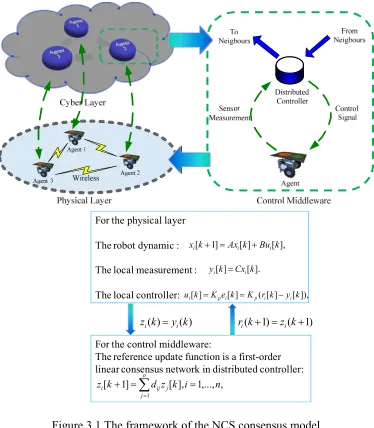
Figure 3.1 The framework of the NCS consensus model ... 22
Figure 3.2 Misbehaving agent models in D-NCS ... 26
Figure 4.1 Flowchart of the secure distributed control algorithm for the leader-follower consensus network ... 29
Figure 4.2 Control block diagram of the secure distributed control algorithm ... 33
Figure 4.3 Overall structure of the iSpace Simulator ... 38
Figure 4.4 Differential drive UGV reference frame and parameters ... 40
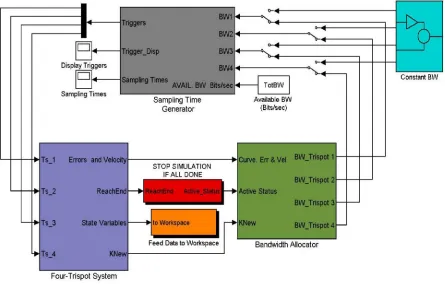
Figure 4.5 The Simulink block diagram of the iSpace Simulator... 42
Figure 4.6 The communication topology of the multi-robot system ... 43
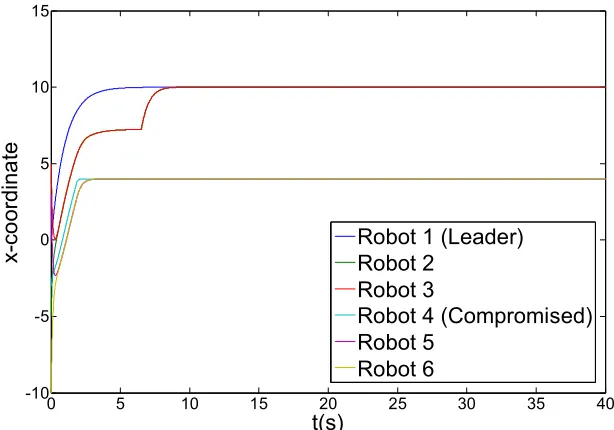
Figure 4.7 Multi-robot system in the presence of one misbehaving robot ... 44
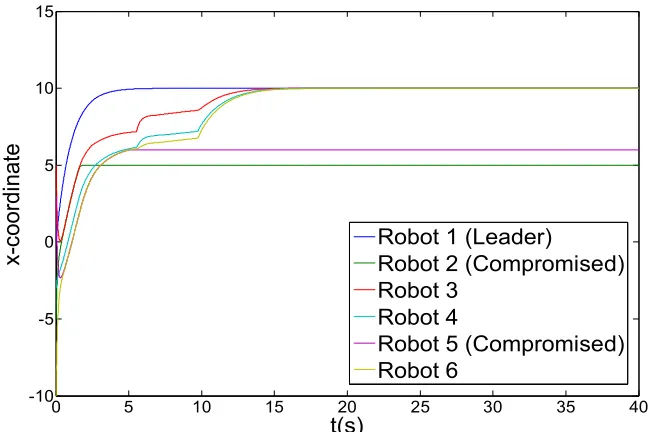
Figure 4.8 Multi-robot system in the presence of two non-colluding misbehaving robots .... 44
Figure 4.9 Multi-robot formation control result using linear consensus algorithm in the presence of one faulty robot ... 45
Figure 6.1 The structure of the secured networked DC motor system ... 72
Figure 6.2 State flow of the security mechanism based on discrete events ... 75
Figure 6.3 Simulink based test-bed for the secured networked DC motor system ... 82
Figure 6.4 The system performance and security levels using different encryption algorithms ... 85
Figure 6.5 The comparison between the required security level and actual security level of the secured networked DC motor system ... 87
Figure 6.6 The trade-off between the system performance and security of the secured networked DC motor system ... 88
Figure 7.1 The conceptually admissible operating region of the model ... 92
Figure 7.2 The performance-security trade-off model based on CGA ... 97
Figure 7.3 Framework of the CGA optimization process ... 98
Figure 7.4 Secured Networked DC Motor System Test-bed ... 103
Figure 7.5 Networked DC Motor System Simulator based on Matlab Simulink ... 104
Figure 7.6 Variations of performance fitness values in CGA process ... 107
Figure 7.7 Variations of security fitness values in CGA process ... 108
Figure 7.8 Pareto front of the Pareto optimal model based on CGA ... 109
Figure 7.9 The step responses of the test-bed for different settings ... 112
Figure 8.1 The performance-security trade-off model of D-NCS based on the CGA ... 126
Figure 8.2 Framework of the CGA optimization process ... 128
CHAPTER 1. INTRODUCTION
1.1 Importance of D-NCS Security
Distributed Networked Control Systems (D-NCS) can be spatially distributed systems for which the communication among distributed sensors, distributed actuators, and distributed controllers is supported by a shared communication network [1]. As a type of Cyber-Physical Systems (CPS), these systems integrate computing and communication capabilities with monitoring and control of entities in the physical world. The widespread growth of wireless communication and embedded systems technologies have been creating a wide variety of applications for D-NCS – in areas such as defense systems, medical devices, autonomous vehicles, and smart structures of national critical infrastructures (e.g., the electrical power system/Smart Grid, transportation systems).
and availability of power by adding more communication and control capabilities. Adding a layer of control and communication to the Smart Grid in places where it does not now exist are certain to introduce increased vulnerabilities in the power grid to cyber attacks. Many D-NCS applications are time-sensitive, data-sensitive, and safety-critical; their failure may cause irreparable harm to the physical system being controlled and to the people who depend on it. In this sense, D-NCS perform vital functions in national critical infrastructures, such as nuclear reactor power plants, electric power distribution, transportation systems, and water and gas distribution [5, 6]. They also play a role in military applications, such as missile defense systems, radar and weapon control systems, and military robotic systems [7]. The potential consequences of compromising a D-NCS can be devastating to public health and safety, national security, and the economy. Compromised D-NCS can, and have, led to extensive cascading power outages, dangerous toxic chemical releases, and explosions [2, 6]. It is, therefore, important to implement D-NCS with embedded security controls that make reliable, safe, and flexible performance possible.
1.2 Enabling Technologies
1.2.1 Advancements in Distributed Control Methodologies
close ties to distributed control. This includes subjects such as consensus [8, 9], algebraic connectivity of complex networks [10, 11], graph theory [12-14], flocks and swarms [15, 16], coordinated tasks [17, 18], asynchronous distributed algorithms and gossip-based algorithms [19, 20], multi-robot systems formation control [21-23], cooperative control [24, 25], and sensor networks [26-28].
1.2.2 Advancements in Networking, Communication and Embedded System Technologies In the last few decades, there have been significant innovations and advances of technologies in areas such as networking technology (e.g., ad hoc network) [29], embedded systems (e.g., FPGA), communications technologies (e.g., the Internet, wireless communications), which give us the luxury to have much more freedom in how we operate the D-NCS.
1.2.3 Advancements in Intrusion Distributed Detection Technologies
consensus-based detections, the sensing and communication phases of the nodes occur in the same time step [32, 33].
These practical methods, tools, and technologies based on advances in the fields of communications, computation, control, and security are enabling D-NCS and other infrastructures to become complex and sophisticated.
1.3 Challenges and Opportunities of D-NCS Security 1.3.1 Traditional IT Security vs. D-NCS Security
Generally, there is a significant difference between the security philosophies of traditional IT and D-NCS. The purpose of IT security is to protect the data residing in the servers from attack. The purpose of D-NCS security is to protect the ability of the facility to safely and securely operate, regardless of what may befall the rest of the network. Therefore, the D-NCS employs the best practices associated with the CIA triad model in the reverse order: Availability, Integrity, and Confidentiality [34]. Extra emphasis is placed on availability and message integrity. Their detailed interpretations in D-NCS are:
Availability: Maintain the operational goals by tolerating and surviving malicious attacks to the information collected by the sensor networks, the commands given by the controllers, the physical actions taken by the actuators and the control algorithms. Integrity: Maintain the operational goals by preventing or detecting deception attacks
Confidentiality: Prevent an adversary from inferring with the state of the control system by eavesdropping on the communication channels between the sensors and the controller, and between the controller and the actuator.
1.3.2 Uniqueness of D-NCS Security
Compared to the Conventional IT security, the new characteristics that may be present in D-NCS security are [35].:
Input and possible feedback from the physical environment Distributed management and control
Uncertainly regarding readings, status, and trust. Real-time performance requirements
Wide-distribution geographically, with components in locations that lack physical security.
Multi-scale and systems of systems control characteristics.
legacy centralized control/management schemes may encounter severe challenges when applied to the D-NCS because most of D-NCS are usually highly dynamic and geographically distributed. In order to effectively control and manage the D-NCS, more and more distributed control algorithms are being used in D-NCS because of their flexibility, robustness, and communication and computation requirements. These algorithms, however, increase the vulnerability of D-NCS to malicious cyber attacks, as well. Because of the lack of a centralized entity that may monitor the activity of the nodes in the network, distributed control strategies are prone to attacks and component failures. Thus, it is of increasing importance to guarantee that computations are secure and trustworthy even in the presence of misbehaving devices. Besides, most of the current effort for protecting D-NCS, e.g., Supervisory Control And Data Acquisition (SCADA) systems, has been accomplished with prevention mechanisms (e.g., cryptography and authentication), which are limited to platform and communication security [37]. Thus, there is an urgent concern to protect the control algorithms from malicious cyber attacks.
1.4 The Need for Novel Approaches and Paradigm Shift
D-NCS to accomplish such tasks (e.g., formation control of multi-robot systems, time synchronization of wireless sensor networks) [40]. Let us take the linear consensus algorithm as an example in which each node updates its state as a weighted combination of its own value and the values received from its neighbors at each time instant [41]. The choice of topologies and weights influences the convergence speed toward the consensus value [42]. In the linear consensus algorithm, all the nodes are assumed to cooperate and follow the protocol exactly. However, due to the lack of a centralized controller that may monitor the activities of all the nodes in the network, distributed control algorithms are prone to attacks and component failures. For instance, if one node in the consensus network is compromised by a malicious cyber attacker, the consensus is not guaranteed to be reached. Thus, it is important to guarantee secure computation in the face of failures and intrusions in the distributed control algorithms.
1.5 Contributions of This Thesis
In order to analyze the performance of our theoretical design on a real-world problem, we also analyze and validate the proposed techniques in different case studies through simulations and experiments.
The main contributions of each chapter are as follows:
Chapter 2 introduces some preliminary definitions, the notations, and a comprehensive literature survey of related works about D-NCS security. This chapter provides the background knowledge for the research work discussed in the subsequent chapters.
Chapter 3 discusses the mathematical problem formulation and the modeling of malicious cyber attacks in D-NCS. The D-NCS model and the corresponding consensus model are both introduced. The misbehaving agents are modeled by formulating the malicious attacks as exogenous inputs that compromise the behavior of agents in D-NCS. Two types of misbehaving agents are introduced, namely, faulty agent and malicious agent, depending on the nature of the cyber attacks they suffer.
update the reference state using the adjusted consensus computation weights to ensure the convergence of well-behaving agents. All phases of the proposed method are distributed. That is, at each step of the detection, mitigation, identification, and update, each agent only uses local and one-hop neighbors’ information. The performance and constraints of the proposed method is illustrated through convergence proof, robustness analysis and simulation results. An experiment-based hardware-in-the-loop testbed for multi-UGV formation control is also introduced and rendezvous tasks are used to illustrate the effectiveness of the proposed method.
Chapter 5 continues the work on developing a secure distributed control methodology that is able to perform secure distributed control computations in the presence of misbehaving agents in D-NCS. In this chapter, the proposed secure distributed control algorithm is extended to the leaderless consensus network by introducing and adding two recovery schemes (rollback recovery and excitation recovery) as a Recovery Phase into the current secure distributed control framework to guarantee accurate convergence of the well-behaving agents in D-NCS. The effectiveness of the proposed method is demonstrated through case studies in multi-robot formation control and wireless sensor networks.
includes the development of a set of metrics to quantitatively measure the performance and security levels of NCS and the development of a trade-off objective function incorporating performance and security. A Simulink based test-bed implemented to control the speed of the DC motor is used to illustrate the effectiveness of this model.
Chapter 7 presents a framework of performance-security trade-off optimization based on Coevolutionary Genetic Algorithm (CGA) for the networked DC motor system based on the trade-off model introduced in chapter 6. Experiments show that CGA is highly efficient in finding the Nash equilibrium for the trade-off model on NCS. The framework presented in this chapter is also demonstrated to be an effective approach for performance-security trade-off analysis and optimization on NCS.
Chapter 8 investigates the trade-off between system real-time performance and security in D-NCS and uses the Intelligent Space (iSpace) for illustration. A multi-agent trade-off model for D-NCS’ dynamic performance and security is presented. This model can be used to allocate system resources to provide sufficient protection and to satisfy the D-NCS’s real-time dynamic performance requirements simultaneously. A paradigm of multi-agent performance-security trade-off optimization based on the CGA for D-NCS is proposed as well. A Simulink-based test-bed is implemented to illustrate the effectiveness of this paradigm. The results of the simulation show that the CGA can efficiently find the optimal values in a multi-agent performance-security trade-off model for D-NCS.
CHAPTER 2. BACKGROUND KNOWLEDGE
2.1 Definition of D-NCS
D-NCS are control systems wherein the control loops are closed through a real-time network, which integrates computing and communication capabilities with monitoring and control of entities in the physical world. These systems are usually composed by a set of networked agents, including: distributed sensors, distributed actuators, distributed controllers and communication network, as shown in Figure 2.1.
Figure 2.1 The conceptual model structure of the D-NCS
significant achievement in conventional control systems occurred when the Wright Brothers made their first successful test flight in 1903. The next significant achievement was the fly-by-wire flight control system that was designed to eliminate the complexity; fragility and weight of the mechanical circuit of the hydro-mechanical flight control systems using an electrical circuit. The simplest and earliest configuration of an analog fly-by-wire flight control systems was first fitted to the Avro Vulcan in the 1950s. This can be called as the first form of analog Networked Control Systems (NCS). Digital computers became powerful tools in control system design and microprocessors added a new dimension to the capability of control systems. A modified NASA F8C Crusader was the first digital fly-by-wire aircraft, in 1972. The next step in evolution was the Distributed Control System (DCS) that was introduced in 1975. Both Honeywell and Japanese electrical engineering firm Yokogawa introduced their own independently produced DCSs at around the same time, with the TDC 2000 and CENTUM systems, respectively. As the expanding needs of industrial applications pushed the limit of point-to-point control, it became obvious that NCS was the solution to achieve remote control operations. Research in tele-operation was initiated with the concern for safety and convenience in hazardous environments; such as space projects and nuclear reactor power plants, and was made feasible only after further development of NCS.
systems in the last few years. Today, NCS is moving into Distributed NCS (D-NCS) [44], which are multi-disciplinary efforts whose aim is to produce a network structure and components that are capable of integrating distributed sensors, distributed actuators, and distributed control algorithms over a communication network in a manner suitable for real-time applications.
2.2 Definition of Consensus Network
Figure 2.2 A simple framework for a consensus network
state to the consensus manager, which negotiates with neighboring agents, among others, via the communication network. The consensus manager then calculates a consensus result and passes it back to the local controller, which adjusts its own action based on the consensus result. Then, the local controller reports its new state to the consensus manager. This process continues as the system operates, which is an iterative process.
2.2.1 Graph Theory Notations
A graph G is used to model the network topology of the system. The graph G is a pair of sets (V, E), where V is a finite non-empty set of elements, called vertices or nodes, and E is a set of unordered pairs of distinct vertices, called edges. A simple graph is an unweighted, undirected graph that contains no graph loops or no multiple edges. A graph is connected if there is a path between any distinct pair of nodes. A directed tree is a digraph, where every node has exactly one parent except for one node, called the root, which has no parent, and where the root has a directed path to every other node. The directed spanning tree of a digraph is a directed tree formed by graph edges that connect all of the graph’s nodes. A graph contains a directed spanning tree if one exists as a subset of the graph.
The adjacency matrix A of a finite graph G on n vertices is the n × n matrix where the off-diagonal entry aij is the number of edges from vertex i to vertex j. In the case of a finite
j i ij iia
l
, for on-diagonal elements; (1)
l
ij
a
ij, for off-diagonal elements. (2)For an undirected graph, L is called the Laplacian matrix, which has the property that it is symmetric, positive, semi-definite. The eigenvalue of the L matrix contains a lot of information about network performance [40] (e.g., the second smallest eigenvalue of Laplacian λ2 is called the algebraic connectivity of the graph). The algebraic connectivity of
the network topology is a measure of the convergence speed of the consensus algorithms [45].
2.2.2 First-Order Linear Consensus Algorithm
Let denote the state valuable of node i. The state value of a node might represent physical quantities including coordinates, velocity, etc. The nodes of a network reach a consensus if and only if = for all i, j [46]. Assuming that each agent has a first-order dynamic:
i
i,
i
1
,...,
n
,
(3) a continuous-time consensus algorithm is given in [45], [46] as:
n j j i iji
a
i
n
1
,
,...,
1
),
(
(4)where aij is the (i, j) entry of the adjacency matrix A. The consensus algorithm can also be
L
n
,
(5) where Ln is the n × n graph Laplacian matrix.When the measurement information is instantaneously available, a continuous-time model can be used to describe the consensus network dynamics. When information takes a fixed time T to travel between nodes, we need to model the consensus network dynamics as a discrete-time dynamic system [23] to facilitate analysis. A discrete-time consensus algorithm is described by:
n j j iji
k
d
k
i
n
1
,
,...,
1
],
[
]
1
[
(6)where k is the discrete-time index; dij is the (i, j) entry of the row-stochastic matrix D, which
can be defined as follows:
,
,
1
,...,
.
1
n
j
i
l
l
d
n h ih ijij
(7)
Since the data packet in a communications network always arrives discretely, the discrete consensus algorithm has been selected for further investigation and development.
2.3 Present State of Knowledge in D-NCS Security
CHAPTER 3. D-NCS MODELING AND FORMULATION
3.1 D-NCS Model
Typically, D-NCS are large-scale complex network systems with time-driven and event-driven features. We view the D-NCS with three interactive layers:
Top layer: cyber layer (communications network) that links the information passing among the physical devices;
Middle layer: control/management middleware interacting with the communications and physical layer;
Bottom layer: physical layer that contains the actual physical devices.
We use the agent concept and control theory to model the overall problem under consideration. Each node (e.g., an autonomous vehicle, a power generator) in the D-NCS will be modeled as an agent with its own dynamics, described as:
, 1
(
,,
,)
(
)
d i k i k i i ki
f
x
u
f
x
, (8)where i i i in T
i x x
x
X [ ,1 ,2 , ] contains the state variables (e.g., velocity, position); T
m i i
i
i u u u i
u [ ,1 ,2 , ] is the control (e.g., the PWM signal) of the i
th
agent with dimensions ni and mi, respectively; k is the time index; and fid is the disturbance (e.g., wind level for a period) on the ith agent. The entire D-NCS state variable x is the collection of all the N agent state variables:
and the overall D-NCS dynamics is described by :
f [f1 f2 fN]T. (10) Without loss of generality, we assume the measurement on the ith agent is of the form:
Y
i
C
iX
i , (11) where Ci is the measurement matrix of agent i and the entire measurement of the D-NCS is:Y [Y1 Y2 YN]T, (12) We use connection matrix Wc to describe the topology of the communications network.
For example, the updating matrix D in the discrete-time consensus algorithm can be considered as Wc matrices.
The D-NCS constraints, such as equality constraints (e.g., power balance), inequality constraints, (e.g., stability), and communications/sensing constraints (e.g., bandwidth limitations) can be incorporated into the model.
Based on the local measurements (those on ith agent and its connected neighbor’s measurements Wc(i,:) Y, we can develop distributed control algorithms relying only on local
information and collaborating with each other:
ui = hi (Wc (i,:) Y(t+i)), (13)
where t is time and
i is the network-in-the-loop time delay to signify the time delay inmeasurements over the network, and hi is the distributed algorithm under investigation. The
This three-layer model can provide an effective mathematical formulation and framework for subsequent tasks on finding the analytical control design for the desired secure distributed control algorithms. We can construct a variety of representative D-NCS configurations and operating conditions based on this model.
For the physical layer
The robot dynamic :
The local measurement :
The local controller:
For the control middleware:
The reference update function is a first-order linear consensus network in distributed controller:
) ( )
(k y k
zi i ri(k1)zi(k1) ], [ ] [ ] 1
[k Ax k Bu k
xi i i
]. [ ] [k Cx k
yi i
]), [ ] [ ( ] [ ]
[k K e k K r k y k
ui p i p i i
n j j iji k d z k i n
z 1 , ,..., 1 ], [ ] 1 [
3.2 Consensus Model of D-NCS
Reaching consensus, which refers to reaching agreement among all the autonomous agents, is one of the most frequent control tasks to be accomplished in the D-NCS. This fundamental problem forms the foundation of distributed computing, and admits many important applications in the areas of communications, control, and networking where information sharing and operation coordination are desirable. In this section, the consensus model of D-NCS is formulated.
Let us consider a network of n agents whose linear dynamics (e.g. first order or second order dynamics) are denoted by
xi[k1] Aixi[k]Biui[k], (14) where xi and ui are the agent states and controls and i is the index for the agents in the
network [23].
Each agent receives the following measurements
yi[k]Cixi[k]. (15) and implements a reference-based proportional controller on-board:
ui[k]Kiei[k]Ki(ri[k]yi[k]), (16) where ri is the reference state and Ki is the proportional gain for the P controller to be
designed.
directed graph G. In this local neighbor-to-neighbor information exchange process, the first-order linear consensus algorithm is implemented in the consensus manager of each agent, where, at each time instant, each agent updates its reference state as a weighted combination of its own current state and other measured states received from its neighbors, as shown in Figure 3.1.
The reference state update rule in the consensus manager of each agent is listed below: zi[k] yi[k], (17)
n j
j ij
i k d z k i n
z
1
, ,..., 1 ], [ ]
1
[ (18)
ri[k1]zi[k1], (19) where dij, the consensus computation weight, is the (i, j) entry of the row-stochastic matrix D,
which is derived from the adjacency matrix of network topology (graph G). zi is the
information transmitted in the communication layer.
3.3 Misbehaving Agent Models
The misbehaving agent in the D-NCS is modeled as one whose distributed controller (consensus manager) is suffering a unexpected fault or under a malicious cyber attack. We model the misbehaving agent in the system as:
[ 1] [ ] [ ],
1 , ,
n j M i M i j iji k d z k B u k
z (20)
where ui,M is the anomaly factor that is modeled as an exogenous input to the consensus
manager, as shown in Figure 3.2.
By the definition above, when the agent is behaving well, the corresponding exogenous input ui,M is constantly equal to zero. When the agent is misbehaving, it is allowed to update
its reference state in an arbitrary way by choosing different exogenous input ui,M. Therefore,
depending on the nature of various misbehaviors, the misbehaving agent can be classified into two categories.
One type of misbehaving agent is the faulty agent, which simply stops to update its reference state and behaves like a stopping failure (e.g., out of power), thus the exogenous input ui,M can be modeled as:
[ ] [ ], 1 ,
n j j ij i Mi k c d z k
u (21)
where is an arbitrary constant value and ∈ .
behave in an arbitrary manner. Thus, the exogenous input ui,M can be equal to any arbitrary
value ci[k] that the attacker wants:
ui,M[k]ci[k]. (22)
For the physical layer
The robot dynamic :
The local measurement :
The local controller:
For the control middleware:
The reference update function is a first-order linear consensus network in distributed controller:
Faulty: False data injection: )
( ) (k y k
zi i ri(k1)zi(k1)
, ] [ ] 1 [ 1
n j j iji k d z k
z BMuM[k]
, ] [ ] [ 1
n j j ijM k c d z k
u uM[k]c[k],
], [ ] [ ] 1
[k Ax k Bu k
xi i i
]. [ ] [k Cx k
yi i
]), [ ] [ ( ] [ ]
[k K e k K r k y k
ui p i p i i
Note that the choice of keeping the matrix D fixed and leaving the exogenous inputs uM
CHAPTER 4. SECURE DISTRIBUTED CONTROL ALGORITHM FOR LEADER-FOLLOWER CONSENSUS NETWORK
Because of the absence of a centralized controller that may monitor the activity of all the agents in the system, the D-NCS is prone to cyber attacks and component failures. Thus, it is important to guarantee a secure distributed control computation in the presence of misbehaving agents in D-NCS. Unlike the conventional methods in which the misbehaving agents are identified by a supervisory monitor, a reputation-base secure distributed control algorithm which embeds the security mechanism internally is proposed in this section to achieve security in D-NCS in a fully distributed fashion.
4.1 Algorithm Description
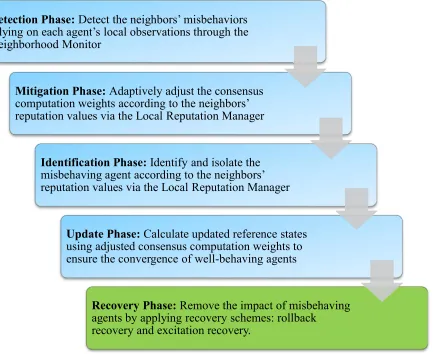
Figure 4.1 Flowchart of the secure distributed control algorithm for the leader-follower consensus network
The proposed secure distributed control algorithm for leader-follower consensus networks, as shown in Figure 4.1, embeds the following four phases into each iteration of the consensus computation (i.e., reference state update) process: (a) Detect the neighbors’ misbehaviors relying only on each agent’s local observations through the Neighborhood Monitor; (b) Adjust the consensus computation weights according to the neighbors’ reputation values via the Local Reputation Manager; (c) Identify and isolate the misbehaving agent; and (d) Use
Update Phase
Calculate updated reference states using adjusted consensus computation weights to ensure the convergence of well-behaving agents
Identification Phase
Identify and isolate the compromised agent according to the neighbors’ reputation values via the Local Reputation Manager
Mitigation Phase
Adaptively adjust the consensus computation weights according to the neighbors’ reputation values via the Local Reputation Manager
Detection Phase
ensure the convergence of the well behaving agents. The detailed description of each phase is given as follows:
4.1.1 Detection Phase
Definition (Neighborhood Monitor): A Neighborhood Monitor is an embedded monitor for an agent to observe the behaviors of its neighbors.
In this phase, with the assumption that listening to a neighbor’s transmission is possible because of the characteristic of wireless communications, each agent constructs a Neighborhood Monitor to observe the neighbors and learn from them by eavesdropping on the transmissions of the one-hop neighbors within its communication range.
In this Neighborhood Monitor, the agent carries out a real-time anomaly detection mechanism for all its neighbors (similar to the watchdog design in the security mechanism of ad hoc networks) [60]. It redundantly calculates and stores its neighbor agent j’s reference state rj and compares it with the state value zj received from the neighbor agent j in time step
k. If [ ] − [ ] ≤ ( , ), the neighbor is normal; if [ ] − [ ] > ( , ), the neighbor has a potential anomaly.
) , ( ] [ ] [ ], 1 [ ) , ( ] [ ] [ , 1 ] 1 [ ] [ k k z k r k G k k z k r k G k G j j ij j j ij
ij , (23)
where Gij is the total number of verifiably correct agent states of neighbor agent j up to time
4.1.2 Mitigation Phase
Definition (Reputation Manager): A Reputation Manager is an onboard system for an agent that updates the reputation values of the neighbor agents and records them in its local reputation table.
Reputation is an index for the credibility of a node in the network; it is widely used in the cooperation issues among the nodes of an ad hoc network. Here, we introduce the reputation metric to quantitatively measure the credibility of the neighbor agents. If misbehaviors of one neighbor agent are detected, the Neighborhood Monitor then reports to the local Reputation Manager. We use the Bayesian Reputation function to calculate the reputation values [61, 62]. Given a set of verifiably correct and incorrect behaviors from a neighbor agent, the probability distribution of seeing a particular combination of correct and incorrect behaviors from this neighbor agent satisfies a beta distribution [62]. The expected value of the beta distribution forms the reputation and is given by the ratio of the number of correct agent states received to the number of total agent states received:
2 1 ] [ ]
[
k k G k
repij ij
, (24)
where repij is the reputation value of neighbor agent j up to time-step k in agent i’s local
In the mitigation phase, a misbehavior or good behavior as the result of the Neighborhood Monitor is used to update the neighbor agent’s reputation value in the each agent’s local Reputation Manager.
4.1.3 Identification Phase
If the reputation value falls below a certain level (i.e., anomaly threshold repth), the
corresponding neighbor agent is identified as a misbehaving agent and will be isolated. In that case, all the information from the misbehaving neighbor agent will be rejected. Nevertheless, a timeout mechanism may be used to allow the misbehaving agent to rejoin the network in case it might have been falsely accused in the past or if it behaves normally again. Actually, the Reputation Manager acts as a confirmation mechanism that one agent is confirmed as misbehaving if it is detected with abnormal values repeatedly during a certain period of time. If this occurs, it is interpreted as the agent’s reputation value dropping below the anomaly threshold.
For any warning and intrusion detection mechanism, there is essentially a trade-off between the false reject rate (FRR) and the false accept rate (FAR). In our methodology, the design preferences are embodied in the threshold functions and the reputation coefficient.
4.1.4 Update Phase
which is the (i, j) entry of the row-stochastic matrix D, based on the reputation values from the local Reputation Manager. The method is shown as:
n h ih ijij k rep k rep k
d 1 ] [ ] [ ]
[ . (25)
Thus, the reference state update rule in the consensus manager is correspondingly changed to:
n j j iji
k
d
k
z
k
i
n
z
1,...,
1
],
[
]
[
]
1
[
. (26)By implementing this method, we build a feedback loop from the output to the input of the distributed controller (consensus manager), as shown in Figure 4.2.
In this secure distributed control algorithm, if the neighbor agent’s reputation drops, the consensus manager will gradually decrease the corresponding consensus computation weights, dij, to slow down the speed at which the malicious effects of that potentially
misbehaving agent spreads. If a neighbor agent is identified as a misbehaving node, the consensus manager will set the corresponding dij to zero to cut off the connection. Since
every agent performs this adaptive consensus computation in parallel, the well-behaving agents finally can isolate the misbehaving agent and converge to a steady state.
The proposed secure distributed control algorithm outperforms the conventional security mechanisms for consensus computation for the following reasons:
a) It is resilient to the single point of failure since no fusion node is required as a centralized intrusion detection scheme.
b) It relies only on each agent’s own observations to avoid the new vulnerability of false accusations from second-hand information exchanges.
c) It embeds the security mechanism as a feedback loop inside the consensus computation, making the distributed control algorithm itself resilient and robust to the presence of misbehaving agents.
4.2 Convergence and Robustness Analysis
Definition (Asymptotic Consensus): The system is said to reach asymptotic consensus if
4.2.1 Convergence Proof Lemma:
If the total number of misbehaving agents is less than the connectivity of the network (the entire network will not be disconnected due to the isolation of some critical nodes being misbehaving), in other words, if there is always a spanning tree associated with the updating matrix D, the consensus of the well behaving nodes can be achieved asymptotically.
Proof:
Firstly, we need the following lemmas from [41] and [63] to derive our proof. Lemma 1:
The discrete linear consensus algorithm achieves asymptotic consensus if and only if D[k 1]D[k2]D[2]D[1]D[0]1cT. (27) As k, where 1 denote the × 1 column vector with all the entries equal to 1 and c is an × 1 vector of constant coefficients.
Lemma 2:
A stochastic matrix P is called indecomposable and aperiodic (SIA) if n T
n P 1y
lim
Lemma 3:
If the union of a set of directed graphs {G1, G2, ⋯, Gm} has a spanning tree, then the
matrix product DmDm-1⋯D2D1 is SIA, where Di is a stochastic matrix with positive diagonal
In the proposed secure distributed control algorithm, at each time-step ∈ , each node communicates with its neighbors and updates its local value using equations (25) and (26), where dij[k] is the weight assigned to node j’s value by node i at time-step k.
Since i th Vi h ih ij ij V rep k rep k rep k
d
1 ] [ ] [ ] [ ,where Vi is the set of neighboring nodes of the ith node, there exists a constant ∈ ,
0 < < 1 such that all of the following conditions hold:
[ ] ≥ , ∀ ,
[ ] = 0 ∉ [ ], ∀ , ,
[ ] ≥ ∈ [ ], ∀ , ,
n j ij k d 1 1 ] [ , ∀ , where i thV
rep
.Thus, D[k] is a stochastic matrix with positive diagonal entries ∀ . The lower bound on the weights is imposed to guarantee convergence.
entire network (except for the isolated misbehaving nodes) is still connected. Thus there is still a spanning tree in the graph that associated with the rest of the well-behaving nodes.
In conclusion, there is always a spanning tree in the graph containing the well behaving nodes associated with the updating matrix D, which is a stochastic matrix with positive diagonal entries. According to Lemmas 1, 2 and 3, all the well-behaving nodes (except for the isolated misbehaving nodes) will achieve consensus asymptotically.
4.2.2 Robustness Analysis
If the misbehaving agent is detected and isolated, it may disconnect the network into two parts (in some certain network topologies), where there is no hope for any consensus algorithm to be working. Thus before removing the misbehaving agent from the network, we need to check the network topology, more specifically, the connectivity of the network to avoid disconnection in the network. For example, if we identify one misbehaving agent in the network and we do not know the entire topology of the network, we need to make sure the network is at least 2-connected before isolating that agent.
maximum number of the malicious nodes these algorithms can tolerate is m-1 in the worst case.
4.3 Simulation Case Studies
A Simulink-based simulation testbed, iSpace Simulator, is developed to evaluate the effectiveness of the proposed secure distributed control methodology.
4.3.1 Simulation Testbed Description and Setup
iSpace Simulator has been implemented to perform basic research and education on time-sensitive and secure D-NCS applications. It is a network-based multi-robot system simulator including a network of mobile robots [64]. It has several major components: distributed sensors and actuators, hybrid hierarchical and distributed controllers, and the communication network. The system structure is shown in Figure 4.3.
In this testbed, mobile robots are represented by unmanned ground vehicles (UGVs). Each UGV has a differential drive with two driving wheels and one caster wheel, as in Figure 4.4. The dynamics of the UGV can be described using the kinematic model:
l r ref refW
W
v
2
2
, (28)
where vref is the UGV’s linear velocity, ωref is its angular velocity, ρ is the radius of the drive
wheels, and W is the distance between the drive wheels. ωr and ωl represent the angular
Figure 4.4 Differential drive UGV reference frame and parameters
The UGV steers by driving the wheels at different speeds determined by solving (28) where vref and ωref are given in the input reference command u=[vref ωref]T:
ref ref ref L ref Rv
W
W
2
1
2
1
, ,, (29)
Using (29), the input reference command can be utilized to set reference speeds for the individual wheels. A Proportional-Integral (PI) controller, defined by (30), is used to achieve the reference speed on each wheel,
u t K e t K e
d
tI
P
0 ) ( ) ( )
where KP is the proportional gain, KI is the integral gain, and e(t) is the difference between
the actual wheel speeds and the reference wheel speeds as shown in (31),
L ref L R ref R t e
, , )( , (31)
The two control parameters in (30) are used to control the three UGV states defined by (32),
(t)
xw(t) yw(t) (t)
, (32) where xw(t) and yw(t) are the UGV coordinates in the world frame and φ(t) is the UGVheading expressed as the angle between the UGV and the positive x axis of the world frame at time t.
This testbed lets us design repeatable experiments under a wide range of network environments, system conditions, and network settings. The Simulink block diagram of the testbed is shown in Figure 4.5.
Figure 4.5 The Simulink block diagram of the iSpace Simulator
4.3.2 Simulation Conditions
To analyze the performance of the proposed secure distributed control methodology, a representative formation control task is designed—let all the robots stay in a line in parallel (reach the same x-coordinate: x = 10). Six robots are used in this task. Their communications topology is shown in Figure 4.6. Robot 1 is the leader while the other robots are the followers.
Figure 4.6 The communication topology of the multi-robot system
Table 4-1 Simulation Parameters
KP 10 repM 0.3
c 5 c(k) k+5
Time Length 40 seconds Time Step Size 0.01 seconds
Table 4-2 Initial Positions (X-coordinates) of Robots
Robot 1 Robot 2 Robot 3 Robot 4 Robot 5 Robot 6
0 -5 5 -3 3 10
4.3.2.1 Case 1: Single Misbehaving Robot
Figure 4.7 Multi-robot system in the presence of one misbehaving robot
4.3.2.2 Case 2: Multiple Misbehaving Robots
In this scenario, let us assume Robot 2 and Robot 5 both are the misbehaving robots under malicious cyber attacks, as shown in Figure 4.8.
Figure 4.8 Multi-robot system in the presence of two non-colluding misbehaving robots
4.3.3 Simulation Results: Vulnerability Analysis
Figure 4.9 Multi-robot formation control result using linear consensus algorithm in the presence of one faulty robot
Figure 4.10 Multi-robot formation control result using linear consensus algorithm in the presence of one malicious robot
0 5 10 15 20 25 30 35 40
-10 -5 0 5 10 15 t(s) x-coor dina te
Robot 1 (Leader) Robot 2
Robot 3 Robot 4
Robot 5 (Compromised) Robot 6
0 5 10 15 20 25 30 35 40
-10 0 10 20 30 40 50 t(s) x-c oor dina te
(b) False Data Injection Attack
Robot 1 (Leader) Robot 2
Robot 3 Robot 4
Figure 4.11 Multi-robot formation control result using linear consensus algorithm in the presence of two faulty robots
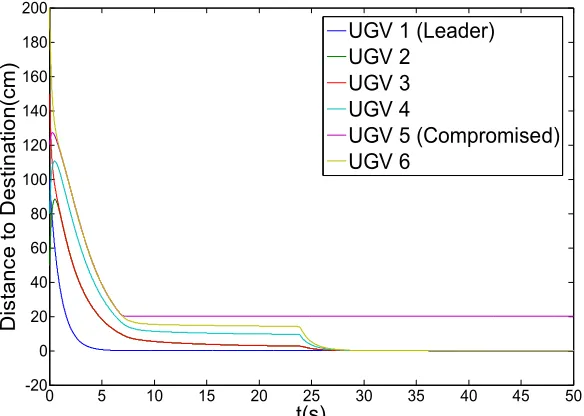
Figures 4.9 and 4.10 show the simulation results of the multi-robot formation control with a compromised robot under fault attack and false data injection attack in Case 1, respectively. As we can see from the figures, only the leader robot reached the desired destination while all the other follower robots stopped at different positions. The formation control task failed under both attacks. We can conclude that because of the absence of security mechanisms, the linear consensus algorithm cannot converge in the presence of a misbehaving robot.
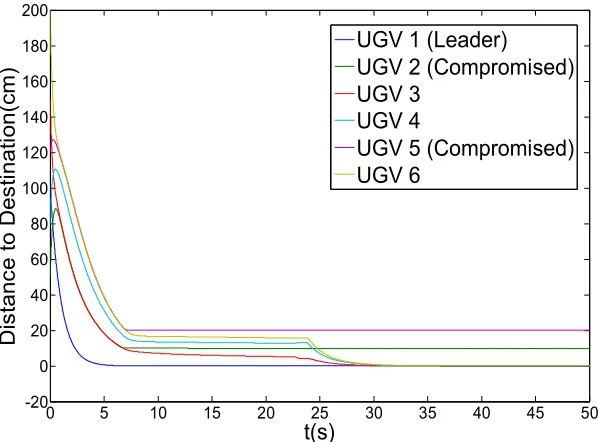
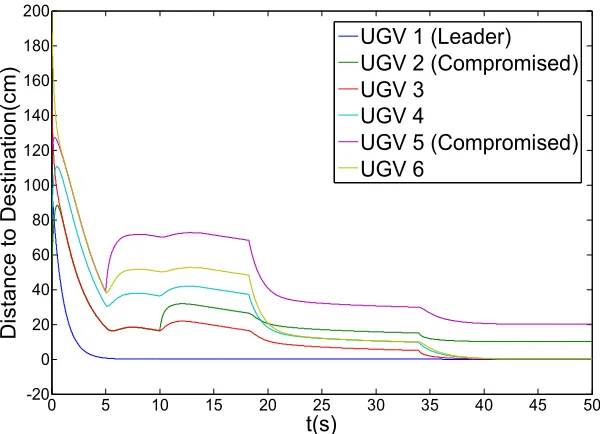
Similar to Case 1, Figures 4.11 and 4.12 show the simulation results of the multi-robot formation control with two compromised robots under fault attack and false data injection attack in Case 2, respectively. As we can see, only the leader robot reached the desired destination while all the other follower robots stopped at different positions. Thus, the formation control task failed in both cases. We can conclude that because of the absence of security mechanisms, the linear consensus algorithm cannot converge in the presence of multiple misbehaving robots, as well.
4.3.4 Simulation Results: Effectiveness Validation
Let us carry out the same task again using the proposed secure distributed control methodology to perform the consensus computation.
all the well-behaving robots can still converge at the correct destination asymptotically in both attack scenarios.
Figure 4.13 Multi-robot formation control result using the proposed secure distributed control algorithm in the presence of one faulty robot
Figure 4.14 Multi-robot formation control result using the proposed secure distributed control algorithm in the presence of one malicious robot
0 5 10 15 20 25 30 35 40
-10 -5 0 5 10 15 t(s) x-c oo rd inate
Robot 1 (Leader) Robot 2
Robot 3 Robot 4
Robot 5 (Compromised) Robot 6
0 5 10 15 20 25 30 35 40
-10 -5 0 5 10 15 20 t(s)
(b) False Data Injection Attack
x-co
or
din
ate
Robot 1 (Leader) Robot 2
Robot 3 Robot 4
Figure 4.15 Multi-robot formation control result using the proposed secure distributed control algorithm in the presence of two faulty robots
Figure 4.16 Multi-robot formation control result using the proposed secure distributed control algorithm in the presence of two malicious robots
0 5 10 15 20 25 30 35 40
-10 -5 0 5 10 15 t(s) x-c oordi nate
Robot 1 (Leader)
Robot 2 (Compromised) Robot 3
Robot 4
Robot 5 (Compromised) Robot 6
0 5 10 15 20 25 30 35 40
-10 -5 0 5 10 15 20 25 t(s) x-c oordin ate
Robot 1 (Leader)
Robot 2 (Compromised) Robot 3
Robot 4
These case studies imply that, if compromised robots exist, the proposed method will be able to gradually mitigate and isolate them, and finally let the well-behaving robots converge to the correct steady state. Furthermore, the convergence is guaranteed as long as the topology satisfies the sufficient conditions of the linear consensus algorithm (we will discuss the robustness of the proposed algorithm in next section).
4.3.5 Simulation Results: Robustness Analysis
The proposed algorithm works with the assumption that the total number of misbehaving agents is less than the connectivity of the network in the worst case. Thus, if we identify one misbehaving agent in the network and we do not know the entire topology of the network, we need to make sure the network is at least 2-connected before we isolate that agent. Otherwise, the network topology after isolation may not satisfy the sufficient conditions for the convergence of the linear consensus algorithm.
Figure 4.17 Multi-robot formation control result using the proposed secure distributed control algorithm in the presence of one faulty robot in the critical link.
4.4 Experiment Case Studies
To further evaluate the proposed secure distributed control algorithm, we also tested it in our multi-UGV hardware-in-the-loop experimental platform—iSpace System.
4.4.1 Experimental Platform Setup and Configuration
iSpace system in the Advanced Diagnosis, Automation, and Control (ADAC) Lab at North Carolina State University (NCSU) is a D-NCS experimental platform composed by several unmanned ground vehicles (UGVs) [64, 65]. It has been implemented to perform research and experiments on D-NCS with hardware-in-the-loop fast-prototyping capabilities.
0 5 10 15 20 25 30 35 40
-10 -5 0 5 10 15
t(s)
x-co
ordina
te
Fault Attack
Robot 1 (Leader) Robot 2
Robot 3
Robot 4 (Compromised) Robot 5
It allows us to design repeatable experiments under different network settings and system conditions.
The entire system structure of the iSpace system platform is described in Figure 4.18. The experimental platform includes several major components: distributed sensors, distributed actuators, hierarchical and distributed controllers, and communication networks. Specifically, it is composed of the following parts:
• UGV: The differential drive UGV used in this testbed has been constructed out of the modular Lego Mindstorms NXT. The wheel radius of the UGV is 0.0286 meters (m) and the distance between wheels is 0.095 m. The maximum speed for the UGV is approximately 0.4 meters per second (m/s) with the default gearing of the NXT motors.
• Base Station: The base station is used to combine the distributed sensor information to accomplish the system goal. It is implemented in a high-performance host PC server. In addition to connecting distributed sensors and actuators and implementing the data fusion, the base station can also makes supervisory control decisions.
• OptiTrack System: OptiTrack system is a vision system that is capable of tracking all the UGVs in real time. It is an image processing server that can triangulate the positions of the UGVs in 3D space based on eight infrared cameras’ observations.
Figure 4.18 System structure of the iSpace system experimental platform