Abstract
JIANG, LIQIU. The Simulation and Approximation of the First Passage Time of the Ornstein–Uhlenbeck Process of Neuron. (Under the direction of Charles Eugene Smith.)
THE SIMULATION AND APPROXIMATION OF THE FIRST PASSAGE TIME OF THE ORNSTEIN-UHLENBECK PROCESS OF NEURON
By
Liqiu Jiang
A thesis submitted to the Graduate Faculty of North Carolina State University
in partial fulfillment of the requirements for the Degree of
Master of Science
BIOMATHEMATICS GRADUATE PROGRAM DEPARTMENT OF STATISTICS
Raleigh
2002
APPROVED BY
___________________________ Dr. Charles E. Smith
BIOGRAPHY
Liqiu Jiang was born September 26, 1974 in Jilin Province, People Repub-lic of China. She received her elementary and secondary education in Jilin province, P. R. China and graduated from Meheikou Fifth High School in 1992.
ACKNOWLEDGEMENT
Contents
List of Tables . . . .viii
List of Figures . . . ix
1 Introduction 1 2 Literature Review 5 2.1 The Biological Background . . . 5
2.2 The Physical Basis for the LIF Model . . . 7
2.3 The Models . . . 12
2.3.1 The Ornstein–Uhlenbeck Model . . . 12
2.3.2 Stein’s model . . . 16
2.4 Approximation of the First Passage Time . . . 18
3 Methods 25
3.1 Simulation . . . 25
3.1.1 Testing for the Independence of Random Numbers . . 26
3.1.2 Euler Method . . . 28
3.1.3 Parameter . . . 31
3.1.4 Goodness–of–fit–test . . . 32
3.2 Approximation . . . 35
3.2.1 Approximation of Moments of the FPT . . . 35
3.2.2 Confidence Limits for the mean and variance of Log-normal Distribution . . . 42
3.2.3 Approximation Error . . . 44
3.2.4 Approximation of Probability Density Function of the FPT . . . 45
3.3 Comparison of Two Probability Density Functions . . . 47
4 Results 55 4.1 Simulation . . . 55
4.2 Approximation . . . 72
5 Discussion 94
6 Conclusions 98
Bibliography 100
List of Tables
List of Figures
2.1 The equivalent circuit of cell membrane with three ions . . . 8 2.2 The equivalent circuit of cell membrane . . . 9 2.3 The trajectory of the membrane voltage with uniform input current 14 3.1 Serial correlation coefficient at lag k with n 1000 . . . 52 3.2 The joint histogram of the random numberXi andXi+1 withn 1000 53
3.3 Scatter plot of the random number: Xi+1 against Xi with n 1000 . . . 54
Chapter 1
Introduction
The first passage time is the theoretical counterpart of the interspike inter-vals. This follows the generally accepted hypothesis that the information transferred within the nervous system is usually encoded by the timing of spikes (action potential). Therefore, the reciprocal relationship between the frequency on one hand and the interspike interval on the other leads to the study of the distribution of the first passage time. When the distribution is too difficult to obtain, the analysis is usually restricted to its moments, primarily the mean and variance.
the membrane depolarizaion is described as a deterministic leaky integrator. Interspike intervals are identified as periods between a reset of the depolariza-tion after firing (an acdepolariza-tion potential or a spike) and the consecutive crossing of a fixed firing threshold. This leaky integrate–and–fire model is one of the most common on both application of artificial neural network and descrip-tion of biological systems and has been studied in [37], [24], [36], [23],[9] and [30].
The OU process has the following properties: the voltage difference be-tween the membrane potential and resting potential at the trigger zone of the neuron is described by a one–dimensional stochastic processX ={X(t) : t ≥0} given by the stochastic differential equation
dX(t) = µ(X(t), t)dt+σ(X(t), t)dW(t), X(0) =x0 (1.1)
consecutive neuronal firings (spikes). The reference level for the membrane potential is usually taken to be the resting potential. Some studies examined the effect of random initial values in a leaky integrator with deterministic trajectory. They found that different distributions for the initial value lead to commonly observed interspike interval distributions [18], [21], and [20]. This is why initial voltage (the reset value following a spike) is often as-sumed to be equal to the resting potential, x0 = 0, i. e., there is no initial afterhyperpolarization. The OU process is appropriate for neurons with a high number of synaptic inputs where each of them has only a slight effect on the cell excitability [27].
Chapter 2
Literature Review
2.1
The Biological Background
potential, occurs when the potential exceeds a critical threshold and ionic concentrations achieve supercritical values.
The biophysical properties of the membrane have important effects on the action potential generation and conduction. For example, the passive resistive electrical properties of the post synaptic cell affect the time course of the postsynaptic cell potentials generated in it by other cells. The passive electrical properties of the postsynaptic cell also determine how efficiently synaptic potentials are propagated within a cell from their sites of origin to the trigger zone. These features of neuronal functioning contribute to synap-tic integration, the process by which a nerve cell adds up all incoming signals and determines whether or not it will generate an action potential. Once an action potential is generated, the speed with which it is conducted from the trigger zone to the axon terminal also depends on the passive electrical properties of axon.
the lipid bilayer, and the ionic concentration gradient (N a+, Cl−, K+).
Al-though they are biological, the three electrical properties of the membrane are functionally indistinguishable from those of a man-made electronic circuit.
2.2
The Physical Basis for the LIF Model
Figure 2.1 is a complete equivalent circuit of the passive electrical properties of the membrane, with membrane capacitance included. Figure 2.2 is the simplified electrical equivalent circuit that can be used to examine the effects of membrane capacitance on the response of a neuron to injected current. The cell membrane is represented by a capacitor (C) in parallel with a re-sistor (R), which represents the RN a, RCl, and RK element in Figure 2.1.
The membrane batteries representing the electromotive forces generated by ion diffusion determine the resting or equilibrium voltage when there are no applied currents. It can be ignored because batteries affect only the absolute value of membrane voltage, not voltage rate of change.
Im =Ii+Ic (2.1)
Figure 2.1. The equivalent circuit of cell membrane with three ions.
Ii:Ionic (or resistive) membrane current represents the actual movement of
ions through the ion (conductance) channels of the membrane. Ic :
proportional to the charge (Q) stored on the capacitor:
V = Q
C (2.2)
Figure 2.2. The equivalent circuit of cell membrane. So, for a change in voltage
∆Vm = ∆
Q
This ∆Q is brought about by the flow of capacitive current (Ic). Also,
cur-rent is defined as the net movement of positive charge per unit time. The value of capacitive current is equal to the rate at which charge stored on the capacitor changes:
Ic =
dQ
dt (2.4)
Obviously, we can obtain ∆Qby integrating Ic over time.
∆Q=
t2 t1
Icdt (2.5)
By substituting to Equation (2.3), we obtain ∆Vm ≈
t2
t1 IcCdt.
The time course of Vm is slowed by the membrane capacitance. When
the Vm is changed by the current injected into the cell, ∆Vm lags behind the
into the capacitor to change the charge on its plates. However, as the pulse continues and ∆Q increases, more and more current must flow through the resistance, because at any instant the voltage drops across the membrane resistor
∆Vm =ImR (2.6)
must be equal to the voltage across the capacitor
∆Vm =
∆Q
C . (2.7)
As a larger fraction of the membrane current flows through the resistor, less is available for charging the capacitor; thus the rate of change ofVm decreases
with time. When ∆Vm reaches its plateau value, all of the membrane current
is flowing through the resistor and
Vm =ImR (2.8)
capacitor discharges and drives current through resistor. So, we can describe the potential change by the following equation (a usual exponential charging relationship [39]):
∆Vm(t) =ImR(1−e−
t
τ), (2.9)
Where τ equals RC, the product of the resistance and capacitance of mem-brane. The parameter τ is called the membrane time constant.
2.3
The Models
2.3.1
The Ornstein–Uhlenbeck Model
The most common diffusion model is the OU process, which is one substan-tial step closer to reality than other models, since the spontaneous changes of the membrane potential are included in the model [25].
an action potential is considered to have infinitesimally small duration, the period of each action potential is just the time between interspike intervals. At the spike onset, the membrane capacitor discharges instantaneously, and the membrane potential is reset to the resting potential. This firing process repeats itself as long as the input current is on. The output of a neuron is the sequence of firing. This model is a classic leaky integrate–and–fire model. If we let µbe the input current, then µ= CI, when the input is on. So, we can rewrite Equation 2.9 as:
dx dt =−
x
τ +µ (2.10)
where x=v. Then,
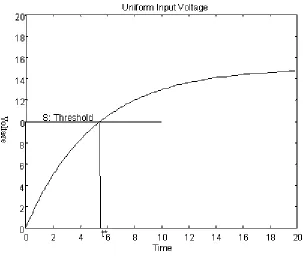
Figure 2.3. The trajectory of the membrane voltage with uniform input current. The rest curve approaches asymptote which is the product of µ and
τ, 15. The straight horizontal line is the threshold, S = 10. As we defined,
t∗ is the time at which mean of membrane voltage passes the threshold.
threshold. So,
t∗ =−τ log(1− S
µτ) (2.12)
Figure 2.3 plotted by Matlab shows that the mean trajectory of voltage, where x0 is 0, µ, uniform input current, is 3 mvolt/msec, τ, membrane constant, is 5 msec, S, threshold, is 10 mvolt. We obtain t∗ is 5.4931 msec. Those values are reasonable parameters for neuron cell, in the spinal cord for example.
Equation 2.10 is easy to interpret. The more abstract OU process can be meaningfully derived. Equation 2.10 can arrive at the stochastic leaky integrator just by adding white noise
dx= (−x
is the moment of the previous firing of an action potential. In the case of suprathreshold stimulation, the model assumes that at each moment of firing, which is mimicked by reaching a firing threshold S, the membrane potential is reset to its initial value, X0 = 0 [43]. Solving the stochastic differential equation, we can obtain
E[x(t)] =µτ(1−e−τt) (2.14)
V ar[x(t)] = σ
2τ
2 (1−e −2t
τ) (2.15)
The OU process has been studied in [2], [31], [32], [33], and [8]. Some sophisticated numerical methods for the first passage time problem have been developed. But, no analytical solution for the OU process is known.
2.3.2
Stein’s model
of the model and its modifications and generalizations have been one of the most common approaches to the theoretical study of neuronal activity, such as in [20], [35], [27], [16], [18], [42], and [46]. The inputs of Stein’s model are divided into excitatory and inhibitory ones and follow Poisson processes. The heuristical stochastic differential equation is
dx dt =−
x τ +aE
dNE
dt −aI dNI
dt , (2.16)
where τ is membrane constant, NE and NI are independent simple
Pois-son processes with mean rates λE and λI. The trajectories of NE and NI
have discontinuities of +1 each time an excitatory or inhibitory input arrives. Hence the derivatives dNE/dtand dNI/dt, which appear in Equation (2.16),
consist of a collection of delta functions concentrated at the random arrival times of the synaptic inputs. When an excitatory input arrives, xwill jump by +aE mvolt, whereas when an inhibitory input arrivesx will jump by−aI
mvolt. The mean and variance of the depolarization in Stein’s model are [43]
E[x(t)] = τ(aEλE −aIλI)(1−e−
t
τ), (2.17)
V ar[x(t)] = 1 2τ(a
2
EλE+a2IλI)(1−e−
2t
τ). (2.18)
2.4
Approximation of the First Passage Time
To study the properties of the models themselves, approximation methods for model are very useful sometimes. Charles E. Smith summarized the approximation methods for the first passage time in [37] and [36]. We are interested in the case with deterministic crossing. The term ”deterministic crossing” will be used when the mean voltage crosses a threshold, S. Our description is a simple generalization of the method for Stein’s model. In this article, we also call it Stein’s method. Letr(t) =S−E[x(t)] be the recovery process following a spike, where S is the threshold. Besides requiring that the mean voltage crosses S, i. e. deterministic crossings, we require that
1. The membrane voltage distribution does not change its shape drasti-cally near t∗.
corre-lation time of x(t) around t∗.
3. r(t) is invertible and sufficiently smooth.
Let h be the inverse function of r(t), that is , h[r(t)] = t. Then, a pdf of first passage time, g(S, t|x0), is approximately f(x)|dh(x)/dx| evaluated at t∗, where f(x) is the marginal distribution of S −x(t∗). This is the usual Jacobian transformation of random variables, i. e., we are treating the mem-brane voltage process like a singular random process. For example, if f(x) is Gaussian or normal and r(t) is a decaying exponential,g(S, t|x0) is approxi-mately lognormal.
In many cases, we may only be interested in the first few moments of the FPT. The function h is now expanded in a Taylor’s series about r(t∗). The approximations for the mean and variance are given next with y=r(t), and µn is the nth central moment of the random variableS−x(t∗) [29]:
E(t)≈t∗+h(y)µ2 2! +h
(y)µ3
3!+,· · · (2.19)
V ar(t)≈(h)2µ2+hhµ3−(hµ2 2! +h
µ3
3!)
where prime denotes differentiation with respect to membrane voltage. The expressions of the first four derivatives of h[r(t)] are in the section 3.2.1 on page 35. Stein’s original approximation method was the first term of Equa-tions (2.19) and (2.20). Then,
E(t) =t∗, (2.21)
and
V ar(t) =
dx dt
2
V ar[x(t)]. (2.22)
been studied in [2], [32], [33], [17], [8], and [22].
Stein’s method is expected to work for the OU process under some condi-tions. For example, we expect it to perform best when the excitatory post– synaptic potential (EPSP) and inhibitory post–synaptic potential (IPSP) amplitudes are small and input frequencies are large. The diffusion approxi-mation therefore has infinitesimal mean
aEλE −aIλI−x≈µ−x, aE, aI >0, (2.23)
and infinitesimal variance
a2EλE +a2IλI ≈σ2. (2.24)
2.5
Distribution Comparison Method
The analysis of neural spike trains has a long history [43]. There are two main approaches for such analysis. The first is to formulate a stochastic model for the neuron’s activity and inputs, derive the distribution of the FPT, and use it to fit the model to data. The stochastic process is often modelled as a random walk such as Stein’s model or an diffusion model such as the OU process. Another important approach in such a study is to fit standard families of densities to the FPT, such as the lognormal or gamma, using maximum likelihood or some ad hoc technique. So, another trial is that we want to compare the approximated FPT distribution derived by us-ing Stein’s method with the lognormal distribution fitted for the simulated FPT of the OU process.
In many cases, there is not enough information to assume that the candi-date families contain the true distribution that is generating the data. This is certainly the case for the problem at hand. So, we leave the true distribu-tion for the FPT histograms unspecified; using the simuladistribu-tion data, we then seek to identify the distribution which is closer to the true and unknown distribution.
[6], Nishii(1988) [28] and White(1982) [45]. We now describe the approach in general , and then specialize it to the case of the lognormal versus the approximated distribution. To assess the closeness of two densities f and p on the real line, we use Kullback–Leibler information criterion (or divergence)
I[p:f] =
∞
0
p(x)log
p(x) f(x)
dx. (2.25)
It is known that I[p : f] ≥ 0, with equality only when p = f [45]. For example, if p(x) = µe−µx and f(x) = λe−λx for x > 0 and zero otherwise, then I[p:f] =λ/µ−1−log(λ/µ), which is 0.09 when the ratio of the means of these exponential densities is λ/µ= 1.5. Next, ifp and f are normal den-sities with means µand ν, respectively, and both variances equal to 1, then I[p:f] = (µ−ν)2/2, which is 0.125 when |µ−ν|= 0.5.
Kullback–Leibler information criterion is not a metric. But, it does have an advantage over metrics for the problem of comparing two approximations f1 and f2 to an unknown densityp. Specifically,
I[p:f1]−I[p:f2] =
∞
0
p(x)log
f2(x) f1(x)
= Ep
logf2(Y) f1(Y)
(2.26)
where Ep refers to expectation with respect to the density p, which
gener-ates the random variable Y. In practice, given independent and identically distributed data (Y1, . . . , Yn) from p, an estimate of Ep is
1 n
n
1
log
f2(Yi)
f1(Yi)
. (2.27)
Chapter 3
Methods
3.1
Simulation
constant threshold S.
3.1.1
Testing for the Independence of Random
Num-bers
In the case of two random variables (X, Y), a random sample of sizenconsists of the n pairs (Xi, Yi), i = 1,2, . . . , n. The sample correlation coefficient is
often defined as
R=
n
i=1(Xi−X¯)(Yi−Y¯)
(ni=1(Xi−X¯)2)(
n
i=1(Yi−Y¯)2)
, (3.1)
where
¯ X = 1
n n i=1 Xi and ¯ Y = 1
n
n
i=1
Yi
are the sample means forXandY [44]. Value of R close to zero indicates that X and Y are uncorrelated, which sometimes implies they are independent, for example, they are from a normal distribution. In the present situation we are concerned with a sequence of random variables X1, X2, . . . , Xn.
can regard the first member of each pair as one variable and the second mem-ber as another variable. The correlation coefficient of the first and second variables is called the serial correlation coefficient at lag 1:
R1 =
n−1
i=1(Xi−X¯∗)(Xi+1−X¯∗∗)
(ni=1−1(Xi−X¯∗)2)(
n−1
i=1(Xi+1−X¯∗∗)2)
(3.2)
where
¯
X∗ = 1 n−1
n−1
i=1
Xi
is the mean of the first n−1 variables and
¯
X∗∗ = 1 n−1
n−1
i=1
Xi+1
is the mean of the last n−1 variables.
It is possible, however, that consecutive variables are independent. But, for example, the pairs (X1, X3),(X2, X4),· · ·,(Xn−2, Xn), are not
indepen-dent. Thus, we also compute a correlation coefficient for Xi and Xi+2. In
Rk =
n−k
i=1(Xi−X¯)(Xi+k−X¯)
n
i=1(Xi−X¯)2
. (3.3)
Furthermore, under the assumption of independence, Rk is, when n is large,
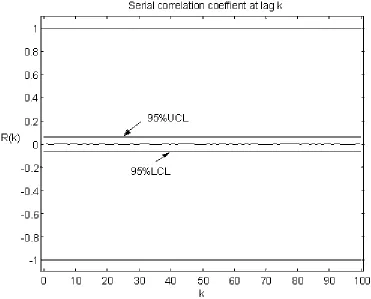
providingk n, approximately normal with mean zero and variance 1/n. It is useful to plot Rk versus k to obtain a serial correlogram. Figure 3.1 shows
that all values of Rk of the random numbers which our program generated
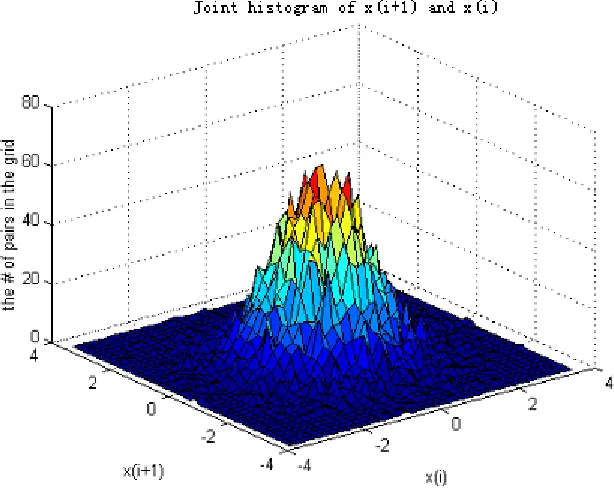
by using Matlab lie in the interval of [−1.96/√n,1.96/√n], where n is 1000 and k is in the interval [1, 100]. Another way is to use the joint histogram. Figure 3.2 is the joint histogram of Xi andXi+1. The joint histogram of two
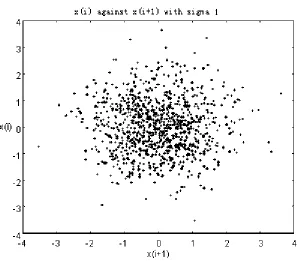
independent normal random variable has a symmetry ”mountain” shape, just as shown in Figure 3.2. Figure 3.3 is the scatter plot of random number Xi
against Xi+1. Those figures give the evidence for that Xi and Xi+1 are
inde-pendent.
3.1.2
Euler Method
be obtained by a mesh of points ti such that t0 < t1 < · · · < tn = T, and
ti+1−ti = ∆t. Equation (1.1) on t0 ≤t ≤ T with the initial value xt0 =x0
can then be rewritten as
x(ti+1) =x(ti) + (−
x(ti)
τ +µ)(ti+1−ti) +σ(x(ti), ti)(W(ti+1)−W(ti)). (3.4)
This is an Euler approximation which is a discrete time stochastic process x(t) satisfying the iterative Equation (3.4). The procedure for solving Equa-tion (1.1) is to compute x(ti+1) from the knowledge of x(ti) realizing that
the increments of the standard Wiener process
∆Wi =Wi+1−Wi (3.5)
appearing in Equation (3.4) are mutually independent, normally distributed r.v.’s with mean zero and variance (ti+1−ti) independent of X(ti) [15]. We
use Matlab to generate random numbers of the increments of the Wiener process with mean µ= 0 and variance σ2 = ∆t.
n, those for which xn is not sufficiently close to x0. The error in the linear
approximation formula
Y(xn+1)≈yn+h·f(xn, yn) = yn+1 (3.6)
is the amount by which the tangent line at (xn, yn) departs from the solution
curve through (xn, yn). This error, introduced at each step in the process,
is called the local error in Euler’s method. Besides local error, yn itself
will introduce roundoff errors 1000 times as often as one withh= 0.1 [5]. In our study, we choose h= 0.1 to do the simulation.
The average time for the sample path ofx(t) to approach to its asymptote is about 20 msec (see Figure 2.3). Because the ∆T we will use is 0.1 msec, to make sure that all the sample path ofx(t) to approach to its asymptote in our program, we let tn be 100 msec which is much greater than the average
time for the sample path of x(t) to approach to its asymptote. So, n in our program is 1000.
3.1.3
Parameter
For any quantitative discussion about the models and their mutual com-parison, at least the approximation about their parameters is necessary. The most appropriate would be to estimate these parameters from the data recorded intracellularly according to the model construction. So, we use rea-sonable parameters of a neuron in the spinal cord for µ, τ and S. For the Wiener process parameter σ2 we can only speculate. From the diffusion
Wiener parameters in the OU process comes immediately from the experi-mental data in [11], where direct estimation from FPT has been performed. In their paper the estimated values of the parameterσ goes up to 15. We also referred to parameter values in [3], [41], [42], and [24] to pick the σ values which are shown in Table 3.1.
Table 3.1. Parameter values used in this study.
Parameter Value Units
τ 5 msec
µ 3 mvolt/msec
σ varies (0.5, 2, 4) mvolt/msec
S varies (6–14) mvolt
3.1.4
Goodness–of–fit–test
tests, which test the null hypothesis that the distribution is in some specified form. We use the D test developed by D’Agostino in 1971. It is one of most powerful tests available for detecting departures from a hypothesized normal or lognormal density function when n is between 50 and 1000. D’Agostino shows that his test compares favorably with other tests in its ability to reject H0, when H0 is actually false.
Suppose we wish to test the null hypothesis that the underlying distribu-tion is normal. Then the D test is conducted as follows:
1. Draw a random samplex1, x2, . . . , xnof sizen ≥50 from the population
of interest. n is 400 in this study.
2. Order the n data from smallest to largest to obtain the sample order statistics x[1] ≤x[2] ≤. . .≤x[n].
3. Compute the statistic
D=
n
i=1[i− 12(n+ 1)]x[i]
n2s , (3.7)
s= 1 n n i=1
(xi−x¯)2
1/2
. (3.8)
4. TransformD to the statistic Y by computing
Y = D−0.28209479
0.02998598/√n (3.9)
Ifnis large and the data are drawn from a normal distribution, then the expected value of Y is zero. For nonnormal distributions Y will tend to be either less than or greater than zero, depending on the particular distribution.
5. Reject at the α significance level the null hypothesis that the n data were drawn from a normal distribution ifY is less than theα/2 quantile or greater than the 1 −α/2 quantile of the distribution of Y. For n = 400, andα= 0.05, the upper and lower limit are 1.633 and -2.270, respectively [7].
3.2
Approximation
First, we go to the details of approximating the first two moments of the FPT (mean and variance).
3.2.1
Approximation of Moments of the FPT
• The First Four Derivatives of h[r(t)]
h[r(t)] = t, i. e., h(x) is the inverse function of r(t). Recall that the first derivative of an inverse function can be expressed as the reciprocal of the derivative of the original function [40]. Then, we take derivative of the first order derivative to get second order derivative, and so on.
h[r(t)] = [r(t)]−1 (3.10)
h[r(t)] = −[r(t)]−3r(t) (3.11) h[r(t)] = 3[r(t)]−5[r(t)]2−r(t)[r(t)]−4 (3.12) h[r(t)] = −15[r(t)]−7[r(t)]3+ 10[r(t)]−6r(t)r(t)
−r(t)[r(t)]−5 (3.13)
The First Four Derivatives ofh[r(t)] evaluated att∗ at which the mean of x(t) passes the threshold S. We can get the following by taking derivatives to r(t) and plugging in t∗ =−τ log(1− µτs ) to r(t).
r(t) =−µe−τt , r(t∗) =−(µ− s
τ) (3.14)
r(t) = µ τe
−t
τ , r(t∗) = 1
τ(µ− s
τ) (3.15)
r(t) = −µ τ2e
−t
τ , r(t∗) =− 1
τ2(µ−
s
τ) (3.16)
r(t) = µ τ3e
−t
τ , r(t∗) = 1
τ3(µ−
s
τ) (3.17)
After substituting to the derivatives of h[r(t)], we can obtain
h(t∗) = −(µ− s τ)
−1 (3.18)
h(t∗) = 1 τ(µ−
s τ)
−2 (3.19)
h(t∗) = − 2 τ2(µ−
s τ)
−3 (3.20)
h(t∗) = 6 τ3(µ−
s τ)
−4 (3.21)
• The nth central moment (µn) of the normal distribution N(µ, σ2)
n is even,n = 2k, the following is the formula for it.
E[(x−µ)2k] = (2k)!σ
2k
k!2k (3.22)
So, µ3 =µ5 = 0 andµ4 = 3σ4,µ6 = 15σ6. • The Taylor’s series of h[r(t)]
E(t) =t∗+hµ2 2! +h
µ3
3! +h µ4
4! +. . .+h
nµn
n! (3.23)
where un is nth central moment of S−x(t∗).
• The Taylor’s series of the variance of h[r(t)]
As we know
V ar(t) = V ar[h(r(t))] =E(h(r(t))2)−[E(h(r(t)))]2. (3.24)
letting g(t) = [h(r(t))]2, we can writeE([h(r(t∗))]2) as
E([h(r(t∗))]2) = g(t∗) +g(t∗)µ2 2! +g
(t∗)µ3
3! +g
(t∗)µ4
4! +. . .+g
n
The first four derivatives of g(t) are
g(t) = 2h(t)h(t) = 2hh (3.26)
g(t) = 2[h(t)]2+ 2h(t)h(t) = 2h2+ 2hh (3.27) g(t) = 6h(t)h(t) + 2h(t)h(t) = 6hh+ 2hh (3.28)
g(t) = 6[h(t)]2+ 8h(t)h(t) + 2h(t)h(t)
= 6h2+ 8hh+ 2hh (3.29)
If we use the original Stein’s method to do the approximation, the mean and variance of FPT are
E(t) =−τ log(1− s
µτ) (3.30)
and
V ar(t) = 1 2
τ S(2µτ −S) (µτ −S)2µ2 σ
2. (3.31)
E(t) =t∗+hµ2
2! =−τ log(1− s µτ) +
1 4
S(2µτ −S) (µτ −S)2µ2σ
2 (3.32)
For the variance of FPT we need to calculate theE[h2(r(t∗))] and [E(h(r(t∗)))]2,
E[h2(r(t∗))] =h2+ (2h2+ 2hh)µ2
2! (3.33)
[E(h(r(t∗)))]2 = (h+hµ2 2!)
2, (3.34)
where h is h[r(t∗)]. So, the variance of FPT is
V ar(t) = E([h(r(t∗))]2)−[E(h(t∗))]2 = h2µ2− h
2µ2 2
4 . (3.35)
Then we plug in h(r(t∗)) and obtain
V ar(t) = τ
2
(µτ −S)2σ 2
x−
τ2
4(µτ −s)4σ 4
where σ2
x isV ar[x(t∗)],
σ2(x) = σ
2s
µ −
σ2s2 2µ2τ =
s(2µτ −s) 2µ2τ σ
2. (3.37)
So, the variance of FPT can be written as
V ar(t) = S(2µτ −S)
2
2µ2(µτ −S)σ
2− S2(2µτ −S)4
4µ4(µτ −S)4σ
4 (3.38)
If we use first four terms to do the approximation, then the mean of FPT is
E(t) = t∗+hµ2 2! +h
µ3
3! +h µ4
4! = −τ log(1− s
µτ) + 1 4
S(2µτ −S) (µτ −S)2µ2σ
2 + 3
16
S2(2µτ −S)2 τ(µτ −S)4µ4σ
4
(3.39)
For the variance of FPT, the calculation steps are as following,
E[h2(r(t∗))] =h2+(2h2+2hh)µ2 2!+(6h
h+2hh)µ3
3!+(6h
2+8hh+2hh)µ4
[E(h(r(t∗)))]2 = (h+hµ2 2! +h
µ3
3! +h µ4
4!)
2 (3.41)
So,
V ar(t) = E([h(r(t∗))]2)−[E(h(t∗))]2
= h2µ2+hhµ3 + (6h2+ 8hh)µ4 24−
h2µ22 22 +
h2µ23 62 +
h2µ24 242
+2hh µ3µ4 6×24 + 2h
hµ2µ3
2×6+ 2h
h µ2µ4
2×24 (3.42)
V ar(t) = τ
2
(µτ −s)2σ 2
x+
5τ2
2(µτ −s)4σ 4
x−
3τ2
4(µτ −s)6σ 6
x−
9τ2
16(µτ −s)8σ 8
x
(3.43)
V ar(t) = s(2µτ −s)τ 2(µτ −s)2µ2σ
2+5s2(2µτ −s)2
8(µτ −s)4µ4 σ
4− 3s3(2µτ −s)3
32(µτ −s)6τ2µ6σ
6− 9s4(2µτ −s)4
256(µτ −s)8τ2µ8σ 8
3.2.2
Confidence Limits for the mean and variance of
Lognormal Distribution
There are several methods for calculating confidence limits. They are given in [7]. We use a simple method to estimate the mean µ and variance σ2 of
the two–parameter lognormal distribution. SupposeX is random variable of lognormal distribution, let Y =log(X), so,
¯ y= 1
n
n
i=1
yi (3.45)
s2y = 1 n−1
n
i=1
(yi−y¯)2. (3.46)
Then, we replace µy and σ2y by ¯y and s2y in the formulas for the true and
unknown µ and σ2. We get
ˆ µ=e
¯
y+s22y
and
ˆ
σ2 = ˆµ2[es2y −1] (3.48)
There are also several methods for calculating confidence limits for mean of lognormal distribution. Land’s method is considered as the best one. Land showed that the upper one-sided 100(1−α)% and the lower one-sided 100α% confidence limits for µare obtained by calculating
U L1−α =e
¯
y+0.5s2y+syH√n1−−1α
(3.49)
and
LLα =e
¯
y+0.5s2y+syHα√n−1
, (3.50)
respectively, where ¯yands2
y are calculated using Equations (3.45) and (3.46),
respectively. The quantities H1−α and Hα are obtained from the tables
pro-vided by Land in [7]. In our study, we use α= 0.05.
in a 100 time loop and get a sample of the variance. Then, we take the 97.5 percentile of the sample data as the upper confidence limit and 2.5 percentile of the sample data as the lower confidence limit. We repeat the procedure 10 times and obtain 10 confidence limits. We take the mean of the 10 percentiles as confidence limits of the variance.
We use the relationship between the approximation values of the mean and variance of FPT and the confidence interval of the simulatied mean and variance to tell if the approximation values are close enough to the simulation results. We conclude the approximation can work for those parameters if the approximation values fall in the confidence interval of the simulation data.
3.2.3
Approximation Error
If all the approximation values fall in the confidence interval no matter how many terms we used to approximate the mean and variance of FPT, we use the error of the approximation to tell which approximation is closer to the simulation data. It is defined as [42]:
E = Approximation−Simulation
=
Approximation
Simulation −1 100%. (3.51)
We use the mean and standard deviation of 100 E values for all the approx-imation value to estimate which approxapprox-imation method is better.
3.2.4
Approximation of Probability Density Function
of the FPT
The marginal distribution of x(t) is normal distribution with mean E(x(t)), which isµτ(1−e−τt), and varianceσ2τ(1−e−2τt)/2. Then, the marginal
dis-tribution forx(t∗) is N(−τ log(1−µτs ), s(2µτ−s)
2µ2τ σ2). Obviously, E(x(t∗)) =S.
So, the marginal distribution for y=S−x(t∗) is N(0,s(22µτµ2−τs)σ2).
fY(y(t∗)) =
1
2πs(2µτ−s) 2µ2τ σ2
e
−s(2µτ(y−)2s)
sµ2τ σ2 (3.52)
The pdf of FPT g(s, t|x0) is
g(s, t|x0) =fYt∗(y)/
dh(y) dy
where
y=r(t) = S−E(x(t)) = µτ(1−e−τt). (3.54)
and h(y) = h(r(t)) = −µe−tτ. So, the pdf of FPT approximated by using
Stein’s method (Jacobian transform) is
g(s, t|x0) = µe −t
τe−
(µτ(1−e−τt)−S)2 σ2τ(1−(1−S
µτ)2)
πσ2τ(1−(1− S µτ)2)
, (3.55)
where t∈(0,∞).
The lognormal pdf estimated from simulation data is
fT(t) =
1 tσlog(t)
√ 2πe
−(log(2t)σ2−µlog(t))2
log(t) (3.56)
where t ∈ (0,∞), µlog(t) is the mean of log(t) and σ2log(t) is the variance of
3.3
Comparison of Two Probability Density
Functions
We use Stein’s method to approximate the probability density function of the FPT. We estimate the lognormal density function by using the maxi-mum likelihood estimator [4]. Then, we can see which one is better for the simulation data by Kullback–Leibler information criteria.
First, we describe the general comparison of two probability density func-tions. We define
F ={f(y|α) :α∈A} (3.57)
and
G={f(y|β) :β ∈B} (3.58)
the member of F that minimizesI[p:f(·|α)], over α∈A, and defineβ∗ ∈ B
similarly. Thus,
IF =IF[p:a∗]=
∞
0
p(y)log
p(y) f(y|a∗)
dy (3.59)
characterizes the proximity ofF top, andIG=IG[p:β∗] (defined similarly) characterized the proximity of G to p. Thus, the difference
IG−IF =
∞
0
p(y)log
f(y|α∗) g(y|β∗)
dy (3.60)
allows for a comparison of F and G, using estimates ofα∗ and β∗, which we describe next.
Given a random sample Y = (y1, . . . , yn) generated from p(y), let the
quasi–log–likelihood function of α under F be
Ln(α|Y) = n
i=1
log[f(yi|α)] (3.61)
and a quasi–maximum likelihood estimator (QMLE) ˆαn be a value which
A natural estimate ofIG−IF is
Tn =
1 n n i=1 log
f(yi|αˆn)
g(yi|βˆn)
, (3.62)
which is asymptotically normal:
√
n[Tn−(IG−IF)]→N(0, σ2), (3.63)
where the variance σ2 =E
p[log[f(Y|α∗)/g(Y|β∗)]]2 is estimated by
ˆ σ2 = 1
n
n
i=1
logf(yi|αˆn) g(yi|βˆn)
2
. (3.64)
The regularity conditions that guarantee the existence of the quasi–true pa-rameters α∗ and β∗, the consistency of ˆσ2
n are described in the papers by [6],
[45], and [28]. These conditions are satisfied for the comparison below. We omit the details of that verification.
H1 : IG = IF. We then compute the statistic
√
nTn and its estimated
standard deviation ˆσn. Given a confidence coefficient α, we construct the
approximate confidence interval for (IG−IF),
In,α =
Tn+cα
ˆ σn
√
n, Tn−cα ˆ σn √ n (3.65)
wherecα is the upper 100(1−α/2) percent point of the standard normal
dis-tribution (if α= 0.05, cα = 1.96). If 0 ∈In,α, then we cannot reject the null
hypothesis that the two distributions are equally close to the true distribu-tion; otherwise we reject the null hypothesis. Furthermore, if In,α ⊆(0,∞),
we conclude that F is closer to the true model; if In,α ⊆ (0,−∞), we
con-clude that G is closer to the true distribution. We now turn to the specifics for lognormal distribution. The QMLEs ˆαn = ( ˆα1n,αˆ2n) for lognormal are
obtained from Equations (3.66) and (3.67).
ˆ α1n =
1 n
n
1
log(yi) (3.66)
ˆ α2n=
1 n
n
1
Figure 3.1. Serial correlation coefficient at lag k with n is 1000. k is be-tween [1,100]. The central irregular line is Rk. The two straight lines are
upper confidence limit and lower confidence limit, respectively, as labelled.
The random numbers are generated from a standard normal distribution with
Figure 3.2. The joint histogram of random numbers Xi and Xi+1, where
Figure 3.3. Scatter plot of the random numbers: Xi+1 against Xi with n
Chapter 4
Results
4.1
Simulation
1. The correlation time of the OU process .
process (at least 5 msec) is greater than the standard deviations of the corresponding FPT. The largest standard deviation of the FPT is 2.5 mesc, when the threshold is 14 mvolt. Most are less than 1 msec. This could also be obtained from the Stein’s approximation method, in section 2.4 on page 18. Thus, the OU process has a long correlation time compared to the resultant standard deviation of FPT.
From the sample paths in Figures 4.5, 4.6, and 4.7, we can see the sample paths are always on one side of the expected mean membrane voltage for a while before they cross their expected mean. The corre-lation of the membrane voltage is apparent over short time ranges.
2. The marginal distribution of membrane voltage is the normal distributed.
D’Agostino’s test results for the marginal distribution of x(t).
time 5 10 15 20 25 30 35
Y 0.5172 0.3746 0.8196 0.6536 1.5296 1.8049 0.9387
The sample size of the x(t) is 400. All the Y values are in the interval (-2.270,1.633). So, we do not reject the null hypothesis and conclude
that all the variables x(t) follow normal distribution.
3. The lognormal distribution is very close to the distribution of FPT.
Table 4.2. D’Agostino’s test results for distribution of the FPT.
Threshold, S σ
mvolt 0.5 2 4
7 -1.6975 -0.2848 0.8183 10 -1.4606 0.0411 1.5692 13 -1.0100 0.3651 0.8468
The sample size of the FPT is 400. All the Y values are in the interval
(-2.270, 1.633). So, we do not reject the null hypothesis and conclude
Figure 4.5. A sample path of the membrane voltage with the Wiener pro-cess parameter 0.25 (the irregular curve). The central smooth curve is the expected mean of membrane voltage and the two smooth curves beside it are
the upper and lower 95% confidence limit, respectively. The horizontal line
Figure 4.6. A Sample path of the membrane voltage with the Wiener process parameter 4 (the irregular curve). The central smooth curve is the expected mean of membrane voltage and the two smooth curves beside it are the upper
and lower 95% confidence limit, respectively. The horizontal line represents
Figure 4.7. A Sample path of the membrane voltage with the Wiener pro-cess parameter 16 (the irregular curve). The central smooth curve is the expected mean of membrane voltage and the two smooth curves beside it are
the upper and the lower 95% confidence limit, respectively. The horizontal
Figure 4.8. The histogram and pdfs of membrane voltage of the OU pro-cess at 5 mesc. The total area of histogram bars is 1. The blue curve is pdf of the simulated membrane voltage, and the green curve is the pdf of
ex-pected membrane voltage at 5 mesc. The sample size of the random variable
Figure 4.9. The histogram and pdfs of membrane voltage of the OU pro-cess at 15 mesc. The total area of histogram bars is 1. The blue curve is pdf of the simulated membrane voltage, and the green curve is the pdf of expected
membrane voltage at 5 mesc. The sample size of the membrane voltage is
Figure 4.10. The histogram and pdfs of the membrane voltage of the OU process at 25 mesc. The total area of histogram bars is 1. The blue curve is pdf of the simulated membrane voltage, and the green curve is the pdf of
ex-pected membrane voltage at 5 mesc. The sample size of the random variable
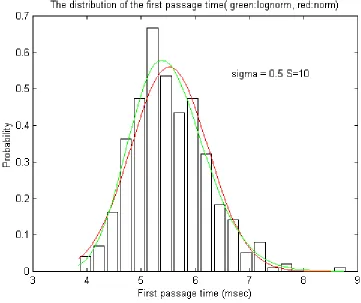
Figure 4.11. The histogram and the pdfs of FPT of the OU process with the Wiener process parameter 0.25 and the threshold 10 mvolt. The green curve is fitted by lognormal density function and the red curve is fitted by
Figure 4.12. The histogram and the pdfs of FPT of the OU process with the Wiener process parameter 4 and the threshold 10 mvolt. The green curve is fitted by lognormal density function and the red curve is fitted by
Figure 4.13: The histogram and the pdfs of FPT of the OU process with the Wiener process parameter 16 and the threshold 10 mvolt. The green curve is fitted by lognormal density function and the red curve is fitted by
4.2
Approximation
1. For the small Wiener process parameter, Stein’s approxima-tion values of the mean and variance of FPT are close to the simulated results.
When σ is 0.5, Figures 4.14 and 4.15 show that the mean and variance approximated using the Stein’s method are very close to the simulated results. This is true except when the threshold is 14 mvolt. This tells us the approximation using Stein’s method works well for a small Wiener parameter. Forσ = 2, Figures 4.15 and 4.16 show that the ap-proximated results deviate from the simulated results a lot, when the thresholds are greater than 9mvolt. Whenσis 4, Figures 4.18 and 4.19 show that the approximation results deviate from the simulated results very much, even if the threshold is very small. All the approximation results are out of the confidence interval (CI) of the simulated results. This result suggests that the Stein’s method should not be used near the large Wiener parameter range in OU process.
results are like Stein’s method for the small Wiener parame-ter. But, this does not work well for a large Wiener process parameter.
When σ is 0.5, after adding the second term of the Taylor’s series to Stein’s method, approximation results are all very close to the simula-tion results. Figures 4.20 and 4.21 show this, except when threshold is greater than 12 mvolt.
When σ is 2, Figures 4.22 and 4.23 show that the approximation re-sults still deviate from the simulation rere-sults a lot, for large thresholds. They also show that by using more terms, the deviations even occur for the small thresholds. Figures 4.24 and 4.25 tell us that for a large Wiener process parameter, σ is 2 or 4, the approximation does not work. All approximation results deviate from the simulation results a lot, particularly for large thresholds, such as 14 mvolt.
3. The approximation errors of two terms of the Taylor’s series are less than those of one term, when σ is 0.5.
Figure 4.14. Stein’s approximation for the mean of FPT by using the first term of the Taylor’s series , where the Wiener process parameter is 0.25.
The central curve is the mean of membrane voltage from simulation and the
other two curves beside it are the upper and lower 95% confidence limit for
the mean FPT, respectively. ”*” represents the approximation values by the
Figure 4.15. Stein’s Approximation for the standard deviation of FPT by using the first term of the Taylor’s series, where The Wiener process pa-rameter is 0.25. The central curve is the mean of membrane voltage from simulation and the other two curves beside it are the upper and lower 95%
confidence limit respectively. ”*” represents the approximated values by the
Figure 4.16. Stein’s approximation for the mean of FPT by using the first term of the Taylor’s series, where the Wiener process parameter is 4. The central curve is the mean of membrane voltage from simulation and the other
two curves beside it are the upper and lower 95% confidence limit for the
mean FPT, respectively. ”*” represents the approximated values by the first
Figure 4.17. Stein’s Approximation for the standard deviation of FPT by using the first term of the Taylor’s series, where the Wiener process parame-ter is 4. The central curve is the mean of membrane voltage from simulation and the other two curves beside it are the upper and lower 95% confidence
limit respectively. ”*” represents the approximated values by the first term of
Figure 4.18. Stein’s approximation for the mean of FPT by using first term of the Taylor’s series, where the Wiener process parameter is 16. The central curve is the mean of membrane voltage from simulation and the other two
curves beside it are the upper and lower 95% confidence limit for the mean
FPT, respectively. ”*” represents the approximated values by the first term
Figure 4.19. Stein’s Approximation for the standard deviation of FPT by using the first term of the Taylor’s series, where the Wiener process parame-ter is 16. The central curve is the mean of membrane voltage from simulation and the other two curves beside it are the upper and lower 95% confidence
limit respectively. ”*” represents the approximated value by the first term of
Figure 4.20. The Approximation for the mean of FPT by using two terms of the Taylor’s series and four terms, where the Wiener process parameter is 0.25. The central curve is the mean of membrane voltage from simulation and the other two curves beside it are the upper and lower 95% confidence
limit, respectively. ”*” represents the approximated values by the first term
of the Taylor’s series; ”+” represents the approximated values by two terms;
Figure 4.21. The Approximation for the standard deviation of FPT by using two terms of the Taylor’s series and four terms, where the Wiener process parameter is 0.25. The central curve is the standard deviation of membrane voltage from simulation and the other two curves beside it are the upper and
lower 95% confidence limit, respectively. ”*” represents the approximated
values by the first term of the Taylor’s series; ”+” represents the
approxi-mated values by two terms; ”◦” represents the approximated values by four
Figure 4.22. The Approximation for the mean of FPT by using two terms of the Taylor’s series and four terms, where the Wiener process parameter is 4. The central curve is the mean of membrane voltage from simulation and the other two curves beside it are the upper and lower 95% confidence limit,
respectively. ”*” represents the approximated values by the first term of the
Taylor’s series; ”+” represents the approximated values by two terms; ”◦”
Figure 4.23. The Approximation for the standard deviation of FPT by using two terms of the Taylor’s series and four terms, where the Wiener process pa-rameter is 4. The central curve is the standard deviation of membrane voltage from simulation and the other two curves beside it are the upper and lower
95% confidence limit, respectively. ”*” represents the approximated values by
the first term of the Taylor’s series; ”+” represents the approximated values
Figure 4.24. The Approximation for the mean of FPT by using two terms of the Taylor’s series and four terms, where the Wiener process parameter is 16. The central curve is the mean of membrane voltage from simulation and the other two curves beside it are the upper and lower 95% confidence limit,
respectively. ”*” represents the approximated values by the first term of the
Taylor’s series; ”+” represents the approximated values by two terms; ”◦”
Figure 4.25. The Approximation for the standard deviation of FPT by using two terms of the Taylor’s series and four terms, where the Wiener process parameter is 16. The central curve is the standard deviation of membrane voltage from simulation and the other two curves beside it are the upper and
lower 95% confidence limit, respectively. * represents the approximation value
by first term of the Taylor’s series; + represents the approximation value by
Table 4.3. The approximation errors of the mean of FPT by the different terms of the Taylor’s series.
S(threshold) one term two terms four terms
mvolt errormean stderror errormean stderror errormean stderror
6 -0.0528 0.0063 -0.0482 0.0063 -0.0482 0.0063 7 -0.0418 0.0063 -0.0364 0.0063 -0.0364 0.0063 8 -0.0335 0.0054 -0.0271 0.0055 -0.0270 0.0055 9 -0.0265 0.0055 -0.0187 0.0055 -0.0185 0.0055 10 -0.0202 0.0063 -0.0103 0.0063 -0.0100 0.0063 11 -0.0129 0.0080 0.0006 0.0081 -0.0014 0.0081 12 -0.0048 0.0074 0.0158 0.0076 0.0179 0.0076
errormean represents the approximation errors of the mean of FPT. stderror
represents the standard deviation of the approximation errors. The sample
Table 4.4. The approximation errors of the standard deviation of FPT by the different terms of the Taylor’s series.
S(threshold) one term two terms four terms
mvolt errorstd stderror errorstd stderror errorstd stderror
6 -0.0003 0.0338 -0.0010 0.0338 0.0058 0.0340 7 0.0057 0.0370 0.0048 0.0370 0.0144 0.0373 8 0.0009 0.0386 -0.0003 0.0386 0.0133 0.0391 9 0.0137 0.0338 0.0118 0.0388 0.0319 0.0395 10 0.0129 0.0390 0.0101 0.0389 0.0405 0.0401 11 0.0287 0.0403 0.0240 0.0401 0.0738 0.0420 12 0.0582 0.0457 0.0493 0.0453 0.1412 0.0493
errorstd represents the approximation errors of the standard deviation of
FPT. stderror represents the standard deviation of the approximation errors.
4.3
Comparison of Two Probability Density
Functions
Figure 4.29. 95% confidence interval of the difference of Kullback–Leibler information criteria. The two irregular curves are the 95% upper and lower limit for the difference of Kullback–Leibler information criteria of the